Article
1
Biological activity and nanostructuration of Fe
3O
4-Ag
2
/polypropylene nanocomposites
3
Phuong Nguyen-Tri
4
1 Department of Chemistry, University of Montréal, Quebec, Canada;
5
Email: [email protected] (P. Nguyen-Tri); Tel. + 514-340 5121 (7326):
6
7
Abstract: We report here the synthesis of uniform nanospheres-like silver nanoparticles (AgNPs,
8
5-10 nm) and the dumbbell-like Fe3O4-Ag hybrid nanoparticles (FeAgNPs, 8-16 nm) by the use of
9
seeding growth method in the presence of oleic acid (OA)/ oleylamine (OLA) as surfactants. The
10
antibacterial activity of pure nanoparticles and nanocomposites by monitoring the bacterial lag–log
11
growth has been investigated. The electron transfer from AgNPs to Fe3O4NPs which enhances the
12
biological of silver nanoparticles has been proven by nanoscale Raman spectroscopy. The lamellae
13
structure in the spherulite of FeAgNPs/PE nanocomposites seems play the key role to the
14
antibacterial activity of nanocomposites, which has been proven by nanoscale AFM-IR. An atomic
15
force microscopy coupled with nanoscale infrared microscopy (AFM-IR) is use to highlight the
16
distribution of nanoparticles on the surface of nanocomposite at the nanoscale. The presence of
17
FeAgNPs in PE nanocomposites has a better antibacterial activity than that reinforced by AgNPs
18
due to the faster Ag+ release rate from the Fe3O4-Ag hybrid nanoparticles and the ionization of
19
AgNPs in hybrid nanostructure.
20
Keywords: Polyethylene, nanocomposites, silver nanoparticles, Fe3O4-Ag hybrid nanoparticles,
21
antibacterial activity
22
23
1. Introduction
24
The transmission of infectious diseases by bacteria in in airports, hospitals and other public
25
places is increasing in the last few decades1. The development of self-sterilizing polymers2-3 able to
26
inactivate bacteria loaded with antibacterial agents is a way to increase the bactericide performance
27
of surfaces designed to disinfect spaces spreading the infections due to toxic biofilms. E. coli has been
28
reported to lead food poisoning4-5. Silver nanoparticles are reported to be effective biocidal agents
29
against various bacteria6-9. The recent report approved that the antibacterial activity comes from
30
silver ions (Ag+), not from Ag metallic6. Different components are combined with silver to yield a
31
nanoentity with desired properties not afforded by their counterparts. For example, combination of
32
Ferrite and silver is expected to enhance the antibacterial activity due to the electron transfer
33
between two these metals and thus enhances the release of silver ions, the main against for the
34
inactivation of bacteria and virus. The magnetic properties of ferrite leads to the formation of
35
superparamagnetic composites which are useful in carcinoembryonic antigen in clinical
36
immunoassay10 and water treatment due to its enable easy separation from solution11.
37
The biological activity of silver can be enhanced in combination with other transition metals
38
such as nano-silver-ferrite composite12 The highest antibacterial effect of 99.4% was achieved at 5.4
39
wt % of NPs and the driving frequency of 100 rpm. A time-dependent antibacterial effect in 0.1 wt %
40
of Ag/Fe3O4 was also observed which indicated that the use of specific rotating magnetic fields to
41
manipulate Ag/Fe3O4 magnetic NPs can significantly improve the antibacterial efficacy to E Coli and
42
the highest antibacterial effect can be achived to 99.4%. The antibacterial silk from Fe3O4-Ag have
43
with have high antibacterial activities against both Escherichia coli and Staphylococcus aureus been
44
also synthesized13. The author confirmed that the as prepared antibacterial silks be easily recycled
45
without a decrease in their antibacterial activities due to the synergistic effects between the Ag NPs
46
and Fe3O4 NPs with large amounts of active sites13. Depending on synthesis conditions, various
47
morphologies of hybrid nanoparticles can be achieved14-16.
48
Polypropylene is one of the most common polyolefin and remains the most consumed polymer
49
in the world due to its interesting good mechanical properties, its stability and its low cost14, 17-22. The
50
addition of additive brings this polymer various new properties depending on end-end
51
applications23-25. Here, the main goal of this word is to prepare of the hybrid silver nanoparticles with
52
high antibacterial activity and then incorporated in the polyethylene matrix and investigate its
53
antibacterial activity. Some recent pointed techniques such as atomic force microscopy coupled with
54
nanoscale infrared (AFM-IR) and nanoscale Raman (AFM-Raman) will be used for better
55
understanding the release behavior on the composite surfaces and propose the possible mechanism
56
for the enhancement of the antibacterial activity.
57
The atomic force microscope (AFM) has been widely used for the study of nanocomposites and
58
polymeric materials with nanoscale spatial resolution26-33. AFM-IR allows surface mapping with a
59
resolution of several tens of nanometers. The main limitation of AFM-IR concerns the laser source
60
near infrared (900-4000 cm-1) region. Detection of the bonding signals between polymer and metals
61
appearing below 900 cm-1 cannot be detected. The nano-Raman can overcome these drawbacks.
62
AFM-Raman combines confocal Raman spectroscopy and imaging providing specific chemical
63
information on the nano-materials with a sub-micron spatial resolution34-37.
64
We show in this study that AFM-IR and AFM-Raman can be used to investigate the nanoscale
65
structure and the electron transfer in hybrid nanoparticles. The detailed microstructure of FeAgNP
66
and PE nanocomposites containing Fe3O4-Ag hybrid nanoparticles is addressed in this study. The
67
release mechanism was investigated when these nanoparticles were incorporated in PE. The effect of
68
these nanoparticles on the lamellae structure of PE was also worked out in the course of this study.
69
2. Materials and Methods
70
2.1. Chemicals
71
Iron(III) acetylacetonate (Fe(acac)3) 99.99 %; silver nitrate (AgNO3) 99 %; sodium borohydride
72
(NaBH4) 99 % and sodium stearate 99 %; solvents: 1-octadecene, di-chlorobenezene (DCB, 99 %),
73
absolute ethanol and hexane; surfactants and reductant: oleic acid (OA) 99 %, oleylamine (OLA) 70
74
%, 1,2 n-hexadecanediol (HDD) 90 %, polyvinylpyrrolidone (PVP) were purchased from
75
Sigma-Aldrich. HDPE granules were purchased from IRPC Public Company (grade G2855 –
76
Polimaxx Polene, Thailand).
77
2.2. Synthesis of nanoparticles
78
AgNPs were prepared by the reduction of silver nitrate using sodium borohydride in the
79
presence of PVP in distilled water. A 20 mL volume of 5 mM silver nitrate was added dropwise to
80
200 mM of PVP (at 0.1 wt.%), then 50 mL of 10 mM chilled sodium borohydride solution was added
81
drop-wise into the above mixture. The reaction mixture was stirred vigorously during 30 min by
82
using a magnetic stirring plate and sonicated for another 30 min. Afterwards, the AgNPs was
83
extracted with 100 mL xylene at 50 °C.
84
Synthesis of Fe3O4 nanoparticles: the Fe3O4 nanoparticles (Fe3O4 NPs) were prepared by
85
pouring cetylacetonate (0.162 g, 0.63 mM), Fe (III) acetylacetonate (0.6 g, 1.9 mM) and
86
hexadecanediol (0.58 g, 1.5 mM) into a 100 mL three-neck flask. At the same time, 3.6 mL OA, 3.6 mL
87
OLA and 30 mL 1-octadecene were added into the above mixture. The concentrations of Fe(acac)3,
88
OA, OLA, and HDD in the solution were equal to 63, 372, 372 and 75 mM, respectively. The reaction
89
mixture was stirred and degassed at room temperature for 30 min before heating to 100 C, and kept
90
at this temperature for 30 min to remove water. The temperature was increased to 200 C, and kept
91
for 30 min. Then, the reaction solution was heated further to 295 C at a heating rate of 5-7 C/min
92
and maintained for 30 min before cooling to room temperature. The Fe3O4 NPs were then purified
93
from the excess ligands before the synthesis of Fe3O4-Ag as follows: 20 mL of the Fe3O4 NPs
solution was mixed with 20 mL of ethanol. The Fe3O4 NPs were then collected using a magnetic bar
95
and the supernatant was discarded. The Fe3O4 NPs were thereafter dispersed in 5 mL hexane and
96
precipitated by adding 5 mL of ethanol. The precipitation/re-dispersion procedure was repeated two
97
more times and the Fe3O4 NPs were finally dispersed in DCB.
98
Synthesis of Fe3O4-Ag hybrid nanoparticles: The seeding growth method was used to prepare
99
Fe3O4-Ag NPs. About 5 mL of DCB solution containing 500 mg AgNO3 and 3 mL OLA was added
100
drop-wise into 20 mL DCB containing 100 mg purified Fe3O4 NPs (at 170 °C). The mixture was
101
maintained at this temperature for 60 min before cooling to room temperature.
102
2.3. Preparation of nanocomposites
103
The master batch of PE nanocomposites containing a high concentration of nanoparticles (2 wt.
104
%) was prepared by the mixing method. PE granules were dissolved in toluene (5 wt. %, stirring at
105
85 °C). The nanoparticles were then added to this solution following a sonication during 1h. Toluene
106
was then removed at (110 ˚C) under vacuum. To fabricate the final PE nanocomposite sheets, the
107
above as-prepared master batch was mixed with PE granules, and then blended in an internal
108
HAAKE mixer at 50 rpm and 170 °C for 8 min to extrude the final PE nanocomposites containing 0.1
109
wt. % of AgNPs.
110
To characterize the polymer nanostructure, a solution of 20 mg/ml was added in 1,2
111
dichlorobenzene and stirring during 24h, then heated up to 90 °C in the dark before casting it over
112
Si-wafer or gold substrates. Polymer films were dried under vacuum at 60 °C for 2 h to ensure
113
complete removal of residual solvent. The polymer film was then melted at 180 °C during 3 min to
114
ensure transformation to crystalline crystals and subsequently quenched to the selected
115
crystallization temperature at a cooling rate of 100 °C/min.
116
2.4. AFM-IR
117
The AFM-IR measurements were carried on a Nano-IR2 system (Anasys Instruments, CA,
118
USA). The AFM images were recorded in contact mode at a rate line 0.1-1 Hz using a gold-plated
119
silicon nitride probe (Anasys Instruments, CA, USA) with an elastic constant of about 0.5 N.m-1 and
120
nominal radius of 10 nm. The nanoscale IR spectra were collected directly on the single fiber surface,
121
deposited on double-side adhesive tape within the 900-3600 cm-1 range at a spectral resolution of 4
122
cm-1, 256 co-averages. The single IR radiation image is recorded with a scan rate of 0.1 Hz,
123
resolution 1024 x 1024 pixels and 16 co-averages, at a power limit within 0.5-4 % at a frequency of
124
196 Hz. All measurements were carried out at room temperature in a room provided with humidity
125
controller (about 20 % RH). This precludes the effect of water absorption on the sample surface
126
during the analyzing. The nano-IR devices were located in an anti-vibration system.
127
2.5. AFM-Raman
128
The Raman spectra and AFM images were recorded on a Witec Alpha300 RSA unit equipped
129
with an AFM & SNOM Confocal Raman Microscope. The AFM images were recorded in contact
130
mode with a rate of 0.3 Hz using an AFM tip TESPA (Brucker, CA, USA). For nano-Raman spectra
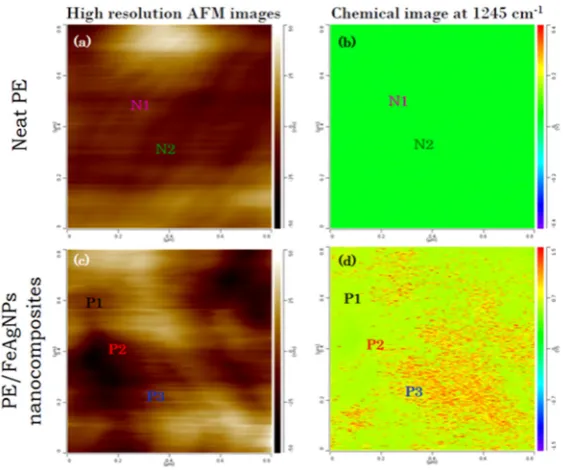
131
measurements, the integration time was about 1s with 10 scans at a spectral resolution of 1 cm-1 and
132
laser wavelength of 532 nm. The laser power was set at 15 mW to avoid sample burning.
133
2.6. UV-Vis analysis
134
An UV–Vis spectrophotometer, model CINTRA 4040 (GBC, USA) with 2 nm slit width was
135
used to monitor the absorbance of the chromophores and the electron transfer in the
136
nanocomposites.
137
2.7. Antibacterial growth test
138
E. coli DH5α bacteria were purchased from Invitrogen (USA). Luria- Broth medium was
139
provided by Merck (Germany). To evaluate the cell density, a Beckman Coulter DU-730 (USA) was
used. In this test, the optical density OD600 measures the light absorbance of the E. coli sample.
141
Different cell strains may have different cell numbers at a given OD600 value, but OD600 = 1 usually
142
means that there are about 1x10⁹ cells per ml culture. Bacterial pre-cultures were prepared to
143
generate subcultures of bacterial in the lag phase so that the number of bacterial cells was constant
144
before the log phase or exponential growth phase. In this way, the growth rate of the bacteria on the
145
nanocomposites was evaluated. The OD600 values in the range 0.1–2.0 for cell densities of E. coli
146
culture indicated the bacterial growth rates.
147
A volume of 100 µL of stock culture of E. coli in glycerol was pipetted into 3 mL of medium in a
148
15 mL test tube and shaken overnight at 200 rpm and 37 °C. Afterward, a 500 µL aliquot of
149
pre-culture was inoculated into 100 mL of medium in a 500 mL Erlenmeyer flask and shaken at 200
150
rpm and 37 °C until the OD600 absorbance value reached 0.3. These pre-cultures were used to
151
account for the bacterial growth rate.
152
The as-prepared nanocomposites were cut into 10×10 mm square samples and then washed
153
with acetone to remove all impurities on the sample surface and autoclaved at 130 ˚C for 20 min
154
before every test.
155
The monitoring test for the evaluation of the bacterial growth was adapted from procedures
156
described in the ASTM E 2149-10 standard. Ten square samples of autoclaved nanocomposites were
157
placed into each 100 mL bacterial pre-culture in a 500 mL Erlenmeyer flask (as described previously)
158
in which the OD600 had reached 0.3 and shaking was continued at 200 rpm at 37 °C. Then, the
159
OD600 values of the bacterial cultures were monitored every 30 min until OD reached 2.0. The
160
reported data was the average of three cultures. The relative OD600 values were then standardized
161
to evaluate the effect of the nanocomposites on the growth rate of the bacteria. The pure bacterial
162
cultures were used as controls.
163
3. Results and discussion
164
3.1. Characterization of nanoparticles
165
Figure 1 shows the TEM images of Fe3O4NPs (Fig. 1a), FeAgNPs (Fig. 1b and 1c) dispersed in an
166
organic solvent (DCB). Figure 1a shows the uniform particle distribution with a diameter of 6-8 nm.
167
Figure 1c shows that hybrid FeAgNPs with a uniform dumbbell-like structure: the bigger
168
nanoparticles are AgNPs and the smaller ones are Fe3O4NPs. It has to be noted that, the synthesis
169
process of hybrid nanoparticles was optimized to attain the reported sizes of the hybrid
170
nanoparticles.
171
The Fe3O4NPs were synthesized and used as the seeding components before hybridization with
172
AgNPs; the average size of Fe3O4NPs (about 6-8 nm) was not affected during the hybridization
173
process with AgNPs. Bigger sizes of AgNPs with an average about 15-16 nm were expected. During
174
the breeding processes both the temperature (170 ˚C) and an Ag-salt concentration 10 times higher
175
than the volume of Fe3O4 nanoparticles. The synthesis of dumbell Ag- Fe3O4 hybrid systems with an
176
AgNPs size of about of 15-16 nm may be used as template to fabricate Au (hollow)-Fe3O4 in which a
177
plasmon-resonance peak in the near infrared region could be of interest for novel optical imaging
178
applications.
180
Figure 1.TEM images of OL/OLA coated Fe3O4NPs (a) and FeAgNPs (b, c) dispersed in DBC.
181
UV-Vis spectra of OL/OLA coated Fe3O4 NPs, AgNPs and FeAgNPs were carried out and the
182
results are shown in Figure 2. A broad absorption band in the region of 300–600 nm for Fe3O4NPs
183
was observed,38 the shoulder at ~360.8 nm was due to nanosized Fe3O4NPs.39 The band around 400
184
nm is characteristic for the surface Plasmon resonance (SPR) peak of AgNPs40.
185
The hybridization of AgNPs and Fe3O4NPs leads to a red shift in the SPR spectra and a
186
significant broadening of the SPR peak. AgNPs, SPR peak is located at 398.5 nm, and at 415.5 nm for
187
the Fe3O4-Ag hybrids. This red shift is assigned to the electron transfer between both samples
188
leading to a depletion of the free electron density in the surface layer due to the increase of π back
189
bonding with the ligand.41-42 In contrast, the presence of electron donors induces a blue-shift of
190
SPR.43-44The contribution of Fe3O4NPs nanoparticles gives raise to a band at ~360 nm. The peak at
191
617.8 nm could be assigned to the hybridization of AgNPs and Fe3O4 NPs.
192
Figure 2.UV-visible absorption spectra of the OL/OLA coated Fe3O4 NPs, PVP coated AgNPs and
194
OL/OLA coated FeAgNPs hybrid nanoparticles dispersed in hexane.
195
3.2. Antibacterial behavior of HDPE nanocomposites
196
Figure 3 shows the effect of the PE/AgNPs and PE/FAgNPs nanocomposites on the growth rate
197
of E. coli liquid cultures. It shows that the growth rates of the pure cultures and mixed cultures with
198
PE slow down after 4h of cultivation. The log phases of the pure cultures and mixed cultures with
199
neat PE are about 93% after 1h cultivation, whereas they are 85 % in the case of mixed cultures with
200
PE/AgNPs. Thus, the E. coli bacterial growth is inhibited by the presence of PE/AgNPs
201
nanocomposites. PE/FeAgNP growth rates of the culture were 81 % after 4h. The presence of
202
FeAgNPs in the PE matrix exhibits a higher antibacterial activity, as compared to the AgNPs. The
203
FeAgNPs had showed a higher bactericidal activity against staphylococcus aureus bacteria
204
compared to AgNPs 28 due to: i) a high catalytic activity of AgNPs dispersion and stability due to
205
the Fe3O4 carrier, and ii) a large surface contact area between the bacterial cell membrane and the
206
hybrid nanoparticles.
207
208
Figure 3.Growth rate of E. coli liquid cultures of neat PE and nanocomposites with AgNPs and
209
hybrid FeAgNPs. The data shown represent the average of three cultures (standard deviation < 2 %).
210
Since the average size of AgNPs in FeAgNPs was bigger than that of AgNPs, the above findings
211
may be due to the faster Ag+ release rate from the Fe3O4-Ag hybrid nanoparticles. It was suggested
212
that the ionization of AgNPs in hybrid nanostructure was be accelerated by Fe3+ ions. It has reported
213
that addition of Ag and Fe3+ enhances the bio-leaching efficiency of the As-bearing gold ore and the
214
electron transfer from Ag-core to the FeCo shell in 15 nm hybrid nanoparticles which are proven by
215
217
Figure 4.Mechanism of inactivation of E. coli by FeAgNPs in which the electron exchange between
218
AgNPs and FeNPs promotes the formation of the Ag+-ion leading to inactivation of E. coli.
219
It is widely accepted that nano-silver interacts with bacterial membranes and causes cell wall
220
disruption.46-47 The AgNPs absorbed on the outer bacteria membrane surface penetrates into the
221
cytoplasm and inhibits cell replication48.The AgNPs simultaneously induce apoptosis and inhibit
222
DNA synthesis due to the silver ions (Ag+)49. Oxidation/reduction of silver ions and Fe+ promoting
223
the release of silver ions to kill bacteria would proceed. In a reversible process, the concentration of
224
silver ions remained stable in hybrid nanoparticles showing a higher antibacterial activity compared
225
to AgNPs. Based on the results mentioned above, we suggest a novel mechanism of the inactivation
226
of bacteria by FeAgNPs hybrids. The Ag+ would intervene in a reversible electron transfer to Fe3+
227
(Fig. 4).
228
3.3. Nanoscale architecture of PE /FeAgNPs nanocomposites
229
Figure 5 shows the morphology of the PE/FeAgNPs of neat PE and PE/FeAgNPs
230
nanocomposites. The nanocomposites present a very different structure compared to that of neat PE
231
in which the PE exhibits banded spherulites with sizes from 10-20 µm. The formation of ring-banded
232
spherulites of semi-crystalline polymers is well known. The concerted twisting of the
233
crystallographic orientation takes place during lamella growth under effect of surface stress but the
234
arrangement of lamella in the banded spherulites is still an open question. It has been suggested that
235
lamella stacks were continuously twisted up and down to create of ridge and valley banded
236
spherulites, respectively. The valley areas are basically composed by plat-on lamella while the
237
edge-on lamellas are present in ridge areas. However, this band structure is not observed in the case
238
of PE/FeAgNPs nanocomposites. This can be attributed to nanoparticles acting as a nucleation agent
239
for the crystallization at an early stage of the crystallization. This can explain why the
240
nanocomposites possess a higher spherulite density with smaller sizes compared to those of neat PE.
241
It is interesting that the PE/FeAgNPs structure of spherulites was mainly composed by edge on
242
lamella with a growth direction perpendicular to the substrate. This structure gives a more suitable
243
configuration for the release of nanoparticles during the antibacterial tests. The IR spectra in Figure 5
244
(left and right sides) show that the main vibrational peaks appearing in the IR spectra of neat PE are
245
similar to those measured by the traditional FT-IR microscope related to the intensity and position.
246
The bands at 2924 and 2874 cm-1 are assigned to the vibration of symmetric and asymmetric
247
methylene groups. These bands shift to lower frequencies in the case of nanocomposites due to the
contribution of long alkyl chain of oleic acid and oleylamine of the nanoparticles coating. The
249
vibrational bands at 1461, 1396 and 1368 cm-1, assigned to CH2 bending, CH3 bending and CH2
250
wagging, respectively, shift to lower frequencies in the nanocomposites. Particularly, a new peak at
251
about 1245 cm-1 is observed in the case of nanocomposites which is slightly different to that observed
252
in the case of pure nanoparticles at about 1225 cm-1. This band is probably due to the presence of C-O
253
stretching in the ester and H bonded hydroxyl group stretching.50 The appearance of the peak at
254
1245 cm-1 is important to identify the presence of nanoparticles near the sample surface of the
255
nanocomposites and it can be used as a marker to detect nanocomposites in PE matrix.
256
257
Figure 5. Nano-IR spectra of neat PE, PE/FeAgNPs nanocomposites and pure dumbbell
258
like-FeAgNPs. The middle column shows AFM images at the position at which the IR spectra were
259
analyzed. Sample thicknesses were about 500 nm and films were deposed on gold substrates.
260
Figure 6 shows high-resolution AFM images of neat PE and the surface nanocomposites. The
261
morphology of the spherulites is shown in Figure 5, but not the contour of the nanoparticle surface.
262
The presence of nanoparticles on the sample was therefore determined by IR-spectroscopy. The peak
263
at 1245 cm-1 was assigned to the C-O stretching in the OL/OLA layer (P1-P3), but it is absent in neat
264
PE as shown in Figure 7. The distribution of nanoparticles was obtained by TEM.
266
Figure 6.High-resolution AFM images of neat PE at different magnifications (a, b, c); high-resolution
267
AFM images of morphology of PE/FeAgNPs nanocomposites (d, e, f) and IR spectra (Figure 6g) of
268
neat PE at position N1 and N2, the spectra of PE/FeAgNPs nanocomposites at different positions P1,
269
P2, P3.
270
271
Figure 7. a) high resolution AFM images of neat PE; b) IR-mapping image of neat PE; c) high
272
resolution AFM images of PE/FeAgNPs nanocomposites; d) IR mapping image of PE/FeAgNPs
273
nanocomposites. The points N1, N2, P1, P2, P3 are points corresponding to the nano-spectra analysis
274
Resonance enhanced IR-spectroscopy single beam mode was used to obtain a dimensional
276
mapping image of C-O stretching at 1245 cm-1 in the area shown in Figure 7. In the case of neat PE,
277
IR- absorption mapping at 1245 cm-1 was observed to be negligible. The band was absent in neat PE
278
shown in Figures 6c and 6g. However, for the PE/FeAgNPs nanocomposites, the absorption of C-O
279
stretching was observed. In fact, there are some domains in which, the IR-absorption of C-O was
280
strong. This high vibrational absorption was due to the presence of OL/OLA on the surface of hybrid
281
nanoparticles. For the first time nanoparticles are detected on a polymer matrix in the nanoscale
282
without using of TEM technique. This is a non-destructive method for the characterization of
283
nanoparticles dispersed on a polymer matrix.
284
285
Figure 8. Raman spectra of neat PE, FeAgNPs and PE/FeAgNPs, nanocomposites with
286
high-resolution AFM images. Right hand images show the position of FeAgNPs together with the
287
spectra of neat PE, PE/FeAgNPs and PE/FeAgNPs nanocomposites. Nano-Raman spectra are shown
288
on the left-hand side.
289
Figure 8 shows the AFM-Raman spectra and AFM images with the characteristic bands for
290
FeAgNPs located at 1792, 1345 and 614 cm-1. It is interesting to see that the typical Raman shift of
291
magnetite Fe3O4 around 668-670cm-1 was not observed in both FeAgNPs and nanocomposites.51
292
However, two new bands at 613 and 1345 cm-1 appeared and were assigned to the Raman vibrational
293
peaks of α-Fe2O3.52 These bands were visible on FeAgNPs alone and in the nanocomposite films. This
294
may involve the phase transformation from Fe3O4 to α-Fe2O3 hexagonal plates. In other words, the
295
electron transfer from AgNPs to Fe3O4 leads to the reduction from Fe3+ to Fe2+ ions during the
296
nucleation/growth of Fe3O4 polyhedral particles as described above in Figure 4. The broadening of
297
the peak at 1792 and 2778 cm-1 is due to the vibrational of carbonyl group and methylene group in
298
the structure of oleic acid53. In neat PE, characteristic Raman vibrational bands are seen at 1060 and
299
1130 cm-1 and both are assigned to C-C stretching; the bands at 1295, 1444, 2846, 2899 cm-1 are
300
assigned to methylene twisting, CH2 wagging and asymmetric and symmetric CH2 stretching
301
vibrations. The shift to lower frequencies is due to the change in the crystallinity and of the lamella
assembly on the PE-surface. Two new bands observed at 1558 and 1373 cm-1 in the Raman
303
spectrogram of the PE/FeAgNPs particles, but could not be assigned at the present time.
304
4. Conclusions
305
This study presents the synthesis of new and uniform hybrid nanoparticles nano-spheres of
306
AgNPs (6-8 nm) and dumbbell like-hybrid FeAgNPs (15-16 nm). The activity was evaluated when
307
they are incorporated a polyolefin. By resonance enhanced atomic force microscopy coupled
308
infrared spectroscopy (nano-IR), it was possible to detect and identify the distribution of the
309
nanoparticles in the polymer matrix. The lamella assembly and the spherulite structure of
310
PE/FeAgNPs are also examined. AFM-Raman spectra of the nanocomposites provide useful
311
information about electron-transfer mechanism of the hybrid nanoparticles, resulting in a higher
312
antibacterial activity. The electron-transfer would proceed from hybrid FeAgNPs and AgNPs to
313
Fe3O4NPs in a reversible fashion. The ionization of AgNPs in hybrid nanostructure might be
314
accelerated by Fe3+ ions. The as- prepared nanocomposites exhibit a self-sterilizing property,
315
avoiding the formation of biofilms the most dangerous source able to spread for long times toxic
316
bacteria into the environment.
317
Author Contributions: P.N.T and S. R.contributed equally to this work
318
Funding: This work was financial supported by Natural Sciences and Engineering Research Council of Canada
319
(NSERC) and the Vietnam Academy of Science and Technology (VAST). This work was also partly supported
320
by NAFOSTED (grant 103.02-2012.74).
321
Acknowledgments: We thank Patricia (University of Montreal, Canada) for help with the AFM-IR
322
measurements.
323
Conflicts of Interest: The authors declare no conflict of interest
324
References
325
1. Wang, L.-S.; Gupta, A.; Rotello, V. M., Nanomaterials for the Treatment of Bacterial Biofilms. ACS
326
Infectious Diseases 2016,2 (1), 3-4.
327
2. Pappas, H. C.; Phan, S.; Yoon, S.; Edens, L. E.; Meng, X.; Schanze, K. S.; Whitten, D. G.; Keller, D. J.,
328
Self-Sterilizing, Self-Cleaning Mixed Polymeric Multifunctional Antimicrobial Surfaces. ACS Applied Materials &
329
Interfaces 2015,7 (50), 27632-27638.
330
3. Hui, L.; Su, Y.; Ye, T.; Liu, Z.; Tian, Q.; He, C.; Zhao, Y.; Chen, P.; Wang, X.; Han, W.; Luo, Y.; Wang, B.,
331
Self-Sterilizing and Regeneratable Microchip for the Precise Capture and Recovery of Viable Circulating Tumor
332
Cells from Patients with Cancer. ACS Applied Materials & Interfaces 2018,10 (1), 207-218.
333
4. Turner, A.; Chen, S.-N.; Joike, M. K.; Pendland, S. L.; Pauli, G. F.; Farnsworth, N. R., Inhibition of
334
Uropathogenic Escherichia coli by Cranberry Juice: A New Antiadherence Assay. Journal of Agricultural and
335
Food Chemistry 2005,53 (23), 8940-8947.
336
5. Osawa, R.; Kamide, T.; Satoh, Y.; Kawano, Y.; Ohtsu, I.; Dairi, T., Heterologous and High Production of
337
Ergothioneine in Escherichia coli. Journal of Agricultural and Food Chemistry 2018,66 (5), 1191-1196.
338
6. Xiu, Z.-m.; Zhang, Q.-b.; Puppala, H. L.; Colvin, V. L.; Alvarez, P. J. J., Negligible Particle-Specific
339
Antibacterial Activity of Silver Nanoparticles. Nano Letters 2012,12 (8), 4271-4275.
340
7. López-Esparza, J.; Espinosa-Cristóbal, L. F.; Donohue-Cornejo, A.; Reyes-López, S. Y., Antimicrobial
341
Activity of Silver Nanoparticles in Polycaprolactone Nanofibers against Gram-Positive and Gram-Negative
342
Bacteria. Industrial & Engineering Chemistry Research 2016,55 (49), 12532-12538.
343
8. Ramalingam, B.; Parandhaman, T.; Das, S. K., Antibacterial Effects of Biosynthesized Silver Nanoparticles
344
on Surface Ultrastructure and Nanomechanical Properties of Gram-Negative Bacteria viz. Escherichia coli and
345
9. Taglietti, A.; Diaz Fernandez, Y. A.; Amato, E.; Cucca, L.; Dacarro, G.; Grisoli, P.; Necchi, V.; Pallavicini, P.;
347
Pasotti, L.; Patrini, M., Antibacterial Activity of Glutathione-Coated Silver Nanoparticles against Gram Positive
348
and Gram Negative Bacteria. Langmuir 2012,28 (21), 8140-8148.
349
10. Tang, D.; Yuan, R.; Chai, Y., Magnetic Core−Shell Fe3O4@Ag Nanoparticles Coated Carbon Paste Interface
350
for Studies of Carcinoembryonic Antigen in Clinical Immunoassay. The Journal of Physical Chemistry B 2006,110
351
(24), 11640-11646.
352
11. Liu, C. H.; Zhou, Z. D.; Yu, X.; Lv, B. Q.; Mao, J. F.; Xiao, D., Preparation and characterization of Fe3O4/Ag
353
composite magnetic nanoparticles. Inorganic Materials 2008,44 (3), 291-295.
354
12. Chang, M.; Lin, W.-S.; Xiao, W.; Chen, Y.-N., Antibacterial Effects of Magnetically-Controlled Ag/Fe3O4
355
Nanoparticles. Materials 2018,11 (5).
356
13. Liu, X.; Yin, G.; Yi, Z.; Duan, T., Silk Fiber as the Support and Reductant for the Facile Synthesis of Ag–
357
Fe3O4 Nanocomposites and Its Antibacterial Properties. Materials 2016,9 (7).
358
14. Nguyen-Tri, P.; Nguyen, T. A.; Carriere, P.; Ngo Xuan, C., Nanocomposite Coatings: Preparation,
359
Characterization, Properties, and Applications. International Journal of Corrosion 2018,2018, 1-19.
360
15. Pyun, J.; Jia, S.; Kowalewski, T.; Patterson, G. D.; Matyjaszewski, K., Synthesis and Characterization of
361
Organic/Inorganic Hybrid Nanoparticles: Kinetics of Surface-Initiated Atom Transfer Radical Polymerization
362
and Morphology of Hybrid Nanoparticle Ultrathin Films. Macromolecules 2003,36 (14), 5094-5104.
363
16. Li, X.; Ji, N.; Li, M.; Zhang, S.; Xiong, L.; Sun, Q., Morphology and Structural Properties of Novel Short
364
Linear Glucan/Protein Hybrid Nanoparticles and Their Influence on the Rheological Properties of Starch Gel.
365
Journal of Agricultural and Food Chemistry 2017,65 (36), 7955-7965.
366
17. Nguyen Tri, P.; Guinault, A.; Sollogoub, C., Élaboration et propriétés des composites polypropylène
367
recyclé/fibres de bambou. Matériaux & Techniques 2012,100 (5), 413-423.
368
18. Azizi, S.; David, E.; Fréchette, M. F.; Nguyen-Tri, P.; Ouellet-Plamondon, C. M., Electrical and thermal
369
conductivity of ethylene vinyl acetate composite with graphene and carbon black filler. Polymer Testing 2018,72,
370
24-31.
371
19. Azizi, S.; David, E.; Fréchette, M. F.; Nguyen-Tri, P.; Ouellet-Plamondon, C. M., Electrical and thermal
372
phenomena in low-density polyethylene/carbon black composites near the percolation threshold. Journal of
373
Applied Polymer Science 2018, 47043.
374
20. Boukehili, H.; Nguyen-Tri, P., Helium gas barrier and water absorption behavior of bamboo fiber
375
reinforced recycled polypropylene. Journal of Reinforced Plastics and Composites 2012,31 (23), 1638-1651.
376
21. Nguyen Tri, P.; Gilbert, V., Non-isothermal Crystallization Kinetics of Short Bamboo Fiber-reinforced
377
Recycled Polypropylene Composites. Journal of Reinforced Plastics and Composites 2010,29 (17), 2576-2591.
378
22. Nguyen Tri, P.; Sollogoub, C.; Guinault, A., Relationship between fiber chemical treatment and properties
379
of recycled pp/bamboo fiber composites. Journal of Reinforced Plastics and Composites 2010,29 (21), 3244-3256.
380
23. Nguyen Tri, P.; Nguyen, T. A.; Nguyen, T. H.; Carriere, P., Antibacterial Behavior of Hybrid
381
Nanoparticles. 2019, 141-155.
382
24. Tri, P. N.; Rtimi, S.; Nguyen, T. A.; Vu, M. T., Physics, Electrochemistry, Photochemistry, and
383
Photoelectrochemistry of Hybrid Nanoparticles. 2019, 95-123.
384
25. Nguyen Tri, P.; Ouellet-Plamondon, C.; Rtimi, S.; Assadi, A. A.; Nguyen, T. A., Methods for Synthesis of
385
Hybrid Nanoparticles. 2019, 51-63.
386
26. Nguyen, T. V.; Nguyen Tri, P.; Nguyen, T. D.; El Aidani, R.; Trinh, V. T.; Decker, C., Accelerated
387
degradation of water borne acrylic nanocomposites used in outdoor protective coatings. Polymer Degradation
388
27. Nguyen Tri, P.; Prud’homme, R. E., Crystallization and Segregation Behavior at the Submicrometer Scale
390
of PCL/PEG Blends. Macromolecules 2018,51 (18), 7266-7273.
391
28. Nguyen, T. P., Nanoscale analysis of the photodegradation of Polyester fibers by AFM-IR Journal of
392
Photochemistry and Photobiology A: Chemistry 2018,Accepted.
393
29. Tri, P. N.; Prud’homme, R. E., Nanoscale Lamellar Assembly and Segregation Mechanism of
394
Poly(3-hydroxybutyrate)/Poly(ethylene glycol) Blends. Macromolecules 2018,51 (1), 181-188.
395
30. Satyabrata, M. T., Anh Nguyen; Phuong, Nguyen-Tri;, Noble Metal-Metal Oxide Hybrid Nanoparticles.
396
Elsevier: 2018; Vol. 1.
397
31. El Aidani, R.; Nguyen-Tri, P.; Malajati, Y.; Lara, J.; Vu-Khanh, T., Photochemical aging of an
398
e-PTFE/NOMEX® membrane used in firefighter protective clothing. Polymer Degradation and Stability 2013,98
399
(7), 1300-1310.
400
32. Zeb, G.; Tri, P. N.; Palacin, S.; Le, X. T., Pulse potential deposition of thick polyvinylpyridine-like film on
401
the surface of titanium nitride. RSC Adv. 2016,6 (84), 80825-80829.
402
33. Nguyen, T. V.; Le, X. H.; Dao, P. H.; Decker, C.; Nguyen-Tri, P., Stability of acrylic polyurethane coatings
403
under accelerated aging tests and natural outdoor exposure: The critical role of the used photo-stabilizers.
404
Progress in Organic Coatings 2018,124, 137-146.
405
34. Cowcher, D. P.; Deckert-Gaudig, T.; Brewster, V. L.; Ashton, L.; Deckert, V.; Goodacre, R., Detection of
406
Protein Glycosylation Using Tip-Enhanced Raman Scattering. Analytical Chemistry 2016,88 (4), 2105-2112.
407
35. Huang, S.; Pandey, R.; Barman, I.; Kong, J.; Dresselhaus, M., Raman Enhancement of Blood Constituent
408
Proteins Using Graphene. ACS Photonics 2018,5 (8), 2978-2982.
409
36. Dazzi, A.; Prater, C. B., AFM-IR: Technology and Applications in Nanoscale Infrared Spectroscopy and
410
Chemical Imaging. Chemical Reviews 2017,117 (7), 5146-5173.
411
37. Hartman, T.; Wondergem, C. S.; Kumar, N.; van den Berg, A.; Weckhuysen, B. M., Surface- and
412
Tip-Enhanced Raman Spectroscopy in Catalysis. The Journal of Physical Chemistry Letters 2016,7 (8), 1570-1584.
413
38. Koutzarova, T.; Kolev, S.; Ghelev, C.; Paneva, D.; Nedkov, I., Microstructural study and size control of iron
414
oxide nanoparticles produced by microemulsion technique. physica status solidi (c) 2006,3 (5), 1302-1307.
415
39. Rahman, O. u.; Mohapatra, S. C.; Ahmad, S., Fe3O4 inverse spinal super paramagnetic nanoparticles.
416
Materials Chemistry and Physics 2012,132 (1), 196-202.
417
40. Kuriakose, S.; Choudhary, V.; Satpati, B.; Mohapatra, S., Enhanced photocatalytic activity of Ag-ZnO
418
hybrid plasmonic nanostructures prepared by a facile wet chemical method. Beilstein J Nanotechnol 2014, 5,
419
639-50.
420
41. Mandal, S.; Wang, J.; Winans, R. E.; Jensen, L.; Sen, A., Quantum Size Effects in the Optical Properties of
421
Ligand Stabilized Aluminum Nanoclusters. The Journal of Physical Chemistry C 2013,117 (13), 6741-6746.
422
42. Peng, S.; McMahon, J. M.; Schatz, G. C.; Gray, S. K.; Sun, Y., Reversing the size-dependence of surface
423
plasmon resonances. Proceedings of the National Academy of Sciences 2010,107 (33), 14530-14534.
424
43. Xu, S.; Hartvickson, S.; Zhao, J. X., Engineering of SiO2−Au−SiO2 Sandwich Nanoaggregates Using a
425
Building Block: Single, Double, and Triple Cores for Enhancement of Near Infrared Fluorescence. Langmuir
426
2008,24 (14), 7492-7499.
427
44. Siiman, O.; Bumm, L. A.; Callaghan, R.; Blatchford, C. G.; Kerker, M., Surface-enhanced Raman scattering
428
by citrate on colloidal silver. The Journal of Physical Chemistry 1983,87 (6), 1014-1023.
429
45. Chudasama, B.; Vala, A. K.; Andhariya, N.; Upadhyay, R. V.; Mehta, R. V., Enhanced antibacterial activity
430
46. Buszewski, B.; Railean-Plugaru, V.; Pomastowski, P.; Rafinska, K.; Szultka-Mlynska, M.; Golinska, P.;
432
Wypij, M.; Laskowski, D.; Dahm, H., Antimicrobial activity of biosilver nanoparticles produced by a novel
433
Streptacidiphilus durhamensis strain. J Microbiol Immunol Infect 2018,51 (1), 45-54.
434
47. Banach, M.; Tymczyna, L.; Chmielowiec-Korzeniowska, A.; Pulit-Prociak, J., Nanosilver Biocidal
435
Properties and Their Application in Disinfection of Hatchers in Poultry Processing Plants. Bioinorg Chem Appl
436
2016,2016, 5214783.
437
48. Bao, H.; Yu, X.; Xu, C.; Li, X.; Li, Z.; Wei, D.; Liu, Y., New toxicity mechanism of silver nanoparticles:
438
promoting apoptosis and inhibiting proliferation. PLoS One 2015,10 (3), e0122535.
439
49. Wakshlak, R. B.; Pedahzur, R.; Avnir, D., Antibacterial activity of silver-killed bacteria: the "zombies"
440
effect. Sci Rep 2015,5, 9555.
441
50. Žagar, E.; Grdadolnik, J., An infrared spectroscopic study of H-bond network in hyperbranched polyester
442
polyol. Journal of Molecular Structure 2003,658 (3), 143-152.
443
51. Lu, J. F.; Tsai, C. J., Hydrothermal phase transformation of hematite to magnetite. Nanoscale Res Lett 2014,9
444
(1), 230.
445
52. Bellot-Gurlet, L.; Neff, D.; Réguer, S.; Monnier, J.; Saheb, M.; Dillmann, P., Raman Studies of Corrosion
446
Layers Formed on Archaeological Irons in Various Media. Journal of Nano Research 2009,8, 147-156.
447
53. Schie, I. W.; Nolte, L.; Pedersen, T. L.; Smith, Z.; Wu, J.; Yahiatene, I.; Newman, J. W.; Huser, T., Direct
448
comparison of fatty acid ratios in single cellular lipid droplets as determined by comparative Raman