Fully Verifiable Secure Delegation of Pairing
Computation: Cryptanalysis and An Efficient
Construction
Osmanbey Uzunkol1, ¨Oznur Kalkar2,3, and ˙Isa Sertkaya2
1 FernUniversit¨at in Hagen, Faculty of Mathematics and Computer Science, Germany
2 Mathematical and Computational Sciences T ¨UB˙ITAK B˙ILGEM, Turkey
{oznur.arabaci,isa.sertkaya}@tubitak.gov.tr
3 Department of Mathematics, Gebze Technical University
Abstract. We address the problem of secure and verifiable delegation of general pairing computation. We first analyze some recently proposed pairing delegation schemes and present several attacks on their security and/or verifiability properties. In particular, we show that none of these achieve the claimed security and verifiability properties simultaneously. We then provide a fully verifiable secure delegation schemeVerPair un-der one-malicious version of a two-untrusted-program model (OMTUP). VerPair not only significantly improves the efficiency of all the previ-ous schemes, such as fully verifiable schemes of Chevallier-Mameset al.
and Canard et al. by eliminating the impractical exponentiation- and
scalar-multiplication-consuming steps, but also offers for thefirst time
the desiredfull verifiabilityproperty unlike other practical schemes. Fur-thermore, we give a more efficient and less memory consuming invo-cation of the subroutine Rand for VerPair by eliminating the require-ment of offline computations of modular exponentiations and scalar-multiplications. In particular,Randincludes a fully verifiable partial del-egation under the OMTUP assumption. The partial deldel-egation ofRand distinguishesVerPairas a useful lightweight delegation scheme when the delegator is resource-constrained (e.g. RFID tags, smart cards or sensor nodes).
1
Introduction
application areas with lots of potential. A very good example is thedelegation
of computational tasks of a client to programs, applications, nearby or remote services and servers. Since the targeted computation is prohibitively high or even impossible in most applications (e.g.Big Data), delegation of such rather com-plex, time-consuming, and usually heavy computational tasks to more powerful entities has become the most expedient option along with its cost-effectiveness. Of particular highly desirable practical interest is to delegate (or outsource) complex computational tasks from resource-constrained and energy-limited units and devices like smart cards, SIM cards, active/passive RFID tags and sensor nodes. Delegating computation to potentially untrusted programs comes how-ever also with new, complicated, and sometimes unique security and privacy challenges. Although, it is highly desirable to have a non-interactive computa-tional and bandwidth efficient delegation mechanism working independent of the delegated functionality, general program obfuscation is unfortunately im-possible even with fully homomorphic encryption techniques [22]. As a usable and practical solution, delegation of the computation of thecostly cryptographic operations while keeping the security and privacy properties of the underlying cryptographic mechanism unchanged has been the subject of many recent stud-ies [25,20,17,15,18,29,19]. Beside the usual security and privacy requirements, ensuring theverifiability of the delegated computation is of utmost importance. In particular, insufficient verifiability comes with fatal consequences especially if it is a part of an authentication protocol or a verification step of a digital signature as also pointed out in [15,29].
Pairings. Pairing-based cryptography is demanded in most cryptographic so-lutions like one round tripartite key exchange in Joux [26], identity-based en-cryption scheme in [9] and short signatures of Boneh, Lynn, and Shacham [11]. Furthermore, it is required to obtain new cryptographic tools in the standard model in order to propose innovative cryptographic solutions with a view towards their various applications and deployments in mobile computing, IoT and cloud computing. In particular, most applications benefit from pairing-based cryptog-raphy like group and ring signatures [8,21], aggregate and verifiably encrypted signatures [10], signcryption [33], homomorphic linear authenticators [43], cryp-tographic accumulators [14], functional encryption [1], and zero-knowledge suc-cinct non-interactive arguments of knowledge (zk-SNARKs) [5] with the new novel applications to privacy in blockchain technologies, i.e. cryptocurrencies like ethereum and zcash.
Delegation of Pairing Computation.Delegation of pairing computation to more powerful and possibly untrusted servers is therefore a cost-effective way of realizing pairing-based cryptography. Additionally, it is the uniquecomputation, space as well as energy constrained option for the deployments of pairings in resource-constrained and energy-limited devices since its computation could ef-fectively be realized without necessarily embedding it directly inside the devices. Nevertheless, mobile devices, physically uncontrollable cheap sensor nodes, per-sonal computers and/or remote servers could always be a target for dishonest entities which they could possibly control by means of physical attacks, malwares and/or malicious insiders as also partially pointed out by Canardet al.[15]. Related Work.In the context of delegating modular exponentiations, Hohen-berger and Lysyanskaya [25] provided the first formal simulation-based security notions for secure and verifiable delegation of cryptographic computations in the presence of malicious powerful helpers. Following their work, different security models for a delegated pairing computation can be summarized as follows:
– One-Untrusted Program (OUP): There exists a single malicious program performing the delegated computation.
– One-Malicious version of a Two-Untrusted Program (OMTUP): There exist two untrusted programs performing the delegated computation but exactly one of them may also behave maliciously.
– Two-Untrusted Program (TUP): There exist two untrusted programs per-forming the delegated computation and both of them may simultaneously behave maliciously, but they do not maliciously collude.
under the OMTUP assumption. The verifiability of this scheme is claimed to be (1−1/120(s−1)2) with an adjustables.
Our Contribution. In this paper, we primarily focus on the analysis of re-cently proposed pairing delegation schemes, and design the first fully verifiable secure delegation schemeVerPairfor pairings under the OMTUP assumption. We also observe that even though the existing precomputation techniques [13,12,45] do not provide the computation of the form gab or u−1 with g, u ∈
G of a
(multiplicatively written) groupG, most papers use these to produce values of
the form (a, b, gab) and u−1 for randomly chosen elements a, b or uas granted [23,39,35,34,27]. Unfortunately, the only way for the delegator to produce such values seems to compute them offline making the delegation scheme highly un-suitable for resource-constrained devices. To eliminate the requirement of offline computation of modular exponentiations (or elliptic curve scalar multiplications) on the delegator’s side, we additionally give a new precomputation subroutine
Randconsisting of two parts. While one part ofRandproduces values of the form (t, gt) using the existing precomputation techniques, the other part delegates the computation of the values of the formgaboru−1 to untrusted servers. The del-egated part of Rand is constructed also as a fully verifiable secure delegation scheme under the OMTUP assumption. This part delegates the costly offline computation of the precomputation step to untrusted servers in contrast to the previous proposals which implicitly require to compute such values offline by the delegator itself. Besides reducing the offline computation of the delegator, the partial delegation ofRandenables also a more efficient realization ofVerPairby reducing the online workload of the delegator. In particular, we give a complete delegation scheme which requires neither online nor offline computation of mod-ular exponentiations and elliptic curve scalar multiplications.
In particular, this paper has two major goals:
– Recently many new delegation schemes for pairings have been proposed to meet the full verifiability property, (mostly) without interactive computa-tions of modular exponentiacomputa-tions and elliptic curve scalar multiplicacomputa-tions [23,39,35,34,27]. Together with [41] we analyze these delegation schemes, and present several attacks on their security and/or verifiability properties: 1. We show that the scheme in [41] does not satisfy the claimed verifiability. More concretely, a malicious server Ui,i∈ {1,2}, could cheat the dele-gator with probability at least 1/10(s−1) instead of the authors’s claim with probability 1/120(s−1)2. Therefore, the scheme offered no signifi-cant computational advantage when compared with the scheme in [44]. Additionally, communication overhead is unfortunately much higher (10 calls to the servers in [41] instead of 6 calls in [44]).
look-up table. Obviously, the secret inputB (hencee(A, B)) could easily be found byUi by a simple search within another look-up table (with 3000 entries fromG2). Hence, the scheme is totally insecure.
3. We show that the scheme in [39] does not satisfy the full verifiability. In particular, a malicious serverUi,i∈ {1,2}, could cheat the delegator with probability at least 1/6.
4. We show that the scheme in [35] does not satisfy the full verifiability. In particular, a malicious serverUi,i∈ {1,2}, could cheat the delegator with probability at least 1/2.
5. We show that the scheme in [34] does not satisfy full verifiability. In par-ticular, a malicious serverU could cheat the delegator with probability at least 1/6. Even worse, the scheme reveals the private pointsA∈G1 andB∈G2 resulting in a totally insecure scheme.
6. We show that the scheme in [27] does not satisfy the full verifiability. In particular, a malicious server Ui, i ∈ {1,2}, could always cheat the delegator.
– We introduce the first fully verifiable secure delegation schemeVerPair un-der the OMTUP assumption which does not require any interactive mod-ular exponentiations and elliptic curve scalar multiplications. Additionally, by reducing the requirement of the invocation of aRandscheme by a partial delegation,VerPair offers a considerably efficient and securecomplete dele-gated pairing computation mechanism. In particular,VerPaircan effectively be utilized even if the delegator has only highly limited resources.
2
Verifiable & Secure Delegation of General Pairing
Computation: Preliminaries and Security Model
In this section, we first revisit the basic notions related to pairings. Then, we give a brief overview for the requirements of a secure and verifiable delegation of thegeneral pairing computation. This section ends with a simulation-based security model for the delegation of pairings under the OMTUP assumption.
2.1 Preliminaries
Pairings. Pairing-based cryptography requires computation of bilinear maps of elliptic curves over finite fields. There are different choices for bilinear maps mainly because of efficiency and security considerations which we mostly see as an abstract generic operation and call them simplypairings. More formally, we assume that (G1,+) =< P1 > and (G2,+) =< P2 > are two additive cyclic groups of prime order q and (G3,·) be a multiplicative cyclic group of order q, where P1∈G1 and P2 ∈G2 are generators of G1 andG2, resp. A pairing is a map
e: G1×G2→G3 satisfying the following properties [7]:
– Bilinearity: For allP, P0∈G1, Q, Q0∈G2,eis a group homomorphism in each component, i.e.
1. e(P+P0, Q) =e(P, Q)·e(P0, Q), 2. e(P, Q+Q0) =e(P, Q)·e(P, Q0).
– Non-degeneracy:eis non-degenerate in each component, i.e., 1. For all non-zeroP ∈G1, there is an element Q∈G2 such that
e(P, Q)6= 1,
2. For all non-zeroQ∈G2, there is an elementP ∈G1 such that e(P, Q)6= 1.
– Computability: There exists an algorithm which computes the bilinear mapein polynomial-time in the length ofq.
Throughout the paper, we denote by Zq (or Fq) the field Z/qZ, and by Z∗q the multiplicative group of Zq. The expression x ← T and x ← y denote the probabilistic process of random and independent choice ofxfrom a setT, and assigning the value of xto a variabley, respectively.
Secure and Verifiable Delegation of Pairing Computations. Following the lines of [20,15], a secure fully verifiable delegation protocol for pairing com-putation is expected to satisfy informally the following main properties:
– Completeness: After completion of the protocol with an honest program U, the delegatorTobtainse(A, B) on the inputsA∈G1andB ∈G2, except with negligible probability.
– Secrecy &Privacy:An untrusted program should not learn any informa-tion about the input points A ∈ G1 and B ∈ G2. More formally, for any malicious programU, there exists a simulator S such that for anyA ∈G1 andB ∈G2, the output ofS, to which the pointsA areBare not given, is computationally indistinguishable from the program’s view:
– Verifiability The delegator should be able to detect a cheating program, except with negligible probability. More formally, for any cheating program Uand for any input valuesA∈G1andB∈G2, the delegator outputs either ⊥ore(A, B)∈G3, except with negligible probability.
We call a program (trusted or untrusted) a server throughout this paper.
Steps of a Delegation Scheme: A delegation scheme for pairing computation under the OMTUP assumption consists of mainly 4 steps:
1. Precomputation Rand: (Pseudo-)random pairs of the form (k1, k1P1) ∈
Zq×G1, (k2, k2P2) ∈ Zq ×G2, and (k3, gk3) ∈ Zq ×G3 are computed to randomize the input points A ∈ G1 and B ∈ G2, where g = e(P1, P2) ∈
G3. Additionally, inverses of the form t−1 ∈ Z∗q and some multiplications of (pseudo-)random elements inZ∗q are sometimes computed to utilize the delegation efficiently.
2. Randomizing the input points A∈G1, B ∈G2. The input points are randomized by the client by performing only point additions (PA’S) in G1 andG2 with precomputed (pseudo-)random points.
3. Delegation to servers. The randomized points (possibly together with some other points from the precomputation step) are queried to the servers U1andU2. This delegation could be performed sequentially (different rounds) or concurrently (more than one delegation of pairing computation in a single round). Fori= 1,2,Ui(X, Y),Ui(α, h), andUi(β,·−1) denote the delegation ofe(X, Y) with X ∈G1, Y ∈ G2, hα with h∈G3, α∈Z∗q, and β−1 with β∈Z∗q, resp.
4. Verification of the delegated computation.Upon receiving the queries from the servers U1 and U2 the validity of the delegated computation is verified by performing comparison of the received data, and/or PA’s inG1 andG2, and modular multiplications (MM’s) in G3 with the received data and some points from the precomputation step. If the verification fails, an error message⊥is returned.
5. Derandomizing the outputs and computinge(A, B)∈G3.If the veri-fication is successful, then the outpute(A, B) is returned by performing only PA’s inG1 and G2, and MM’s inG3 of the received data and some points from the precomputation.
Remark 2. 1. Usually, a fixed number of offline elements (xi, xiP1, xiP2, gxi) are stored toT at the initialization of the system by a trusted server. Then,
Randcomputes dynamic pairs of the form (k1, k1P1),(k2, k1P1),(k3, gk3) by choosing a random subset of the static values and performing PA’s and MM’s.
delegator considerably while enabling the delegator to precompute values of the form (a, b, gab) and u−1 for randomly chosen elements a, b ∈
Z∗q of (a multiplicatively written) groupGwithg, u∈G. Since, the precomputation techniques [13,12,45] do not include the computation of such gab, the only realizable way of producing such values is to compute these offline by the delegator although most papers regard them as granted. This makes these schemes totally impractical when the delegator has restricted resources.
2.2 Definitions & Security Model
In this section, we adapt the simulation-based security notions of [25] following the previous delegation schemes [18,44].
Informally, a trusted honest but resource-component part T securely delegates some work to a potentially untrusted componentU, and (T, U) forms a delegated-secure implementation of a cryptographic scheme Algif
· T andU jointly implementsAlg=TU,
· if T is given oracle access to a malicious U0, U 6= U0, then despite the assumption thatU0acts maliciously every time it is invoked by recording its own computation over time, it cannot obtain any information about both the input and the output ofTU0.
SinceU0is not the single entity acting maliciously and interacting withAlg, the adversaryAconsists of two parts:
· the adversarial componentU0 operating in place ofU,
· an adversarial component environment E submitting adversarially chosen inputs toAlg.
The fundamental assumption in [25] is thatEandU0may develop a joint strat-egy before until interacting withT, but they will not have a direct communica-tion channel thereafter. According to this assumpcommunica-tion, first logical divisions of inputs toAlgare
· secret information solely available toT,
· environmentallyprotected information available to both T and E but nor available toU0,
· protected information available to bothT andU0 but nor available toE, · unprotected information available toT, E, and U0.
information are called protected if there is no need to distinguish the cases from which adversarial component the information is protected.
Moreover, the above divisions have additional subdivisions depending on whether the inputs were generated honestly or adversarially. Note that there cannot however exist a adversarial secret input.
Similarly, the outputs of Alg are logically divided into secret, protected, and
unprotected outputs. The simplified formal definition is given as follows (i.e. by neglecting possible relations of the inputs and outputs to each other):
Definition 1. [25] (Algorithm with delegated-IO)
An algorithm Alg is said to obey the delegation input/output specification if it takes five inputs, and produces three outputs. The first three inputs are generated by an honest party T, and are classified by how much information about them is available to the adversary A = (E, U0), where E is the adversarial environ-ment submitting adversarially chosen inputs to Alg, and U0 is the adversarial component operating in place of oracle U. The first input is called the honest, secret input, which is unknown to both E and U; the second is called the hon-est, protected input, which may either be known to E, but is protected fromU, or known to U, but is protected from E; and the third is called the honest, un-protected input, which may be known by both E and U. In addition, there are two adversarially-chosen inputs generated by the environmentE; the adversarial, protected input, which is known toE, but protected fromU; and the adversarial, which may be known by bothE andU. Similarly, the first output called secret is unknown to both E and U; the second is protected, which may be known to E, but it is protected from U; and the third is unprotected, which may be known by both E andU.
Definition 2. [25] (Delegated Security)
Let Alg(·,·,·,·,·)be an algorithm with delegated-IO. A pair of algorithms (T, U)
is said to be a delegated-secure implementation of an algorithm Algif:
Completeness.TU is a correct implementation of Alg.
Security. For all probabilistic polynomial-time adversaries A = (E, U0), there exist probabilistic expected polynomial-time simulators(S1, S2)such that the
fol-lowing pairs of random variables are computationally indistinguishable. We as-sume that the honestly-generated inputs are chosen by a process I.
– Pair One:EV IEWreal∼EV IEWideal:
• The view that the adversarial environmentE obtains by participating in the following REAL process:
EV IEWi
real={(istatei, xihs, xihp, xihu)←I(1k, istatei−1); (estatei, ji, xi
ap, xiau, stopi)←E(1k, EV IEW i−1 real, x
i,
hp, xihu); (tstatei, ustatei, yis, ypi, yui)←
TU0(ustatei−1)(tstatei−1, xhsji, xjhpi, xhuji , xiap, xiau) : (estatei, yi
EV IEWreal=EV IEWreali ifstop
i =T RU E.
The real process proceeds in rounds. In round i, the honest (secret, pro-tected, and unprotected) inputs(xi
hs, x i hp, x
i
hu)are picked using an honest,
stateful process I to which the environment does not have access. Then the environment, based on its view from the last round, chooses (0)the value of itsestateivariable as a way of remembering what it did next time
it is invoked;(1)which previously generated honest inputs(xjhsi, xjhpi, xjhui)
to give toTU0 (note that the environment can specify the indexjiof these
inputs, but not their values);(2)the adversarial, protected input xi ap;(3)
the adversarial, unprotected input xiau; (4) the Boolean variable stopi
that determines whether round i is the last round in this process. Next, the algorithmTU0 is run on the inputs(tstatei−1, xjhsi, xhpji, xjhui, xiap, xiau),
where tstatei−1 is T’s previously saved state, and produces a new state tstatei forT, as well as the secret yi
s, protected ypi, and unprotected yui
outputs. The oracle U0 is given its previously saved state, ustatei−1, as input, and the current state ofU0 is saved in the variable ustatei. The
view of the real process inroundi consists ofestatei, and the values yi p
and yi
u. The overall view of the environment in the real process is just
its view in the last round, i.e. for iwith stopi=T RU E. • The IDEAL process:
EV IEWi
ideal={(istate i, xi
hs, x i hp, x
i
hu)←I(1
k, istatei−1); (estatei, ji, xiap, xiau, stopi)←E(1k, EV IEW
i−1 ideal, x
i,
hp, xihu); (astatei, yi
s, ypi, yui)←Alg(astatei−1, x ji
hs, x ji
hp, x ji
hu, x i ap, xiau); (sstatei, ustatei, Ypi, Yui, replacei)←
SU0(ustatei−1 )
1 (sstatei−1,· · ·, x ji hp, x
ji hu, x
i
ap, xiau, ypi, yui); (zi
p, zui) =replacei(Ypi, Yui) + (1−replacei)(ypi, yui) : (estatei, zi
p, ziu)} EV IEWideal=EV IEWideali ifstopi=T RU E.
The ideal process also proceeds in rounds. In the ideal process, we have a stateful simulator S1 who, shielded from the secret input xhs, but given
the non-secret outputs thatAlgproduces when run all the inputs for round
i, decides to either output the values(ypi, yiu)generated byAlg, or replace them with some other values (Yi
p, Yui) Note that this process is captured
by having the indicator variablereplacei be a bit determining whetheryi p
will be replaced withYi
p. In doing so, it is allowed to query the oracleU0;
moreover,U0 saves its state as in the real experiment.
– Pair Two:U V IEWreal∼U V IEWideal:
• The view that the untrusted software U0 obtains by participating in the REAL process described in Pair One. U V IEWreal =ustatei ifstopi= T RU E.
• The IDEALprocess:
U V IEWideali ={(istatei, xihs, xihp, xihu)←I(1k, istatei−1);
(estatei, ji, xi
(astatei, yi
s, yip, yiu)←Alg(astatei−1, x ji
hs, x ji
hp, x ji
hu, x i ap, xiau); (sstatei, ustatei)←SU0(ustatei−1 )
2 (sstatei−1, x ji
hu, x i au) : (ustatei)} U V IEWideal=U V IEWideali ifstop
i=T RU E.
In the ideal process, we have a stateful simulator S2 who, equipped with
only the unprotected inputs (xi hu, x
i
au), queries U0. As before, U0 may
maintain state.
In our security model we assume one-malicious version of a two-untrusted pro-gram (OMTUP) model as we discussed in Introduction. More concretely, we haveU = (U1, U2), where only one of theUiis assumed to be malicious,i= 1,2. Definition 3. (α-Efficiency)
A pair of algorithms (T, U1, U2) are an α-efficient delegated-implementation of
an algorithm Alg if (1) TU1,U2 is a complete implementation of Alg, and (2) ∀
inputsx, the running time ofT is smaller than anα-multiplicative factor of the running time ofAlg(x).
Definition 4. (β-Verifiability)
A pair of algorithms (T, U1, U2) are a β-verifiable delegated implementation of
an algorithm Alg if (1) TU1,U2 is a complete implementation of Alg, and (2) ∀ inputs x, if Ui0, i = 1,2 deviates from its advertised functionality during the execution of T(U10,U20)(x), T will detect the error with probability larger than β.
In particular, ifT will always detect the error, except with negligible probability, i.e. 1−β is negligibly small, then a pair of algorithms (T, U1, U2) are a fully
verifiable delegated implementation of an algorithm Alg.
Definition 5. (α, β-Delegated Secure Implementation)
A pair of algorithms(T, U1, U2)are an(α, β)-delegated secure implementation of
an algorithmAlgif they are bothα-efficient andβ-verifiable. In particular, a pair of algorithms(T, U1, U2) are a fully verifiable(α,1)-delegated secure
implemen-tation of an algorithm Algif they are a fully verifiable delegated implementation of an algorithmAlg.
3
Verifiability And/Or Security Issues of Recent Schemes
In this section, we give security analysis of recently proposed delegation schemes for general pairing computation [41,23,39,35,34,27]. To give a self-contained sec-tion, and make the attacks easily understandable for readers, we explain each attack after briefly recalling the original schemes.
3.1 Ren et al.’s Scheme from Security and Communication
Networks [41]
t1, t2, a1P+a2P, a3P, a4P, b1P+b2P, b3P, −(a1P+a2P+b3P),−(t2a1P+a2P),−(a1P+t2a2P),
a1Q+a2Q, a3Q, b1Q+b2Q, b3Q, b4Q,
−(b1Q+b2Q+a3Q),−(t1b1Q+b2Q),−(b1Q+t1b2Q), e(a3P, a3Q), e(b3P, b3Q), e(a4P, b1Q+b2Q)t1+1, e(a1P+a2P, b4Q)t2+1, e(a1P+a2P, b1Q+b2Q)−1,
whereP is the generator ofG1 (of prime orderq) andQis the generator of G2 (of prime order q), ai, bi ∈R Z∗q, 1≤ i ≤4, tj ∈ {2,3,· · · , s}, and s ∈ Nis a
small number.
Let T denote the delegator and U1 and U2 be the two untrusted servers. The scheme in [41] is given as follows:
1. T queries U1 in random order as follows:
. U1(X1=A+a1P+a2P, Y1=B+b1Q+b2Q)←−α11=e(X1, Y1), . U1(X2=A+b1P+b2P, Y2=a3Q)←−α12=e(X2, Y2),
. U1(X3=−(a1P+a2P+b3P), Y3=B+b3Q)←−α13=e(X3, Y3), . U1(X4=A+a4P, Y4=−(t1b1Q+b2Q))←−α14=e(X4, Y4), . U1(X5=−(t2a1P+a2P), Y5=B+b4Q)←−α15=e(X5, Y5). 2. Then similarly, T queries U2 in random order as follows:
. U2(X1=A+a1P+a2P, Y1=B+b1Q+b2Q)←−α21=e(X1, Y1) . U2(X6=A−a3P, Y6=−(b1Q+b2Q+a3Q))←−α22=e(X6, Y6), . U2(X7=b3P, Y7=B+a1Q+a2Q)←−α23=e(X7, Y7),
. U2(X8=A+a4P, Y8=−(b1Q+t1b2Q))←−α24=e(X8, Y8), . U2(X9=−(a1P+t2a2P), Y9=B+b4Q)←−α25=e(X9, Y9). 3. Upon receiving computation results from both servers, T checks if
. α11 ? =α21,
. (α12α22e(a3P, a3Q))
t1+1 ?=α
14α24e(a4P, b1Q+b2Q)t1+1, . (α13α23e(b3P, b3Q))
t2+1 ?=α
15α25e(a1P+a2P, b4Q)t2+1.
If the check is not successful, thenT outputs⊥. Otherwise, using some precom-puted values and α12, α13, α22, α23 the delegator T can compute e(A, B). We refer to [41] for the details.
1/10(s−1).
Assume without loss of generality that (α12, α14) is the correctly guessed pair with the exponentt1. Then, the serverU1could send the bogus values with using an arbitrary elementθ∈G3
γ12=α12·θ, γ14=α14·θt1+1
to the delegator T which successfully enable U1 to cheat the delegator T, and pass the verification step with probability at least 1/10(s−1). Moreover, since af-ter the verification step, the valueα12(resp.α13) is also used to recovere(A, B), the output yields to a bogus value instead of e(A, B) with probability at least 1/10(s−1). It is obvious that the same simple attack strategy could be used to manipulateα22or α23 andα24orα25 forU2.
Fors= 4, the verification step in [41] is successful with probability 1−1/10·3≈ 0.967 instead of the author’s claim with probability≈0.999. Now, if the verifi-cation probabilities of [44] and [41] are chosen to be the same (i.e. by choosing appropriate values for the adjustable verification probabilities in both schemes), then it can be seen that the proposed scheme in [41] has almost no efficiency
benefit when carefully compared with the Tianet al.’s scheme [44]. Additionally, it hasworse communication overhead than [44] (with 10 calls to the servers in-stead of 6 calls in [44]). Hence, the scheme in [41] is less practical than the scheme in [44] with almost no computational advantages and requirement of additional bandwidth.
3.2 Dong et al.’s Scheme from KSII Trans. Int. and Inf, Systems
[23]
Dong et al. proposed the following scheme: The Rand algorithm outputs the following values
a1P, a2P, a3P, a4P, a5P, a6P, a7P, b1Q, b2Q, b3Q, b4Q, b5Q, b6Q, b7Q,
e(a1P, b1Q)−1, e(a2P,(b4+b6)Q)−1, ri, r0i, i∈ {4,5,6,7}, e(a3P,(b5+b7)Q)−1, e((a4+a6)P, b2Q)−1, e((a5+a7)P, b3Q)−1, where P is the generator ofG1 (of prime orderq),Qis the generator ofG2 (of prime orderq),aj, bj∈RZ∗q, 1≤j≤7,ri, ri0 ∈ {±1,±2,±4}, and
r4b4=r6b6, r5b5=r7b7, r04a4=r06a6, r05a5=r70a7, 7
X
j=4
bj=−b1, 7 X
j=4
aj =−a1.
1. T queries U1 in random order as follows:
. U1(A+a1P, B+b1Q)←−θ11=e(A+a1P, B+b1Q), . U1(A+a2P, b4Q)←−α11=e(A+a2P, b4Q),
. U1(A+a3P, b5Q)←−α12=e(A+a3P, b5Q), . U1(a4P, B+b2Q)←−β11=e(a4P, B+b2Q), . U1(a5P, B+b3Q)←−β12=e(a5P, B+b3Q). 2. Then similarly, T queries U2 in random order as follows:
. U2(A+a1P, B+b1Q)←−θ21=e(A+a1P, B+b1Q), . U2(A+a2P, b6Q)←−α21=e(A+a2P, b6Q),
. U2(A+a3P, b7Q)←−α22=e(A+a3P, b7Q), . U2(a6P, B+b2Q)←−β21=e(a6P, B+b2Q), . U2(a7P, B+b3Q)←−β22=e(a7P, B+b3Q).
Then, T performs the verification step usingθ11, θ12, αij, βij, 1≤i, j ≤2, and after successful verificationTcomputese(A, B) by multiplying these values with some precomputed values. We refer to [23] for the details of the verification step and the computation ofe(A, B).
An Attack on The Security of [23]:Since by the specification of the scheme, the equations
a4P+a5P+ (r40/r60)a4P+ (r05/r07)a5P =−a1P b4Q+b5Q+ (r4/r6)b4Q+ (r5/r7)b5Q=−b1Q
hold. A malicious server U1 could prepare a preliminary look-up table with each 1000 entries, since we have 10 possibilities for the correct pair a4P and a5P (resp. similarly for b4Q and b5Q) and 10 possibilities for each ri/rj ∈ {±1/4,±1/2,±1,±2,±4}(resp.r0i/rj0 ∈ {±1/4,±1/2,±1,±2,±4}withi∈ {4,5} andj∈ {6,7}.
Then for each entry in the preliminary look-up table, we have 3 possibilities for A+a1P (resp.B+b1Q). Adding all these possibilities to the preliminary look-up table yields to a look look-up table with 3000 entries for possible candidates of A∈G1 (resp. another look-up table yields to a look up table with 3000 entries for possible candidates ofB∈G2).
If the delegatorT usesA∈G1(resp.B∈G2) to delegate a pairing computation of the forme(A, Y) withY ∈G2 (resp.e(X, B) withX ∈G1), then a malicious serverU1could successfully findA(resp.B). Obviously, any delegation of pair-ing computations of the forme(A, Y) ande(X, B) would leak the output value e(A, B) ∈ G3. Hence, the scheme in [23] is completely insecure in its current form.
pairing delegation, itsraison d’´etre. The computational complexity would then be very similar to the schemes of Chaevallier-Mameset al., [20], Kanget al.[28], and Canard et al.[15] as outlined in Introduction. Note also that the schemes in [20,28,15] have lesscommunication overhead than the scheme in [23].
3.3 Ren et al.’s Scheme from SCIENCE CHINA, Inf. Sciences [39]
Renet al. proposed the following scheme: The Rand algorithm outputs the fol-lowing values
a−1, b−1, aP, bP , aˆ 2P, b2P , e(aP, bˆ P), e(aˆ 2P, bPˆ)−1, e(aP, b2Pˆ)−1, a−11, b−11, a1P, b1P , aˆ 3P, b3P , e(aˆ 1P, b1Pˆ), e(a3P, b1P)ˆ −1, e(a1P, b3Pˆ)−1, where P is the generator ofG1 (of prime orderq), ˆP is the generator ofG2 (of prime orderq),a, b, ai, bi∈RZ∗q, 1≤i≤3.
Let T denote the delegator and U1 and U2 be the two untrusted servers. The scheme in [39] is as follows:
1. T queries U1 in random order as follows:
. U1(A−aP, B−bPˆ)←−α11=e(A−aP, B−bPˆ), . U1(A−aP +a3P, b1Pˆ)←−α12=e(A−aP+a3P, b1P),ˆ . U1(a1P, B−bPˆ+b3P)ˆ ←−α13=e(a1P, B−bPˆ+b3P).ˆ 2. Then similarly, T queries U2 in random order as follows:
. U2(A−aP+a1P, B−bPˆ+b1Pˆ)←−α21=e(A−aP+a1P, B−bPˆ+b1Pˆ), . U2(A−aP +a2P, bP)ˆ ←−α22=e(A−aP +a2P, bPˆ),
. U2(aP, B−bPˆ+b2Pˆ)←−α23=e(aP, B−bPˆ+b2Pˆ). 3. T computes
. α12·e(a3P, b1Pˆ)−1=e(A−aP, b1Pˆ), . α13·e(a1P, b3Pˆ)−1=e(a1P, B−bPˆ), . α22·e(a2P, bPˆ)−1=e(A−aP, bPˆ), . α23·e(aP, b2Pˆ)−1=e(aP, B−bPˆ).
4. T choices t1, t2∈RZ∗q and queries U1 in random order as follows:
. U1(e(A−aP, bPˆ), t1b−1)←−α14=e(A−aP, t1P),ˆ . U1(e(aP, B−bP), tˆ 2a−1)←−α15=e(t2P, B−bP),ˆ 5. Similarly,T queriesU2 in random order as follows:
. U2(e(A−aP, b1P), tˆ 1b1−1)←−α24=e(A−aP, t1Pˆ), . U2(e(a1P, B−bPˆ), t2a1−1)←−α25=e(t2P, B−bPˆ), 6. T verifies
. α14 ? =α24, . α21
?
8. Else, T outputs
e(A, B) =α11·e(A−aP, bP), e(aP, Bˆ −bPˆ)·e(aP, bPˆ).
An Attack on The Verifiability of [39]:SupposeU1is a malicious andU2is an honest server. Firstly, it could successfully guess the correct positions ofα1i, i= 1,2,3 with probability 1/6. After a successful guess,U1knowsa1P andb1Pˆ, and could easily computea3P by subtracting the first component ofα12from the first component ofα11 as well. Similarly, by subtracting the second component ofα13 from the second component ofα11, the pointb3Pˆ could be computed by U1. Then,U1could computee(a3P, b1Pˆ) ande(a1P, b3P). Moreover, the it couldˆ compute values
α12·e(a3P, b1Pˆ)−1 −1
=e(A−aP, b1Pˆ)−1,
α13·e(a1P, b3P)ˆ −1 −1
=e(a1P, B−bP)ˆ −1.
Then,U1could simply send to the delegatorT the following bogus values instead ofα1i,i= 1,2,3:
θ11=α11·e(A−aP, b1Pˆ)−1·e(a1P, b3P)ˆ −1, θ12=α212·e(a3P, b1P)ˆ −1,
θ13=α213·e(a1P, b3P)ˆ −1.
After receiving the valuesθ1i, α2i,i= 1,2,3,the delegatorT would compute the following values following the scheme specification:
. θ12·e(a3P, b1Pˆ)−1=e(A−aP,2b1Pˆ), . θ13·e(a1P, b3Pˆ)−1=e(2a1P, B−bPˆ), . α22·e(a2P, bPˆ)−1=e(A−aP, bP),ˆ . α23·e(aP, b2Pˆ)−1=e(aP, B−bP).ˆ
In the second round, the malicious serverU1 could send θ14=α214=e(A−aP,2t1P),ˆ θ15=α215=e(2t2P, B−bPˆ),
instead of α14 and α14, respectively. Note that U1 could manipulate α14 and α15 withθ14 and θ15 with probability 1 since only squares are taken which are independent of the correct positions ofα14andα15. Then, following the protocol honestly, the second serverU2 would compute
. θ14=α24,
. α21=θ11·e(A−aP,2b1P)ˆ ·e(2a1P, B−bPˆ)·e(a1P, b1Pˆ).
After passing the verification step with these bogus values, the output would be the bogus value
e(A, B)e(A−aP, b1Pˆ)−1e(a1P, b3P)ˆ −1=θ11·e(A−aP, bPˆ), e(aP, B−bPˆ)·e(aP, bPˆ). instead ofe(A, B). Note that the valuese(A−aP, b1Pˆ) ande(a1P, B−bP) areˆ computed by the honest serverU2, hence these values remain unchanged. This attack shows that the scheme in [39] does not satisfy thefull verifiability, and it is a scheme in which a malicious U1 could pass the verification step with bogus values with probability at least 1/6. Hence,U1could manipulate the output with probability at least 1/6.
3.4 Luo et al.’s Scheme from IEEE TrustCom 2016 [35]
Luoet al.proposed a scheme for delegation of generic batch pairings [35]. They use a multiplicative notation for the groups G1 and G2. To be consistent with the rest of the paper, we summarize their scheme for a single delegatione(A, B), where A∈G1 andB ∈G2in the usual additive notation. The Rand algorithm outputs the following values
uP,2uP, vQ,2vQ,−2vQ, xP,2xP, yQ,2yQ,−2yQ,
e(P, Q)2uv, e(P, Q)2xy,
whereP is the generator ofG1 (of prime orderq) andQis the generator of G2 (of prime orderq) andu, v, x, y∈RZ∗q.
Let T denote the delegator and U1 and U2 be the two untrusted servers. The scheme in [35] is as follows:
1. T queries U1 in random order as follows:
. U1(A+uP, B+vQ)←−α1=e(A+uP, B+vQ),
. U1(A+ 2xP,−B−2yQ)←−α2=e(A+ 2xP,−B−2yQ). 2. Then similarly, T queries U2 in random order as follows:
. U2(A+xP, B+yQ)←−β1=e(A+xP, B+yQ),
. U2(A+ 2uP,−B−2vQ)←−β2=e(A+ 2uP,−B−2vQ). 3. T verifies
α21·β2·e(P, Q)2uv ?
=β12·α2·e(P, Q)2xy. 4. If the verification step failsT outputs⊥.
5. Else, T outputs
An Attack on The Verifiability of [35]:Assume U1is a malicious server. It could successfully guess the positions ofα1andα2with probability 1/2. Instead of sendingα1andα2,U1could send the bogus valuesθ1=α1·Candθ2=α2·C2 and would pass the verification step with probability at least 1/2, whereC∈G3 is any arbitrary bogus value. Then, the scheme outputs C2e(A, B) instead of e(A, B) with probability at least 1/2. Obviously, a malicious server U2 could mount a similar simple attack.
This fairly simple attack shows that the authors’ claim in [35] of having a fully verifiable scheme is unfortunatelyfalse.
3.5 Luo et al.’s Scheme from Advances in Internetworking, Data &
Web Technologies, 2018 [34]
Luoet al. proposed the following scheme for delegation of pairing computation under OUP model [34]: The Rand algorithm outputs the following values
a, b, k1, k2, aP1, bP2, ak2−1P1, bk1−1P2, e(P1, P2)−ab(k1k2)
−1 ,
whereP1 is the generator ofG1(of prime orderq) andP2is the generator ofG2 (of prime orderq) anda, b, k1, k2∈RZ∗q.
LetT denote the delegator and U be the untrusted server. The scheme in [34] is as follows:
1. T queries U1 in random order as follows:
. U(A+aP1, B+bP2)←−V1=e(A+aP1, B+bP2), . U(k1A+ak2−1P1, k2B+bk−11P2)
←−V2=e(k1A+ak−21P1, k2B+bk1−1P2), . U(A, B+bP2)←−V3=e(A, B+bP2), . U(A+aP1, B)←−V4=e(A+aP1, B),
. U(k1A, k2B+bk−11P2)←−V5=e(k1A, k2B+bk1−1P2), . U(k1A+ak2−1P1, k2B)←−V6=e(k1A+ak2−1P1, k2B). 2. T verifies
V3·V4−1 ?
=V5·V6−1. 3. If the verification step failsT outputs⊥. 4. Else, T outputs
e(A, B) = V2·e(P1, P2)
−ab(k1k2)−1 V1
!(k1k2−1)−1 .
e(X, B) withX ∈G1, then a malicious serverU1could successfully findAorB. Obviously, any delegation of both e(A, Y) and e(X, B) would leak the output valuee(A, B)∈G3, too. Hence, the scheme in [34] iscompletely insecure. On the other side, the authors’ claim forfull verifiability of the scheme in [34] doesnot hold either. A malicious serverU could guess the correct position ofV1 with probability at least 1/6 (resp. the correct position of V2 with probability at least 1/6) and outputs an arbitrary bogus value C1 ∈ G3 (resp. C2 ∈ G3) instead ofV1 (resp.V2), and pass the verification step withC1(resp.C2). This results in a bogus value instead of e(A, B) with probability at least 1/6. In addition to having neither secure nor fully verifiable scheme, the scheme in [34] is alsototally inefficient, since the valuesk1Aandk2B need to be computed interactively. In particular, the scheme would be at least as computationally inefficient as a direct computation of e(A, B) by the delegatorT, which could directly annihilatethe purpose of pairing delegation, itsraison d’´etre.
3.6 Kalkar et al.’s Scheme from International Conference on Information Security Theory and Practice (WISTP’2017) [27]
The following scheme is proposed by Kalkaret al.: The Rand algorithm outputs the following values
α, β, x, y, m, n, αP1, xP1, yP1, αP1−xP1, αP1−yP1, mP2, nP2, βP2, e(αP1, βP2), whereP1 is the generator ofG1(of prime orderq) andP2is the generator ofG2 (of prime orderq) andα, β, x, y, m, n∈RZ∗q.
1. T queries U1 in random order as follows:
– U1(A−αP1, mP2)←−A11=e(A−αP1, mP2),
– U1(A−αP1, B−nP2)←−A12=e(A−αP1, B−nP2), – U1(αP1−xP1, B−βP2)←−A13=e(αP1−xP1, B−βP2), – U1(yP1, B−βP2)←−A14=e(yP1, B−βP2).
2. Similarly,T queriesU2 in random order as follows: – U2(A−αP1, nP2)←−A21=e(A−αP1, nP2),
– U2(A−αP1, B−mP2)←−A22=e(A−αP1, B−mP2), – U2(αP1−yP1, B−βP2)←−A23=e(αP1−yP1, B−βP2), – U2(xP1, B−βP2)←−A24=e(xP1, B−βP2).
3. T verifies – A11A22
?
=A21A12, – A13A24
?
=A23A14.
4. If the verification step fails T outputs⊥.T computes and outputs 5. Else, T outputs
An Attack on The Verifiability of [27]:A malicious serverU1could send the bogus valuesCA1i instead ofA1i, i= 1,2,3,4, and could successfully pass the verification step always, i.e. with probability 1. Then, the delegator computes the bogus outputC2e(A, B) instead ofe(A, B). Obviously, a malicious serverU
2 could also mount a similar attack, and could always pass the verification step with bogus values.
This fairly simple attack shows that the the claim in [35] of having afully veri-fiable scheme is unfortunatelyfalse. In particular,no verifiability is provided in [27].
4
VerPair
: An Efficient Fully Verifiable Secure Delegation
Scheme For Pairing Computation
In this section, we first propose an efficient fully verifiable secure partial delega-tion scheme for the precomputadelega-tion step Rand. Secondly, we introduceVerPair
which is a fully verifiable efficient secure delegation scheme for general pairing computation under the OMTUP assumption.
4.1 Rand: A Fully Verifiable Secure Partial Delegation Scheme of The Precomputation Step
The precomputation schemeRandconsists of a precomputation step realized by one of the existing techniques [13,12,45]. The other part consists of a delegation scheme. Before initializing the subroutineRand, a global security parameterκis chosen which outputs theglobal parameters
1. the prime numberq,
2. the groups (G1,+), (G2,+), and (G3,·) of orderq, 3. the pairing mape: G1×G2−→G3,
4. the generators P1,P2, and g:=e(P1, P2) ofG1, G2, andG3, respectively. Together with these global parameters, thestatic tuples
(α1, α1P1, α1P2),(α2, α2P1, α2P2) (1) are computed at the initialization of the subroutine Rand, and loaded to the delegatorT (by a trusted party, e.g. by using HSM, TPM, etc.), whereα1 and α2are random elements inZ∗q. Note that (α1, α1P1, α1P2) issecret andprotected from U2, but not necessarily fromU1, and (α2, α2P1, α2P2) is secret and
pro-tected fromU1, but not necessarily fromU2.Randtakes no input except global parameters and static tuples (1).
After calling Rand, the first part chooses random values a, b, s, , t ∈R Z∗
q and outputs
1. T queries U1 in random order as follows:
. U1(a·b−t, g)←−γ1=gab−t, . U1(t1·s−t, g)←−γ2=gt1s−t, . U1(t2·s−t, g)←−γ3=gt2s−t, . U1(t1−α1, P1)←−γ4= (t1−α1)P1, . U1(t1−α1, P2)←−γ5= (t1−α1)P2, . U1(t2−α2, P1)←−γ6= (t2−α2)P1, . U1(t2−α2, P2)←−γ7= (t2−α2)P2, . U1(c1·t1,·−1)←−θ11=c−11t
−1 1 , . U1(c2·t2,·−1)←−θ12=c−21t
−1 2 . 2. T queries U2 in random order as follows:
. U2(ab−t, g)←−β1=gab−t, . U2(t1s−t, g)←−β2=gt1s−t, . U2(t2s−t, g)←−β3=gt2s−t, . U2(t1−α1, P1)←−β4= (t1−α1)P1, . U2(t1−α1, P2)←−β5= (t1−α1)P2, . U2(t2−α2, P1)←−β6= (t2−α2)P1, . U2(t2−α2, P2)←−β7= (t2−α2)P2, . U2(c1t1,·−1)←−θ21=c−11t
−1 1 , . U2(c2t2,·−1)←−θ22=c−21t
−1 2 .
3. After receiving γi, θ1j from U1 and βi, θ2j from U2, 1 ≤ i ≤ 7,≤j ≤ 2, T verifies
γi ?
=βi andθ1j ?
=θ2j. (3)
4. If Equations (3) do not hold simultaneously, thenT outputs⊥. 5. Else, T outputs
. ((a, aP1), (b, bP2), (s, sP1, sP2), (t, gt), (t1, t1P1=γ4+α1P1, t1P2=γ5+α1P2), (t2, t2P1=γ6+α2P1, t2P2=γ7+α2P2), gab=γ
1·gt, gt1s=γ2·gt, gt2s=γ3·gt, t−11=c1·θ11,t−21=c2·θ12,a·t−11,a·t
−1 2 ,b·t
−1 1 , b·t
−1 2 ).
Remark 3. We note that the outputs of the delegated part of Rand is always secret or (honest/adversarial) protected exceptpossibly (t1, t1P1, t1P2) fromU1 and (t2, t2P1, t2P2) fromU2. We refer to Section 5 for the further details. Fur-thermore, we here give a simple but more efficient two-server version for secure delegation of the modular inversion t−1modqwhich is first introduced in [16].
4.2 VerPair: A Fully Verifiable Secure Delegation Scheme
TheRandscheme outputs the following values
gab, gt1s, gt2s,
t−11, t−21, at−11, at−21, bt−11, bt−21),
whereP1 is the generator ofG1(of prime orderq) andP2is the generator ofG2 (of prime orderq) anda, b, t1, t2, s∈RZ∗q.
Let T denote the delegator and U1 and U2 be the two untrusted servers. The inputs ofVerPair are the outputs ofRandscheme and the secret, private inputs A∈G1 andB∈G2.
The steps ofVerPair are given as follows:
1. T queries U1 in random order as follows:
. U1(t1P1, B−bP2−sP2)←−D11=e(t1P1, B−bP2−sP2), . U1(A−aP1−sP1, t1P2)←−D12=e(A−aP1−sP1, t1P2). 2. Then similarly, T queries U2 in random order as follows:
. U2(t2P1, B−bP2−sP2)←−D21=e(t2P1, B−bP2−sP2), . U2(A−aP1−sP1, t2P2)←−D22=e(A−aP1−sP1, t2P2). 3. After receivingD11, D12 fromU1andD21, D22 fromU2,T computes
. β1=D11·gt1s=e(t1P1, B−bP2), . β2=D12·gt1s=e(A−aP1, t1P2), . β3=D21·gt2s=e(t2P1, B−bP2), . β4=D22·gt2s=e(A−aP1, t2P2).
4. Then, T queriesU1 in random order as follows:
. U1(β3, at−21)←−D13=β at−21
3 =e(aP1, B−bP2), . U1(β4, bt−21)←−D14=β
bt−21
4 =e(A−aP1, bP2), . U1(A−aP1, B−bP2)←−D15=e(A−aP1, B−bP2). 5. Similarly,T queriesU2 in random order as follows:
. U2(β1, at−11)←−D23=β at−11
1 =e(aP1, B−bP2), . U2(β2, bt−11)←−D24=β
bt−1 1
2 =e(A−aP1, bP2), . U2(A−aP1, B−bP2)←−D25=e(A−aP1, B−bP2). 6. T verifies
D13 ?
=D23, D14 ?
=D24, D15 ?
=D25. (4)
7. If Equations (4) do not hold simultaneously, thenT outputs⊥. 8. Else, T outputs
5
Efficiency & Security Analysis of
Rand
and
VerPair
In this section, we analyze the security, verifiability and efficiency properties of the delegated part ofRand and VerPair. Moreover, we compare VerPair with the previous proposals with respect to its computational and communication complexities for both the delegator T and the services Ui, i = 1,2, i.e. the overall communication overhead, number of rounds, memory requirements of the delegatorT, and the computational complexity forT.
Theorem 1. In the one-malicious version of a two-untrusted program model (OMTUP), the algorithms(T, U1, U2)are a fully verifiableO(log1q)-efficient
delegated-secure implementations of the delegated part of Rand scheme, where the static inputs
(α1, α1P1, α1P2),(α2, α2P1, α2P2)
of Rand maybe honest, secret; or(α1, α1P1, α1P2) honest, unprotected fromU1;
or(α2, α2P1, α2P2)honest, unprotected fromU2.
Proof.We prove completeness, security, full verifiability and efficiency ofRand
as follows:
Completeness. Assume that the servers U1 and U2 run Rand honestly. Since we delegate the same computations to bothU1 andU2, we clearly have
γi=βi, θ1j =θ2j, for 1≤i≤7, j= 1,2.
Hence, the first verification step ofRandis complete. Now, the following equali-ties hold:
. γ1·gt=gab−tgt=gab, . γ2·gt=gt1s−tgt=gt1s, . γ3·gt=gt2s−tgt=gt2s,
. γ4+α1P1= (t1−α1)P1+α1P1=t1P1, . γ5+α1P2= (t1−α1)P2+α1P2=t1P2, . γ6+α2P1= (t2−α2)P1+α2P1=t2P1, . γ7+α2P2= (t2−α2)P2+α2P2=t2P2, . c1θ11=c1(c−11t
−1 1 ) =t
−1 1 , . c2θ12=c2(c−21t
−1 2 ) =t
−1 2 .
Since the valuesa, b, t∈Z∗qwith (aP1, bP2, sP1, sP1, gt) are computed in the first part of Rand using a precomputation subroutine, and the outputs at−i 1, bt−i1, i= 1,2, are solely computed byT itself, we are also done with completeness of
Rand.
Security&Full verifiability.The proof is similar to [25]. We assume now that A= (E, U10, U20) is a probabilistic polynomial-time (PPT) adversary interacting with a PPT-based algorithmT in the delegated-security model of Section (2). Our fist claim is
e.g. Pair One in the security model that theexternal adversary environmentE learns nothing useful. Note thatall static inputs
(α1, α1P1, α1P2), (α2, α2P1, α2P2)
are assumed to be honest, secret for an environmental adversary since neither E andU10 nor E andU20 cannot communicate directly to develop a joint strat-egy after interacting with T. Then, ignoring the ith round, a simulatorS1 first chooses elements xi, 1≤i ≤9 randomly, and makes 18 random queries toU10 andU20
. U10(xi, P1)←−γi,U20(xi, P1)←−βi fori= 4,6, . U10(xi, P2)←−γi,U20(xi, P2)←−βi fori= 5,7, . U10(xi, g)←−γi,U20(xi, g)←−βi fori= 1,2,3, . U10(x8,·−1)←−θ11,U20(x8,·−1)←−θ21, . U10(x9,·−1)←−θ12,U20(x9,·−1)←−θ22.
Note that we do not consider the outputsat−i 1, bt−i1,i= 1,2, to prove the result since it is solely computed byT without any interaction withE,U10 orU20. Then, S1 behaves
. if the outputs ofU10 andU20 are not equal for a randomly selectedi, 1≤i≤9, then the valuesYi
p =00 error00, Yui =∅, andreplacei = 1 (corresponding to the output (estatei,00error00,∅) in the ideal process) are produced byS
1, . if no 00error00 is detected , then then the values Ypi = ∅, Yui = ∅, and
replacei= 0 (corresponding to the output (estatei, Yi
p, Yui) in the ideal pro-cess) are produced byS1,
. otherwise, S1 selects a random element r and outputs Ypi = r, Yui = ∅, and replacei = 1 (corresponding to the output (estatei, r, Yi
u) in the ideal process).
In either cases,S1 saves the appropriate states.
The distributions of inputs in the real and ideal experiments are computation-ally indistinguishable. In the ideal experiment, the inputs are chosen uniformly at random. In the real experiment, all inputs of the delegated part ofRand are independently randomized by the choice of uniformly distributed random ele-ments t1, t2, c1, c2 ∈R Z∗q. Note that, by each invocation of Rand, new random values are generated which are different from other invocations. Then, there are two cases
. if U10 and U20 behave honestly both in the real and the ideal experiments in the round i, then we have EV IEWreali ∼EV IEWideali since in the real executionTU10,U
0
2 perfectly runsRandand in the ideal executionS1does not change the output,
. If one ofU10 or U20 behaves dishonestly in the round i, than this can be de-tected by bothT andS1 with probability 1. The reason is that one server is
server. Then, any misbehavior could always be detected, and this will re-sult an output of an 00error00. This argument also shows thatRand is fully verifiable.
Note that it is impossible that Randcould be corrupted implying thatS1 never executes the case of selecting a random elementrand returningYi
p =r,Yui=∅, andreplacei= 1 in the ideal experiment sinceRand is fully verifiable, thence it is impossible for bothU10 andU20 to deviate from their functionalities. Thus, we have
EV IEWreali ∼EV IEWideali
even in the case of a dishonest server U10 or U20. By the hybrid argument, we conclude that
EV IEWreal∼EV IEWideal.
Secondly, we claim thatU V IEWreal∼U V IEWideal, i.e. Pair Two of the delegated-security model that the untrusted serverUi,i= 1 ori= 2, learns nothing useful. By ignoring theith round, a simulatorS2 produces random queries for bothU10 and U20, behaving exactly like S1, and saves its states. Furthermore, it saves the states of (U10, U20). Due to OMTUP assumption, an external environment adversary cannot tell U10 or U20 that the simulatorS2 produces bogus outputs since neither E and U10 nor E and U20 can communicate directly to develop a joint strategy after interacting withT. Similarly,U10andU20 cannot communicate directly to collaborate to test the random inputs. Now, we have the following possibilities:
. (α1, α1P1, α1P2),(α2, α2P1, α2P2) are honest, secret for bothU10 andU20, . (α1, α1P1, α1P2) is honest, unprotected fromU10, and/or (α2, α2P1, α2P2) is
honest, unprotected fromU20.
If (α1, α1P1, α1P2),(α2, α2P1, α2P2) are honest, secret for bothU10 andU20, then U10 andU20 cannot distinguish the real queries from the random ones due to the exactly same reason when interacting withS1, whenceU V IEWreali ∼U V IEW
i ideal. Hence, by a hybrid argument
U V IEWreal∼U V IEWideal.
If (α1, α1P1, α1P2) is honest, unprotected fromU10, thent1, t1P1, t1P2are unpro-tected from U0
1 but honest, secret for U20. If further (α2, α2P1, α2P2) is honest, unprotected from U0
2, then t1, t1P1, t1P2 are unprotected from U20 but honest, secret for U10. Then, the simulation S2 is trivial for unprotected values, i.e. S2 behaves the same way as in the real execution. In this case, the rest of the proof follows exactly as above for honest, secret static inputs, whence
U V IEWreal∼U V IEWideal.
Efficiency. SinceRandneeds
. four elliptic curve point additions (PA’s) to compute
t1P1, t1P2, t2P1, t2P2, . three MM’s to computegab, gt1s, gt2s,
. two MM’s to computet−11and t−21, and
. four MM’s to computeat−11,bt−11,at−21, andbt−21.
Moreover, computation of modular exponents and elliptic curve scalar multi-plications take O(logq) steps (e.g. by square-and-multiply and double-and-add methods or their variants). Therefore, (T, U1, U2) is anO(1/logq)-efficient im-plementation ofRand.
Theorem 2. In the one-malicious version of a two-untrusted program model, the algorithms (C,U1,U2)are a fully verifiableO(log1q)-efficient delegated-secure
implementations of VerPair, where the inputs (A, B) may be honest, secret; or honest, protected; or adversarial protected.
Proof.We prove completeness, security, full verifiability and efficiency ofVerPair
as follows:
Completeness.Assume that the servers U1 andU2run VerPair honestly. It is not difficult to see that
D13=β at−21
3 =e(aP1, B−bP2) =βat
−1 1
1 =D23, and
D14=β bt−21
4 =e(A−aP1, bP2) =βbt
−1 1
2 =D24. Similarly,
D15=e(A−aP1, B−bP2) =D25. Hence, the verification step ofVerPair is complete. Now,
D13·D14·D15·gab=β at−1
2 3 ·β
bt−1 2
4 ·e(A−aP1, B−bP2)·gab
=e(aP1, B−bP2)·e(A−aP1, bP2)·e(A−aP1, B−bP2)·e(aP1, bP2) =e(aP1, B−bP2)·e(aP1, bP2)·e(A−aP1, bP2)·e(A−aP1, B−bP2) =e(aP1, B)·e(A−aP1, B)
=e(A, B).
h= gω ∈
G3 be given. Now, we consider the algorithms TU1,U2 implementing
VerPair for which aP1 =ωP1 is chosen. The delegator T verifies at the end of the scheme
D13=β ωt−21
3 =e(ωP1, B−bP2) =β ωt−11
1 =D23, (5)
D14=β bt−21
4 =e(A−ωP1, bP2) =β bt−11
2 =D24, (6)
and
D15=e(A−ωP1, B−bP2) =D25. (7) Since both D15 and D25 are used to delegate e(A−ωP1, B−bP2) and U2 is honest, U1 can only cheat T during the verification formulas (5) and (6). Let x, y∈Z∗
q withA−ωP1−sP1=xP1, B−bP2−sP2=yP2be given. Instead of sendingD11=gxt1 (resp.D12=gyt1),U1chooses bogus valuesθ1, θ2∈Z∗q and sendΓ11=gθ1 andΓ12=gθ2 to the delegator. Then,T computes
. ϕ1=Γ11·gt1s=gθ1+t1s, . ϕ2=Γ12·gt1s=gθ2+t1s,
. β3=D21·gt2s=e(t2P1, B−bP2), . β4=D22·gt2s=e(A−ωP1, t2P2).
instead ofβ1 andβ2. Note thatβ3 andβ4 are correct values sinceU2is honest. Then,U2computes in the second round
. φ23= (gθ1+t1s)ωt
−1
1 =gθ1ωt−11+sω, and . φ24= (gθ2+t1s)bt
−1
1 =gθ2bt−11+sb
instead of D23 and D24 following TU1,U2 honestly. Hence, in order to pass the verification steps (5) and (6), U1 must know exactly the values of φ23 andφ24. Note that if B −bP2 = y2P2 and A−ωP1 = x1P1, then U1 knows further β3 = gx1t2 and β4 = gy1t2, and the values ωt−21 and bt
−1
2 from the scheme specification. Furthermore, sP1 (resp. sP2) is also known by U1 in the second round; since by subtractingA−ωP1(resp.B−bP2) from the first component of D12(resp. from the second component of D11),U1 can easily obtain sP1 (resp. sP2). Then, in order to compute the values
. φ23=gθ1ωt
−1
1 +sa=gω(θ1t−11+s)= (gθ1t−11+s)ω, and . φ24=gθ2bt
−1
1 +sb=gb(θ2t−11+s)= (gθ2t−11+s)b.
U1 needs to know the exponents ω and b from hω1 and hb2 with non-negligible probability due the fact that h1 = gθ1t
−1
1 +s, h2 = gθ2t−11+s ∈ G3 are known to U1. Notice that,ω, b and ωb cannot also be computed fromωt−21,bt
−1 2 and ωb−tby the proof of secrecy of the delegated part ofRand, i.e.t2is only available to U2. Therefore, if U1 can compute ω from hθ1t
−1
1 +s =hω
with a PPT-based algorithmT in the delegated-security model of Section (2). Our fist claim is
EV IEWreal∼EV IEWideal,
e.g. Pair One in the security model that theexternal adversary environmentE learns nothing useful. If inputs (A, B) are either honest, protected or adversarial protected, then a simulator S1 behaves exactly as in the real execution, i.e. it never requires to access (A, B) since both of them are not secret to the adversary E. We now assume that (A, B) are honest, secret inputs. Then, ignoring the ith round, S1 first chooses elements `i ∈ Z∗q, 1 ≤ i ≤ 8 randomly, computes (`1P1, `2P2, `3P1, `4P2) forU10 and (`4P1, `6P2, `7P1, `8P2), and makes 2 random queries toU10
. U10(`1P1, `2P2)←−D11, . U10(`3P1, `4P2)←−D12, and 2 random queries toU20 . U20(`5P1, `6P2)←−D21, . U20(`7P1, `8P2)←−D22.
After receiving the outputs of U10 and U20, the simulator S1 chooses random elements (g1, γ1), (g2, γ2)∈G3×Z∗q and random elements`9, `10∈Z∗q, compute (`9P1, `10P2), and queries randomly toU10
. U10(g1, γ1)←−D13, . U10(g2, γ2)←−D14, . U10(`9P1, `10P2)←−D15,
similarly, S1 chooses random elements (g3, γ3),(g4, γ4)∈ G3×Z∗q and random elements`11, `12∈Z∗q, compute (`11P1, `12P2), and queries randomly toU20
. U0
2(g3, γ3)←−D23, . U0
1(g4, γ4)←−D24, . U0
1(`11P1, `12P2)←−D25. Then,S1 behaves
. if the outputs D1i of U10 andD2i U20 are not equal for a randomly selected i, 3 ≤ i ≤ 5, then the values Ypi =00 error00, Yui = ∅, and replacei = 1 (corresponding to the output (estatei,00error00,∅) in the ideal process) are
produced byS1,
. if no 00error00 is detected , then then the values Yi
p = ∅, Yui = ∅, and replacei= 0 (corresponding to the output (estatei, Ypi, Yui) in the ideal pro-cess) are produced byS1,
. otherwise, S1 selects a random element r and outputs Ypi = r, Yui = ∅, and replacei = 1 (corresponding to the output (estatei, r, Yi
In either cases,S1 saves the appropriate states.
The distributions of inputs in the real and ideal experiments are computation-ally indistinguishable. In the ideal experiment, the inputs are chosen uniformly at random. In the real experiment, all inputs ofVerPair are independently ran-domized by the choice of uniformly distributed random elements. Note that, by each invocation ofVerPair, new random values are generated by Randwhich are different from other invocations, and computationally indistinguishable from random elements. SinceVerPairis a fully verifiable secure-delegated scheme, we only have two cases
. if U0
1 and U20 behave honestly both in the real and the ideal experiments in the round i, then we have EV IEWi
real∼EV IEW i
ideal since in the real executionTU10,U20 perfectly runsVerPair, and in the ideal execution S
1 does not change the output,
. If one of U10 or U20 behaves dishonestly in the round i, than this can be detected by bothT andS1 with probability 1, see full verifiability.
In particular, it is impossible thatVerPair could be corrupted implying thatS1 never executes the case of selecting a random element r and returningYpi =r, Yi
u =∅, andreplacei = 1 in the ideal experiment, see Remark (4.2) for further details. This implies that it is impossible for both U10 and U20 to deviate from their functionalities. Thus, we have
EV IEWreali ∼EV IEWideali
even in the case that one of Ui0,i = 1,2, misbehaves. By the hybrid argument, we conclude that
EV IEWreal∼EV IEWideal.
It is clear that this argument only works if only one server misbehaves (under OMTUP model), i.e. if both U1 and U2 are malicious simultaneously, then the misbehavior in this case is not independent of the inputs (A, B) whereas the misbehavior of only one ofUi, i=1,2, is independent of the inputs (A, B). Secondly, we claim that
U V IEWreal∼U V IEWideal,
i.e. Pair Two of the delegated-security model that the untrusted serverUi,i= 1 or i = 2, learns nothing useful. For a round i, a simulator S2 behaves exactly like S1 to produce random queries by ignoring the ith round for both U10 and U0
2, and saves its states. Furthermore, it saves the states of (U10, U20). Due to OMTUP assumption, an external environment adversary can tell neither toU0
S1, is that in the ith round of the real experiment, the values given to either U10 or U20 are completely re-randomized by Rand, and S2 generates random, independent queries for bothU10 andU20 in the ideal experiment. Thus, we have
U V IEWreali ∼U V IEWideali
for each roundi. It follows then by a hybrid argument
U V IEWreal∼U V IEWideal.
Efficiency. SinceVerPairneeds
. four elliptic curve point additions (PA’s) to compute
A−aP1, B−bP2, A−aP1−sP1, B−bP2−sP2,
. four MM’s to computeβi for 1≤i≤4, . three MM’s to computee(A, B).
Furthermore, computation of modular exponents and elliptic curve scalar multi-plications take O(logq) steps (e.g. by square-and-multiply and double-and-add methods or their variants). Hence, (T, U1, U2) is an O(1/logq)-efficient imple-mentation ofVerPair.
Remark 4. 1. Note that revealing information aboutα1 toU10 (resp.α2toU20) in Theorem (1) corresponds for instance to the case that U10 (resp. U20) is a computationally unbounded adversary that can use an effective discrete logarithm solver (DLP-solver) to retrievet1fromt1P1ort1P2(resp.t2 from t2P1 or t2P2), e.g. by means of an efficient quantum algorithm, and sub-sequently using t1 (resp. t2), to obtain the values α1 (resp. α2) of Rand. Hence, Theorem (1) implies that Rand offers security even in the presence of acomputationally unrestricted adversary corrupting one ofU1 orU2. 2. On the other hand, security proof of Theorem (2) relies on the proof of its
full verifiability. Since, full verifiability is only guaranteed in the presence of polynomially bounded adversaries,VerPairoffers security against polyno-mially bounded adversarial serverUi, i = 1,2, whereas a computationally unbounded adversary could cheat the delegatorT by means of a DLP-solver such that the third case in the proof of Theorem (2) could happen that
6
Comparison
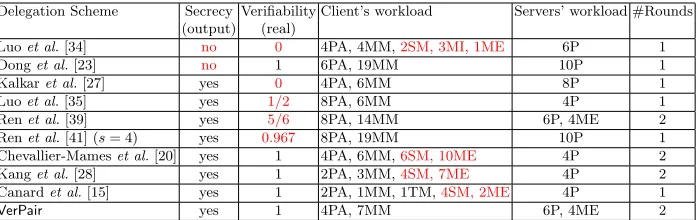
Delegation Scheme Secrecy Verifiability Client’s workload Servers’ workload #Rounds (output) (real)
Luoet al.[34] no 0 4PA, 4MM,2SM, 3MI, 1ME 6P 1
Donget al.[23] no 1 6PA, 19MM 10P 1
Kalkaret al.[27] yes 0 4PA, 6MM 8P 1
Luoet al.[35] yes 1/2 8PA, 6MM 4P 1
Renet al.[39] yes 5/6 8PA, 14MM 6P, 4ME 2
Renet al.[41] (s= 4) yes 0.967 8PA, 19MM 10P 1
Chevallier-Mameset al.[20] yes 1 4PA, 6MM,6SM, 10ME 4P 2
Kanget al.[28] yes 1 2PA, 3MM,4SM, 7ME 4P 2
Canardet al.[15] yes 1 2PA, 1MM, 1TM,4SM, 2ME 4P 1
VerPair yes 1 4PA, 7MM 6P, 4ME 2
Table 1. Comparison of the Delegator’s Computational Costs and Communication Complexities.
In this section, we compare VerPairwith the previous results claiming full veri-fiability. LetSMrepresent scalar multiplication in G1,G2, MEmodular expo-nentiation inG3,MImodular inverse inG3,PApoint addition inG1,G2,TM test membership inGT, andPa pairing computation.
160-bit MNT 256-bit BN 512-bit KSS 640-bit BLS Pairing 0.0032647 0.0049727 0.0440744 0.0754905 Canardet al.[15] 0.0042152 0.00656252 0.0447128 0.161772
Renet al.[39] 0.0001405 0.0002814 0.0012098 0.0021017 VerPair 0.0000837 0.0001726 0.0007897 0.0013833
Table 2.Comparison ofVerPairwith pairing calculation for different choices of curves
0 0.2 0.4 0.6 0.8 1
·104
0 20 40 60
Rounds
Time
(in
seconds)
Pairing Canard VerPair
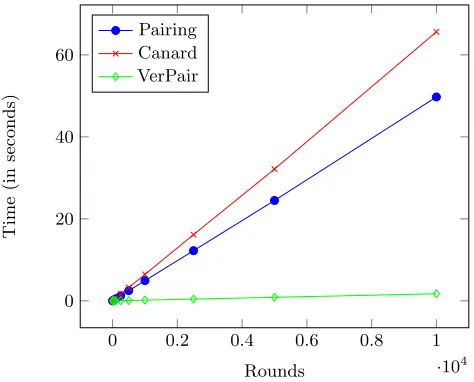
Fig. 1.Timing for different number of rounds on a 256-bit BN curve
Numerical Results. From fully verifiable schemes apart from VerPair, we choose the one that requires least computational overhead [15]. Again from [39] [41], we choose the one that requires less information [40]. These schemes are im-plemented together withVerPair using the MIRACL library [38] on a 3.40 GHz Intel Core i7-3770 processor, compiled with GCC, with standard /O2 compiler optimization. One can find the average results for 10000 trials on Table (2). For [15], the values that can be precomputed are assumed to be computed offline, and also membership test operation is not included in timed section.
Using a 256-bit BN curve, computation times of a pairing, the scheme in [15], andVerPair are compared. The results can be seen in Figure (1).
any online computation of SM,ME, andMIoperations, or to prove its impos-sibility. We however conjecture that it is impossible to have a non-interactive fully verifiable delegation scheme as long as the description of the groups G1,
G2, and G3 are known by the servers. Hence, the tradeoff of achieving the full verifiability is either to perform costly online operations likeSM,ME, andMI, or to add another round to the delegation. In practice however, Meulenaeret al.
in their seminal work [37] give a model regarding the total energy consumption of cryptographic operations in wireless sensor networks by measuring the energy consumptions in MICAz and TelosB sensor nodes. In particular, this analysis shows that the computation of a singleSM(or aMEoperation) requires con-siderably more energy than a single round of communication (considering the total communication overhead including Transmit, Listen, Receive, Compute, Sleep). Hence, the risk of causing single point of failure is considerably higher in the schemes in [20] and [15] thanVerPairsince they require severalSMandME operations while VerPair requires only an additional round in order to achieve the full verifiability.
7
Conclusion
Main focus of this study is to deal with the problem of fully verifiable secure delegation of general pairing computation. By presenting the concrete attack scenarios, we show that several pairing delegation schemes do not satisfy the claimed verifiability and/or security guarantees. Then, we propose an efficient and fully verifiable secure delegation schemeVerPairunder one-malicious version of a two-untrusted-program model (OMTUP). The proposed scheme involves a precomputation stepRandand pairing delegation schemeVerPair. We also point out that it is also possible to reduce the overall scheme computation overhead by partially delegating Rand. Later, we give a detailed security analysis ofVerPair