Osteopathic graduates perceptions of stress and competence – a longitudinal study Preethi Subramaniam, Sally-Anne Eaton, Jessica Cranfield, Jane Mulcahy, Patrick McLaughlin, Dr Tracy Morrison, Brett Vaughan
PII: S1746-0689(14)00098-4
DOI: 10.1016/j.ijosm.2014.10.007 Reference: IJOSM 348
To appear in: International Journal of Osteopathic Medicine
Received Date: 14 May 2014 Revised Date: 25 September 2014 Accepted Date: 7 October 2014
Please cite this article as: Subramaniam P, Eaton S-A, Cranfield J, Mulcahy J, McLaughlin P, Morrison T, Vaughan B, Osteopathic graduates perceptions of stress and competence – a longitudinal study, International Journal of Osteopathic Medicine (2014), doi: 10.1016/j.ijosm.2014.10.007.
M
AN
US
CR
IP
T
AC
CE
PT
ED
Osteopathic graduates perceptions of stress and competence – a longitudinal study
Preethi Subramaniam,1 Sally-Anne Eaton, 1 Jessica Cranfield,1 Jane Mulcahy,1 Patrick McLaughlin,1,2 Tracy Morrison,1 Brett Vaughan1,2
1. College of Health and Biomedicine, Victoria University, Melbourne, Australia
2. Institute of Sport, Exercise and Active Living, Victoria University, Melbourne, Australia
Contact details corresponding author: Dr Patrick McLaughlin
College of Health and Biomedicine Victoria University
PO Box 14428 MCMC Melbourne 8001 Vic
M
AN
US
CR
IP
T
AC
CE
PT
ED
1
M
AN
US
CR
IP
T
AC
CE
PT
ED
2
INTRODUCTION
Osteopathic students develop their professional skills and competencies through
external (with a qualified osteopath in private clinic) and internal (within the university
teaching clinic) supervised clinical placements and clinical tutorials.1 Osteopaths in Australia
are eligible for registration after five years of prescribed study2 then predominantly work in
privately owned clinics which may be sole operator, osteopathic group or multidisciplinary
in nature.3
Research suggests that when transitioning into their first year of health care practice,
medical and allied health students and graduates:
• were unsure of their role and what was expected of them;4-7
• identified it as a time of acquiring new skills and knowledge and accepting increased
responsibilities;8
• felt unprepared to deal with significant increases in workload, adjusting to full time
work, complex cases and decision making about patient care;4-6,8-11
• were lacking in confidence and competence to perform their job requirements
adequately;6,12
• felt that graduate programs and mentorship increase confidence and competence,
make the transition from study to work less stressful, and increase job satisfaction.
7-9,13,14
Health professional graduates perceive conflict between expectations of the clinical
practice role and the reality of the work setting.4-6,8,15 This has been termed ‘reality shock’.16
M
AN
US
CR
IP
T
AC
CE
PT
ED
3
organisation, differ significantly from what is experienced upon entering the organisation”
(page 55).17
Unlike many other health professions, there are currently no graduate programs to
support an osteopath’s transition to practice in Australia. Mentoring relationships are
sometimes established with the employer if the graduate is an associate in the practice but
there is no formal professional structure upon which a uniform approach to mentoring is
based. Some graduates may start practicing independently (their own clinic/business) and
therefore have limited scope for a mentoring relationship. In either situation, from their first
day in practice graduates are expected by their employers and their patients to be
competent practicing osteopaths (in contrast to competent student osteopaths), with the
ability to handle all situations. The expectation for graduates to immediately be competent
practitioners has the potential to be a major source of stress for new graduates as
evidenced in other health professions.8,18 The present study aims to explore osteopathic
M
AN
US
CR
IP
T
AC
CE
PT
ED
4
METHOD
Sampling and Recruiting
Osteopathy students in their final year at Victoria University (Melbourne, Australia) in
2010 were invited to take part in this study by completing two anonymous web-based
surveys. An invitation to participate was sent by global email to the final year osteopathy
students at Victoria University in November 2010 for the initial survey, and in July 2011 for
the follow up survey. If students agreed to participate they were asked to follow the link
embedded within the email and complete the survey hosted by Survey Monkey (Survey
Monkey Inc., Palo Alto, California, USA). All information to participants was included in the
invitation emails and repeated on the first page of the survey. Students were notified that
informed consent would be implied on the completion of the survey. Inclusion criteria for
the first survey were that the participants had completed the course requirements and
would be in the graduating class of the Victoria University Master of Health Science
(Osteopathy) in 2010 and were not yet working as an osteopath. Only those students who
had completed the first survey and were working as a registered osteopath were eligible to
complete the second survey. Not completing the second survey indicated voluntary
withdrawal from the study.
The study involved the collection of self-reported data and received prior approval from
the University’s Human Research Ethics Committee.
M
AN
US
CR
IP
T
AC
CE
PT
ED
5
As there were no available measurement tools specific to the osteopathic profession,
two surveys were developed for this study by the researchers. The surveys were developed
to investigate variables similar to those identified as relevant to soon to be, and new,
graduates in other health professions.
Survey One (T1), ‘Expectations of Practice’ (Appendix 1), consisted of items to capture
students’ personal demographics, their expectations of what professional practice as an
osteopath would entail, and perception of their level of competence to practice as an
osteopath. Self-perceived competence as an osteopath was assessed in the form of a Likert
scale and consisted of 45 items identified by Hager, Boud & Stone19 as key elements within a
capability framework for osteopaths. Work-related stressors, assessed in the form of a
Likert scale, were adapted from Salter20 and Smith and Pilling.14
Survey Two (T2), ‘Transitioning to Practice’ (Appendix 2), completed by the same
cohort when they had commenced practice, aimed to substantiate whether or not their
perceptions of osteopathic practice had been met. This survey included the same 65 items
as Survey One and was designed to provide information about job characteristics (not
reported here) and difficulties new graduate osteopaths experienced. This survey also
attempted to identify areas in which participants’ self-perceived competence levels changed
after their first months of professional practice.
To ensure ease of readability the survey was subjected to the Flesch–Kincaid
readability tests included in Microsoft Word 2010. Both surveys have a Flesch reading ease
of 3.4 and a Flesch-Kincaid grade level of 16.1. This was within the expected capabilities of
M
AN
US
CR
IP
T
AC
CE
PT
ED
6
equivalent to year 17 of formal education.21 Face validity testing was performed by the
authors.
Data analysis
Data were received in a Microsoft Excel table from the survey-hosting site then collated
for comparison of the two surveys. For the stress items, responses were coded as follows to
simplify input and to allow the calculation of descriptive statistics: extremely stressful=4;
moderately stressful=3; somewhat stressful=2; mildly stressful=1; and, not stressful=0. For
the competence items responses were coded as follows: extremely competent=3; quite
competent=2; competent=1; unsure=0; and, not competent =-1.
Although the survey collected a high volume of perceived competence data from each
participant, this paper reports on aspects of competence considered most relevant by the
authors. We wanted to identify key areas that may require development in pre-registration
teaching programs, or the development of post-registration mentoring programs, in order
to facilitate a smoother transition from student to practitioner. Each of the 45 competence
items were considered in the context of the most essential to safe and efficient practice of
osteopathy. The six authors discussed each item in this context and the agreed final list of
19 are reported here.
Data analysis was performed using Microsoft Excel and SPSS version 19 (IBM Corp, USA).
Data were summarised and assessed for normality prior to significance testing using
M
AN
US
CR
IP
T
AC
CE
PT
ED
7
RESULTS
Participant characteristics
A total of 25 of the 51 graduates of 2010 completed the first survey, and 14 of 51
completed both surveys (response rate of 27%). The age range of the participants was 20-34
years of age. Of the 14 participants, 9 were female. Participants had between 2 and 9
months experience in osteopathic practice at the time of completing survey two.
Participants were treating between 11 and 50 patients per week, with an expected income
range of $20,000 to $100,000 in their furst year of practice.
To determine whether participants withdrew from the study (did not complete survey
2) because of increased stress or decreased competence, the total stress and competence
data at T1 were compared between groups. There were non-significant differences between
those who participated in survey 2 (n=14) and those who withdrew from the study after
survey 1 (n=11) for both stress (33±12 vs. 32±12; p= 0.976) and competence (76±18 vs.
67±17; p=0.195) at the time of the initial survey (T1). These data indicate that participants
did not withdraw from the study because of increased stress or decreased competence.
Stress
Overall, the mean stress scores (out of a possible 80) were 32.9 ± 12.5 for T1 and
32.3± 10.8 for T2 with the participant group showing no significant change in total stress
after approximately 6 months of practice (p=0.83). As a group, the overall stress expected at
M
AN
US
CR
IP
T
AC
CE
PT
ED
8
Eight of 14 participants (57%) experienced more stress as an osteopath than they
anticipated (see Figure 1). Participants 2, 4 and 8 had the lowest stress scores at T1 and all
subsequently experienced an increase in stress at T2 (Figure 1).
INSERT Figure 1 here
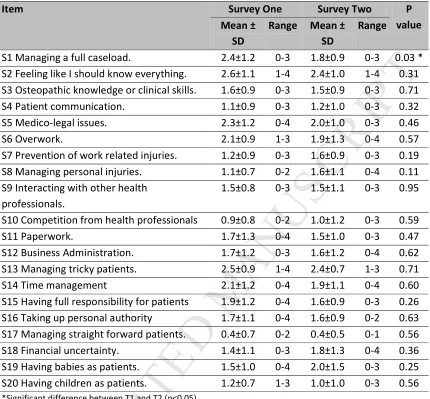
Managing a full case load was rated the most stressful item at T1 and was the only stress
item found to change significantly, decreasing between T1 and T2 (p=0.03) indicating the
participants over-estimated the stress this would cause (Table 1 ). The most stressful items
for new graduates were:
• S2 Feeling like I should know everything;
• S5 Medico-legal issues;
• S6 Overwork;
• S13 Managing the tricky patients;
• S14 Time management - including work competing with non-work demands; and,
• S19 Having babies as patients.
Only one of these stressors (S19 Having babies as patients) was associated with an
increase in stress between T1 and T2.
The least stressful items for new graduates were:
• S10 Competition from other health professionals including osteopaths;
M
AN
US
CR
IP
T
AC
CE
PT
ED
9
• S20 Having children as patients.
INSERT Table 1 here
To gather more information about stressors in the transition to osteopathy practice,
participants were asked to respond to the open-ended question “Do you find any other
aspects of working stressful?” Verbatim responses can be found in the appendices section
(appendix 3).
Competence
The mean total competence scores (out of a possible 135) at T1 (75±18.3) and T2
(64.3±17.2) indicated a significant decrease in perceived competence after commencing
professional practice (p<0.001). This demonstrated that graduates perceived themselves as
being less competent after commencing professional practice. Only two of the 14
participants (11%) reported increased perceived competence between T1 and T2 (Figure 2).
INSERT Figure 2 here
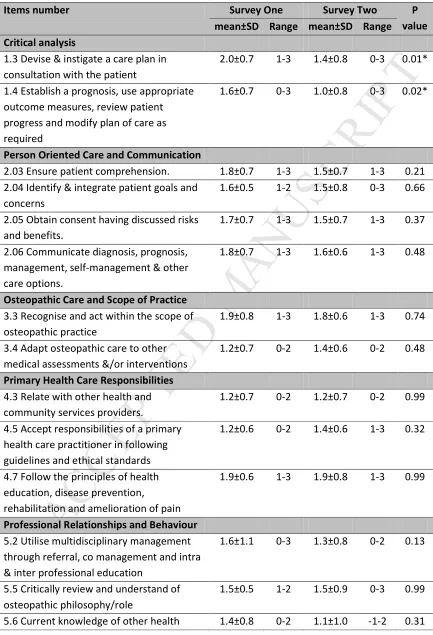
Participants reported a significant decrease in perceived competence between T1 and T2 on
(Table 2):
• 1.3 Critical analysis: Devise and instigate a care plan in consultation with a patient;
• 1.4 Critical analysis: Establish a prognosis, use appropriate outcome measures,
M
AN
US
CR
IP
T
AC
CE
PT
ED
10
• 6.6 Professional and business activities: Manage risks to minimise impact on all
concerned; and,
• 6.7 Professional and business activities: Maintain currency of knowledge and skills.
Of interest, “not competent” (score of -1) was only used by one participant on one item. So
whilst the perception of competence decreased at T2, it did not decrease to a level where
participants felt “not competent” on any of the items.
INSERT Table 2 here
The results demonstrate that university students in their final months of training feel more
competent to be osteopaths than when they begin their career as a practitioner. Job related
stress is noted, although the actual stressors are different to those that students were most
worried about before leaving university. The results also demonstrate that students could
be better prepared in several areas of practice, especially:
• establishing prognosis;
• devising and instigating a care plan;
• managing risks; and,
• maintaining currency of knowledge and skills.
Furthermore, adequate graduate supervision is reported to be valuable when beginning a
career in osteopathy.
To find out more about the transition to osteopathy practice, participants were asked to
M
AN
US
CR
IP
T
AC
CE
PT
ED
11
helped you to transition into a professional osteopath and/or make suggestions about how
you think the transition process could be made easier for others.” The verbatim list of
M
AN
US
CR
IP
T
AC
CE
PT
ED
12
DISCUSSION
The results of the present study suggest that osteopathy graduates from Victoria
University face similar difficulties to other health graduates, especially when it comes to
stress and a perceived lack of competence. Data from the present study indicate that
managing the tricky patients, feeling like they should know everything, medico-legal issues,
having babies as patients, time management, and overwork, are major stressors for recently
graduated osteopaths from Victoria University. Similar findings of feelings of being
unprepared, particularly in relation to workload, no time to care, and role stress (being
legally responsible for someone else’s life), too much work to do, earning enough money,
threat of litigation, and patients who are difficult to manage22 were also reported by new
practitioners in other health fields.14
In association with managing a full case load, participants indicated that ‘time
management – including work competing with non-work demands’ rated amongst the most
stressful experiences. This is a common occurrence amongst graduates in other medical
professions.23, 24 Social isolation has been shown to increase stress levels25, 26 and the
change of environment from university life to that of a professional in practice, often with a
change in location and potential isolation both in the treatment room, and from their peers,
has effects on the social life of new graduates. It is expected that osteopathy graduates
would learn to balance work and non-work demands over time, but further research with
osteopaths who have been practicing for longer than the sample involved in the present
study is needed to investigate this.
The results reported in the current study can be explained as a product of both the
M
AN
US
CR
IP
T
AC
CE
PT
ED
13
structured. The Masters’ degree course at Victoria University requires students to
participate in 686 supervised clinical hours and 270 hours of clinical placements outside the
university clinic, over two years.27 While this may seem a significant amount of time, it
breaks down to less than 10 hours per week, less than a third of what most of the graduates
in this study worked in their first year of practice. Limited hours in the student clinic make it
difficult for students to gain experience, and follow up on patients, especially with complex
medical needs. This is due to the case mix of presenting patients to a student clinic, the lack
of external clinic hours in different environments as well as the limited amount of hours per
week each student is able to attend clinic. This limits the amount of clinical knowledge and
experience the graduates have in dealing with complex cases. With self-reflection,
experience and exposure to these complex cases in practice, we surmise that confidence
and knowledge in this area will improve and dealing with complex cases should become less
stressful but further research with more experienced practitioners would be useful to
determine how long it takes for this transition to occur, and whether the osteopathic
profession needs to provide ongoing professional development to ensure that this occurs.
It appears that the assumption of both students and some employers that new
graduates are ready to treat a full case load without limited supervision – compared to their
clinical training - has a large effect on new graduate stress levels. This may be an area where
osteopathy training in the tertiary setting can be improved by implementing a networking
program or mentorship from other qualified osteopaths. This may, to some extent, have the
same effect as a formal graduate program and smooth the transition from clinical student to
M
AN
US
CR
IP
T
AC
CE
PT
ED
14
Several studies have shown the merit of access to ongoing support during the
transition stage for graduates,7,14,28 where participants can share their concerns and fears
and have questions answered. Other health and science related fields often have graduate
programs to develop knowledge whilst having access to greater supervision and the ability
to defer decision-making processes to a more qualified supervisor.7 Graduate programs
supporting the transition from student to professional are common in nursing, and
internship and graduate support to medical practitioners are an integral part of medical
training.10 Other health graduates may also have professional networking requirements
prescribed by their professional associations (eg. Australian Psychological Society).
Unfortunately, however, in Australia and the UK29 it is unusual to provide a structured
program to support allied health graduates through this phase of transition to practice.30
In some instances there was a large decrease in competence ratings at T2. This may
reflect that as students, participants were unaware of all of the demands they would face
(reality shock), or may be due to reduced feedback regarding performance due to the
change of environment from the clinical student setting. Performance feedback for the
osteopathy graduate is mostly in the form of patient feedback on outcomes and
satisfaction. One participant in the present study commented that “providing patient
satisfaction was stressful”. Patient satisfaction may be lower than what participants were
accustomed to as student clinicians, because patients pay on average three times the cost of
an appointment at the university clinic for an appointment with a qualified practitioner.
Patients have greater expectations of treatment when they are paying more for the
treatment, and this could contribute to a decrease in patient satisfaction.31 Medico-legal
M
AN
US
CR
IP
T
AC
CE
PT
ED
15
possible that the stress caused by medico legal aspects in the transition to practice is high
because this is the first time that participants are exposed to full legal responsibility for their
practice, the threat of litigation and the management of patients who are litigating.
Medico-legal training at Victoria University entails: record keeping; using an evidence based
approach to practice; to practice only what you are insured to practice; the advice to be
courteous and considerate; to have procedures for managing unsatisfied patients in place in
your clinic; and, to promptly contact one’s insurer in these situations. Further research is
necessary to quantify what specific medico-legal aspects were found to be stressful and to
address the question ‘What further training could assist graduates in this area?’
Graduates felt barely competent in establishing an appropriate prognosis for the
patient and using outcome measures. Outcome measures are now becoming a necessity for
daily osteopathic practice32 as third party payers (workers compensation, transport accident
schemes) require health care providers to utilise them. Outcome measures are introduced
to students in clinical tutorials, and practice management classes, but are not routinely used
in the teaching clinic, potentially due to the absence of third party payers or lack of
encouragement from clinical educators. Therefore participants had little exposure to
outcome measures before starting practice. This aspect of practice demonstrates that
integrating what is learnt in academic units with the clinical learning environment is vital.
It is worth noting that under the scoring system used in this study, the new
graduates still considered themselves competent (mean scores greater than or equal to 1 on
all competence items) at T2. So whilst there are clear areas for improvement, the overall
M
AN
US
CR
IP
T
AC
CE
PT
ED
16
Limitations
This study was limited by including only Victoria University graduates. However,
there are four osteopathic training courses offered in Australia and New Zealand and due to
accreditation processes, they are all similar in content. This study was also limited by the
small number of participants (n=14 or participation rate of 27%). However, the issues
identified by this study are not necessarily isolated to the Victoria University osteopathy
program. It is reasonable to assume that all osteopathy graduates transitioning to practice
in Australia and New Zealand will encounter similar issues.
Perhaps the students who opted out of participating in the study perceived they had
completed the course of training, passed all required assessments and were therefore
adequately prepared for practice. The data presented earlier indicated they were not “more
stressed” or “less competent” than the students who stayed in the study. Alternately, they
may have not as yet commenced working as an osteopath. The reasons students chose not
to participate in this study would have been helpful to this analysis and could be included in
future studies.
The authors also acknowledge the limitations of the survey instrument developed for
this study. The fact that the tool was developed by Victoria University students and staff to
survey Victoria University graduates may limit the scope outside the Australian context.
Further work needs to be conducted to validate this instrument outside the local context.
Similarly, other users may have a different interpretation of the most relevant items to safe
M
AN
US
CR
IP
T
AC
CE
PT
ED
17
Recommendations
A follow up study on the same cohort after 3 or 4 years in practice would provide
more data on the transition process of this cohort of graduates. This type of study could
substantiate whether or not osteopaths adjusted to the stressors identified and felt more
competent. As identified by this study, it is recommended that future graduates benefit
from improved graduate mentorship and support programs. It is also apparent that the
osteopathic profession should be encouraged to establish ongoing professional
development opportunities around these topic areas to ensure that the needs of the new,
M
AN
US
CR
IP
T
AC
CE
PT
ED
18
CONCLUSION
Student osteopaths have realistic expectations of stress during the transition to
professional practice. To decrease the stress involved in the transition, having a suitable
networking, mentoring or graduate supervision program is recommended as soon as the
student becomes an osteopath in a working practice.
Graduate osteopaths entering practice face similar stressors to other health
graduates about overwork, time management and medico-legal issues. There are several
areas where osteopathy graduates feel they are under prepared for practice: risk
management; medico-legal procedures; paediatrics; and, prognosis and management of the
complex patient. Improved training in these areas is indicated at the undergraduate,
M
AN
US
CR
IP
T
AC
CE
PT
ED
19
STATEMENT OF COMPETING INTERESTS
M
AN
US
CR
IP
T
AC
CE
PT
ED
20
REFERENCES
1. Vaughan B, Macfarlane C, Florentine P. Clinical education in the osteopathy program at Victoria University. Int J Osteopath Med 2013, DOI: 10.1016/j.ijosm.2013.10.010
2. Australian Osteopathic Association. Welcome to the Australian Osteopathic Association. http://osteopathic.com.au/index.php/home. Accessed 15 December 2011.
3. Orrock P. Profile of members of the Australian Osteopathic Association: Part 1 - The practitioners. Int J Osteopath Med, 2009;12:14-24.
4. Sutton G, Griffin MA. Transition from Student to Practitioner: the Role of Expectations, Values and Personality. Br J Occup Thera. 2000;63:380-388.
5. Curtis KA, Martin T. Perceptions of acute care physical therapy practice: issues for physical therapist preparation. Phys Thera. 1993;73:581-594.
6. Prince KJAH, Boshuizen HPA, Van Der Vleuten CPM, Scherpbier AJJA. Students' opinions about their preparation for clinical practice. Med Educ. 2005;39:704-712.
7. Newton JM, McKenna L. The transitional journey through the graduate year: a focus group study. Int J Nursing Stud. 2007;44:1231-1237.
8. Goh K, Watt E. From 'dependent on' to 'depended on' : the experience of transition from student to registered nurse in a private hospital graduate program. Aust J Adv
Nursing. 2003;21:14-20.
9. Gill B, Deagan E, McNett M. Expectations, perceptions, and satisfaction of graduate nurses. J Nurses Staff Dev. 2010;26:E11-17.
10. Smith RA, Pilling S. Allied health graduate program - supporting the transition from student to professional in an interdisciplinary program. J Interprof Care. 2007;21:265-276.
11. Heslop L, McIntyre M, Ives G. Undergraduate student nurses' expectations and their self-reported preparedness for the graduate year role. J Adv Nurs. 2001;36:626-634.
12. Tryssenaar J, Perkins J. From student to therapist: exploring the first year of practice. Am
J Occup Thera. 2001;55:19-27.
13. Casey K, Fink R, Krugman M, Propst J. The graduate nurse experience. J Nurs Admin. 2004;34:303-311.
14. Smith R, Pilling S. Supporting the transition from student to professional - A case study in allied health. Aust Health Rev. 2008;32:134-138.
M
AN
US
CR
IP
T
AC
CE
PT
ED
21
16. Kramer M. Reality shock : why nurses leave nursing. Saint Louis: Mosby ; London : Distributed by Kimpton; 1974.
17. Dean, R.A. Reality shock: the link between socialisation and organisational commitment.
J Manage Dev, 1983;2:55-65.
M
AN
US
CR
IP
T
AC
CE
PT
ED
22
19. Stone C, Boud D, Hager P. Capabilities for Osteopathic Practice. 2009;
http://www.osteopathiccouncil.org.nz/images/stories/pdf/draft%20nz%20osteo%20 capabilities%20july%202010.pdf, 2010. Accessed February 11, 2010.
20. Salter J. Occupational stress and job satisfaction in recently qualified Australian
osteopaths. Minor thesis, Victoria University, 2005.
21. Streiner D, Norman G. Health measurement scales: a practical guide to their
development and use.: Oxford University Press. 2003.
22. Flaherty K. Job satisfaction and occupational stress in experienced osteopaths. Minor thesis, Victoria University, 2005.
23. Cooper CL, Rout U, Faragher B. Mental health, job satisfaction, and job stress among general practitioners. Br Med J. 1989;298:366-370.
24. Richardsen AM, Burke RJ. Occupational stress and job satisfaction among physicians: sex differences. Soc Sci Med. 1991;33:1179-1187.
25. House JS. Social isolation kills, but how and why? Pyschosom Med. 2001;63:273-274.
26. Williams ES, Konrad TR, Linzer M, McMurray J, Pathman DE, Gerrity M, Schwartz MD, Scheckler WE & Douglas J. Physician, practice, and patient characteristics related to primary care physician physical and mental health: results from the Physician Worklife Study. Health Serv Res. 2002;37:121-143.
27. Victoria University. Courses: Graduate Certificate in Neonatal and Infant Paediatric Manual Therapy. http://www.vu.edu.au/courses/graduate-certificate-in-neonatal-and-infant-paediatric-manual-therapy-htpo. Accessed 18 December, 2011.
28. Brumfitt SM, Enderby PM, Hoben K. The transition to work of newly qualified speech and language therapists: implications for the curriculum. Learn Health Soc Care. 2005;4:142-155.
29. Freeth D, McIntosh P, Carnes D. New Graduates’ Preparedness to Practice: Research Report of a Study Comissioned by the General Osteopathic Council. 2012.
30. Adamson BJ, Harris LM, Hunt AE. Health science graduates: preparation for the workplace. J Allied Health. 1997;26:187-199.
31. Anderson EA. Measuring service quality at a university health clinic. Int J Healt Care
Assur. 1995;8:32-37.
M
AN
US
CR
IP
T
AC
CE
PT
ED
Appendix 1: Survey One
Student Osteopaths’ Expectation of Professional Practice Survey
Please be aware that the survey will be administered in an online format. Hard copy surveys will only be given if requested. As such this hard copy does not reflect the final formatting of the online survey (questions will not break across pages). The online survey will have identical questions and answer recording methods as this hard copy.
If you received this survey then you are eligible to participate in the study titled Transition from a Student Osteopath to Practicing Osteopath: Students’ expectations and the realities of
professional practice’ being conducted at Victoria University by: Patrick McLaughlin and Jane Mulcahy. Please see your email box for the Information to Participants document. Any queries may be directed to the researchers: Patrick McLaughlin and Jane Mulcahy
By completing this survey you are confirming you agree to participate in this research study.
Please tick ANY of the boxes that apply to you:
1. Age
□ 20-24
□ 25-29
□ 30-34
□ 35-39
□ 40-44
□ 45-49
□ Older than 50
2. Sex
□ Male
□ Female
3. Study Status
□ International student
□ Local resident student
4. How many years have you spent studying osteopathy? • 5
• 6
• 7 or more
5. Relationship status
□ Single
□ Married
□ De Facto
6. Number of dependants (children or disabled in your care)
M
AN
US
CR
IP
T
AC
CE
PT
ED
□ 1
□ 2
□ 3
□ 4 or more
7. If you are employed, what is your current employment level?
□ Part time
□ Casual
□ Full time
8. What is your current income range?
□ Less than $2,000
□ $2,001-$6,000
□ $6,001-$10,000
□ $10,001-$20,000
□ $20,001-$30,000
□ $30,001-$40,000
□ More than $40,000
9. What is your current source of income? (please tick all that apply)
□ Government allowance
□ Parental support
□ Employee
□ Self employed
□ Contractor
□ Scholarship
10. What areas are you currently, or have you been previously, employed in (please tick all that apply)
□ Health and Human Services
□ Administration or Business Management
□ Customer service
□ Sport & Recreation
□ Retail
□ Hospitality
□ Information Technology
□ Commerce or Finance
□ Education
□ Other, please specify:
_____________________________________________________
11. Prior to your current course in osteopathy what was your highest level of education
□ Year 12
□ Diploma
□ Advanced Certificate
□ Degree
M
AN
US
CR
IP
T
AC
CE
PT
ED
□ Professional Examination of a professional body (e.g. chartered accounting)
12. Have you undertaken a clinical internship in osteopathy?
□ Yes
□ No
THE FOLLOWING QUESTIONS RELATE TO YOUR EXPECTATIONS OF OSTEOPATHIC PRACTICE WITHIN THE NEXT YEAR ONLY.
13. Do you intend to complete further research or studies in or related to osteopathy within the following year?
□ Yes
□ No
If yes what study or research are you going to undertake?
_____________________________________________________________________
14. Do you intend to work as a practising osteopath in the next year? • Yes
• No
15. How difficult do you think it will be to find employment in osteopathy?
1 2 3 4 5
Not at all Moderately Extremely
Hard hard hard
16. Where do you expect to work?
□ Within 50kms of current residence
□ More than 50km away from current residence
□
Interstate:
□ S.A. □ N.S.W. □ TAS. □ N.T. □ W.A. □ QLD. □ A.C.T.
□ Overseas
17. How will you be getting to your work? Tick all that apply
□ Public transport
□ Drive car or other vehicle
M
AN
US
CR
IP
T
AC
CE
PT
ED
□ Moved closer to work
18. What range do you expect your first year income will be in?
□ Less than $20,000
□ $20,001-$34,000
□ $34,001 -$40,000
□ $40,001-$60,000
□ $60,001-$70,000
□ $70,001-$80,000
□ $80,001-$100,000
□ More than $100,001
19. Do you feel that you are prepared for working as an osteopath?
1 2 3 4 5
not at all moderately extremely well
prepared prepared prepared
20. Do you feel that you are prepared for running a small business?
1 2 3 4 5
not at all moderately extremely well
prepared prepared prepared
21. Do you feel that you are prepared for both the running of a small business and working as an osteopath together
1 2 3 4 5
not at all moderately extremely well
prepared prepared prepared
22. What sort of setting do you expect to work in?
□ Mobile clinic
□ Private residence/home
□ Osteopathic clinic
□ Multi-disciplinary clinic
□ Sporting club
□ Research institute
□ Tertiary Education
□ Other
M
AN
US
CR
IP
T
AC
CE
PT
ED
23. How many osteopaths do you expect to work with?
□ None work alone
□ 2
□ 3
□ 4 or more
24. If you worked in a clinic, what do you expect your position would be?
□ Subcontractor
□ Employee
□ Principal
□ Locum
□ Sole trader renting facilities
□ Other
Please specify: _____________________________________________________
25. How many hours per week do you expect to work as an osteopath?
□ 0-10
□ 11-20
□ 21-30
□ 31-40
□ More than 41
26. How many patients do you expect to treat per week?
□ Less than 10
□ 11-20
□ 21-30
□ 31-40
□ 41-50
□ 51-60
□ 61-70
□ More than 71
27. How many hours per week do you expect to spend on paperwork?
□ Less than 5
□ 6-10
□ 11-15
□ 16-20
M
AN
US
CR
IP
T
AC
CE
PT
ED
28. Tick how much stress you think will be caused by the following aspects of working as an osteopath (specifically in your first year).
1 2 3 4 5
N o t a t a ll str e ss fu l M ild ly str e ss fu l S o m e w h a t str e ss fu l M o d e ra te ly str e ss fu l E x tr e m e ly str e ss fu l
Managing a full caseload.
Feeling like I should know everything. Osteopathic knowledge or clinical skills. Patient communication.
Medico-legal issues. Overwork.
Prevention of work related injuries. Managing personal injuries.
Interacting with other health professionals.
Competition from other health professionals including Osteopathy. Paperwork.
Business Administration. Managing the "tricky" patients.
Time management - adjusting to full-timework and balancing a full caseload with competing non-work demands.
Having full responsibility for patients – not always having a supervisor around to ask for assistance or go through plans and issues in detail.
Taking up personal authority - even when confidence is low. Managing the “straight forward” patients.
M
AN
US
CR
IP
T
AC
CE
PT
ED
The questions below relate to the competencies and skills that are required by the osteopathy profession in Australia to ensure the safe and proficient practice of osteopathy as approved by the Australian and New Zealand Osteopathic Council. (Hager, P., Boud, D., & Stone, C.F. (2009). Capabilities for Osteopathic Practice. Sydney, Australia: University of Technology Sydney).
29. Can you please rate your current level of proficiency for each of the competencies in the boxes corresponding to each of the items as follows:
Not competent, Unsure, Competent, Quite competent and Extremely competent.
1. Clinical Analysis.
1 2 3 4 5
N o t co m p e te n t U n su re C o m p e te n t Q u it e co m p e te n t E x tr e m e ly co m p e te n t
1.1. Gather, organise and record a focused personal health record.
1.2. Synthesize information into a suitable working diagnosis and demonstrate an understanding of general health status.
1.3. Devise and instigate a plan of care addressing the person’s presenting disorder and their general health, in consultation with that person (or their representative or carer).
1.4. Establish a prognosis with appropriate outcome measures, review patient progress and modifying plan of care as required.
1.5. Recognise when further information is required. 1.6. Critically reflect on clinical challenges and uncertainties.
2. Person Oriented Care and Communication.
2.1. Consider socio-cultural factors in communication and management strategies.
2.2. Use appropriate questioning strategies.
2.3. Ensure patient comprehension.
2.4. Ensure patients goals and concerns are identified and integrated into the clinical analysis.
2.5. Obtain consent having discussed risks and benefits.
2.6. Communicate clearly with respect to diagnosis, prognosis, and possible management plans, self management and other options of care.
2.7. Take account of previous patient experiences of health care, medical and allied health systems.
2.8. Understand the complexity of therapeutic relationships and have the professionalism to engage in appropriate levels of interaction and care. 2.9. Ensure a professional commitment towards patient trust, confidentiality, safety and patient oriented care.
M
AN
US
CR
IP
T
AC
CE
PT
ED
3.0. Osteopathic Care and Scope of Practice.
3.1. Implement an appropriate management plan that reflects the application of osteopathic philosophy.
3.2. Understand and appropriately employing a variety of osteopathic examination and treatment techniques and approaches.
3.3. Recognise and act within the scope of osteopathic practice.
3.4. Where the patient has a condition that requires other medical assessments and I or interventions identify how any ongoing osteopathic care of the person should be adapted.
3.5. Adapt ongoing care of a patient to their general health and wellbeing needs and to their changing circumstances.
3.6. Identify how your personal professional approach to patients is placed within general osteopathic healthcare philosophy and practice.
3.7. Recognise and acting within the scope of your personal osteopathic capabilities.
3.8. Modify and adapt management in accordance with osteopathic practice.
4.0. Primary Health Care Responsibilities.
4.1. Accept responsibility for an individual’s welfare.
4.2. Recognise and respond to professional capabilities and limitations, as a primary healthcare provider.
4.3. Relate effectively and knowledgeably with other health and community services or providers.
4.4. Facilitate an individual’s access to appropriate health and community services.
4.5. Accept responsibilities as a primary health care practitioner in relation to guidelines and ethical standards, as issued by appropriate bodies and authorities.
4.6. Ensure awareness of costs associated with healthcare, and the principles of efficient and equitable allocation and use of finite resources.
4.7. Maintain commitment to the principles of health education, disease prevention, rehabilitation and amelioration of pain and suffering. 4.8. Carry out basic first aid and life-saving procedures as required.
5. Professional Relationships and Behaviour.
5.1. Demonstrate the ability to be able to work as part of a net work of osteopaths, and other disciplines and providers via respectful effective and efficient communication.
5.2. Recognise how to implement a multidisciplinary approach through referral and co management, and intra and interprofessional education. 5.3. Implement the appropriate multidisciplinary care for the individual.
5.4. Maintain effective lines of communication with other parties.
M
AN
US
CR
IP
T
AC
CE
PT
ED
6. Professional and Business Activities.
6.1. Ensure ethical conduct of self and others in provision of care and services.
6.2. Provide for continuing professional learning for self and of employees.
6.3. Care of self.
6.4. Maintaining an appropriate physical environment for privacy, comfort, and confidentiality.
6.5. Managing all aspects of practice to comply with legal and regulatory requirements (as a sole operator or as an employer of others).
6.6. Manage risks effectively and responsibly in such a way that minimises impact on all concerned.
M
AN
US
CR
IP
T
AC
CE
PT
ED
1 Appendix 2: Survey 2
Transitioning to Practice Follow Up Survey
Please be aware that the survey will be administered in an online format. Hard copy surveys will only be given if requested. As such this hard copy does not reflect the final formatting of the online survey (questions will not break across pages). The online survey will have identical questions and answer recording methods as this hard copy.
If you received this survey then you have already consented to be a part of and completed part one of this research study titled Transition from a Student Osteopath to Practicing Osteopath: Students’ expectations and the realities of professional practice’ being conducted at Victoria University by: Patrick McLaughlin and Jane Mulcahy. Please see your email box for the Information to Participants document. Any queries may be directed to the researchers: Patrick McLaughlin and Jane Mulcahy
Please tick all of the boxes that apply:
1. Have you practiced osteopathy professionally in 2011?
□ Yes - GO TO QUESTION 3.
□ No
2. Please indicate the reason(s) for not practicing osteopathy
□ Working in another occupation
□ Difficulty finding employment as an osteopath
□ Family care commitments
□ Holidaying
□ Completion certificate not gained, still studying Masters of Osteopathy
□ Completion certificate not gained, no longer studying Masters of Osteopathy
□ Completion certificate gained, but undergoing further education
Please use this space to elaborate on any of these answers or list other reasons:
________________________________________________________________________ ________________________________________________________________________ _____________________________________________________.
M
AN
US
CR
IP
T
AC
CE
PT
ED
2 3. Have you completed or are you currently undertaking further studies related to
osteopathy since course completion?
□ Yes
Please explain the nature and title of the study or research:
_________________________________________________________________.
□ No
4. How many months have you practised osteopathy professionally?
□
0-1 □
2 □
3 □
4 □
5 □
6 □
7□8
5. How difficult was it to find employment in osteopathy?
1 2 3 4 5
Not at all Moderately Extremely
Hard hard hard
6. Did you move residence since gaining your completion certificate?
□ Yes
□ No
If you work at multiple practices then the following questions apply to your main practice where you work the most hours
7. Where do you work in relation to where you resided as a student?
□ Within 50kms
□ More than 50km away
□ Interstate: □ S.A.
□ N.S.W.
□ TAS.
□ N.T.
□ W.A.
□ QLD.
□ A.C.T.
□ Overseas Please specify country if you feel comfortable doing so ____________________________.
8. How do get to work? Tick all that apply
□ Public transport
□ Drive car or other vehicle
M
AN
US
CR
IP
T
AC
CE
PT
ED
3 9. What is your current projected income for 2011?
□ Less than $20,000
□ $20,001-$34,000
□ $34,001 -$40,000
□ $40,001-$60,000
□ $60,001-$70,000
□ $70,001-$80,000
□ $80,001-$100,000
□ More than $100,001
9. Relationship status
□ Single
□ Married
□ De Facto
10.How prepared do you feel you were for working as an osteopath when you gained your completion certificate?
1 2 3 4 5
not at all moderately extremely well
prepared prepared prepared
11.How prepared do you feel you were for running a small business when you gained your completion certificate?
1 2 3 4 5
not at all moderately extremely well
prepared prepared prepared
12.How prepared do you feel you were for both the running of a small business and working as an osteopath, together, when you gained your completion certificate?
1 2 3 4 5
not at all moderately extremely well
prepared prepared prepared
13.In what sort of setting do you work?
□ Mobile clinic
□ Private residence/home
□ Osteopathic clinic
□ Multi-disciplinary clinic
□ Sporting club
M
AN
US
CR
IP
T
AC
CE
PT
ED
4
□ Tertiary Education
□ Other
Please specify: ____________________________________________________
14.How many osteopaths do you work with?
□ None work alone
□ 2
□ 3
□ 4 or more
15.If you work in a clinic, what is your position within the practice?
□ Subcontractor
□ Employee
□ Principal
□ Locum
□ Sole trader renting facilities
□ Other
Please specify: _____________________________________________________
16.How many hours per week do you work as an osteopath?
□ 0-10
□ 11-20
□ 21-30
□ 31-40
□ More than 41
17.How many patients do you treat per week?
□ Less than 10
□ 11-20
□ 21-30
□ 31-40
□ 41-50
□ 51-60
□ 61-70
□ More than 71
18.How many hours per week do you spend on paperwork?
□ Less than 5
□ 6-10
□ 11-15
□ 16-20
M
AN
US
CR
IP
T
AC
CE
PT
ED
5 19.Tick a box to indicate how much stress you feel from the following aspects of working as anosteopath. N o t a t a ll st re ss fu l M ild ly st re ss fu l S o m e w h a t st re ss fu l M o d e ra te ly st re ss fu l E x tr e m e ly st re ss fu l
Managing a full caseload.
Feeling like I should know everything.
Osteopathic knowledge or clinical skills.
Patient communication.
Medico-legal issues.
Overwork.
Prevention of work related injuries.
Managing personal injuries.
Interacting with other health professionals.
Competition from other health professionals including Osteopathy.
Paperwork.
Business Administration.
Managing the "tricky" patients.
Time management - adjusting to full-timework and balancing a full caseload with competing non-work demands.
Having full responsibility for patients – not always having a supervisor around to ask for assistance or go through plans and issues in detail.
Taking up personal authority - even when confidence is low.
Managing the “straight forward” patients.
Financial uncertainty.
Having babies as patients.
Having children as patients.
M
AN
US
CR
IP
T
AC
CE
PT
ED
6 The questions below relate to the competencies and skills that are required by the osteopathic profession in Australia to ensure the safe and proficient practice of osteopathy as approved by the Australian and New Zealand Osteopathic Council. (Hager, P., Boud, D., & Stone, C.F. (2009). Capabilities for Osteopathic Practice. Sydney, Australia: University of Technology Sydney).20.Can you please rate your level of proficiency for each of the competencies in the boxes corresponding to each of the items as follows:
Not competent, Unsure, Competent, Quite competent and Extremely competent.
N o t c o m p e te n t U n su re C o m p e te n t Q u it e c o m p e te n t E x tr e m e ly c o m p e te n t
1. Clinical Analysis.
1.1. Gather, organise and record a focused personal health record.
1.2. Synthesize information into a suitable working diagnosis and demonstrate an understanding of general health status.
1.3. Devise and instigate a plan of care addressing the person’s presenting disorder and their general health, in consultation with that person (or their representative or carer).
1.4. Establish a prognosis with appropriate outcome measures, review patient progress and modifying plan of care as required.
1.5. Recognise when further information is required.
1.6. Critically reflect on clinical challenges and uncertainties.
2. Person Oriented Care and Communication.
2.1. Consider socio-cultural factors in communication and management strategies.
2.2. Use appropriate questioning strategies.
2.3. Ensure patient comprehension.
2.4. Ensure patients goals and concerns are identified and integrated into the clinical analysis.
M
AN
US
CR
IP
T
AC
CE
PT
ED
7 2.6. Communicate clearly with respect to diagnosis, prognosis, and
possible management plans, self management and other options of care.
2.7. Take account of previous patient experiences of health care, medical and allied health systems.
2.8. Understand the complexity of therapeutic relationships and have the professionalism to engage in appropriate levels of interaction and care.
2.9. Ensure a professional commitment towards patient trust, confidentiality, safety and patient oriented care.
2.10. Understand when it is required that a representative, carer or family member, communicate on behalf of, or in conjunction with the patient, and acting accordingly.
3.0. Osteopathic Care and Scope of Practice.
3.1. Implement an appropriate management plan that reflects the application of osteopathic philosophy.
3.2. Understand and appropriately employing a variety of osteopathic examination and treatment techniques and approaches.
3.3. Recognise and act within the scope of osteopathic practice.
3.4. Where the patient has a condition that requires other medical assessments and I or interventions identify how any ongoing osteopathic care of the person should be adapted.
3.5. Adapt ongoing care of a patient to their general health and wellbeing needs and to their changing circumstances.
3.6. Identify how your personal professional approach to patients is placed within general osteopathic healthcare philosophy and practice.
3.7. Recognise and acting within the scope of your personal osteopathic capabilities.
3.8. Modify and adapt management in accordance with osteopathic practice.
4.0. Primary Health Care Responsibilities.
M
AN
US
CR
IP
T
AC
CE
PT
ED
8 4.2. Recognise and respond to professional capabilities and
limitations, as a primary healthcare provider.
4.3. Relate effectively and knowledgeably with other health and community services or providers.
4.4. Facilitate an individual’s access to appropriate health and community services.
4.5. Accept responsibilities as a primary health care practitioner in relation to guidelines and ethical standards, as issued by appropriate bodies and authorities.
4.6. Ensure awareness of costs associated with healthcare, and the principles of efficient and equitable allocation and use of finite resources.
4.7. Maintain commitment to the principles of health education, disease prevention, rehabilitation and amelioration of pain and suffering.
4.8. Carry out basic first aid and life-saving procedures as required.
5. Professional Relationships and Behaviour.
5.1. Demonstrate the ability to be able to work as part of a net work of osteopaths, and other disciplines and providers via respectful effective and efficient communication.
5.2. Recognise how to implement a multidisciplinary approach through referral and co management, and intra and interprofessional education.
5.3. Implement the appropriate multidisciplinary care for the individual.
5.4. Maintain effective lines of communication with other parties.
5.5. Maintain a strong understanding and critical review of
osteopathic philosophy and professional ethos and its place in general healthcare systems.
5.6. Maintain understanding of other approaches to healthcare, and their contribution to patient management.
6. Professional and Business Activities.
M
AN
US
CR
IP
T
AC
CE
PT
ED
9 6.2. Provide for continuing professional learning for self and of
employees.
6.3. Care of self.
6.4. Maintaining an appropriate physical environment for privacy, comfort, and confidentiality.
6.5. Managing all aspects of practice to comply with legal and regulatory requirements (as a sole operator or as an employer of others).
6.6. Manage risks effectively and responsibly in such a way that minimises impact on all concerned.
6.7. Maintain currency of knowledge and skills according to changes in regulatory and other, ethico-legal requirements and practice
environments over time.
21. Please list and/or discuss anything that you think helped you to transition into a professional osteopath and/or make suggestions about how you think the transition process could be made easier for others:
__________________________________________________________________________________ __________________________________________________________________________________ __________________________________________________________________________________ __________________________________________________________________________________ __________________________________________________________________________________ __________________________________________________________________________________ __________________________________________________________________________________ __________________________________________________________________________________ __________________________________________________________________________________ ____________.
22. Please list and/or discuss anything that you feel is important and hasn’t been covered or that you wish to elaborate on that you think has negatively impacted on your transition from a student to a professional osteopath:
M
AN
US
CR
IP
T
AC
CE
PT
ED
Appendix 3: Verbatim responses to “stressors”:
The following is an exhaustive and verbatim list of the responses:
• “Patients who are not improving”;
• “Taking holidays versus losing potential or current patients”;
• “Not having any patients, being locked into a contract with no patients and still
having to give 2 months notice, giving notice and still having to work with principle
for another 2 months, being a contractor yet still being told what to do and when to
do it and not being allowed to promote yourself to gain patients”; and
M
AN
US
CR
IP
T
AC
CE
PT
ED
Appendix 4: Verbatim responses to “competencies”
• “The clinical internship that I did in 5th year was a huge benefit to transition into
working in a clinic. I think this should be completed by more students”;
• “Prior to commencing work, I worked with the clinic principle to improve my
communication skills and to understand that clinics’ specific beliefs and philosophies
and the way they liked to manage patient care. I found this extremely useful at the
time and it definitely helped boost my confidence. I also had weekly meetings with
other practitioners within the clinic over the first 4/52 to help me settle in and to
discuss any issues I was having”.
• “More business subjects starting earlier on. Discussion about whether osteo (sic)
contracts are actually legally binding? More information about how to promote own
business in an established practice”;“I feel like university was a stepping stone,
making me a safe practitioner and touching the surface as to what to expect. The
only thing that made the transition easier was having a support network of
experienced osteopaths to discuss cases with and learn from. My boss' have played a
major mentoring role, as well as my colleagues who have helped me from filling out
my BAS form, to difficult patients and techniques I’ve forgotten”;
• “(name removed) classes all helped with the transition. Very intelligent in
understanding what its (sic) like to be a student and very open for questioning. The
university could do with some more people like (name removed) and less academics
with minimal experience”;
• “All that is needed is provided through the university course. I did want to review
M
AN
US
CR
IP
T
AC
CE
PT
ED
practice, however, I found that this does not happen until you actually start
practicing and you then become more competent along the way”.
• “Previous experience during university as a subcontractor”;
• “Go over the common conditions in 5th year as these are the "bread and butter"
cases. I believe it woul (sic) be much more beneficial doing htis (sic) subject is 5th
year, possibly 2nd semester, rather than in 2nd and 3rd year”;
• “Working as a massage therapist in a practice with osteopaths whilst studying
osteo (sic) and building up a clientel (sic) for when becoming an osteo (sic) and
having a job”.
The question “Please list and/or discuss anything that you feel is important and hasn’t
been covered or that you wish to elaborate on that you think has negatively impacted on
your transition from a student to a professional osteopath” was asked. This response was
received:
“Personally I found the building of client numbers difficult, I didn't like being around the
clinic for 5 days (sic) hours on end without many patients. Looking back I would prefer to
shorten my days and hours worked initially and gradually build up to full days, rather than
have to try to entertain myself and find productive things to do with my time. I also felt like
I should have been clearer with my expectations to the practice principle, I had issues with
confidence initially however we don't work together and although technically there is an
M
AN
US
CR
IP
T
AC
CE
PT
ED
Table 1. Descriptive statistics for individual stress items in Survey One (T1) and Two (T2).
Item Survey One Survey Two P
value Mean ±
SD
Range Mean ± SD
Range
S1 Managing a full caseload. 2.4±1.2 0-3 1.8±0.9 0-3 0.03 *
S2 Feeling like I should know everything. 2.6±1.1 1-4 2.4±1.0 1-4 0.31
S3 Osteopathic knowledge or clinical skills. 1.6±0.9 0-3 1.5±0.9 0-3 0.71
S4 Patient communication. 1.1±0.9 0-3 1.2±1.0 0-3 0.32
S5 Medico-legal issues. 2.3±1.2 0-4 2.0±1.0 0-3 0.46
S6 Overwork. 2.1±0.9 1-3 1.9±1.3 0-4 0.57
S7 Prevention of work related injuries. 1.2±0.9 0-3 1.6±0.9 0-3 0.19
S8 Managing personal injuries. 1.1±0.7 0-2 1.6±1.1 0-4 0.11
S9 Interacting with other health professionals.
1.5±0.8 0-3 1.5±1.1 0-3 0.95
S10 Competition from health professionals 0.9±0.8 0-2 1.0±1.2 0-3 0.59
S11 Paperwork. 1.7±1.3 0-4 1.5±1.0 0-3 0.47
S12 Business Administration. 1.7±1.2 0-3 1.6±1.2 0-4 0.62
S13 Managing tricky patients. 2.5±0.9 1-4 2.4±0.7 1-3 0.71
S14 Time management 2.1±1.2 0-4 1.9±1.1 0-4 0.60
S15 Having full responsibility for patients 1.9±1.2 0-4 1.6±0.9 0-3 0.26
S16 Taking up personal authority 1.7±1.1 0-4 1.6±0.9 0-2 0.63
S17 Managing straight forward patients. 0.4±0.7 0-2 0.4±0.5 0-1 0.56
S18 Financial uncertainty. 1.4±1.1 0-3 1.8±1.3 0-4 0.36
S19 Having babies as patients. 1.5±1.0 0-4 2.0±1.5 0-3 0.25
S20 Having children as patients. 1.2±0.7 1-3 1.0±1.0 0-3 0.56
*Significant difference between T1 and T2 (p<0.05).