Efficient Arithmetic in (pseudo-)Mersenne
Prime Order Fields
Kaushik Nath and Palash Sarkar
Applied Statistics Unit Indian Statistical Institute
203, B. T. Road Kolkata - 700108
India
{kaushikn r,palash}@isical.ac.in
Abstract
Elliptic curve cryptography requires efficient arithmetic over the underlying field. In particular, fast implementation of multiplication and squaring over the finite field is required for efficient pro-jective coordinate based scalar multiplication as well as for inversion using Fermat’s little theorem. In the present work we consider the problem of obtaining efficient algorithms for field multiplication and squaring. From a theoretical point of view, we present a number of algorithms for multipli-cation/squaring and reduction which are appropriate for different settings. Our algorithms collect together and generalise ideas which are scattered across various papers and codes. At the same time, we also introduce new ideas to improve upon existing works. A key theoretical feature of our work, which is not present in previous works, is that we provide formal statements and detailed proofs of correctness of the different reduction algorithms that we describe. On the implementation aspect, a total of fourteen primes are considered, covering all previously proposed cryptographically relevant (pseudo-)Mersenne prime order fields at various security levels. For each of these fields, we provide 64-bit assembly implementations of the relevant multiplication and squaring algorithms targeted to-wards two different modern Intel architectures. We were able to find previous 64-bit implementations for six of the fourteen primes considered in this work. On the Haswell and Skylake processors of Intel, for all the six primes where previous implementations are available, our implementations outperform such previous implementations.
Keywords: field multiplication, field squaring, reduction, inversion, constant-time computation, Fermat’s little theorem, elliptic curve cryptography, scalar multiplication.
1
Introduction
Elliptic curve cryptography was independently introduced by Koblitz [16] and Miller [19], and later cryptography based on hyper-elliptic curves was introduced by Koblitz [17]. Over the last three decades, there has been a tremendous amount of research on various aspects of secure and efficient curve based cryptography.
Presently, there are several different approaches for choosing a suitable curve. The basic task for all such approaches is to choose the underlying finite field. This field can either have composite or prime order. Further, for a prime order field, the prime may be a Mersenne or a pseudo-Mersenne prime. Some well known examples are the Mersenne prime 2127−1 used in [12, 5, 8, 10], and the
pseudo-Mersenne primes 2255−19 and 2256−232−977 [24] used in Curve25519 [3] and the Bitcoin [20] protocol
respectively. The NIST proposals [11], on the other hand, provide examples of unstructured primes and efficient implementation of arithmetic using such primes have been studied in [14]. In this work, we will focus only on Mersenne and pseudo-Mersenne prime order fields.
Two basic applications of curve-based cryptography are key agreement and signature schemes. Both of these schemes require scalar multiplications. The computation consists of two steps. In the first step, the scalar multiplication is computed using projective coordinates and in the second step, an inversion in the underlying finite field is required to convert the output to affine coordinates.
which again requires efficient algorithms for multiplication and squaring. Alternatively, inversion can be computed using Euclid’s algorithm which requires additions and subtractions.
Our Contributions
The core technical contribution of the present work is to carry out a comprehensive study of multiplication and squaring algorithms over fields whose order is either a Mersenne or a pseudo-Mersenne prime. We concentrate on single multiplication and squaring algorithms and so the aspect of simultaneous multiplications using single instruction multiple data (SIMD) instructions is not considered in the present work.
Field multiplication and squaring have two broad phases, namely, a multiplication phase and a reduction phase. Of the two, the reduction phase is relatively more complex. Let the primep= 2m−δ. Elements ofFp fit within anm-bit string. Such anm-bit string is formatted into κbinary strings where
the firstκ−1 strings are eachηbits long and the last string isνbits long with 0< ν≤η. Following the usual convention, we call each of the individualκbinary strings to be limbs. For 64-bit arithmetic, each limb fits into a 64-bit word. Two kinds of representations have been considered in the literature. In the first kind of representation,η= 64, and so the limbs (except possibly for the last one) are packed tightly into 64-bit words. In the second kind of representation,η <64, and so the 64-bit words containing the limbs have some free or redundant bits. We call the first kind of representation to be saturated limb representationand the second kind to beunsaturated limb representation.
We provide various algorithms for multiplication/squaring and reduction using both the saturated and the unsaturated limb representations. A brief summary of these contributions is as follows.
Multiplication/squaring for saturated limb representation: We describe two sets of algorithms with each set consisting of an algorithm for multiplication and one for squaring. The first set of al-gorithms (which we callmulSLDCC/sqrSLDCC) generalizes the multiplication/squaring algorithms in the Intel white papers [23,22] to work for 64i-bit integers for anyi≥2. These algorithms use two independent carry chains and can be implemented in the newer generation of processors. The second set of algorithms (which we callmulSLa/sqrSLa) do not use double carry chains and can be implemented across all generation of processors. These algorithms combine an initial step of the reduction with the multiplication. The idea behind mulSLa/sqrSLa have not appeared earlier in the literature.
Multiplication/squaring for unsaturated limb representation: We describe two sets of algo-rithms. The first set of algorithms (which we callmulUSL/sqrUSL) generalize the ideas used in [6] for the prime 2255−19. These algorithms, however, lead to overflow for certain primes such as
the Bitcoin prime 2256−232−977. To handle such overflow issues, we describe a second set of
algorithms (which we callmulUSLa/sqrUSLa) which have not appeared earlier in the literature.
Reduction for saturated limb representation: We describe four reduction algorithms, namely,
reduceSLMP,reduceSLPMP, reduceSLPMPaandreduceSL. AlgorithmsreduceSLMP,reduceSLPMP
and reduceSLPMPa reduce the outputs ofmulSLDCC/sqrSLDCC. Specifically, reduceSLMP works for all Mersenne primes and is a generalization of the ideas used in [5] for the prime 2127−1. AlgorithmreduceSLPMPworks for a large class of pseudo-Mersenne primes and has not appeared earlier. Algorithm reduceSLPMPa works for a large class of pseudo-Mersenne primes and is a generalization of the ideas for 4-limb representation used in [6] for the prime 2255−19. Algorithm
reduceSLreduces the outputmulSLa/sqrSLa and has not appeared earlier in the literature.
Reduction for unsaturated limb representation: We describe three reduction algorithms, namely,
reduceUSL,reduceUSLA andreduceUSLB. Algorithm reduceUSL works for a large class of pseudo-Mersenne primes and is a generalization of the ideas for 5-limb representation used in [9]1 for the
prime 2255−19. For certain primes,reduceUSLAis more efficient than reduceUSLand generalizes
ideas used in [6] for the prime 2255−19. For certain other primes, reduceUSLB is more efficient
than both reduceUSL and reduceUSLA. The idea behindreduceUSLB has not appeared earlier in the literature.
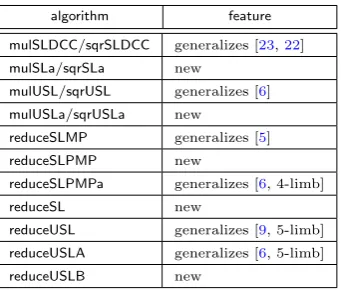
In Table1, for each algorithm presented in this work, we state whether it is new or, the earlier work that it generalizes.
There are two key theoretical features of our work.
1. While previous works have developed code for a single prime, we describe the algorithms in their full generality.
2. For each reduction algorithm, we state precise theorems about their correctness and provide detailed proofs of correctness. Such formal treatment of correctness of reduction algorithms does not appear earlier in the literature.
The second aspect of our work is in the efficient implementation of the various multiplication and squaring algorithms.
Assembly implementation: All the algorithms described in this paper, have been implemented in 64-bit assembly for Intel processors. The implementations are divided into two groups, namelymaa
and maax. For implementations in themaagroup, the only arithmetic instructions used are mul, imul, addandadc, while for implementations in themaaxgroup, the arithmetic instructionsmulx, adcx and adox are also used. These second set of instructions are available from the Broadwell processor onwards.
Library for field-arithmetic: Through our efficient 64-bit assembly implementations, we provide a li-brary of field multiplication and squarings in cryptographically relevant prime order fields targeting the modern Intel processors. The efficient field arithmetic library can be used for the development of fast projective coordinate based scalar multiplication over appropriate elliptic curves.
algorithm feature
mulSLDCC/sqrSLDCC generalizes [23,22]
mulSLa/sqrSLa new
mulUSL/sqrUSL generalizes [6]
mulUSLa/sqrUSLa new
reduceSLMP generalizes [5]
reduceSLPMP new
reduceSLPMPa generalizes [6, 4-limb]
reduceSL new
reduceUSL generalizes [9, 5-limb]
reduceUSLA generalizes [6, 5-limb]
reduceUSLB new
Table 1: The various algorithms for multiplication/squaring and reduction described in this paper.
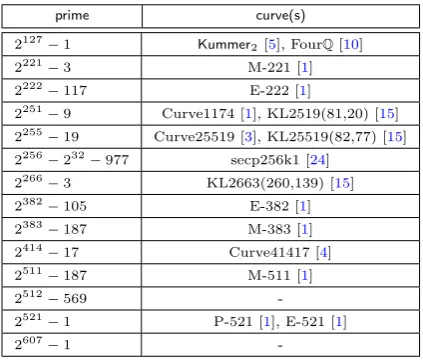
We have considered a total of fourteen primes which include all previously proposed cryptographically relevant (pseudo-)Mersenne primes at various security levels. These primes are shown in Table 2. For the prime 2255−19, we have found earlier implementations of bothmaaandmaax types and for five of
the other primes, we have found implementations of maatype. So, for eight of the fourteen primes, we provide the firstmaa type implementation and for thirteen of the fourteen primes, we provide the first
maaxtype implementations.
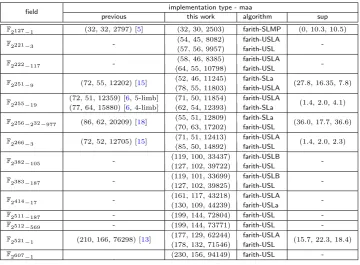
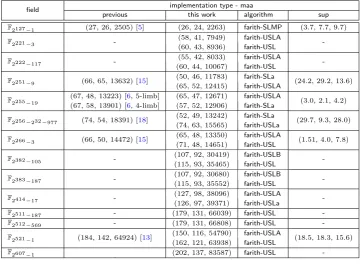
Timings of the field operations for the new implementations and the existing implementations have been measured on the Haswell and Skylake processors. For each prime where a previous implementation is available, our implementation improves upon such previous implementations. A summary of the various speed-ups that were observed is as follows. Further details are provided later.
maatype implementations:
OnHaswell: Speed-ups of about 10%, 3%, 4%, 36%, 2% and 18% were observed for the primes 2127−1, 2251−9, 2255−19, 2256−232−977, 2266−3 and 2521−1 respectively.
OnSkylake: Speed-ups of about 10%, 12%, 4%, 28%, 8% and 16% were observed for the primes 2127−1, 2251−9, 2255−19, 2256−232−977, 2266−3 and 2521−1 respectively.
maax type implementations: On the Skylake processor, a speed-up of about 26% was observed for the prime 2255−19.
The speed-ups obtained for 2255 −19 and 2256 −232−977 are particularly important. The prime
2255 −19 defines the underlying field for the famous Curve25519 while the prime 2256−232 −977
mentioned improvements arises from use of new reduction algorithms as well as hand optimisations of the corresponding assembly codes.
Source codes for all our implementations are publicly available at the following link.
https://github.com/kn-cs/pmp-farith.
Structure of the Paper
For ease of reference, we provide a brief summary of the relevant Intel instructions in Section 2. The background on representation of elements of Fp and the exponentiation based inversion algorithm are
covered in Section 3. An overview of the various algorithms presented in this paper is provided in Section 4. Algorithms for integer multiplication and squaring using the saturated limb representation and using double independent carry chains are given in Section 5. Corresponding reduction algorithms along with formal statements of correctness are presented in Section6. Multiplication using unsaturated limb representation is considered in Section7and the corresponding reduction algorithms are described in Section8. Multiplication and reduction using saturated limb representation without using double carry chains are described in Section9. Detailed timing results of the field operations and their consequences are presented in Section10. Finally, Section11concludes the paper.
prime curve(s)
2127−1 Kummer
2[5], FourQ[10]
2221−3 M-221 [1]
2222−117 E-222 [1]
2251−9 Curve1174 [1], KL2519(81,20) [15]
2255−19 Curve25519 [3], KL25519(82,77) [15] 2256−232−977 secp256k1 [24]
2266−3 KL2663(260,139) [15]
2382−105 E-382 [1] 2383−187 M-383 [1] 2414−17 Curve41417 [4]
2511−187 M-511 [1]
2512−569
-2521−1 P-521 [1], E-521 [1]
2607−1
-Table 2: The primes considered in this work.
2
A Brief Summary of Relevant Intel Instructions
The 64-bit architecture of the Intel x86 processors has sixteen 64-bit registers, namelyrax, rbx, rcx, rdx, rsi, rdi, rsp, rbp, r8, r9, r10, r11, r12, r13, r14, r15. Except rsp (which is the stack pointer), all other registers can be used for storing data and operating on them. There is a register namedFLAGS, which consists of various available flags. We note two of these flags. Bit 0 ofFLAGS is the carry flagCF and bit 11 ofFLAGSis the overflow flagOF. Integer addition and multiplication affect the states of these two flags and are relevant to our work.
The basic 64-bit arithmetic operations in the x86 processors aremul, imul, addandadc. From the Broadwell processor onwards, Intel also provides another set of arithmetic instructions, namely, mulx, adcx and adox. The structure of multiplication and addition instructions and their operations are as follows.
mulsrc2; rdx:rax←src2·rax. imulsrc1, src2,dst; dst←lsb64(src1·src2). addsrc,dst; dst←src+dst. adcsrc,dst; dst←src+dst+CF. mulxsrc1, dst`,dsth; dsth:dst`←src1·rax. adcxsrc,dst; dst←src+dst+CF. adoxsrc,dst; dst←src+dst+OF.
The effect on the carry and the overflow flags for the above mentioned arithmetic operations are the following.
•mul, imul, addandadcaffectbothCFandOF; •mulx affects neitherCFnorOF;
•adcx affects onlyCFbut, notOF; •adox affects onlyOFbut, notCF.
Suppose there is an interleaved sequence of multiplications and additions to be performed. The additions generate carries which need to be taken into consideration for subsequent additions. Themuland imul instructions affect the carry flag and so the carry out of the previous addition gets lost. On the other hand, a sequence of mulx and adcinstructions can efficiently perform such an interleaved sequence of multiplications and additions. The mulxinstruction does not affect the carry flag and so the sequence ofadcinstructions can carry out the instructions using asingle carry chain.
The combination of mulx, adcx andadox provides a more powerful tool. As mentioned above, the mulx instruction does not affect either CFor OF. A sequence ofadcx instructions proceeds by using a carry chain using onlyCF, while a sequence of adoxinstructions proceeds by using a carry chain using onlyOF. So, in effect, it is possible to use twoindependentcarry chains which we calldouble carry chain. This greatly facilitates arithmetic computations as we will see later.
Remark: Letxbe an`-bit number andη≤`. The operationxmod 2ηreturnslsbη(x), i.e., theηleast
significant bits ofx, whereas the operationbx/2ηcreturns the`−η most significant bits ofx. It will be helpful to keep this simple observation in mind while going through the various algorithms given later.
3
Representation of Elements in
Fp
Letη be a positive integer andθ= 2η. Consider a polynomial
h(θ) = h0+h1θ+· · ·+hk−1θk−1 (1)
whereh0, h1, . . . , hk−1are non-negative integers. The polynomialh(θ) is given by the vector of coefficients
(h0, h1, . . . , hk−1). We will call these coefficients to be the limbs of the polynomial. Note that we do
not insist that the coefficients are less than 2η; in fact, at intermediate steps, the coefficients will not necessarily be less than 2η.
Given positive integersmandη, letκandν be positive integers such that
m = η(κ−1) +ν with 0< ν ≤η. (2)
Givenmandη, the values ofκandνare uniquely determined. An integer in the range [0, . . . ,2m−1] can be represented by anm-bit string. From (2), anm-bit string can be considered to be the concatenation ofκstrings, where the firstκ−1 strings are eachη bits long while the last string isν bits long. So, an m-bit integer can be represented as h(θ) =h0+h1θ+· · ·+hκ−1θκ−1 where 0≤h0, h1, . . . , hκ−1 <2η
and 0≤hκ−1<2ν. As mentioned above, each of theκindividual strings will be referred to as a limb. Given anm-bit integer, by a(κ, η, ν)-representation we will mean aκ-limb representation, where the first
κ−1 limbs areη bits long, the last limb isν bits long andm=η(κ−1) +ν.
Proposition 1. Letxandybe twom-bit integers both having a(κ, η, ν)-representation and letz=x·y. Thenz has a (κ0, η, ν0)-representation where
κ0 = 2κ−1, ν0= 2ν if0< ν≤η/2; and κ0 = 2κ, ν0= 2ν−η if η/2< ν≤η.
Proof. We have m =η(κ−1) +ν. The number of bits in z is at most 2m and we may write 2m = η(2κ−2) + 2ν. If 0< ν ≤η/2, thenzhas a (2κ−1)-limb representation where the first 2κ−2 limbs are eachη bits long and the last limb isν0 = 2ν bits long. On the other hand, ifη/2< ν ≤η, then we may write 2m=η(2κ−1) + 2ν−η and sozhas a 2κ-limb representation where the first 2κ−1 limbs are each η bits long and the last limb is 2ν−η bits long. (Note thatη/2< ν≤η implies 0<2ν−η≤η.)
Consider a (κ, η, ν)-representation of anm-bit integerw. Suppose thatω-bit arithmetic will be used for implementation. Using ω-bit arithmetic,w will be represented byκ ω-bit wordsw0, . . . , wκ−1 such
that the binary representation ofwis given by
lsbν(wκ−1)||lsbη(wκ−2)|| · · · ||lsbη(w0). (3)
Herelsbi(x) denotes theileast significant bits of the binary string xand 0< ν≤η≤ω. Depending on
Saturated limb representation: In this caseη =ω. So, each of the ω-bit words w0, w1, . . . , wκ−2
are “saturated” in the sense that there are no leading redundant bits in these words. The ω-bit wordwκ−1 is saturated or unsaturated depending on whetherν=η orν < η respectively.
Unsaturated limb representation: In this caseη < ω. So, each of theω-bit wordsw0, w1, . . . , wκ−1
are “unsaturated” in the sense that they contain some leading redundant bits. The word wκ−1
contains the same or more leading redundant bits according as whetherν=ηorν < ηrespectively.
Remark: In this work, we will consider 64-bit arithmetic and so ω = 64. The general ideas of the algorithms apply to arbitrary values of ω. The actual value of ω = 64 is used at some places in the (non-)overflow analysis of the correctness proofs.
The primespthat we consider are of the form
p = 2m−δ, (4)
whereδis sufficiently small. Given (κ, η, ν)-representation ofm-bit integers, we have
2η(κ−1)+ν = 2m≡δmodp. (5)
For future reference, we define
cp = 2η−νδ. (6)
The different values of m, δ, κ, η andν for the various primes pconsidered in this work are given in Table 3 2. For each prime, two sets of values of κ, η and ν are provided, one using saturated limb
representation and the other using unsaturated limb representation.
The main goal of obtaining a representation of mof the form (2) is to minimize the value ofκ. As the value of κgrows, so does the complexity of multiplication. Clearly the value of κis minimized for the saturated limb representations. An issue with the saturated limb representations is that each limb has the maximum possible size and so handling overfull issues can be complex. It is for this reason that one considers the unsaturated limb representations. For the unsaturated limb representations, in Table3 there is a column labeled “type”. This column refers to the particular type of reduction algorithm which applies best to the corresponding prime and will be explained in details later.
prime m δ unsaturated limb saturated limb
κ η ν type κ η ν
2127−1 127 1 3 43 41 A 2 64 63
2221−3 221 3 4 56 53 A 4 64 29
2222−117 222 117 4 56 54 A 4 64 30
2251−9 251 9 5 51 47 A 4 64 59
2255−19 255 19 5 51 51 A 4 64 63
2256−232−977 256 232+ 977 5 52 48 A 4 64 64
2266−3 266 3 5 54 50 A 5 64 10
2382−105 382 105 7 55 52 B 6 64 62
2383−187 383 187 7 55 53 B 6 64 63
2414−17 414 17 8 52 50 A 7 64 30
2511−187 511 187 9 57 55 G 8 64 63
2512−569 512 569 9 57 56 G 8 64 64
2521−1 521 1 9 58 57 A 9 64 9
2607−1 607 1 10 61 58 G 10 64 31
Table 3: The primes considered in this work and their saturated and unsaturated limb representations.
Supposem-bit integers have a (κ, η, ν)-representation andθ= 2η. The primep= 2m−δis represented as the polynomialp(θ), defined as
p(θ) = p0+p1θ+· · ·+pκ−1θκ−1, (7)
wherep0= 2η−δ,p1=p2=· · ·=pκ−2= 2η−1, andpκ−1= 2ν−1.
An element in Fp is represented as a polynomialf(θ) of degree at mostκ−1, defined as
f(θ) = f0+f1θ+· · ·+fκ−1θκ−1, (8)
where 0≤f0, f1, . . . , fκ−1<2η and 0≤fκ−1<2ν.
It should be noted that the polynomials f(θ) are in one-one correspondence with the integers 0,1, . . . ,2m −1. This leads to a non-unique representation of δ elements in
Fp, i.e., the elements
0,1, . . . , δ−1 are also represented as 2m−δ,2m−δ+ 1, . . . ,2m−1. The non-unique representation
does not affect the correctness of the computations. At the end of the computation, the final result is converted to a unique representation using a simple algorithm. This procedure is shown in Algorithm1.
Algorithm 1Converts to unique representation inFp, where p= 2m−δ. 1: functionmakeUnique(h(0)(θ))
2: input: h(0)(θ) =h(0)0 +h1(0)θ+· · ·+h(0)κ−1θκ−1, where 0≤h(0)0 , h(0)1 , . . . , h(0)κ−2<2ηand 0≤h(0)κ−1<2ν.
3: output: h(1)(θ) =h(1) 0 +h
(1)
1 θ+· · ·+h (1)
κ−1θκ−1, where 0≤h (1)
0 <2η−δ, 0≤h (1) 1 , h
(1) 2 , . . . , h
(1) κ−2<2η,
0≤h(0)κ−1<2ν andh(1)(θ)≡h(0)(θ) modp. 4: u←h(0)0 ≥p0
5: fori←1 toκ−2do 6: u←u& (h(0)i = 2η−1) 7: end for
8: u←u& (h(0)κ−1=pκ−1) 9: v← −u;u← ¬v
10: h(1)0 ←(h(0)0 &u)|((h(0)0 −p0) &v) 11: fori←1 toκ−1do
12: h(1)i ←(h(0)i &u)|(0 &v)
13: end for
14: returnh(1)(θ) =h(1) 0 +h
(1)
1 θ+· · ·+h (1) κ−1θκ−1 15: end function.
3.1 Inversion in Fp
Fermat’s little theorem states that for a prime pand any non-zero a∈Fp, ap−1≡1 modp. So, ap−2 is
the inverse ofa in Fp. Thus, the computation of inverse of any non-zero element in Fp reduces to the
problem of exponentiating ato the power p−2. The standard way to compute this exponentiation is to use the square-and-multiply algorithm. Since, the valuep−2 is fixed, the numbers of squarings and multiplications are fixed and do not depend on the value ofa. So, if squaring and multiplication in Fp
are constant time algorithms, then the exponentiation based inversion is also a constant time algorithm. Till recently, FLT based inversion was considered to be the more efficient of the two methods for inversion in (pseudo-)Mersenne prime order fields. On the face of it, this seems counter-intuitive since the Fermat based approach uses multiplications and squarings, whereas the Euclid based approach uses only additions and logical shifts. The reason for Fermat based approach being faster for (pseudo-)Mersenne primes seems to be based on two factors, namely, the number of iterations in the Euclid based approach is more and the availability of very fast multiplication instructions in modern processors. Defying this reasoning, a recent work by Bernstein and Yang [2] showed that the Euclid based approach could indeed be faster for (pseudo-)Mersenne primes.
Remark: In the rest of the paper, we will focus entirely on field multiplication and squaring. In comparison, field addition, negation and subtraction are much faster. We note one important difference in these operations which arises from the representation of the elements. For saturated limb representations, field addition/negation/subtraction can be implemented using add/adc/sub/sbb. On the other hand, for unsaturated limb representations, implementation of these operations also require shift operations.
4
Overview of the Algorithms
Meanings of various abbreviations:
SL : saturated limb;
USL : unsaturated limb;
SCC : single carry chain;
DCC : double (independent) carry chains;
MP : Mersenne prime;
PMP : pseudo-Mersenne prime;
maa : algorithms implemented using onlymul,imul,addandadc;
maax: algorithms which also usemulx,adcxandadox.
Brief descriptions of the tasks of the different algorithms that we consider are given below.
Algorithms for the saturated limb representation:
mulSCC: Multiply a word whose value is less than 264 to an integer given by a saturated limb represen-tation using a single carry chain.
mulSLDCC: Multiply two integers given in saturated limb representations using double (independent) carry chains.
sqrSLDCC: Square an integer given in saturated limb representation using double carry chains.
reduceSLMP: Reduction algorithm to be applied to the outputs of mulSLDCC or sqrSLDCCwhen the underlying prime is a Mersenne prime.
reduceSLPMP: Reduction algorithm to be applied to the outputs ofmulSLDCCor sqrSLDCCwhen the underlying prime is a pseudo-Mersenne prime.
reduceSLPMPa: A partial reduction algorithm to be applied to the outputs ofmulSLDCC orsqrSLDCC
when the underlying prime is a pseudo-Mersenne prime.
mulSLa: Multiply two integers given in saturated limb representations and perform an initial step of the reduction.
sqrSLa: Square an integer given in saturated limb representation and perform an initial step of the reduction.
reduceSL: A generic reduction algorithm to be applied to the outputs of mulSLa/sqrSLa.
farith-SLa: Denotes the algorithm triplet which computes a field multiplication, squaring and inverse usingmulSLa, sqrSLaand reduceSL.
farith-SLMP: Denotes the algorithm triplet which computes a field multiplication, squaring and inverse usingmulSL, sqrSLandreduceSLMP. See the remark below formulSLandsqrSL.
farithx-SLMP: Denotes the algorithm triplet which computes a field multiplication, squaring and inverse usingmulSLDCC, sqrSLDCC andreduceSLMP.
farithx-SLPMP: Denotes the algorithm triplet which computes a field multiplication, squaring and inverse usingmulSLDCC, sqrSLDCC andreduceSLPMP.
Remark: The output of mulSLDCC is the product of the two integers and the output ofsqrSLDCC is the square of an integer. Algorithms mulSLDCC/sqrSLDCC utilize double carry chains to perform the computations. The product of two integers in the saturated limb representation can also be performed without using double carry chains and similarly, the square of an integer in the saturated limb representa-tion can be performed without using double carry chains. For the prime 2255−19, the 4-limb algorithms
in [6] perform such computations. The 4-limb algorithms in [6] can be extended to work for arbitrary limb representations. We will denote the resulting multiplication and squaring algorithms bymulSLand
Algorithms for the unsaturated limb representation:
mulUSL: Multiply two integers given in unsaturated limb representations and perform an initial step of the reduction.
sqrUSL: Square an integer given in unsaturated limb representation and perform an initial step of the reduction.
mulUSLa: Multiply two integers given in unsaturated limb representations and perform an initial step of the reduction. This is a variant ofmulUSLwhich is to be used whenmulUSLleads to overflows.
sqrUSLa: Square an integer given in unsaturated limb representation and perform an initial step of the reduction. This is a variant ofsqrUSLwhich is to be used whensqrUSLleads to overflows.
reduceUSL: A generic reduction algorithm to be applied to the outputs of mulUSL/sqrUSL or mu-lUSLa/sqrUSLa.
reduceUSLA: An algorithm to be applied to the outputs ofmulUSL/sqrUSLor mulUSLa/sqrUSLa when the prime is of type A. For such primes,reduceUSLA is more efficient thanreduceUSL.
reduceUSLB: An algorithm to be applied to the outputs ofmulUSL/sqrUSLor mulUSLa/sqrUSLa when the prime is of type B. For such primes,reduceUSLBis more efficient thanreduceUSLorreduceUSLA.
farith-USL: Denotes the algorithm triplet which computes a field multiplication, squaring and inverse usingmulUSL, sqrUSL andreduceUSL.
farith-USLA: Denotes the algorithm triplet which computes a field multiplication, squaring and inverse usingmulUSLA, sqrSLAandreduceUSLA.
farithx-USLB: Denotes the algorithm triplet which computes a field multiplication, squaring and inverse usingmulUSLB, sqrUSLB andreduceUSLB.
farithx-USLa: Denotes the algorithm triplet which computes a field multiplication, squaring and inverse usingmulUSLa, sqrUSLaandreduceUSLA.
The implementations of the various algorithms are divided into two groups.
Algorithms in the maasetting: The algorithmsfarith-SLa,farith-USL,farith-USLA,farith-USLBand
farith-USLa have been implemented in assembly using only the instructions mul, imul, addand adcto do arithmetic. These implementations are downward compatible with previous generations of Intel processors.
Algorithms in the maax setting: The implementations of the algorithmsfarithx-SLMPand farithx-SLPMPalso use the instructionsmulx, adcxandadoxfor doing arithmetic. These implementations work on the Broadwell and later generation processors.
Descriptions of the algorithms. We describe a number of algorithms. The descriptions of the algorithms are at a fairly high level. They are provided in a form which make it easy to understand the algorithms and present the proofs of correctness. For the various reduction algorithms, the input is considered to be a polynomialh(0)(θ), withθ= 2η, and the output ish(k)(θ) for somek≥1, such that
h(0)(θ)≡h(1)(θ)≡ · · · ≡h(k)(θ) modp.
Conceptually, the algorithm proceeds in stages where thei-th stage computesh(i)(θ) from h(i−1)(θ) for i = 1,2, . . . , k. The proofs of correctness show that h(i)(θ)≡h(i−1)(θ) modpand also provide precise
bounds on the coefficients ofh(i)(θ). In order to define the polynomialsh(i)(θ), the algorithms use certain
statements which simply copy some of the coefficients ofh(i−1)(θ) to h(i)(θ). Also, for ease of reference
in the proofs, certain temporary variables are indexed by the loop counter creating the impression that a number of such variables are required, whereas in actual implementation one variable is sufficient.
5
Integer Multiplication/Squaring for Saturated Limb Representation Using
Independent Carry Chains
Letcbe anη-bit constant,θ= 2ηandf(θ) be a polynomial inθof degree at mostd−1 whose coefficients
are fromZθ. A basic step in the multiplication and squaring algorithms is the computationc·f(θ). The
result is a polynomial h(θ) of degree at most dand whose coefficients are from Zθ. Function mulSCC
given in Algorithm2 performs this computation.
Algorithm 2Multiply f(θ) with anη-bit constantc;θ= 2η, η= 64.
1: functionmulSCC(f(θ), c)
2: input: f(θ) =f0+f1θ+· · ·+fd−1θd−1,c, where 0≤c, f0, f1, . . . , fd−1<2η andd≥1. 3: output: h(θ) =h0+h1θ+· · ·+hdθd=c·f, where 0≤h0, h1, . . . , hd<2η.
4: t←c·f0;h0←tmod 2η;h1← bt/2ηc 5: c←0
6: fori←1 tod−1do
7: t←c·fi; hi+1← bt/2ηc
8: t←hi+tmod 2η+c;hi←tmod 2η;c← bt/2ηc 9: end for
10: hd ←hd+c
11: returnh(θ) =h0+h1θ+· · ·+hdθd 12: end function.
The multiplication in Step 4 of mulSCC can be completed using a single mulx operation. The for loopin Steps 6 to 9 uses an interleaved sequence of multiplications and additions. The additions involve a carry propagation through the variable c. Step 4 can be completed using a single mulx instruction while Step 5 can be completed using anadcinstruction. The single bit value of the carry variable cis carried through CF. Note that mulx does not affect CFand so it is possible to use adcinstructions to implement the carry chain. Since the mulinstruction affects CF, usingmul instead of mulx would not have allowed an efficient implementation of the carry chain usingadcinstructions.
The single carry chain of mulSCC is pictorially depicted in Figure 1a. The horizontal rectangular boxes denote the two η-bit quantities arising out of the multiplication shown at the left end of the corresponding row. The vertical oval shape encapsulates the quantities that are added using the adc instruction. These consist of twoη-bit quantities and the carrycwhose value is available in theCFflag. In general, it is required to multiply two integers written as polynomialsf(θ) andg(θ) having degrees danderespectively. This is performed using FunctionmulSLDCCgiven in Algorithm 3. The algorithm is written in a manner so that there are two independent carry chains in action. This is illustrated in Figure1b.
Algorithm 3Multiply f(θ) andg(θ);θ= 2η, η= 64. 1: functionmulSLDCC(f(θ), g(θ))
2: input: f(θ) = f0 +f1θ +· · · +fd−1θd−1 and g(θ) = g0 +g1θ +· · ·+ge−1θe−1, where 0 ≤ f0, f1, . . . , fd−1, g0, g1, . . . , ge−1<2η, andd≥e≥2.
3: output: h(θ) =h0+h1θ+· · ·+hd+e−1θd+e−1=f ·g, where 0≤h0, h1, . . . , hd+e−1<2η. 4: h0+h1θ+· · ·+hdθd←mulSCC(f(θ), g0)
5: fori←1 toe−1 do 6: c1←0; c2←0 7: forj←0 tod−1 do
8: t←gi·fj
9: r←hi+j+ (tmod 2η) +c1 10: s←hi+j+1+bt/2ηc+c2
11: hi+j←rmod 2η; c1← br/2ηc 12: hi+j+1←smod 2η; c2← bs/2ηc 13: end for
14: hi+j+1←hi+j+1+c1 15: end for
16: returnh(θ) =h0+h1θ+· · ·+hd+e−1θd+e−1 17: end function.
c·f0: h0 h1
c·f1: • h2
h1 h2 c
HHj
c·f2: • h3
h2 h3 c
HHj
c·f3: • h4
h3 h4 c
HHj
(a) Single carry chain formulSCC.
g0·f: h0 h1 h2 h3 h4 h5 h6
g1·f0: • •
h1 h2 h3
c1 HHj HHjc2
g1·f1: • •
h2 h3 h4
c1 HHj HHjc2
g1·f2: • •
h3 h4 h5
c1 HHj HHjc2
g1·f3: • •
h4 h5 h6
c1 HHj HHjc2
(b) Two independent carry chains formulSLDCC.
Figure 1: Illustration of carry chains.
additions are also independent and can be performed simultaneously. The additions, however, depend on the result of the previous multiplication. Themulxinstruction is used to perform the multiplications. This instruction does not affect either CF or OF. The two independent carry chains arising in Func-tion mulSLDCC (and as illustrated in Figure 1b) are implemented using a sequence of adcx and adox instructions. Theadcxinstruction usesCFto propagate the carry while theadoxinstruction usesOFto propagate the carry.
Intel processors have multiple ALUs. So, the independent additions can be simultaneously executed on two separate ALUs. Further, subject to availability, the independent multiplications can be scheduled on separate ALUs and the multiplications and additions can be scheduled in a pipelined manner on separate ALUs such that the time for addition does not cause any delay in the overall computation.
Squaring an integer of the formf(θ) can be performed by setting both inputs inmulSLDCCto be equal tof(θ). On the other hand, it is possible to reduce the number of multiplications. FunctionsqrSLDCC
given in Algorithm4squaresf(θ). It consists of three phases. In the first phase, the cross product terms are computed; in the second phase, these are multiplied by 2 (which is a doubling operation); and in the third phase, the squares of the coefficients of f(θ) are computed. Multiplications are performed in the first and the third phase. In the first phase, two independent carry chains arise in a manner similar to that of mulSLDCC. These two chains are implemented using the instructionsmulx, adcx andadox. In the third phase, there is a single carry chain which is implemented using the instructionsmulxandadc in a manner similar to that used inmulSCC.
6
Reduction in
Fp
Using Saturated Limb Representation
Forp= 2m−δ, elements ofFp arem-bit integers and have a (κ, η, ν)-representation. In this section, we
consider saturated limb representation and so η = 64. As mentioned earlier, a multiplication/squaring in Fp consists of an integer multiplication/squaring followed by a reduction. The integer multiplication
and squaring operations are respectively performed by the functionsmulSLDCCandsqrSLDCCdescribed in Section 5. In both cases, two m-bit integers having (κ, η, ν)-representations are multiplied and the product is a 2m-bit integer having (κ0, η, ν0)-representation where the values ofκ0 and ν0 are given by Proposition 1. The task of the reduction is to reduce the product modulo pto anm-bit integer which again has a (κ, η, ν)-representation.
We provide two reduction algorithms using the saturated limb representation, namely reduceSLMP
Algorithm 4Square f(θ);θ= 2η, η= 64. 1: functionsqrSLDCC(f(θ))
2: input: f(θ) =f0+f1θ+· · ·+fd−1θd−1 such that 0≤f0, f1, . . . , fd−1<2η.
3: output: h=h0+h1θ+· · ·+h2d−1θ2d−1=f2such that 0≤h0, h1, . . . , h2d−1<2η. 4: h1+h2θ+· · ·+hdθd←mulSCC(f1+f2θ+· · ·+fd−1θd−2, f0)
5: fori←1 to d−3 do hd+i ←0end for 6: fori←1 tod−3do
7: c1←0; c2←0
8: forj←i+ 1 tod−1do
9: t←fi·fj
10: r←hi+j+ (tmod 2η) +c1;s←hi+j+1+bt/2ηc+c2 11: hi+j←rmod 2η; c1← br/2ηc
12: hi+j+1←smod 2η; c2← bs/2ηc 13: end for
14: hi+j+1←hi+j+1+c1 15: end for
16: t←fd−1·fd−2
17: r←h2d−3+ (tmod 2η);h2d−3←rmod 2η 18: c← br/2ηc;h2d−2← bt/2ηc+c
19: h2d−1← bh2d−2/2η−1c
20: fori←2d−1 down to2 do hi←(2himod 2η) +bhi−1/2η−1cend for 21: h1←2h1mod 2η
22: t←f0·f0
23: h0←tmod 2η; t←h1+bt/2ηc 24: h1←tmod 2η; c← bt/2ηc 25: fori←1 tod−1do
26: t←fi·fi
27: r←h2i+ (tmod 2η) +c;h2i←rmod 2η;c← br/2ηc 28: r←h2i+1+bt/2ηc+c;h2i+1 ←rmod 2η; c← br/2ηc 29: end for
30: returnh(θ) =h0+h1θ+. . .+h2d−1θ2d−1 31: end function.
Algorithm 5 Reduction for saturated limb representation. Performs reduction modulo p, where p= 2m−1 is a Mersenne prime; θ= 2η.
1: functionreduceSLMP(h(0)(θ)) 2: Input: h(0)(θ).
3: Output: h(3)(θ).
4: fori←2κ−1 down to κdo
5: h(1)i ←(2η−νh(0)
i ) mod 2η+bh (0)
i−1/2νc;h (1) i−κ←h
(0) i−κ 6: end for
7: h(1)κ−1←h(0)κ−1mod 2ν
8: t←h(1)0 +h(1)κ ;h(2)0 ←tmod 2η;c← bt/2ηc 9: fori←1 toκ−2do
10: t←h(1)i +h(1)κ+i+c;h(2)i ←tmod 2η;c← bt/2ηc 11: end for
12: h(2)κ−1←h(1)κ−1+h(1)2κ−1+c
13: t←h(2)0 +bh(2)κ−1/2νc;h(3)0 ←tmod 2η;c← bt/2ηc 14: fori←1 toκ−2do
15: t←h(2)i +c;hi(3) ←tmod 2η;c← bt/2ηc 16: end for
17: h(3)κ−1←h(2)κ−1mod 2ν+c
18: Full Reduction: returnh(3)(θ) =h(3)0 +h1(3)θ+· · ·+h(3)κ−1θκ−1
19: end function.
for pseudo-Mersenne primes.
6.1 Mersenne Primes
Letp= 2m−1 and supposem-bit integers have a (κ, η, ν)-representation. FunctionreduceSLMP given
in Algorithm5takes as input the output of eithermulSLDCCorsqrSLDCCand outputs anm-bit integer in an (κ, η, ν)-representation, which is congruent to the input modulop.
The following result states the correctness of reduceSLMP
Theorem 2. Let p= 2m−1 be a Mersenne prime and let κ≥2,η andν be such that,m-bit integers have a (κ, η, ν)-representation. Suppose that the input h(0)(θ) to reduceSLMP is the output of either
mulSLDCC(f(θ), g(θ))orsqrSLDCC(f(θ))wheref(θ)andg(θ)representm-bit integers having (κ, η, ν) -representations. Then the output h(3)(θ) of reduceSLMP has a (κ, η, ν)-representation and h(3)(θ) ≡ h(0)(θ) modp.
Proof. Sincem-bit integers have a (κ, η, ν)-representation, we havem=η(κ−1) +ν with 0< ν≤η. If ν =η, thenm=κη and sop= 2m−1 = 2κη−1 = (2κ)η−1, which has a factor 2κ−1 contradicting
thatpis a prime. So, ifpis a Mersenne prime, then it necessarily follows thatν < η.
The input h(0)(θ) to reduceSLMP is the product of two m-bit integers each having a (κ, η, ν )-representation. From Proposition 1, the 2m-bit integer h(0)(θ) has a (κ0, η, ν0)-representation where the values ofκ0 andν0 are given by Proposition1. Using these values, we have the following bounds on the coefficients ofh(0)(θ).
0≤h(0)0 , h(0)1 , . . . , h(0)2κ−3<2η; and
0≤h(0)2κ−2<22ν, h(0)
2κ−1= 0 if 0< ν ≤η/2;
0≤h(0)2κ−2<2η, 0≤h(0)
2κ−1<22ν−η if η/2< ν < η.
(9)
The inputh(0)(θ) can be written as
h(0)(θ) =h(0)0 +h(0)1 θ+· · ·+h(0)κ−1θκ−1+h(0)κ θκ+h(0)κ+1θκ+1+· · ·+h(0)2κ−1θ2κ−1, = (h(0)0 +h(0)1 θ+· · ·+h(0)κ−1θκ−1) + (h(0)κ +h(0)κ+1θ+· · ·+h2κ(0)−1θκ−1)θκ,
≡(h(0)0 +h(0)1 θ+· · ·+h(0)κ−1θκ−1) + (hκ(0)+h(0)κ+1θ+· · ·+h(0)2κ−1θκ−1)2η−νmodp, (10)
since using (5) and δ = 1, we have θκ = 2κη = 2(κ−1)η+ν ·2η−ν = 2m·2η−ν ≡ 2η−ν modp. For j=κ−1, κ, . . . ,2κ−2, define
h(0)j =h(0)j,0+hj,1(0)2ν, whereh(0)j,0 =h(0)j mod 2ν, andh(0)j,1 =bh(0)j /2νc. (11)
Using (9), we have the following bounds onh(0)j,0 andh(0)j,1.
Claim 1. 0≤h(0)j,0 <2ν for j=κ−1, κ, . . . ,2κ−2; 0≤h(0) j,1 <2
η−ν forj =κ−1, κ, . . . ,2κ−3; and
0≤h(0)2κ−2,1<2ν if0< ν≤η/2;0≤h(0)2κ−2,1<2η−ν if η/2< ν < η. Substituting (11) into (10) we obtain
h(0)(θ)
≡ (h(0)0 +h(0)1 θ+· · ·+h(0)κ−2θκ−2+ (h(0)κ−1,0+h(0)κ−1,12ν)θκ−1) +
((h(0)κ,0+h(0)κ,12ν) + (h(0)κ+1,0+h(0)κ+1,12ν)θ+· · ·+ (h(0)2κ−2,0+h2κ(0)−2,12ν)θκ−2 + h(0)2κ−1θκ−1)2η−ν modp
= (h(0)0 +h(0)1 θ+· · ·+h(0)κ−2θκ−2+h(0)κ−1,0θκ−1) +
(h(0)κ−1,12((κ−1)η+ν)+h(0)κ,02η−ν+hκ,1(0)2η+h(0)κ+1,022η−ν+h(0)κ+1,122η+· · ·+ (12) h(0)2κ−2,02(κ−1)η−ν+h(0)2κ−2,12(κ−1)η+h(0)2κ−12κη−ν) [usingθ= 2η] (13)
≡ (h(0)0 +h(0)1 θ+· · ·+h(0)κ−2θκ−2+h(0)κ−1,0θκ−1) +
(h(0)κ−1,1+ 2η−νh(0)κ,0) + (h(0)κ,1+ 2η−νh(0)κ+1,0)θ+ (h(0)κ+1,1+ 2η−νh(0)κ+2,0)θ2+· · ·+
InreduceSLMP, Steps4 to7perform the computations in (14), giving us
h(0)(θ)≡(h(1)0 +h(1)1 θ+· · ·+h(1)κ−1θκ−1) + (h(1)κ +h (1)
κ+1θ+· · ·+h (1) 2κ−1θ
κ−1
)
| {z }
through Steps4to7
=h(1)(θ), (15)
whereh(1)j =h(0)j forj= 1,2, . . . , κ−2,h(1)κ−1=h(0)κ−1,0,
h(1)j = 2η−νh(0)j,0+h(0)j−1,1 forj=κ, κ+ 1, . . . ,2κ−2, andh(1)2κ−1= 2η−νh(0)2κ−1+h(0)2κ−2,1.
In (15), it directly follows that 0 ≤ h(1)0 , h(1)1 , . . . , h(1)κ−2 < 2η and h(1)
κ−1 < 2ν. The bounds on h(1)κ , h(1)κ+1, . . . , h(1)2κ−1 are given in the following result.
Claim 2. 0≤h(1)κ , h (1) κ+1, . . . , h
(1) 2κ−2<2
η and0≤h(1) 2κ−1<2
ν.
Proof. Using Claim1, forj=κ, κ+ 1, . . . ,2κ−2 we have
0≤h(1)j = bh(0)j−1/2νc+ (2η−νh(0)j ) mod 2η = h(0)j−1,1+ (2η−νh(0)j,0+ 2ηh(0)j,1) mod 2η = h(0)j−1,1+ 2η−νh(0)j,0,
which implies 0≤h(1)j <2η−ν+ 2η−ν(2ν−1) = 2η. The argument for the bounds on h(1)
2κ−1 is in two
cases.
Case 1: 0< ν≤η/2. From (9) and Claim1,h2κ(1)−1= 2η−νh(0) 2κ−1+h
(0)
2κ−2,1<2ν.
Case 2: η/2< ν < η. From (9) and Claim1,h2κ(1)−1= 2η−νh(0) 2κ−1+h
(0)
2κ−2,1<2η−ν(22ν−η−1) + 2η−ν=
2ν.
In Steps8to12, we pairwise add the coefficients ofθ0, θ1, . . . , θκ−1sequentially in (15) by forwarding
the 1-bit carry to the subsequent pair to get an intermediateκ-limb polynomialh(2) as
h(1)(θ) = (h(1)0 +h(1)κ ) + (h(1)1 +h(1)κ+1)θ+· · ·+ (h(1)κ−1+h(1)2κ−1)θκ−1, =h(2)0 +h(2)1 θ+· · ·+h(2)κ−1θκ−1
| {z }
through Steps8to12
=h(2)(θ). (16)
From the computation done in the Steps8to 11it follows that
0≤h(2)0 , h(2)1 , . . . , h(2)κ−2<2η. (17)
Also, since 0≤h(1)κ−1, h(1)2κ−1≤2ν−1 and 0≤c≤1, we have
0≤h(2)κ−1=h(1)κ−1+h(1)2κ−1+c ≤ 2ν+1−1 (18)
≤ 2η−1 (using ν < η). (19)
From (15), (16), (17) and (18), we haveh(2)(θ)≡h(0)(θ) modpandh(2)(θ) has a (κ, η, ν+1)-representation. Equation (19) proves that Step12does not lead to an overflow. Define
h(2)κ−1=h(2)κ−1,0+h(2)κ−1,12ν, whereh(2)κ−1,0=h(2)κ−1mod 2ν and h(2)
κ−1,1=bh (2)
κ−1/2νc. (20)
From (18), it follows that that 0≤h(2)κ−1,0<2ν and 0≤h(2)
κ−1,1≤1. We write
h(2)(θ) =h(2)0 +h1(2)θ+· · ·+h(2)κ−2θκ−2+ (h(2)κ−1,0+h(2)κ−1,12ν)θκ−1 =h(2)0 +h1θ+· · ·+h
(2) κ−2θ
κ−2+h(2) κ−1,0θ
κ−1+h(2) κ−1,12
(κ−1)η+ν
≡(h(2)0 +h(2)κ−1,1) +h(2)1 θ+· · ·+h(2)κ−2θκ−2+h(2)κ−1,0θκ−1modp[using (5) andδ= 1]. (21)
Claim 3. Ifh(2)κ−1,1= 1, then it is impossible to simultaneously have h(2)0 =h(2)1 =· · ·=h(2)κ−2= 2η−1 andh(2)κ−1,0= 2ν−1.
Proof. Supposeh(2)κ−1,1 = 1 and let if possible,h(2)0 =h(2)1 =· · ·=h(2)κ−2= 2η−1,h(2)κ−1,0= 2ν−1. So, from (20), we haveh(2)κ−1=h(2)κ−1,0+h(2)κ−1,12ν = 2ν+1−1. In this case, the polynomialh(2)(θ) is given as follows.
h(2)(θ) =h(2)0 +h(2)1 θ+· · ·+h(2)κ−1θκ−1,
= (2η−1) + (2η−1)2η+· · ·+ (2ν+1−1)2(κ−1)η, = 2(κ−1)η+ν+1−1,
= 2m+1−1 [using (5)]. (22)
From (16), h(2)(θ) is obtained by adding the polynomials (h(1)0 +h(1)1 θ+· · ·+h(1)κ−1θκ−1) and (h(1)κ + h(1)κ+1θ+· · ·+h(1)2κ−1θκ−1), where 0≤h(1)
0 , h (1) 1 , . . . , h
(1) κ−2, h
(1) κ , . . . , h
(1)
2κ−2<2η and 0≤h (1) κ−1, h
(1)
2κ−1<2ν.
So, the maximum possible value of each of the polynomials is 2m−1 and hence the bounds ofh(2)(θ)
should be 0≤h(2)(θ)<2m+1−1, which contradicts what is obtained in (22). Hence the result.
The computation h(3)0 = (h(2)0 +bh(2)κ−1/2νc) mod 2η in (21) is performed in Step13, and the 1-bitc
is forwarded to the subsequent terms for addition, which are performed in Steps14to17producing the values ofh(3)1 , h(3)2 , . . . , h(3)κ−1. Hence, (21) can be written as
h(2)(θ)≡h(3)0 +h(3)1 θ+· · ·+h(3)κ−1θκ−1
| {z }
through Steps14to17
mod p=h(3)(θ).
(23)
We now argue that either thecout of Step13is 0 or it is absorbed in one of the subsequent additions in Steps15or in the addition in Step17. Ifh(2)κ−1,1= 0, then thecout of Step13itself is 0. So, suppose that h(2)κ−1,1 = 1. From Claim3, it follows that either there is aj ∈ {0,1, . . . , κ−2} such that h(2)j <2η−1
orh(2)κ−1,0<2ν−1. In the former case, thecis absorbed by one of the additions in Step15; if this does not happen, then the later case arises and the carry is absorbed by the addition in Step17.
This shows that the algorithm terminates without any overflow and at the end of the algorithm we have 0 ≤ h(3)0 , h(3)1 , . . . , h(3)κ−2 < 2η and 0 ≤ h(3)κ−1 < 2ν and so h(3)(θ) has a (κ, η, ν)-representation. Further, By combining (15), (16), (21) and (23) we have h(3)(θ) ≡ h(0)(θ) modp, which proves the
statement of the theorem on full reduction.
6.2 Pseudo-Mersenne Primes
Letp= 2m−δand supposem-bit integers have a (κ, η, ν)-representation. FunctionreduceSLPMPgiven in Algorithm6takes as input the output of eithermulSLDCCorsqrSLDCCand outputs anm-bit integer in an (κ, η, ν)-representation which is congruent to the input modulop.
As in the case ofreduceSLMP, for the correctness ofreduceSLPMP, it is not required to haveη= 64. The value ofη = 64 is used for 64-bit implementation and the algorithm can equally well be used with η-bit arithmetic for any value ofη (sayη= 32 orη= 128).
We note that reduceSLMP does not work ifδ >1. This may not be immediately obvious from the description of reduceSLMP. To see that reduceSLMP does not work whenδ > 1, one needs to consider the proof of correctness of the algorithm. In the proof of Theorem 2, the step from (13) to (14) uses 2(κ−1)η+ν = 2m ≡δmodp. In the case of Mersenne primes,δ = 1 and so the step from (13) to (14)
works; for δ > 1, this step does not work. Instead, we consider a multiplication of the upper half of the input by cp = 2η−νδ at the very beginning and then the resulting polynomial is reduced in several
steps. Due to this multiplication, the number of iterations required to obtain the complete reduction in
reduceSLPMPis one more than that required inreduceSLMP. Also, the termination argument (that after a certain stage there is no carry) is more complicated.
Remark: The boolean condition in Step22ofreduceSLPMPdoes not depend on the inputh(0)(θ) and is determined entirely byη,ν andα. So, once the prime and the values ofη andν are fixed, either the ‘then’ part of the ‘if’ statement will be required or, the ‘else’ part of the ‘if’ statement will be required. Among the primes considered in Table3, the ‘else’ part is required only for the prime 2256−232−977.
Algorithm 6 Reduction for saturated limb representation. Performs reduction modulo p, where p= 2m−δis a pseudo-Mersenne prime;c
p= 2η−νδ, 2α−1≤δ <2α,ν0 = 2(1− bν/ηc) andθ= 2η. 1: functionreduceSLPMP(h(0)0 (θ))
2: input: h(0)(θ).
3: output: h(3)(θ) orh(4)(θ).
4: fori←0 toκ−1doh(1)i ←h(0)i end for 5: h(1)κ +h
(1)
κ+1θ+· · ·+h (1) 2κθ
κ←mulSCC(h(0) κ +h
(0)
κ+1θ+· · ·+h (0) 2κ−1θ
κ−1, c p) 6: t←h(1)0 +h(1)κ ;h
(2)
0 ←tmod 2η;c← bt/2ηc 7: fori←1 toκ−1do
8: t←h(1)i +h(1)κ+i+c;h(2)i ←tmod 2η;c← bt/2ηc 9: end for
10: h(2)κ ←h (1) 2κ +c 11: r←2η−νh(2)
κ +bh (2)
κ−1/2νc;h (2) κ−1←h
(2)
κ−1mod 2ν 12: u←h(2)0 +δr;h0(3)←umod 2η;q← bu/2ηc 13: v←h(2)1 +q;h1(3)←vmod 2η; c← bv/2ηc 14: fori←2 toκ−2do
15: t←h(2)i +c;hi(3) ←tmod 2η;c← bt/2ηc 16: end for
17: h(3)κ−1←h(2)κ−1+c
18: Partial Reduction for ν < η: returnh(3)(θ) =h(3)0 +h (3)
1 θ+· · ·+h (3) κ−1θ
κ−1
19: t←h(3)κ−1;h(3)κ−1←tmod 2η;c← bt/2ηc;h(3) κ ←c 20: s←2η−νh(3)
κ +bh(3)κ−1/2νc;h (3) κ−1←h
(3)
κ−1mod 2ν 21: z=h(3)0 +δs
22: if max(2η−ν+α,22α+ν0) + 2η−ν+α−2α≤2η−1then 23: h(4)0 ←z;h(4)1 ←h(3)1
24: else
25: h(4)0 ←zmod 2η; c← bz/2ηc;h(4)1 =h(3)1 +c
26: end if
27: fori←2 toκ−1doh(4)i ←h(3)i end for
28: Full Reduction: returnh(4)(θ) =h(4) 0 +h
(4)
1 θ+· · ·+h (4) κ−1θκ−1 29: end function.
Lemma 3. Let x, y1 and y2 be two integers such that 0≤x <2η and0≤y1, y2≤2η−1. Then either x+y1<2η ory2+ (x+y1mod 2η)<2η.
Proof. If 0≤x <2η−y
1, then x+y1<2η and so the result holds. Otherwise, assume that 2η−y1≤ x < 2η. In this case, 2η ≤ x+y
1 < 2η+y1. So, 0 ≤ x+y1mod 2η < y1 ≤ 2η−1. Consequently, y2≤y2+ (x+y1mod 2η)< y2+ 2η−1≤2η, which proves the result.
The following result states the correctness of reduceSLPMP
Theorem 4. Letp= 2m−δbe a prime and letκ≥2,ηandνbe such that,m-bit integers have a(κ, η, ν) -representation. Let αbe such that 2α−1 ≤δ <2α and α <min (ν+ 1, η−2(1− bν/ηc)). Suppose that the inputh(0)(θ)toreduceSLPMPis the output of eithermulSLDCC(f(θ), g(θ))orsqrSLDCC(f(θ))where
f(θ)andg(θ)arem-bit integers having(κ, η, ν)-representations, ifν =η;
f(θ)andg(θ)are(m+ 1)-bit integers having(κ, η, ν+ 1)-representations, ifν < η.
Then the following holds.
1. In the case of partial reduction forν < η, the output h(3)(θ) of reduceSLPMP has a(κ, η, ν+ 1) -representation and h(3)(θ)≡h(0)(θ) modp.
Proof. Note that sincep= 2m−δis a prime, forδ >1,δcannot be a power of 2. Letν0= 2(1− bν/ηc) and soν0= 0 ifν=η andν0= 2 for 0< ν < η. Fromα <min (ν+ 1, η−ν0), we have
α≤α+ν0 ≤η−1. (24)
Also, sinceδ <2α andα≤ν, we haveδ <2ν. Using 2α−1≤δ <2α,
2η−ν+α−1≤cp= 2η−νδ < 2η−ν+α (25)
≤ 2η (sinceα≤ν).
So,cp<2η and hence can be considered to be anη-bit word.
The input h(0)(θ) is the product of twom-bit integers each having a (κ, η, ν)-representation. As in the proof of Theorem2, using Proposition1we have the following bounds on the coefficients ofh(0)(θ).
Case 1: ν < η.
0≤h(0)0 , h(0)1 , . . . , h(0)2κ−3<2η; and
0≤h(0)2κ−2<22(ν+1), h(0)
2κ−1= 0 if 1< ν+ 1≤η/2;
0≤h(0)2κ−2<2η, 0≤h(0)
2κ−1<22(ν+1)−η if η/2< ν+ 1≤η.
Case 2: ν =η.
0≤h(0)0 , h(0)1 , . . . , h(0)2κ−1<2η.
For the case 0< ν+ 1≤η/2, we have 0≤h2κ(0)−2<22ν+2≤2η. The above cases can be merged and the following bounds can be stated for all 0< ν≤η.
0≤h(0)0 , h(0)1 , . . . , h2κ(0)−3, h(0)2κ−2<2η and 0≤h(0)2κ−1<max(1,22ν−η+ν0). (26)
Usingθ= 2η andp= 2m−δwe have
θκ= 2κη= 2(κ−1)η+ν·2η−ν = 2m·2η−ν≡2η−νδmodp=cp. (27)
The inputh(0) toreduceSLPMPcan be written as
h(0)(θ) = h(0)0 +h1(0)θ+· · ·+h(0)κ−1θκ−1+h(0)κ θκ+h(0)κ+1θ(κ+1)+· · ·+h(0)2κ−1θ(2κ−1) = (h(0)0 +h(0)1 θ+· · ·+h(0)κ−1θκ−1) + (h(0)κ +h
(0)
κ+1θ+· · ·+h (0) 2κ−1θ
κ−1)θκ
≡ (h(0)0 +h(0)1 θ+· · ·+h(0)κ−1θκ−1) + (h(0)κ +h(0)κ+1θ+· · ·+h2κ(0)−1θκ−1)cp. (28)
Step5computes the product (h(0)κ +h(0)κ+1θ+· · ·+h(0)2κ−1θκ−1)cpof (28) usingmulSCC, obtaining the
output as (h(1)κ +h (1)
κ+1θ+· · ·+h (1)
2κθκ). Step4simply copies the values ofh (0) i toh
(1)
i , fori= 0,1, . . . , κ−1.
This defines the polynomialh(1)(θ) and from (28) we have
h(0)(θ) ≡ (h(1)0 +h(1)1 θ+· · ·+h(1)κ−1θκ−1)
| {z }
through Step4
+ (h(1)κ +h(1)κ+1θ+· · ·+h(1)2κθκ)
| {z }
through Step5
modp
= h(1)(θ). (29)
Limb bounds of h(1)(θ): The bounds on h(0)
j are given in (26). So, by Step 4, 0 ≤h (1)
j <2η, j =
0,1, . . . , κ−1. Let X(θ) = h(0)κ +h(0)κ+1θ+· · ·+h (0)
2κ−1θκ−1 and Y(θ) = h (1)
κ +h(1)κ+1θ+· · ·+h (1) 2κθκ.
Using (26), the size of the integer represented byX(θ) is at most (κ−1)η+ 2ν−η+ν0bits. The integer represented byY(θ) is obtained by multiplyingX(θ) by the constantcp. From (25), the size of cp is at
most (η−ν+α) bits. Hence, the number of bits in the integer represented byY(θ) is at most
(κ−1)η+ 2ν−η+ν0+ (η−ν+α) = (κ−1)η+ν+α+ν0.
cases, the limb bounds forY(θ) = (h(1)κ +h(1)κ+1θ+· · ·+h(1)2κθκ) are 0≤h(1)j <2η, j=κ, κ+ 1, . . .2κ−1,
0≤h(1)2κ <max(1,2ν+α+ν0−η). Hence, the limb bounds ofh(1)(θ) can be stated as
0≤h(1)j <2η forj= 0,1, . . . ,2κ−1, and 0≤h(1)2κ <max(1,2ν+α+ν0−η). (30)
Through Steps6 to10, we pairwise add the coefficients ofθ0, θ1, . . . , θκ−1 given in (29) sequentially
by forwarding the 1-bit carry, and in Step 10 we add the last carry toh(1)2κ producing the (κ+ 1)-limb polynomialh(2)(θ). Hence, from (29) we have
h(1)(θ) = (h(1)0 +h(1)κ ) + (h(1)1 +h(1)κ+1)θ+· · ·+ (h(1)κ−1+h(1)2κ−1)θκ−1+h(1)2κθκ, = h(2)0 +h(2)1 θ+· · ·+h(2)κ−1θκ−1+h(2)κ θκ
| {z }
through Steps6to10
=h(2)(θ). (31)
Limb bounds ofh(2)(θ): Using the bounds in (30), the bounds on the limbs ofh(2)(θ) defined in (31)
are given by
0≤h(2)j <2η forj= 0,1, . . . , κ−1, and 0≤h(2)κ ≤max(1,2ν+α+ν0−η). (32)
In Step11, r= 2η−νh(2) κ +bh
(2)
κ−1/2νcis computed and the product δr is used in Step12. The bounds
onrandδrare obtained as follows.
Bounds on rand δr: From (32), we have 0≤hκ(2)−1<2η and so bh(2)
κ−1/2νc<2η−ν i.e.,bh (2)
κ−1/2νc ≤
2η−ν−1. Also, from (32), we have 0≤h(2)
κ ≤max(1,2ν+α+ν 0−η
). From the definition ofr, we obtain
0 ≤ r ≤ max(2η−ν,2α+ν0) + 2η−ν−1
⇒ 0 ≤ δr < max(2η−ν+α,22α+ν0) + 2η−ν+α−2α [sinceδ <2α]. (33) If the boolean condition in Step22holds, then
0≤δr <2η−1. (34)
Otherwise, a bound onδris obtained by continuing the computation of (33) as follows.
⇒ 0 ≤ δr < max(22η−ν−1,22η−2) + 22η−ν−1−2η−1[from (24)α, α+ν0≤η−1] ⇒ 0 ≤ δr < 22η−2+ 22η−ν−1−2η−1 [sinceν≥1]
⇒ 0 ≤ δr < 22η−1−2η−1 [again sinceν ≥1]. (35)
So, (35) holds irrespective of whether the boolean condition in Step 22holds or not. The variable uis defined in Step12. From (32) and (35) an upper bound onuis as follows.
u = h(2)0 +δr < 2η−1 + 22η−1−2η−1. (36)
Writeh(2)κ−1=h(2)κ−1,0+h(2)κ−1,12ν whereh(2) κ−1,0=h
(2)
κ−1mod 2ν andh (2)
κ−1,1=bh (2)
κ−1/2νc. Then h(2)(θ) = h(2)0 +h(2)1 θ+· · ·+h(2)κ−1θκ−1+h(2)κ θκ
= h(2)0 +h(2)1 θ+· · ·+ (h(2)κ−1,0+h(2)κ−1,12ν)θκ−1+h(2)κ θκ = h(2)0 +h(2)1 θ+· · ·+h(2)κ−1,0θκ−1+h(2)κ−1,12η(κ−1)+ν+h(2)κ θκ = h(2)0 +h(2)1 θ+· · ·+h(2)κ−1,0θκ−1+h(2)κ−1,12m+h(2)κ θκ
≡ h(2)0 +h(2)1 θ+· · ·+h(2)κ−1,0θκ−1+h(2)κ−1,1δ+hκ(2)cp [using 2m≡δmodpand (25)]
= h(2)0 +h(2)1 θ+· · ·+h(2)κ−1,0θκ−1+ (h(2)κ−1,1+h(2)κ 2η−ν)δ[using (25)] = (rδ+h(2)0 ) +h(2)1 θ+· · ·+h(2)κ−1,0θκ−1[from Step11]
= u+h(2)1 θ+· · ·+h(2)κ−1,0θκ−1 [from Step12] (37)
≡ h(3)0 +h(3)1 θ+· · ·+h(3)κ θκ
| {z }
through Steps12to19
modp=h(3)(θ). (38)