Volume 10, Number 1 Jaiwary, 1957
Journal
of
RANGE
MANAGEMENT
Grazing Capacity of Wiregrass-Pine
Ranges of Georgia1
LOWELL K. HALLS
Range Conservationist, Southeasterut Forest Experiment Station:, Forest Service, U. S. Dedpt. of Agriculture, Coastal Plain Experiment Station, Tiffton) Georgia
Cattle grazing wiregrass forage in longleaf-slash pine forests of the Georgia coastal plain have long contributed to the economy of the region. It is estimated that these 13.5 million acres of forest lands supply from 20-25 percent of the total feed for the half million or more beef cattle in the area. How- ever, most landowners consider grazing a secondary use of forest- land because the major investments are for timber production. Hence, the major aim in grazing longleaf- slash pine forests is to bring in ad- ditional income by producing maxi- mum beef per animal.
Maximum beef production may be attained only by a proper bal- ance between livestock numbers and available forage. In the past, cattlemen have depended on obser- vation and experience for deter- mining stocking rates in wiregrass- pine ranges. But many problems have beset attempts to regulate cat- tle numbers in relation to forage production. Pine tree overstory continually changes through a rela- tively short timber rotation. These changes cause the production of the range to vary from year to year. In addition, the use of fire has a
1 Cooperative investigations of the Uni- versity of Georgia, Coastal Plain Experi- ment Station, and the Forest Service and Agricultural Research Service of the 27. S. Department of Agriculture. Pub- lished with the approval of the Director us Journal Series Paper No. 17.
pronounced effect on timber repro- duction and on the availability, palatability and production of cer- tain native forage species. Thus, best management of the forage, so as not to conflict with timber, is extremely complicated and basic standards are necesary to provide guides for optimum stocking rates conducive to greatest economic re- turns.
Previous grazing studies in the longleaf and slash pine forests of the South (Kirk, et al., 1945 ; Halls, et aZ., 1952; Shepherd, et al., 1953 ;
Campbell and Cassady, 1951; and Bond and Campbell, 1951) have provided information helpful to better grazing management but none were specifically designed to measure grazing capacity. Other surveys and studies (Biswell, et al., 1942; and Brasington, 1949) have shown that stocking rates vary con- siderably and according to local customs. Halls, et al., (19’52) re- ported that winter burning to remove forest “rough” appears es- sential for maximum cattle produc- tion. Shepherd, et al., (1953) showed that grazing capacity dur- ing the spring and summer should be based primarily on the acreage of freshly burned range. Contro- versy still exists as to’ the use of fire in forest management, but with thorough analysis, planning and preparation, a system of periodic controlled burning can be used with beneficial results. (Bickford
1
and Curry, 1946; Bond and Camp- bell, i951; McCulley, 1950; and Wahlenberg, et al., 1939).
Topography of the coastal plain varies from gently rolling to nearly flat. The higher elevations, or up- ’
lands, are seldom under water and support an overstory of longleaf (Pinus palustris) and slash pine (Pinus elliottii) and a shrub under- story of gallberry (1Zex glabra) and sawpalmetto (Serenoa repens). Just a few feet in elevation sep- arates these areas from the low- lands or swamps which are often under water. The latter are char- acterized by cypresses (~axodiz~nz sPP*) various hardwoods, and shrubs.
The longleaf-slash pine forests coincide with the wiregrass graz- ing type, which is a mixture of wiry, fire-tolerant grasses. Domi- nant among these is pineland three- awn ( Arist ida stricta). Other
prominent grasses which may occur to varying degrees are Curtiss dropseed (Xporobolus curtissii), several bluestems (kndropoyon spp. ) , panicums (I-‘aniczLulz spp. ) ,
paspalums (Paspalum spp.), cut- over muhly (Muhlenbergia expan- sa) , lopside Indiangrass (Sorghas- trum secundum) and toothache- grass (Ctenium aromaticurn). This type contributes the greater por- tion of forage for cattle grazing in the forest.
The study reported herein was conducted on lands fairly typical of the coastal plain. Its purpose was to determine the grazing ca- pacity and optimum stocking rate for burned wiregrass-pine range as measured by weight performance of steers ; also, to evaluate factors
2
the following spring and summer. Using grazing capacity of these burned ranges as a standard of comparison, subsequent adjust- ments for cattle of different age and sex and to unburned range could be made.
Three hundred acres at the Al- apaha Experiment Range were di- vided into six 50-acre grazing units and classified according to topog- raphy and vegetation. The ranges were burned during the winter to remove “rough” and promote green growth of grass the following spring. Acreage allowance per steer was based on acreage of burned upland and border. From 2 to 6 steers per unit provided stocking rates of 18, 14, 9, 7, 6, and 4 acres per steer. The same number of steers grazed the same unit each year from March 15 to January 17, except in 1954 when numbers on half the units were reduced by one and all steers were removed in Oc- tober. Even though the total acre- age remained the same each year, the acreage of burned range varied slightly because of the inability to get a complete burn over the entire area.
The effects of burning and graz- ing upon herbaceous and shrubby vegetation were evaluated through changes in amount of ground cover on twelve grazed plots, each one milacre in size, and the same num- ber of ungrazed plots per range
LOWELL K. HALLS
unit. Yield and utilization of grasses were estimated by harvest- ing herbage at the end of the graz- ing season from eight grazed and ungrazed plots per unit. Grass yields were related to pine tree overstory and shrub cover by esti- mating the percent of ground cov- ered by shadow on a series of 0.02- acre plots and harvestihg the grass from 3.1-foot-square plots in the center of the tree plot.
Factors Affecting Steer Weight
Changes
Rate of Stocking
Performance of steers, and pre- sumably other cattle, is dependent upon an ample source of burned
Table 1. Body weight changes of steers and forage utilization under various stock- ing intensities of wiregra,ss-pine) ranges.1
Burned wiregrass range &rage
Adjusted to removed Initial Weight changes per steer
Range open bY Weight Mar. 17- Oct. 26-
unit Actual conditions? grazing Mar. 15 act. 25 Jan. 17
-4 cres Percent Pounds
Lightly Stocked Ranges
1 18.1 14.5 29 465 155 -49
8 14.2 8.5 32 457 167 -47
Moderately Stocked R,anges
3 8.5 6.9 38 481 118 -55
4 6.8 5.3 48 479 117 -42
5 6.4 4.4 46 495 108 -48
Heavily St&eked Range *
6 4.4 3.0 65 480 76 -60
1 Average for 1950, 1951, 1953, and 1954. Steers were removed from range in October 26, 1954.
2 Calculated to represent the number of acres of wiregrass range without trees or shrubs.
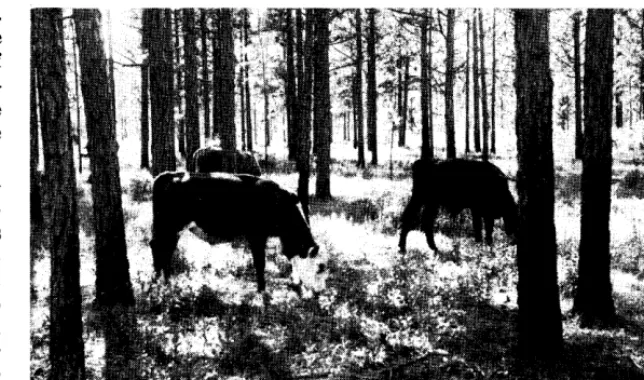
wiregrass herbage. Results from this study showed that increases in body weight of steers from March to October were consistently great- est on lightly stocked ranges (Table 1). Steers gained approximately 160 pounds when supplied with 14 or more acres of timbered range, an equivalent of 8.5 acres of open range (Fig. 1). This rate of stock- ing permitted steers to attain maxi- mum performance as shown by the fact that additional range of 18.1 acres did not increase weight gains. When ranges were stocked at a moderate rate, 6.4 to 8.5 acres of timbered range (4.4 to 6.9 acres of open range), average steer gains from March to October were 114 pounds. This was approximately 46 pounds per steer less than on lightly stocked ranges. Individual animal performance was very simi- lar within the group on moderately stocked ranges. However, acreage of burned range varied each year and animal weight changes tended to be greatest on the unit that had the greatest acreage of burned range per steer.
WIREGRASS-PINE RANGE OF GEORGIA 3
450L
M,$R. A;R. MAY JUNE JULY AUG. AUG SEPT. OCT NOV. DEC. JAN.
IO 7 5 2 30 22 25 22 20 17
FIGURE 2. Increases in body weight were most rapid during the spring; maximum body weight was reached in October and on lightly stocked ranges (data from 1950,
1951 and 1953).
Season
in all ranges. However, herbage production during late spring and summer was not adequate on the heavily stocked ranges.
Rate of gain was greatest dur- ing the spring, regardless of stock- ing rate (Fig. 2). Approximately 80 percent of total weight changes occurred by July 1. Light gains continued through the summer in proportion to acreage of burned range per steer. The seasonal trend in gains was also influenced to some extent by the relative abun- dance of main forage species. Pine- -land threeawn and Curtiss drop- seed made rapid growth and were particularly palatable during the spring. Gains tended to be higher in the spring on units where these species predominated. Bluestems and carpetgrass made greatest
growth and were more palatable during the summer ; therefore,
steer gains were better through the summer where these species were most prevalent, provided grazing was not too close.
The advantage of a light to mod- erate rate of stocking was further emphasized by performance of steers during fall and early winter (Oct. 26-Jan. 17). Although the steers were fed two pounds of cot- tonseed meal per head daily, all lost weight. But the steers on
LIGHT STOCKlNG .
---
MODERATE
STOCKING
.**.~..~*~.*~. HEAVY STOCKING
\
‘\ \
‘. .
‘. ‘. . .
lightly to moderately stocked ranges, even though in better flesh at the beginning of the fall, lost significantly less weight than those on heavily stocked range. Adequate forage was not the com- plete solution to the prevention of weight losses during the critical fall period, but it did help to re- duce them.
Effect of Rate of Stocking on
Degree of Forage Utilization
Forage utilization varied con- siderably among units but was closely related to the acreage of burned range per steer. Average utilization on upland varied ap- proximately 30 percent on lightly stocked units to a high of 65 per- cent under the heaviest rate of stocking (Table 1). Utilization was rather consistent from year to year for any particular unit.
Forage utilization on burned lowland areas was generally equal to or greater than on the uplands. Upland species were grazed pri- marily in the spring, but use of species other than bluestems and carpetgrass slackened off during the summer. On the other hand, forage species on the burned low- lands were grazed consistently from early summer info the fall and winter.
The degree of forage utilization was tied in very closely to animal performance. Maximum weight gains per animal were dependent largely on forage availability to the extent that the steers could obtain sufficient feed when approx- imately 30 percent of the total sea- son’s growth of grass was removed by grazing. When stocking rate was most intense and steers were forced to remove a high percent- age of the herbage, the gains per steer were least (Table 1).
Table 2. Ca~ntinue~d grazing of burned ranges caused a decrease in ground cover and yield of grass.
Ground covered by grasses Grass yield per acre
19421 1949 1954 1953-1954
Percent Pounds
Grazed 30.5 28.9 21.7 775
Ungrazed 30.2 33.2 32.6 1075
4 LOWELL K. HALLS
Effect of Burning and Grazing
Table 3. Effect elf overgroti of trees and shrubs on grass production. .on Ground Cover and Yield
of Grasses
Grazing of these annually burned ranges decreased the ground cover and yield of grasses.
With grazing, average grass cover decreased from 30.5 percent in 1942 to 28.9 percent in 1949 and to 21.7 percent by the end of 1954 (Table 2). D ecreases were least under light stocking and greatest under a heavy rate of stocking and forage utilization.
Shrub density
Peroen t 0 5 10 15
None
1060 995 930 865
Tree overstory
5% 20% 35% 50%
Pounds of grass
985 757 530 292 918 691 464 226 852 625 398 160 786 557 332 94
On ungrazed plots, the ground cover of grass changed very little and a fairly stable community of wiregrass species was maintained. Since the native vegetation is a selection of species that has de- veloped through frequent burning over many years, only minor changes would be expected so long as timber stands remained the same and litter was periodically re- moved.
Basic relationships established in this study can be used to esti- mate the productiveness of other wiregrass ranges which vary as to timber stand density and shrub cover. This relationship between grass, trees, and shrubs was best expressed by the calculated regres- sion formula :
Y = 1060-15X1-13X2 where
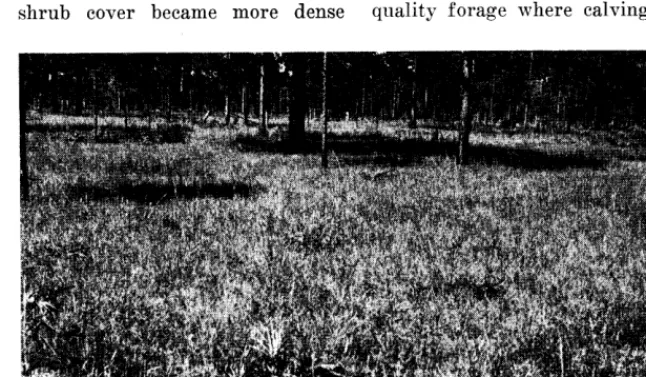
Y = estimated grass yield X1 = tree overstory in percent X2 = shrub cover in percent For example, where there were no trees or shrubs, grass yields were 1,060 pounds per acre (Table 3). Assuming that with light stock- ing 35 percent of the forage would be removed by grazing, that grasses contribute 85 percent towards total cattle diet, and that daily dry mat- ter intake for a 50-pound steer is 13 pounds, it would take about 9 acres of wiregrass range to permit a 500-pound steer to make maxi- mum weight gains (Fig. 3).
This acreage would need to be increased as the timber stand and shrub cover became more dense
(Fig. 4). For example, calculated per-acre grass yield on Range Unit 8 was 636 pounds. The required amount of timbered range for best animal performance would be 15 acres. This compares very closely to the average of 14.2 acres, which was the actual stocking rate of Unit 8 and from which maximum weight gains were obtained. By the same manner, calculated grass yields on Unit 6 indicated the need for 13 acres of range for best ani- mal performance, but only 4.4 acres were supplied. Therefore, forage utilization was extremely heavy and steer gains were very low. The decrease in ground cover of
grass on grazed portions of range units was accompanied by a de- crease in yields. As measured by clippings from caged plots, the average oven-dry grass yield on grazed areas was 300 pounds per acre less than the 1,075 pounds of grass produced on similar plots which had been ungrazed since 1942. Thus, with continued burn- ing and grazing, grazing capacity was reduced 28 percent.
Light Rate of Stocking is Desirable
Several factors tend to favor a light rate of stocking and forage utilization. Maximum gains gen- erally indicate a higher market grade for cattle. Also, the ability of cattle to make greater gains under light stocking should enable mature cows to calve more con- sistently. This factor is of special importance in this region of low quality forage where calving per-
Effect of Tree Overstory and
Shrub Cover on Grass Yields
and Grazing
’Capacity
WIREGRASS-PINE RANGE OF GEORGIA 5
centage is restricted because of the cows’ inability to meet the require- ments for lactation and breeding simultaneously. Also, less supple- mental feeding would be required to keep cattle at an adequate level of nutrition during fall and,winter.
Light stocking permits the same number of cattle to graze the range from year to year without causing excessive utilization of forage dur- ing the years when a minimum of burned range is available.
Moderate stocking and degree of forage utilization permit more cat- tle to be run on the forest but at the expense of individual animal performance. During years of lim- ited burned range, adjustments and additional feed may be required to keep cattle in good condition.
There appears to be one justifica- tion for heavy utilization of forage. Since wildfire is a critical problem in timber management, removal of maximum herbage may be justified at times to reduce the amount of flammable material. However, this advantage does not compensate for
the poor cattle performance under these conditions.
Resume
Where timber is generally re- garded as the most valuable prod- uct of these forest lands, grazing should be planned not to conflict with timber-growing requirements. The rapidly changing conditions from seedbed preparation to har- vest in a timber rotation dictate the exclusion of fire for several years. During this time cattle graz- ing should be markedly reduced but continued, in order to reduce fire hazard. Later, this same area may be very productive for cattle grazing when and if prescribed burning is used as a tool in timber management. Prescribed burning should be planned primarily for timber rather than grazing needs. The acreage of burned range will, therefore, vary each year but cattle will concentrate on forest range lands which have been burned. Cat- tle management based on an aver- age of 35percent utilization of burned wiregrass forage provides
greatest returns per animal and presumably greatest return per dollar invested in cattle. Approxi- mately 9 acres of good wiregrass range which yields nearly 1,100 pounds of grass provides ample feed for a 500-pound steer from March to January. Depending on the amount of the tree overstory and shrub cover, the acreage would have to be increased to compensate for decreased yields of grass.
LITERATURX CITED
BICKFORD, C. A., AND J. R. CURRY. 1946. The use of fire in the protection of longleaf and slash pine forests. South- ern Forest Expt. Sta. Occas. Paper 105. 22 pp.
BISWELL, H. H., B. L. SOUTHWELL, J. W. STEVENSON, AND W. 0. SHEPHERD. 1942. Forest grazing and beef cattle production in the Coastal Plain of Georgia. Ga,. Coastal Plain Expt. Sta.
Cir. 8, 22 pp.
BOND, W. E., AND R. S. CAMPBELL. 1951. Planted pines and cattle grazing- a profitable use of southwest Louisi- ana’s cut-over pine land. La. Forestry Comm. Bull. 4. 28 pp.
BRASINGTON, J. J. 1949. Forest grazing in South Alabama and West Florida. South. Forest Expt. Sta. 22 pp. CAMPBI%L, R. S., AND J. T. CASSADy.
1951. Grazing values for cattle on pine forest ra.nges in Louisiana. La. Agr. Expt. Sta. Bull. 452. 31 pp.
HALLS, L. K., B. L. SOUTHWELL, AND F. E. KNOX. 1952. Burning and grazing in coastal plain forests. Ga. Coastal Plain Expt. Sta. Bull. 51. 33 pp. KIRK, W. G., A. L. SHEALY, AND BRAD-
PORD KNAPP, JR. 1945. Weight changes of cattle on a Florida range. Fla. Expt. Sta. Bull. 418. 23 pp. MCCULLEY, R. D. 1950. Management of
natural slash pine stands in the flat- woods of south Georgia and North Florida. U. S. Dept. Agr. Cir. 845. 57 PP.
SHEPHERD, W. O., B. L. SOUTHWELL, AND J. W. STEVENSON. 1953. Grazing longlea,f-slash pine forests. U. S. Dept. Agr. Cir. 928. 31 pp.
WAHLENBERG, W. G., S. W. GREENE, AND H. R. REED. 1939. Effects of fire and cattle graziug on longleaf pinelands as studied at McNeill, Mississippi. U. S. Dept. Agr. Tech. Bull. 683. 52 pp.
Need of a Unified System for Measuring
Range Productivity
MERRITT D. BURDICK
Range Consemationist, Soil Conservation Service, Great Falls, Montalna
Range productivity is a subject of importance to all concerned with the range resource. As a most basic attribute of range its evaluation should have priority over evaluation of most other range factors. Productivity research is considered a prerequisite to study of range improvement (Upchurch 1952). Logically, the need for and results of a range improve- ment practice are best expressed in terms of production of the range. If assessment of range land for tax purposes is to be comparable to that on cropland, a measure of productivity is needed. Economists must have production data for analysis of the ranching industry and for proper evalution of the range resource in the economy of the nation as a whole. Public land administrators need data on for- age production as a basis for allot- ment of grazing privileges and for harmonizing grazing with other land uses. Range conservationists must have the information for cor- relation of stocking rates with range sites and condition data. Much research work in the field of animal husbandry is dependent upon range production data. Last, and by no means least, the rancher needs data on production from his ranges as well as the other parts of his operating unit if he is to make sound management decisions and conduct an efficient profitable business.
Problems and Techniques Measurement of grassland pro- duction poses many unique prob- lems for the researcher. Watson (1950) considers accurate evalua- tions of pasture yields one of the most difficult techniques in agri- cultural experiments. Unlike other crops, grass yields are rarely meas-
ured at any one pre-determined time; the total yield may be the sum of two or more harvests or harvest may be a continuous proc- ess over a considerable period of time during which the crop con- tinues to grow. Furthermore, the harvesting mechanism is biological rather than mechanical and the attendant variations of the graz- ing animal further complicate the problem.
Grassland production has re- ceived attention from many work- ers. Castle (1955) grouped the experimental methods for evaluat- ing grassland production on the basis of the unit of measurement as follows :
1. Botanical composition
2. Quantity of herbage 3. Grazing days 4. Animal produce 5. Standard food units 6. Feed replacement 7. Monetary return 8. Biochemical analysis
Upchurch (1952) in a research committee report gave an outline for methods used in measuring productivity on range with the techniques grouped under six head- ings :
1. Domestic animals 2. Game animals 3. Plants
4. Hydrological characteristics 5. Cultural characteristics 6. Economic factors
The very number of techniques devised is an indication of the im- portance and complexity of the problem of productivity measure- ment. The diversity of technique is matched by diversity of units used in measurement. For exam- ple, measurements using domestic aimals have been determined in terms of body-weight gain of var-
. c,
ious age groups of either sex per unit of area, per animal, per ani- mal unit, or per unit of time, Some data consider calf weights including cow gain or loss; others measure only the calf. Measure- ment of milk or wool production may or may not consider body weight changes and may be meas- ured per unit of time, area or ani- mal. Some measurements have been made only in terms of numbers of animals per unit of land.
The Joint Committee on Pasture and Range Research Techniques (1952) considered the variations in technique as obstacles to maximum progress and agreed that some sort of standardization of grazing re- search procedure was desirable.
Present methods of measuring range productivity were sharply criticized in the report of a re- search methods committee on the “Economics of Range Resources Development,” organized by Up- church (1952), for the Western Agricultural Economics Research Council. The basic defect of all methods was considered as the lack of an acceptable standard unit of measurement. For example, the often-used term “animal unit month” is variously defined as:
( 1) a given amount of feed or for-
age, (2) an animal or animals grazed for one month or for an average month, or (3) a certain weight of live animals grazed for one month. Dissatisfaction was also expressed with the knowledge of relationships b et w e en range condition and trend, range forage, grazing animals, hydrological char- acteristics, cultural characteristics and economic factors, a lack that might be ascribed in part to di- verse techniques with untranslat- able terms of measurement.
Castle (1955) pointed out de- fects of techniques using measure- ment of herbage quantity, animal produce, animal grazing day, feed replacement, economic returns and biochemical indicators for depend- able and acceptable figures on grassland production.
SYSTEM FOR MEASURING RANGE PRODUCTIVITY 7
its relationships with economical factors, Stoddart (1952) believed that the most reliable method of determining stocking intensity for range was translation of range condition into stocking rate on the basis of comparison with ranges of known capabilities. It should be noted here that grazing intensity or grazing capacity is based on range condition, range productiv- ity and economic factors with uti- lization generally at a very con- servative level to allow for wide annual variations in production without comparable changes in stocking or damage to range flora. Comparison with ranges of known capabilities thus provides basic data for determining grazing ca- pabilities where actual use data are not available.
Lack of a unified system of meas- urement has been felt in allied fields for some of these techniques have been used as a basis for other projects. Aandahl, Murray and Scholtes (1954) proposed a, method for using soil maps to estimate eco- nomic productivity of land for tax assessment in which the rating for permanent pasture was based on “estimation of the relative grass production of each soil mapping unit in such terms as cow-days per acre.” The “cow-days per acre” were determined in this case by estimate based on a season of use by animals, a method which makes no allowance for range condition, animal production or for supple- mental feed the animals may have received. Fortunately, the authors state that their basic approach could be used with other (presum- ably more accurate) methods of determining grassland productiv- ity.
Current Status
The current situation can be summarized thus :
1. Range productivity data are a
basic expression of quality of the range resource prerequisite to determination of proper range management or improvement. 2. Present techniques for measur-
ing range productivity are nu- merous and diverse, and gener-
ally overlook or improperly emphasize one or more factors. There is no generally accepted standard unit of measurement of range productivity; the data gathered on any one research project are usually applicable to all portions of that project but can rarely be applied or translated to apply to other re- search data.
Research work in allied fields such as range improvement, range economics, and animal husbandry lacks acceptable range production data to use as a base for further study. To state the basic considerations in developing a unified system of measuring range productivity as : (1) accuracy, (2) economy, (3)
versatility, and (4) simplicity, would be over-simplification, al- though any system devised must pass the test of these criteria.
Of primary importance is rec- ognition of the differences between range and tame pasture and proper consideration of the significant factors. Range, as land that pro- duces primarily native forage suit- able for grazing by livestock (SCSA 1952), differs from tame pasture in that the vegetation is usually a wide variety of native species, and maintenance of a per- manent cover is generally impera- tive. Soils in range are’ as im- portant as in tame pasture but this factor is generally recognized in conjunction with climate and to- pography to delineate range sites (SCSA 1952). In tame pastures, the soils should be evaluated in terms of their ability to produce various cultivated forage crops. Climax vegetation is generally con- sidered the potential type of cover for a range site and range condi- tion is measured by departure from that potential. A general’but direct relationship is known to ex- ist between range condition and productivity (Dyksterhuis 1949). Consideration of range condition, based on plant succession and cli- max, appears to be essential in measurement of relative as well as
absolute range productivity. Fully sustained production of the com- posite resource of soil, climate and native vegetation cannot be pre- dicted unless site and range condi- tion are taken into account. It must be re-emphasized that over- grazing of range will give high initial yields with degeneration of the vegetation and subsequent de- creased production. While such overutilization gives an overstate- ment of productivity, underutiliza- tion may give an understatement of productivity (Anon. 1952). Uti- lization standards thus also become a vital part of productivity meas- ’
urements on range.
It is generally accepted that measurement of range production must be related to grazing animals despite the difficulties of account- ing for differences in animals such as grazing preference, daily intake and conversion of forage to gain. Grazing trials, however, are not economically feasible on each ranch. In addition, any results from measurement must be trans- lated into terms usable for man- agement predictions and decisions. Grazing capabilities are generally determined today by inventory of cover conditions, and in some agen- cies also soil conditions, correlated with use histories on comparable ranges. All systems are seriously limited by the lack of grazing his- tory for many ranges (Sampson 1955). Quantitative measurements of forage yields correlated with grazing trials would be valuable in checking and augmenting field es- timates and grazing history rec- ords and may some day serve as a basis for establishing standard co- efficients. This assumption, how- ever, is predicated on use of a de- pendable unified system of quanti- tative measurements of range flora and herbage samples.
8
a form that can be used by each group concerned ; animal husband-
men and economists, for example, need this data as much as the ranchers and range men. The unit should be capable of expression in terms of effect upon animals from the grazing and digestion of the forage. Castle (1955) and others (Anon. 1952) believe that the unit of pounds of total digestible nu- trients, commonly referred to as T.D.N., offers the best available means of meeting these criteria. Some difficulty may be experienced in using this term due to inade- quate coefficients of digestibility and nutrient requirements. Bio- chemical measurement techniques using digestible or indigestible tracer elements or combinations of the two give promise of providing this information on plant values for grazing animals. Raymond
(1954) and his associates (Ray- mond, et al. 1954) considered these techniques critically and proposed the faecal index measurement as the most suitable.
summary
this brief review of bio- physical and economic
MERRITT D. BURDICK
problems involved in developing a unified system, we may perhaps conclude that a unified system of measuring range productivity must contain provisions for appraisal of these factors:
Range site and condition class.
Degree of utilization of the herbage in relation to range condition and trend.
A standard unit of forage measurement clearly defined and readily translated. Supplemental data required to approximate equivalents in related sciences.
LITERATURX CITED
AANDAHL, ANDREW R., WILLIAM G. MUR- RAY AND WAYNE SCHOLTES. 1954. Economic rating of soils for tax as- sessment. Jour. Farm Econ. 36: 483- 499.
CASTLE, M. E. 1955. Methods of evaluat- iug grassland production in temperate zones. Herb. Abstr. 25: l-75. DYKSTER~HUIS, E. J. 1949. Condition and
management of range land based on quantitative ecology. Jour. Range Mangt. 2: 104-115.
JOINT COMMITTEE 01” ASA, ASDA, ASAP AND ASRM. 1952. Pasture and range
research techniques. Agron. Jour. 44: 39-50.
RAYMOND, W. F. 1954. Studies iu the digestibility of herbage. III. The use
of faecal collection and chemical analy- sis in pasture studies (a) ratio and tracer methods. Jour. Brit. Grassl. Sot. 9: 61-67.
-~ C. D. KEMP, A. W. KEMP AND C. E: HARRIS. 1954. Studies in the di- gestibility of herbage. IV. The use of faecal collection and chemical aualysis in pasture studies (b) faecal index methods. Jour. Brit. Grassl. Sot. 9:69- 84.
SAMPSON, ARTHUR W. 1955. Where have we been and where are we going in raiige management. Jour. Range Mangt. 8: 241-246.
SOIL CONSERVATION SOCIETY OF AMERICA. 1952. Soil aud water conservation glossary. Jour. Soil and Water Cons. 7: 41-52, 93-105, 144-156.
STODDART, L. A. 1952. Problems in esti- mating graziug capacity of ranges. Proc. Sixth International Grassland Congress. II. pp. 1367-1373.
UPCHURCH, M. L. 1952. Report of the research methods workshop of the eco- nomics of range resources development commit.tee. West Agr. Econ. Research Council, Logan, Utah. 35 pp. mimeo. WATSON, S. J. 1950. Grass as a source
of animal feediug stuffs. Jour. Sci. Fld. Ag. 1: 317-322.
From the President:
A TRIBUTE TO ROBERT A. DARROW
We of the American Society of Range Management are deeply indebted to Robert A. Darrow for the outstanding job he has done the past three years as Editor of the JOURNAL OF RANGE MANAGEMENT.
During his editorship, the Journal has gained in stature and prestige. It is highly sought .after by libraries from all over the world. He has kept the articles factual and yet presented them in an interesting and readable style. We have received compliments on the Journal from ranchers and technical people alike. The Editor’s job, like that of others in the Society, requires a lot of a man’s personal time. This was no obstacle for Bob. He is dedicated to the Society’s aims and objectives and is a firm believer and active supporter of the Society. To advance the interests of the Society, he was willing to devote many hours and burn a lot of midnight oil in order to turn out a first-class Journal each issue. And this he did.
Thanks, Bob, for a job well done. We are all proud to have known and worked with you.
Renovation and Fertilization of Crested
Wheatgrass Stands in the Northern
Great Plains’
WALTER R. HOUSTON
Rainge Conservationist (Research), FieJd Crops Research
Branch, Agricultural Research Service, U. S. Dept. of Agri- culture, Miles City, Montarza
The problem of renovating or in- creasing the yield of sodbound or low-producing older stands of Standard crested wheatgrass (Ag- ropyron desertorum) has recently received increasing attention in the Northern Great Plains Region. This grass has become widely recognized as being well adapted for range re- seeding in this area and over much of the western United States.
Crested wheatgrass has several attributes which have led to its wide acceptance and use. It greens up in the spring from two to four weeks earlier than native range, is drought resistant, produces well for hay and pasture, and is palatable to livestock.
Other characteristics limit its productiveness and use. It is un- palatable after maturity, summer dormant, and tends to become sod- bound and low-producing in older stands.
Observations in eastern Montana have indicated a tendency for pure stands to increase in both density and production with favorable weather. Then in periods of less favorable weather, production drops rapidly-more rapidly than’ density-often to a point below that of newer plantings of a like density. From this it seems that possibly the drop in production with age of stand is not due to fewer
plants, but to reduced vigor and size of individual plants. This phe- nomenon seems to be related to a
1 Study conducted by the former North- ern Rocky &fountain Forest and Range Experiment Station, 77. S. Forest Service, Missoula, Montana.
large degree to depletion of nutri- ents available to the plants as well as to soil compaction, aeration, etc. Because of the high value and wide use of crested wheatgrass for pasture and hay in the Northern Great Plains Region, studies have been conducted over the past dec- ade at the U. S. Range Livestock Experiment Station, Miles City, Montana, on methods and practices that might help to overcome the decreased production in old stands.
Review of Literature Renovation studies in Wyoming have indicated that certain mechan- ical treatments of native grasslands succeeded in increasing forage pro- duction from 10 to 36 percent
(Barnes, et al., 1945).
A preliminary report on later renovation studies of reseeded grasslands in Wyoming (Barnes, et al., 1952) indicated that land treatments which severely disturb cover show promise of increasing forage production, but may be un- economical for the small increase in yield obtained. Application of nitrogen fertilizer to stands of crested wheatgrass, western wheat- grass (Agropyron sm~ithii) , and
Russian wildrye (Elyuntius junceus) increased production markedly, the greatest increase coming in those years of more favorable precipita- tion. In this study application of manure gave similar increases in production but had greater carry- over effect into the second year. Spring applications of nitrogen or manure greatly stimulated seed pro- duction of Russian wildrye the year following application.
9
A twenty-year study by Heady (1952) in Montana of the effects of manuring, light renovation (disk- ing), and heavy renovation (disk- ing plus spring tooth harrowing) on native range indicated that all practices increased the yield of grasses, but manuring more than renovation. These treatment differ- ences were generally apparent 12 years after the treatments had ceased. A residual effect of manur- ing upon plant height 12 years after treatment was evident.
Recent studies in Canada (Lodge, 1954) have indicated that mechani- cal disturbance of old stands of crested wheatgrass can double yield even in dry years. Here the great- est increase in yield accompanied the greatest disturbance or thin- ning of the stand. Burning old stands in spring or fall or fall mow- ing may increase yields from one- third to one half over untreated seedings.
Experimental Procedure Preliminary renovation studies were conducted in 1944 at the U. S. Range Livestock Station on crested wheatgrass pastures that had been seeded in 1937 and grazed since 1939.
Between 1950 and 1952, a sec- ond, more comprehensive study was carried out in the same crested wheatgrass stand to determine the effect on production of various ren- ovation methods and nitrogen fer- tilization.
This study was initiated in April, 1950 on an area of uniform soil, slope and stand density. Six treat- ments were involved, consisting of two nitrogen levels on each of three cultural or tillage treat- ments. Nitrogen levels were : (1)
50 pounds of N per acre applied in the spring of 1950 and (2) no nitrogen. Cultural treatments in- cluded : (1) harrowing with spring-
10 WALTER R. HOUSTON
FIGURE 1. View of disked (right) and untreated (left) crested wheatgrass, both grazed (foreground) and protected (background) on August 11, 1944. Note close utilization on disked area and abundance of sweet clover on disked protected area.
and nitrogen fertilizer levels in sub-plots. The study included a total of 12 plots each 35 x 50 feet in size.
Data on stand density were taken in early April, 1950, prior to treatment of the plots, and again in early April of 1’952. Produc- tion determinations were made in early August of 1950 and 1952 fol- lowing completion of the current season’s growth. Production was determined by clipping to a l/2- inch stubble height, ten 4.356- square-foot (l/& mil-acre) circular plots located at random in each treatment. Density was determined
by the point plot method, using three transects per plot with 100 points per transect.
Weather
Spring and early summer pre- cipitation-April through July- was 5 to 10 percent below the nor- mal of 7.21 inches in all . three
years of the second study. Only during the months of April and June of 1950 did monthly precipi- tation reach the long-term average. Total annual precipitation for the three years was 5 to 15 per- cent below the long-time average of 13.00 inches. The first and third years (1950 and 1952) may be con- sidered as dry years with 1951 as almost normal. Especially dry weather prevailed in 1949, the year before this study started, when
precipitation was 40 to 60 percent below normal.
Experimental Results Results of the 1944 studies in- dicated that, in the first year, both harrowing and double-disking the stand resulted in a decrease in for- age production, number of plants per unit of area, and proportion of plants bearing seed. Further, these renovation measures lowered total forage production and encouraged invasion by low-value weeds and other plants. Figure 1 shows the disked areas, both grazed and pro- tected, in contrast to adjacent un- treated areas. The thinner stands of crested wheatgrass on the treated portion, both grazed and
protected, may be seen as well as the noticeable greater quantity of sweet clover.
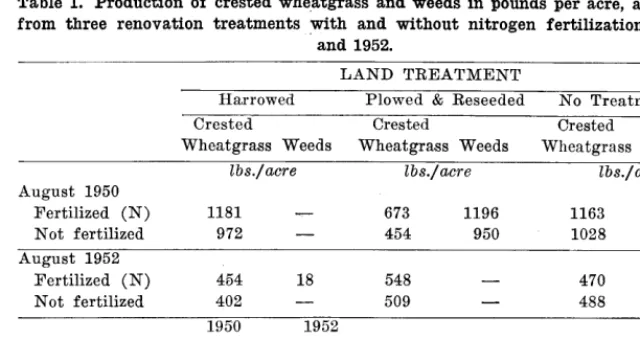
The 1950 production data from the second study disclose some significant differences between ren- ovation treatments during the season of treatment (Table 1). Both the harrowed and control plots produced about 90 percent more crested wheatgrass forage than the plowed and reseeded treat- ment. The average amounts of crested wheatgrass produced were 564, 1076 and 1096 pounds per acre, respectively, for the plowed and reseeded, harrowed and control
treatments.
Nitrogen applied at the rate of 50 pounds per acre increased pro- duction on all land treatments in the first year. The increases in yield were not large, but they amounted to 22 percent on the harrowed treatment, 48 percent on the plowed and reseeded treatment, and 13 percent on the control.
The only weeds found in 1950 were on the plowed and reseeded treatment. Here the fertilized plots produced l,lC76 pounds of weeds per acre in addition to the 673 pounds of crested wheatgrass, while the unfertilized plots pro- duced 950 pounds of weeds with 454 pounds of crested wheatgrass forage.
By Il.952 production had declined on all plots except the unfertilized
plot of the plowed and reseeded
Table 1. Production of crested wheatgrass and weeds in pounds per acre, air dry, from three renovation trelatments with and without nitrogen fertilization, 1950
and 1952.
LAND TREATMENT
August 1950 Fertilized (N) Not fertilized August 1952
Fertilized (N) Not fertilized
L. S. D. (.05) Cultivatioll Fertilizer
Harrowed Plowed & Reseeded No Treatment
Crested Crested Crested
Wheatgrass Weeds Wheatgrass Weeds Wheatgrass Weeds l&./acre lbs./acre b&/acre
1181 - 673 1196 1163 -
972 - 454 950 1028 -
464 18 548 - 470 -
402 - 509 - 488 -
1950 1952
236 166
RENOVATION OF CRESTED WHEATGRASS STANDS 11
treatment. The decline in produc- tion averaged approximately 60 percent on both fertility levels of the harrowed and control treat- ments, and 19 percent on the ferti- lized plot of the plowed and re- seeded treatment. Production in this period increased 13 percent on the unfertilized plot of the latter treatment.
In 1952 production on the plowed and reseeded treatment was above that on the other two treat- ments, although the differences were not significant. Also in this year there was no significant dif- ference in production between the harrowed and no treatment, or be- tween the two levels of fertilization on these treatments. For both har- rowed and plowed and reseeded treatments there was about 10 per- cent higher production on the ferti- lized plot, but the yield was about the same on both fertility levels of the plots which received no tillage.
Crested wheatgrass density was remarkably similar in 1950 and 1952 in all treatments and be- tween all treatments in both years. Density averaged between 20.5 and 26.0 percent on all treatments in both years, with no significant dif- f erences present.
Discussion
Under the conditions of these studies, conducted during a com- paratively dry period, nitrogen fertilizer tended to increase pro- duction of old stands of crested wheatgrass at least during the year of application. Yields were not taken the second year after appli- cation, but by the third growing season such response had largely disappeared. This could have been
due to failure of the nitrogen effect to carry over into the second year after application or to the dry weather, or both factors could have been operating. These results in- dicate posibilities for range f ertili- zation in this area, but the prac- ticability and economics of such a practice will need to be determined by future studies of a more com- prehensive nature.
These studies also indicate that considerable disturbance of the old stand by double-disking or plowing and reseeding not only decreases production, height of growth, and seed production in the first year, but also allows considerable inva- sion by low value annual weeds. However, two years ,after plowing and reseeding the stand regains op- timum density, weeds largely dis- appear, and there is a slight tend- ency for increased production. Moderate disturbance of, the stand by harrowing may or may not de- crease production, probably de- pending in part on amount of rain- fall during the growing season.
In this study differences in crested wheatgrass density result- ing from renovation or fertilization
(at 50 pounds per acre of nitro- gen) also were non-existent.
It is possible that the fertilization and renovation treatments would be more effective in periods of more nearly normal precipitation.
Summary
The effects of renovating or fer- tilizing old crested wheatgrass stands were studied at the U. S. Range Livestock Experiment Sta- tion, near Miles City, Montana, in 1944 and in 1950-1952.
Treatments consisted of spring- tooth harrowing, double disking, plowing and reseeding, and nitro- gen fertilization. Dry weather prevailed over much of the period during which these studies were conducted. The following results were obtained :
1.
2.
3.
4.
Nitrogen fertilization at the rate of 50 pounds of N per acre increased forage produc- tion to some extent in the year of application, but two years after application this response had largely disappeared. Considerable disturbance of the stand by double disking or plowing and reseeding caused decreased forage and seed pro- duction and increased weed growth in the first year. After two years the efforts of plowing and reseeding upon production and weed density largely disappeared.
Moderate disturbance of the stand by harrowing had little effect upon production or plant density, although it did result in decreased seed pro- duction in the first year.
LITERATURE CTTED
BARNES, 0. K. AND A. L. NELSON. 1945. Mechanical treatments for increasing the grazing capacity of shortgrass range. Wyo. Agr. Expt. Sta. Bull. 273. 34 PP.
-, et d. 1952. Grass establishment on Wyoming dryland. Wyo. Agr. Expt. Sta. Bull. 314. 23 pp.
HEADY, HAROLD F. 1952. Reseeding, fer- tilizing, and renovating in an ungrazed mixed prairie. Jour. Range Mangt. 5: 144-149.
LODGE, R. W. 1954. Unpublished sum- mary. Personal communication. Exp. Sta., Swift Current, Sask., Canada.
LATE BULLETIN
W. T. (Terry) White, Executive Secretary of the American Society of Range Management since
January, 1952, died at Providence Hospital, Portland, Oregon, on, the morning of December 10, 1956.
Terry had been seriously ill for over a month before his death. Terry’s devotion to the objectives of
the ISociety, his friendly, active personality, and his spirit of cooperation in the conduct of Society busi-
ness won him the friendship of all with whom he came in coIntact. The Society and his many personal
friends will miss him.
Problems Involving Conservation in
Range Economics Research1
S. V. CIRIACY-WANTRUP AND A. M. SCHULTZ
Professor of Agricultural Economics anId Associate Speciai- is-t 6~ Forestry, University of Ca’lifornia5 Berkeley, Cali- f ornia
Range economics must deal with the+ lowg term view rather tha,n with im,mediate profits. Range reseaach to date has deaJt with the ma,the- matics of agronomy a,nd animal1 hus- bandry and most of the winning caads ha,ve been drawn, from th,e deck of immediate profits. Often there are long tedrm efects which are not possible to measure at once. These facts are pa,rticularly tru,e of con- serv~ation measu,res on the range which8 mq hme ha<d lasting effects on the water su,pply for some city, upon the value6 of la&t for recrea- tion or wildlife, or that ma,y save the soil for future generations. All of these things a’re of little or no proftt to the own#er, but present techniques of research are geneYrally lack&,g in ways to measure such, enmduring bene- fits.-Reviewer’s com(ment.
Many of the problems that con- front the range manager are ccm- cerned with conservation. These problems have economic aspects that require an economic approach. Range conservation is considered here from this point of view.
From the point of view of eco- nomics the essential issue in conser- vation is the distribution of re- source use over time. The ecbnom- its of conservation is concerned with the when of production from natural resources (Ciriacy-Want- rup, 1952).
Range managers are familiar with the multiple-use problem, that is, with the decision about what combination of different products- beef, mutton, wool, wildlife, timber, water or recreation-should be pro-
UXannini Foundation of Agricultural Ec- onomics Paper No. 155.
duced from a given area or a given unit of management. The type of decision that a range manager must make with respect to this problem is conceptually not different from the decision that he must make with respect to the time distribution of resource use. In the former case, the joint products are differenti- ated by physical characteristics- how much beef and how much tim- ber; in the latter case they are dif- ferentiated by their occurrence in different intervals of time-how much beef this year and next, and how much timber now and in ten years.
The term “interval” has a special meaning in time economics. It is de- fined as that period of time within which changes of rates of produc- tion and of other economic vari- ables can be neglected in an analy- sis. An interval may have any extent in terms of clock time. For many problems of range economics, twelve ccmsecutive months or a “grazing season” constitute a suit- able clock-time extent of the inter- val. For some problems, however, a longer or shorter period is more suitable-for example, a full breed- ing cycle comprising several years or the period of finishing expressed in weeks rather than months.
Management decisions with re- spect to the physical and time-dis- tribution characteristics of the products are interrelated. For ex- ample, decisions that result in changes in the relative coverage of grass, brush and trees, and there- by the physical characteristics of the final product between grazing and browsing animals and between animals and timber, also change the time distribution of the final
products. For analytical purposes, it is well to focus on the latter change separately. This change has technological, economic and po- litical aspects of its own, and it is of particular concern in range management even in those cases in which production is undifferenti- ated in terms of its physical char- acteristics, for example, if only beef is being produced.
Decisions about the time distri- bution of production are not con- fined to planning the use of natural resources, that is, “conservation de- cisions,” but are part and parcel of all business planning. However, in non-agricultural industries the deferred effects of current inputs and outputs are generally smaller relative to the immediate effects than in agricultural enterprises. In range and forest management this rat.io of deferred to immediate ef- fects of management practices is large, compared with that of culti- vated crop farming.
In range management it often takes many intervals-decades or even generations (in terms of clock time) -until stability is reached. Sometimes the effects are economi- cally irreversible. Examples of this are : tillage and overgrazing prac-
tices directly responsible for deep gully erosion and loss of A-horizon
of soils; destruction of certain nat- ural habitats of wildlife resulting in extermination of species.
Decisions involving conservation are not only a special challenge to range technicians but also a promis- ing field for research in time eco- nomics.
CONSERVATION IN RANGE ECONOMICS RESEARCH 13
revenue flow. It can be considered as the optimum state in terms of time economics. .
The maximization principle is a useful fiction-like Adam Smith’s “economic man.” It helps the range operator, the researcher and the policy maker to understand certain aspects of decision making. In time economics, some of these are: (1)
the significance of making choices between alternative time distribu- tions of production; (2) the rea- sons why and in what direction- toward the future or toward the present-a given planned time distribution of production should be changed under assumed changes of the economic environment; (3) why, when viewed historically, range operators, taken individually or as groups, have realized certain time distributions ; and (4) what
public policy measures might in- duce range operators to adopt practices which will result in a time distribution that appears de- sirable “in the public interest.”
Use of the maximization prin- ciple in production economics does not mean that a range operator ac- tually does, should, or could maxi- mize the present (discounted) value of the expected total flow of revenues over time. The actual ob- jective of conservation decisions is far more modest: to increase rather than to maximize present value through comparing total additional revenues with the corresponding total additional costs resulting from
alternative practices. Usually such comparison will be hypothetical, that is, with’paper and pencil. Ad- mittedly, a maximum cannot be realized in this way, save by acci-’ dent. But a course toward it can be st,eered effectively in an economic environment characterized by un- certainty and ceaseless change.
This proximate objective of in- creasing the net revenue flow dis- continuously and by trial and error has certain implications for re- search in range economics that will be discussed presently. But such practical approximation of the the- oretical objective does not invali- date the usefulness of the maximi-
zation principle as a concept if diligence in searching for alter- natives is assumed for an individual range operator or if a statistical population of operators is consid- ered over a sufficient period of time. To use an analogy familiar to range technicians, a particular “cli- max type” in ecology or an “adap- tive peak” in genetics is difficult if not impossible to define in actu- ality ; nor do these “maxima”-
“optimum” stages of succession or evolution-explain an actual plant association or the developmental state of a species at a particular time and place; nor do they indi- cate that static states exist or that the system being considered is closed. Still, these concepts are helpful in understanding the di- rection, the rate and the conditions of change in plant associations and species. The maximization princi- pal has a similar usefulness in economics.
fmplications for Data and Tools
of Research
In exploring the implications of what has been said for research in range economics, one may first stress the need for more suitable but not necessarily more volumi- nous data. Conservation decisions require comparison of time distri- butions of interrelated costs and returns of range management prac- tices. To ascertain the cost of inputs is comparatively easy. To ascer- tain their effects in physical and monetary terms upon output over a number of intervals is a much more difficult task. This is evinced by the literature on brush clear- ing and conversion, replete with costs per acre for bulldozing, grubbing, disking, burning, spray- ing or seeding, but destitute of data on returns. The effectiveness of the original and follow-up clearing operation, the possibility of erosion during the early inter- vals, the permanence of the con- verted cover in terms of normal brush succession, and the wide variability of production from year to year on lands where water and fertility are not easily con- trolled must be considered.
Continuity Over Time in Observation The most obvious requirement for data is “follow through” in scientific observation to make sure that all significant deferred effects of an experiment are included. It may be submitted that a consid- erable portion of present contra- dictory evidence and controversy in interpreting effects of the same practices, controlled burning, for example, under .similar physical conditions is explained by differ- ences in focus with respect to time. In range economics, some indica- tion, however crude, of the quali- tative and quantitative relation between deferred and immediate effects of an experiment is no less important than statistical refine- ment in the measurement of im- mediate effects. This, of course, does not mean that refinement of statistical information about the immediate effects is necessutily competitive with obtaining infor- mation on the deferred effects. The investigators themselves may be perfectly aware of the require- ment to follow through and be suffi-
ciently patient and cautious. But the ever-present pressure from re- search administrators to shift funds and personnel to “new” projects and to announce and pub- licize the “solution” of problems is especially detrimental to prob- lems involving conservation.
Type of Output Data
The economist would like to have data of physical range output that relate to the final product-for eir- ample, pounds of beef, wool, ven- ison or animal unit month of pas- ture for “maintenance.” Data re- lating to the intermediate products,
such as forage in. its many forms, stages and quantitative expres- sions, are not enough. First, the final product is needed for mone- tary evaluation. Second, the effects of the forage on quantity and qual- ity of the final product are eco- nomically significant.