New Attacks on Feistel Structures with
Improved Memory Complexities
Itai Dinur1, Orr Dunkelman2,4,?,
Nathan Keller3,4,??, and Adi Shamir4
1 D´epartement d’Informatique, ´Ecole Normale Sup´erieure, Paris, France 2 Computer Science Department, University of Haifa, Israel
3 Department of Mathematics, Bar-Ilan University, Israel
4 Computer Science department, The Weizmann Institute, Rehovot, Israel
Abstract. Feistel structures are an extremely important and exten-sively researched type of cryptographic schemes. In this paper we de-scribe improved attacks on Feistel structures with more than 4 rounds. We achieve this by a new attack that combines the main benefits of meet-in-the-middle attacks (which can reduce the time complexity by comparing only half blocks in the middle) and dissection attacks (which can reduce the memory complexity but have to guess full blocks in the middle in order to perform independent attacks above and below it). For example, for a 7-round Feistel structure onn-bit inputs with seven independent round keys ofn/2 bits each, a MITM attack can use (21.5n, 21.5n) time and memory, while dissection requires (22n, 2n) time and memory. Our new attack requires only (21.5n, 2n) time and memory, us-ing a few known plaintext/ciphertext pairs. When we are allowed to use more known plaintexts, we develop new techniques which rely on the ex-istence of multicollisions and differential properties deep in the structure in order to further reduce the memory complexity.
Our new attacks are not just theoretical generic constructions — in fact, we can use them to improve the best known attacks on several concrete cryptosystems such as CAST-128 (where we reduce the memory com-plexity from 2111 to 264) and DEAL-256 (where we reduce the memory
complexity from 2200to 2144), without affecting their time and data com-plexities. An extension of our techniques applies even to some non-Feistel structures — for example, in the case of FOX, we reduce the memory complexity of all the best known attacks by a factor of 216.
Keywords: Cryptanalysis, block cipher, Feistel structure, dissection,
meet-in-the-middle, splice-and-cut, CAST-128, DEAL.
?The second author was supported in part by the Israeli Science Foundation through
grant No. 827/12.
⊕
Fi KiLi−1 Ri−1
Li Ri
Oi Ii
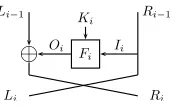
Fig. 1.Thei’th Round of a Feistel Structure
1
Introduction
Feistel structures were first used in the design of DES [17], and had a major influence on the development of both the theory and the practice of cryptography (e.g., in the Luby-Rackoff [16] construction of pseudo random permutations and in the design of numerous block cipher proposals). In this paper we will primarily consider generic Feistel structures whosei-th round is depicted in Figure 1. They divide their n-bit blocks into two equal parts (Li, Ri), use independent n/2-bit
subkeys in their ` rounds, and have round functions Fi over n/2-bit inputs,
outputs and subkeys which are perfect in the sense that they cannot be broken with attacks that are faster than exhaustive search. This choice of parameters allows us to consider any two consecutive rounds in a Feistel structure as a single round in a regular (non-Feistel) structure that has n-bit inputs outputs and subkeys. However, when we describe attacks on concrete schemes which have a Feistel structure, we will consider the relevant key and block sizes, and exploit some of the weaknesses of the actual round functions.
A major type of low-data attacks which can be applied to multi-round con-structions is the Meet-In-The-Middle (abbreviated as MITM) attack, which was proposed by Diffie and Hellman [8] in 1977 as a method for cryptanalyzing dou-ble encryption schemes. It gained additional fame in 1985, when Chaum and Evertse [7] applied it to reduced-round variants of DES [17], and it is now con-sidered as an essential part in any course in cryptanalysis. In the last few years, research of MITM techniques had expanded in diverse directions and numer-ous new extensions of the basic MITM appeared, including partial matching [4], probabilistic matching [14, 20], bicliques [3], sieve-in-the-middle [6], and many others. A more recent approach is the dissection attack, which was introduced by Dinur et al. [9] at CRYPTO 2012. Dissection can solve a wide variety of com-binatorial search problems with improved combinations of time and memory complexities. In its cryptanalytic application, dissection significantly improved the time/memory tradeoff achievable by MITM attacks on multiple encryption schemes with more than 3 rounds.
con-dition to identify the correct keys, and there is no need to know them in order to start the attack. In dissection attacks the adversary starts by guessing the relevant values in the middle, and works from the middle towards the endpoints. In fact, the knowledge of the middle values enables the adversary to break the cryptanalytic problem into two independent smaller problems with new known plaintext and ciphertext pairs at their endpoints, which can be solved recursively by another dissection, or with MITM at the leaves of the recursion tree.
When we compare the two types of attacks on a Feistel structure with an odd number of`= 2r+ 1 rounds, we notice that each one of them offers different advantages and disadvantages. The MITM attack can ignore the middle round by comparing only then/2-bit half blocks which are not affected by this round in the Feistel structure. This enables the MITM attack to be more time-efficient in the case of Feistel structures, since it does not have to guess the middle subkey. Even though dissection is naturally more efficient than MITM, it loses in its time complexity in this case since it has to guess the fulln-bit middle value in order to be able to encrypt and decrypt this guessed value through multiple rounds.
In this paper we present new techniques which enable us to combine the MITM and dissection approaches, along with additional ingredients, such as iterating over values that are not used later in the MITM attack, and using multi-collisions and differential properties in the middle of the Feistel structure. We first consider the case of Feistel structures with an odd number of rounds, and try to reduce the memory complexity of the most time-efficient attacks on them. We show that the memory complexity of the MITM attack on`= 2r+ 1 rounds for r ≥ 3 can be reduced all the way from 20.5rn to about 2dr/2e0.5n
(like in dissection) without increasing the time complexity, at the expense of increasing the data complexity to about 2d(rr−+1)3 e0.5n known plaintexts. If no
additional plaintexts are allowed, we are still able to reduce the memory, but only to about 2d2r/3e0.5n. In particular, we can reduce the memory complexity
of the standard MITM attack on 7-round Feistel from 21.5n to 2n with no effect
on the data and time complexities.1
A different goal is to reduce the time complexity of the most memory-efficient nontrivial attacks (in which the memory available to the adversary is restricted to 20.5n, which makes it possible to store in memory all the possible values of a single
half-block or a single subkey, but not more). Here, we assume that the round functions can be inverted efficiently when their subkey is given. In [9], Dinur et al. considered low-memory dissection attacks on general (non-Feistel) structures, in which the available memory is restricted to 2n (where n is the length of a
single block or a single subkey). They defined thegain of a dissection attack of time complexityT over a standard MITM attack with 2n memory (whose time
complexity is 2(`−1)n for`rounds) by (`−1)−log
2(T)/n. Then, they computed the sequence of round numbers`for which the gain of the best dissection attack increases by one —{4,7,11,16,22,29,37,. . .}. We use our techniques to compute a similar sequence of round numbers ` of Feistel structures for which the gain
1 We alert the reader that similarly to [9], we concentrate on the asymptotic complexity
(over MITM, whose time complexity is 2(`−2)0.5n) increases by one — it turns
out to be{5,10,15,22,29,38,47,. . .}, and the asymptotic complexity of an attack on `-round Feistel using a minimal amount of 20.5n memory turns out to be
20.5n(`−2−√2`+o(√`)). In particular, we present an attack on 5-round Feistel with time complexity of 2n and memory complexity of 20.5n (compared to (2n,2n) or
(21.5n,20.5n) which are the best that can be obtained by previous attacks).
To deal with an even number of rounds without having to guess the extra key, we show that our algorithms can be combined with a recent algorithm presented by Isobe and Shibutani [11] at Asiacrypt 2013. This algorithm extends MITM attacks on Feistel structures by one round, at the expense of increasing the time complexity by 20.25n and using 20.25n chosen plaintexts. As a result, we obtain
an attack on a Feistel structures with `= 2r rounds (forr ≥4) that requires 2(0.5r−0.25)n time, about 2(0.5dr/2e−0.25)n memory, and max
{20.25n,2dr−4 r e0.5n}
chosen plaintexts. Alternatively, we can use only 20.25n chosen plaintexts like
in [11], with 2(0.5r−0.25)n time and about 2(d2(r−1)/3e0.5+0.25)n memory. In
par-ticular, we reduce the memory complexity of Isobe and Shibutani’s attack [11] on 8-round Feistel structures from 21.75n to 21.25n, with no effect on the data
and time complexities.
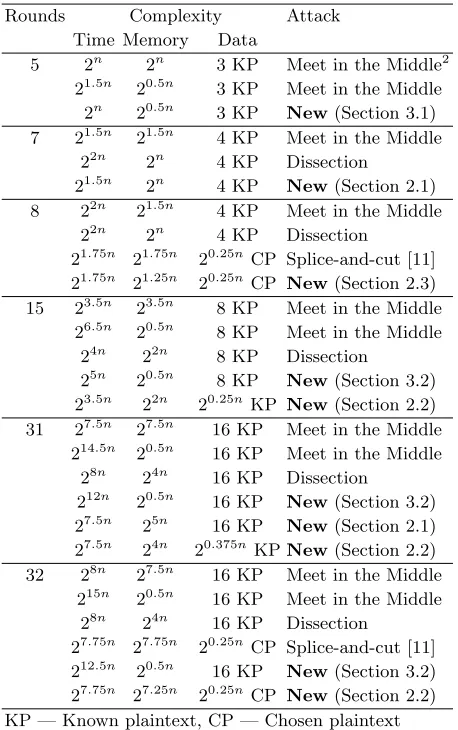
In Table 1 we compare the complexity of our attacks with previous results for certain numbers of rounds which have “clean” exponents.
While all the techniques described so far are completely generic, they allow us to significantly improve the best known attacks on several concrete block ciphers. In particular, we reduce the memory complexity of the best known attack on 8-round CAST-128 [1] from 2111 to 264, and the memory complexity of the best known attack on 8-round DEAL [15] with 256-bit keys from 2200 to 2144, both without affecting the time and data complexities. It is interesting to note that an extension of our techniques can even be applied to certain non-Feistel cryptosystems, such as FOX [13], in which the best MITM attack uses thepartial matchingtechnique.
This paper is organized as follows: In Section 2 we describe the improved memory complexities we obtain when we consider the most time-efficient at-tacks, and in Section 3 we describe the improved time complexities which can be obtained when we consider the most memory-efficient attacks. In Section 4 we sketch the application of our results to concrete block ciphers. We conclude the paper in Section 5.
2
Improving the Memory Complexity of the most
Time-Efficient Attacks on Feistel Structures
Consider a standard Feistel structure with an odd number`= 2r+ 1 of rounds. The generic dissection attack on this construction (that does not exploit the
Feis-2 In the case of 5-round Feistel, the dissection attack is not better than the meet in
Rounds Complexity Attack
Time Memory Data
5 2n 2n 3 KP Meet in the Middle2
21.5n 20.5n 3 KP Meet in the Middle 2n 20.5n 3 KP
New(Section 3.1) 7 21.5n 21.5n 4 KP Meet in the Middle
22n 2n 4 KP Dissection
21.5n 2n 4 KP New(Section 2.1) 8 22n 21.5n 4 KP Meet in the Middle
22n 2n 4 KP Dissection
21.75n 21.75n 20.25nCP Splice-and-cut [11] 21.75n 21.25n 20.25nCP New(Section 2.3) 15 23.5n 23.5n 8 KP Meet in the Middle
26.5n 20.5n 8 KP Meet in the Middle 24n 22n 8 KP Dissection
25n 20.5n 8 KP New(Section 3.2) 23.5n 22n 20.25n KP New(Section 2.2) 31 27.5n 27.5n 16 KP Meet in the Middle
214.5n 20.5n 16 KP Meet in the Middle 28n 24n 16 KP Dissection
212n 20.5n 16 KP New(Section 3.2) 27.5n 25n 16 KP New(Section 2.1) 27.5n 24n 20.375nKPNew(Section 2.2) 32 28n 27.5n 16 KP Meet in the Middle
215n 20.5n 16 KP Meet in the Middle 28n 24n 16 KP Dissection
27.75n 27.75n 20.25nCP Splice-and-cut [11] 212.5n 20.5n 16 KP New(Section 3.2) 27.75n 27.25n 20.25nCP
New(Section 2.2) KP — Known plaintext, CP — Chosen plaintext
Table 1.Comparing and Summarizing Some of our Results
tel structure) requires 20.5(r+1)ntime and about 20.25rnmemory.3The standard MITM attack can exploit the Feistel structure to reduce the time complexity to 20.5rn, at the expense of enlarging the memory complexity to 20.5rn. No attacks
faster than 20.5rn are known (unless additional assumptions are made on the
round functions or on the key schedule) and thus we concentrate in this section on attacks which have this time complexity. Our goal is to combine the benefits of both MITM and dissection attacks in order to reduce the memory complexity
3 Note that such an attack has to treat every two consecutive Feistel rounds as a single
to 20.25rn. We show that this is indeed possible, but at the expense of somewhat
enlarging the data complexity of the attack.
First, we present a basic 7-round attack4 that requires 21.5n time and 2n
memory (compared to (21.5n,21.5n) and (22n,2n) in generic MITM and
dissec-tion, respectively), and extend it to an attack on 2r+ 1 rounds that requires 20.5rn time and about 20.33rn memory. Then, we present a more sophisticated
attack that requires 20.5rn time and about 20.25rn memory as desired, but at
the expense of enlarging the data complexity to 2d(r−4)/re·0.5nknown plaintexts.
Finally, we show that our attacks can be combined with a technique of Isobe and Shibutani [11] that allows extending MITM attacks on Feistel structures by one round using a splice-and-cut technique [2, 19]. We obtain an attack on
`= 2r-round Feistel that requires 2(0.5r−0.25)n time, about 20.25(r+1)n memory,
and 2max(dr−4
r e,0.5)·0.5n chosen plaintexts.
2.1 Attacks with a Low Data Complexity
In this section we present attacks that are time-efficient (i.e., have a time com-plexity of 20.5rn for 2r+ 1 rounds) and also data-efficient (i.e., require only a
few known plaintexts, like the standard MITM attack).
A standard MITM attack In order to put our attacks in context, we begin
by describing a standard MITM attack on a 7-round Feistel structure.
A 7-Round MITM Attack
1. Obtain 4 plaintext-ciphertext pairs (Pi, Ci) (i= 1,2,3,4).
2. For each value ofK1, K2, K3:
(a) Partially encryptPifori∈ {1,2,3,4}through the first three rounds
and obtain suggestions for Ri3. Store the suggestions in a list List sorted by the Ri
3 values. 3. For each value ofK5, K6, K7:
(a) Partially decryptCifori
∈ {1,2,3,4}through the last three rounds, obtain suggestions for Ri
3 and search the suggestions inList. For each match, retrieve K1, K2, K3, guess5 K4, and test the full key using trial encryptions.
The time complexity of Step 2 is about 21.5n, which is also the size of List.
In order to calculate the time complexity of Step 3, we note that we have a total of 21.5n key suggestions from each side of the encryption, each associated with
4 values of Ri3 (filtering conditions). Thus, the expected total number of key suggestions that remain after the 2n-bit match in Step 3 is 21.5n+1.5n−2n = 2n.
For each such suggestion, we guess K4, and thus we expect to perform about
4 We consider attacks on less than 7 rounds in Section 3. 5 We note thatK
4 can also be found by a precomputed table instead of guessing, but
21.5ntrial encryptions. Consequently, the time complexity of Step 3 is also about
21.5n, which is the time complexity of the full attack.
A 7-round attack The basic idea of our reduced memory attack is to guess the
n/2-bit valueR1
3and to iterate over all the possible guesses as an outer loop. Each guess imposes an n/2-bit constraint on the key suggestions for K1, K2, K3 and
K5, K6, K7, and thus, allows reducing the expected size ofListto 2n. In order to compute the reduced lists efficiently, we prepare auxiliary tables Tupper, Tlower
that allow retrieving the subkeyK3(resp.,K5) instantly given the input (L2, R2) of round 3 (resp., the output (L5, R5) of round 5).
The table Tupper is computed as follows. We guess the intermediate value
R1
2 and the subkey K3. Since (R21 = L13, R31) form the full state after the 3’rd round in the encryption process ofP1, the guesses enable us to partially decrypt through round 3 and obtain (R1
1 =L12, R12). We store the triple (L12, R21, K3) in
Tupper, sorted by (L12, R12). The tableTlower is constructed similarly.
7-Round Attack with Reduced Memory Complexity
1. Obtain 4 plaintext-ciphertext pairs (Pi, Ci).
2. For each value ofR1 3:
(a) For each value ofK3 andI31=R12, computeL12=F3(K3, I31)⊕R13, and store the triplet (L1
2, R12, K3) in a tableTupper, sorted according
to (L12, R21).
(b) For each value ofK5andI51=R14, computeR15=F5(K5, I51)⊕R13, and store the triplet (L1
5, R15, K5) in a tableTlower, sorted according
to (L1 5, R51).
(c) For each value ofK1, K2:
i. Partially encrypt P1 through the first two rounds to obtain suggestions forR1
2 andL12. ii. Search for the pair (L1
2, R12) in Tupper and obtain suggestions
forK3. For each suggestion, givenK1, K2, K3, partially encrypt
Pi for i
∈ {2,3,4} through the first three rounds and obtain suggestions forRi
3. Store the suggestions in a listList1, sorted by the valuesR2
3, R33, R43. (d) For each value of K6, K7:
i. Partially decryptC1through the last two rounds to obtain sug-gestions forR1
5 andL15=R14.
ii. Search for the pair (L15, R15) inTlowerand obtain suggestions for
K5. For each suggestion, givenK5, K6, K7, partially decryptCi fori∈ {2,3,4}through the last three rounds, obtain suggestions for Ri
3 and search the suggestions in List1. For each match, retrieveK1, K2, K3, guessK4, and test the full key using trial encryptions.
In Steps 2a and 2b, a single round function (eitherF3 or F5) is called once for each guess of (R1
complexity is 21.5n. The memory complexity of the tables T
upper and Tlower
is 2n. In Steps 2(c)ii and 2(d)ii there is an average of one match in T upper
and Tlower, respectively. Thus, on average, we perform a constant number of
partial encryption and decryption operations per guess ofK1, K2andK6, K7in Steps 2c and 2d, respectively. The expected number of matches in Step 2(d)ii is 2n+n−1.5n = 20.5n, and the expected number of trial encryptions (after guessing
K4) is 20.5n+0.5n = 2n. Therefore, the time complexity of each of Steps 2c and 2d is about 2n each, and the total time complexity of the attack is about 21.5n, as
in the standard MITM attack. On the other hand, the memory complexity of the attack is reduced from 21.5n to about 2n, which is the expected number of
elements in List1 (based on standard randomness assumptions on the round functions).
We note that the time complexity of the attack can be slightly reduced by precomputing a table forF4, which allows to avoid guessingK4 in Step 2(d)ii. However, this requires an additional table of size 2n, i.e., maintaining the 2n
total memory complexity.
Extension to 6r+ 1 rounds. The 7-round attack presented above can be
extended to an attack on a 6r+ 1-round Feistel structure, with time complexity of 21.5rn(as in standard MITM) and memory complexity of 2rn(instead of 21.5rn
in standard MITM). As the attack is similar to the 7-round attack, we describe it briefly. The reader can follow this attack by verifying that the case r = 1 reduces exactly to the attack described above.
First, we obtain 3r+ 1 plaintext/ciphertext pairs (Pi, Ci). Then, the outer
loop is performed for all guesses of therintermediate valuesR1
3r, R23r, . . . , Rr3r. In
the inner loop, we guess the 2rvaluesR1
3r−1, R23r−1, . . . , R3rr−1, K3r, . . . , K2r+1. Since for eachi, (Ri
3r−1=Li3r, Ri3r) forms the full state after the 3r’th round in
the encryption process ofPi, we can partially decrypt this state through rounds
2r+1, . . . ,3rto obtain the corresponding values (Ri2r−1=Li2r, Ri2r). This allows
us to prepare a tableTupperof size 2rnof the values ((Li2r, Ri2r)ri=1, K2r+1, . . . , K3r),
sorted by ((Li
2r, Ri2r)ri=1). The tableTlower is prepared similarly. Note that the
2rvalues guessed from each side are used only for preparing the tables and not in the rest of the attack.
After preparing the tables, we guess the subkeysK1, K2, . . . , K2r, obtain the
intermediate values (Li
2r, Ri2r)ri=1and access the tableTupperto obtain a
sugges-tion for the subkeysK2r+1, . . . , K3r. For each suggestion, givenK1, K2, . . . , K3r,
we partially encryptPifori∈ {r+1, . . . ,3r+1}through the first 3rrounds and
obtain suggestions for Ri
3r. We store the suggestions in a list List1, sorted by
the valuesRr3+1r , . . . , R33rr+1. Then, we guess the subkeysK6r+1, . . . , . . . , K4r+2, access the table Tlower to obtain a suggestion for K4r+1, . . . , K3r+2, partially decrypt the ciphertexts to get suggestions for Ri
3r (i=r+ 1, . . . ,3r+ 1), and
search them inList1. For each match, we retrieveK1, . . . , K3r, guessK3r+1, and test the full key using trial encryptions.
The same attack applies for a general odd number 2r0+ 1 of rounds. The time complexity is 2r0n
(like in MITM), but the memory complexity has to be rounded up to 2d2r0/3
e·0.5n, due to lack of balance between the part of table creation and
the rest of the attack.
2.2 Using Multi-Collisions to Further Reduce the Memory
Complexity
We now present a more sophisticated variant of the attacks described above, that allows to reduce the memory complexity to the “desired” 20.25(r+1)n, with
no increase in the time complexity, but at the expense of some increase in the data complexity.
Consider the 6r+ 1-round attack described above. In the course of preparing the tableTupper, we make an auxiliary guess of the valuesR13r−1, . . . , Rr3r−1, K3r,
. . . , K2r+1, and in the course of preparing the tableTlower, we guessR31r+1, . . . ,
Rr
3r+1, K3r+2, . . . , K4r+1. If there was some relation between the guessed values, we could have used this relation to enumerate over some “common relative” in the outer loop of the attack, and thus reduce the memory complexity. We cannot hope for such a relation between the subkeys, as they are assumed to be independent. However, some relation betweenRi
3r−1 andRi3r+1 may exist. We observe that such a relation can be “created”, using multi-collisions. Assume that the partial encryption of the plaintextsP1, P2, . . . , Prconsidered in
the attack results in anr-multi-collision at the stateR3r, i.e., thatR13r=R23r=
· · · = Rr
3r. In such a case, the r values Ri3r−1⊕R3ir+1 =O3ir+1 (i = 1, . . . , r) are all equal! This allows us to enumerate over the r−1 values R1
3r−1⊕Ri3r−1 (i = 2, . . . , r) in the outer loop, such that in the inner loop, a single guess of R1
3r−1 provides all the values {Ri3r−1}i=2,...,r, while a single guess of R13r+1 provides all the values {Ri
3r+1}i=2,...,r. In order to obtain the multi-collision,
we consider 2((r−1)/r)·0.5n known plaintexts (which guarantees that anr
-multi-collision exists in the data with a constant probability), and repeat the attack for allr-tuples of plaintext/ciphertext pairs in the data set.
In the description of the algorithm below, we switch from 6r+ 1 rounds to 8r−1 rounds, in order to balance the complexities of all the steps of the attack. Hence, the external guesses are performed at stateR4r−1, instead ofR3r. Note
that forr= 1, the algorithm reduces to the 7-round attack presented above.
An8r−1-Round Attack Using Multi-Collisions
1. Obtain 2((r−1)/r)·0.5n plaintext-ciphertext pairs (Pi, Ci).
2. For eachr-tuple (Pi1, Ci1),(Pi2, Ci2), . . . ,(Pir, Cir) of plaintext-ciphertext
pairs in the data set (hereinafter denoted for simplicity by (P1, C1), . . . , (Pr, Cr)), for each possible value of R1
4r−1, and for all possible differ-encesR1
4r−2⊕Ri4r−2 (i= 2,3, . . . , r):
(a) For eachI41r−1=R14r−2 and the subkeysK4r−1, K4r−2, . . . , K2r+1, compute6 (Li
((Li
2r, Ri2r)i=1,...,r, K2r+1, . . . , K4r−1) in a table Tupper, sorted
ac-cording to (Li
2r, R2ir)i=1,...,r.
(b) For each I1
4r+1 =R14r and the subkeysK4r+1, . . . , K6r−1, compute (Li
6r−1, Ri6r−1) for all i= 1, . . . , r, and store the vector ((Li
6r−1, Ri6r−1)i=1,...,r, K4r+1, . . . , K6r−1) in a table Tlower, sorted
according to (Li
6r−1, Ri6r−1)i=1,...,r.
(c) For each value ofK1, K2, . . . , K2r:
i. Partially encryptP1, . . . , Pr through the first 2rrounds to
ob-tain suggestions for (Li
2r, Ri2r)i=1,...,r.
ii. Search for (Li
2r, Ri2r)i=1,...,r in Tupper and obtain suggestions
forK2r+1, . . . , K4r−1. For each suggestion, givenK1, . . . , K4r−1, partially encrypt 2r+ 1 additional plaintextsPj forj ∈ {1, . . . ,
2r+ 1}through the first 4r−1 rounds and obtain suggestions for Rj4r−1. Store the suggestions in a list List1, sorted by the values{Rj4r−1}j=1,...,2r+1.
(d) For each value of K8r−1, . . . , K6r:
i. Partially decryptC1, . . . , Cr through the last 2r rounds to
ob-tain suggestions for (Li
6r−1, Ri6r−1)i=1,...,r.
ii. Search for (Li
6r−1, Ri6r−1)i=1,...,r in Tlower and obtain
sugges-tions forK4r+1, . . . , K6r−1. For each suggestion, givenK4r+1, . . . ,
K8r−1, partially decrypt the additional ciphertexts C0j for j∈
{1, . . . ,2r+1}through the last 4r−1 rounds, obtain suggestions for{Rj4r−1}j=1,...,2r+1, and search the suggestions inList1. For each match, retrieveK1, . . . , K4r−1, guessK4r, and test the full
key using trial encryptions.
The inner loop of the algorithm is repeated for each of the 2(r−0.5)n
val-ues of the external gval-uess. In each of Steps 2(a) and 2(b), we perform 2rn par-tial encryptions/decryptions and construct a table of size 2rn. In Steps 2.(c).ii.
and 2.(d).ii. there is an average of one match inTupper andTlower, respectively.
Thus, on average, we perform a constant number of partial encryption and de-cryption operations per guess ofK1, . . . , K2randK6n, . . . , K8n−1in Steps 2.(c) and 2.(d), respectively. The expected number of matches in Step 2.(d).ii is 2rn+rn−(r+0.5)n = 2(r−0.5)n, and the expected number of trial encryptions
(af-ter guessing K4) is 2(r−0.5)n+0.5n = 2rn. Therefore, the time complexity of Steps 2.(c) and 2.(d) is about 2rn and the total time complexity of the attack
is about 2(2r−0.5)n, as in the standard MITM attack. On the other hand, the
memory complexity of the attack is reduced from 2(2r−0.5)n to about 2rn, which
is the expected number of elements inList1.
The same attack applies for a general odd number 2r0+1 of rounds. The time complexity is 2r0n(like in MITM), the memory complexity has to be rounded up
6 The computation of (Li
2r, R2ir) for alli= 1, . . . , ris feasible, since by the assumption that (P1, C1), . . . ,(Pr, Cr) is an r-multi-collision, the value R1
4r−2 along with the
externally guessed values are sufficient for obtaining the valuesR2
to 2d0.5(r0+1)
e·0.5n, due to lack of balance between the part of table creation and
the rest of the attack, and the data complexity is 2drr0 −0+13e·0.5n known plaintexts.
2.3 Attacks on Feistel Structures with an Even Number of Rounds
In this section we show that all the attacks presented above can be combined with the recent technique of Isobe and Shibutani [11] that allows to extend MITM attacks on Feistel structures by one round, at the expense of a relatively small increase in the time complexity and of using 20.25n chosen plaintexts. The
generic attack of [11] on a 2r-round Feistel structures requires 2(0.5r−0.25)n time,
2(0.5r−0.25)n memory, and 20.25n chosen plaintexts. Our attacks allow to either
reduce the memory complexity to about 20.33(r−1)n+0.25n with no effect on the
time and data complexities or to reduce the memory complexity all the way to about 20.25(r+1)n, while increasing the data complexity to 2max(dr−4
r e,0.5)·0.5n
chosen plaintexts, with no effect on the time complexity. In the specific case of the 8-round Feistel structures considered in [11], our attack reduces the mem-ory complexity significantly from 21.75n to 21.25n, without affecting the other
complexities.
Consider a MITM attack on a 2r-round Feistel structure. In a standard appli-cation (skipping the guess of the middle subkey), the attack is not balanced, as
rsubkeys are guessed on one side of the MITM, whiler−1 subkeys are guessed on the other side. The attack of [11] aims to rebalance the attack, by “splitting” the guess of one subkey between the two sides. The basic idea behind the attack is as follows. If in all plaintexts used in the attack, the right half is equal to a fixed valueR0, then in all encryptions, we haveR1=Const⊕L0, whereConst is an unknown constant that depends onK1. This allows to replace the 2r-round Feistel with an equivalent construction that consists of a 2r−1-round Feistel, prepended by an addition of Const to the right half of the plaintext (that can be treated as a subkey addition). This, in turn, allows to use the splice-and-cut technique [2, 19] to “split” the guess ofConst between the two sides of the MITM, at the price of using 2n/4 chosen plaintexts. As a result, the attack be-comes balanced and the time complexity is reduced from 20.5rn to 2(0.5r−0.25)n.
For a full description of the attack, see [11].
In order to incorporate the splice-and-cut procedure of [11] into our attacks, we consider the equivalent 2r−1-round variant, perform one of our attacks against it, and insert the splice-and-cut procedure into the “key guessing” part of the attack (i.e., Steps 2(c) and 2(d)), without changing the “table construction” part (Steps 2(a) and 2(b)). As a result, the time complexity of our 2r− 1-round attack is increased by a factor of 20.25n to 2(0.5r−0.25n) (just like the complexity of the attack of [11]), and the memory complexity is increased by a factor of 20.25n to either 20.33(r−1)n+0.25n (in the low data complexity attack)
or to about 20.25(r+1)n (in the attack using multi-collisions). As for the data
complexity, in our low data complexity attack the data complexity increases to 20.25n chosen plaintexts (required for the splice-and-cut procedure), and in the
multi-collision based attack the data complexity increases to 2max(dr−4
as the plaintexts required for the multi-collision can be chosen in such a way that they will contain the structures required for the splice-and-cut attack.
3
Memory-Restricted Attacks on Feistel Structures
After analyzing the most time-efficient attacks, a natural question to explore is what are the most memory-efficient attacks one can devise against an r-round Feistel structure. Specifically, we shall concentrate on the problem of devising attacks with 20.5nmemory complexity, since it is the smallest amount of memory
that enables us to list all the values of a single subkey or of half a block. With such a restriction, a standard meet in the middle attack takes 2(`−2)·0.5n
on an`-round Feistel, and one can trade time for memory. One can also try to consider the original dissection attack of [9]. However, as noted before, dissection takes at least 2n memory to store all the possible values of a full block, which
implies that it cannot be used in this context, even though we adopt several concepts from it.
Section 3.1 presents our new attack on 5-round Feistel structures that uses 2n
time and 20.5n memory. This is to be compared with meet in the middle attacks
that use time of 21.5nwith 20.5nmemory or time of 2nwith 2nmemory. We then
generalize the attack to more rounds, and show in Section 3.2 how to increase the gain over meet in the middle attacks as the number of rounds increases. The attacks in this section assume that the round function is efficiently invertible given the round’s subkey. Due to space constraints, we postpone the discussion of this assumption to Appendix B, but note that it holds for almost any Feistel block cipher we are aware of.
3.1 A Memory-Restricted Attack against 5-Round Feistel
Constructions
The algorithm of our basic 5-round attack is as follows.
A 5-Round Attack with20.5n Memory (DF
2(5,1))
1. Obtain 4 plaintext-ciphertext pairs (Pi, Ci) (i= 1,2,3,4).
2. For each value ofR1 2=I31: (a) ComputeO1
2=I31⊕R10 andO14=I31⊕R14.
(b) For each value ofK1, computeR11=F1(K1, I11)⊕L10and store the pair (R1
1, K1) in a tableTupper sorted according toR11.
(c) For each value of K2, compute R11 = F2−1(K2, O12)⊕R12, search for the valueR1
1 in Tupper and obtain suggestions for K1. For each suggestion, givenK1, K2, computeR22, R32forP2, P3. Store the sug-gestions (R2
2, R32, K1, K2) in a listList1 sorted by the value ofR22. (d) For each value ofK5, computeR13=F5(K5, I51)⊕L15and store the
pair (R1
(e) For each value of K4, compute R13 = F− 1
4 (K4, O14)⊕R12, search for the value R1
3 in Tlower and obtain suggestions forK5. For each suggestion, givenK4, K5, computeR22, R32 fromC2, C3, and search the suggestion inList1. For each match, retrieveK1, K2, guessK3, and test the full key using trial encryptions.
For reasons which will become apparent later, we call the above attackDF2(5,1). As before,Tupper, Tlower, are each of size 20.5n. The memory complexity of
List1 depends on the number of (K1, K2) pairs that satisfy the meet in the middle condition on the value of I2 in Step 2c. For sufficiently random round functions, we expect about 20.5n such (K
1, K2) pairs.
The time complexity of the algorithm is 2n, as it iterates over 2n/2 values for R1
2, and each step of the loop takes 20.5n operations (besides the XOR of Step 1a, which takes less).
We note that the time complexity of the attack can be slightly reduced by precomputing a table for F3 (given its input value I31), which allows to avoid guessing K3. However, this requires an additional table of size 20.5n, which in-creases the memory complexity by a small constant factor.
Finally, it is important to note that given only two plaintext-ciphertext pairs, the above attack finds all possible (K1, K2, K3, K4, K5) in time 2n and memory of 20.5n. The expected number of candidates is about 20.5n. This observation will
be used in the subsequent attacks.
3.2 Extension to More Rounds
As the time complexity of a MITM attack with 20.5n memory on an r-round
Feistel structure is 2(`−2)0.5n, we define the gain over MITM of an attack on
`-round Feistel that requiresT time and 20.5nmemory by (`
−2)−log2(T)/0.5n. Thus, the 5-round attack presented above has gain of 1. We denote byGain(`) the maximal gain achieved by an `-round attack with 20.5n memory. In this
section, we extend the 5-round attack to a sequence of attacks which show that asymptotically,Gain(`) =Ω(√`), and compute the sequence of round numbers for which the gain is strictly increased.
Obviously, it is possible to attack 6-round Feistel by guessingK6, and ap-plying the 5-round attack for each guess. The result is an attack of 21.5n time and 20.5n memory on 6-round Feistel structure. This approach can obviously be
extended, but maintains a gain of 1.
Attacking 10-Round Feistel Constructions To increase the gain to 2, we
consider the case of 10-round Feistel, and develop the following attack:
10-Round Dissection Attack with2n/2 Memory (DF
5(10,4))
1. Obtain 5 plaintext-ciphertext pairs (Pi, Ci) i=1,...,5. 2. For each value of (L1
(a) RunDF2(5,1) on the first 5 rounds, and obtain a list of 20.5n can-didates for (K1, K2, K3, K4, K5).
(b) For each candidate for the subkeys (K1, K2, K3, K4, K5), partially encrypt a third plaintext P3 through the first 5 rounds, and store the suggestions (with the keys) (L3
5, R35, K1, . . . , K5) in a listList1 sorted by the values of (L3
5, R35).
(c) RunDF2(5,1) on the last 5 rounds, and obtain a list of 20.5n can-didates for (K6, K7, K8, K9, K10).
(d) For each candidate for the subkeys (K6, K7, K8, K9, K10), partially decrypt C3 through the last 5 rounds, and obtain suggestions for (L3
5, R35) and search the suggestion inList1. For each match, retrieve
K1, . . . , K5, and test the full key using trial encryptions.
It is easy to see that the 10-round attack calls 22n times two independent
5-round attacks, each running in time 2n. Hence, the time complexity of the
10-round attack is 23n, and the memory complexity is 20.5n. Hence, the gain of
the 10-round attack is 2.
We use the following notations, DF2(5,1) denotes the 5-round attack pre-sented earlier, as it is a generalized Dissection attack on Feistel xistructures with 5 rounds, which guesses onen/2-bit value after two rounds of encryption. Simi-larly, DF5(10,4) attacks 10 rounds by guessing 4 n/2-bit values after 5 rounds of encryption (i.e., two full intermediate encryption values). As in [9], we now explore how to extend the attack to more rounds.
Attacking 15-Round Feistel Constructions We can increase the gain to 3,
when attacking 15-round Feistel: Guess two complete intermediate encryption values after 5 and after 10 rounds (a total of four internal values), and run the 5-round attack three times subsequently (on rounds 1–5, 6–10, and 11–15), resulting in 20.5n candidates for each set of corresponding subkeys. Then, the
correct value can be found by an additional standard MITM. If the memory is kept at 20.5n, this means that the last layer of the MITM takes 2n time. Hence, the total time complexity of the 15-round attack is 25n, and thus, its gain is 3.
In other words,DF5(15,4) is based on guessing fourn/2-bit internal state words after 5 rounds, and running recursively running DF2(5,1) on the first rounds, and running DF5(10,4) on the last rounds. This contrasts with the works of [9], where each new layer in the dissection was of a different size.
5-round to 10-round (comparingDF2(5,1) andDF5(10,4): whereas the 5-round attack guesses a single n/2-bit value, the 10-round attack starts by guessing 4 such values.
Attacking 22-Round Feistel Structures We now turn our attention to
22-round Feistel structures. Due to the differences between regular dissection attacks and attacking Feistels, the extension of the 15-round attack into the 22-round attack follows a slightly different path than the extension from the 10-round to the 15-round:
22-Round Dissection Attack with2n/2 Memory (DF
7(22,6))
1. Obtain 11 plaintext-ciphertext pairs (Pi, Ci)
i=1,...,11. 2. For each possible value of (L1
7, R17), (L27, R72), and (L37, R37):
(a) RunDF2(7,3) on the first 7 rounds, and obtain a list of 20.5n can-didates for (K1, K2, . . . , K7).
(b) For each candidate for the subkeys (K1, K2, . . . , K7), partially en-crypt a fourth plaintext P4 through the first 7 rounds, and store the suggestions (with the keys) (L47, R47, K1, . . . , K7) in a listList1 sorted by the values of (L4
7, R47).
(c) Run DF5(15,4) on the last 15 rounds, and obtain a list of 21.5n candidates for (K8, K9, . . . , K22).
(d) For each candidate for the subkeys (K8, . . . , K22), partially decrypt
C4 through the last 15 rounds, and obtain suggestions for (L3 7, R37) and search the suggestion inList1. For each match, retrieveK1, . . . , K7, and test the full key using trial encryptions.
It is easy to see that the memory complexity of the attack is 20.5n. The
7-round attackDF2(7,3) is actuallyDF2(5,1), run whenK6, K7are guessed, i.e., takes 22n time for 20.5n. Both the 7-round attack and the 15-round attack are called 23n times, suggesting a total running time of 28n, i.e., the attack offers a
gain of 4.
Generalization to More Rounds In the second generalization, we prepend
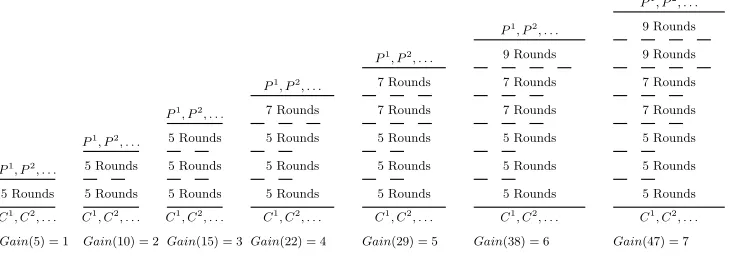
5 rounds to the 10-round attack (obtaining 15 rounds in total), and again, guess two full internal states in order to run two independent attacks — one on 5 rounds, and the other on 10 rounds. The 22-round attack is based on guessing three additional full internal states, and prepending 7 rounds before the 15-round attack. Similarly, a 29-15-round attack with a gain of 5 can be obtained by prepending 7 rounds before the 22-round attack and guessing three additional full internal states. It is now apparent that the sequence of round numbers for which the gain increases is{5,10,15,22,29,38,47,58,69, . . .},7which shows that for allk,Gain(2k2+ 6k+ 2)≥2kand Gain(2k2+ 8k+ 5)≥2k+ 1. It follows that asymptotically,Gain(`) grows as√2`.
7 A gain ofjis first achieved when attacking 5j+ 2Pj−1
The general form of the recursion is described in Figure 2. We note that the recursion yields only a lower bound on Gain(`). The discussion about the optimality of this lower bound will be presented in the full version of the paper.
P1, P2, . . .
5 Rounds
C1, C2, . . .
P1, P2, . . .
5 Rounds
5 Rounds
C1, C2, . . .
P1, P2, . . .
5 Rounds
5 Rounds
5 Rounds
C1, C2, . . .
P1, P2, . . .
7 Rounds
5 Rounds
5 Rounds
5 Rounds
C1, C2, . . .
P1, P2, . . .
7 Rounds
7 Rounds
5 Rounds
5 Rounds
5 Rounds
C1, C2, . . .
P1, P2, . . .
9 Rounds
7 Rounds
7 Rounds
5 Rounds
5 Rounds
5 Rounds
C1, C2, . . .
P1, P2, . . .
9 Rounds
9 Rounds
7 Rounds
7 Rounds
5 Rounds
5 Rounds
5 Rounds
C1, C2, . . .
Gain(5) = 1 Gain(10) = 2 Gain(15) = 3 Gain(22) = 4 Gain(29) = 5 Gain(38) = 6 Gain(47) = 7
Dashed lines represent internal state values which are guessed in the attack.
Fig. 2.Generalizing the 5-Round Attack and Increasing the Gain
4
Applications to Concrete Cryptosystems
While the new techniques presented in Sections 2 and 3 are generic, they can also be used to improve the memory complexity of the best known attacks on several block ciphers, including CAST-128, DEAL, and FOX. It turns out that even a straightforward application of the generic techniques already yields im-provements over previously known attacks, and if we also exploit the specific properties of the analyzed cipher, the improvements become even more signif-icant. Due to space constraints, we present in this section only a very brief description of our improved attacks on specific schemes. The full description of the attack on CAST-128 is given in Appendix A, and the full descriptions of the other applications will be given in the full version of the paper.
4.1 Lower Memory Attacks on DEAL
structures (described in Section 2.3) can be used to reduce the time complexity to 23·56+32= 2200, with memory complexity of 2200 and data complexity of 232 chosen plaintexts. We show that by using our techniques, the memory complex-ity can be significantly reduced to 2144, while maintaining the same data and time complexities.
Our generic attack on 8-round Feistel structures (presented in Section 2.3) requires 21.75n time, 21.25n memory, and 20.25nchosen plaintexts. A direct
appli-cation of this attack to DEAL, taking into account the fact that each round key has only 56 bits rather than 64, yields time complexity of 264+56+56+32= 2208. However, the time complexity can be reduced to 2200by performing the external enumeration over 56 out of the 64 bits of the intermediate valueR1
4, rather than over the full value. In the phase of table preparation, we guess the remaining 8 bits of R1
4, along with the auxiliary guess of R13, K4, and thus, the complexity of this step is increased to 28+64+56 = 2128. However, this complexity is still dominated by the 232+56+56 = 2144 complexity of the key guessing step. As a result, the overall time complexity remains 256+56+56+32 = 2200, the memory complexity is reduced to 256+56+32= 2144, and the data complexity remains 232 chosen plaintexts.
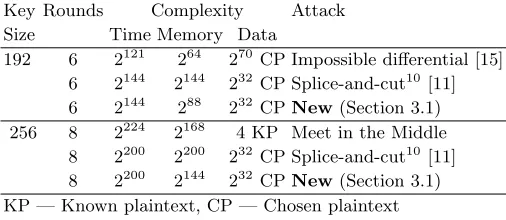
In a similar way we can reduce the memory complexity of the improved MITM attack on the full 6-round DEAL with 192-bit keys from 256+56+32 = 2144 to 256+32 = 288 (while keeping the 2144 time complexity and 232 data complexity unchanged), using a modification of the generic attack on 6-round Feistel structures presented in Section 3. The resulting attack in this case is the best known attack which uses a practical data complexity, but is outperformed (in terms of time complexity) by the impossible differential attack presented by Knudsen [15] that requires 2121time but uses an unrealistic amount of 270chosen plaintexts. Table 2 compares the complexities of attacks against the variants of DEAL.
4.2 A Lower Memory Attack on CAST-128
CAST-128 [1] is a 16-round Feistel structure that uses 64-bit inputs and 128-bit keys, which was designed in 1996 by Adams. It is used in several real-life products, such as GPG, PGP, and SSH2. The currently best known attack on the cipher (excluding weak-key attacks such as [21]) is the MITM attack of Isobe and Shibutani [11], breaking 8 out of the 16 rounds in time complexity of about 2118, using 8 chosen ciphertexts and a memory complexity of 2111 words. Using our techniques, the memory complexity can be reduced significantly to 264, while maintaining the same data and time complexities.
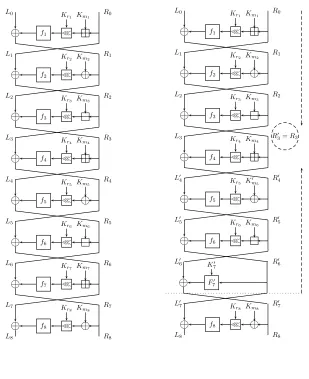
The general structure of CAST-128 is shown in Figure 3 (which describes only 8 out of its 16 rounds). In the round functionFi, the 32 LSBs of the 37-bit
round keyKi (denoted asKmi) are first either XORed, added (modulo 2
32), or subtracted (modulo 232) from R
i−1. Then, the result is rotated to the left by 0–31 bits, according to the value of the 5 MSBs ofKi (denoted asKri). Finally,
Since each round key of CAST-128 is of 37 bits, the time complexity of a basic MITM attack on a 8-round variant is 24·37 = 2148. Using the generic attack of [11] on 8-round Feistel structures (described in Section 2.3), the time complexity can be reduced to 23·37+16= 2127, which is only slightly faster than exhaustive key search. Isobe and Shibutani [11] showed that the specific structure of the round function of CAST-128 can be used to further reduce the time complexity to 2118. The main idea of [11] is that by fixing most of the ciphertext bits (in all ciphertexts) to a constant value and exploiting the specific round function structure, the amount of key material required for partial decryption can bereduced(and not only divided between the upper and lower halves of the MITM, like in the generic attack). To achieve this, [11] consider an equivalent 7-round Feistel structure, with different round functions F50, F60, F70 that imitate the four round functionsF5, F6, F7, F8for the specifically chosen ciphertexts. See Appendix A for details of the attack.
As in case of the generic attack of Isobe and Shibutani discussed in Sec-tion 2.3, we can incorporate the advanced attack procedure in the “key guessing” part of our generic memory-efficient attack on 7-round Feistel structures. As a result, the memory complexity of the attack is reduced from 2111 to 279, with-out increasing the time and data complexities. The memory complexity can be further reduced using a refined attack that exploits the relatively simple round function of CAST-128. As we show in Appendix A, it is possible to guess two in-termediate valuesR1
3, R23(instead of a single value in the generic 7-round attack) and to structures separate tablesTupper1, Tupper2 for rounds 2,3 (and similarly, separate tables Tlower1, Tlower2 for rounds 5,6). These tables make use of com-plex differential properties of F2 and F6 that simultaneously combine different operations overGF(2) and overGF(232). As a result, the memory complexity is reduced to 264with no effect on the time complexity. The details of this (rather involved) attack are given in Appendix A.
4.3 Lower Memory Attacks on Other Cryptosystems
We conclude this section by mentioning briefly applications of our generic tech-niques to several other specific and generic structures.
1. FOXFox is a non-Feistel block cipher. The memory complexity of all the attacks of [12] on round-reduced variants of the block cipher FOX (namely, on 6 and 7-round FOX-64 and FOX-128), which are currently the best known attacks on FOX, can be reduced by a factor of 216. We note that in these attacks, the 16 bits of filtering on which the attack iterates in the outer loop of the attack are not actual state bits, but rather linear combinations of state bits. However, our techniques are still applicable in this case, as in the inner loop, for each side of the attack, we simply complement these linear combinations to obtain an intermediate encryption state of FOX, and invert its round function as done in our generic attacks.
2. CamelliaThe memory complexity of the attacks of [11] on reduced variants
attack). We note however that MITM attacks are not the best known attacks on Camellia (in terms of the number of rounds).8
3. Feistel-2 SchemesThe memory complexity of the attacks of [11] on the 8
and 9-round Feistel-2 scheme (which is a more specific Feistel implementation compared to the generic Feistel-1) with a 2n-bit key can be reduced from about 21.5n to 2n. We note that these MITM attacks are the best known attacks on this specific Feistel-2 only when the data complexity is limited. With large data complexity in the chosen plaintext model, the attacks of [10] have superior time complexities.
5
Conclusions
In this paper we introduced some new cryptanalytic techniques, and combined the known techniques of MITM and dissection in new ways which enabled us to merge their advantages and avoid their disadvantages. Taken together, these techniques allowed us to develop improved attacks on Feistel structures with more than four rounds, and to improve the best known concrete attacks on several well known block ciphers.
References
1. Adams, C.: The CAST-128 Encryption Algorithm. RFC 2144 (1997), https://tools.ietf.org/html/rfc2144
2. Aoki, K., Sasaki, Y.: Preimage Attacks on One-Block MD4, 63-Step MD5 and More. In: Avanzi, R.M., Keliher, L., Sica, F. (eds.) Selected Areas in Cryptogra-phy, 15th International Workshop, SAC 2008, Sackville, New Brunswick, Canada, August 14-15, Revised Selected Papers. Lecture Notes in Computer Science, vol. 5381, pp. 103–119. Springer (2008)
3. Bogdanov, A., Khovratovich, D., Rechberger, C.: Biclique Cryptanalysis of the Full AES. In: Lee, D.H., Wang, X. (eds.) ASIACRYPT. Lecture Notes in Computer Science, vol. 7073, pp. 344–371. Springer (2011)
4. Bogdanov, A., Rechberger, C.: A 3-Subset Meet-in-the-Middle Attack: Cryptanal-ysis of the Lightweight Block Cipher KTANTAN. In: Biryukov, A., Gong, G., Stinson, D.R. (eds.) Selected Areas in Cryptography - 17th International Work-shop, SAC 2010, Waterloo, Ontario, Canada, August 12-13, 2010, Revised Selected Papers. Lecture Notes in Computer Science, vol. 6544, pp. 229–240. Springer (2010) 5. Boura, C., Naya-Plasencia, M., Suder, V.: Scrutinizing and Improving Impossible Differential Attacks: Applications to CLEFIA, Camellia, LBlock and Simon. In: Sarkar and Iwata [18], pp. 179–199
6. Canteaut, A., Naya-Plasencia, M., Vayssi`ere, B.: Sieve-in-the-Middle: Improved MITM Attacks. In: Canetti, R., Garay, J.A. (eds.) Advances in Cryptology -CRYPTO 2013 - 33rd Annual Cryptology Conference, Santa Barbara, CA, USA, August 18-22, 2013. Proceedings, Part I. Lecture Notes in Computer Science, vol. 8042, pp. 222–240. Springer (2013)
8 Although they can handle fewer rounds, the advantage of MITM attacks over other
7. Chaum, D., Evertse, J.H.: Cryptanalysis of DES with a Reduced Number Of Rounds: Sequences of Linear Factors in Block Ciphers. In: Advances in Cryptology, CRYPTO 85. pp. 192–211. Springer (1986)
8. Diffie, W., Hellman, M.E.: Cryptanalysis of the NBS Data Encryption Standard. Computer 10(6), 74–84 (1977)
9. Dinur, I., Dunkelman, O., Keller, N., Shamir, A.: Efficient Dissection of Compos-ite Problems, with Applications to Cryptanalysis, Knapsacks, and Combinatorial Search Problems. In: SafaviNaini, R., Canetti, R. (eds.) Advances in Cryptology -CRYPTO 2012 - 32nd Annual Cryptology Conference, Santa Barbara, CA, USA, August 19-23, 2012. Proceedings. Lecture Notes in Computer Science, vol. 7417, pp. 719–740. Springer (2012)
10. Guo, J., Jean, J., Nikolic, I., Sasaki, Y.: Meet-in-the-Middle Attacks on Generic Feistel Constructions. In: Sarkar and Iwata [18], pp. 458–477
11. Isobe, T., Shibutani, K.: Generic Key Recovery Attack on Feistel Scheme. In: Sako, K., Sarkar, P. (eds.) Advances in Cryptology - ASIACRYPT 2013 - 19th Interna-tional Conference on the Theory and Application of Cryptology and Information Security, Bengaluru, India, December 1-5, 2013, Proceedings, Part I. Lecture Notes in Computer Science, vol. 8269, pp. 464–485. Springer (2013)
12. Isobe, T., Shibutani, K.: Improved All-Subkeys Recovery Attacks on FOX, KATAN and SHACAL-2 Block Ciphers. Presented at FSE 2014. To appear in Lecture Notes in Computer Science. (2014)
13. Junod, P., Vaudenay, S.: FOX : A New Family of Block Ciphers. In: Handschuh, H., Hasan, M.A. (eds.) Selected Areas in Cryptography, 11th International Workshop, SAC 2004, Waterloo, Canada, August 9-10, 2004, Revised Selected Papers. Lecture Notes in Computer Science, vol. 3357, pp. 114–129. Springer (2004)
14. Khovratovich, D., Rechberger, C., Savelieva, A.: Bicliques for Preimages: Attacks on Skein-512 and the SHA-2 Family. In: Canteaut, A. (ed.) Fast Software En-cryption - 19th International Workshop, FSE 2012, Washington, DC, USA, March 19-21, 2012. Revised Selected Papers. Lecture Notes in Computer Science, vol. 7549, pp. 244–263. Springer (2012)
15. Knudsen, L.: DEAL - A 128-bit Block Cipher (1998), nIST AES Proposal 16. Luby, M., Rackoff, C.: How to Construct Pseudorandom Permutations from
Pseu-dorandom Functions. SIAM J. Comput. 17(2), 373–386 (1988)
17. National Bureau of Standards: Data encryption standard. Federal Information Pro-cessing Standards Publications (FIPS) 46 (1977)
18. Sarkar, P., Iwata, T. (eds.): Advances in Cryptology - ASIACRYPT 2014 - 20th International Conference on the Theory and Application of Cryptology and Infor-mation Security, Kaoshiung, Taiwan, R.O.C., December 7-11, 2014. Proceedings, Part I, Lecture Notes in Computer Science, vol. 8873. Springer (2014)
19. Sasaki, Y., Aoki, K.: Preimage Attacks on Step-Reduced MD5. In: Mu, Y., Susilo, W., Seberry, J. (eds.) Information Security and Privacy, 13th Australasian Con-ference, ACISP 2008, Wollongong, Australia, July 7-9, 2008, Proceedings. Lecture Notes in Computer Science, vol. 5107, pp. 282–296. Springer (2008)
20. Wang, L., Sasaki, Y.: Finding Preimages of Tiger Up to 23 Steps. In: Hong, S., Iwata, T. (eds.) Fast Software Encryption, 17th International Workshop, FSE 2010, Seoul, Korea, February 7-10, 2010, Revised Selected Papers. Lecture Notes in Com-puter Science, vol. 6147, pp. 116–133. Springer (2010)
A
Full Description of the Lower Memory Attack on
8-Round CAST-128
CAST-128 is 64-bit a Feistel structure which was designed in 1996 by Adams [1], and is currently deployed in several products and protocols such as PGP, GPG, and SSH2. The currently best known attack on the cipher (not including weak-key attacks such as [21]) is a MITM attack (described in [11]), breaking 8 out of the full 16 rounds in time complexity of about 2118, using 8 chosen ciphertexts and memory complexity of 2111 words. In this section, we apply the dissection technique to CAST, reducing the memory complexity to 264, while maintaining the same data and time complexities.
A.1 Description of CAST-128
CAST-128 accepts keys of length between 40 and 128 bits. We concentrate in this paper on the most widely used and most secure version of 128-bit key, for which the previous attack of [11] (and our improved attack) is faster than exhaustive search.
The general structure of CAST-128 is shown in Figure 3 (which describes only 8 out of 16 rounds). We denote by xy addition modulo 2n/2, byxy subtraction modulo 2n/2, and by x ≫ b (or x ≪ b) rotation to the left (or to the right) by b bits. Depending on the round number,i, the 32 LSBs of the 37-bit subkeyKi(denoted asKmi) are first either XORed, added (modulo 2
32), or subtracted (modulo 232) fromRi−1. Then, the result is rotated to the left by 0–31 bits, according to the value of the 5 MSBs ofKi (denoted asKri). Finally,
a key-less functionfiis applied to the result. We note that CAST-128 alternates
between 3 different functions,fi, but our attack (and the previous one [11]) does
not exploit this property, and we assume that thefi functions are independent.
In total, each round function of CAST-128 depends on the 37-bit subkey
Ki = (Kmi, Kri), which is derived from the master key using a key schedule
algorithm. However, our attack (and the previous one [11]) does not exploit dependencies between the subkeys, and thus it applies to any key schedule.
A.2 The Previous Attack on 8-Round CAST-128 [11]
It is possible to apply the attacks of Section 4.2 to 7-round CAST-128. In a straightforward application of these attacks, we requires 4 known plaintext-ciphertext pairs, and break the scheme in time and memory complexities of about 23·(32+5) = 2111 (as we guess 3 subkeys from each side of the computa-tion). Using our generic technique, the memory complexity can be optimized to about 2111−32= 279.
faster than exhaustive search. The attack of [11] allows9 to break 8 rounds of CAST-128 by exploiting the internal structure of the CAST-128 round functions, described in Figure 3. The attack (sketched in Figure 4) uses 8 (chosen) cipher-texts, and computes 8 filtering conditions (of 32 bits) on R3 = L4 from both sides of the encryption process, where the computation from the encryption side is done in a straightforward way by partially encrypting the 8 plaintexts for all possible values ofK1, K2, K3. On the other hand, a straightforward computation ofR3=L4from the decryption side requires iterating over all possible values of
K5, K6, K7, K8, which has an inefficient time complexity of at least 24·37= 2148. The main idea of [11] (which is called “function reduction”) is to reduce the amount of key material required for partial decryption by fixing some ciphertext bits to constants. In particular, the attack requests the decryption of 8 chosen ciphertexts (Li
8, Ri8) for which all but the 3 MSBs ofL8 are fixed to zero (or an arbitrary constant), and these 3 MSBs range over their 8 possible values. This essentially allows to compute the suggestions for Ri
3 without having to guess
K8, by starting the computation from round 7, and evaluating the decryption process for 8 values (L0i
7, R70i), where R07i = Ri8 is known to be zero (from the choice of ciphertexts), the 29 LSBs ofL0i
7 are set to zero and their 3 MSBs range over their 8 possible values. In particular, [11] defines subkeysK0
5, K60 =K6, K70, whereK0
5= (Km0 5, Kr5) is a new 37-bit subkey (that is derived from the original K5 and K8), and K70 is a new 40-bit subkey (that is derived from the original
K7andK8). For these subkeys, [11] shows thatR30i=Ri3 (for all 1≤i≤8) and thus the amount of key material required to compute the filtering conditions is reduced to 37 + 37 + 40 = 114.
The high-level description of the resultant scheme is shown in Figure 4. We note that the new round functionF0
7 has a slightly more complicated structure than F7, and its exact details are irrelevant to our subsequent attack. More generally, the full details of the function reduction procedure are not required to understand the rest of this paper, and are given in [11]. The total time complexity of the attack of [11] is about 2118, while its memory complexity is about 2111.
A.3 Lower Memory Attack on 8-Round CAST-128
In this section, we adapt our techniques to reduce the memory complexity of the attack of [11]. First, we note that it is possible to reduce the memory complexity by a factor of 232(from 2111to 2111−32= 279) by iterating over the 32-bit value ofR1
3. In order to efficiently enumerate over the solutions from both sides of the computation, we preprocess F3 and F5 similarly to the attack of Section 4.2. However, in the case of CAST-128, we can exploit the (relatively) simple round functions in order to further reduce the memory complexity to about 264.
The main idea of the optimized attack is to iterate over two 32-bit values of
R1
3 andR23(64 bits in total). However, in this case, the algorithm for efficiently enumerating over the solutions (subkeys) from both sides of the computation is more involved than the previous attack described in this paper.
Km1
⊕
≪⊞
Kr1
f1
L0 R0
Km2
⊕
≪⊕
Kr2
f2
L1 R1
Km3
⊕
≪⊟
Kr3
f3
L2 R2
Km4
⊕
≪⊞
Kr4
f4
L3 R3
Km5
⊕
≪⊕
Kr5
f5
L4 R4
Km6
⊕
≪⊟
Kr6
f6
L5 R5
Km7
⊕
≪⊞
Kr7
f7
L6 R6
Km8
⊕
≪⊕
Kr8
f8
L7 R7
L8 R8
Km1
⊕
≪⊞
Kr1
f1
L0 R0
Km2
⊕
≪⊕
Kr2
f2
L1 R1
Km3
⊕
≪⊟
Kr3
f3
L2 R2
Km4
⊕
≪⊞
Kr4
f4
L3 R3′=R3
K′
m5
⊕
≪⊕
Kr5
f5
L′
4 R′4
Km6
⊕
≪⊟
Kr6
f6
L′5 R′5
⊕
F7′K′
7
L′
6 R′6
Km8
⊕
≪⊕
Kr8
f8
L′
7 R′7
L8 R8
Fig. 3.8-Round CAST-128 Km1
⊕
≪⊞
Kr1
f1
L0 R0
Km2
⊕
≪⊕
Kr2
f2
L1 R1
Km3
⊕
≪⊟
Kr3
f3
L2 R2
Km4
⊕
≪⊞
Kr4
f4
L3 R3
Km5
⊕
≪⊕
Kr5
f5
L4 R4
Km6
⊕
≪⊟
Kr6
f6
L5 R5
Km7
⊕
≪⊞
Kr7
f7
L6 R6
Km8
⊕
≪⊕
Kr8
f8
L7 R7
L8 R8
Km1
⊕
≪⊞
Kr1
f1
L0 R0
Km2
⊕
≪⊕
Kr2
f2
L1 R1
Km3
⊕
≪⊟
Kr3
f3
L2 R2
Km4
⊕
≪⊞
Kr4
f4
L3 R′3=R3
K′
m5
⊕
≪⊕
Kr5
f5
L′4 R′4
Km6
⊕
≪⊟
Kr6
f6
L′5 R′5
⊕
F7′K′
7
L′
6 R′6
Km8
⊕
≪⊕
Kr8
f8
L′
7 R′7
L8 R8
Fig. 4.Attack on 8-Round CAST-128
Decryption Side We start by describing the enumeration algorithm for the
decryption side. The algorithm requires preprocessing the two key-less functions
f5 and f6. For f5, we prepare a table, T5, which allows to invert it efficiently, namely, given a 32-bit wordy,T5[y] contains all the wordsxsuch thatf5(x) =y. Such a table can be easily prepared in 232time, and it requires 232memory. For
f6, we prepare a table,T6, whose entries are sorted according to two 32-bit words
∆1, ∆2. The entryT6[∆1, ∆2] contains all the wordsxsuch thatf6(x)⊕f6(x
and can be computed in time complexity 264 according to the preprocessing algorithm below.
T6 Computation
1. For each value of∆1: (a) For each value ofx:
i. Compute∆2=f6(x)⊕f6(x∆1). ii. Addxto the entryT6[∆1, ∆2].
GivenT5andT6, for fixed values ofR13andR23, the corresponding solutions (subkeysK0
5, K60 =K6, K70) from the decryption side are computed according to the following algorithm, which is an adaptation of the previous attack (described in Section A.2).
Decryption Side Algorithm
1. For each 40-bit value of K0
7, the 5-bit value ofKr5 and the 5-bit value
ofKr6:
(a) Partially decrypt (L01
7, R071) and (L072, R072) (as defined in the previ-ous attack, described in Section A.2) through round 7, and obtain suggestions for R01
5,R052.
(b) Invert the output values of f5 by computing suggestions for x15 ,
T5[R501⊕R13] andx52,T5[R502⊕R23]. (c) ComputeR01
4 ⊕R042 = (x51 ≫ Kr5)⊕(x
2
5 ≫ Kr5), and compute ∆2,(R041⊕R042)⊕(R061⊕R062).
(d) Compute∆1,(R501R052)≪Kr6.
(e) Find all x6 which satisfy the differential transition [∆1, ∆2] from
T6, and compute a suggestion forKm6=R0
1
5 (x6≫Kr6).
(f) Partially decrypt (L01
6, R061) through round 6, computeR041, and ob-tain a suggestion for Km0 5 =R
01
4 ⊕(x15≫Kr5).
The algorithm iterates over the 40 + 5 + 5 = 50 key bits, and for each iterations performs a constant number of operations (on average). Thus, the time complexity of the algorithm is about 250.
Encryption Side The enumeration algorithm for the encryption side requires
preprocessing the two key-less functionsf2 andf3. Forf3 (similarly tof5 from the decryption side), we prepare a table,T3, which allows to invert it efficiently, namely, given a 32-bit wordy,T3[y] contains all the wordsxsuch thatf5(x) =y. For f2, we also prepare a table, T2, but its computation depends on the plaintexts (Li
0, Ri0) (more precisely, it depends onR01 and R20), and cannot be performed in preprocessing as the computation ofT6(from the decryption side). The reason for this complication is that the third round function mixes Km3