Behavioral and Brain Sciences
http://journals.cambridge.org/BBSAdditional services for
Behavioral and Brain Sciences:
Email alerts: Click here
Subscriptions: Click here
Commercial reprints: Click here
Terms of use : Click here
Localist representation can improve efficiency for detection and counting
Horace Barlow and Anthony GardnerMedwin
Behavioral and Brain Sciences / Volume 23 / Issue 04 / August 2000, pp 467 468 DOI: 10.1017/S0140525X00223352, Published online: 09 February 2001
Link to this article: http://journals.cambridge.org/abstract_S0140525X00223352
How to cite this article:
Horace Barlow and Anthony GardnerMedwin (2000). Localist representation can improve efficiency for detection and counting. Behavioral and Brain Sciences,23, pp 467468 doi:10.1017/S0140525X00223352
Request Permissions : Click here
1. Introduction
The aim of this target article is to demonstrate the power,
flexibility, and plausibility of connectionist models in
psy-chology which use localist representations. I will take care
to define the terms “localist” and “distributed” in the
con-text of connectionist models and to identify the essential
points of contention between advocates of each type of
model. Localist models will be related to some classic
math-ematical models in psychology and some of the criticisms of
localism will be addressed. This approach will be contrasted
with a currently popular one in which localist
representa-tions play no part. The conclusion will be that the localist
approach is preferable whether one considers
connection-ist models as psychological-level models or as models of the
underlying brain processes.
At the time of writing, it is thirteen years since the
pub-lication of Parallel Distributed Processing: Explorations in
the Microstructures of Cognition
(Rumelhart, McClelland,
& the PDP Research Group 1986). That two-volume set
has had an enormous influence on the field of
psychologi-cal modelling (among others) and justifiably so, having
helped to revive widespread interest in the connectionist
enterprise after the seminal criticisms of Minsky and Papert
(1969). In fact, despite Minsky and Papert’s critique, a
num-ber of researchers (e.g., S. Amari, K. Fukushima, S.
Gross-berg, T. Kohonen, C. von der Malsburg) had continued to
develop connectionist models throughout the 1970s, often
in directions rather different from that in which the 1980’s
“revival” later found itself heading. More specifically, much
of the earlier work had investigated networks in which
lo-calist representations
played a prominent role, whereas, by
contrast, the style of modelling that received most attention
as a result of the PDP research group’s work was one that
had at its centre the concept of distributed representation.
It is more than coincidental that the word “distributed”
found itself centrally located in both the name of the
re-search group and the title of its major publication but it is
important to note that in these contexts the words
“paral-lel” and “distributed” both refer to processing rather than
to representation. Although it is unlikely that anyone would
deny that processing in the brain is carried out by many
dif-ferent processors in parallel (i.e., at the same time) and that
such processing is necessarily distributed (i.e., in space), the
logic that leads from a consequent commitment to the idea
of distributed processing,
to an equally strong commitment
to the related, but distinct, notion of distributed
represen-tation,
is more debatable. In this target article I hope to
show that the thoroughgoing
use of distributed
representa-tions, and the learning algorithms associated with them, is
very far from being mandated by a general commitment to
parallel distributed processing.
As indicated above, I will advocate a modelling approach
that supplements the use of distributed representations
(the existence of which, in some form, nobody could deny)
with the additional use of localist representations. The
lat-ter have acquired a bad reputation in some quarlat-ters. This
cannot be directly attributed to the PDP books themselves,
in which several of the models were localist in flavour (e.g.,
Printed in the United States of America
Connectionist modelling in
psychology: A localist manifesto
Mike Page
Medical Research Council Cognition and Brain Sciences Unit, Cambridge, CB2 2EF, United Kingdom
[email protected] www.mrc-cbu.cam.ac.uk/
Abstract:Over the last decade, fully distributed models have become dominant in connectionist psychological modelling, whereas the virtues of localist models have been underestimated. This target article illustrates some of the benefits of localist modelling. Localist models are characterized by the presence of localist representations rather than the absence of distributed representations. A general-ized localist model is proposed that exhibits many of the properties of fully distributed models. It can be applied to a number of prob-lems that are difficult for fully distributed models, and its applicability can be extended through comparisons with a number of classic mathematical models of behaviour. There are reasons why localist models have been underused, though these often misconstrue the lo-calist position. In particular, many conclusions about connectionist representation, based on neuroscientific observation, can be called into question. There are still some problems inherent in the application of fully distributed systems and some inadequacies in proposed solutions to these problems. In the domain of psychological modelling, localist modelling is to be preferred.
Keywords: choice; competition; connectionist modelling; consolidation; distributed; localist; neural networks; reaction-time
interactive activation and competition models, competitive
learning models). Nonetheless, the terms “PDP” and
“dis-tributed” on the one hand, and “localist” on the other, have
come to be seen as dichotomous. I will show this apparent
dichotomy to be false and will identify those issues over
which there is genuine disagreement.
A word of caution: “Neural networks” have been applied
in a wide variety of other areas in which their plausibility as
models of cognitive function is of no consequence. In
crit-icizing what I see to be the overuse (or default use) of fully
distributed networks, I will accordingly restrict discussion
to their application in the field of connectionist modelling
of cognitive or psychological function. Even within this
more restricted domain there has been a large amount
writ-ten about the issues addressed here. Moreover, it is my
im-pression that the sorts of things to be said in defence of the
localist position will have occurred independently to many
of those engaged in such a defence. I apologize in advance,
therefore, for necessarily omitting any relevant references
that have so far escaped my attention. No doubt the BBS
commentary will set the record straight.
The next section will define some of the terms to be used
throughout this target article. As will be seen, certain
sub-tleties in such definitions becloud the apparent clarity of
the localist/distributed divide.
2. Defining some terms
2.1. Basic terms
Before defining localist and distributed representations, we
establish some more basic vocabulary. In what follows, the
word nodes
will refer to the simple units out of which
con-nectionist networks have traditionally been constructed. A
node might be thought of as consisting of a single neuron
or a distinct population of neurons (e.g., a cortical
minicol-umn). A node will be referred to as having a level of
acti-vation, where a loose analogy is drawn between this
activa-tion and the firing rate (mean or maximum firing rate) of
a neuron (population). The activation of a node might lead
to an output signal’s being projected from it. The projection
of this signal will be deemed to be along one or more
weighted connections, where the concept of weight in
some way represents the variable ability of output from one
node to affect processing at a connected node. The
rela-tionship between the weighted input to a given node (i.e.,
those signals projected to it from other nodes), its
activa-tion, and the output which it in turn projects, will be
sum-marized using a number of simple, and probably familiar,
functions. All of these definitions are, I hope, an
uncontro-versial statement of the basic aspects of the majority of
con-nectionist models.
2.2. Localist and distributed representations
The following definitions, drawn from the recent literature,
largely capture the difference between localist and
distrib-uted representations [see also Smolensky: “On the Proper
Treatment of Connectionism” BBS
11(1) 1988; Hanson &
Burr: “What Connectionist Models Learn” BBS
13(3) 1990;
Van Gelder: “The Dynamical Hypothesis in Cognitive
Sci-ence” BBS
21(5) 1998; O’Brien & Opie: “A Connectionist
Theory of Phenomenal Experience” BBS
22(1) 1999].
First, distributed representations:
Many neurons participate in the representation of each mem-ory and different representations share neurons. (Amit 1995, p. 621)
The model makes no commitment to any particular form of representation, beyond supposing that the representations are distributed; that is, each face, semantic representation, or name is represented by multiple units, and each unit represents mul-tiple faces, semantic units or names. (Farah et al. 1993, p. 577)
The latter definition refers explicitly to a particular model
of face naming, but the intended nature of distributed
rep-resentations in general is clear. To illustrate the point,
sup-pose we wished to represent the four entities “John,”
“Paul,” “George,” and “Ringo.” Figure 1a shows distributed
representations for these entities. Each representation
in-volves a pattern of activation across four nodes and,
impor-tantly, there is overlap between the representations. For
in-stance, the first node is active in the patterns representing
both John and Ringo, the second node is active in the
pat-terns representing both John and Paul, and so on. A
corol-lary of this is that the identity of the entity that is currently
represented cannot be unambiguously determined by
in-specting the state of any single node.
Now consider the skeleton of a definition of a localist
rep-resentation, as contrasted with a distributed coding:
With a local representation, activity in individual units can be interpreted directly . . . with distributed coding individual units cannot be interpreted without knowing the state of other units in the network. (Thorpe 1995, p. 550)
For an example of a localist representation of our four
en-tities, see Figure 1b. In such a representation, only one
node is active for any given entity. As a result, activity at a
given unit can unambiguously identify the currently
repre-sented entity.
When nodes are binary (i.e., having either activity 1 or 0),
these definitions are reasonably clear. But how are they
af-fected if activity can take, for example, any value between
these limits? The basic distinction remains: in the localist
model, it will still be possible to interpret the state of a given
node independent of the states of other nodes. A natural
way to “interpret” the state of a node embedded in a
local-ist model would be to propose, as did Barlow (1972), a
mo-notonic mapping between activity and confidence in the
presence of the node’s referent:
The frequency of neural impulses codes subjective certainty: a high impulse frequency in a given neuron corresponds to a high degree of confidence that the cause of the percept is present in the external world. (Barlow 1972, p. 381)
It may be that the significance of activating a given node is
assessed in relation to a threshold value, such that only
su-perthreshold activations are capable of indicating nonzero
confidence. Put another way, the function relating
activa-tion to “degree of confidence” would not necessarily be
lin-ear, or even continuously differentiable, in spite of being
monotonic nondecreasing.
Having offered both Thorpe’s and Barlow’s descriptions
of localist representation, I must point out that interpreting
a node’s activation as “degree of confidence” is potentially
inconsistent with the desire to interpret a given node’s
acti-vation “directly,” that is, independent of the actiacti-vation of
other nodes. For example, suppose, in a
continuous-activa-tion version of Figure 1b, that two nodes have near
maxi-mal activity. In some circumstances we will be happy to
re-gard this state as evidence that both the relevant referents
are present in the world: in this case the interpretation of
the node activations will conform to the independence
as-sumption. In other cases, we might regard such a state as
indicating some ambiguity as to whether one referent or the
other is present. In these cases it is not strictly true to say
that the degree of confidence in a particular referent can be
assessed by looking at the activation of the relevant node
alone, independent of that of other nodes. One option is to
assume instead that activation maps onto relative
degree of
confidence, so that degree of activation is interpreted
rela-tive to that of other nodes. Although strictly inconsistent
with Thorpe’s desire for direct interpretation, this preserves
what is essential about a localist scheme, namely that the
entity about which relative confidence is being expressed is
identified with a single node. Alternatively, both Thorpe’s
and Barlow’s definitions can be simultaneously maintained
if some competitive process is implemented directly (i.e.,
mechanically), so that it is impossible to sustain
simultane-ously high activations at two nodes whose interpretations
are contradictory. A scheme of this type would, for
exam-ple, allow two nodes to compete for activation so as to
ex-clusively identify a single person.
As an aside, note that a simple competitive scheme has
some disadvantages. Such a scheme is apparently
inade-quate for indicating the presence of two entities, say, John
and Paul, by strongly activating the two relevant nodes
si-multaneously. One solution to this apparent conundrum
might be to invoke the notion of binding, perhaps
imple-mented by phase relationships in node firing patterns
(e.g., Hummel & Biedermann 1992; Roelfsema et al.
1996; Shastri & Ajjanagadde 1993). (Phase relationships
are only one candidate means of perceptual binding and
will be assumed here solely for illustrative purposes.)
Thus, in the case in which we wish both John and Paul to
be simultaneously indicated, both nodes can activate fully
but out of phase with each other, thus diminishing the
ex-tent to which they compete. This out-of-phase
relation-ship might stem from the fact that the two entities driving
the system ( John and Paul) must be in two different
spa-tial locations, allowing them to be “phased” separately. In
the alternative scenario, that is, when only one individual
is present, the nodes representing alternative
identifica-tions might be in phase with each other, driven as they are
by the same stimulus object, and would therefore
com-pete as required.
A similar binding scheme might also be useful if
distrib-uted representations are employed. On the face of it, using
the representations in Figure 1a, the pattern for John and
George will be the same as that for Paul and Ringo. It may
be possible to distinguish these summed patterns on the
ba-sis of binding relationships as before – to represent John
and George the first and second nodes would be in phase
with each other while the third and fourth nodes would
both be out of phase with the first two nodes and in phase
with each other. But complications arise when we wish to
represent, say, John and Paul: would the second node be in
phase with the first node or the third? It is possible that in
this case the second node would fire in both the phases
as-sociated with nodes one and two (though this would
poten-tially affect its firing rate as well as its phase relationships).
Mechanisms for binding are the focus of a good deal of
on-going research, so I shall not develop these ideas further
here.
2.3. Grandmother cells . . .
In a discussion of localist and distributed representations it
is hard to avoid the subject of “grandmother cells.” The
con-cept can be traced back to a lecture series delivered by
Jerome Lettvin in 1969 (see Lettvin’s appendix to Barlow
1995), in which he introduced to a discussion on neural
rep-resentation an allegory in which a neuroscientist located in
the brains of his animal subjects “some 18,000 neurons . . .
that responded uniquely only to the animal’s mother,
how-ever displayed, whether animate or stuffed, seen from
be-fore or behind, upside down or on a diagonal, or offered by
caricature, photograph or abstraction” (from appendix to
Barlow 1995).
The allegorical neuroscientist ablated the equivalent
cells in a human subject, who, postoperatively, could not
conceive of “his mother,” while maintaining a conception of
mothers in general. The neuroscientist, who was intent on
showing that “ideas are contained in specific cells,”
consid-ered his position to be vulnerable to philosophical attack,
and rued not having searched for grandmother cells
in-stead, grandmothers being “notoriously ambiguous and
of-ten formless.”
The term “grandmother cell” has since been used
exten-sively in discussions of neural representation, though not
al-ways in al-ways consistent with Lettvin’s original conception.
It seems that (grand)mother cells are considered by some
to be the necessary extrapolation of the localist approach
and thereby to demonstrate its intrinsic folly. I believe this
conclusion to be entirely unjustified. Whatever the
rele-vance of Lettvin’s allegory, it certainly does not demonstrate
the necessary absurdity of (grand)mother cells and, even if
it did, this would not warrant a similar conclusion
regard-ing localist representations in general. Given the definitions
so far advanced, it is clear that, while (grand)mother cells
are localist representations, not all localist representations
necessarily have the characteristics attributed by Lettvin to
(grand)mother cells. This depends on how one interprets
Lettvin’s words “responded uniquely” (above). A localist
representation of one’s grandmother might respond
par-tially, but subthreshold, to a similar entity (e.g., one’s great
aunt), thus violating one interpretation of the “unique
re-sponse” criterion that forms part of the grandmother-cell
definition.
2.4. . . . and yellow Volkswagen cells
cells hypothesized to be devoted to low-level visual coding.
Such a proliferation had been suggested by experiments
into, for instance, the “McCollough Effect” (McCollough
1965), which had led to the positing of detectors sensitive
to particular combinations of orientation and colour. The
message that has been extrapolated from Harris’s
observa-tion is one concerning representaobserva-tional capacity: that while
“yellowness” cells and “Volkswagen cells” may be
reason-able, surely specific cells devoted to “yellow Volkswagens”
are not. The fear is that if yellow VWs are to be locally
rep-resented then so must the combinatorially explosive
num-ber of equivalent combinations (e.g., lime-green Minis).
There is something odd about this argument. In accepting
the possibility of Volkswagen cells, it begs the question as
to why the fear of combinatorial explosion is not already
in-voked at this level. Volkswagens themselves must
presum-ably be definable as a constellation of a large number of
ad-jective-noun properties (curved roof, air-cooled engine,
etc.), and yet accepting the existence of Volkswagen cells
does not presume a vast number of other cells, one for each
distinct combination of values in whatever
feature-space VWs inhabit. On a related point, on occasions when
the (extrapolated) yellow-VW argument is invoked, it is not
always clear whether the supposed combinatorial
explo-sion refers to the number of possible percepts, which is
in-deed unimaginably large, or to the vanishingly smaller
number of percepts that are witnessed and, in some sense,
worth remembering. Since the latter number is likely to
grow only approximately linearly with lifespan, fears of
combinatorial explosion are unwarranted. It is perfectly
consistent with the localist position that different aspects
of a stimulus (e.g., colour, brand name, etc.) can be
repre-sented separately, and various schemes have been
sug-gested for binding such aspects together so as to correctly
represent, in the short term, a given scene (e.g., Hummel
& Biedermann 1992; Roelfsema et al. 1996; see earlier).
This systematicity (cf. Fodor & Pylyshyn 1988) in the
per-ceptual machinery addresses the problem of
combinator-ial explosion regarding the number of possible percepts. It
in no way implies, however, that in a localist model each
possible
percept must be allocated its own permanent
rep-resentation, that is, its own node. A similar point was made
by Hummel and Holyoak (1997) who noted that “it is not
necessary to postulate the preexistence of all possible
con-junctive units. Rather a novel binding can first be
repre-sented dynamically (in active memory), with a conjunctive
unit created only when it is necessary to store the binding
in LTM” (p. 434).
It is entirely consistent with the localist position to
pos-tulate that cells encoding specific combinations will be
al-located only when needed: perhaps in an experiment in
which pictures of yellow VWs and red bikes require one
re-sponse, while red VWs and yellow bikes require another (cf.
XOR); or, more prosaically, in establishing the memory that
one’s first car was a yellow VW. When one restricts the
num-ber of localist representations to those sufficient to describe
actual percepts of behavioural significance (i.e., those that
require long-term memorial representation), the threat of
combinatorial explosion dissipates. Later I shall show how
new localist nodes can be recruited, as needed, for the
per-manent representation of previously unlearned
configura-tions (cf. the constructivist learning of Quartz & Sejnowski
1997, and the accompanying commentary by Grossberg
1997; Valiant 1994).
2.5. Featural representations
The above discussion of yellow VWs illustrates the issue of
featural representation.
A featural representation will be
defined here as a representation comprising an array of
lo-calist nodes in appropriate states. Figure 2 shows the
feat-ural representations of Tony Blair, Glenda Jackson,
An-thony Hopkins, and Queen Elizabeth II, where the
relevant features are “is-a-woman,” “is-a-politician,” and
“is/was-a-film-actor.” Clearly, the representations of these
four entities are distributed, in the sense that the identity
of the currently present entity cannot be discerned by
ex-amining the activity of any individual node. Nonetheless,
the features themselves are locally represented (cf.
“is-yel-low,” “is-a-Volkswagen”). Whether or not a politician is
currently present can be decided by examining the activity
of a single node, independent of the activation of any other
node.
It is curious that researchers otherwise committed to the
thoroughgoing use of distributed representations have
been happy to use such featural representations. For
in-stance, Farah et al. (1993), whose commitment to
distrib-uted representations was quoted earlier [see Farah:
“Neu-ropsychological Inference with an Interactive Brain” BBS
17(1) 1994], used a distributed representation for semantic
information relating to particular people. To continue the
earlier quotation:
The information encoded by a given unit will be some “micro-feature” . . . that may or may not correspond to an easily la-beled feature (such as eye color in the case of faces). The only units for which we have assigned an interpretation are the “oc-cupation units” within the semantic pool. One of them sents the semantic microfeature “actor” and the other repre-sents the semantic microfeature “politician.” (Farah et al. 1993, p. 577)
It would be odd to be comfortable with the idea of nodes
representing “is-an-actor,” and yet hostile to the idea of
nodes representing “is-Tony-Blair” or “is-my-grandmother.”
If “is-an-actor” is a legitimate microfeature (though one
wonders what is micro about it), then why is “is-Tony-Blair”
not? Is there any independent rationale for what can and
cannot be a microfeature? Moreover, to anticipate a later
discussion, by what learning mechanism are the localist
(micro)featural representations (e.g., “is-an-actor”)
them-selves deemed to be established? The most natural
as-sumption is that, at some level, local unsupervised featural
learning is carried out. But a commitment to fully
distrib-uted representation of identity, if not profession, would
therefore require that at some arbitrary stage just before
the level at which identity features (e.g., “is-Tony-Blair”)
might emerge, a different, supervised learning mechanism
cuts in.
Whether or not we choose to define featural
representa-tions as a subclass of distributed representarepresenta-tions has little
to do with the core of the localist/distributed debate. No
lo-calist has ever denied the existence of distributed
repre-sentations, especially, but not exclusively, if these are taken
to include featural representations. To do so would have
en-tailed a belief that percepts “go local” in a single step, from
retina directly to grandmother cell, for instance. The key
tenet of the localist position is that, on occasion, localist
rep-resentations of meaningful entities in the world (e.g.,
words, names, people, etc.) emerge and allow, among other
things, distributed/featural patterns to be reliably classified
and enduringly associated.
I should make clear that restricting the definition in the
preceding paragraph to “meaningful entities in the world”
is simply a rather clumsy way of avoiding potentially sterile
discussions of how far localist representation extends down
the perceptual hierarchy. To take a concrete example, one
might ask whether an orientation column (OC) in the visual
cortex should be considered a localist representation of line
segments in a particular part of the visual field and at a
par-ticular angular orientation. An opponent of such a localist
description might argue that in most everyday
circum-stances nothing of cognitive significance (nothing of
mean-ing, if you like) will depend on the activation state of an
in-dividual OC and that later stages in the perceptual path will
best be driven by a distributed pattern of activation across
a number of OCs so as to preserve the information available
in the stimulus. I am sympathetic to this argument – there
seems little point in describing a representation as localist
if it is never interpreted in a localist manner. Nonetheless,
to temper this conclusion somewhat, imagine an
experi-ment in which a response is learned that depends on which
of two small line segments, differing only in orientation, is
presented. Assuming that such a discrimination is
learn-able, it does not seem impossible a priori that a
connec-tionist model of the decision task would depend rather
di-rectly on the activations of specific OCs. (The issue is
related to the decoding of population vectors, discussed
briefly in section 4.3.1 and in the accompanying footnote.)
I have not modelled performance in this rather contrived
task and hence cannot say what should be concluded from
such a model. One can simply note that certain models
might lead to a more charitable view toward an
interpreta-tion that treated single OCs as localist representainterpreta-tions. The
general point is that a representation might be labelled
lo-calist or not depending on the particulars of the modelled
task in which the corresponding nodes are taken to be
in-volved. Whether one chooses to reserve the term localist for
representations that are habitually involved in processes/
tasks that highlight their localist character or, alternatively,
whether one allows the term to apply to any
representa-tional unit that can at some time (albeit in unusual or
con-trived circumstances) usefully be treated as localist, is
prob-ably a matter of taxonomic taste. For fear of getting
unnecessarily involved in such matters, I will retreat to
us-ing the term localist to refer, as above, to a form of
repre-sentation of meaningful entities in the world whose localist
character is habitually displayed. I do so in the hope and
be-lief that, at least in the modelling of most types of
cognitive-psychological task, it will be clear what the relevant
mean-ingful entities are.
2.6. What is a localist model?
Given the definitions of localist and distributed
represen-tations discussed so far, what are we to understand by the
term “a localist model”? The first and most crucial point,
al-luded to above, is that a localist model is not well defined
as one that uses localist rather than distributed
representa-tions: localist models almost always use both localist and
distributed representations. More explicitly, any entity that
is locally represented at layer n
of a hierarchy is sure to be
represented in a distributed fashion at layer n
2
1. To
il-lustrate, take as an example the interactive activation (IA)
model of visual word recognition (McClelland &
Rumel-hart 1981; RumelRumel-hart & McClelland 1982), which is
gener-ally agreed to be localist. It uses successive processing
lay-ers: In the “lowest” of these are visual-feature detectors,
which respond selectively to line segments in various
ori-entations; in the next layer are nodes that respond
selec-tively to letters in various positions in a word; in the third
are nodes that respond maximally to individual familiar
words. Thus, a given word is represented locally in the
up-per layer and in a distributed fashion at the two previous
layers. Letters-in-position are likewise represented locally
in the second layer but in a distributed manner in the first
layer. It accordingly makes no sense to define a localist
model as one that precludes distributed representation. A
better definition relies only on whether or not there are
lo-calist representations of the relevant entities.
It so happens that, in the IA example, the distributed
rep-resentations at lower layers are of the featural variety, as
discussed above. This, however, is not a crucial factor in the
IA model’s being labelled localist: The lower layers might
have used distributed representations unamenable to a
fea-tural characterization without nullifying the fact that in the
upper layer a localist code is used. The difference between
localist and distributed models is most often not in the
na-ture or status of the representation of the input patterns,
which depends ultimately (in vivo) on the structure and
function of the relevant sense organ(s), but in the nature of
representation at the later stages of processing that input.
As stated above, localists posit that certain cognitively
meaningful entities will be represented in a local fashion at
some, probably late, level of processing, and it is at this level
that decisions about which entities are identifiable in any
given input can best be made.
pro-nunciations could be carried out in a distributed fashion,
that is, without any recourse to either a locally represented
mental lexicon or an explicit system of
grapheme-to-pho-neme correspondence rules. So whereas the Plaut et al.
model was certainly localist at the letter and phoneme
lev-els, it was undeniably distributed at the lexical level. It is for
this reason that calling that model localist would be
thor-oughly misleading. I conclude that the term “localist
model” should be used with care. In most cases, it will be
better to be explicit about the entities for which localist
cod-ing is used (if any), and to identify the theoretical
signifi-cance of this choice.
A further point should be made regarding localist
mod-els, again taking the IA model as our example. When a word
is presented to the IA model, a large number of nodes will
be maximally active – those representing certain visual
fea-tures, letters-in-position, and the word itself. A number of
other nodes will be partially active. On presentation of a
nonword, no word-node will attain maximal activation but
otherwise the situation will be much the same. The simple
point is this: The fact that activity is distributed widely
around the network should not lead to the incautious
sug-gestion that the IA model is a distributed rather than a
lo-calist model. As noted earlier, it is important to distinguish
between distributed processing and distributed
represen-tation. Having made this distinction we can better interpret
labels that have been applied to other models in the
litera-ture, labels that might otherwise have the potential to
con-fuse.
As an illustration, consider the Learning and Inference
with Schemas and Analogies (LISA) model of Hummel and
Holyoak (1997), as applied to the processing of analogy. The
title of the paper (“Distributed representations of
struc-ture: A theory of analogical access and mapping”) might
suggest that LISA is a fully distributed model, but a closer
look reveals that it uses localist representation. For
in-stance, in its representation of the proposition “John loves
Mary,” there is a node corresponding to the proposition
it-self and to each of the constituents “John,” “Mary,” and
“loves”; these nodes project in turn onto a layer of
seman-tic units that are crucially involved in the analogy
process-ing task. The whole network is hierarchically structured,
with activity distributed widely for any given proposition
and, in this case, organized in time so as to reflect various
bindings of, for example, subjects with predicates. (Most, if
not all, models that use phase binding do so in the context
of localist representation.) LISA thus constitutes a clear
ex-ample of the interaction between localist representations of
entities and a distributed or featural representation of
se-mantics. As in the IA model, there is no contradiction
be-tween distributed processing and localist representation. At
the risk of overstating the case, we can see exactly the same
coexistence of local representation, distributed
representa-tion, and distributed processing in what is often considered
a quintessentially localist model, namely, Quillian’s (1968)
model of semantics. Quillian’s justly influential model did
indeed represent each familiar word with a localist “type”
unit. But a word’s meaning was represented by an intricate
web of structured connections between numerous tokens
of the appropriate types, resulting, on activation of a given
word-type, in a whole plane of intricately structured
spreading activation through which semantic associative
re-lationships could become apparent.
To summarize, a localist model of a particular type of
en-tity (e.g., words) is characterized by the presence of (at least)
one node that responds maximally to a given familiar (i.e.,
learned) example of that type (e.g., a given familiar word),
all familiar examples of that type (e.g., all familiar words)
being so represented. This does not preclude some
redun-dancy in coding. For example, in the word example used
here, it may be that various versions of the same word (e.g.,
different pronunciations) are each represented locally,
though in many applications these various versions would
be linked at some subsequent stage so as to reflect their
lex-ical equivalence.
It is hoped that this definition of what constitutes a
lo-calist model will help to clarify issues of model taxonomy.
Under this taxonomy, the term “semilocalist” would be as
meaningless as the term “semipregnant.” But what are we
to make of representations that are described as “sparse
dis-tributed” or “semidisdis-tributed”? It is rather difficult to
an-swer this question in general because there is often no
pre-cise definition of what is meant by these terms. Sparse
distributed representational schemes are frequently taken
to be those for which few nodes activate for a given
stimu-lus with few active nodes shared between stimuli, but this
definition begs a lot of questions. For example, how does
the definition apply to cases in which nodes have
continu-ous rather than binary activations? To qualify as a sparse
dis-tributed representational scheme, are nodes required to
ac-tivate to identical degrees for several different stimuli (cf.
Kanerva’s binary sparse distributed memory, Kanerva 1988;
Keeler 1988)? Or are nodes simply required to activate (i.e.,
significantly above baseline) for more than one stimulus?
Certainly in areas in which the term “sparse distributed” is
often employed, such as in the interpretation of the results
of single-cell recording studies, the latter formulation is
more consistent with what is actually observed. As will be
pointed out later, however, it is not really clear what
dis-tinction can be made between a sparse distributed scheme
defined in this way and the localist schemes discussed
above – after all, the localist IAM model would be
classi-fied as sparse distributed under this looser but more
plau-sible definition. If the class of sparse distributed networks
is defined so as to include both localist and
nonlo-calist networks as subclasses (as is often the case), then
statements advocating the use of sparse distributed
repre-sentation cannot be interpreted as a rejection of localist
models.
measure of time to relearn the original associations – some
compensation but hardly a satisfactory solution to the
in-terference problem itself.
It is informative to note that French’s (1992) motivation
for using a semidistributed rather than a localist network
was based on his assumption that localist models acquire
their well-known resistance to interference by sacrificing
their ability to generalize. In what follows I will question
this common assumption and others regarding localist
models, thus weakening the motivation to seek
semidistrib-uted solutions to problems that localist networks already
solve.
3. Organization of the argument
Before launching into the detail of my remaining argument,
I will first signpost what can be expected of the remainder
of this target article. This is necessary because, as will be
seen, on the way to my conclusion I make some moderately
lengthy, but I hope interesting, digressions. These
digres-sions may seem especially lengthy to those for whom
math-ematical modelling is of little interest. Nonetheless, I hope
that the end justifies the means, particularly since the
ap-proach adopted here results in a model that is practically
equivalent to several mathematical models, but with most
of the mathematics taken out.
It seems essential, in writing an article such as this, to
em-phasize the positive qualities of localist models as much as
to note the shortcomings of their fully distributed
counter-parts. In the next part of the paper, I accordingly develop a
generalized localist model, which, despite its simplicity, is
able to exhibit generalization and attractor behaviour –
abilities more commonly associated with fully distributed
models. This is important because the absence of these
abil-ities is often cited as a reason for rejecting localist models.
The generalized localist model is also able to perform
sta-ble supervised and unsupervised learning and qualitatively
to model effects of age of acquisition, both of which appear
difficult for fully distributed models. The model is further
shown to exhibit properties compatible with some
mathe-matical formulations of great breadth, such as the Luce
choice rule and the “power law of practice,” thus extending
the potential scope of its application.
In later sections I consider why, given the power of
lo-calist models, some psychological modellers have been
re-luctant to use them. These parts of the paper identify what
I believe to be common misconceptions in the literature, in
particular those based on conclusions drawn from the
do-main of neuroscience. Finally, I address some of the
prob-lems of a fully distributed approach and identify certain
inadequacies in some of the measures that have been
pro-posed to overcome these problems.
4. A generalized localist model
In this section I shall describe, in general terms, a localist
approach to both the unsupervised learning of
representa-tions and the supervised learning of pattern associarepresenta-tions. In
characterizing such a localist approach I have sought to
gen-eralize from a number of different models (e.g., Burton
1994; Carpenter & Grossberg 1987a; 1987b; Foldiak 1991;
Kohonen 1984; Murre 1992; Murre et al. 1992; Nigrin
1993; Rumelhart & Zipser 1986). These models differ in
their details but are similar in structure and I shall attempt
to draw together the best features of each. The resulting
generalized model will not necessarily be immediately
ap-plicable to any particular research project but it will, I hope,
have sufficient flexibility to be adapted to many modelling
situations.
4.1. A learning module
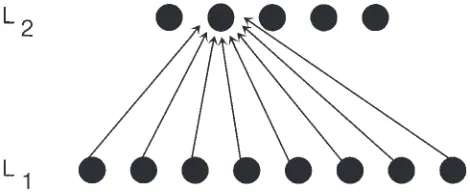
As a first step in building a localist system, I will identify a very simple module capable of unsupervised, self-organized learning of individual patterns and/or pattern classes. This work draws heavily on the work of Carpenter and Grossberg and colleagues (e.g., Carpenter & Grossberg 1987a; 1987b; a debt that is happily acknowledged), with a number of simplifications. The module (see Fig. 3) comprises two layers of nodes, L1and L2, fully con-nected to each other by modifiable, unidirectional (L1-to-L2) con-nections, which, prior to learning, have small, random weights, wij. (Throughout the paper, wijwill refer to the weight of the connec-tion from the ith node in the originating layer to the jth node in the receiving layer.) For simplicity of exposition, the nodes in the lower layer will be deemed to be binary, that is, to have activations (denoted ai) either equal to zero or to one. The extension to con-tinuous activations will usually be necessary and is easily achieved. The input to the nodes in the upper layer will simply be sum of the activations at the lower layer weighted by the appropriate con-nection weights. In fact, for illustrative purposes, I shall assume here that this input to a given node is divided by a value equal to the sum of the incoming weights to that node plus a small constant (see, e.g., Marshall 1990) – this is just one of the many so-called “normalization” schemes typically used with such networks. Thus the input, Ij, to an upper-layer node is given by
where ais the small constant. Learning of patterns of activation at the lower layer, L1, is simply achieved as follows. When a pat-tern of activation is presented atL1, the inputs, Ij, to nodes in the upper layer, L2, can be calculated. Any node whose vector of in-coming weights is parallel (i.e., a constant multiple of) the vector of activations at L1will have input, Ij, equal to 11 a/1
(oalliwij). Any L2node whose vector of incoming weights is orthogonal to the current input vector (that is, nodes for which wij50 where ai5
1) will have zero input. Nodes with weight vectors between these two extremes, whose weight vectors “match” the current activa-tion vector to some nonmaximal extent, will have intermediate val-ues of Ij. Let us suppose that, on presentation of a given L1 pat-tern, no L2node achieves an input, Ij, greater than a threshold u. (With uset appropriately, this supposition will hold when no learn-ing has yet been carried out in the L1-to-L2connections.) In this case, learning of the current input pattern will proceed. Learning will comprise setting the incoming weights to a single currently “uncommitted” L2node (i.e., a node with small, random incom-ing weights) to equal the correspondincom-ing activations at L1– a
pos-Figure 3. A simple two-layer module.
(1)
I a w
w j
i ij
ij
=
(
)
+∑
sible mechanism is discussed later. The learning rule might thus be stated
where Jindexes the single L2node at which learning is being per-formed, lis the learning rate, and, in the case of so-called “fast learning,” the weight values reach their equilibrium values in one learning episode, such that wiJ5ai. The L2node indexed by Jis thereafter labelled as being “committed” to the activation pattern at L1, and will receive its maximal input on subsequent presenta-tion of that pattern.
The course of learning is largely determined by the setting of the threshold, u. This is closely analogous to the vigilance pa-rameter in the adaptive resonance theory (ART) networks of Car-penter and Grossberg (1987a; 1987b), one version of which (ART2a, Carpenter et al. 1991) is very similar to the network de-scribed here. More particularly, if the threshold is set very high, for example, u 51, then each activation pattern presented will lead to a learning episode involving commitment of a previously uncommitted L2node, even if the same pattern has already been learned previously. If the threshold is set slightly lower, then only activation patterns sufficiently different from previously pre-sented patterns will provoke learning. Thus novel patterns will come to be represented by a newly assigned L2node, without in-terfering with any learning that has previously been accomplished. This is a crucial point in the debate between localist and distrib-uted modellers and concerns “catastrophic interference,” a topic to which I shall return in greater depth later.
The value of the threshold, u, need not necessarily remain con-stant over time. This is where the concept of vigilance is useful. At times when the vigilance of a network is low, new patterns will be unlikely to be learned and responses (see below) will be based on previously acquired information. In situations where vigilance, u, is set high, learning of the current L1pattern is likely to occur. Thus learning can, to some extent, be influenced by the state of vigilance in which the network finds itself at the time of pattern presentation.
In order to make these notions more concrete, it is necessary to describe what constitutes a response for the network described above. On presentation of a pattern of activation atL1, the inputs to the L2nodes can be calculated as above. These inputs are then thresholded so that the net input, Ijnet, to the upper-layer nodes is given by
Ijnet5max (0,[I
j2 u]), (3)
so that nodes Ijwith less than uwill receive no net input, and other nodes will receive net input equal to the degree by which Ij ex-ceeds u. Given these net inputs, there are several options as to how we might proceed. One option is to allow the L2activations to equilibrate via the differential equation
which reaches equilibrium when daj
dt 50, that is, when ajis some function, f,of the net input. A common choice is to assume thatf
is the identity function, so that the activations equal the net inputs. Another option, which will be useful when some sort of decision process is required, is to allow the L2nodes to compete in some way. This option will be developed in some detail in the next section because it proves to have some very attractive properties. For the moment it is sufficient to note that a competitive process can lead to the selection of one of the L2nodes. This might be achieved by some winner-takes-allmechanism, by which the L2
nodes compete for activation until one of them quenches the ac-tivation of its competitors and activates strongly itself. Or it may take the form of a “horse-race,” by which the L2nodes race, un-der the influence of the bottom-up inputs, Ijnet, to reach a
crite-rion level of activation,x. Either way, in the absence of noise, we will expect the L2node with the greatest net input, Ijnet, to be se-lected. In the case where theJth L2node is selected, the pattern at L1will be deemed to have fallen into the Jth pattern class. (Note that in a high-uregime there may be as many classes as patterns presented.) On presentation of a given input pattern, the selection (in the absence of noise) of a given L2node indicates that the cur-rent pattern is most similar to the pattern learned by the selected node, and that the similarity is greater than some threshold value. To summarize, in its noncompetitive form, the network will re-spond so that the activations of L2nodes, in response to a given input (L1) pattern, will equilibrate to values equal to some func-tion of the degree of similarity between their learned pattern and the input pattern. In its competitive form the network performs a classification of the L1activation pattern, where the classes cor-respond to the previously learned patterns. This results in sus-tained or super-criterion activation (aj. x) of the node that has previously learned the activation pattern most similar to that cur-rently presented. In both cases, the network is self-organizingand
unsupervised.“Self-organizing” refers to the fact that the network can proceed autonomously, there being, for instance, no separate phases for learning and for performance. “Unsupervised” is used here to mean that the network does not receive any external “teaching” signal informing it how it should classify the current pattern. As will be seen later, similar networks will be used when supervised learning is required. In the meantime, I shall simply assume that the selection of an L2node will be sufficient to elicit a response associated with that node (cf. Usher & McClelland 1995).
4.2. A competitive race
In this section I will give details of one way in which competition can be introduced into the simple module described above. Al-though the network itself is simple, I will show that it has some ex-tremely interesting properties relating to choice accuracy and choice reaction-time. I make no claim to be the first to note each of these properties; nonetheless, I believe the power they have in combination has either gone unnoticed or has been widely un-derappreciated.
Competition in the layer L2is simulated using a standard “leaky integrator” model that describes how several nodes, each driven by its own input signal, activate in the face of decay and competi-tion (i.e., inhibicompeti-tion) from each of the other nodes:
where Ais a decay constant; Ijis the excitatory input to the jth node, which is perturbed by zero-mean Gaussian noise, N1, with variance s2
1;f1(aj) is a self-excitatory term; C okÞj f2 (ak)
re-presents lateral inhibition from other nodes in L2; and N2 repre-sents zero-mean Gaussian noise with variance s2
2. The value of
the noise term, N1, remains constant over the time course of a single competition since it is intended to represent inaccuracies in “measurement” of Ij. By contrast, the value of N2varies with each time step, representing moment-by-moment noise in the calculation of the derivative. Such an equation has a long history in neural modelling, featuring strongly in the work of Grossberg from the mid 1960s onwards and later in, for instance, the cas-cade equation of McClelland (1979).
4.2.1. Reaction time. Recently, Usher and McClelland (1995) have used such an equation to model the time-course of percep-tual choice. They show that, in simulating various two-alternative forced choice experiments, the above equation subsumes optimal classical diffusion processes (e.g., Ratcliff 1978) when a response criterion is placed on the difference between the activations, aj, of two competing nodes. Moreover, they show that near optimal per-formance is exhibited when a response criterion is placed on the
(2)
dw
dt a w
iJ
i iJ
= l( − ),
(4)
da
dt a f I
j
j j
= − + ( net),
(5)
da
dt Aa I N f a C f a N
j
j j j k
k j
= − + + + − +
≠
∑
absolute value of the activations (as opposed to the difference be-tween them) in cases where, as here, mutual inhibition is assumed. The latter case is easily extensible to multiway choices. This lat-eral inhibitory model therefore simulates the process by which multiple nodes, those in L2, can activate in response to noisy, bot-tom-up, excitatory signals, Inet, and compete until one of the nodes reaches a response criterion based on its activation alone. Usher and McClelland (1995) have thus shown that a localist model can give a good account of the time course of multiway choices.
4.2.2. Accuracy and the Luce choice rule.Another interesting feature of the lateral inhibitory equation concerns the accuracy with which it is able to select the appropriate node (preferably that with the largest bottom-up input, Ij) in the presence of input noise,
N1, and fast-varying noise, N2. Simulations show that in the case where the variances of the two noise terms are approximately equal, the effects of the input noise, N1, dominate – this is simply because the leaky integrator tends to act to filter out the effects of the fast-varying noise, N2. As a result, the competitive process tends to “select” that node which receives the maximal noisy in-put, (Ijnet1N
1). This process, by which a node is chosen by adding zero-mean Gaussian noise to its input term and picking the node with the largest resultant input, is known as a Thurstonian process (Thurstone 1927, Case V). Implementing a Thurstonian process with a lateral-inhibitory network of leaky integrators, as above, rather than by simple computation, allows the dynamics as well as the accuracy of the decision process to be simulated.
The fact that the competitive process is equivalent to a classical Thurstonian (noisy-pick-the-biggest) process performed on the inputs, Ij, is extremely useful because it allows us to make a link with the Luce choice rule (Luce 1959), ubiquitous in models of choice behaviour. This rule states that, given a stimulus indexed by i,a set of possible responses indexed by j,and some set of sim-ilarities, hij, between the stimulus and those stimuli associated with each member of the response set, then the probability of choosing any particular response, J,when presented with a stim-ulus, i,is
Naturally this ensures that the probabilities add up to 1 across the whole response set. Shepard (1958; 1987) has proposed a law of generalization which states, in this context, that the similarities of two stimuli are an exponential function of the distance between those two stimuli in a multidimensional space. (The character of the multidimensional space that the stimuli inhabit can be re-vealed by multidimensional scaling applied to the stimulus-re-sponse confusion matrices.) Thus hij5e2dij, where
where the distance is measured in M-dimensional space, im rep-resents the coordinate of stimulus ialong the mth dimension, and
cmrepresents a scaling parameter for distances measured along dimension m.The scaling parameters simply weigh the contribu-tions of different dimensions to the overall distance measure, much as one might weigh various factors such as reliability and colour when choosing a new car. Equation 7 is known as the Minkowski power model formula and dijreduces to the “city-block” distance for r51 and the Euclidean distance for r 52, these two measures being those most commonly used.
So how does the Luce choice rule acting over exponentiated distances relate to the Thurstonian (noisy choice) process de-scribed above? The illustration is easiest to perform for the case of two-alternative choice, and is the same as that found in Mc-Clelland (1991). Suppose we have a categorization experiment in
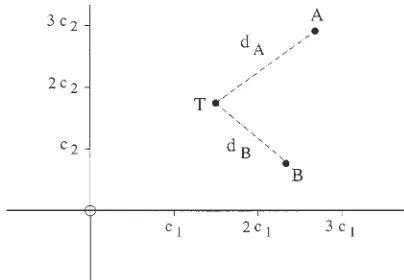
which a subject sees one exemplar of a category A and one exem-plar of a category B. We then present a test exemexem-plar, T,and ask the subject to decide whether it should be categorized as being from category A or category B. Suppose further that each of the three exemplars can be represented by a point in an appropriate multidimensional space such that the test exemplar lies at a dis-tance dAfrom the A exemplar and dBfrom the B exemplar. This situation is illustrated for a two-dimensional space in Figure 4. Note that coordinates on any given dimension are given in terms of the relevant scaling parameters, with the increase of a given scaling parameter resulting in an increase in magnitude of dis-tances measured along that dimension and contributing to the overall distance measures dAand dB. (It is for this reason that an increase of scaling parameter along a given dimension is often de-scribed as a stretching of space along that dimension.) The Luce choice rule with exponential generalization implies that the prob-ability of placing the test exemplar in category A is
dividing top and bottom by e2dAgives
which equals 0.5 when dA5dB. This function is called the logis-tic function, and it is extremely similar to the function describing the (scaled) cumulative area under a normal (i.e., Gaussian) curve. This means that there is a close correspondence between the two following procedures for probabilistically picking one of two re-sponses at distances dAand dBfrom the current stimulus: one can either add Gaussian noise to dAand dBand pick the category corresponding to, in this case, the smallest resulting value (a Thurstonian process); or one can exponentiate the negative dis-tances and pick using the Luce choice rule. The two procedures will not give identical results, but in most experimental situations will be indistinguishable (e.g., Kornbrot 1978; Luce 1959; Nosof-sky 1985; van Santen & Bamber 1981; Yellott 1977). (In fact, if the noise is double exponential rather than Gaussian, the correspon-dence is exact; see Yellott 1977.)
The consequences for localist modelling of this correspon-dence, which extends to multichoice situations, are profound. Two things should be kept in mind. First, a point in multidimensional space can be represented by a vector of activations across a layer of nodes, say the L1layer of the module discussed earlier, and/or by a vector of weights, perhaps those weights connecting the set of L1nodes to a given L2node. Second, taking two nodes with activations dAand dB, adding zero-mean Gaussian noise, and pick-(6)
p J i iJ
ik
( | )= .
∑
h h all k
(7)
dij cm im jm r m
M r
= −
=
∑
|
|
/ , 1
1
Figure 4. Locations of exemplars A and B and test pattern T in a two-dimensional space. The distances dAand dBare Euclidean distances, and coordinates on each dimension are given in terms of scaling parameters, ci.
(8)
p e
e e
d
d d
A
A B
(test is an A)=
+ −
− − ;
(9)
p
edA dB
(test is an A)=
+ −
1 1
ing the node with the smallest resulting activation is equivalent, in terms of the node chosen, to taking two nodes with activations (k2dA) and (k2dB) (where kis a constant), adding the same zero-mean Gaussian noise and this time picking the node with the largest activation. Consequently, suppose that we have two L2
nodes, such that each has a vector of incoming weights corre-sponding to the multidimensional vector representing one of the training patterns, one node representing pattern A,the other node representing pattern B.Further, suppose that on presentation of the pattern of activations corresponding to the test pattern, T,at layer L1, the inputs, Ij, to the two nodes are equal to (k2dA) and (k2dB), respectively (this is easily achieved). Under these cir-cumstances, a Thurstonian process, like that described above, which noisily picks the L2node with the biggest input will give a pattern of probabilities of classifying the test pattern either as an
Aor, alternatively, as a B,which is in close correspondence to the pattern of probabilities that would be obtained by application of the Luce choice rule to the exponentiated distances, e2dij (Equa-tion 9).
4.2.3. Relation to models of categorization.This correspondence means that mathematical models, such as Nosofsky’s generalized context model (Nosofsky 1986), can be condensed, doing away with the stage in which distances are exponentiated, and the stage in which these exponentiated values are manipulated, in the Luce formulation, to produce probabilities (a stage for which, to my knowledge, no simple “neural” mechanism has been suggested1), leaving a basic Thurstonian noisy choice process, like that above, acting on (a constant minus) the distances themselves. Since the generalized context model (Nosofsky 1986) is, under certain con-ditions, mathematically equivalent to the models of Estes (1986), Medin and Schaffer (1978), Oden and Massaro (1978), Fried and Holyoak (1984), and others (see Nosofsky 1990), all these models can, under those conditions, similarly be approximated to a close degree by the simple localist connectionist model described here. A generalized exemplar model is obtained under high-u(i.e., high threshold or high vigilance) conditions, when all training patterns are stored as weight vectors abutting a distinct L2node (one per node).
4.2.4. Effects of multiple instances.We can now raise the ques-tion of what happens when, in the simple two-choice categoriza-tion experiment discussed above, the subject sees multiple pre-sentations of each of the example stimuli before classifying the test stimulus. To avoid any ambiguity I will describe the two training stimuli as “exemplars” and each presentation of a given stimulus as an “instance” of the relevant exemplar. For example, in a given experiment a subject might see ten instances of a single category A exemplar and ten instances of a single category B exemplar. Let us now assume that a high-uclassification network assigns a dis-tinct L2node to each of the ten instances of the category A exem-plar and to each of the ten instances of the category B exemexem-plar. There will thus be twenty nodes racing to classify any given test stimulus. For simplicity, we can assume that the learned, bottom-up weight vectors to L2nodes representing instances of the same exemplar are identical. On presentation of the test stimulus, which lies at distance dA(in multidimensional space) from instances of the category A exemplar and distance dBfrom instances of the cat-egory B exemplar, the inputs to the L2nodes representing cate-gory A instances will be (k2dA) 1N1j, where N1is, as before, the input-noise term and the subscript j(0 #j,10) indicates that the zero-mean Gaussian noise term will have a different value for each of the ten nodes representing different instances. The L2
nodes representing instances of the category B exemplar will like-wise have inputs equal to (k2dB) 1N1j, for 10 #j,20. So what is the effect on performance of adding these extra instances of each exemplar? The competitive network will once again select the node with the largest noisy input. It turns out that, as more and more instances of each exemplar are added, two things happen. First, the noisy-pick-the-biggest process becomes an increasingly
better approximation to the Luce formulation, until for an as-ymptotically large number of instances the correspondence is ex-act. Second, performance (as measured by the probability of pick-ing the category whose exemplar falls closest to the test stimulus) improves, a change that is equivalent to stretching the multidi-mensional space in the Luce formulation by increasing by a com-mon multiplier the values of all the scaling parameters, cm, in the distance calculation given in Equation 7. For the mathematically inclined, I note that both these effects come about owing to the fact that the maximum value out of Nsamples from a Gaussian dis-tribution is itself cumulatively distributed as a double exponential, exp(2e2ax), where ais a constant. The distribution of differences between two values drawn from the corresponding density func-tion is a logistic funcfunc-tion, comparable with that implicit in the Luce choice rule (for further details see, e.g., Yellott 1977; Page & Nimmo-Smith, in preparation).
To summarize, for single instances of each exemplar in a cate-gorization experiment, performance of the Thurstonian process is a good enough approximation to that produced by the Luce choice rule such that the two are difficult to distinguish by experiment. As more instances of the training exemplars are added to the net-work, the Thurstonian process makes a rapid approach toward an asymptotic performance that is precisely equivalent to that pro-duced by application of the Luce choice rule to a multidimen-sional space that has been uniformly “stretched” (by increasing by a common multiplier the values of all the scaling parameters, cm, in Equation 7) relative to that space (i.e., the set of scaling pa-rameters) that might have been inferred from the application of the same choice rule to the pattern of responses found after only a single instance of each exemplar had been presented. It should be noted that putting multiple noiseless instances into the Luce choice rule will not produce an improvement in performance rel-ative to that choice rule applied to single instances – in mathe-matical terminology, the Luce choice rule is insensitive to uniform expansion of the set (Yellott 1977).
Simulations using the Luce formulation (e.g., Nosofsky 1987) have typically used uniform multiplicative increases in the values of the dimensional scaling parameters (the cmin Equation 7) to account for performance improvement over training blocks. The Thurstonian process described here, therefore, has the potential advantage that this progressive space-stretching is a natural fea-ture of the model as more instances are learned. Of course, until the model has been formally fitted to experimental data, the sug-gestion of such an advantage must remain tentative – indeed early simulations of data from Nosofsky (1987) suggest that some para-metric stretching of stimulus space is still required to maintain the excellent model-to-data fits that Nosofsky achieved (Page & Nimmo-Smith, in preparation). Nonetheless, the present Thurs-tonian analysis potentially unites a good deal of data, as well as rais-ing a fundamental question regardrais-ing Shepard’s “universal law of generalization.” Could it be that the widespread success encoun-tered when a linear response rule (Luce) is applied to representa-tions with exponential generalization gradients in multidimen-sional stimulus space is really a consequence of a Thurstonian decision process acting on an exemplar model, in which each of the exemplars actually responds with a linear generalization gra-dient? It is impossible in principle to choose experimentally be-tween these two characterizations for experiments containing a reasonable number of instances of each exemplar. The Thurston-ian (noisy-pick-the-biggest) approach has the advantage that its “neural” implementation is, it appears, almost embarrassingly simple.