Secure Auditing and Deduplicating Data in
Cloud
1
Mrs. G. KALPANA,
2Mrs. N. SUJATHA
1
Pursuing M.Tech(CSE)from
Jagruti Institute of Engineering and Technology
2Associate Professor, Department of Computer Science and Engineering,
Jagruti Institute of Engineering and Technology
, Telangana State, India.
Abstract:
Now a days Cloud Computing is an emerging technology where can utilize the services like SaaS, PaaS and IaaS .In this paper, we show the trustworthiness evaluating and secure deduplication over cloud data utilizing imaginative secure frameworks .Usually cloud framework outsourced information at cloud storage is semi-trusted because of absence of security at cloud storage while putting away or sharing at cloud level because of weak cryptosystem information may be uncover or adjusted by the hackers keeping in mind the end goal to ensure clients information protection and security We propose novel progressed secure framework which empower the cloud framework secured and legitimate utilizing Verifier(TPA) benefit of Cloud Server. Additionally our framework performs data deduplication in a Secured way in requested to enhance the cloud Storage space too data transfer capacity.Keywords:
TPA(Trusted Third party Auditor),Cloud Computing, Integrity Auditing, Data Deduplication,1. INTRODUCTION
Cloud storage furnishes clients with advantages, extending from cost sharing and streamlined accommodation to portability opportunities and scalable service. These awesome properties pull in more clients to utilize and storage their own information to the cloud storage: as per the investigation report, the volume of information in the cloud is relied upon to accomplish 40 trillion gigabytes in 2020. Despite the fact that cloud storage framework has been generally received, it neglects to suit some principle developing needs, for example, the capacities of inspecting uprightness of cloud documents by cloud customers and identifying copied records by cloud servers. We outline both issues
beneath. The primary issue is uprightness reviewing. The cloud server can soothe customers from the overwhelming weight of storage administration and upkeep.
send the document uncovers that some other customer has the same record, which could be delicate At times. These assaults start from the reason that the verification that the customer possesses a given document (or piece of information) is exclusively taking into account a static, short esteem (by and large the hash of the record) [3]. Along these lines, the second issue is summed up as by what means can the cloud servers effectively affirm that the customer claims the transferred record before making a connection to this document for him/her.
In this paper, going for getting information integrity auditing and deduplication in the cloud, we exhibit novel Secured framework i.e SecCloud empowers the certification of document privacy. We exhibit a system of specifically inspecting trustworthiness on encoded information. The test of deduplication on encoded is the counteractive action of lexicon assault [4]. Similarly as with [4], we make an alteration on joined encryption such that the concurrent key of a document is made and controlled by a mystery "seed", such that any foe couldn't specifically get the united key from the substance of the record and the word reference assault is forestalled.
2. RELATED WORK.
Provable Data Possession at Untrusted Stores Authors: Giuseppe Ateniese We introduce a model for provable data possession (PDP) that permits a customer that has put away information at an untrusted server to check that the server has the first information without recovering it. The model creates probabilistic confirmations of ownership by testing arbitrary arrangements of pieces from the server, which definitely decreases I/O costs. The customer keeps up a consistent measure of metadata to check the confirmation. The test/reaction convention transmits as the shopping center, the steady measure of information, which minimizes system correspondence. In this manner, the PDP model for remote information checking underpins extensive information sets in generally - dispersed storage frameworks.
A Survey on “Secure and Constant Cost Public Cloud Storage Auditing with Deduplication”
To securely fulfill the two vital prerequisites of cloud storage: information integrity auditing and storage proficiency, various plans have been proposed in light of the ideas of POR, PDP, POW and POSD. Be that as
perspective, on the grounds that unimportant blend of existing POR/PDP plans with POW plans can negate the objects of POW. The one and only that all the while accentuated both viewpoints in light of the idea of POSD experiences gigantic calculation and computational expenses and has been demonstrated not secure. In this work, we filled the hole amongst POR and POW and proposed a steady cost plot that accomplishes secure open information uprightness examining and storage deduplication in the meantime. Our proposed plan empowers the deduplication of both documents and their relating validation labels. What's more, we extend our outline to bolster clump respectability evaluating, and in this way considerably spare computational expense and correspondence cost for different solicitations situations. The security of our PCAD plan is demonstrated in view of the CDH issue, the Static Diffie-Hellman issue and the tSDH issue. We approve the effectiveness and versatility of our plan through numerical investigation and trial results on Amazon EC2 Cloud. Our proposed polynomial based verification tag can likewise be utilized as an autonomous answer for other related applications, for example, certain SQL seek, encoded catchphrase look, and so forth.
DupLESS: Server-Aided Encryption for
3.1 Presented System
Over insecure setting, the information gets the spillage issue inside the system correspondence or trades the assets of the substance data particular procedure. Since the outsourced cloud storage is not completely reliable, it raises security worries on the best way to acknowledge information deduplication in the cloud while accomplishing uprightness examining. In our exhibited framework, we saw the issue of integrity auditing and secure deduplication on cloud storage framework.
3.1.1 Drawbacks of Existing System
Lack of integrity auditing and secure deduplication on cloud data.
3.2 Proposed system
In our proposed system aiming at achieving both data integrity and deduplication in cloud, we propose novel secure systems, namely SecCloud.
SecCloud is designed motivated by the fact that customers always want to encrypt their data before uploading, and enables integrity auditing and secure deduplication on encrypted data.
3.2.1 Advantages of proposed system
Enables integrity auditing and secure deduplication on encrypted data Proper verification
4. SYSTEM MODEL WITH RESULTS
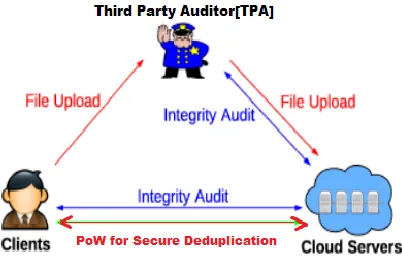
Aiming at allowing for auditable and deduplicated storage, we propose the SecCloud system. In the SecCloud system, we have three objects:
4.1 Clients: Clients have large data files to be stored and rely on the cloud for data maintenance and computation. They can be either individual consumers or commercial organizations.
4.2 Cloud Servers: Cloud Servers virtualize the resources according to the requirements of clients and expose them as storage pools. Typically, the cloud clients may buy or lease storage capacity from cloud servers, and store their individual data in these bought or rented spaces for future utilization.
4.3 Third Party Auditor [TPA]: Auditor which helps clients upload and audit their outsourced data maintains a MapReduce cloud and acts like a certificate authority. This assumption presumes that the auditor is associated with a pair of public and
private keys. Its public key is made available to the other entities in the system.
Fig 1. System Architecture
The SecCloud system supporting file-level deduplication includes the following three protocols respectively highlighted by red, blue and green in Fig.[1]
1) File Uploading Protocol: This protocol aims at allowing clients to upload files via the TPA. Specifically, the file uploading protocol includes three phases:
I)Phase 1 (client → cloud server):
Fig 2. PoW for Data Deduplication
Client takes the duplicate check with the cloud server to confirm if such a file is stored in cloud storage or not before uploading a file. If there is a duplicate, another protocol called Proof of Ownership will be run between the client and the cloud storage server. Otherwise, the following protocols (including phase 2 and phase 3) are run between these two entities.
Fig 3. File Uploading Phase (client → auditor)
III)Phase 3 (auditor → cloud server): Auditor helps generate a set of tags for the uploading file, and send them along with this file to cloud server.
Fig 4. File Uploading Phase (auditor → Cloud Server)
2) Integrity Auditing Protocol: It is an interactive protocol for integrity verification and allowed to be initialized by any entity except the cloud server. In this protocol, the cloud server. plays the role of prover, while the auditor or client works as the verifier. This protocol includes two phases:
I) Phase 1 (client/auditor → cloud server): Verifier (i.e., client or auditor) generates a set of challenges and sends them to the prover (i.e., cloud server).
Fig 4. Integrity Checking at (client or auditor)
II) Phase 2 (cloud server → cloud client/auditor):
Based on the stored files and file tags, prover (i.e., cloud server) tries to prove that it exactly owns the target file by sending the proof back to verifier (i.e., cloud client or auditor). At the end of this protocol, verifier outputs true if the integrity verification is passed.
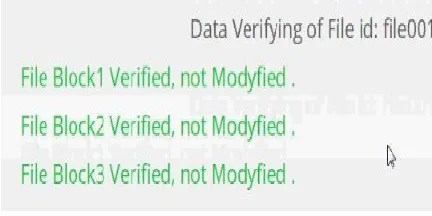
Fig 5.Veification Results for Integrity Checking
I)
Phase 1 (cloud server → client): Cloud server generates a set of challenges and sends them to the client.II) Phase 2 (client → cloud server): The client responds with the proof for file ownership, and cloud server finally verifies the validity of proof. Our main objectives are as follows.
i) Integrity Auditing:
The first design goal of this work is to provide the capability of verifying correctness of the remotely stored data. The integrity verification further requires two features those are public verification and stateless verification.
ii)Secure Deduplication: The second design goal of this work is secure deduplication. In other words, it requires that the cloud server is able to decrease the storage space by keeping only one copy of the same file. Notice that, regarding to secure deduplication, our objective is distinguished from previous work [3] in that we propose a method for allowing both deduplication over files and tags.
iii)Cost-Effective: The computational overhead for providing integrity auditing and secure deduplication should not show a major additional cost to traditional cloud storage, nor should they alter the way either uploading or downloading operation.
5. CONCLUSION:
As of our conclusion we address the information respectability and deduplication in a cloud, we display SecCloud+. SecCoud empowers secure deduplication through introducing a Proof of Possession convention and maintaining a strategic distance from the spillage of side direct data in information deduplication. SecCloud+ is a propelled structure motivated by the way that clients dependably need to encode their information before transferring and takes into consideration integrity auditing and secure deduplication straightforwardly on scrambled information.
REFERENCES
[1] S. Halevi, D. Harnik, B. Pinkas, and A. ShulmanPeleg, “Proofs of ownership in remote storage systems,” in Proceedings of the 18th ACM Conference on Computer and Communications Security. ACM, 2011, pp. 491–500.
[2] S. Keelveedhi, M. Bellare, and T. Ristenpart, “Dupless: Serveraided encryption for deduplicated storage,” in Proceedings of the 22Nd USENIX
Conference on Security, ser. SEC’13. Washington,
D.C.: USENIX Association, 2013,
pp.179194.[Online].Available:https://www.usenix.org /co nference/usenixsecurity13/technicalsessions/ presentation/bellare
[3] G. Ateniese, R. Burns, R. Curtmola, J. Herring, L. Kissner, Z. Peterson, and D. Song, “Provable data possession at untrusted stores,” in Proceedings of the
14th ACM Conference on Computer and
Communications Security, ser. CCS ’07. New York, NY, USA: ACM, 2007, pp. 598– 609.
[4] G. Ateniese, R. Burns, R. Curtmola, J. Herring, O. Khan, L. Kissner, Z. Peterson, and D. Song, “Remote data checking using provable data possession,” ACM Trans. Inf. Syst. Secur., vol. 14, no. 1, pp. 12:1–12:34, 2011.
[5] G. Ateniese, R. Di Pietro, L. V. Mancini, and G. Tsudik, “Scalable and efficient provable data possession,” in Proceedings of the 4th International
Conference on Security and Privacy in
Communication Netowrks, ser. SecureComm ’08. New York, NY, USA: ACM, 2008, pp. 9:1– 9:10. [6] C. Erway, A. K¨upc¸ ¨u, C. Papamanthou, and R. Tamassia, “Dynamic provable data possession,” in Proceedings of the 16th ACM Conference on Computer and Communications Security, ser. CCS ’09. New York, NY, USA: ACM, 2009, pp. 213–222. [7]P. Rizwana khatoon et al., International Journal of Computer Engineering In Research Trends Volume 3, Issue 5, May-2016, pp. 210-215
[8] F. Seb´e, J. Domingo-Ferrer, A. Martinez-Balleste, Y. Deswarte, and J.-J. Quisquater, “Efficient remote data possession checking in critical information infrastructures,” IEEE Trans. on Knowl. and Data Eng., vol. 20, no. 8, pp. 1034–1038, 2008. [9] H. Wang, “Proxy provable data possession in public clouds,” IEEE Transactions on Services Computing, vol. 6, no. 4, pp. 551–559, 2013.
[10] Y. Zhu, H. Hu, G.-J. Ahn, and M. Yu, “Cooperative provable data possession for integrity verification in multicloud storage,” IEEE Transactions on Parallel and Distributed Systems, vol. 23, no. 12, pp. 2231– 2244, 2012.
[11] H. Shacham and B. Waters, “Compact proofs of retrievability,” in Proceedings of the 14th International Conference on the Theory and Application of Cryptology and Information Security: Advances in Cryptology, ser. ASIACRYPT ’08. Springer Berlin Heidelberg, 2008, pp. 90– 107.
Security – ESORICS 2009, M. Backes and P. Ning, Eds., vol. 5789. Springer Berlin Heidelberg, 2009, pp. 355–370.
ABOUT THE AUTHORS
Mrs. G.KALPANA
is pursuing M.Tech degree in, Computer Science and Engineering from Jagruti Institute of Engineering and Technology, Telangana State, India.Mrs.N.Sujatha
is presentlyworking as Associate Professor in, Department of computer science
and engineering, Telangana