
Zero-knowledge Argument for Polynomial Evaluation
with Application to Blacklists
?Stephanie Bayer and Jens Groth?? University College London
{s.bayer,j.groth}@cs.ucl.ac.uk
Abstract. Verification of a polynomial’s evaluation in a secret committed value plays a role in cryptographic applications such as non-membership or member-ship proofs. We construct a novel special honest verifier zero-knowledge argu-ment for correct polynomial evaluation. The arguargu-ment has logarithmic commu-nication cost in the degree of the polynomial, which is a significant improvement over the state of the art with cubic root complexity at best. The argument is rel-atively efficient to generate and very fast to verify compared to previous work. The argument has a simple public-coin 3-move structure and only relies on the discrete logarithm assumption.
The polynomial evaluation argument can be used as a building block to construct zero-knowledge membership and non-membership arguments with communica-tion that is logarithmic in the size of the blacklist. Non-membership proofs can be used to design anonymous blacklisting schemes allowing online services to block misbehaving users without learning the identity of the user. They also allow the blocking of single users of anonymization networks without blocking the whole network.
Keywords:Zero-knowledge argument, discrete logarithm, polynomial evalua-tion, anonymous blacklisting, membership and non-membership proofs.
1
Introduction
In many cryptographic applications a party wants to prove possession of a secret value uthat fulfills a certain property. Since polynomials are widely used a natural question is for instance given a polynomialP(X)and a valuevwhether the secret valueusatisfies P(u) =vin a prime order fieldZp.
We propose a special honest verifier zero-knowledge argument of knowledge for two committed valuesu, vsatisfyingP(u) =vfor a given polynomialP(X)of degree D. The argument has the following properties:
?c
IACR 2013. This article is the final version submitted by the authors to the IACR and to Springer-Verlag on March 8, 2013. The version published by Springer-Verlag is available at http://dx.doi.org/10.1007/978-3-642-38348-9 38
??
– It is based on the discrete logarithm assumption in a prime order group
– It has a standard 3-round public coin structure and a common reference string with just a few group elements
– Communication grows logarithmically in the degree of the polynomial – Both the prover and the verifier are computationally efficient
– We have a working implementation, which gives us real life performance data As a concrete application of our polynomial evaluation argument we will look at blacklisting anonymous users, which is a notoriously difficult cryptographic problem. Anonymizing networks such as Tor [35] allow a user to hide her IP address and are used by a number of groups including undercover police agents, abuse victims and citizens living under dictatorships. During the Arab Spring for instance the Tor network experienced a spike in users from Libya and Egypt [13]. However, anonymous access to services can also lead to abuse. Wikipedia for instance allows anonymous postings, but blocks the IP address of misbehaving users. This crude solution means that if one user of Tor abuses Wikipedia, all users whose traffic comes out of the same Tor relay with this IP-address are blocked. So one misbehaving user causes many innocent users to be punished. Johnson et al. [20] suggested the Nymble system to deal with this problem. In this alternative solution IP-addresses are not blocked but instead each user anonymously proves that she has not been blacklisted. Using the polynomial evaluation argument we construct a non-membership proof, which enables a user to efficiently prove that she has not been blacklisted.
We can also use our polynomial evaluation argument to construct efficient member-ship proofs. Membermember-ship proofs are useful when operating a whitelist access control system, or in applications such as e-voting or e-auctions where users want to prove that their votes are valid or their bids belong to a set of approved values.
1.1 Our Contribution
Our main contribution is an efficient special honest verifier zero-knowledge argument of knowledge for two secret committed valuesu, v ∈ZpsatisfyingP(u) =vfor a given polynomialP(X)∈Zp[X], wherepis a prime. We work over an orderpgroupGand
use the Pedersen commitment scheme, i.e., a commitment touis of the formguhrfor somer ∈Zp. Given the coefficients of the polynomialP(X) =PDi=0aiX
i and two Pedersen commitments our zero-knowledge argument can demonstrate knowledge of openings of the commitments to valuesuandvsuch thatP(u) =v.
Our polynomial evaluation argument is highly efficient. The communication com-plexity is O(logD) group and field elements, which is very small compared to the statement size ofDfield elements. The prover computesO(logD)exponentiations and O(DlogD)multiplications inZp, and the verifier calculatesO(logD)exponentiations
andO(D)multiplications inZp. The constants in the expressions are small and the
ar-gument very efficient in practice as illustrated by a concrete implementation. We refer to Sections 3 and 5 for further details on the efficiency and a comparison with previous solutions.
an-swers the challenge. It has perfect completeness, perfect special honest verifier zero-knowledge1, and computational soundness, which is based on the discrete logarithm
assumption inG.
The discrete logarithm assumption is one of the most fundamental and well-studied cryptographic assumptions. There are several types of prime order groups where the discrete logarithm assumption is believed to hold, for instance an orderpsubgroup of
Z∗qwhereqis a large prime, or a group of points on an elliptic curve. There are examples of elliptic curve groups where group elements are roughly|p|bits and the best known attacks have a complexity ofΩ(√p)group operations. In such groups a communication complexity ofO(klogk)bits suffices to get a security level of2−kwhenD= poly(k)
and|p|=O(k).2
Based on the polynomial evaluation argument we then construct zero-knowledge ar-guments for membership and non-membership with logarithmic communication com-plexity. More precisely, given a Pedersen commitment c and a list of values L =
{λ1, . . . , λD}we give a zero-knowledge argument of knowledge thatc is a commit-ment to u ∈ Lin the case of a membership proof or u /∈ Lin the case of a non-membership proof. Following Brands et al. [4] we do this by computing the polynomial P(X) = QD
i=1(X−λi)and demonstratingP(u) = 0in the case of a membership proof orP(u)6= 0in the case of a non-membership proof. With our polynomial eval-uation argument this requires onlyO(logD)communication, which is much smaller than the size of the list.
1.2 Related Work
Polynomial Evaluation Arguments. Given two committed valuesu, vwe give a zero-knowledge argument thatP(u) = vfor a public polynomialP(X)of degreeD. Kil-ian [21] gave a communication efficient argument for circuit satisfiability and several other general purpose zero-knowledge arguments for NP-languages exist. However, since they are not tailored for the discrete logarithm setting using them would require a costly NP-reduction.
In the prime order group setting there are already several general zero-knowledge techniques for the satisfiability of arithmetic circuits that can demonstrate the correct-ness of a polynomial evaluation. Using Cramer and Damg˚ard [11] we would get a linear communication complexity for this problem and using Groth [15] we would get a com-munication complexity ofO(√D)group elements. Using stronger assumptions and a pairing-based argument by Groth [16] we could reduce this further to a communication complexity ofO(D13)group elements.
1Standard techniques can be used to make the argument fully zero-knowledge against malicious
adversaries at a negligible cost of a few extra group elements in the common reference string as described in Section 2.2. There is therefore no loss of generality in considering just the special honest verifier zero-knowledge case.
2
It is uncommon to have zero-knowledge arguments for large statements where an asymptotic communication complexity ofO(klogk)suffices for a security level of2−k. Hash-trees and cut-and-choose techniques give a communication complexity ofΩ(k2)for instance and
Fujisaki and Okamoto [14] looked at the specific problem of polynomial evaluation in an RSA-based context but their zero-knowledge argument has linear complexity. The most efficient zero-knowledge argument for correct polynomial evaluation stems from Brands et al. [4], which has a communication complexity ofO(√D)group elements and is based on the discrete logarithm assumption just like our argument.
Membership Proofs and Non-membership Proofs. Proofs for set membership and non-membership for a committedu ∈ Loru /∈ LwhereL = {λ1, . . . , λD} have been studied in their own right. The most straightforward approach is to prove in a one by one manner the conjunctionλ16=u∧. . .∧λD6=uin the case of non-membership or the disjunctionλ1 =u∨. . .∨λD = uin the case of membership. In the context of revoking members of group signature schemes Bresson and Stern [5] proposed such a solution based on the strong RSA assumption. Peng and Bao [32] gave a general dis-crete logarithm based zero-knowledge arguments of non-membership with linear com-plexity. Brands et al. [4] improved the communication complexity to O(√D)group elements and later Peng [31] gave a solution for a non-membership proof with the same complexity using techniques similar to Brands et al. [4].
Accumulators [2, 9, 37, 29, 8, 38] provide another mechanism for giving member-ship proofs. An accumulator is a succinct aggregate of a set of values where it is possible to issue membership proofs for each accumulated value. A party in possession of such a membership proof, typically a few group elements, can then demonstrate that the value is included in the set. Non-membership accumulators have also been proposed [22, 39]. However, most accumulators rely on a trusted party to maintain the accumulator and if corrupt this trusted party can issue arbitrary membership proofs. Furthermore, accumu-lators rely on cryptographic assumptions that have been less studied than the discrete logarithm problem, for instance the strong RSA assumption or the pairing-basedq-SDH assumption. These assumptions also mean that group elements have to be large and once this has been factored in the accumulator-based solutions end up having larger commu-nication than our membership and non-membership proofs for groups over elliptic or hyper-elliptic curves. The construction of Camacho et al. [6] does not rely on a trusted party and only assumes the existence of hash functions; however proofs in their setting depend logarithmically on the number of accumulated elements.
In Song’s non-membership proof [34] the prover publishes a constant number of elements and the verifier checks these elements against a blacklist by carrying out a few operations for each blacklist element; several systems along these lines have been proposed [1, 3, 27]. The operations consist either of exponentiations or pairings, so this scheme places a heavy computational burden on the verifier.
Camenisch et al. [7] gave a membership proof where the elements in the set are signed by a trusted third party. Now membership can be proven with a constant number of group elements by demonstrating that the value has been signed. Related ideas have recently been used by Libert et al. [23] in the context of revoking group signatures, where a trusted third party signs representatives of sets that cover the whitelist of non-revoked users and the user gives a zero-knowledge proof of belonging to this set [28].
or signing messages, and to get efficient proofs the signatures are built from strong assumptions such as the strong RSA assumption or pairing-based assumptions.
A different approach is taken by Nymble-like systems [36, 19, 18, 26], which also rely on a trusted third party. The user obtains a pseudonym, a “nymble”, from the trusted third party which is only valid for a certain time frame with one server. The blacklist consists of nymbles by misbehaving users and in [36, 19] the server simply checks if the nymble of a connecting user is contained in the blacklist. To weaken the trust in the trusted third party Lofgren and Hopper [26] use accumulators together with the Nymble setup, while Henry and Goldberg [18] rely on the techniques of Brands et al. [4] for the user to give a zero-knowledge argument for the non-membership of the blacklist.
2
Preliminaries
We write y = A(x;r)when the algorithmAon input xand randomness r, outputs y. We writey←A(x)for the process of picking randomnessrat random and setting y=A(x;r). We also writey←Sfor samplingyuniformly at random from a setS. We say a functionf :N→[0,1]is negligible iff(k) =O(k−c)for every constantc >0. We say1−f is overwhelming if f is negligible. We will give a security parameter k written in unary as input to all parties in our protocols. Intuitively, the higher the security parameter the more secure the protocol.
2.1 The Pedersen Commitment Scheme
The Pedersen commitment scheme [30] works as follows. First the key generation al-gorithm G on input1k chooses a cyclic group
Gof k-bit prime order pand random
generatorsg, h. The commitment key isck = (G, p, g, h). To commit toa ∈ Zp the committer picks randomnessr∈Zpand computes
comck(a;r) =gahr.
The Pedersen commitment scheme is computationally binding under the discrete logarithm assumption, i.e., a non-uniform probabilistic polynomial time adversary has negligible probability of finding two different openings of the same commitment. The Pedersen commitment scheme is perfectly hiding since the commitment is uniformly distributed inGno matter what the valueais.
The Pedersen commitment scheme is homomorphic. For alla, b∈Zpandr, s∈Zp
comck(a;r)·comck(b;s) =gahr·gbhs=ga+bhr+s= comck(a+b;r+s).
2.2 Zero-knowledge Arguments of Knowledge
In the arguments we consider a proverPand a verifierVboth of which are probabilistic polynomial time interactive algorithms. All our protocols will be 3-move public-coin arguments; first the prover sends a message, then the verifier responds with a random challenge, and finally the prover sends an answer to the challenge.
We assume the existence of a probabilistic polynomial time setup algorithmGthat when given a security parameterkreturns a common reference stringσ. In this paper the common reference string will always be a public keyckfor the Pedersen commitment scheme.
LetR be a polynomial time decidable ternary relation, we callwa witness for a statementxif(σ, x, w)∈R. We define the CRS-dependent language
Lσ={x| ∃w: (σ, x, w)∈R}
as the set of statementsxthat have a witnesswin the relationR.
The public transcript produced byP andV when interacting on inputssandtis denoted bytr ← hP(s),V(t)i. The transcript consists of the initial message from the prover, the random challenge from the verifier, the answer from the prover and the decision to accept or reject from the verifier. We writehP(s),V(t)i=bdepending on whether the verifier rejects,b= 0, or accepts,b= 1.
Definition 1 (Argument of knowledge) The triple(G,P,V)is called anargument of knowledgefor the relationRif we have completeness and witness-extended emulation as defined below.
Definition 2 (Perfect completeness) (G,P,V)has perfect completeness if for all non-uniform polynomial time adversariesA
Pr[σ← G(1k); (x, w)← A(σ) : (σ, x, w)6∈RorhP(σ, x, w),V(σ, x)i= 1] = 1.
To define an argument of knowledge we follow Groth and Ishai [17] that borrowed the term witness-extended emulation from Lindell [25]. Informally, their definition says that given an adversary that produces an acceptable argument with some probability, there exist an emulator that produces a similar argument with the same probability and at the same time provides a witnessw. We give a strong black-box definition where the emulator just has black-box access to a prover and verifier’s interaction, which it can rewind and run again with fresh randomness for the verifier.
Definition 3 (Computational witness-extended emulation) (G,P,V) has witness-extended emulationif for all deterministic polynomial timeP∗there exists an expected polynomial time emulatorX such that for all non-uniform polynomial time interactive adversariesA
Pr[σ← G(1k); (x, s)← A(σ);tr← hP∗(σ, x, s),V(σ, x)i:A(tr) = 1]
≈ Pr[σ← G(1k); (x, s)← A(σ); (tr, w)← XhP∗(σ,x,s),V(σ,x)i(σ, x) :
A(tr) = 1and iftris accepting then(σ, x, w)∈R],
where the verifier picks fresh public coin challenges in each oracle call by XhP∗(σ,x,s),V(σ,x)i
In the definition,scan be interpreted as the state ofP∗, including the randomness. So, wheneverP∗is able to make a convincing argument when in states, the emulator can extract a witness. This is why we call it an argument of knowledge.
Definition 4 (Public coin) An argument(G,P,V)is calledpublic coinif the verifier chooses his messages uniformly at random and independently of the messages sent by the prover, i.e., the challenges correspond to the verifier’s randomnessρ.
An argument is zero-knowledge if it does not leak information about the witness beyond what can be inferred from the truth of the statement. We will present arguments that have special honest verifier zero-knowledge in the sense that if the verifier’s challenge is known in advance, then it is possible to simulate the entire argument without knowing the witness.
Definition 5 (Perfect special honest verifier zero-knowledge) A public coin argu-ment (G,P,V)is called a perfect special honest verifier zero knowledge (SHVZK) argument forRif there exists a probabilistic polynomial time simulatorSsuch that for all interactive non-uniform polynomial time adversariesAwe have
Pr[σ← G(1k); (x, w, ρ)← A(σ);tr← hP(σ, x, w),V(σ, x;ρ)i: (σ, x, w)∈RandA(tr) = 1] = Pr[σ← G(1k); (x, w, ρ)← A(σ);tr← S(σ, x, ρ) : (σ, x, w)∈RandA(tr) = 1],
whereρis the public coin randomness used by the verifier as the challenge.
Full zero-knowledge. In real life applications special honest verifier zero-knowledge may not suffice since a malicious verifier may give non-random challenges. However, it is easy to convert an SHVZK argument into a full zero-knowledge argument secure againstarbitraryverifiers in the common reference string model using standard tech-niques. The conversion can be very efficient and only costs a small additive overhead, so we will in the paper without loss of generality just focus on building efficient SHVZK arguments.
One example of such a conversion that would work in our case is the following: The common reference string is set up with an additional group elementy. The prover will now use an OR-proof [12] to show that she knows a witness for the statement being true or she knows the discrete logarithm of y. Since she does not know the discrete logarithm ofythis is a convincing argument of knowledge. On the other hand, we can set the simulator up such that it does know the discrete logarithm of y and now it is easy to simulate proofs. This conversion yields an argument of knowledge with perfect zero-knowledge at the price of an extra group element in the common reference string.
3
Polynomial Evaluation Argument
Given a polynomialP(U) =PD
By padding with zero-coefficients we can without loss of generality assumeD = 2d+1−1. It is useful to writeiin binary, i.e.,i=i
d. . . i0whereij ∈ {0,1}. We can then rewrite the termUiasUi =UPd
j=0ij2j =Qd
j=0(U
2j)ij. Substituting this in the polynomial we get
P(U) =
D
X
i=0 aiUi=
1
X
i0,...,id=0 aid...i0
d
Y
j=0
(U2j)ij.
The prover will make commitmentsc1, . . . , cd tou21, u22, . . . , u2d, use standard techniques to prove they are well-formed, and prove that when inserted into the rewrit-ten polynomial we haveP1
i0,...,id=0aid...i0
Qd
j=0(u
2j)ij =v. Sinced=blogDcthe prover only makes a logarithmic number of commitments, which will help keep com-munication low.
To show the committed powers ofuinc0, c1, . . . , cdevaluate to the commitedvthe prover picks random valuesf0, . . . , fd←Zpand defines a new polynomial
Q(X) =
1
X
i0,...,id=0 aid...i0
d
Y
j=0
(Xu2j+fj)ijX1−ij =Xd+1P(u)+Xdδd+. . .+Xδ1+δ0.
The idea behind this choice ofQ(X)is that for eachijeither anXu2j factor is included or anX factor is included so the coefficient ofXd+1 isP(u). Eachfj on the other hand is not multiplied byXand will therefore only affect the lower degree coefficients δ0, . . . , δdofQ(X).
The prover will now demonstrate that the coefficient ofXd+1in the secretQ(X)is the same as vin a way that cancels out theδ0, . . . , δd coefficients. The prover sends the verifier commitments cf0, . . . , cfd to f0, . . . , fd, and commitments cδ0, . . . , cδd to δ0, . . . , δd. Afterwards, the verifier will pick a random challenge x ← Zp. The
prover will now open suitable products of the commitments in a way such that the verifier can check that the committed values u, v satisfy Q(x) = xd+1v +xdδd+
. . .+δ0. More precisely, after receiving the challengexthe prover opens each prod-uct cx
jcfj to f¯j = xu 2j
+fj. Furthermore, the prover opens cxd+1 v
Qd
j=0c xj δj to
¯
δ =P1
i0,...,id=0ai0...id
Qd
j=0f¯ ij
j x1−ij. Note that the verifier can calculateδ¯himself and therefore only accepts the opening if
1
X
i0,...,id=0 ai0...id
d
Y
j=0
¯
fij j x
1−ij =xd+1v+xdδ
d+. . .+xδ1+δ0.
This has negligible probability of being true unlessP(u) =v.
Returning to the commitmentsc1, . . . , cd tou21, . . . , u2dwe said the prover could use standard techniques to show that they contain the correct powers ofu. To do this the prover sends some commitmentscf uj tofju
2j
to the verifier and later opens the commitmentscx
uj+1c −f¯
j uj cf uj to
The full polynomial evaluation argument is given below. Common reference string: ck← G(1k)
Statement: P(U) = PD
i=0aiUi = P 1
i0,...,id=0aid...i0
Qd
j=0(U 2j)ij ∈
Zp[U]and c0, cv∈G
Prover’s witness: u, v, r0, t∈Zpsuch thatc0= comck(u;r0), cv = comck(v;t)and P(u) =v
Initial message: Compute 1. c1= comck(u2
1
;r1), . . . , cd= comck(u2 d
;rd)wherer1, . . . , rd←Zp 2. cf0 = comck(f0;s0), . . . , cfd= comck(fd;sd)wheref0, s0, . . . , fd, sd←Zp 3. δ0, . . . , δd∈Zpsuch that
1
X
i0,...,id=0 aid...i0
d
Y
j=0
(Xu2j +fj)ijX1−ij =Xd+1v+ d
X
j=0 Xjδj
4. cδ0 = comck(δ0;t0), . . . , cδd = comck(δd;td)wheret0, . . . , td←Zp 5. cf u0 = comck(f0u2
0
;ξ0), . . . , cf ud−1 = comck(fd−1u 2d−1
;ξd−1) where ξ0, . . . , ξd−1←Zp
Send:c1, . . . , cd, cf0, . . . , cfd, cδ0, . . . , cδd, cf u0, . . . , cf ud−1 Challenge: x←Zp
Answer: Compute for allj
¯
fj=xu2j+fj ¯rj =xrj+sj ¯t=xd+1t+
d
X
i=0
tixi ξj¯ =xrj+1−fjrj¯ +ξj
Send:f¯0,r¯0, . . . ,f¯d,r¯d,¯t,ξ¯0, . . . ,ξ¯d−1 Verification: Accept if and only if for allj
cxjcfj = comck( ¯fj; ¯rj) c x j+1c
−f¯j
j cf uj = comck(0; ¯ξj)
and
cxvd+1 d
Y
i=0 cxδi
i = comck
1
X
i0,...,id=0 aid...i0
d
Y
j=0
¯
f ij j x
1−ij; ¯t
Example: LetG=hg= 3i ⊂Z∗467, which has prime orderp= 233and leth= 266. The common reference string describing(G, p, g, h)isck ={467,233,3,266}. The
statement consists of the polynomialP(X) = 93X4+ 3X2+ 115X+ 51∈Z233[X] and commitmentscu0 = 90, cv= 68. We haved=blog 4c= 2.
The prover knows valuesu = 5, v = P(u) = 110 ∈ Z233 andr0 = 201, t =
189 ∈ Z233such thatcu0 = 90 ∈ Gandcv = 68 ∈ G. To prove knowledge of the witness the prover first picksr1 = 23, r2 = 63at random fromZ233 and computes commitmentsc1= 387andc2= 4tou2
1
Next she computes δ0, δ1, δ2. She calculates the five products Q d j=0(Xu
2j
+
fj)ijX1−ij fori=i2i1i0∈ {0,1,2,3,4}using a binary tree.
1
Xu4+f 2
X2u4+Xf 2 X3u4+X2f
2= 159X3+ 15X2 X
X2u2+Xf1
X3u3+X2(u2f
0+uf1) +Xf0f1= 75X3+ 232X2+ 4X X3u2+X2f
1= 25X3+ 220X2 X2
x3u+X2f0= 5X3+ 161X2 X3
The prover takes theaiand multiplies them on the result of the binary tree, to get i= 0 : a0·X3= 51X3
i= 1 : a1·(5X3+ 161X2) = 109X3+ 108X2 i= 2 : a2·(25X3+ 220X2) = 75X3+ 194X2 i= 3 : a3·(75X3+ 232X2) = 0
i= 4 : a4·(159X3+ 15X2) = 108X3+ 230X2
Last, to extract the valuesδishe adds fori= 0,1,2the coefficients for eachXito get δ0= 0, δ1= 0, δ2= 66 mod 233.Now the prover pickst0= 33, t1= 201, t2= 205 at random and commits to theδi’s to getcδ0= 438, cδ1 = 329, cδ2 = 467.
Finally, the prover calculatesf0u= 106, f1u2= 174and commits to these values. So, she picksξ0 = 13, ξ1 = 75and computescf u0 = 352, cf u1 = 141. She sends all the commitments to the verifier.
The verifier returns a random challengex= 123∈Z233, and the prover calculates answers f¯0 = 77,f¯1 = 33,f¯2 = 0,r¯0 = 35,¯r1 = 70,r¯2 = 209,t¯= 189,ξ¯0 =
180,ξ¯1= 75,and sends all values to the verifier.
The verifier checks first if all commitments are inGand all answers valid numbers
inZ233. Then he checks fori= 0,1,2ifcuxicfi = comck( ¯fi; ¯ri): cxu0cf0= 68 = comck( ¯f0; ¯r0) cxu1cf1 = 91 = comck( ¯f1; ¯r1) c
x
u2cf2 = 220 = comck( ¯f2; ¯r2).
Next, he checkscxui+1c −f¯i
ui cf ui= comck(0,ξi¯)fori= 0,1, i.e., cxu1c
−f¯0
u0 cf u0 = 157 = comck(0; ¯ξ0) c x u2c
−f¯1
u1 cf u1 = 250 = comck(0; ¯ξ1).
Then the verifier calculatesδ¯=P1
i0,...,id=0ai0...id
Qd
j=0f¯ ij j x
1−ij in a binary tree fashion. The output leaves in the binary tree are x3 = 129, x2f0¯ = 166, x2f2¯ = 171, xf0¯f1¯ = 90, x2f2¯ = 0. He multiplies the values by theai’s and adds the re-sults together, to getδ¯=a0129 +a1166 +a2171 +a390 +a40 = 86∈Z233.Finally,
he checks the last verification equationcx3 v cx
2 δ2c
x1 δ1c
x0
δ0 = 395 = comck
¯
δ; ¯t
Efficiency. The communication in the polynomial evaluation argument for a degree D= 2d+1−1polynomial is roughly4dgroup elements and3dfield elements.
The prover uses8dexponentiations to compute the commitments. She also has to calculate δ0, . . . , δd that are defined to satisfy P1
i0,...,id=0aid...i0
Qd
j=0(Xu 2j +
fj)ijX1−ij = Xd+1v+Pd
j=0Xjδj. The prover can calculate theD degreed+ 1 polynomials Qd
j=0(Xu2 j
+fj)ijX1−ij in a binary-tree fashion for all choices of i0. . . , id ∈ {0,1}at a cost ofdDmultiplications inZp. Multiplying with theaid...i0’s uses anotherdDmultiplications. The total cost for the prover is therefore8d exponen-tiations inGand2dDmultiplications inZp.
The verifier can check the argument using6dexponentiations inGsince the
expo-nentxis used twice in the verification equations. He also needs to compute the sum
P1
i0,...,id=0aid...i0
Qd
j=0f¯ ij j x
1−ij, which can be done in a binary tree fashion for all choices ofi0, . . . , id∈ {0,1}using2Dmultiplications inZp.
We have ignored small constants in the calculations above and just focused on the dominant terms. Using multi-exponentiation techniques, randomized verification and other tricks it is possible to reduce the computation even further for the prover and verifier, so the estimates are quite conservative.
Theorem 6 Assuming the discrete logarithm assumption holds the polynomial evalua-tion argument is a public coin perfect SHVZK argument of knowledge of openings ofc0 andcvtouandvsuch thatP(u) =v.
Proof. Perfect completeness follows by careful inspection.
We will now argue perfect SHVZK. Given a challenge x ∈ Zp the simula-tor picks c1, . . . , cd, cδ1, . . . , cδd ← G andf0,¯ r0, . . . ,¯ fd,¯ ¯rd,¯t,ξ0, . . . ,¯ ξd¯−1 ← Zp and for all j he sets cfj = comck( ¯fj; ¯rj)c
−x
j cf uj = comck(0; ¯ξj)c −x j+1c
¯ fj j and cδ0 = comck
P1
i0,...,id=0aid...i0
Qd
j=0f¯ ij
j x1−ij; ¯t
c−xd+1 v
Qd
i=1c −xi δi .
This is a perfect simulation. In a real argument c1, . . . , cd, cδ1, . . . , cδd are uni-formly random perfectly hiding commitments as in the simulation. In a real argument
¯
f0,r0, . . . ,¯ fd,¯ rd,¯ ¯t,ξ0, . . . ,¯ ξd¯−1 ∈ Zpare also uniformly random because of the ran-dom choice off0, r0, . . . , fd, rd, t0, ξ0, . . . , ξd−1. Finally, both in the simulation and in the real argument given these choices the verification equations uniquely determine the values ofcf0, . . . , cfd, cδ0 andcf u0, . . . , cf ud−1. This means simulated and real argu-ments given a challengexhave identical probability distributions.
Finally, we will show that the argument has witness-extended emulation. The em-ulatorX runs the argument with random challengex←Zp and if the transcripttris accepting it rewinds until it hasd+2accepting arguments. For a prover withchance of making a convincing argument we expect the emulator to rewind d+2 =d+ 2times, soX runs in expected polynomial time.
There is negligible probability that the verifier will end up with two or more transcripts with the same challenge x, so we just need to be able to extract a wit-ness when we haved+ 2transcripts with different challenges. Givenf¯j(1),¯rj(1) and
¯
cj. More precisely, we have that the two answers satisfycx1
j cfj = comck( ¯f (1) j ; ¯r
(1) j ) cx2
j cfj = comck( ¯f (2) j ; ¯r
(2)
j ).Pickingα1, α2such thatα1x1+α2x2= 1andα1+α2= 0 gives uscj=cα1x1+α2x2
j c
α1+α2
fj = comck(α1
¯
fj(1)+α2f¯j(2);α1r¯(1)j +α2r¯(2)j ),which is an opening ofcj.
Other types of linear combinations of the verification equations give us openings of the other commitmentscfj, cf uj, cvandcδithe prover sends in the initial message. In the case ofcδiwe find the linear combination as follows: Let
M =
1 x1 . . . xd+11 ..
. ...
1xd+2. . . xd+1d+2
.
Since it is a Vandermonde matrix with differentx1, . . . , xd+2it is invertible. By taking linear combinations of the verification equations
cxvd+1 d
Y
i=0 cxδi
i = comck
1
X
i0,...,id=0 aid...i0
d
Y
j=0
¯
f ij j x
1−ij; ¯t
for different challengesx1, . . . , xd+2we get that
δ0t0 .. . ... δdtd v t
=M−1
P1
i0,...,id=0aid...i0
Qd
j=0( ¯f (1) j )
ijx1−ij 1 ¯t
(1)
..
. ...
P1
i0,...,id=0aid...i0
Qd
j=0( ¯f (d+2)
j )
ijx1−ij d+2 ¯t
(d+2)
which gives us openings ofcδ0, . . . , cδdandcv.
We now have openings to all the commitments. Because the commitments are bind-ing, each answer must be computed as they are by an honest prover in the argument. Therefore, the verification equationscx
jcfj = comck( ¯fj,rj¯)give usfj¯ = xuj +fj, whereujis the extracted value incjandfjis the extracted value incfj.
The verification equationscx j+1c
−f¯j
j cf uj = comck(0; ¯ξj)give us that the committed values satisfyxuj+1−(xuj+fj)uj+φj = 0forj= 0, . . . , d−1withφjbeing the value we extracted forcf uj. Since each of the polynomial equalities is of degree1inx and holds ford+ 2different challengesxwe see thatuj+1=ujuj. Sinceu0=uthis gives usu1=u2
1
, u2=u2 2
, . . . , ud=u2 d
. Turning to the verification equation
cxvd+1 d
Y
i=0
cxδii= comck
1
X
i0,...,id=0 aid...i0
d
Y
j=0
¯
f ij j x
1−ij; ¯t
we now have that this corresponds to the degreed+ 1polynomial equation
Xd+1v+Xdδd+. . .+Xδ1+δ0= 1
X
i0,...,id=0 aid...i0
d
Y
j=0
Withd+ 2different valuesx1, . . . , xd+2satisfying the equation, we conclude the two polynomials are identical. Looking at the coefficient for Xd+1 we conclude that the extracted openings ofc0andcvsatisfyP(u) =v. ut
4
Membership and Non-membership Arguments
In this section we will construct membership and non-membership arguments for com-mitted values being included in whitelists or excluded from blacklists. In both cases the whitelists or blacklists are given as a setL ⊂Zp, and the goal is to show that the com-mitted valueu∈ Lin the case of membership oru /∈ Lin the case of non-membership. Let us first describe a non-membership argument for a committed value not be-longing to a setL = {λ1, . . . , λD} using ideas from Brands et al. [4]. We define a polynomialP(X) = QD
i=1(X−λi)with the elements in the set as roots. With this choice of polynomial we haveu∈ Lif and only ifP(u) = 0. The prover has a com-mitmentcand will demonstrate that the committed valueudoes not belong toLby showingP(u)6= 0.
The prover computesv=P(u)and makes a commitment tov. She can now give an SHVZK argument that the new commitment containsv =P(u)using the polynomial evaluation argument from Section 3. To prove non-membership she just needs to prove v 6= 0. To do this the prover commits tow=v−1and uses a multiplication argument to showv·w= 1, which will convince the verifier thatv 6= 0. The main cost in this argument is the polynomial evaluation argument; multiplication arguments are standard cryptographic tools [10] that only cost a couple of group elements in communication. Common reference string: ck← G(1k)
Statement: L={λ1, . . . , λD} ⊂Zp, P(X) =QDi=1(X−λi)∈Zp[X], c∈G
Prover’s witness: u, r∈Zpsuch thatc= comck(u;r)andu /∈ L
Argument: Pick s, t ← Zp, compute v = P(u), w = v−1 and c v =
comck(v;s), cw= comck(w;t), and sendcv, cwto the verifier. Engage in parallel in an SHVZK multiplication argument [10] to showv·w= 1and in the SHVZK polynomial evaluation argument from Section 3 to showP(u) =v.
Verification: The verifier acceptsu6∈ Lif and only ifcv, cw∈Gand the two SHVZK
arguments are valid.
Theorem 7 If the discrete logarithm assumption holds, the above protocol is a public coin SHVZK argument of knowledge of an opening ofctou6∈ L.
Proof. Perfect completeness follows from the perfect completeness of the two SHVZK arguments.
The SHVZK simulator pickscv, cw ← Gat random and runs the SHVZK
sim-ulators for the two underlying SHVZK arguments. Since the commitment scheme is perfectly hiding and the underlying SHVZK arguments are perfect SHVZK this gives us perfect SHVZK.
and the second equality then tells usP(u) 6= 0. This meansuis a not a root of the polynomialP(X) =QD
i=1(X−λi)and thereforeu /∈ L. ut It is easy to modify the non-membership argument into a membership argument. If u∈ LthenP(u) = 0. We therefore get a membership argument by removingcwand instead of a multiplication argument letting the prover give an SHVZK argument forcv containingv = 0. Arguments of knowledge of an opening of a commitment to 0 are standard and only cost a couple of group elements in communication [33].
Efficiency. The coefficients of the polynomialP(X) =QD
i (X−λi)can be computed in a binary tree fashion with the linear functionsX −λi as leaves. Fast polynomial multiplication techniques that rely on the Fast Fourier Transform can if pis an FFT friendly prime multiply two degree npolynomials using O(nlogn) multiplications inZp. This means the prover and the verifier can compute the coefficients ofP(X)
usingO(Dlog2D)multiplications inZp. If the list stays fixed, the computation of the
polynomials coefficients is a one-time cost. Single element additions or deletions can be done usingDmultiplications. If multiple elements are added or deleted at the same time the per element cost can be reduced by using fast polynomial multiplication and division techniques.
Once the coefficients of P(X)are given, the main cost of the membership and non-membership arguments are dominated by the underlying polynomial evaluation argument. For moderate Dthe computation is dominated by the logarithmic number of exponentiations involved in the polynomial evaluation argument. For largeD the computational cost of computing the coefficients of the polynomial matters more as do the multiplications in the polynomial evaluation argument.
5
Comparison and Implementation
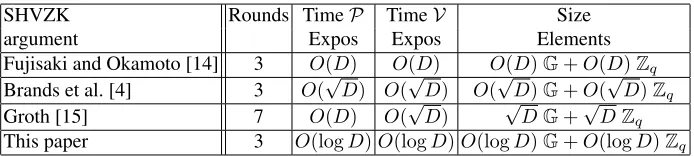
The first approaches to prove for committedu, v∈Zpthatp(u) =vfor a given poly-nomialP(X)with orderD split in two parts: first construct commitmentsc1, . . . , cD to values u, u2. . . , uD and then use the homomorphic property of the commitment scheme to getP(u)as a linear combination ofu, u2, . . . , uD. This requiresD com-mitments andD multiplication arguments to show that the commitments c1, . . . , cD have been correctly constructed and contain the correct powers ofu. The cost can re-duced toO(√D)as suggested in Brands et al. [4] by splitting the polynomial in√D polynomials of degree√Deach.
Our protocol also has a two part structure but only needs logD commitments c1, . . . , cdandlogDmultiplication arguments to prove they have been correctly formed and contain u2, u4, u8, u16, . . . , u2d. By using a sophisticated combination of these values in combination with the homomorphic properties of the commitment scheme, we then get the desired argument forv = p(u). This reduces our communication to O(logD)group elements.
SHVZK Rounds TimeP TimeV Size
argument Expos Expos Elements
Fujisaki and Okamoto [14] 3 O(D) O(D) O(D)G+O(D)Zq Brands et al. [4] 3 O(√D) O(√D) O(√D)G+O(
√ D)Zq
Groth [15] 7 O(D) O(√D) √DG+
√ DZq This paper 3 O(logD)O(logD)O(logD)G+O(logD)Zq
Table 1.Comparison of our polynomial argument with former work
SHVZK Rounds TimeP TimeP TimeV TimeV Size
argument Expos Multip. Expos Multip. Elements
[4] 3 8√D 2D+ 8√D 7√D D+ 4√D 4√DG+ 3√DZq This paper 3 8 logD 2DlogD 7 logD 2D 4 logDG+ 3 logDZq
Table 2.Detailed comparison of our blacklist argument with Brands et al. [4] argument
following give a more detailed theoretical and practical comparison. In Table 2 we give a more detailed theoretical analysis that also counts the number of multiplications.
Based on Table 2 we would expect our verifier to run faster than Brands et. al.’s as our asymptotic computation cost is much smaller and we expect our argument size to be much smaller. Just looking at the numbers of exponentiations needed by the prover can be a little deceptive though since in our polynomial evaluation argument we need O(DlogD)multiplications inZpto compute theδj and for largeDthis cost becomes dominant. Our performance gain for the prover is therefore largest in the range, where D is large enough forlogDto be significantly smaller than√Dyet not so large that the cost ofDlogDmultiplications inZpbecomes dominant.
We implemented our polynomial evaluation argument and Brands et al.’s argument in C++ with the NTL library to obtain experimental confirmation of our theoretical analysis and to get a real life comparison based on similar implementation techniques.
For the comparison of the polynomial evaluation arguments we have used a 256-bit subgroup modulo a 1536-bit prime, assumed that the polynomialP(X)is pre-computed and obtained the running time for polynomials with degree between10and500,000
elements. The performance measurements have been obtained on a MacBook Pro with a 2.54 GHz Intel Core 2 Duo CPU, 4 GB RAM running Mac OS X 10.8.6; all code is single threaded and optimized code using the multi exponentiation techniques by [24]. The results can be found in Table 3.
Elements Prover Prover Verifier Verifier Communication Communication in listD Brands et al. This paper Brands et al. This paper Brands et al. This paper
10 21 ms 13 ms 24 ms 17 ms 12 KB 8 KB
100 66 ms 24 ms 69 ms 30 ms 37 KB 15 KB
1000 227 ms 41 ms 234 ms 45 ms 128 KB 21 KB
10000 747 ms 182 ms 759 ms 81 ms 406 KB 29 KB
100000 2386 ms 1420ms 2402 ms 217 ms 1295 KB 35 KB
1000000 8650 ms 15512 ms 8165 ms 1315 ms 4161 KB 41 KB
Table 3.Our polynomial evaluation argument compared to Brands et al. [4]. All experiments used a 256-bit subgroup modulo a 1536-bit prime and a MacBook Pro, 2.54 CPU, 4 GB RAM.
The computation cost of the non-membership argument by Brands et al. is smaller than the cost of their polynomial argument. It still requires very large degreeDalso for the non-membership argument of Brands et al. to become better from a computational perspective though; for moderate sizeDwe have a clear performance advantage.
References
1. G. Ateniese, D. Song, and G. Tsudik. Quasi-efficient revocation in group signatures. Finan-cial Cryptography, LNCS vol. 2357:183–197, 2002.
2. J. Benaloh and M. de Mare. One-way accumulators: A decentralized alternative to digital sinatures (extended abstract).EUROCRYPT, LNCS vol. 765:274–285, 1993.
3. D. Boneh and H. Shacham. Group signatures with verifier-local revocation.ACM Conference on Computer and Communications Security, pages 168–177, 2004.
4. S. Brands, L. Demuynck, and B. De Decker. A practical system for globally revoking the unlinkable pseudonyms of unknown users.ACISP, LNCS vol. 4586:400–415, 2007. 5. E. Bresson and J. Stern. Efficient revocation in group signatures.Public Key Cryptography,
LNCS vol. 1992:190–206, 2001.
6. P. Camacho, Al. Hevia, M. Kiwi, and R. Opazo. Strong accumulators from collision-resistant hashing.Int. J. Inf. Sec., 11(5):349–363, 2012.
7. J. Camenisch, R. Chaabouni, and S. Shelat. Efficient protocols for set membership and range proofs.ASIACRYPT, LNCS vol. 5350:234–252, 2008.
8. J. Camenisch, M. Kohlweiss, and C. Soriente. An accumulator based on bilinear maps and efficient revocation for anonymous credentials. Public Key Cryptography, LNCS vol. 5443:481–500, 2009.
9. J. Camenisch and A. Lysyanskaya. Dynamic accumulators and application to efficient revo-cation of anonymous credentials.CRYPTO, LNCS vol. 2442:61–76, 2002.
10. D. Chaum and T. P. Pedersen. Wallet databases with observers. InCRYPTO, volume LNCS vol. 740, pages 89–105, 1992.
11. R. Cramer and I. Damg˚ard. Zero-knowledge proofs for finite field arithmetic; or: Can zero-knowledge be for free?CRYPTO, LNCS vol. 1462:424–441, 1998.
12. R. Cramer, I. Damg˚ard, and B. Schoenmakers. Proofs of partial knowledge and simplified design of witness hiding protocols.CRYPTO, LNCS vol. 839:174–187, 1994.
13. R. Dingledine. Tor and circumvention: Lessons learned - (abstract to go with invited talk).
14. E. Fujisaki and T. Okamoto. Statistical zero knowledge protocols to prove modular polyno-mial relations.CRYPTO, LNCS vol. 1294:16–30, 1997.
15. J. Groth. Linear algebra with sub-linear zero-knowledge arguments. CRYPTO, LNCS vol. 5677:192–208, 2009.
16. J. Groth. Efficient zero-knowledge arguments from two-tiered homomorphic commitments.
ASIACRYPT, LNCS vol. 7073:431–448, 2011.
17. J. Groth and Y. Ishai. Sub-linear zero-knowledge argument for correctness of a shuffle.
EUROCRYPT, LNCS vol. 4965:379–396, 2008.
18. R. Henry and I. Goldberg. Extending nymble-like systems. IEEE Symposium on Security and Privacy, pages 523–537, 2011.
19. R. Henry, K. Henry, and I. Goldberg. Making a nymbler nymble using verbs. Privacy Enhancing Technologies, LNCS vol. 6205:111–129, 2010.
20. P. Johnson, A. Kapadia, P. Tsang, and S. Smith. Nymble: Anonymous ip-address blocking.
Privacy Enhancing Technologies, LNCS vol. 4776:113–133, 2007.
21. J. Kilian. A note on efficient zero-knowledge proofs and arguments. InSTOC, pages 723– 732, 1992.
22. J. Li, N. Li, and R. Xue. Universal accumulators with efficient nonmembership proofs.
ACNS, LNCS vol. 4521:253–269, 2007.
23. B. Libert, T. Peters, and M. Yung. Scalable group signatures with revocation.EUROCRYPT, LNCS vol. 7327:609–627, 2012.
24. C. Lim. Efficient multi-exponentiation and application to batch verification of digital signa-tures.http://dasan.sejong.ac.kr/˜chlim/pub/multiexp.ps, 2000. 25. Y. Lindell. Parallel coin-tossing and constant-round secure two-party computation.J.
Cryp-tology, 16(3):143–184, 2003.
26. P. Lofgren and N. Hopper. Bnymble: More anonymous blacklisting at almost no cost (a short paper).Financial Cryptography, LNCS vol. 7035:268–275, 2011.
27. T. Nakanishi and N. Funabiki. A short verifier-local revocation group signature scheme with backward unlinkability.IWSEC, LNCS vol. 4266:17–32, 2006.
28. D. Naor, M. Naor, and J. Lotspiech. Revocation and tracing schemes for stateless receivers.
CRYPTO, LNCS vol. 2139:41–62, 2001.
29. L. Nguyen. Accumulators from bilinear pairings and applications. CT-RSA, LNCS vol. 3376:275–292, 2005.
30. T. P. Pedersen. Non-interactive and information-theoretic secure verifiable secret sharing.
CRYPTO, LNCS vol. 576:129–140, 1991.
31. K. Peng. A general, flexible and efficient proof of inclusion and exclusion.CT-RSA, LNCS vol. 6558:33–48, 2011.
32. K. Peng and F. Bao. Improving applicability, efficiency and security of non-membership proof. International Symposium on Data, Privacy, and E-Commerce, pages 39–44, 2010. 33. C. Schnorr. Efficient signature generation by smart cards. J. Cryptology, 4(3):161–174,
1991.
34. D. Song. Practical forward secure group signature schemes.ACM Conference on Computer and Communications Security, pages 225–234, 2001.
35. Tor. The tor project inc.https://www.torproject.org/.
36. P. Tsang, A. Kapadia, C. Cornelius, and S. Smith. Nymble: Blocking misbehaving users in anonymizing networks.IEEE Trans. Dependable Sec. Comput., 8(2):256–269, 2011. 37. G. Tsudik and S. Xu. Accumulating composites and improved group signing.ASIACRYPT,
LNCS vol. 2894:269–286, 2003.
38. P. Wang, H. Wang, and J. Pieprzyk. A new dynamic accumulator for batch updates. ICICS, LNCS vol. 4861:98–112, 2007.
![Table 3. Our polynomial evaluation argument compared to Brands et al. [4]. All experimentsused a 256-bit subgroup modulo a 1536-bit prime and a MacBook Pro, 2.54 CPU, 4 GB RAM.](https://thumb-us.123doks.com/thumbv2/123dok_us/7943675.1318586/16.612.132.512.115.212/polynomial-evaluation-argument-compared-brands-experimentsused-subgroup-macbook.webp)
