Deepika N*, Pankaj Sharma, Dr. Prakash Rao. B, Birendra Shrivastava
Department of Chemistry, Karnataka College of Pharmacy*, Bangalore, Karnataka. School of Pharmaceutical Sciences, Jaipur National University, Rajasthan
*Corresponding author’s E-mail:[email protected]
Received: 27-09-2018; Revised: 30-10-2018; Accepted: 08-11-2018.
ABSTRACT
A Simple, specific, accurate and reliable RP-HPLC method was developed for Domperidone (DOM) in solid dosage formulations. By waters C18, 5µm, 150 x 4.6 mm I.D. column eluted with mixture of Buffer ( potassium dihydrogen phosphate + dipotassium hydrogen phosphate & pH adjusted to 7.5 with 0.1 N NaOH) and Acetronitrile in a ratio of 60:40, isocratic elution pattern. Isocratic elution is simple, requires only one pump & flat baseline separation for easy and reproducible results. So, it was preferred for the current study over gradient elution. And at a flow rate of 1.0 ml/minute and a detection wavelength of 280 nm with injection volume of 20 µl at Ambient (30°C) temperature afforded the best separation of these analytes. The retention time of Domperidone was found to be 2.81 min. with runtime of 10 min. The system precision of this method was evaluated by calculating the %RSD of the peak areas of six replicate injections of the standard solution, which were found to be 0.752. The mean recovery was found to be 99.882% for Domperidone. The limit for mean % recovery is 98-102% and as both the values are within the limit, hence it can be said that the proposed method was accurate. Linearity was established for Domperidone in the range of 5-30 µg/ml with correlation coefficient of 0.998. Furthermore, Specificity studies were demonstrated indicating that the excipients of the formulation did not interfere with the active ingredients of the drug product. The analytical procedure is validated as per ICH Q2B guidelines and shown to be accurate, precise and specific. This method is amenable to the routine analysis and can be successfully employed for Domperidone in different formulations.
Keywords:Domperidone (DOM), RP-HPLC, Accuracy, Precision, Validation.
INTRODUCTION
omperidone, 1-(3-(4-(5-chloro-2-oxo-2, 3 Dihydrobenzo [D] imidazol-1-yl) piperidin-1 yl) propyl)-1H-benzo [D]imidazol-2(3H)-one (fig.no.1) (Mol.wt.-425.9) acting as a specific blocker of dopamine receptors. It speeds gastrointestinal peristalsis, causes prolactin release, and is used as antiemetic and tool in the study of dopaminergic mechanisms1. It is a gastrointestinal emptying (delayed) adjunct and peristaltic stimulant. The gastroprokinetic properties of domperidone are related to its peripheral dopamine receptor blocking properties. Domperidone facilitates gastric emptying and decreases small bowel transit time by increasing esophageal and gastric peristalsis and by lowering esophageal sphincter pressure. The antiemetic properties of domperidone are related to its dopamine receptor blocking activity at both the chemoreceptor trigger zone and at the gastric level2. It has strong affinities for the D2 and D3 dopamine receptors, which are found in the chemoreceptor trigger zone, located just outside the blood brain barrier, which - among others - regulates nausea and vomiting.
According to the literature survey it was found that few analytical methods such as (HPLC, UV-Visible analysis and LC-MS) were reported for the estimation of Domperidone3-6. Many of them suffer from one disadvantage or other such as low sensitivity lack of
sensitivity and simplicity etc., the objective of the proposed method is to develop simple and accurate methods for the determination of Domperidone by RP-HPLC method in pharmaceutical dosage forms & it’s stability indicative studies7-8.
Figure 1: Chemical structure of Domperidone
The present study describes the development of a new rapid, efficient and reproducible RP-HPLC method using isocratic mobile phase for the analysis of Domperidone offers certain advantages in its simplicity and time saving and applicable in routine analysis9-10. It also describes the development of validation work as per ICH Q2B guidelines recommended by the Food and Drug Administration (FDA) of the United States12-14.
A Novel RP-HPLC Method Development, Optimization and Validation for
Estimation of Domperidone as Drug Substances
D
MATERIALS AND METHODS
Instruments Used
S.No. Name Of Instrument Instrument Model Name Of Manufacturer
1 UV-Spectrophotometer UV/1800 Shimadzu
2 HPLC 2695 Waters (Empower Software)
3 Ultra Sonicator LN Equitron
4 Digital Ph Meter S220 Mettler Toledo
5 Analytical Digital Balance (0.01mg Sensitive) TX/TXB Shimadzu
Chemicals / Reagents Used
Table 1: List of Chemicals Reagents Used
S. No. Name
Specifications
Manufacturer/Supplier Purity HPLC Grade
1. Doubled distilled water ---- HPLC grade Sd fine-Chem ltd; Mumbai
2. Methanol 99.9% A.R. Loba Chem; Mumbai.
3. Dipotassium hydrogen
orthophosphate 96% L.R. Sd fine-Chem ltd; Mumbai
4. Acetonitrile 99.9% HPLC Loba Chem; Mumbai.
5. Potassium dihydrogen
orthophosphate 99.9 L.R. Sd fine-Chem ltd; Mumbai 6. Sodium hydroxide 99.9 L.R. Sd fine-Chem ltd; Mumbai
Details of marketed formulation used
Brand name Manufacturer Batch No. Mfg. Date Exp. Date
Vomistop Cipla 11U1179 June -2016 Dec-2018
RESULTS AND DISCUSSION
Method Development
Selection of wavelength
The standard & sample stock solutions were prepared separately by dissolving standard & sample in a solvent in mobile phase diluting with the same solvent.(After optimization of all conditions) for UV analysis. Itscanned in the UV spectrum in the range of 200 to 400nm. This has been performed to know the maxima of domperidone, so that the same wave number can be utilized in HPLC UV detector for estimating the domperidone. While scanning the domperidone solution we observed maxima at 280 nm. The UV spectrum has been recorded on UV-SPECTROPHOTOMETER of model no-UV/1800 by SHIMADZU. The scanned UV spectrum is attached in
Mobile Phase Preparation
The mobile phase used in this analysis consists of a mixture of Buffer (potassium dihydrogen phosphate + dipotassium hydrogen phosphate & pH adjusted to 7.5 with 0.1 N NaOH) and Acetronitrile in a ratio of 60:40.
600 ml of this buffer solution was added and properly mixed with 400 ml of acetronitrile and a homogenous solution is achieved. This mobile phase was filled and sonicated for 5 minutes before using in the experiment
Preparation of standard solution of Domperidone
25 mg of Domperidone was weighed accurately and transferred into 25 ml volumetric flask. About 10 ml of HPLC dimethyl sulfoxide was added and sonicated to dissolve. The volume was made up to the mark with same solvent. The final solution contained about 1000 μg/ml of Domperidone. From the stock solution again 1 ml was taken in a 10 ml volumetric flask & volume was make up to the mark by mobile phase. This solution contains 100 μg/ml of Domperidone which has been injected to HPLC.
Initialization of the instrument
Different chromatographic conditions used and their Optimizations
The different HPLC chromatographic conditions were used to find out the optimum chromatographic condition for best elution of drugs.
Trail 1
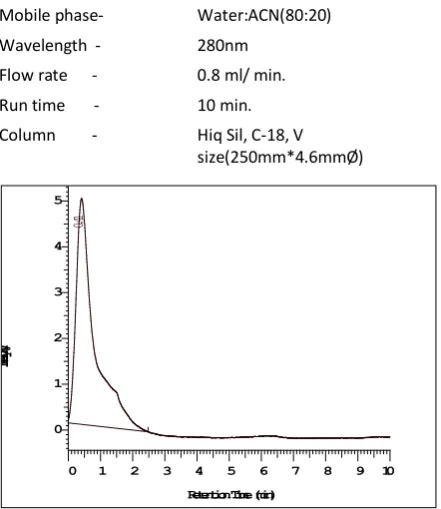
Mobile phase- Water:ACN(80:20) Wavelength - 280nm
Flow rate - 0.8 ml/ min. Run time - 10 min. Column - Hiq Sil, C-18, V
size(250mm*4.6mmØ)
Figure 2: Trail 1 Chromatogram
Result
No peaks were separated and a negative peak was also found. Hence chromatogram was not acceptable.
Limit: % rsd <1 , Resolution factor >2
Trail 2
Mobile phase - Water: Methanol (20:80) Wavelength - 280nm
Flow rate - 0.8 ml/ min. Run time - 10 min.
Column - Hiq Sil, C-18, V size (250mm*4.6mmØ)
Result
Peak shape was not proper. Peak tailing and a negative peak were found. Hence chromatogram was not acceptable.
Limit: % rsd <1, Resolution factor >2
Final method
By waters C18, 5µm, 150 x 4.6 mm I.D. column eluted with mixture of Buffer ( potassium dihydrogen phosphate + dipotassium hydrogen phosphate & pH adjusted to 7.5 with 0.1 N NaOH) and Acetronitrile in a ratio of 60:40, isocratic elution pattern. And at a flow rate of 1.0 ml/minute and a detection wavelength of 280 nm with injection volume of 20 l at Ambient(30°C) temperature afforded the best separation of these analytes. The retention time of Domperidone was found to be 2.81 min. with runtime of 10 min.
Figure 4: Optimized Chromatogram of Domperidone
Result
The HPLC system was set with the optimized chromatographic conditions to run the standard solution of Domperidone for 10 min. The retention time were found to be 2.81 min.
Method Validation
Specificity
Preparation and running of Domperidone
As per the label claim, each tablet contains 10mg of Domperidone. To estimate this 500 mg of the powdered tablet has been dissolved in 25 ml of dimethyl sulfoxide. Further dilution was done by taking 1ml of this solution in 10ml volumetric flask, dissolve and make up with mobile phase. To extract the drug in the solution, it has been sonicated for 5 minutes followed by cyclo-mixing for 5 minutes. Resulting solution was filtered by using Millipore syringe filter (0.42 micron). Resulting clear solution was injected in HPLC in duplicate as per the above mentioned HPLC method. Area obtained in both the injections is as mentioned below.
0.4
1
0 1 2 3 4 5 6 7 8 9 10 Retention Time (min)
0 1 2 3 4 5
Intensi
ty (mV)
2.78
3.09
3.73 4.69
5.29
7.69
8.27
0 1 2 3 4 5 6 7 8 9 10
RetentionTime(min) 0
1 2 3 4
Intensit
y (mV)
1.7
3 1.93
2.4
2
2.8
1
4.6
8 5.80
0 1 2 3 4 5 6 7 8 9 10 Retention Time (min)
0 2 4 6 8 10
Intensi
Result
No peaks were found at the retention of Domperidone. Specificity studies indicating that the excipients did not interfere with the analysis. No interference is observed with the drug.
Accuracy
In nine different 10 ml volumetric flasks, 1 ml of the pre-analyzed capsule solution (100 g/ml) was taken and added 1, 2, 3 ml of standard solution of bulk (API) mixture (100g/ml) and the volume was made up to 10 ml with mobile phase.
The solutions were then injected into the HPLC system and the peak areas were recorded. The data are shown in the below table.
Linearity and Range
Result
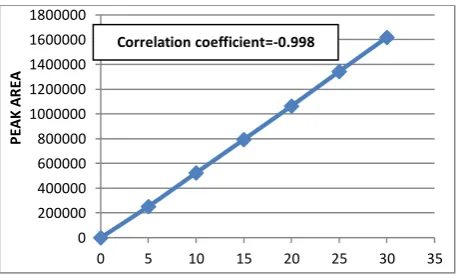
Linearity range was found to be 5-30 µg/ml for Domperidone. The correlation coefficient was found to be 0.998
Figure 5: Standard curve for Domperidone
Table 2: Data of recovery studies
Result
The mean recovery was found to be 99.882% for Domperidone. The limit for mean % recovery is 98-102% and as both the values are within the limit, hence it can be said that the proposed method was accurate.
Precision
Repeatability
The precision of each method was ascertained separately from the peak areas obtained by actual determination of six replicates of a fixed amount of drug Domperidone. The percent relative standard deviations were calculated for Domperidone are presented in the table-26.
Table 3: Data showing repeatability analysis
HPLC Injection
Standard of Domperidone Area
Retention Time
Replicate – 1 161765 2.81 Replicate – 2 161811 2.81 Replicate – 3 163199 2.81 Replicate – 4 161143 2.82 Replicate – 5 161913 2.82 Replicate – 6 161905 2.81
Average 161966.2 2.814
Standard Deviation 752.4714 0.005477
% RSD 0.752
Result
The repeatability study which was conducted on the solution having the concentration of about 10 g/ml of Domperidone showed a RSD of 0.752%. It was concluded
0 200000 400000 600000 800000 1000000 1200000 1400000 1600000 1800000
0 5 10 15 20 25 30 35
P
EAK
AR
EA
Accuracy levels Concentration (µg/ml) %Recovery of Pure drug Statistical Analysis Pure drug Formulation
S1 : 80 % 8 10 99.63 Mean= 99.67667%
S2 : 80 % 8 10 99.92 S.D. = 0.223681
S3 : 80 % 8 10 99.48 % R.S.D.= 0.224407
S4 : 100 % 10 10 99.19 Mean= 99.19%
S5 : 100 % 10 10 99.25 S.D. = 0.06
S6 : 100 % 10 10 99.13 % R.S.D.= 0.06049
S7 : 120 % 12 10 99.25 Mean= 99.49%
S8 : 120 % 12 10 99.54 S.D. = 0.219317
S9 : 120 % 12 10 99.68 % R.S.D. = 0.220441
Limit: % rsd <1, Resolution factor >2
System Suitability Parameter
System suitability testing is an integral part of many analytical procedures. The tests are based on the concept that the equipment, electronics, analytical operations and samples to be analyzed constitute an integral system that can be evaluated as such. Following system suitability test parameters were established.
S. No. Parameter Limit Result
1 Resolution factor Rs 2 9.15
2 Tailing factor T 2 Domperidone=0.12 3 Theoretical plate N 3000 Domperidone=3246
CONCLUSION
A sensitive & selective RP-HPLC method has been developed & validated for the analysis of Domperidone API. Further the proposed RP-HPLC method has excellent sensitivity, precision and reproducibility. The sample preparation is simple and the analysis time is short. The analytical procedure is validated as per ICH Q2B guidelines and shown to be accurate, precise and specific. The result shows the developed method is yet another suitable method for assay, purity which can help in the analysis of Domperidone in different formulations.
REFERENCES
1. British Pharmacopoeia. British Pharmacopoeia Commission Office, London: U.K. 2008, 752-56.
2. Zarapkar SS, Bhandari NP and Halker UP. Simultaneous estimation of Cinnarizine and Domperidone maleate in table by RP-HPLC. Indian Drugs 37(6), 2000, 295-298.
3. Manoj K and Anbazhagan S. RP-HPLC method for Simultaneous estimation. Indian Drugs 41(10), 2004, 604-607.
4. Zarapkar SS and Kanyawar NS. Simultaneous estimation of Domperidone and Omeprazole in Pharmaceutical dosage by RPHPLC. Indian Drugs 39(4), 2004, 217-221
5. Zarapkar SS and Salankhe BB. Determination of Domperidone by HPTLC in Pharmaceutical Preparation. Indian Drugs 27(10), 1990, 537-570.
6. Kanumula GV and Bhanu Raman. Simultaneous determination of Ranitidine HCL and Domperidone in
Pharmaceutical dosage by RPHPLC. Indian Drugs 37(8), 2000, 375-378.
7. M. F. Francis, L. 7.Lavoie, F. M. Winnik, Solubilization of cyclosporine A in dextrang-polyethyleneglycol-alkylether polymeric micelles. Eur. J. Pharm. Biopharm., (56), 2003, 337-346
8. European Pharmacopoeia; Council of Europe Strasburg; 3rd edition, 1997, 778-780.
9. British Pharmacopoeia, HMSO Publication, London 1, 2002, Through CD-ROM
10.M Kobyli ñska, K Kobyli ñska. HPLC analysis for determination of domperidone in human plasma. Journal of chromatography B: Biomedical sciences and application (744), 2000, 207-212.
11.SS Zarapkar, BB Salunke. Determination of domperidone by HPTLC in pharmaceutical preparation. Indian Drugs (27), 1990, 537-540.
12.MJ Smit, FCW Sutherland,HKT Humdt,KJ Swart, AF Humdt, J Els. Rapid and sensitive liquid chromatography tandem mass spectrometry method for the quantitation of domperidone in human plasma. Journal of chromatography A (949), 2002, 65-70.
13.Putta Rajesh Kumar, Somashekar Shyale , Mallikarjuna Gouda M and S. M. Shanta Kumar, Physico-chemical characterization, UV spectrophotometric method development and validation studies of Esomeprazole Magnesium Trihydrate, J. Chem. Pharm. Res., (2), 2010, 484-490.
14.B. H. Patel, B. N. Suhagia, M. M. Patel and J. R. Patel, Determination of Pantoprazole, Rabeprazole, Esomeprazole, Domperidone and Itopride in Pharmaceutical Products by Reversed Phase Liquid Chromatography Using Single Mobile Phase , a Springer open journal, (65), 2007, 743-748. 15.Arma ĞAn ÖNal and Aysel ÖZtunÇ, Development and
Validation of High Performance Liquid Chromatographic Method for the Determination of Esomeprazole in Tablets, Journal of Food and Drug Analysis, (14), 2006, 12-18. 16.Triphati kd: essential of medical pharmacology, jaypee
brother medical publisher.