The Carnac protocol or how to read the
contents of a sealed envelope
Michael Scott and Brian Spector
Certivox Labs [email protected]
Abstract. Johnny Carson as long time host of the Tonight show often appeared in the spoof role of Carnac the Magnicent, a mentalist who could magically read the contents of a sealed envelope. This is in fact a well known stock-in-trade trick of the mentalist's craft, known as billet reading. Here we propose a cryptographic solution to the problem of billet reading, apparently allowing a ciphertext to be decrypted without direct knowledge of the ciphertext, and present both a compelling use case and a practical implementation.
1 Introduction
A credit card owner, a customer of a credit card company, wants to carry his credit card number (CCN) around on his mobile phone, but stored in an en-crypted form (lest his mobile phone should be stolen), that is tied to his iden-tity. We call this the Ciphertext. However no encryption or decryption keys are available to the owner. So although the owner may know his own credit card details, the owner cannot either encrypt another's details, or indeed decrypt his own Ciphertext.
At some point the owner decides to make a purchase from a merchant. The merchant knows nothing about the owner or their credit card, and has nothing stored locally related to either. Ideally the credit card owner wants to enter into a protocol with the merchant using the Ciphertext such that (a) the merchant learns nothing about the Ciphertext (lest a dishonest merchant should use the Ciphertext for their own purchases), but nonetheless (b) the merchant is able to determine the credit card number and the associated authenticated identity of its owner.
An immediate objection might be that in this scenario a stolen Ciphertext is as good as a CCN, as it can clearly be used to make purchases from the merchant. Later we shall show how, in a practical implementation, the Ciphertext can be adequately protected just using a short PIN number. Using a PIN number to protect credit card transactions is a well known and trusted mechanism, and the same familiar PIN can be used here.
its own master key s. The customer approaches the TA who encrypts the CCN
using the encryption key s to create the CiphertextEs(CCN), which is given
to the customer. Note that it is not essential that the customer actually knows their own CCN. The TA also issues to the merchant a valueDs, derived froms,
but from whichscannot be extracted.
The idea now is that the customer should be able to enter into a protocol with the merchant, using Es(CCN), such that the merchant ends up knowing CCN
and the identity of its owner, but in the process learns nothing aboutEs(CCN).
By analogy the customer is able to magically determine CCN without touching the sealed envelope that isEs(CCN). The trick is (and there has to be a trick!)
is that the mentalist/merchant has in their possession the apparently unrelated secret Ds.
For the purposes of this paper we assume that a credit card number consists of 5 blocks of 4 decimal digits each.
2 A simple authentication protocol
To realise our solution, we will use pairing-based cryptography. To be concrete we assume the use of a BN elliptic curve [1] at the AES-128 level of security. This is (and for our purposes must be) a type-3 pairing [3], wheree:G1×G2→
GT. The groups G1, G2 and GT are all of the same prime order q. We make
standard pairing-based security assumptions, including the XDH assumption that the decisional Die-Hellman problem is hard inG1.
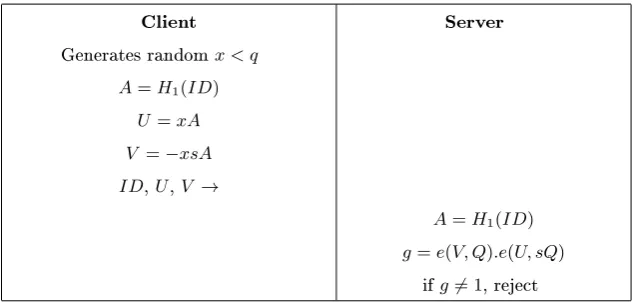
First consider a simple protocol, in which a client tries to authenticate its identity to a server. We assume that the server is authenticated to the client in a standard way, perhaps using the well known SSL protocol. HereIDis the client
identity andH1(.)is a hash function which hashes its input to a point on G1.
This protocol attempts to prove in zero knowledge to the server that the owner of the claimed identityIDis in possession of the valuesAissued to it by
the TA, whereA=H1(ID). The same TA has issued the secretsQ∈G2to the
server, where Q is a xed public point inG2. Correctness follows immediately
from the well known bilinearity property of the pairing. See Table 1.
As an authentication protocol this has some obvious deciencies (for example it is subject to a simple replay attack), but for the moment we will ignore them. Next we introduce a small errorϵinto the client's secretsA. See Table 2.
Observe now that the value ofg as calculated on the server side can be used
to recoverϵ. Strictly speaking as an authentication protocol we might consider
that the authentication has failed. Or we may permit a small deviation ϵ and
judge the authentication a success. In either case we claim that the successful transmission ofϵrepresents a secure narrow-band subliminal channel [6] whereby
a short secretϵcan be communicated from the client to the server.
For the server to ndϵrequires the calculation of a pairing and the solution
Client Generates randomx < q
A=H1(ID)
U =xA
V =−xsA
ID,U,V →
Server
A=H1(ID)
g=e(V, Q).e(U, sQ)
ifg̸= 1, reject Table 1. A simple authentication protocol
Client Generates randomx < q
A=H1(ID)
U =xA
V =−x(s−ϵ)A
ID,U,V →
Server
A=H1(ID)
g=e(V, Q).e(U, sQ) =e(U, Q)ϵ
for a 4-digitϵusually only a few hundred multiplications inGT will be required
to ndϵ, which is completely practical.
To establish the security of the subliminal channel consider a powerful pas-sive observer who has recorded the communication and subsequently somehow captures the un-adjusted client secretsA. Now they are in possession ofsA,xA
andx(s−ϵ)A. However even this does not revealϵ, as a consequence of the XDH
assumption,
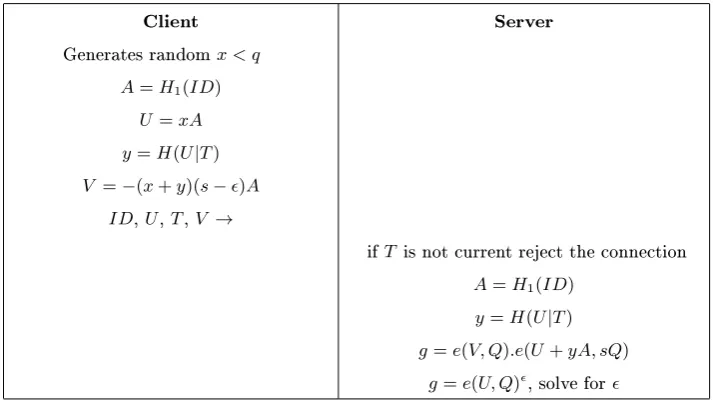
Finally we upgrade our protocol to use a non-interactive version of a provably secure zero-knowledge protocol for proof of identity [2], section 5.3, introducing a time stampT to prevent replay attacks. See Table 3, where the hash function H(.) hashes its input to an element in Fq, and the symbol | indicates simple
concatenation of the inputs.
Client Generates randomx < q
A=H1(ID)
U =xA
y=H(U|T)
V =−(x+y)(s−ϵ)A
ID,U,T,V →
Server
ifT is not current reject the connection A=H1(ID)
y=H(U|T)
g=e(V, Q).e(U+yA, sQ)
g=e(U, Q)ϵ, solve forϵ
Table 3. The nal protocol
3 Our use case solution
The way forward is now quite straightforward. The TA issues to the customer whose identity is proven to beIDthe secrets (s−ϵn)H1(ID|n)whereϵnisn-th
block of 4 digits of the CCN. This is done for each of the 5 blocks of the CCN, for n = 1 to 5. This now constitutes our ciphertextEs(CCN). On the server
side Ds =sQ. To communicate the CCN to the merchant's server, we run the
4 Discussion
In the particular use case considered here, the identity used in the protocol is of no particular signicance, and may be a pseudonym in a predetermined format to preserve anonymity. However this identity is authenticated in the course of the protocol, and is assumed to be bound to the associated CCN in the back-oce payment centre.
To protect the Ciphertext a simple idea borrowed from [5] is to subtract from each component of it a PIN number, so that the secrets are now (s−ϵn−
P IN)H1(ID|n). This PIN can then be re-inserted when the protocol is run.
Clearly without the correct PIN, a valid CCN will not be received by the server. If the merchant's secret is stolen then clearly all captured Ciphertexts can be decrypted. However a stolen merchant secret cannot by itself be used to make purchases from honest merchants.
To remove any single point of failure, the TA can be distributed. In the sim-plest scenario the client can retrieves1H1(ID)from one TA, s2H1(ID)from a
second TA, and simply add them together to createsH1(ID), wheres=s1+s2.
In this case the adjusted secret for our use case would be created by subtracting theϵifrom just one of the TA master secret shares. Also the equivalent server
se-cretss1Qands2Qcan be applied separately ase(X, sQ) =e(X, s1Q).e(X, s2Q)
due to the bilinearity property of the pairing.
An alternate viewpoint would be to observe that the original input secret, if protected by a human-memorisable password, might be subject to an o-line dictionary attack. Here we rst convert the secret to be protected into a form where it is no longer vulnerable to such an attack, and indeed can be protected by a simple PIN number.
References
1. P.S.L.M. Barreto and M. Naehrig. Pairing-friendly elliptic curves of prime order. In Selected Areas in Cryptology SAC 2005, volume 3897 of Lecture Notes in Computer Science, pages 319331. Springer-Verlag, 2006.
2. M. Bellare, C. Namprempre, and G. Neven. Security proofs for identity-based iden-tication and signature schemes. In Eurocrypt 2004, volume 3027 of Lecture Notes in Computer Science, pages 268286. Springer-Verlag, 2004.
3. S. Galbraith, K. Paterson, and N. Smart. Pairings for cryptographers. Discrete Applied Mathematics, 156:31133121, 2008.
4. J. Pollard. Monte Carlo methods for index computation mod p. Mathematics of Computation, 32, 1978.
5. M. Scott. Authenticated ID-based key exchange and remote log-in with simple token and PIN number. Cryptology ePrint Archive, Report 2002/164, 2002. http: //eprint.iacr.org/2002/164.