MATHEMATICS TEACHERS’ POSITIONS AND PRACTICES IN
DISCOURSES OF ASSESSMENT
Candia Morgan
Anna Tsatsaroni
Stephen Lerman
Work carried out at:
Institute of Education, University of London
20 Bedford Way
LONDON WC1H 0AL
Address for proofs, correspondence and offprints:
Dr Candia Morgan
Mathematical Sciences
Institute of Education, University of London
20 Bedford Way
SUMMARY
Recent curriculum reforms have led to a wider variety of methods of assessment in formal „high
stakes‟ assessment regimes in many countries. Morgan‟s (1998) study of mathematics
coursework assessment in UK schools identified a number of positions adopted by teachers as
they assessed student texts. Using Bernstein‟s theoretical framework, we revisit Morgan‟s study
in order to construct a model for understanding teachers‟ assessment practices and positionings.
The model consists of opposing forms, generated by modelling agencies, agents, practices and
specialised forms of communication, to identify their principles of construction, displayed as
changes in the strength of boundary. This helps to distinguish practices of assessment as
different modalities of regulation, and to understand the tensions within and between discourses
and practices. Thus, for example, by interpreting tensions between discourses of „mathematical
investigation‟ and of „assessment‟ in terms of the contradictory demands made by different
BIOGRAPHICAL DETAILS
Candia Morgan is Senior Lecturer in Mathematics Education at the Institute of Education, University of London, working with in-service and pre-service mathematics teachers. Her
research interests include assessment practices in mathematics education, language in
mathematics education, and the use of critical discourse analysis in educational research. She
is the author of Writing Mathematically: The Discourse of Investigation (Falmer Press) and a
number of articles in the area of mathematics education.
Anna Tsatsaroni is Assistant Professor in the Department of Early Childhood Education, University of Patras, Greece. Her research interests are in the sociology of scientific
knowledge, sociology of school knowledge, and theoretical issues in social science. She is the
author of a number of articles in the area of the sociology of science and mathematics
education, in collaboration with educators in these fields, focusing on the analysis of
pedagogical texts and practices.
Stephen Lerman is Professor of Mathematics Education at South Bank University in London and Head of Educational Research. He was President of the International Group for the
Psychology of Mathematics Education from 1995 to 1998 and Chair of the British Society for
Research into Learning Mathematics from 1994 to 1996. His research interests include:
philosophy of mathematics; teacher education; equity issues; learning theories; and
MATHEMATICS TEACHERS’ POSITIONS AND PRACTICES
IN DISCOURSES OF ASSESSMENT
1INTRODUCTION
At all stages of schooling, students are subject to evaluation – by their teachers and, through
externally devised tests and examinations, by other agents. The results of such evaluations
have profound consequences for students, affecting their future educational experiences and
further educational and employment opportunities. This is particularly the case for
mathematical attainment as a qualification in mathematics is often used as a necessary
criterion for entry into further education or employment. At the same time, evaluation has
important consequences for teachers. As well as being concerned for their students‟
well-being, teachers are likely to be judged professionally through evaluations of their students‟
achievements.
Recent mathematics curriculum developments in a number of countries have led to the
inclusion in formal assessment regimes (leading to „high stakes‟ consequences for students
and teachers) of a wider variety of methods of assessment, including „performance‟ and
„authentic‟ assessment (e.g. Romberg, 1995). There has been a move away from traditional
tests and examinations towards tasks that allow more varied, complex responses. This move
1
The work reported here has been supported in part by the authors‟ participation in the project
has simultaneously increased the complexity of the task of assessing student responses – a
task generally undertaken by teachers, who must interpret the texts (written, spoken or
behavioural) produced by their students in order to evaluate them.
Most existing research on assessment in mathematics education has been concerned with the
development and validation of assessment instruments or the degree of reliability in
assessment by teachers (see Morgan, 2000a; 2000b). Studies at the detailed level of individual
teachers‟ assessment practices suggest that there can be substantial differences not only
between evaluations made by different teachers but also in the approaches they take to the task
of assessment (Morgan, 1996; Watson, 1999). Morgan attempted to make sense of these
differences by identifying a number of positions adopted by teachers during the process of
assessing student texts, encompassing different relationships to students and to external
authorities and different orientations towards the texts and the task of assessment. In this
paper, we revisit Morgan‟s study in order to clarify the notion of positioning and to construct
a framework for understanding mathematics teachers‟ assessment practices. In doing this, we
draw on the work of Bernstein.
Bernstein‟s writings (1990; 1996) offer a framework for systematic study of educational data
informed by theoretical considerations that bring together macro-sociological analyses with
their realisation in the classroom. His work provides a language for description of the
pedagogic mechanism through which education reproduces social inequality. This mechanism
comprises forms of curriculum, pedagogy and assessment, the final element being the focus of
this paper.
We will be using examples from the assessment of GCSE coursework as studied by Morgan
(1998). The General Certificate of Secondary Education (GCSE) is the examination taken by
choice of syllabuses offered by a small number of examination boards. These boards are
independent commercial bodies, but all syllabuses must be approved by the Qualifications and
Curriculum Authority, a government agency. The mathematics GCSE includes a coursework
element, which most commonly takes the form of written reports of work on one or more
investigative tasks. While a timed examination element is marked by external examiners,
students‟ own teachers assess the coursework and these assessments are moderated by the
boards. Teachers are provided with official criteria and „performance indicators‟ from the
boards but they may also draw on ideas from their training and previous teaching experience
as well as more general ideas from the media or from „common sense‟ discourses.
BACKGROUND
Morgan‟s (1998) study of teachers assessing students‟ coursework attempted to describe the
ways in which teachers read student texts. Empirical analysis of interviews during which
teachers read and assessed student texts suggested that the teachers drew on resources from
different, sometimes contradictory, discourses and that the various ways they were positioned
within these discourses could lead to different evaluations of the same student text. The
analysis identified the following positions:
examiner, using externally determined criteria
examiner, setting and using her own criteria
teacher/advocate, looking for opportunities to give credit to students
teacher/adviser, suggesting ways of meeting the criteria
teacher/pedagogue, suggesting ways students might improve their perceived levels of
imaginary naïve reader
interested mathematician
interviewee
Teachers were found to adopt one or more of these positions as they evaluated student work
and justified their evaluations (see Morgan, 1998, pp. 134-137).
Further examination of the data enabled us to identify some of the discourses on which the
teachers appeared to be drawing in order to make sense of and evaluate students‟ texts. We
illustrate this with the following extract from an interview with an experienced teacher, Fiona,
reading a student coursework text:
. . but again even that‟s not, I mean he‟s given . . one thing that I think they have to do
is when they give a formula they should explain it using quite a few examples and
show how it works. The thing that I always look for and I say to the kids is: you write
it up as if you‟re writing it for somebody who‟s never seen this problem, […] I don‟t
think it‟s clear enough for somebody to use it and then work out, I mean he hasn‟t
done even one example of how it works.
The original analysis of Fiona‟s positioning saw her as shifting between several positions: as
an examiner, as a teacher/adviser, an imaginary naïve reader and an interviewee. Revisiting
the data we ask: how is Fiona positioned in relation to the official discourse of the
examination and what resources, from which discourses, does she draw on in order to make
sense of the practice of assessment? For example, the official discourse of the examination
includes „clear communication‟ among its evaluation criteria. Fiona appears to be accepting
and applying this criterion but she is recontextualising it, making sense of it by drawing on
transmission of meaning as well as her teacher knowledge of „explaining‟ as providing
examples that will enable the reader to complete similar problems. She also draws on her
everyday teaching experience – “the thing I always look for and I say to the kids …”.
In this paper, we seek to construct a theoretical model, drawing on Bernstein‟s work, to
identify and explain the positions available to teachers within assessment practices and to
address the question of how the official discourse of assessment, including the explicit criteria
provided for teacher-assessors, may be transformed within the school as teachers such as
Fiona make sense of their practice by drawing on the various resources available to them.
THEORETICAL CONSIDERATIONS
To understand how teachers engage in assessment practices, we need to be able to describe
systematically the field, the sub-fields, the agents acting in them and the social relations
through which pedagogical and other educational discourses are constructed, and practices
distributed. Bernstein‟s theoretical model provides us with a set of concepts for such a
systematic description.
Within the pedagogical field, we can, first, distinguish the sub-field where pedagogical
discourses are constituted through processes of recontextualisation of knowledge and practices. This is of major importance for our understanding of how such discourses are formed because it
helps us to focus our analysis on the agents responsible for a particular recontextualisation, the
resources used and the processes of selection, simplification, condensation, repositioning and
refocusing (Bernstein, 1990), through which a discourse is transformed, and a pedagogical
discourse formed and used in contexts different from its substantive context.
of the specialised discourse of Mathematics. Such a recontextualisation is driven by a purposeful
intention to initiate, develop or change knowledge by somebody who already possesses or has
access to the necessary resources, and the means of evaluating the acquisition of the discourse
(Bernstein and Solomon, 1999). Another example is the discourse of evaluation, an educational
discourse regulating the activity of assessment of acquisition of school mathematics. This is the
product of recontextualisation of elements from other discourses, knowledge and practices,
which are much more difficult to identify, and which provide teachers (and pupils) with forms
and criteria of good or appropriate practice. Obviously there are multiple, often difficult to track
down, links between the two discourses of pedagogy and of evaluation; and sometimes an
explicit discourse of assessment is not prevalent (see Bernstein, 2000; Broadfoot, 1996; 2000).
In this paper we focus on the evaluation discourse.
The production and operation of evaluation discourse
The discourse of evaluation is not unitary but consists of an official discourse and other
unofficial discourses. We shall attempt to discern the nature of the discourses of evaluation,
within which teachers in Morgan‟s study, briefly described earlier, carry out the activity of
assessment, how these discourses are produced and how they operate.
The official discourse of evaluation is produced by agents operating in the Official Pedagogic Recontextualising Field (OPRF) (Bernstein, 1996), for example, the examination boards, government departments and agencies. To produce this discourse, official agents have drawn on
a set of discourses and practices, available within the sub-field of recontextualisation, and have
subsumed them under their own aims and purposes. Among such discourses are those produced
in the field of production of knowledge by the activities and practices of the mathematics
Field (UPRF) (Bernstein, 1996) such as teacher training courses. Elements of these are appropriated by official agents, often constituting central elements of the official discourse.
Elements of discourses produced by other educational communities and circulated within the
UPRF, such as discourses on school management, school effectiveness, etc., might also become
elements of the official discourse. Therefore the official discourse of evaluation consists of a
variety of elements from heterogeneous discourses, including those of mathematics and other
education research, inspection reports, productions of other government agents, parents, and
wider social discourses. However, discourses produced by the mathematics education research
and other communities might remain outside the official pedagogic discourse, forming
unofficial, oppositional educational discourses on evaluation.
Figure 1 here
We can argue, then, that the guidelines, procedures and criteria of assessment of coursework in
Morgan‟s study, are products of such processes of recontextualisation and elements of the
official discourse on evaluation. For example, the guidelines for assessment of coursework
provided by one of the examination boards discuss the use of oral evidence. These guidelines
draw on arguments, produced within the mathematics education research field and circulated
within the UPRF, that students‟ oral and written texts are equally valid sources of evidence of
mathematical achievement (e.g., MacNamara & Roper, 1992). Thus it is stated that:
credit can be given for remarks made orally but not necessarily written down
But the guidelines also draw on elements of official discourse on evaluation that give priority to
For instance, a candidate might be able to express a strategy well orally but lack some of
the skill required to communicate the strategy in other ways.
and:
When credit is given for something expressed orally it is sensible for the teacher to record
this This will greatly help the process of moderation. (Edexcel, 1999, p.12)
What does this discourse do? It suggests to teachers (or attempts to impose on them) practices
and criteria of assessment, and provides them with arguments to make sense, justify and explain
their practices to pupils, parents, official moderators, and interested others. Following Bernstein,
we can say that this discourse attempts to regulate teachers‟ practices of assessment.
It is crucial to ask how the discourse on coursework assessment positions teachers (and pupils). Assessment of coursework, in contrast to traditional, formal, timed examinations, is completed
by students in class, and in their own time. Thus its pacing is slower, compared to the timed
examination, and the investigation tasks may vary, depending on the specific, local interests of
pupils and teachers. Furthermore, whereas formal examinations are marked by external
examiners who do not know the students, the coursework is marked by the classroom teacher,
who is expected to know the students and is committed to regulating their progress. Compared
to formal examinations, therefore, coursework is less strongly classified and framed (Bernstein,
1971) such that it looks more like a learning exercise than an assessment task of students‟
acquisition of mathematics. Thus we note that, on the one hand, teachers are provided with
official criteria and „performance indicators‟ from the examination boards; and that examination
boards keep the control over the process of coursework assessment through the mechanism of
moderation. These measures serve to draw a strong boundary between the examination board
(and the related official agency) and teachers, constituting official agency as a strong voice. On
se, make it appear as if teachers have the power to exercise judgement as to what resources to use to construct such tasks, when to implement them within the classroom, how much time to
allocate, what constitutes admissible help, what account to take of achievement evidenced in
ways that are not recorded in the student‟s formal written report. This seems, somehow, to
weaken the official voice, seemingly allowing for interpretation and discretion at the local level.
We are therefore arguing that teachers‟ positioning in the official discourse is a function of the
degree of boundary maintenance (Bernstein, 2000) that regulates the relation between official agents on the one hand, and other agents (such as educational advisers, researchers, mathematics
teacher educators) and teachers on the other. In this case the boundary is in some respects strong,
and in other respects less strong and, as we will show below, this affects teachers‟ positions
within and their degree of affiliation to the discourse.
A second aspect of the production of discourse is that among its constitutive elements are
theories, evidence, arguments, in short projections of practice produced by agents operating in
the mathematics education research field of production (see Figure 1). As argued, these
knowledges become resources that the official discourse of evaluation draws on to prescribe assessment tasks and procedures and forms of pedagogical relationships, though these are
subject to recontextualisation and multiple transformations. These can also relay different and at
times oppositional voices.
There are a number of issues regarding the field of mathematics education research and its
relationship to the official evaluation discourse, notably its status and its internal organisation.
To start with its status: mathematics education research comprises a sub-field within the general
field of educational studies in the field of intellectual production. Though small, this sub-field is
continually growing nationally and internationally and, relative to other sub-fields, enjoys some
intellectual production, educational studies is a most vulnerable area, subject to interventions by
the state, as a consequence of current economic, cultural, technological and social changes,
reducing its significance.
The second issue is the way its knowledge is organised. That is to say, as well as the external
relations of the sub-field of mathematics education research we should consider its internal
structure. This structure is shared with the field of educational studies more generally. We can
identify two models, performance and competence pedagogical models. Within the competence model there are several modes: the liberal-progressive mode, focused on the cognitive empowerment of the individual; a populist mode, backed by sociological approaches, and a more elaborate version, the radical-emancipatory mode, backed by critical social theories (Lerman & Tsatsaroni, 1998). In the 1990s, competence models have tended to be replaced by
new performance models, legitimated by instrumental, managerial discourses.
While it cannot be assumed that such modes and models are clearly identifiable in the field of
education research and its sub-fields they, nevertheless, help to reveal the internal structure of
(mathematics) education research which, in Bernstein‟s terms, is a horizontal knowledge structure with a weak grammar (cf. Bernstein, 1999; Lamnias & Tsatsaroni, 1999). This means that, unlike hierarchical knowledge structures, exemplified by the natural sciences, which are
motivated towards greater and greater integrating propositions, operating at more and more
abstract levels, mathematics education research consists of a series of specialised languages with
specialised modes of interrogation and criteria for the construction and circulation of texts.
Developments take the form of the addition of a new language, an additional segment, rather
than greater generality and integrative potential.
The character of the (mathematics) education research field as a horizontal knowledge structure
considerations in this paper. These consequences are linked to what Maton (2000), elaborating
and extending Bernstein‟s notion of weak and strong grammars, calls the „language of
legitimation‟ for new knowledge production in a given field. For Maton, a language of
legitimation comprises an articulation of an epistemic and a social relation. The former refers to
what may be claimed knowledge of and how, while the latter refers to who may claim
knowledge. According to this definition, intellectual fields with weak grammars are those which
specialise and privilege positions within the field on the basis of who is making the claim to
knowledge (the social relation) rather than the epistemic relation. Maton calls this a „knower
mode‟ and contrasts it to a „knowledge mode‟ of legitimation, where the articulation of the
epistemic and social relation is reversed. Hence the serial or segmental character of knowledge
based on knowledge structures with a weak grammar, and the way that they tend to develop and
change, that is, by addition of new specialised languages.
Accordingly, what we described earlier as competence and performance models and modes, and
the „switch‟ from one to another, can be seen as attempts to weaken or strengthen the grammar
for knowledge production and change (cf. Moore and Maton, 2001). More specifically,
performance models can be understood as effects of a language of legitimation with relatively
strong grammar: they represent a tendency towards a „knowledge mode‟. In contrast,
competence models exemplify the weakening of the knowledge structure and a switch towards a
„knower mode‟ of legitimation.
Weakening or strengthening of the grammar of an intellectual field of knowledge production, in
our case the tendency to „switch‟ from performance to competence models and the reverse, has
important consequences. With strengthening (performance models), there is an emphasis on
knowledge, on the product/text of pupils, while weakening (competence models) entails a shift
cultural studies, the researcher (and ultimately the teacher) is meant to stand for, have privileged
access to, or represent the interests of usually marginalised individuals or social groups: to „give
voice to‟ those who occupy a dominated social position (Moore and Muller, 1999).
Thus the status and organisation of knowledge in the field of mathematics education research
points to the shifting and uncertain nature of the field. This affects voice constitution and power
relations and makes positioning precarious since there is no stable single specialised language,
therefore no clear distinction between official and oppositional discourses. Instead there are
complex relationships between the official voice and other voices. Coursework exemplifies this.
The official discourse of evaluation draws mainly on and recontextualises elements from the
liberal-progressive mode. This apparently gives autonomy to teachers vis-à-vis the official educational agency and shifts responsibility to them: the liberal-progressive mode places value
on pupils and their internal processes rather than on their finished product; it orientates teachers to look for evidence of pupils‟ progress and development, i.e., what is present in the work; and it suggests criteria of assessment which are multiple and diffuse. Thus the voice of the official discourse is not imperative and authoritative, while the voice of weaker students, e.g. those who
would find it difficult to compete in national, high-stakes assessment conditions, is listened to
and given a chance. However, the elaboration of official criteria of assessment, at the national
level, is a move in the opposite direction. Formal and explicit criteria are an element of re-emerging performance models which are thus valorised. By drawing on these resources, the
discourse re-institutes the authority and power of the official voice. Pre-given criteria of
assessment orientate teachers towards pupils‟ finished products, and what is absent from these products. The voice of the dominated or of the weak participant in the pedagogic relationship is
The recontextualisation of the discourse of evaluation in the mathematics classroom
A further important aspect of the discourse is how it is deployed in practice. Bernstein stresses
that it is crucial to distinguish between two kinds of transformation of elements of discourse,
when they become subjected to recontextualisation processes. The first, already referred to, is
the transformation of discourses and the construction of an official discourse of evaluation. The
second is the transformation of this new discourse, as it becomes active in the pedagogic process
and the mathematics classroom. In order to examine the deployment of the discourse in practice,
we analyse teachers‟ positions within it, that is to say, their position vis-à-vis the official
discourse, the resources on which they draw and their assessment practices, i.e., the criteria and
their orientation to the task.
What affects the recontextualisations at this level is a crucial question. What are the resources
teachers use to construct their position and deploy „appropriate‟ practice? We have already
argued that both the official discourse of evaluation (including elements from the specialised
(mathematics) education discourse) and the specialised languages of (mathematics) education
research field, independently available within UPRF (see Figure 1), are resources for teachers.
But in addition, the strategies they develop in doing their tasks, and in justifying their practices, depend on how they interpret their own schoolwork activity. Strategies may be drawn from
vertical or horizontal discourses. Horizontal discourse refers to forms of knowledge usually
typified as everyday or common sense; while vertical discourse refers to knowledge forms
whose circulation is subject to distributive rules regulating access, transmission and evaluation.
Discourses about teachers‟ professional development and work have at times stressed the very
specialised and elaborate knowledge structure which should underpin their performance (e.g.,
developmental psychology). In contrast, current professional discourses conceive of teaching as
Resources drawn from these two distinct vertical discourses prescribe very different forms of
action and behaviour for teachers. Moreover, these contrast with resources drawn from other,
local contexts in which teachers live and act. Such discourses, we argue, are additional resources
for teachers and provide them with strategies and the means to argue for and justify their
decisions and actions concerning the assessment of their pupils (cf. Ensor, 1999).
BUILDING THE MODEL - THE RESEARCH TOOL
Morgan‟s study of teachers assessing students‟ coursework as described earlier has identified
empirically a number of positions adopted by teachers as they evaluated students‟ work. We
shall now use our theoretical sources and the set of concepts introduced above to attempt to
build a model, to re-address the same set of data and to be applicable more generally.
Our theoretical considerations indicate that the official discourse of evaluation shapes teachers‟
assessment activity, constructing teachers‟ positions and forms of practice, and that structurally
there are two (pre-)dominant subject positions for teachers: speaking the voice of the official
(legitimate) discourse of evaluation, or speaking the voice of other discourses. Therefore, the
central question that directs our attempt to build the model is: Do teachers accept or reject the
official discourse?
Though compulsory, with “clear” criteria, moderation processes, etc., teachers‟ resistance to the
official discourse of evaluation is always a possibility. This resistance is easier to trace in the
context of interviewing. However, we do not consider worth pursuing the question of the
difference between the situation of interviewing and their activity of assessment as deployed in
teachers‟ local contexts. Rather it is much more productive to describe:
assessing coursework
the resources they draw on to understand and interpret these tasks;
the kind of strategies they deploy in acting and justifying their decisions and judgements.
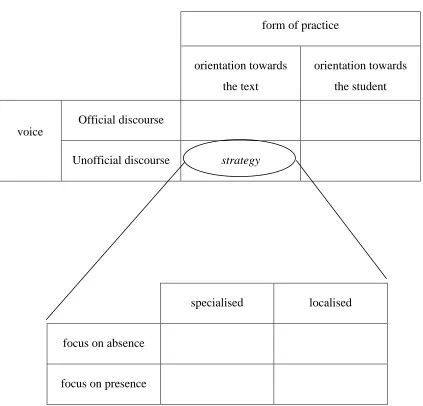
Figure 2 presents a four dimensional model. In the main matrix, the rows represent the two
structural positions of the discourse of evaluation („voice‟ constitution): the position of teachers
speaking the voice of the official discourse of evaluation, and the position of teachers speaking
the voice(s) of other discourses. The columns represent forms of practice, defining teachers‟
orientations and strategies. Again, two oppositional forms of practice can be identified:
orientation towards the text produced by the student, as in performance models, and orientation
towards the student, as in competence models. This is when discursive resources are drawn on
„consistently‟, though all four positions in the model are possible.
Embedded within the first is a second matrix, which represents „strategies‟ (cf. Dowling, 1998),
according to the focus directing teachers‟ actions, and the level of generality of their
commentary (cf. Brown, 1999). The rows represent teachers‟ focus towards what is present or
absent. Again, while there are two logical possibilities, a teacher who uses resources
„consistently‟ would tend to focus on what is absent (i.e. what is lacking in the text), if his/her
orientation is defined by performance models. Likewise, a teacher would tend to focus on what
is present (i.e. what qualities the student exhibits), if his/her orientation is defined by
competence models. The columns represent the level of generality of teachers‟ comments,
ranging from localised to specialised judgements. Depending on whether they perceive of their
activity as a specialised or an everyday one, drawing on vertical or horizontal discourses
respectively, teachers would tend to justify their evaluation of a student by reference either to
orientation and strategies, will, in turn, affect the criteria used by teachers and their degree of
explicitness. The possibilities here range from explicit adoption, or implicit reinforcement of the
criteria of the discourse, to explicit rejection of the criteria of the official discourse and adoption
of alternative criteria, and their interpretation (or re-interpretation) according to everyday
resources.
Questions of contradictory demands created by different resources and of the tendency to
interpret the criteria adopted through resources drawn from the horizontal discourse are pertinent
here. For example, use of criteria would be „consistent‟ if a teacher, with an orientation towards
the student, a focus on presences, using specialised commentary, all according to a pedagogic
model of competence, acts in ways that keep his/her criteria implicit, and uses multiple and
defuse criteria interpreted through recourse to theories informing this pedagogic model.
Furthermore, for the overall position to be „consistent‟, the structural position adopted would
draw only on resources from the same model. However, there is likely to be a tendency for
teachers to reinterpret the criteria provided by the pedagogic model, attributing them
commonsensical meanings and using localised, non-specialised commentary to justify
evaluations. We should stress that we do not place a value on „consistency‟ or „inconsistency‟
in teachers‟ practices. The discourse we have attempted to describe makes contradictory
demands on the positions it creates. Evaluating would be inappropriate, given our accord with
Bernstein‟s insistence that research should be directed to systematic description.
Figure 2 here
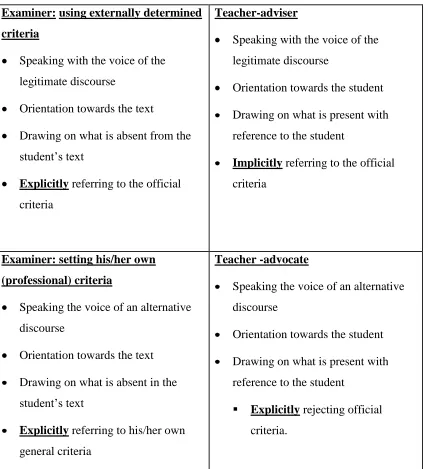
The two-way matrix in Figure 2 is deliberately pared down, and so too will be the elaborated
figure 3 which follows. The categorisation is based on our theoretical analysis, which combines
structural and interactional features to describe the discourse of evaluation in terms of positions
and forms of practice, respectively. The four cells derive from the projection of the model
constructed in Figure 2 onto the empirical categories identified by Morgan. Each cell explains a
category of teacher in terms of the position adopted in the discourse and the discursive resources
used to deploy strategies: orientation (student/text), focus (present/absent) and criteria of
assessment. The (reduced) model thus incorporates and explains theoretically four of the
categories originally identified by Morgan: teacher adviser; teacher advocate; examiner using
externally determined criteria; and examiner setting his/her own (professional) criteria.
When we say that the model helps us explain the categories we mean that it helps us to make
systematic remarks on the empirical categories, and ultimately to read the text of interviews with
teachers through the framework developed theoretically. Such observations and explanations of
the data are:
The tendency, clearly identified in the data, for teachers to switch between student-present
(teacher-adviser, teacher-advocate) and text-absence (the two positions of examiner).
The contradictions between the orientation-focus and the criteria employed (most clearly
identified in the position of the teacher-adviser).
The contradictory demands created by the structural position adopted (voice) and the
strategies employed. Such contradictions explain the actual compatibilities observed between
the use of strategies „properly‟ belonging to the legitimate discourse, and the voice of an
alternative discourse in which a teacher speaks, and vice versa.
coursework assessment expresses this tension. Contradictory demands, then, are made when the
teacher uses the resources of a competence model within examination structures that impose
strategies that are more consistent with a performance model.
Furthermore, systematic remarks, facilitated by the use of this reduced model, might include
the identification of the various strengths of the tendency to draw on non-specialised resources
involved in (coursework) examination practices. This is the case, for example, of the „teacher
advocate‟. This position, because it relies on resources that privilege localising strategies,
might also make available resources from horizontal discourse (localised rather than
specialised) as a basis for judgements. Other positions are clearly possible through further
fragmentation.
Figure 3 here
The positions identified in Figure 3 are now elaborated, using examples from Morgan‟s data,
illustrating how they may operate in practice.
Examiner: using externally determined criteria
Fiona is clearly speaking the voice of the official discourse. She refers to diagrams – an element
of „mathematical communication‟ valued in the official criteria – and to the notion of Fiona:
This is a major problem because he‟s got these results but unless one is there in the
class and you‟re a teacher you don‟t know whether this is his results or somebody else‟s.
authenticating the work as belonging to the student – part of the officially stated work of
teachers within the coursework assessment system. Orientation is towards the text and,
consistently within a traditional pedagogic mode, the focus is on what is absent from the text.
She refers explicitly to official criteria in interpreting the task of assessment. Contradictions
inherent in the discourse are exemplified here. Coursework assessment is meant to be oriented to
the student – the official discourse drawing on liberal-progressive resources to weaken official
assessment practices and their consequences – but the criteria push this teacher‟s practice
towards a text/absence orientation.
Teacher-adviser
Harry:
he‟s also looked at the difference between each of the different piles. Now that
straightaway will show him that there‟s a pattern there as well as the initial pattern.
So that‟s something that would may come to when he‟s investigating later. Okay, so
he‟s recognised that there is a pattern […] there is a limitation because he‟s only
gone up to ten units as the base; so that is something that he‟s considered that it may
be just for this number of units. So making predictions over a hundred or so base
units may be something he could mention as well.
The teacher-adviser speaks with the voice of the official discourse, in this case making use of
notions of pattern and prediction, identified in the assessment criteria and other curriculum
documents. The form of practice is, however, oriented towards the student and what is present in
the text, reflecting the tension between performance and competence models within the official
discourse. Rather than criticising the student for failing to draw more general conclusions, Harry
points towards ways in which what the student has done might form the basis for further work.
generalised criteria offered by the discourse. However, use of the criteria is implicit and
reference to pattern and prediction is not explicitly evaluative.
Examiner: setting his/her own (professional) criteria
In this position, the teacher speaks with the voice of an unofficial discourse, adopting the values
of a traditional pedagogic discourse (performance model), and endorsing calculation as
explanation, rejecting the notion that „explain‟ involves verbalisation. Orientation is towards
what is absent in the student‟s text, identifying what is generally required but may be lacking.
Carol explicitly rejects the official criteria and refers instead to her own professional values. But
there is ambivalence about the sources that may be drawn upon in interpreting her role as
examiner. Orientation towards performance models defeats the initial official purpose of
coursework assessment, supposedly serving the interest of less privileged pupils.
Teacher-advocate
Carol:
it does say explain your working and it‟s true that the candidate has got the answer
and hasn‟t just written down the answer and the explanation I find acceptable here. It‟s
done just as a mathematical explanation. I think sometimes that word „explain‟ causes
problems. [ ] So the fact that this student has used a simple calculation and left it at
that actually at this stage makes me into an even more positive frame towards them
because they see that a mathematical calculation can be sufficient explanation.
Andy:
The formula is accurate, needs a bracket in it, but it‟s quite clear that his intention and
he‟s given a nice example which clarifies his thinking, so although algebraically it‟s not
The teacher-advocate speaks with the voice of an unofficial discourse, valuing the supposition
that the student knows what he‟s doing. Andy uses a discourse of competence, situating
knowledge in the student‟s own activity. Consistent with this particular discourse voice, he is
oriented towards the student through what is present in the text. It is likely that resources are
drawn from populist or emancipatory modes, which value pupils‟ everyday meanings and
practices (such as using examples) and in which teacher and pupils trust each other as members
of a community.
Criteria encompassed in the mode of practice projected by the alternative discourse may tacitly
operate, creating compatibilities and contradictions vis-à-vis the official criteria. The tendency to
reject specialised and adopt localised criteria leaves room for commonsensical interpretations of
aspects of the assessment task as pedagogic activity. In this case, Andy explicitly rejects official
criteria such as correct notation, valorising thinking and understanding. Judgements about what
the student knows are made confidently but relationships between these judgements and
evidence in the text are not fully articulated. The operation of tacit criteria might well be
grounded in commonsensical meanings.
The positions identified in Figure 3 are not exhaustive, but describe limit cases where the
positions and resources available to these positions are identified and theoretically explained.
Thus, in each example above, orientation towards the student is associated with strategies that
involve focussing on what is present (consistent with competence models), while, conversely,
orientation towards the text is associated with a focus on absences (consistent with performance
models).
We have illustrated the four positions presented in Figure 3. We now provide an illustration of
Example of drawing upon horizontal (everyday) discourse:
Here, Joan uses and values the notion that the student‟s apparent approach to the problem
“seems like a sensible idea”. This is not part of an explicitly educational discourse but draws on
an everyday discourse in which “sensible” is a positive evaluative criterion. The aspects of the
student‟s approach that make it sensible are not made explicit, although they could have been
justified by drawing on resources from mathematics educational discourses such as analysing the
problem, using deductive reasoning, etc.
Of the eight positions originally identified by Morgan (1998), the first four have been
incorporated into the model proposed here and are now defined in theoretical terms. Of the
others, we now see „imaginary naive reader‟ as a strategy adopted in order to operationalise
criteria rather than as a genuine position. „Teacher/pedagogue‟ can be seen as a more general or
less refined position that can be recategorised as either teacher/advocate or teacher/adviser or
may arise from a less„consistent‟ use of resources, for example, combining orientation towards
the student with a focus on absences. The position of „interviewee‟ is alienated from the
assessment discourse in that a teacher is engaging in a practice that is not an assessment
practice. Some examples of teachers apparently positioned as „interested mathematicians‟ are
similarly seen to be in alienated positions, while most are re-categorised as speaking with the
voice of an unofficial discourse (either teacher/advocate or examiner, setting and using their
own criteria, depending on their orientation). Joan:
I wonder, the fact that he‟s drawn that dotted line across the middle makes me think he
was looking at it in terms of two trapeziums but he hasn‟t said that here [ ] so that
CONCLUSIONS
In this final section we will examine what has been gained by revisiting the data and analysis in
Morgan (1998). The original classification of positions was derived empirically and was not
systematic, failing to establish links between the positions adopted by teachers and other aspects
of their practice. Setting the classification in a theoretical framework has validated the empirical
distinctions and identified the locations of the positions in official or oppositional pedagogic
discourse or in alternative discourses, including the interview discourse. Thus the identification
of the positions and discourses in play is less arbitrary. We can also reconsider the nature of
tensions between discourses. Whereas Morgan identified tensions between a discourse of
„investigation‟ and a discourse of „assessment‟, we now see this tension as being between
liberal progressive and traditional modes of pedagogic discourse. Thus the model helps us
describe teachers‟ assessment practices systematically, explaining apparent consistencies and
inconsistencies.
The model was derived by systematic use of a theory seeking to understand how educational
practices relay power and control relations and serve to reproduce or change them. Our main
objective has been to reveal varieties of modalities of regulation (Bernstein, 2000) by modelling
agencies, agents, practices and specialised forms of communication. The model consists of
opposing forms according to the strength of power relations (examiner/teacher) and control
relations (adviser/advocate). These positions are not ideal types; they are generated to assist in
the description of the empirical.
In a more general sense the approach that we have provided enables a conversation between the
theoretical and empirical fields of the research focus, and allows us to understand teachers‟
relationships to the discourses at play in evaluation practices. Beyond assessment, the
teachers, and differences between teachers. For example, it provides an alternative way of
looking at teachers‟ beliefs, usually seen as private, individual belief systems (see Lerman,
2001).
The significance of the endeavour inheres in the possibility of raising questions about dominant
policies, such as coursework, and investigating them in a systematic way. Bernstein‟s
framework enables a more elaborated language for describing the mechanisms whereby social
forces impact upon schooling. Without such a language, connections with the ideologies of
social groups remain covert, hindering possibilities of resistance. We contend that the
framework developed here can enable teachers to examine the sources of their attitudes to
assessment. By doing this, practices can be changed as teachers recognise how success and
failure are constructed within different pedagogic modes. The question of whether teachers
recognise the form of pedagogy they draw on, the sources of the pedagogy and the special
demands or requirements is not only a substantive issue (Morais, Fontinhas, Neves, 1992;
Ensor, 1999; Solomon & Tsatsaroni, 2001) but is also methodologically relevant: if a teacher
recognises the sources of his/her pedagogy, this can counter the effects of the mediation of
teacher assessment activity in the interview situation.
The analysis can also be applied in other educational contexts.2 For example, in considering the
National Numeracy Framework, being implemented in all primary classrooms in the UK by
central government pressure, analysis of the OPRF and the UPRF enables us to study the
2
The model is currently being developed to be applied to a study of the production and use of
theories in mathematics education research (ESRC project no. R000223610). In addition a
positions available to teachers, again enabling avenues of resistance. More generally, curriculum
innovations in any subject offer researchers interesting possibilities since the visibility of
different discourses is greater than when practices are strongly established.
To conclude, our concern in this article has been with using theory to further develop the
methodological approach to an empirical study. This required us to engage with analysis of the
construction of the discourse. Attempting to explain what interests such a discourse serves (or
what changes in society give rise to such a discourse) goes beyond the aims of the present work.
However, we are aware that Bernstein would invite us not simply to analyse the elements of the
discourse as two competing ideologies (cf. Broadfoot, 1998), but also to ask what social
fractions promote them, what class assumptions underpin them. This would elaborate more
clearly the effects of the discourse and whether it serves to empower or disempower teachers
REFERENCES
BERNSTEIN, B. (1971) On the classification and framing of educational knowledge, in:
M.F.D YOUNG (Ed) Knowledge and Control (London, Collier-Macmillan).
BERNSTEIN, B. (1990) The Structuring of Pedagogic Discourse (London, Routledge).
BERNSTEIN, B. (1996) Pedagogy, Symbolic Control and Identity (London, Taylor & Francis). BERNSTEIN, B. (1999) Vertical and horizontal discourse: an essay, British Journal of Sociology of Education, 20(2), pp. 157-173.
BERNSTEIN, B. (2000) Pedagogy, Symbolic Control and Identity. (revised edition)(Lanham, Maryland, Rowman & Littlefield).
BERNSTEIN, B. & SOLOMON, J. (1999) „Pedagogy, identity and the construction of a theory
of symbolic control‟: Basil Bernstein questioned by Joseph Solomon, British Journal of Sociology of Education, Vol. 20(2), pp. 265-279.
BROADFOOT, P. (1996) Education, Assessment and Society: A sociological analysis
(Buckingham, Open University Press).
BROADFOOT, P. (1998) Quality standards and control in Higher Education: what price
life-long learning? International Studies in Sociology of Education, Vol. 8(2), pp.155-180.
BROADFOOT, P. (2000) Culture, learning and comparison: Lawrence Stenhouse’s vision of
education for empowerment, BERA Stenhouse Lecture(Southwell, British Educational Research Association).
BROWN, A. J. (1999) Parental participation, positioning and pedagogy: a sociological study of
DOWLING, P. (1998) The Sociology of Mathematics Education (London, Falmer).
EDEXCEL. (1999) Mathematics 1385 and 1386: The Assessment of Ma1 (London, Edexcel
Foundation).
ENSOR, P. (1999) A study of the recontextualising of pedagogic practices from a South African University preservice mathematics teacher education course by seven beginning secondary mathematics teachers, Unpublished PhD Thesis, University of London.
LAMNIAS, C & TSATSARONI, A. (1999) School knowledge and practices of assessment:
their role with respect to pupils‟ failure and social exclusion, in: C. KONSTANTINOU & G.
PLEIOS (Eds) Proceedings of 8th International conference of the Greek Pedagogical Association, ‘ School Failure and Social Exclusion’ (Athens, Ellinika Grammata (in Greek)). LERMAN, S. (2001) A review of research perspectives on mathematics teacher education, in:
F-L F-LIN & T. COONEY (Eds) Making Sense of Mathematics Teacher Education (Dordrecht, Kluwer).
LERMAN, S. & TSATSARONI, A. (1998) Why children fail and what mathematics education
studies can do about it. The contribution/role of sociology, in: P. GATES (Ed) Mathematics Education and Society, Proceedings of the First International Mathematics Education and Society Conference (MEAS1) (Nottingham, Centre for the Study of Mathematics Education, Nottingham University).
MATON, K. (2000) Languages of legitimation: The structuring significance for intellectual
fields of strategic knowledge claims, British Journal of Sociology of Education, Vol. 21(2), pp. 147-167.
MACNAMARA, A. & ROPER, T. (1992) Unrecorded, unobserved and suppressed
MOORE, R. & MATON, K. (2001) Realising potential: Basil Bernstein, intellectual fields
and the epistemic device, in: A. MORAIS, I. NEVES, B. DAVIES, & H. DANIELS, (Eds),
Towards a sociology of pedagogy: The contribution of Basil Bernstein to research (New York, Peter Lang).
MOORE, R. & MULLER, J. (1999) The Discourse of „voice‟ and the problem of knowledge
and identity in the sociology of education, British Journal of Sociology of Education, 20(2), pp. 189-206.
MORAIS, A. M., FONTINHAS, F. & NEVES, I. P. (1992) Recognition and realization rules in
acquiring school science: The contribution of pedagogy and social background of students,
British Journal of Sociology of Education, 13 (2), pp. 247-270.
MORGAN, C. (1996) Teacher as examiner: The case of mathematics coursework, Assessment in Education, 3(3), pp. 353-375.
MORGAN, C. (1998) Writing Mathematically: The Discourse of Investigation (London, Falmer).
MORGAN, C. (2000a) Discourses of Assessment – Discourses of Mathematics, in: J. F.
MATOS & M. SANTOS (Eds), Proceedings of the Second International Mathematics Education and Society Conference (Lisbon, Centro de Investigação en Educação, Faculdade de Ciências da Universidade de Lisboa).
MORGAN, C. (2000b) Better assessment in mathematics education? A social perspective, in: J.
BOALER (Ed), Multiple Perspectives on Mathematics Teaching and Learning (Westport, CT, Ablex).
SOLOMON, J. & TSATSARONI, A. (2001) Educational evaluation: The social production of
texts and practices, in: A. MORAIS, I. NEVES, B. DAVIES, & H. DANIELS, (Eds), Towards a sociology of pedagogy: The contribution of Basil Bernstein to research (New York, Peter Lang). WATSON, A. (1999) Paradigmatic conflicts in informal mathematics assessment as sources of
CAPTIONS TO FIGURES
Figure 1: Fields and sub-fields in the production of the discourse of evaluation
Figure 2: Positions and practices in discourses of assessment
Figure 3: Teachers‟ subject positions in the Education Discourse and their orientation in
FIGURE 1
Recontextualising Fields of Mathematics Classrooms Mathematics Education
UPRF
Mathematics Education
OPRF Mathematics Education
Research Field of Production
FIGURE 2
form of practice
orientation towards
the text
orientation towards
the student
voice
Official discourse
Unofficial discourse strategy
specialised localised
focus on absence
FIGURE 3
Examiner:using externally determined criteria
Speaking with the voice of the
legitimate discourse
Orientation towards the text
Drawing on what is absent from the
student‟s text
Explicitly referring to the official criteria
Teacher-adviser
Speaking with the voice of the
legitimate discourse
Orientation towards the student
Drawing on what is present with
reference to the student
Implicitly referring to the official criteria
Examiner: setting his/her own (professional) criteria
Speaking the voice of an alternative
discourse
Orientation towards the text
Drawing on what is absent in the
student‟s text
Explicitly referring to his/her own general criteria
Teacher -advocate
Speaking the voice of an alternative
discourse
Orientation towards the student
Drawing on what is present with
reference to the student
Explicitly rejecting official criteria.