Dismantling real-world ECC
with Horizontal and Vertical Template Attacks
Margaux Dugardin1,2, Louiza Papachristodoulou3, Zakaria Najm1, Lejla Batina3, Jean-Luc Danger1, Sylvain Guilley1, Jean-Christophe Courrège2, and
Carine Therond2?
1 TELECOM ParisTech, COMELEC, 46 rue Barrault, 75014 Paris, France
2 Thales Communications & Security, CESTI, 3 avenue de l'Europe, 31000 Toulouse,
France
3 Radboud University Nijmegen, Digital Security Group, P.O. Box 9010, 6500 GL
Nijmegen, The Netherlands
[email protected], [email protected]
Abstract. Recent side-channel attacks on elliptic curve algorithms have shown that the security of these cryptosystems is a matter of serious concern. The development of techniques in the area of Template Attacks makes it feasible to extract a 256-bit secret key with only 257 traces. This paper enhances the applicability of this attack by exploiting both the horizontal leakage of the carry propagation during the nite eld multiplication, and the vertical leakage of the input data. As a further contribution, our method provides detection and auto-correction of pos-sible errors that may occur during the key recovery. These enhancements come at the cost of extra traces, while still providing a practical attack. Finally, we show that the elliptic curve technology developed in PolarSSL running on a ARM STM32F4 platform is completely vulnerable, when used without any modications or countermeasures.
Keywords: Side-channel analysis, horizontal leakage, vertical leakage, scalar multiplication, Brainpool curves, NIST curves, PolarSSL.
1 Introduction
Implementing security protocols for embedded devices is a constant challenge for the cryptographic community, due to the development of new and powerful side-channel attack techniques. By measuring the power consumption or the electromagnetic emanation of a device during the execution of a cryptographic algorithm, it is possible to derive secret data from a single or multiple traces.
Within the area of side-channel attacks there exist dierent methods of anal-ysis; either by using a single trace (Simple Analysis) or a large number of traces (Dierential and Correlation Analysis) from the target device [20, 6]. Template ?This work was supported in part by the Technology Foundation (STW) through
Attacks belong to yet another kind of attacks and are considered to be the most powerful method from the information-theoretic point of view, since they take advantage of most information available in a side-channel observation [8]. The attacker is assumed to have one or limited number of side-channel measure-ments from the target device, i.e. power, EM traces or timing, but he has access to a similar device, on which he can simulate the computations of the target (template building phase). Rechberger and Oswald presented the rst practical template attack on RC4 running on an 8-bit micro-controller in [27].
Most notably, the work of De Mulder et al. [25] showed the rst practical at-tack using electromagnetic emanation of Elliptic Curve Cryptosystems (ECC) on an FPGA implementation. The main idea of the attack presented in this paper is a collision attack exploiting the doubling operation during an ECC computation. Collision attacks exploit the leakage between two portions of the same or dier-ent traces, when the same intermediate values are reused. In [4, 10, 9, 14], these attacks are presented as theoretical horizontal attacks using collisions. Our work is a practical horizontal attack. The idea of attacking the doubling operation in the elliptic curve setting was originally proposed by Fouque and Valette in [13]. Their Doubling Attack is based on the fact that similar intermediate values may be manipulated when working with points P and 2P. However, in most
cases, the intermediate values during ECC scalar multiplications are dierent than the input point. The most ecient result in practical template attacks on ECC is the Online Template Attack (OTA), presented in [3], which requires one full target trace and one template trace per key-bit. With 256 templates, Batina et al. retrieve a 256-bit key on the twisted Edwards curve used for the Ed25519 signature scheme [15].
Our contribution. PolarSSL (recently bought by ARM and renamed to mbed TLS [21]) is an open-source library designed initially for servers and PCs, but easy to adapt to embedded environments, like smart-phones. We demonstrate an attack on PolarSSL with Brainpool BP256r1 and NIST SecP256r1 curves run-ning on an ARM Cortex-M4 micro-controller on a STM32F4 platform [23]. Our work shows that the countermeasure of the input randomization implemented in PolarSSL must be activated on embedded platforms.
For the demonstration of our attack, we extend the idea of Online Template Attacks (OTA) by Batina et al. presented in [3]. These authors used one full target trace and one template trace to determine the correct key bit. However, this method requires an identication phase, in order to compute the threshold between matching and non-matching templates. In our case, there are two dif-ferent leakage models, a horizontal and a vertical one. Therefore, a threshold as described in [3] can not be established. We propose a more generic method to distinguish the matching templates.
(dened by the length of register). We observed that in OpenSSL (a widely used open-source library) the dierent propagation of carry leaks in the same way as in PolarSSL, making this library vulnerable not only to our attack, but also to more trivial timing attacks. The timing side-channel leakage due to the dierent propagation of carry can be eliminated by using a dummy operation, such as addition by zero. But in side-analysis an addition by zero can be detected using vertical leakage. Therefore, this method may create a constant time implemen-tation, but it is still not really ecient to avoid the problem of the propagation of carry.
The vertical leakage that we exploited comes from the Hamming weight of the value stored in the register or the Hamming distance between two values stored in the same register. Despite the fact that the levels of noise (from the USB power supply and the general purpose input/output slots) on the STM32F4 platform are high, the vertical leakage can still be exploited to retrieve the scalar bits.
The advantage of our adaptive template attack over the original OTA is the fact that it detects and corrects errors. Making one assumption for each key bit and deciding according to the established threshold if this bit is the correct one, does not always give the correct result. In some instances of our attack, the templates obtained for a 0 key-bit assumption was very similar to the template made for the assumption that the key-bit is 1. To increase the success rate of our attack and to determine wrong assumptions, we decided to obtain two template traces for each key-bit. The choice to use both assumptions to create template traces allows to detect and to adjust any possible error to get back the whole scalar.
Organization of the paper. This paper is organized as follows: We describe the elliptic curves and the scalar multiplication algorithms used for our attack in Section 2. Section 3 gives an overview of the OTA methodology with vertical and horizontal leakage. Section 4 presents our practical adaptive template attack on Brainpool and NIST curves on a STM32F4 micro-controller and the error correction technique used to improve OTA. Section 5 proposes a discussion about the eciency of certain countermeasures against our attack. Finally, Section 6 summarizes our results and concludes the paper.
2 Mathematic background
2.1 Preliminaries on Elliptic Curves
An elliptic curveEoverFpcan be dened in terms of solutions to the reduced Weierstrass equationy2=x3+ax+b overFp. The pairs (x, y) that verify the previous equation represent the ane coordinate of a point over the curve E.
For our experiments, we used the Brainpool curve BP256r1 recommended by BSI [7] (noted BP) and the NIST curve SecP256r1 recommended by the NIST standard [26]. These curves are dened over a 256-bit eld and have security level of 128 bits (see [16] for more details).
2.2 Scalar Multiplication Algorithm
The scalar multiplication is the main operation in cryptographic protocols using ECC, such as ECDSA signatures [1] or the Die-Hellman key-exchange pro-tocol (ECDH) [2]. The scalar multiplication is an expensive operation that a designer wants to optimize, yet at the same time a sensitive operation, because it manipulates the secret key or it allows to recover the secret key from a secure component. There are a lot of scalar multiplication algorithms used for eciency and/or resistance against side-channel attacks. In this paper, we perform an at-tack against the binary left-to-right double-and-add-always algorithm (see in [12, 17]), which is considered to be resistant against simple power analysis (SPA). Our attack applies to other regular algorithms as well, similarly to the original OTA [3].
The double-and-add-always algorithm takes as input a point P = (xP, yP) in ane coordinates and the scalar k. For our experiments the scalar is 256-bit
long. For every iteration the computation block performs a doubling operation and an addition with P. The output is the result of the scalar multiplication
[k]P depending on the current bit ofki at the specic iteration.
2.3 Scalar multiplication module of PolarSSL
3 Attack Description
3.1 The main idea of Online Template Attack
The Online Template Attack(OTA) is an adaptive template attack. The main dierence with the classical template attacks as described in [27] is the absence of the building phase. The attack consists of two phases:
1. The attacker rst obtains a target trace from the target device.
2. For each key bit, he obtains template traces for [m]P, them is chosen
ac-cording to the algorithm used in the target device, and the rstm−1 bits found by the attacker. He decides which key bit has the highest probability by matching the relevant template trace to the target trace.
For more details, see the App. A or [3]. The main dierence between our attack and the attack described by Batina et al. [3] is that we use two template traces to retrieve one key bit e.g. 2P and3P for the rst bit. By using more template
traces, we can detect and correct an error to increase the success rate of the attack.
3.2 Horizontal leakage due to propagation of carry
In case the whole doubling operation is used to construct templates, it is not possible to achieve high similarity between our templates and the target, mainly due to the noise and the non-constant time implementation. As explained later in Sec. 4.3, we can not use the intermediate values (in Jacobian coordinates) as input point (in ane) for the templates. However, by focusing on the operations in the rst doubling of the double-and-add-always algorithm to construct the template traces, we achieve more accurate results. For the template pattern, we need only the pattern of the rst nite-eld multiplication in the doubling. In our implementation (Alg. 13 in [29]), the rst operations during the doubling of pointP = (X, Y, Z)are the following:
D1← X×X modp
D2← Y×Y modp
... (1)
In PolarSSL a multiplication between two elements in the nite eld is computed as described in [22]. The result of the multiplication is stored in a 512-bit element, called multiplication-before-reduction; then the result is reduced modulop(the
characteristic of the nite eld). For the curves dened in Sec. 2, one element in the nite eld is 256-bit long. The micro-controller is Cortex-M4 (see Sec. 4.1 for more details). Therefore, one element corresponds to 8 words of 32-bits.
LetA and B be two 256-bit elements in the nite eld. Then, A (resp.B)
Algorithm 1: Multiplication in PolarSSL
Require: AandB7..B0 two elements of 256-bits long.
Ensure: X=A×B
1: X←0
2: for i from 7 down to 0 do
3: (C, Xi+7, Xi+6, .., Xi)←(Xi+7, .., Xi) +A×Bi
4: j←i+ 8
5: repeat
6: (C, Xj)←Xj+C
7: j←j+ 1
8: untilC6= 0
9: end for 10: returnX
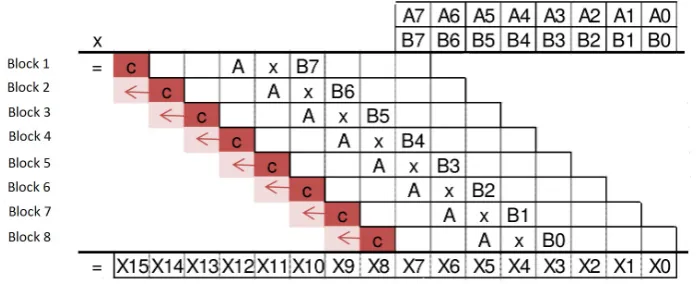
(MSW) ofA. LetX be the result of the multiplicationA×B before reduction; X can be represented by 16 words of 32-bits (X15X14...X0). The Alg. 1 shows how multiplication is performed in PolarSSL. The result A×Bi is stored in eight 32-bit words and there is a potential carry C, which needs to be stored
separately (see step 3). This potential overow creates a signicant pattern that can be distinguished from its high amplitude when C = 1; this pattern is the propagation of carry as depicted in Fig. 1. The leakage due to the propagation of
Fig. 1. Propagation of carry during multiplication in the eld
carry depends on the MSW of the input dataA7. For the BP curvemax{A7|A∈
multiplication, but we can not detect the last propagation. So, the probability to have two templates with the same propagation of carry, denoted byP(C), is:
P(C) = 6 X
i=0 6 i
p2i(1−p)2(6−i) (2)
where pis the probability to have an internal propagation of carry. For the BP
curve, the probability to have horizontal leakage is0.86using p= 0.17. For the NIST curve, the probability to have horizontal leakage is0.95usingp= 0.25.
However, it is more interesting from the OTA point of view to nd out when a dierence in the propagation of carry occurs between the target and template traces. This is the only part of PolarSSL that is non-constant time and we take advantage of this timing dierence, every time it occurs. In this case, there is an obvious horizontal leakage between the target and the template traces, as depicted in the Fig. 2.
Fig. 2. Squaring of two random data with dierent propagation of carry
3.3 Vertical leakage due to signal amplitude
In constant time executions of our implementation, there is no dierence in the propagation of carry and the template traces are synchronized with the target trace. In those cases, we observe only a vertical leakage due to the amplitude of the signal and the same method as described in [3] can be used. To observe this leakage, we use the pattern matching technique, with the Pearson correlation computation.
4 Detailed Phases of the Attack in Practice
4.1 Acquisition Setup
acquisition, we used a 54855 Inniium Agilent oscilloscope and a Langer EMV-TECHNIK RF-U5-2 near eld probe. The sampling frequency is 1GSa/s with 50MHz hardware input low-pass lter enabled. For the analysis, we used the Inspector SCA tool [28] and Matlab 2014b. The position of the probe was de-termined to maximize the signal related to the activity of the hardware32×32 multiplier.
For the curves dened in Sec. 2, one element in the nite eld is 256-bit long. Thus, each operation over the eld consists of manipulating eight processor words (8×32bits). In our implementation, a multiplication-before-reduction consists of eight multiplications between a 256-bit element by each 32-bit words of the second element. It leads to eight easily identiable patterns of eight blocks on EM traces. The length between two blocks can be dierent depending on the propagation of carry, as explained in Sec. 3.2.
4.2 Pre-proccessing Phase
The pre-processing phase starts with choosing an input point P and obtaining
the target trace from our target device; this is depicted in Fig. 3. In this trace,
Fig. 3. EM acquisition for scalar multiplication on NIST curve withk=0xA5A5
we need to spot the multiplication patterns, which are eight blocks of256×32 multiplications depicted in Fig. 4. The multiplication procedure is described in Sec. 3.2.
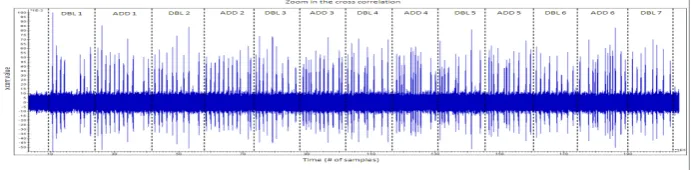
When we have a clear pattern for the multiplication, we cross correlate this pattern with our target trace and we obtain the cross-correlation pattern with one peak at the position of every multiplication. Fig. 5 shows the cross correla-tion of the target trace with the multiplicacorrela-tion pattern. By counting the peaks in
Fig. 5. Cross correlation between the pattern of the multiplication and the target trace
the cross-correlation trace, we can nd the part of the computation that we are interested in. For BP, as explained in [5], the doubling consists of 10 multiplica-tions (except for the rst doubling, where there are only 7 multiplicamultiplica-tions4), and the mixed addition consists of 11 multiplications. For NIST, there is a particular parameter equal to(−3 modp), so the multiplication byain the doubling can
be optimized. The doubling consists of 9 multiplications and the mixed addition of 11 multiplications5.
In this way, we can cut the target trace in sections according to the loop of the scalar multiplication operation (as in Fig. 6). The rst iteration of the
double-Fig. 6. The rst seven iterations of the scalar multiplication algorithm on the curve
and-add always algorithm is completed after 18 peaks of cross-correlation. For the next iterations, we take into account that each doubling consists of 9 or 10 multiplications and each addition of 11. For the rst bit, the interesting section on the target is the 19th multiplication. For the second bit, the interesting section
4 Because in the beginningZ= 1 and we computedaZ4 with 3 multiplications.
5 The fact that doubling is performed faster for NIST curves, allows us to recover 7
is the 39th multiplication for NIST curve or 40th multiplication for BP curve. For the third bit, the interesting section on the target is the 59th multiplication for NIST curve or 61th multiplication for BP curve, and so on for all the other bits of the scalar.
As the last step of this phase, we calculate multiples of the pointP using our
PolarSSL implementation. We explain this in detail in the next section.
4.3 Template acquisition
In PolarSSL every input point is represented in ane coordinates and then converted to Jacobian coordinates. The intermediate values are represented in Jacobian coordinates. The input points to the device are given in ane coordi-nates. To create templates, we need to nd an input point in ane corresponding to an intermediate value in Jacobian coordinates.
The target trace is obtained with input pointP = (xP, yP)given in ane coordinates. In order to compute the intermediate values of the points 2P = (X2P, Y2P, Z2P)and3P= (X3P, Y3P, Z3P)with PolarSSL, we use the formulas dened in [5]. Note that this does not correspond to the point2P and3Pin ane
coordinates, becauseZ2P, Z3P 6= 1. Therefore, we can not compare directly the templates with input point2P (resp.3P), since they are not in ane form.
We create our templates with a specic input point Qi such that the rst eld multiplication D1 in 2P or 3P is the same with the one attacked on the target trace. The squaring of the X-coordinate of the intermediate value is not aected by the change of coordinates system.
The way to construct the input point for templates is more sophisticated. Let us assume that we have the input point Q0 = (xQ0, yQ0)in ane coordinates associated to the point value2P andQ1= (xQ1, yQ1)corresponding to3P. We need to analyze the squaring of X-coordinate in Jacobian coordinates. The input pointQ0= (xQ0, yQ0)should be a solution inFp×Fp of the following system:
(
xQ0 =X2P
y2Q
0 =x 3
Q0+axQ0+b
(3)
witha, bthe parameters of the curve as dened in [7, 26].
The numberX used as input in the squaring is random, soX3+aX+b is also random. Ifx3
Q0+axQ0+bis not a square in the nite eld, we can change one bit in X as proposed in [3] we get another point on the curve that satises
Eq.(3).
We locate the rst multiplication in the template trace corresponding to the squaring of the X-coordinate of the input point Q0 or Q1, depicted in Figs. 8, 9 respectively. With these two patterns and the target trace (Fig. 7), we can perform template matching.
4.4 Template Matching
Fig. 7. Pattern of the 19th
multiplication in trace with inputP
Fig. 8. Pattern of the 1st
multiplication in trace with inputQ0
Fig. 9. Pattern of the 1st
multiplication in trace with inputQ1
horizontal and vertical leakage. The probability of having a horizontal leakage corresponds to the probability of having dierent propagation of carry between the two templates.
Horizontal leakage When the traces are not synchronized (86% of cases in BP curve, and 95% in NIST curve), cross correlation between the multiplication pattern and the target trace is performed before template matching, in order to choose the correct part of the target trace. Then we align the template and target traces and decide what is the correct key-bit guess.
Horizontal leakage is observed when there is dierent propagation of carry between two multiplications256×32in the eld. In Fig. 10 we see the misalign-ment of the traces due to propagation of carry.
Fig. 10. Misalignment of two template traces due to propagation of carry
Fig. 11. Two templates with the same propagation of carry
as described in Sec. A.3 and we get a correlation of0,81 for the multiplication obtained from the target trace and the template trace of 2P. The same value
drops to0,78 for the correlation of the target trace with the template trace of 3P.
4.5 Success Rate for one key-bit
In this part, we describe the method used to calculate and increase the success rate of our attack. As explained in Sec. 3.2 for the NIST curve the probability to have a dierent propagation of carry between the two templates is95% and for BP86%. The horizontal attack scenario is easy, since if two templates have dierent propagation of carry, then the success rate of nding this bit is 100%.
For the vertical attack scenario, the success rate depends on the input data. So, we keep only the input data, when the propagation of carry is the same for the two template traces. We perform the computation of the success rate, using random points on each curve for the target trace. We acquire 30 target traces to attack, and for the template trace, we acquire 1000 traces for each assumption when the propagation of carry is the same. We compute the two Pearson cor-relations between one target trace and one template by each assumption. Each bit ki is the notation for the correct key-bit of k. If the highest Pearson corre-lation gives the assumptionki, then the counter corresponding to the success of the attack increases, otherwise, the counter corresponding to the failure of the attack increases. The success rate to retrieve one key-bit in vertical leakage for the NIST curve is76,23%and for the BP curve is69%. To conclude, the success rate to nd one bit is1×0,95 + 0,76×0,05 = 98,8%for the NIST curve, and 1×0,86 + 0,69×0,14 = 95,66%for the BP curve.
To increase the vertical information leakage the average of traces can be used. When the scalar is randomized, we can not perform the attack with more than one target traces. But we can still acquire more than one template traces. So, by using only one target trace with an average of a few template traces, the success rate increases as shown the Tab. 1 on the BP curve. To conclude, the success rate for BP curve is1×0,86 + 0,99×0,14 = 99,86%
4.6 Error-correcting bit from the template traces
Number of average traces 1 10 50 100 Success Rate 69% 80,70% 91,60% 99,80%
Table 1. Dierent success rates according to the number of average template traces on BP curve.
using OTA is close to99%, which means that there is a1%probability of having an unsuccessful attack due to a wrong key-guess. For a 256-bit scalar, if an error is not detected, the success rate for the original OTA is7,6%(0.99255'0.076), since this error will propagate and aect all the bits after the wrong guess. Therefore, it is very important to detect and correct errors before making new templates. An error can be made when both template traces have the same propagation of carry. If we want to be sure of the key-bit value, then we can automatically compute the value of this bit and the following one. For instance, if the two templates for2P and3P have the same propagation of carry, then we
create templates for4P,5P,6P and7P. We have the following four cases:
1. Let us assume that only one template has the same propagation as the target, so we can conclude for both key-bits. For example, if the template of7Pgives
the highest correlation, then the second key-bit is 1, and the third bit is 1. 2. Let us assume that two templates have the same propagation as the target, so
we compute 4 templates, and start looking the next bit with the 4 template traces.
3. Let us assume that three templates have the same propagation as the target, so we compute 6 templates, and start looking the next bit with the 6 template traces.
4. Let us assume that four templates have the same propagation as the target, so we compute the 8 templates, and start looking the next bit with the 8 template traces.
For BP curve, the probability to have one template trace with the same propagation of carry with the target trace is, 70%, two template traces is 14%, 3 template traces is 3,9% , 4 template traces is 1,2%, 5 template traces is 0,4%, 6 template traces is 0,1%, the probability for more template trace with the same propagation of carry is very low. For NIST curve, the probability to have one template trace with the same propagation of carry with the target trace is, 90%, two template traces is 5,9%, 3 template traces is 0,7%, 4 template traces is 0,1%, 5 template traces is 0,01%. For both curves, this probability reduces signicantly for more template traces. To conclude the number of template traces cannot increase exponentially. At the end of the attack, in order to retrieve the 256-bit scalar, we can have an uncertainty for the 2 or 3 last bits; we nd the 22 or 23 scalar key by comparing with the output Q= [k]P and in this way we can nd
5 Countermeasure
At this point, it is clear that both OTA and our adaptive template attack are very ecient methods to attack scalar the double-and-add always algorithm during the execution of ECC protocols. These methods can be easily adapted to other scalar multiplication algorithms as described in [17, 29]. For the binary algorithm Montgomery Ladder [18], we can compare the doubling operation and nd the correct key bit. For the non-binary algorithm using windows, we can obtain templates for all hypotheses and make the same attack with more template traces. Since the most commonly used scalar multiplication algorithms are vulnerable to our attack, it is interesting to see which countermeasure can be applied against it. We hereby give a list of the possible countermeasures and their eciency against our attack:
Randomization of the scalar.
The dierent ways of scalar randomization are :
1. [k]P = [k−r]P + [r]P, two scalar multiplications are computed Q = [k−r]P andR= [r]P;
2. [k]P= [k×r−1]([r]P), two scalar multiplications are computedQ= [r]P
andR= [k×r−1]Q;
3. [k]P = [k modr]P+ [bk
rc]([r]P), three scalar multiplications are com-putedQ= [k modr]P,R= [r]P andS= [bk
rc]R.
For all these randomization techniques, our attack can be applied; the target trace requires one acquisition on the second or third scalar multiplication. This acquisition is possible using an oscilloscope with big memory depth. For the template traces, we make assumptions for each part of the scalar mul-tiplication. We retrieve a random scalar part for each scalar multiplication part. And to retrieve the scalar, we compute the addition (randomization 1.) or the multiplication (randomization 2.) of the scalar or the both addition and multiplication (randomization 3.). So, using the scalar randomization is no ecient against this kind of attack.
Randomization of the point.
The Jacobian representation of the point can be easily randomized as the projective coordinate. For the Jacobian coordinate, the randomization con-sists in selecting a randomrin the nite eldFp, and compute:(X, Y, Z)7→ (r2×X, r3×Y, r×Z). In most cases, the input point is in ane coordi-nates, so the randomization of the point is reduced to compute: (x, y) 7→
Random eld isomorphism.
This countermeasure prevents our attack, in the same way as described in [3]. Random eld isomorphisms can be performed by changing the prime of the nite eld that our computations take place. If we use random primes to generate our curves, our attack will not work.
6 Conclusion
In this paper we presented a practical extension of OTA on Brainpool Br256r1 and NIST Sec256r1 curves implemented on an ARM Cortex M4 micro-controller. A modied version of OTA is applied with the Pearson correlation coecient as distinguisher for the correct hypothesis on the key-bit. Error detection and correction of a wrong key-bit guess is possible for our modied version of the attack, mainly due to the fact that we expect to have99.8% success rate with averaging 100 template traces.
Most of the countermeasures applicable to the original OTA attack should also work against our attack. Blinding the coordinates for every execution of the attacked algorithm is the most ecient countermeasure against OTA, though in-curring with some cost for the performance of the implementation. Point blinding is also ecient against our attack, since we need to know the input point and to actually be able to choose input points for our templates. To use PolarSSL in ARM embedding device, the countermeasure of point blinding must be activated.
References
1. ANSI-X9.62. Public Key Cryptography for the Financial Services Industry: The Elliptic Curve Digital Signature Algorithm (ECDSA), 1998.
2. ANSI-X9.63. Public Key Cryptography for The Financial Services Industry: Key Agreement and Key Transport Using Elliptic Curve Cryptography, 1998.
3. Lejla Batina, Lukasz Chmielewski, Louiza Papachristodoulou, Peter Schwabe, and Michael Tunstall. Online template attacks. In Progress in Cryptology - IN-DOCRYPT 2014 - 15th International Conference on Cryptology in India, New Delhi, India, December 14-17, 2014, Proceedings, pages 2136, 2014.
4. A. Bauer, E. Jaulmes, E. Prou, and J. Wild. Horizontal collision correlation attack on elliptic curves. In T. Lange, K. Lauter, and P. Lisonek, editors, Selected Areas in Cryptography, volume 8282 of LNCS, pages 553570. Springer, 2014. 5. Daniel J. Bernstein and Tanja Lange. Explicit formulas database.
http://www.hyperelliptic.org/EFD/.
6. Eric Brier, Christophe Clavier, and Francis Olivier. Correlation power analysis with a leakage model. In Marc Joye and Jean-Jacques Quisquater, editors, CHES, volume 3156 of Lecture Notes in Computer Science, pages 1629. Springer, 2004. 7. BSI. RFC 5639 - Elliptic Curve Cryptography (ECC) Brainpool Standard Curves
and Curve Generation. Technical report, Bundesamt für Sicherheit in der Infor-mationstechnik (BSI), 2010.
9. C. Clavier, B. Feix, G. Gagnerot, C. Giraud, M. Roussellet, and V. Verneuil. ROSETTA for single trace analysis. In Steven Galbraith and Mridul Nandi, ed-itors, Progress in Cryptology INDOCRYPT 2012, volume 7668 of LNCS, pages 140155. Springer, 2012.
10. C. Clavier, B. Feix, G. Gagnerot, M. Roussellet, and V. Verneuil. Horizontal correlation analysis on exponentiation. In Miguel Soriano, Sihan Qing, and Javier Lopez, editors, Information and Communications Security, volume 6476 of LNCS, pages 4661. Springer, 2010.
11. Henri Cohen, Atsuko Miyaji, and Takatoshi Ono. Ecient elliptic curve exponen-tiation using mixed coordinates. In Kazuo Ohta and Dingyi Pei, editors, Advances in Cryptology - ASIACRYPT '98, International Conference on the Theory and Applications of Cryptology and Information Security, Beijing, China, October 18-22, 1998, Proceedings, volume 1514 of Lecture Notes in Computer Science, pages 5165. Springer, 1998.
12. Jean-Sébastien Coron. Resistance against dierential power analysis for elliptic curve cryptosystems. In Çetin Kaya Koç and Christof Paar, editors, Crypto-graphic Hardware and Embedded Systems, First International Workshop, CHES'99, Worcester, MA, USA, August 12-13, 1999, Proceedings, volume 1717 of Lecture Notes in Computer Science, pages 292302. Springer, 1999.
13. Pierre-Alain Fouque and Frédéric Valette. The doubling attack Why upwards is better than downwards. In Colin D. Walter, Çetin K. Koç, and C. Paar, editors, Cryptographic Hardware and Embedded Systems CHES 2003, volume 2779 of LNCS, pages 269280. Springer, 2003.
14. N. Homma, A. Miyamoto, T. Aoki, A. Satoh, and A. Shamir. Collision-based power analysis of modular exponentiation using chosen-message pairs. In E. Oswald and Pankaj Rohatgi, editors, Cryptographic Hardware and Embedded Systems CHES 2008, volume 5154 of LNCS, pages 1529. Springer, 2008.
15. Michael Hutter and Peter Schwabe. NaCl on 8-bit AVR microcontrollers. In Amr Youssef and Abderrahmane Nitaj, editors, Progress in Cryptology AFRICACRYPT 2013, volume 7918 of LNCS, pages 156172. Springer, 2013. 16. N. Smart I. Blake, G. Seroussi. Advances in Elliptic Curve Cryptography, volume
317. Cambridge University Press, 1999.
17. Marc Joye. Elliptic curve cryptosystems and Side Channel Analysis, volume 4, pages 1721. ST J. Syst. Res., 2003.
18. Marc Joye and Sung-Ming Yen. The montgomery powering ladder. In Burton S. Kaliski Jr., Çetin Kaya Koç, and Christof Paar, editors, Cryptographic Hardware and Embedded Systems - CHES 2002, 4th International Workshop, Redwood Shores, CA, USA, August 13-15, 2002, Revised Papers, volume 2523 of Lecture Notes in Computer Science, pages 291302. Springer, 2002.
19. Neal Koblitz. Elliptic curve cryptosystems, volume 48, pages 203209. Mathematics of Computation, 1987.
20. Paul C. Kocher, Joshua Jae, and Benjamin Jun. Dierential power analysis. In Michael J. Wiener, editor, CRYPTO, volume 1666 of Lecture Notes in Computer Science, pages 388397. Springer, 1999.
21. ARM mbed. Polarssl version 1.3.7. https://tls.mbed.org/.
22. Alfred Menezes, Paul C. van Oorschot, and Scott A. Vanstone. Handbook of Applied Cryptography. CRC Press, 1996.
23. ST Microelectronics. RM0090 Reference Manual. DocID018909 Rev 8, 2014. 24. Victor S. Miller. Use of elliptic curves in cryptography. In Hugh C. Williams, editor,
18-22, 1985, Proceedings, volume 218 of Lecture Notes in Computer Science, pages 417426. Springer, 1985.
25. Elke De Mulder, Pieter Buysschaert, Sddka Berna Örs, Peter Delmotte, Bart Preneel, Guy Vandenbosch, and Ingrid Verbauwhede. Electromagnetic Analy-sis Attack on an FPGA Implementation of an Elliptic Curve Cryptosystem. In IEEE International Conference on Computer as a tool, pages 18791882, Novem-ber 2005. Belgrade, Serbia & Montenegro. DOI: 10.1109/EURCON.2005.1630348, http://www.sps.ele.tue.nl/members/m.j.bastiaans/spc/demulder.pdf.
26. NIST. FIPS publication 186-4 - Digital Signature standard (DSS). Technical report, National Institute of Standards and Technology (NIST), July 2013. 27. Christian Rechberger and Maria Elisabeth Oswald. Practical template attacks. In
Chae Hoon Lim and Moti Yung, editors, Information Security Applications, volume 3325 of Lecture Notes in Computer Science, pages 440 456. Springer, 2004. 28. https://www.riscure.com/security-tools/inspector-sca/ Riscure Inspector. 29. Matthieu Rivain. Fast and regular algorithms for scalar multiplication over elliptic
curves. IACR Cryptology ePrint Archive, 2011:338, 2011.
A Description for Online Template Attack
A.1 Attack model for OTA
Online Template Attacks (OTA), introduced in [3], is an adaptive template at-tack technique, which can be used to recover the secret scalar in a scalar multi-plication algorithm. The main assumption in the OTA attacker model is in his ability to choose an input point to the scalar multiplication algorithm, in order to generate template traces. As it is demonstrated in the original paper, OTA works with one target trace from the device under attack and one template trace per key-bit obtained from the attacker's device that runs the same implementa-tion. Performing OTA in practice requires the following assumptions to be made regarding the attacker:
The attacker knows the inputP of the target device.
He knows the implementation of the scalar multiplication algorithm and he is able to compute the intermediate values.
He can choose the input points on a device similar to the target device. Furthermore, we work with the following assumptions related to the device:
The scalar can be randomized.
The intermediate values are deterministic. The OTA is then performed as follows:
1. The attacker rst obtains a target trace with input point P from the target
device.
2. He obtains template traces with input points [m]P, m∈Zfor multiples of
the pointP, e.g.2P or3P.
The OTA technique is originally described for binary algorithms, but it can be easily adapted to the windows method by creating one template for a hypothesis made for each window.
The attacker model for OTA is more suitable for the Die-Hellman key-exchange protocol, because the input point can be selected. Nevertheless, this attack can be applied against the ECDSA algorithm, if the input point of the target device is known.
A.2 Constructing template traces for OTA
At this point, it is important to explain precisely how the interesting points to generate the template traces are chosen. With the term interesting points we mean the multiples of the pointP that are expected to be the outputs of every
iteration of the scalar multiplication algorithm, i.e.2P and3P for the rst bit
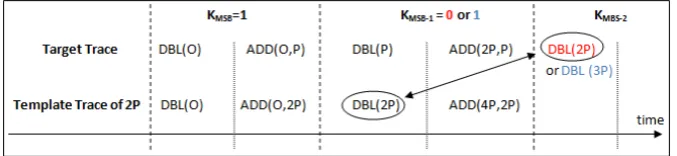
of the scalar. This is demonstrated with a graphical example depicted in Fig. 12. Let us assume that the initial input point to the double-and-add-always al-gorithm isP and the most signicant bit (KM SB) of our secret scalar is1. Then, the output of the second iteration (operations forKM SB−1) is either2P or 3P. For example, ifKM SB−1= 0, then the output of the second iteration is2P and consequently the template trace for 2P gives higher correlation to the target
trace than the template for3P. We compute the correlations between the
tem-plate traces2P,3P, and the target trace, in order to nd the most likely key-bit.
The highest correlation value is considered to be the right key guess.
We continue the same procedure of calculating the two possible outcomes for bit KM SB−2, which are the template traces for4P or 5P, and then nding the highest correlation between the templates and the target trace. Fig. 13 shows how the templates for the third bit KM SB−2 can be generated. In general, for
Fig. 12. How to nd the second MSBKM SB−1 in the target trace with the template
trace of2P
each iteration of the scalar multiplication algorithm, we compare theith iteration
Fig. 13. How to nd the third MSBKM SB−2 in the target trace with the template
trace of4P
A.3 Template Matching Phase
Template matching is performed at suitable parts of the traces, where key-bit related assignments take place. Our pattern matching technique, in order to distinguish the right hypothesis on the attacked bit of the scalar, is based on the Pearson correlation coecient ρ(X, Y) between the target trace and the template traces.
ρ(X, Y) = P
i(Xi−X¯)(Yi−Y¯) pP(X
i−X¯)2pP(Yi−Y¯)2
= hX− ¯
X, Y −Y¯i
||X−X¯|| ||Y −Y¯|| (4)
We chose this metric, since it is both scale and oset-shift invariant.
B Probability of the propagation of carry
Computing the probability of having an inner carry is the same as computing the probability of (X×Y +R×232) ≥264 with X a random value between [0,max{A7|A ∈ Fp}], with Y a random value between[0,max{Bi|B ∈ Fp, i ∈
{0,· · ·,7}}] and with R a random value between [0,max{Xi|X ∈ F(p−1)2, i ∈
{7,· · ·,15}}]. For all curves,max{Bi|B ∈Fp, i∈ {0,· · ·,7}}andmax{Xi|X ∈
F(p−1)2, i ∈ {7,· · · ,14}} equal 232−1. The value max{A7|A ∈ Fp} depends on the MSW of the characteristic of the nite eld. The probability can be computed as follows:
P(X×Y +R×232)≥264) = 1
4
max{A7|A∈Fp}2
We hereby give a the complete computation of the probability of an inner-carry propagation (Eq. 5)
P(XY + 232R≥264) =
A7−1
X
x=0 232−1
X
y=0 232−1
X
r=0
P(XY + 232R≥264|X =x, Y =y, R=r)P(X =x)P(Y =y)P(R=r) =
A7−1
X
x=0 232−1
X
y=0 232−1
X
r=0
P(xy+ 232r≥264) 1
A7
1 232
1 232 =
1
A7
1 (232)2
A7−1
X
x=0 232−1
X
y=0 232−1
X
r=0
1xy+232r≥264 ,where1is the indicator, i.e.,1z =
(
0 ifzis false,
1 otherwise
which can be approximated by:
1
A7
1 (232)2
Z A7−1 x=0
Z 232−1
y=0
Z 232−1
r=0
δxy+232r≥264drdydx
' 1
A7
1 (232)2
Z A7 x=0
Z 232
y=0
Z 232
r=0
δxy+232r≥264drdydx
=2
32
A7
Za7 x=0
Z1
y=0
Z 1
r=0
δxy+r≥1drdydx
withx←x/232,y←y/232,r←r/232 anda
7=A7/232.
It holds,δxy+r≥1=δr≥1−xy. Besides,1−xy∈[1−a7,1]⊂[0,1]. Indeed,
0≤x≤a7,0≤y≤1 =⇒ 0≤xy≤a7, hence1−a7≤1−xy≤1 . Therefore,
232
A7
Z a7 x=0
Z 1
y=0
Z1
r=0
δxy+r≥1drdydx =
232
A7
Z a7 x=0
Z 1
y=0
Z 1
r=1−xy
drdydx=
232
A7
Z a7 x=0
Z 1
y=0
xydydx =2
32
A7
Z a7 x=0
xdx×
Z 1
y=0
ydy=
232 A7 x2 2 a7 0 × y2 2 1 0 =2 32 A7 a2 7 2 × 1 2 = 232 A7 1 4a 2 7= 1 4 A7
232 .