Learning from Reciprocal Peer Observation: A Collaborative Self-study
Kimberley Pressick-Kilborn and Kitty te Riele University of Technology, Sydney
Learning from Reciprocal Peer Observation: A Collaborative Self-study
Kimberley Pressick-Kilborn and Kitty te Riele University of Technology, Sydney
Studying one’s teacher education practices is a multi-faceted activity. Critical reflection by educators is advocated as involving not only autobiography and theory, but also our students and our colleagues. Learning from and with colleagues can take many forms. This article discusses the authors’ experience with reciprocal classroom observation in Teacher Education. Peer observation supported our learning about our own teaching, providing suggestions for change as well as reassurance. In this article, we make connections between learning from each other, and from ourselves, our students and theory. Specifically, we address what we learnt about pedagogy, in relation to missed opportunities, teacher-directedness and articulating purpose; about curriculum, in relation to balance and standards; about our students, in relation to their backgrounds as well as ‘social tensions’; and about ourselves as teachers and learners, in relation to rapport, role modeling and collegiality. We demonstrate how peer observation can be a valuable component of ongoing professional development for tertiary teachers.
At first sight collaboration and self-study may seem contradictory, perhaps even
incompatible. The approach of self-study evokes images of introspection by the lone teacher, involved in “monologic research” (Guilfoyle, Hamilton, Pinnegar & Placier, 2004, p. 1140) about her or his own personal and professional practice and identity. Self-study thus seems a
solitary rather than a collaborative pursuit. In contrast, Bodone, Guδjónsdóttir and Dalmau
and self-study research,” a claim which we found was supported by our practice of collaborative self-study as reported in this article.
The benefits, and even necessity, of constructive and collaborative dialogue with colleagues for improving one’s teaching practices are recognized by scholars in the fields of self-study and of higher education research. Such collaboration can counter critiques of limited validity or even self-justification in self-study projects (Loughran & Northfield, 1998). Critical reflection on our work as teachers benefits from gaining information from a variety of sources, including autobiography, theoretical literature, our students and our colleagues (Brookfield, 1995). Recognizing that academics are used to a high level of autonomy in their teaching, Brookfield (1995) argues that,
Talking to colleagues about what we do unravels the shroud of silence in which our practice is wrapped. Participating in critical conversations with peers opens us up to their versions of events we have experienced. Our colleagues serve as critical mirrors reflecting back to us images of our actions that often take us by surprise. (p. 30)
Such collegial conversations can take many forms, from informal chats over coffee, to more formal opportunities for gaining and giving feedback. For example, Ramsden and Dodds (1989) suggest debriefing with a colleague after a class or course in order to gain their advice. Guidelines for giving such advice have focused on the manner of providing feedback, the environment and the relationship between feedback provider and recipient (Boud, 1995; Brinko, 1993; Martin & Double, 1998; Ramsden & Dodds, 1989). In considering the notion of productive reflection, Boud, Cressey and Docherty (2006) assert that collective reflection is important in the process of making sense of one’s work.
We must observe each other teach, at least occasionally—and we must spend more time talking to each other about teaching” (p. 143). This combination of collegiality and critical reflection can be a mutually supportive extension of self-study practices in teacher education (Bodone et al, 2004). Peer observation is a powerful way of focusing attention on the
teaching process (Martin & Double, 1998) and enhancing the quality of teaching and learning (Fullerton, 1993). Brookfield (1995) recognizes that the lens of collegial feedback more often involves discussion than direct observation. He advises that, “For those of us with egos strong enough to stand it, colleagues’ observations of our practice can be one of the most helpful sources of critical insight to which we have access” (Brookfield, 1995, p. 83).
The encouragement to engage in this practice is thus somewhat tentative and, perhaps not surprisingly, Brookfield recommends that if teachers are to engage in peer observation, this “must be reciprocal” (1995, p. 85; see also Ramsden & Dodds, 1989). This reciprocity goes some way to allaying the concern, noted by Cosh (1998), of confusion over whether the purpose of peer observation of teaching is professional development or
accountability. Reciprocity also acknowledges that “seeing you allows me to see myself differently and to explore the variables we both use” (Faneslow, 1990 in Cosh, 1998, p. 173). Rawnsley (1993) points out that when participants have greater ownership of the observation process, it is more likely that the observation will meet its aims. In particular, the equal role played by the observed peer is a crucial difference between observation for professional development and observation for the purpose of evaluation or appraisal.
Our Collaborative Endeavour
This article reports on our experiences of engaging in mutual, collaborative peer observation over a two year period (2004-2005). We each took up positions as lecturers in the Faculty of Education at the University of Technology, Sydney in 2004, both with previous experience teaching in higher education but in our first appointments as full-time, tenure-track
from a suggestion by our joint supervisor that this was a useful practice. While our supervisor expressed his willingness to conduct these peer observations with each of us, our intuition was that this practice would be more beneficial between peers of equal status, as confirmed by Brown and Colling (1993) and Brinko (1993). The ability to choose who to work with benefits peer observation by avoiding the dangers of “contrived collegiality” in teacher collaboration (Hargreaves, 1991). Without any guarantees as to how our collaboration would work out, we agreed to enter into a collegial peer observation experience to help us reflect on and improve our teaching. We drew on the concept of critical friendship for highlighting genuine peer collaboration and feedback (Arthur & Kallick, 1993; Schuck & Russell, 2005), as we assumed that it is within such a friendship that peer observation of one another’s teaching can be most effective.
Reflective action, according to Dewey (1933), is a special form of problem-solving requiring careful consideration of practice and open-mindedness. This means being open to, and using, information from any source that may be helpful for this problem-solving. In relation to the improvement of teaching in higher education, Brookfield (1995), Ramsden and Dodds (1989), Rawnsley (1993) and Wilkerson (1988) all emphasize the need for teachers to use a range of information from several different sources, in order to gain a richer
understanding of their own teaching and ways to improve it. Triangulation of data from various sources is as valuable in reflective practice as it is in social research. Thus, we argue along with others (Schuck & Russell, 2005) that peer observation is a valuable inclusion in the practices of researchers engaged in self-study in Teacher Education.
Approach
Our collaborative peer observation activities primarily were aimed at supporting improvement in our teaching, in order to support and improve our students’ learning. We sought to
Shulman (2000, p.11) argues, “Research that renders one’s own practice as the problem for investigation is at the heart of what we mean by professing or profession.” Our project thus contributes to the professionalism of our own work and of Teacher Education generally.
A secondary purpose was to model a critical, collegial friendship for our students, to practically highlight our serious concern for developing our own teaching and to demonstrate an approach to ongoing professional learning that could be used in their own practice. We thus were embarking on a process of interrogating teaching and learning—both our own and our students’—in our respective tertiary classrooms.
The methodology for our collaboration is derived from both self-study and peer observation traditions. Although there is no single blue print for self-study research,
LaBoskey (2004) helpfully suggests five common components of self-study research design. First, the questions of who is doing the research and who is being studied lead to a major distinguishing feature of self-study research, since the self is included in the answer to both. LaBoskey (2004, p. 842) refers to this as being “self-initiated and focused.” Although the initial impetus for our study came from a suggestion from our supervisor, we agree that the way we set up our study was initiated by ourselves, and focused on our own teaching.
Second, self-study research is aimed at improving and enhancing our understanding of our practice through carefully and thoroughly understanding our settings (LaBoskey, 2004). As stated above, our own project was primarily aimed at supporting improvement in our teaching. We were gaining new insights into our settings through the peer observation process and critical conversations about our practice.
in same institutional context. In the typology proposed by Bodone, et al (2004, p. 750) our project formed a collaborative self-study with the collaboration designed as a critical element of our approach from the start. We started with reciprocal peer observation and reflective practice as the foundation for this self-study project.
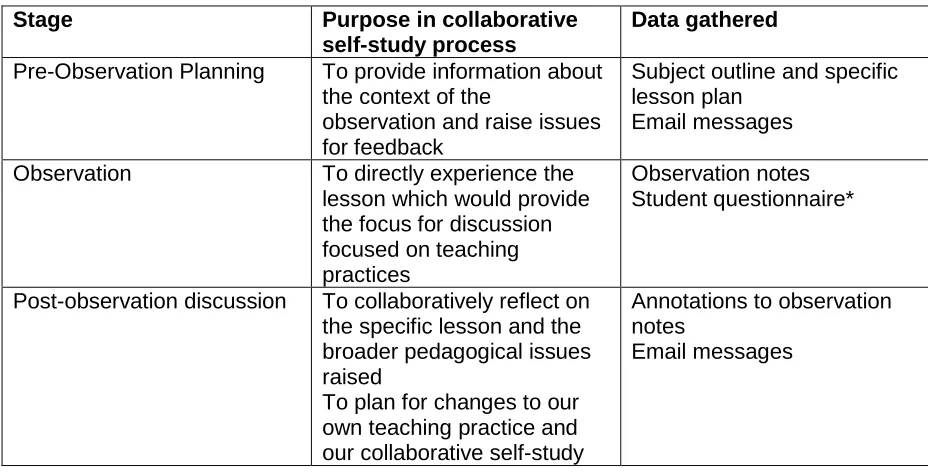
Fourth, self-study research uses multiple, primarily qualitative methods to generate data (LaBoskey, 2004). In our study, we used observation, collaborative journaling through email, and an open questionnaire as methods for generating data (see Table 1).
Finally, in self-study research validity is redefined “as trustworthiness, meaning that the field is advanced by the construction, testing, sharing and re-testing of exemplars of teaching practice” (LaBoskey, 2004, p. 851). Through sharing our experiences with
colleagues through seminars, papers and articles such as this one, we also aim to contribute to more general understandings of teacher education as well as to inform our own on-going collaborative self-study project.
Data Collection and Analysis
Drawing on the peer observation tradition, our methodology used a three-stage process involving pre-observation planning, the observation itself and post-observation discussion (see Table 1). This is a process that is widely recommended in discussions of peer
Stage Purpose in collaborative self-study process
Data gathered
Pre-Observation Planning To provide information about the context of the
observation and raise issues for feedback
Subject outline and specific lesson plan
Email messages
Observation To directly experience the lesson which would provide the focus for discussion focused on teaching practices
Observation notes Student questionnaire*
Post-observation discussion To collaboratively reflect on the specific lesson and the broader pedagogical issues raised
To plan for changes to our own teaching practice and our collaborative self-study
Annotations to observation notes
Email messages
TABLE 1. Methodology for peer observation process for each lesson observed * The student questionnaire was distributed in two classes at the end of semester 2 2004 only and asked students for feedback about the practice of reciprocal peer observation rather than the effectiveness of the lecturer’s teaching practices.
Observations were of one lesson at a time, in all cases within a seminar situation of 25 to 40 students, and took place once a semester for each of us. At the start of each lesson, we introduced the observer to the students and explained that this was part of our own on-going professional development. Since the purpose was developmental rather than for appraisal, we both taught “normal” rather than “model” lessons. Unlike suggestions by Jones (1993), we did not use formal checklists, but noted our observations in relation to issues raised and anything else that we found of interest. This is consistent with the emphasis on qualitative methods in self-study research (LaBoskey, 2004).
All lessons observed were subjects in Teacher Education programs. One lesson was observed in a one-year Graduate Diploma program for pre-service secondary school
teachers, and the remaining five lessons observed were in subjects in a four-year Bachelor of Primary Education program. The subjects were all compulsory, and included Philosophy of Education, Science and Technology Education, a third year Professional Experience subject focused on student assessment and reporting, and a first year Professional Experience subject designed to introduce students to a range of issues relating to teaching and learning in contemporary Australian schools. Observations took place during semesters 1 and 2 in 2004, and during semester 1 in 2005.
While we purposely left the role of the observer fairly open, we were surprised by the degree of participation in the activities of the workshop. It was never a team-teaching
situation however neither were we able to sit in the corner, detached from the teaching and learning processes. On occasions, the teacher invited the observer to comment during class discussion, while at other times, the students in small groups included the observer in their conversations as a co-learner. Since self-study is inherently interactive and embraces subjectivity, this was not problematic but rather a natural component of understanding, constructing and transforming our teacher knowledge in collaboration with others (LaBoskey, 2004).
Our data include our observation notes and our email messages, which formed a kind of collaborative journal and documented the discussion that contributed to the collaborative self-study process. Our reflections and analytical comments shared in this article draw on the observation and discussion notes and emails that we wrote at the time of the peer
observations.
party to our self-study practice. We asked for input from students at the end of semester 2, 2004, after we had experienced 4 observation cycles. We asked the students in the two subjects involved during that semester to voluntarily and anonymously complete a
questionnaire with open questions about their perceptions of our peer observation process, including their views on the possible contributions peer observation can make to teaching and learning, both theirs and ours. Findings from students that we present in this article draw on their responses to this questionnaire. We use the following coding for questionnaire responses that we share: P for Bachelor of Primary Education, S for Graduate Diploma in Secondary Education; Phil for Philosophy, Prof for Professional Experience; a number for the student’s questionnaire. For example, P-Prof-1 refers to student questionnaire numbered 1 from the Professional Experience subject in the Bachelor of Primary Education.
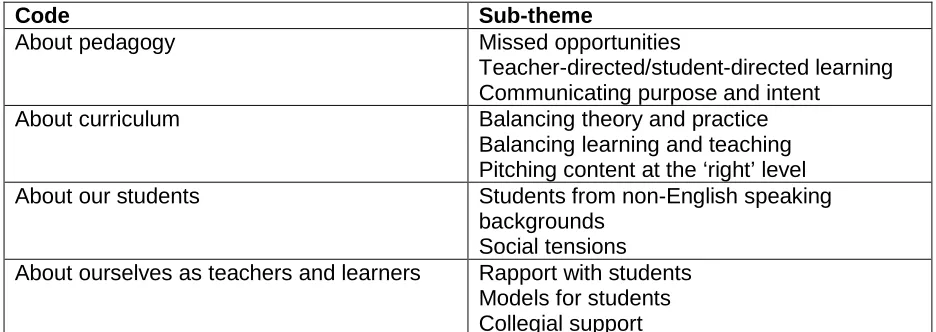
We approached the analysis of the data by coding the content of text in relation to four areas which were the focus of our collaborative self-study: (1) about pedagogy, (2) about curriculum, (3) about our students and (4) about ourselves as teachers and learners. Sub-themes emerged within each of these areas (Table 2) and were critically reviewed for what they revealed about our learning through the peer observation process. We share our findings in the remainder of this article.
Code Sub-theme
About pedagogy Missed opportunities
Teacher-directed/student-directed learning Communicating purpose and intent
About curriculum Balancing theory and practice Balancing learning and teaching Pitching content at the ‘right’ level About our students Students from non-English speaking
backgrounds Social tensions About ourselves as teachers and learners Rapport with students
What did we Learn about Pedagogy?
Not surprisingly, a key focus for our observations was the process of classroom practice. Although, in hindsight, we had little knowledge of each other’s pedagogical practices at the outset of the observation process, we did not experience the problems of getting caught up with mere style differences, pointed out by Ramsden and Dodds (1989) or a breakdown in communication due to clashing approaches, as Trowler and Cooper (2002) warn. This may be partly due to the pre-observation process we used and also simply because we get on with each other. We accepted as a ground rule “not [to] presume to know what is right for the other” (Palmer, 1998, p. 151) but to support each other in finding our own answers. As a result, we often recorded questions in our observation notes, with the aim of stimulating thought and discussion around a broader issue related to a specific event or aspect within the lesson.
Our insights related to pedagogy are detailed below. While not dramatic, we believe they are useful for our professional development as teacher educators and unlikely to have been gained so clearly without the experience of peer observation.
Missed Opportunities
I have found myself reflecting on my observation of your lesson in relation to my own teaching also. It made me wonder whether I encourage reporting back to the whole group enough and I’ve thought more about how I develop and relate students’ responses in providing feedback also (email correspondence, 5 April 04).
This then became a point of observation for Kitty when she observed Kimberley’s class later in that same week.
You were taking up the ideas from the students and running with them, which was positive and also added relevant information or reformulated their ideas more clearly. But sometimes you took over more – again an issue of time maybe? If you had more time, you could wait to see if the ideas you want to cover come from the students themselves? (observation notes, 8 April 04).
Kitty’s comments here provided reassurance for Kimberley yet also gave her suggestions for further developing this aspect of her teaching practice. Interestingly, in the following
semester, Kimberley’s attention continued to be drawn to this aspect of her teaching during the shared lesson. In an email sent to Kitty following the observation session, Kimberley reflected,
The report samples again generated a great deal of discussion in today’s workshop, with a particularly provocative statement made by one student in relation to not reporting comparatively. This really engaged a wide range of students in a whole class discussion (email correspondence, 31 August 04).
Structuring workshop activities to focus students’ learning was a pedagogical issue raised by Kitty following an observation of Kimberley’s 3 hour Science and Technology class. The opportunity to immediately engage students in the main content of the workshop was missed when the lesson introduction became bogged down in discussion about an upcoming assessment task. Kimberley followed the students’ lead, seeking to reduce their assessment-related anxiety, and allowed extended discussion about the task. This led to a missed
opportunity to capture and develop the students’ interest from the outset, so that when the main body of the workshop got underway, Kimberley had to refocus the students, who by this time were somewhat more flat than when they had come into the room. In the
post-observation discussion, we raised the possibility of initially flagging that conversation about the assessment task would occur at the end of the workshop. This would enable the class to move straight into the planned workshop activities while students’ energy levels were high and attention could be more easily focused on the key lesson concepts, thus enhancing their learning in relation to the workshop outcomes. It also raised a broader issue for us as
teachers, however, in considering the time point in a workshop when we should plan what we anticipate to be the most engaging learning task. A subsequent incidental conversation with another colleague focused on whether highly engaging tasks are best placed at the end of a class, to contribute to maintaining students’ motivation for and attention to their learning. We have reflected that in planning a workshop or seminar, we need to consider the purpose and content of the learning experiences we are designing for our students, as well as practical aspects such as the time of day and length of the session, in deciding how we structure a class.
Our peer observation experience raised our awareness of the magic of teachable moments when students are captured by and assume ownership of their learning in the space that we have created in our classroom. While it is impossible to list features of teachable moments or predict when they might occur, we became more attuned to
listening extends to awareness of the mood of the class and the nuances. Moreover, our discussion subsequently gave us confidence to act on this recognition and divert from planned workshops to more closely follow the students’ interests and ideas. From our experience, this rarely was a neat process in terms of the flow of the workshop and did not always address our intended learning outcomes. The benefits were that many students became energized and engaged, and demonstrated our belief that teachers and students together create the paths along which learning occurs.
Concerns about Teacher-Directedness—or How our Students Construct us as Teachers
As part of our ongoing discussions about embracing teachable moments, we reflected that even when we felt it worked well, students’ responses varied. While many were enthused, others seemed uncomfortable or even anxious when we departed from the planned lesson structure which we had shared with them at the outset of the workshop. This tension was confirmed by some questionnaire responses, revealed in students’ comments in relation to their expectations of us as their teachers. This is apparent in the comments of two students from the same class, one whose expectation was for the teacher to tell them what to think— “less time spent on class discussions and more time of you explaining your thoughts and views on the issue” (S-Phil-7)—and the other who shared our view of the teacher’s role being to “help us to learn from one another better and understand different viewpoints and work with others” (S-Phil-22). Our own view aligns more closely with the second student as we regard our purpose as helping our students to become more reflective educators. The diversity of students’ expectations of teacher-directedness, however, became clear to us through their comments and we felt the need to acknowledge that we had students who perceived our role quite differently to what we saw it to be. Some students believed that they were actively responsible for their own learning and the teacher’s role was to provide
how through more explicit articulation of our purpose and intent, we actively can contribute to this construction.
Some students’ requests for greater teacher-directedness in our workshops
motivated us to reflect on the view that “how teachers view their role and goals as a teacher determines to a large extent how they will structure their teaching” (Fenstermacher & Soltis, 1998, p. 4). It became clearer to us through engaging in peer observation that we need to explicitly communicate to students our reasoning for designing activities and tasks in particular ways, based on our specific intentions for their learning and, more broadly, in relation to our own educational philosophy. In teacher education, this appears especially relevant, as we are seeking to support our students in making sound pedagogical decisions in their work with children. Articulating why we have chosen a certain structure for a
workshop or assessment task enables our students to gain insight into factors that influence our decision-making, including reasons for departing from the planned structure, so that the complexity of the teaching and learning process can become a focus for reflective
discussion.
What did we Learn about the Curriculum?
A second key focus for our observations was the curriculum. Although we taught quite different subjects, we experienced similar content-related issues regarding balance and pitch.
Balancing Theory and Practice, Balancing Learning and Teaching
that Kitty made of Kimberley teaching her third year students about reporting children’s progress was that,
Students draw heavily on anecdotal evidence—this seems to carry more weight for some of them than issues/principles which are more abstract. Can you use this? Eg. getting/giving anecdotes to back up various issues/principles? How do you lift their reasoning? (observation notes, 30 August 04).
Interestingly in the following year, Kitty highlighted this issue in relation to her own teaching of a first year Philosophy of Education class.
How well am I managing to make the link between thinking about epistemology and thinking about curriculum and knowledge in schools? Last year I felt this part got a bit too bogged down in little anecdotal stories, but on the other hand I want to show the relevance and personal anecdotes from the students helps with that. I suppose I am wondering if the balance is about right (email correspondence, 6 April 05).
We are not alone in feeling this tension. LaBoskey (2004, p.835) agrees that the telling of teacher stories is common and useful, but that “the simple telling is not enough […]
opportunities for teacher educators and their students to rewrite and retell new stories that imagine other possibilities need to be provided.” Discussion about this issue continued between us and provides evidence that our collaborative self-study heightened our
awareness of balancing theory and practice that extended beyond the initial shared session.
One of the key aims of Science and Technology Education is to provide experiences that increase students’ confidence, attitudes and understanding while at the same time developing their approach to teaching science and technology in their own primary classrooms. One of the things I’m concerned about is how I am balancing these two aspects – their own content knowledge on the one hand and their development as teachers on the other… Are they increasingly willing to take risks during the workshop? Are they posing questions that will help to develop their understanding? (Are they aware of what they don’t know?) Are they making connections between what we are doing in class and what they could do with K-6 students? (email correspondence, 5 April 04).
Are we Pitching it at the Right Level?
In two of the classes that we observed, new content was being introduced into workshops that had been revised from the previous year in which they were taught. Our focus areas identified during pre-observation discussion centred on the benefits to students’ learning from the incorporation of this new material. In the case of the Primary Professional Experience workshop, Kimberley sought Kitty’s feedback about whether a new framework of professional teaching standards was being introduced to first year students in a way that made sense to them, particularly given that it was only the fifth week in their degree. In the case of the Secondary Philosophy of Education workshop, Kitty wanted Kimberley’s perspective on whether the students were receiving effective support in making sense of potentially challenging readings.
In both cases, the observation from a colleague enabled the teacher to focus on delivery and support for students’ meaning-making, while the observer circulated amongst the student groups to ascertain understanding, eavesdropping on conversations. Brookfield (1995, p. 4) challenges the assumption that it is “common sense to visit small groups after you’ve set them a task” and counters that it may be perceived as “a way of checking up.” For that reason, it can be less intrusive for the visiting observer rather than the classroom
What did we Learn about our Students?
Our peer observations enabled us to sit amongst the students to gain insight into workshops from their perspective. As a result, we gained some understanding of the experiences of students from non-English speaking backgrounds and we shared some ideas for how we might deal with “difficult” students.
Experiences of Students from Non-English Speaking Backgrounds
In our observations in 2005, Kimberley brought a concern in relation to a small number of first year international students who were in both Kitty’s and her classes. She had noticed that these students rarely contributed to whole class or small group discussion and was wondering about whether her own workshop delivery was appropriately timed and structured for students from non-English speaking backgrounds. She was concerned that she was not connecting with these students and as a result, they did not feel confident in asking
Dealing with “Difficult” Students
There were social tensions in some of the classes that we observed, which we perceived were impacting on the learning of students and the effectiveness of our teaching. In our first year Primary Education classes, some students who had come straight from high school seemed to find the relative freedom of university, and the excitement of sharing a classroom with peers of the other sex, a bit overwhelming. This meant that they tended to focus on the social rather than the educational dimension of our seminars, affecting not only their own learning but also disrupting the learning of others. On the other hand, in one Graduate Diploma in Secondary Education class, some of the mature age students were so used to more passive, transmissive modes of learning that cooperative learning, especially across different subject disciplines, became difficult. Our peer observation process provided opportunities for exploring strategies to deal with these situations, for example in relation to how and when we used small groups to complete workshop tasks, and to gain a different perspective. Importantly, however, it also allowed us to share our frustrations without needing solutions, but rather to provide what Brookfield (1995, p. 36) calls “emotional sustenance.”
What did we Learn about Ourselves as Teachers and Learners?
Developing Rapport with Students
While we see ourselves more as facilitators of student learning rather than authoritarian experts, as previously discussed, we recognize that we are not the students’ equals. The comments we make and feedback we give about students’ ideas, questions and practical work influence how they feel, and how they engage with the class. Constructive use of this power of the teacher was evident in Kimberley’s Science and Technology Education workshop on electrical circuits, as this comment from Kitty notes:
You gave lots of positive feedback, so the whole exercise became a wonderful uplifting experience. Even if they did not make a complicated product, they all seemed to feel much more confident about their knowledge/skills regarding circuits and also became more interested/motivated to follow up on this. (observation notes, 8 April 04)
The way a teacher behaves, comments, and responds to students’ comments to each other all contribute to establishing the culture of the classroom. Done well, it can lift students from being passive-receptive to becoming actively involved in learning. When Kimberley
Our Role as Models for our Students
We believe that an important aspect of our peer observation activities has been to model to our Teacher Education students that we are learning about our teaching in an ongoing way. The importance of such modeling in Teacher Education is highlighted by Schulte (2005) as well as Nicol (2006), who acknowledges the importance of making our practices, actions and reactions explicit to our students. La Boskey (2004, p. 830-831) also suggests that since teacher educators are powerful role models, “we are concerned with the integrity of our work, with ‘walking our talk’ by bringing together our beliefs and actions.” A number of students appreciated our efforts to “practice what we preach” (P-Prof-18) and claimed that, “I thought it was a really great idea—and something I could take into consideration and put into practice when I’m teaching” (P-Prof-11). Other students, however, wanted the post-observation process to be more transparent. “Tell us (students) more about the areas you’re working on and those that went well” (P-Prof-10) requested one student, while another suggested that, “Perhaps Kitty could talk/report to us about what kinds of observations she was making and how” (P-Prof-14).
We did tell students about changes that we made in repeat workshops with other student groups, when that was the case, and also highlighted some of the broader changes that we intended to make as a result of our post-observation conversations. For example,
I openly shared with the students in today’s class my revisions to today’s plan based on the reflection and feedback from yesterday’s workshop. They seem to really like hearing this! Modeling reflection in action, I guess—and also knowing that their lecturer is always learning and far from perfect! (email correspondence, Kimberley to Kitty, 31 August 2004).
way, we would be giving students access to how we think like a teacher and modeling early in their careers that there is not one “right” answer or way to approach teaching and learning. In the words of LaBoskey (2004, p.828), we want our students to understand that their and our “knowledge of teaching is never conclusive” and we accept that this requires us to involve the students more in our reflective activities.
Such potential benefits to our students have led us to reconsider the purpose of our observations, in terms of the primary and secondary purposes discussed earlier in this article. There is some reluctance on our part to make the post-observation discussion public, in that we have regarded this as a two-way, collegial discussion rather than one in which student input is sought. We already receive summative and formative student feedback through evaluation questionnaires as well as comments from students in and outside of class, so our teaching is currently informed by student input. Could the involvement of students be a beneficial way to enhance the peer observation process, in developing it further and deepening the feedback? We believe it would be beneficial to our students’ learning about collaborative peer observation to enhance their own professional
development, however we are yet to decide whether it would be constructive in the context of our peer collaboration for self-study.
how the involvement of students in critical observation and discussion might contribute to their own self-study process as teacher educators.
Russell (2007) describes strategies in his own teacher education practice that have fostered communication between his students and himself in relation to their learning about teaching. In particular, Russell (2007) focuses on making his educational values explicit to students and listening to students in ways that promote clarification of issues and
assumptions. Above all, however, Russell (2007) emphasizes the power of experience. The implication that we draw from Russell’s (2007) approach is that engaging students in our own self-study process through their direct experience of the post-observation discussion will potentially have significant benefits to our students’ learning about peer observation for professional learning. Informed by such work in the field of self-study, we intend to explore and document different ways of engaging students in our peer observation process as we continue to develop our practice.
Benefits of First-Hand Collegial Support
Active and reciprocal involvement in each other’s teaching can provide prompts for
articulation of reasoning and ongoing reflection. An example is a question Kitty asked: “I was wondering how you decided on grouping students for the first activity?” (30 August 04). Moreover, having opened the door to supporting each other’s professional development, the knowledge we had of each other’s teaching as well as the sense of welcome made it easier and more useful to draw each other in for ongoing reflection, separate from the classes observed.
case where there is trust and the peer observation is embedded within a context of critical friendship (te Riele & Pressick-Kilborn, under review). The relational practice of teaching that Noddings (2003) refers to thus extends outside the classroom to ourselves as colleagues and fellow learners.
Concluding Comments
Collaboration in self-study research can “provide opportunities for openness to new ideas, plus critical reflection and discernment in the knowledge creation process” (Bodone et al, 2004, p.774). In particular, as Fullerton (1993, p. 77) explains, peer observation can assist academics to, “critically reflect upon their teaching through planned observation, discussion and analysis. This may result in staff trying out new ideas, reaffirming what is being done, or modifying existing techniques in order to help students better learn.”
In agreement with Fullerton, we found that our peer observation process served both to provide new or modified ideas about our practices as teacher educators, as well as to reaffirm and reassure. Within the “bureaucratic, competitive and measurement-driven world of teacher education”, collaboration can be used “to create safe spaces where practitioners can support one another to make sense of a challenging world and rebuild energy and action” (Bodone et al, 2004, p. 755, 756). This does not mean that we always agreed with each other but that our collaboration, between equals and built on respect and trust, provided us with support and motivation.
Our collaborative peer observations have provided a catalyst for change through giving us fresh insights into our teaching practice. We emphasize that these insights have contributed to the professional learning of both the observer and the observed; for example, while it was during an observation of Kitty’s teaching that the issue of capitalizing on
in her own workshops. It therefore subsequently heightened our awareness of “teachable moments” in both of our classrooms.
As Bodone et al (2004, p. 772) explain, “despite the strong presence of collaboration in the practice of self-study, its consideration in the current discourse is largely tacit and implied.” Through sharing our own endeavour, we hope to contribute to giving collaboration a more explicit place in the self-study discourse. In particular, we have argued that peer
observation has the potential to enhance self-study, in order to better understand our own teaching practice. Boud and Kilty (1995, p. 119) refer to a “collaborative rather than
adversarial role within a context of mutual inquiry.” Harnessing this sense of collegiality as a component of self-study is both beneficial for students and a source of energy and inspiration for teacher educators.
.
Acknowledgements
This paper was first presented at the American Educational Research Association (AERA) Annual Meeting in San Francisco in 2006. We would like to thank colleagues at AERA and others within our Faculty for their collegiality and feedback on our peer observation
experiences, prompted by our presentations as well as through informal conversations. We also thank our students, who continue to provide us with insights into our teaching.
Address for correspondence Kimberley Pressick-Kilborn Faculty of Education
University of Technology Sydney PO Box 222
Lindfield NSW 2070 Australia
References
Andresen, L. (2000). A useable, trans-disciplinary conception of scholarship. Higher Education Research & Development, 19, 137-153.
Arthur, C. & Kallick, B. (1993). Through the lens of a critical friend. Educational Leadership, 51. Electronic version (html) via Ingenta [date retrieved 31 March 2003].
Bodone, F., Guδjónsdóttir, H. & Dalmau, M. (2004). Revisioning and recreating practice:
Collaboration in self-study. In J. Loughran, M. Hamilton, V. LaBoskey & T. Russell (Eds.), International handbook of self-study of teaching and teacher education practices (pp. 743-784). Dordrecht: Kluwer.
Boud, D. (1995). Enhancing learning through self assessment. London: Kogan Page.
Boud, D. & Kilty, J. (1995). Using self appraisal with peer feedback in professional development. In D. Boud (Ed.), Enhancing learning through self assessment (pp. 118-128). London: Kogan Page.
Boud, D., Cressey, P. & Docherty, P. (Eds.) (2006). Productive reflection at work. London: Routledge.
Brinko, K. (1993). The practice of giving feedback to improve teaching: What is effective? Journal of Higher Education,64. Electronic version (html) via Ingenta [date retrieved 31 March 2003].
Brown, S. & Colling, C. (1993). Observing teaching: Issues and outcomes. In S. Brown, G. Jones & S. Rawnsley (Eds.), Observing teaching (pp. 19-22). Birmingham: SEDA Paper 79.
Cosh, J. (1998). Peer observation in higher education—a reflective approach. Innovations in Education and Training International,35, 171-176.
Dewey, J. (1933). How we think. Boston: Heath & Co.
Fenstermacher, G. & Soltis, J. (1998). Approaches to teaching. (3rd edition). New York: Teachers College Press.
Fullerton, H. (1993). Observation of teaching: Guidelines for observers and observed. In S. Brown, G. Jones & S. Rawnsley (Eds.), Observing teaching (pp. 77-83). Birmingham: SEDA Paper 79.
Garrison, J. (1997). Dewey and Eros. Wisdom and desire in the art of teaching. New York: Teachers College Press.
Guilfoyle, K., Hamilton, M. Pinnegar, S. & Placier, P. (2004). The epistemological dimensions and dynamics of professional dialogue in self-study. In J. Loughran, M. Hamilton, V. LaBoskey & T. Russell (Eds.), International handbook of self-study of teaching and teacher education practices (pp. 1109-1167). Dordrecht: Kluwer.
Jones, G. (1993). Ways of observing: comment. In S. Brown, G. Jones & S. Rawnsley (Eds.). Observing teaching (pp. 11-15). Birmingham: SEDA Paper 79.
self-study of teaching and teacher education practices (pp. 817-869). Dordrecht: Kluwer.
Loughran, J., Berry, A. & Tudball, E. (2005). Developing a culture of critique in teacher education classes. In G. F. Hoban (Ed.), The missing links in teacher education design: Developing a multi-linked conceptual framework (pp. 193-208). Dordrecht: Springer.
Martin, G. & Double, J. (1998). Developing higher education teaching skills through peer observation and collaborative reflection. Innovations in Education and Training International, 35, 161-170.
Nicol, C. (2006). Designing a pedagogy of inquiry in teacher education: Moving from resistance to listening. Studying Teacher Education: A journal of the self-study of teacher education practices, 2, 25-41.
Noddings, N. (2003). Is teaching a practice? Journal of Philosophy of Education, 37, 241-252.
Orsmond, P. (1993). Peer observation of teaching. The New Academic, 6(2), 10-13.
Palmer, P. (1998). The courage to teach. San Francisco: Jossey-Bass
Ramsden, P. & Dodds, A. (1989). Improving teaching and courses. A guide to evaluation. Melbourne: Centre for the Study of Higher Education, Melbourne University
Russell, T. (2007). How experience changed my values as a teacher educator. In T. Russell & J. Loughran (Eds.), Enacting a pedagogy of teacher education: Values, relationships and practices (pp.182-191). London: Routledge.
Schuck, S. & Russell, T. (2005). Self-study, critical friendship, and the complexities of teacher education. Studying Teacher Education: A journal of the self-study of teacher education practices, 1, 107-121.
Schulte, A. (2005). Assuming my transformation: Transforming my assumptions. Studying Teacher Education: A journal of the self-study of teacher education practices. 1, 31-42.
Shulman, L. (2000). Inventing the future. In P. Hutchings (Ed.). Opening lines: Approaches to the scholarship of teaching and learning (pp. 95-105). Menlo Park (CA): Carnegie Foundation for the Advancement of Teaching.
Te Riele, K. & Pressick-Kilborn (under review). Peer observation for professional development in higher education.
Trowler, P. & Cooper, A. (2002). Teaching and learning regimes: Implicit theories and recurrent practices in the enhancement of teaching and learning through educational development programmes. Higher Education Research & Development, 21, 221-240.