Non-Locality in Interactive Proofs
Claude Cr´epeau1? and Nan Yang2??
1 McGill University, Montr´eal, Qu´ebec, Canada. [email protected] 2
Concordia University, Montreal, Quebec, Canada. na [email protected]
Abstract. In multi-prover interactive proofs (MIPs), the verifier is usually non-adaptive. This stems from an implicit problem which we call “contamination” by the verifier. We make explicit the verifier contamination problem, and identify a solution by constructing a generalization of the MIP model. This new model quantifies non-locality as a new dimension in the characterization of MIPs. A new property of zero-knowledge emerges naturally as a result by also quantifying the non-locality of the simulator.
1
Introduction
An interactive proof is a dialog between two parties: a polynomial-time verifier and an all-powerfulprover [1, 2]. They agree ahead of time on some languageLand a stringx. The prover wishes to convince the verifier thatx∈L. If this is true, the prover should succeed almost all the time; if not, the prover should fail almost all the time. This is a generalization of the complexity classNP, except instead of simply being handed a polynomial-sized witness, the verifier is allowed to quiz the prover. The set of languages that admit an interactive proof is calledIP.
Themulti-prover model was introduced in [3]. This model consists of multiple, non-commu-nicating? ? ? provers talking to a single verifier. The inspiration for this model was that of a detective interrogating a number of suspects, each of whom is isolated in a separate room. The suspects may share a strategy before being separated, but once the interrogation begins they are no longer able to talk to one another. The main motivation for studying this model was to remove the complexity assumptions used in the commitment schemes. We will abbreviate “multi-prover interactive proof” as MIP and the set of languages which can be accepted by MIPs as the boldfaceMIP.
Implicit in the definition of the multi-prover model (in the original [3]) is that the provers are
local. That is, not only do the provers not communicate, but they are not correlated in any way beyond sharing random bits.
An interactive proof iszero-knowledgeif the verifier learns nothing except the truth of “x∈L”. This is usually defined by saying that adistinguisher is unable to tell apart a real conversation between the prover and the verifier, and one which is generated by a lone polynomial-time
simulator. We will denote sets of zero-knowledge interactive proofs with aZKbold prefix. From a complexity perspective, the zero-knowledge aspect of interactive proofs is character-ized byIP=ZKIP=PSPACEfor single-prover IPs ([4–6]), andMIP=ZKMIP=NEXP for multi-prover IPs ([3, 7–12]). The (conjectured) necessity of complexity assumptions for zero-knowledge in the single-prover case was the initial motivation for the multi-prover model.
However, there is a relationship betweennon-locality and zero-knowledge which remains un-explored. Let us call this the cryptographic characterization (or perspective) of ZKMIPs.
?
Supported in part by FRQNT (INTRIQ) and NSERC (CryptoWorks21 and Discovery grant program).
?? Supported in part by Professors V´aclav Chv´atal, Jeremy Clark, Claude Cr´epeau, and David Ford. ? ? ?
1.1 A Cryptographic Perspective
The foundation of zero-knowledge is the idea of a simulator, a machine with no more power than the verifier, which can pretend to be all-powerful provers. Obviously, this simulator cannot accomplish this task without some kind of advantage – independent of knowledge – that must be provided. In single-prover zero-knowledge proofs, this advantage can be in the form of the ability to rewindcomputation, to discard failed simulations, or knowledge of a trapdoor in the commitment scheme. In multi-prover zero-knowledge proofs, the advantage in existing literature can be summed up assignaling: the simulator, acting as several provers, knows secrets which real provers, in a real instance of the protocol, would not. This is then used to produce the simulation. This signaling advantage of existing ZKMIP simulators is unnecessarily strong in the sense that if we were to require the transcript to come from multiple, non-communicating simulators (as we do with provers in real instances), then existing simulation strategies would fail (as they would require the simulators to communicate), whereas we have discovered that there exist simulation strategies which do not require communication. Instead, we only require some level of non-local correlation between the simulators. The exact level of correlation required is a heretofore uncharacterized dimension in interactive proofs.
In order to build the framework necessary to express and characterize this dimension, we begin with an implicit problem in the existing MIP literature.
1.2 Implicit Problem / Ad Hoc Solution
There is an implicit problem in what we call the “standard” MIP model (one verifier talking to a number of provers) in the existing literature. As a lead-up to describing this problem, we invite the readers to consider the following ridiculous two-prover protocol:
Protocol 1. ( Ridiculous Protocol )
1. Verifier sends Prover 1 a random stringS. 2. Prover 1 replies with a stringT.
3. Verifier sends Prover 2 the stringT. 4. Prover 2 replies with a stringS0. 5. Verifier accepts ifS=S0.
Suppose that we claim the following ridiculous theorem:
Theorem 2. (Ridiculous Theorem) The probability that the verifier accepts in the Ridiculous Protocol is exponentially small.
Proof. (Ridiculous Proof) By the definition of MIPs, the provers cannot communicate. If Prover 2 can output anS0 that is the same as the uniformly randomS that only Prover 1 knows, then
they must have communicated. Contradiction. ut
The reader is astute in pointing out that steps 2 and 3 of the Ridiculous Protocol clearly show that the verifier is helping the provers by relaying the very answer it is supposed to keep secret. This is the implicit problem, exaggerated.
The ad hoc solution in existing literature is to cripple the verifier so that it would not do this (and much more). The verifier in existing literature is assumed to be (or constructed to be) non-adaptive. That is, the verifier essentially chooses the questions ahead of time. This circumvents the problem of contamination.
However, this is overkill. We can address the problem of contamination without requiring the verifier to be non-adaptive. We do so by constructing a multi-prover, multi-verifier model which we shall calllocality-explicit multi-prover interactive proofs (LE-MIP). MIPs in this form have prover-verifier pairs who are talking, but no communicationbetween any of the pairs. At the end of a locality-explicit protocol, a special, read-only verifier accepts or rejects.
Locality-explicit protocols do not have to worry about contamination by the verifier, therefore they do not need to be non-adaptive. We will show later that LE-MIPs can be generalized to account for non-locally augmented provers without resorting to non-adaptive verifiers.
This new model offers the following advantages:
1. The provers and verifiers are guaranteed to be local (i.e., a very strong notion of no-commu-nicating), if desired.
2. Any non-local resources of provers and verifiers are made explicit.
3. It is possible to enforce “honest non-locality” on the provers by having the verifier provide them with non-local resources. Our model makes this explicit.
The new characterization of ZKMIPs emerges as we naturally extend zero-knowledge to LE-MIPs, by making explicit the non-local resources of the (multiple) simulators.
1.3 Our Contributions
– We explain the aforementioned implicit problem with the standard (single-verifier) MIP model (section 3).
– We describe the locality-explicit model and justify its definition by expanding on its advan-tages over the standard model (section 4).
– We show that, in the LE-MIP model, a new, stronger property of zero-knowledge naturally emerges (section 4.1).
– We describe a protocol which is local-verifier, local-prover and zero-knowledge which accepts oracle-3-SAT, achieving zero-knowledge without needing the provers to authenticate any messages, and prove its security (section 5).
– We describe how to simulate the above protocol with simulators which have only a specific no-signaling advantage (section 5.2).
2
Previous Work
The multi-round issue we address may seem trivial because it is a known fact that multi-round MIPs may be reduced to a single round using techniques of Lapidot-Shamir [15] and Feige-Lovasz [16]. Nevertheless, if interested inzero-knowledge MIPs, commitment schemes are generally used to obtain the zero-knowledge property and thus the single-round structure is lost in the process. Although single-round protocols bypass verifier’s non-local contamination problems we describe in this work, converting multi-round protocols into single-round ones is highly inefficient and complex. Preserving zero-knowledge while achieving single-round has turned out to be a major challenge. Practically, keeping a multi-round protocol’s structure, using only commitments to achieve zero-knowledge is very appealing.
In [15], Lapidot-Shamir proposed a parallel ZKMIP forNEXP, but they removed the zero-knowledge claim in the journal version [17] of their work without any explanation as of why. Feige and Kilian [10] were the last ones to follow this approach combining techniques drawn from Lapidot-Shamir [15], Feige-Lovasz [16] and Dwork, Feige, Kilian, Naor, and Safra, [11] to achieve a “2-prover 1-round 0-knowledge” proof for NEXP. As far as we can tell, this is the only paper in the ZKMIP literature that appears to avoid the multi-round problems and the non-local contamination that we discuss. However, note that the analysis of [10] is partly based of that of [15], and the journal version of Feige-Kilian [12] does not contain their prior claim of zero-knowledge either. All other ZKMIPs forNEXPin the literature are multi-round, and thus our analysis applies to them.
Similar issues are possible using more recent results such as Ito-Vidick’s proof [18] that NEXP ⊆ MIP∗ and Kalai, Raz and Rothblum’s proof [19] that MIPns= EXP. The rea-son why these multi-round constructions may maintain their soundness despite the potential non-locality contamination (via the verifier) is the non-adaptive nature of their verifiers. Non-adaptive verifiers cannot take advantage of information acquired in recent rounds to construct new questions to the provers: all their questions are pre-established before the interaction with the provers start. This is a special simpler case of local verifiers. Nowhere in this large literature can one find a single statement observing the non-adaptiveness of the verifiers and its impor-tance to guarantee soundness of those MIPs. Moreover, their multi-round structure requires that any straightforward extensions toZKMIP∗orZKMIPnsvia commitment schemes be analyzed very carefully and the locality of the resulting verifiers be re-established. This is part of the reasons why the ZK version did not follow easily. Recently, Chiesa, Forbes, Gur, and Spooner [20] discovered a proof thatNEXP⊆ZKMIP∗. Their construction is based on refinements of Ito-Vidick’s proof and along the lines of Feige-Kilian, building on algebraic structures to bypass the need of commitment schemes. Unfortunately, this work is so complicated that we are unable to assess whether their verifier is actually non-adaptive. And of course, this is not mentioned or proven anywhere nor available from the authors...
Bellare, Feige, and Kilian [21] considered a multi-verifier model similar to ours in order to analyze the role of randomness in multi-prover proofs. This is completely unrelated to our goal of analyzing verifier non-local contamination. Finally, the notion of relativistic commitment schemes put forward by Kilian [22] and Kent [23] leads to several results [24–26] where a similar multi-verifier model is necessary in order to assess spatial separation of the provers. The new (Non-local) Zero-Knowledge definition is 100% fresh from this work. No prior work exists at all.
3
The Standard MIP Model
Multi-prover interactive proofs were introduced in [3]. The intuition for their model was that of a detective interrogating two suspects held in different rooms. This was formalized as follows:
Definition 1. Let P1, . . . , Pk be computationally unbounded Turing machines and let V be a
long, read-only random tape. EachPi has a write-only communication tape toV, and vice-versa.
We call(P1, . . . , Pk, V) a k-prover interactive protocol (k-prover IP).
This model is essentially equivalent to that of Bell [27] who introduced his famous Bell’s inequality to distinguishlocalparties from entangledparties.
Zero-knowledge MIPs were also defined in [3]:
Definition 2. Let (P1, . . . , Pk, V) be a k-prover IP for a languageL.Letview(P1, . . . , Pk, V, x)
denote the verifier’s incoming and outgoing messages with the provers, including his coin tosses. We say that(P1, . . . , Pk, V)isperfect zero-knowledgeforLif there exists an expected
polynomial-time machine M such that for all V0, view(P1, . . . , Pk, V0, x) and M(x) are identically
dis-tributed.
Let us call the above two definitions thestandard MIP model. There have also been augmen-tations of the model by giving the provers various non-local resources, such as entanglement [18], or arbitrary no-signaling power [19].
The first work to point out the aforementioned blind spot in the standard MIP model, al-though it was not worded explicitly, was [13]. In order to understand their point, we need to understand the following two-prover protocol.
Protocol 3. ( BGKW-type commitment for bit b )
P1 andP2 pre-share a randomn-bit stringw. 1. V sends a randomn-bit stringsrtoP2. 2. P2 replies withx←b×r⊕w.
3. P1 announces toV a stringw0. 4. V accepts iff (w0⊕x)∈ {0, r}.
This is a two-prover commitment protocol. Steps 1 and 2 commit, while steps 3 and 4 unveil. An intuitive proof of its binding condition is that, since the provers cannot signal, and they both need to knowrin order to unveil the commitment in the way they want, therefore they cannot cheat. This intuition is incomplete, as was pointed out in [13], because breaking the binding conditiondoes not require signaling. The following protocol, known as aPR-box, can be used to break binding without signaling.
c // PR
r
o
o
w0:=c×r⊕x oo // x(uniform)
Fig. 1.aPR-box
By having P1, P2 obtain w0, x via the PR-box, P1 can unveil the commitment the way it wishes,c. This fact will become extremely important in Sections 5 and 4.1.
The punchline of [13] is that the verifier itself can act as a PR-box for the provers without violating their no-signaling assumption. Consider the following:
3. Composition of protocols, for instance between the committing and the opening of commit-ments, must be done in such a way that provably does not create a non-local box.
The solution proposed in [13] was that of verifier isolation. Informally, this means that any message an “isolating” verifier sends to a setSof provers must be computed solely from messages that are received from S. The end result is that an isolating verifier can never accidentally implement a PR-box and, in general, it will always enforce the locality of the provers. In a sense, we can think of an isolating verifier as “local”. Our new model will make this more precise and more general.
Furthermore, existing zero-knowledge MIPs such as [9] require that the verifier courier an authenticated message between the provers in order to obtain soundness while ensuring zero-knowledge. The gist of it goes like this:
1. V asksP1 some questions.
2. V wants to check one of P1’s answers withP2 for consistency.
3. In order for zero-knowledge to hold,V must askP2 a question it has already askedP1. 4. P1authenticates a question with a key that was committed at the beginning of the protocol
and sends it to V.
5. V sends the question and the authentication to P2, who proceeds only if authentication succeeds.
Steps 4 and 5 consists of V sending a message fromP1 to P2. Proofs that this act does not contaminate non-locally (such as simulating a PR-box) is not found in any existing MIP. This needs to be proven, and the proof contained in [9] does not address this issue. Moreover, the zero-knowledge protocol of [9] allows P1 to send an arbitrary message to P2 (via the authentication key). Therefore, one cannot compose such a protocol in a nested fashion (as a subroutine call) since the inner instance would violate the no-communication assumption of the outer instance. For more details on the problems of the standardMIPmodel, see [28].
Existing simulators for zero-knowledge protocols such as those found in [9] needs to know how to break commitments in order to simulate. The simulator accomplishes this by acting as both provers, thereby receiving the secret stringrwhich was meant for one prover only. This standard model of zero-knowledge gives the simulatorunnecessary power, in a sense. We will discuss this further in section 4.1.
4
Locality-Explicit MIP
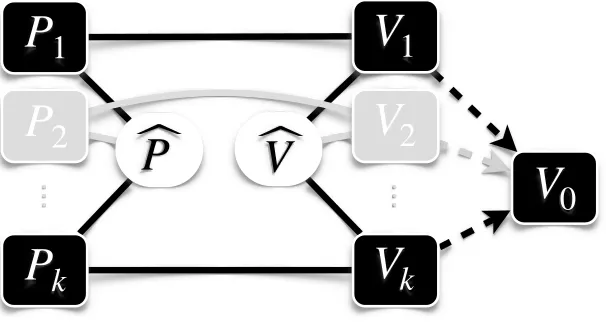
The standard MIP model allows the verifier to non-locally contaminate the provers. We neutralize this problem by defining a model with multiple verifiers, each of which talks to a single prover; in turn, each prover talks to a single verifier. There are no communication tapes between the verifiers, nor are there between provers. There is a special verifierV0whichonly readsthe outputs of the other verifiers; this is the verifier that will decide to accept or reject membership toL. We call this model “locality-explicit” since the provers and verifiers are explicitly local, and if any non-local resources (such as entanglement) are available to them, then it is explicitly specified via a supplementary entity namedPb for the provers andVb for the verifiers.
This model is ageneralization of the standard model because the special setting wherePb is
empty andVb signals for the verifiers corresponds to the standard MIP model.
Definition 3. An interactive Turning machine (ITM) is a Turing machine augmented with the following tapes:
– k1 read-only incoming communication tapes.
– Private work, auxiliary-input, and random tapes.
An ITMAcan signal to an ITMB ifA’s write-only outgoing tape isB’s read-only incoming tape.
Definition 4. Let (P , P1, . . . , Pb k,V , V0, V1, . . . , Vb k)be a tuple of ITMs, where the P’s are
com-putationally all-powerful and the V’s are polynomial-time. For each i, there are two-way com-munication tapes between Vi andPi, and that for all j, there is a two-way communication tape
between Vb and Vj and also between Pb andPj. In addition, for each`, there is a read-only tape
going from V` to V0 (where V0 reads). Then, this is said to be a locality-explicit multi-prover interactive proof.
We call Pb and Vb correlators and say that the provers and verifiers are Pb-local and Vb-local
respectively. We define the class of all MIPs with such correlatorsMIPPb b V.
It is perhaps easier to understand our definition with the help of figure 2.
. . .
P
̂
V
̂
. . .
P
1
P
2
P
k
V
1
V
2
V
k
V
0
Fig. 2.Locality-Explicit MIP
The solid lines represents two-way communication and the dashed arrows represents one-way communication, with the arrow indicating the direction of information flow.
We can define that an LE-MIP accepts a languageLif the usual soundness and completeness conditions hold:
Definition 5. An LE-MIP(V , V0, V1, . . . , Vb k,P , P1, . . . , Pb k)accepts a languageLif and only if
– (completeness)∀x∈L,Pr[V0(x, t1, . . . , tk) =accept]>2/3, – (soundness)∀x /∈L,∀P0
1, . . . , Pk0,Pr[V0(x, t1, . . . , tk) =accept]<1/3,
whereti is the read-only tape fromVi toV0 at the end of the interaction ofVi withPi (orPi0)
on inputx.
Note that we do not quantify over Pb (nor Vb), as we want to use them not as (possibly
Definition 6. An LE-MIP is local if Vb =Pb=∅and all of the provers’ (resp. verifiers’)
ran-dom tapes are initialized with the same uniformly ranran-dom stringR(resp. verifiers with another, independent uniformly random stringS)†.
MIPs in the standard model (with local provers) are equivalent to LE-MIPs where Pb = ∅
andVb acts as a bulletin board. That is, a single verifier communicating with multiple provers is
equivalent to multiple verifiers communicating with provers and each other.
In standard MIPs, it is possible that the honest (single) verifier bridges the provers non-locally. If a protocol does not desire this – and most existing MIPs do not – it must be proven. With local LE-MIPs, the special verifier V0 decides to accept or reject. This verifier cannot communicate with anyone else, avoiding the aforementioned problem of contamination.
4.1 Zero-Knowledge LE-MIPs
Zero-knowledge is defined by simulations, the fundamental idea that if a transcript can be pro-duced by an entity (simulator) with no more power than one (verifier) interrogating all-powerful provers, then no knowledge is gained.
The simulator of single-prover IP and standard MIP are equal to the verifier in computational power, but they do have “advantages” which allow them to fake transcripts. For single-prover IPs, the simulator is allowed to rewind computation; for standard MIPs, the simulator is given a (commitment-breaking) secret. Those advantages are, of course, independent of knowledge.
LE-MIPs naturally induces a new advantage for the simulator: non-local correlations. This is a very powerful advantage. Using the correct non-local correlations, simulators do not need to rewind, do not need to pretend to be multiple (isolated) provers, and do not need to know any commitment-breaking secrets. In short, they do not need to signal. Multiple, no-signaling simu-lators can even produce transcripts in “real-time” (example will follow) if the proper correlations are used.
Definition 7. Let M = (M , M1, . . . , Mc k) be a tuple of polynomial-time ITMs. Each machine
has a random tape, and every random tape is initialized with the same random bits. For1≤i≤k, there is a two-way communication tape betweenMcand Mi. There are no communication tapes
between any of theMi’s. Then this is called a tuple of locality-explicit simulators andMcis the
locality classof M, which will be abbreviated Mc-local.
Definition 8 (White-box version).
Let PV = (P , P1, . . . , Pb k,V , V0, V1, . . . , Vb k) be an LE-MIP for language L. If there exists a
correlatorSbsuch that for all verifiers(V00, V10, . . . , Vk0), there exists(S1, . . . , Sk)for all correlator
b
V0, such that for all x∈Lthe transcripts of conversations
(P , P1, . . . , Pb k,Vb0, V00, V10, . . . , Vk0)(x)
and those generated by
(Sb∪Vb0, V00, S1, . . . , Sk)(x)
are identically distributed, where(S, S1, . . . , Sb k)is a tuple of locality-explicit simulators, then we
say thatPV is a Sb-local perfect zero-knowledge LE-MIPforL.
We will denote the set of all ZK LE-MIPs where the provers, verifiers, and simulators are
b
P-local,Vb-local, and Sb-local by
ZKSbMIPPb b V.
†
Let S,P,Vbe sets of correlators. We will denote, by convention,
ZKSMIPP V
as the set of all ZK LE-MIPs where each correlator comes from each of the respective sets.
Definition 9 (Black-box version).
Let PV = (P , P1, . . . , Pb k,V , V0, V1, . . . , Vb k) be an LE-MIP for language L. If there exists a
tuple of locality-explicit simulators(S, S1, . . . , Sb k), such that for all verifiers (Vb0, V00, V10, . . . , Vk0),
such that for all x∈L the transcripts of conversations
(P , P1, . . . , Pb k,Vb0, V00, V10, . . . , Vk0)(x)
and those generated by
(S, Vb 00, S1(V10), . . . , Sk(Vk0))(x)
(where theVi0 still have access toVb0) are identically distributed, then we say thatPV is a Sb-local
perfect (black-box) zero-knowledge LE-MIPforL.
We will denote the set of all BBZK LE-MIPs where the provers, verifiers, and simulators are
b
P-local,Vb-local, and Sb-local by
ZKSb
BBMIP
b P b V.
Let S,P,Vbe sets of correlators. We will denote, by convention,
ZKS
BBMIPPV
as the set of all BBZK LE-MIPs where each correlator comes from each of the respective sets.
Our motivations for the above definitions are twofold.
First, a simulator (or simulators) should not have more power than necessary. If two local
simulators can output for two local verifiers, then it is not necessary to have a single simulator (equivalent to twosignaling simulators) do the job. Allowing simulators to signal (equivalently, having a single simulator) in the multi-prover setting is analogous to allowing unbounded running-time simulation in single-prover zero-knowledge. In general, finding the minimalSbthat will allow
simulation establishes how little extra is needed to obtain the zero-knowledge property.
Second, the non-locality of simulators is a characterization of the resilience of zero-knowledge. A protocol with local simulators which can withstand arbitrary (malicious) verifiers is more resilient than one in which signaling simulators are needed.
This may be of practical interest, if transcripts are timestamped. For example, under the relativistic assumption that one may not signal faster-than-light, one may be able to distinguish two spatially separated simulators from two spatially separated verifiers, if the simulators need to signal (transmit a commitment-breaking secret) in order to generate a transcript. On the other hand, if two entangled simulators are sufficient to produce the transcript, then they are indis-tinguishable from real verifiers and provers. Our protocol 7 can be modified as to let entangled simulators do their work, without needing PR-boxes or signaling. Details in section 5.
4.2 The Power of LE-MIPs
Local LE-MIPs form a subclass of standard MIPs. They are, by design, more restricted in what you can make the verifier do. An immediate question is whether this istoo restrictive. Perhaps, in all interesting cases, it is necessary for a single verifier to go back-and-fourth between provers, using previous discussions to generate new questions.
this for the multi-prover protocol for oracle-3-SAT in [8]. The protocol details can be found in the appendix. For the purpose of our discussion, we only need to look at the general form of the protocol:
Protocol 4. ( BFL Classic, Single-Verifier )
1. V asksP1 some questions non-adaptively.
2. V chooses a questionQfrom the pool of questions which were asked toP1. 3. V asksQtoP2.
4. V accepts if the interaction withP1 was successful, and the answer fromP2 is con-sistent with those ofP1.
The crucial observation is that V does not adaptively ask questions to P1. Therefore, the questions asked on that entire side of the conversation can be selected in advance, and thus they can be shared in advance with a second verifier. We can therefore naturally rewrite the BFL classic protocol as a local LE-MIP in the following way. The reader can check the details in the appendix, and in section 3 of [8].
Protocol 5. ( BFL as an LE-MIP )
1. V1 prepares the questions which it will askP1.
2. V1 chooses a questionQfrom the above list and shares it withV2. 3. LE-MIP begins. All parties are local as per definitions.
4. V1 asks the questions to P1. 5. V2 asksQtoP2.
6. V0, reading the responses, decides to accept or reject, based on the same criteria as in protocol 4.
The BFL protocol is for oracle-3-SAT, which is NEXP-complete. Rewritten as a local LE-MIP, it circumvents all non-locality issues we have mentioned. Thus, we can conclusively say that “MIP∅
∅ =MIP=NEXP”; no transformation to single-round MIP necessary, and no need to invoke the general theory of PCPs.
5
ZK
PRMIP
∅∅
= NEXP
The question which follows naturally is whether there exists azero-knowledge, local LE-MIP for NEXP. The existing technique for achieving zero-knowledge in MIP [3, 9] requires the (single) verifier to courier an authenticated message between provers. This is not possible with local-verifier LE-MIPs. We show that there is a way around that constraint.
By adapting the protocol from [8], we will exhibit a protocol with the following properties:
1. The provers and verifiers are local:Vb =Pb=∅.
2. The simulators need only access to instances of PR-boxes to work. That is,Mcsimply
We may succinctly summarize the above as ZKPRMIP∅
∅ =NEXP, where PR denotes a correlator which simply computesPR-boxes for the simulators.
The generic way of turning an interactive proof into a zero-knowledge one is by running it in committed form [3, 9]. With this technique, provers commit their answers instead of directly responding, and use cryptographic techniques to convince the verifier that the answers are correct. As shown in section 4.2, the BFL protocol can be turned into a local LE-MIP. If we try to turn it into a zero-knowledge LE-MIP by having the provers commit their answers (for example using protocol 3 as commitment), we run into a problem. In order to achieve zero-knowledge, the proversmust ensure that the question P2 receives fromV2 is one of the questions which V1 has asked P1. On the other hand, since the provers and verifiers are local, the provers cannot communicate, nor can they ask the verifiers to courier authenticated messages between them.
Our solution essentially asks the provers to (strongly-universal-2) hash the selected committed answer with a key that is based on the verifier’s question. We force V2 to behave honestly (to ask a question thatV1 has asked) by making bad questions meaningless. If the verifiers ask the provers the same question, they will receive the same hash of the same answer. Otherwise, they will receive two unrelated random hash values.
We need thePRcommitment (protocol 6), which is secure in the local setting as previously proved in [23, 13, 24].
5.1 The Protocols
The following is aPR-type commitment that is perfectly concealing and statistically binding. In general, we use the commitment-box notation “b” as the name of a commitment to bitbin the next two protocols.
Protocol 6. A statistically binding, perfectly concealing commitment protocol to bitb.
All parties agree on a security parameter 1k.
P1 andP2 partition their private random tape into twok-bit stringsw1, w2.
Pre-computation phase:
– V1 samples two k-bit strings z1, z2 independently and uniformly, and provides them toV2.
– V1 sendsz1 toP1andV2 sendsz2to P2. Commit phase:
– P1 commitsbtoV1 as b = (b×z1)⊕w1, whereb×z1 is a multiplication inF2n.
– P2 sendsV2:d= (w1×z2)⊕w2. Unveiling phase:
– P1 sendsw1, w2to V1.
– V1 computesb= 1 if b ⊕w1=z1, orb= 0 if b =w1.
– V0 rejectsif b ⊕w1 is anything butz1 or 0, or ifd⊕w26=w1×z2 andacceptsb otherwise.
Below is the zero-knowledge, local LE-MIP for oracle-3-SAT (Protocol 7). The basis of pro-tocol 7 is the localized BFL propro-tocol we presented in section 4.2 (details in the appendix). A note on notation: for a circuit f, we will denote f x as the gate-by-gate committed circuit
Protocol 7. A local zero-knowledge LE-MIP for oracle-3-SAT
Let x = (B, r, s), an instance of oracle-3-SAT, be the common input, let k = |x| = r+ 3s+ 3, and let Λbe the verifier’s program in protocol 11 (see appendix).
1. Pre-computation:
(a) V1 samples two k-bit strings z1, z2 independently and uniformly, and provides them to V2.
(b) V1 selects k+ 3 random bit strings R1, ..., Rk+3 (size specified implicitly by Λ) and evaluates the circuit ofΛusing theRias randomness, resulting in questions Q1, ..., Qk+3, and provides them toV2
(c) V1 randomly choosesi, 1≤i≤k+ 3, the index of an oracle query that will be made to bothP1 andP2.V1 providesitoV2.
(d) V1sendsz1 toP1 andV2 sendsz2 toP2for future commitments.
(e) All parties agree on a family of strongly-universal-2 hash functions{Hi}indexed byk-bit keys.
(f) P1andP2 agree on ak-bit keyγ, an index to the above family. (g) P1commits γ toV1.
2. Sumcheck with oracle:
– Let f be the arithmetization obtained in protocol 10, let z be a string fromIr and Qk+1, Qk+2, Qk+3 be strings of Is as generated in protocol 11. V1 and P1 execute protocol 10 in committed form. At the end of this phase,P1shows that the committed final value is equal to
fz, Qk+1, Qk+2, Qk+3, A(Qk+1), A(Qk+2), A(Qk+3)
,
an evaluation in committed form off using the committed values that were used during the protocol’s loop. If this fails,V1 instructsV0 to reject.
3. Multilinearity test: (a) For 1≤i≤k:
i. V1 sendsQi toP1,
ii. P1 commits his answer as A(Qi) .
(b) P1 and V1 evaluate a circuit description of Λ in committed form with inputs A(Q1), . . . , A(Qk) to verify proper linearity among them.P1 unveils the cir-cuit’s committed output. If it rejects,V1instructsV0to reject.
4. Consistency test: (a) V1sendsi toP1.
(b) P1computes Ω1 = A(Qi) ⊕H γ (Qi) and sends Ω1 to V1.
(c) P1proves toV1that Ω1 was computed correctly, from the existing commitments. (d) P1unveils Ω1 forV1, who getsΩ1.
(e) V2sendsQi to P2 (recall that this was pre-agreed in step 1.(c)) (f) P2responds to V2 withΩ2=A(Qi)⊕Hγ(Qi).
(g) V0accepts if and only if all of the following conditions are met: – Ω1=Ω2
5.2 Proofs of Security
Locality
Since the protocol is written as an LE-MIP in which Pb =Vb =∅, the protocol is local by
definition 6.
Completeness
Completeness follows from the completeness of the underlying protocol [8], and the fact that the commitment protocol (protocol 6) is well-defined for honest provers (who will never send a commitment that they cannot unveil).
Soundness
Without loss of generality, we may assume that the soundness error in the BFL protocol to be 1/3, through sequential amplification. The probability that our commitment scheme (protocol 6) fails binding is exponentially small in k. Local probabilistic provers are equivalent to local deterministic provers. This is because the success probabilityαof randomized provers of breaking soundness is an average over the randomized provers’ random tapes. Each instance of a random tape represents a deterministic strategy. Therefore there is a deterministic strategy which succeeds with probability at leastα, and hence we only need to consider local deterministic provers.
Since P1 is deterministic, we may unambiguously consider what happens if we were to “rewind” the prover machine. Suppose that at some pointP1unveils a particular commitmentc to 0. We rewindP1 and letV1 make different choices before that point. Suppose that, with these alternate choices,P1then unveils cto 1 (an attempt to break binding). Because of locality,P1’s behavior is independent of what P2 receives (namely z2). Therefore, there is only one such z2 whichV0will ultimately accept as a valid unveiling ofcin both ways (recall that our commitment is statistically binding).
Therefore, in the worst case, for every commitment there exists a sequence of interactions betweenV1 and P1 such thatP1 will attempt to break the binding of that commitment. Each such commitment-breaking corresponds to at most one stringz2 that will actually work.
Let us denote the set of such binding-breaking strings byB. If z2∈/ B, then the proverswill
not break binding, and the soundness error is reduced to that of the underlying protocol (at most 1/3). On the other hand, since|B|<poly(k), the probability thatz2∈Bis at mostpoly(k)/2k.
Therefore, the soundness error of our protocol is at most
P r[z2∈/ B and underlying protocol accepts] +P r[z2∈B]≤1 3 +
poly(k) 2k .
Zero-Knowledge The simulation will be divided in two parts. In the first part, the simulator produces a transcript of thepre-computation,multilinearity test andsumcheck with oracle parts, which involves only interactions with V1. In the second part, the simulator will fake a valid
consistency test.
Protocol 8. ( Perfectly Indistinguishable, PR-Local Simulator for Protocol 7, Part 1)
The setup:
– Let (S, S1, S2b ) be a set of locality-explicit simulators.
– Sbcompletes the indexedPRbox (protocol 3) for both simulators.
The simulation strategy:
1. The simulators agree on unique indices for every commitment used in the protocol. 2. S1interacts withV1the wayP1would. WheneverP1 should commit,S1 commits to
random bits, just like the single-simulator from Sec. 5.
3. For each commitment,V2 sends S2 a strings. S2 sends to Sb the index of the
com-mitment ands.
4. Sbruns thePRbox (protocol 3) and replies withV2’s half of the output.
5. WheneverS1needs to unveil a commitment, it can be unveiled in the wayS1desires by sending the corresponding index and bit toSb.
6. Sbcompletes the correspondingPRbox which outputst.Sbsendstto S1.
7. S1sends ttoV1.
The second part (the consistency test) can be done by having the simulators ignore the question.
Protocol 9. ( Perfectly Indistinguishable, PR-Local Simulator for Protocol 7, Part 2)
1. V1 sendsitoS1.
2. S1computes Ω1 =H γ (Qi).
3. UsingSbto break binding,S1 convincesV1 that Ω1 is actually A(Qi) ⊕H γ (Qi). 4. S1unveils Ω1 forV1, who getsΩ1=Hγ(Qi).
5. V2 sendsQ0i toS2.
6. S2responds with Ω2=Hγ(Q0i).
By the properties of the strongly-universal-2 hash H, if Qi =Q0i then Ω1 =Ω2. Otherwise Ω1 6=Ω2 with probability exponentially close to one. This produces the result as desired. The simulators then feed the transcripts toV0, and terminates simulation.
5.3 Entangled Simulators
The binding condition of commitment used above (protocol 6) can be broken givenPR-boxes. However, if the verifier were willing to tolerate approximately 15% of errors in the provers’ unveiling string (z1 or 0), then it is possible to break binding with shared entanglement [31] while maintaining soundness against local provers. Using this weakened version of commitment
in place of protocol 6 yields aZK poly
|LOCiMIP∅
∅protocol for aNEXP-complete language (ZK poly
|LOCi
denotes shared entanglement for the simulator; consult Appendix B for more notations). We leave the details of this modification to the reader.
6
Conclusions and Future Work
necessary to avoid contamination, and it induces the question of non-locality with respect to zero-knowledge. We close with four open questions.
First, although the provers and verifiers of protocol 7 are local, the simulators are not – they use PR-boxes. We do not know whether it is possible to simulate protocol 7 withlocal simulators. In fact, we conjecture that there does not exist aZK∅MIP∅
∅ protocol for anyNEXP-complete language.
Second, as we have sketched out in section 5.3, by weakening the commitment scheme used,
we getZK poly
|LOCiMIP∅
∅=NEXP. What is a minimalSbsuch thatZK b SMIP∅
∅=NEXP? Third, as of the time of this writing, it is an open question whether NEXP (MIP∗ [18]. Under the locality-explicit setup, we ask a slightly more general question: does there exist a correlator Pb and a corresponding LE-MIP which accepts a language ∈/ NEXP? We remind
the reader that characterizing the complexity classes of MIPs where the provers have non-local resources are generally open questions.
Finally, although the verifier’s contamination is undesirable (in the standard MIP model), is it possible to turn it into a resource? For example, given local provers, let the verifier provide them with some non-local resources, such PR-boxes or entanglement that can be simulated in polynomial-time. This can be seen as “enforceable honest non-local resources.” Malicious provers would not be able to use these resources at will. Perhaps this concept would be useful in the design of multi-prover protocols.
Acknowledgements
We would like to thank G. Brassard, A. Chailloux, S. Fehr, J. Kilian, S. Laplante, J. Li, A. Lev-errier, A. Massenet, S. Ranellucci, L. Salvail, C. Schaffner, and T. Vidick for various discussions about earlier versions of this work. We would also like to thank Jeremy Clark for his insightful comments. Finally, we are grateful to Raphael Phan and Moti Yung for inviting us to publish a lead-up paper to this work as anInsight Paperat MyCrypt 2016.
References
1. S. Goldwasser, S. Micali, and C. Rackoff, “The knowledge complexity of interactive proof-systems,”
SIAM. J. Computing, vol. 18, pp. 186–208, Feb. 1989.
2. L. Babai, “Trading group theory for randomness,” inProceedings of the Seventeenth Annual ACM Symposium on Theory of Computing, pp. 421–429, May 1985.
3. M. Ben-Or, S. Goldwasser, J. Kilian, and A. Wigderson, “Multi-prover interactive proofs: How to remove intractability assumptions,” in Proceedings of the Twentieth Annual ACM Symposium on Theory of Computing, STOC ’88, (New York, NY, USA), pp. 113–131, ACM, 1988.
4. A. Shamir, “IP = PSPACE,”J. ACM, vol. 39, pp. 869–877, Oct. 1992.
5. R. Impagliazzo and M. Yung, “Direct minimum-knowledge computations,” inAdvances in Cryptol-ogy: Proceedings of Crypto ’87(C. Pomerance, ed.), vol. 293, pp. 40–51, Springer-Verlag, 1988. 6. M. Ben-Or, O. Goldreich, S. Goldwasser, J. H˚astad, J. Kilian, S. Micali, and P. Rogaway, “Everything
provable is provable in zero-knowledge,” inProceedings of the 8th Annual International Cryptology Conference on Advances in Cryptology, CRYPTO ’88, (London, UK, UK), pp. 37–56, Springer-Verlag, 1990.
7. L. Fortnow, J. Rompel, and M. Sipser, “On the power of multi-prover interactive protocols,”Theor. Comput. Sci., vol. 134, pp. 545–557, Nov. 1994.
8. L. Babai, L. Fortnow, and C. Lund, “Non-deterministic exponential time has two-prover interactive protocols,”Comput. Complex., vol. 2, pp. 374–374, Dec. 1992.
9. J. Kilian,Uses of randomness in algorithms and protocols. MIT Press, 1990.
11. C. Dwork, U. Feige, J. Kilian, M. Naor, and S. Safra, “Low communication 2-prover zero-knowledge proofs for NP,” in Advances in Cryptology - CRYPTO ’92, 12th Annual International Cryptology Conference, Santa Barbara, California, USA, August 16-20, 1992, Proceedings(E. F. Brickell, ed.), vol. 740 ofLecture Notes in Computer Science, pp. 215–227, Springer, 1992.
12. U. Feige and J. Kilian, “Two-prover protocols - low error at affordable rates,”SIAM J. Comput., vol. 30, no. 1, pp. 324–346, 2000.
13. C. Cr´epeau, L. Salvail, J.-R. Simard, and A. Tapp, “Two provers in isolation,” in Advances in Cryptology – ASIACRYPT 2011: 17th International Conference on the Theory and Application of Cryptology and Information Security, Seoul, South Korea, December 4-8, 2011. Proceedings, (Berlin, Heidelberg), pp. 407–430, Springer Berlin Heidelberg, 2011.
14. J. Kilian, “Personal e-mail communication,” July 2018.
15. D. Lapidot and A. Shamir, “Fully parallelized multi prover protocols for nexp-time (extended ab-stract),” in32nd Annual Symposium on Foundations of Computer Science, San Juan, Puerto Rico, 1-4 October 1991, pp. 13–18, IEEE Computer Society, 1991.
16. U. Feige and L. Lov´asz, “Two-prover one-round proof systems: Their power and their problems (extended abstract),” inProceedings of the Twenty-fourth Annual ACM Symposium on Theory of Computing, STOC ’92, (New York, NY, USA), pp. 733–744, ACM, 1992.
17. D. Lapidot and A. Shamir, “Fully parallelized multi-prover protocols for nexp-time,” J. Comput. Syst. Sci., vol. 54, no. 2, pp. 215–220, 1997.
18. T. Ito and T. Vidick, “A multi-prover interactive proof for nexp sound against entangled provers,” in
Proceedings of the 2012 IEEE 53rd Annual Symposium on Foundations of Computer Science, FOCS ’12, (Washington, DC, USA), pp. 243–252, IEEE Computer Society, 2012.
19. Y. T. Kalai, R. Raz, and R. D. Rothblum, “How to delegate computations: The power of no-signaling proofs,” inProceedings of the Forty-sixth Annual ACM Symposium on Theory of Computing, STOC ’14, (New York, NY, USA), pp. 485–494, ACM, 2014.
20. A. Chiesa, M. A. Forbes, T. Gur, and N. Spooner, “Spatial isolation implies zero knowledge even in a quantum world,”Electronic Colloquium on Computational Complexity (ECCC), vol. 25, p. 44, 2018.
21. M. Bellare, U. Feige, and J. Kilian, “On the role of shared randomness in two prover proof systems,” in Third Israel Symposium on Theory of Computing and Systems, ISTCS 1995, Tel Aviv, Israel, January 4-6, 1995, Proceedings, pp. 199–208, IEEE Computer Society, 1995.
22. J. Kilian, “Strong separation models of multi prover interactive proofs,” inDIMACS Workshop on Cryptography, 1990.
23. A. Kent, “Unconditionally secure bit commitment,”Phys. Rev. Lett., vol. 83, pp. 1447–1450, Aug 1999.
24. T. Lunghi, J. Kaniewski, F. Bussi`eres, R. Houlmann, M. Tomamichel, S. Wehner, and H. Zbinden, “Practical relativistic bit commitment,”Phys. Rev. Lett., vol. 115, p. 030502, Jul 2015.
25. E. Adlam and A. Kent, “Deterministic relativistic quantum bit commitment,” CoRR, vol. abs/1504.00943, 2015.
26. A. Chailloux and A. Leverrier, “Relativistic (or 2-prover 1-round) zero-knowledge protocol for NP secure against quantum adversaries,” inAdvances in Cryptology – EUROCRYPT 2017: 36th Annual International Conference on the Theory and Applications of Cryptographic Techniques, Paris, France, April 30 – May 4, 2017, Proceedings, Part III, pp. 369–396, Springer International Publishing, 2017. 27. J. S. Bell, “On the Einstein-Podolsky-Rosen paradox,”Physics, vol. 1, pp. 195–200, 1964.
28. C. Cr´epeau and N. Yang, “Multi-prover interactive proofs: Unsound foundations,” inParadigms in Cryptology – Mycrypt 2016. Malicious and Exploratory Cryptology: Second International Conference, Mycrypt 2016, Kuala Lumpur, Malaysia, December 1-2, 2016, Revised Selected Papers, pp. 485–493, Springer International Publishing, 2017.
29. G. Brassard and C. Cr´epeau, “Zero-knowledge simulation of boolean circuits (extended abstract),” inAdvances in Cryptology: Proceedings of Crypto ’86(A. M. Odlyzko, ed.), vol. 263, pp. 223–233, Springer-Verlag, 1987.
30. G. Brassard and C. Cr´epeau, “Non-transitive transfer of confidence: A perfect zero-knowledge in-teractive protocol for SAT and beyond,” in 27th Symp. of Found. of Computer Sci., pp. 188–195, IEEE, 1986.
32. A. Ac´ın, T. Fritz, A. Leverrier, and A. B. Sainz, “A combinatorial approach to nonlocality and contextuality,”Communications in Mathematical Physics, vol. 334, pp. 533–628, Mar 2015. 33. H. Barnum, C. A. Fuchs, J. M. Renes, and A. Wilce, “Influence-free states on compound quantum
systems,”CoRR, vol. quant-ph/0507108v1, 2005.
34. J. Barrett, N. Linden, S. Massar, S. Pironio, S. Popescu, and D. Roberts, “Nonlocal correlations as an information-theoretic resource,”Phys. Rev. A, vol. 71, p. 022101, Feb 2005.
35. M. Forster and S. Wolf, “Bipartite units of nonlocality,”Phys. Rev. A, vol. 84, p. 042112, Oct 2011. 36. T. Ito, H. Kobayashi, D. Preda, X. Sun, and A. C. Yao, “Generalized tsirelson inequalities, commuting-operator provers, and multi-prover interactive proof systems,” inProceedings of the 23rd Annual IEEE Conference on Computational Complexity, CCC 2008, 23-26 June 2008, College Park, Maryland, USA, pp. 187–198, IEEE Computer Society, 2008.
A
Babai, Fortnow and Lund’s MIP for Languages in NEXP
This section describes a variant of the multi-prover protocol for oracle-3-SAT found in [8]. We refer to this as the BFL protocol, or BFL classic.
Definition 10. Let r, s > 0 be integers. Let z, b1, b2, b3 be strings of variables, where |z| = r
and|bi|=s. Let B(z, b1, b2, b3, t1, t2, t3)be a Boolean formula inr+ 3s+ 3 variables. A Boolean
function A:{0,1}s→ {0,1}is a 3-satisfying oracle forB if
B(z, b1, b2, b3, A(b1), A(b2), A(b3)) = 1
for every stringz, b1, b2, b3.
B is oracle-3-satisfiable if such a functionA exists.
The Oracle-3-SAT problem (B, r, s)asks whether a Boolean formulaB is oracle-3-satisfiable, wherer andsdenote the lengths ofz andbi, as above.
Lemma 1. Oracle-3-SAT isNEXP-complete.
Definition 11. Let F be an arbitrary field. Letφ:{0,1}m→ {0,1} be a Boolean function. An arithmetizationofφis a polynomialf(x1, . . . , xm)∈F[X1, . . . , Xm]such that for allz∈ {0,1}m, φ(z) = 0⇔f(z) = 0. A specific one is given in [8], proposition 3.1 .
Equivalently, theφ(z) = 0⇔f(z) = 0 condition can be replaced withφ(z) = 1⇔f(z) = 0.
Protocol 10. ( Sumcheck Protocol )
Let φ(x1, . . . , xm) be the 3-CNF formula which the prover P is trying to show to be a tautology to a verifier V. LetF be a field of sufficient size (of order at least (3c+ 1)m will suffice where cis the number of clauses ofφ).
1. V takes φand computes its arithmetization f according to [8] Proposition 3.1 and sends it toP.
2. V andP agree on a setI⊂Fof size at least 2dmwheredis the degree off. 3. V assignsb0= 0, which is supposed to be equal to the sum
1
X
x1=0 . . .
1
X
xm=0
f(x1, . . . , xm)2= 0
5. P sends the coefficients of the univariate polynomial inx,
gi(x) =h(r1, . . . , ri−1, x) =
1
X
xi+1=0 . . .
1
X
xm=0
f(r1, . . . , ri−1, x, xi+1, . . . , xm)2
6. V checks whetherbi−1=gi(0) +gi(1). If not, abort.
7. V chooses a randomri∈I, computesbi=gi(ri) and sendsri toP. 8. Ifi≤mtheni←i+ 1 and go to step 4.
9. V checks whetherbm=f(r1, . . . , rm)2.
Protocol 11. ( Babai, Fortnow and Lund’s MIP for Oracle-3-SAT )
Given (B, r, s) as common input.
1. (sumcheck with oracle) V and P1 execute protocol 10. Let (Qk+1, Qk+2, Qk+3) = (rr+1...rr+s, rr+s+1...rr+2s, rr+2s+1...rr+3s)∈(Is)3beV’s questions during this phase. 2. (multilinearity test)V asksP1to simulate an oracle storing the functionA.V queries
P1with random, linearly related values inIs. If any response does not satisfy linearity, abort protocol. LetQ1, . . . , Qk∈Is beV’s questions during this phase.
3. (non-adaptiveness test)V chooses uniformly at random anisuch that 1≤i≤k+ 3 and asksQi toP2. IfP2’s answer differs from that ofP1, reject. Otherwise accept.
B
Non-Locality – an introduction
In this section we solely focus on the two-party single-round games and strategies that are sufficient to discuss and analyze most of the MIPs. Definitions and proofs for complete gener-alizations to multi-party multi-round games and strategies will appear in a forthcoming paper with co-author Adel Magra.
Games: LetV be a predicate onA×B×X×Y (for some finite setsA, B, X,andY) and letπ be a probability distribution onA×B. ThenV andπdefine a (single-round) gameGas follows: A pair of questions (a, b) is randomly chosen according to distributionπ, and a∈A is sent to Alice and b ∈ B is sent to Bob. Alice must respond with an answerx ∈ X and Bob with an answery∈Y. Alice and Bob win if V evaluates to 1 on (a, b, x, y) and lose otherwise.
Strategies: Two-Party Channels A strategy for Alice and Bob is simply a probability distri-butionP(x,y|a,b)describing exactly how they will answer (x, y) on every pair of questions (a, b). We now breakdown the set of all possible strategies for Alice and Bob according to theirnon-locality.
Deterministic and Local Strategies: A strategy P(x,y|a,b) is deterministic if there exists functionsfA:A→X, fB:B→Y such that
P(x,y|a,b)=
(
1 ifx=fA(a) andy=fB(b)
0 otherwise .
A strategy P(x,y|a,b)islocal if there exists a finite setR and functionsfA :A×R→X, fB : B×R→Y such that
P(x,y|a,b)=
|{r∈R:x=fA(a, r) andy=fB(b, r)|
|R| .
A local strategy corresponds to the situation where Alice and Bob agree on a deterministic strategy selected uniformly among|R|such possibilities. The choicerof Alice and Bob’s strategy, and the choice of inputs (a, b) provided to Alice and Bob are generally agreed to be statistically independent random variables.
B.1 Local Reducibility
We now turn to the notion of locally reducing a strategy to another, that is how Alice and Bob limited to local strategies but equipped with a particular (not necessarily local) strategyU0 are able to achieve another particular (not necessarily local) strategyU. For this purpose we introduce a notion of distance between strategies in order to analyze strategies that are approaching each other asymptotically.
Distances between Strategies: Several distances could be selected here as long as their mean-ing as it approaches zero are the same. In the definitions below,U, U0 are strategies andU0 is a finite set of strategies.
Definition 12. |U, U0|= X
a,b,x,y
|PU(x, y|a, b)−PU0(x, y|a, b)|
Definition 13. |U,U0|= min
U0∈U0|U, U 0|
Local extensions of Strategies: For natural integern, we define the set LOCn(U) of strategies that are local extensions (of ordern) ofU to be all the strategies Alice and Bob can achieve using local strategies where strategyU may be used up tontimes as sub-routine calls‡. If we restrict all the functions used to be polynomial-time computable we analogously define LOC
poly n(U).
Definition 14. U0 Locally (poly-)Reduces to U (U0≤LOC
(poly)
U) iff lim n→∞|U
0,LOC (poly)
n
(U)|= 0.
Definition 15. U0 is Locally (poly-)Equivalent toU (U0=LOC
(poly)
U) iff U0≤LOC
(poly)
U ≤LOC
(poly)
U0.
Non-Adaptive extensions of Strategies: For natural integern, we define the set NADn(U) of strategies that are Non-Adaptive extensions (of ordern) ofU to be all the strategies Alice and Bob can achieve using Non-Adaptive strategies where strategyU may be used up to ntimes as sub-routine calls§. If we restrict the functions used to be poly-time computable we get NAD
poly n(U).
Definition 16. U0 Non-Adaptively (poly-)Reduces toU (U0≤NAD
(poly)
U) iff lim n→∞|U
0,NAD
(poly)
n(U)|=
0.
‡
Done by selecting functionsfA0 :A×R→A, f
1
A:A×X×R→A, ..., f n−1
A :A×X n−1×
R→A,
fn
A:A×Xn×R→X to determine the input of each sub-routine from inputaand previous outputs.
§
Done by selecting functionsf0
A:A×R→A, fA1 :A×R→A, ..., f n−1
A :A×R→A,
Definition 17. U0 is Non-Adaptively (poly-)Equivalent toU (U0=NAD
(poly)
U) iffU0≤NAD
(poly)
U ≤NAD
(poly)
U0.
In general, Non-Adaptive reducibility is a weaker notion than local reducibility. However, for certain distributionsUit may result that {D|D≤LOC
(poly)
U}={D|D≤NAD
(poly)
U}as follows.
B.2 Locality
We now define the lowest of the non-locality classesLOC. We could define it directly from the notion of local strategies as defined above, but for analogy with the other classes we later define,
LOC is defined as all those strategies locally reducible to a complete strategy we call ID (see Fig. 3). Of course, any strategy is complete for this class.
a //
ID b
o
o
a oo // b
Fig. 3.anID-box
Definition 18. LOC={U|U ≤LOCID}andLOC
poly
={U|U ≤LOC
poly
ID}
Note:LOCis the class of strategies that John Bell [27] considered as classical hidden-variable theories that he compared to entanglement. It is also the class of strategies that BenOr, Gold-wasser, Kilian and Wigderson [3] chose to define classical Provers in Multi-Provers Interactive Proof Systems.LOCis also those strategies Non-Adaptively reducible toID
Definition 19. Alternatively,LOC={U|U ≤NADID} andLOC poly
={U|U ≤NAD
poly
ID}
Alternatively, we can also defineLOC from an empty box as used in the core of this paper
a // ∅
b
o
o
x oo // y
Fig. 4.an∅-box wherex∈X andy∈Y are uniform and independent of everything else
Definition 20. Alternatively,LOC={U|U ≤NAD∅}={U|U ≤LOC∅}
B.3 One-Way Signalling
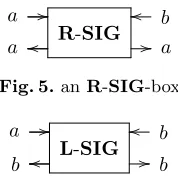
We now turn to One-Way Signalling which allows communication from one side to the other. We name the directions arbitrarily Left and Right. We defineR-SIG(resp.L-SIG) as all those strategies locally reducible to acompletestrategy we callR-SIG(seeFig. 5) (resp.L-SIG(see Fig. 6)). These classes are useful to define what it means for a strategy to signalas well as the notion ofNo-Signalling strategies.
Definition 21. R-SIG={U|U ≤LOCR-SIG} andR-SIG
poly ={U|U ≤LOCpoly
a //
R-SIG b
o
o
a oo // a
Fig. 5.anR-SIG-box
a //
L-SIG b
o
o
b oo // b
Fig. 6.anL-SIG-box
Definition 22. We say thatU Right Signals (isR-SIG-verbose¶) iff R-SIG≤LOCU.
Definition 23. L-SIG={U|U ≤LOCL-SIG} andL-SIG
poly ={U|U ≤LOCpoly
L-SIG}
Definition 24. We say thatU Left Signals (isL-SIG-verbose) iff L-SIG≤LOCU.
Definition 25. We say thatU Signals iffU Right Signals or Left Signals.
We prove a first result that is intuitively obvious. We show that the complete strategyR-SIG cannot be approximated inL-SIGand the other way around.
Theorem 12. R-SIG6∈L-SIGandL-SIG6∈R-SIG.
Proof. Follows from a simple capacity argument. For all n, all the channels in LOCn(R-SIG) have zero left-capacity, whileL-SIGhas non-zero left-capacity. And vice-versa.
B.4 Signalling
We are now ready to define the largest of the non-locality classes SIG. Indeed every possible strategy is inSIG.
Definition 26. SIG={U|U ≤LOCSIG} andSIG
poly ={U|U ≤LOCpoly
SIG}
a //
SIG b
o
o
b oo // a
Fig. 7.aSIG-box
Definition 27. We say thatU Fully Signals (isSIG-verbose) iffU Right Signals and Left
Sig-nals.
¶
We define the notion ofL-verbose in analogy toNP-hard: it means “as verbose as any distribution in
L
-
SIG
𝕊𝕀𝔾
R
-
SIG
𝕃𝕆ℂ
ℕ𝕆𝕊𝕀𝔾
|
𝕃𝕆ℂ⟩
ℂ𝕆𝕄𝕆ℙ
L
-
𝕊𝕀𝔾
R
-
𝕊𝕀𝔾
SIG
ID
R B
GRBG
PR
,
??
??
ℕ𝔸𝔻
L
-
SIG
𝕊𝕀𝔾
R
-
SIG
𝕃𝕆ℂ
ℕ𝕆𝕊𝕀𝔾
|
𝕃𝕆ℂ⟩
ℂ𝕆𝕄𝕆ℙ
L
-
𝕊𝕀𝔾
R
-
𝕊𝕀𝔾
SIG
ID
PR
??
??
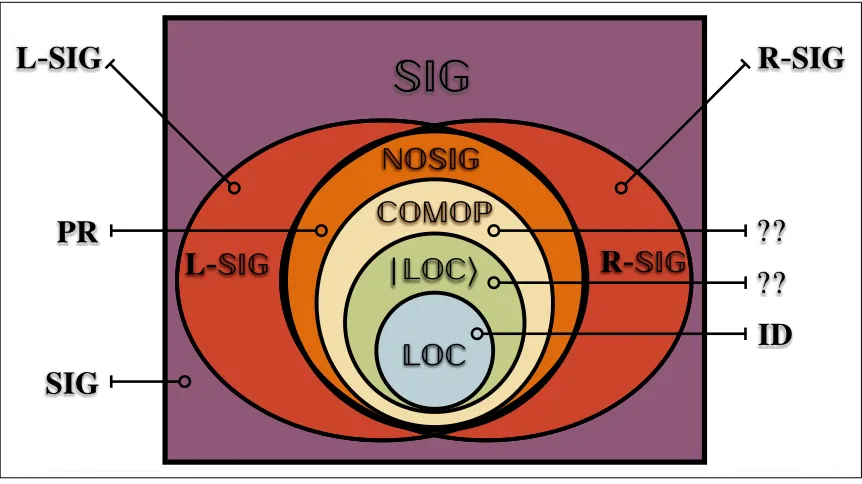
Fig. 8.Non-locality Hierarchy and complete (two-party) distributions in each class.
B.5 No-Signalling
We finally define the less intuitive non-locality classNOSIGin relation to classes defined above.
Definition 28. NOSIG=R-SIGTL-SIGandNOSIG poly
=R-SIG poly
TL
-SIG poly.
A similar characterization may be found in [32] Section 3 and [33] Corollary 3.5.
Theorem 13. . The above definition of NOSIGexactly coincides with the traditionalnotion of
No-Signalling [34].
Intuitively, a distribution P(x, y|a, b) is No-Signalling as long as for every a thex|b and for everyb they|achannels have zero capacity.
Note: Forster and Wolf [35] have proved thatPR(seeFig. 1) is complete forNOSIG distri-butions under an asymptotic definition similar to ours.
Fig. 8shows the relation of these classes as well as the case obtained via quantum entangle-ment (|LOCi) as considered by Bell [27] and via commuting-operators (COMOP) as defined by Ito, Kobayashi, Preda, Sun, and Yao [36]. We include those for completeness but will not discuss these particular classes any further in this work.
Definition 29. We say that U does not Signal iff U does not Right Signal nor Left Signal iff
U ∈NOSIG.
C
Visual description of the new model
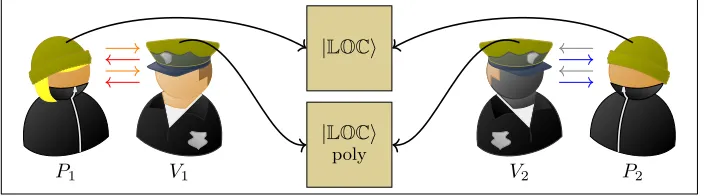
C.1 Local Multi-Prover Interactive Proofs
LOC poly LOC
P1 V1 V2 P2
V1 V2 V0
Fig. 9.Interrogation phase (top) followed by decision phase (bottom).
interactive part, all the V1, ..., Vk report to V0 who takes the final decision. The corresponding complexity class isMIP=MIPLOC
LOC poly
=NEXP.
C.2 Entangled Multi-Prover Interactive Proofs
|LOCi poly |LOCi
P1 V1 V2 P2
Fig. 10.Interrogation phase.
In the Interrogation phase (see Fig. 10) V1, ..., Vk (equipped with an arbitrary entangled correlator) individually interrogateP1, ..., Pk (equipped with an arbitrary entangled correlator). At the end of the interactive part, all theV1, ..., Vkreport toV0who takes the final decision. The corresponding complexity class isMIP∗ =MIP||LOCi
LOCi
poly
⊇NEXP.
C.3 No-Signalling Multi-Prover Interactive Proofs
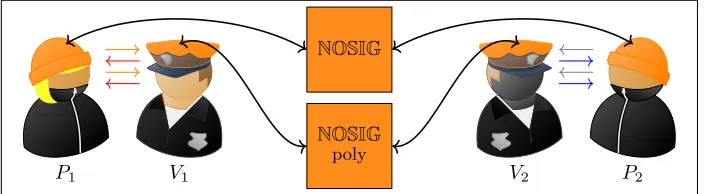
NOSIG poly NOSIG
P1 V1 V2 P2
Fig. 11.Interrogation phase.
At the end of the interactive part, all theV1, ..., Vkreport toV0who takes the final decision. The corresponding complexity class isMIPns=MIPNOSIG
NOSIG poly
=EXP.
As noted before, most MIPs found in the literature are actually (non-adaptive) local-verifier MIPs (seeFig. 12) yielding for instanceMIPns=MIPNOSIG
LOC poly
.
LOC poly NOSIG
P1 V1 V2 P2
Fig. 12.Interrogation phase.
C.4 A New, Stronger Flavour of Zero-Knowledge
Traditionally zero-knowledge is defined as a property of the honest provers for all (polynomial-time) verifiers
∀polyV0 ∃polyS ∀x∈L∀w VIEWV0[P1, ..., Pk, V0](w, x) =S(w, x).
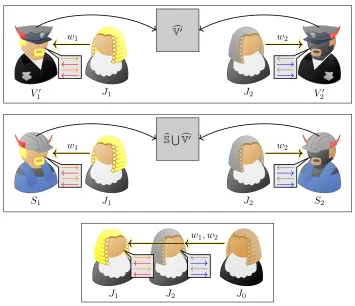
However, in the present context, the fact that the simulation of V0’s view via a single cen-tralized simulator S, achieving zero-knowledge is rather easy because such an S can cheat the binding property of the commitments at will. The intuition behind the original definition is that the verifier is unable to convince a third party (a JudgeJ0) because theVIEWhe reports (see Fig. 13) could have been equally created (with the same distribution) by a simulator. Never-theless, a stronger flavour of zero-knowledge is achieved if the simulator is not invoking its full signalling power whenever the verifier does not use such power.
For all non-locality levels starting withbSand up, the simulatorsSido not need more non-local
power than the verifiers V0
i. The ultimate (strongest) notion of “LOC poly
-local ZK” being ZK poly LOC
J0 V0
w
Fig. 13.(Interac/Simula)tion-Distinction phase.
the opposite end of the spectrumZK poly
SIG is what is generally considered zero-knowledge with a
single simulator or a group of signalling simulators.
This stronger notion of zero-knowledge is particularly interesting in the relativistic bit-commitment scenario where a pair of judges may provide separate auxiliary-inputs to spatially separated verifiers pretending to be speaking to powerful provers. If the verifiers can report their conversation fast enough to the judges (but not interact with the judges however), they must be able to do so without invoking signalling because of the distance separating them. If a pair of simulators can produce the same distribution of views in the same context, we obtain a stronger flavour of zero-knowledge (SeeFig. 14).
|LOCi
c
V0
V10 J1 J2 V20
w1 w2
|LOCi
b
SScV0
S1 J1 J2 S2
w1 w2
J1 J2 J0
w1, w2
The results of this paper, depending on the specific bit commitment used, may be achieved under a stronger flavour of zero-knowledge if a member of the non-locality classbS is enough to
break the binding property of the commitments. For instance, the result of section 5.1 is really
ZK poly
NOSIGMIPLOC LOC poly
= NEXP although existing proofs usually mean ZK poly
SIGMIPLOC LOC poly
= NEXP.
Using the bit commitment scheme based on the magic square game of [28] we can also obtain
ZK poly
|LOCiMIPLOC LOC poly
=NEXP.
Some interesting questions resulting from this definition is whether any higher class such as
ZK poly
LOCMIPLOC LOC poly
orZK poly
NOSIGMIPNOSIG NOSIG poly
contains more than the natural examples such as GRAPH
ISO or CODE EQUIV already found in the most natural classZK poly
SIGMIPSIG SIG poly
=ZKIP.
C.5 A note on notation
ZK
S
MIP
P
V
is the complexity class of Zero-Knowledge Multi-provers Interactive Proofs where (honest and dishonest) provers are restricted to non-locality class P (important for soundness), where the honest verifier is from non-locality classV (also important for soundness), and where the Zero-Knowledge simulators are from non-locality classS unlessVc0 is outside ofS in which case they