Power Optimization Using Dual Dynamic
Node Pulsed Hybrid Flip-Flop Based on
Footed Logic
Indumathi.M, A.Jeena Thankachan
M.E, Dept. of VLSI Design, Karpaga Vinayaga College of Engineering & Technology, Maduranthakam, India
Assistant Professor, Dept. of ECE, Karpaga Vinayaga College of Engineering & Technology, Maduranthakam, India
ABSTRACT: Designing a new dual dynamic node hybrid flip-flop (DDFF) and low power 4/5 Counter was based on DDFF using FOOTED logic. The proposed designs eliminate the large capacitance present in the precharge node of several state-of-the-art designs by following a split dynamic node structure to separately drive the output pull-up and pull down transistors. The DDFF offers a power reduction of up to 62% and 48% compared to the conventional flip-flops like Power PC 603 flip-flop and semi dynamic flip-flop. The aim of the DDFF-ELM is to reduce pipeline overhead. It presents an area, power, and speed efficient method to incorporate complex logic functions into the flip-flop. The performance comparisons made in a 90 nm UMC process show a power reduction of 48% compared to the Semi dynamic flip-flop, with no degradation in speed performance. The leakage power and delay variations of various designs are compared with the proposed designs. The Footed logic is used to reduce power in the circuits. An efficient power reduction was obtained using footed logic and a single design was used for both counter which is called low power 4/5 counter.
KEYWORDS:Low power, Leakage current, Dual-Dynamic Flip Flop, high speed, Footed logic.
I.
INTRODUCTIONPower consumption plays major roll in Integrated circuits of VLSI design. In synchronous systems, high speed has been achieved using advanced pipelining techniques. In modern deep-pipelined architectures, pushing the speed further up demands a lower pipeline overhead. This overhead is the latency associated with the pipeline elements, such as the flip-flops and latches.
In the paper we introduce a new dual dynamic node hybrid flip-flop (DDFF) and low power 4/5 Counter was based on DDFF using FOOTED logic. The proposed designs eliminate the large capacitance present in the precharge node of several state-of-the-art designs by following a split dynamic node structure to separately drive the output pull-up and pull down transistors.
The DDFF offers a power reduction of up to 62% and 48% compared to the conventional flip-flops like Power PC 603 flip-flop and semi dynamic flip-flop. The aim of the DDFF-ELM is to reduce pipeline overhead. It presents an area, power, and speed efficient method to incorporate complex logic functions into the flip-flop. The performance comparisons made in a 90 nm UMC process show a power reduction of 48% compared to the Semi dynamic flip-flop, with no degradation in speed performance.
II.RELATED WORK
A. Semi Dynamic Flip Flop(SDFF)
Semi dynamic flip flop is fastest classic hybrid structure. They are purely dynamic designs as well as pseudo dynamic design, which has an internal precharge structure and static output. Dynamic frontend and static output.
Disadvantages
Not efficient for power consumption because of large clock and large precharge capacitance, High power consumption devices,
Area is also high.
B. Cross Charge Control Flip Flop(XCFF)
A low power and high-speed flip-flop named Cross Charge control Flip-Flop (XCFF). It has two dynamic nodes driving output transistors separately. The minimum power-delay product of the XCFF is 48% smaller than that of CMOS flip flop and 20% smaller than that of the semi dynamic Flip-Flop (SDFF). Charge sharing is uncontrollable when complex functions are embedded is the disadvantage.
C. Conditional Data Mapping Flip Flop(CDMFF)
A new family of low power and high-performance flip flops, namely conditional data mapping flip flops (CDMFFs), which reduce their dynamic power by mapping their inputs to a configuration that eliminates redundant internal transitions.The conditional data mapping flip flop (CDMFF) is one of the most efficient which uses an output feedback structure to conditionally feed the data to the flip flop. This reduces overall power dissipation by eliminating unwanted transitions when a redundant event is predicted.
D. Power PC 603 Flip Flop
PowerPC 603 is one of the most efficient classic static structures. The PowerPC 603 was based on master slave latch. They dissipate comparatively lower power and have a low clock-to-output (CLK-Q) delay. In a synchronous system, the delay overhead associated with the latching elements is expressed by the data to output (D-Q) delay rather than CLK-Q delay. It has advantages of having low power keeper structure and low latency direct path. Disadvantage of large data to output delay during large setup time.
E. Dual Dynamic Flip-Flop (DDFF)
In DDFF architecture Node X1 is pseudo-dynamic, with a weak inverter acting as a keeper, whereas, compared to the XCFF, in the new architecture nodeX2 is purely dynamic. An unconditional shutoff mechanism is provided at the frontend instead of the conditional one in XCFF. The operation of the flip-flop can be divided into two phases:
1) The evaluation phase, when CLK is high, and 2) The precharge phase, when CLK is low.
Evaluation phase Precharge phase
When Clk=1 and D=1, x1 discharged , it switches the INV1-2 (pair) and X1B=1 & QB discharge QB=0&Q=1.
X1=0 will maintain throughout the evaluation phase.
Clk=0->1 and D=0 X1=1 X2=0, QB=1 &Q=0.
CLK =0 and D=1 X1=1 it switches the state of INV1-2 and X2 is in inactive state. It store the charge dynamically.
QB maintain previous state QB=0 and Q=1.
CLK =0,D=0 it will remain previous state Q=0 and QB=1.
III.PROPOSED WORK
A. Footed Logic
Fig.1.Logic diagram of Footed Technique
B. High-Speed Divide 4by5 Counter
Most divide-by-128/129 dual-modulus prescalers consist of a synchronous divide 4by5 counter as the first (high-frequency) stage, followed by a chain of toggle flip-flops (TFFs), which forms an asynchronous divide-by-32 counter as the second (low-frequency) stage. The operating speed of prescalers is mainly limited by that of the divide-by-4/5 counter.
There is a clock preprocessor(CP) and also two TFFs in the circuit. The clock preprocessor consists of a „half transparent‟ (HT) register in the front, and a domino CMOS logic in the rear. The HT register in its register mode (with a „0‟ input) is extremely fast, nearly one inverter delay is required. In its transparent mode (with a „1‟ input), the inverse data directly returns to the input of the precharged stage (becoming „0‟) so that the output signal is allowed to delay a period of the input signal. If MC is set to „O‟, then MCx is always „l‟, and this domino gate is used as the buffer stage of the two-stage inverter and directly transports the signal to the next stage (TFF). The state in the HT register is not effected since its input CKx is the inverse of clock signal „id.
Fig.2. Schematic diagram of circuit ofdivide-by-4/5
Fig.3.Timing diagram divide-by-4/5
IV.SIMULATION RESULTS
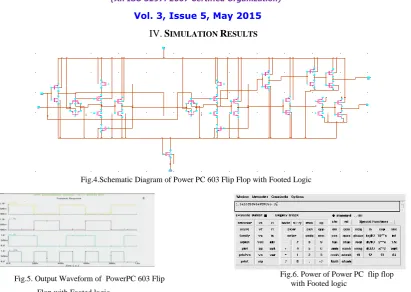
Fig.4.Schematic Diagram of Power PC 603 Flip Flop with Footed Logic
Fig.5. Output Waveform of PowerPC 603 Flip Flop with Footed logic
Fig.6. Power of Power PC flip flop with Footed logic
The clk and d which are the input signal and q&qb are considered as output signals.The output was based on D flip-flop so when 1 is given as input to d then 0 as getting output for q and qb as inverted output of 1.The overall power in footed logic is reduced upto 63% when compared with power pc flip flop.
Fig.7.Schematic Diagram of Proposed DDFF with footed logic
Fig.8.Power of Proposed Dual Dynamic Flip Flop with footed logic
In footed logic technique the NMOS transistor is introduced in the circuit whose gate is shorted with its drain and connected to the source of the NMOS clock transistor. The source of NMOS transistor is connected to gate.The overall power in footed logic is reduced upto 82% when compared with dual dynamic flip flop.
The counter was designed with the help of one 2*1 MUX, one 2input NAND gates, one 2input NOR gate and three power pc flip-flop. The advantage of this counter is a single design was proposed for both counter. The 4by5 counter was based on asynchronous counter it does not require clock pulse for every individual flip flop.In asynchronous counter communication in which data can be transmitted rather than in a steady steam.
Fig.10. Power of Counter (4) using Power PC with footed logic
Fig.11. Power of Counter (5) using Power PC with footed logic
The power is reduced upto 87% when using footed logic in power pc flip flop in 4by5 counter(4 counter). The power is reduced upto 82% when using footed logic in power pc flip flop in 4by5 counter(5 counter). The power consumption in dual dynamic flip flop was better so its greater to consider for designing 4by5 counter using proposed dual dynamic flip flop. We calculate the power of 4by5 counter when the mc signal is 0 so that counter act as 4 counter and then when mc signal is 1 counter act as 5 counter.
Fig.12. Schematic Diagram of 4by5 Counter using Proposed DDFF
The counter is designed with the help of one 2*1 MUX, one 2input NAND gates, one 2input NOR gate and three proposed DDFF. The advantage of this counter is a single design was proposed for both counter. The mc signal which can decide the type of counter. The 4by5 counter was based on asynchronous counter.
Fig.13. Power of Power pc Counter (4) using PDDFF Fig.14. Power of Power pc Counter (5) using PDDFF with Footed logic with Footed logic
The overall power is reduced upto 38% when using footed logic in proposed Dual Dynamic Flip Flop. The overall power is reduced upto 54% when using footed logic in proposed Dual Dynamic Flip Flop. When comparing with other 4by5 counter the overall power is efficiently reduced in 4by5 counter using proposed Dual Dynamic flip flop. By Footed logic technique low power 4by5 counter was designed
Table 1 Comparison of Power with FOOTED logic
Flip-Flop Total Power(µw) Flip-Flop Footed logic Total Power(µw) Power PC 603 5.32 Power PC 603 1.96
Proposed DDFF 1.0 Proposed DDFF 0.171 4 Counter using Power 7.2 4 Counter using Power PC 3.85
5 Counter using Power 7.4 5 Counter using Power PC 4.63 4 Counter using PDDFF 0.912 4 Counter using PDDFF 0.564 5 Counter using PDDFF 1.33 5 Counter using PDDFF 0.609
The comparison table of overall power produced using various flip flop and flip flop with footed logic is compared and given in above table. It was concluded that the 4by5 counter has low power when it is designed using Proposed Dual Dynamic Flip Flop.
V.CONCLUSION
A new low power DDFF and a low power 4by5 counter is designed. The proposed DDFF eliminates the redundant power dissipation present in the XCFF. A comparison of the proposed flip-flop with the conventional flip flops with Footed logic showed that it exhibits lower power dissipation along with comparable speed performances. A new divide 4by5 circuit without pass gates is adopted for the high-speed prescaler. The experimental results of the prescaler have demonstrated its ability to operate up to 1.1 1 GHz with low power consumption .The diode-footed domino circuit design style and demonstrated that the technique is leakage-tolerant, achieves high-performance and low power compared to the conventional domino styles, and is suitable for scaled CMOS technologies. Power is reduced using low power techniques such as FOOTED DIODE and MTCMOS. The power produced by 4/5 counter using proposed Dual Dynamic Flip Flop was reduced upto 38% and 54% for 4 counter and 5 counter respectively.
REFERENCES
1. H. Patrovi, R. Burd, U. Salim, F. Weber, L. DiGregorio, and D. Draper, “Flow through latch and edge triggered flip flop hybrid elements” in Proc. IEEE ISSCC Dig. Tech. Papers, Feb. 1996, pp. 138–139.
2. F. Klass, “Semi-dynamic and dynamic flip-flops with embedded logic,” in Proc. Symp. VLSI Circuits Dig. Tech. Papers Honolulu, HI, Jun. 1998,pp. 108–109.
3. A. Hirata, K. Nakanishi, M. Nozoe, and A. Miyoshi, “The cross charge control flip flop: A low-power and high-speed flip-flop suitable for mobile application SoCs,” in Proc. Symp. VLSI Circuits Dig. Tech Papers, Jun. 2005, pp. 306–307.
4. C. K. Teh, M. Hamada, T. Fujita, H. Hara, N. Ikumi, and Y.Oowaki, “Conditional data mapping flip-flops for low-power and high performance systems,” IEEE Trans. Very Large Scale Integr. (VLSI) Syst., vol. 14, no. 12, pp. 1379–1383, Dec. 2006.
5. V. Stojanovic and V. Oklobdzija, “Comparative analysis of master slave latches and flip-flops for high-performance and low-power systems,”IEEE J. Solid-State Circuits, vol. 34, no. 4, pp. 536–548, Apr.1999.
6. N. Nedovic and V. G. Oklobdzija, “Hybrid latch flip-flop with improved power efficiency,” in Proc. Symp. Integr. Circuits Syst Design, 2000,
7. S. H. Rasouli, A. Khademzadeh, A. Afzali-Kusha, and M. Nourani, “Low-power single- and double-edge-triggered flip-flops for high-speed applications,” Proc. Inst. Elect. Eng. Circuits Devices Syst., vol. 152, no. 2, pp. 118–122, Apr. 2005.
8. O. Sarbishei and M. Maymandi-Nejad, “Power-delay efficient overlap based charge-sharing free pseudo-dynamic D flip-flops,” in Proc. IEEE Int. Symp. Circuits Syst., May 2007, pp. 637–640.
9. O. Sarbishei and M. Maymandi-Nejad, “A novel overlap-based logic cell: An efficient implementation of flip–flops with embedded logic,” IEEE Trans. Very Large Scale Integr. (VLSI) Syst., vol. 18, no. 2, pp. 222–231, Feb. 2010.