ARTICLES
Robert J. Fox, MD
Bruce A.C. Cree, MD,
PhD, MCR
Jerome De Sèze, MD
Ralf Gold, MD
Hans-Peter Hartung, MD
Douglas Jeffery, MD,
PhD
Ludwig Kappos, MD
Michael Kaufman, MD
Xavier Montalbán, MD,
PhD
Bianca
Weinstock-Guttman, MD
Britt Anderson, PhD
Amy Natarajan, MS
Barry Ticho, MD, PhD
Petra Duda, MD, PhD
Correspondence to Dr. Fox: [email protected]
Editorial, page 1484
Supplemental data at Neurology.org
MS disease activity in RESTORE
A randomized 24-week natalizumab treatment interruption study
ABSTRACT
Objective:
RESTORE was a randomized, partially placebo-controlled exploratory study evaluating
multiple sclerosis (MS) disease activity during a 24-week interruption of natalizumab.
Methods:
Eligible patients were relapse-free through the prior year on natalizumab and had no
gadolinium-enhancing lesions on screening brain MRI. Patients were randomized 1:1:2 to
con-tinue natalizumab, to switch to placebo, or to receive alternative immunomodulatory therapy
(other therapies: IM interferon
b
-1a [IM IFN-
b
-1a], glatiramer acetate [GA], or methylprednisolone
[MP]). During the 24-week randomized treatment period, patients underwent clinical and MRI
assessments every 4 weeks.
Results:
Patients (n
5
175) were randomized to natalizumab (n
5
45), placebo (n
5
42), or other
therapies (n
5
88: IM IFN-
b
-1a, n
5
17; GA, n
5
17; MP, n
5
54). Of 167 patients evaluable for
efficacy, 49 (29%) had MRI disease activity recurrence: 0/45 (0%) natalizumab, 19/41 (46%)
placebo, 1/14 (7%) IM IFN-
b
-1a, 8/15 (53%) GA, and 21/52 (40%) MP. Relapse occurred in 4%
of natalizumab patients and in 15%
–
29% of patients in the other treatment arms. MRI disease
activity recurred starting at 12 weeks (n
5
3 at week 12) while relapses were reported as early as
4
–
8 weeks (n
5
2 in weeks 4
–
8) after the last natalizumab dose. Overall, 50/167 patients (30%),
all in placebo or other-therapies groups, restarted natalizumab early because of disease activity.
Conclusions:
MRI and clinical disease activity recurred in some patients during natalizumab
inter-ruption, despite use of other therapies.
Classification of evidence:
This study provides Class II evidence that for patients with MS taking
natalizumab who are relapse-free for 1 year, stopping natalizumab increases the risk of MS relapse
or MRI disease activity as compared with continuing natalizumab.
Neurology®2014;82:1491–1498GLOSSARY
EDSS5Expanded Disability Status Scale;GA5glatiramer acetate;Gd15gadolinium-enhancing;IFN-b-1a5interferon
b-1a;MP5methylprednisolone;MS5multiple sclerosis;PML5progressive multifocal leukoencephalopathy;QOL5quality of life;SDMT5Symbol Digit Modalities Test;VAS5Visual Analogue Scale.
Natalizumab (Tysabri, Biogen Idec Inc., Cambridge, MA) has demonstrated efficacy in the
treatment of multiple sclerosis (MS).
1,2In patients who are anti–JC virus antibody–positive,
natalizumab treatment duration increases the risk of progressive multifocal leukoencephalopathy
(PML),
3–5although PML in patients with MS may have a better prognosis than PML in
HIV-infected patients.
6Planned dosage interruption has been proposed, hypothetically, as a way to mitigate PML
risk.
7–15To date, there have been no prospective controlled studies of the effects of natalizumab
treatment interruption. Some studies suggest that withdrawal of natalizumab treatment for
$
3
months may be associated with return of MS disease activity.
7–17Following natalizumab
From the Mellen Center for Multiple Sclerosis (R.J.F.), Cleveland Clinic, OH; University of California San Francisco Multiple Sclerosis Center (B.A.C.C.); Hopital Civil (J.D.S.), Strasbourg, France; St. Josef Hospital (R.G.), Ruhr University, Bochum; Department of Neurology (H.-P.H.), Heinrich-Heine-University, Düsseldorf, Germany; The MS Center at Advance Neurology at Cornerstone Health Care (D.J.), Advance, NC; Departments of Neurology and Biomedicine (L.K.), University Hospital Basel, Switzerland; MS Center (M.K.), Carolinas Medical Center, Charlotte, NC; Vall dHebron University Hospital (X.M.), Barcelona, Spain; Jacobs MS Center and Pediatric MS Center of Excellence (B.W.-G.), Jacobs Neurological Institute, Buffalo, NY; Infusion Communications (B.A.), Haddam, CT; and Biogen Idec Inc. (A.N., B.T., P.D.), Weston, MA. Go to Neurology.org for full disclosures. Funding information and disclosures deemed relevant by the authors, if any, are provided at the end of the article. The Article Processing Charge was paid by Biogen Idec Inc.
discontinuation, MS disease activity exceeded
prenatalizumab disease activity in some
stud-ies
9,15,16,18,19but not in others.
13,14,20,21The
tim-ing of the return of disease activity and optimal
monitoring and treatment strategies for patients
discontinuing natalizumab are not known.
The objectives of RESTORE, a randomized,
partially placebo-controlled study, were to
explore the course of MS disease activity and
the effects on pharmacokinetic,
pharmacody-namic, and immune parameters in patients
undergoing an interruption of natalizumab
therapy for up to 24 weeks as compared with
those in patients remaining on natalizumab.
It also assessed the effects of alternate therapies
during natalizumab interruption. RESTORE
was an exploratory study and was neither
de-signed nor powered for any specific endpoint
or to detect an effect of natalizumab treatment
interruption on PML occurrence.
We present the clinical and MRI outcomes
during natalizumab treatment interruption
and after restarting natalizumab in RESTORE.
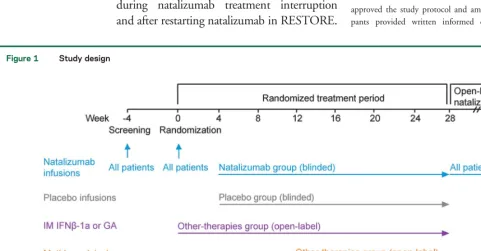
METHODSStudy design.In this phase 4, randomized, mul-ticenter, partially placebo-controlled, parallel-group exploratory study, patients with MS receiving natalizumab were randomized into 3 treatment arms in a 1:1:2 ratio: natalizumab:placebo:alternate immunomodulatory therapy (other therapies: IM interferonb-1a [IM IFN-b-1a] [Avonex, Biogen Idec Inc., Cambridge, MA], glatiramer acetate [GA] [Copaxone, Teva Neuroscience, Kansas City, MO], or methylprednisolone [MP]). In the other-therapies group, patients and their neurologist selected the immunomodulatory therapy on an individual basis; as such, the distribution of patients receiving IM IFN-b-1a, GA, and MP was not randomized, and the groups were unbalanced (figure 1). Planned enrollment was approximately 160 patients randomized 1:1:2 natalizumab:placebo:other therapies. As an exploratory study, the sample and randomization allocation were chosen to evaluate trends in radiologic and clinical disease recurrence in each group. Patients from 31 sites in North America and Europe were randomized using a centralized interactive voice response system at the baseline visit, and randomization was stratified by country and pretreatment disease activity (high vs low). High disease activity was defined as$2 relapses within 12 months prior to initiating natalizumab therapy. The study was performed between March 2010 and November 2011.
Standard protocol approvals, registrations, and patient consents.Each site’s institutional review board reviewed and approved the study protocol and amendments, and all partici-pants provided written informed consent. The study was
Figure 1 Study design
performed in accordance with the Declaration of Helsinki and International Conference on Harmonisation Guideline on Good Clinical Practice and is registered with ClinicalTrials.gov, number NCT01071083.
Primary research question.This analysis of patients with MS who were relapse-free for 1 year on natalizumab therapy was conducted to compare clinical and MRI outcomes during natalizumab treatment interruption with those in patients remaining on natalizumab. While the effects of alternative therapies during natalizumab interruption were also assessed, RESTORE was not designed to compare the efficacy of the different alternative therapies.
Classification of evidence.This study provides Class II evi-dence that for patients with MS taking natalizumab who are relapse-free for 1 year, stopping natalizumab increases the risk of MS relapse or MRI disease activity as compared with continuing natalizumab. Because of differences in baseline characteristics and the open-label design, the comparisons with the alternative immunotherapies group provide Class IV evidence.
Patients.RESTORE enrolled patients between 18 and 60 years of age with relapsing forms of MS who had been treated with na-talizumab for at least 12 months prior to randomization and who had no relapses during those 12 months.
Exclusion criteria included the presence of gadolinium-enhancing (Gd1) lesions on screening MRI; presence of antina-talizumab antibodies at screening; history of significant infectious illness or significant disease other than MS; and inability to undergo monthly MRI scans for 6 months. Patients were also excluded if they received immunosuppressive treatment within 24 months prior to randomization; treatment with IV immuno-globulin, plasmapheresis, or cytapheresis within 12 months prior to randomization; or treatment with systemic corticosteroids within 3 months prior to randomization.
Interventions.At the baseline visit (day 0), all patients received a standard 300-mg natalizumab infusion. Starting at week 4, patients randomized to natalizumab or placebo received infusions every 4 weeks through week 24 in a double-blind fashion. Patients randomized to other therapies who chose IM IFN-b-1a or GA received their first injections on day 0. Patients randomized to other therapies who chose MP received infusions every 4 weeks starting at week 12. All 3 other therapies were administered open-label. Clinical, MRI, and laboratory evaluations were performed every 4 weeks during the randomized treatment period starting at week 0, at the time of suspected relapse, and at the final visit.
At week 28, patients resumed open-label infusions of natalizu-mab and stopped placebo or other therapy. Participants were fol-lowed for an additional 24 weeks, concluding the study at week 52.
Treatment for MS disease recurrence.If a patient experi-enced protocol-defined evidence of MS disease recurrence during the randomized treatment period, the investigator had the option of administering high-dose corticosteroid treatment as per local standard of care or restarting open-label natalizumab infusions. Because natalizumab discontinuation has been linked to severe clinical relapses in some studies,15,18,19disease recurrence
criteria incorporated subclinical measures of radiographic disease activity as detected by every-4-week brain MRI scans. This method allowed physicians to use radiographic criteria to initiate treatment with corticosteroids or restart natalizumab.
Disease recurrence criteria were (1) 1 Gd1lesion of.0.8 cm3in volume, (2) 2 or more Gd1lesions of any size, as reported
by the Central MRI Reading Center (NeuroRx Research,
Montreal, Canada), or (3) a relapse defined as new or recurrent neurologic symptoms not associated with fever or infection, last-ing at least 24 hours and associated with any of the followlast-ing: an increase of$1 grade in$2 functional scales of the Expanded Disability Status Scale (EDSS); an increase of$2 grades in one functional scale of the EDSS; an increase of$1.0 in the overall EDSS score if the previous overall EDSS score was 0.0–5.5; or an increase of$0.5 if the previous overall EDSS score was.5.5.
Patients who restarted natalizumab during the randomized treatment period entered the follow-up period immediately and were followed on open-label natalizumab for 24 weeks. The end of the follow-up period for these patients was considered
“week 52,”even though their total study time may have been less than 52 weeks.
Assessments.The objective of this study was to assess radio-graphic and clinical disease activity in patients with MS undergo-ing up to a 24-week interruption of natalizumab therapy. The time course to return of radiologic or clinical evidence of MS activity was assessed by Gd1 lesions on cranial MRI and clinical relapse.
Evaluations of quality of life (QOL) using a Visual Analogue Scale (VAS), fatigue using the Modified Fatigue Impact Scale, and cognition using the Symbol Digit Modalities Test (SDMT) were performed at the same time points as clinical, MRI, and laboratory evaluations (every 4 weeks during the randomized treatment period starting at week 0, at the time of suspected relapse, and at the final visit). EDSS was assessed at day 0, at week 28, at the time of sus-pected relapse, and at the final visit. EDSS and SDMT evaluations were performed by clinical staff blinded to treatment assignment. The Central MRI Reading Center that performed MRI assessments was blinded to treatment allocation. Investigators assessed patient safety by physical examination (including vital signs), concomitant therapy and procedure recording, laboratory tests, and adverse event and serious adverse event recording.
Statistical analysis.All efficacy analyses were performed on an evaluable population that completed the study through at least week 4 and did not incur any of the following major protocol de-viations: testing positive for anti-IFN-b-1a antibodies and choos-ing IFN-b-1a as an alternative immunomodulatory therapy, not receiving the day 0 (baseline) natalizumab dose, and being previ-ously randomized into the study.
Baseline comparisons were performed using a 1-way analysis of variance for continuous variables and Fisher exact test for pro-portions. Other proportions are presented with exact binomial confidence intervals and were compared using Fisher exact test. Kaplan-Meier analyses were performed andpvalues from log-rank tests are provided.
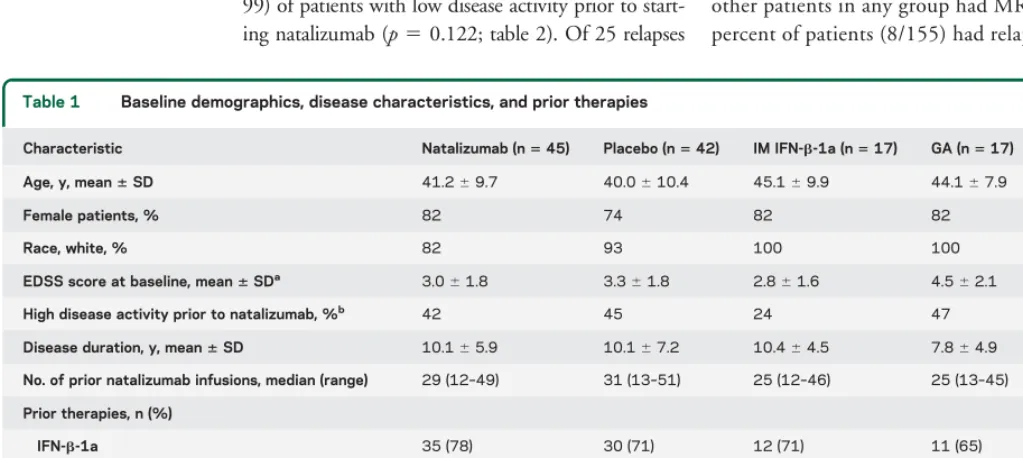
RESULTSPatient demographics and disease characteristics.
return for the protocol-defined monthly visits, and
inclusion/exclusion criteria violations.
Except for baseline EDSS score, baseline
demo-graphics and disease characteristics were similar across
the groups (table 1). Seventy-three percent of
RESTORE patients had prior IFN-
b
-1a use, 37%
had prior GA use, and 33% had prior IFN-
b
-1b use.
MRI disease activity.
During the randomized
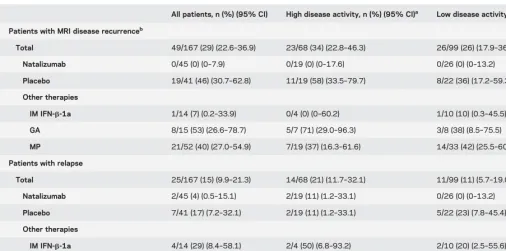
treat-ment period, 49 of 122 patients (40%) randomized
to placebo or other therapies had MRI activity
meet-ing disease recurrence criteria, while none of the
pa-tients randomized to natalizumab had MRI activity
meeting the criteria (
p
,
0.001). Thirty-four
percent (23/68) of patients with high disease
activity prior to natalizumab treatment had MRI
activity meeting criteria during the randomized
treatment period; the proportion was 26% (26/99)
for those with low disease activity prior to
natalizumab treatment (
p
5
0.305; table 2). No
MRI activity meeting defined disease recurrence
criteria was detected prior to week 12. A total of 49
patients developed MRI findings that met defined
criteria for disease recurrence; 3 patients (6%) at
week 12, 37 patients (76%) at week 16 or 20, and
9 patients (18%) after week 20 (figure 2A).
Relapse.
Twenty-three of 122 patients (19%) off
nata-lizumab and 2 of 45 patients (4%) on natanata-lizumab
experienced relapses during the randomized treatment
period (
p
5
0.026). Relapses occurred in 21% (14/68)
of patients with high disease activity and in 11% (11/
99) of patients with low disease activity prior to
start-ing natalizumab (
p
5
0.122; table 2). Of 25 relapses
occurring during the randomized treatment period, 2
(8%) occurred between weeks 4 and 8, 9 (44%)
occurred between weeks 8 and 16, and 14 (56%)
occurred between weeks 16 and 28 (figure 2B). Two
patients with high disease activity (in GA and MP
groups) experienced a relapse in both the randomized
treatment period and in the follow-up period.
Natalizumab restart.
During the randomized treatment
period, 50 patients restarted open-label natalizumab,
including 12 patients who experienced a clinical
relapse without MRI activity and 7 patients who had
both a clinical relapse and MRI activity. Thirty-one
of 40 patients (78%) who met MRI criteria without
experiencing a clinical relapse restarted natalizumab;
an additional 2 patients were treated with steroids.
Time to restarting natalizumab is shown in figure 2C.
QOL, fatigue, and cognition.
Measures of QOL,
fatigue, and cognition were exploratory measures
and analyzed separately for patients who continued
on their randomized treatment through week 28
and for those who restarted natalizumab earlier due
to disease recurrence. Patients experiencing disease
activity showed a mean decrease from baseline in
VAS score at the time of relapse (results are provided
in table e-1 and figure e-1 on the
Neurology
®Web site
at Neurology.org).
Follow-up.
At the week 52 follow-up visit, after 24
weeks of open-label natalizumab, one patient in
the placebo group had 1 Gd
1
lesion on MRI; no
other patients in any group had MRI activity. Five
percent of patients (8/155) had relapses during the
Table 1 Baseline demographics, disease characteristics, and prior therapies
Characteristic Natalizumab (n545) Placebo (n542) IM IFN-b-1a (n517) GA (n517) MP (n554)
Age, y, mean6SD 41.269.7 40.0610.4 45.169.9 44.167.9 40.1610.0
Female patients, % 82 74 82 82 72
Race, white, % 82 93 100 100 93
EDSS score at baseline, mean6SDa 3.061.8 3.361.8 2.861.6 4.562.1 3.061.4
High disease activity prior to natalizumab, %b 42 45 24 47 35
Disease duration, y, mean6SD 10.165.9 10.167.2 10.464.5 7.864.9 8.966.7
No. of prior natalizumab infusions, median (range) 29 (12–49) 31 (13–51) 25 (12–46) 25 (13–45) 28 (13–50)
Prior therapies, n (%)
IFN-b-1a 35 (78) 30 (71) 12 (71) 11 (65) 39 (72)
GA 18 (40) 18 (43) 6 (35) 8 (47) 15 (28)
IFN-b-1b 13 (29) 11 (26) 6 (35) 5 (29) 22 (41)
Corticosteroids 6 (13) 7 (17) 2 (12) 2 (12) 2 (4)
Mitoxantrone 6 (13) 4 (10) 0 1 (6) 3 (6)
Methotrexate 1 (2) 4 (10) 1 (6) 0 3 (6)
Abbreviations: EDSS5Expanded Disability Status Scale; GA5glatiramer acetate; IFN-b-1a5interferonb-1a; MP5methylprednisolone.
aAll baseline characteristics were well-balanced among the study groups (nominalp.0.05) with the exception of EDSS score at baseline (p50.016).
follow-up period; 5 of the 8 patients were not
receiving natalizumab during the randomized
treatment period, and 3 patients had a relapse
within 4 weeks of reinitiation of open-label
natalizumab treatment. Nineteen of 175 patients
(11%) did not receive natalizumab during the
follow-up period, and one patient was excluded
from the analysis.
Safety.
During the randomized treatment and
follow-up periods, the majority of patients in all
groups had at least one adverse event: randomized
treatment period: natalizumab, 84% (n
5
38);
placebo, 83% (n
5
35); IM IFN-
b
-1a, 88%
(n
5
15); GA, 88% (n
5
15); MP, 78% (n
5
42);
follow-up period: natalizumab, 58% (n
5
25);
placebo, 51% (n
5
19); IM IFN-
b
-1a, 69%
(n
5
9); GA, 73% (n
5
11); MP, 50% (n
5
24).
Adverse events were primarily mild or moderate in
severity, and the most frequently reported adverse
events were generally consistent with MS and
disease-modifying therapy product labels, but also
included
upper
respiratory
tract
infection,
nasopharyngitis, and influenza-type illness (table e-2).
Four patients withdrew from the study during the
randomized treatment period due to severe fatigue
(placebo), moderate muscular weakness (placebo),
mild hypoesthesia (IM IFN-
b
-1a), and a serious
adverse event of brain abscess (MP). There were no
deaths during the study.
DISCUSSION
Natalizumab is often used to treat
pa-tients whose disease has been inadequately controlled
with
other therapies,
and natalizumab-treated
patients are at significant risk of disease recurrence
following treatment cessation. RESTORE is the
largest randomized prospective study to date
analyzing MS disease recurrence during natalizumab
treatment interruption in a subpopulation of
patients who had been stable on natalizumab for
over a year with no Gd
1
lesions at baseline.
Disease
recurred
in
a
large
proportion
of
RESTORE patients who discontinued natalizumab
treatment, and radiologic disease recurrence was
more frequent in patients with high disease activity
(based on relapses) prior to natalizumab therapy than
in patients with low disease activity prior to starting
natalizumab.
22The safety evaluations were generally
consistent with the labeled risk profile for each of
the respective marketed products, notably for
natalizumab.
Similar to smaller observational studies and
retros-pective analyses,
8,10–12,15,18RESTORE demonstrated
that natalizumab treatment interruption resulted in
occurrence of MRI disease activity as early as 12
weeks, and of clinical disease activity as early as 4
–
8
weeks, after the last natalizumab dose. The earlier
recurrence of clinical disease vs radiologic disease
may also reflect the more subjective nature of clinical
relapse reporting, although our study design required
objective EDSS changing for defining a clinical
Table 2 Patients with disease recurrence during the randomized treatment periodAll patients, n (%) (95% CI) High disease activity, n (%) (95% CI)a Low disease activity, n (%) (95% CI)
Patients with MRI disease recurrenceb
Total 49/167 (29) (22.6–36.9) 23/68 (34) (22.8–46.3) 26/99 (26) (17.9–36.1)
Natalizumab 0/45 (0) (0–7.9) 0/19 (0) (0–17.6) 0/26 (0) (0–13.2)
Placebo 19/41 (46) (30.7–62.8) 11/19 (58) (33.5–79.7) 8/22 (36) (17.2–59.3)
Other therapies
IM IFN-b-1a 1/14 (7) (0.2–33.9) 0/4 (0) (0–60.2) 1/10 (10) (0.3–45.5)
GA 8/15 (53) (26.6–78.7) 5/7 (71) (29.0–96.3) 3/8 (38) (8.5–75.5)
MP 21/52 (40) (27.0–54.9) 7/19 (37) (16.3–61.6) 14/33 (42) (25.5–60.8)
Patients with relapse
Total 25/167 (15) (9.9–21.3) 14/68 (21) (11.7–32.1) 11/99 (11) (5.7–19.0)
Natalizumab 2/45 (4) (0.5–15.1) 2/19 (11) (1.2–33.1) 0/26 (0) (0–13.2)
Placebo 7/41 (17) (7.2–32.1) 2/19 (11) (1.2–33.1) 5/22 (23) (7.8–45.4)
Other therapies
IM IFN-b-1a 4/14 (29) (8.4–58.1) 2/4 (50) (6.8–93.2) 2/10 (20) (2.5–55.6)
GA 4/15 (27) (7.8–55.1) 3/7 (43) (9.9–81.6) 1/8 (13) (0.3–52.7)
MP 8/52 (15) (6.9–28.1) 5/19 (26) (9.1–51.2) 3/33 (9) (1.9–24.3)
Abbreviations: CI5confidence interval; GA5glatiramer acetate; Gd1 5gadolinium-enhancing; IFN-b-1a5interferonb-1a; MP5methylprednisolone. aHigh disease activity was defined as
$2 relapses occurring within the 12 months prior to initiating natalizumab therapy.
relapse. While most studies report that disease recurs
an average of
$
3 months after the last natalizumab
dose,
7,9–15,17,18,20relapses occurring during the first
1
–
3 months have also been observed.
7,11,12,14,15,20The emergence of MRI disease activity is consistent
with RESTORE pharmacodynamic data, which
showed that pharmacodynamic markers were
consis-tent with levels in non
–
natalizumab-treated patients
at 16 weeks after the last dose.
22In RESTORE, GA starting after the last dose of
natalizumab and monthly MP starting 12 weeks after
the last natalizumab dose did not appear to be
effec-tive in disease suppression, as compared with
contin-ued natalizumab treatment. Starting MP at 12 weeks
may have been too late to prevent disease activity,
although most patients randomized to MP did not
have disease recurrence until after 12 weeks. There
appeared to be less recurrence of MRI disease activity
with IM IFN-
b
-1a than with other open-label
treat-ments, although the IM IFN-
b
-1a group had a lower
proportion of patients with high disease activity
prenatalizumab than the other groups. However,
patients were not randomly assigned to specific
treatments within the other-therapy group, and
RESTORE was neither designed nor adequately
pow-ered to compare the efficacy of the different
alterna-tive immunomodulatory therapies. Therefore, larger
controlled trials would be needed to confirm this
observation.
Findings on alternative immunomodulatory drug
use during natalizumab treatment interruption have
been mixed. A large retrospective study of more than
1,800 patients showed that during natalizumab
treat-ment interruption, MS disease activity returned to
baseline levels within 4
–
7 months, regardless of
whether patients received immunomodulatory
thera-pies.
20Data from 2 small studies suggested that
im-munomodulating therapies (IM IFN-
b
-1a or GA)
reduced MS disease activity recurrence during
natali-zumab treatment interruption.
14,21In other studies,
use of GA or MP, or fingolimod during natalizumab
treatment interruption was associated with recurrence
of disease activity to higher levels than that seen
dur-ing natalizumab use.
8,9,13,16,23It is unknown whether
other disease-modifying therapies might maintain the
low rate of clinical and radiologic disease activity
in natalizumab-treated patients who discontinue
natalizumab.
Some studies have suggested that MS disease
activity returns to a higher than baseline level during
natalizumab
treatment
interruption,
9,15,16,18,19although larger studies have not shown evidence of
overshoot.
13,20,21The nature of MRI disease
recur-rence in RESTORE will be characterized in more
detail in a separate report.
This study used serial monthly MRI scans
follow-ing natalizumab discontinuation and specific disease
activity criteria for resuming natalizumab treatment.
The majority of patients who experienced defined
MRI disease activity restarted natalizumab during
Figure 2 Time to MRI disease recurrence, relapse, and restarting natalizumabprior to week 28 due to disease recurrence
the randomized treatment period despite the absence
of clinical symptoms, suggesting that physicians made
clinical decisions based on MRI findings. It is
plausi-ble that use of MRI criteria for restarting natalizumab
treatment following discontinuation reduced the
occurrence of severe clinical relapses that have been
reported in other studies. Results from RESTORE
and other studies suggest that, in patients who
discon-tinue natalizumab, brain MRI surveillance beginning
12
–
16 weeks after the last natalizumab infusion may
be useful for identifying patients with a return of
disease activity.
24The results suggest planned dosage interruption is
likely not useful for the management of most patients
switching to no treatment or to the disease-modifying
therapies employed in this study. The extent and time
course of disease recurrence described in this
randomi-zed prospective study are highly relevant for all patients
discontinuing natalizumab treatment for any reason
and
—
together with the recognition of risk factors for
PML
3—
may also inform decisions about the timing
and choice of alternative therapies.
AUTHOR CONTRIBUTIONS
Drafting/revising the manuscript for content, including medical writing for content: R.J.F., B.A.C.C., J.D., R.G., H.-P.H., D.J., L.K., M.K., X.M., B.W.-G., B.A., A.N., B.T., P.D. Study concept or design: R.J.F., B.A.C.C., J.D., R.G., H.-P.H., D.J., L.K., M.K., X.M., B.W.-G., A.N., B.T., P.D. Analysis or interpretation of data: R.J.F., B.A.C.C., J.D., R.G., H.-P.H., D.J., L.K., M.K., X.M., B.W.-G., A.N., B.T., P.D. Acquisition of data: R.J.F., B.A.C.C., J.D., R.G., H.-P.H., D.J., L.K., M.K., X.M., B.W.-G. Statistical analysis: A.N. Study supervision or coordination: P.D. Obtaining funding: P.D.
ACKNOWLEDGMENT
Biogen Idec provided funding for editorial support in the development of this article; Britt Anderson, PhD, from Infusion Communications, wrote the first draft of the manuscript based on input from authors, and Jackie Cannon from Infusion Communications copyedited and styled the manu-script per journal requirements. Biogen Idec reviewed and provided feed-back on the paper to the authors. The authors had full editorial control and provided their final approval of all content.
STUDY FUNDING Sponsored by Biogen Idec Inc.
DISCLOSURE
R. Fox has received consultant fees from Allozyne, Avanir, Biogen Idec, EMD Serono, Novartis, Questcor, Teva, and Xenoport and has received research support from Biogen Idec and Novartis. B. Cree has received consulting honoraria from AbbVie, Biogen Idec, EMD Serono, Gen-zyme, Novartis, sanofi-aventis, and Teva Neurosciences. J. De Sèze has received honoraria from Bayer Schering, Biogen Idec, LFB, Merck Serono, Novartis, sanofi-aventis, and Teva. R. Gold has received research support and honoraria from Bayer HealthCare, Biogen Idec, Merck Serono, and Teva; is Editor-in-Chief ofTherapeutic Advances in Neurological Disorders; has received a license fee from Biogen Idec (no future rights); and has received research support from Bayer Health-Care, Biogen Idec, Merck Serono, Novartis, and Teva. H. Hartung has received honoraria for consulting and speaking at symposia from Bayer HealthCare, Biogen Idec, BioMS, Genzyme, Merck Serono, Novartis, Roche, sanofi-aventis, and Teva. D. Jeffery is a consultant for Acorda, Berlex, Genzyme, GlaxoSmithKline, Novartis, Pfizer, Questcor, Serono, and Teva, and has received research support from Berlex,
Biogen Idec, Novartis, Pfizer, Serono, and Teva. L. Kappos has received research support from Acorda, Actelion, Allozyne, BaroFold, Bayer HealthCare, Bayer Schering, Bayhill, Biogen Idec, Boehringer Ingelheim, Elan, Genmab, GlaxoSmithKline, Glenmark, Merck Serono, MediciNova, Novartis, sanofi-aventis, Santhera, Shire, Roche, Teva, UCB, Wyeth, Swiss MS Society, Swiss National Research Foun-dation, European Union, Gianni Rubatto FounFoun-dation, and the Novar-tis and Roche Research Foundations. M. Kaufman has received honoraria and research support from Biogen Idec; has received financial support from Bayer, EMD Serono, Novartis, and Teva; and is a con-sultant for the Department of Defense. X. Montalbán has received speaking honoraria and travel expenses for scientific meetings, has been a steering committee member of clinical trials, or has participated in advisory boards of clinical trials in the past years with Almirall, Bayer Schering, Biogen Idec, EMD Merck Serono, Genentech, Genzyme, Novartis, sanofi-aventis, and Teva. B. Weinstock-Guttman has received honoraria for speaking and serving on scientific advisory boards from Acorda, Biogen Idec, EMD Serono, Novartis, Pfizer, and Teva, and has received financial support for research from Acorda, Biogen Idec, EMD Serono, Novartis, Pfizer, and Teva. B. Anderson is an employee of Infusion Communications, which received funding for writing and editorial support from Biogen Idec. A. Natarajan is an employee of Biogen Idec. B. Ticho is an employee of Biogen Idec. P. Duda is an employee of Biogen Idec. Go to Neurology.org for full disclosures.
Received March 1, 2013. Accepted in final form December 17, 2013.
REFERENCES
1. Polman CH, O’Connor PW, Havrdova E, et al. A random-ized, placebo-controlled trial of natalizumab for relapsing multiple sclerosis. N Engl J Med 2006;354:899–910. 2. Rudick RA, Stuart WH, Calabresi PA, et al. Natalizumab
plus interferon beta-1a for relapsing multiple sclerosis. N Engl J Med 2006;354:911–923.
3. Bloomgren G, Richman S, Hotermans C, et al. Risk of natalizumab-associated progressive multifocal leukoen-cephalopathy. N Engl J Med 2012;366:1870–1880. 4. Fox RJ, Rudick RA. Risk stratification and patient
coun-seling for natalizumab in multiple sclerosis. Neurology 2012;78:436–437.
5. Major EO. Progressive multifocal leukoencephalopathy in patients on immunomodulatory therapies. Annu Rev Med 2010;61:35–47.
6. Wenning W, Haghikia A, Laubenberger J, et al. Treat-ment of progressive multifocal leukoencephalopathy associated with natalizumab. N Engl J Med 2009;361: 1075–1080.
7. Borriello G, Prosperini L, Marinelli F, Fubelli F, Pozzilli C. Observations during an elective interruption of natalizumab treatment: a post-marketing study. Mult Scler 2011;17:372–375.
8. Borriello G, Prosperini L, Mancinelli C, Gianni C, Fubelli F, Pozzilli C. Pulse monthly steroids during an elective interruption of natalizumab: a post-marketing study. Eur J Neurol 2012;19:783–787.
9. Havla J, Gerdes LA, Meinl I, et al. De-escalation from natalizumab in multiple sclerosis: recurrence of disease activity despite switching to glatiramer acetate. J Neurol 2011;258:1665–1669.
10. Kaufman MD, Lee R, Norton HJ. Course of relapsing-remitting multiple sclerosis before, during and after nata-lizumab. Mult Scler 2011;17:490–494.
12. Killestein J, Vennegoor A, Strijbis EM, et al. Natalizumab drug holiday in multiple sclerosis: poorly tolerated. Ann Neurol 2010;68:392–395.
13. Magraner MJ, Coret F, Navarre A, et al. Pulsed steroids followed by glatiramer acetate to prevent inflammatory activity after cessation of natalizumab therapy: a prospec-tive, 6-month observational study. J Neurol 2011;258: 1805–1811.
14. Rossi S, Motta C, Studer V, et al. Effect of glatiramer acetate on disease reactivation in MS patients discontinu-ing natalizumab. Eur J Neurol 2013;20:87–94. 15. West TW, Cree BA. Natalizumab dosage suspension: are
we helping or hurting? Ann Neurol 2010;68:395–399. 16. Rinaldi F, Seppi D, Calabrese M, Perini P, Gallo P.
Switching therapy from natalizumab to fingolimod in relapsing-remitting multiple sclerosis: clinical and mag-netic resonance imaging findings. Mult Scler 2012;18: 1640–1643.
17. Sempere AP, Martin-Medina P, Berenguer-Ruiz L, et al. Switching from natalizumab to fingolimod: an observa-tional study. Acta Neurol Scand 2013;128:e6–e10. 18. Miravalle A, Jensen R, Kinkel RP. Immune reconstitution
inflammatory syndrome in patients with multiple sclerosis
following cessation of natalizumab therapy. Arch Neurol 2011;68:186–191.
19. Vellinga MM, Castelijns JA, Barkhof F, Uitdehaag BM, Polman CH. Postwithdrawal rebound increase in T2 lesional activity in natalizumab-treated MS patients. Neurology 2008;70:1150–1151.
20. O’Connor PW, Goodman A, Kappos L, et al. Disease activity return during natalizumab treatment interruption in patients with multiple sclerosis. Neurology 2011;76:1858–1865. 21. Stüve O, Cravens PD, Frohman EM, et al. Immunologic,
clinical, and radiologic status 14 months after cessation of natalizumab therapy. Neurology 2009;72:396–401. 22. Cree B, De Seze J, Fox R, et al. RESTORE study: effects of
a 24-week natalizumab treatment interruption on immune parameters and multiple sclerosis magnetic resonance imag-ing disease activity. Neurology 2012;78:P06.168. 23. Centonze D, Rossi S, Rinaldi F, Gallo P. Severe relapses
under fingolimod treatment prescribed after natalizumab. Neurology 2012;79:2004–2005.
24. Grimaldi LM, Prosperini L, Vitello G, Borriello G, Fubelli F, Pozzilli C. MRI-based analysis of natalizumab therapeutic window in multiple sclerosis. Mult Scler 2012; 18:1337–1339.
Pre-order 2014 Annual Meeting On Demand and Save
Take the meeting home with you. AAN Annual Meeting On Demand is the comprehensive digital
library of presentations from the 2014 Annual Meeting providing more than 500 hours* of
edu-cational content. Special discounted pricing is available when you pre-order before the Annual
Meeting.
Learn more at
AANonDemand.com/ad
*Total hours of presentations available subject to speaker permissions.
Enjoy Big Savings on NEW 2014 AAN Practice
Management Webinars Subscriptions
The American Academy of Neurology offers 14 cost-effective Practice Management Webinars you
can attend live or listen to recordings posted online. AAN members can purchase one webinar for
$149 or subscribe to the entire series for only $199.
This is new pricing for 2014 and significantly less
than 2013
—
and big savings from the new 2014 nonmember price of $199 per webinar or $649 for
the subscription. Register today for these and other 2014 webinars at
AAN.com/view/pmw14:
April 8
–
How PQRS Quality Measures Will Inform Future Medicare Value-based Payments
May 13
–
Measuring and Improving Your Patients
’
Experience
DOI 10.1212/WNL.0000000000000355
2014;82;1491-1498 Published Online before print March 28, 2014
Neurology
Robert J. Fox, Bruce A.C. Cree, Jerome De Sèze, et al.
interruption study
MS disease activity in RESTORE: A randomized 24-week natalizumab treatment
This information is current as of March 28, 2014
rights reserved. Print ISSN: 0028-3878. Online ISSN: 1526-632X.
Services
Updated Information &
http://n.neurology.org/content/82/17/1491.full
including high resolution figures, can be found at:
Supplementary Material
355.DC2
http://n.neurology.org/content/suppl/2014/03/28/WNL.0000000000000
355.DC1
http://n.neurology.org/content/suppl/2014/03/28/WNL.0000000000000
Supplementary material can be found at:
References
http://n.neurology.org/content/82/17/1491.full#ref-list-1
This article cites 24 articles, 5 of which you can access for free at:
Citations
http://n.neurology.org/content/82/17/1491.full##otherarticles
This article has been cited by 8 HighWire-hosted articles:
Subspecialty Collections
http://n.neurology.org/cgi/collection/multiple_sclerosis
Multiple sclerosis
http://n.neurology.org/cgi/collection/mri
MRI
following collection(s):
This article, along with others on similar topics, appears in the
Errata
/content/84/8/862.full.pdf
or:
page
next
An erratum has been published regarding this article. Please see
Permissions & Licensing
http://www.neurology.org/about/about_the_journal#permissions
its entirety can be found online at:
Information about reproducing this article in parts (figures,tables) or in
Reprints
http://n.neurology.org/subscribers/advertise
Information about ordering reprints can be found online:
rights reserved. Print ISSN: 0028-3878. Online ISSN: 1526-632X.
the rest regarding neuropathologic markers. The
pres-ence of comorbid depression in Alzheimer disease
(AD) has been demonstrated to correspond to
increases in AD-related neuropathologic changes
beyond age, sex, level of education, and cognitive
status.
3Moreover, lifetime history of depression in
patients with AD has been associated with higher levels
of plaque and tangle formation in the hippocampus.
4The authors did not provide information on the
use of psychotropic agents such as antidepressants
or lithium. Antidepressants or mood stabilizers may
not only counteract depression, but also exert
neuroprotective and neurotrophic actions extending
beyond mood effects.
5© 2015 American Academy of Neurology
Author Response: Robert S. Wilson, Chicago:
The authors
1thank Kunte et al. for their
com-ments. We agree that the levels of depressive
symp-toms in the cohort were mostly mild (i.e., 54.6%
with none, 30.7% with 1 or 2, and 14.7% with 3 or
more). It is surprising that the variability within
this relatively narrow range of depression severity
accounted for nearly 5% of the variance in rates of
cog-nitive decline (after adjustment for demographic and
postmortem pathologic variables). If the cohort
con-tained a higher proportion of participants with severe
depression (defined psychometrically or diagnostically),
the association of depression with cognitive decline
would likely have been stronger. We agree that our
findings do not rule out the possibility that depression
only influences the accumulation of dementia-related
pathologies when it is severe. We plan to investigate this
possibility. We agree that antidepressants may have a
neuroprotective effect, but we have not yet seen
evi-dence suggestive of this.
© 2015 American Academy of Neurology
1. Wilson RS, Capuano AW, Boyle PA, et al. Clinical-pathologic study of depressive symptoms and cognitive decline in old age. Neurology 2014;83:702–709.
2. Diniz BS, Butters MA, Albert SM, et al. Late-life depression and risk of vascular dementia and Alzheimer’s disease: systematic review and meta-analysis of community-based cohort studies. Br J Psychiatry 2013;202:329–335. 3. Rapp MA, Schnaider-Beeri M, Purohit DP, et al. Increased
neurofibrillary tangles in patients with Alzheimer disease with comorbid depression. Am J Geriatr Psychiatry 2008; 16:168–174.
4. Rapp MA, Schnaider-Beeri M, Grossman HT, et al. Increased hippocampal plaques and tangles in patients with Alzheimer disease with a lifetime history of major depres-sion. Arch Gen Psychiatry 2006;63:161–167.
5. Cirrito JR, Disabato BM, Restivo JL, et al. Serotonin sig-naling is associated with lower amyloid-blevels and plaques in transgenic mice and humans. Proc Natl Acad Sci USA 2011;108:14968–14973.
CORRECTION
MS disease activity in RESTORE: A randomized 24-week natalizumab treatment interruption study
In the article“MS disease activity in RESTORE: A randomized 24-week natalizumab treatment interruption study”by R.J. Fox et al. (Neurology®2014;82:1491–1498), the supplemental file listing all study coinvestigators and sites was
omitted. It is now available as supplemental data with the article. The authors regret the error.
Author disclosures are available upon request ([email protected]).
862 Neurology 84 February 24, 2015