Available Online atwww.ijcsmc.com
International Journal of Computer Science and Mobile Computing
A Monthly Journal of Computer Science and Information Technology
ISSN 2320–088X
IJCSMC, Vol. 3, Issue. 5, May 2014, pg.280 – 287
RESEARCH ARTICLE
An Improved Stable Election Based
Routing Protocol with Threshold
Sensitiveness for Wireless Sensor Network
Anand Mohan Tripathi
1, P.Velmurugan
21
M.tech Student, Department of Computer Science & Engineering, SRM University, India
2Assistant Professor, Department of Computer science & Engineering, SRM University, India
Abstract- This paper deals with the routing protocol for wireless sensor networks. Many conventional protocols for WSNs like Low Energy adaptive Clustering Hierarchy (LEACH), Stable Election Protocol (SEP), Threshold Sensitive Energy Efficient Network (TEEN), Distributed Energy Efficient Clustering Protocol (DEEC) may not be optimal and energy efficient. In this paper according to this improved protocol we can get the best result as it is a reactive protocol which uses three levels of heterogeneity. Reactive networks are different from proactive networks and respond immediately to changes in relevant parameters of interest. We evaluate performance of our new protocol for a simple temperature sensing application zone and compare results of our new protocol with some other protocols like LEACH, TEEN and from simulation results it is observed that I-SETS protocol performance is the better than previous implemented protocols for WSNs.
Keywords: Wireless Sensor Networks, Zone, Stable, Election, Protocol, Threshold
1. Introduction
stationary and can be deployed in their environment randomly or with a proper deployment mechanism. In random deployment of sensors there is even distribution of nodes over the field, while for regular deployment nodes are in static mode. Some amount of energy of nodes is consumed during sensing as well as some part of energy is reduced due to transmission and reception of data. Practically, this is not possible to replace or recharge batteries of nodes if once nodes deployed in field or in a zone. WSN must operate without human involvement so that main focus is to increase network life as well as security in any way and for this purpose many protocols are introduced. The Routing protocols can be classified on the basis of their applications into following two categories:
A. Proactive Routing Protocols: The Nodes available in network provide a continuous report of data, nodes keep on sensing the environment, turn on their transmitters and transmit, so suitable for applications where information on regular basis is required.
B. Reactive Routing Protocols: The Nodes sense data continuously however, transmit only at the time when there is a sudden change in sensed value of the environment, so, reactive networks are suitable for time critical applications.
In routing protocols clustering of nodes reduces energy consumption in sensor nodes [2, 5, 11,12]. When clusters are formed, election of CHs(Cluster Head) can be done on the basis of energy of nodes or on probability of nodes to be elected as CHs(Cluster Head). After clusters formation is done each node transmits data during its available time slot and as the last node transmits data, schedule is repeated. The total time which is spent in completing this schedule is called frame time. Direct Transmission is also a traditional approach in which each node senses data and turns on its transmitter and sends its data directly to sink. Those nodes which are placed closed to sink, data transmission causes less reduction in energy however for nodes at far distances from sink will consume more energy and will die more quickly [1].
Fig.1 (a) single hop (b) multi hop clustering in WSN
2. Background and Related Work
The Clustering procedures in sensor network are associated with energy control. We show a brief description of some of concerned protocols provided in this section. For Minimum Transmission Energy (MTE) [2], transmission is done through the paths where minimum transmission power is depleted. So, under Minimum Transmission Energy (MTE), nodes that are at large distances from the sink will die later, while nodes which are near to sink act as conveys and so they will die sooner.
and then convey this data to the sink or to the Base Station (BS). All the nodes deployed in field or in an area are homogeneous and constrained in energy. To reduce burden among nodes, improve network life clusters are formed. Nodes are made to become CHs on their turns. Nodes are given chance to be electing themselves as CHs randomly and it is done in a way that each node becomes CH once in an epoch 1/P [1, 7, 8, 9]. CHs (cluster Head) selection is done on probabilistic basis, a random number r is generated by each node .The random number r is inclusive of 0 and 1, if generated value is less than threshold computed by formula given below, then this node becomes CH(Cluster Head).
if nεG’ (1)
0 otherwise
After clusters formation is done, each CH broadcasts a TDMA (Time Division Multiple Access) schedule for nodes associated with it. Nodes sense the data and transmit data to associated CHs (Cluster Head) during time slots assigned to them. Once each node in a cluster sent data then frame is repeated. In WSNs, our main purpose is to control energy consumption and hence to increase life of the entire network.
Drawback:-Drawback of LEACH is that it is not useful to be used in large areas due to energy constraint. In LEACH once attributes are selected, they cannot be changed during communication.
(ii). Stable Election Protocol (SEP)
As described in [4], heterogeneity is introduced in SEP (Stable Election Protocol) protocol. This protocol is based on two levels of heterogeneity. A fraction m of total n nodes is given with an additional energy factor α, which are called advanced nodes. So, probabilities of normal nodes and advanced nodes to become CHs (Cluster Head Selection) can be expressed as given below:
pnrml = popt/(1+m.α) and padvc = popt./(1+m.α) respectively, where popt is the optimal probability of each node to become CH(Cluster Head). CHs(cluster Head Selection)election in SEP (Stable Election Protocol) is done randomly on the basis of probability of each type of node as in LEACH. Nodes sense data and transmit this data to associated CH(cluster head) which convey it to BS (Base Station).
Drawback:- Drawback of SEP is that it has two level heterogeneity and also caused increased throughput.
(iii). Threshold Sensitive Energy Efficient sensor Network protocol (TEEN)
WE know that a reactive routing network protocol can be used for time critical applications. In TEEN (Threshold Sensitive Energy Efficient sensor Network protocol) transmission is done only when a sudden and solid change occurs in field. This protocol is a threshold sensitive protocol which is based on two threshold levels, hard threshold and soft threshold. Whenever the sensed attribute’s value becomes equal or greater than hard threshold then nodes turn on their transmitters and data is conveyed to CHs (Cluster Head Selection). And for the second time the nodes transmit data only in case when the difference between sensed value and previously saved value at which transmission was done is greater than or equal to soft threshold. That’s why energy consumption as well as throughput is reduced and as a result network life and stability period are improved than other protocols discussed above [6].
Drawback:-TEEN in the presence of high energy nodes goes to in a large unstable region. The reason is that, all high energy nodes are equipped with almost the same energy however, the CH (Cluster Head) selection process is unstable and as a result most of the time these nodes are idle, as there is no CH (Cluster Head) to transmit.
3. Proposed protocol Concept
In this section we describe our new improved protocol I-SETSP (Improved Stable Election Threshold sensitiveness Protocol) which has three main features: “It is a reactive routing protocol”, as transmission consumes more energy than sensing and it is done only when a specific threshold is reached and “Three levels of heterogeneity” and it improves storage mechanism of data packets in buffer .We describe whole protocol clearly and for this we particularly discuss about energy model and how optimal number of clusters can be computed. For three levels of heterogeneity we consider nodes with different energy levels are:
1) Normal Nodes
2) Intermediate Nodes
3) Advance Nodes
We know that advance nodes have energy greater than all other nodes, intermediate nodes have energy in between normal nodes and advance nodes while remaining nodes are normal nodes. We can choose Intermediate nodes by using b and a fraction of nodes which are intermediate nodes and using the relation that energy of normal nodes is µ times more than that of normal nodes. In SEP protocol energy for normal nodes is Eo, for advance nodes it is
E
ADV = Eo(1+α) and energy for intermediate nodes can be computed as EINT = Eo(1 + µ), where µ = α/2 . So total energy of normal nodes and advance nodes and for intermediate nodes will be, n.b(1 + α), nEo.(1 − m − bn), and n.m.Eo.(1 + α) respectively. So, the total Energy of all the nodes will be, nEo.(1−m−bn) + n.m.Eo.(1 + α) + n.b.(1 + µ) = n.Eo(1 + mα + bµ).Where, n is number of nodes m is proportion of advanced nodes to total number of nodes n with energy more than rest of nodes and b is proportion of intermediate nodes.According to SEP protocol optimal probability of cluster head is given by
(2)
Where Kopt is the optimal number of clusters and n is the number of advance nodes.
Now we can calculate the optimal probability of normal nodes using equation (2) which is given below:
(3)
Probability for intermediate nodes using equation (2) which is given below:
(4)
Probability for advance nodes using equation (2) which is given below:
(5)
Where m=proportion of advance nodes to total no. of nodes n with energy more than rest and b=proportion of intermediate nodes.
Now for the calculation of threshold sensitiveness calculation from equations (1), (3), (4), (5).
Threshold for normal nodes can be expressed as given below
if nεG’ (6)
Threshold for intermediate nodes can be expressed as given below
if nεG’’ (7)
0 otherwise
Threshold for advance nodes can be expressed as given below
if nεG’’’ (8)
0 otherwise
G′, G′′ and G′′′ are the set of normal nodes, intermediate nodes and set of advanced nodes that has not become CHs (Cluster Head Selection) in the past respectively, so ensuring that the equations (2), (3), (4) and (5) are working. Average total number of CHs per round will be:
n.(1 − m− b).pnrml + n.b.pint + n.m.padvc = n.popt (9)
Here is a good aspect of our improved protocol that the energy dissipation is reduced due to energy heterogeneity. At the starting level of each round, here takes place the phenomenon of cluster change. In case of this protocol, at time of cluster change , we can consider the following parameters of CH (Cluster Head)during the broadcasts.
Report Time (TR): When each node successively sends reports then this time period is called report time.
Attributes(A): The physical parameters about which information is being sent.
Hard Threshold (HT): This is the absolute value of sensed attribute beyond which node will transmit data to CH (cluster Head).When sensed value becomes equal to or greater than this threshold value, node turns on its transmitter and sends that information to CH (cluster Head).
Soft Threshold (ST): The smallest sensed value at which the nodes switch on their transmitters and transmit the data to sink.
3.1 Flowchart of protocol
4. Result Analysis
Here, we will compare the results of our improved protocol with TEEN and LEACH. We have introduced heterogeneity in LEACH, with the same setting as in our proposed protocol, so as to access the performance of all the protocol in presence of heterogeneity. Our goal is conduct simulation for the following aspects.
We will examine the stability period of LEACH, TEEN and I-SETSP.
We also examine the throughput of LEACH, TEEN and I-SETSP.
We also examine the no. of dead nodes of LEACH, TEEN and I-SETSP.
Parameter can be set as follows:-
Eelect=50nJ/bit,EDA=5nJ/bit/message,ϵfs=10pJ/bit/m 2
,ϵmp=0.0013pJ/bit/m 4
,Eo=0.5J,K=4000,Popt=0.1,n=100, m=0.1,α=2.
Fig.3 Number of Alive nodes per round
Fig .4 Number of Dead nodes per round
0 1000 2000 3000 4000 5000 6000 7000 8000 9000
0 10 20 30 40 50 60 70 80 90 100
Rounds
D
ea
d
N
od
es
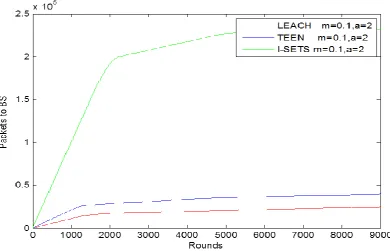
From Fig.3, Fig.4 and Fig.5 it can be clearly concluded that stability period and network life time are greater in I-SETS, than all other protocols. Nodes tend to die slowly in I-SETS, as in our new protocol we emphasize on transmission so a major part of energy is consumed in sensing; while Transmission of data is start only at conditions when hard Threshold value is achieved by sensed node or is exceeded.
Fig .5 Number of packets sent to Base Station
Compression Table for performance of Protocols When m=0.1,α=2,
Protocol Stability Periods (Rounds)
Network Lifetime(Rounds)
Dead Nodes in Rounds(Approx.)
Throughput(Packets)
LEACH 890 5580 88 2.45×10⁴
TEEN 1150 5075 95 4.0×10⁴
I-SETS 1585 5970 85 2.48×10⁴
Table.1
5. Conclusion and future Scope
In future research we can add additional functionalities in this protocol like prevention of duplicate data packets into storage so that new incoming message can be stored in memory as sensors are very small in size and they have very less amount of memory during the communication of nodes.
References
[1] Jin Wang, Zhongqi Zhang, jian Shen, Feng Xia, Sungyoung Lee”An Improved stable election Based routing Protocol with Mobile sink for wireless Sensor Networks” in Green Computing and Communications (GreenCom), 2013 IEEE and Internet of Things (iThings/CPSCom), IEEE International Conference on and IEEE Cyber, Physical and SocialComputing.
[3] T. J. Shepard, “A channel access scheme for large dense packet radio networks.” in Proccedings of ACM SIGCOMM, September 1996, pp. 219230.
[4] ] W. Heinzelman, A. Chandrakasan, and H. Balakrishnan. “Energy- Efficient Communication Protocols for Wireless Microsensor Networks.” In Proceedings of Hawaiian International Conference on Systems Science, January 2000.
[5] G. Smaragdakis, I. Matta, A. Bestavros,“SEP: A Stable Election Protocol for clustered heterogeneous wireless sensor networks.” in: Second International Workshop on Sensor and Actor Network Protocols and Applications (SANPA 2004), 2004.
[6] Femi A. Aderohunmu, Jeremiah D. Deng,“ An Enhanced Stable Elec- tion Protocol (SEP) for Clustered Heterogeneous WSN.” Department of Information Science, University of Otago, New Zealand.
[7] Manjeswar, A.; Agrawal, D.P. “TEEN: A protocol for enhanced efficiency in wireless sensor networks.” In Proceedings of 1st International Workshop on Parallel and Distributed Computing Issues in Wireless Networks and Mobile Computing, San Francisco, CA, USA, 2001; p. 189.
[8] “An application-specific protocol architecture for wireless microsensor networks,” IEEE Transactions on Wireless Communications, vol. 1, no. 4, pp. 660670, October 2002.
[9] S. Bandyopadhyay and E. J. Coyle, “An energy efficient hierarchical clustering algorithm for wireless sensor networks,” in Proceedings ofINFOCOM 2003, April 2003.
[10] S. Bandyopadhyay and E.J. Coyle, “Minimizing communication costs in hierarchically-clustered networks of wireless sensors,” Computer Networks, Vol. 44, Issue 1, pp. 1-16, January 2004.
[11] Li Qing, Qingxin Zhu, Mingwen Wang, “Design of a distributed energy-efficient clustering algorithm for heterogeneous wireless sensor networks,” Computer Communications, Volume 29, Issue 12, 4 August 2006, Pages 2230-2237.
[12] W. R. Heinzelman, A. P. Chandrakasan, and H. Balakrishnan “An application-specific protocol architecture for wireless microsensor networks,” IEEE Transactions on Wireless Communications, vol. 1, no. 4, pp. 660670, October 2002