Available Online at www.ijcsmc.com
International Journal of Computer Science and Mobile Computing
A Monthly Journal of Computer Science and Information Technology
ISSN 2320–088X
IMPACT FACTOR: 6.017
IJCSMC, Vol. 6, Issue. 12, December 2017, pg.34 – 43
MOBILE TECHNOLOGIES FOR MOBILE
LEARNING: DEVELOPMENTAL PROCESS REVIEW
Nilay YILDIRIM
Fırat University, Software Engineering Department E-mail: [email protected]
Asaf VAROL
Fırat University, Software Engineering Department E-mail: [email protected]
Abstract: A different dimension have come to the education with becoming widespread and cheapening of mobile devices and the development of wireless technologies, mobile devices have begun to be used in education and the concept of mobile learning has emerged. Mobile phones, smartphones, handhelds, tablets, laptop computers and wearable technologies are the main devices and categories used in mobile learning. It is observed that rapid technological developments in mobile devices have resulted in a rapid development in software technologies for mobile devices. Augmented reality applications, new generation game engines and personal developable applications for wearable technology show the size of mobile technology reached as the software. It is seen that mobile network and wireless communication technologies are also developed in line with the pace of mobile and software technology. All these mobile technologies allows mobile learning to be most appropriate for the learner. In addition, these technologies increase the mobility of learning and the convenience for learning anytime and anywhere. In this study, used and existing technologies for mobile learning will be covered. Developing mobile technologies will be examined and the comments will be made on how these technologies can be used in mobile learning.
Keywords: Mobile Learning, Mobile Technologies, Mobile Technologies in Education
1. INTRODUCTION
Students spend their entire lives using computers, mobile phones, music players, video game devices and all other devices in the digital age and as a result, college graduates spend five thousand hours studying throughout their school life, it seems that they spend ten thousand hours dealing with their mobile phones (Prensky, 2001).
The use of mobile technologies in education is very common. Students can easily upload educational applications developed for mobile devices to their phones and can share information about the learning process via their phones, MMS, e-mail, Internet connection also can install tests and exams on their phones. (Yerushalmy & Oshrat, 2004)
The advantages of mobile devices are as follows (Enocta Akademi, 2010):
Mobility:Mobile devices can easily be moved anywhere and without occupying too much space.
Popularity: Smart phones and mobile devices are becoming more popular every day. One person can use more than one mobile device, and everyone from 7 to 70 can have a mobile device. The reason of the mobile device popularity is the reasonable prices.
Accessibility: Since mobile phones and other mobile devices are so widespread and mobile devices provide wireless-wap-GPS-3G-4G- 4.5G connectivity, information is easily accessible from anywhere.
Connectivity: With the communication facilities of social networks that can be connected from mobile devices, social media and operators, it is possible to connect with people from all over the world.
Sensitivity to the environment: Thanks to the applications that perceive location, time, and environment, mobile learning is dynamic according to the environment. Individuality: Since the mobile devices are private, mobile devices allow
individualization of the information transmitted through intelligent programming and therefore allows for individual learning.
2. GENERAL OVERVIEW OF THE DEVELOPMENT OF MOBILE TECHNOLOGIES
In this section, mobile technologies using for education and development of these technologies will be handled.
2.1. Mobile Software Technologies
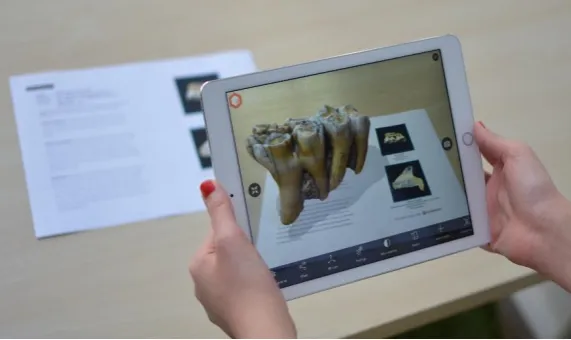
As shown in Figure 1, Augmented Reality (AR) is live, direct or indirect physical appearance of the real world and its environment that formed with computer generated audio, video, graphics and GPS data (wikipedia.org, 2016).
Figure 1. Augmented Reality(Shin, Visualizing the Past: Pioneering Technology in Archaeology, 2016)
The history of Augmented Reality can be listed as follows (augment.com, 2016):
1968-1994: Ivan Sutherland developed the first head- mounted display system. In 1990 Boeing researcher coined the term „Augmented Reality‟. At the end of first epoch, the first AR theater production, „Dancing in Cyber Space‟, had been created. 1998-2009: Naval researches began working on Battlefield Augmented Reality
System, ARToolkit has been developed.
2013-2017: Car manufacturers have begun to use augmented reality as the new age vehicle service manuals, Google announced Google Glass as wearable AR and Microsoft Hololens Developer Kit has been put up for sale.
While QR codes are 2-dimensional and being the bridge to the embedded data in the code, AR markers being the bridge to the 3-dimensional data which is found in the printed material and appears only as a picture but is embedded in this trigger picture. (Çınar, 2014)
Today, Augmented Reality emerges with the most common use in education as a mobile learning software that presents the visuals on educational materials such as books, brochures with three-dimensional, animated and audible way to the students via mobile devices.
Educational game software provides students to learn lessons or improve their problem-solving skills by playing via taking advantage of the enthusiasm and willingness of students to play (Yıldırım, 2012). Game engines and technologies have an important place in developing more effective educational game software. More impressive and realistic educational games can be prepared via developed new technology game engines.
2.2. Mobile Network Technologies
accessing the internet is gaining importance for mobile learning for faster and uninterrupted connectivity to educational materials and online training.
The development of mobile network technologies can be summarized as follows (Enginar,
2016);
2G:Supporting a speed of only 50 kilobits per second in maximum speed, 2G is a type of mobile network that is no longer valid.
GPRS: GPRS, which started in early 2000 and played an important role in the transition to 3G, was the "always on" first mobile network, but GPRS with 114 kilobits of support is very slow for today.
EDGE: EDGE with the maximum speed of 217 kilobits per second can be used for low-resolution YouTube videos although it is significantly faster than G. It may also be said that it is slow for access to developing mobile learning materials.
3G: It is extremely useful for digital music services, video surveillance and other situations because it supports 384 kilobits per second at maximum speed.
HSPA: This network can be considered inadequate for high-volume file downloads although it is enough for YouTube videos, digital music services and web browsing.
4G: First introduced in Stockholm and Oslo in 2009, 4G can reach 100 Mbit/s with 4G LTE.
4.5G: With 4.5G, a version of 4G technology, download speed of 1Gbits/s can be reached.
2.3. Mobile Hardware Technologies
Oran and Karadeniz (Oran & Karadeniz, 2007) ranked internet-based mobile learning tools as servers, mobile phones, PDAs, tablet computers, and laptop computers.
Servers: These consisted of database server, web server, wap server, SMS server, e-mail server. Cloud servers have become popular as a result of smart devices and mobile applications serving billions of people. Cloud Server is a virtual server model that doesn't have data center, provides processor, memory, etc. resources within a virtual pool of resources and can update them instantly, uses virtualization technology (plusclouds, 2016). Servers are the most important tools for sharing data in the realization of mobile learning (Oran & Karadeniz, 2007). Cloud servers have an important place thanks to such advantages that not being affected from hardware failure, increasing business continuity, accessing new generation systems at reasonable costs, minimizing loss of data, working with high performance (plusclouds, 2016) and reaching the right data in terms of seamless learning and security in mobile learning.
screen size. In particular, Android and IOS operating systems bring the features of smartphones to the extreme.
Mobile and Smart Phones: The first device that combines the features of a classical mobile phone and PDAs is IBM's Simon phone that has some features of mobile phone, computer, pager and fax machine and known as the first smartphone in history (Ertuğrul, 2015). Pocket PC with Windows Pocket PC OS operating system in 2002, BlackBerry Pearl in 2006, iOS iPhone 2G by Apple, one of the two largest mobile operating systems today in 2007 were made available for use and HTC launched the HTC Dream phone with Android operating system in 2008. Now, Smart phones can be carried in a pocket but is able to perform almost all the functions of a PC can do. Smartphones with 10% usage worldwide in 2011 are expected to have 36% usage by 2018 (statista.com, 2017). Smartphones will continue to be the most popular technological tool for mobile learning with its popularity, accessibility and individuality features.
Tablets: It is heavier than pocket PCs but it is more useful than pocket PCs when screen sizes are considered and lighter than laptop computers. In addition, with the help of the Android technology, it can meet all the requests of the user. Within the scope of FATIH project in Turkey, it is aimed to reach the students with tablet computers and students to carry books anywhere and at any time without any difficulty. This application example is one of the most important steps taken in the context of mobile learning.
Laptops: Nowadays, the usage rates of laptop computers are higher than those of desktop computers. Laptop computers provide access to information as space and time independent via connections such as wireless, Bluetooth. However, when it is thought that mobile learning should allow learning at anytime and anywhere, carrying problem due to weight of laptop computers can be said as its limitation for mobile learning.
With today's technology, wearable technology has been added as a new category to mobile learning tools. Wearable technology is the technology and the technological devices which someone can wear and which may include computer properties or which can transfer the data obtained by the help of its sensor to a computer or a smartphone.
Usable areas of wearable technologies for mobile learning can be listed as follows (Kuzu & Demir, 2015):
Materials about the course content can be presented before, during or after the course.
It can be applied as student performance evaluation activities. A problem directed by the teacher during the lesson can be answered by the students using the smart watches.
It can contribute to situated learning. The students can access additional resources related to the subject they studied in their environment using smart glasses.
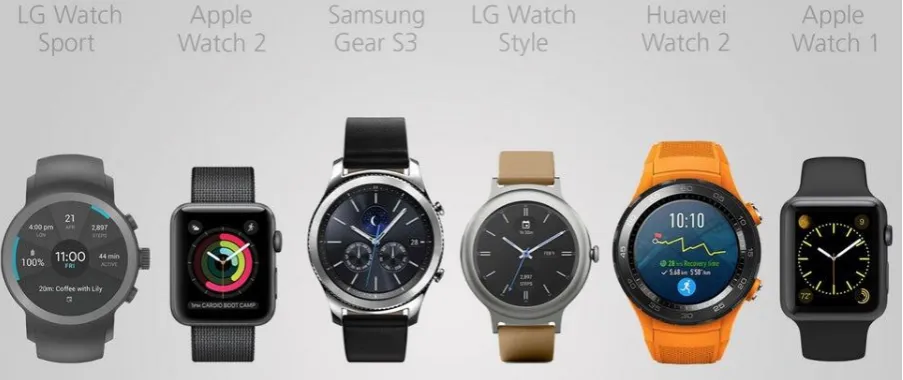
Wearable technologies can be classified as smart watches, smart clothes, VR glasses and smart glasses.
such as heart rate, walking distance can also be obtained with the sensors by the smart watches.
Figure 2. Smart watches (Shanklin, 2017)
Virtual Reality Glasses: Virtual Reality Glasses are the glasses that is worn on head, that presents the videos with a 360 degree angle, and that provides a sense of reality within the virtual environment. The first encountered device in the history of virtual reality is named View Master that was produced in 1939 and it allows to see the films in this device with the help of light (Sahin, 2016). After that, in addition to the virtual glasses developed by the game companies Nintendo and Sega, the most important of these glasses was developed by Oculus VR Company in 2010. It allows command input without using keyboard or mouse in the environment via VR gloves. According to Cone of Experience developed by Edgar Dale, when the number of sensory organs participating in learning is so much, learning will be so well and learning will become permanent, therefore the use of VR glasses in education can be listed as follows (Sahin, 2016):
It provides permanent learning because it addresses many sensory organs.
It makes training more efficient by bringing individual differences to the forefront. It provides to see the areas that cannot be traveled in the virtual environment and
obtain information on this subject.
Provides the ability to experiment and see results when there is no laboratory facility.
Increases motivation and encourages creativity. Improves the ability to use computers and technology.
Glass is a wearable computer that differs from traditional smartphones or tablets. Google Glass also has an important place in wearable technologies used in mobile learning.
Figure 3. Google Glass (x.company, 2017)
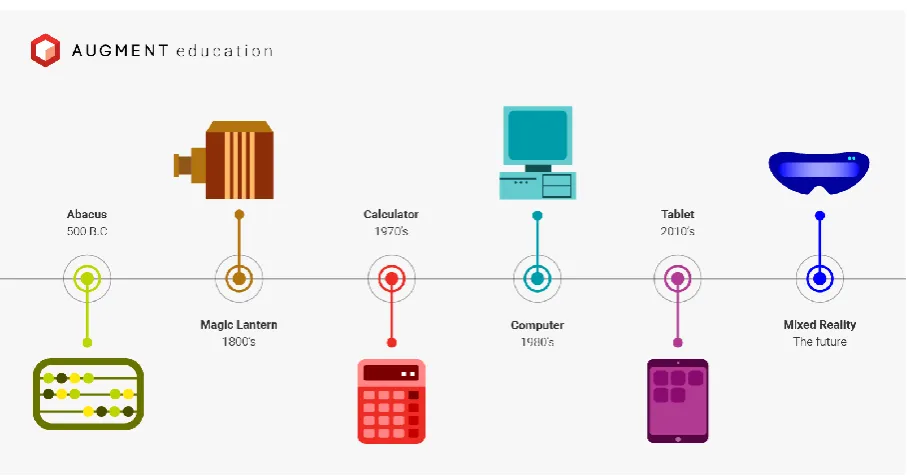
The continuing evaluation of technology in the classroom can be seen on Figure 4.
3. FUTURE SPREAD OF MOBILE TECHNOLOGY FOR MOBILE LEARNING
Considering the developments in mobile network technologies, in addition to the technologies supported by the operators, it is also seen that there are network systems that technology companies such as Google have developed and will utilize. Project Fi, developed by Google in 2015, is a platform that gives the opportunity to pass to best network 4G LTE-enabled T-Mobile and Sprint mobile network and the Wi-Fi points that in agreement (Baş, 2016). In this way, users will be able to connect through the operator which is the better in the country. With Project Fi technology, the uninterrupted mobile learning environment will be more accessible.
Google Glass has been refreshed and sold with features such as a faster processor, longer battery, 8 megapixel camera, and more secure wireless connection with “Glass” name. The X Company uses the “Assisted Reality” term rather than augmented reality for Glass. According to X Company, technology maker and the part of Google's parent company Alphabet, large companies such as DHL, GE, Sutter Health and AGCO work with the Enterprise version of Glass (Stein, 2017). The company workers are supported by watching videos with Glass while they are working, Glass AR technology is used for faster and safer work. With the help of augmented reality, the workers who see which cable to connect to where during the implementation make fewer mistakes. In the future, Glass will make practical learning opportunities much more possible in the sense of assisted reality and live simulation.
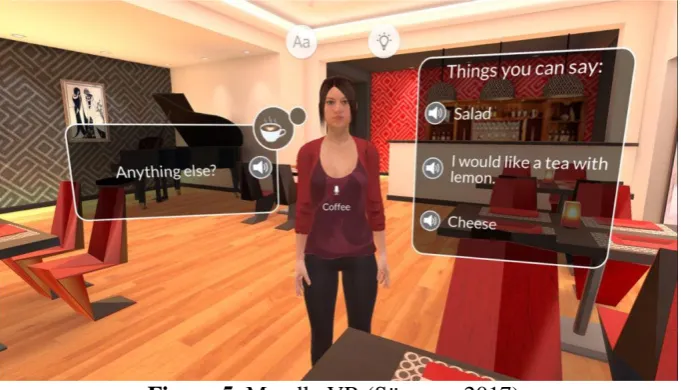
Google notified the signal that the virtual reality glasses can be operated without being connected to a computer or a mobile device at Google I/O 2017 conference (egitimvr.com, 2017). In this way, virtual glasses will be able to have more mobility. One of the best examples of the use of virtual glasses in education is the Mondly VR application developed for Oculus VR. The application shown in Figure 5 provide voice recognition and chatting with an artificial intelligence that can give limited answers and a virtual teaching environment for 28 languages (Sönmez, 2017).
Figure 5. Mondly VR (Sönmez, 2017).
4. CONCLUSIONS
Today's technology has reached unpredictable dimensions and continues to evolve rapidly. It is observed that technology has been used extensively in education and especially in mobile education and mobile learning. In this paper, mobile technologies, the use of mobile technology for mobile learning and the development of mobile technologies were examined.
With the development and use of mobile technologies, the studies are being carried out about how to use it in education. As a result of literature studies, it has been seen that mobile technology has been utilized rapidly in the field of education.
Thanks to the developed mobile technology, it seems that the constraints for learning at any time and place are quickly becoming clear when considering the last ten years. Considering that young generation is closely following mobile technologies and adapting quickly to new technologies, it is important to conduct further studies for integrating new mobile technologies to the field of education.
REFERENCES
Aktaş, C., & Çaycı, B. (2013). QR Kodun Mobil Eğitimde Yeni Eğitim Yöntemlerinin Geliştirilmesine Katkısı. Global Media Journal: Turkish Edition.
augment.com. (2016, 05 12). Infographic: The History of Augmented Reality. augment.com: http://www.augment.com/blog/infographic-lengthy-history-augmented-reality/
Baş, L. (2016, 10 13). Google, mobil bağlantı teknolojisi Project Fi için atağa geçti. webrazzi.com: https://webrazzi.com/2016/10/13/google-mobil-baglanti-teknolojisi-project-fi-icin-ataga-gecti/
Çınar, D. (2014, 09 29). Dijital Nesil İçin Hibrid Ders Kitabı: Augmented Coursebook. egitimdeteknoloji.com: http://www.egitimdeteknoloji.com/dijital-nesil-icin-hibrid-ders-kitabi-augmented-coursebook/
egitimvr.com. (2017, 06 18). Bağımsız VR (Standalone VR) gözlükler. egitimvr.com: http://egitimvr.com/bagimsiz-vr-gozlukler/
Enginar, K. (2016, 02 16). Mobil Ağ Türleri ve Farklılıkları. shiftdelete.net: https://shiftdelete.net/mobil-ag-turleri-ve-farkliliklari-68801
Enocta Akademi. (2010). Cebinizden daha da çok şey bekleyin. 02 2011 enocta.com.tr: http://www.enocta.com.tr/web2/ContentShowOne.asp?CType=2&ContentID=560&T =5
Ertuğrul, S. (2015, 05 29). Akıllı Telefon Tarihi. mediamarkt.com.tr: https://mediatrend.mediamarkt.com.tr/akilli-telefon-tarihi/
Kuzu, E. B., & Demir, K. (2015). Giyilebilir Teknolojiler ve Eğitimde Kullanımı. TOJET, 251-270.
Oran, M., & Karadeniz, Ş. (2007). İnternet Tabanlı Uzaktan Eğitimde Mobil Öğrenmenin Rolü. Akademik Bilişim 2007 (s. 1-4). Kütahya: Dumlupınar Üniversitesi.
Özcan, A. (2008). Cep Bilgisayarları (PDA) İçin Bir Mobil Öğrenme Ortamı Tasarım ve Uygulaması. Muğla: Muğla Üniversitesi, Master Thesis.
Prensky, M. (2001). Computer games and learning: Digital game-based learning. J. Raessens, & J. Goldstein içinde, Handbook of computer game studies (s. 97-122). Cambridge: The MIT Press.
Sahin, O. Y. (2016, 05 29). Eğitimde Sanal Gerçeklik Ve Artırılmış Gerçeklik. kodyazar.net: https://kodyazar.net/tr/egitimde-sanal-gerceklik-artirilmis-gerceklik/
Shanklin, W. (2017, 05 17). newatlas.com. 2017 Smartwatch Comparison Guide: https://newatlas.com/smartwatch-comparison-2017-specs/49553/
Shin, J. (2016, 02 12). Visualizing the Past: Pioneering Technology in Archaeology. augment.com: http://www.augment.com/blog/visualizing-the-past-pioneering-technology-in-archaeology/#iLightbox[gallery1297]/0
Shin, J. (2017, 04 19). The Continuing Evolution of Technology in the Classroom: Past, Present, and Future. augment.com: http://www.augment.com/blog/evolution-tech-classroom-mixed-reality/
Sönmez, S. (2017, 02 20). Yabancı Dil Öğrenmek İçin Yaz Kampına Gitmek mi, Sanal Gerçeklikte Chatbotlarla Konuşmak mı? | Mondly VR. egitimdevr.com: https://www.egitimdevr.com/yabanci-dil-ogrenmek-icin-yaz-kampina-gitmek-mi-sanal-gerceklikte-chatbotlarla-konusmak-mi-mondly-vr/
statista.com. (2017). Number of smartphone users worldwide from 2014 to 2020 (in billions). statista.com: https://www.statista.com/statistics/330695/number-of-smartphone-users-worldwide/
Stein, S. (2017, 07 18). Google Glass returns: This time, it's professional. cnet.com: https://www.cnet.com/news/google-glass-2-goes-for-enterprise/
Şekercioğlu, İ. (2017, 03 02). Unity yeni nesil oyun motorunu tanıttı. shiftdelete.net: https://shiftdelete.net/unity-yeni-nesil-oyun-motorunu-tanitti-79831
Temel, K. A. (2017). Android'de QR Kod Okuma. gelecegiyazanlar.turkcell.com.tr: https://gelecegiyazanlar.turkcell.com.tr/blog/androidde-qr-kod-okuma
uzmantv.com. (2016). uzmantv.com. Google Glass nedir?: http://rehber.uzmantv.com/google-glass-nedir
wikipedia.org. (2016). Augmented Reality. wikipedia.org: https://en.wikipedia.org/wiki/Augmented_reality
x.company. (2017). www.x.company: http://www.x.company/glass/
Yerushalmy, M., & Oshrat, B.-Z. (2004). Mobile phones in Education:the case of mathematics. Haifa: Haifa University.