Available Online at www.ijcsmc.com
International Journal of Computer Science and Mobile Computing
A Monthly Journal of Computer Science and Information Technology
ISSN 2320–088X
IMPACT FACTOR: 6.017
IJCSMC, Vol. 7, Issue. 1, January 2018, pg.46 – 52
Cloud Load Balancing using Round Robin
and Shortest Cloudlet First Algorithms
Manoj Kumar Bishwkarma
1, Kapil Vyas
2*1
Research Scholar, Department of Computer Science &Engg., BM College of Technology Indore, M.P, India 2
Assistant Professor, Department of Computer Science &Engg., BM Collegeof TechnologyIndore, M.P, India 1
[email protected]; 2 [email protected]
Abstract: Load balancing in the cloud-computing environment has an important impact on the performance. Good load balancing makes cloud computing more efficient and improves user satisfaction. A better load balance model for the cloud based on the cloud-partitioning concept with a switch mechanism to choose different strategies for different situations. Two type of load balancer used in cloud computing first is static load balancer in which number of recourse, cloudlet, VM, and data centre are fixed, second is dynamic load balancer in which number of recourse, cloudlet, VM, and data centre are changed at run time. There are many load balancing algorithms such as FCFS, Round Robin and Priority based. In This paper we used combination of Round Robin and Shortest cloudlet First algorithm. Combination improved efficiency and performance of load balancing in cloud computing environment. We implement proposed algorithm with the help of CloudSim 3.0 under VM scheduling policies.
Keywords— ―Virtual Machine‖, ―CloudSim‖, ―Load Balancing‖, ―Task Scheduling‖, ―Round Robin‖, ―Shortest Job First‖.
1. INTRODUCTION
Cloud computing is a new emerging applied science that helps to develop a new area in education and industry. This new technology offers distributed virtualized, elastic resources as utilities to clients. It has total capability for supporting full realization of computing as a utility in the near future [1]. Cloud technology supports both parallel and distributed system. This distributed architecture deploys resources to distribute services effectively to clients in different geographical channels [2].
The available Cloud platforms distinguish among the service type, the cost, the Quality of Service (QoS) as well as performance. This fact brings Cloud customers the flexibility of freely selecting target architecture from broad range of Cloud platforms. However, at the same time, this raises the issue of the interoperability among the different Clouds [1].
Development of efficient service provisioning policies is the major issues in Cloud research. Modern Clouds exists in an open world characterized by constant changes occurring autonomously and unpredictably. In this context, game theoretic methods allow in-depth analytical understanding of the service-provisioning problem [2]. The cloud computing mainly offers three types of services:
1. Infrastructure as a Service (IaaS), 2. Platform as a Service (PaaS),
Considering that the cloudlets arrival pattern is just not predictable and the capacities of each and every node in cloud differ, regarding load balancing difficulty, workload control is important to improve system performance and gaze after stability. Load balancing schemes based on whether the system dynamics are very important can be possibly static and dynamic [6]. Static schemes tend not to use the system information and therefore are less complex whilst dynamic schemes provide additional costs to the system but can transform as the system status changes.
A dynamic scheme is utilized here for it is flexibility. The model includes a main controller and balancers to collect and analyze the information. So, the dynamic control has little influence around the other working nodes. The system status then gives a basis for deciding on the best load balancing.
2. RELATEDWORK
In the distributed environment users generate request randomly in any processor. So the disadvantage of this randomness is associated with task assignment. The inconsistency in task assignment to the processor generates imbalance behaviour, i.e. some of the processors are overloaded and some of them are under loaded [3]. The goal of load balancing is to transfer the load from overloaded process to under loaded process transparently. Load balancing technique decides which user would use the virtual machine and which requesting machines will be put on hold. Load balancing of the entire system can be handled dynamically by using virtualization technology where it becomes possible to remap Virtual Machines (VMs) and physical resources with respect to change in load. A VM is a software implementation of a computing environment in which an OS or program can be installed properly and run.
Load balancing is done with the help of load balancers where each succeeding request is redirected and transparent to users who make the request. Based on different parameters like availability of current load, the load balancer uses different scheduling algorithm to decide which server should handle and forwards the request to the selected server [5]. There are different scheduling algorithm exist in load balancing like Round Robin(RR) , First-Come-First-Served (FCFS), and some other scheduling algorithm. Most of these algorithm concentrate on maximizing throughput and minimizing the turnaround time, response time, waiting time and number of context switching for a set of request. In this paper our objective is to approach a new scheduling algorithm which helps to give better performance compare to existing algorithms such as Round Robin (RR), First-Come-First-Served (FCFS), etc.
Many load balancing algorithms, such as Round Robin, both equally Spread Current Execution Algorithm, and Colony algorithm. Nishant et al. [9] used the ant colony optimization method in nodes load balancing. Rundles et al. [10] gave any compared analysis involving some algorithms with cloud computing by simply checking the overall performance time and cost. They concluded that this ESCE algorithm in addition to throttled algorithm is greater than the Round Robin the boy wonder algorithm. Some of the classical load balancing methods act like the allocation method within the operating system, one example is, the Round Robin algorithm and also the First Come First Served (FCFS) rules. The Round Robin algorithm is used here because it truly is fairly simple.
3. EXISTINGSYSTEM 3.1 Round Robin:
In Current Scenario, with an environment of cloud the task is divided and disseminated into same size of small jobs i.e. Cloudlets. These Cloudlets as well as Virtual Machines are scheduled according to the various scheduling policy for e.g. FCFS, Round Robin etc. Generally, in Cloud Computing scenario user submit the task to be performed / executed. Cloud Coordinator (CC) [2] divides the task into equal sized cloudlets and passes it to Data Centre (DC).
Normally it takes a lot of time because the cloudlets are processed one at a time in FCFS manner as and when they reach to VM. VM executes the cloudlets present in the queue as they reach the VM’s. Basically this default job scheduled policy is extremely Time- Consuming, Cost insensitive and inefficient.
Round Robin Algorithm for Load Balancing:
1. Creates same size of Cloudlets.
2. CC divides the assigned Cloud task into same size of cloudlets. 3. Create Broker and User assigns the task to Cloud Coordinator (CC).
5. Request for the execution of the Cloudlet is sent to the VM by VMM from the Host. 6. Cloudlet scheduling is done in VM according to FCFS scheduling policy.
7. Sends the executed job as Cloudlets in a wrap file to the VMM.
8. VMM further passes the executed Cloudlets as wrapped file format to CC.
9. CC combines all executed Cloudlets in wrapped file form combine to form the whole task. 10. CC sends the executed task in authenticated file format to the user/client
11. . PRINT the Result
3.2 Shortest Cloudlet First:
Shortest Job First (SJF) scheduling is a priority and Non-Preemptive scheduling. Non-Preemptive means, when the allotted time a processor then the processor cannot be taken the other, until the process is completed in the execution. Basically Shortest Job First is a dynamic load balancing algorithm which handles the process with priority basis. It determines the priority by checking the size of the process. This algorithm distributes the load randomly by first checking the size of the process and then transferring the load to a Virtual Machine, which is lightly loaded. In that case that process size is lowest, this process will get first priority to execute whether we suppose lowest sized process executes in minimum time. The load balancer spreads the load on to different nodes known as spread spectrum technique.
4. CLOUDSIM
CloudSim [12] is the many efficient tool you can use with regard to modelling regarding Cloud. during your current lifecycle of a Cloud, CloudSim allows VMs for you to be managed coming from hosts that will inside turn are usually managed by data centres.
Figure1. CloudSim Architecture
thing using overriding few Classes like Data centre, Data centre Broker, Host, Cloudlet, Circular Host, Round Robin, VM Allocation Policy etc. [2].
5. PROPOSED SYSTEM
We will implement combination of load balancing algorithms like Round-Robin and less resources first. And will produce better result with existing system because in round robin algorithm not consider priority factor or less resources first at the time of load balancing. And also compare proposed algorithm with existing load balancing algorithm like, Round Robin and shorted Job First.
We implemented Round Robin and Round Robin with shortest job First scheduling policy for VM using Cloudsim3.0. This paper aims towards the establishment of performance qualitative analysis on existing VM load balancing algorithm and then implemented in CloudSim and java language
The Proposed algorithm is as follows:
1. Creates same size of Cloudlets.
2. CC divides the assigned Cloud task into same size of cloudlets. 3. Create Broker and User assigns the task to Cloud Coordinator (CC).
4. CC sends cloudlets to VMM and VMM sends the list of the needed resources to the RsP. 5. Request for the execution of the Cloudlet is sent to the VM by VMM from the Host. 6. Set all the VM allocation is zero. After set Parameters
a. User request/task/cloudlet receives by data center receivers.
b. On the base of shorted job first allocated virtual machine and calculate range (R)
c. R=Max Burst Time + Min Burst Time
d. Basis of range, load balancer allocates the time quantum to user request 7. After the complete of task (cloudlets), VM are allocated to other user request.
8. Cloudlet scheduling is done in VM according to shortest job first then round-robin scheduling policy. 9. Sends the executed job as Cloudlets in a wrap file to the VMM.
10. VMM further passes the executed Cloudlets as wrapped file format to CC.
11. CC combines all executed Cloudlets in wrapped file form combine to form the whole task. 12. CC sends the executed task in authenticated file format to the user/client.
13. PRINT the Result.
6. IMPLEMENTATION AND RESULT
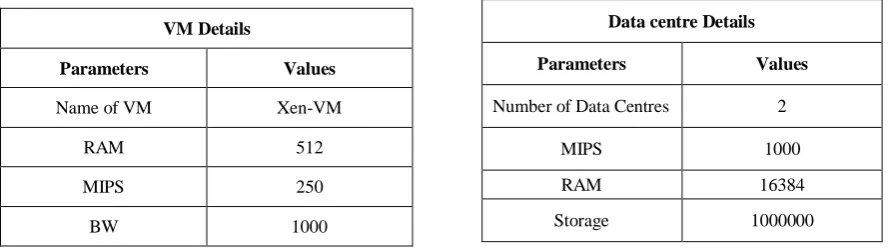
Proposed system implemented in Net Beans using advanced JAVA. Cloud simulator is simulated for simulation with different configuration. Before simulation we configure many parameters like number of data centres, number of cloudlets, VM configuration, bandwidth and MIPS. Round Robin and Modified Round Robin evolution with following configuration, which show in below.
In Table 1 show sequence of cloudlets allocated in Round Robin Simulation Parameters
Parameters Values
Number of users 6
Number of VMs 4
Number of Cloudlets 40
Cloudlets Details Parameters Values
Cloudlets Length 50000
File Size 400
Output Size 400
VM Details
Parameters Values
Name of VM Xen-VM
RAM 512
MIPS 250
BW 1000
Data centre Details Parameters Values
Number of Data Centres 2
MIPS 1000
RAM 16384
Storage 1000000
We apply Round Robin and Hybrid algorithm on above configuration with the help of cloud-sim simulator. In below Figures show that execution cloudlets, amount of time needed for execution, it is also showing that which cloudlets assign on which virtual machine
.
Figure 2: Graph Between cloudlet ID and Virtual Machine ID for Existing Approach
Figure 3: Graph Between cloudlet ID and Virtual Machine ID for Proposed Approach
7. CONCLUSION
Proposed algorithm will improve performance and efficiency of Data centres. Cloud simulation will be used effective cloud simulator. This approach can be easily implement in the cloud simulator. Proposed algorithm will improve performance and efficiency of Data centres. Cloud simulation will be used effective cloud simulator. Hybrid approach implemented in the cloud simulator cloudsim3.0.
Future work of our project is improve efficiency and reduce cost of data centers and VM using new adaptive algorithm. And also improved for it will work for heterogeneous environment such as big data.
ACKNOWLEDGEMENT
I would like to thank my Guide and Head of Department, Prof. Kapil Vyas, for the patient guidance, encouragement and advice he has provided throughout my time as his student. I have been extremely lucky to have a guidance who cared so much about my work, and who responded to my questions and queries so
promptly. I would also like to thank all the members of BM College of Technology, Indore.
R
EFERENCES
[1] Soumen Santra and Dr. Kalyani Mali “A New Approach to Survey on Load Balancing in VM in Cloud Computing: using CloudSim” IEEE International Conference on Computer, Communication and Control (IC4-2015)
[2] Ritu Kapur “A Cost Effective approach for Resource Scheduling in Cloud Computing” IEEE International
Conference on Computer, Communication and Control (IC4-2015).
[3] Pooja and Mishra2, “Analysis of Variants in Round Robin Algorithms for Load Balancing in Cloud Computing”, (IJCSIT) International Journals of Computer Science and Information Technologies, Volume 4 (3), 2013, pg. no. 416- 419.
[4] Kunal Mahurkar1, Shraddha Katore2 and Suraj Bhaisade3, Pratikawale4, “Reducing Cost of Provisioning in Cloud Computing”, International Journal of Advance in Computer Science and Cloud Computing, Volume- 1, Issue- 2, nov.- 2013, pg. 6- 8.
[5] Dr. Rakesh Rathi1, Vaishali Sharma2 and Sumit Kumar Bole3, “Round Robin Data Center Selection in Single Region for Service Proximity Service Broker in Cloud Analyst”, International Journal of Computer & Technology, Volume 4 no. 2, March- April 2013, pg. no. 254- 260.
[6] Bhatiya Wickremansinghe1, Rodrigo N. Calheiros2and Dr. Rajkumar Buyya3, “Cloud Analyst: A CloudSim- based Visual Modeler for Analyzing Cloud Computing Environments and Applications”, IEEE Computer Society, 2010, pp. 446-452.
[7] Kunal Mahurkar1, Shraddha Katore2 and Suraj Bhaisade3, Pratikawale4, “Reducing Cost of
Provisioning in Cloud Computing”, International Journal of Advance in Computer Science and Cloud Computing, Volume- 1, Issue- 2, nov.- 2013, pg. 6- 8.
[8] Jaspreet Kaur, “Comparison of load balancing algorithm in a Cloud”, International Journal of Engineering
Research and Applications (IJERA), vol. 2, Issue 3, May- June 2012, pp. 1169- 1173.
[9] Syed Tauhid Zuheri1, Tamanna Shamrin2 and Rusia Tanbin3, Firoj Mahmud4, “An Efficient Load
Balancing Approach in Cloud Environment by using Round Robin Algorithm”, International Journal of Artificial and Mechatronics, volume 1, issue 5, 2013, pp 96-99.
[10] B. Santosh Kumar1 and Dr. Latha Parthiban2, “An Implementation of Load Balancing Policy for Virtual
Machines Associated with a Data Centre”, International Journal of Computer Science & Engineering Technology (IJCSET), volume 5 no. 03, March 2014, pp. 253- 261.
[11] Sonika Matele1, Dr, K James2 and Navneet Singh3, “A Study of Load Balancing Issue Among
Multifarious Issues of Cloud Computing Environment”, International Journals of Emerging Technology Computational and Applied Science (IJETCAS), volume 13- 142, 2013, pg. 236- 241.
[12] Subasish Mohapatra1, Subhadarshini2 and K. Smruti Rekha3, “Analysis of Different Variants in Round
Robin Algorithms for Load Balancing in Cloud Computing”, International Journal of Computer Application, Volume 69- no. 22, may 2013, pp. 17-21.
[14] Randles1, M Lamb2 and Taleb Bendiab3, “A Comparative Study into Distributed Load Balancing
Algorithm for Cloud Computing”, Advanced Information Networking and Application Workshop (WAINA) 2010.
[15] Dr. Rajkumar Buyya, “CloudSim: a toolkit for modelling and simulation of cloud computing environments