On the Strategy and Behavior of Bitcoin Mining with
N-attackers
ABSTRACT
Selfish mining is a well-known mining attack strategy discovered by Eyal and Sirer in 2014. After that, the attackers’ strategy space has been extended by many works. These works only analyze the strategy and behavior of one single attacker. The extension of the strategy space is based on the assumption that there is only one attacker in the blockchain network. However, a proof of work blockchain is likely to have several attackers. The attackers can be independent of other attackers instead of sharing information and attacking the blockchain as a whole. During this problem, we are the team who for the first time analyze the miners’ behavior in a proof of work blockchain with several attackers by establishing a new model. Based on our model, we extend the attackers’ strategy space by proposing a new strategy set publish-n. Meanwhile, we revisit other attacking strategies such as selfish mining and stubborn mining in our model to explore whether these strategies work or not when there are several attackers. We compare the performance of different strategies through relative stale block rate of the attackers. In a proof of work blockchain model with two attackers, strategy publish-n can beat selfish mining by up to 26.3%.
KEYWORDS
Bitcoin, Mining, Selfish mining, N-attackers
1
INTRODUCTION
Traditional payment on the Internet is based on trusted third par-ties. The weakness of the trust based model makes completely non-reversible transactions impossible [2] and arises public’s in-terest in decentralized cryptocurrencies based on cryptographic proof. These cryptocurrencies, as represented by Bitcoin, apply the blockchain technology which is a distributed database used to store and maintain a list of records[10]. Although a series of consensus protocol such as proof of stake (POS) and practical Byzantine fault tolerance (PBFT) is also applied to some of these cryptocurrencies, Proof of work powered blockchains take about 90 percent of the market. In a proof of work blockchain, a miner withαfraction of the whole hashpower should only gainαfraction of the total block reward. However, many studies indicate that an attacker can take some strategies to gain extra revenue. Among these strategies, the most well-known one is selfish mining represented by Eyal and Sirer in 2014. Many other strategies such as stubborn mining are the extensions of selfish mining. We can call these strategies selfish mining style strategies.
In Bitcoin, selfish mining style attacks have not shown up yet due to the stable environment of Bitcoin. A statistics fromblockchain.info indicates that in the past year, the difficulty to find a new block has increased by four times. Up to now, the increase of block reward
(in USD) and the increase of difficulty to find a new block are still proportionate.
A proof of work blockchain will have several attackers once the block reward drops to 12.5 Bitcoin per block in the future or the price of Bitcoins drops because of other factors, the crisis may show up and the likelihood for a miner or a mining pool to take tricky strategies increases. Once one attacker shows up, the other miners can either stick to the Bitcoin protocol and lose part of their share of revenue or become another attacker and steal the honest miners’revenue to make up for his loss. The second option is more appealing to a miner. Thus it is necessary to build a new model for a proof of work blockchain and analyze the attackers’ behavior and strategy.
We establish a new model of a proof of work blockchain with several attackers and explore the attackers’ behaviors and their min-ing strategies. Existmin-ing works about minmin-ing attacks [1][4][6][8] put their emphasis on the development of one single attacker’s strategy space. As far as we know, the miners’ behaviors and strategies in a proof of work powered blockchain with several attackers have not been studied in detail so far. What new action will be made and whether the attacking strategies for a single attacker still work has not been analyzed yet.
Contribution 1: Establishing a new model of a proof of work blockchain.Our model allows the existence of several at-tackers. The attackers do not share information, and they will have an impact on each other by publishing mew blocks. Their decision-making process is an independent work, but their state transition depends on other miners. A proof of work blockchain model with several attackers is first discussed in our work. Thus new mining behaviors and new mining strategies will be introduced.
Contribution 2: Presenting a new strategy set publish-n.
We extend the strategy space of mining attack and propose a strat-egy named publish-n. Our simulation result turns out that publish-n strategy performs better than other strategies when there are sev-eral attackers and the attackers’ hashpower is low. This strategy set allows the attacker earn more profits and it even benefits the honest miner sometimes.
Contribution 3: Revisiting of existing strategies.We revisit selfish mining proposed by Eyal and Sirer[1] and stubborn mining proposed by Nayak[8]. Stubborn mining may not be a good option in a blockchain with several attackers while selfish mining still works in most of the situation. Our simulation result even shows that a selfish mining attacker with the hashpower which is not enough to earn extra revenue in a blockchain with n attackers is likely to gain revenue more than his share in a blockchain with n+1 attackers.
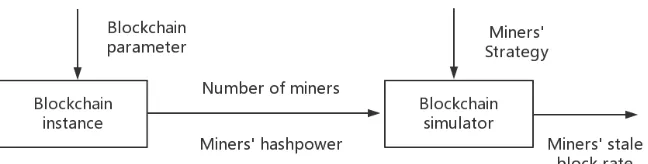
Figure 1: Our blockchain model with two phases
our model and present the attackers’ potential state space, action space. In Section 4, we discuss miners’ strategy space. In Section 5, we compare the strategies in the strategy space. In Section 6 we conclude our paper.
2
PRELIMINARIES
2.1
Behavior of Attackers and Honest miners
For an honest miner Alice, her action is irrelevant to her state. She obeys the relevant protocols in a proof of work blockchain system so that she reveals a block immediately after she finds it. She always accepts the most extended chain and mines on top. When a fork exists, she works on the chain she received first.
For an attacker Bob, his decision depends on the state and his strategy. Bob aims to waste his opponents’ hashpower and gain extra revenue. The most well-known method is to reveal his blocks and publish it according to his state and strategy.
2.2
Mining Attacks
The proof of work consensus protocol of Bitcoin is based on an idealized assumption that the majority of the hashpower is honest. Since Eyal and Sirer defined the behavior of selfish mining in 2014, the reliability of the proof of work consensus protocol has been broken. Selfish mining allows a mining pool to obtain a revenue more massive than its ratio of mining power[1]. An attacker with more than 33 percent hashpower can gain an extra revenue. The threshold can even be lower if the attacker influences the honest miner. Selfish mining wastes the hashpower of the honest miner. Note that, selfish mining is an irrational strategy. The attacker’s revenue will also drop in a short term until the difficulty of mining decreased. Several works [4][8] have analyzed that selfish mining strategy is suboptimal.
After Eyal and Sirer’s work, many works have analyzed mining attack. Some works such as [4] [8] can be seen as the extension of selfish mining, and some works including [6][7] describe a network-level attack, eclipse attack. Meanwhile, [8] also combines selfish mining and eclipse attack. Among these works,[8] systematically explores the strategy space of the attacker. A new mining strategy stubborn mining is first proposed in it. The key to their new stub-born mining strategies is that the attacker should not give up so easily. In other words, the difference between stubborn mining and
selfish mining is when to give up the private chain and adopt a longer chain from opponents.
2.3
Current Model of Proof of Work
Blockchain
On modeling and simulation side, Eyal and Sirer [1] simulate self-ish mining strategy. After their work, many works [4][5][8][9] built their model to simulate the proof of work blockchain with one attacker. Most of these works [4][8][9] analyzed selfish min-ing by usmin-ing Markov Decision Processes. The discrete state space and action space for the player makes it fit for modeling mining behavior.
2.4
Stale Blocks
The security of blockchain is thoroughly studied in the recent year [1][11][12][13].It is related to its stale block rates. Stale blocks result from chain forks that are not included in the most extended chain. Thus the miner of a stale block will not earn block reward. The stale block rate directly represents the portion of wasted hashpower of a miner. Under most situation, the stale blocks are caused by occasional conflict ,and the stale block rate is quite low. According to Gervais [9], the stale block rate of Bitcoin is 0.41 percent and another work [3] shows that the probability is under 1.7 percent. Both of their works suggest that when all miners are honest, the possibility that stale blocks show up is low. When mining attacks especially selfish mining exists, the stale block rate will increase significantly.
Gervais [9] also use the stale block rate of the miner as a pa-rameter to measure whether a proof of work blockchain model is safe or not. He discusses the cost of attacking behavior of selfish mining and double spending in a blockchain model with different stale block rate. His work connects stale blocks and security of a blockchain.
3
SYSTEM MODEL
In this section, we introduce our system model shown in Figure1 which can simulate the behavior of different miners and construct an environment where multiple selfish miners may occur.
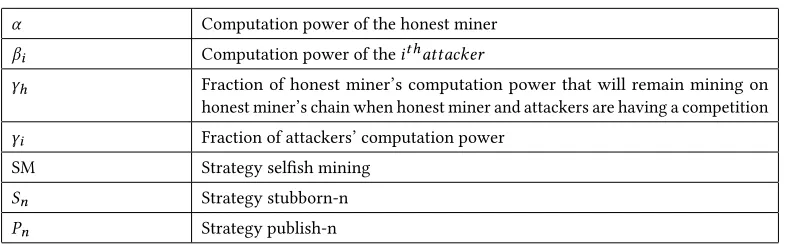
Table 1: Table of notation
α Computation power of the honest miner
βi Computation power of theithattacker
γh Fraction of honest miner’s computation power that will remain mining on honest miner’s chain when honest miner and attackers are having a competition
γi Fraction of attackers’ computation power
SM Strategy selfish mining
Sn Strategy stubborn-n
Pn Strategy publish-n
3.1
Our model
Our model has two phases, a blockchain instance and a proof of work blockchain simulator. A blockchain instance can be any cryp-tocurrencies based on proof of work blockchains such as Bitcoin or Ethereum. The output of the blockchain instance is the number of miners or mining pools and their corresponding fraction of hash-power. It will be used as the input of the blockchain simulator.In the blockchain simulator, each attacker’s behavior is based on his state and action. The output of the simulator is the attackers’ rela-tive stale block rate. The notations in our model are mentioned in Table1.
3.2
Parameters
Our model has three main parameters:
Hashpower of the honest minerα:αis the fraction of the total hashpower controlled by the honest miner. This portion of miner follows the protocol of the proof of work blockchain. For instance, the honest miners of Bitcoin follow the Bitcoin protocol. To make it brief, we consider this portion of miners as an entirety and refer to it as Alice.
Hashpower of theithattackerβi: In the basic models mentioned above, with one attacker, one value beta is enough to describe the hashpower of the attacker. While in our model, since we make the assumption that several attackers can exist simultaneously and they are independent to each other, the values of the attackers’ hashpower should be an n-dimension set andbetai stands for the hashpower of theithattacker. We refer to these attackers asBobi. For anyBobiandBobj, they are independent of each other, which means they do not share their state information. ForBobi, the only method to affectBobj’s state is to publish a new block on the main chain thus forBobjthe behavior ofBobiand Alice shows no difference. Note thatÍ
iβi+α=1.
The propagation ability of the honest minerγh:γh indicates whether the honest miner can be easily affected or not. A large value ofγhmeans that the attackers can have little impact on the honest miners’ choice.
The propagation ability of the attackerγi: With a largeγi, at-tackerBobican easily have an impact on the honest miners’ choice.
Remained hashpower of the honest minerγh:γh= 1−Í iγi;
3.3
Decision Process
An attacker needs to decide what action he should take and when to take an action.
Each attacker faces a single-player decision problem: M = (S, A, P, R) where S is state space, A is action space or decision space, P is the probability and R is the revenue of each action or decision. For
Bobi, whenBobi or other miners find a block,Bobi should make the action ,and the transition of its state will occur. For every state inBobi’s state space:
Pa(S1,S2)=P(St+1=S2|St =S1and At =a) (1) For Alice, the honest miner, the action space is smaller. As an honest miner, Alice always follows the default protocol. She will publish the block as soon as she finds it and she will follow the longest published chain and work on the top of it.
3.3.1 Statesi:In our model, each attacker maintains a private
state and the action of the attacker is based on his state. As a result, the following information should be included in the state:
• Whether there is a fork in the main chain: If several miners publish their chain at the same time and these chains have the same length, the fork will occur ,and under this situation, these miners are competing with each other. The competition will end if a miner publishes a new block after one of these chains or another attacker publishes a longer chain. • Whether the attacker is involved in this competition: If the
attacker is involved, he will mine on his chain. Otherwise, the action is up to the attacker’s strategy.
• The attacker’s lead: We define the lead ofBobias:
lead=len(Bobi′s chain) −len(Alice′s chain) (2) The information above can be included in a 3-tuples T = (lead, f1, f2) in which f1 = 1 means the competition exists and f2 = 1 means the attacker is involved in the competition. Note that the state in which f1 = 0 and f2 = 1 is impossible.
To simplify the expression in our work, we define the state of each attackersi = lead o f the attaker. At the same time, we denote the attacker’s state in previous step asprev1. Withsi and
previ, the information in the 3-tuples can be inferred.
3.3.2 ActionAi:Bobi can make the following actions: Hold, Match, Override, Adopt, Stubborn and Publish. Except for the last two actions, the other actions are mentioned in many pieces of research. Thus, we will only briefly introduce these five actions and put our emphasis on the attackers’ behavior with this action space and state space in the environment with several attackers. We initially propose the action Stubborn and Publish.
Hold:Bobiholds his private chain and keeps working on it until the state transition occurs.
Match:Bobi releases all of his chain to generate a fork in the main chain. Under this situation, competition occurs.
Override:Bobipublishes all or part of his chain and assures that his newly released chain is the longest chain.
Adopt:Bobigives up on his private chain and mines at the top of the main chain.
Publish:Bobipublish the head of his blocks when his private chain achieves a certain length.
3.3.3 State transition.The state transition only occurs when a
new block is found or published. In most cases,Bobi hasβi pos-sibility of mining the next block and Alice has alpha pospos-sibility of mining the next block. However, in some cases where compe-tition occurs, due to the participants’ propagation ability, Alice’s hashpower will be split into different parts. We define the situation whereBobigets extra help from part of Alice’s hashpower as redis-tribution of hashpower. Note that, once the competition is over, the separated hashpower of Alice will gather to the longest chain and mine at the top of this chain together.
From theithattackerBobi’s perspective, the probability of state transition seems reasonable. However, the probability estimated by the attacker may not be the real state transition probability in the model with several attackers. For instance, whenBobi’s state issi =1. From his perspective, when he applies the action hold, the probability to the state 0 is 1−βi. But other attackers may take the same action asBobi and keep mining on their chain and their action may causeBobi’s overestimating to the probability of state transition to 0. As a result,Bobimay be misled and make the wrong choice between Adopt and Hold when the state is 1. Unfortunately, the gap between the real probability and the estimated probability ofBobicannot be eliminated sinceBobihas no idea of other miners’ strategy and whether they are honest or not.
3.4
Revenue
We build connection between revenue and stale block rate to evalu-ate the performance of mining strevalu-ategies.
Once a block is accepted by the chain, its finder will receive his block reward. The number of a miner’s accepted blocks can directly show the revenue he gains. And an expectation of the revenue can be calculated by the miner wherertotis the total revenue gained by a miner andraiis the revenue gained in every actionAi:
rtot =E[nlim
→+∞
n Õ
i=1
rai] (3) This number cannot indicate the efficiency of the miner. The attacking strategies are not always rational. The attackers’ aim is
not to increase their revenue but to increase their share of revenue. A simple comparison of the revenue gained by the attackers will not indicate whether a strategy works or not since when a mining attack exists, the victims and the attackers will both face a situation that they waste a portion of hashpower. Thus, instead of miners’ revenue, miners’ efficiency indicates whether a strategy works or not. In our model, we compare the miners’ efficiency through their portion of wasted hashpower.
The portion of a miner’s wasted hashpower can be measured by his stale block rate :
si= Sti
Sti+Aci (4)
whereStiis the abandoned stale blocks andAciis the block accepted by the main chain of theithattacker. The portion of the whole system’s wasted hashpower can be measured by
T = Sth+
Í iSti
Ach+Sth+Íi(Sti +Aci) (5) whereSthstands for the honest miner’s stale block andAchis honest miner’s accepted block. Then we define the relative stale block rate for theithattacker:
Ri =si
T (6)
The value ofRishows the relative efficiency of theithattacker and withRi <1, theithminer waste a less portion of hashpower than others and his aim of increasing the portion of his blocks in tha main chain can be achieved.
3.5
Mining behavior
With n attackers, the miners will face new situations. Thus, in this section, we discuss the miners’ behavior when facing these situations.
For simplicity, we define the time betweenblocki is mined and
blocki+1is mined as one round. An interesting fact in a blockchain with several attackers is that the attackers’state keeps changing in one round. As a result, the attacker’s action varies.
First, recall the process of state transition in the model with only one attacker. For an attacker, he follows the selfish mining strategy and makes one action in one round. Once the action is made, the probability of his state transition in this round is ensured. In the blockchain with several attackers, the decision making process of the attackers seems like an auction and the state transition for the attackerBobiwill be confirmed only if no new blocks are published in this round and his action will not change anymore. Note that, in one round, action Match and Override result in publishing of new blocks ,but only action override changes the length of blockchain. To clarify this problem, we present a basic instance: Suppose there are three miners Alice, Bob and Lucy. Alice is an honest miner while Bob and Lucy are two selfish miners. For Bob and Lucy, they do not know each other in advance so that they have no access to each other’s state. Assume thatSBob = 2 andSLucy = 3 and their actions are both hold at this moment. When Alice reveals a new block, for Lucy, the state changes to 2 and the action is hold ,and for Bob, the action is override which changes his state to 0. Clearly, in this round, Lucy will continue to publish his chain and override the main chain again. At this moment, Lucy’s state is 0
Step 1: Alice publishes her block Step 2: Bob takes the action Override and
Lucy takes action hold Step 3: Lucy takes action Override
Figure 2: Two attackers (Bob and Lucy) with strategy selfish mining and an honest miner Alice’s action in one round. The dash line represents for the unpublished blocks.
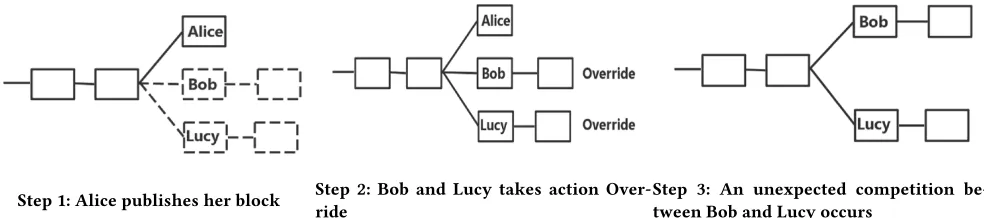
Step 1: Alice publishes her block Step 2: Bob and Lucy takes action Over-ride
Step 3: An unexpected competition be-tween Bob and Lucy occurs
Figure 3: The generation of an unexpected competition when there are two attackers with strategy selfish mining an honest miner.
Algorithm 1Attackers’ behavior in one round 1: whilenew blocks are publisheddo
2: fori=0 tondo
3: U pdate attackers′state
4: U pdate attackers′action
5: end for
6: ifAction Override is madethen
7: LenO f Chain = LenO f Chain+1 8: end if
9: end while
with action hold and Bob’s state is 0 with action Adopt. After Bob’s state converts to 0 and his action converts from Adopt to Hold, in this round, no blocks will be published anymore and the state of all miners is finally be ensured. Figure2 illustrates this process in detail. In addition, we use Algorithm1 to indicate the attackers’ mining behavior in one round.
Because of the variation of the attackers’ action in one round, the blockchain network will arise some results which are beyond the attackers’ expectation.
One of the results is called unexpected competition. In a proof of work blockchain with only one attacker, the competition occurs when the honest miner publishes a block and the attacker takes the action Match and releases one block to catch up the honest miners’ chain. If the attacker’s action is Override or Adopt, the competition will not show up since either the honest miner or the attacker gives up and accepts the opponent’s chain. In our
blockchain model with several attackers, unexpected competition shows up. In Figure3, the honest miner Alice publishes her newly found block, and two attackers Bob and Lucy hold their private chain of the length two respectively so that both Bob and Lucy publish two blocks to override Alice’s chain. In this round, neither Bob nor Lucy means to start a competition, but a competition shows up.
3.6
Choice of
β
and
γ
3.6.1 Value ofβi.We discuss the value of beta based on the real
case: The hashpower of the mining pools in Bitcoin. Since selfish mining is a risky behavior, we assume that the miner cannot take the risk of being caught. Based on this assumption, the miner will be less likely to mine jointly if they are selfish. Table2 indicates the mining pool’s hashpower of Bitcoin. The largest pool ever shown up in the past 3 years (2014-2017) takes 40% hashpower of the whole network. Nowadays,the largest mining pool of Bitcoin only occupies 21.9% hashpower of the whole network. If all the attackers attack the blockchain individually, the hashpower of a single attacker is less than 0.4. In our simulation, we decrease the upper boundary to 0.33 which is threshold to gain extra revenue even if all other miners are honest.
3.6.2 The value ofγiandγh.The value ofγi andγhis the
great-est uncertainty in our model. A set of values is to be confirmed instead of one single value. The model will be too complicated if we determineγirespectively. Fortunately, three characteristics of mining behavior help us to simplify the model.
Table 2: Mining pool’s hashpower of Bitcoin
Hashpower Scale of the mining pool
40% The largest mining pool of Bitcoin over the past 3 years. (2014-2017) 21.9% The largest mining pool today. (2017.7)
12% The second-largest mining pool today. (2017.7)
•The starter of one round is always the honest miner or the attacker with the strategy set publish-n: once an attacker applies selfish mining or stubborn-n strategy, he will hold his blocks until someone publishes a new block. The strategy he adopts does not allow him to publish a block on his initiative. Instead, he can use the action Match to start a competition in this round or use action override to lengthen his chain and finish one round.
•When the honest miner’s block is still involved in the com-petition at the end of one round, it means that no attacker takes the action override. Once an attacker makes the action override, the honest miner has to adopt the attacker’s chain since she has no unpublished blocks to match the length of the attackers’ chain.
•For an attacker with the state nn>=2, the priority level of action Override is higher than the action Match. It means that he will always take action override when his state changes from n to 1 instead of holding his blocks until his state changes to 0 and then taking the action Match.
Based on these three facts, the process of determiningγican be divided into two steps:
•Determine the portion of Alice’s (honest miner’s) remained hash powerγh. If Alice is not involved in the competition,
γhis 0.
•If the competition is an unexpected competition which means that it is caused by the action Override of several attackers, the hashpower of the honest miner will be evenly split be-tween these attackers. Otherwise, the competitors’ propaga-tion is proporpropaga-tional to their hashpower.
In fact,γhis still in a wide range. For the best case, the propaga-tion delay does not exist ,and the value ofγhis 1. When propagation delay is taken into consideration, based on Bitcoin protocol, the propagation of a block takes three rounds of interaction and the first two rounds are optional. Due to several tricky methods such as Inv block attack and Eclipse attack, the information propagation of Al-ice’s newly discovered block can be delayed by all attackers. For the worst case, all the honest miners are eclipsed so thatγh=0. Thus, in our paper, with a more complex and chaotic environment, the range ofγhwill not be restricted. Meanwhile, to simplify the simu-lation,γi, the attackers’ propagation ability will be proportional to their hashpower.
4
MINING STRATEGY
Generally speaking, the mining strategy is about when to take the action adopt or when to take action publish. In this section, we ex-plore existing mining strategies and propose our new mining strate-gies. These strategies built up the strategy space in our model. We introduce the behavior of these mining strategies through pseudo code and display the properties of these strategies through some simulation result.
4.1
Revisiting of existing strategies
4.1.1 Strategy Selfish Mining.First, consider the case in which
there is only one attacker and the other miners are all honest. The behavior of selfish mining strategy is illustrated in Algorithm2.
Many existing works indicate that when the value ofγh is 1, the threshold of hashpower for the attacker to gain extra revenue is 1/3 while the value ofγh drops to 0.5, the threshold drops to 0.25. As an attacker whose hashpower is less than 1/3, if there is no evidence that another attacker exists, he must consider carefully about whether to launch a selfish mining attack according to the value ofγh.
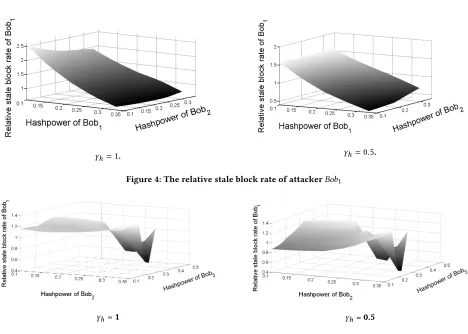
Figure4 shows the relative stale block rate ofBob1 when the number of attackers is 2 and the value ofγhis 1 and 0.5 respectively. Whenγh =1, we focus on a specific value ofBob1’s hashpower —-0.33 which is the threshold forBob1to gain extra revenue when there is only one attacker. As we can observe from the simulation result, for Bob, the threshold is no longer 1/3. Instead, the threshold for Bob to gain extra revenue is determined by the hashpower of Lucy. Whenγh =0.5 and the hashpower of Lucy is relatively small (typically less than Bob), the threshold of Bob is less than 0.25 ,and it can even drop to 0.20. With the increase of Lucy’s hashpower, the threshold for Bob also increases. As suggested in the simulation result, when Lucy’s hashpower is higher than about 0.3, the threshold for Bob will larger than 0.25.
The threshold is also determined by the hashpower of Lucy. Even if the hashpower of Bob reach the threshold with which he can earn extra revenue when he is the only attacker, he cannot necessarily gain additional revenue.
In a proof of work blockchain with several attackers, the envi-ronment becomes more complicated and there is no longer a certain value of threshold which ensures the attacker to gain extra revenue. When the attacker is tending to launch an attack with strategy selfish mining, he should not only consider the value ofγhbut also should consider the number of his opponents and his opponents’ hashpower.
γh=1. γh =0.5. Figure 4: The relative stale block rate of attackerBob1
γh= 1 γh= 0.5
Figure 5: Relative stale block rate of an attackerBobi with 20 % hashpower
Result 1:The threshold for an attacker to gain extra revenue drops since the hashpower of his opponents are more separated. The threshold is related to the value ofγhand the hashpower of another attacker.
Result 2:Bob2has a positive impact onBob1whenBob1’s hash-power is low (Less than 0.2). WhenBob1’s hashpower is high, they start to compete with each other andBob2has a negative impact onBob1.
Then, we start to add the number of attackers. Note that when the number of attackers Bob is two and the attackers’ hashpower is 0.2, he cannot gain extra revenue whenγhis 0.5 or 1. Figure5 indicates the simulation result with more than two attackers, we set the hashpower ofBob1as a constant 0.2. The scope of the other two attackers’ hashpower is 0.1 and 0.33.Bob1still has the chance to gain extra revenue while under most of the circumstance, with 20 % of hashpower, it is unwise for Bob to launch a selfish mining attack.
4.1.2 A strategy set: Stubborn-n. In most of the circumstance,
when an attacker’s private chain falls behind the honest miner’s chain, because of the hashpower differential between the attacker and the honest miner, the attacker usually takes action adopt and adopts the honest miner’s chain. When taking the action adopt, the effort of the attacker is totally wasted. Sometimes, not giving up the private chain so easily can earn unexpected revenue.
Figure 6: Dominant strategy for different value ofβ andγh when there is one attacker.
Stubborn-n is a strategy set and n represents the persistent de-gree of the attacker. If an attacker Bob takes the strategy Stubborn-j, j new states from -1 to -j are added to his state space. When a new block is found by his opponents, he gives up at state -j instead of state 0. According to this description, strategy selfish mining is a special instance of stubborn-n with the value of n =0. To avoid garble, when strategy Stubborn-n is mentioned about, the default value of n is greater than 0. The behavior of attacker with strategy stubborn-n is illustrated in Algorithm3.
Algorithm 2Selfish Mining 1: LenPrivateChain = 0 2: PrivateChain = PublicChain 3: whileMiningdo
4: ifMyPoolFoundthen
5: prev = state 6: state = state + 1
7: LenPrivateChain = LenPrivateChain + 1 8: ifprev == 0 and PrivateChain == 2then
9: publish this block 10: state = 0
11: LenPrivateChain = 0
12: else
13: Action hold
14: end if
15: else
16: prev = state 17: state = state - 1 18: ifprev == 0then
19: Action Adopt
20: private chain == public chain 21: LenPrivateChain = 0 22: state = 0
23: else ifprev == 1then
24: Action Match 25: state = 0
26: else ifprev == 2then
27: Action Override 28: state = 0
29: LenPrivateChain = 0
30: else
31: Publish the first unpublished block
32: end if
33: end if
34: end while
Consider the case in which there is only one attacker ,and the other miners are all honest. Since our strategy space has been enlarged to{S1, ...,Sn,SM}, we test the efficiency of different at-tacking strategies and find out which one is optimal under a large parameter space.
Figure6 is the simulation result when there is only one attacker. The regions in the result indicate that a certain strategy outperforms others in a certain parameter space. In most of the circumstance, strategy selfish mining is not the best option and when the hash-power of the attacker grows, the value of n increases.
Result 3:Strategy stubborn-n has a lower relative stale block rate than selfish mining in the parameter space where hashpower of the attacker is high when there is only one attacker. The perfor-mance of stubborn-n indicates that compared with selfish mining it waste more hashpower of the honest miner.
Algorithm 3Stubborn-n 1: LenPrivateChain = 0 2: PrivateChain = PublicChain 3: whileMiningdo
4: ifMyPoolFoundthen
5: prev = state 6: state = state + 1
7: LenPrivateChain = LenPrivateChain + 1 8: ifprev == 0 and PrivateChain == 2then
9: publish this block 10: state = 0
11: LenPrivateChain = 0
12: else
13: Action hold
14: end if
15: else
16: prev = state 17: state = state - 1 18: ifprev == -nthen
19: Action Adopt
20: private chain == public chain 21: LenPrivateChain = 0 22: state = 0
23: else ifprev > -n and prev <= 0then
24: Action hold 25: else ifprev == 1then
26: Action Match 27: state = 0
28: else ifprev == 2then
29: Action Override 30: LenPrivateChain = 0 31: state = 0
32: else
33: Publish the first unpublished block
34: end if
35: end if
36: end while
4.2
A new strategy set: Publish-n
During the attack, the attacker may face an embarrassing situation: He holds a long private chain and it turns out that he still falls behind the main chain. Under this situation, he may face a choice: either to take the action adopt and give up the efforts he made in a long period of time or choose the strategySn.
He has another option: Applying the strategy set publish-n, de-noted byPn. This strategy is originally proposed by us. The value of n can be seen as a cordon the attacker set for his state. When his state reaches n, he will either publish the first block of his private chain or take the action override depending on whether he finds the next block or not. This strategy helps the attacker to shorten his pri-vate chain quickly so that his state will never exceedn. Algorithm4 indicates the behavior of strategyPn.
Actually,Pncan be seen as a combination of selfish mining and honest mining, when the attacker reaches state n, he acts like an
Algorithm 4Publish-n 1: LenPrivateChain = 0 2: PrivateChain = PublicChain 3: whileMiningdo
4: ifMyPoolFoundthen
5: prev = state 6: state = state + 1
7: LenPrivateChain = LenPrivateChain + 1 8: ifprev == 0 and PrivateChain == 2then
9: publish this block 10: state = 0
11: LenPrivateChain = 0
12: else
13: ifprev < nthen
14: Action hold
15: else
16: Publish the first unpublished block
17: end if
18: end if
19: else
20: prev = state 21: state = state - 1 22: ifprev == 0then
23: Action Adopt
24: private chain == public chain 25: LenPrivateChain = 0 26: state = 0
27: else ifprev == 1then
28: Action Match 29: state = 0
30: else ifprev == 2then
31: Action Override 32: LenPrivateChain = 0 33: state = 0
34: else
35: ifprev <nthen
36: Publish the first unpublished block
37: else
38: Action Override
39: LenPrivateChain = LenPrivateChain -2 40: state = state - 1
41: end if
42: end if
43: end if
44: end while
honest miner if he finds the next block while he acts like a selfish miner at state 2. Note that, the behavior ofP1is equivalent to the honest miner andP2is similar to a selfish miner. When taking about
Pn, our default value of n isn>2. Meanwhile, for aPnminer with hashpower ofβi, the probability to reach state n is:
Ps→n=βin (7)
lim
n→+∞Ps→n =n→lim+∞βi
n=0 (8)
Thus, when n is sufficiently large, the behavior ofPncan be equiv-alent to Selfish mining.
From Algorithm4, we can notice that an attacker with strategy publish-n will publish his block initiative when he reaches state n. This characteristic of publish-n determines that it wastes less hashpower of the honest miner than the selfish miner if there is only one attacker in a proof of work blockchain.
5
PERFORMANCE OF DIFFERENT MINING
STRATEGIES
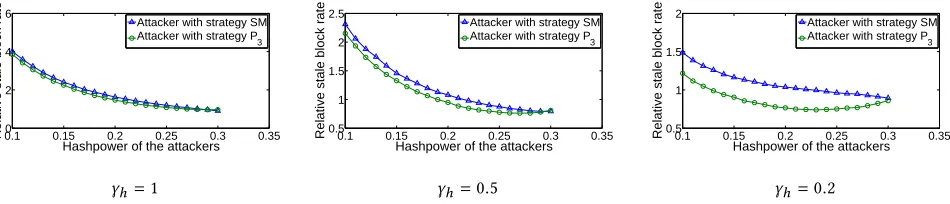
In this section, the attackers will take strategyPn,Sn and selfish mining at the same time and their performance will be compared. We use numeric simulations to evaluate the stale block rate of the miners. We simulate 100 paths of the state machine and for each path and iterate for 100000 times. In our simulation, the hashpower of the attackers will be the same. They will launch an attack inde-pendently while they can have an impact on the honest miner and the other attackers. The most well-known mining attack strategy —- selfish mining will be used as a standard of comparison. Other mining attack strategy will be compared with selfish mining in our blockchain model with several attackers.
5.1
Stubborn-n against selfish mining
To test the performance of stubborn mining, we simulate stubborn mining in our blockchain model where one honest miner and one selfish miner exist. In our simulation, both of the attackers hash-power will not exceed 33 percent so that the honest miner is still the majority. Among the strategy setSn, we chooseS1which has the lowest persistent degree to compare with selfish mining.
Figure7 illustrates the simulation result under the situation where
γhis 1 and 0.5. Selfish mining outperformsS1from the beginning to the end. The relative stale block rate of selfish mining is always lower than stubborn-1 which indicates that selfish mining is a more efficient strategy when there are more than one attackers in the blockchain model. When the hashpower of both the attackers grows, stubborn-1 narrows the gap.
Another fact which can be observed from the simulation result is that with the decrease of the value ofγh, the gap between stubborn-1 and selfish mining is increasing. It indicates that, when the honest miner can be easily influenced, strategy selfish mining receives more support from the honest miner.
Result 4:Whenγh= 1, the relative stale block rate of an attacker with strategy selfish mining is 40% lower than the attacker with strategy stubborn-1 while the attackers’ hashpower is 0.1. When their hashpower increases to 0.3, the relative stale block rate of selfish mining is only 4.3% lower than stubborn-1.
Generally speaking, in a blockchain with several attackers, the hashpower of the attackers is more separated. Under this situation, n is suboptimal compared with selfish mining. Stubborn-n is fit for the situatioStubborn-n where the hashpower of the attacker is high.
0.1 0.15 0.2 0.25 0.3 0.35 1
2 3 4 5
Hashpower of the attackers
Relative stale block rate
Attacker with Selfish Mining strategy Attacker with Stubborn−1 strategy
γh=1
0.1 0.15 0.2 0.25 0.3 0.35
1 2 3 4
Hashpower of the attackers
Relative stale block rate
Attacker with Selfish Mining strategy Attacker with Stubborn−1 strategy
γh=0.5
Figure 7: Comparison between an attacker with strategy Stubborn-1 and another attacker with strategy Selfish mining
0.1 0.15 0.2 0.25 0.3 0.35 0
2 4 6
Hashpower of the attackers
Relative stale block rate
Attacker with strategy SM Attacker with strategy P3
γh =1
0.1 0.15 0.2 0.25 0.3 0.35 0.5
1 1.5 2 2.5
Hashpower of the attackers
Relative stale block rate
Attacker with strategy SM Attacker with strategy P3
γh=0.5
0.1 0.15 0.2 0.25 0.3 0.35 0.5
1 1.5 2
Hashpower of the attackers
Relative stale block rate
Attacker with strategy SM Attacker with strategy P3
γh=0.2
Figure 8: Comparison between an attacker with strategy publish-3 and another attacker with strategy Selfish mining
Result 5:Whenγh= 0.5, the relative stale block rate of selfish mining is 89% lower than stubborn-1 while the attackers’ hashpower is 0.1. When their hashpower increases to 0.3, the relative stale block rate of selfish mining is 12.1% lower than stubborn-1.
The decrease ofγhbenefits attackers with strategy selfish mining instead of stubborn-1. In addition, with the value of n increases, the attacker with strategy stubborn-n is more persistent on his private chain so that he will get less support from the honest miner. We draw the conclusion that selfish mining outperforms stubborn-n when several attackers launch attacks at the same time.
5.2
Publish-n against selfish mining
Strategy publish-n does not fit for the blockchain model with only one attacker. In a proof of work blockchain with several attack-ers, an attacker should not only consider wasting his opponents’ computation power but also consider earning the honest miner’s support. The failure of strategy stubborn-1 gives a full illustration of this point.
In the simulation we have one honest miner, one attacker who takes the selfish mining strategy and another attacker who takes thepnstrategy. Among the strategy setpn, we selectp3since the difference between selfish mining andp3is more significant than any other strategies in the strategy setpn.
In Figure8, the relative stale block rate of an attacker with strat-egyp3is lower than the attacker with strategy selfish mining when the hashpower of both attackers are low. When the hashpower increases, the performance of selfish mining narrows the gap and eventually it outperformsp3. Another fact which can be observed
from the simulation result is that when the value ofγhis lower,p3 performs better. This phenomenon indicates that strategyp3can gain more support from the honest miner.
Result 6:Withγh= 1, the efficiency of publish-1 is 0.69% better than selfish mining when the hashpower of attackers is 0.1 and the efficiency is 2.25% worse than selfish mining when the hashpower of attackers is 0.3.
Result 7:Withγh= 0.2, the efficiency of publish-1 is 26.3% better than selfish mining when the hashpower of attackers is 0.1 and the efficiency is 3.78% better than selfish mining when the hashpower of attackers is 0.3.
When the hashpower of the attackers is low, strategy publish-n has lower relative stale block rate than selfish mining. With the increasing of the attackers’ hashpower, selfish mining eventually outperforms publish-n. With the value ofγhdropping, the honest miners are more likely to accept the chain published by the attackers and gap between the two different strategies grows larger.
Figure9 compares the relative stale block rate of the selfish miner in the blockchain model with two selfish miners and the selfish miner in the blockchain model with one selfish miner and onep3 miner. The simulation result indicates that the selfish miner in the model with one selfish miner and onep3miner always earn less revenue.
To find the lost revenue, we compared the relative stale block rate of the honest miner in the two situations mentioned above.
Figure10 displays a great decrease of the honest miner’s rela-tive stale block rate. Under the circumstanceγh =1, the honest
0.2 0.22 0.24 0.26 0.28 0.3 0.32 0.8
1 1.2 1.4 1.6 1.8
Hashpower of the attackers
Relative stale block rate
With one SM attacker and one P
3 attacker
With two SM attackers
γh=1
0.2 0.22 0.24 0.26 0.28 0.3 0.32
0.7 0.8 0.9 1 1.1 1.2
Hashpower of the attackers
Relative stale block rate
With one SM attacker and one P3 attacker
With two SM attackers
γh=0.5
Figure 9: Comparison between one selfish miner in a model with two selfish miners and in a model with one selfish miner and onepnminer
0.1 0.15 0.2 0.25 0.3 0.35
0.5 1 1.5
Hashpower of the attackers
Relative stale block rate
With two selfish attackers With one selfish attacker and one Publish−3 attacker
γh=1
0.1 0.15 0.2 0.25 0.3 0.35
0.8 1 1.2 1.4
Relative stale block rate Hashpower of the attackers
With two selfish attackers With one selfish attacker and one Publish−3 attacker
γh=0.2
Figure 10: Honest miner’s relative stale block rate
Figure 11: Dominant strategy for different value ofβandγh with 3 attackers
miner can even gain extra revenue. The poor selfish mining attacker becomes the victim of the strategy ofPn
Result 8:The strategyPndecreases the revenue of selfish mining attacker. This part of revenue not only benefit thePn miner but also benefits the honest miner if the attackers’ hashpower is low.
In the discussion above, the number of attackers is limited to two. The situation in which more attackers launch the attack should also be considered. The increase of attacker will result in a complicate mining circumstance and the decrease of the hashpower of the honest miner. Thus, in this section, we will not assure that the honest is the majority. The hashpower of the honest miner is in a wide range from 0 to 1.
Figure 12: Dominant strategy for different value ofβandγh with 5 attackers
First, we consider the case in which 3 attackers with strategy
Pi,Pj and selfish mining respectively. We find the fact that when the value of n is greater than 5, there is no significant difference between the mining result ofPnand selfish mining. Thus, we set the value of i to 3 and j to 4.
Figure11 is the simulation result. Each region represents that a certain mining strategy performs the best with the parameter space of the region. StrategyP3has the lowest relative stale block rate among the three mining attack strategies when the hashpower of the attackers are low while selfish mining outperforms other strategies when the hashpower of the attackers are high.
Then strategys1ands2are added to the model so that the number of attackers increases to 5. Although the simulation result in Figure7 has proved that strategysndo not perform well when there are several attackers, they still have impacts on other attackers.
Figure12 is the simulation result. As expected, there is no region for strategys1ands2. The greatest difference between the Figure12 and Figure11 is that the region for strategyp4almost disappear. The edge between regionp4, regionp3and regionSMis blurry. This result indicates that the efficiency ofp3,p4and SM is too close when the number of attackers is 5.
6
CONCLUSION AND FUTURE WORK
6.1
Detection of mining attack
Our conclusion about mining attack is that: mining attack is easy to be detected but the attacker is difficult to be caught. The detection of mining attack results from the variety of the stale block rate of miners. Fluctuations in the value of total stale block rate can be detected easily. But owning the information of the stale block rate of each miner or mining pool is not enough to find who is the attacker especially when multiple attackers are launching attacks to a proof of work blockchain.
6.2
Mining attack is risky
One reason is that due to the discovery of strategies to earn extra revenue in mining, the Bitcoin community deploys monitors to monitor the behaviors of miners.
Another explanation is based on our simulation result. For a miner with low computation power, typically less than 20%, he can barely gain extra revenue even if there are three attackers in the blockchain. That means, under most circumstance, he cannot earn extra revenue compared with mining honestly. Since he knows nothing about other miners’ strategy space, he cannot cooperate with other attackers either. For an attacker with a large amount of computation power, typically larger than 30%, he indeed has the power to launch an attack and gain extra revenue compared with mining honestly. Other miners will soon be aware of the fact that someone has launched an attack according to the raising stale block rate. According to Result 8, when other miners take strategy publish-n the efficiepublish-ncy of the attacker will drop sigpublish-nificapublish-ntly. He may fipublish-nd an embarrassing fact that no one in the blockchain network earns more than before, including himself. A huge amount of computation power has been wasted.
6.3
P
nreceives more support than
S
nStubborn-n has the lowest relative stale block rate compared with other mining strategies when there is only one attacker. When the number of attackers increases, strategy stubborn-n soon lose its advantage. We draw the conclusion that strategy stubborn-n pays too much focus on wasting his opponents’ computation power and when his opponent is the honest miner, this strategy always works. When competing with the honest miner and other attackers, an-other aspect should be noticed: getting the support from the honest miner. In a blockchain model with several attackers, forks exist more frequently. Being the first one to publish the block helps gain
the support from the honest miner. This is the reason why publish-n strategy success in the competition of several attackers when the computation power of the attacker is low. But strategy publish-n also has a side effect: The attacker wastes less computation power of his opponents. When the computation power of the attacker raises, this side effect’s influence becomes more significant.
7
FUTURE WORK
We show that in a proof of work blockchain, several attackers may show up. Through the model, we analyze the attackers’ potential behaviors and adding publish-n to strategy space. Our work leaves the following challenge:
• The miners’ behavior in a proof of work blockchain with several attackers can be explored.
• With the existence of several attackers, the stale block rate or relative stale block rate is not enough to distinguish the attacker and the honest miner. How to detect the attackers remains a problem to be solved.
• Our simulation only shows the performance of different strategies. Actually, an attacker can change his attacking strategy on his own initiative. Determining when to shift from one strategy to another remain to be discussed.
REFERENCES
[1] Eyal I, Sirer E G. Majority is not enough: Bitcoin mining is vulnera-ble[C]//International conference on financial cryptography and data security. Springer, Berlin, Heidelberg, 2014: 436-454.
[2] Nakamoto S. Bitcoin: A peer-to-peer electronic cash system[J]. 2008. [3] Decker C, Wattenhofer R. Information propagation in the bitcoin
network[C]//Peer-to-Peer Computing (P2P), 2013 IEEE Thirteenth Inter-national Conference on. IEEE, 2013: 1-10.
[4] Sapirshtein A, Sompolinsky Y, Zohar A. Optimal selfish mining strategies in bit-coin[C]//International Conference on Financial Cryptography and Data Security. Springer, Berlin, Heidelberg, 2016: 515-532.
[5] Eyal I. The miner’s dilemma[C]//Security and Privacy (SP), 2015 IEEE Symposium on. IEEE, 2015: 89-103.
[6] E. Heilman, A. Kendler, A. Zohar, and S. Goldberg. Eclipse attacks on bitcoin’s peer-to-peer network.Usenix, 2015.
[7] A.Gervais,H.Ritzdorf,G.O.Karame and S.Capkun. Tampering with the Delivery of Blocks and Transactions in Bitcoin,Acm Sigsac Conference on Computer and Communications Security, 2015.
[8] K.Nayak,S.Kumar,A.Miller and E.Shi.Stubborn Mining:Generalizing Selfish Mining and Combining with an Eclipse Attack,IEEE European Symposium on Security and Privacy,2016.
[9] A. Gervais,Ghassan O. Karame and K.Wust. On the Security and Performance of Proof of Work Blockchains, Acm Sigsac Conference on Computer and Communi-cations Security,2016.
[10] Economist Staff (31 October 2015). "Blockchains: The great chain of being sure about things". The Economist. Retrieved 18 June 2016.
[11] Y.Sompolinsky and A.Zohar. Secure high-rate transaction processing in bitcoin. In Financial Cryptography and Data Security, 2015.
[12] Ghassan O. Karame, E.Androulaki, and S.Capkun.Double-spending fast payments in bitcoin. Conference on Computer and communications security, 2012. [13] M.Rosenfeld.Analysis of hashrate-based double spending.arXiv preprint
arXiv:1402.2009,2014.
[14] Y. Lewenberg, Y. Bachrach, Y. Sompolinsky, A. Zohar, and J. S.Rosenschein. Bitcoin mining pools: A cooperative game theoretic analysis. In Proceedings of the 2015 International Conference on Autonomous Agents and Multiagent Systems, pages 919-927. International Foundation for Autonomous Agents and Multiagent Systems, 2015.
[15] Miller A, Litton J, Pachulski A, et al. Discovering bitcoinâĂŹs public topology and influential nodes[J]. et al., 2015.
[16] Bag S, Ruj S, Sakurai K. Bitcoin block withholding attack: Analysis and mitiga-tion[J]. IEEE Transactions on Information Forensics and Security, 2017.