Available Online atwww.ijcsmc.com
International Journal of Computer Science and Mobile Computing
A Monthly Journal of Computer Science and Information Technology
ISSN 2320–088X
IMPACT FACTOR: 5.258
IJCSMC, Vol. 5, Issue. 4, April 2016, pg.16 – 21
An Effective Authentication Scheme for
Distributed Mobile Cloud Computing
Services Using a Single Private Key
Mrs. Kavitha K K
1, Avinash B
21
Assistant professor, Department of Information Science, New Horizon College of Engineering, India
2
Student, Department of Information Science, New Horizon College of Engineering, India
1
[email protected], 2 [email protected]
Abstract: Mobile cloud computing comprises of cloud computing, mobile computing and wireless network. Providing secure and convenience for the mobile users to access multiple cloud computing services is essential. This paper furnishes an effective way of providing the authentication for the mobile users to access multiple cloud computing services. The proposed scheme outfits a secure and expediency for mobile users to access several cloud computing services from multiple service providers using a single private key. Our proposed scheme is based on bilinear pairing cryptosystem. In addition, the scheme also supports mutual authentication, key exchange, user anonymity. To overcome the vulnerabilities of traditional methods, from system implementation point of view, the proposed scheme eliminates the usage of verification tables that are required to store the user credentials (user ID and password) which are the part of smart card generator service and cloud computing service provider.
Keywords—smart card generator (SCG), mutual authentication, ID based cryptosystem, bilinear pairing cryptosystem, identity provider (IdP).
I.
INTRODUCTION
mobile devices (such as, smart phones, tablets, etc.), with several type of services tied, so called Cloud Computing System (CCS). The user can use services and application on the cloud through internet.
However, In the recent years, there is a rapid growth in the mobile application due to increase in the popularity of smart phones. Mobile devices have started becoming abundant with application in various categories such as entertainment, health, games, business, social networking, travel and news [2]. The reason for this is that mobile computing is able to provide a tool to use the user when and where is needed, irrespective of user movements, hence supporting location independence. So the development mobile cloud computing become an important research in this mobile oriented world. The general purpose[3] of mobile cloud computing is, a public system is built need uses the cloud infrastructure, to contribute in improving mobile device performance efficiency.
In this paper, an effective authentication schema for the distributed mobile cloud computing is proposed. This schema uses a single private key for the authentication of multiple service providers [4]. Earlier, in one mobile user authentication only the target cloud service provider need to interact with the requestor(user). As the mobile user generally access different mobile cloud computing services, it is very tedious for user to register different user accounts on each service provider and to maintain them. The proposed schema is built upon bilinear pairing[5]. And therefore, requires less computation resources on both mobile devices and service provider. Through this, a user can get access to multiple service providers using a single private key, provided both mobile user and service provider should know the identities of each other.
II.
RELATED WORK
Today, providing access to right user is the major concern. There should be a right mechanism that prevent the illegal access from unauthorized user. Authorization schema is the security mechanism for the network based services. Traditionally, authorization schema's user traditional public key cryptosystem such as RSA, which requires lengthy key size and utilizes the maximum of computational resources on the mobile devices. Since mobile devices be short of resources, traditional authentication schema are inappropriate to use. Therefore an efficient schema is required, which is beneficial for the mobile device.
In the recent years, many ID based cryptosystem [6] have been proposed. An ID based cryptosystem is the public key cryptosystem that resolve the issues with the traditional public key cryptosystem. In the proposed system, an ID based cryptosystem is based on bilinear pairing in an elliptic curve.
III.
PROPOSED SYSTEM
In this paper, an user authentication schema is based on bilinear pairing for distributed mobile cloud computing. The proposed system supports mutual authentication, key exchange, and user untraceability.
The following are the benefits that are preserved by using this authentication scheme.
i. The key size provided by ECC is much smaller compared to the size provided by the traditional public key cryptosystem.
scheme, the user is assigned a smart card, which is being modified by some parameters during the user registration phase. The usage of this smart card makes the system make more protected by avoiding the user from distributing their login credentials. By this the scheme effectively prevents the situation of many logged in users with same login ID. Typically the registered user share his credentials so that other who know the login-ID and password can login successfully. In this scheme, the login request is created by the smart card using its stored secret component without any human intervention. It is extremely difficult to extract the secret component from the smart card, and thus the user cannot share it with others. Even if the legitimate user’s password is shared with others, the other person cannot login to the system without the smart card. Once a valid user logs into the remote system, his smart card will be inside the terminal until the user logs out. If the user pulls out the card from the terminal after login the remote system, the login session will be immediately expired. Thus, the scheme can successfully prevent the scenario of many logged in users with the same login-ID.
The scheme consist of three phases: set up phase, registration phase, and authentication phase. In the rest of the paper, we give preliminaries of these three phases based on bilinear pairing cryptosystem [7].
Preliminaries
A. Bilinear pairing
Let G1the cyclic additive group generated by P, whose order is Q. G2be the multiplicative group of
same order. A map e : G1×G1G2 is called bilinear mapping if it satisfies the following properties.
a. Bilinear: e(aP, bQ)=e(P,Q)abfor all P,Q ∈ G1and a,b ∈ Zq*.
b. Non degenerate: there exist P,Q ∈ G1 such that e(P,Q) ≠ 1.
c. Computable: there exist an efficient algorithm to compute e(P,Q) for all P,Q ∈ G1.
In reality, G1 is the group of points on an elliptic curve Zq*and G2is the subgroup of multiplicative group
of finite field Z*qk for some k
∈
Zq*.B. Set up Phase
During set up phase, the smart card generator select the random number and computes its master private key (s). With this master private key it also generates public key and public parameters.
Suppose G1is an additive group and G2 is the multiplicative group of order q and suppose P is the generator of G1, then e : G1×G1G2 is called bilinear mapping, H: {0,1}* G1is the cryptographic hash function. Selects a
master private key s and computes public key as Pub=sP. Then publishes the public parameters (G1, G2, e, q, P, Pub, H) and keeps s secret.
C. Registration Phase
Fig 1. Registration Phase
This phase is executed by following steps when user wants to register.
i) Suppose a new user Ui wants to register with SCG.
ii) Ui submits the identity IDiand password PWi.
iii) On receiving the request, the SCG computes Regid = s.H(IDi) | H(PWi).
iv) The SCG initializes the smart card with the parameter IDi, Regid, H(.) and send the smart card to the Ui
over a secure channel.
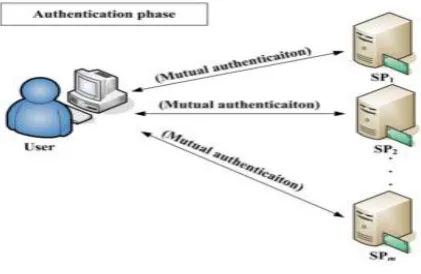
D. Authentication Phase
This is executed when the user logs into the system. This phase is further divided into login phase and verification phase.
Fig 2. Authentication Phase
1) Login Phase
The user Ui insert the smart card in a terminal and enter IDiand PWi. The IDi is identitical to one that is
2) Verification Phase
The SP receives the login message (IDi, DIDi, Vi, T) at time T* (≥T). Over receiving the login request
the SP does the following operations.
i) Computes the time interval between T and T*. If (T* - T) ≤ ΔT then SP proceeds to step ii. Otherwise rejects the login request. ΔT is the expected time interval between transmission delay.
ii) Checks whether e(DIDi - Vi, P) = e(H(IDi), Pub). If it is valid, the SP accept the request , else rejects it.
During this phase, the mobile user and service provider are able to authenticate without the intervention of SCG. And therefore reduces the time required by the trusted third party to verify the user. The session key is also generated during this phase to encrypt/decrypt the messages sent between user and service provider.
E. Password Change Phase
This phase is executed when the user wants to change the password. The proposed scheme allow this step to execute without the intervention of the SCG. The user insert the smart card into the terminal and keys IDi and PWi. If IDi is matching with the value stored in smart card then allows the user to change or it terminates the
operation. The phase works like this.
i) Ui enters the new password PWi.
ii) The smart card calculates Regid*= Regid - H(PWi) + H(PWi*) = s.H(IDi) + H(PWi*).
iii) The password has been changed to the new password PWi*and the smart card restore the value of Regidwith Regid* value.
IV.
RESILIENCE OF PROPOSED SYSTEM
A. Security
The proposed scheme can resist to the following attacks:
1) Replay Attack
Suppose an adversary tap the login request from the valid user, the SP receive the request at time Tnew. The SP
calculates the time interval (Tnew - T) and compares with expected time interval delay (ΔT) which exceed the
value. And therefore the attack fails.
2) Forgery Attack
From the valid login message, an adversary can get only get IDi, DIDi, Vi and T. from these values an adversary
can't find any use full information. Though DIDi = T. Regid , this does not reveal any information needed since the
Regid kept secret.
3) Insider Attack
In password based user request, the trusted third party maintains a separate table called verifier table for storing the user credentials. Since in our proposed scheme, the login request is based on user's password as well as the secret key s, and thus it eliminates the usage of verifier table.
V.
CONCLUSION
REFERENCES
[1] Steffen Sorrell, "Cloud Computing - Consumer Markets: Strategies & Forecasts 2015-2020", Juniper, Enabling Technologies, 04 November 2015.
[2] Ahmed Dheyaa Basha, Irfan Naufal Umar, Merza Abbas, "Mobile Applications as Cloud
Computing:Implementation and Challenge", International Journal of Information and Electronics Engineering, Vol. 4, No. 1, January 2014.
[3] Niroshinie Fernando, Seng W. Loke, Wenny Rahayu," Mobile cloud computing: A survey", Elsevier, 22 May 2012.
[4] Jia-Lun Tsai and Nai-Wei Lo, "A Privacy-Aware Authentication scheme for Distributed Mobile Cloud Computing Services", IEEE SYSTEMS JOURNAL, VOL. 9, NO. 3, SEPTEMBER 2015.
[5] Al-Sakib Khan Pathan and Choong Seon Hong "Bilinear-Pairing-Based Remote User Authentication Schemes
Using Smart Cards " ICUIMC’09, January 2009.
[6] T. H. Chen; H. l. Yeh; W. K. Shih, "An Advanced ECC Dynamic ID-Based Remote Mutual Authentication
Scheme for Cloud Computing" IEEE Conference Publications, 2011.