ARTICLES
Ludwig Kappos, MD
Gilles Edan, MD
Mark S. Freedman, MD
Xavier Montalbán, MD
Hans-Peter Hartung, MD
Bernhard Hemmer, MD
Edward J. Fox, MD
Frederik Barkhof, MD
Sven Schippling, MD
Andrea Schulze, MS
Dirk Pleimes, MD
Christoph Pohl, MD
†
Rupert Sandbrink, MD
Gustavo Suarez, MD
Eva-Maria Wicklein, MD
For the BENEFIT Study
Group
Correspondence to Prof. Kappos: [email protected]
Editorial, page 970
Supplemental data at Neurology.org
The 11-year long-term follow-up study
from the randomized BENEFIT CIS trial
ABSTRACT
Objective:
To assess outcomes for patients treated with interferon beta-1b immediately after
clin-ically isolated syndrome (CIS) or after a short delay.
Methods:
Participants in BENEFIT (Betaferon/Betaseron in Newly Emerging MS for Initial
Treat-ment) were randomly assigned to receive interferon beta-1b (early treatTreat-ment) or placebo (delayed
treatment). After conversion to clinically definite multiple sclerosis (CDMS) or 2 years, patients on
placebo could switch to interferon beta-1b or another treatment. Eleven years after
randomiza-tion, patients were reassessed.
Results:
Two hundred seventy-eight (59.4%) of the original 468 patients (71.3% of those eligible at
participating sites) were enrolled (early: 167 [57.2%]; delayed: 111 [63.1%]). After 11 years, risk of
CDMS remained lower in the early-treatment arm compared with the delayed-treatment arm (
p
5
0.0012), with longer time to first relapse (median [Q1, Q3] days: 1,888 [540, not reached] vs 931
[253, 3,296];
p
5
0.0005) and lower overall annualized relapse rate (0.21 vs 0.26;
p
5
0.0018). Only
25 patients (5.9%, overall; early, 4.5%; delayed, 8.3%) converted to secondary progressive multiple
sclerosis. Expanded Disability Status Scale scores remained low and stable, with no difference
between treatment arms (median [Q1, Q3]: 2.0 [1.0, 3.0]). The early-treatment group had better Paced
Auditory Serial Addition Task
–
3 total scores (
p
5
0.0070). Employment rates remained high, and
health resource utilization tended to be low in both groups. MRI metrics did not differ between groups.
Conclusions:
Although the delay in treatment was relatively short, several clinical outcomes
favored earlier treatment. Along with low rates of disability and disease progression in both
groups, this supports the value of treatment at CIS.
ClinicalTrials.gov identifier:
NCT01795872.
Classification of evidence:
This study provides Class IV evidence that early compared to delayed
treatment prolongs time to CDMS in CIS after 11 years.
Neurology®2016;87:978–987GLOSSARY
ARR5annualized relapse rate;BENEFIT5Betaferon/Betaseron in Newly Emerging MS for Initial Treatment;CDMS5clinically definite multiple sclerosis;CI5confidence interval;CIS5clinically isolated syndrome;DMT5disease-modifying therapy;
EDSS5Expanded Disability Status Scale;EQ-5D5EuroQoL–5 Dimension;FAMS5Functional Assessment of Multiple Sclerosis;Gd15gadolinium-enhancing;KM5Kaplan-Meier;MS5multiple sclerosis;PASAT5Paced Auditory Serial Addition Task;Q5quartile;RR5risk ratio;SDMT5Symbol Digit Modalities Test;SPMS5secondary progressive multiple sclerosis.
Patients with multiple sclerosis (MS), the most common chronic demyelinating disorder of the
CNS, often present with an acute or subacute episode of neurologic dysfunction known as a
clin-ically isolated syndrome (CIS).
1,2Eventually, most of these patients (up to 85%) will be
diagnosed with MS once evidence for dissemination of lesions in space and time accumulates.
2,3†Deceased.
From Neurology (L.K.), Departments of Medicine, Clinical Research, Biomedicine and Biomedical Engineering, University Hospital Basel, Switzerland; CHU–Hopital Pontchaillou (G.E.), Rennes, France; University of Ottawa (M.S.F.), and the Ottawa Hospital Research Institute, Ottawa, Canada; Hospital Universitari Vall d’Hebron (X.M.), Ps. Vall d’Hebron, Barcelona, Spain; Department of Neurology (H.-P.H., R.S.), Medical Faculty, Heinrich-Heine Universität, Düsseldorf; Technische Universität München (B.H.), Munich, Germany; Central Texas Neurology Consultants (E.J.F.), Round Rock, TX; VU University Medical Center (F.B.), Amsterdam, the Netherlands; Neuroimmunology and Multiple Sclerosis Research (S.S.), Department of Neurology, University Hospital Zurich and University of Zurich, Switzerland; Bayer Pharma AG (A.S., C.P., E.-M.W.), Berlin; Myelo Therapeutics GmbH (D.P.), Berlin; University Hospital of Bonn (C.P.), Germany; and Bayer HealthCare Pharmaceuticals (G.S.), Whippany, NJ.
BENEFIT Study Group coinvestigators are listed at Neurology.org.
Go to Neurology.org for full disclosures. Funding information and disclosures deemed relevant by the authors, if any, are provided at the end of the article. The Article Processing Charge was paid by Bayer Pharma AG/Bayer HealthCare Pharmaceuticals.
Several controlled studies have shown that
conversion to MS can be delayed by starting
treatment with disease-modifying therapies
(DMTs) at CIS.
4–11However, data about the
effects of starting treatment this early on the
long-term disease course, including potential
improvements relative to delayed treatment on
measures of confirmed disability progression,
participation, and quality of life, are scarce.
The 5-year Betaferon/Betaseron in Newly
Emerging MS for Initial Treatment (BENEFIT)
trial and its 8-year extension have shown
improved outcomes in patients who initiated
treatment with interferon beta-1b (Betaferon/
Betaseron; Bayer HealthCare Pharmaceuticals,
Whippany, NJ) immediately after CIS, relative
to patients who had started treatment after their
second clinical event or 2 years post-CIS at the
latest.
6,10Specifically, we have shown delays in
conversion to CDMS and reductions in the
annualized relapse rate (ARR) 2, 3, 5, and 8
years after randomization
6,8–10but only a small
change in mean Expanded Disability Status
Scale (EDSS) score in both treatment groups
up to the 8-year analysis, indicating a relatively
mild disease course.
6The objective of the
pres-ent study was to examine the longer-term effects
of treatment with interferon beta-1b on the
dis-ease course at 11 years after occurrence of CIS.
METHODS Patient selection.The phase 3 BENEFIT trial consisted of a prospective, 2-year, international, multicenter, randomized, double-blind, placebo-controlled, parallel-group study of interferon beta-1b 250mg administered subcutaneously every other day with a preplanned open-label interferon beta-1b treatment follow-up phase, blinded to the initial treatment allocation and lasting up to 5 years.10All patients had experienced a CIS suggestive of MS and had$2 clinically silent MRI lesions. Enrollment was completed at centers in Europe, Canada, and Israel between February 2002 and June 2003.10The 5-year core and follow-up study was followed by an open-label observational extension study with a maximum follow-up of 8.7 years.6Following the extension study, the investigators decided to conduct a prospective, comprehensive, 11-year, cross-sectional reassessment (BENEFIT 11 Study), which is presented here.
Randomization and masking.In the core study, patients were randomized (5:3) by means of a central interactive voice response sys-tem within 60 days of CIS to receive either interferon beta-1b 250 mg (early treatment) or placebo (delayed treatment) subcutaneously every other day. After 2 years or conversion to CDMS, all patients could have treatment with interferon beta-1b but could also take another or no DMT.
Assessments.Eleven years after randomization, all patients from participating study centers who were randomized and treated at least once in the placebo-controlled phase were eligible to enter the 11-year follow-up and were approached to participate in a comprehensive reassessment. The battery of assessments included
(see figure e-1 at Neurology.org for full list): neurologic history and examination (relapses, current disease course), EDSS,12 Multiple Sclerosis Functional Composite,13employment status and resource use, health-related quality of life (EuroQoL–5 Dimension [EQ-5D],14Functional Assessment of Multiple Sclerosis [FAMS]),15 depressive symptoms (Center for Epidemiologic Studies Depression Scale),16 fatigue (Fatigue Scale for Motor and Cognitive Functions),17,18 MS medication history, cognition (Paced Auditory Serial Addition Task [PASAT]-3, Symbol Digit Modalities Test [SDMT]),19,20and MRI. Investigators conducted patient assessments at their respective centers but, to include sicker patients who were unable to attend a center in person, a structured interview via phone that included a validated instrument for the assessment of the EDSS21,22was offered as an alternative.
CDMS was defined according to slightly modified Poser cri-teria23as (1) a relapse with clinical evidence of$1 CNS lesion, and if the first presentation was monofocal, a lesion distinct from the one responsible for the CIS presentation, or (2) sustained progression by$1.5 points on the EDSS reaching a total EDSS score of$2.5 and confirmed at a consecutive visit 3 months later. Such EDSS progression must have been based on objective clin-ical evidence of$1 neurologic abnormality other than vegetative or cerebral dysfunction.
EDSS progression (unrelated to the CDMS definition) was defined as an increase of$1 point compared with the initial EDSS score (the lower of the 2 scores obtained during screening and baseline) or an increase of$1.5 points if the initial score was 0. A confirmed EDSS progression was defined as a progres-sion confirmed at a scheduled study visit$140 days later. A sustained EDSS progression was defined as a progression that had been confirmed in the course of BENEFIT or BENEFIT follow-up and was sustained up to the 11-year visit.
Investigators collected MRI data at study sites according to a standardized MRI protocol. Scans were analyzed at a central reading site (VU University Medical Center, Amsterdam, the Netherlands). Trained readers manually identified and quantified lesions using a local thresholding technique.
Statistical procedures.Statistical modeling was used to esti-mate treatment effects and explore the relationships of target var-iables to treatment. The study was exploratory in nature, with the primary objective to describe disease course, particularly time to con-version to CDMS (Class III evidence) and/or secondary progressive MS (SPMS), relapse activity, change in disability, cognitive function, resource use, and working status (Class IV evidence) at year 11. Sec-ondary objectives included assessment of MRI, treatment history, quality of life, depression, and DMT choices. Variables of primary and secondary interest were assessed using proportional hazards regression for time-to-event outcomes and generalized linear regression models, with steroid use during first event (yes or no), multifocal or monofocal onset of disease, and number of T2 lesions at screening (2–4, 5–8, or$9) included as the standard set of covariates. An extended set of covariates that included number of gadolinium-enhancing (Gd1) lesions at screening, age, and sex in addition to the standard covariates was used for analysis of time to CDMS, time to first relapse, and ARR. Other variables were analyzed using nonparametric methods. A negative binomial regression model for T1 lesions adjusting for T2 lesions at screening and initial treatment as independent variables was fitted. Changes in imaging hardware and software precluded comparisons of MRI-related outcomes over time. Therefore, only cross-sectional MRI comparisons at year 11 between early and delayed treatment were performed.
Figure 1 Study profile for the entire BENEFIT Study
aIncludes one patient randomized to receive interferon beta-1b but treated with placebo.bIncludes one patient randomized to receive placebo but treated
beta-1b at CIS or after a short delay on clinical and MRI outcomes after 11 years.
Standard protocol approvals, registrations, and patient consents.The institutional review boards of participating institu-tions approved the protocol for the study. Patients provided informed consent at enrollment into each phase of the trial. The BENEFIT 11 trial is listed on clinicaltrials.gov under NCT01795872.
RESULTS Patient disposition.
Of the 468 patients
originally randomized in BENEFIT, 278 (59.4%)
enrolled in BENEFIT 11 (167 [57.2%] from the
early-treatment arm and 111 [63.1%] from the
delayed-treatment arm) between September 2013
and April 2014 in the 66 of 97 sites in 19 countries
that participated in this 11-year follow-up (figure 1).
A total of 71.3% of the patients originally randomized
and treated in these participating sites were enrolled.
Two hundred thirty-seven patients (85.3%) had
in-person assessments at study centers; 41 patients
(14.7%) had phone assessments.
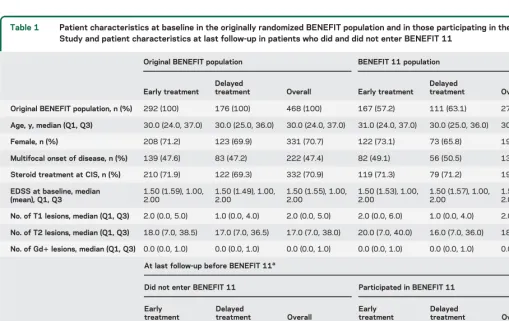
Baseline characteristics and outcomes of the original
cohort vs BENEFIT 11 participants at their last study
visits before the 11-year follow-up were generally well
comparable (table 1) with the exception of a somewhat
higher number converting to CDMS in the 11-year
follow-up group. Patients in the early- and
delayed-treatment arms of the 11-year follow-up also had similar
baseline characteristics. The mean (SD) delay until
starting interferon beta-1b treatment was 1.5 (0.73)
years in the delayed-treatment group. One hundred
seventy-one (61.5%) of the 278 patients enrolled in
BENEFIT 11 were on a DMT at the time of
assess-ment; 86 (30.9%) were on interferon beta-1b. Mean
(SD) time on interferon beta-1b was 1,523.2 (861.4)
days over the 11 years, excluding the BENEFIT Study
medication.
Clinical outcomes.
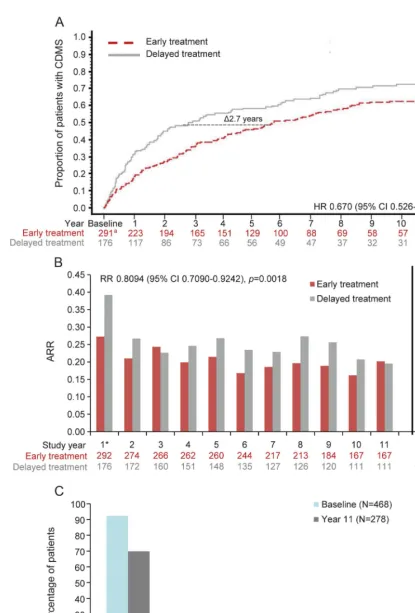
After 11 years, the risk of
conver-sion to CDMS was still reduced by 33.0% for patients
in the early-treatment arm relative to those in the
delayed-treatment arm (hazard ratio 0.670; 95%
confidence interval [CI] 0.526
–
0.854,
p
5
0.0012;
figure 2A). One hundred sixty-two patients (66.6%
of total early-treatment group; Kaplan-Meier [KM]
estimate) in the early-treatment group and 118 (75.0%
of total delayed-treatment group [KM estimate]) in the
Table 1 Patient characteristics at baseline in the originally randomized BENEFIT population and in those participating in the BENEFIT 11 Study and patient characteristics at last follow-up in patients who did and did not enter BENEFIT 11
Original BENEFIT population BENEFIT 11 population
Early treatment
Delayed
treatment Overall Early treatment
Delayed
treatment Overall
Original BENEFIT population, n (%) 292 (100) 176 (100) 468 (100) 167 (57.2) 111 (63.1) 278 (59.4)
Age, y, median (Q1, Q3) 30.0 (24.0, 37.0) 30.0 (25.0, 36.0) 30.0 (24.0, 37.0) 31.0 (24.0, 37.0) 30.0 (25.0, 36.0) 30.0 (25.0, 37.0)
Female, n (%) 208 (71.2) 123 (69.9) 331 (70.7) 122 (73.1) 73 (65.8) 195 (70.1)
Multifocal onset of disease, n (%) 139 (47.6) 83 (47.2) 222 (47.4) 82 (49.1) 56 (50.5) 138 (49.6)
Steroid treatment at CIS, n (%) 210 (71.9) 122 (69.3) 332 (70.9) 119 (71.3) 79 (71.2) 198 (71.2)
EDSS at baseline, median (mean), Q1, Q3
1.50 (1.59), 1.00, 2.00
1.50 (1.49), 1.00, 2.00
1.50 (1.55), 1.00, 2.00
1.50 (1.53), 1.00, 2.00
1.50 (1.57), 1.00, 2.00
1.50 (1.55), 1.00, 2.00
No. of T1 lesions, median (Q1, Q3) 2.0 (0.0, 5.0) 1.0 (0.0, 4.0) 2.0 (0.0, 5.0) 2.0 (0.0, 6.0) 1.0 (0.0, 4.0) 2.0 (0.0, 5.0)
No. of T2 lesions, median (Q1, Q3) 18.0 (7.0, 38.5) 17.0 (7.0, 36.5) 17.0 (7.0, 38.0) 20.0 (7.0, 40.0) 16.0 (7.0, 36.0) 18.0 (7.0, 39.0)
No. of Gd1lesions, median (Q1, Q3) 0.0 (0.0, 1.0) 0.0 (0.0, 1.0) 0.0 (0.0, 1.0) 0.0 (0.0, 1.0) 0.0 (0.0, 1.0) 0.0 (0.0, 1.0)
At last follow-up before BENEFIT 11a
Did not enter BENEFIT 11 Participated in BENEFIT 11
Early treatment
Delayed
treatment Overall
Early treatment
Delayed
treatment Overall
No. 125 65 190 167 111 278
CDMS, n (%) 48 (38.4) 35 (53.8) 83 (43.7) 92 (55.1) 68 (61.3) 160 (57.6)
ARR 0.1995 0.2653 0.2196 0.1947 0.2517 0.2177
EDSS, median (mean), Q1, Q3 1.5 (1.72), 1.0, 2.0 1.5 (1.52), 1.0, 2.0 1.5 (1.65), 1.0, 2.0 1.5 (1.68), 1.0, 2.0 1.5 (1.69), 1.0, 2.5 1.5 (1.69), 1.0, 2.5
PASAT-3, median (Q1, Q3) 58.0 (53.0, 59.0) 57.0 (49.0, 59.0) 57.0 (52.0, 59.0) 58.0 (54.0, 59.5) 58.0 (51.0, 59.0) 58.0 (53.0, 59.0)
Abbreviations: ARR5annualized relapse rate; BENEFIT5Betaferon/Betaseron in Newly Emerging MS for Initial Treatment; CDMS5clinically definite multiple sclerosis; CIS5clinically isolated syndrome; EDSS5Expanded Disability Status Scale; Gd1 5gadolinium-enhancing; PASAT-35Paced Auditory Serial Addition Task–3; Q5quartile.
Figure 2 Kaplan-Meier estimates of probability of CDMS (A), ARR (B), and EDSS scores (C) in the BENEFIT 11 population
aOne patient in the early-treatment arm was excluded from this analysis because diagnosis of CDMS was unclear. Risk of conversion to CDMS was
delayed-treatment group had converted to CDMS at any
time until BENEFIT 11. Time to CDMS was shorter in
the delayed-treatment arm (log rank
p
5
0.0034) as well
as time to first relapse (hazard ratio 0.655 [95% CI
0.517
–
0.830],
p
5
0.0005). Risk of a first relapse was
reduced by 34.5% in the early-treatment compared with
the delayed-treatment group. The overall ARR over the
11-year study period was lower in the early-treatment
group than in the delayed-treatment group, resulting in
a 19.1% reduction in risk of relapses (risk ratio [RR]
0.8094 [95% CI 0.7090
–
0.9242],
p
5
0.0018; figure
2B). Inspection of figure 2B revealed that the ARR by
study year was not only different during the core study
but also remained lower in all but 2 of the follow-up
years, although after the second year, both groups were
similarly exposed to interferon beta-1b treatment.
Overall, only 25 patients had converted to SPMS
(5.9%, KM estimate) by year 11 (early 4.5%, delayed
8.3%, KM estimate; log rank
p
5
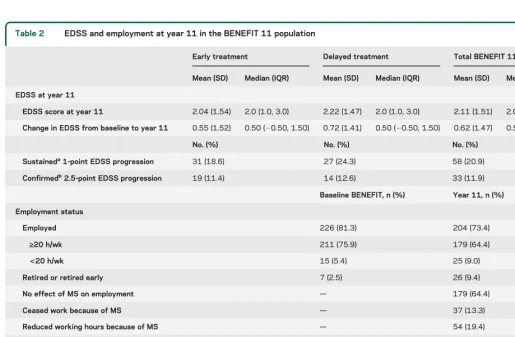
0.4857). EDSS
scores also did not differ between the treatment arms.
EDSS scores of study participants remained low and
stable with a median (quartile [Q]1, Q3) score of 2.0
(1.0, 3.0) and median change from baseline over 11
years of 0.5 (
2
0.50, 1.50) in both groups (table 2).
By year 11, 69.8% of patients were fully ambulatory
with minor or no signs of disability (EDSS score
,
3.0) (figure 2C).
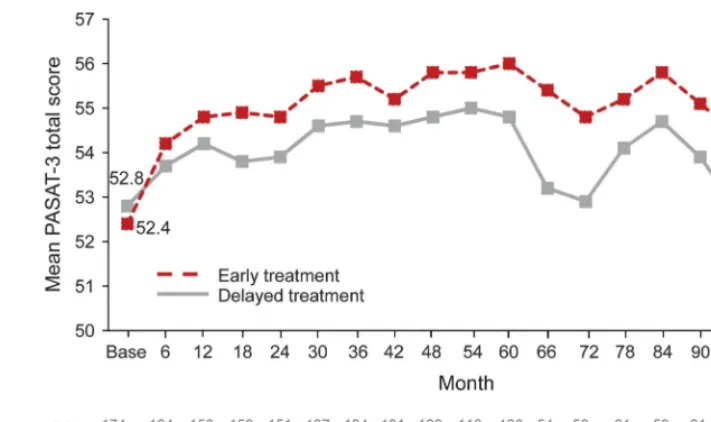
As a neuropsychological measure, 222 patients had
PASAT-3 data available at baseline and year 11. Over
the entire study period, the PASAT-3 total score
(adjusted for baseline score) was higher in the
early-treatment group (
p
5
0.0070) (figure 3). Two
hun-dred thirty-three patients completed the SDMT (early
141, delayed 92). Overall median (Q1, Q3) SDMT
score was 53.0 (44.0, 59.0), with little difference
between groups. No differences were found between
groups on the EQ-5D, FAMS trial outcomes index,
Fatigue Scale for Motor and Cognitive Functions, or
Center for Epidemiologic Studies Depression Scale
with stable values relative to baseline for EQ-5D and
FAMS, both of which had also been assessed at
base-line. Absence of fatigue (score
,
43) was reported in
Table 2 EDSS and employment at year 11 in the BENEFIT 11 population
Early treatment Delayed treatment Total BENEFIT 11 population
Mean (SD) Median (IQR) Mean (SD) Median (IQR) Mean (SD) Median (IQR)
EDSS at year 11
EDSS score at year 11 2.04 (1.54) 2.0 (1.0, 3.0) 2.22 (1.47) 2.0 (1.0, 3.0) 2.11 (1.51) 2.0 (1.0, 3.0)
Change in EDSS from baseline to year 11 0.55 (1.52) 0.50 (20.50, 1.50) 0.72 (1.41) 0.50 (20.50, 1.50) 0.62 (1.47) 0.50 (20.50, 1.50)
No. (%) No. (%) No. (%)
Sustaineda1-point EDSS progression 31 (18.6) 27 (24.3) 58 (20.9) Confirmedb2.5-point EDSS progression 19 (11.4) 14 (12.6) 33 (11.9)
Baseline BENEFIT, n (%) Year 11, n (%)
Employment status
Employed 226 (81.3) 204 (73.4)
‡20 h/wk 211 (75.9) 179 (64.4)
<20 h/wk 15 (5.4) 25 (9.0)
Retired or retired early 7 (2.5) 26 (9.4)
No effect of MS on employment — 179 (64.4)
Ceased work because of MS — 37 (13.3)
Reduced working hours because of MS — 54 (19.4)
Days taken off work because of MS in the last 12 moc
None — 178 (64.0)
1–10 — 19 (6.8)
11–30 — 17 (6.1)
>30 — 30 (10.8)
Abbreviations: BENEFIT5Betaferon/Betaseron in Newly Emerging MS for Initial Treatment; EDSS5Expanded Disability Status Scale; IQR5interquartile range; MS5multiple sclerosis.
aSustained EDSS progression defined as a progression that was confirmed in a previous BENEFIT analysis and was again confirmed at year 11.
bConfirmed EDSS progression defined as an increase compared with baseline that was confirmed at a scheduled visit$140 days later and not within
140 days after a relapse.
128 patients (46%), and 191 (68.7%) reported no
depressive symptoms.
Both groups had similar resource utilization (table 2).
Overall, 204 patients (73.4% of all patients in the
11-year follow-up) were still employed, compared with
226 patients (81.3%) at study start. Twenty-six patients
(9.4%) were retired at year 11 (22 [7.9%] retired early).
Two hundred seventy-one patients (97.5%) were living
alone or with a spouse/partner/family, with only
3 (1.1%) living in a long-term care facility. Two
hun-dred fifty-four patients (91.4%) had not been
hospital-ized because of MS in the 12 months before the 11-year
assessment. Sixty-seven patients had used second-line
therapy (14.3%, KM estimate: 21.2%) by year 11 (early
38 [13.0%, KM estimate: 19.1%], delayed 29 [16.5%,
KM estimate: 24.4%]).
MRI outcomes.
One hundred ninety-one patients had
MRI scans (early 114, delayed 77). All MRI data are
reported as median (Q1, Q3). Relatively little
difference in cerebral lesion number or volume was
seen between the 2 treatment groups. Brain volume
was 1,527.0 cm
3(1,444.0, 1,595.0) in the
early-treatment group and 1,514.0 cm
3(1,429.0, 1,575.5)
in the delayed-treatment group. Ten patients (5.2%)
had 1 Gd
1
lesion (early 7 [6.1%], delayed 3 [3.9%])
and 6 patients (3.1%) had 2 to 5 Gd
1
lesions (early
5 [4.4%], delayed 1 [1.3%]). The number of new T2
lesions since the patient
’
s last study scan was 2.0 (0.0,
6.0) in the early-treatment arm and 2.0 (0.0, 6.5) in the
delayed-treatment arm, while T2 lesion volume was
2,237.0 mm
3(618.0, 5,473.0) and 1,640.5 mm
3(911.0, 3,419.0), respectively.
T1 hypointense lesion count was 4.0 (1.0, 11.0) in
the early-treatment group and 2.0 (1.0, 6.0) in the
delayed-treatment group. A regression model identified
an effect of baseline T2 lesion count on the number of
T1 lesions at year 11 (RR 1.02 [95% CI 1.02, 1.03],
p
,
0.0001), but treatment did not decrease the number
of lesions (RR 1.29 [95% CI 0.95, 1.76],
p
5
0.1030).
Safety.
The frequency and type of adverse events
re-ported were consistent with the known profile of
interferon beta-1b. There were no new safety signals
detected at year 11. No serious adverse events were
reported during BENEFIT 11.
DISCUSSION
Performing a comprehensive
reassess-ment after 11 years in a well-characterized group of
patients, systematically followed since the initial
clinical manifestation, provides a unique opportunity
to better understand the benefits of early treatment
on outcomes relevant to patients and physicians.
This long-term follow-up study provided Class IV
evidence that time to CDMS was prolonged and that
additional clinical measures (ARR, PASAT score)
were improved by early treatment while both groups
showed a generally mild disease course. If we
consider the length of follow-up, this trial included
a sizable proportion (71%) of the originally
randomized patients from the centers participating in
BENEFIT 11. The comparison of baseline and
available follow-up characteristics of patients who did
not participate with those who participated in
BENEFIT 11 did not reveal sources of systematic
bias by selective dropout. A factor that may be
Figure 3 Mean PASAT-3 total score from baseline to year 11critical to interpretation of these data is the unblinding
of the initial randomization that occurred after
completion of the year 5 assessments and the
uncontrolled nature of treatment after the
placebo-controlled phase, a characteristic shared with natural
history and observational treatment studies.
Even if we consider this and differences in
method-ology that make cross-study comparisons difficult,
sev-eral clinically relevant outcomes in the current study
remained relatively stable over 11 years and compare
favorably with those reported in natural history
cohorts. This is reflected in the high proportion of
patients having EDSS score
,
3.0 and remaining
em-ployed through year 11 and in the low rate of
conver-sion to SPMS. A natural history study from Canada
found that after 10.2 years, 50% of the patients had
reached EDSS score
$
3.0.
24A group of 1,261 patients
from 5 European countries with similar disease
dura-tion and demographics had rates of employment
rang-ing from 51% to 63%, with the exception of patients
from Italy where 78% remained employed (but in
a population that on average was 3 years younger
and had a 3-year shorter duration of disease than the
BENEFIT 11 population).
25A cohort of 241 patients
with MS from Canada also had lower rates of
employ-ment (54%).
24Natural history studies have reported
median times to progressive disease ranging from 15
26to 19 years
27,28since the original attack.
29,30The more favorable outcomes as compared to
nat-ural course studies may be overestimated because of
differences in ascertainment
26,30and temporal shifts
with more recent studies showing better outcomes
ir-respective of treatment allocation.
31Nevertheless, after
11 years, we observed a relative stability with no
appar-ent difference between the randomization arms. A
pos-sible explanation of this relative stability may be found
in the fact that both arms can be considered to have
received treatment relatively early in the course of the
disease as even the delayed-treatment group started
treatment within a maximum of 2 years following CIS.
Despite the relatively short delay in treatment
initi-ation in the placebo group, measures reflecting clinical
disease activity such as time to CDMS, time to first
relapse, and relapse rates, as well as scores on the
PA-SAT, the only neuropsychological test applied from
baseline to year 11, still suggest persistent long-term
benefits of the earlier treatment. Although the overall
lower ARR favoring the earlier-treatment group
ap-pears to be mainly driven by differences in the first year
of the core study, it is intriguing to see that in the
early-treatment group, ARR remained lower in all but 2 of
the follow-up years
—
when treatment with interferon
beta-1b was equally available to both groups. This
finding suggests the possibility of a more remote
decrease in the pathogenic factors that contribute to
detectable attacks. This could be an effect on immune
regulation or the consequence of better preserved
com-pensation capacity that allowed the consequences of
inflammatory attacks to be reduced.
This study adds to the literature on the optimal
treatment of patients with MS by supporting and
ex-panding the data on treatment at the earliest clinical
manifestation of the disease. Other studies have shown
benefits of early treatment for patients with CIS
10,32,33;
however, BENEFIT 11 includes longer follow-up with
additional outcome measures that have not previously
been described, including resource use, employment
status, and patient-reported outcomes. Despite the
inherent problems of a comparison with natural course
studies, our results indicate that early treatment with
interferon beta-1b had a long-lasting, even remote,
ben-eficial effect on disease activity as well as cognitive
out-comes, resource utilization, and employment rate.
Taken together, the findings of BENEFIT 11 reinforce
the importance of starting therapy with interferon
beta-1b as soon as possible after the onset of MS symptoms.
AUTHOR CONTRIBUTIONS
L. Kappos: planned the study, reviewed the statistical analysis, interpreted data, and actively contributed to the writing and reviewing of the submit-ted manuscript. Chair of the study steering committee and study inves-tigator. G. Edan: interpreted data and actively contributed to the writing and reviewing of the submitted manuscript. Member of the study steering committee and study investigator. M.S. Freedman: interpreted data and actively contributed to the writing and reviewing of the submit-ted manuscript. Member of the study steering committee and study investigator. X. Montalbán: interpreted data and actively contributed to the writing and reviewing of the submitted manuscript. Member of the study steering committee and study investigator. H.-P. Hartung: inter-preted data and actively contributed to the writing and reviewing of the submitted manuscript. Member of the study steering committee and study investigator. B. Hemmer: interpreted data and actively contributed to the writing and reviewing of the submitted manuscript. Member of the study steering committee and study investigator. E. Fox: interpreted data and actively contributed to the writing and reviewing of the submitted manuscript. Member of the study steering committee and study investi-gator. F. Barkhof: collected and analyzed the MRI data, reviewed the statistical analyses, and actively contributed to the writing and reviewing of the submitted manuscript. S. Schippling: interpreted data and actively contributed to the writing and reviewing of the submitted manuscript. Member of the study steering committee and study investigator. A. Schulze: developed the statistical analysis plan, conducted the statisti-cal analysis, interpreted data, and actively contributed to the writing and reviewing of the manuscript. D. Pleimes: drafted the statistical analysis plan, interpreted data, and drafted and reviewed the manuscript. C. Pohl: actively involved in drafting the MRI protocol and the statistical analysis plan, reviewed the statistical analyses, and actively contributed to the writing and reviewing of manuscript drafts. Sponsor’s responsible clini-cian for the follow-up study phase. R. Sandbrink: interpreted data and actively contributed to the writing and reviewing of the submitted man-uscript. Member of the study steering committee. Sponsor’s responsible clinician for the placebo-controlled study phase. G. Suarez: drafted the statistical analysis plan, interpreted data, and drafted and reviewed the manuscript. E.-M. Wicklein: drafted the statistical analysis plan, inter-preted data, and drafted and reviewed the manuscript. Sponsor’s respon-sible clinician for the extension study phase.
ACKNOWLEDGMENT
consisting of medical editing, English-language assistance, formatting of text and figures, and coordinating reviews, which was funded by Bayer HealthCare Pharmaceuticals. This article is dedicated to the memory of our colleague Christoph Pohl who passed away on August 28, 2015. His contributions to the BENEFIT Study have been invaluable and until his last days—although completely paralyzed by his progres-sive neuromuscular disease and on artificial respiration—he was actively involved in the development of this manuscript and accompanying sci-entific projects.
STUDY FUNDING
This study was funded by Bayer HealthCare Pharmaceuticals. Represen-tatives of the study sponsor participated in the discussions of the steering committee on the design of the study, including the assessments to be made and the statistical analysis plan. They also provided input on the manuscript, with the understanding that the final decisions related to publication of these data would be made by the study steering committee.
DISCLOSURE
L. Kappos’institution (University Hospital Basel) has received in the last 3 years and used exclusively for research support: steering committee/ consulting fees from Actelion, Addex, Bayer HealthCare, Biogen, Biotica, Genzyme, Lilly, Merck, Mitsubishi, Novartis, Ono, Pfizer, Receptos, Sanofi-Aventis, Santhera, Siemens, Teva, UCB, and Xenoport; speaker fees from Bayer HealthCare, Biogen, Merck, Novartis, Sanofi-Aventis, and Teva; support of educational activities from Bayer HealthCare, Bio-gen, CSL Behring, Genzyme, Merck, Novartis, Sanofi-Aventis, and Teva; royalties from Neurostatus Systems AG; grants from Bayer HealthCare, Biogen, the European Union, Merck, Novartis, Roche, Roche Research Foundations, the Swiss Multiple Sclerosis Society, and the Swiss National Research Foundation. G. Edan has received honoraria for lectures or consulting from Biogen Idec, Merck Serono, and Sanofi-Aventis, and received personal compensation for serving on the BENEFIT scientific advisory board and for speaking from Bayer Pharma AG. He has also received research support from Serono (a grant to University Hospital to support a research program on MRI in MS) and from Teva (a grant to support a research program on anti-IBF neutralizing antibodies). M. Freedman has received compensation from Bayer HealthCare, Biogen Idec, EMD Canada, Genzyme, Merck Serono, Novartis, Sanofi-Aventis, and Teva Canada Innovation for consulting services, and has received research/educational grants from Bayer HealthCare and Genzyme. He also participates in a Genzyme-sponsored speakers bureau. X. Montalbán has received speaking honoraria and travel expenses for scientific meetings and has been a steering committee member of clinical trials or participated in advisory boards of clinical trials in the past years with Bayer, Biogen Idec, EMD, Genentech, Genzyme, Merck Serono, Neuro-Tec, Novartis, Sanofi-Aventis, Teva Pharmaceuticals, and Almirall. H. Hartung has received honoraria for consulting and speaking at symposia from Bayer Pharma AG, Biogen Idec, Genzyme, Merck Serono, Novartis, Roche, Teva, and Sanofi-Aventis, with approval by the rector of Heinrich-Heine Univer-sity. B. Hemmer has served on scientific advisory boards for Roche, Novartis, Bayer Schering, Merck Serono, Biogen Idec, GSK, Chugai Pharmaceuticals, Micromet, and Genzyme Corporation; is author on patents re: KIR4.1 antibody testing in MS and genetic determinant of neutralizing antibody development in interferon-beta–treated patients; has received speaker honoraria from Bayer Schering, Novartis, Biogen Idec, Merck Serono, Roche, and Teva Pharmaceutical Industries Ltd.; and has received research support from Biogen Idec, Bayer Schering, Merck Serono, Five Prime, Metanomics, and Novartis. E. Fox has received consulting fees, honoraria, travel, or research support from Acor-da, Bayer, Biogen Idec, Eli Lilly, EMD Serono, Genzyme, GlaxoSmithK-line, Novartis, Ono, Opexa Therapeutics, Pfizer, Roche, Sanofi, and Teva. F. Barkhof has received compensation for consultancy from Bayer Schering Pharma, Biogen Idec, Merck Serono, Novartis, Sanofi-Aventis, Genzyme, Roche, and Teva, and has received research support from the Dutch Foundation for MS Research (an NGO). S. Schippling has received research grants from Biogen Idec, Bayer Schering Pharma, and Genzyme, and consulting/speaker fees from Bayer Schering Pharma, Bio-gen Idec, Merck Serono, Novartis, Teva, and Sanofi-Aventis. A. Schulze is a salaried employee of Bayer Pharma AG. At the time this work was
conducted, she was a salaried employee of PAREXEL International. D. Pleimes is a salaried employee of Myelo Therapeutics GmbH. He was a salaried employee and is currently a paid consultant for Bayer HealthCare Pharmaceuticals. D.P. owns stock in Bayer AG, the owner of Bayer Pharma AG/Bayer HealthCare Pharmaceuticals. C. Pohl is deceased; disclosures are not included for this author. R. Sandbrink was a salaried employee of Bayer Pharma AG. He owns stock in Bayer AG, the owner of Bayer Pharma AG/Bayer HealthCare Pharmaceuticals. G. Suarez was a salaried employee of Bayer HealthCare Pharmaceuticals. E. Wicklein is salaried employee of Bayer Pharma AG. Go to Neurology. org for full disclosures.
Received September 28, 2015. Accepted in final form April 14, 2016.
REFERENCES
1. Compston A, Coles A. Multiple sclerosis. Lancet 2008; 372:1502–1517.
2. Miller DH, Chard DT, Ciccarelli O. Clinically isolated syndromes. Lancet Neurol 2012;11:157–169.
3. Miller DH, Barkhof F, Montalban X, Thompson A, Filippi M. Clinically isolated syndromes suggestive of mul-tiple sclerosis: part I: natural history, pathogenesis, diag-nosis, and prognosis. Lancet Neurol 2005;4:281–288. 4. Comi G, Filippi M, Barkhof F, et al. Effect of early
inter-feron treatment on conversion to definite multiple sclero-sis: a randomised study. Lancet 2001;357:1576–1582. 5. Comi G, Martinelli V, Rodegher M, et al. Effect of glatiramer
acetate on conversion to clinically definite multiple sclerosis in patients with clinically isolated syndrome (PreCISe study): a randomised, double-blind, placebo-controlled trial. Lancet 2009;374:1503–1511.
6. Edan G, Kappos L, Montalban X, et al. Long-term impact of interferon beta-1b in patients with CIS: 8-year follow-up of BENEFIT. J Neurol Neurosurg Psychiatry 2014;85: 1183–1189.
7. Jacobs LD, Beck RW, Simon JH, et al. Intramuscular inter-feron beta-1a therapy initiated during a first demyelinating event in multiple sclerosis. CHAMPS Study Group. N Engl J Med 2000;343:898–904.
8. Kappos L, Polman CH, Freedman MS, et al. Treatment with interferon beta-1b delays conversion to clinically def-inite and McDonald MS in patients with clinically isolated syndromes. Neurology 2006;67:1242–1249.
9. Kappos L, Freedman MS, Polman CH, et al. Effect of early versus delayed interferon beta-1b treatment on disability after a first clinical event suggestive of multiple sclerosis: a 3-year follow-up analysis of the BENEFIT Study. Lancet 2007;370: 389–397.
10. Kappos L, Freedman MS, Polman CH, et al. Long-term effect of early treatment with interferon beta-1b after a first clinical event suggestive of multiple sclerosis: 5-year active treatment extension of the phase 3 BENEFIT trial. Lancet Neurol 2009;8:987–997.
11. Kinkel RP, Dontchev M, Kollman C, Skaramagas TT, O’Connor PW, Simon JH. Association between immediate initiation of intramuscular interferon beta-1a at the time of a clinically isolated syndrome and long-term outcomes: a 10-year follow-up of the Controlled High-Risk Avonex Multiple Sclerosis Prevention Study in Ongoing Neurolog-ical Surveillance. Arch Neurol 2012;69:183–190. 12. Kurtzke JF. Rating neurologic impairment in multiple
sclerosis: an Expanded Disability Status Scale (EDSS). Neurology 1983;33:1444–1452.
integrated approach to MS clinical outcome assessment. National MS Society Clinical Outcomes Assessment Task Force. Mult Scler 1999;5:244–250.
14. EuroQol Group. EuroQol—a new facility for the mea-surement of health-related quality of life. Health Policy 1990;16:199–208.
15. Cella DF, Dineen K, Arnason B, et al. Validation of the Functional Assessment of Multiple Sclerosis quality of life instrument. Neurology 1996;47:129–139.
16. Weissman MM, Sholomskas D, Pottenger M, Prusoff BA, Locke BZ. Assessing depressive symptoms in five psychi-atric populations: a validation study. Am J Epidemiol 1977;106:203–214.
17. Penner IK, Raselli C, Stocklin M, Opwis K, Kappos L. The FSMC (Fatigue Scale for Motor and Cognitive Func-tions): a new patient-reported outcome measure for cog-nitive and motor fatigue in multiple sclerosis. Mult Scler 2006;12(suppl 1):S151.
18. Penner IK, Raselli C, Stocklin M, Opwis K, Kappos L, Calabrese P. The Fatigue Scale for Motor and Cognitive Functions (FSMC): validation of a new instrument to assess multiple sclerosis-related fatigue. Mult Scler 2009; 15:1509–1517.
19. Parmenter BA, Weinstock-Guttman B, Garg N, Munschauer F, Benedict RH. Screening for cognitive impairment in multiple sclerosis using the Symbol Digit Modalities Test. Mult Scler 2007;13:52–57.
20. Smith A. Symbol Digit Modalities Test (SDMT) Manual (Revised). Los Angeles: Western Psychological Services; 1982.
21. Lechner-Scott J, Kappos L, Hofman M, et al. Can the Expanded Disability Status Scale be assessed by telephone? Mult Scler 2003;9:154–159.
22. Collins C, Ivry B, Bowen JD, et al. A comparative analysis of Patient-Reported Expanded Disability Sta-tus Scale tools. Mult Scler Epub 2015 Nov 12. pii: 1352458515616205.
23. Poser CM, Paty DW, Scheinberg L, et al. New diagnostic criteria for multiple sclerosis: guidelines for research pro-tocols. Ann Neurol 1983;13:227–231.
24. Karampampa K, Gustavsson A, Miltenburger C, Kindundu CM, Selchen DH. Treatment experience, bur-den, and unmet needs (TRIBUNE) in multiple sclerosis: the costs and utilities of MS patients in Canada. J Popul Ther Clin Pharmacol 2012;19:e11–e25.
25. Karampampa K, Gustavsson A, Miltenburger C, Eckert B. Treatment experience, burden and unmet needs (TRI-BUNE) in MS study: results from five European countries. Mult Scler 2012;18(2 suppl):7–15.
26. Scalfari A, Neuhaus A, Daumer M, Muraro PA, Ebers GC. Onset of secondary progressive phase and long-term evolution of multiple sclerosis. J Neurol Neuro-surg Psychiatry 2014;85:67–75.
27. Eriksson M, Andersen O, Runmarker B. Long-term follow up of patients with clinically isolated syndromes, relapsing-remitting and secondary progressive multiple sclerosis. Mult Scler 2003;9:260–274.
28. Tremlett H, Yinshan Z, Devonshire V. Natural history of secondary-progressive multiple sclerosis. Mult Scler 2008; 14:314–324.
29. Rovaris M, Confavreux C, Furlan R, Kappos L, Comi G, Filippi M. Secondary progressive multiple sclerosis: cur-rent knowledge and future challenges. Lancet Neurol 2006;5:343–354.
30. Tremlett H, Zhao Y, Rieckmann P, Hutchinson M. New perspectives in the natural history of multiple sclerosis. Neurology 2010;74:2004–2015.
31. Steinvorth SM, Rover C, Schneider S, Nicholas R, Straube S, Friede T. Explaining temporal trends in annual-ised relapse rates in placebo groups of randomannual-ised controlled trials in relapsing multiple sclerosis: systematic review and meta-regression. Mult Scler 2013;19:1580–1586. 32. Comi G, De SN, Freedman MS, et al. Comparison of two
dosing frequencies of subcutaneous interferon beta-1a in patients with a first clinical demyelinating event suggestive of multiple sclerosis (REFLEX): a phase 3 randomised controlled trial. Lancet Neurol 2012;11:33–41. 33. Comi G, Martinelli V, Rodegher M, et al. Effects of early
treatment with glatiramer acetate in patients with clinically isolated syndrome. Mult Scler 2013;19:1074–1083.