First pionic atom spectroscopy at RIBF
Kenta Itahashi1,a, Georg P.A. Berg2, Hiroyuki Fujioka3, Hans Geissel4, Ryugo S. Hayano5, Satoru Hirenzaki6, Natsumi Ikeno6, Naohito Inabe1, Satoshi Itoh5, Daisuke Kameda1, Toshiyuki Kubo1, Hiroaki Matsubara7, Shinichiro Michimasa7, Kenjiro Miki8, Hiroyuki Miya7, Masaki Nakamura1, Takahiro Nishi5, Shumpei Noji7, Shinsuke Ota7, Ken Suzuki9, Hiroyuki Takeda1, Koichi Todoroki5, Kyo Tsukada10, Tomohiro Uesaka1, Helmut Weick4, and Koichi Yoshida1
1 RIKEN Nishina Center, RIKEN, 351-0198 Saitama, Japan
2 JINA and Department of Physics, University of Notre Dame, Indiana 46556, USA 3 Division of Physics and Astronomy, Kyoto University, 606-8502 Kyoto, Japan
4 GSI - Helmholtzzentrum f¨ur Schwerionenforschung GmbH, D-64291 Darmstadt, Germany
5 Department of Physics, University of Tokyo, 113-0033 Tokyo, Japan
6 Department of Physics, Nara Women’s University, 630-8506 Nara, Japan 7 Center for Nuclear Study, University of Tokyo, 351-0198 Saitama, Japan
8 RCNP, Osaka University, 567-0047 Osaka, Japan
9 Stefan-Meyer-Institut f¨ur subatomare Physik Austrian Academy of Sciences, Austria
10 Department of Physics, Tohoku University, 980-8578 Miyagi, Japan
Abstract. We have performed an inclusive spectroscopy of122Sn(d,3He) reaction near
the pion emission threshold at an incident energy ofTd =250 MeV/nucleon. The first ex-periment aims as devloping the high precision spectroscopy of pionic atoms at the RI beam factory (RIBF) of RIKEN, which leads to a new project, pionic Atom Factory project (piAF) to measure pionic atoms for a wide range of elements. We report the analysis status of the pilot experiment.
1 Introduction
In order to understand the non-perturbative aspects of the QCD in the low energy region, it is important to understand the chiral SU(3) dynamics where hadrons behave as the degree of freedom. The chiral symmetry is spontaneously broken and is parametrized by chiral condensatehqq¯ i, which varies as a function of the temperature and the density of the medium [1, 2]. Among experimental approaches to study chiral symmetry and its spontaneous breaking, in-medium spectroscopy of hadrons has been playing an important role. One of the preceding works is a high precision spectroscopy of deeply bound pionic atoms in (d,3He) reactions at GSI [3–6]. Thehqq¯ i condensate at the normal nuclear density is found to be∼30 % smaller than in vacuum [6–8]. Although the evaluation is still associated with large statistical and systematic errors, precision spectroscopy of in-medium hadrons proved itself capable of setting constraints on the dynamically-breaking chiral symmetry.
Now, we performed an experiment to measure pionic atoms at RIBF for the first time. The em-ployed reaction was122Sn(d,3He) to produce pionic121Sn atoms. According to theoretical works, we expect observation of (1s)πstate as a distinct peak in the excitation spectrum.
We will report here the present status of the spectral analysis and future perspectives.
a e-mail:[email protected] DOI: 10.1051/
C
Owned by the authors, published by EDP Sciences, 2012 epjconf 20123/ 701013
2 Experiment
Comparing facilities RIBF and GSI from the viewpoint of pionic atom spectroscopy, the largest ad-vantage of RIBF is its high intensity primary beam. RIBF has a DC continuous beam with an intensity of 1012/s while GSI provides 1011/spill with the duty factor of 16%. Thus, effectively, we have more than 10 times higher intensity in RIBF, which allows adoption of thinner target leading to better res-olution potentially. The largest problem of the RIBF is the intrinsic beam momentum spread which is evaluated to be∼0.1% and the corresponding resolution was estimated to be∼1 MeV (FWHM). Comparing to GSI, the resolution is more than twice worse.
In order to achieve better resolution eliminating the contribution from the beam momentum spread, one way is to reduce the beam momentum spread using slits at a dispersive focal plane. This will result in activation of the facility and will reduce the beam intensity. We have developed another way by constructing a special beam optics. The incident beam momentum spread is analyzed on the target with a dispersion matching condition to a central focal plane, and the contribution from the momentum spread is eliminated from the focal plane spectra.
2.1 Pilot Experiment
In order to demonstrate the feasibility and establish the necessary experimental conditions, we per-formed a pilot experiment. This R&D effort involves many aspects including beam track calculations in the accelerators, beam optics, detectors, and electronics. The pilot experiment was carried out in October 2010 for the data taking period of three days aiming at (i) test of the detector performance under extremely high rate conditions of∼30 MHz, (ii) investigation of the spectral resolution, and (iii) overall test of the conditions of systematic studies of pionic atoms. Our goal was the world highest spectral resolution of∼400 keV (FWHM) with a high intensity beam of∼1012deuterons/sec.
Figure 1 depicts a schematic view of the RIBF facility [9]. The deuteron beam is accelerated by the SRC cyclotron toTd =250 MeV/nucleon with the maximum intensity of∼1012/s. We placed a 122Sn target with the thickness of 10 mg/cm2at the target position.
3He particles emitted in the (d,3He) reaction are momentum-analyzed by the first part of the Bi-gRIPS beamline used as a magnetic spectrometer. The central focal plane (F5) is set to be a dispersive focal plane with the dispersion of about 6 m. A set of two multi-wire drift chambers are installed at F5 to measure the3He tracks. The second part is used mainly for particle identification purposes. We installed two sets of scintillation counters at F5 and F7 to measure the energy loss of particles and the time of flight (TOF) between the F5 and F7 focal planes. The instantaneous particle rate at the F5 scintillation counters amounted to∼35 MHz mainly due to the breakup reaction of the deuteron beam in the target.
The trigger for the data acquisition system is provided by the scintillation counters. We have ad-justed the coincidence between F5 and F7 scintillation counters to apply rough selection of particles based on the TOF. The coincidence trigger rate was suppressed to less than 100 Hz.
Figure 2 shows the particle identification performance of the detector system. The abscissa is the measured energy loss in the scintillation counter at F5 and the ordinate is the TOF measured between the F5 and F7 scintillation counters. As clearly seen,3He is identified without any contamination.
2.2 Experimental Results
Figure 3 shows the measured acceptance-corrected spectrum of the (d,3He) reaction atTd = 250
MeV/nucleon. The spectrum reprents the data accumulated in a 16-hour measurement. We still need to finalize the calibrations of the the 3He energy and the cross section of the reaction. Thus, both abscissa and the ordinate are still preliminary and will be adjusted once the analysis is finalized.
Fig. 1.A schematic view of the experimental site, RIBF [9]. TheTd = 250 MeV/nucleon deuteron beam is accelerated by the cyclotron SRC and impinges on the target. The3He particles are momentum analyzed and measured at the dispersive focal plane F5. The F5-F7 section is used for particle identification purposes.
Fig. 2.Particle identification capability of the detector system by measuring the TOF between F5 and F7 and the energy loss in the F5 scintillator.3He particles are identified with perfect background rejection.
energy region between 357 and 362 MeV are due to the first experimental observation of pionic121Sn atoms. The properties of the three peaks are being discussed.
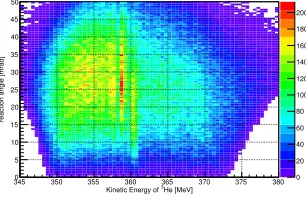
Figure 4 depicts the reaction angle at the target vs. the roughly calibrated energy. This is the first observation of the angular dependence of the pionic atom formation cross section in the (d,3He) reaction.
C o u n ts [ a .u .] 2 2.5 3 3.5 4 4.5 5 5.5 6 6.5
He kinetic energy [MeV]
355 360 365 370
Fig. 3.Measured roughly acceptance-corrected spectrum of the (d,3He) reaction near the pion-emission threshold. The calibrations of the abscissa is preliminary.
He [MeV]
3
Kinetic Energy of
345 350 355 360 365 370 375 380
reaction angle [mrad]
0 5 10 15 20 25 30 35 40 45 50 0 20 40 60 80 100 120 140 160 180 200
Fig. 4.Measured reaction angle as function of the kinetics energy.
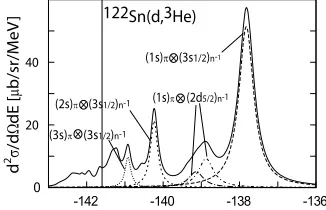
is not included in the calculation. Overall structures in the figures agree well, and the most prominent peak is assigned to a configuration of (1s)π⊗(3s1/2)n−1.
3 Conclusion and Future Perspectives
We have successfully observed for the first time a spectrum of 122Sn(d,3He) reaction near theπ− emission threshold at an incident deuteron energy of 250 MeV/nucleon. The spectrum was measured at RIBF. The BigRIPS beamline was used as a forward angle spectrometer. The large acceptance of BigRIPS allowed the first measurement of the angular dependence of the pionic-atom formation cross section by using the (d,3He) reaction.
The overall experimental resolution is estimated to be similar to the value of 400 keV (FWHM) previously achieved at GSI. A simple estimation of the resolution would exceed 1 MeV due to the incident beam momentum spread of 0.1 % which is a factor of three worse than GSI. The achievement of 400 keV is due to development and application of a dispersion matching beam optics.
We observed121Sn−1spionic atom as a distinct large peak and the 2salso as a small peak. We are presently working on higher-order aberration corrections of the beam optics, acceptance correction, and calibration of the spectra. The information on the binding energies and widths will be deduced in the extensive analysis that follows.
Position [mm]
-100 -80 -60 -40 -20 0 20 40 60 80 100
C
o
u
n
t
s
/
1
m
m
0 100 200 300 400 500 600 700
Fig. 5.Measured acceptance-corrected position spectrum with a condition of the reaction angle<15 mrad.
Fig. 6.Theoretical calculation by Ikenoet al.with an assumed resolution of 150 keV (FWHM) [10]. The quasi-free component is not included in the calculation. Comparison of the figures of the calculation and the data of Fig. 5 lead to the assignment of the largest peak to a configuration of (1s)π⊗(3s1/2)n−1.
a wide range of elements. We are going to optimize the experimental procedure in order to achieve higher resolution with smaller systematic errors in the near future. This work is partly supported by the Grants-in-Aid for Scientific Research (22105517, 20540273, 22105510, 24105712), JSPS fellows (No. 23·2274), and Specially Promoted Research (20002003).
References
1. U. Vogl and W. Weise, Prog. Part. Nucl. Phys.27, 195 (1991) and references therein. 2. T. Hatsuda and T. Kunihiro, Phys. Rept.247, 221 (1994) and references therein. 3. H. Gilget al., Phys. Rev.C62, 025201 (2000).
4. K. Itahashiet al., Phys. Rev.C62, 025202 (2000). 5. H. Geisselet al., Phys. Rev. Lett.88, 122301 (2002). 6. K. Suzukiet al., Phys. Rev. Lett.92, 072302 (2004).
7. E. E. Kolomeitsev, N. Kaiser, and W. Weise, Phys. Rev. Lett.90, 092501 (2003). 8. T. Hatsuda and T. Kunihiro, Prog. Theor. Phys.74, 765 (1985).
![Fig. 1. A schematic view of the experimental site, RIBF [9]. The Td = 250 MeV/nucleon deuteron beam isaccelerated by the cyclotron SRC and impinges on the target](https://thumb-us.123doks.com/thumbv2/123dok_us/8070948.1346118/3.482.103.368.54.226/schematic-experimental-nucleon-deuteron-isaccelerated-cyclotron-impinges-target.webp)