c
Owned by the authors, published by EDP Sciences, 2010
New developments of the CARTE thermochemical code:
I-parameter optimization
N. Desbiens and V. Duboisa
CEA, DAM, DIF, 91297 Arpajon, France
Abstract. We present the calibration of the CARTE thermochemical code that allows to compute the properties of a wide variety of CHON explosives. We have developed an optimization procedure to obtain an accurate multicomponents EOS (fluid phase and condensed phase of carbon). We show here that the results of CARTE code are in good agreement with the specific data of molecular systems and we extensively compare our calculations with measured detonation properties for several explosives.
1 Introduction
Thermochemical methods have been used with considerable success to calculate the properties of the detonation products [1–4]. The advantages are a very fast calculation of the properties (few seconds) and a direct evaluation of the Gibbs free energy. The thermochemical approach then becomes of great interest for choosing new molecules to be synthesized or for selecting an explosive for a given practical application. These methods can be very accurate provided that the different parameters are carefully chosen. The parameters are generally optimized to reproduce a very large variety of experimental (and
ab initio) data. In this work, we present a new calibration of the CARTE thermochemical code [2].
2 Models
The CARTE code computes the equilibrium composition of chemical species by minimization of the Gibbs free energy of a system of detonation products. The system can be formed of one or possibly two fluid phases and of a condensed carbon phase. The fluid phase is composed of CO2, H2O, N2, CO,
H2, O2, NO, NH3, CH4, O3, NO2, N2O, HCN, C2H6, C2H4, C3H8. The potential energy is given by
an EXP-6 potential. In the case of mixtures, an average potential is obtained through a mixing law. We apply an equation of state for the EXP-6 fluid to obtain the free energy of the system. In this version of the CARTE code, we use the following equation :
– Buckingham-Keesom method [5] to treat dipolar molecules
– Van der Waals one-fluid approximation proposed by Ree [6] to treat the mixture of chemical species
– Statistical physics method MCRSR [7], a variational perturbation theory which is based on the inverse 12th-power potential as a reference system to calculate the free energy.
We have checked the accuracy of the treatment of fluid phase by comparison with molecular sim-ulations results. The performance are satisfactory but suggest some new developments which are presented in an other work [8].
ae-mail:[email protected]
The decomposition of a carbon-rich explosive produces an important amount of carbon, made of nanoparticles with different shapes, sizes, environments,. . .[9]. In order to characterize the intrinsic properties of an explosive CxHyOzNw(of molar mass M), we use the oxygen balance (OB), which is
the excess oxygen mass after the formation of CO2and H2O in g/kg of explosive:
OB= 16
M(z−2x−0.5y) (1)
If OB is negative, the amount of oxygen is not sufficient to consume all the carbon into CO2 and
carbon nanoparticles are produced. To model the condensed carbon, the distribution of clusters is replaced by an effective cluster in equilibrium with fluid phase and treated by a modified 3 phases
(graphite/diamond/liquid) Ree-van Thiel EOS [10]:
– the EOS of each bulk phase is modified by the 0 K Birch potential’s parameters (V0,E0) to take
into account the size effect of clusters,
– the EOS of liquid carbon is obtained by a scaling model from effective graphite/diamond solids, – we use a Boltzmann law to mix the carbon phases.
To take into account the evolution of the carbon EOS, we postulate that the size of the effective cluster depends on the quantity of carbon in excess, and thus the oxygen balance. The energy of formation (E0) and the molar volume (V0) of the 0 K isotherm also evolve with oxygen balance of the
explosives.
3 Parameters
The parameters have to be optimized in order for the thermochemical code to reproduce some reference data. We minimize error functions representing the difference between reference data and calculated properties by a quadratic normalized function. We developed an original method which performs the minimization in two steps. An exploration step (Monte Carlo scheme) allows to visualize the sur-face parameters and to extract particular points which act as initial points of the minimization step (Nelder-Mead method). A similar procedure has been recently applied to fluid force fields for molec-ular simulations [11]. In the CARTE code, the parameters can be separated in three groups:
– the parameters of EXP-6 potentials describing the interactions between like molecules in fluid phase (pure fluids)
– the parameters describing the interactions between unlike molecules (cross potentials). Indeed, the cross potential between two unlike molecules is usually given by the Lorentz-Berthelot rules. Nevertheless, the accuracy of these rules decreases with increasing pressure and temperature. We thus adjusted these rules by three parameters (mi j, ki j, li j):
σi j=ki j
σii+σj j
2 (2)
εi j =li j√εiiεj j (3)
αi j=mi j√αiiαj j (4)
– the parameters related to the carbon EOS.
0.0004 0.0006 0.0008
V (m
3/kg)
DFT 2-species model 1-specie model
0 2e+10 4e+10
P (Pa) 0
20 40 60 80 100
H2
O
i/H
2
O
tot %
3000K isotherm 0.5 H2O + 0.5 CO2
Fig. 1. Top: isotherm at 3000 K for the mixture H2O-CO2obtained from CARTE code (red line) and compared to
DFT results [12] (black points with error bars). Bottom: proportion of associated water (H2Oi) along the 3000 K
isotherm.
4 Results
4.1 Pure fluids
We built our database with all the available experimental data in the thermodynamic range (0.05– 100 GPa/400–6000 K). We have thus applied our minimization routine with these large databases. For prior species (CO2, H2O, N2), we use nearly 150 data per molecule with direct or derivative
properties along isothermal, isochoric or isobaric curves. The potentials obtained are able to reproduce all the data in the thermodynamic domain (0.05–100 GPa/400–6000 K) with a standard deviation less than 2%.
4.2 Cross potentials for mixtures
These parameters are obtained by matching reference data. Nevertheless, this calibration is not easy due to the lack of specific results on binary mixtures in the domain of detonation products. The parameters are generally obtained by matching the detonation velocity of some explosives [2], but this global optimization can hide some balancing errors between the different contributions. Ab initio data appear as an alternative way to supply us with specific binary data. We used ab initio results [12] on binary mixtures involving (CO2, H2O and N2) and some other experimental specific results to calibrate
the cross potentials between the prior species. The other cross parameters are taken equal to unity. The cross potentials H2O-N2 and CO2-N2 remain close to the Lorentz-Berthelot rules. On the
contrary, the mixture H2O-CO2 at high pressure and temperature strongly deviates from idealy
(decrease of volume) with the formation of new species CO3H2 [12]. To model the properties of
mixture, we have introduced a two-species model where the water is represented by two species in chemical equilibrium : non-associated water (standard water H2O) and associated water (H2Oi). The
agreement between DFT results and thermochemistry data is shown in Fig. 1. The decrease of volume observed at 3000 K and 20 Gpa in the DFT results is fairly reproduced by our empirical model. This behaviour is obtained by an increase of H2Oispecies with the pressure and temperature.
4.3 Carbon EOS
The EOS bulk of carbon is modified by changing the energy of formation (E0) and the molar
2000 4000 6000 8000
D (m/s)
CARTE exp.
0.5 1 1.5
ρ0(g/cm 3 ) 0
10 20 30 40
P (GPa)
PETN
OB=-100
Fig. 2. Evolution of detonation velocity (top) and pressure (bottom) as a function of the initial density for PETN
(carbon-poor). The experimental data are represented by red crosses and solid black lines represent results calcu-lated with CARTE code.
4000 6000 8000
DCJ
(m/s)
0.5 1 1.5
ρ0 (g/cm 3 ) 0
10 20 30 40
PCJ
(GPa)
HMX and RDX OB=-220
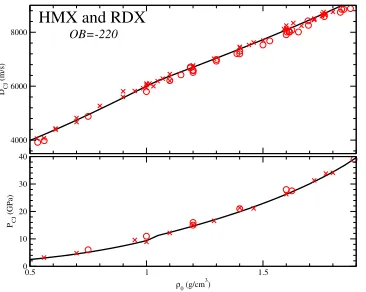
Fig. 3. Evolution of detonation velocity (top) and pressure (bottom) as a function of the initial density for
HMX/RDX (carbon-middle). The experimental data are represented by red crosses (RDX)/red circles (HMX)
and solid black lines represent results calculated with CARTE code.
procedure of (E0,V0) values is decomposed in three steps:
– We picked out a very large database of CJ points (150 values of DC Jand 50 values of PC J) and
separated these data by class of oxygen balance (OB) between−800 and+70.
– For each OB class, we fitted (E0,V0) by matching the CJ data.
– At last, we adjusted analytical functions to describe the evolution of (E0,V0) with OB.
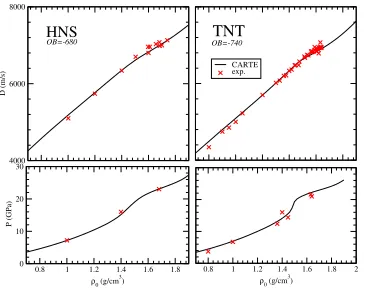
With this new calibration, the CARTE code is able to reproduce the detonation properties of a very large panel of high explosives. As an illustration of the efficiency of our code, we reproduced with a very good precision the evolution of experimental CJ properties (velocity and pressure) with the initial density for carbon-poor explosive (like PETN, see Fig. 2), as well as for carbon-middle explosives (like HMX/RDX, see Fig. 3), as well as for carbon-rich explosives (like HNS/TNT, see Fig. 4). In particular, we are able to reproduce the smooth transitions in condensed carbon phase as shock conditions vary.
5 Conclusion
4000 6000 8000
D (m/s)
CARTE exp.
0.8 1 1.2 1.4 1.6 1.8 ρ0 (g/cm
3) 0
10 20 30
P (GPa)
0.8 1 1.2 1.4 1.6 1.8 2 ρ0 (g/cm
3 )
HNS TNT
OB=-680 OB=-740
Fig. 4. Evolution of detonation velocity (top) and pressure (bottom) as a function of the initial density for
HNS/TNT (carbon-rich). The experimental data are represented by red crosses and solid black lines represent
results calculated with CARTE code.
pure fluids for example) and global experimental results (such as CJ state properties of explosives). The CARTE code is able to calculate the performances of a wide variety of explosives, and can help in choosing new explosives to be synthesized or in implementing an explosive for a given practical application. Whatever the performances of the code, several new developments are in progress:
– Bayesian theory to evaluate the uncertainties on the parameters, – Improvement of fluid phase EOS, presented in paper [8],
– Development of a new equation of state of Carbon to better describe the ultra dispersed particles
of carbon in detonation products.
References
1. F.H. Ree, J. Chem. Phys., 81, (1984) 1251
2. F. Charlet, M.-L. Turkel, J.-F. Danel, L. Kazandjian, J. Applied Phys., 84, (1998) 4227 3. K.R. Glaesemann and L.E. Fried, In Proceedings of Shock Compression Matter, (2005) 4. S. Victorov and S. Gubin, Shock Waves, 15, (2006) 113
5. W. Byers Brown and M. Braithwaite, In 9th International Symposium on Detonation (1989) 6. F.H. Ree, J. Chem. Phys. 78, (1983) 409
7. M. Ross, J. Chem. Phys., 71, (1979) 1567 8. N. Desbiens and V. Dubois, these proceedings
9. V.M. Titov, B.P. Tolochko, K.A. Ten, L.A. Lukyanchikov, E.R. Prue, Diamond and related materials, 16, (2007) 20009
10. M. Van Thiel, F.H. Ree, J. of Thermophysics, 10, (1989) 227
![Fig. 1. Top: isotherm at 3000 K for the mixtureDFT results [12] (black points with error bars)](https://thumb-us.123doks.com/thumbv2/123dok_us/8093202.1350852/3.595.183.368.91.237/fig-isotherm-mixturedft-results-black-points-error-bars.webp)