Workshop on
Stochastics and Quantum Physics
October 21-26, 1999
Centre for Mathematical Physics and Stochastics — MaPhySto
University of Aarhus
1
Introduction
The Workshop focused on some of the areas where concepts and techniques from
Stochas-tics (i.e. Probability and Mathematical StatisStochas-tics) are, or seem likely soon to become, of
real quantum physical importance.
By bringing together leading physicists and mathematicians, having an active interest in
the themes of the Workshop, it was sought to foster fruitful discussions and collaboration
on the role and use of Stochastics in Quantum Physics.
In this leaflet we have gathered the (extended) abstracts of the talks given. We thank
all contributors for taking upon them the extra work of writing these extended abstracts.
We hope that this booklet may be of some use to mathematicians as well as physicists
working in the area of interplay between Quantum Physics and Stochastics.
At the end of the booklet, the schedule of the workshop and the list of participants is
reproduced.
We wish to thank all participants — the speakers in particular — for contributing to the
workshop.
Contents
1 Introduction
1
2 (Extended) Abstracts of Talks
3
Luigi Accardi . . . .
3
Alberto Barchielli . . . .
8
Fran¸cois Bardou . . . .
17
Viacheslav P. Belavkin . . . .
22
Howard Carmichael . . . .
22
Alexander Gottlieb . . . .
23
Inge S. Helland . . . .
33
Alexander S. Holevo . . . .
37
Peter Høyer . . . .
48
Uffe Haagerup . . . .
49
G¨
oran Lindblad . . . .
49
Yuri Yu. Lobanov . . . .
50
Elena R. Loubenets . . . .
56
Hans Maassen . . . .
62
G¨
unther Mahler . . . .
72
Serge Massar . . . .
72
Ian Percival . . . .
73
Asher Peres . . . .
78
D´
enes Petz
. . . .
84
Howard Wiseman . . . .
89
Jean Claude Zambrini . . . .
94
Bernt Øksendal . . . .
99
3 Workshop Program (revised)
104
2
(Extended) Abstracts of Talks
The abstracts/papers are ordered alphabetically after the last name of the author who
presented the work.
∗
Luigi Accardi
The stochastic limit of quantum theory and the dilation problem
†
.
My task was to discuss the connections between the stochastic limit of quantum theory
and the dilation problem.
The
dilation problem
is the following:
given a Markov semigroup to construct a Markov
process whose canonically associated semi–group is the given one
.
The
stochastic limit
studies the following problem:
given a Hamiltonian system
(clas-sical or quantum), depending on a parameter
λ
, study the behaviour of this system in a
time scale of order
t/λ
2
. In the case of interest, the parameter
λ
is small and therefore
the stochastic limit is related to long time scales (as scattering theory). On the other
hand the smallness of the parameter
λ
reflects a weak interaction (as in perturbation
the-ory). Thus the stochastic limit is a new asymptotic technique in the study of dynamical
(Hamiltonian–for the moment) systems, combining together scattering and perturbation
theory with the new ideas on quantum Markov processes, stochastic calculus, central limit
theorems, which arose from quantum probability. This mixture brought a multiplicity of
results both in physics [AcLuVo00] and in mathematics (cf. [AcLuVo97] for the notion of
interacting Fock space and Fock module, [Ske99] for their relationships, [AcLuVo99] for
the white noise approach to classical and quantum stochastic calculus).
Apparently the two topics are far apart, but there is a connection: the unique feature
of the stochastic limit with respect to all the up to now known classical and quantum
asymptotic methods, is that:
the dominating contribution (in a suitable topology) to the
unitary evolution is still a unitary evolution
. Even more: it is a unitary Markovian cocycle
and therefore, by a (now standard) technique introduced in [Ac78] it allows to construct a
Markov process and a Markov semigroup. Thus, using the language of dilations we could
say that
in the stochastic limit, the original Hamiltonian evolution converges to a unitary
dilation of a Markov semi–group
.
A first natural question is: which Markov semigroups can be obtained with the stochastic
limit technique? The answer is: all those semigroups of which a dilation can be
con-structed by means of classical or quantum stochastic calculus. One would like to have a
∗
The contribution of Richard D. Gill has appeared in the separate note
Asymptotics in Quantum
Statistics
, Miscellanea No. 15, October 1999, Centre for Mathematical Physics and Stochastics, University
of Aarhus.
†
Unfortunately L. Accardi had to cancel his participation in the workshop. This is the manuscript for
the talk he would have given.
definitive result of the type:
all the Markov semigroups admit a dilation obtained through
the stochastic limit
. Up to now the obstruction to such a result was that an infinitesimal
characterization of isometric flows, analogue to the Stone theorem for strongly continuous
unitary groups or to the Hille–Yoshida theorem for
C
0
–semigroups, was absent. Recently
such a characterization has been obtained in [AcKo99b] where it is proved that, if
B
is an
arbitrary
C
∗
–algebra, any completely positive flow on the space
B ⊗
Γ(
L
2
(
R))
(Γ
2
(
L
2
(
R
)being the Boson Fock space on
L
2
(
R
))
is characterized by a single, completely positive (but non Markovian), semigroup on
M
2
(
B
), the 2
×
2 matrices with coefficients in
B
. This
extended semigroup
is strongly
continuous if and only if the associated flow has this property. Therefore this theorem
reduces the classification of strongly continuous completely positive flows to the known
classification of
C
0
–semigroups, achieved via the Hille–Yoshida theorem. This result,
com-bined with the stochastic golden rule, allowed to give what seems to be the first deduction
of the flows associated to the Glauber–Kawasaki type dynamics, and in fact of all the
dynamics used in the theory of
interacting particle systems
, from a Hamiltonian model,
as well as a single unified proof of the existence of such flows in arbitrary dimensions
[AcKo99a].
This result is new even when restricted to classical (commutative) flows which, as it is well
known, include all the classical stochastic processes which satisfy a stochastic differential
equation driven by Wiener or compound Poisson processes.
Another natural question is: from the point of view of physics, what is the relation between
a dilation constructed by stochastic calculus and one obtained by the stochastic limit?
The answer is simple: the same relation existing between a phenomenological model and
a physical law, deduced by basic principles. In fact, given a Markov semigroup, one can
a priori
invent
uncountably many unitary dilations of it: classical, Boson, Fermi, free,
q
–deformed, Fock, finite temperature, squeezing,... Moreover, even if we want to restrict
ourselves to the Boson Fock case, still there are uncountably many choices which can be
made and which are completely equivalent from a purely mathematical point of view.
The usual constructions, in the physical literature, of dilations of Markov semigroups are
based on the following steps:
i) one starts from the generator of a Markov semigroup (master equation)
ii) on the basis of more or less plausible physical arguments, one chooses, among the
infinitely many unitary dilations of it, a definite one
iii) one describes some physical phenomena using this dilation. This procedure is not
very satisfactory from the physical point of view for the following reasons:
i1) The master equation is itself an approximation, so it should be one of the final results
of the construction of a model and not its starting point.
i2) The structure of the noise itself, driving the stochastic equation, used to construct
the dilation, has a deep physical meaning which cannot be invented, but is one of
the essential characteristics to be
deduced
from the physical model.
The stochastic limit bypasses these problems because it starts from the well established
Hamiltonian models of quantum physics and to each of them it associates in a unique
way a unitary (or isometric) flow and to this, by the quantum Feynman–Kac formula of
[Ac78], a Markov semigroup. The flow is the limit of the Heisenberg evolution (in
interac-tion representainterac-tion) of the original Hamiltonian system and the Markov semigroup is the
limit of the expectation of the flow for the reference state of the fast degrees of freedom of
the system (reservoir, environment, field, gas,...). This means that the Heisenberg
equa-tion of moequa-tion converges to a (stochastic) Langevin equaequa-tion whose expectaequa-tion gives the
master equation. It follows that all the parameters which enter in these equations have a
microscopic interpretation and can be experimentally controlled.
In the class of physical systems to which the stochastic limit technique can be applied,
one can distinguish 3 levels in increasing order of difficulty:
Level I
corresponds to the standard open system scheme, i.e. a discrete spectrum system
interacting with a continuous spectrum one. It should be noted that
all the models studied
up to now in the physical literature concern this level
. The situation in the remaining two
levels is too complex to be handled by plausibility arguments.
For the models in this class the
stochastic golden rule
gives to the physicists a
sim-ple recepee which allows to solve, with very few elementary calculations, the following
problem:
given the Hamiltonian model, how to write the stochastic Schr¨
odinger equation
obtained by taking the stochastic limit?
Since this rule is extremely simple to apply and
since all the master equations which are the (more or less implicit) starting point of the
unitary dilations built up to now in the physical literature, presuppose an underlying
Hamiltonian model, the stochastic limit procedure offers to the physicist the opportunity
to replace the, up to now standard, scheme:
Hamiltonian system
→
master equation
→
dilation
by the stochastic limit scheme:
Hamiltonian system
→
dilation
→
master equation
which is much more satisfactory because now not only the master equation, but also the
noise and the Langevin equation become uniquely determined by the original Hamiltonian
system.
Level II
has to do with the low density limit and is much more difficult than Level I
because, while in case of Level I the stochastic golden rule gives the possibility to guess
the correct stochastic equation by simple inspection of the first and second order terms
of the iterated series (which, in the limit, give respectively the martingale and the drift
term of the stochastic equation), in the case of Level II, the drift term of the stochastic
equation receives contributions from each term of the iterated series and to single out
these contributions and resum them into the 2–particle scattering operator is a subtle
point.
Level III
replaces the discrete–continuum interactions of the first two levels by continuum–
continuum ones. Here dramatically new phenomena arise, the most important of which is
the
breaking of the commutation (or anticommutation) relations
and the
subse-quent replacement of the Fock space by the interacting Fock space and emergence of Fock
modules. Another non trivial point is the
emergence of new statistics
based on non
crossing diagrams rather than on the usual boson or fermion ones (in which all crossing
diagrams are allowed). The mathematical interpretation of these diagrams in terms of
free independence
as well as their connection with the semi–circle law was discovered by
Voiculescu. The stochastic limit gave rise to more sophisticated and more physically
in-teresting notions of independence in which the role of the
Gaussian is played by different
measures
whose explicit form is, in many cases, still unknown (even if all their momenta)
can be written explicitly.
The absence of explicit formulae is one of the common features of nonlinear problems: the
semicircle law corresponds to a linear problem (absence of interaction, in physical terms)
and, as usual in linear problems, in this case all calculations can be made explicitly.
The fact that the non crossing diagrams give the dominating contribution to the quantum
dynamics was first discovered, in the case of QED without dipole approximation, in the
paper [AcLu92] and the fact that in the huge literature devoted to this topic (surely much
larger in volume than that devoted to the last Fermat problem and involving people such
as Dirac, Fermi, Heisenberg, Landau,...) such an important phenomenon was not even
conjectured, is an indication of how hidden it was. In fact the original proof was rather
elaborated but a much simpler and intuitive one was given later in [AcKoVo98] where
the following intuitive picture was derived: before the stochastic limit (finite coupling
constant
λ
) by effect of the nonlinearity the time rescaled fields obey a
q
–commutation
relation with the constant
q
depending both on time and on
λ
. In the stochastic limit
(
λ
→
0) this quantity tends to zero (this give an intuitive explanation of why only the
non crossing diagrams survive). The explanation of the Hilbert module structure and the
explicit form of the (new type of) quantum stochastic equation requires more work and a
good reference for this is Skeide’s paper [Ske99].
From the paper [AcLu92] several new mathematical notions emerged: the notion of full
Fock module (in a particular case: the general case was dealt with one year later by
Pim-sner), the notion of interacting Fock space, of stochastic integration on Hilbert module
(mathematically developed by Lu and later by Speicher and Skeide), the white noise
ap-proach to stochastic calculus on Boltzmannian interacting Fock space (which includes the
free case). In particular the notion of interacting Fock space turned out to have a
multi-plicity of unexpected connections with apparently totally unrelated fields of mathematics
such as orthogonal polymomials, wavelets, solvable models in statistical mechanics, new
forms of independence and of central limit theorems,... Among the new physical
implica-tions of this paper we mention the power decay law in the polaron model [AcKoVo99c].
In conclusion Level III of the stochastic limit provides a clear illustration, in a
multi-plicity of fundamental physical models, of the basic philosophy of this theory namely:
the physically interesting dilations of Markovian semigroups should be deduced from the
basic Hamiltonian equations. The results emerged from the realization of this program
show that the wealth and beauty of the structures hidden in the basic physical laws
by far exceeds the fantasy displayed in the construction of phenomenological models.
Bibliography
[AcLuVo00] Accardi L., Y.G. Lu, I. Volovich: Quantum Theory and its Stochastic Limit.
to be published in the series Texts and monographs in Physics, Springer Verlag
(2000); Japanese translation, Tokyo–Springer (2000)
[AcLuVo97c] Accardi L., Lu Y.G., I. Volovich The QED Hilbert module and Interacting
Fock spaces. Publications of IIAS (Kyoto) (1997)
[AcLuVo99] Accardi, L., Lu, Y.G., Volovich, I.V.: A white noise approach to classical
and quantum stochastic calculus, Preprint of Centro Vito Volterra N.375, Rome,
July 1999, World Scientific (2000)
[Ac78] Accardi L.: On the quantum Feynmann-Kac formula. Rendiconti del seminario
Matematico e Fisico, Milano 48 (1978) 135-180
[AcLu92] Accardi L., Lu Y.G.: The Wigner Semi–circle Law in Quantum Electro
Dy-namics. Commun. Math. Phys.,
180
(1996), 605–632. Volterra preprint N.126
(1992)
[AcKo99a] L. Accardi, S.V. Kozyrev: The stochastic limit of quantum spin system.
invited talk at the 3rd Tohwa International Meeting on Statistical Physics, Tohwa
University, Fukuoka, Japan, November 8-11, 1999. to appear in the proceedings
published by American Physical Society
[AcKo99b] L. Accardi, S.V. Kozyrev: On the structure of Markov flows. to appear in:
Chaos, Solitons and Fractals (2000)
[AcKoVo98] L. Accardi, S.V. Kozyrev and I.V. Volovich: Dynamical origins of
q
-deformations
in QED and the stochastic limit Journal of Physics A, Math. Gen. 32 (1999) 3485–
3495 q-alg/9807137
[AcKoVo99c] L. Accardi, S.V. Kozyrev and I.V. Volovich: Non-Exponential Decay for
Polaron Model Phys. Letters A 260 (1999) 31–38
[Ske96] Skeide M.:
Hilbert modules in quantum electro dynamics and quantum probability
.
Volterra preprint N. 257 (1996). Comm. Math. Phys. (1998)
electromagnetic cross sections.
A. Barchielli
Dipartimento diMatematica, Politecnico diMilano, Piazza Leonardoda Vinci32,I-20133 Milano, Italy
and IstitutoNazionale diFisica Nucleare,SezionediMilano{ E-mail: [email protected]
Quantum stochastic processes
Quantum stochasticcalculus (QSC)[1-4], a noncommutativeanalog of the classicalIto's stochastic calculus, revealed to be a powerful tool to construct mathematical models of quantum optical systems [3, 5-12] and to develop a theory of photon detection [13-16]. Justatthe beginningof QSC,HudsonandParthasarathy proposed aquantum stochastic Schrodinger equation forquantum open systems [1, 4]:
dU(t)= X j R j dA y j (t)+ X i;j (S ij Æ ij )d ij (t) X i;j R y i S ij dA j (t) iKdt U(t): (1)
The annihilation, creation and gauge (or number) processes A j (t), A y j (t), ij (t) are the fundamentalingredientsofQSC;they areBoseelds,actingonthesymmetricFockspace F =F(X)overthe \one-particlespace"X =ZL
2 (R + )'L 2 (R + ;Z)(Z is aseparable complex Hilbert space with a c.o.n.s. fe
j
g). We denote by e(f) a normalized coherent vector for the eld: A
j (t)e(f) = R t 0 f j (s)dse(f). Moreover, R i , i 1, S ij , i;j 1, K, H are bounded operators in H { another separable complex Hilbert space (the system space) { such that K = H
i 2 P j R y j R j , H y = H, P i R y i R i is strongly convergent to a bounded operator, and
P i;j S ij je i ihe j j=S 2U(HZ)(unitary operatorsin HZ). Then [4], there exists a unique unitary operator-valued adapted process U(t) satisfying Eq. (1)with the initialcondition U(0)=1l.
In usual applications the term containing the gauge process does not appear, i.e. S
ij = Æ
ij
is taken. In Refs. [17, 18], whose results I present here, we have studied the possibilityofusing the fullHudson-Parthasarathyequation asaphenomenologicalmodel forthe simplestphotoemissivesource,namelyatwo-levelatomstimulatedbyalaser. The points I want todiscuss are:
(a) how to determine the system operators in Eq. (1) by means of physical consider-ations; here, a central role is played by a balance equation saying that the mean number of outgoingphotons plus the mean number of photons stored in the atom isequal tothe mean numberof ingoing photons;
(b) howto obtain the electromagnetic cross sections and the atomic uorescence spec-trum by the theory of measurements continuous in time,via the heterodyne detec-tion scheme [15, 16];
byamonochromaticlaser; intheusualcasethedependenceofthetotalcrosssection onthe frequency ofthestimulatinglasercan presentonlyaLorentzianshape,while in our case the full variety of Fano proles can appear [19, 20]; for what concerns the spectrum the known triplet structure obtained by Mollow [21] is distorted by the presence of the new termsand madeasymmetric.
A quantum stochastic model for a two-level atom
In order todescribea two-level atom, we take H=C 2
. When nophoton isinjected into the system (initial state e(0), wheree(0) is the Fock vacuumand is ageneric state of the atom) it is natural to ask that the atom can emit at most one photon and that it exists a unique equilibrium state for the reduced dynamics of the atom. Under these conditions we prove that
H= 1 2 ! 0 z ; ! 0 2R; R j =he j j i ; 2Z; 6=0: (2)
Now, let us denote by N(t) = P
j
jj
(t) the observable \total number of photons enteringthesystemup totimet"andtakeasinitialstate (;f)2HF agenericstate for the atom and a coherent vector for the eld, i.e. (;f)=e(f), 2H , kk=1, f 2L
2 (R
+
;Z). Then,the quantity
hN(t)i f
=hU(t) (;f)jN(t)U(t) (;f)i (3)
represents the mean number of outgoingphotons leaving the system in the time interval [0;t], while hN(t)i 0 f =h (;f)jN(t) (;f)i= Z t 0 kf(s)k 2 ds (4)
gives the mean number of ingoingphotons entering the system in the time interval[0;t]. Now we require a balance equation on the number of photons: the mean number of outgoingphotonsup totime tplus the meannumber ofphotons storedinthe atommust be equal to the mean number of ingoing photons, i.e. 8t, 8, 8f we require the balance equation hN(t)i f + 1 2 Tr H z (t) (0) =hN(t)i 0 f ; (5)
where(t) is the reduced density matrix for the atom. Weprove that this implies
S =P + S + +P S ; S 2U(Z); (6) whereP = 1 2 (1 z
)are the projectors on the excited and ground states. Forphysicalreasons, wetake also!
0
>0and, inorder tohave anatom stimulatedby amonochromaticcoherent wave, we take
[0;T]
wave for T !+1.
Finally,we particularize our modeltothe case of aspherically symmetricatom stim-ulatedby a wellcollimatedlaser. If weconsider only not polarizedlight,the one-particle spaceZ has tocontainonlythe degrees of freedomlinkedtothe direction ofpropagation [22], so that we can take Z =L
2
; sindd
, = f0 ; 0 <2g. Then, inorder to describea laser beam propagatingalong the direction =0,we haveto take
=k k 2 e iÆ 0 ; >0; Æ 2[0;2); 0 (;)= 1 [0;] () p 2(1 cos) ; (8)
in all the physical quantities the limit # 0 will be taken. Moreover, by denoting by Y
l m
(;) the spherical harmonic functions,the sphericalsymmetry of the atom requires
(;)=k kY 00 (;)=k k= p 4; S = X l m e 2iÆ l jY l m ihY l m j; (9)
wherethe quantities Æ + l
and Æ l
are phase shifts.
Heterodyne detection
The best way to obtainthe spectrum ofour stimulated atomis by meansof the balanced heterodyne detection scheme; the output current of the detector is represented by the operator[15, 23] I( ;h;t)= Z t 0 F(t s)j( ;h;ds); (10)
whereF(t)isthedetectorresponsefunction,say F(t)=k 1 p 4 exp 2 t , >0,k 1 6=0 has the dimensions of a current, j is essentially aeld quadrature
j( ;h;ds)=qe is dA h (s)+h.c.; dA h (t)= X j hhje j idA j (t); (11)
q is a phase factor, q 2 C, jqj = 1, is the frequency of the local oscillator and h 2 Z, khk=1; h contains informationonthe localizationof the detector, say
h( 0 ; 0 )= 1 p jj 1 ( 0 ; 0 ); (12)
where is a small solid angle around (;) (in all physical quantities the limit # f(;)g is understood). From the canonical commutationrelations for the elds one has that I( 1 ;h 1 ;t 1 ) and I( 2 ;h 2 ;t 2
) are compatible observables for any choice of the times either if 1 = 2 and h 1 = h 2 either if hh 1 jh 2
i = 0. Under the same conditions also the j's commute. This means that the operators I( ;h;t), t 0, can be jointly diag-onalized and the joint probability law obtained; in other terms, once the initial state is xed, a (classical)stochastic process can be obtained from the continuously observed operators I( ;h;t). All statistical properties of this process can be obtained by means of the technique of the characteristic functional [15] or by transforming the quantum
ditional state, quantum ltering equations or quantum trajectories, ... [24, 25]). How-ever, to compute the uorescence spectrum and the cross sections, we do not need the full theory of continuous measurements, but only the second moments of I( ;h;t). In the following for the quantum expectation of any operator B we shall use the notation hBi
T
=hU(T) (;f)jBU(T) (;f)i.
In the long run the outputmean poweris given by
P( ;h)= lim T!+1 k 2 T Z T 0 I( ;h;t) 2 T dt; (13) k 2
> 0 has the dimensions of a resistance, it is independent of , but it can depend on the otherfeatures of thedetection apparatus. As afunction of,P( ;h)givesthe power spectrum observed in the \channel h"; in the case of the choice (12) it is the spectrum observed around the direction(;). Next Proposition relatesP( ;h)to normalordered quantum expectations of products of eld operators and gives a sum rule which relates P( ;h) to kk
2
; let us note that ~!kk 2
is the total power of the input monochromatic statef(t)(7). MoreoverthisPropositionidentiesanelasticandaninelasticcontribution tothepowerand reduces thecomputationof P( ;h)tothe solutionofamasterequation withLiouvillian(23). FortheuseofQSCinthecomputationofthespectrumofatwo-level atom see alsoRef. [26].
Proposition. The meanpower P( ;h) can be expressed as
P( ;h)= k 4 + lim T!+1 k 2T D Z T 0 dA y h (t) Z t 0 dA h (s)e ( 2 +i ) (t s) E T +c.c. ; (14) wherek =k 2 1 k 2
; Eq. (14) holds almosteverywhere in. We havealso Z +1 1 P( ;h) k 4 d = lim T!+1 k T h hh (T)i T ; (15) where hh (T)= P ij he i jhi ij (T)hhje j
i; moreover, the following sum rule holds:
X j Z +1 1 P( ;e j ) k 4 d =kkk 2 : (16)
The mean powercan bedecomposed asthe sum of three positivecontributions
P( ;h)= k 4 +P el ( ;h)+P inel ( ;h); (17) where P el ( ;h)=kjr(h)j 2 1 =2 ( !) 2 + 2 =4 ; (18) P inel ( ;h)= k 2 Z +1 0 dt exp h 2 +i( !) t i Tr D(h) y e L t D(h) eq +c.c. ;
r(h) = Tr R (h) eq ; (21) R (h) = e i hhj i +hhjS + iP + +hhjS iP ; =arg hS j i ; (22) L [] = i[H ;]+ 1 2 X j R (e j ); R (e j ) y + R (e j );R (e j ) y ; (23) H = 1 2 (! 0 !) z 1 2 jh jS ij y ; (24) eq
isthe equilibriumstate for the master equationwith Liouvillian (23).
Noticethatinthedecomposition(17)thetermk=(4),independentof,isapparently a white noise contributionto the power; P
el
( ;h) is the elastic contribution, as one sees fromEq. (18) whichgivesP
el
( ;h)/Æ( !) for #0;nally, P inel
( ;h) isthe inelastic contribution (fromEq. (19) one can see that nodelta term develops for #0).
Cross sections and uorescence spectrum
Let us consider now the case of the spherically symmetric atom, stimulated by a well collimated laser beam (8), (9). We also assume that the detector spans a small solid angle, so that h is given by Eq. (12) with # f(;)g, jj ' sindd. Moreover, we assume that the transmitted wave does not reach the detector, i.e. > 0, and so hhji = 0. Then, we obtain the elastic and inelastic contributions to the power per unit of solid angle
1 jj P el ( ;h) ' P el (;;), 1 jj P inel ( ;h) ' P inel (;;). For the elastic and inelastic cross sections we shall have
el () / R 0 sind R 2 0 dP el (;;), inel () / R 0 sind R 2 0 dP inel (;;); moreover, we set el = R +1 1 el ()d, inel = R +1 1 inel ()d, TOT = el + inel
. Let us stress that TOT
can be alsoobtained via the direct detection scheme [17, 18]. Finally,we can introduce the spectrumas
TOT (x)= ! 2 k k 2 6c 2 ( el ()+ inel ()); (25) wherex=( !)=k k 2
isthe reduced frequency (k k 2
isthe naturallinewidth)and we have taken the normalization
R +1 1 TOT (x)dx= ! 2 6c 2 TOT .
By solving the master equation and by using the proposition given before, the cross sectionsand thespectrumcan becomputed;however, theexpressions arelong andI refer to[18]. Here I limitmyselftosomecommentsand Igivesomeplotsobtained by choosing the parameters in such a way that the on resonance spectrum be distorted, but not too dierent fromthe Mollowone.
Forwhat concerns the total cross section,according tothe values of the various coef-cients, dierent lineshapes appear, which are known as Fano proles (see Ref. [20] pp. 61{63);theseshapesaretypicalofthe interferenceamongvariouschannels. Someplotsof
! 2 6c 2 TOT
are given inFig. 1as functionsof the reduced detuning z =(! ! 0
)=k k 2
; the same gure contains plots of elasticand inelastic cross sections. Let usrecall that in the usual case
TOT
has a Lorentzian shape. Whichever the line shape be, there is a strong variationofthecross sectionfor !around!
0
+ `anintensitydependentshift',shiftwhich has received various names in the literature; a very suggestive one is lamp shift, a name suggested by A. Kastler [27]. Letus stress that also the width of the resonance and the whole lineshape are intensity dependent.
0
0.01
0.02
0.03
0.04
0.05
0.06
-30
-20
-10
0
10
20
30
Ω
2
= 10
TOT
inel
el
0
0.01
0.02
0.03
0.04
-30
-20
-10
0
10
20
30
Ω
2
= 18
TOT
inel
el
0
0.01
0.02
0.03
-30
-20
-10
0
10
20
30
Ω
2
= 28
TOT
inel
el
0
0.01
0.02
0.03
-30
-20
-10
0
10
20
30
Ω
2
= 40
TOT
inel
el
Figure 1: ! 2 6c 2the cross sections as functions of the reduced detuning z for 2
= 10; 18; 28; 40.
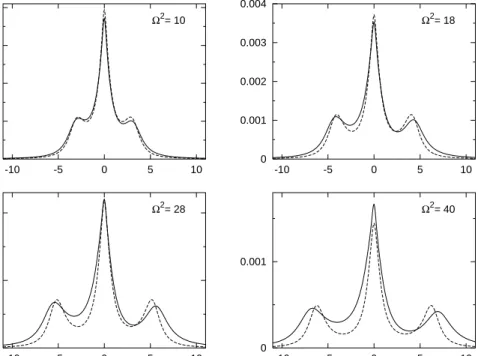
For what concerns the spectrum, according to the values of the various parameters, a well resolved triplet structure can appear, but also single-maximum structures can be shown. With the choice of parameters of Fig. 1 and with an instrumental width =k k
2
=0:6, the on resonance spectrum for 2
=10; 18;28; 40is given inFig. 2 (solid lines); the dashed lines give the Mollow spectrum for the same values of
2
and ( is essentially the reduced Rabi frequency and it is proportional to the square root of the laser intensity). The parameters in Fig. 2 have been chosen in such a way that a triplet structureappears,not toodierentfromtheusual one,butwithawellvisibleasymmetry in the frequency x. Experiments [28-32] conrm essentially the triplet structure; some asymmetry has been found, whose origin has been attributed tovarious causes.
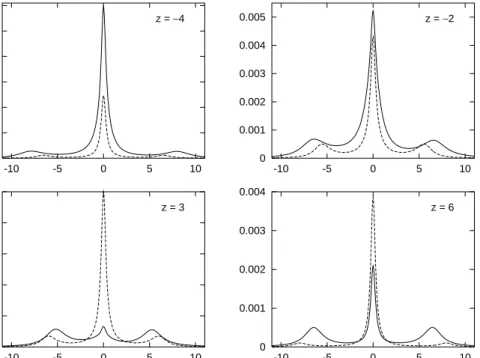
Finally, in Fig. 3 we show some out of resonance spectra (reduced detunings z = 4; 2; 3; 6) for
2
= 28 and the other parameters as in Figs. 1 and 2 (solid lines); again, the dashed lines give the Mollow spectrum. Now, a strong dierence from the usual case is shown, consistent with the strong asymmetry in z shown by the total and the elastic cross sectionsin Fig. 1.
References
[1] R.L.Hudson and K.R. Parthasarathy, Commun. Math. Phys. 93, 301 (1984).
0
0.002
0.004
0.006
0.008
-10
-5
0
5
10
Ω
2
= 10
0
0.001
0.002
0.003
0.004
-10
-5
0
5
10
Ω
2
= 18
0
0.001
0.002
-10
-5
0
5
10
Ω
2
= 28
0
0.001
-10
-5
0
5
10
Ω
2
= 40
Figure 2: Total spectrum as a function of the frequency x for z = 0 and 2
= 10; 18; 28; 40; solid line: the same parameters as in Fig. 1; dashed line: the Mollow case.
[4] K.R. Parthasarathy, An Introduction to Quantum Stochastic Calculus (Birkhauser, Basel,1992).
[5] C.W. Gardiner, Phys. Rev. Lett. 56, 1917 (1986).
[6] A. Barchielli, J. Phys. A: Math. Gen. 20, 6341 (1987).
[7] T. Kennedy and D.F. Walls,Phys. Rev. A 37, 152 (1988).
[8] P. Alsing, G.J.Milburn, and D.F. Walls, Phys. Rev. A37, 2970 (1988).
[9] A.S.Lane, M.D. Reid, and D.F.Walls,Phys. Rev. A 38, 788 (1988).
[10] M.A. Marte, H. Ritsch,and D.F. Walls,Phys. Rev.A 38, 3577 (1988).
[11] M.J. Colletand D.F. Walls, Phys. Rev. Lett. 61, 2442 (1988).
[12] H.M. Wisemanand G.J.Milburn, Phys. Rev.A 49, 4110 (1994).
[13] A. Barchielliand G. Lupieri,J. Math. Phys. 26, 2222 (1985).
[14] A. Barchielli, Phys. Rev. A 34, 1642 (1986).
[15] A. Barchielli, Quantum Opt. 2, 423 (1990).
0
0.002
0.004
0.006
0.008
0.01
0.012
-10
-5
0
5
10
z = −4
0
0.001
0.002
0.003
0.004
0.005
-10
-5
0
5
10
z = −2
0
0.001
0.002
0.003
0.004
0.005
-10
-5
0
5
10
z = 3
0
0.001
0.002
0.003
0.004
-10
-5
0
5
10
z = 6
Figure 3: Total spectrum as a function of the frequency x for 2
= 28 and z = 4; 2; 3; 6;solid line: the same parameters as inFig. 1; dashedline: the Mollowcase.
[17] A. Barchielli and G. Lupieri, in R. Alicki, M. Bozejko, W.A. Majewski, Quantum Probability, Banach Center Publications,Vol.43(PolishAcademy of Sciences, Insti-tute of Mathematics, Warsawa, 1998),pp. 53{62.
[18] A.BarchielliandG. Lupieri,Quaderni delDipartimentodi Matematica,Politecnico diMilano, n. 356/P Marzo 1999 |quant-ph/9904065.
[19] U. Fano, Phys. Rev. 124, 1866 (1961).
[20] C. Cohen-Tannoudji, J. Dupont-Roc, and G. Grynberg, Atom-Photon Interactions: Basic Processes and Applications (Wiley, New York, 1992).
[21] B.R. Mollow, Phys. Rev. 188, 1969 (1969).
[22] A. Barchielli, inO. Hirota, A.S.Holevoand C.M. Caves (eds.), Quantum communi-cation, computing, and measurement (Plenum, New York, 1997)pp. 243{252.
[23] A. Barchielli, in H.D. Doebner, W. Scherer, F. Schroeck Jr. (eds.), Classical and Quantum Systems | Foundationsand Symmetries |Proceedingsof the II Interna-tional Wigner Symposium, (World Scientic, Singapore, 1993) pp. 488{491.
[24] A. Barchielliand V.P.Belavkin, J.Phys. A: Math Gen. 24, 1495 (1991).
[25] H. Carmichael, An Open System Approach to Quantum Optics, Lect. Notes Phys. m18 (Springer, Berlin,1993).
[28] S. Ezekiel and F.Y. Wu, in J.H. Eberly and P. Lambropoulos (eds.), Multiphoton Processes(Wiley, New York, 1978),pp. 145{156.
[29] F. Schuda, C.R. Stroud Jr., M. Hercher, J. Phys. B: Atom. Molec. Phys. 7, L198 (1974).
[30] W. Harting,W. Rasmussen, R.Schieder, H. Walther,Z. Physik A 278, 205 (1976).
[31] R.E.Grove, F.Y.Wu, S. Ezekiel,Phys. Rev.A 15, 227 (1977).
[32] J.D. Cresser, J. Hager, G. Leuchs, M. Rateike, H. Walther, in R. Bonifacio (ed.), Dissipative Systemsin Quantum Optics,TopicsinCurrentPhysicsVol.27(Springer, Berlin,1982), pp. 21-59.
and Levy ights
Francois Bardou
Institut dePhysique et de Chimie des Materiaux de Strasbourg, 23 ruedu Loess, F-67037Strasbourg Cedex,France
1 Introduction
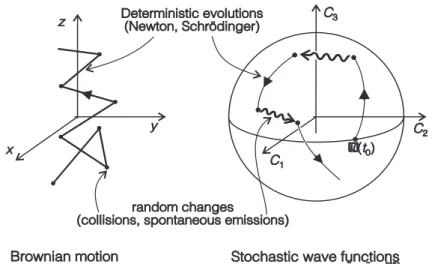
Stochastic wave function approaches, also called Monte-Carlo wave function ap-proaches, describe the evolution of open quantum systems by sequences of hamil-tonian evolutions of wave functions interrupted at random times by quantum jumps [DCM92, DZR92, Car93]. These approaches, complementary to the usual masterequation formalism,are nowwidely used asnumerical methods inquantum optics. Stochastic wave functions perform random walks in Hilbert spaces which are qualitatively similar tothe random walks in real space associated to Brownian motioninclassicalphysics (see Fig.1). By stressingboth randomwalks (inHilbert spaces) and wave function propagation, stochastic wave functions provide insights which stimulate new theoretical studies of certain quantum systems. We present here two results inspiredby stochastic wavefunctions.
We rst study how a small momentum transfer associated to a quantum jump canmodify wavefunction propagation. We nda neweect, called`quantum evap-oration',inwhichsmallmomentumtransfersincrease dramaticallythe transmission probabilityof a particleimpingingon apotentialbarrier.
Second,atthe`statistical'level,weexaminetherandomwalkpropertiesofatoms undergoingsubrecoillaser cooling,the lasercooling methodthat leadstothelowest temperatures (nanokelvin range). The random walks of the atoms appear to be dominated by rare events which, although rare, play a crucial role in the cooling process. Such anomalous random walks are called `Levy ights'. This approach provides an analyticaltheory of subrecoilcooling and the gained insight enables to improvethe cooling strategies.
E-mail: [email protected]. Temporary address : Department of Physics, Universityof Newcastle,Newcastle-upon-Tyne NE17RU, UnitedKingdom.
1
,
2
,
3
...)
ψ
Figure 1. Analogy between stochastic wave functions and a classical randomwalk. Forsimplicity,we haverepresenteda 3DHilbertspace.
2 Quantum evaporation
We have investigated the behaviour of a 1D quasi-monochromatic wave function undergoingamomentumtransferwhileimpingingonapotentialbarrier[BoB99](see Fig. 2). This problem can be seen, in the framework of stochastic wave functions, asthe elementary part of a quantum diusion process.
x
Figure2. Quantumevaporation. Awavefunctionundergoesa momen-tumtransfer before(A) orwhile(B) bouncingona potentialbarrier.
If the momentum hq is transferred to the wave function before (or, of course, after) its interaction with the barrier (case A in Fig. 2), the eects of the momen-tumtransfer onthe transmissionprobability T(q)of the barrierare relativelysmall and are trivially related to the energy changes. On the other hand, if the momen-tum transfer occurs while the wave function is bouncing on the barrier (case B in Fig.2), the transmisssion probability T(q) isgreatly enhanced, even if the momen-tumtransfer hq issmall,i.e. if the averagekinetic energy ofthe wavefunction after the transfer remains much smaller than the height of the barrier. This is what we call`quantum evaporation'.
energy states with an unexpectedly large amplitude, decaying only algebraicallyat high energies. Thus, even in the case of a small momentum transfer, states with energies above the barrier are easily populated, giving rise to large transmission probabilities T(q). The transmission T(q) is found to vary as T(0)+T
2 q
2
+::: for smallq. Remarkably, T(q) is therefore independent on the sign of the momentum transferhq.
We think that quantum evaporation could be observed, for instance, in laser cooled atomicgases or ineld emission of electrons.
3 Levy ights in subrecoil laser cooling
We have studied laser cooling of atomic gases in the subrecoil regime 1
, i.e. when thenalatomickinetic energyisless thanthekinetic energytransferred toanatom atrest by the absorption of a single photon. Subrecoil cooling relies ona diusion coeÆcient (relatedto the spontaneousemission rate) whichdepends onthe atomic momentum p and vanishes at p = 0 due to quantum interference eects [AAK89]. This enablesto accumulate `cooled' atomsin the vicinity of p=0.
In some particularly interesting situations, the random walk of the stochastic wavefunctions ofthe atoms undergoingsubrecoilcooling reduces toarandomwalk in momentum space [CBA91, Bar95]. Thus, it becomes relatively simple to study these otherwise complex quantum processes of laser cooling with classical random walktechniques.
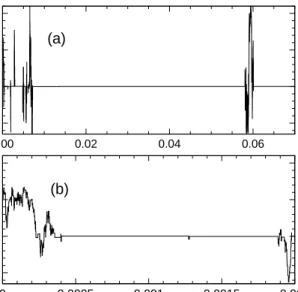
However,aninspectionofindividualstochasticwavefunctionhistories(seeFig.3) reveals that their random walks are strongly anomalous [BBE94, Bar95]. Indeed, mosthistoriesare completelydominatedby veryfew(oneortwotypically)trapping events inthe vicinityof p=0.
This unusual statistical behaviour can be understood within the framework of the Generalized Central Limit Theorem demonstrated by Paul Levy in the thir-ties [BoG90]. The probabilitydensitiesof characteristictimes exhibit slowly decay-ingpowerlawtails(suchthattheir varianceortheir average value isinnite)which dominate the statistical properties. These `broad' distributions generate random walks which are dominated by rare events and which are called `Levy ights'.
Wehaveobtained ananalyticaltheory ofsubrecoilcooling whichisbasedonthe properties of broaddistributions[BBE94, Bar95,BBA99]. Its predictionshave now been veried by several experiments [RBB95, SHK97, SLC99]. Schemes have also beproposedtomeasure directlykeystatisticaldistributions[SSY99]. Atlast,recent mathematicaldevelopments shed interesting light on the anomalous random walks
1
Alongerintroductorypaperonthissubjectcanbefoundinthe`mini-proceedings'ofaprevious MaPhyStoconference: seeF.Bardou,CoolinggaseswithLevyights: usingthegeneralizedcentral limittheoreminphysics,inConferenceon'Levyprocesses: theoryandapplications'Aarhus18-22 january1999,MaPhyStoPublication(Miscellaneano. 11,ISSN1398-5957),O.Barndor-Nielsen, S.E.GraversenandT.Mikosch(eds.).
0
0.0005
0.001
0.0015
0.002
θ
[s]
−10
0
10
20
p
0.00
0.02
0.04
0.06
−10
0
10
20
p
(b)
(a)
Figure 3. (a)Exampleof amomentum randomwalk resultingfrom a Monte-Carlosimulationofsubrecoilcoolingofmetastableheliumatoms. The unit of atomic momentum p is the momentum h k of the photons. Thezoom(b)ofthebeginningofthetimeevolutionisstatistically anal-ogoustotheevolutionatlargescale, afractalpropertytypicalofaLevy ight.
associated tosubrecoil cooling by relatingthem, in particular, to the framework of renewal processes [BaB99].
References
[AAK89] A. Aspect, E. Arimondo, R. Kaiser, N. Vansteenkiste and C. Cohen-Tannoudji, Lasercooling below the one-photonrecoil energy by velo city-selective coherentpopulation trapping : theoreticalanalysis,J.Opt. Soc. Am.B 6,2112-2124 (1989).
[BaB99] O.E. Barndor-Nielsen and F.E. Benth, Laser cooling and stochas-tics, MaPhySto Publication (ISSN 1398-2699), Research Report no. 38 (1999);and to be published.
[Bar95] F.Bardou,Ph.D.Thesis,UniversityofParisXIOrsay,chapterV(1995).
[BBA99] F. Bardou, J.-P. Bouchaud, A. Aspect, and C. Cohen-Tannoudji, Non-ergodic cooling: subrecoil laser cooling and Levy statistics, in prepara-tion.
[BBE94] F. Bardou, J.-P. Bouchaud, O. Emile, A. Aspect and C. Cohen-Tannoudji, Subrecoil Laser Cooling and Levy Flights, Phys. Rev. Lett. 72, 203-206(1994).
(1999).
[BoG90] J.P. Bouchaud and A. Georges, Anomalous diusion in disordered me-dia: statistical mechanisms,modelsandphysicalapplications,Phys.Rep. 195, 127-293(1990).
[Car93] H. Carmichael, An Open Systems Approach to Quantum Optics, Springer-Verlag (1993).
[CBA91] C. Cohen-Tannoudji,F. Bardou, andA. Aspect, Review of fundamental processes in laser cooling, Proceedings of Laser Spectroscopy X (Font-Romeu, 1991), edited by M. Ducloy, E. Giacobino, and G. Camy, 3-14 (World Scientic, Singapore, 1992).
[DCM92] J. Dalibard, Y. Castin, and K. Mlmer, Wave-Function Approach to Dissipative Processes in Quantum Optics, Phys. Rev. Lett. 68, 580-583 (1992).
[DZR92] R.Dum,P.Zoller,and R.Ritsch,Monte-Carlo simulationof the atomic master equation for spontaneous emission, Phys. Rev. A 45, 4879-4887 (1992).
[RBB95] J. Reichel, F. Bardou, M. Ben Dahan, E. Peik, S. Rand, C. Salomon and C. Cohen-Tannoudji, Raman Cooling of Cesium below 3 nK: New Approach Inspired by Levy Flight Statistics, Phys. Rev. Lett. 75, 4575-4578 (1995).
[SHK97] B. Saubamea, T.W. Hijmans, S. Kulin, E. Rasel, E Peik, M. Leduc, and C. Cohen-Tannoudji, Direct measurement of the spatial correlation function of ultracold atoms, Phys. Rev.Lett. 79, 3146-3149(1997).
[SLC99] B. Saubamea, M. Leduc, and C. Cohen-Tannoudji,Experimental Inves-tigation of Non-Ergodic Eects in Subrecoil Laser Cooling, Phys. Rev. Lett. 83, 3796-3799 (1999).
[SSY99] S.Schauer, W.P. Schleich, and V.P. Yakovlev, A key hole look at Levy ights in subrecoil cooling, Phys. Rev. Lett. 83, 3162-3165(1999).
Viacheslav P. Belavkin
Quantum Stochastics as a Boundary Value Problem, and Classification of
Quantum Noise.
Abstract:
Using a white (Poisson) analysis in Fock triples we formulate a class of
boundary value problems for quantized fields which interact with a quantum system at
the boundary. We prove that in the interaction representation the scattered fields plus
the boundary satisfy a quantum stochastic equation for the Markovian unitary evolution
in Fock space with respect to a quantum Poisson noise as an ultrarelativistic limit of the
input fields.
We give the complete classification of quantum noises as stochastic processes with
inde-pendent increments indexed by arbitrary non-Abelian Itˆ
o algebra, and prove that each
such process can be decomposed into the orthogonal sum of quantum independent
Brow-nian and L´
evy motions. Every quantum stochastic unitary evolution driven by such noise
corresponds to a unique self-adjoint boundary value problem for a free quantum field with
the singular boundary interaction.
Howard Carmichael
Physical principles of quantum trajectories.
Abstract:
The earliest proposal of a stochastic evolution in quantum optics was that
of Einstein, who put forward his so-called A and B theory to account for the approach to
equilibrium of matter in interaction with black body radiation. Modern quantum
trajec-tory methods are close relatives of the Einstein proposal. In this talk I trace the differences
between quantum trajectories and the Einstein stochastic process, and the physical
rea-sons that they must be introduced. The logic of a quantum trajectory as a conditioned
evolution is set out and illustrated by a number of examples from quantum optics. The
physical meaning of the term “quantum jump” is explored in relation to ongoing
experi-ments in cavity QED.
Quantum Systems: an extended abstract
Alexander David Gottlieb
Thepurposeofthisabstractistoshowhowtheclassicalnotionof molecu-larchaoscanbegeneralizedtoquantummany-particlesystems. Theconcept of molecularchaos is due toBoltzmann[2], who assumed, inorder toderive thefundamentalequationofthekinetictheoryofgases,thatthemoleculesof anonequilibriumgasareinastateof\moleculardisorder." Kac[9,10]called molecularchaos\theBoltzmannproperty"andusedittoderivethe homoge-neous Boltzmannequationin the innite-particlelimitofcertain Markovian gas models. This idea was further developed in [6, 22]. McKean [13, 14] proved the propagation of chaos for systems of interacting diusions that yield diusiveVlasovequations inthe mean-eld limit. See [23] and [15] for twodenitive surveys of propagationof chaos and itsapplications.
Classicalmolecularchaos isatypeof stochasticindependence ofparticles that manifestsitselfinaninnite-particlelimit. IfS
n
isthe n-foldCartesian power of a measurable space S, a probability measure P on S
n is called symmetric if P(E 1 E 2 E n )=P(E (1) E (2) E (n) )
forallmeasurablesetsE 1
;:::;E n
Sandallpermutationsoff1;2;::: ;ng. For k n, the k-marginalof P, denoted P
(k)
,is the probability measure on S k satisfying P (k) (E 1 E 2 E k )=P(E 1 E k SS)
for allmeasurable sets E 1
;:::;E k
S. One may dene molecular chaos as follows [23]:
space. Let P be a probability measure on S, and for each n 2N, let P n
be a symmetric probability measure on S
n . Thesequence fP
n
g is P-chaoticif the k-marginals P (k) n
converge weakly to P
k
as n !1, for each xed k 2N.
We proceed tothe quantum version of molecularchaos:
LetH beaHilbert spacewhosevectors represent thepure statesof some quantumsystem. Thestatisticalstatesofthatquantumsystemareidentied with the normal positive linear functionals on B(H) that assign 1 to the identity operator. These positive linear functionals on B(H) are also called states. A state ! onB(H) isnormal if
X a2A !(P a )=1 whenever fP a g a2A
isafamilyof commuting projectorsthat sumtothe iden-tity operator (i.e., the net of nite partial sums of the projectors converges in the weak operator topology tothe identity).
Normalstatesarepreciselythosestatesthatcanberepresentedbydensity operators. IfDisadensityoperatoronH, i.e.,apositivetraceclassoperator with trace 1, then A7! Tr (DA) denes a state on B(H). Conversely, every normal state ! on B(H) is of the form !(A) = Tr(DA) for some density operator D.
TheHilbertspaceofpurestatesofacollectionofndistinguishablesystems (the i
th
system having a Hilbert space H i of pure states) is H 1 H n . The Hilbert space for n distinguishableparticles of the same species willbe denoted H n . If D n is a density operator on H n
, then its k-marginal, or partial contraction, is a density operator on H
k
that gives the statistical state ofthe rstk particles. Thek-marginalisdenotedTr
(k) D
n
,and maybe dened as follows: Let O be any orthonormal basis of H. If x 2 H
k with k <n then for any w;x2H
k D Tr (k) D n (w);x E = X y 1 ;:::;y n k 2O hK(wy 1 y n k );xy 1 y n k i:
The trace-class operatorsform aBanach space wherein kTk=Tr (jTj). A state onB(H n ) is symmetric if it satises ! n (A 1 A n )=! n (A (1) A (2) A (n) )
1 n permutation off1;2;::: ;ng, denetheunitaryoperatorU
onH
n
whose action onsimple tensors is
U (x 1 x 2 x n )=x (1) x (2) x (n) : (1) A density operator D n
corresponds to a symmetric state if and only D n commuteswitheachU
. AdensityoperatorD n
correspondstothestatistical stateofasystemofnbosons,aBose-Einsteinstate,ifandonlyifD
n U
=D
n for allpermutations.
Denition 2 (Quantum Molecular Chaos) Let D be a densityoperator on H, and for each n2N, let D
n
be a symmetric density operator on H n
. The sequence fD
n
g is D-chaotic if, for each xed k 2 N, the density operators Tr
(k) D
n
converge in trace norm to D k
as n !1. The sequence fD
n
g is molecularly chaotic if it is D-chaotic for some density operator D on H.
A sequence, indexed by n, of n-particle dynamics propagates chaos if molecularlychaoticsequencesofinitialdistributionsremainmolecularlychaotic for alltime under the n-particle dynamicalevolutions. Forthe sake of gen-erality,we allowthe transformationof states to be the dual of a completely positiveandunitalmap, thatis, thestate A7!Tr(DA)maybetransformed into a state of the form A 7! Tr (D(A)) where is a (normal) completely positiveunitalendomorphismof B(H
n ). Alinear map :A 1 !A 2 of C* algebras is completely positive if, for each n 2 N, the map from A
1 B(C n ) to A 2 B(C n
) that sends AB to (A)B is positive. It is known that all normalcompletely positive unit preserving maps from B(H) to B(K) are of the form (A) = X a2J W a AW a ; (2)
where the family fW a
g a2J
of bounded operators is such that P a2J W a W a converges strongly to the identity operator. The class of completely posi-tive maps is important in quantum dynamics, for it includes the unitarily implemented automorphismsA7!UAU
of the Heisenberg pictureof quan-tum dynamics, but it also includes transformations A 7! A
0
preserving map
on the trace class operatorsdened implicitlyby
Tr(
(D)A)=Tr(D(A))
for allA 2B(H). If has the form(2) then
(D)= X a2J W a DW a ;
where the series converges inthe tracenorm [18].
Denition 3 (Propagation of Molecular Chaos) For each n 2 N, let
n
be a normal completely positive map from H n
to itself that xes the identity and which commutes with permutations, i.e.,such that
n (U AU )=U n (A)U (3) for all A 2 B(H n
) and all permutations of f1;2;::: ;ng, where U
is as dened in (1).
The sequence f n
g propagates chaos if the molecular chaos of a se-quence of densityoperators fD
n
g entailsthe molecular chaosof thesequence f
n (D
n )g.
We willnowdescribea class ofdeterministic many-particle systems that propagates molecular chaos. Let V be a bounded Hermitian operator on H H such that V(x y) = V(y x) for all x;y 2 H, representing a two-body potential. LetV
n 1;2
denote the operator on n H dened by V n 1;2 (x 1 x 2 x n )=V(x 1 x 2 )x 3 x n ; (4)
and foreachi;j n withi<j,deneV n ij
similarly,sothat itactsonthei th and j
th
factors of each simple tensor. This may be accomplishedby setting V n ij = U n V n 1;2 U n
, where = (2j)(1i) is a permutation that puts i in the rst place and j in the second place, and U
n
is as dened in (1). Dene the n-particle Hamiltonians H
n
as the sum of the pair potentials V n ij
, with common couplingconstant 1=n:
H n = 1 n X i<j V n ij : (5)
If D n is a state on H , let D n
(t) denote the state of an n-particle system thatwasinitiallyinstateD
n
andwhichhasundergonetunitsofthetemporal evolutiongoverned by the Hamiltonian(5):
n (D n )D n (t)=e iHnt=~ D n e iHnt=~ : (6)
Theorem 1 Suppose Disa densityoperatoron H and fD n
gisa D-chaotic sequence of symmetric density operators on H
n
. Thenthe sequence of den-sity operators fD
n
(t)g dened in (5) and (6) is D(t)-chaotic, where D(t) is the solution at time t of the following ordinary dierential equation in the Banach space of trace-class operators:
d dt D(t) = i ~ Tr (1) [V;D(t)D(t)] D(0) = D: (7)
Theorem 1 can be applied to mean-eld spin models of ferromagnetism, where the spin angular momentum of each atom of a crystal is supposed to be coupled to the average spin and to an external magnetic eld. The traditionalapproach to the dynamics of mean-eld spin models has been to construct the innite-particledynamics asalimitofnite-particledynamics [4], as is customary in quantum statistical mechanics. However, although the innite-particle dynamics of spin models with nite-range interactions (such as the Ising model) can be dened without diÆculty in this manner [19], dening the innite-particle dynamics of spin models with long-range interactions(suchastheCurie-Weissmodel)isamuchmoresubtleaair[1]. Theorem1providesuswithanalternativeapproach: Considerthe Curie-Weiss modelfor
spin-1 2
atoms. The Hamiltonianfor the n-spin Curie-Weiss model is H n = 1 n n X i;j=1 J z i z j H z i ; (8)
where J is a positive coupling constant and H is another constant whose magnitude is proportional to and whose sign reects the direction of the external magneticeld. IfD
n
istheinitialdensity ofann-spinsystem, then D
n
is the density operator attime t. Forany density operator Don C , let[D] denotethe 22matrix thatrepresents D. Ifthe sequence fD
n
gof initial
n-spin states isD-chaoticwith [D ]= a c c d
,the sequence of n-spinstates
at time t is D(t)-chaotic foreach t0, where
[ D(t)] = a ce it ce it d = H+~J(a d):
Another consequence of Theorem 1 is that there exist many molecularly chaotic sequences of Bose-Einstein states: For any 2 H, let D denote the orthogonalprojectionontothe spanof ;this isthe density operatorfor the pure state A7!hA ; i. The sequence of Bose-Einstein statesfD
n gis D -chaotic, andTheorem 1 shows thatthe sequence ofstates obtained after t seconds of temporalevolutiongoverned by Hamiltoniansof the form(5)is also molecularlychaotic. These states are alsoBose-Einstein states because of the symmetry of the Hamiltonians. In contrast to this, we note that itis not possible for a sequence of Fermi-Dirac states to be molecularly chaotic [8].
We now describe another class of particle systems that propagate quan-tum molecular chaos. Let fW
a g
a2A
be a family of bounded operators on H H such that X a2A W a W a =I (9)
inthesenseofstrongconvergence, andW a
(xy)=W a
(yx)forallx;y2H and a 2A. For each n 2 and each 1 i <j n, dene W
n a;ij 2 B(H n ) by W n a;ij =U n (2j)(1i) (W a 11)U n (2j)(1i) ; whereU n (2j)(1i)
isthe permutationoperatordened in(1)forthepermutation (2j)(1i). For each n 2, dene a completely positive unital map
n of B(H n )intoitself by n (A)= n 2 1 X 1i<jn X a2A W n a;ij AW n a;ij :
n n n (D)= n 2 1 X 1i<jn X a2A W n a;ij DW n a;ij : (10)
In physical terms, the map n
describes how the state of an n-component quantum system changes whentwo of the ncomponents are selected at ran-dom and made to interact with one another and an external environment using the family of interaction operatorsfW
a g
a2A .
Theorem 2 Suppose Disa densityoperatoron H and fD n
gisa D-chaotic sequence of densityoperators on H
n
. For each n 2, let m(n)2N be such that lim n!1 m(n) n =t. Let m(n) n denote n
composed with itself m(n) times.
Thenf m(n) n
(D n
)g isa D(t)-chaotic sequence of densityoperators, where D(t) isthe solution at time t of
d dt D(t) = 2Tr (1) X a2A W a (D(t)D(t))W a ! 2D(t) D(0) = D: (11)
Equation (11) is analogous to the Boltzmann equation. Using the prop-agation of chaos and the properties of entropy, we can prove an H-theorem for (11). The entropy of E relative toD is
S(EjD)= Tr (ElogE ElogD):
Corollary 1 Let D 1
be a density operator on H suchthat
D 1 D 1 = X a2A W a (D 1 D 1 )W a : (12)
Let D(t) be a solution of (11). Then S(D(t)jD 1
) is nondecreasing as t increases.
at times s;s+t. Then D(s+t) equals the solutionat time t of d dt X(t) = 2Tr (1) X a2A W a (X(t)X(t))W a ! 2X(t) X(0) = D(s):
Choose a sequence fm(n)g such that lim m(n) n =t. By Theorem 2, D(s+t) = lim n!1 Tr (1) m n (D(s) n ): (13) Condition(12)onD 1 impliesthat n (D n 1 )=D n 1
foralln. Completely positiveunital maps increase the relativeentropy of densities[12], so
S(D(s) n jD n 1 )S( m n (D(s) n )jD n 1 ): It follows that S(D(s)jD 1 ) liminf n!1 1 n S( m n (D(s) n )jD n 1 ) liminf n!1 S(Tr (1) m n (D(s) n )jD 1 ) S(D(s+t)jD 1 ):
The nal inequality follows from (13) and the upper semicontinuity of rela-tive entropy. The second-to-last inequality is the subadditivity property of relative entropy. See [17]for these properties of relativeentropy.
References
[1] F. Bagarello and G.Morchio. Dynamicsofmean-eld spin models from basic results in abstract dierential equations. Journal of Statistical Physics 66: 849 -866, 1992.
[2] L. Boltzmann.Lectures on Gas Theory. Dover Publications,New York, 1995.
[3] W. Braun and K. Hepp. The Vlasov dynamics and its uctuations in the
1 n
limitofinteracting classicalparticles. Communications in Mathe-matical Physics 56: 101-113,1977.
tremal KMS states. Journal of Mathematical Physics 11(no. 10): 3008 - 3018, 1970.
[5] A.D.Gottlieb.Propagationofmolecularchaosbyquantumsystemsand the dynamics of the Curie-Weiss model. Center for Pure and Applied Mathematics, University of California at Berkeley.Reportno. 764.
[6] F. A. Grunbaum. Propagation of chaos for the Boltzmann equation. Archive for Rational Mechanics and Analysis 42: 323-345,1971.
[7] E. Hewitt and L. Savage. Symmetric measures on Cartesian products. Transactions of the American MathematicalSociety 80: 470-501, 1955.
[8] R.L.Hudson andG.R.Moody.Locallynormalsymmetricstatesand an analogue ofde Finetti'stheorem.Zeitschrift f ur Wahrscheinlichkeitsthe-orie und verwandte Gebiete 33: 343-351, 1976.
[9] M.Kac.Foundationsofkinetictheory.ProceedingsoftheThirdBerkeley Symposium on MathematicalStatistics andProbability, VolIII. Univer-sity of CaliforniaPress, Berkeley, California, 1956.
[10] M. Kac. Probability and Related Topics in Physical Sciences. American Mathematical Society,Providence, Rhode Island, 1976.
[11] O.E.Lanford III and D.W.Robinson.Mean entropy ofstates in quan-tum statisticalmechanics.Journalof MathematicalPhysics 9(7): 1120-1125, 1968.
[12] G. Lindblad. Completely positive maps and entropy inequalities. Com-munications in MathematicalPhysics 40: 147-151,1975.
[13] H.P.McKean,Jr.AclassofMarkovprocessesassociatedwithnonlinear parabolicequations.Proceedingsof theNationalAcademy ofScience56: 1907-1911, 1966.
[14] H.P.McKean,Jr.Propagationofchaosforaclassofnonlinearparabolic equations. Lecture Series in Dierential Equations 7: 41-57. Catholic University, Washington, D.C.,1967.
McKean-Vlasov and Boltzmannmodels. Lecture Notes in Mathematics, 1627. Springer, Berlin, 1995.
[16] H. Narnhofer and G. Sewell. Vlasov hydrodynamics of a quantum me-chanical model. Communications in Mathematical Physics 79: 9-24, 1981.
[17] M. Ohya and D. Petz. Quantum Entropy and its Use. Springer, Berlin, 1993.
[18] K. R. Parthasarathy. An Introduction to Quantum Stochastic Calculus Birkhauser,Basel, 1992.
[19] D. Ruelle. Statistical Mechanics: Rigorous Results. Addison Wesley, RedwoodCity, California,1969.
[20] J. Messer and H. Spohn. Statistical mechanics of the isothermal Lane-Emden equation. Journal of Statistical Physics 29(3): 561-578,1982.
[21] E.Strmer. Symmetricstates ofinnitetensorproductsofC*-algebras. Journal of Functional Analysis 3: 48-68, 1969.
[22] A.Sznitman.
EquationsdetypedeBoltzmann,spatialementhomogenes. Zeitschrift f ur Wahrscheinlichkeitstheorie und verwandte Gebiete 66: 559-592, 1984.
[23] A. Sznitman. Topics in propagation of chaos. Lecture Notes in Mathe-matics, 1464. Springer, Berlin,1991.
ALEXANDER DAVID GOTTLIEB DEPARTMENT OF MATHEMATICS UNIVERSITY OF CALIFORNIA BERKELEY, CALIFORNIA 94720