Adopting a Competency Based Human
Resource Management System in Palestine
Cellular Communication LTD-JAWWAL
By
Enas Hamzi Mohammad Hijazeh
Supervisor
Prof. Grace Khoury
Submitted in Partial Fulfillment of the Requirements for the Degree of Master in Engineering Management, Faculty of Graduate Studies, An-Najah National University, Nablus, Palestine
DEDICATION
To Mom and Dad
Acknowledgment
I would like to express my sincere thanks and appreciation to all those who supported me to complete this study.
I would like to express my deep gratitude, appreciation and thankfulness to my supervisor Dr. Grace Khoury for her endless support and assistance, generous encouragement and supervision during all phases of this study, as well as in all the time of research and writing up this thesis.
My deep appreciation to the supervisory committee, Dr. Suhail Sultan and Dr. Husam Arman and Dr. Ayham Jaaroon for reviewing my thesis, and for their kind support and encouragement.
My profound appreciation to my friends from JAWWAL, and my Engineering management colleagues for their many advice and tips that helped me a lot in staying at the right track.
I am deeply indebted to my parents. They have been providing me with such a wonderful encouragement throughout the period of my study. Both of them have taught me the good things that really matter in life.
Surely, my profound thanks and love to my beloved sisters and brother who have been an amply source of encouragement, unlimited patience and endless assistance. Without their love, kindheartedness, endurance, patience, support and assistance; I would not have been able to continue with my Engineering Management program and completing this dissertation.
ﺭﺍﺭﻗﺇ
ﻥﺍﻭﻨﻋ لﻤﺤﺘ ﻲﺘﻟﺍ ﺔﻟﺎﺴﺭﻟﺍ ﻡﺩﻘﻤ ﻩﺎﻨﺩﺃ ﻊﻗﻭﻤﻟﺍ ﺎﻨﺇ
:
Adopting a Competency Based Human
Resource Management System in Palestine
Cellular Communication LTD-JAWWAL
ﺱﻓﺎﻨﺘ
ﺩﺎﻤﺘﻋﺍ
ﻡﺎﻅﻨﻜ
ﺕﺍﺀﺎﻔﻜﻟﺍ
ﺓﺭﺍﺩﻹ
ﺔﻴﺭﺸﺒﻟﺍ
ﺩﺭﺍﻭﻤﻟﺍ
ﻲﻓ
ﺔﻴﻨﻴﻁﺴﻠﻔﻟﺍ
ﺔﻴﻭﻠﺨﻟﺍ
ﺕﻻﺎﺼﺘﻻﺍ
ﺔﻜﺭﺸ
-لﺍﻭﺠ
ﺎـﻤ ﺀﺎﻨﺜﺘﺴﺎﺒ ، ﺹﺎﺨﻟﺍ ﻱﺩﻬﺠ ﺝﺎﺘﻨ ﻭﻫ ﺎﻤﻨﺇ ﺔﻟﺎﺴﺭﻟﺍ ﻩﺫﻫ ﻪﻴﻠﻋ ﺕﻠﻤﺘﺸﺍ ﺎﻤ ﻥﺎﺒ ﺭﻗﺍ ﺕـﻤﺘ ﺔـﺠﺭﺩ ﺔﻴﺃ لﻴﻨﻟ لﺒﻗ ﻥﻤ ﻡﺩﻘﻴ ﻡﻟ ﺎﻬﻨﻤ ﺀﺯﺠ ﻭﺃ ﻥﻤ لﻜﻜ ﺔﻟﺎﺴﺭﻟﺍ ﻩﺫﻫ ﻥﺍﻭ ،ﺩﺭﻭ ﺎﻤﺜﻴﺤ ﻪﻴﻟﺇ ﺓﺭﺎﺸﻹﺍ ﻯﺭﺨﺃ ﺔﻴﺜﺤﺒ ﻭﺃ ﺔﻴﻤﻴﻠﻌﺘ ﺔﺴﺴﺅﻤ ﺔﻴﺃ ﻯﺩﻟ ﻲﺜﺤﺒ ﻭﺃ ﻲﻤﻠﻋﺙﺤﺒ ﻭﺃ ﺔﻴﻤﻠﻋ . DedicationThe work provided in this thesis, unless otherwise referenced, is the researcher's own work, and has been submitted elsewhere for any other degree or qualification.
Student's name: ……… :بلاطلا مس
Signature: ……… :عيقوتلا
Table of Contents
Subject Page Dedication III Acknowledgement IV Declaration V Table of Contents VI List of Figure IX List of Tables X Abstract XIChapter One: Introduction 1
1.1 Introduction 2 1.2 Problem statement 4 1.3 Study Importance 6 1.3.1 Research objectives 7 1.3.2 Research Questions 7
1.4 Assumptions of the study 8
1.5 Structure of the Study 8
Chapter Two: Theoretical Framework 11
2.1 Introduction 12 2.2 Definitions of competencies 12 2.3 Core Competencies 16 2.4 Technical Competencies 17 2.5
Competency Models and Competency-Based Human Resource Management
18
2.6
Benefits of Competency Based Human Resource Management System
21
2.7 DISADVANTAGES OF COMPETENCY BASED HUMAN RESOURCE MANAGEMENT SYSTEM
30
2.8
Competencies and Competency Modeling – Existing Research
30
2.9
Sources of Competency-based Human Resource
Management System 33
2.9.1 Dimensions of a competency system 33
2.10 Competency Model Framework 33
2.11Conclusion and Theoretical Framework 36
Chapter Three: Human Resource Management at Palestine Cellular Communication LTD-JAWWAL
41
3.1
Introduction 42
Subject Page
3.2.1 Recruitment and Selection 43
3.2.2 Training and Development 48
3.2.3 Performance Management 51
3.3 Transitioning to Competency-Based HR Management 53 3.4
Conclusion 55
Chapter Four: Research Methodology 57
4.1 Introduction 58 4.2 Triangulation Method 58 4.3 Research Categories 59 4.3.1 Quantitative Research 59 4.3.2 Qualitative Research 60
4.4 Type of sampling (random or purposive( 62
4.5 Data Collection Methods 62
4.6 Transcription and Translation 65
4.7
Focus Group 66
4.8 Type of Questions 67
4.9 Competency based training courses appraisal form 67 4.10 Validity 68 4.11 Reliability 70 4.12 Data Analysis 71
4.13 Limitations of the study 71
4.14
Conclusion 72
Chapter Five: Findings and discussion 73
5.1
Introduction 74
5.2 Results of Focus Groups and Semi-Structured Interviews 74
5.2.1 JAWWAL Core Competencies 74
5.2.2 Weaknesses of current human recourse functions 76 5.2.3 The need for a competency system at JAWWAL 77 5.2.4 Preference for a competency-based Human resource management approach versus a familiar traditional HR approach
79
5.2.5 Advantages gained from a competency-based approach 82 5.2.5.1 Primary results after the implementation of competency
based recruitment and selection 85
5.2.5.2 Primary results after the implementation of competency based training
86
5.2.6 Challenges to a competency-based approach at JAWWAL 87 5.2.7 Strategies that must be taken in consideration to ensure success
88
5.3
Subject Page
Chapter Six: Conclusion and Recommendations 90
6.1 Introduction 91 6.2 Conclusion 91 6.3 Recommendations 95
6.4 Recommendations for Further Research 97
References 99 Appendices 112 Appendix (1) 113 Appendix (2) 114 Appendix (3) 116 Appendix (4) 117 Appendix (5) 118 Appendix (6) 140 صخلملا ﺏ
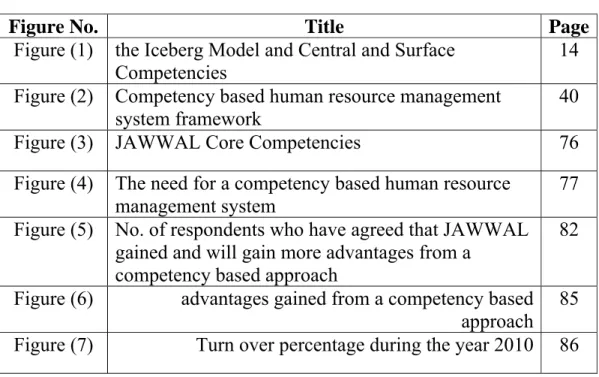
List of Figures
Figure No. Title Page
Figure (1) the Iceberg Model and Central and Surface Competencies
14
Figure (2) Competency based human resource management
system framework 40
Figure (3) JAWWAL Core Competencies 76
Figure (4) The need for a competency based human resource
management system 77
Figure (5) No. of respondents who have agreed that JAWWAL gained and will gain more advantages from a
competency based approach
82
Figure (6) advantages gained from a competency based approach 85 Figure (7) 86Turn over percentage during the year 2010
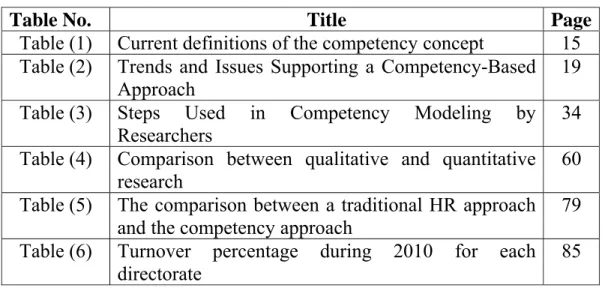
List of Tables
Table No. Title Page
Table (1) Current definitions of the competency concept 15 Table (2) Trends and Issues Supporting a Competency-Based
Approach
19
Table (3) Steps Used in Competency Modeling by Researchers
34
Table (4) Comparison between qualitative and quantitative research
60
Table (5) The comparison between a traditional HR approach and the competency approach
79
Table (6) Turnover percentage during 2010 for each directorate
Adopting a Competency Based Human Resource Management System in Palestine
Cellular Communication LTD-JAWWAL By
Enas Hamzi Hijazeh Supervisor Prof. Grace Khoury
ABSTRACT
The goal of this research is to identify JAWWAL core competencies that will serve as a foundation for a competency based human resource (HR) management system, which for this research will include recruitment and selection, training and development, and performance management for this research. In order to achieve the general objectives of this study, semi-structured interviews and focus groups with JAWWAL directors, managers and supervisors were conducted as well as gathering completed competency based training appraisal forms from direct supervisors of employees who have participated in a competency based training course. Based upon the analysis of responses, which formed 63% of the sample, the following conclusions were drawn:
- Eleven core competencies have been identified for JAWWAL employees, derived from JAWWAL’s mission and vision statements and they will serve as the base for the HR competency system.
- JAWWAL will gain many advantages by adopting such a system. First, it will link its employees with the mission and vision statements; second, recruitment and selection will be competency based and not job based which encourages managers and other decision makers to clarify the verifiable, measurable results they expect from successful performers before a selection decision is
made. This makes selection methods more effective, which reduces turnover, where, in this study, turnover was reduced by 0.196%
during a period of seven months, since the employees who are hired
are more likely to do well in jobs or work roles that are matched to their existing or potential competencies.
- Competency based training allowed JAWWAL employees to structure their activities and processes in ways that are most meaningful to them. With this approach to training, JAWWAL managers, supervisors and employees are now more able to identify and use many learning resources in diverse settings. JAWWAL’s competency-based approach to training consistently communicates a common set of performance expectations to every team member. JAWWAL started to focus all training on meeting employees’ needs that support successful and creative team performance. Competency-based training began to help JAWWAL managers and supervisors keep JAWWAL employees focused on achieving exemplary performance.
- It was concluded by the respondents that in a competency based system the process will encourage frank and non adversarial communication between employees and their managers. It is not unusual for JAWWAL employees to express their concerns in performing work that is not aligned with their strengths or interests. It is not only the less productive employees but often exemplary performers as well, who express these concerns. It also gives JAWWAL employees the opportunity to convey their interests and satisfaction in performing work that is aligned with their
competencies. JAWWAL employees' work results will be aligned with achievement of strategic objectives, and this contribution will be identified in specific and usually measurable terms. Work that is identified as nonstrategic can be eliminated; it will allow JAWWAL to use its resources in other more productive ways. A competency-based HR performance management system establishes a work environment at JAWWAL in which the roles, relationships, and responsibilities of both managers and employees are well defined.
- Communication of strategic change is the most important strategy that the HR Directorate must work on to ensure success of the competency system JAWWAL is seeking to adopt for HR functions.
In conclusion, this study recommends that JAWWAL’s top management allow the HR Directorate to play an effective strategic role through adopting the competency based human resource management system that will align HR practices with JAWWAL's strategic objectives and employee development efforts as well as to integrate all components of the HR functions across JAWWAL.
Key words: JAWWAL, HR Directorate, Core Competencies, Competency
Based Human Resource Management System, Recruitment and Selection, Training and Development, and Performance Management.
Chapter One
Introduction
Chapter One
Introduction
1.1 Introduction
In the globalised and skill based economies around the world, human capital is considered to be the most important resource for any organization, Walker (1980). How the organization leverages this resource
will ultimately decide if it can achieve its strategic objectives. It is imperative for any organization to align its employees’ behavior to its strategic objectives for sustained success. The changing nature of work as organizations transition from an industrial to a knowledge-based economy has been documented through research in the early 21st century. The American Society for Training and Development [ASTD], 2006; the Business-Higher Education Forum [BHEF], 2003; and other studies have identified the various skills and competencies important for the 21st century workforce, as well as skill gaps.
Organizations must develop the ability to continuously and consciously transform themselves and their contexts. Contexts include restructuring for optimum effectiveness, reengineering key procedures and streamlining functions that are able to provide a source of competitive advantage. All this aims to adapt regenerate and most importantly, survive (McLean, 2006). Rothwell, Prescott, and Taylor (1998), examined many trends that affect businesses and organizations by prioritizing them as technological change, globalization, continued cost containment, market change, growing importance of knowledge capital and the increased rate and magnitude of change.
The character of organizational change and the changing nature of jobs are both the cause and result of an increased emphasis on human capital. The ASTD Public Policy Council (2003) described the success of organizations as being dependent on the knowledge and capabilities of their employees. "In the knowledge-based economy of the 21st century, it is not capital, equipment or technology that differentiates organizations; it is their workforce and the processes by which that workforce is established, leveraged, and maintained" (ASTD Public Policy Council, 2003, p. 5).
Competency-based human resource management became popular in the 90s, principally because it offered employers a new way of defining and assessing those hard-to-measure traits, or "soft skills”, that so often make the difference between superior performers and the rest of the crowd--for example, initiative, adaptability, drive for achievement, etc. Competencies also provided fundamental building blocks for ensuring that all of the "people" processes in the organization could be fully integrated. No longer would there be one set of criteria for selection, another set for performance management, and yet a third set for learning and development. "Competencies" were proclaimed as the one common set of standards to be used for all HR processes (Houtzagers, 1999).
HR Directorate at Palestine Cellular Communication LTD-JAWWAL is still using the traditional roles for HR activities, which is far from the company’s mission and vision. Through this research and through adopting the competency based human resource management system, the researcher aims to transform HRM to a business partner in achieving the company’s strategic goals.
1.2 Problem statement
Palestine Cellular Communication LTD-JAWWAL is the first Palestinian provider of mobile communication in Palestine and is a model for continuing success and transparency through a diversified number of distinguished services that enable its customers to communicate using the most advanced global trends in mobile industry. Palestine Cellular Communication LTD-JAWWAL started as a project related to PALTEL Company, and after obtaining its license, worked tirelessly to build the first Palestinian GSM network and managed to make its first call in 1999. The company’s policy has always been to attract the best and brightest Palestinian talent to join its staff. To do so, the company seeks to provide a challenging work environment, and continuing training that offers its team opportunities to enhance their knowledge and skills.
The HR directorate is in charge of measuring and evaluating the competencies of employees and providing the required training and development programs. There is a great gap between the potential and actual performance of the HR Directorate, in terms of services provided to accomplish its mission. This gap resulted from drawbacks and limitations in the current system including:
1. An inability to measure the real performance of employees. The current appraisal system only measures the technical skills that employees should have in order to accomplish their tasks. These skills are determined according to the annual plan of each directorate. There is no management system that is capable of measuring the behavioral skills that JAWWAL employees must demonstrate, skills
which have a competitive advantage, and can distinguish JAWWAL employees from others.
2. The current system doesn’t provide the HR directorate and JAWWAL’s management with the competencies that are considered essential to each employee. These competencies should link employees’ performance with JAWWAL’s mission and vision. There is a need for a new system that can foster positive outcomes with customers and suppliers.
3. The HR directorate does not have a training plan linked to JAWWAL’s strategic objectives. The offered training lacks the ability to provide the employees with the required skills that are important to improve their performance, as well as align HR management practices with the mission, vision, values, and business strategies or objectives of the company. JAWWAL’s intentions are to build on individual knowledge, skills, and attitudes to meet present or future work requirements. However, training should have an immediate and highly specific impact on work performance.
Moreover, it should be grounded in the organization's requirements and unique corporate culture. It is different in this respect from education and employee development, which prepare the individual for life and future work.
4. The current system utilizes a traditional recruitment and selection process. It depends mainly on screening the applicants, then comparing their qualifications to job requirements by means of interviews. This method makes it difficult to attract individuals with
specific characteristics that cannot be acquired by training or development. Although the selected persons are likely to fit in their work roles, there is a need for new selection methods that provide insight into whether or not a new employee will fit in the organization's culture.
1.3 Study Importance
The task of this study is to adopt a competency based human resource system for HR professionals to serve in new roles as strategic business partners, advisors/consultants, and change agents as well as professional experts in all areas of HR management. The purpose of this study is to develop and validate a competency model for Palestine Cellular Communication LTD-JAWWAL. Developing such a competency based human resource management system and validating it is an important issue for JAWWAL and the HR directorate since it will involve a transition from the traditional way of managing human resources based on what people have (e.g. qualifications) to what people can do (performance). The benefits of using the competency based framework for human resources subsystems such as recruitment and selection, training and development, and performance management are:
1. Shifting from a day to day organizational operation to a competency based one; an approach to managing employee performance based on both “what” is achieved and “how” results are derived.
2. Providing a systematic approach to human resource activities and making them more effective. Competencies bring out the synergy between different subsystems by reinforcing each other and
minimizing needless overlap and contradictions. The competency used in selection assessment may yield benefits for training needs.
3. The competency based human resources management system will provide JAWWAL with a wide common language to understand different roles and responsibilities that will help employees to know how they can grow to fulfill their aspirations.
1.3.1 Research objectives
1. Identify and describe competencies required for Palestine Cellular Communication LTD-JAWWAL professionals to be successful now and in the future.
2. Construct a competency based human resource management system that includes core competencies and technical competencies, describes what they look like in practice, and reflects organizational preferences.
3. Ensure that the competency based human resource management system is a valid one.
1.3.2 Research Questions
Based on the above objectives, this study should result in answers to the following questions:
1. Why does JAWWAL need a competency system?
2. How does a competency-based human resource management approach differ from the familiar traditional approach?
3. What advantages will the organization gain from a competency-based approach?
4. What challenges will the organization experience in adopting a competency-based approach?
5. What strategies should be taken into consideration to ensure success?
1.4 Assumptions of the study
The following assumptions underlie this study:
1. Existing competency literature and frameworks are valid as menus for constructing a competency based human resource management system for Palestine cellular communication LTD- JAWWAL.
2. Individual incumbents involved as participants in the study, such as the directors, managers, and supervisors, are able to articulate the competencies needed now and in the future.
3. It is possible to identify competencies that predict performance.
4. Use of participatory methods will yield valid results.
1.5 Structure of the Study
The study is organized into six chapters as follows:
Chapter 1: Introduction
This chapter provides the background, objectives and rational of the study. The scope and structure of the study are also included.
Chapter 2: Literature Review and Theoretical Framework
This chapter reviews the relevant literature on the research questions. It is divided into nine main sections. The first three sections review the identification of core and technical competencies. The fourth section reviews competency models and competency based human resource management. The fifth section presents how the competency models are the basis of and provide benefits to human resource management systems and their organizations. The sixth section summarizes research about competencies and competency modeling. The seventh section reviews the sources of competency based human resource management systems. The eighth section identifies the competency model framework. The last section is a conclusion of the research.
Chapter 3: Human Resource Management system at Palestine Cellular Communication LTD-JAWWAL
This chapter represents the history of the Human Resource Directorate at Palestine Cellular Communication LTD-JAWWAL; it highlights the challenges and services, and describes its current situation. The chapter describes the functions performed by the HR Directorate and the management system that is used to conduct daily business and provide service to other directorates.
Chapter 4: Research Methodology
The aim of this chapter is to justify the choice of research
instruments, type of sampling and how the semi–structured interviews and focus groups are designed. To ensure that research instruments will meet
questions that will build the competency based human resource
management system. Furthermore, the selection of the sample and how it is assessed is discussed.
Chapter 5: Data Analysis
This chapter presents a comprehensive analysis and discussion of the results obtained from the semi- structured interviews, and focus groups, where the design of the analysis elaborates and summarizes the answers of the study questions that were stated in chapter one. Each research question will be answered by presenting and discussing the results obtained from the data analysis appropriate for each particular question. Also, results of the survey that were conducted to measure the performance of the employees who participated in competency based training courses will be presented and discussed.
Chapter 6: Conclusion and Recommendation
This chapter restates the research problem and provides an overview of the methodology used for the study. Results are summarized and then discussed in a more general sense than the discussion provided in Chapter five. The discussion includes conclusion, recommendations for JAWWAL, and suggestions for further research.
Chapter Two
Chapter Two
Literature Review and Theoretical Framework
2.1 Introduction
The purpose of this chapter is to define the competency concept and take a short look at the background of core and technical competencies and the competency based human resource management system. The most relevant literature is reviewed concerning the research questions starting with which function of HR activities will adopt the competencies model, knowing that competencies will be divided into core and technical competencies.
2.2 Definitions of competencies
The first time the term competency was introduced to the psychology literature was in 1973. In his article ‘Testing for competence rather than for intelligence’ David McClelland (1973) claims that the content of traditional tests of academic aptitude and knowledge in fact have neither predicted job performance nor success. Since then competency has become a significant factor in Human Resource Development practices. A competency can be defined as “an underlying characteristic of a person which results in effective and or superior performance in a job” Boyatzis (1982: page 21).
A job competency represents ability. Individuals set of competencies reflect their skills, capability and behaviors. Functional competencies may be a motive, trait, skill, aspect of one’s self-image or social role, or a body of knowledge that an individual uses, and the existence and procession of
these characteristics may or may not be known to the individual (Boyatzis,1982).
Individual characteristic is a competency that can be counted reliably and that can be shown to differentiate significantly between effective and ineffective performers. Meanwhile, competency can be described as a set of behavior patterns that an incumbent needs to bring to a position in order to perform its tasks and functions in the delivery of desired results or outcomes (Woodruffe, 1992).
Also Competency was viewed as “an underlying characteristic of an individual that is causally related to criterion-referenced effective and/or superior performance in a job or situation (Spencer & Spencer,1993: page 104). In the business culture (including both business and public administration communities), the terms job competencies, core competencies, organizational competencies, management competencies, and individual competencies are becoming part of today's business language.
The concept of competency is also linked to a growing range of human resource-related activities - competency-based performance management, competency-based approaches to developing people, competency-based approaches to developing organizations.
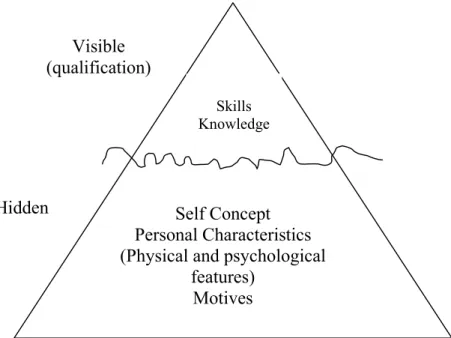
Five types of competency characteristics were defined, they are consisting of motives, traits, self-concept, knowledge and skills. Motives are known to be the driving force which causes people to achieve goals. Motivation is related to, but distinct from, emotion. Motives drive, direct and select behavior toward certain actions or goals and away from others.
Traits are known as the physical characteristics and consistent responses to situations. Self-concept is an individual’s attitudes, values or self-image. Knowledge is the information that an individual has in specific content areas. Finally, skill is the ability to perform a certain physical or mental task. Surface knowledge and skill competencies are easy to be developed and train in the most cost-effective way to secure those employee abilities (Spencer & Spencer, 1993). Figure 1 illustrates central and surface competencies.
Figure 1: the Iceberg Model and Central and Surface Competencies Source: Spencer & Spencer (1993: 11)
In other words, visible competencies such as knowledge and skills may be somewhat technical competencies basically required by the job, whereas hidden competencies such as self-concept, traits and motives are behavioral competencies that drive an individual’s performance in the job. Boyatzis (1982) states that motive and trait competencies have the most direct impact on self-concept and also have an impact on skill. In an effort to provide a complete understanding of the different aspects that the term
Skills Knowledge
Self Concept Personal Characteristics (Physical and psychological
features) Motives Visible
(qualification)
“competencies” mean, Table 1, presents the main definitions from different writers or companies.
Table (1): Current definitions of the competency concept
Author Definition
Marrelli (1998)
Competencies are measurable human capabilities that are required for effective work performance demands.
Dubois (1998)
Competencies are those characteristics- knowledge, skills, mindsets, thought patterns, and the like-that, when used either singularly or in various combinations, result in successful performance.
Boyatzis (1982)
Boyatzis described competencies as underlying characteristics of an individual, which are, causally (change in one variable cause change in another) related to effective job performance Selby et al. (2000)
UK National Vocational Council
for Vocational Qualification (1997)
The National Vocational Council for Vocational Qualification described competency as performance standards, the ability to perform in work rules or jobs to the standard required in employment
Treasury Board of Canada Secretariat (1999)
Competencies” are the knowledge, skills, abilities and behaviors that an employee applies in performing his/her work and that are the key employee-related levers for achieving results that are relevant to the organization’s business strategies
Perrenaud (2000) A capacity to mobilize diverse cognitive resources to meet a certain type of situation
LeBoterf (1998)
LeBoterf says that competencies are not themselves resources in the sense of knowing how to act, knowing how to do, or attitudes, but they mobilize, integrate and orchestrate such resources. This mobilization is only pertinent in one situation, and each situation is unique, although it could be approached as an analogy to other situations that are already known
Author Definition
Jackson and Schuler (2003)
Competencies are defined as “the skills, knowledge, abilities and other characteristics that someone needs to perform a job effectively”
Intagliata et al. (2000)
Most fundamentally, competencies provide organizations with a way to define in behavioral terms what their leaders need to do to produce the results the organization desires and do so in a way that is consistent with and builds its culture. They should provide the ‘North Star’ by which leaders at all levels navigate in order to create synergy and produce more significant and consistent results.
PeopleSoft A set of measurable and observable knowledge, skills and behaviors that contribute to success in a job/position
Gartner group A competency is a set of characteristics, including skills, knowledge and attributes, that causes or forecasts performance
Source: Draganidis and Mentza, Competency based management a review of systems and approaches (2005:53).
In conclusion, most of the authors mentioned in the table above that a competency is a mix of knowledge, behavior, skills and tacit, that gives people the potential for effectiveness in performing tasks.
2.3 Core Competencies
Competencies that are describing the behaviors that are keys to the success of an organization are known as core competencies. It defines the skills and abilities that all employees must demonstrate in order to drive business results. They are aligned with and support the primary goals and strategies of the organization. Specification of primary goals and organization strategies are the first steps of identifying core competencies. Some of the questions that might be included in the process of identifying core competencies include: What things company hope to achieve? What
are the critical business results? What are the primary drivers of success? Where is the company heading? A corporation’s culture, mission, vision, and values should also be reflected in the organizations core competencies. Meeting with organization top management, leaders and strategists to fully understand the company’s goals, mission values and strategies should be conducted before identifying core competencies. The majority of competency models include 7-9 core competencies that all employees must demonstrate for the company to achieve strategic goals and objectives (Maddy, 2002).
2.4 Technical Competencies
Technical competencies which are the knowledge and abilities that are required to drive results in the particular position and describe the behaviors that are keys to the success of an individual job or position within the organization are often built upon the foundation of the organization’s core competencies.
Specification of position’s major duties and responsibilities is the main step of identifying technical competencies for any positions. Sample of questions that might be used in the process of identifying technical competencies include: What are the responsibilities for an individual employee in this position? To what results is an employee held accountable? What behaviors must be demonstrated in order for an employee to be successful in this position?
For creating a competency model, organization need to combine organization’s core with technical competencies. Taken together, the core and technical competencies for a job describe the skills, abilities, and
behaviors that must be consistently demonstrated in order for an employee to be successful in the job (Maddy, 2002).
2.5 Competency Models and Competency-Based Human
Resource Management
From a Jobs-based to a Competency-based Approach
Job analysis is considered as the basis of human resource activities used for creating job descriptions and minimum requirements, (Dubois et al., 2004). Job analysis has focused on what employees actually do in their jobs, perceptions of what employees do, what employees should be doing, and what should be done in the future (Dubois et al., 2004; Walker, 1980). Problems occur when organizations focus on jobs as the criterion for matching employees with work that is important for organizational success.
Traditional job descriptions are written to identify activities and may not clearly describe outputs needed for organizational success also, traditional job descriptions become quickly outdated in today’s rapidly changing, dynamic environment (Byham & Moyer, 2005; Dubois et al., 2004). Dubois et al. (2004) further suggested that job descriptions may become disregarded before they are written and thus become hindrance to organizational change. Several authors (Byham & Moyer, 2005; Carnevale, 1991; Dubois et al., 2004; Lawler, 1994; Weatherly, 2005a) have described forces or trends facing organizations and how a competency-based approach can help by moving the focus away from jobs and toward individuals and their competencies.
Other trends and issues facing organizations support a need for a competency based approach to human resource management are summarized in Table 2 Lawler (1994) described trends such as those in Table 2. One reason that cuts across the issues and trends is that competency-based HR management “focuses attention on the people who do the work rather than the work done by those people” (Dubois et al., 2004, p. 10). This focus on the people who do the work has resulted in competency-based HR management systems gaining recognition, acceptance, and support in organizations worldwide (Dubois & Rothwell, 2000; Lucia & Lepsinger, 1999; McLagan, 1996). In order to understand how competency models can be the basis of human resource management, it is important to explore the use of competency models in human resource systems and the literature on their benefits.
Table (2): Trends and Issues Supporting a Competency-Based Approach
Trend Relationship to a Need for Competency-based HR
Technological change
Need to structure thinking around competencies that enable individuals to make best use of existing and emerging technology (Dubois et al., 2004)
Increased diversity and globalization
Requires more attention to diversity, open-thinking, and attention to employees who can work in and across different cultures. Competency-based HR helps identify capabilities needed and insures consistent standards are applied across an organization (Byham & Moyer, 2005; Dubois et al., 2004; Lucia & Lepsinger, 1999). Accelerated speed to market change and aximizing Productivity
Customer expectations are changing quickly and they expect rapid responses. And as organizations are being forced to become more lean, it is increasingly important to have employees with the right competencies to be effective. Competency-based HR can help and focus selection, training, and evaluation systems based on current future needs (Dubois et al., 2004; Lucia & Lepsinger, 1999).
Growing importance of
knowledge capital
Competency-based HR strives to identify and develop exemplary performance and bring average employees closer to exemplary (Dubois et al., 2004).
Rapidly changing, team-oriented
environment
For organizations to anticipate and react to change, they must have individuals capable of dealing with the associated challenges where jobs change and roles change frequently. Competency-based HR management moves the traditional focus on work to individual competencies that may underpin all required roles, align with organizational problems and strategic issues. In an environment with jobs in flux, competency models provide a tool for describing skills required now and in the future as needs change (Byham & Moyer, 2005; Dubois et al., 2004; Lucia & Lepsinger, 1999). Organizations with fewer layers, flatter structure, and empowerment/ increased employee involvement
Competencies can help identify the skills needed to operate in an organization with less hierarchy and a culture of high involvement where learning, flexibility, and initiative are important. Competencies help define organizational expectations in an environment where employees have the capacity to do more than in the past (Byham & Moyer, 2005). Fewer advancement opportunities and a need for horizontal movement increase the need for defining competencies so the right people can be identified and moved across or up in the organization without mismatches or errors (Byham & Moyer, 2005; Lawler, 1994).
Clarifying work expectations
Addresses issues raised about traditional human resource management by describing: (a) what skills, knowledge and characteristics are required; and (b) what behaviors have the most impact on performance success. This promotes shared understanding about how to perform and what it takes to succeed (Lucia & Lepsinger, 1999). Popularity of multi- perspective instruments for evaluation
The use of multi-perspective instruments to help people understand how they are perceived by others has elevated the importance of competencies that form the categories against which people are evaluated (Byham & Moyer, 2005).
More difficult personal career
planning
The dynamic nature of the workplace makes career planning more difficult because paths to advancement are less clear. Competencies provide a framework for self-development efforts and career planning (Byham & Moyer, 2005).
2.6 Benefits of Competency Based Human Resource
Management System
HR management, human capital, intellectual capital, and talent management all share the common idea that people have capabilities that drive organizational performance (i.e., people make a difference in how organizations perform) (Dubois et al., 2004).
Effective organizations must find, use, develop, and keep people to fulfill their mission. Human resource management is the process of doing that (Dubois et al., 2004; Lado & Wilson, 1994). Traditional HR management systems typically include aspects of the following: recruitment and selection, performance management, compensation, training development, and career and development planning (Dubois & Rothwell, 2000; Lucia & Lepsinger, 1999; Schippmann, 1999). In traditional HR management, job analysis becomes the basis for recruiting, selecting, training, rewarding, appraising, and developing people. Using this approach, the HR function seeks to discover the skills, knowledge, and characteristics that contribute directly to the organization’s success and configure HR activities around those competencies (Dubois et al., 2004; Lucia & Lepsinger, 1999; Thompson et al., 1996).
The objective of a competency-based approach is to “identify the competencies required of high performers in key positions throughout the organization; strive to eliminate any competency gaps that exist through effective selection and/or training and development; and ensure that meritorious performance is recognized and rewarded” (Weatherly, 2005a, p. 4). McLagan (1980) described competency models as a focal point for planning, organizing, integrating, and improving all aspects of HR management systems, a concept called horizontal alignment (Mulder, 2001). Stone and Bieber (1997) noted that “competencies help make forward-looking HR decisions by clarifying the knowledge, skills, and behaviors needed in the future and by serving as a foundation upon which to build employee selection, training, professional development, performance appraisal, and succession planning” (p. 2). Weatherly (2005b) stated that “competencies can be used to support the entire HR platform within an organization – from selection and recruitment to training and development, succession planning and total rewards” (p. 1). Many authors indorse that competency models can support HR management systems (Bernthal et al., 2004; Dubois et al., 2004; Hayes, 1979; Lucia & Lepsinger, 1999; McLagan, 1980; Moulton et al., 2006, Stone & Bieber, 1997; Weatherly, 2005b). These systems include: (1) recruitment and selection; (2) training and development (3) employees development; (4) performance management (e.g., multi-perspective feedback and appraisals); (5) compensation and benefits (e.g., salary adjustments based on merit); (6) career development; and (7) promotion and succession planning. One goal of looking at competencies is to discover the difference between fully successful and exemplary performers, pinpoint those differences, and then select more people who function at the exemplary level or help others
develop that capability (Dubois et al., 2004). Conceptually, an organization uses a competency model to staff positions with employees who possess the characteristics of high performers. To understand the reasons for using competencies in HR management, it is important to look at what competency-based HR management looks like, the benefits related to some of the HR management systems, Dubois et al. (2004) described the differences between traditional and competency-based HR management and the benefits as well as the differences in each of the HR systems. In terms of the overall HR function, competency-based HR management moves the focus from compliance and policies to HR playing an important role in talent management, a role that contributes directly to the organizational mission and productivity. While HR continues to fulfill its compliance responsibilities, it does so in a competency-based environment. HR planning shifts from a focus on head counts and forecasts based on the past to a concentration on talent and qualitative planning methods. Recruitment and selection moves away from qualifications, and assumptions that qualifications equal ability to perform to a focus on decisions based on competency, models for the organization that define the knowledge, skills, and attributes of high performers (Dubois et al., 2004). By clarifying behaviors and practices of effective employees, competency models increase the likelihood that resources invested in hiring put the right people in the right jobs (Lucia & Lepsinger, 1999). Competency models provide a complete picture of the job requirements; increase the chance that those hired will succeed, ensure a more systematic interview process, and help distinguish between competencies that can be improved through training and those that are more difficult to develop. Selection focuses on few technical or subject matter skills without taking into consideration the
other qualities needed to be successful for example customer focus. A competency model provides a more complete and clear picture for the interviewer and interviewee (Lucia & Lepsinger, 1999). Using competency-based interviewing techniques (e.g., behavior-based interviews), hiring managers can be more effective in determining if an individual has the knowledge, skills, and characteristics to be successful (Stone, 1997). A competency-based training and development system builds individual competencies aligned with measurable high performance and draw process for individuals to know their own competencies and for the organization to identify and cultivate talent (Dubois, et al., 2004). An important aspect of employee development is that much of the efforts to build competencies occur through learning experiences on the job that are intentional efforts. Also, organizations can target competencies that are most relevant or have the greatest impact, avoiding a short-term perspective. Lucia and Lepsinger (1999) described four primary benefits of competency based HR systems.
1. Competency-based HR systems enable a focus on relevant skills and behaviors. When people are clear about what it takes to succeed, they are better able to make decisions about training and development. Individuals are encouraged to become more active in their own development
2. Competency-based HR systems ensure alignment of training and development. Focus for training and development aligns with what is essential for the organization. A well constructed competency model describes behaviors for effectiveness on the job and supports the
organization’s strategic direction. Thus, HR can develop programs to meet future needs.
3. Competency-based HR systems make the most effective use of training and development. This approach removes the guesswork on where to focus scarce resources so time and money are well spent. Can help identify who needs which skills at which point in their career and then provide training and development when employees have a use for it; a time when they are more likely to apply and reinforce experiences.
4. Competency-based HR systems provide a framework for bosses and coaches. The clarity and specificity of competency models provide bosses and coaches a shared picture of what it takes to succeed. Behaviors described in the model can be used as a basis for constructive development discussions.
The feedback described above is also important in performance management. Using traditional approaches to performance management, key concerns or issues have been raised such as lack of agreement on performance criteria, lack of balance in appraising what is accomplished and how it is accomplished, and lack of specificity in discussion of deficiencies (Lucia & Lepsinger, 1999). Competencies provide an evaluation tool against which all individuals, or at least a broad band of individuals, can be evaluated (Byham & Moyer, 2005). This is particularly beneficial in an environment where jobs may be fluid and people move from one job to another within an organization. Lucia and Lepsinger (1999) described three key ways a competency-based approach improves the
performance management system. First, use of a competency model provides a shared understanding of what will be monitored and measured. For example, integrating elements of the model into appraisal forms helps balance what gets done, showing a concern for both results and the behavior or manner in which they are attained. Secondly, competencies provide focus and help facilitate the performance appraisal dialogue. Finally, competencies are a framework for gaining information about behavior, offering a starting point by identifying specific behaviors (e.g., if the competency is teamwork, a boss can look for evidence of behaviors that support teamwork like resolving conflict). Gaining information through peer or 360-degree feedback is easier with competencies as a guide.
Another example of how competencies benefit HR systems is in succession planning. Many organizations prefer promoting from within, which makes sense for many reasons but is not simple. Lucia and Lepsinger (1999) described key components of succession planning to include: (a) a list of positions under consideration; (b) agreement among decision makers about what is required for success in each; (c) a list of who is ready for filling positions now and why; and (d) a list of who will be ready soon, accompanied by the person’s developmental needs and actions to close the gaps. Using a competency model to support these components clarifies required skills, knowledge and characteristics; provides a method to assess candidate readiness; focuses training and development plans to address missing competencies; and allows an organization to measure its bench strength. The benefits of a competency-based approach were described for several of the HR systems. From an organizational perspective, benefits combine to provide positive results for organizations.
The use of competency models and approaches to HR management is widespread in the United States. Chase Manhattan Bank, 3M, Sony, AT&T, Burger King, Canadian Imperial Bank, and Geon are all examples of organizations using competencies (Dauphinee, 2001; Dewey, 1997; Lucia & Lepsinger, 1999), the Secretary’s Commission on Achieving Necessary Skills (1991) and the Leadership Effectiveness Framework (Rothwell & Lindholm, 1999), professional organizations such as the American Society for Training and Development (Bernthal et al., 2004), and Extension organizations such as North Carolina State University Extension (Liles & Mustian, 2004) and Texas Extension (Stone & Coppernoll, 2004). Research based on a survey with 292 members of the HR Benchmark Group found that 75% of organizations were using competencies in selection, promotion, and training and development; 65% were using competencies in performance management; and many were also using them in career and succession planning (Cook & Bernthal, 1998). The American Compensation Association-sponsored research (Thompson et al., 1996) demonstrated that competencies can serve as a foundation of an integrated HR system. Respondents in this study were positive about the use of competencies in raising the bar on employee performance and providing a framework to integrate HR applications. Another study by the HR Benchmark group (Cook & Bernthal, 1998) found competencies to strengthen HR systems. Organizations reported positive impact in specific areas (e.g., 91% reported improved training and development processes when supported by competencies) and overall organizational outcomes (67% reported competences to be at least moderately effective in improving organization performance) when competencies supported their HR system. Cook and Bernthal also found that supporting multiple HR
systems with competencies increases overall performance and that impact increases over time. For organizations using competencies for two years or more, the percentage reporting improved organization performance increased to 75 percent.
Benefits of using a competency-based approach to HR management have been described in different key areas. Alignment is the term used to describe how competencies link where an organization is going (strategic objectives) and the talent needed to get there (skills of individuals). Competency-based HR management supports and facilitates an organization’s strategic objectives (Dubois et al., 2004; Lawler, 1994; Mulder, 2001; Stone & Bieber, 1997). Concentration and focus has been used to describe the similar concept of competencies helping HR systems as well as employees behaviors and quality of work that supports the mission, values, and strategic goals of an organization (Byham & Moyer, 2005; Dubois et al., 2004; Lucia & Lepsinger, 1999;Mulder, 2001; Thompson et al., 1996). Adapting to and driving organizational change is another benefit. In an era of rapid change, new skills may be required for changing roles in organizations. Competency models provide a tool for identifying what is needed today and in the future. This approach creates a more flexible and responsive pool of talent by adjusting selection criteria and professional development systems and by supporting development of a broad set of skills (Byham & Moyer, 2005; Lucia & Lepsinger, 1999). "Core competencies are becoming increasingly important as organizations become more flexible in using their workforces and as they strive to drive organizational change throughout the organization using human resource systems as the vehicle" (Byham & Moyer, 2005, p. 78). For maximizing
productivity, competencies help businesses and individuals focus on what will have the important and biggest impact (Dubois et al., 2004; Lucia and Lepsinger, 1999; Mulder, 2001). Discussing the impact of competency-based approaches, Dubois et al. (2004) stated that “recognizing critical differences in individual productivity implies that more work might be done by fewer people, or that better work might be done by the same number of people” (p. xii). Costs can also be avoided because competencies reduce the costs of poor selection decisions and investments in professional development (Hay Group, 2003).
Organizational and employee commitment to learning is another benefit of competencies mentioned by several authors (Hamel & Prahalad, 1994; Lawler, 1994; Maddy et al., 2002; Stone, 1997; Thompson et al., 1996). This commitment to learning includes attracting employees with an interest in learning and fostering ongoing learning as well as an environment or organizational culture supporting lifelong learning. Specifically for Extension organizations, Maddy et al. (2002) recommended use of core competencies throughout the Cooperative Extension System as a best practice that would support and show a commitment to lifelong learning. Finally, Rothwell & Lindholm (1999) described competency-based HR management as the “keystone bridge between individual career development and organizational strategy” (p. 101). The concept of portability is important in an environment of boundary-less careers where individuals move throughout an organization and across organizations. Competencies are portable and are taken with an individual from project to project, job to job, and employer to employer.
2.7 Negative Outcomes of Competency Based Human
Resource Management System
However, less valid and reliable competency based human resource management models can result in negative outcomes. For example, they can:
• Develop less meaningful competencies in organizations without clear visions of their goals or strategies
• Be quite expensive and time-consuming to administer
• Reduce core organizational competencies understanding as a result of poor employee buy-in
• Preserve the organizational status quo and in adequately address soft, integrative and/or innovative competencies such as intercultural or cross-cultural competency
• Add nothing in organizations that have difficulty in differentiating between successful and unsuccessful performance and when the competencies are too''generic". (Dubois et al., 2004).
2.8 Competencies and Competency Modeling – Existing
Research
Efforts have been made to apply competency modeling in public education, government, professional associations, private sector businesses, and Extension organizations. This section will describe models developed in the public education and government sector, others developed for specific professional associations, generic models, an application in a
specific corporation, 3M, and will conclude with those for Extension organizations.
Private Sector
In addition to governmental efforts, professional associations, and generic models developed by researchers, numerous corporations have developed competency models including Sony, 3M, Allstate, Sharp Electronics, AT&T, Burger King, Canadian Imperial Bank, Chase Manhattan Bank, and Geon (Dauphinee, 2001; Dewey, 1997; Lucia & Lepsinger, 1999; Montier, Alai, & Kramer, 2006). Although there is considerable variation in how these models were developed and their intended audience, some examples are helpful to illustrate how competency models are being developed and described in the business world. 3M has created an executive-level competency model (Alldredge & Nilan, 2000). The research process at 3M was led by an in-house team and included: (a) an internal process to review the literature and learn about competencies, (b) internal groups used to coalesce around current expectations and future needs, (c) a team representing HR practitioners from the area of leadership development and assessment, and (d) critical incident interviews to collect data and develop behavioral expectations. The resulting model included competency labels, descriptions, and behavioral anchors for 12 competencies clustered by how they are expected to develop throughout an executive’s career. Listed by cluster, they include:
1. Fundamental – ethics and integrity, intellectual capacity, and maturity and judgment;
2- Essential – customer orientation, developing people, inspiring others, and business health and results; and
3- Visionary–global perspective, vision and strategy, nurturing innovation, building alliances, and organizational agility.
Another example is Sharp Electronics, where a core competency model was developed initially and competency models specific to key job functions are being added (Montier et al., 2006). Sharp placed an emphasis on involving individuals at all levels in developing and validating a model that was customized for their organization. The Sharp research process included an examination of the business environment, interviews with senior executives, a review of other competency models and best practices, behavioral interviews with top performers, focus groups across functions and locations, validation meetings, and a final review with senior management. Themes emerging from the background data, interviews with executives, and behavioral interviews were used to construct an initial competency model. Focus groups then provided additional input, which helped create ownership in the process and further refine the model. Interview and focus group participants met to validate the model and senior management reviewed it for strategic alignment. The resulting core competency model included 14 competencies grouped into 4 themes. Sharp’s model included the following core competencies: demonstrates creativity, learns continuously, establishes high standards, uses information technology, communicates effectively, partners with others, understands the organization, drives change, focuses on the customer, knows the global business, thinks strategically, delegates authority, develops and coaches, and leads others.
2.9 Sources of Competency-based Human Resource
Management System
The widely used sources of data for developing competency model are theory, senior management interviews, focus groups with subject matter experts, behavioral event interview and generic competency dictionaries.
Models emerging from theoretical sources tend to be generic. Those generated by focus group and senior management are non-scientific since they are opinion based unless they are validated against performance data. Competency models that emerge from systematic observation of people and jobs use rigorous research methods to casually link competency with performance (Palaniappan, 2003).
2.9.1 Dimensions of a competency system
Any competency model should have two dimensions: the type of competency and the level at which the competency exists. Types related to core and technical competencies. Level refers to whether they are obvious as in skills and knowledge or underlying characteristics like motives, traits, self-concept, and values (Palaniappan, 2003).
2.10 Competency Model Framework
Conducting a competency study and developing a competency model for an organization is a multi-step process. Major approaches to competency modeling and the unique steps to those approaches were discussed previously. What steps are taken, and in what order, relies to a large degree on the methodology selected and the specific data collection methods used. However, there were steps in developing a competency
model that appeared across authors and methods; these steps were synthesized and are presented in Table 3.
Table(3): Steps Used in Competency Modeling by Researchers Steps Used in Competency Modeling by Researchers
Source Steps
Bernthal et al., 2004 (1) needs assessment and data collection (literature review, expert interviews, focus groups), (2) new model velopment (data integration and model draft, expert group review and model revision, final expert review and model revision), (3) model validation, (4) final refinement and confirmation Byham & Moyer,
2005
(1) background review, (2) data collection, (3) data integration, (4) validation, (5) finalization
Draganidis &
Mentzas, 2006 Summarized key steps based in competency modeling based on a literature review: (1) creating of a competency systems team (CST), (2) identification of performance metrics and validation sample, (3) development of a tentative competencies list, (4) definition of competencies and behavioral indicators, (5) development of an initial model, (6) cross-check of initial model, (7) model refinement, (8) validation of the model, (9) finalize the model
Hay Group,
2003 (1) establish performance criteria and sample, (2) collect data, (3) analyze data and define competencies, (4) validate the model and revise, (5) Final model for HR system
Lucia & Lepsinger, 1999
(1) determine data collection methodology, ( 2) conduct interviews and focus groups, (3) perform job observations, (4) analyze data and develop interim model Next, or steps used if adapting an existing model – (1) test the model for accuracy and relevance, (2) analyze data and refine, (3) validate the model, (4) finalize
Naquin & Holton, 2006
(1) select previously identified model as a foundation, (2) tailor language to organization, (3) pilot test and validate, (4) revise and finalize model
Schoonover, 2002
(1) clarify organizational context and challenges, (2) design study, (3) develop initial model (using existing data, other models, benchmarking), (4) test models (validation survey and/or focus groups), (5) final model
Spencer & Spencer, 1993
(1) define performance criteria and criterion sample, (2) collect data, (3) analyze data and develop a model, (4) validate a model, (5) finalize and apply
Based on the steps used by researchers in Table 3 as well as the literature review of this research, common steps in competency modeling include:
1. Identifying performance metrics and validation sample – if methodology calls for this in selecting participants and conducting validation step;
2. Needs assessment, background data, and benchmarking;
3. Data collection and development of initial model;
4. Cross-check and model refinement (may occur in several steps);
5. Validation – face, content, and/or predictive (may occur as part of several steps); and
6. Finalization.
Decisions about each of these steps are influenced by many factors such as trends, recommendations, and guidelines described above. For example, several authors have suggested that alignment with organizational strategy (Cook & Bernthal, 1998; Dewey, 1997; Dubois, 1993; Green, 1999; Moulton et al., 2006; Rahbar-Daniels et al., 2001; Schoonover, 2002;
Tabet, 2003) and use of participatory approaches (Athey & Orth, 1999; Dewey, 1997; Dubois, 1993; Green, 1999; Liles & Mustian, 2004; Public Service Commission of Canada, 1998) are important for successful competency modeling. Authors who utilize some type of a team or expert group in one or more steps of their competency modeling are providing one opportunity for participation. Sometimes participation and alignment fit together. Dubois (1993) described one step of identifying a representative group that included key stakeholders, those most affected, those responsible for implementing, and customers. This group then looks at existing data (needs analysis, assessments, background, strategic goals) to generate information on organizational context, competence needs, current and future outputs, major tasks, and so forth (Dubois, 1993).Others have described using a steering committee or project team (Dubois & Rothwell, 2000; Liles & Mustian, 2004; Naquin & Holton, 2006) through many of the competency modeling steps.
2.11 Conclusion and Theoretical Framework
From the wide range of related literature, the definition of competency can be summarized as an underlying characteristic of an individual that is causally related to criterion-referenced effective and/or superior performance in a job or situation. Job competency is a set of behavior patterns that a job incumbent needs to bring to a position in order to perform its tasks and functions with competence.
There are several methods for collecting and analyzing data, for deciding what to include in the model, and for formatting the model and its behavioral descriptors. Goals of key stakeholders, the needs of key users,
the budget and time available to develop the model, and the preferred styles of the model building team are all that must be taken into consideration in the process of choosing the competency model. Competencies should be coherent and different from other competencies. The behavioral descriptors should be clearly and crisply worded. The model should include too many competencies and behavioral descriptors make a model ponderous to read and use. A good model is often supplemented with components that will add value for an intended HR application (Mansfield, 2005). Competency models are created to explain how competencies lead to performance, when planning the development of a competency model, there are practical consideration that affect the design of the model, the format and content of the competency model, and the success of the models implementation. The following questions must be taken into consideration for the planning of the competency model:
1. What HR application should be included in the model?
2. Who are the key people involved in the process of developing and validating the model
Firms create a competency model to explain how competencies lead to performance, it explains personal and job related characteristics, the organizational context, and the inter-relationship of these elements that result in performance as per pre-determined standards.
There are at least three questions we should ask before embarking upon developing competency models (Mansfiled, 2005).
2. What are the strategies for system building?
3. What are the available resources?
A brief answers for the above mentioned question can be summarized as follows:
1. The system will support the integration of human resources planning with business planning and this will be achieved by allowing the organizations to assess the current human resource capacity based on their competencies against the capacity needed to achieve business goals of the organization.
2. Human resource strategies, plans policies and procedures to address gaps (e.g., hiring / staffing; learning; career development; succession management; etc.) are designed, developed and implemented to close the gaps. Properly designed, competencies translate the strategic vision and goals for the organization into behaviors or actions employees must display for the organization to be successful
3. Competency system standardizes and integrates all HR activities based on competencies that support organizational goals. Thus there will be efficient use of available resources.
Seven essential steps are needed to transform the HR functions and develop the Competency system. All these steps are critical and appear in some form in those successful organizations that have used a competency (Stephen C, 1998).