Twenty Second European Conference on Information Systems, Tel Aviv 2014
1
Research in Progress
Turber, Stefanie, University of St Gallen, St Gallen, CH, [email protected]
Smiela, Christoph, University of St Gallen, St Gallen, CH, [email protected]
Abstract
The increasing pervasiveness of digital technologies, often referred to as the "Internet of Things" (IoT), offers a wealth of new services and business model opportunities across an ecosystem of partners - and so it forces companies to rethink their current business models. To date, literature does yet not provide actionable, field-tested model theories for capturing, visualizing and analyzing firms' business models in digitally intensive business environments.
The present paper (research in progress) therefore addresses the need for a business model type for the Internet of Things, which recognizes the affordances and impacts of digitization in order to allow companies to truly tap into new business model opportunities. We describe the design and evaluation of a type model, which enables researchers and practitioners alike to capture, visualize and analyze firms' current and future business models in IoT in a structured and actionable way. For our study we elected an iterative design science research approach, which prioritizes the utility of prototype artifacts. We feel confident of reaching at an empirically tested business model type, drawn from both Strategic Management and Information Systems research.
Keywords: Internet of Things, IoT, Business Model, Product-Service Systems, Digital Ecosystem, Design Science Research, Value Networks.
Twenty Second European Conference on Information Systems, Tel Aviv 2014
2
1
Introduction
Today companies are exposed to highly dynamic business environments, driven by rapid developments and ever-increasing pervasiveness of digital technologies. A driving force is that digital technology gets increasingly weaved in previously non-digital products, such as bikes, watches and everyday household appliances, with major impacts on the nature of products and services, and, in consequence, on overarching business models (El Sawy & Pereira, 2013; Yoo, Henfridsson & Lyytinen, 2010). The Auto-ID Lab has coined the term "Internet of Things" (IoT)1 to describe this
phenomenon (Atzori, Iera, & Morabito, 2010).
The "Nest", a digitized thermostat for private homes, is a perfect example for this phenomenon and how it is currently changing market logics and dynamics in its domain: Equipped with sensors and connected to the internet, the "Nest" can be controlled remotely via a mobile app and can track the energy use of a household over time2. Both features combined open up numerous opportunities for
novel services and business models within an emerging ecosystem of new collaborators. E.g. one current campaign includes energy companies to reward "Nest" users, when they switch off the air condition during peak times3. From this perspective "Nest" serves as a platform, which brings multiple
partners together to co-create and use valuable services. This as simple, still emerging example. The Internet of Things inspires a wealth of innovative business models, which forces organizations across industries to adjust their strategies in order to succeed in digital market environments. However, many companies have difficulties to capture the unprecedented ecosystem complexity and to develop adequate business models. According to Burkhart, Krumeich, Werth & Loos (2011) one reason is the "absence of formalized means of representations (...) to allow a structured visualization of business model". We ourselves attempted to use existing business model approaches to identify IoT business models in workshops with companies, and found a major challenge is, that recent market dynamics in the IoT are not sufficiently explicit in the models or not addressable at an acceptable complexity. Examples of these dynamics are multi-partner collaborations on digital platforms and the customers' enhanced role as co-creator or co-producer, to name just a few (Lusch & Vargo, 2004; Yoo, Lyytinen, & Majchrzak, 2012).
Our paper therefore addresses the need for a business model type for Internet of Things environments - one that recognizes the affordances and attributes of digital objects to allow companies to fully tap into the opportunities of digitization. For our study we chose a design science research (DSR) approach, which allows explicating the specific requirements and underlying theory for a new artifact, which in our case is a business model type specifically for IoT. We refer to our artifact as "type model", emphasizing its purpose to represent a new type of business models, supposed to meet the defined requirements in the defined context. In that it differs from instance models or simulation models (Burkhart, Werth, Krumeich & Loos, 2011). To clarify what elements a business model type for IoT should feature, we consulted the Service-Dominant Logic (Vargo & Lusch, 2004), which to our view perfectly depicts new market logics spurred by digitization. Moreover, recent concepts on the nature of digitized objects (Yoo, Henfridsson, & Lyytinen, 2010) provides us with valuable input to reflect the specifics and affordances of digitized objects. Both the design and evaluation process is guided by the design science research approach as suggested by Gregor & Hevner (2013).
1 http://en.wikipedia.org/wiki/Internet_of_Things 2 https://nest.com/thermostat/life-with-nest-thermostat/
Twenty Second European Conference on Information Systems, Tel Aviv 2014
3
We proceed as follows: We begin by describing three key concepts: (a) The nature of digitized objects, (b) the emerging concept of business models, and (c) the Service-Dominant-Logic, which was used to derive requirements for the model artifact. We then present an extract of our review of prior approaches by using previously defined requirements. In section 3 we outline the design science research methodology, which we have been applying in our research in progress. We then explicate the preliminary dimensions of our business model type for IoT.The evaluation, which we are using to test and improve the design of the model in an iterative fashion, is included in section 3 as part of the research design. We conclude with a research outlook and discuss implications for researchers and practitioners.The model type intends to provide researchers with a framework to readily analyze firms' business models and ecosystems along relevant dimensions, e.g. to identify industry-specific pattern or constellations and further contribute to the emerging research field. Moreover, the model provides practitioners with guidance to capture their organization's current and envisioned digital business models by a structured framework.
2
Background
Digital technology embedded in previously non-digital goods causes products and services to change their nature. This in turn gives rise to new business models circling around these digitized objects (Yoo, Lyytinen, & Majchrzak, 2012).
Acknowledging this overarching causality, we start developing the artifact of a business model type for the IoT by first describing three main concepts, which our research builds upon: Digitized objects as source of digital business models (2.1), business models in general terms, which we seek to tailor to IoT environments (2.2), and finally the "Service-dominant logic" as both useful summary on how digitization has changed business logics and as source to extract requirements for the artifact (2.3). We use the same requirements to finally check to what extent they are considered by existing business model approaches (2.4).
2.1
Nature of digitized objects: The nucleus of business models in IoT
We regard insights on the nature of digital technologies including their impact on digitized products and services as key to understand new business model and ecosystem dynamics. One useful concept thereof is the layered architecture view by which digital technologies manifest in a four-layered architecture applicable to all kinds of digitized goods and related services (Benkler, 2006; Yoo, Henfridsson, & Lyytinen, 2010). These four layers are: Device, network, service and contents, as shown in Figure 1. The device layer includes the hardware and the operating systems, while the network layer comprises the logical transmission and physical transport. The service layer provides application functionality, such as persistence services or dynamic linkage, and directly serves users as they deal with contents. The contents layer finally includes data and metadata.As these four modular layers of digitized objects can be de-coupled, the digitized product can be seen as a decomposable combination of its elements. These elements are in turn interconnected through specified interfaces. This feature is supposed to be the nucleus of new services, new organizing logics and, in consequence, new business models involving digital technologies (Yoo, Henfridsson, & Lyytinen, 2010). Due to its importance for business models in the era of Internet of Things, we suggest the artifact to reflect the four-layer architecture as source of distributed value creation. Fig 1 Architecture of digital technology (Benkler, 2006; Yoo et al, 2010) DEVICE LAYER NETWORK LAYER CONTENTS LAYER SERVICE LAYER Logical Transmission Physical Transport Logical Capability Physical Machinery
Twenty Second European Conference on Information Systems, Tel Aviv 2014
4
2.2
Archetypal business model serves as basis for the artifact design
Business model innovation is still an emergent field of research and the literature has not yet provided a common definition (El Sawy & Pereira, 2013). A business model generally is supposed to "allow for a holistic picture of the business by combining factors located inside and outside the firm" (Gassmann, Frankenberger, Csik & Weiblen, 2013). In this paper, we draw upon an archetypal business model approach by Gassmann, Frankenberger, & Csik (2014) as shown
in Figure 2: Reduced to the essence, this approach consists of four core dimensions: "Who" emphasizes the importance to define the target customer, "What" refers to the value proposition towards the customer, "How" addresses the value chain necessary to deliver the value proposition. "Revenue" finally describes which revenue model is employed to capture value. For its archetypal character, we elected the triangle as appropriate starting point for developing a business model type in the IoT context by employing design science research methods (vom Brocke, 2006).
2.3
Service-dominant logic delivers artifact requirements
The increasing pervasiveness of digital technology and digitized products has changed business models and market dynamics tremendously (Elaluf-Calderwood, Sørensen, & Yoo, 2011; Henfridsson, Mathiassen, & Svahn, 2009), and old paradigms in terms of the notion of value, the customer's role or the role of physical products have become obsolete. The seminal work by Vargo & Lusch (2004; 2007) introduced the service-dominant (S-D) logic, which outlines these digitization-driven market dynamics, and the changed levers of competitive advantage. We therefore elected the S-D-logic as well-suited concept to derive the key requirements for the IoT business model artifact, as depicted in table 1:
S-D Logic (extract) Requirements (R) for the business model artifact:
• Ecosystem is operant resource and to
be seen as lever of competitive advantage
R1: Explicates all involved ecosystem participants of the external environment
• Customer and partners as co-creator
and co-producer of value.
• Their incentives to participate can be
both monetary and non-monetary
R2: Depicts customer as operant resource (rather than operand = solely receiving)
R3: Charts monetary and monetary benefits for all ecosystem partners
• Collaboration is essential R4: Network-centric, rather than firm-centric Table 1 S-D logic (left), translated into requirements for the IoT business model artifact (right)
2.4
Previous business model approaches
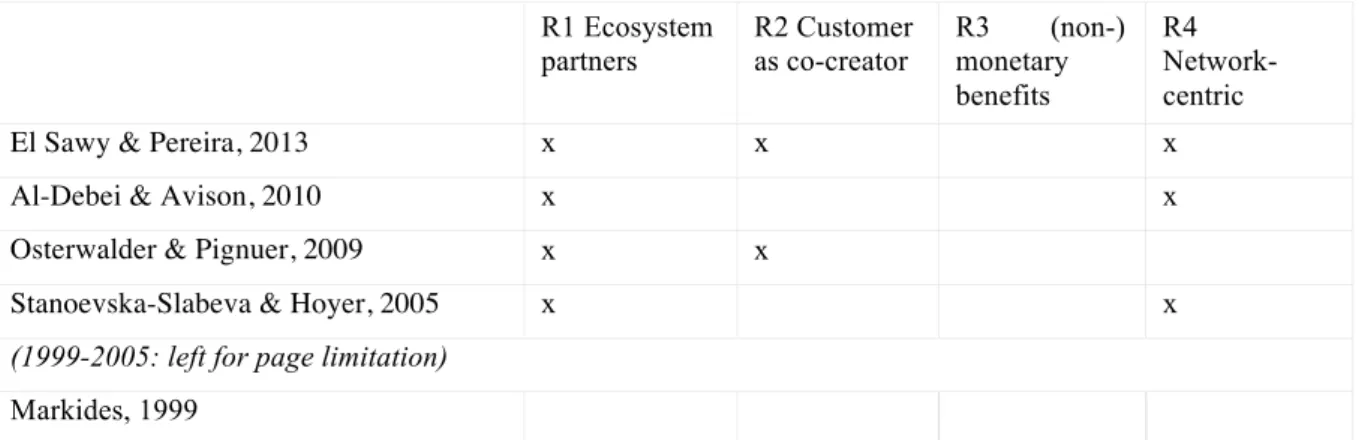
In a literature review we took the model requirements as defined in 2.3 and checked existing business model approaches against these requirements R1, R2, R3, R4. For the sake of page limitation we do not include the exhaustive literature review, but an extract as illustrated in Table 2. Our conclusion from the literature review is, that most of the analyzed business model approaches as of 1999 do not consider explicitly the logics of digitized business environments. As an exception can be regarded the
Fig. 2 Archetypal Business Model (Gassmann et al. 2014) How? Rev.? What? Who? Revenue
Model ValueChain Value Proposition
Twenty Second European Conference on Information Systems, Tel Aviv 2014
5
approach by El Sawy & Pereira (2013), which explicates an evolutionary dimension of digital ecosystems. R1 Ecosystem partners R2 Customer as co-creator R3 (non-) monetary benefits R4 Network-centric
El Sawy & Pereira, 2013 x x x
Al-Debei & Avison, 2010 x x
Osterwalder & Pignuer, 2009 x x
Stanoevska-Slabeva & Hoyer, 2005 x x
(1999-2005: left for page limitation) Markides, 1999
Table 2 Literature review (abbreviated) based on defined requirements for IoT business models
3
Methodology: Design Science Research
As our target is to create a new, useful artifact, we purposefully chose a design science research approach. In this paper, the artifact, which we describe as business model type for the Internet of Things, is an approach for visualizing, envisioning and analyzing complex business models in the Internet of Things environment. More traditional explorative methods would usually have involved the proposition of model components and their evaluation by statistical tools or by analytical methods used in case study research (Yin, 2009). To our view the design science research method is advantageous in our research context in that it emphasizes the precise clarification of the objectives of our model artifact as well as the explication of its requirements. Moreover, it guides us through an iterative, yet structured process of building and evaluating the model. In sum, this approach, provides a well-suited base to arrive at an artifact of high utility, closely connected to extant knowledge and a relevant, real-world problem (Hevner, March, Park & Ram, 2004).
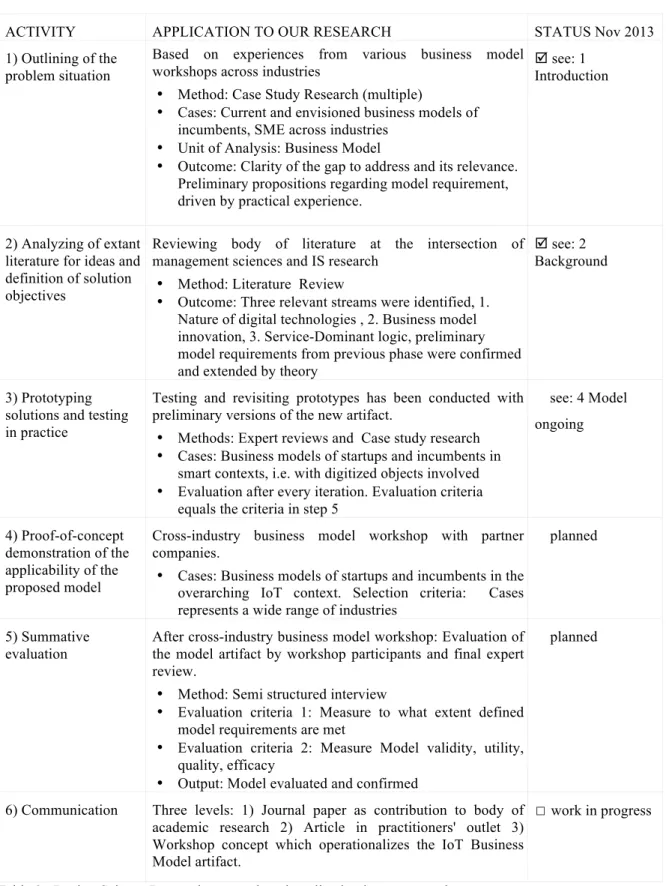
Our study mostly apply the method suggested by Peffers, Tuunanen, Rothenberger, & Chatterjee (2007) and includes six activities. Table 3 provides the main idea and details how the method is applied in our research. The last column outlines the current status of our research in progress and our research plan. Our research is currently progressing in step 3.
We see our prototype artifact at a level of maturity, which we intend to share with the scientific community, to feed in further useful feedback. The next section describes the artifact as is:
Twenty Second European Conference on Information Systems, Tel Aviv 2014
6
ACTIVITY APPLICATION TO OUR RESEARCH STATUS Nov 2013
1) Outlining of the problem situation
Based on experiences from various business model workshops across industries
• Method: Case Study Research (multiple)
• Cases: Current and envisioned business models of
incumbents, SME across industries
• Unit of Analysis: Business Model
• Outcome: Clarity of the gap to address and its relevance.
Preliminary propositions regarding model requirement, driven by practical experience.
! see: 1 Introduction
2) Analyzing of extant literature for ideas and definition of solution objectives
Reviewing body of literature at the intersection of management sciences and IS research
• Method: Literature Review
• Outcome: Three relevant streams were identified, 1.
Nature of digital technologies , 2. Business model innovation, 3. Service-Dominant logic, preliminary model requirements from previous phase were confirmed and extended by theory
! see: 2 Background
3) Prototyping solutions and testing in practice
Testing and revisiting prototypes has been conducted with preliminary versions of the new artifact.
• Methods: Expert reviews and Case study research
• Cases: Business models of startups and incumbents in
smart contexts, i.e. with digitized objects involved
• Evaluation after every iteration. Evaluation criteria
equals the criteria in step 5
see: 4 Model ongoing 4) Proof-of-concept demonstration of the applicability of the proposed model
Cross-industry business model workshop with partner companies.
• Cases: Business models of startups and incumbents in the
overarching IoT context. Selection criteria: Cases represents a wide range of industries
planned
5) Summative evaluation
After cross-industry business model workshop: Evaluation of the model artifact by workshop participants and final expert review.
• Method: Semi structured interview
• Evaluation criteria 1: Measure to what extent defined
model requirements are met
• Evaluation criteria 2: Measure Model validity, utility,
quality, efficacy
• Output: Model evaluated and confirmed
planned
6) Communication Three levels: 1) Journal paper as contribution to body of academic research 2) Article in practitioners' outlet 3) Workshop concept which operationalizes the IoT Business Model artifact.
☐ work in progress
Twenty Second European Conference on Information Systems, Tel Aviv 2014
7
4
Artif
act: A Business Model Type for the Internet of Things
In this section, we describe our artifact, which we have reached at after several iterations (step 3) and which we intend to test-drive and evaluate by a final cross-industry business model workshop (step 4 and 5). We first recapitulate in a highly condensed way how the model was built by drawing on the design principles repertoire (vom Brocke, 2006). We then briefly describe each dimension of the model artifact. For the sake of page limitation we do not include the exhaustive instantiation and evaluation, which is yet depicted in the research plan in section 3.
4.1
Building the artifact
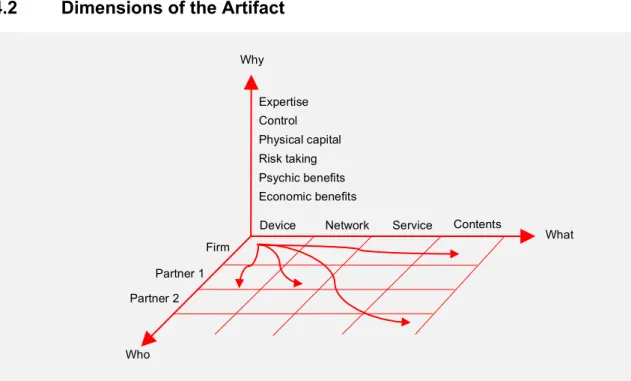
As outlined in section 2, we used an archetypal business model as starting point. To be able to map business models, we used its basic dimensions to span a 3-D Model by analogy building (vom Brocke, 2006). In the next step we enhanced the original dimensions by incorporating the model requirements R1, R2, R3, R4 and digital objects' specifics, as outlined in section 2.
4.2
Dimensions of the Artifact
b
b
Instantiation by embedding~
Analogy ! by creativityFig. 3 Model prototyping by using design principles
Fig. 4 Prototype Artifact of the Business Model Type for IoT (work in progress)
Network
Partner 2
Firm Partner 1
Device Service Contents
What Who Why Expertise Control Physical capital Risk taking Psychic benefits Economic benefits
Twenty Second European Conference on Information Systems, Tel Aviv 2014
8
Dimension 1 "WHO" encompasses all participants involved in the ecosystem. This includes partners, suppliers and customers alike, which we refer to as "collaborators" in a wider sense. Rational: 1) a firms external ecosystem is "operant resource" (Vargo & Lusch, 2007), we therefore suggest to explicate all collaborators 2) Value is co-created by all members of the ecosystem, and so by customers. A differentiation between partners and customers is redundant in this context.
Dimension 2 "WHAT" incorporates the four-layered architecture of digitized products (2.1), with each layer as contributing source of value creation and capturing among collaboration partners. Rational: We strongly suggest that these four layers need to be made explicit in an IoT business model as its specifics and value networks trace back to this architecture.
Dimension 3 "WHY"outlines each collaborator's "reason" to participate in the ecosystem and meant to outline the benefits of different nature according to (Lusch et al., 2007). Rational: 1) With the external ecosystem as operant resource, we suggest to apply Adner's "the wide lens" and consider all ecosystem partners surplus of participation and the ecosystem's overall stability 2) Benefits can be monetary, yet, through collaboration, non-monetary incentives come into play, such as control, expertise, (non-) physical capital etc. (Lusch et al., 2007)
Dimension 4 "HOW"is not explicated in our model, as the question how value is created is implicitly outlined at the intersection of Dimension 1 and 2 by depicting in what way each partner contributes to the overall value creation process.
5
Conclusion
Although many business model approaches exist, a dedicated business model type to support business model development for the Internet of Things has not yet been introduced. We see this gap in quite contrast to the overall importance of this topic, and, in essence, our research approach attempts to address this need.
The specific feature of our IoT business model type can be seen in the fact, that it incorporates (a) digitization-driven market paradigms and (b) the architecture of digitized objects as their driving agents. Another benefit is the applied design science research method, which allows for developing the model closely linked with theory and practice.
Our project is currently progressing at phase three, which includes the prototyping and testing of solutions. Our research at its completion is supposed to reach at a business model artifact, which contributes to both theory and practice: For theory, our work adds to the current business model research by providing a field-tested and theoretically founded business model framework, which researchers can readily use to analyze digital business models and ecosystems in a scalable, structured way. Moreover, our paper demonstrates how design science can be applied for developing a model type at the interface of two domains, strategic management and information systems. Interesting therefore, as design science research has been commonly employed in IS research (Gregor & Hevner, 2013), yet has rarely been used in management sciences. For practitioners the business model artifact serves as tool for capturing, analyzing and envisioning business models. By making recent digitization-spurred market paradigms explicit as well as by incorporating the specifics of digitized goods, the artifact is able to decidedly support business model development for the Internet of Things. Resulting instance models specific to a certain company and its wider market environment can be seen as mean of communication with current and future ecosystem partners.
For now, we are in the midst of designing and testing the prototype artifact and trust to get further valuable feedback from the wider ECIS community.
Twenty Second European Conference on Information Systems, Tel Aviv 2014
9
Switzerland. We wish to acknowledge the valuable discussions with our fellows Christian Ruf and Bernhard Lingens and the faculty during the DSR doctoral seminar at St Gallen University in 2013. We thank the reviewers for their helpful comments as integral element of our iterative research.References
Al-Debei, M.M. and Avison, D. (2010). Developing a unified framework of the business model concept. European Journal of Information Systems, 19, 359–376.
Atzori, L., Iera, A., and Morabito, G. (2010). The Internet of Things: A survey. Computer Networks, 54(15), 2787–2805.
Benkler, Y. (2006). The wealth of networks: How social production transforms markets and freedom. Yale University Press.
Burkhart, T., Werth, D., Krumeich, J., and Loos, P. (2011). Analyzing the Business Model Concept - A Comprehensive Classification of Literature, Proceedings of the Thirty-Second International Conference on Information Systems (ICIS 2011), Shanghai.
Eaton, B., Elaluf-Calderwood, S., Sørensen, C. and Yoo, Y. (2011). Dynamic Structures of Control and Generativity in Digital Ecosystem Service Innovation: The Cases of the Apple and Google Mobile App Stores. LSE, London Report, 44 (183), 1-25.
El Sawy, O. A., and Pereira, F. (2013). Business Modeling in the Dynamic Digital Space. 1st Edition. Springer Berlin Heidelberg.
Fleisch, E. (2010). What is the Internet of Things? An Economic Perspective. Auto-ID Labs White Paper, WP-BIZAPP-053.
Frankenberger, K., Weiblen, T., Csik, M., and Gassmann, O. (2013). The 4I - framework of business model innovation: a structured view on process phases and challenges. International Journal of Product Development, 18(3-4), 249–273.
Gassmann, O., Frankenberger, K., and Csik, M. (2014). Revolutionizing the Business Model. In Management of the Fuzzy Front End of Innovation (pp. 89-97). Springer International Publishing. Gregor, S., and Hevner, A. (2013). Positioning and presenting design science research for maximum
impact. MIS Quarterly, 37(2), 337–355.
Henfridsson, O., Mathiassen, L., and Svahn, F. (2009). Reconfiguring Modularity: Closing Capability Gaps in Digital Innovation. Sprouts: Working Papers on Information Systems, 9(22), Viktoria Institute, Sweden. http://sprouts.aisnet.org/9-22.
Hevner, A., March, S., Park, J., and Ram, S. (2004). Design science in information systems research, MIS Quarterly, 28(1), 75–105.
Hoyer, V., and Stanoevska-Slabeva, K. (2009). Generic business model types for enterprise mashup intermediaries. In: Value creation in E-business management: 15th Americas Conference on Information Systems (AMCIS 2009), SIGeBIZ track, San Francisco, USA.
Lusch, R.F., and Vargo, S.L. (2004). Evolving to a New Dominant Logic for Marketing. Journal of Marketing, 68(1), 1-17.
Lusch, R.F., Vargo, S.L., and O’Brien, M. (2007). Competing through service: Insights from service dominant logic. Journal of Retailing, 83(1), 5–18.
Markides, C. (1999). Six Principles of Breakthrough Strategy. Business Strategy Review, 10(2), 1–10. Osterwalder, Alexander, & Pigneur, Y. (2010). Business Model Generation: A Handbook for
Twenty Second European Conference on Information Systems, Tel Aviv 2014
10
Peffers, K., Tuunanen, T., Rothenberger, M., and Chatterjee, S. (2008). A Design Science ResearchMethodology for Information Systems Research. Journal of Management Information Systems, 24, 45–77.
Sarma, S., Brock, D.L., Ashton, K. (2000). The Networked Physical World. TR MIT-AUTO ID- WH-001, MIT Auto-ID Center.
Timmers, P. (2000). Electronic commerce-strategies and models for business-to-business trading. Wiley, London.
Vargo, S. L., and Lusch, R. F. (2007). Service-dominant logic: continuing the evolution. Journal of the Academy of Marketing Science, 36(1), 1–10.
Vom Brocke, J. and Buddendick, C., (2006). Reusable conceptual models-requirements based on the design science research paradigm. In Proceedings of the 1st International Conference on Design Science Research in Information Systems and Technology (DESRIST 2006) (Chatterjee, S. and Hevner, A. Ed.), p. 576–604, Claremont.
Yin, R.K. (2009): Case Study Research: Design and Methods. 4th Edition. Sage Publications, Thousand Oaks.
Yoo, Y., Henfridsson, O., and Lyytinen, K. (2010). Research Commentary - The New Organizing Logic of Digital Innovation: An Agenda for Information Systems Research. Information Systems Research, 21(4), 724–735.
Yoo, Y., Boland R.J., Lyytinen, K., and Majchrzak, A. (2012). Organizing for Innovation in the Digitized World. Organization Science, 23(5), 1398–1408.
Yoo, Y., Lyytinen, K., Boland, R.J., Berente, N., Gaskin, J., Schutz, D. and Srinivasan, N. (2010). The Next Wave of Digital Innovation: Opportunities and Challenges.A Report on the Research
Workshop 'Digital Challenges in Innovation Research' Fox School of Business, Temple University, PA, USA, 2010.