Algorithms for Constructing Exact Nearest Neighbor
Graphs
A DISSERTATION
SUBMITTED TO THE FACULTY OF THE GRADUATE SCHOOL OF THE UNIVERSITY OF MINNESOTA
BY
David C. Anastasiu
IN PARTIAL FULFILLMENT OF THE REQUIREMENTS FOR THE DEGREE OF
Doctor of Philosophy
Dr. George Karypis, Advisor
c
David C. Anastasiu 2016 ALL RIGHTS RESERVED
Acknowledgements
A great deal of time and effort was invested in producing this thesis, and none of it would have been possible without the help and support of family, friends, mentors, and teachers.
First and foremost, I would first like to thank my advisor, George, for believing in me even when I did not believe in myself, and for teaching me the importance of hard work and perseverance. He has spent a great deal of time helping me grow as a researcher and as an engineer. I am deeply indebted to him, and consider myself very lucky to have had such a talented advisor.
I would like to thank Professors Sen Arnab, Arindam Banerjee, John Carlis, and Georgios Giannakis for taking the time to serve on my preliminary exam and thesis committees. Furthermore, I am thankful to my Masters advisor, Byron J. Gao, without whose initial guidance and encouragement I would not have even considered pursuing a PhD degree.
I owe a great deal of thanks to the past and present members of Karypis Lab: Asmaa, Agi, Chris, Dominique, Eva, Fan, Haoji, Jeremy, Kevin, Mohit, Rezwan, Santosh, Sara, Saurav, Shaden, and Xia. They have helped me in more ways than one to cope with the ups and downs of graduate school and research activities. They provided a constant source of encouragement, support, and laughter. I am grateful to have known each and every one of them, and I will miss them all dearly.
I would like to thank the wonderful staff at the Department of Computer Science, the Digital Technology Center, and the Minnesota Supercomputing Institute at the University of Minnesota for providing assistance, facilities, and other resources for my research. I would also like to thank the Graduate School at University fo Minnesota for generously funding my research activities during my last year there.
of faith and letting me pursue my dreams half way across the globe. Without their steadfast support and selfless commitment to my future and my happiness I would not be where I am today.
Last, but definitely not least, I would like to thank my wife, Heather, and my son Joseph. They are my light at the end of the tunnel, my happy at the end of the day, my joie du vivre.
Dedication
To my wife, my constant encourager and love of my life.
Abstract
Nearest neighbor graphs (NNGs) contain the set of closest neighbors, and their similari-ties, for each of the objects in a set of objects. They are widely used in many real-world applications, such as clustering, online advertising, recommender systems, data clean-ing, and query refinement. A brute-force method for constructing the graph requires
O(n2) similarity comparisons for a set of n objects. One way to reduce the number of comparisons is to ignore object pairs with low similarity, which are unimportant in many domains. Current methods for construction of the graph tackle the problem by either pruning the similarity search space, avoiding comparisons of objects that can be determined to not meet the similarity bounding conditions, or they solve the problem approximately, which can miss some of the neighbors.
This thesis addresses the problem of efficiently constructing the exact nearest neigh-bor graph for a large set of objects, i.e., the graph that would be found by comparing each object against all other objects in the set. In this context, we address two specific problems. The-nearest neighbor graph (-NNG) construction problem, also known as all-pairs similarity search (APSS), seeks to find, for each object, all other objects with a similarity of at least some threshold. On the other hand, thek-nearest neighbor graph (k-NNG) construction problem seeks to find the k closest other objects to each object in the set. For both problems, we propose filtering techniques that are more effective than previous ones, and efficient serial and parallel algorithms to construct the graph. Our methods are ideally suited for sparse high dimensional data.
We address the -NNG construction problem for two similarity functions widely used in the data mining and chemoinformatics communities, cosine and Tanimoto. Our solution uses a number of novel bounds on the similarity of two vectors, based on their length, to filter those object pairs that will not be similar enough. We prove the effectiveness of the new filtering bounds, both theoretically and experimentally, and compare the efficiency of our methods against several state-of-the-art baselines for a range of values. Our methods achieve 2–13x lower runtimes than the best state-of-the-art alternative, in many cases outperforming even approximate methods required to obtain at least 95% of the correct result.
Next, we design a new algorithm that applies filtering techniques in a novel way to construct the k-NNG for a set of objects. Our method quickly builds an approximate solution to the problem, identifying many of the most similar neighbors, and then uses theoretic bounds on the similarity of two vectors, based on the `2-norm of part of the vectors, to find each object’s exact k-neighborhood. We perform an extensive evaluation of our algorithms, comparing against both exact and approximate state-of-the-art baselines, and demonstrate the efficiency of our method across a variety of real-world datasets and neighborhood sizes. Our approximate method achieves high recall in less time than competing approximate state-of-the-art baselines, and is an order of magnitude more efficient when building a graph that is at least 95% correct. Furthermore, our exact method achieves 2–28x lower runtimes than exact state-of-the-art baselines.
Finally, we develop filtering based shared memory parallel methods for both the
-NNG and the k-NNG construction problems. The pruning process in filtering based methods results in unpredictable memory access patterns that can reduce search ef-ficiency. Our parallel graph construction methods use a number of cache-tiling op-timizations, combined with fine-grained dynamically balanced parallel tasks, to solve the problem up to two orders of magnitude faster than existing parallel baselines, on datasets with hundreds of millions of non-zeros. In particular, our parallel -NNG method outperforms baselines using 24 cores by 2–232x. Using 16 cores, our parallel
k-NNG method constructs an approximate graph containing at least 95% of the correct result 2–22x faster than previous methods, and is able to find all exact nearest neighbors in 3–13x less time than the best alternative.
Contents
Acknowledgements i Dedication iii Abstract iv List of Tables x List of Figures xi 1 Introduction 11.1 Problems & Applications . . . 1
1.2 Emerging Challenges . . . 3
1.3 Contributions . . . 4
1.3.1 -Nearest Neighbor Graph Construction . . . 5
1.3.2 k-Nearest Neighbor Graph Construction . . . 6
1.3.3 Parallel Graph Construction Methods . . . 6
1.4 Outline . . . 7
1.5 Related Publications . . . 7
2 Background 9 2.1 Definitions & Notation . . . 9
2.2 Theory Background . . . 11
2.2.1 Similarity Functions . . . 14
2.3 Datasets . . . 15
2.4 Data Processing . . . 17
2.4.1 Text Data Processing . . . 17
2.4.2 Network Data Processing . . . 18
2.4.3 Chemical Compound Processing . . . 18
2.5 Performance Measures . . . 18 2.6 Execution Environment . . . 19 3 Related Work 23 3.1 -NNG Construction . . . 23 3.1.1 Tanimoto-NNG Construction . . . 25 3.2 k-NNG Construction . . . 26 3.3 Parallel Algorithms . . . 29 4 Serial -NNG Construction 31 4.1 Filtering Framework . . . 31
4.1.1 Prefix and Suffix Filtering . . . 33
4.1.2 Index Construction . . . 34 4.1.3 Candidate Generation . . . 35 4.1.4 Candidate Verification . . . 36 4.2 Cosine-NNG Construction . . . 37 4.2.1 `2-norm Bounds . . . 37 4.2.2 Index Construction . . . 38 4.2.3 Candidate Generation . . . 39 4.2.4 Candidate Verification . . . 41 4.2.5 Approximate -NNG Construction . . . 43
4.3 Choice of Pruning Strategies . . . 43
4.4 Experimental Evaluation for Cosine-NNG Construction . . . 44
4.4.1 Baseline Approaches . . . 44
4.4.2 Pruning Effectiveness . . . 45
4.4.3 Execution Efficiency . . . 52
4.5 Tanimoto-NNG Construction . . . 56
4.5.1 A Basic Indexing Approach . . . 56
4.5.2 Incorporating Cosine Similarity Bounds . . . 59
4.6 Experimental Evaluation for Tanimoto-NNG Construction . . . 67 4.6.1 Baseline Approaches . . . 67 4.6.2 Execution Efficiency . . . 68 4.6.3 Pruning Effectiveness . . . 69 4.6.4 Scaling . . . 70 5 Serial k-NNG Construction 73 5.1 Cosinek-NNG Construction . . . 73
5.1.1 Approximate Graph Construction . . . 74
5.1.2 Filtering . . . 75
5.1.3 Block Processing . . . 79
5.2 Experimental Evaluation for Cosinek-NNG Construction . . . 80
5.2.1 Baseline Approaches . . . 80
5.2.2 Evaluation of Approximate Methods . . . 81
5.2.3 Evaluation of Exact Methods . . . 85
6 Parallel Nearest Neighbor Graph Construction 94 6.1 Filtering Framework Memory Access Pattern Analysis . . . 94
6.1.1 Indexing . . . 96
6.1.2 Candidate Generation . . . 98
6.1.3 Candidate Verification . . . 99
6.2 Parallel Cosine-NNG Construction . . . 100
6.2.1 pAPT . . . 101
6.2.2 pL2AP . . . 102
6.3 Experimental Evaluation for Parallel Cosine-NNG Construction . . . . 105
6.3.1 Baseline Approaches . . . 105
6.3.2 Pruning Effectiveness . . . 106
6.3.3 Execution Efficiency . . . 113
6.4 Parallel Cosinek-NNG Construction . . . 118
6.4.1 Serial Improvements in L2Knn . . . 118
6.4.2 pL2Knn . . . 125
6.5 Experimental Evaluation for Parallel Cosinek-NNG Construction . . . . 127
6.5.1 Baseline Approaches . . . 128 6.5.2 Evaluation of Approximate Methods . . . 129 6.5.3 Evaluation of Exact Methods . . . 134
7 Conclusion 139
References 142
List of Tables
2.1 Notation used throughout the work. . . 11
2.2 Dataset statistics. . . 17
4.1 Pruning strategies inL2AP. . . 44
4.2 Performance comparison of thers3 and rs4 bounds. . . 48
4.3 Execution time scaling given increasing problem size. . . 72
5.1 Execution time and memory scalability. . . 90
5.2 Average speedup ofL2Knngand L2Knng-aover the best alternative. . . . 92
5.3 Execution time and scan rate for competing algorithms. . . 92
6.1 Similarity estimates inAPT/pAPT and L2AP/pL2AP. . . 95
6.2 TestedpL2APpruning strategies. . . 113
6.3 Performance of different pruning choice configurations inpL2AP. . . 114
6.4 Percent of the computation time for different sections of the approximate graph construction. . . 120
6.5 Approximate graph construction similarity computation and pruning strate-gies. . . 129
6.6 Efficiency improvement inL2Knng. . . 130
6.7 Parameter sensitivity analysis inpL2Knng. . . 135
6.8 Load imbalance inpL2Knng. . . 135
List of Figures
4.1 Comparison of estimated prefix dot-products
d≤qj,dc
for two random
10,000 dimensional vectors inMMJoinand L2AP. . . 38
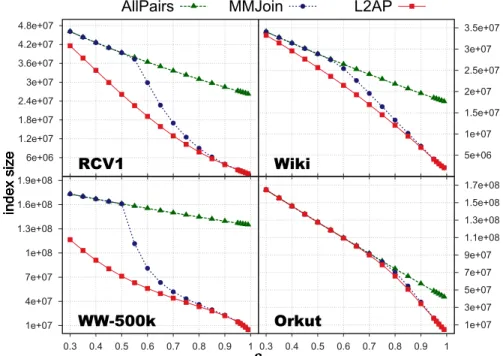
4.2 Index size reduction inL2AP vs. previous methods. . . 46
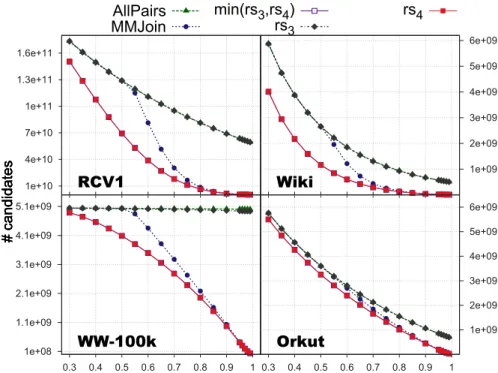
4.3 Candidate pool sizes when using differentremscorebounds. . . 47
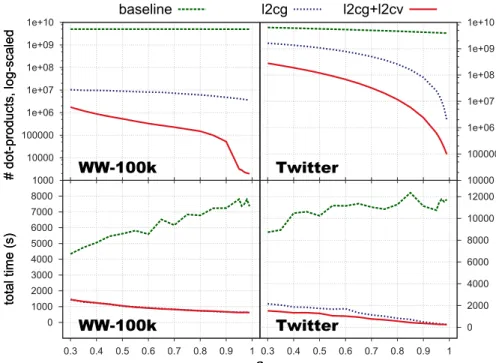
4.4 Number of dot-products and total time with and w/o`2-norm filtering. 48 4.5 Number of dot-products and total time with and w/opscorefiltering. . 50
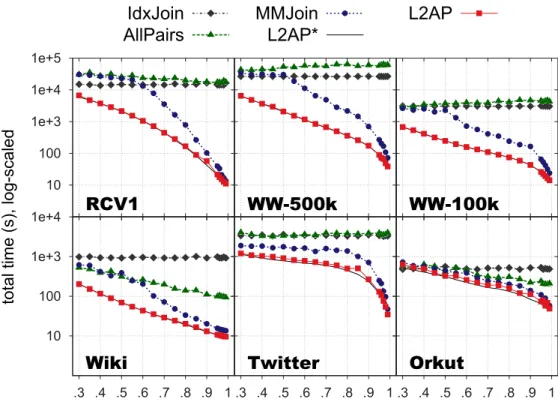
4.6 Number of dot-products and total time when using differentL2AP bounds. 51 4.7 Total execution times for exact algorithms. . . 53
4.8 Total execution times for approximate algorithms. . . 54
4.9 L2APspeedup over competing methods. . . 55
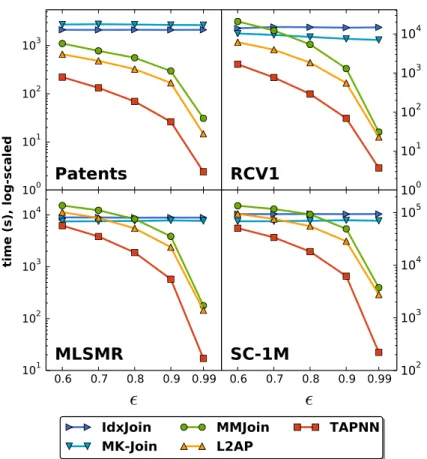
4.10 Efficiency comparison ofTAPNNvs. baselines. . . 69
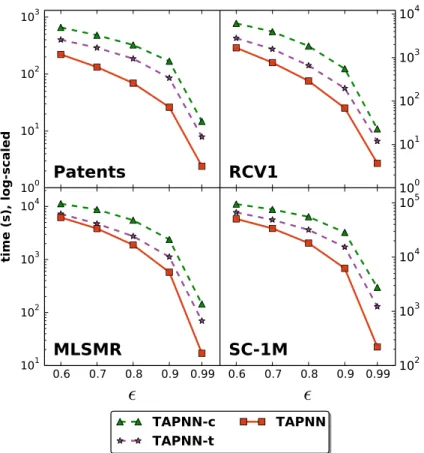
4.11 Effect of Tanimoto bounds on search efficiency. . . 70
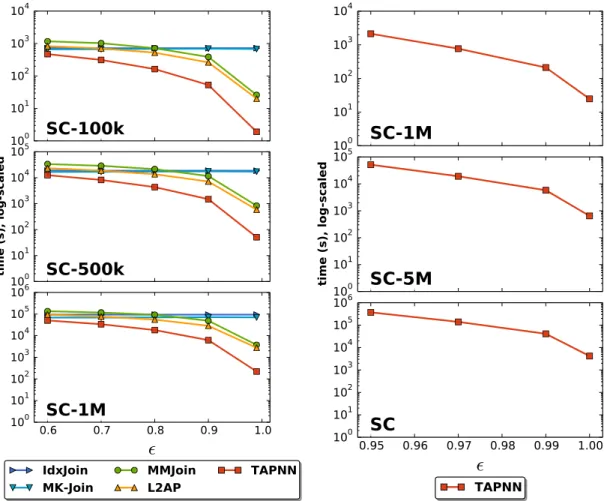
4.12 Execution time scaling given increasing problem size. . . 71
5.1 Recall and execution time of approximate methods given increasing can-didate pool sizes. . . 82
5.2 Recall and execution time of approximate methods except NN-Descent given increasing candidate pool sizes. . . 83
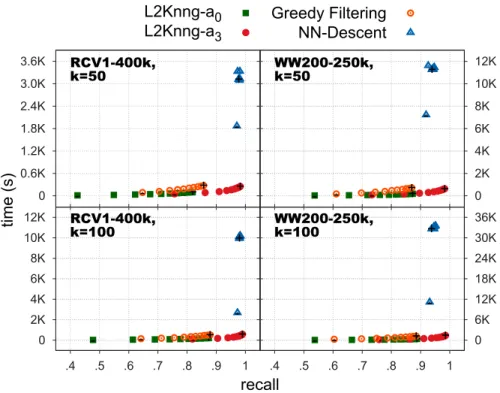
5.3 Approximatek-NNG construction efficiency. . . 84
5.4 Initial graph influence overL2Knngefficiency. . . 85
5.5 L2Knngµparameter sensitivity. . . 87
5.6 L2Knngγ parameter sensitivity. . . 88
5.7 L2Knngν parameter sensitivity. . . 89
5.8 Candidate pruning inL2Knng. . . 89
5.9 Exactk-NNG construction efficiency comparison. . . 91 xi
6.2 Example query hash table use inpL2AP. . . 104
6.3 Index size, number of candidates, and number of dot-products in pL2AP executions vs. respective values inpAPT. . . 107
6.4 Candidate pruning inpL2AP. . . 108
6.5 Mean percent accumulated non-zeros before pruning inpL2AP. . . 109
6.6 Speedup of 1-threadedpL2APoverL2AP. . . 110
6.7 Percent cache misses ofpL2APrrand pL2APwithζ between 1.5M and 4M non-zeros for the RCV1 (top) and Orkut (bottom) datasets. . . 110
6.8 Relative execution times for differenth,η, and ζ parameter choices. . . 112
6.9 Execution times of parallel methods and the best serial alternative. . . . 115
6.10 Strong scaling of parallel methods at= 0.3 (top) and= 0.9 (bottom). 116 6.11 Load imbalance in pL2AP. . . 117
6.12 k-NNG construction effectiveness comparison. . . 132
6.13 Approximatek-NNG construction efficiency comparison. . . 133
6.14 Strong scaling of approximatek-NNG construction methods. . . 134
6.15 Exact k-NNG construction efficiency comparison. . . 137
6.16 Strong scaling of exact k-NNG construction methods. . . 138
Chapter 1
Introduction
Efficiently identifying nearest neighbors for large sets of objects has long been a chal-lenging problem. Many data mining tasks must first identify nearest neighbors before their analysis can be completed. A number of data structures and efficient search algo-rithms exist for objects embedded in a small dimensional space. Finding neighbors for objects described by sparse vectors in a high dimensional space is a much harder open problem, which is often solved by approximation, returning only some of the nearest neighbors. In this thesis, we design novel data structures and algorithms that efficiently solve the exact nearest neighbor graph construction problem, which is akin to finding thenearest neighbors amongst a set of objects for each object in the set. We show that our solutions can be applied with multiple similarity functions, on data from several domains, and result in substantial gains in terms of runtime in comparison to previous state-of-the-art approaches. Furthermore, we provide efficient multi-core algorithms for solving the problem which scale well with an increasing number of cores and outperform previous baselines by an order of magnitude.
1.1
Problems & Applications
Computing the nearest neighbor graph, or similarity graph, for a set of objects is a common task in fields such as clustering [1, 2], online advertising [3], recommender sys-tems [4], data cleaning [5, 6], query refinement [7, 8], and drug discovery [9]. Many algorithms in these fields use the type of methods described in this thesis to identify
nearest neighbors before performing their task. For example, item-based nearest neigh-bor collaneigh-borative filtering algorithms recommend items (e.g., books or movies) to a user based on the k most similar items to each of the user’s preferred items [10]. In the context of data cleaning, near-duplicate objects can be detected by constructing a threshold-based nearest neighbor graph and merging or removing all but one object in each neighborhood. In the chemoinformatics domain, fueled by the generally valid premise that structurally similar molecules exhibit similar binding behavior and have similar properties [11], many methods use the computation of pairwise similarities as a kernel within their algorithms. Virtual screening (VS), for example, uses nearest neigh-bor based search, clustering, classification, and outlier detection to identify structurally diverse compounds that display similar bioactivity, which form the starting point for subsequent chemical screening [12, 13].
Objects in the real-world are often depicted as points in a high-dimensional feature space, numerically represented by vectors, where each dimension quantifies a relevant object feature. When only the presence of features is of interest, binary vectors suffice to encode the set of features in an object, each vector element indicating the presence (1) or absence (0) of a feature. However, weighted vectors often better represent objects for comparison [14, 15] and are standard in fields like information retrieval [16] and text mining [17]. In many domains, only some of all possible features are relevant for a given object, resulting in vectors with more zero than non-zero values, also calledsparse vectors.
While a true measure of similarity between objects may not be feasible to obtain, a number of similarity functions have been devised that can be used to compare objects represented as points inRm, wheremis the number of features or attributes. The choice of similarity function is often domain and data dependent. In general, it is assumed that a practitioner (e.g., data analyst) is familiar with what functions work well for the type of data they are analyzing. In this thesis, we address two popular similarity functions that have been shown to be very effective at different analysis tasks on various types of data: cosine and Tanimoto. Cosine similarity measures the cosine of the angle between the high dimensional vectors representing the objects and is a standard way to measure proximity of documents in text analysis or user/item profiles in collaborative filtering methods. Tanimoto similarity, on the other hand, is most often used in domains, such as
3 plagiarism detection or chemical compound search, where the amount of feature overlap in relation to the overall presence of features in the objects is important.
A na¨ıve approach to constructing the nearest neighbor graph executesO(n2) object comparisons for a set ofn objects. One way to reduce the number of comparisons is to ignore unimportant object pairs, i.e., those with low similarity. The problem is then to efficiently find, for each object in the set, those other objects with the highest similarity (smallest distance) values. Given a set of n objects D = {d1, d2, . . . , dn}, a nearest neighbor graph G = (V, E) consists of a vertex set V, corresponding to the objects in
D, and an edge set E which is a subset of V V. An edge (vi, vj) indicates that thejth
object is similar enough to the ith object, i.e., that the jth object is in theith object neighborhood. Based on how the similarity between two objects is bounded, there are two nearest neighbor graphs often used in practice:
• The -nearest neighbor graph (-NNG) contains an edge for each pair (vi, vj) with a similarity value above a predefined threshold ∈ R+. When the similarity function being used is commutative, which is often the case, this results in an undirected graph. The problem of constructing the-NNG is also known as theall-pairs similarity search (APSS) or thesimilarity join problems.
• The k-nearest neighbor graph (k-NNG) contains an edge for each pair (vi, vj) when
the similarity value sim(di, dj) between theith andjth objects is among thekhighest values in the set{sim(di, dl) | l= 1, . . . , i−1, i+ 1, . . . , n}. Thek-NNG is generally
a directed graph.
1.2
Emerging Challenges
While the nearest neighbor graph construction problem is not new, and many solutions exist for the problem, the scale that the problems is applied to has dramatically increased over the years. Collaborative filtering systems from major companies such as Walmart, Amazon, or Netflix store profiles for tens of millions of users and hundreds of millions of items. Analyzing web traffic to identify potential fraudulent user rings involves sifting through tens of millions of user click sessions. The number of commercially available chemical compounds (currently∼2107) is steadily increasing. We have now entered the
era of Big Data, which promises to deliver game changing effects in retail, science, and healthcare, among others, through the collection and analysis of huge volumes of data. Given the ever increasing problem size, analysts must be able to effectively sift through the myriad of possibilities to find the few nearest neighbors needed to gain insight from such data. Existing methods do not scale to more than a million objects, taking hours or even days to provide an answer for problems at that scale. Methods are needed that can quickly and safely ignore objects that theoretically cannot be one of the nearest neighbors, providing a fast solution whose quality does not need to be questioned.
The trend in today’s computer systems is no longer to increase processing speed, but rather the number of processing cores. While the number of cores is quickly climbing, the amount of memory that can be shared among the cores is slower to grow. Nearest neighbor graph construction methods must be able to efficiently execute on all available cores in a modern processor while making efficient use of often reduced memory available for each core. Given the large existing gap in speed between memory transfers and processor computations, this can only be achieved by designing methods that promote data reuse once it has been copied to the processor cache.
Solving nearest neighbor graph construction problems involving hundreds of millions of objects generally involves breaking the problem into a number of smaller problems and using many nodes in a supercomputer or the cloud to solve the sub-problems concur-rently. The most efficient solutions for these problems usually involve efficient multi-core graph construction methods such as the ones described in this thesis. Advancements in designing multi-core graph construction methods will thus provide immediate benefits to distributed algorithms for solving the problem.
1.3
Contributions
The contributions of this thesis are the development of effective and efficient serial and shared memory parallel algorithms for constructing nearest neighbor graphs. We propose new theoretic bounds on the similarity of two vectors and algorithms that effec-tively use these bounds to efficiently deliver the exact solution to the problem. We show that both our serial and parallel algorithms achieve substantially better performance
5 than previous state-of-the-art methods.
1.3.1 -Nearest Neighbor Graph Construction
In the context of filtering based exact methods for -NNG construction, we provide a unifying framework which helps connect and explain previous state-of-the-art methods for solving the problem [18]. We then introduce new filtering strategies that allow the exact-NNG construction problem to be solved efficiently for cosine similarity and non-negative real-valued vectors. Our method uses upper bound estimates on the similarity of two vectors, after comparing only a few of their features, to filter those object pairs that will not be similar enough. We prove theoretically that the bounds we propose are tighter than previously proposed bounds, and show experimentally that our method effectively uses these bounds. We analyze the filtering process and find that our bounds lead to fewer object comparisons and non-neighbor objects being eliminated from con-sideration quicker than in previous approaches. As a result, our method is able to solve the problem 2–13x faster than the best alternative, depending on the input threshold
, and up to 1600x times faster than a linear search. While baseline algorithms do not scale well as the similarity threshold decreases, our new pruning techniques make our method effective at both high and low similarity thresholds. In many of the experi-ments, our exact graph construction method is able to outperform even approximate methods required to obtain at least 95% of the correct result.
In the context of Tanimoto similarity, we show how cosine bounds we defined in [18] can be combined with new bounds and filtering techniques based on the length of vectors to solve the problem efficiently [19]. We define a new class of length-based bounds and show that a previously proposed bound [20] is actually the upper limit of the bounds we describe. We prove the effectiveness of our filtering bounds and compare the efficiency of our method against several state-of-the-art baselines for a range of values. Our method is up to 12.5x more efficient than the most efficient baseline and up to two orders of magnitude faster than a linear search. In particular, it was able to find all near-duplicate pairs among 5M chemical compounds in minutes, using a single CPU core.
1.3.2 k-Nearest Neighbor Graph Construction
We introduce a novel method for constructing the cosine k-NNG [21]. Our method uses an initial approximate solution graph as a guide to find the nearest k neighbors, through a modified similarity search framework. In this framework, we introduce several new pruning bounds specific to the k-NNG construction problem, which leverage the Cauchy-Schwarz inequality in partial vector dot-products at each stage in the framework to prevent full similarity computation for most object pairs. We perform an extensive evaluation of our algorithm, comparing against both exact and approximate baselines, and demonstrate the efficiency of our method across a variety of real-world datasets and neighborhood sizes. Our inexact k-NNG construction method achieves high recall in less time than competing approximate methods, and is an order of magnitude faster than our approximate baselines. Furthermore, our exact method computes fewer object similarities in full and is able to achieve an order of magnitude improvement against exact baselines.
1.3.3 Parallel Graph Construction Methods
We develop filtering based shared memory parallel methods for both the-NNG [22] and the k-NNG [23] construction problems. The pruning process in filtering based meth-ods results in unpredictable memory access patterns that can reduce search efficiency. Our parallel graph construction methods use a number of cache-tiling optimizations, combined with fine-grained dynamically balanced parallel tasks, to solve the problem up to two orders of magnitude faster than existing parallel baselines, on datasets with hundreds of millions of non-zeros. In particular, our parallel -NNG method displays less than 2% load imbalance amongst the threads and has better scaling characteristics than all baselines. Our algorithm finds the exact solution, using 24 cores, 1.5–232x faster than the best alternative. Using 16 cores, our parallelk-NNG method constructs an approximate graph containing at least 95% of the correct result 1.5–21.7x faster that previous methods, and is able to find all exact nearest neighbors in 3.0–12.9x less time than the best alternative.
7
1.4
Outline
This thesis is organized as follows:
• In Chapter 2 we introduce our notation and formally define the problems addressed in the thesis, review some mathematics theory relevant to the following discussion, and present materials relevant to the experimental evaluation of our methods. • In Chapter 3 we present an overview of prior work done on serial and parallel similarity
search and nearest neighbor graph construction.
• In Chapter 4 we present our work on developing serial algorithms for cosine and Tanimoto-nearest neighbor graph construction.
• In Chapter 5 we present our work on efficient construction of k-nearest neighbor graphs using the cosine similarity function.
• In Chapter 6 we discuss high-performance shared memory parallel methods for both theand k-nearest neighbor graph construction problems.
• In Chapter 7, we discuss the collective impact of the works presented in this thesis and future research directions.
1.5
Related Publications
• David C. Anastasiu& George Karypis. L2AP: Fast Cosine Similarity Search With Prefix L-2 Norm Bounds. In The 30th IEEE International Conference on Data En-gineering (ICDE 2014), pages 784-795, 2014.
• David C. Anastasiu& George Karypis. L2Knng: Fast Exact K-Nearest Neighbor Graph Construction with L2-Norm Pruning. In Proceedings of the 24th ACM Inter-national Conference on Information and Knowledge Management (CIKM ’15), pages 791-800, ACM, 2015.
• David C. Anastasiu & George Karypis. PL2AP: Fast Parallel Cosine Similarity Search. In Proceedings of the 5th Workshop on Irregular Applications: Architectures and Algorithms, in conjunction with SC’15 (IA3 2015), pages 1-8, ACM, 2015.
• David C. Anastasiu& George Karypis. Efficient Identification of Tanimoto Nearest Neighbors. Under submission: IEEE International Conference on Data Science and Advanced Analytics (DSAA’2016).
• David C. Anastasiu & George Karypis. Fast Parallel Cosine K-Nearest Neighbor Graph Construction. To be submitted.
Chapter 2
Background
In this chapter, we introduce our notation and formally define the problems addressed in the thesis, review some mathematics theory relevant to the following discussion, and present materials relevant to the experimental evaluation of our methods.
2.1
Definitions & Notation
LetD={d1, d2, . . . , dn}be a set of objects such that each object di is a (sparse) vector in an m dimensional feature space. We will use di to indicate the ith object, di to
indicate the feature vector associated with the ith object, anddi,j to indicate the value (or weight) of the jth feature of object di.
Given object di, we denote by Γdi its neighborhood, the set of objects in D\ {di}
with non-zero similarity with di, which are the neighbors of di. The number of objects in a neighborhood represents its size, which we denote by|Γdi|. We focus on two related
problems in this work. The-NNG construction problem seeks, for each object inD, all neighbors with a similarity value of at least , while the k-NNG construction problem seeks up to kneighbors with highest similarity values.
The similarity graph of D is a graph G = (V, E) where vertices correspond to the objects and an edge (vi, vj) indicates that thejth object is in the neighborhood of the ith object and is associated with a weight, namely the similarity value sim(di, dj). We denote byG the similarity graph containing edges for all neighbor pairs with similarity values of at least , and by Gk the similarity graph in which an edge exists between an
object and all its k-nearest neighbors. An approximate k-NNG ˜Gk is one in which the
k neighbors of each vertex do not necessarily correspond to thek most similar objects. An approximate -NNG ˜G is one which does not have an edge for all neighbors of a vertex with similarity of at least , yet all similarities represented in the graph are at least . Note that the similarity values represented in all constructed graphs, either exact or approximate, are the exact values returned by the chosen similarity function.
For a given neighborhoodΓdi, we denote by the minimum (neighborhood) similarity
σdi the minimum similarity between objectdi and one of its current neighbors. We say
that a k-neighborhood (a neighborhood in a k-NNG) is improved when its minimum similarity σdi increases in value, and it is complete when adding any other neighbor to
the k-neighborhood cannot increase σdi. Similarly, we say that an -neighborhood is
improved when a new neighbor with similarity at leastis added to the neighborhood, and is complete when all remaining neighbors have similarities lower than.
The majority of feature values in sparse vectors are 0. As a result, a vector di is
generally represented as the set of all pairs (j, di,j) satisfying 1 ≤j ≤m and di,j > 0. For a set of objects represented by sparse vectors, an inverted index representation of the set is made up ofm lists,I={I1, I2, . . . , Im}, one for each feature. ListIj contains pairs (di, di,j), also called postings in the information retrieval literature, where di is an
indexed object that has a non-zero value for feature j, and di,j is that value. Postings may store additional statistics related to the feature within the document it is associated with.
Given a vector di and a dimension p, we will denote by d≤i p the vector obtained
by keeping the p leading dimensions in di, (di,1, . . . , di,p,0, . . . ,0), which we call the
(inclusive) prefix (vector) of di. Similarly, we refer tod>pi = (0, . . . ,0, di,p+1, . . . , di,m) as the (exclusive)suffix ofdi, obtained by setting the firstpdimensions of di to 0. The
exclusive prefix d<pi and inclusive suffix d≥i p are analogously defined. Table 2.1 provides a summary of notation used in this thesis.
11 Table 2.1: Notation used throughout the work.
Description
D set of objects
di theith object
di vector representingith object
di,j value forjth feature indi
d≤i p,d>pi (inclusive) prefix and (exclusive) suffix ofdiat dimensionp
d<pi ,d≥ip exclusive prefix and inclusive suffix ofdi at dimensionp
d≤i ,d>i un-indexed/indexed portion ofdi
ˆ
di normalized version ofdi
σdi smallest similarity value inΓdi
I inverted index
fj vector containingjth feature values from all objects
Γdi neighborhood for objectdi
N set of neighborhoods
ˆ
N set of initial approximate neighborhoods
minimum desired similarity
k size of desired neighborhoods
µ candidate list size
γ number of neighborhood enhancement updates
δ early neighborhood enhancement termination
ν number of completion blocks
ζ number of non-zeros in an inverted index tile
η number of objects in a query tile
nt number of threads
2.2
Theory Background
For any two vectorsdianddjinRm, thestandard inner product, ordot-product, between
them is di,dj =dTi dj = m X l=1 di,ldj,l , (2.1)
whereT denotes the vector transpose. In this work, we will prefer the
di,dj
notation for the dot-product.
The norm of a vector d is a function f :Rm → R+, which measures the length of the vector. A vector norm satisfies the following properties:
• positive definiteness: f(d)≥0 for alld∈ Rm and f(d) = 0 iff d= 0 , • absolute homogeneity: f(αd) =|α|d for any α∈ R,
• triangle inequality: f(di+dj)≤f(di) +f(dj),for alldi, dj ∈ Rm.
Some popular vector norms referenced throughout this work include the Chebyshev or
`∞-norm, computed as
kdik∞= max{di,1, di,2, . . . , di,m}, (2.2)
and the`p-norm,
kdikp = (|di,1|p+|di,2|p+. . .+|di,m|p)1/p. (2.3)
Thedistance between two vectors is measured as the norm of their difference,kdi− djk. The generic`p-norm based distance, kdi−djkp, is called the Minkowski distance.
Two popular versions of the Minkowski distance are the Manhattan or Taxicab distance (`1-norm) and the Euclidean distance (`2-norm). The `2-norm is also often generically referred to in literature as the vectormagnitude, orlength.
kdik1 =|di,1|+|di,2|+. . .+|di,m| (`1-norm), (2.4) kdik2 = (d2i,1+di,22+. . .+d2i,m)1/2 = q di,di (`2-norm). (2.5) The H¨older inequality provides an upper bound for the dot-product of two vectors based on their length. Specifically, given scalar values pand q such that 1/p+ 1/q= 1, it states that
|
di,dj
| ≤ kdikpkdjkq. (2.6)
For the norms previously defined, it follows that | di,dj | ≤ kdik1kdjk∞, (2.7) | di,dj | ≤ kdik∞kdjk1, (2.8) | di,dj | ≤ kdik2kdjk2. (2.9)
Proposition 2.9 is also known as the Cauchy-Schwarz inequality, and can be equivalently written as di,dj 2 ≤ di,di dj,dj . (2.10)
13 The following additional inequalities between different norms can also be proved,
kdk∞≤ kdk1 ≤mkdk∞ (2.11)
kdk∞≤ kdk2 ≤√mkdk∞ (2.12)
kdk2 ≤ kdk∞≤√mkdk2. (2.13)
The interested reader may find proofs for many of the properties described in this section in the excellent matrix computations reference by Golub and Van Loan [24].
The `0-pseudo-norm represents the function that counts the number of non-zero values in a vector. Denoted as kdk0, the `0-norm of d is not a true vector norm, as it does not satisfy the absolute homogeneity property. Given the prefix and suffix vector definitions given in Section 2.1, one can then verify, for a given prefix feature p, that
di=d≤i p+d >p i , (2.14) kdik0=kd≤i pk0+kd>pi k0, (2.15) kdik1=kd≤i pk1+kd>pi k1, (2.16) kdik22=kd≤i pk22+kd>pi k22, (2.17) kdik∞= max(kd ≤p i k∞, kd >p i k∞), and (2.18) di,dj =di,d≤jp+di,d>pj . (2.19) These properties are evident from the presented definitions and the fact that the set of non-zero values in the vector is the union of the disjoint sets of non-zero values in the prefix and suffix vectors.
Given a vector norm k · k, a vector can be scaled to have unit norm, an operation called normalization, by dividing it by its length with respect to that norm. Vector normalization changes the length of the vector without changing its direction. A number of methods presented in this work make use of`2-norm normalized vectors, denoted as
ˆ
d= d
kdk2. (2.20)
When clear from context, we will drop the hat from the notation and denote the normal-ized version of theith object vector representation asdi. Specifically, in our description
of our cosine similarity based nearest neighbor graph construction methods, we assume input vectors have been normalized and denote the normalized version of theith object vector representation as di.
2.2.1 Similarity Functions
While there have been many proposed similarity functions between weighted vectors, we focus on a subset of popular similarity measures that take advantage of sparsity when comparing objects. In other words, the similarity function can be computed by traversing only the non-zero values in the two vectors.
Cosine similarity: C(di,dj) = di,dj kdik2kdjk2 =ˆ di,dˆj (2.21) Tanimoto similarity: T(di,dj) = di,dj kdik22+kdjk22− di,dj (2.22)
Tanimoto similarity is also known in the literature as the Tanimoto coefficient or the (extended) Jaccard coefficient.
Given non-negative real-valued vectors, which represent the type of input our meth-ods are designed for, the following properties hold for these similarity measures. • Similarity values range in [0,1], and sim(di,dj) = 1 only if di = dj, where sim(·,·)
represents any of the similarity measures above. • Symmetry: sim(di,dj) = sim(dj,di).
Another popular proximity measure is the Euclidean distance, computed as the`2 -norm of the difference between the two vectors,
E(di,dj) =kdi−djk2. (2.23)
Dissimilarity measures, such as the Euclidean distance, can be converted into a measure of similarity via a monotonic decreasing function. For example,
ES(di,dj) =e−kdi−djk
2 2,
15 is a popular transformation that relates the squared loss function to the negative log-likelihood of group membership in clustering [25]. Euclidean distance is symmetric, and, since it is a norm, its values are positive definite, absolute homogeneous, and follow triangle inequality,
E(di,dk)≤E(di,dj) + E(dj,dk). (2.24)
2.3
Datasets
We use a diverse set of datasets from three different domains to evaluate the performance of our methods, namely text documents, networks (graph), and chemical compounds. They represent some benchmark text corpora popularly used in text-categorization re-search and several real-world web/social networks and chemical compound datasets. We chose these datasets because they represent real-world problems, yet are quite varied with respect to their number of objects and row and column size. Below, we give addi-tional details about each dataset. Their characteristics, including number of objects (n), features (m), millions of non-zeros (nnz), and row/column mean number of non-zeros are detailed in Table 2.2.
Text datasets:
• RCV1 is a standard benchmark corpus containing over 800,000 newswire stories provided by Reuters, Ltd. for research purposes, We use version 2 of the dataset, also known as RCV1-v2, made available by Lewis et al. [26].
• RCV1-400k and RCV1-100k are random subsets of 400,000 and 100,000 docu-ments, respectively, from RCV1.
• WW-500k was kindly provided to the authors by Satuluri and Parthasarathy [27], along with the WW-100k and Wiki datasets. It contains documents with at least 200 distinct features, extracted from the September 2010 article dump of the English Wikipedia.
• WW-100kcontains documents from the WW-500k dataset with at least 500 distinct features.
author from the October 2014 article dump of the English Wikipedia1.
• WW500 contains the subset of documents from WW200 with at least 500 distinct features.
• WW200-250kis a random subset of 250,000 objects from WW200.
• Patentsis a random subset of 100,000 patent documents from all US utility patents2 . Each document contains the patent title, abstract, and body.
Network datasets:
• Twitter, first provided by Kwak et al. [28], containsfollow relationships of a subset of Twitter users that follow at least 1,000 other users. Vectors represent users, and features are users they follow.
• Wiki represents a directed graph of hyperlinks between Wikipedia articles in the Wiki dump.
• Orkut contains the friendship network of over 3M users of the Orkut social media site, made available by Mislove et al. [29]. Vectors represent users, and features are friends of the users.
Chemical datasets:
• MLSMR [30] (Molecular Libraries Small Molecule Repository) is a collection of structures of compounds accepted into the repository of PubChem, NCBI’s database of small organic molecules and their biological activity. We used the December 2008 version of the SDF database3.
• SC contains chemical compounds from the SureChEMBL [31] database, which in-cludes a large set of compounds automatically extracted from text, images and at-tachments of patent documents.
• SC-5M,SC-1M,SC-500kandSC-100kare random subsets of 5,000,000, 1,000,000, 500,000 and 100,000 compounds, respectively, from the SCdataset.
1http://download.wikimedia.org 2http://www.uspto.gov/
17 Table 2.2: Dataset statistics.
dataset type n m nnz·106 µr µc RCV1 text 804,414 45,669 62 77 1,348 RCV1-400k text 400,000 45,669 31 77 670 RCV1-100k text 100,000 45,669 8 78 187 WW-500k text 494,244 343,622 197 399 574 WW-100k text 100,528 339,944 79 787 233 WW200 text 1,017,531 663,419 437 430 659 WW500 text 243,223 660,600 202 830 306 WW200-250k text 250,000 663,410 108 430 164 Patents text 100,000 759,044 46 464 61 Twitter network 146,170 143,469 200 1370 1395
Wiki (L2AP) network 1,815,914 1,648,879 44 24 27
Wiki (pL2AP) network 3,714,404 3,714,401 111 30 56
Orkut network 3,072,626 3,072,441 223 73 73 MLSMR chemical 325,164 20,021 56 173 2,803 SC chemical 11,519,370 7,415 1,785 155 262,669 SC-5M chemical 5,000,000 7,415 700 155 103,063 SC-1M chemical 1,000,000 6,752 155 155 22,949 SC-500k chemical 500,000 6,717 78 155 11,533 SC-100k chemical 100,000 6,623 16 155 2,336
In the table, n represents the number of objects (rows), m is the number of features in the vector representation of the objects (columns),nnzis the number of non-zero values (measured in millions), andµrandµcare the mean number of non-zeros in each row and column, respectively.
2.4
Data Processing
2.4.1 Text Data Processing
We use standard text processing methods to encode documents as sparse vectors. Each document is first tokenized, removing punctuation, making text lower-cased, and split-ting the document into a set of words. Each word is stemmed using the Porter stem-mer [32], reducing different versions of the same word to a common token. Within the space of all tokens, a document is then represented by the sparse vector containing the frequency of each token present in the document. When computing cosine near-est neighbor graphs, as is customary in text analysis tasks, we scaled frequency based vectors by the inverse document frequency [16], which reduces the importance of terms frequently used in the corpus when computing similarities.
2.4.2 Network Data Processing
We represent relationships for a given object in a network as a sparse binary vector within the space of the number of objects in the network. Each value in the vector denotes whether a relationship (edge) exists between the object represented by the vector and another object. In general, the relationships are not symmetric. A vector representing an object can be thought of as a row or column in the adjacency matrix representing the network (graph), depending on the type of relationship (in-coming or outgoing edges). When computing cosine nearest neighbor graphs, we scaled binary vectors by the inverse document frequency.
2.4.3 Chemical Compound Processing
We encode each chemical compound as a sparse frequency vector of the molecular frag-ments it contains, represented by GF [33] descriptors extracted using the AFGen v. 2.0 [34] program4. AFGen represents molecules as graphs, with vertices corresponding to atoms and edges to bonds in the molecule. GF descriptors are the complete set of unique size-bounded subgraphs present in each compound. Within the space of all GF descriptors for a compound dataset, a compound is then represented by the sparse vec-tor containing the frequency of each GF descripvec-tor present in the compound. We used a minimum length of 3 and a maximum length of 5 and ignored Hydrogen atoms when generating GF descriptors (AFGen settings fragtype=GF, lmin=3, lmax=5, fmin=1, noh: yes). Before running AFGen on each chemical dataset, we used the Open Babel toolbox [35] to remove compounds with incomplete descriptions.
2.5
Performance Measures
When comparing the search performance of different methods, an important charac-teristic in our experiments is CPU runtime, which is measured in seconds. I/O time needed to load the dataset into memory or write output to the file system should be the same for all methods and is, in general, ignored5. Between a method A and a baseline
4http://glaros.dtc.umn.edu/gkhome/afgen/download
5Experiments for ourL2APandL2Knngprototypes (see Sections 4.4 and 5.2) and all related baselines
19 method B, we report speedup as the ratio ofB’s execution time and that of A’s.
We use average recall to measure the accuracy of the returned result when compar-ing the performance of approximate graph construction methods. We obtain the true neighborhood graph via brute-force search, then compute the average recall as,
R = 1 |D| X di∈D # true neighbors in Ndi |Ndi| .
We follow others in using the number of full similarity computations as an architec-ture and programming language independent way to measure nearest neighbor graph construction cost [36, 37]. However, we use a slightly different normalization constant,
N C =n(n−1), as some of our baselines may not take advantage of symmetry in simi-larity computations, and thus may compute up ton−1 similarity values for each vector in the dataset. We report, for all algorithms,scan rate=# similarity evaluations/N C, and candidate rate=# candidates/N C.
We report the performance of parallel methods in two ways. We compare the effi-ciency of all parallel methods against the best existing serial algorithm for solving the problem and report execution times and/or speedup values. Additionally, we report strong scaling results, in which multi-threaded execution times for a parallel method are compared with the 1-threaded execution of the same method.
2.6
Execution Environment
Depending on the resources available at the time of our completing a research prototype, we used several environments for executing our experimental evaluations. For each prototype, we executed all experiments for our methods and all related baselines in the same environment. In this section, we describe the environments we used and parameters we chose for our methods and baselines, the algorithms for which will be presented later in this thesis.
Cosine -NNG Construction
Our method, L2AP, and all baselines for cosine -NNG construction are single-threaded, serial programs, implemented in C and compiled using gcc 4.4.6 with the
-O3 optimization setting enabled. TheBayesLSHpackage6includes implementations for LSH,AllPairs+BayesLSH-Lite,LSH+BayesLSH-Lite, andAllPairs. An implementa-tion ofMMJoinwas not available. We implemented IdxJoin,AllPairs7,MMJoin,L2AP, and L2AP-a8in our prototype. Each method was executed on its own node in a cluster of HP ProLiant BL280c G6 blade servers, each with 2.8 GHz Intel Xeon processors and 24 Gb RAM. Methods that took longer than 48 hours to execute were terminated. For each method, we varied the similarity threshold between 0.3 and 0.95, in increments of 0.05. To further qualify the utility of our method for near-duplicate object detection, we also executed each method for similarities between 0.96 and 0.99, in increments of 0.01. As suggested by Satuluri and Parthasarathy, we used r = 0.03 (97% recall) and checked h= 128 hashes in both BayesLSH-Lite and L2AP-aapproximate pruning. For approximate methods, we executed each test a minimum of three times and report the average time over all test executions.
Tanimoto -NNG construction
Our method, TAPNN, and all baselines for Tanimoto -NNG construction are single-threaded, serial programs, implemented in C and compiled using gcc 5.1.0 with the -O3 optimization setting enabled. Each method was executed on its own node in a cluster of HP Linux servers. Each server is a dual-socket machine, equipped with 24 Gb RAM and two four-core 2.6 GHz Intel Xeon 5560 (Nehalem EP) processors with 8 Mb Cache. We executed each method a minimum of four times for ∈ {0.6,0.7,0.8,0.9,0.99} and report the best execution time in each case. Due to its size (14 Gb), we executed data scaling experiments involving the full SC dataset on a different server, equipped with 64 Gb RAM and two 12-core 2.5 GHz Intel Xeon (Haswell E5-2680v3) processors with 30 Mb Cache. As all tested methods are serial, only one core was used on each server during the execution.
Cosine k-NNG construction
6
Seehttp://www.cse.ohio-state.edu/∼satuluri/research.html 7Unlike the
AllPairs mplementations by Bayardo et al. and in theBayesLSHpackage, ours uses a
dense representation of the query vector. We found our implementation, on average, to be 2.5x faster than the one in the BayesLSHpackage and use it as baseline in this work. This implementation detail has since been incorporated into the other packages.
21 Our method, L2Knng, and all baselines for cosine k-NNG construction are single-threaded, serial programs. A C++ based library implementing NN-Descent can be found at http://www.kgraph.org/. We implemented9kIdxJoin,kL2AP,Greedy Filtering10, Maxscore,BMM,L2Knng, andL2Knng-ain C and compiled our program using gcc 4.4.7 with -O3 optimization. Each method was executed on its own node in a cluster of HP ProLiant BL280c G6 blade servers, each with 2.8 GHz Intel Xeon processors and 24 Gb RAM.
We executed each method for k ∈ {1,5,10,25,50,75,100} and tuned parameters to achieve balanced high recall and efficient execution. For all L2Knng and L2Knng-a experiments, we set the parameter δ = 0.0001. We tested kL2AP by decreasing the threshold t in steps of 0.1, 0.25, and 0.5, and report the best results among the step choices. For the NN-Descentlibrary11, we set ρ= 1, S = 20, and indexing K =µ(the candidate list sizeµ≥k). For all stochastic methods, we executed a minimum of 5 runs for each set of parameter values and we report averages of all recorded times.
Parallel cosine -NNG construction
Our method,pL2AP, and all baselines are implemented in C and compiled using gcc 4.4.7 with -O3 optimization. We used the OpenMP framework for implementing shared-memory parallel methods. Each method was executed on its own node in a cluster of HP Linux servers. Each server is a dual-socket machine, equiped with 64 Gb RAM and two twelve-core 2.5 GHz Intel Xeon E5-2680v3 processors with 30 Mb Cache. For each method, we varied the similarity threshold between 0.3 and 0.9, in increments of 0.1. For pL2AP, we fixed η at 25K objects and varied ζ between 250K and 4M in 250K
increments. We set the masked hash-table size parameter h to 213. Parallel cosine k-NNG construction
Our method, pL2Knng, and all baselines are implemented in C and compiled using gcc 5.1.0 with the -O3 optimization setting enabled. We used the OpenMP framework for implementing shared-memory parallel methods. Each method was executed on its
9
Source code available athttp://cs.umn.edu/∼dragos/l2knng. 10
The authors ofGreedy Filteringkindly provided a Java-based implementation of their algorithm for comparison. On average, our C implementation achieved 1.13x speedup over the Java one.
11
We thank Wei Dong for his invaluable assistance with using the KGraph library and finding
own node in a cluster of HP Linux servers. Each server is a dual-socket machine, equipped with 64 Gb RAM and two eight-core 2.6 GHz Intel Xeon E5-2670 (Sandy Bridge) processors with 20 Mb Cache.
We executed each method for
k∈ {10,25,50,75,100,200,300,400,500}
and tuned parameters for each method to achieve balanced high recall and efficient execution. For all L2Knng based methods, we set the parameter δ = 0.0001. We used the latest version of the NN-Descent12library available at the time of our experiments (v.1.4), and set ρ = 1, and indexing K = µ (the candidate list size µ ≥ k). For all stochastic methods, we executed a minimum of 3 runs for each set of parameter values and we report averages of all recorded times.
Chapter 3
Related Work
In this section, we will give an overview of some important works addressing our two nearest neighbors graph construction problems of interest. We will focus our discus-sion first on methods for cosine nearest neighbor graph construction, and then discuss existing extensions for the Tanimoto similarity.
3.1
-NNG Construction
The -NNG construction problem has its roots in thesimilarity join problem from the database community [5,38]. In that context, Chaudhuri et al. first formalized the prefix-filtering principle [38], showing that only a few elements from the beginning of a query vector must be checked against other vectors to find all necessary candidates. Bayardo et al. [8] disconnected the problem from the underlying database system and developed additional pruning strategies based on a predefined vector order in the dataset. They also introduceddynamic indexing, leveraging the prefix-filtering principle to index only a portion of each vector after its candidate list was generated.
The majority of subsequently developed -NNG construction methods follow the same format as in the method described by Bayardo et al. They proceed in three stages. First, during candidate generation, a list of objects is compiled whose similarity scores to the query object are believed to exceed the threshold. Potential candidates during this stage are vetted based on different theoretic upper bounds on the similarity. The candidate verification stage finalizes the similarity computation for identified candidates
and compares it against the threshold . Additional pruning may reduce the number of full similarities being computed. Finally, the query object is indexed (indexing stage) before continuing with the next object in the processing order.
A number of extensions have focused on the set-based or binary representation of objects. While not directly applicable to our domain, they provide insights into types of pruning that may be beneficial during the graph construction. Xiao et al. [6] first in-troduced a tighter indexing bound andpositional filtering inPPJoin. During candidate generation, positional filtering provides additional pruning based on the remaining size of the vectors once a feature is found in common. Motivated by experimental results showing quadratic growth in the candidate pool size in AllPairs, Xiao et al. pushed filtering into the candidate verification stage through Hamming distance based suffix filtering. When considering string similarity search using the edit distance measure, Xiao et al. [39] showed that the problem can be efficiently solved using q-gram-based mismatch filtering. Xiao et al. [40] introduced furtherAllPairsoptimizations to answer top-k queries efficiently. While previous algorithms focused on reducing the generated candidate pool size, Ribeiro and H¨arder [41] sought to reduce overall search time by minimizing the size of the inverted index through dynamic min-prefix indexing. They coupled a cheap candidate generation step with additional stopping criteria in the ver-ification stage to improve on AllPairsand PPJoin. Wang et al. [42] sought to reach a balance between the number of candidates being generated and the number of pruned candidates, which lead them to develop of a cost-based scheme for choosing variable-length prefixes.
There has been little focus, in comparison, on solving the-NNG construction prob-lem for weighted vectors and cosine similarity. Bayardo et al. [8] gave the first integrated solution for the problem, the AllPairsalgorithm. In APT, Awekar and Samatova [43] provided tighter bounds over AllPairson the candidate vector minimum size and sim-ilarity score estimate. Lee et al. [15] introduced length filtering and length-basedsuffix filtering inMMJoin. As they are pertinent to our problem, we detail these methods in Section 4.1. We then show, both theoretically and experimentally, that our pruning strategies outperform those in these methods.
Although emphasis has recently shifted to solving -NNG construction exactly, ap-proximate methods remain popular, especially in domains only interested in objects with
25 high similarity thresholds. In the context of near-duplicate object detection, Broder et al. [1] applied similarity search to sketches built using min-wise independent permuta-tions of shingled Web documents. A popular alternative, Locality Sensitive Hashing (LSH) [44, 45], uses families of functions that hash similar objects to the same bucket with high probability to generate candidate sets. Zhai et al. [46] presented a probabilis-tic algorithm for similarity search based on random filters. Note that these algorithms solve a related problem, that of nearest neighbor(s) search, in which the query objects are not assumed to be a part of the input set. The -NNG could be constructed by executing a nearest neighbors query for each of the objects in the input set, but its construction does not consider the computation structure inherent in the -NNG con-struction problem. To take advantage of this structure, Satuluri and Parthasarathy [27] introduced BayesLSH, a principled Bayesian approach for candidate pruning and simi-larity estimation, which they combine with candidate generation steps from AllPairs and LSH.
3.1.1 Tanimoto -NNG Construction
Within the chemoinformatics community, a great deal of effort has been spent trying to accelerate pairwise similarity computations using the Tanimoto coefficient. Swamidass and Baldi [47] described a number of bounds for fast exact threshold based Tanimoto similarity searches of binary and integer based vector representations of chemical com-pounds. These bounds allow skipping many object comparisons that will theoretically not be similar enough to be included in the result. Baldi et al. [48] proposed an algo-rithm for pruning the similarity search space through exclusive OR (XOR) operations on compressed bit-vector representations of the molecules. Nasr et al. [49] developed hashing techniques for pruning the search space by transforming bounds on the intersec-tion of molecule hash signatures to the Tanimoto similarity of their fingerprint vectors. Kristensen et al. [50] and Smellie [51] relied instead on tree-based data structures to speed up similarity search. Tabei and Tsuda [52] described SketchSort, an approximate method which uses min-wise independent permutation based locality sensitive hashing to solve the-NNG construction problem. Most recent approaches focus on speeding up chemical searches using inverted index data structures borrowed from information re-trieval [49,53,54]. Among all existing methods, algorithms taking advantage of inverted
indexes have been shown to be the most effective means for identifying neighbors when dealing with objects represented in a high-dimensional space.
The numeric representation of chemical compounds is still an open problem in chemoinformatics. Due to computation efficiency constraints, initial representations focused on capturing the presence or absence of features within the compound. Com-pounds were represented as binary vectors, referred to as afingerprints. In recent years, frequency (or counting) vectors, which capture how many times a feature is present, and real valued vectors, called descriptors, have gained popularity [9, 55]. Arif et al. [56], for example, investigated the use of inverse frequency weighting of features in frequency de-scriptors for similarity-based Virtual Screening, and found marked increases in screening effectiveness in some circumstances. The efficient Tanimoto-NNG construction meth-ods described in this thesis may be used to compute bounded pairwise similarities of descriptor vectors, accelerating chemical compound search and other Virtual Screening tasks.
Tanimoto similarity has also been widely used in the computer science community. As noted earlier, a number of data mining methods have been devised for solving the
-NNG construction problem. While most of the existing work addresses either binary vector object representations [6, 40, 57] or cosine similarity [18, 43], Bayardo et al. [8] and Lee et al. [15] showed how their filtering based -NNG construction methods can be extended to the Tanimoto coefficient for binary and real-valued vectors, respectively. Focusing on real-valued vectors, Kryszkiewicz [20, 58] proved several theoretic bounds on the Tanimoto similarity and sketched an inverted index based algorithm for efficient similarity search.
3.2
k
-NNG Construction
Relatively few k-NNG construction algorithms have been designed to address cosine similarity. Park et al. [37] described Greedy Filtering, an approximate filtering-based approach which prioritizes computing similarities between objects with high weight features in common. After first reordering the dimensions of each vector based on their weight, in decreasing weight order, the algorithm builds a partial inverted index, which it uses to find candidates for each object. Candidates for an object di are those objects
27 in the inverted index lists associated with the leading dimensions in di, i.e., the prefix
of di. Greedy Filtering indexes enough of each vector’s prefix as to lead to at least µ candidates for each object. After all prefixes are identified and the partial inverted index is constructed, Greedy Filtering computes pairwise similarities of objects in each inverted index list, which can lead to much more than µ similarity computations for each object, and repeated computations for pairs of objects with two or more common features in their prefixes.
In NN-Descent, Dong et al. [36] followed an iterative neighborhood improvement strategy based on the intuition that similar objects are likely to be found among the neighborhoods of objects in a query object’s neighborhood. Starting with a randomly chosen initial k-NNG, their method iteratively improves the graph by computing, for each objectdi, via alocal join, pairwise similarities betweendi, objects in its neighbor-hood, and those objects that contain di in their neighborhoods. The neighborhoods of
both objects participating in a similarity computation are updated with the result. The method avoids duplication of effort between iterations by only allowing an object to par-ticipate in the local join if it has been added to some neighborhood in the last update. Sampling and early termination parameters provide a way to control the compromise between algorithm runtime and recall. However, NN-Descent computes O(nk2) object similarities in its first iteration. Furthermore, the algorithm does not provide a way to filter out candidates that are unlikely to improve the query object’s neighborhood.
Top-kdocument retrieval is a related problem from information retrieval, which has had many proposed solutions over the years. Most methods in this class have been designed for very large document collections, and have focused on minimizing and/or parallelizing operations needed to quickly answer fairly short input queries. Result sets are in most cases inexact. Some recent works use an in-memory inverted index and pruning, called safe early termination, to return the same result set as an exhaustive search [59–63]. One could then solve the exact k-NNG problem by executing n top-k
queries with one of these methods, one for each of the input objects. In their Block-Max WAND (BMW) method [61], Ding and Suel use an augmented index structure, called a Block-Max index, which stores inverted lists as compressed blocks of postings, along with the maximum score that could be achieved given the values in the block postings. By using the block maximum scores for early termination, many blocks can be skipped,
resulting in improved execution. Dimopoulos et al. [62] extended the work of Ding and Suel and designed several methods that take advantage of Block-Max type indexes. Among them, docID-oriented Block-Max Maxscore with variable block sizes (BMM) has been shown to outperform the others and several baselines (including BMW) for long queries. The method partitions the postings in each inverted list into blocks of equally-sized ID ranges, allowing fast look-up for the block a document’s posting may be found in. Block sizes vary based on the number of postings in each list. For each block, BMM also keeps track of the maximum document ID and maximum score for any of the postings in the block. The Maxscore [64] algorithm described by Turtle and Flood was then adapted to use block maximum scores for early termination.
Locality Sensitive Hashing (LSH) [44, 45] uses families of functions that hash signa-tures of similar objects to the same bucket with high probability. The objects in the buckets that a query object hashes to can be considered its neighbors. The similarity with a neighbor can then either be estimated by comparing the object signatures or computed exactly. Created initially to solve the top-kretrieval problem, LSH has been shown effective at solving the nearest-neighbor problem (1-NNG), but suffers from low recall as the required neighborhood size increases [61]. Some recent LSH variations have tackled the k-NNG problem specifically (e.g., E2LSH [65] and DSH [66]), but focus on distance functions between objects, such as the Euclidean distance.
While-NNG construction algorithms cannot be used directly to construct ak-NNG, as we do not know the appropriate threshold that will lead to generating the complete
k-NNG, some of the techniques used in -NNG construction algorithms can be adapted to prune the search space when solving the k-NNG construction problem. We provide an overview of existing -NNG construction methods in Section 3.1.
A number ofk-NNG construction algorithms have been proposed formetric spaces, where we seek the k objects with the smallest metric distance from the query. Tree-based data structures are often used to facilitate partitioning the search space, allowing neighbor searches to be prioritized within grids close to the one the query object is in [67]. These types of methods have been shown effective in low dimensional spaces, but do not scale well as dimensionality increases.
29
3.3
Parallel Algorithms
Existing distributed solutions for nearest neighbor graph construction generally use the MapReduce [68] framework and can be thought of as belonging to one of two categories. Most rely on the framework’s built-in features to aggregate (reduce) partial similarities of object pairs computed in mappers [69–72]. The computation efficiency can be greatly increased by first generating an inverted index for the set of objects, which can be done using one MapReduce task. The postings in the inverted index lists can then be combined with features in the object vectors or with other postings in the same list to generate partial similarity scores. While some pruning strategies can be used to avoid generating some partial scores, these methods often suffer from high communication costs which make then inefficient for large datasets [73].
The second category of MapReduce methods use a mapper-only scheme, with no reducers [73–75]. They partition the set of objects into subsets (blocks) and use serial -NNG construction methods to find pairwise similarities of objects in block pairs. Certain block comparisons can be eliminated by relying on block-level filtering techniques, such as computing the similarity of the objects made up of the maximum values for features in the two blocks. When comparing two blocks, Alabduljalil et al. proposed locally building a full inverted index for one of the blocks and scanning through query objects in the other block to compute their similarity. They found that filtering candidates was detrimental to execution speed and suggested removing this optimization, rendering their local search identical to that performed in one tile by our na¨ıve baseline,pIdxJoin. Within this context, they examined distributed load balancing strategies [75] and cache-conscious performance optimizations for the local searches [74]. They provided a cost based analysis aimed at finding sizes for comparison blocks that maximize cache locality. Their analysis was based on a full inverted index and mean lengths of vectors and inverted lists, which can vary greatly in real datasets.
Existing multi-core cosine -NNG construction solutions are limited to the parallel APT (pAPT) algorithm by Awekar and Samatova [76]. After first indexing all input objects,pAPTallows threads to share the data structure during the candidate generation and verification stages, which use the same pruning strategies Awekar and Samatova proposed in APT [43]. Some of the pruning leads to reducing the size of the inverted