PDF hosted at the Radboud Repository of the Radboud University
Nijmegen
The following full text is an author's version which may differ from the publisher's version.
For additional information about this publication click this link.
http://hdl.handle.net/2066/101693
Please be advised that this information was generated on 2017-12-06 and may be subject to
change.
Exemplar-based Sparse Representation and Sparse Discrimination for Noise
Robust Speaker Identification
Rahim Saeidi
†, Antti Hurmalainen
?, Tuomas Virtanen
?, David A. van Leeuwen
††
Centre for Language and Speech Technology, Radboud University Nijmegen, The Netherlands
?Department of Signal Processing, Tampere University of Technology, Tampere, Finland
{r.saeidi, d.vanleeuwen}@let.ru.nl {antti.hurmalainen, tuomas.virtanen}@tut.fi
Abstract
Probabilistic modeling is the most successful approach widely used in speaker recognition either for modeling the speakers in GMM-UBM structure or by serving as a prior in secondary-level feature extraction to form i-vectors. In this paper, we introduce exemplar-based sparse representation and sparse dis-crimination for closed-set speaker identification in a noisy liv-ing room from very short speech segments each of 2 seconds length on average. Large spectro-temporal contexts in mel-frequency band energy domain are used to build dictionary of all speakers and decomposing the observed noisy speech, the sparse activations are extracted as features for modeling stage. Sparse discriminant analysis is employed to learn sparse dis-criminative directions for classification stage. Experiments on the recently developed computational hearing in multi source environments (CHiME) corpus demonstrate excellent perfor-mance of the proposed approach specially in low-SNR. The speaker identification results are also reported for baseline text-independent GMM-UBM and text-dependent HMM.
1. Introduction
Speaker recognition robustness in adverse condition has been investigated widely in recent years [1, 2, 3, 4, 5, 6]. There are quite a number of factors affecting the automatic speaker recognition performance including channel/session variability and noise/reverberation. In real-world applications dealing with mismatched condition is inevitable and any type of mismatch between training and test session will potentially result in de-graded performance. Based on the type of the data in national institute of standards and technology (NIST) speaker recog-nition evaluations [7], the researchers in speaker recogrecog-nition field have successfully developed techniques to deal with ses-sion/channel variability [1, 2, 3].
Although the state-of-the-art algorithms’ sensitivity to un-seen channel or session variability are partially mitigated, they are highly vulnerable to additive noise and reverberant environ-ment [8, 5]. It has also been shown that even the performance of the state-of-the-art speaker recognition systems degrades sub-stantially when limited speech is available in testing phase [9]. Although there are recent studies to handle reverberation and additive noise in feature [6] and model domain [4, 5] for speaker recognition systems, the compensation techniques with respect to noise and reverberation for speaker recognition systems are still an open question.
Multi-condition training entails including noisy samples of original data in the training phase to have parallel models for each speaker in different noise/SNR conditions. This tech-nique has been shown to be an effective way of handling noisy
condition specially when the expected noise type in test phase has already been observed in training phase [10, 4]. Train-ing the speaker models with multi-conditioned noisy speaker models by incorporating missing feature principals has been studied for GMM-UBM based speaker recognition which pro-vides considerable performance improvement over the models only trained with clean data [4]. GMM-UBM system has also shown an average 85% identification accuracy on GRID cor-pus (speech+speech mixture) when a mixed-UBM and multi-conditioned GMMs are utilized [11]. Multi-condition training for Gaussian PLDA-based speaker recognition on a subset of NIST SRE’10 interview data is shown to be an effective ap-proach to handle additive noise and reverberation [5].
There are many speech enhancement algorithms proposed for robust automatic speech recognition (ASR), most of them relying on the assumption that the additive noise is a stationary process which is not always true for real-world applications. Minimum statistics [12], improved minima controlled recursive averaging [13], MMSE spectral amplitude estimator [14] and log-spectral amplitude estimator [15] are examples of these al-gorithms which essentially fail in non-stationary noise tracking and produce undesirable artifacts yet to be captured by recogni-tion system during training phase [16]. Although there are more robust speech enhancement algorithms proposed to handle non-stationary reverberant scenarios [17, 18, 16], it is outside of the focus of this paper to investigate the effect of speech enhance-ment algorithms on speaker recognition performance.
Sparse representations have recently gained attention in speaker recognition [19, 20, 21, 22, 23]. An over-complete dictionary of speakers’ GMM mean supervectors [24] can be utilized and then by finding the sparse activations for a test utterance, the identity inference build upon the activations [19, 20, 21]. Promising results have been reported by repre-senting an utterance with its i-vector [3] instead of GMM mean supervector in an over-complete dictionary for speaker verifica-tion [22]. The i-vectors can also be computed subject to spar-sity [23]. Exemplar-based sparse representation of speech sig-nal has recently been found also useful in speech enhancement and speech recognition [25, 26].
In this work, we investigate whether an appropriate sparse representation can be used in the task of speaker recognition to improve robustness in dealing with additive noise. Specifi-cally, we propose exemplar-based sparse representation, which can satisfactorily handle additive noise in speech recognition [26], for a closed-set speaker identification task. The differ-ence with existing works in speaker recognition is that the dic-tionary is made by utilizing mel-frequency band energies in a large spectro-temporal context (25 frames) called exemplars. The dictionary elements are selected in such a way to be
repre-sentative of specific acoustic events. A set of noise exemplars is also included to allow coping with additive noises. The sparse activations are estimated to minimize the reconstruction error for the observation. In this work the activations are averaged over the utterance to make the secondary-feature for classifi-cation. Next these secondary-features are mapped onto sparse discriminant directions [27] followed by a dot-scoring for clas-sification. The contribution of the current study is to intro-duce the exemplar-based sparse representation framework for speaker recognition and utilize sparse discriminant analysis to find speaker discriminant directions.
2. Sparse Representation and
Discrimination
Speech and speaker recognition are two different tasks, still sharing many of their challenges and potential solutions. The fundamental problem is to construct a model of speech, and to match the observation to the model. In speech recognition, the speaking and pronunciation styles of different speakers can vary significantly. Therefore it has been found beneficial to train models for each speaker individually whenever possible. Meanwhile, the speaker-dependent models can also be used for speaker recognition by detecting the model best matching to the observed speech.
Recently, it has been demonstrated how speech can be mod-eled as a linear combination of long spectro-temporal segments, also known as speech atoms [25]. In the context of speech and speaker recognition, the sparse model based on spectro-temporal atoms has two major benefits. First, its inherent capa-bility to model additive noise makes it suitable for recognition in adverse environments. Second, given enough atoms from multiple speakers, it can often capture both the phonetic con-tent and the speaker identity of observations. The long tempo-ral context of atoms is able to capture spectro-tempotempo-ral patterns characteristic to words and speakers, which would not be possi-ble using only momentary frame spectra.
It has been shown previously how to employ speech and noise atoms sampled directly from training material or the con-text to perform noise robust speech recognition [25, 28]. Atoms acquired this way are known as exemplars, and the approach as a whole is dubbed exemplar-based sparse classification. Whereas earlier work has mostly focused on recognizing speech using a single speaker’s dictionary at a time, here the same ap-proach is used with an important difference that we maintain a basis of all speakers’ exemplars and utilize this dictionary in factorizing the observed utterance. Ideally, the exemplars from the speaker that originates the observed utterance will be acti-vated.
2.1. Exemplar-based sparse representation
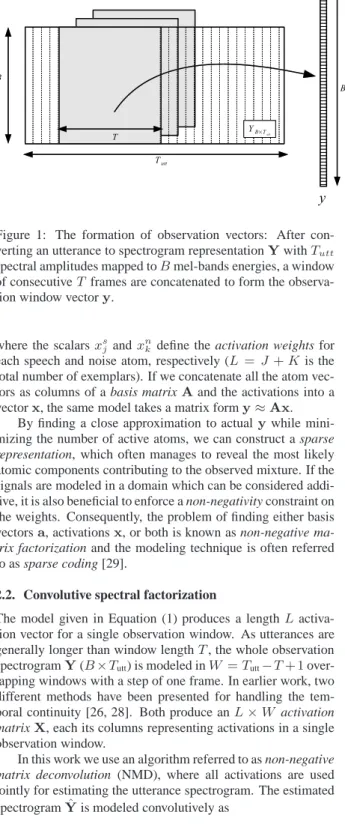
Let us denote the spectral magnitudes calculated in B mel-frequency bands in a sequence ofT frames and reshaped into a vector, byy. Fig. 1 shows the formation of a speech obser-vation vector yfor a single window. We can represent noisy speech observations as an additive combination of speech and noise atoms. Given an exemplar dictionary or basis of similarly vectorized speech and noise atomsas
j (j = 1, . . . , J) andank
(k= 1, . . . , K), we can model the observation as
y≈ J X j=1 asjx s j+ K X k=1 ankx n k, (1)
Figure 1: The formation of observation vectors: After con-verting an utterance to spectrogram representationYwithTutt
spectral amplitudes mapped toBmel-bands energies, a window of consecutiveTframes are concatenated to form the observa-tion window vectory.
where the scalarsxsjandxnk define the activation weights for
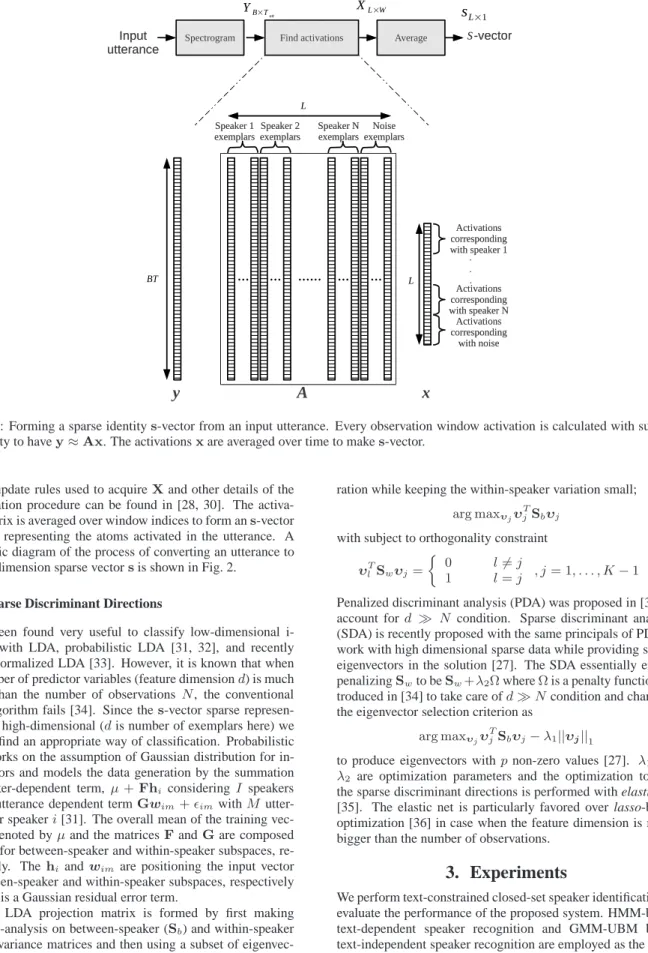
each speech and noise atom, respectively (L =J+Kis the total number of exemplars). If we concatenate all the atom vec-tors as columns of a basis matrixAand the activations into a vectorx, the same model takes a matrix formy≈Ax.
By finding a close approximation to actualy while mini-mizing the number of active atoms, we can construct a sparse representation, which often manages to reveal the most likely atomic components contributing to the observed mixture. If the signals are modeled in a domain which can be considered addi-tive, it is also beneficial to enforce a non-negativity constraint on the weights. Consequently, the problem of finding either basis vectorsa, activationsx, or both is known as non-negative ma-trix factorization and the modeling technique is often referred to as sparse coding [29].
2.2. Convolutive spectral factorization
The model given in Equation (1) produces a lengthL activa-tion vector for a single observaactiva-tion window. As utterances are generally longer than window lengthT, the whole observation spectrogramY(B×Tutt) is modeled inW =Tutt−T+ 1
over-lapping windows with a step of one frame. In earlier work, two different methods have been presented for handling the tem-poral continuity [26, 28]. Both produce anL×W activation matrixX, each its columns representing activations in a single observation window.
In this work we use an algorithm referred to as non-negative matrix deconvolution (NMD), where all activations are used jointly for estimating the utterance spectrogram. The estimated spectrogramYˆ is modeled convolutively as
ˆ Y= T X t=1 At →(t−1) X , (2)
where eachAt is a B×Lmatrix containing the tth frame
of all atom spectrograms, and →
(·) shifts columns right within aL×Tuttmatrix. The cost function to be minimized consists of
Kullback-Leibler divergence for spectral distance between the observation and its estimate, and weightedl1-norm penalty for nonzero activations to enforce sparsity in the solution. The
it-Figure 2: Forming a sparse identitys-vector from an input utterance. Every observation window activation is calculated with subject to sparsity to havey≈Ax. The activationsxare averaged over time to makes-vector.
erative update rules used to acquireXand other details of the factorization procedure can be found in [28, 30]. The activa-tion matrix is averaged over window indices to form ans-vector (L×1) representing the atoms activated in the utterance. A schematic diagram of the process of converting an utterance to a fixed-dimension sparse vectorsis shown in Fig. 2.
2.3. Sparse Discriminant Directions
It has been found very useful to classify low-dimensional i-vectors with LDA, probabilistic LDA [31, 32], and recently source normalized LDA [33]. However, it is known that when the number of predictor variables (feature dimensiond) is much higher than the number of observations N, the conventional LDA algorithm fails [34]. Since thes-vector sparse represen-tation is high-dimensional (dis number of exemplars here) we need to find an appropriate way of classification. Probabilistic LDA works on the assumption of Gaussian distribution for in-put vectors and models the data generation by the summation of speaker-dependent term, µ+Fhi consideringI speakers
and an utterance dependent termGwim+imwithM
utter-ances for speakeri[31]. The overall mean of the training vec-tors is denoted byµand the matricesFandGare composed of basis for between-speaker and within-speaker subspaces, re-spectively. The hi andwimare positioning the input vector
in between-speaker and within-speaker subspaces, respectively andimis a Gaussian residual error term.
The LDA projection matrix is formed by first making an eigen-analysis on between-speaker (Sb) and within-speaker
(Sw) covariance matrices and then using a subset of
eigenvec-tors,υjhaving the largest eigenvalues. ConsideringK
speak-ers, the eigenvectors in LDA are found using the Fisher’s crite-rion to find directions that maximize the between-speaker
sepa-ration while keeping the within-speaker variation small; arg maxυjυ
T
jSbυj (3)
with subject to orthogonality constraint
υT l Swυj=
0 l6=j
1 l=j , j= 1, . . . , K−1 (4)
Penalized discriminant analysis (PDA) was proposed in [34] to account for d N condition. Sparse discriminant analysis (SDA) is recently proposed with the same principals of PDA to work with high dimensional sparse data while providing sparse eigenvectors in the solution [27]. The SDA essentially entails penalizingSwto beSw+λ2ΩwhereΩis a penalty function in-troduced in [34] to take care ofdNcondition and changing the eigenvector selection criterion as
arg maxυjυjTSbυj−λ1||υj||
1 (5)
to produce eigenvectors withpnon-zero values [27]. λ1 and
λ2 are optimization parameters and the optimization to find the sparse discriminant directions is performed with elastic net [35]. The elastic net is particularly favored over lasso-based optimization [36] in case when the feature dimension is much bigger than the number of observations.
3. Experiments
We perform text-constrained closed-set speaker identification to evaluate the performance of the proposed system. HMM-based text-dependent speaker recognition and GMM-UBM based text-independent speaker recognition are employed as the base-line methods for performance comparison. In addition to sim-ple manipulation of exemplar activations, we employ PLDA and SDA to model the sparse exemplar activations.
Figure 3: CHiME corpus sentences grammatical structure
3.1. Database description
For performance evaluation, we conducted our experiments on the PASCAL computational hearing in multi source environ-ments (CHiME) speech separation and recognition challenge dataset [37]. The CHiME evaluation data is derived from con-volving the clean speech signals (extracted from the GRID audio-visual corpus [38]) with real room impulse response to simulate the reverberant environment as well as adding wide range of noise sources collected from a living room at different locations. The GRID corpus consists of 34,000 distinct utter-ances from 34 speakers (18 males and 16 females) and as it is shown in Fig. 3 the sentences follow a unique grammatical structure each composed of a combination of as six word com-mands: verb, color, preposition, letter, digit and coda (e.g., “bin white at p nine soon”). The keywords emphasized for speech intelligibility or recognition task in challenge are the items in position 4 and 5 referring to letter and digit, respectively. The possible letters are 25 English alphabet letters and finally the digits are selected from0to9.
The CHiME dataset is sub-divided into three parts: train-ing, development and test sets. For each speaker, 500 clean (re-verberated) utterances are provided for training purposes. Each of development and test sets are composed of 600 utterances mixed at six SNR levels ranging from−6dBto9dB. The noise contamination was done by challenge organizers which the de-tails can be found in [37]. The SNR levels encountered in devel-opment and test sets are expected to be representative of real-world situation except the fact that it is not accounting for the Lombard effect. It should be noted that noise types are differ-ent across differdiffer-ent SNR-levels. The sdiffer-entences were originally stereophonic and sampled at 48kHz and provided also in 16kHz format. The recognizers in this work use single-channel signals by averaging the two channels together in waveforms and we use 16 kHz data in our experiments. Summing two channels is equivalent to a delay-and-sum beamformer where no delay estimation is employed. All the analysis is performed on rever-berated speech as a straightforward approach for considering the effect of reverberation in modeling.
3.2. Experimental protocol
The training set is used to train speaker models, while the devel-opment and test sets are used to report the system performance in terms of the speech enhancement, speech recognition, and in this paper speaker recognition accuracy. Here we are using the speakers’ training material to build up speaker models. The de-velopment set is used to tune the PLDA and SDA parameters. The tuned system is then tested on unseen test set to evaluate the generalization capability of trained model. The criterion for optimizing the system performance on development set is considered as the identification accuracy over all SNR ranges in development set. This ensures us that the recognizer parameters are not optimized for a specific condition.
Table 1: ASR results for key-word recognition accuracy in per-cent on unprocessed mixture (no speech enhancement applied) on CHiME corpus. SNRs 9dB 6dB 3dB 0dB −3dB −6dB Development set 83.1 73.8 64.0 49.1 36.7 31.1 Test set 83.8 74.3 62.4 48.3 37.4 31.6 3.3. Text-Dependent HMM
Since the setup of the CHiME corpus is text constrained, the first baseline approach is selected to be a text-dependent HMM approach where basically speaker-dependent HMMs are trained for speech recognition. We take the baseline recognizer sup-plied by the CHiME challenge organizers [37] and instead of decoding the observed utterance with only the known speaker model, we let all the speaker-dependent HMMs decode the observation and identify the speaker as the one who provides highest log-likelihood. The words are modeled as whole-word HMMs with a left-to-right model topology with no skips over states and 7 Gaussian mixtures per state with diagonal covari-ance matrices [37]. Considering 2 states per phoneme the num-ber of states for each word is given as:
4 states: at by in a b c d e f g h i j k l m n o p q r s t u v x y z one two three eight
6 states: bin lay place set blue green red white with four five six nine now please soon
8 states: again zero 10 states: seven
This leads to overall number of 250 states in the HMM struc-ture. Speaker-dependent HMMs are trained by first estimating a set of speaker independent HMMs as the starting point, and then performing 4 more iterations of EM training using the 500 training utterances for each speaker. The HMMs are trained using reverberant signals without any noise and there is nei-ther adaptation to noisy signals nor multi-conditional training. For HTK the training and test scripts provided for the CHiME challenge were used [37]. The features are cepstral mean nor-malized MFCCs which include 12 base coefficients plus energy, concatenated with delta and acceleration features.
We report the ASR results averaged on development set in Table 1 to show the key-word recognition performance of the baseline HMM for detecting color and letter.
3.4. Text-Independent GMM-UBM
Although the speaker recognition task in context of CHiME corpus is a text-constrained, in addition to HMM-based approach we have also evaluated a baseline text-independent GMM-UBM approach [39] as our second benchmark method. To this end, using the same MFCC features as HMM-based approach we pooled all the target speakers training data to
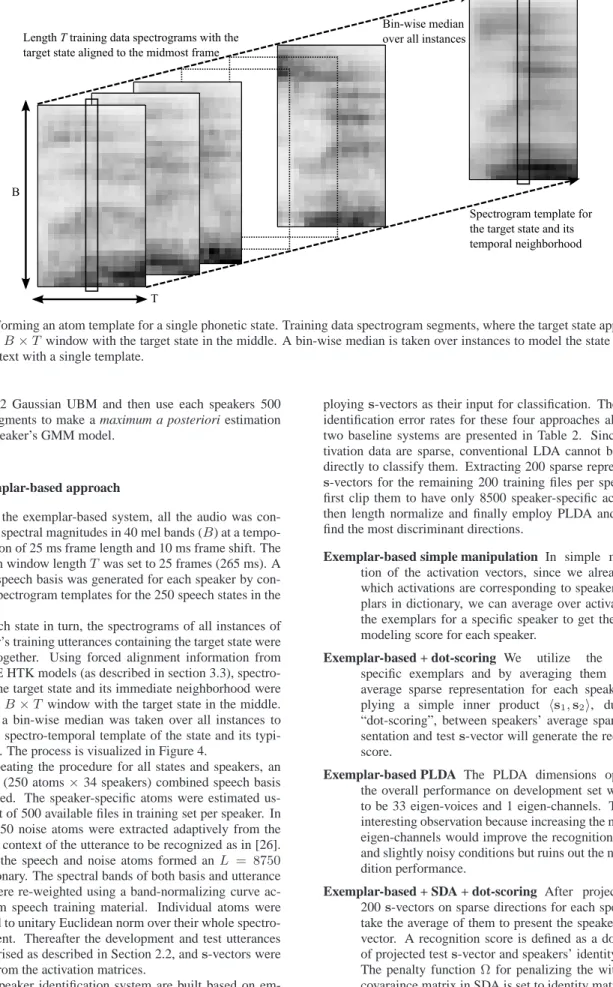
Figure 4: Forming an atom template for a single phonetic state. Training data spectrogram segments, where the target state appears, are placed in aB×T window with the target state in the middle. A bin-wise median is taken over instances to model the state spectrum and its context with a single template.
make a 512 Gaussian UBM and then use each speakers 500 training segments to make a maximum a posteriori estimation for each speaker’s GMM model.
3.5. Exemplar-based approach
Setting up the exemplar-based system, all the audio was con-verted into spectral magnitudes in 40 mel bands (B) at a tempo-ral resolution of 25 ms frame length and 10 ms frame shift. The observation window lengthT was set to 25 frames (265 ms). A 250-atom speech basis was generated for each speaker by con-structing spectrogram templates for the 250 speech states in the system.
For each state in turn, the spectrograms of all instances of the speaker’s training utterances containing the target state were gathered together. Using forced alignment information from the CHiME HTK models (as described in section 3.3), spectro-grams of the target state and its immediate neighborhood were placed in aB×T window with the target state in the middle. Thereafter a bin-wise median was taken over all instances to construct a spectro-temporal template of the state and its typi-cal context. The process is visualized in Figure 4.
By repeating the procedure for all states and speakers, an 8500-atom (250 atoms×34 speakers) combined speech basis was acquired. The speaker-specific atoms were estimated us-ing 300 out of 500 available files in trainus-ing set per speaker. In addition, 250 noise atoms were extracted adaptively from the local noise context of the utterance to be recognized as in [26]. All in all, the speech and noise atoms formed anL = 8750 atom dictionary. The spectral bands of both basis and utterance features were re-weighted using a band-normalizing curve ac-quired from speech training material. Individual atoms were normalized to unitary Euclidean norm over their whole spectro-gram content. Thereafter the development and test utterances were factorised as described in Section 2.2, ands-vectors were averaged from the activation matrices.
Four speaker identification system are built based on
em-ployings-vectors as their input for classification. The speaker identification error rates for these four approaches along with two baseline systems are presented in Table 2. Since the ac-tivation data are sparse, conventional LDA cannot be applied directly to classify them. Extracting 200 sparse representation s-vectors for the remaining 200 training files per speaker, we first clip them to have only 8500 speaker-specific activations, then length normalize and finally employ PLDA and SDA to find the most discriminant directions.
Exemplar-based simple manipulation In simple manipula-tion of the activamanipula-tion vectors, since we already know which activations are corresponding to speakers’ exem-plars in dictionary, we can average over activations for the exemplars for a specific speaker to get the first no-modeling score for each speaker.
Exemplar-based + dot-scoring We utilize the speaker-specific exemplars and by averaging them make an average sparse representation for each speaker. Ap-plying a simple inner product hs1,s2i, dubbed as “dot-scoring”, between speakers’ average sparse repre-sentation and tests-vector will generate the recognition score.
Exemplar-based PLDA The PLDA dimensions optimizing the overall performance on development set was found to be 33 eigen-voices and 1 eigen-channels. This is an interesting observation because increasing the number of eigen-channels would improve the recognition on clean and slightly noisy conditions but ruins out the noisy con-dition performance.
Exemplar-based + SDA + dot-scoring After projecting the 200s-vectors on sparse directions for each speaker, we take the average of them to present the speaker identity vector. A recognition score is defined as a dot-scoring of projected tests-vector and speakers’ identity vectors. The penalty functionΩfor penalizing the within-class covaraince matrix in SDA is set to identity matrix which
Table 2: Speaker identification error rate (in percent) comparison of different systems. The identification errors are measured on CHiME corpus development and test set for each SNR utilizing 600 utterances each of average 2 seconds length.
Development
SNR Clean 9dB 6dB 3dB 0dB −3dB −6dB
HMM 0.3 1.7 6.7 17.8 33.8 51.8 62.8 GMM-UBM 0.3 4.7 6.7 15.8 23.8 30.2 37.7 Exemplar-based simple manipulation 0.5 1.2 2.0 2.7 8.3 16.5 32.7 Exemplar-based + dot-scoring 1.2 1.5 1.5 4.0 7.8 12.0 23.3 Exemplar-based PLDA 0.2 0.7 1.0 2.3 7.7 16.0 34.2 Exemplar-based + SDA + dot-scoring 0.3 0.5 0.7 1.7 3.2 8.2 17.3
Test
HMM 2.0 6.8 16.8 41.2 56.7 67.3 GMM-UBM - 2.2 8.2 14.7 26.3 35.3 43.7 Exemplar-based simple manipulation - 1.0 2.0 3.7 7.7 14.8 34.8 Exemplar-based + dot-scoring - 1.7 2.5 3.5 7.0 10.3 22.7 Exemplar-based PLDA - 0.5 0.8 2.3 8.3 14.5 33.7 Exemplar-based + SDA + dot-scoring - 0.2 0.7 1.3 4.5 5.7 17.5
corresponds to a ridge regression scenario. The parame-terλ2is set to0.01meaning that by adding a small num-ber to the diagonal of the wihtin-class covariance matrix it gets full rank and that takes care of thed N con-dition. We have optimized on whole development set the number of non-zero elements for sparse discriminant direction in SDA by fixing the number of discriminant directions to be 33. Te optimal number of non-zero ele-ments was found to be500.
3.6. Results and Discussion
The speaker identification performance of baseline systems along with proposed exemplar-based approach are presented in Table 2. It is observed that baseline systems only show a rea-sonable performance on the clean and slightly noisy (SNR= 9dB) conditions and the performance drops substantially for SNR<9dB. The GMM-UBM system shows more robust be-havior in low SNRs compared to text-dependent HMM system. The HMM-based system performance decline in noisy condi-tions for speaker identification is much bigger than for speech recognition. It yet remains to be investigated if applying speech enhancement algorithms, which most of the time increase the ASR performance, will translate to improved speaker recogni-tion accuracy.
The simple manipulation ofs-vectors in development and test set (without any training) provides much better speaker identification results than baseline systems for SNR≤ 9dB. This great improvement is a result of inherent capability of exemplar-based approach to capture long spectro-temporal con-text and careful design of the system which compresses speaker-specific information into s-vectors. Although the exemplar-based system utilizes the noise exemplars in estimating the ac-tivations (baseline HMM and GMM-UBM system do not incor-porate noise information in modeling), the small performance difference between development and test sets reveals that this representation is indeed robust to unseen noise conditions. Em-ploying dot-scoring directly ons-vectors to calculate the recog-nition score provides reduced error in SNR≤ 0dB. This phe-nomenon can be described as the noisy speech can activate the exemplars in a different way than they are activated in clean speech and hence by using average s-vector of each speaker, the more relevant activations are emphasized in dot-scoring. By employing a modeling approach on s-vector domain both PLDA and SDA bring extra performance improvement over simple manipulation ofs-vectors. The PLDA essentially
helps in SNR>0dBwhich is a result of optimizing the discrim-inative directions to the clean data. The performance gain in the order of magnitude for SDA-based approach in SNR≤0dB enlightens the suitability of sparse discriminative directions for projecting thes-vectors. Employing McNemars’ statistical test, it is found out that all the results for SNR≤6dBfor exemplar-based approach are significantly different than of baseline sys-tems. It is again a topic for further research if finding sparse discriminant directions is only helpful in handling sparse data or can be useful also in dealing with information rich i-vectors.
4. Conclusions
A new approach for closed-set speaker identification based on exemplar-based representation and sparse discrimination is pro-posed. Evaluating on recently developed CHiME corpus we have found the proposed system outperforming the baseline GMM-UBM and HMM based systems with a large margin.
5. Acknowledgment
The work of Rahim Saeidi was funded by the European Com-munity’s Seventh Framework Program (FP7/2007-2013) un-der grant agreement no. 238803. Authors would like thank Dr. Mitchell McLaren for fruitful discussions and Dr. Line Clemmensen for sharing her implementation of sparse discrim-inant analysis.
6. References
[1] A. Solomonoff, W.M. Campbell, and I. Boardman. Ad-vances in channel compensation for SVM speaker recog-nition. In Proc. Int. Conf. on Acoustics, Speech, and Sig-nal Processing (ICASSP 2005), pages 629–632, Philadel-phia, USA, March 2005.
[2] P. Kenny, P. Ouellet, N. Dehak, V. Gupta, and P. Du-mouchel. A study of interspeaker variability in speaker verification. IEEE Trans. Audio, Speech and Language Processing, 16(5):980 –988, july 2008.
[3] N. Dehak, P. Kenny, R. Dehak, P. Dumouchel, and P. Ouellet. Front-end factor analysis for speaker verifi-cation. IEEE Trans. Audio, Speech and Language Pro-cessing, 19(4):788 –798, may 2011.
[4] J. Ming, T.J. Hazen, J.R. Glass, and D.A. Reynolds. Ro-bust speaker recognition in noisy conditions. IEEE Trans.
Audio, Speech and Language Processing, 15(5):1711 – 1723, july 2007.
[5] D. Garcia-Romero, X. Zhou, and C. Y. Espy-Wilson. Mul-ticondition training of gaussian plda models in i-vector space for noise and reverberation robust speaker recogni-tion. In Proc. Int. Conf. on Acoustics, Speech, and Signal Processing (ICASSP 2012), 2012.
[6] C.M. Vannicola, B.Y. Smolenski, B. Battles, and P.A. Ardis. Mitigation of reverberation on speaker identifi-cation via homomorphic filtering of the linear prediction residual. In Proc. Int. Conf. on Acoustics, Speech, and Signal Processing (ICASSP 2011), pages 5512–5515, may 2011.
[7] NIST speaker recognition evaluation.
[8] M. I. Mandasari, M. McLaren, and D. A. van Leeuwen. The effect of noise on modern automatic speaker recog-nition systems. In Proc. Int. Conf. on Acoustics, Speech, and Signal Processing (ICASSP 2012), 2012.
[9] M. I. Mandasari, M. McLaren, and D. A. van Leeuwen. Evaluation of i-vector speaker recognition systems for forensic application. In Proc. Interspeech 2011, pages 21– 24, 2011.
[10] R. Lippmann, E. Martin, and D. Paul. Multi-style train-ing for robust isolated-word speech recognition. In Proc. Int. Conf. on Acoustics, Speech, and Signal Processing (ICASSP 1987), volume 12, pages 705 – 708, apr 1987. [11] R. Saeidi, P. Mowlaee, T. Kinnunen, Z. H. Tan, M. G.
Christensen, P. Fr¨anti, and S. H. Jensen. Signal-to-signal ratio independent speaker identification for co-channel speech signals. In Proc. IEEE Int. Conf. Pattern Recog-nition (ICPR 2010), pages 4545–4548, 2010.
[12] R. Martin. Noise power spectral density estimation based on optimal smoothing and minimum statistics. IEEE Trans. on Speech and Audio Processing, 9(5):504 –512, jul 2001.
[13] I. Cohen. Noise spectrum estimation in adverse environ-ments: improved minima controlled recursive averaging. IEEE Trans. on Speech and Audio Processing, 11(5):466 – 475, sept. 2003.
[14] Y. Ephraim and D. Malah. Speech enhancement using a minimum-mean square error short-time spectral ampli-tude estimator. IEEE Trans. Acoustics, Speech, and Signal Processing, 32(6):1109 – 1121, dec 1984.
[15] Y. Ephraim and D. Malah. Speech enhancement using a minimum mean-square error log-spectral amplitude esti-mator. IEEE Trans. Acoustics, Speech, and Signal Pro-cessing, 33(2):443 – 445, apr 1985.
[16] P. Mowlaee, R. Saeidi, and R. Martin. Model-driven speech enhancement for multisource reverberant environ-ment (signal separation evaluation campaign sisec 2011). In Proc. 10th International Conference on Latent Variable Analysis and Source Separation (LVA/ICA 2012), 2012. [17] J.S. Erkelens and R. Heusdens. Tracking of nonstationary
noise based on data-driven recursive noise power estima-tion. IEEE Trans. Audio, Speech and Language Process-ing, 16(6):1112 –1123, aug. 2008.
[18] R. C. Hendriks, R. Heusdens, and J. Jensen. Mmse based noise psd tracking with low complexity. In Proc. Int. Conf. on Acoustics, Speech, and Signal Processing (ICASSP 2010), pages 4266 –4269, march 2010.
[19] I. Naseem, R. Togneri, and M. Bennamoun. Sparse rep-resentation for speaker identification. In Proc. IEEE Int. Conf. Pattern Recognition (ICPR 2010), pages 4460 – 4463, aug. 2010.
[20] J.M.K. Kua, E. Ambikairajah, J. Epps, and R. Togneri. Speaker verification using sparse representation classifica-tion. In Proc. Int. Conf. on Acoustics, Speech, and Signal Processing (ICASSP 2011), pages 4548–4551, may 2011. [21] M. Li and S. Narayanan. Robust talking face video verifi-cation using joint factor analysis and sparse representation on gmm mean shifted supervectors. In Proc. Int. Conf. on Acoustics, Speech, and Signal Processing (ICASSP 2011), May 2011.
[22] M. Li, X. Zhang, Y. Yan, and S. Narayanan. Speaker ver-ification using sparse representations on total variability i-vectors. In Proc. Interspeech 2011, August 2011. [23] M. Li, S. Narayanan, C. Lu, and A. Wang. Speaker
verifi-cation using lasso based sparse total variability supervec-tor and probabilistic linear discriminant analysis. In NIST 2011 Speaker Recognition Workshop, December 2011. [24] W.M. Campbell, D.E. Sturim, and D.A. Reynolds.
Support vector machines using GMM supervectors for speaker verification. IEEE Signal Processing Letters, 13(5):308–311, May 2006.
[25] J. F. Gemmeke, T. Virtanen, and A. Hurmalainen. Exemplar-based sparse representations for noise robust automatic speech recognition. IEEE Trans. Audio, Speech and Language Processing, 19(7):2067 – 2080, 2011. [26] A. Hurmalainen, K. Mahkonen, J. F. Gemmeke, and
T. Virtanen. Exemplar-based recognition of speech in highly variable noise. In International Workshop on Ma-chine Listening in Multisource Environments, pages 1–5, march 2011.
[27] L. Clemmensen, T. Hastie, D. Witten, and B. Ersboll. Sparse discriminant analysis. Technometrics, 54(4):406– 413, 2011.
[28] A. Hurmalainen, J. Gemmeke, and T. Virtanen. Non-negative matrix deconvolution in noise robust speech recognition. In Proc. Int. Conf. on Acoustics, Speech, and Signal Processing (ICASSP 2011), pages 4588 – 4591, 2011.
[29] T. Virtanen. Separation of sound sources by convolutive sparse coding. In in Proceedings of ISCA Tutorial and Research Workshop on Statistical and Perceptual Audio Processing, 2004.
[30] T. Virtanen. Sound source separation in monaural music signals. PhD thesis, Tampere University of Technology, Tampere, Finland, 2006.
[31] S. J. D. Prince and J. H. Elder. Probabilistic linear dis-criminant analysis for inferences about identity. In 11th International Conference on Computer Vision, pages 1–8, 2007.
[32] P. Kenny. Bayesian speaker verification with heavy-tailed priors. In Proc. IEEE Odyssey: the Speaker and Language Recognition Workshop (Odyssey 2010), Brno, Czech Re-public, June 2010.
[33] M. McLaren and D. van Leeuwen. Source-normalized lda for robust speaker recognition using i-vectors from multi-ple speech sources. IEEE Trans. Audio, Speech and Lan-guage Processing, 20(3):755–766, march 2012.
[34] T. Hastie, A. Buja, and R. Tibshirani. Penalized discrimi-nant analysis. Annals of Statistics, 23(1):73–102, 1995. [35] H. Zou and T. Hastie. Regularization and variable
selec-tion via the elastic net. Journal of the Royal Statistical Society: Series B, 67(2):301–320, 2005.
[36] R. Tibshirani. Regression shrinkage and selection via the lasso. Journal of the Royal Statistical Society: Series B, 58(1):267–288, 1996.
[37] H. Christensen, J. Barker, N. Ma, and P. Green. The CHiME corpus: a resource and a challenge for compu-tational hearing in multisource environments. In Proc. In-terspeech, pages 1918–1921, 2010.
[38] M. Cooke, J. R. Hershey, and S. J. Rennie. Monau-ral speech separation and recognition challenge. Elsevier Computer Speech and Language, 24(1):1–15, 2010. [39] D.A. Reynolds, T.F. Quatieri, and R.B. Dunn. Speaker
verification using adapted gaussian mixture models. Dig-ital Signal Processing, 10(1):19–41, January 2000.