default resources of central counterparties
Central counterparties (CCPs) have become pillars of the new global financial architecture following the financial crisis of 2008. The key role of CCPs in mitigating counterparty risk and contagion has in turn cast them as systemically important financial institutions whose eventual failure may lead to potentially serious consequences for financial stability, and prompted discussions on CCP risk management standards and safeguards for recovery and resolutions of CCPs in case of failure. We contribute to the debate on CCP default resources by focusing on the incentives generated by the CCP loss allocation rules for the CCP and its members and discussing how the design of loss allocation rules may be used to align these incentives in favor of outcomes which benefit financial stability. After reviewing the ingredients of the CCP loss waterfall and various proposals for loss recovery provisions for CCPs, we examine the risk management incentives created by different ingredients in the loss waterfall and discuss possible approaches for validating the design of the waterfall. We emphasize the importance of CCP stress tests and argue that such stress tests need to account for the interconnectedness of CCPs through common members and cross-margin agreements. A key proposal is that capital charges on assets held against CCP Default Funds should depend on the quality of the risk management of the CCP, as assessed through independent stress tests.
CONTENTS
1. CCPs: bulwarks against systemic risk or new Too Big To Fail entities? 2. Provisioning for default losses: the CCP loss waterfall
3. Margin requirements
3.1 Backtesting of margin requirements 3.2. Procyclicality of margin requirements
3.2. Exposures to worst-case scenarios and portfolio crowding 3.3 Accounting for liquidation costs
4. Mutualizing default losses: the CCP Default Fund
3.1. Size of the Default Fund
3.3 Allocation of Default Fund contributions across Clearing Members
5. CCP capital and “skin-in-the-game”
5.1. Capital requirements for CCPs 5.2 Skin-in-the-game
6. Assessing a CCP’s default resources
6.1 Stress testing of CCP default resources
6.2 Beyond single-CCP stress-tests: accounting for interconnectedness: 6.3 How risky are Default Fund assets?
6.4 How reliable are unfunded default resources?
7. The end of the waterfall : recovery mechanisms for CCPs
7.1 Variation Margin Haircuts (VMGH) 7.2 Liquidity provision during recovery 7.3 Contract tear-ups
7.4. Should ‘initial margin’ be used to fund a CCP’s recovery?
8. When all else fails: failure resolution of CCPs 9. Lessons for CCP design
1. CCPs: bulwarks against systemic risk or new ‘Too Big To Fail’ entities?
Following the financial crisis of 2008, one of the key ingredients in proposals for regulatory reform has been the (mandatory) clearing of over-the-counter (OTC) derivative transactions through central counterparties (CCPs). Guidelines present in Title VII of the Dodd-Frank Act, the Basel Committee’s proposal for regulatory reform (Basel III), and the European Market Infrastructure Regulation (EMIR) emphasize mandatory central clearing of standardized OTC derivatives for regulated financial institutions and capital surcharges for non-centrally cleared derivatives transactions, casting CCPs as pillars of the new global financial architecture.
of symmetric trades intermediated by a central counterparty CCP.
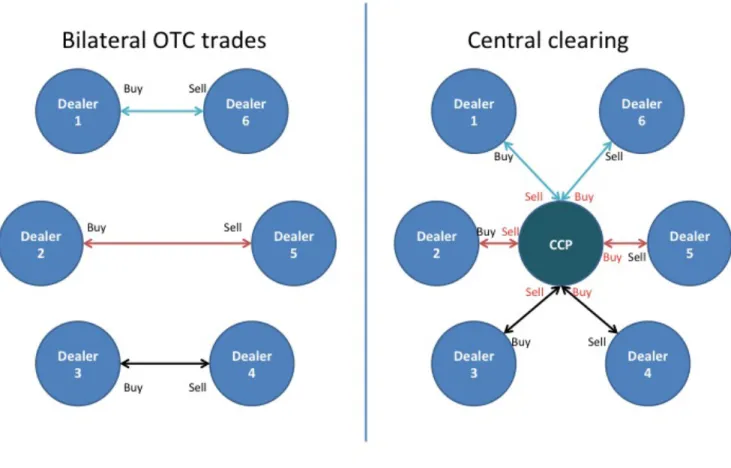
Central clearing involves replacing each bilateral trade between between a pair of
counterparties by a pair of symmetric trades with a central counterparty (CCP), which then
becomes counterparty to both sides of the trade (Figure 1). Trades cleared through the CCP are subject to collateral requirements: all counterparties, called ‘Clearing Members’, post Initial Margin requirements corresponding to an assessment of the risk of their position with the CCP. Collateral requirements are computed using a standardized approach for all counterparties and regularly updated through (daily or more frequent) margin calls.
Central clearing, when properly implemented and subject to adequate risk management safeguards, can be a powerful tool for mitigating counterparty risk and contagion. The merits of CCPs include the reduction of exposures through multilateral netting across counterparties (Acharya & Bisin 2014; Duffie & Zhu 2011; Cont & Kokholm 2014), the reduction of counterparty risk through transparent collateral requirements, the reduction of operational risk, the enhancement of price discovery and regulatory transparency in OTC markets, and the improvement of risk management standards. These benefits are illustrated by the observation that many OTC markets had implemented central clearing well before being mandated to do so by recent legislation.
Figure 2 illustrates how channeling bilateral OTC exposures through a CCP can reduce the overall level of exposures through multilateral netting (Cont & Kokholm 2014). The same example also illustrates how a chain of exposures, which may potentially lead to contagion in case one element in the chain defaults, is broken by central clearing through a CCP. This feature, together with the fact that all Clearing Members are subject to collateral requirements, helps mitigate the counterparty risk and the associated risk of contagion which may arise from OTC exposures (Cont & Minca, 2014).
participants, central clearing leads to a reduction of exposures through multilateral netting across counterparties.
An important feature of central clearing is the standardization –and centralization- of collateral requirements for all participants in OTC transactions, which has not been the case for bilateral OTC transaction. Although this entails a cost for market participants, it also reduces operational risk and legal risk associated with collateral disputes in bilateral transactions, by deferring margin calculations to the CCP. This may trigger in turn the standardization of data formats and risk models for cleared transactions.
The potential benefits of central clearing are, however, conditional on the availability of sufficient liquidity resources for the CCP to maintain its clearing operations through market stress scenarios, which in turn hinges on the adequacy of the risk management of the CCP. The increasingly important role given to CCPs in mitigating counterparty risk and contagion has in turn cast them as systemically important financial institutions whose eventual failure may lead to potentially serious consequences for financial stability and prompted discussions on CCP risk management standards and safeguards for recovery and resolutions of CCPs in case of failure. By concentrating counterparty risk in CCPs and increasing the range and volume of cleared instruments, central clearing mandates have turned some CCPs into « Too Important to Fail » entities, whose failure would be a catastrophic event. Accordingly, market participants have voiced legitimate concerns about the risk management procedures used by CCPs, the adequacy of their resources in the event of the default of one or several Clearing Members and the procedures to follow in the event of a CCP’s failure (BlackRock 2014, JP Morgan 2014).
A CCP may incur losses due to market variations of assets held on its balance sheet (non-default losses) as well losses due to the (non-default of its Clearing Members. Non-(non-default losses are absorbed by the CCP’s capital, which in this respect is subject to adequacy rules similar in spirit to that of a bank. What makes a CCP different from a bank is its exposures to losses stemming from the default of Clearing Members, and CCPs have developed various “default resources” to deal with these exposures. The current debate focuses on the adequacy of these default resources and what to do once these resources are depleted.
A key issue is the regulation and supervision of CCPs and their Clearing Members. Close examination of the incentives of the CCP and its Clearing members reveals that the absence of appropriate regulation may lead to outcomes where the CCP may become a source of systemic risk rather than a safeguard against it (Cont 2010; Murphy 2012; Acharya & Bisin 2014; Cont & Minca 2014). In absence of proper regulation, the presence of multiple CCPs, may generate a “race to the bottom”, allocating the largest market share to CCPs which have the lowest collateral requirements (Santos & Scheinkman, 2001).
generated by the CCP loss allocation rules for the CCP and its members and discussing how the design of loss allocation rules may be used to align these incentives in favor of outcomes which benefit financial stability. After reviewing the ingredients of the CCP loss waterfall and various proposals for recovery provisions for CCPs, we examine the risk management incentives created by different ingredients of the loss waterfall and discuss possible approaches for validating the design of the waterfall.
We emphasize the importance of CCP stress tests and argue that such stress tests need to account for the interconnectedness of CCPs through common members and cross-margin agreements. A key proposal is that capital charges on assets held against CCP Default Funds should depend on the quality of the risk management of the CCP, as assessed through independent stress tests.
Finally, we discuss different options for the recovery of a failing CCP, emphasizing the interplay between liquidity and solvency constraints and the risk incentives resulting from each type of recovery mechanism.
2. Provisioning for default losses: the CCP loss waterfall
Clearing Members bring to the CCP a set of bilateral transactions for clearing. In any contract, the sum of long and short positions is zero (clearing condition). Both parties pay an initial margin as well as a contribution to the CCP Default Fund.
Each member periodically pays or receives a variation margin corresponding to the variation
of the market value of its open positions. The sum across members of all variation margins paid and received is zero due to the clearing condition so, if all members pay in the variation margins due to the CCP, the CCP then simply acts as a pass-thru and transfers it to the members whose mark-to-market variation is positive. As long as members have not defaulted, variation margin payments sum to zero. So the CCPs are affected by market risk of member portfolios only in scenarios where one or more Clearing Members default.
If one or several members default, the margin payments are not zero-sum anymore: defaulting members may fail to pay the variation margin due to the CCP and the CCP then liquidates their open positions, typically through an auction. During this process the CCP continues to honor all variation margin payments to open positions of non-defaulted members, which may entail a loss for the CCP. Due to continuous (e.g. daily) variation margin payments, the CCP is only exposed to losses which occur at or following the member’s default.
To fulfill its role, a CCP thus needs to maintain financial resources that can absorb losses in the event of their members defaulting. These include
-margin requirements collected from Clearing Members
-a Default Fund, to which all Clearing Members are required to contribute, designed to absorb losses that exceed the initial margin posted by defaulting members, and
-the CCP’s own equity.
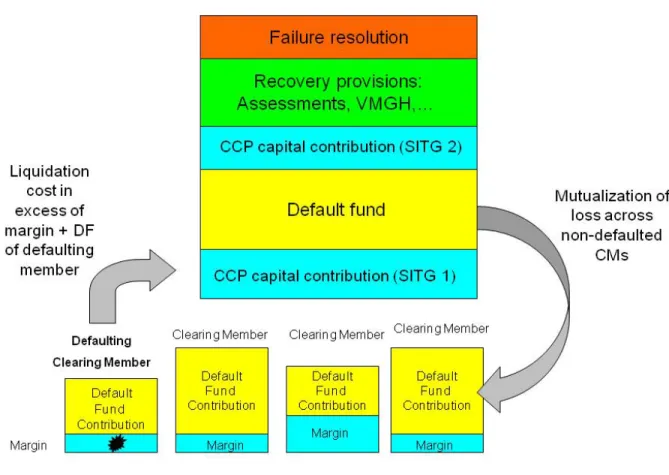
The “loss waterfall” describes how these resources available are used to absorb potential losses arising from the default of Clearing Members:
1. The first layer of protection against losses is provided by the margin requirements. Each
Clearing Member maintains a margin requirement with the CCP, sometimes called ‘Initial Margin’, which corresponds to a measure of the risk of the member’s portfolio over a risk horizon. The risk horizon ranges from one to several days, depending on the asset class being cleared. The level of margin requirements is typically set to cover potential market losses in the Clearing Member’s positions over the risk horizon over a range of scenarios.
A common approach has been to set the level of margin requirements for a Clearing Member to cover losses of the member’s portfolio in a set of risk scenarios corresponding to possible portfolio losses over the risk horizon. This set may be a set of scenarios fixed in advance by the CCP (as in the CME’s Standard Portfolio Analysis, or SPAN, approach), a set of historical scenarios (historical Value-at-Risk) or a set of scenarios simulated using a statistical model. The margin requirement may then be computed as the worst case loss (in the SPAN method) a loss quantile (VaR) or Expected Shortfall (tail conditional expectation) at a certain confidence level, which may be 99% or higher. The margin level may then be interpreted as the amount of collateral required to absorb losses in a proportion of scenarios given by the confidence level.
The initial margin paid in by each member may only be used to absorb the losses arising from the member’s portfolio, but cannot be used to offset losses of other members or other losses incurred by the CCP.
2. If the loss exceeds the initial margin contribution, the failing member’s Default Fund
contribution is used to offset the additional losses.
3. If the loss exceeds the sum of the defaulting member’s margin and Default Fund
contribution:
- first the CCP makes a limited (capped) contribution to offset the remaining loss: this contribution is sometimes referred to as “skin-in-the-game”.
- if the CCP’s contribution in insufficient, the Default Funds of other members are used to absorb remaining losses.
4. If the losses exceed the size of the Default Fund, the CCPs may have recourse to:
-an additional contribution from the CCP’s own capital
-an additional contribution to the Default Fund by non-defaulting Clearing Members: this “assessment” is sometimes uncapped and sometimes capped by the initial contribution of the members.
5. Recovery: If the above resources are not sufficient for absorbing the losses resulting from the default of Clearing Members, then the CCP may take extraordinary measures to replenish its resources and maintain continuity of its clearing operations. These measures are known as the “recovery plan”. Some solutions which have been considered are:
-Variation Margin Haircutting (VMGH): during the recovery phase the CCP continues to collect variation margin payments from members with negative P&L but does not transfer them entirely to their counterparties, retaining a portion for replenishing its resources.
-tear-up of contracts: in some cases the CCP may decide to close (i.e. liquidate) some positions of CCP members.
-“initial margin haircuts”: some proposals include the use of initial margin of non-defaulted members as a source of funds for the CCP’s recovery.
We discuss below the relative merits of these and other recovery provisions.
6. Failure Resolution: If recovery measures fail to replenish the resources of the CCP or if the CCP or its members choose not to proceed with recovery measures, the CCP might eventually become insolvent or lack the liquidity resources for continuing its operations, resulting in default or requiring the use of resolution powers by authorities. Alternatively, the regulators may choose to trigger the failure resolution regime before failure actually occurs. The triggers for entry into resolution may vary from jurisdiction to jurisdiction. The failure of a CCP is an undesirable outcome which may impair the stability of the financial system. It is therefore understandable that failure resolution of CCPs has focused a lot of debate. An important component of this debate has focused on the legal regime most appropriate for the resolution of a CCP, loss allocation in the resolution phase and the legal and financial implications of resolution for CCP members and their clients. Duffie (2014) gives an excellent and up-to-date discussion of these important issues.
By contrast, less discussion has been devoted to preventive measures which could reduce the likelihood of failure in the first place. These measures relate to the design of the loss waterfall, not only in terms of the loss absorbing capacity of its various components but also in terms of the resulting incentives for the CCP and its Clearing Members.
CCP risk management systems are subject to approval and periodic review by regulators. In practice, such reviews have typically focused on backtesting of margin levels for clearing member portfolios and assessing whether the size of the Default Fund corresponds to the regulatory guideline of covering the liquidation costs for one (or two) clearing member defaults. Such backtesting procedures assess the effectiveness of the waterfall design in covering losses in stress scenarios and are necessary for the validation of a CCP’s risk management model.
However, an equally important issue in assessing the design of the waterfall concerns the risk management incentives it provides to the CCP and the clearing members in advance of such stress scenarios. A well-designed loss waterfall should provide the right risk management incentives to Clearing Members and the CCP to steer away as much as possible from configurations that may lead to failure of the CCP. We will now examine the ingredients of the loss waterfall from the perspective of the incentives they generate for the CCP and its members.
3. Margin requirements
Margin requirements for Clearing Members are typically computed based on a measure of market risk for the Clearing Member’s positions over the risk horizon. The risk horizon, in current practice, depends on the asset class being cleared and ranges from one to several days.
Choices for the risk measure include
-scenario based approaches, such as CME’s “Standard Portfolio Analysis approach” (SPAN), which evaluate the worst loss of the portfolio across a range of scenarios;
-statistical risk measures, such as Value at Risk (VaR) or Expected Shortfall (ES) or variants of these, such as “truncated Tail Conditional Expectation”, which is a robust version of Expected Shortfall (Cont, Deguest & Scandolo, 2010). These risk measures are usually computed at a confidence level which ranges from 99% to 99.75%, depending on CCPs. The estimation of these risk measures involves statistical assumptions on the risk factors affecting the Clearing Member’s portfolios.
3.1 Backtesting of margin requirements
Different assumptions lead to different values for margin requirements and, even within an asset class, there is often no consensus on model and parameter choices. As a result, margin requirements for identical portfolios cleared in different CCPs may be quite different and one may observe differences up to 50% in some cases. Given the difference in assumptions
across models, a higher confidence level does not necessarily imply higher margin requirements: for example, a 99.75% Value at Risk computed in a Gaussian model may be in fact less conservative than a 99% Value at Risk in a model with heavy-tailed risk factors. Thus, the adequacy of margin requirements must be assessed using an objective criterion which is comparable across models.
A common approach to the validation of margin requirements is ‘historical back testing’: the margin requirements are computed for a set of portfolios (often, the Clearing Member portfolios) every day using historical data and compared with the subsequent (out of sample) T-day realized, where T is the risk horizon. Various criteria, such as the frequency and the clustering in time of loss in excess of margin, are used to assess the adequacy of the level of margin requirements. This procedure, similar to the one used for backtesting risk models for bank portfolios, leads to a result which is comparable across models if the same historical data set is used. CCPs should be equipped with the necessary data and computational resources for performing such backtests systematically on Clearing Member portfolios, as some already do.
Historical backtesting, though necessary and useful, yield an incomplete assessment of the adequacy of margin requirements: they are restricted to a set of historical scenarios which may or may not be representative of potential stress scenarios facing the CCP, and only consider current positions of Clearing Members.
A more comprehensive validation should involve not just current Clearing Member portfolios but also hypothetical ‘test’ portfolios which may represent possible positions that members may bring to the CCP. This allows to track potential weaknesses in the margin calculations and identify “worst-case portfolios” whose risk may not be captured by the margin requirements.
3.2. Pro-cyclicality in margin requirements
Margin requirements are computed, either directly through historical simulation or indirectly
through a statistical model, using recent market data.1 The use of (a sliding window of)
recent market data introduces procyclicality in the margin requirements. Margin levels increase following an episode of market turbulence, due to updating of risk factor volatilities. Conversely, episodes of severe market turbulence, such as the crisis of 2008, are ‘forgotten’ by the model once they are not part of the estimation window. Accordingly, recent regulatory guidelines (in particular EMIR) have recommended to introduce ‘pro-cyclicality adjustments’ in margin requirements.
1 Regulatory guidelines recommend to use at least 2 years of historical data for parameter estimation and in
When margin requirements are computed through historical simulation (for example, historical VaR), a simple way to avoid pro-cyclicality is to include a (fixed) set of ‘stress scenarios’ in the scenarios being used for the margin calculation. These stress scenarios may either correspond to historical episodes of market stress which may fall outside the estimation window, or correspond to counterfactual, but realistic, co-movements of risk factors.
When margin requirements are computed using model-based calculations or simulations, pro-cyclicality may be attenuated by using a floor (minimum value) for risk factor volatilities. These floors may be estimated using a longer data set including past episodes of market stress, thus rendering them robust to changes in the data set. Using such floor levels also makes the initial margin requirements more stable and less sensitive to day-by-day market fluctuations (which should be primarily be captured by the variation margin).
The use of similar models for margin calculations across different CCPs is also a factor of procyclicality: models using similar methodologies or based on similar inputs will lead to simultaneous increases in margin requirements. Although regulators tend to be conforted by the use of ‘commonly used’ models for margin calculations, the diversity of models is in fact desirable from the perspective of mitigating procyclicality.
3.3. Correlation breakdown, worst-case scenarios and portfolio crowding
When initial margin is computed at the portfolio level, rather than at single instrument level, the calculation involves assumptions on correlations, or ‘offsets’, of gains and losses across different instruments. Historical risk calculations implicitly assume that the historical dependence structure of risk factors will remain stable; model-based or simulation-based margin calculations may involve explicit assumptions on the dependence structure of risk factors, typically estimated from recent market data. We will refer to these assumptions as the ‘baseline scenario’. However, empirical studies and theoretical models both point to the possibility that ‘historical correlation’ assumptions may fail to hold in market crisis scenarios leasding either to sharp increase or decrease in correlation levels (Cont & Wagalath, 2013), for reasons which are endogenous to the origin of market correlations. It is therefore important to consider, when computing initial margin requirements, ‘correlation stress scenarios’ where the dependence structure of risk factors may be stronger or weaker than the baseline scenario based on historical data. Considering such scenarios, which are not based on recent market data, also has the benefit of reducing the procyclicality of margin requirements by attenuating their dependence on recent market moves which affect correlation levels used in the baseline scenario.
Another useful complement to historical backtesting is ‘reverse stress testing’: instead of verifying the frequency of excess losses above margin across a given set of scenarios, one
attempts to identify extreme but plausible scenario(s) which maximize excess losses above margin for current member portfolios.
The nature of these ‘worst case scenarios’ give an insight into the risks the CCP is exposed to. When derivatives positions are involved, these ‘worst case scenarios’ may be in fact quite different from tail scenarios for the underlying risk factors. For example, the worst case scenario for a ‘straddle position’ (long position in an the money call and an out-of-the-money put) is that the underlying asset does not move. Similarly, when several correlated risk factors are involved, worst case scenarios may involve complex co-movements in the risk factors which may correspond to typical, rather than ‘tail’, scenarios. Examination of ‘worst case scenarios’ is also useful for assessing the dependence of tail risks across Clearing Members: if many Clearing Members are exposed to the same ‘worst case scenarios’, this reveals a ‘crowding risk’ across member portfolios which implies that these Clearing Members may be simultaneously subject to large margin calls if such scenarios occur. Clearing Members, being unaware of other members’ positions, may fail to take this risk into account. This should prompt the CCP to increase the margin requirements for such portfolios.
3.4. Accounting for liquidation costs
It should be clear from the description of the CCP loss waterfall that the only scenarios in which the CCP is exposed to losses in a Clearing member’s portfolios are scenarios where this Clearing Member defaults. In this case, the CCP typically liquidates the defaulting member’s positions. Any loss incurred in the process of liquidation is therefore realized as a liquidation cost. Whereas the margin requirements are computed by assessing the market risk of a Clearing Member’s position over a (fixed) risk horizon T, the result may be substantially different from the liquidation cost due to several reasons:
-Bid-ask spreads: the liquidation of a portfolio with long and short positions involves an unwinding cost which, for small positions, is proportional to the bid-ask spread of the instruments involved. Thus, two positions with the same market risk but different bid-ask spreads entail different liquidation costs, which is not accounted for in margin requirements based on market risk measures such as VaR or Expected Shortfall.
-Liquidation horizon for large positions: orderly unwinding of positions whose magnitude is large compared to the market depth may not be feasible over the (pre-specified) risk horizon and may require more time. For example, if a CDS position whose size is twice the magnitude of daily trading volume is liquidated at the rate of 20% of daily volume, its orderly liquidation requires 10 days, rather than the 5-day risk horizon conventionally used for CDS margin calculations. As observed in this example, for large positions the liquidation horizon
may be larger than the risk horizon for margin calculations and increases proportionally to the position size.
A consequence of this is a nonlinear scaling of liquidation costs with portfolio size. Recall that commonly used risk measures such as standard deviation, VaR or Expected Shortfall, when computed over a fixed horizon T, are proportional to the notional size N of the
portfolio and typically have a square-root ( √T ) dependence with respect to the horizon.
If the liquidation horizon itself increases linearly with the notional size N, as explained above, then the overall dependence of the risk measure with respect to the position size N
will be proportional to N √N = N3/2. Thus, if the notional size of the position is increased
by a factor 4, standard deviation, VaR or Expected Shortfall would increase by a factor 4 but
the liquidation cost typically increases by a factor 4 √4=8.
These arguments show commonly used market risk measures such as VaR or Expected shortfall do not yield a proper evaluation of liquidation costs: they do not use any information on market depth or bid ask spreads and scale linearly with positions size.
Collateral requirements for CCP members should not be solely based on an evaluation of
the market risk of their portfolio but include an additional liquidity charge which corresponds
to the potential additional cost incurred by the CCP for liquidating the member’s portfolio in an extreme but plausible market scenario. In the example above, the liquidity charge would correspond to the difference between an estimation of the liquidity cost of the portfolio and a measure of its market risk (VaR, Expected Shortfall, etc) over the standard risk horizon T:
Collateral Requirement = Market Risk requirement + Liquidity Charge over standard risk horizon
Whereas the first component typically increases proportionally with position size, the Liquidity Charge should increase faster than linearly, as argued above, reflecting the higher liquidation cost per dollar notional for large, concentrated positions. Thus, when applied to portfolios which have the same market risk measure, a properly calculated liquidity charge should be
-higher for portfolios with positions whose sizes are large relative to market depth, and -higher for portfolios with positions in less liquid instruments.
A properly calibrated liquidity charge should therefore deter members from accumulating concentrated exposures and illiquid positions, and provides incentives to the Clearing Members for managing their exposure to liquidity risk.
The list of centrally cleared OTC derivatives is steadily expanding and for many of them liquidity is an essential component of the risk, which cannot be ignored. It is our opinion
that the incorporation of a liquidity charge as described above in margin requirements is an essential step towards a sound risk management of CCPs clearing such instruments. A corollary to this remark is that, when establishing the eligibility of a new class of instruments for clearing, a necessary condition should be the availability of a methodology for evaluating the liquidation cost for these instruments.
A correct evaluation of the liquidation cost needs to account for market depth of each instrument held in the portfolio and can be a challenging task for complex, multi-asset portfolios. An integrated approach to the evaluation of margin requirements, which simultaneously addressed market risk and liquidation cost, is described in (Avellaneda & Cont, 2012); similar approaches are currently being implemented in several major CCPs.
4. Mutualizing large losses: the CCP Default Fund
The second layer in the loss waterfall of a CCP is the Default Fund. When the initial margin
contributions of a defaulting member is insufficient to cover the liquidation costs, the Default Fund contribution of the Defaulting member is used as a first recourse. However, unlike the initial margin contributions which may only be used for covering the contributing member’s losses, the Default Funds may be also used to cover other member’s losses: the Default Fund mutualizes large losses across all Clearing Members. Two important questions regarding the CCP Default Fund are its size and the allocation of Default Fund contributions across Clearing Members.
4.1. Size of the Default Fund
CPSS-IOSCO regulatory guidelines require CCPs to maintain a Default Fund whose size suffices for covering liquidation costs of any member of the CCP in extreme but plausible market scenarios. This provision, known as “cover one”, implies that the CCP should assess its exposure to the default of each Clearing Member, by evaluating the potential liquidation cost of the member’s portfolio across a range of plausible stress scenarios. The CCP should then ensure that the size of the Default Fund exceeds the largest exposure to any member. Following multiple failures of Clearing Members in 2008, this requirement has been strengthened to “cover two” for systemically important CCPs (CPSS-IOSCO 2012): such CCPs should provision for two member defaults. The recent European Market Infrastructure Regulation (EMIR) now requires all CCPs to cover “the default of the clearing member to which it has the largest exposures or of the second and third largest
clearing members, if the sum of their exposures is larger ».2
These requirements are sometimes described as “covering the default losses from the (two) largest member(s)”. This interpretation is not correct: the spirit of the guideline (CPSS-IOSCO 2012) is clearly to provision for the (possibly simultaneous) default of the two
members to which the CCP has the largest exposure. Since the initial margin of each member is
offset against its loss, this may or may not correspond to the member(s) with the largest initial margin or the member(s) with the largest open interest. For example, if the member with the largest (notional) position has also posted a large amount of initial margin, the exposure of the CCP to its default may in fact be quite small.
This remark is important, since it entails that Clearing Members to which the CCP will be most exposed are typically not those with large directional positions (and equally large margin requirements) but rather those who have ‘well-balanced’ portfolios with large long and short positions and small ratio of net-to-gross notional value. When margin
requirements are computed at the portfolio level, such portfolios may end up with a low ratio of margin to gross notional; however the liquidation of multiple long and short positions typically entails a liquidation cost which is proportional to the gross notional, hence the possibility of a large shortfall for the CCP.
The necessity of considering more than one default emerged following the recent crisis during which several large financial institutions failed or encountered severe liquidity problems simultaneously. ‘Simultaneous’ refers here to the possibility that a second default occurs before the Default Fund can be replenished following the first default. Whereas standard default correlation models, such as those used for credit rating of such financial institutions, would attach an extremely low probability to the simultaneous default of large Clearing Members, the near failure of several large financial institutions during the 2008 debacle indicates that such scenarios may be a real possibility.
The criterion of “two defaults” has been criticized as being arbitrary and unrelated to the number of Clearing Members or their creditworthiness. Indeed, it has been proposed (Ghamami 2014) to use instead assumptions on default probabilities and default correlations of Clearing Members and determine the Default Fund size as a tail risk measure quantifying losses from joint member defaults. This approach, while more appealing from a quantitative perspective, has in fact more pitfalls than advantages: it requires to specify (unobservable) joint default probabilities for Clearing Members, which are often large financial institutions whose creditworthiness is difficult to assess, making this approach difficult to validate. The “cover N” approach, on the other hand, offers a robust alternative which considers the worst-case scenario across all possible member defaults without making (unverifiable) assumptions on their joint default probabilities.
The choice of N=2 seems somewhat arbitrary: some CCPs have a dozen Clearing Members, others more than a hundred. However, it should also be noted that CCPs with a broad membership also have a high degree of heterogeneity in the sizes and open positions of the Clearing Members, and the exposures to the largest Clearing Members (which typically number around a dozen) dominate the risk of the CCP, so the situation is not so different as it seems. One might object that this choice neglects the possibility of a large number of small member defaults, which may occur in a CCP with a broad membership: such a scenario deserves to be considered if there is a high degree of overlap (or concentration) across many Clearing Member portfolios, a possibility that the CCP can identify by monitoring the members positions on an ongoing basis. If a large number of members develop concentrated, overlapping positions, then the CCP may consider increasing the Default Fund to provision for their joint failure.
Another important issue in the calculation of the Default Fund size is the calculation of the default losses in the event of the default of a large Clearing Member. The scenarios based on
which the Default Fund is sized involve the default of members with large positions with the CCP. These members often turn out to be large broker-dealer banks, whose default is very likely to be associated with a high level of market volatility (Duffie 2010) and/or widened bid-ask spreads. The calculation of liquidation costs for Clearing Member portfolios should therefore go beyond the current mark-to-market value of the portfolio and account for adverse market moves and widening of bid-ask spreads in a market stress scenario.
Although margin requirements are updated daily by most CCPs, the Default Fund is sometimes updated less frequently. Whatever method is used to compute the size of the Default Fund, it should be clear from the discussion above that it depends on the configuration of Clearing Member portfolios. Thus, substantial changes in the positions of clearing members warrant a recalculation of Default Fund contributions. The size of the Default Fund should therefore be updated as frequently as required by the turnover of member portfolios. The frequency of these adjustments may vary according to the asset class. There may also be particular dates, such as index option maturity dates for equity options, index roll dates for credit default swaps and LIBOR fixing dates for interest rate swaps, on which one expects a high turnover of positions; it is then important to readjust Default Fund contributions at these dates to take into account possible changes in portfolios.
4.2. Allocation of Default Fund contributions across Clearing Members
Regulatory oversight of the Default Fund is often limited to inspection of its size, using a “cover one” or “cover two” criterion. However, the allocation of Default Fund contributions across Clearing Members plays an important role in the incentives it generates for Clearing Members and should fall within the scope of any validation of default resources. The discussion above shows that exposure of the CCP to the default of the Clearing Member, not the level of margin or open interest, should be the primary driver of Default Fund contributions. The members most likely to draw on the Default Fund in case of failure are not necessarily those with large initial margins, but those who entail a large liquidation cost at default for the CCP once margin is accounted for. To be clear, what we are advocating here is that the allocation of Default Fund contribution of a Clearing
Member be proportional to the exposure of the CCP to the Clearing Member, rather than
the market risk or margin level of the Clearing Member’s portfolio.
Surprisingly, CPSS-IOSCO does not provide any regulatory guideline regarding the allocation of Default Fund contributions across Clearing Members and many CCPs actually use other, ad-hoc, allocation rules ranging from a fixed amount to weighted averages of open interest, clearing volume and initial margin. EMIR (EU Regulation 648/2012 Article 42 §3) states that Default Fund contributions « shall be proportional to the exposures of each
clearing member » which refers to the exposures of the Clearing Member rather than the
exposure of the CCP to the Clearing Member.3
It should be clear from the above discussion that such allocation schemes may provide distorted incentives to Clearing Members. Consider the example of a large Clearing Member maintaining a large ‘spread trade’ positions: large, symmetric positions in different but similar, correlated instruments, such as interest rate swaps or credit default swaps with the same underlying but different maturities (curve trades). Such a portfolio has a low ratio of ‘net notional’ to gross notional; this ratio can even be zero in principle if the long and short positions are well-balanced. If the instruments involved in the spread trade are highly correlated, such a portfolio will have a low volatility and the member’s “exposure” -and therefore its initial margin calculated at the portfolio level- will then be small, and proportional to the net, rather than gross, notional.
However, if the notional sizes of these long/short positions are large, the liquidation of such a portfolio may turn out to be extremely costly for CCP in case of the Clearing Member’s default, and such a large portfolio may be very well the one to which the CCP has the largest exposure. Thus, in a scheme where Default Fund contributions are allocated proportional to initial margin or a market risk measure of the member’s portfolio, a Clearing Member with a well-balanced long/short portfolio may be simultaneously the one which determines the size of the Default Fund (by generating the largest liquidation cost) while contributing to it the least (by minimizing its margin requirement) (Cont 2010)! More generally, the issue is that margin is an evaluation of ‘typical risks’ while the Default Fund is designed to cover ‘tail risk’: using margin or volume as a basis for allocation generates incentives for ‘free-riding’ for Clearing Members, by exposing themselves to tail risk which is then mutualized through the Default Fund, while maintaining a low contribution in terms of margin or volume.
3 From our discussion with various regulators and market participants, most understand the
issue to be the exposure of the CCP to clearing members, not the (market) exposures of the
Clearing Members. The wording of EMIR 42 §3 is thus unfortunate and deserves to be
5. CCP capital and “skin-in-the-game” 5.1. Balance sheet structure of a CCP
Much recent debate has focused on the question of moral hazard and capital adequacy for CCPs, as well as incentives for CCPs to implement proper risk management procedures. Such discussions typically point to the fact that CCPs typically maintain equity levels which are quite low compared with the large pool of assets they clear and have principally relied on collateral posted by members, rather than their own capital, for absorbing losses. This reflects the nature of a CCP’s activity as a pure intermediary: although it collects revenue proportional to the volume of assets it clears, it does not own these assets and is only exposed to losses of Clearing Members in excess of their margin and Default Fund requirements.
Regulatory discussions often refer to the ‘financial resources’ that the CCP can use to ‘absorb losses’. In the bank regulation terminology, this would refer to the capital of financial institution and its role as a buffer against insolvency. However, in the case of a CCP, this rather vague terminology fails to distinguish liquidity risk from solvency risk, a distinction which is important for our discussion. To understand this point, let us take a closer look at the balance sheet of a CCP.
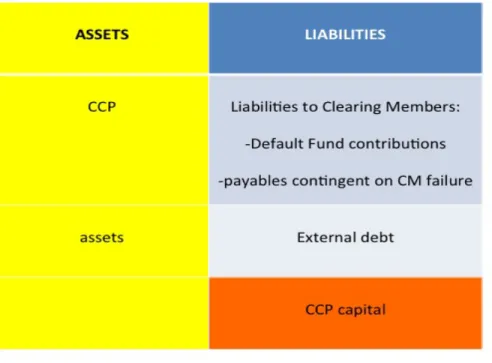
Figure 5 displays a stylized balance sheet of a CCP. A CCP collects Default Fund contributions from its members, and invests them in low-risk, liquid assets, which constitute the asset side of the balance sheet. The CCP may also hold other liabilities in the form of external debt, but one would expect the liability side of the balance sheet to be dominated by liabilities to Clearing Members stemming from Default Fund contributions.
Figure 5: Balance sheet of a CCP.
The assets of the CCP are subject to market fluctuations and, as in a bank portfolio, this leads to a prudential requirement that the CCP’s capital be sufficient to absorb these losses across a set of extreme but plausible scenarios, that is, to prevent insolvency due to market losses. But, given that CCPs typically invest in low-risk, high quality assets, the level of capital needed for this type of insolvency risk is a very small fraction of the balance sheet. Losses due to the default of a Clearing Member affect the CCP’s balance sheet in a different way. Whereas mark-to-market losses on CCP assets directly affect the capital, default losses are first absorbed by the Clearing Member’s margin and Default Fund contribution and then flow through the different steps in the loss waterfall. The CCP is affected by default losses insofar as it needs to make good on the payments to the counterparties of the defaulted
member: thus, in principle, default losses pose a liquidity risk to the CCP, not an insolvency
risk. Indeed, one could design a CCP waterfall in which all default losses are allocated to
non-defaulting members through the Default Fund and other recovery mechanisms. These losses would then eventually pose a liquidity risk to the CCP, but would not necessarily impact its equity; if this liquidity risk arises, the CCP would then attempt to raise further liquidity from non-defaulting members and eventually rely on a lender of last resort to obtain further liquidity. We call such a CCP design the “liquidity pass-through model” since it allocates all default losses to non-defaulting members through the Default Fund. In this
situation, the only insolvency risk for the CCP can arise from market losses in its investments, not from default losses. A CCP’s revenue being proportional to the volume of assets cleared, such a CCP has no incentive to increase margin levels beyond the regulatory minimum since a higher margin rate is likely to reduce the volume.
In absence of regulatory constraints, there is no incentive for a profit-maximizing CCP to deviate from this “liquidity pass-through” model. In particular, in absence of regulation requiring the CCP to expose its own capital to default losses, there is no incentive for the CCP to include a capital contribution in the waterfall, unless its members are able to exert sufficient pressure for the CCP to do so.
For CCPs, a key issue in designing the capital structure is to provide incentives to the CCP’s stakeholders to design a robust risk waterfall. The above observations show that an important variable for this purpose is the ‘skin-in-the-game’ of the CCP: the portion of its capital which is exposed to default losses in the loss waterfall. The issues are thus quite different from those pertaining to capital adequacy for banks, where the discussion has centered on the size of the capital buffer (see e.g. Admati & Hellwig 2013).
5.2. Skin-in-the-game
In order to align the risk management incentives of the CCP with those of its members, the CCP should be exposed to capital losses before the Default Fund contribution of non-defaulted members is used. This buffer should constitute a non-negligible fraction of the CCP’s equity (current regulatory discussions place it around 20-25%) in order to provide a
strong incentive for adequate risk management to the CCP.4 In order to align incentives of
CCP management with Clearing Members, CCP management, and not just shareholders, should bear some consequences in the event that this capital buffer is used.
Some waterfall designs call for a second “skin-in-the-game” contribution after the Default Fund has been depleted but before any additional resources are deployed in the recovery phase (see Figure 3). This is a sound idea and provides incentives to the CCP to maintain an adequately sized Default Fund.
Such provisions are already in place at most CCPs, but the issue has been that given the low level of CCP equity, the size of the CCP’s equity contribution is sometimes negligible compared to the Default Fund. The reason is that the many CCPs have maintained capital levels in view of the (non-default) risks faced by the CCP’s treasury rather than as a provision for Clearing Member default losses, which were traditionally viewed as a liquidity requirement affecting the collateral pool. The Basel Committee’s more recent guidelines
(BCBS 2013) try to address this by formulating capital adequacy criteria for CCPs which combine the non-default risk of the CCP’s assets and the loss waterfall, albeit in a rather opaque way which is difficult to rationalize (Ghamami 2014).
Given the impossibility of estimating the probabilities of events -joint defaults of Clearing Members- that may affect the CCP’s capital, it is difficult to adopt a quantitative, formula-based approach to CCP capital adequacy in terms of confidence levels, as done, for instance, for bank capital. If one keeps in mind that one purpose for maintaining CCP capital is “skin-in-the-game”, this implies that CCP capital should be comparable in size to the Default Fund contributions of the Clearing Members, so that the CCP faces losses of the same order of magnitude in case the “skin-in-the-game” is breached. Requiring the “skin-in-the-game” of the CCP to match, say, the largest Default Fund contribution of any member will also deter the CCP from accumulating a large exposure to any single Clearing Member. Similar ideas may be found in recent proposals by market participants (JP Morgan 2014, BlackRock 2014).
The presence of “skin-in-the-game” provisions transforms what is initially a liquidity risk resulting from default losses (as in the “liquidity pass-through model” described in 5.1) into insolvency risk for the CCP, which clearly affects the shareholders of the CCP. A further problem which needs to be tackled is the possible misalignment of incentives between shareholders and management (the so-called ‘principal-agent problem’). In order to align incentives of CCP management with shareholders and Clearing Members, CCP management should bear some consequences in the event that the CCP’s capital buffer is used. This may involve retention of bonuses or removal of management.
6. Assessing the default resources of a CCP
6.1. Stress testing of default resources
A necessary step in the assessment of a CCP’s default resources -margin requirements,
default fund contribution and the CCP’s “skin-in-the-game” contribution- is stress-testing.
Stress testing is sometimes interpreted to be synonymous with historical backtesting but based on a longer test period which includes periods of severe market turbulence: one compares, for every day in the sample, the possible losses (over the risk horizon) arising from the default of (one or two) Clearing Members with the CCP’s default resources at the time of default. The goal is to assess whether the default resources of the CCP (margin requirements and Default Fund) would have been sufficient to absorb these losses.
A broader approach to stress-testing involves counterfactual scenarios, designed to represent extreme but plausible changes in the risk factors.
A common approach is to apply these stress tests to current Clearing Member portfolios; given the turnover in member portfolios, adequacy of default resources in such a stress test does not tell us whether other configurations of member portfolios will not fail the stress test.
A more comprehensive validation should involve not just current Clearing Member portfolios but also hypothetical ‘test’ porfolios which may represent possible positions that members may bring to the CCP. This allows to track potential weaknesses in the design of the loss waterfall and identify “worst-case portfolio configuration” which maximize the strain on the CCP’s default resources.
6.2 Beyond single CCP stress tests: accounting for interconnectedness
Current CCP stress testing is limited to stress tests performed on a single CCP. However, since large financial institutions typically belong simultaneously to several CCPs and given the interoperating agreements between many CCPs, isolated stress tests of single CCPs may fail to provide an accurate picture of the levels of collateral and liquidity demand that clearing members may be subject to in the event of the default of one or more other clearing members.
Consider the case of several large dealer banks with positions in several classes of derivatives, each cleared in a different CCP. If one of these banks defaults on its margin calls in one of the CCPs, it will simultaneously default on its positions in all CCPs of which it is a member, leading to possible draws on the Default Fund of one or more CCPs. If this dealer bank happens to be the ‘largest member’ of one or more of the CCPs, its default may result
in simultaneous calls for liquidity on the surviving banks emanating from more than one CCP. This examples shows that the liquidity exposures of a Clearing Member to multiple CCPs, far from being independent, may turn out to be highly correlated to the same event, namely the default of another large Clearing Member.
Another example is the case of a large Clearing Member to which a CCP’s exposure is largest. This exposure determines the size of the Default Fund under a ‘cover one’ rule. Now assume there existing a second, competing CCP clearing the same asset class. By dividing its positions across two CCPs, this member may avoid being identified as the CCP’s largest exposure; this may lead to less Default Funds in total for the CCPs than if the large Clearing Member clears through a single CCP. Such a situation can only be acknowledged through regulatory supervision or information sharing between CCPs on common members.
A realistic assessment of the systemic risk associated with a CCP failure thus calls for stress tests which accounts for the interconnectedness of different CCPs, in particular through the presence of common Clearing Members. Such stress tests require data sharing between CCPs and monitoring of cross-membership and cross-margin agreements by supervisory authorities.
6.3 How risky are Default Fund assets?
An important issue regarding stress testing is how to make use of the results of a stress test. Beyond a simple assessment of failure or success, stress tests may be used as a method for assessing the risk of assets held in the Default Fund. These assets, which remain on the balance sheet of the Clearing Member, are subject to a capital charge and are affected a “risk weight” which, under the Basel III proposal, is 2% for “qualified CCPs”. A more complex
formulation has been proposed for risk weights attached to Default Fund exposures5.
Default Funds of CCPs have been growing in size over the last few years and may constitute a substantial sum in the balance sheet of Clearing Members, so the issue of these risk weights and the associated capital charges is quite important.
It should be clear from the presentation of the CCP loss waterfall that the risk of assets held in the Default Fund depends on “what’s underneath”, i.e the level of margin requirements and ‘skin-in-the-game’, which varies across CCPs. In this respect, a risk weight attached to Default Fund exposures which does not take into account the quality of the risk management of the CCP would provide the wrong risk incentives and encourage a “race to the bottom”.
To use a “CDO” analogy, each Clearing member is exposed to the first losses in its own
portfolio (“equity tranche”) up to the level given by its margin plus its Default Fund contribution; losses exceeding this level flow are first absorbed by a portion of the CCP’s capital (“mezzanine tranche”) and then absorbed by other members’ Default Fund contribution. Thus, each member holds the ‘senior tranche’ of other members losses; the risk of the assets held against the Default Fund therefore depends on the level of subordination of this “senior tranche”, which depends in turn on the level of margin and Default Fund requirements in the CCP. Accordingly, the risk weight assigned to Default Fund assets and the corresponding capital charge for Clearing Members should depend on the quality of the risk management of the CCP, as assessed for example through independent stress testing of its default resources.
A risk weight based on a stress test of the default resources of the CCP would provide Clearing Members with an incentive to clear with CCPs with better risk management standards, whereas a flat risk weight for Default Fund assets encourages a “race to the bottom” for a profit-maximizing CCP with the objective of maximizing clearing volume. Using CCP stress tests for determining the risk of the Default Fund implies some degree of standardization in stress tests to ensure comparability of stress test results across CCPs clearing the same asset class. This calls for the supervisor, or an independent entity charges with stress testing, to design a series of stress scenarios for each asset class which can then be used to calibrate Default Fund levels and risk weights.
The comparability of results across CCPs, especially in the same asset class, is important: it provides an objective basis for assigning higher risk weights to assets held against Default Funds of CCPs deemed less resilient to stress. Differentiation of risk weights across CCPs is a natural way of preventing the ‘race to the bottom’ and giving incentives to market participants for clearing transaction through CCPs with better risk management standards.
6.4. How reliable are unfunded default resources ?
Currently, most CCP waterfalls include unfunded default resources, the most important of which
is an assessment right for Default Fund contributions : in the event that the existing Default Fund is insufficient to cover losses, the CCP may request from all (non-defaulted) Clearing Members an additional contribution proportional to their previous contribution to the Default Fund. in order to replenish the Default Fund. In some CCPs, the contribution is uncapped. In other CCPs, this contribution is capped by the pre-default contribution of each member.
The presence of such assessment rights potentially gives the CCP access to a much larger pool of resources to cover losses in stress scenarios. Even in the case where the assessment right is capped by the pre-default contribution of clearing members, this leads to a pool which is double the size of the (funded portion of the) Default Fund. Some CCPs treat this unfunded portion as part of their default resources when performing stress tests.
However, if one considers that the depletion of the Default Fund will most probably occur in a stress scenario where two large Clearing Members have already defaulted, the risk that other non-defaulted members may fail to raise enough liquidity to make large payments to the Default Fund in such a stress scenario is non-negligible. This is due to the fact that some non-defaulted members may have been partially exposed to the same shocks or market losses which resulted in the failure of defaulted members.
This observation shows that the unfunded portion of the Default Fund should be considered as an uncertain cash flow and that the risk of its non-payment is correlated with the default events which trigger the assessment rights. In the terminology of credit risk, the unfunded portion of a CCP default fund is in general subject to « wrong-way risk ». To our knowledge, this aspect has not been taken into account when assessing default resources of CCPs and the unfunded portion is sometimes incorrectly considered on the same level as the funded component in stress tests. We also note that a quantitative assessment of this wrong way risk may be quite challenging, so a conservative baseline assumption in CCP stress tests would be to rely solely on funded resources.
Even in the situation where the surviving members have the necessary resources for meeting the assessment payments for replenishing the Default Fund, they will have an incentive not to do so, by terminating their membership and either closing their positions or migrating to another CCP.
Some CCPs have clauses in their membership agreements which enforce the CCP’s assessment rights by considering payment of the assessment as a default of the non-paying member ; this may reduce the risk of non-payment from the CCP’s viewpoint, this
may have undesirable consequences from a financial stability perspective. Indeed, such a mechanism subjects surviving members to potentially large draws on their liquidity resources and may lead to their default. Bearing in mind that the intitial purpose of central clearing is to mitigate the contagion arising from a member’s default, enforcing a rule which would increase the likelihood of other members defaulting in such a scenario would be paradoxical. In addition to being pro-cyclical, such assessments run the risk of not being provisioned when required due to members lacking the liquidity resources in a stress scenario. Thus, the unfunded portion of the Default Fund may not materialize as expected in a stress scenario and is subject to wrong-way risk. If the CCP retains assessment rights for the Default Fund, such assessment rights should be provisioned for in the liquidity reserve of Clearing Members in order to ensure payment. If the Clearing Member is a bank, such assessment rights should enter into the denominator of the member’s Liquidity Coverage Ratio as a liquidity outflow in a stress scenario. Under the Basel III bank liquidity regulation framework, this forces the bank to provision for the unfunded portion of the Default Fund upfront, which requires the assessment to be capped and makes it less of an advantage compared with the funded portion of the Default fund contribution.
In summary, we have argued that although there may be no downside for the CCP itself in including such unfunded components in the loss waterfall, the above arguments show that these unfunded contributions
-may fail to materialize when needed and they should be treated as subject to wrong way risk ; in particular the actual contribution of Default Fund assessment rights to the default resources of the CCP may in fact be much less than suggested by their notional size and difficult to assess in an objective manner;
-should be provisioned for in the liquidity reserves of Clearing Members which, if the members are banks, affects their Liquidity Coverage Ratio;
-in the event that their payment is enforced, they may lead to undue stress on liquidity resources of non-defaulted Clearing Members and act as a mechanism of contagion for liquidity shocks, which contradicts the very purpose of the CCP.
Prudential regulation of CCPs should therefore take into account the risky nature of unfunded resources and give priority to funded resources. This is contrast to Basel III proposals (BCBS 2013) which do not distinguish funded and unfunded Default Fund contributions when determining the CCP’s default resources or risk weights for default fund exposures.
including any unfunded portion in a CCP’s default resources. Whether or not one supports this view, which is not without merit, the above discussion pleads for relying primarily on funded resources when assessing the default resources of a CCP for stress testing purpose and recognizing the possibility of non-payment of any unfunded resources such as Default Fund assessment rights. From a financial stability perspective, such assessment rights should be capped and either provisioned for by Clearing Members in terms of liquidity reserves or removed from the table.
7. The end of the waterfall : recovery mechanisms for CCPs
In the situation where the losses exceed the total available Default Fund (including assessments) and the CCP’s contribution from its own capital, one reaches the “end of the waterfall”. In such a scenario, most other financial institutions, such as banks, would enter a resolution procedure and restructuring or liquidation would then ensue. However, given the CCPs’ systemically important role as a conduit for transactions of other large financial institutions, it may be desirable to use further resources to ensure the continuity of the CCP’s clearing services to prevent further contagion from the triggering event of the CCP’s losses. These operations, known as ‘recovery arrangements’, act as a temporary backstop and may, if successful deployed, delay further losses to the CCPs until the market situation is re-established and default resources may be replenished to pre-stress levels.
7.1 Variation Margin Haircuts (VMGH)
If a Clearing Member defaults primarily due to losses on its positions cleared within the CCP, then these losses materialize as large variation margin payments to other Clearing members. These variation margin payments are thus sufficient in principle to cover the (market) losses generated by the defaulting member’s portfolio. Variation Margin Haircutting (VMGH) consists in using these variation margin payments as a source of funds for recovery of the CCP’s default resources.
When haircutting variation margin, the CCP may reduce pro rata the amount it is due to pay participants with in-the-money positions, while continuing to collect in full from those participants with out-of-the-money positions. This procedure is meant to be a temporary means for recovery of the CCP’s default resources. Clearing Members whose variation margin payments are withheld may receive notes which they may redeem once the CCP has recovered; alternatively they may receive shares of the CCP’s equity.
The key attractive feature of VMGH is that it taps a resource which, by definition, is sufficient to absorb the market losses of the defaulting member’s portfolio since this loss is mirrored in variation margins flowing to the counterparty. However, if loss of resources of