University of Nebraska - Lincoln
DigitalCommons@University of Nebraska - Lincoln
Nebraska Department of Transportation Research
Reports Nebraska LTAP
3-2016
Active Traffic Management Case Study: Phase 1
Anuj Sharma
Iowa State University, [email protected]
Shuo Wang
University of Nebraska-Lincoln Aemal Khattak
University of Nebraska-Lincoln, [email protected]
Follow this and additional works at:http://digitalcommons.unl.edu/ndor Part of theTransportation Engineering Commons
This Article is brought to you for free and open access by the Nebraska LTAP at DigitalCommons@University of Nebraska - Lincoln. It has been accepted for inclusion in Nebraska Department of Transportation Research Reports by an authorized administrator of DigitalCommons@University of Nebraska - Lincoln.
Sharma, Anuj; Wang, Shuo; and Khattak, Aemal, "Active Traffic Management Case Study: Phase 1" (2016).Nebraska Department of Transportation Research Reports. 194.
Active Traffic Management Case Study: Phase 1
Technical Report Documentation Page 1. Report No.
SPR-P1(14) M007
2. Government Accession No. 3. Recipient's Catalog No.
4. Title and Subtitle
Active Traffic Management Case Study: Phase 1
5. Report Date March 2016
6. Performing Organization Code
7. Author(s)
Anuj Sharma, Shuo Wang, and Aemal Khattak
8. Performing Organization Report No. SPR-P1(14) M007
9. Performing Organization Name and Address
Iowa State University for University of Nebraska-Lincoln 527 Nebraska Hall
PO Box 830851
Lincoln, NE 68588-0529
10. Work Unit No. (TRAIS)
11. Contract or Grant No.
12. Sponsoring Agency Name and Address Nebraska Department of Roads
1500 Hwy. 2 Lincoln, NE 68502
13. Type of Report and Period Covered
August 2013 – December 2015
14. Sponsoring Agency Code
15. Supplementary Notes
16. Abstract
This study developed a systematic approach for using data from multiple sources to provide active traffic management solutions. The feasibility of two active traffic management solutions is analyzed in this report: ramp-metering and real-time crash risk estimation and prediction. Using a combined dataset containing traffic, weather, and crash data, this study assessed crash likelihood on urban freeways and evaluated the economic feasibility of providing a ramp metering solution. A case study of freeway segments in Omaha, Nebraska, was conducted. The impact of rain, snow, congestion, and other factors on crash risk was analyzed using a binary probit model, and one of the major findings from the sensitivity analysis was that a one-mile-per-hour increase in speed is associated with a 7.5% decrease in crash risk.
FREEVAL was used to analyze the economic feasibility of the ramp metering implementation strategy. A case study of a 6.3 mile segment on I-80 near downtown Omaha showed that, after applying ramp metering, travel time decreased from 9.3 minutes to 8.1 minutes and crash risk decreased by 37.5% during the rush hours. The benefits of reducing travel time and crash cost can easily offset the cost of implementing ramp metering for this road section.
The results from the real-time crash risk prediction models developed for the studied road section are promising. A
sensitivity analysis was conducted on different models and different temporal and spatial windows to estimate/predict crash risk. An adaptive boosting (AdaBoost) model using a 10 minute historical window of speeds obtained from 0.25 miles downstream and 0.75 miles upstream was found to be the most accurate estimator of crash risk.
17. Key Words
active traffic management, crash risk, ramp metering
18. Distribution Statement
19. Security Classif. (of this report) Unclassified
20. Security Classif. (of this page) Unclassified
21. No. of Pages 70
Active Traffic Management Case Study: Phase 1 Final Report
Anuj Sharma, PhD
Research Scientist and Associate Professor
Center for Transportation Research and Education Institute for Transportation
Iowa State University Shuo Wang, MS
Graduate Research Assistant
Civil, Construction, and Environmental Engineering Iowa State University
Aemal Khattak, PhD Associate Professor Civil Engineering
University of Nebraska-Lincoln
A Report on Research Sponsored by
Nebraska Department of Roads
Table of Contents
DISCLAIMER ... ix
EXECUTIVE SUMMARY ...x
1. INTRODUCTION ...1
2. LITERATURE REVIEW ...3
2.1 Aggregate-Level Crash Model ...3
2.2 Disaggregate Level Crash Model...4
2.3 Classification with Imbalanced Data ...7
3. DATABASE DEVELOPMENT ...10
3.1 Road Network ...10
3.2 Data Description ...10
3.3 Data Integration ...11
3.4 Data Processing Platform ...11
4. EXPLORATORY DATA ANALYSIS ...13
4.1 Data Visualization – Traffic Speed Heat Maps ...13
4.2 Speed, Weather, and Crashes ...15
5. CRASH RISK ASSESSMENT ...18
5.1 Correlation among Crashes, Speed, and Weather Conditions ...18
5.2 Crash Risk Modeling and Sensitivity Analysis ...20
6. TRAFFIC PERFORMANCE MEASURE AND BOTTLENECK IDENTIFICATION...24
6.1 Speed Based Performance Measure ...24
6.2 Bottlenecks on the Omaha Urban Freeway System ...27
7. EVALUATING THE IMPACTS OF RAMP METERING ...34
7.1 Modeling the Bottleneck Segment ...34
7.2 Speed to Volume Conversion and Model Validation ...35
7.3 Ramp Metering Evaluation ...37
7.4 Cost-Benefit Analysis ...39
8. CRASH ESTIMATION/PREDICTION AND POTENTIAL APPLICATIONS ...41
8.1 Crash Estimation/Prediction Using a Single Speed Variable ...41
8.2 Crash Estimation Using Multiple Speed Variables ...42
8.2.1 Data Structure, Window Selection, and Distinction ...43
8.2.2 Resampling ...45
8.2.3 Modeling Algorithms and AdaBoost ...45
8.2.4 Model Performance Metric ...45
8.2.5 Model Comparison...46
8.3 Potential Applications ...48
9. CONCLUSIONS AND RECOMMENDATIONS ...49
9.1 Findings...49
9.2 Limitations and Future Work ...50
REFERENCES ...51
List of Figures
Figure 2.1 Previously used aggregate-level crash analysis models ... 3
Figure 2.2 Previously used disaggregate-level crash analysis models ... 5
Figure 2.3 Best predictors found in the literature ... 5
Figure 2.4 Predictor selection by Abdel-Aty et al. (2) ... 6
Figure 3.1 RTMS locations in the Omaha area... 10
Figure 4.1 Annual average speed of I-80 westbound in Omaha in 2008 ... 13
Figure 4.2 Daily speed heat map of I-80 westbound in Omaha in December 2008 ... 14
Figure 4.3 Daily speed heat map of eastbound I-80 in Omaha in September 2013 ... 15
Figure 4.4 Clustered daily congestion overlaid with crashes and precipitation ... 16
Figure 6.1 Congestion counts for I-80 westbound in Omaha on weekdays in 2008 ... 24
Figure 6.2 Average travel time delay for I-80 westbound in Omaha on weekdays in 2008 ... 25
Figure 6.3 Monthly travel time profile for I-80 westbound in Omaha in 2008 ... 26
Figure 6.4 Monthly traffic speed profile for I-80 westbound in Omaha in 2008 ... 27
Figure 6.5 Summary of AM and PM congestion in 2008 and 2009 ... 29
Figure 6.6 Cumulative travel time delay on I-80 westbound in 2008 and 2009 ... 30
Figure 6.7 Cumulative travel time delay on I-80 eastbound in 2008 and 2009 ... 30
Figure 6.8 Average daily traffic condition on I-80 eastbound in 2008 ... 31
Figure 6.9 Daily traffic conditions on I-80 eastbound in August 2008 ... 32
Figure 6.10 Average traffic conditions on I-80 eastbound on Fridays ... 32
Figure 6.11 Bottleneck on I-80 eastbound near downtown Omaha ... 33
Figure 7.1 Segment selected for ramp metering analysis with nine sensors on I-80 eastbound ... 34
Figure 7.2 Ramps and sensor locations on the studied roadway ... 34
Figure 7.3 Speed-flow curves from HCM 2010 ... 35
Figure 7.4 Speed-flow curves for the study segments ... 36
Figure 7.5 Speed profile for the studied segment without ramp metering... 38
Figure 7.6 Speed profile for the study segment with ramp metering... 38
Figure 8.1 Daily speed heat maps overlaid with crashes for the studied segment... 43
Figure 8.2 Attribute selection for crash likelihood prediction ... 43
Figure 8.3 Speed heat maps for randomly selected non-crash cases (top row) and crash cases (bottom row) ... 44
Figure 8.4 Distribution of speed for crash and non-crash cases ... 45
Figure 8.5 ROC curve colored according to cut-off threshold ... 46
Figure 8.6 AUC of different classifiers on nine training sets ... 47
Figure 8.7 Eleven windows used for building a big data model ... 47
List of Tables
Table 2.1 Comparison of aggregate-level models ... 4
Table 4.1 Data summary statistics of I-80 westbound in Omaha in 2008 ... 16
Table 5.1 Crash summary for I-80 westbound in Omaha in 2008 ... 18
Table 5.2 Contingency analysis of weather conditions by traffic speed... 19
Table 5.3 Nonparametric chi-square test results for crash distribution ... 20
Table 5.4 Descriptive statistics of variables ... 21
Table 5.5 Estimated parameters by the binomial probit model ... 22
Table 5.6 Sensitivity analysis: Estimated elasticity ... 23
Table 7.1 Summary of characteristics for the 18 studied segments ... 35
Table 7.2 Model validation summary ... 37
Table 7.3 Nebraska cost estimate for motor vehicle crashes in 2013 ... 40
Disclaimer
The contents of this report reflect the views of the authors, who are responsible for the facts and the accuracy of the information presented herein. This document is disseminated under the sponsorship of the Nebraska Department of Transportation in the interest of information exchange. The contents do not necessarily reflect the official views of the Nebraska Department of Roads. This report does not constitute a standard, specification, or regulation. The U.S. Government assumes no liability for the contents or use thereof.
Executive Summary
This report documents a study of active traffic management on an urban freeway system in Omaha, Nebraska. The objective of this study was twofold: (1) evaluate the benefits and costs of ramp metering in terms of alleviating traffic congestion and reducing delay and crash risk and (2) report the feasibility of crash risk estimation and prediction using real-time speed information.
This study demonstrates a systematic way to use multiple data sources for traffic condition monitoring and operations decision support. A comprehensive database was built by integrating traffic speed data from radar sensors, weather information from roadside weather stations, and crash reports from the police department. An automatic data visualization program was created to easily display traffic conditions with archived speed data in multiple time
intervals and distance ranges. Various traffic performance measures were developed to help understand the traffic conditions across different road segments or different time periods and to identify bottlenecks in the urban freeway network. The data visualization program can also be used with a real-time data feed to monitor and analyze current traffic conditions.
With the comprehensive database, this study performed two levels of analysis for crash risk assessment. The aggregate-level analysis was used to identify the crash contributing factors. Statistical hypothesis tests were used to examine the relationships between crash occurrence and potential contributing factors such as traffic speed and weather conditions (e.g., precipitation). A binomial probit model was built and a sensitivity analysis was conducted to quantify the impacts of the crash contributing factors. The model found that a one mile per hour increase in traffic speed is associated with 7.5% decrease in crash risk.
A comprehensive analysis of five urban freeway segments was also performed. A 6.3 mile long segment on I-80 eastbound near the downtown area was identified as a bottleneck. This segment was used as a study subject for implementing ramp metering strategy. A cost-benefit analysis focusing on the impact of ramp metering on travel time and crash risk indicated that the ramp metering strategy was cost-effective.
The crash risk estimation and prediction models used disaggregate-level analysis. Multiple data mining methods were applied and compared. Related issues were considered, including attribute selection, sampling, ensemble learning, and performance metrics. The disaggregate-level analysis showed that using a combination of speed data from a series of time intervals for both the upstream and downstream segments and the target road segment can capture the details of traffic conditions and predict crash risk reasonably well. Also, it is possible to increase the buffer time to improve the reaction time of operations by moving the time
window earlier. However, as a trade-off to acquiring more time to respond, the model prediction accuracy could degenerate.
Some good insights can be drawn from this study. The integrated database, data processing platform, and data visualization methods developed in this study were found to be very helpful for understanding the traffic problem from a comprehensive perspective. The proposed real-time crash prediction mechanism is ready for real-world implementation in subsequent phases of the study.
1. Introduction
While traffic congestion tends to increase continuously, the growth of transportation infrastructures is limited by the availability of financial and land resources, especially in urban areas. This has led to the use of intelligent transportation systems (ITS) to efficiently manage the existing capacities of transportation systems. Active traffic management (ATM) is a method of smoothing traffic flows on busy urban freeway segments based on real-time traffic conditions so that better traffic system performance can be achieved. ATM is different from the conventional passive traffic management because ATM can actively respond to traffic, weather, and other available information in real-time to increase traffic safety and operational reliability. Some of the most notable ATM strategies include ramp metering, speed harmonization, temporary shoulder use, junction control, and dynamic signing and rerouting.
In Nebraska, the main traffic management methods passively react to traffic conditions. These traditional management methods may not be capable of handling the increased travel demands during peak periods. Therefore, advanced traffic management methods like ATM are desired to provide a better understanding of current traffic conditions, predict short-term trends, and proactively apply optimal control strategies. For any effective traffic management system such as ATM, the basic requirement is a reliable, spatially dense network of traffic detectors that can obtain essential data. The Nebraska Department of Roads (NDOR) has been investing significant resources in ITS infrastructure such as sensors, dynamic message signs, and roadside weather stations. The existing traffic surveillance systems in NDOR’s jurisdiction collect an enormous amount of data in real-time. This data collection lays the foundation for implementing an advanced traffic management system and provides the data sources necessary for monitoring and identifying high crash risk locations.
Crash prediction can be treated as a classification problem in the field of data mining. Observed instances (labeled as crash or non-crash) are used to build a classifier that can best distinguish crashes from non-crash cases using traffic sensor information. The likelihood of a crash has to be estimated on a real-time basis because the likelihood is significantly affected by short-term turbulence in the traffic flow. Therefore, high-resolution data, that is, data collected in short time intervals, are required. The high-resolution data for real-time crash prediction can be extremely imbalanced. For example, in a one-year data set aggregated in five-minute intervals for a road segment with 10 crashes, the ratio of crash instances to non-crash instances is as low as 10:105,110 (every five-minute interval is treated as an instance, and there are only 10 crash cases out of a total of 105,120 instances in one year). Consequently, real-time crash prediction can be seen as a classification problem with an extremely imbalanced class distribution. Here, “non-crash” is the major class and “crash” is the minor class.
The size of the data set, along with the extreme imbalance, could become an issue due to the computational capacity of the hardware used to process the data. To address this concern, H2O, a big data tool, was introduced. This tool uses a batch processing technique that allows the training of a model on a large data set. Both imbalance and data size issues are carefully
addressed in this report.
To analyze the effect of a ramp metering strategy, FREEVAL (FREway EVALuation), a computational engine provided in the Highway Capacity Manual (HCM) by the Transportation Research Board of the National Academy of Sciences, was used as the tool to study the travel time reduction after the implementation of ramp metering.
This report is organized as follows. A literature review summarizing previous related studies is provided in Chapter 2. Chapter 3 presents the data used in this report and discusses the integrated database and data processing platform. The details of the data visualization procedure and its findings are described in Chapter 4. Chapter 5 presents the binomial probit model for identifying the crash contributing factors. Chapter 6 discusses the identification of traffic bottlenecks. The performance of ramp metering is evaluated in Chapter 7. Chapter 8 discusses real-time crash prediction comprehensively and explains some potential applications. Chapter 9 concludes with the findings of this study and discusses future recommendations.
2. Literature Review
This chapter provides a review of the literature on traffic crash prediction. The crash prediction techniques can be classified into two categories: aggregate level and disaggregate level. Aggregate-level models link crash statistics (such as number of crashes, crash rate, etc.) to potential effective factors and quantify the impact of each factor by estimating the coefficient for it. Disaggregate-level models focus on each individual crash or non-crash case. These models classify crash and non-crash cases based on observable factors and predict crashes in the short-term future. Traffic crash data are extremely imbalanced, which highly influences the
performance of disaggregate-level crash prediction models. Research related to imbalanced data is discussed in this chapter.
2.1 Aggregate-Level Crash Model
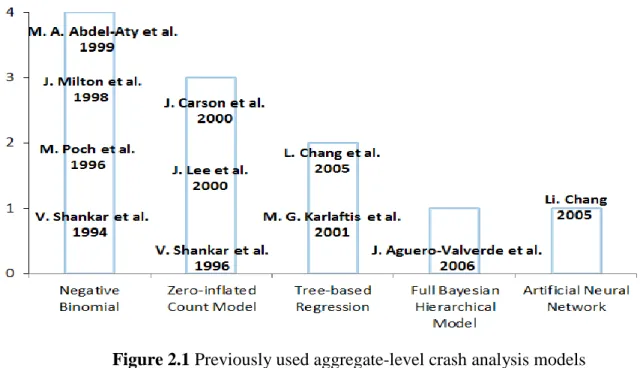
Most commonly, for aggregate models a crash performance function is built using regression models to grade the parameters of geometric and traffic characteristics according to their contribution to crash potential. Besides the regression models, some black-box algorithms such as artificial neural networks are used for constructing the crash performance function. Figure 2.1 summarizes some of the aggregate crash analysis models previously used.
Figure 2.1 Previously used aggregate-level crash analysis models The models’ advantages and disadvantages are provided in Table 2.1.
Table 2.1 Comparison of aggregate-level models
2.2 Disaggregate Level Crash Model
Geometric and general traffic characteristics are analyzed as predictor variables while crash frequencies are treated as the response to identify the factors that contribute to high crash potential. Aggregate-level approaches are not an appropriate fit for the real-time crash prediction problem, but using them in a preliminary analysis helps to understand the impact of potential predictive factors and supports attribute selection. The aggregate-level preliminary crash analysis for this study is presented in Chapter 5.
For the real-time crash prediction problem, a disaggregate-level approach attempts to classify individual cases (e.g., a five-minute interval) as a “crash” case (i.e., a crash occurred within the minute interval) or “non-crash” case (i.e., no crash occurred within the five-minute interval). For such analyses, previous studies have usually built models using data that contain predictors in a certain time interval prior to the occurrence of the accident and the
corresponding crash data. The models are then used to predict crash occurrence in the near future. The major predictors used in disaggregate-level models are traffic-related characteristics such as speed, volume, and occupancy. The level of aggregation and the locations of traffic data
collection can significantly influence the models’ performance. Some of the previous models used in disaggregate-level analysis and the most significant predictors are summarized in Figures 2.2 and 2.3.
Model/Method Advantage Disadvantage
Poisson and negative
binomial (NB) Easy estimation
Poisson model cannot handle over- and under-dispersion, while NB can only deal with over-dispersed data
Zero-inflated and random effect negative
binomial
Able to deal with all
kinds of data Requires a specified functional form Classification and
regression tree (CART)
Does not require a specified functional form
Has the risk of over-fitting and cannot handling the interactions between risk factors
Artificial neural network (ANN)
Does not require a specified functional form and can handle the interactions between the predictors
Difficult to perform elasticity and elasticity analyses, which is important to provide the marginal effects of the variables on crash frequency
Full Bayesian (FB) hierarchical approach
Capable of accounting for uncertainty
Figure 2.2 Previously used disaggregate-level crash analysis models
Figure 2.3 Best predictors found in the literature
As shown in Figure 2.4, previous studies have chosen predictors in different time domains.
Figure 2.4 Predictor selection by Abdel-Aty et al. (2)
For example, Abdel-Aty and Pande (0) found that the logarithm of the coefficient of variance (CV) of speed 10 to 15 minutes prior to the crash occurrence can significantly affect crash potential, and the authors used it as the only predictor.
Figure 2.3 shows that some studies used a short time interval immediately before the study’s time point as the time domain of the crash prediction model. In practice, this kind of attribute selection strategy leaves no time for the operation system to respond to the predicted crash. A model built on such strategy is more likely to be a quick crash identification model. Other studies (such as the bottom five studies in Figure 2.3) used a time interval to identify crash propensity that is prior to (e.g., 10 to 15 minutes before) the study time point. This kind of attribute selection could be appropriate for practical use in traffic operations because it provides some time to take action to avoid the predicted crash. In addition to different time domains, different distance domains were also considered in the previous studies shown in Figure 2.3. The crash likelihood on a certain road segment may be influenced by the traffic conditions on
adjacent segments. For example, the congestion at a certain location might influence the
likelihood of rear-end crashes in the upstream segment, or a high-volume merging location may increase the likelihood of side-swipe crashes in the downstream segment because of the high lane change frequency. Therefore, to determine the influenced range, the study of predictors in
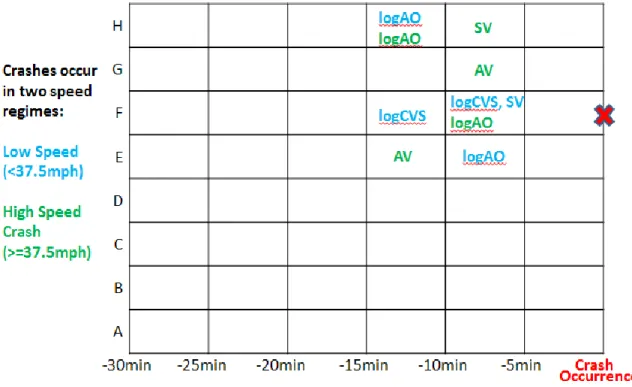
different distance domains is critical. Abdel-Aty et al. (2) conducted a comprehensive case study of analysis window selection in both the time and distance domains. The researchers divided the time domain into six slices by five-minute increments (i.e., the first slice is zero to five minutes prior to study time point, the second slice is five to ten minutes prior to study time point, and so on). The distance to the study location was divided into eight segments according to the location of traffic detectors. The detectors are labeled A through H, from upstream to downstream, in Figure 2.4. For each time and location combination, six independent variables (AV: average
volume, SV: standard deviation of volume, AS: average speed, logCVS: logarithm of coefficient of variation of speed, logAO: logarithm of average occupancy, SO: standard deviation of
occupancy) were used as predictor variables so that a total of 288 (6 × 8 × 6) variables were tested for each case. The crashes were also classified into low-speed and high-speed crashes and modeled separately. Figure 2.4 shows the significant predictor variables, and the point of the study target is marked as a red X. The most significant slots were located within the nearest two detectors both upstream and downstream and from 5 to 15 minutes prior to the study point. The optimal slots varied by target location.
In Chapter 8 of this report, different data mining methods are used to develop a
disaggregate-level crash prediction model, and the selection of the analysis window is carefully examined.
2.3 Classification with Imbalanced Data
Previous work has pointed out that class imbalance can significantly limit the performance attainable by most standard classifier learning algorithms (3). Most standard classifiers assume equal class distribution and equal misclassification costs, which does not hold true in most classification problems with an imbalanced data set. In using the standard
classification approach in a real-time crash prediction problem, the crash cases tend to be ignored while the overall prediction accuracy can be close to 100% for non-crash cases (e.g., for 10 crashes out of 105,120 cases, the accuracy is 105110/105120 = 0.9999905 if all cases are predicted as non-crash cases). Sun et al. (4) comprehensively reviewed solutions to address the problems of performing classification with imbalanced data and categorized the solutions into the data-level approach and the algorithm-level approach.
For the data-level approach, the objective is to rebalance the class distribution by resampling the data space, including oversampling instances of the minor class and
undersampling instances of the major class. Padmaja et al. (5) applied two data-level approaches to a highly overlapped and imbalanced data set of automobile insurance information to resample the fraud and non-fraud cases: (1) a hybrid sampling technique that is a combination of
oversampling the minority data and undersampling the majority data and (2) an extreme outlier elimination data cleaning method for eliminating extreme outliers in minority regions. On using the resampled data set in analysis, improved performance of the classifier was reported.
For the algorithm-level approach, the solution is to adapt existing classifier learning algorithms to create a bias towards the minor class. Ensemble learning techniques, such as
adaptive boosting (AdaBoost), and cost-sensitive learning are the two main approaches. Sun et al. (6) introduced cost items into the learning framework of AdaBoost. On investigating the effect of this cost-sensitive meta-learning technique on most classifier learning algorithms, better results were found in most of the experiments.
Rather than working specifically on either data-level or algorithm-level approaches, most previous studies combined the resampling method with a minor class–adapted algorithm to improve classification performance. Phua et al. (7) proposed an innovative fraud detection method named stacking-bagging that combined minor class oversampling with a meta-learning technique. Seiffert et al. (8) introduced random undersampling into AdaBoost. Tang et al. (9) applied both oversampling and undersampling and cost-sensitive items to support vector machine–based strategies. Khalilia et al. (10) combined repeated random subsampling with the
random forest method. The performance of these hybrid methods match or surpass most standard classifiers.
As to real-time crash prediction, although most studies work on both the data level and the algorithm level to build a crash classifier, few studies have emphasized or focused on the data imbalance problem, which greatly hinders the performance of standard data mining algorithms. This data imbalance problem is a relative rarity rather than an absolute rarity (3) because a large amount of traffic surveillance and crash data are available. The simplest method to tackle relative rarity is to undersample the non-crash cases. This method is used in most models at the data level. Another reason for undersampling the non-crash cases is because the size of the data set for real-time crash prediction is usually too large to be handled by normal analytic tools.
Other than randomly undersampling the non-crash cases, the most common method used is the matched case-control method, which has proven to be an efficient method for studying rare events in the field of epidemiology (11). For either randomly undersampling or matched case-control methods, the key issue is to determine the optimal class distribution. Weiss and Provost (12) implemented a thorough experimental study on the effect of a training set’s class
distribution on a classifier’s performance using artificial data sets. The findings indicated that a balanced class distribution (a class size ratio of 1:1) performed relatively well but is not
necessarily optimal. Optimal class distributions vary by the data used. Abdel-Aty et al. (13) used matched case-control sampling with a control-to-case ratio of 5:1, while Zheng et al. (14) and Xu et al. (15) used a control-to-case ratio of 4:1. Pande and Abdel-Aty (16) studied 49 lane change– related collisions along with 1,096 randomly selected non-crash cases. Another study by these authors (17) used a distribution of 2,179 crashes and 150,000 (0.04% of a total of 362,862,720 cases) randomly selected non-crashes. Data sets with different class distributions have been documented in the literature, but few studies have investigated the impact of class distribution on model performance for real-time crash prediction.
In most of the previous research on algorithm-level models, logistic regression or classifiers based on probabilistic neural networks (PNN) have been applied with little concern for the data imbalance problem. Abdel-Aty and Pande (18) and Oh et al. (19) applied PNN to real-time crash prediction in 2004. Abdel-Aty et al. (13) then conducted an analysis using a logistic regression model in 2005. Xu et al. (20) built a sequential logit model to predict crashes with severity in 2012. In 2013, Hossain and Muromachi (21) introduced an ensemble learning method, which is recognized as an effective approach for tackling the imbalanced classification problem. In their study, a random multinomial logit model (RMNL), a random forest of logit models, was applied to very high-resolution traffic data (eight-millisecond raw data grouped into five-minute aggregate data) collected in Tokyo for real-time crash prediction; good prediction performance was reported.
Another issue that can be identified in studies on real-time crash prediction models is inappropriate or unclear model performance metrics. Because the cost of ignoring a crash case (positive) is much higher than misclassifying a non-crash case (negative), the overall accuracy is not as important as the true positive rate (or sensitivity or recall) and the false positive rate (or false alarm rate). A high true positive rate and a low false alarm rate are desired, but there is a trade-off between the two. A higher true positive rate can always be achieved by increasing the classification cut-off threshold, but the false positive rate can also rise as a result. The optimal threshold for the performance metric varies across models. The receiver operating characteristic (ROC) curve and the total area under the curve (AUC) are the most appropriate performance
metrics for classifiers (12). Most of the aforementioned studies provided the model performance metric at the threshold with highest overall accuracy, which makes it difficult to compare the performance of the model across different studies.
This chapter summarized previous studies on urban freeway crash analysis. At the
aggregate level, statistical models and long time-scaled data (e.g., data aggregated monthly) have been used to examine the impact of factors contributing to crash risk. At the disaggregate level, short time-scaled data (e.g., data aggregated every 20 seconds) have been used to develop crash prediction models. In order to improve the accuracy of crash prediction models in a way that has more practical value, both data-level and algorithm-level approaches were studied. In this study, both aggregate- and disaggregate-level crash analyses were conducted using traffic speed data collected by field sensors, and this report includes a comprehensive discussion on ways to improve crash prediction accuracy. The following chapter describes the data and the data processing platform.
3. Database Development
Good data sources and high-quality data are essential for any analysis. This chapter describes the data sources as well as the integrated database and automated data processing platform used in this study.
3.1 Road Network
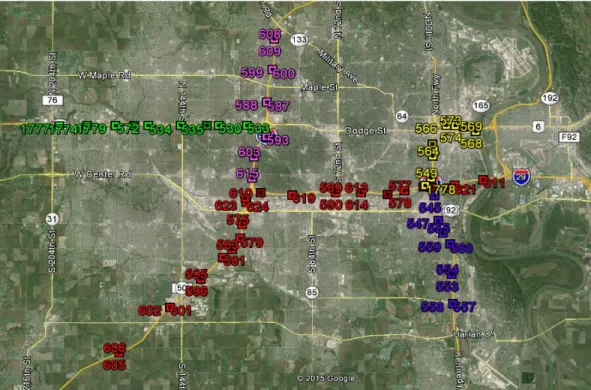
This study focuses on urban freeways and major arterials in the Omaha, Nebraska, area. NDOR has installed permanent remote traffic microwave sensors (RTMS) on five routes in Omaha, including I-80, I-480, I-680, US-75, and West Dodge Street. Figure 3.1 shows the geo-locations of the RTMS. The sensors on I-80, I-480, I-680, US-75, and West Dodge Street are colored in red, yellow, pink, violet, and green, respectively. The studied road segments are those covered by the sensors shown in Figure 3.1.
Figure 3.1RTMS locations in the Omaha area 3.2 Data Description
Three data sources were available for this study:
Traffic speed data: The RTMS vendor, Speed Info, provides one-minute speed data for each sensor from 2008 to 2014. These speed data were obtained from NDOR’s Microsoft SQL Server database.
Weather data: The temperature and precipitation data collected from roadside sensors were also obtained from NDOR’s Microsoft SQL Server database. Due to the low
quality and incompleteness of the data, additional weather data (in CSV format) were downloaded from MesoWest (http://mesowest.utah.edu/) for validation purposes. Crash data: The crash records (in CSV format) of Douglas County and Sarpy County
from 1997 to 2012 were provided by the Omaha Police Department. 3.3 Data Integration
In this study, data integration is defined as the process of storing all the related data from different sources in a single database with the same format. This method of data processing ensures consistency throughout the database and makes the data processing procedure easier to automate. For crash prediction purposes, data integration and data processing automation are important because the data processing system should be able to quickly handle a large amount of data.
Because the majority of the data for this study were stored in Microsoft SQL Server, data in all other formats were integrated into a Microsoft SQL Server research database to ensure easy access to the data and to allow querying and editing of the data in one place. This integration made it easy to query and process the data by linking the Microsoft SQL Server database to MATLAB.
The data sources were processed as follows:
Traffic speed: The Microsoft SQL Server tables remained unchanged.
Weather data: The original data in the Microsoft SQL Server tables remained unchanged. The CSV tables of weather data from MesoWest were imported into the Microsoft SQL Server database through the Microsoft SQL Server import wizard. Crash data: The crash-related data, including crash-level description data,
vehicle-level description data, and traffic crash coordinates, were stored in large Microsoft Excel files with more than half a million rows on each sheet. Due to the large file size, the Microsoft SQL Server import wizard could not process the crash data files.
Therefore, MATLAB was used to create the data set. A Java database connectivity (JDBC) connection was created between the MATLAB and Microsoft SQL server programs. A program was developed in MATLAB to read crash data from CSV files and insert them into SQL tables line by line.
In addition to the data sources mentioned above, the geo-locations of speed sensors and weather sensors were also uploaded into the Microsoft SQL Server database. The integrated data in the Microsoft SQL Server research database could be accessed from any machine on the same network as the research database.
3.4 Data Processing Platform
After the Microsoft SQL Server database was created, MATLAB was used as a
processing platform to query and edit the data and perform data analytics. The workflow of the MATLAB- Microsoft SQL Server data processing platform is described below:
All the data processing code was written and run in MATLAB.
A JDBC connection was established between MATLAB and Microsoft SQL Server. When a data processing job was requested, a query to retrieve the needed data was sent
When a data table was generated by Microsoft SQL Server as a query result, it was returned to the MATLAB workspace as a MAT-file.
All necessary analytics were performed on the MAT-file in MATLAB. Appropriate graphics were generated as needed.
Any updates to the database were also executed through SQL commands run using MATLAB.
The data processing procedure was semi-automated using computer programming, as described above. With the integrated database and the data processing platform, it was possible to quickly generate performance measures or compute crash likelihood between different sensor groups or between different time periods. Also, with this platform new crash-related data could be easily added into the existing database for analysis.
In summary, this chapter provided a description of the study road network, the data, and the design of the data processing platform. This platform can be of great use when the data processing procedures are automated. The following chapter introduces data visualization methods that take advantage of the capability of this data processing platform for both single-layer information (traffic speed) and multi-single-layer information (traffic speed, weather, and crashes).
4. Exploratory Data Analysis
A clear visualization of the traffic data is usually the best way to understand the actual traffic conditions in the field. This chapter describes the visualization methods that were used in this study, which were powered by the aforementioned data processing platform. 4.1 Data Visualization – Traffic Speed Heat Maps
It is always desirable to visualize traffic speed data in order to understand traffic conditions. A traffic speed heat map is a good way to display speed information in both the temporal and spatial domains. An example of a speed heat map is shown in Figure 4.1.
Figure 4.1 Annual average speed of I-80 westbound in Omaha in 2008
In a two-dimensional speed heat map, the two axes are scaled by time and distance, respectively. Each pixel, representing a certain time and distance interval, is colored
depending on the speed value. The heat map provides an overview of traffic conditions on a roadway segment at different distances from a reference point during a certain time period. From the heat maps, the times and locations with high congestion or low speeds can also be easily identified. The heat maps presented in this chapter have time of day on the horizontal axis and distance on the vertical axis. The speed is colored from green to red with decreasing values of speed, with green representing high speed and red representing low speed.
The speed sensors are usually not equally distanced along the road. In this study, to scale the vertical axis by the actual distance, the speeds on the segment between any two adjacent sensors were linearly interpolated by 0.1 mile along the direction of traffic. The speed data are aggregated into five-minute intervals. To deal with the missing data, the following assumptions were made for data interpolation:
First, for each plotted time interval, the percentage of missing data was verified. If the percentage of missing data exceeded a predetermined threshold, and thus not enough data were available to make a meaningful interpolation, the entire time interval was omitted. (For example, in Figure 4.2, all sensors are treated as having missing data around 3 p.m. on December 2.)
If enough data were available for interpolation, the algorithm only interpolated speeds between two points with known speeds and never extrapolated. (For example, in Figure 4.2, speed data recorded around 6 p.m. on December 28 are reported for the segments between 2 to 12 miles from the start point.)
Heat maps were plotted for both annual average speed and daily average speed for all studied roads. Figure 4.1 shows the annual average speed heat map of I-80 westbound in Omaha in 2008. Each pixel is colored based on the average speed over the entire year for the corresponding location at a specific time of day. The vertical axis is ticked at each actual sensor location along the direction of traffic. On this segment, vehicles travel from the east end (bottom of the vertical axis) to the west end (top of the vertical axis). The lowest speed was observed on the segment within two miles from the east end, which is roughly in the downtown area. On average, the most congested time appeared to be from 5 p.m. to 6 p.m. and the evening peak hours were more congested than the morning peak hours. The general trend of traffic conditions on I-80 westbound in Omaha can be easily determined by reading this annual average speed heat map.
Note: blue stars represent mainline crashes, blue Xs represent on-ramp crashes, and blue plus signs represent off-ramp crashes
Figure 4.2 Daily speed heat map of I-80 westbound in Omaha in December 2008 To investigate the finer details, daily speed heat maps were created. Figure 4.2
displays the historical traffic speed of I-80 in December 2008. Each subplot in this figure is a one-day speed heat map. The daily heat maps are arranged in calendar order, with Sundays in
the left column. From Figure 4.2, December 16, 18, and 19 appear to be the most congested days in that month. Heavy congestion is evident during the morning peak hours on December 19, while continuous low speeds can be observed from 6 p.m. to midnight on December 18. Slow traffic can be seen to have lasted throughout the daytime on December 16, which could be related to a traffic incident or a special event on that day, such as a crash or severe weather. As expected, the congestion subsides during the Christmas holiday, with more people staying at home. These daily traffic heat maps show the general trend of traffic conditions and are very useful to determine if there is any recurring congestion. For example, Figure 4.2 shows that there was no clearly evident recurring congestion on I-80 westbound in Omaha in
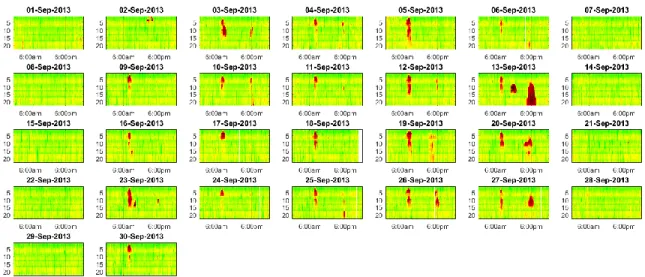
December 2008. This finding could be attributed to variable time schedules or the absence of office traffic due to the December holiday season. As a comparison, Figure 4.3 gives the daily speed heat maps for I-80 eastbound in Omaha in September 2013. Distinct recurring congestion was observed during the morning peak hours, evident in the repeating red pattern on every weekday morning, and the highest congestion was observed on Thursday mornings.
Figure 4.3 Daily speed heat map of eastbound I-80 in Omaha in September 2013 As discussed in Chapter 3, the data processing platform makes it possible to automate the data visualization procedure. Heat maps can therefore be easily and quickly created for all studied segments. Due to limited space, however, not all heat maps have been included in this report.
4.2 Speed, Weather, and Crashes
Taking advantage of the integrated database described in the previous chapter, data visualization can combine information from multiple data sources to reveal the underlying correlations among speed, weather, and crashes. In Figure 4.2, the crashes that occurred in December 2008 on I-80 westbound in Omaha are marked on the heat maps according to the crash time and location information. Blue stars on the maps represent mainline crashes, blue Xs represent on-ramp crashes, and blue plus signs represent off-ramp crashes. Most crashes occurred during peak traffic hours and were associated with low traffic speeds. Several
crashes occurred on December 16, in parallel with one of the worst congestion periods observed for the segment in the month of December.
Weather information such as rain or snow events can also be included in the speed heat maps. To make the maps easy to read, speed data were made more brief and concise, and only clustered low-speed events (speeds lower than or equal to 45 mph) are displayed. Figure 4.4 shows the clustered daily low-speed events overlaid with crashes and precipitation for I-80 westbound in Omaha in December 2008.
Note: light blue: rain, dark blue: snow, *: mainline crash, +: on-ramp crash, ×: off-ramp crash
Figure 4.4 Clustered daily congestion overlaid with crashes and precipitation The red points represent low-speed clusters. This figure shows that some correlation exists among crashes, low-speed events, and precipitation. The summary statistics for speed, crashes, and precipitation for the studied segment on I-80 westbound in 2008 are listed in Table 4.1.
Table 4.1 Data summary statistics of I-80 westbound in Omaha in 2008
Variables Value
Mean speed (mph) 62.05
Standard deviation of speed (mph) 5.54
Number of crashes 257
Total hours of rain (hour) 647.4 Total hours of snow (hour) 45.7
The model developed to investigate the relationship between crashes and contributing factors will be discussed in Chapter 5. Furthermore, if certain patterns of speed events and precipitation are frequently observed before the occurrence of a crash, some identification mechanism for the hazardous condition could be developed for crash prediction. This topic will be discussed in Chapter 8.
This chapter demonstrated several data visualization methods. The annual average speed heat map reveals the trends in traffic speed by time of day. The daily average speed heat maps, plotted in calendar order, display the traffic speeds of a certain segment in detail, and speed trends can be identified by different measures (day of the week, month, mile marker, etc.). In addition, through the integrated database and data processing platform, speed, weather, and crash data can be displayed together to show the correlation among these data. To verify and quantify this correlation, the impacts of different factors on crash risk based on aggregate-level crash analysis are studied in the next chapter
5. Crash Risk Assessment
Safety is an important aspect of traffic management. Crash risk assessment can reveal the relationships between crashes and contributing factors and can help to quantify the benefits of traffic operation strategies in improving safety. In this chapter, preliminary hypothesis tests were conducted to analyze the correlations among traffic speeds, ambient weather conditions, and crash occurrences. A binomial probit model was developed to identify the crash contributing factors. A sensitivity analysis of these factors was conducted and is discussed in this chapter.
5.1 Correlation among Crashes, Speed, and Weather Conditions
Using the MATLAB-Microsoft SQL Server data processing platform presented in Chapter 4, descriptive statistics were obtained and a preliminary data analysis was conducted for the traffic, weather, and crash data. Table 5.1 summarizes the crash occurrences by traffic and weather conditions on I-80 westbound in Omaha in 2008.
Table 5.1 Crash summary for I-80 westbound in Omaha in 2008
Crash Summary
Weather Condition Clear Rain Snow
Traffic Condition Speed > 50mph Crash counts 187 28 0 Crash percentage 72.76% 10.89% 0.00% Time percentage 92.09% 5.84% 0.29% Speed ≤ 50mph Crash counts 26 16 0 Crash percentage 10.12% 6.23% 0.00% Time percentage 0.020% 1.53% 0.23% A threshold of 50 mph divides the traffic conditions into two categories: uncongested conditions (speeds greater than 50 mph) and congested conditions (speeds less than or equal to 50 mph). This threshold was selected based on the traffic characteristics of the studied road segment. The weather conditions were categorized into clear, rain, and snow. A total of 257 crashes were observed on this road segment. The crash percentage was calculated by dividing the crash counts in each category by the total number of crashes. The time percentage is the time duration of a certain combination of traffic and weather conditions out of the entire study period. For 92% of the time in 2008, this road segment was uncongested and in clear weather, and 73% of the crashes in that year occurred in this combination of traffic and weather conditions. The segment was congested and in clear weather for 0.02% of the time in 2008, and 10% of the total crashes occurred in such conditions. The relationships implied by the data in Table 5.1 are as follows: (1) the conditional probability of a low-speed event given different weather conditions varied significantly, which indicated a potential correlation between weather and traffic speed, and (2) the conditional probability of a crash given different traffic and weather conditions differed, which indicated the impact of speed and weather on crash occurrence.
For the interrelationship between weather and traffic conditions, if these two factors are independent, the probability of a combined traffic and weather event should be equal to the product of the individual probabilities of the corresponding traffic event and weather event. The hypothesis that the traffic and weather conditions are independent was tested by a chi-square test using a contingency table. The test results are shown in Table 5.2. Because some of the expected counts of events were lower than five, Fisher’s exact test was appropriate. The null hypothesis was rejected at a 95% confidence level, and there was no evidence that the traffic and weather conditions were independent of each other. The highest chi-square values were observed for low speed with rain and low speed with snow, which shows that rain and snow significantly
increased the chance of congestion.
For the crash likelihood, if the crash occurrence has an equal likelihood across different combinations of traffic and weather conditions, the crash percentage values presented in Table 5.2 should follow the distribution of time percentage.
Table 5.2 Contingency analysis of weather conditions by traffic speed Weather
Clear Rain Snow Marginal Total Speed > 50mph Total % Expected % Chi-square 92.09 90.4704 0.0290 5.84 7.238 0.2703 0.29 0. 5107 0.0954 98.22 Speed ≤ 50mph Total % Expected % Chi-square 0.02 1.6395 1.5998 1.53 0.1312 14.9153 0.23 0.0092 5.2645 1.78 Marginal Total 92.11 7.37 0.52 100.00 Test Results Log likelihood 4.6249 R square 0.1567 p-value Pearson 0.0098 Likelihood Ratio <0.0001 Fisher’s Exact Test 0.0007
Note: A small p-value indicates that the null hypothesis should be rejected
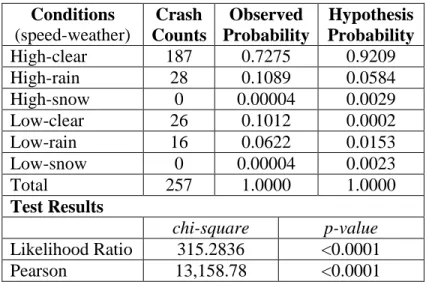
This hypothesis that crash percentage and time percentage have the same distribution was tested by a nonparametric chi-square test. The results are shown in Table 5.3.
Table 5.3 Nonparametric chi-square test results for crash distribution Conditions (speed-weather) Crash Counts Observed Probability Hypothesis Probability High-clear 187 0.7275 0.9209 High-rain 28 0.1089 0.0584 High-snow 0 0.00004 0.0029 Low-clear 26 0.1012 0.0002 Low-rain 16 0.0622 0.0153 Low-snow 0 0.00004 0.0023 Total 257 1.0000 1.0000 Test Results chi-square p-value Likelihood Ratio 315.2836 <0.0001 Pearson 13,158.78 <0.0001
Note: A small p-value indicates that the null hypothesis should be rejected
The null hypothesis was rejected at a 95% confidence level, which indicates that the likelihood of a crash varies by traffic and weather conditions. From Table 5.3, the observed probabilities of high speed and rain, low speed and clear weather, and low speed and rain are much higher than the hypothesized values, which provides evidence that these three conditions increase the likelihood of a crash. A high crash likelihood was usually associated with low speed and rain. Rain is an important causal factor for low speed and high crash likelihood. Although the causal relationship between low speed and crash occurrence was difficult to determine for each individual case, the interaction was statistically detected.
5.2 Crash Risk Modeling and Sensitivity Analysis
After the preliminary hypothesis tests, a binomial probit model was built to identify the crash contributing factors, and the data for I-80 westbound in Omaha in 2008 were used. The descriptive statistics of the model variables are provided in Table 5.4.
Table 5.4 Descriptive statistics of variables
Variable Mean S.D. Min Max Sum Obs.
Dependent variables
Indicator of crash occurrence 0.028 0.164 0 1 285 10,285
Independent variables speed (mph) 62.456 5.258 5.88 76.84 10,285 indicator of weekend 0.275 0.447 0 1 2,828 10,285 indicator of Monday 0.137 0.344 0 1 1,408 10,285 indicator of Tuesday 0.148 0.355 0 1 1,518 10,285 indicator of Wednesday 0.142 0.349 0 1 1,459 10,285 indicator of Thursday 0.154 0.361 0 1 1,587 10,285 indicator of Friday 0.144 0.351 0 1 1,485 10,285 indicator of Saturday 0.144 0.351 0 1 1,481 10,285 indicator of Sunday 0.131 0.337 0 1 1,347 10,285 indicator of 12am-6am 0.239 0.427 0 1 2,459 10,285 indicator of 6am-8am 0.090 0.286 0 1 922 10,285 indicator of 8am-10am 0.083 0.276 0 1 853 10,285 indicator of 10am-12pm 0.084 0.278 0 1 869 10,285 indicator of 12pm-2pm 0.084 0.277 0 1 862 10,285 indicator of 2pm-4pm 0.080 0.271 0 1 820 10,285 indicator of 4pm-6pm 0.090 0.287 0 1 929 10,285 indicator of 6pm-8pm 0.084 0.278 0 1 869 10,285 indicator of 8pm-12pm 0.165 0.372 0 1 1,702 10,285 indicator of 0 mile - 3 mile 0.184 0.387 0 1 1,892 10,285 indicator of 3 mile - 6 mile 0.182 0.386 0 1 1,869 10,285 indicator of 6 mile - 9 mile 0.157 0.363 0 1 1,610 10,285 indicator of 9 mile - 12 mile 0.136 0.343 0 1 1,399 10,285 indicator of 12 mile - 15 mile 0.176 0.381 0 1 1,807 10,285 indicator of 15 mile - 18 mile 0.166 0.372 0 1 1,708 10,285 indicator of clear weather 0.926 0.262 0 1 9,520 10,285 indicator of rain 0.060 0.238 0 1 618 10,285 indicator of snow 0.014 0.119 0 1 147 10,285
Besides speed and weather conditions, the time of day, day of the week, and location on the road were also considered in the model. Indicators were created for each day of the week. The time of day was classified into nine intervals (12 a.m. to 6 a.m., 6 a.m. to 8 a.m., 8 a.m. to 10 a.m., 10 a.m. to 12 p.m., 12 p.m. to 2 p.m., 2 p.m. to 4 p.m., 4 p.m. to 6 p.m., 6 p.m. to 8 p.m., and 8 p.m. to 12 a.m.). The 18 mile long freeway was divided into six equal-length segments (0: east end, 18 miles: west end), and indicators were created for modeling. The period of 8 p.m. to 12 a.m. and the location between 15 and 18 miles on Monday on this segment was used as the baseline to evaluate the impacts of the other variables.
Using the indicator of crash occurrence as a dependent variable, a binomial probit model was built. The estimated coefficients of the independent variables are shown in Table 5.5.
Table 5.5 Estimated parameters by the binomial probit model
Independent Variable Coefficient t-statistic Confidence Level
Constant -0.1153 -0.37 speed (mph) -0.0451 -11.79 *** indicator of weekend -0.3057 -3.02 *** indicator of Tuesday -0.0253 -0.25 indicator of Wednesday -0.0575 -0.55 indicator of Thursday 0.0172 0.18 indicator of Friday -0.1639 -1.53 indicator of 12am-6am -0.1075 -0.95 indicator of 6am-8am 0.4436 3.84 *** indicator of 8am-10am 0.1599 1.19 indicator of 10am-12pm 0.3206 2.50 ** indicator of 12pm-2pm 0.2764 2.18 ** indicator of 2pm-4pm 0.1887 1.41 indicator of 4pm-6pm 0.5746 5.26 *** indicator of 6pm-8pm 0.2257 1.73 *
indicator of 0 mile - 3 mile 0.7483 3.88 *** indicator of 3 mile - 6 mile 1.3577 7.23 *** indicator of 6 mile - 9 mile 0.6375 3.21 *** indicator of 9 mile - 12 mile 0.5220 2.53 ** indicator of 12 mile - 15 mile 0.1976 0.90
indicator of rain 0.1572 1.47
indicator of snow 0.3504 1.68 *
Model performance
Log Likelihood -1028.6419 Restricted log likelihood -1303.0108
R-squared 0.2106
Note: ***, **, and * indicate confidence at a 99%, 95%, and 90% level, respectively
The model results are summarized in the following:
The crash risk is higher on this road when the road is operated at a lower traffic speed. The crash risk was consistent on different weekdays but significantly lower on weekends. During the 6 a.m. to 8 a.m., 10 a.m. to 2 p.m., and 4 p.m. to 6 p.m. intervals, the crash
risk was higher than at other times of day. The highest crash risk appeared to be between the 6 a.m. to 8 a.m. and 4 p.m. to 6 p.m. intervals.
The western 12 miles had a higher crash risk than the rest of the road, and the hot spot appeared to be 3 to 6 miles toward the western end.
Rain and snow did not have a significant impact on crash risk at a 95% confidence level. However, there was some evidence that the impact of snow was larger than that of rain. To better quantify the impacts of contributing factors on crash risk, a sensitivity analysis was conducted. The estimated elasticities are shown in Table 5.6.
Table 5.6 Sensitivity analysis: Estimated elasticity
Independent Variable Elasticity t-statistic Confidence Level
speed (mph) -0.0750 11.16 ***
indicator of weekend -0.7762 3.32 ***
indicator of 6am-8am 0.9887 5.04 ***
indicator of 4pm-6pm 1.1879 7.88 ***
indicator of 3 mile - 6 mile 1.7899 28.90 *** indicator of rain 0.3984 1.55
indicator of snow 0.8134 2.04 **
Note: ***, **, and * indicate confidence at a 99%, 95%, and 90% level, respectively
These elasticity results show the following:
Every one mile per hour increase in speed was associated with a 7.5% decrease in crash risk.
The crash risk on weekends was 77.6% lower than on weekdays.
The crash risk approximately doubled during morning peak hours (6 a.m. to 8 a.m.) and afternoon peak hours (4 p.m. to 6 p.m.) compared to the rest of the day.
The crash risk on the segment three to six miles toward the western end of the road was much higher than on all other segments.
Rain did not have a statistically significant impact on crash risk, while snow could increase the crash risk by 81%.
This chapter analyzed the impact of speed, weather, time, and location on crash occurrence at the aggregate level. A binomial probit model for predicting crash count was developed to identify the contributing factors, and a sensitivity analysis was conducted to quantify their impacts. The crash analysis found that a one mile per hour increase in speed was associated with a 7.5% decrease in crash risk. The crash risk on weekends was 77.6% lower than the crash risk on weekdays. The rate of crash risk during the peak hours (6 a.m. to 8 a.m. and 4 p.m. to 6 p.m.) was approximately twice the rate of the crash risk during the rest of a given day. The crash risk was also affected by the location of the road. Rain, observed during the analysis period, was found to have no significant impact on crash risk, while snow could increase the crash risk by 81%. These results are used in the cost-benefit analysis of ramp metering discussed in Chapter 7. The following chapter introduces speed-based performance measures, identifies the bottleneck locations on the Omaha urban freeway system, and prioritizes these locations for potential ramp metering implementation.
6. Traffic Performance Measure and Bottleneck Identification
In Chapter 5, traffic speed, snow, certain time periods of the day, and certain segments on the road were identified as statistically significant factors impacting the expected number of crashes per year. Among these factors, traffic speed is the topic of focus for this study because it is most commonly used as the control variable in active traffic management strategies. As described in this chapter, several traffic speed–based performance measures were developed and used to identify the bottlenecks on the Omaha urban freeway system.
6.1 Speed Based Performance Measure
To quantify and compare the traffic conditions across different locations and time periods, a series of performance measures was developed in this study. In this study, congestion is
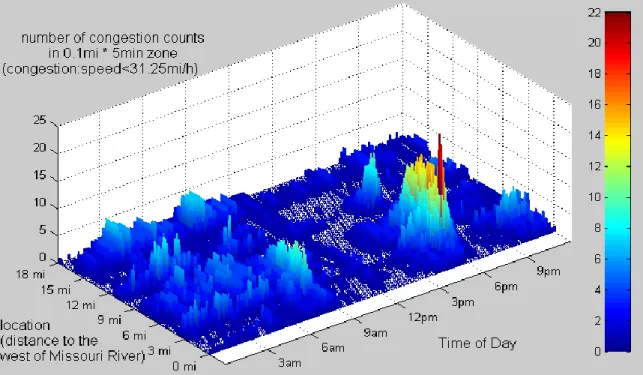
defined as traffic speeds lower than a threshold of 40 mph. A colored three-dimensional (3D) bar chart was developed to show the congestion at different times and locations. Figure 6.1 shows congestion counts and illustrates the congestion conditions on weekdays on an 18 mile road segment of I-80 westbound in Omaha in 2008.
Figure 6.1 Congestion counts for I-80 westbound in Omaha on weekdays in 2008 Data were aggregated in five-minute intervals for each 0.1 mile section along this
segment. The x and y axes represent the time of day and location on the road, respectively. Each bar represents a grid of 0.1 mile × five minutes, and the height of the bar represents congestion count, that is, the number of days that congestion was observed on a 0.1 mile segment (specified by location axis) during a five-minute period (specified by the time of day axis). A higher value for congestion count implies a higher frequency or higher likelihood of congestion. The
represent a medium to high likelihood of congestion. For the studied road on I-80 westbound in Omaha, the heaviest congestion was observed on the segment between one to six miles from the eastern end during the period from 4 p.m. to 7 p.m. Similar bar charts can be created for each day of the week or weekend to show the congestion distribution patterns on different days of the week.
The 3D bar chart of congestion counts treats speed as a categorical variable (congestion or non-congestion) and can be a good illustration of congestion frequency. However, the chart is unable to accurately quantify the severity of congestion. Travel time delay can be used as a performance measure to capture the severity of congestion. A colored 3D bar chart of travel time delay was developed, as shown in Figure 6.2, and is similar to the chart of congestion counts.
Figure 6.2 Average travel time delay for I-80 westbound in Omaha on weekdays in 2008 The horizontal axis represents the grid of the time of day and the location on the road. Travel time delay was calculated for each grid (1 mile × 15 minutes). The vertical axis represents travel time delay, or travel time deficiency. Travel time delay is the additional time required to travel through a road segment at an observed speed compared to traveling at a reference speed. In this study, the posted speed limit was used as the reference speed. The height of each bar in Figure 6.2 represents the amount of travel time delay for the location and time period specified by the horizontal axis. The colors of the bars also indicate the congestion levels, with dark blue representing no congestion and red representing high congestion levels. As seen in Figure 6.2, the location and time period with the highest travel time delay was similar to the location and time period with the highest congestion frequency identified in Figure 6.1.
On average, the segment between one to two miles from the eastern end of the road experienced longer delays than all other road segments throughout the day.
Two new performance charts, travel time profile and speed profile, were designed to visualize and compare the temporal and spatial trends in traffic conditions. Travel time profiles
provide a description of expected travel time and travel time reliability along the road by time of day. The travel time profiles can be created for a wide range of analysis periods. Figure 6.3 shows the monthly travel time profile for an 18 mile segment on I-80 westbound in Omaha in 2008. The black line in the figure represents the median travel time at a particular time of day, and the red line marks the 85th percentile travel time. The difference between the median and the 85th percentile travel time is used as a measure of travel time reliability. In Figure 6.3, all of the missing data were replaced by the mean; therefore, the accuracy of this travel time profile depends greatly on the quality of the sensor data. The data quality could be improved by using additional data sources, such as INRIX (INRIX, Inc. http://inrix.com/) data. INRIX provides better data completeness and provides segment speed instead of point speed from roadside sensors. The percentage of missing data is shown on top of each subplot in Figure 6.3.
Figure 6.3 Monthly travel time profile for I-80 westbound in Omaha in 2008
There were relatively higher percentages of missing data during February and July, and hence, in these cases, the travel time profiles would fail to capture parts of the real variation. Overall, the average travel time on this road was stable. There were more variations during the morning peak hours and afternoon peak hours, specifically during the afternoon peak hours. The highest travel times observed were during the afternoon traffic peak hours in the months of January, September, October, and December.
A travel speed profile illustrates the number of hours during the analysis period that the operational speed on a segment is within a predefined range. Figure 6.4 shows the monthly speed profile for the aforementioned road on I-80 westbound in 2008.
Figure 6.4 Monthly traffic speed profile for I-80 westbound in Omaha in 2008
The speed profile is a stacked bar chart drawn horizontally. The colors from dark brown to green represent speed ranges from lowest to highest, respectively. The vertical axis is scaled by 0.l mile increments and labeled by mile marker. Due to space limitations, only the top 100 hours with the lowest operational speeds are shown for each month. The locations near mile marker 452.5 (at the eastern end of the road) had longer travel times with lower operational speeds, and December was found to be the month with the most frequent observations of low speeds.
The charts for travel time profile and speed profile are also useful for comparing the traffic characteristics between different travel directions along a corridor or among different roadways. Benefiting from the integrated database and data processing platform, the data
visualization methods and performance measure charts can be easily applied to any road segment in the database for a wide range of analysis periods. This technique provides the ability to
quickly investigate traffic conditions on multiple corridors and display key findings. 6.2 Bottlenecks on the Omaha Urban Freeway System
This part of the analysis used data collected for the years 2008 and 2009 on five major corridors in Omaha, including I-80, I-480, I-680, US-6, and US-75. To identify the traffic bottlenecks, daily traffic speed heat maps were created for the entire two years in both travel directions of these five corridors. These heat maps include a total of 7,310 subplots (731 days × 5 corridors × 2 directions). All of the heat maps used a uniform color scale for easy comparison. The findings from the daily heat maps are summarized below:
I-80: For the westbound direction, recurring congestion during the afternoon (PM) peak hours was observed, while there was no congestion observed during the morning (AM) peak hours. For the eastbound direction, recurring congestion was observed during both
the AM and PM peak hours on weekdays, specifically during the PM peak hours on Fridays. It was also observed that the congested locations were different between the AM and PM peak hours. During the PM peak hours, the most congested area was near the eastern end near downtown (mile markers 450 to 454), while during the AM peak hours the most congested area was near the western end (mile markers 445 to 448).
I-480: The average speed was slightly lower than that on I-80. The eastbound direction of I-480 experienced recurring congestion during the AM peak hours, and the westbound direction experienced congestion during the PM peak hours.
I-680: The overall speed was above the speed limit (60 mph). There was some recurring congestion during the AM and PM peak hours on I-680 northbound, but no obvious issues were observed for the southbound traffic.
US-6: The speed sensors on both directions of US-6 were not in good working condition, and hence there was a significant amount of missing data. However, the data showed some evidence that US-6 eastbound experienced congestion during the AM peak hours, and minor congestion was observed during the PM peak hours for the westbound traffic. US-75: US-75 had similar patterns to I-680 and US-6. The northbound traffic
experienced congestion during the AM peak hours, and the southbound traffic was slightly worse during the PM peak hours than the AM peak hours.
Overall, the traffic on the analyzed freeways in 2008 and 2009 demonstrated some
similar patterns: the roads going into the Omaha central district experienced recurring congestion during the AM peak hours, and those roads going out of the Omaha central district experienced severe congestion during the PM peak hours. The recurring congestion could most likely be attributed to commuter traffic. The most congested segments are shown in Figure 6.5.
Figure 6.5 Summary of AM and PM congestion in 2008 and 2009
The yellow arrows in the top two windows represent the congested areas during the AM peak hours. The red arrows in the bottom two windows represent the congested areas during the PM peak hours. The left two windows show the congested areas in 2008, and the right two windows show the traffic in 2009. The traffic direction is indicated by the direction of the arrow, and the congestion level is indicated by the width of the arrow. The traffic in the years 2008 and 2009 had similar congestion patterns. Out of the five studied corridors, I-80 experienced the highest congestion and was selected for further analysis.
Three-dimensional charts for travel time delay were created for I-80 westbound and are shown in Figure 6.6. Similar charts for I-80 eastbound are shown in Figure 6.7. The
corresponding AM and PM congestion locations are marked on the map below each bar chart by a yellow circle and a red circle, respectively.
Left: 2008, Right: 2009
Figure 6.6 Cumulative travel time delay on I-80 westbound in 2008 and 2009
Left: 2008, Right: 2009