The effect of increased nitrate loading on nitrate reduction via denitrification and
DNRA in salt marsh sediments
Ketil Koop-Jakobsen
a,band Anne E. Giblin
b,*aBoston University Marine Program, Boston, Massachusetts
bThe Ecosystems Center, Marine Biological Laboratory, Massachusetts
Abstract
The effects of increased nitrogen loading on denitrification and dissimilatory nitrate reduction to ammonium (DNRA) in marsh sediments were studied in permanently submerged subtidal creek sediments and on the tidally inundated vegetated marsh platform in Plum Island Sound estuary, Massachusetts. DNRA and denitrification in surface sediments were measured at all sites using whole-core incubations and the isotope pairing technique, which allows distinction between denitrification of water column nitrate and coupled nitrification–denitrification. On the marsh platform, denitrification was also measured at depth in the rhizosphere, using a new approach that combined the push–pull method and the isotope pairing technique. In tidal creek sediments, fertilization increased denitrification of water column nitrate by approximately one order of magnitude, and coupled nitrification– denitrification threefold. Coupled nitrification–denitrification made a significant contribution to the total N2
production in the unfertilized creek but was of minor importance in the fertilized creek due to increased rates of denitrification of water column nitrate. In the surface sediment of the marsh platform, fertilization increased denitrification of water column nitrate by an order of magnitude during inundation of the marsh platform, about 12%of the day. However, coupled nitrification–denitrification occurring at depth in the rhizosphere was the main denitrification pathway, accounting for more than 50%of the total N2production in the fertilized as well as in the
reference marsh. DNRA was measured in the surface sediment only, where it was comparable in magnitude to denitrification in the fertilized as well as in the unfertilized marsh.
Human activities in coastal areas have increased over the last several decades. Discharge of nutrients from agricul-ture, industries, sewage treatment, and septic tanks has led to a marked increase in the export of nutrients, particularly nitrogen, to nearshore coastal areas (Howarth et al. 2002). As a result, many coastal areas have experienced the severe negative consequences of eutrophication caused by in-creased nutrient loading, such as hypoxia and anoxia in bottom waters, changes in the benthic community, increased frequency of phytoplankton and macroalgal blooms, and loss of habitat for submerged vascular plants (Rabalais and Nixon 2002). Consequently, the environ-mental as well as scientific interest in the nitrogen cycle and potential nitrogen removing processes has intensified for coastal ecosystems (NRC 2000).
In the developed coastal zone, tidal marshes are of great ecological importance. Tidal marshes intercept and reduce the flow of nitrogen from the terrestrial upland to the coastal marine environment. Gaseous loss of nitrogen via denitrification and burial of nitrogen-containing com-pounds are important processes reducing the nitrogen flow through marshes (White and Howes 1994; Howes et al. 1996) and can diminish the severe negative effects of eutrophication in the nearshore coastal environment (Teal and Howes 2000; Valiela and Cole 2002; Fisher and Acreman 2004).
Insight into the interaction between nitrogen removal capacity and increased nitrogen loading is essential for understanding how marshes act as buffers for eutrophica-tion of coastal waters. Denitrificaeutrophica-tion rates in marshes are
generally higher than in other marine sediments (Hopkin-son and Giblin 2008) and are largely controlled by nitrate availability (Knowles 1982; Seitzinger 1988; Seitzinger et al. 2006). Nitrate in marsh sediments originates either from internal sources, such as nitrification, or from external, primarily anthropogenic, sources. The nitrate from external sources is delivered through river water and ground water seepage and predominantly ends up in the marsh tidal creeks (Howes et al. 1996).
The denitrification response to increased nitrogen loading may vary spatially in the marsh, depending on exposure to anthropogenic nitrogen entering the marsh through the tidal creeks. The subtidal sediments of the tidal creeks are permanently inundated and therefore constantly exposed to the nitrate entering the marsh from external sources. The remainder of the marsh is exposed to tidal waters for lesser amounts of time. On the vegetated marsh platform, exposure to tidal water is dependant on marsh elevation and varies with the neap–spring tidal cycle. The low marsh is usually inundated for a couple of hours on every high tide, whereas the landward edges of the high marsh may only be inundated periodically at spring tides.
Rhizospheres of vegetated aquatic sediments (Reddy et al. 1989; Bodelier et al. 1996) and intertidal vegetated marsh sediments (Sherr and Payne 1978) stimulate denitri-fication. Internal oxygen transport through the aerenchyma of salt marsh grasses results in oxic microzones surround-ing the roots and rhizomes, potentially stimulatsurround-ing coupled nitrification–denitrification at depth in the sediment. Furthermore, exudates of labile organic compounds from roots and rhizomes serve as electron donors for denitrifi-cation. Inorganic nitrogen in salt marsh sediment exists *Corresponding author: [email protected]
predominantly in the form of ammonium, and nitrate availability is usually low, resulting in a tight coupling between nitrification and denitrification (Thompson et al. 1995; Hamersley 2002; Dollhopf et al. 2005).
Competition for nitrate is another factor affecting the amount of nitrate denitrified in salt marshes. Denitrifiers, anammox bacteria, and microorganisms carrying out dissimilatory nitrate reduction to ammonium (DNRA) all use nitrate or nitrite as the electron acceptor for respiratory processes (Burgin and Hamilton 2007). Denitrification and anammox remove nitrogen as dinitrogen gas, which results in a reduction of the anthropogenic nitrogen loading to adjacent water bodies. In contrast, DNRA conserves nitrogen in the sediment as ammonium, retaining the elevated nitrogen levels, and may thereby contribute to export of inorganic nitrogen from the marsh to nearby coastal waters. Hence, the nitrogen removal capacity of a marsh is to a large extent determined by the predominant nitrate reduction pathway.
In coastal sediments with anoxic and sulfidic conditions, DNRA can be the predominant nitrate reduction pathway (Brunet and Garciagil 1996; Christensen et al. 2000; McGlathery et al. 2007). Sulfide oxidizing bacteria play a crucial role carrying out DNRA in marine sediments (Christensen et al. 2000; An and Gardner 2002). In salt marshes, DNRA can also be an important nitrate-reducing process (Hopkinson and Giblin 2008), but only relatively few studies have investigated DNRA in marsh sediments. The few studies available indicate that the relative importance of DNRA is highly variable, accounting for anywhere between 0% and 60% of the nitrate reduced (Tobias et al. 2001a,b; Ma and Aelion 2005).
The presence of marsh vegetation may be an important factor controlling biogeochemical conditions, and thereby the importance of DNRA. Elevated oxygen levels in the marsh rhizosphere caused by oxygen transport through roots and rhizomes may suppress DNRA and stimulate coupled nitrification–denitrification (Matheson et al. 2002), but the multiple factors potentially influencing DNRA in marsh sediment are still largely unknown.
Even though inorganic nitrogen pools are usually high in salt marsh sediments compared to other marine sediments, the production of salt marsh grasses is nitrogen-limited due to ecophysiological factors, such as high salinity and sulfide concentrations, which inhibit nutrient assimilation by plants (Mendelssohn and Morris 2000). However, nitrogen uptake by salt marsh plants may limit nitrogen available for denitrification and coupled nitrification–denitrification during periods of extensive plant growth (Hamersley 2002; Hamersley and Howes 2005).
Several recent studies have investigated the effect of increased nitrogen loading on denitrification in salt marshes with different results. Wigand et al. (2004) found denitrification enzyme activity to be positively correlated with nitrogen load in the high marsh but not in the low marsh. Lee et al. (1997) measured potential rates of denitrification in salt marsh sediments and found a positive correlation with nitrogen loading, whereas Davis et al. (2004) found an inverse relationship between the gaseous nitrogen fluxes and nitrogen loading measured in
air-exposed whole-core incubations. In marsh fertilization experiments, Hamersley and Howes (2005) found denitri-fication to be stimulated by nitrogen fertilizer addition using in situ15N-NHz
4 -tracer additions, whereas Caffrey et
al. (2007) found no significant fertilization effect on denitrification in marsh sediment based on N2: Ar
mea-surements in whole-core incubations.
The effect of increased nitrogen loading on nitrogen removal in salt marshes is currently not well understood. Nitrogen transformations in salt marshes are complex, and ever-changing environmental conditions make them diffi-cult to analyze.
This study investigates the effect of increased nitrogen loading on nitrate reduction pathways in salt marsh sediments. Denitrification and DNRA were studied in a large-scale salt marsh fertilization experiment carried out in salt marshes of the Rowley River in the Plum Island Sound estuary, Massachusetts (Deegan et al. 2007).
Since 2003, the ecological and biogeochemical effects of nutrient enrichment and predator removal have been studied in marshes of the Rowley River. During the first 4-yr period, two tidal marshes were fertilized continuously on every incoming tide throughout the growing season (May–Oct), and two unfertilized marsh areas with similar size, geomorphology, hydrology, biogeochemistry, and plant composition were designated as reference sites and were monitored under ambient conditions (Deegan et al. 2007). The fertilization affected an area of,60,000 m2of
nearly pristine marshlands. The fertilizer was mixed with the flooding water in the tidal creeks, mimicking the route by which anthropogenic nitrogen naturally reaches salt marsh ecosystems, and inducing a natural spatial and temporal gradient in the marshes’ exposure to the added fertilizer. Fertilization of one creek was discontinued but one creek (Sweeney) continued to be fertilized.
Specifically, we investigated the effect of nitrate enrich-ment on denitrification of water column nitrate and on coupled nitrification–denitrification and dissimilatory ni-trate reduction to ammonium (DNRA) in the surface sediment of the permanently inundated tidal creek and tidally inundated marsh platform. Denitrification occurring at depth in the rhizosphere of the marsh platform was also examined.
Methods
Field description—Plum Island Sound is a 25-km long macrotidal estuary with a mean tidal range of 2.9 m. The estuary contains salt marshes dominated by Spartina alternifloraandSpartina patens in the seawater-dominated intertidal zone, and Typha angustifolia in the upper freshwater-dominated areas. The freshwater input to the Plum Island estuary and the associated marshlands is primarily riverine.
Measurements were made in one experimentally fertil-ized tidal creek (Sweeney Creek) and one unfertilfertil-ized reference creek (West Creek). Both creeks are located along the Rowley River. The vegetation in both tidal creek watersheds consists ofS. alternifloranear the creek banks and S. patens at higher elevations. Salinity of the tidal
water averages 20.8% and 24.0% for the fertilized and reference creeks, respectively. In the fertilized creek, nitrate and phosphate levels were increased on the incoming tide by dripping in a solution of commercial fertilizer, with the goal of increasing creek water concentrations to 70mmol L21nitrate. The fertilizer additions are equivalent
to a 15-fold increase in the nitrogen loading to the marsh. This nitrate level is representative for estuarine waters designated as moderate to highly eutrophic, according to the EPA (2002). Phosphate concentrations were increased to approximately 4mmol L21, aiming for a 15 : 1 N : P ratio
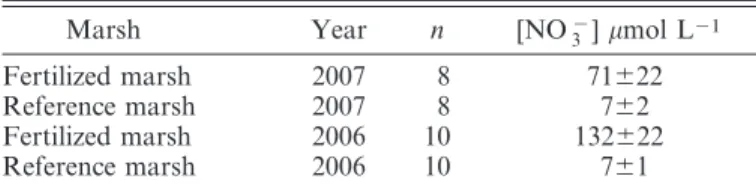
in the creek water. Nitrate was monitored biweekly in the creek water at three locations in the fertilized and reference marsh from May to September. In 2006, the average in situ nitrate concentrations were almost twice as high as the expected 70 mmol L21, whereas in 2007, the actual
concentrations were much closer to the target values (Table 1). Detailed background information of experimen-tal design, biogeochemistry of the tidal creeks, and the effects of fertilization can be found in Deegan et al. (2007). Methods applied—Overview: Denitrification and DNRA were studied in different areas of the fertilized marsh and the unfertilized reference marsh using three different methods that were all based on tracer experiments using
15NO{
3 additions and on the isotope pairing technique
(Nielsen 1992). Table 2 summarizes the three methods used.
Nitrate reduction rates in surface sediments—Denitrifica-tion of water column nitrate (Dw), coupled nitrification–
denitrification (Dn), and DNRA were studied in the surface
sediments of the tidal creek and on the marsh platform under flooded conditions, using whole sediment core incubations with 15NO{
3 additions. Denitrification rates
were calculated using the isotope pairing technique (Nielsen
1992), which calculates the denitrification rates under ambient environmental conditions (D14), and as amended
denitrification rates (D14 + D15), calculated as the sum of
denitrification rates of ambient nitrate (D14) and
denitrifi-cation stimulated by the added labeled 15N-nitrate (D 15).
The amended rates are a measure of the denitrification capacity under field conditions when nitrate is not limiting. DNRA rates were calculated based on the 15N-NHz
4
production and the isotope pairing technique according to equations described in Christensen et al. (2000).
Studies of denitrification and DNRA in tidal creek sediment were carried out in early August 2006, whereas the surface sediments of the marsh platform were studied in late July 2007.
Bottom sediments of the tidal creeks were collected by inserting polyvinyl chloride (PVC) core tubes (15.2-cm diameter) into the sediment and digging out the cores. Four cores were collected from each creek. The cores were brought to the laboratory immediately after collection.
On the marsh platform, the cores were collected using a long-bladed knife to cut into the rhizosphere around the PVC tubes before inserting the tubes and digging out the cores. The cores were immediately replaced into their respective holes and left in the field for a week before they were removed and brought to the laboratory. This procedure was followed to let roots and rhizomes recover from damage and thereby prevent leaching of plant constituents from biasing the nitrate reduction measure-ments. The vegetation was retained in the cores during incubation, but in order to ensure homogeneous mixing of the water column, the flexible stems of the marsh grasses were tied up and weighed down along the edges of the cores. Four cores were collected from the reference marsh platform, and four were collected from the fertilized marsh platform. The cores were collected in the lower edge of the high marsh, at a distance of 6–8 m from the creek bank, in an area dominated by S. patens. This location was often inundated on high tides, but drainage of pore waters was low.
The sediment cores from both habitats contained approximately 20 cm of sediment. Cores from the subtidal creek sediment were collected with a water column on top of the sediment, whereas the cores from the marsh platform were collected exposed to air. The collected cores were kept submerged and air exposed, respectively, until the nitrate reduction studies were initiated.
In the laboratory, the cores were kept in a constant-temperature bath between 22uC and 24uC, equivalent to in Table 1. Average seasonal nitrate concentrations in the creek
water during incoming tides in the fertilized marsh and in the unfertilized reference marsh, measured from May to September in 2006 and 2007 (mean 6 SE). The nitrate concentration was monitored biweekly on three locations in each marsh.
Marsh Year n [NO{
3]mmol L21
Fertilized marsh 2007 8 71622
Reference marsh 2007 8 762
Fertilized marsh 2006 10 132622
Reference marsh 2006 10 761
Table 2. Overview of the methods applied to measure denitrification and DNRA in tidal creek and marsh platform sediment in the fertilized marsh and unfertilized reference marsh in the Plum Island estuary. All methods are based in 15NO{
3 addition and isotope pairing.
Methods applied Incubation time Light conditions Target processes
Anaerobic sediment slurries 4–6 d Dark Potential denitrification in surface
sediment
Whole-core incubations 6–7 h Dark In situ denitrification and DNRA
in surface sediments
situ temperatures at the sediment surface measured at the time of collection (Table 3). The sediment cores, from both the fertilized and reference creek, were incubated with water from the unfertilized creek spiked with 15N-NO{
3 .
This procedure was followed to allow cores from both the fertilized and unfertilized reference creek to be incubated at the same nitrate levels. For both fertilized and reference sites, two cores were amended with15NO
3to a target value
of 70mmol L21, and the other two cores were amended to a
target value of 150mmol L21. The actual measured nitrate
amendments differed somewhat from intended concentra-tions (Table 3) but are referred to as 70 mmol L21 and
150mmol L21for convenience.
Incubations were carried out in the dark. Oxygen concentrations were monitored in each core throughout the incubation in order to measure the sediment oxygen demand and to ensure that the oxygen condition did not become hypoxic. Oxygen concentrations were measured using oxygen sensors (WTW brand galvanic O2electrodes).
The incubations were terminated after 6–7 h of incubation, or earlier if the water column reached hypoxic conditions (, 2 mg L21), in order to prevent an unintended
decoupling of coupled nitrification–denitrification.
Water column samples were taken at 45–90-min intervals. Water samples for 29N
2 and 30N2 gas analysis
were siphoned into glass vials with screw-on septum caps (ExetainersH), which were overflowed to prevent gas loss, and preserved with 20mL of saturated HgCl2(aq). Samples
for nitrate and ammonium analyses were frozen immedi-ately. At the end of each incubation of the subtidal creek bottom sediment, duplicate subcores, including both sediment and water column, were collected from the whole-core incubations using a small diameter Plexiglas cylinder (internal diameter [ID]5 1.25 cm). The subcores were slurried, and samples of the slurry were collected for gas analysis. The slurry samples were collected to include denitrification end products from the pore water in the denitrification measurements. In the cores from the marsh platform, the presence of roots and rhizomes prevented effective subcoring of the sediment. To capture N2isotopes
in the pore water, the sponge-like sediment was rapidly compressed several times with a plunger after the core was opened in order to mix the pore waters with the water column, after which samples of the water column were collected for gas analysis.
The production of 29N
2 and 30N2 from denitrification
was measured using membrane inlet mass spectrometry (An et al. 2001). Denitrification rates were calculated based on the concentrations of 29N
2 and 30N2 measured in the
slurries at the end of incubation. The monitoring of the
29N
2and30N2production in the water columns was used to
assure linearity of denitrification rates throughout the entire incubation time.
For the unfertilized reference marsh, direct denitrifica-tion of water column nitrate (Dw) was calculated as
described by Nielsen (1992) using the isotope pairing technique. This method distinguishes between Dw and
coupled nitrification–denitrification (Dn).
For the fertilized marsh, direct denitrification rates were calculated using a modified interpretation of the isotope pairing method. At this site nitrate concentrations had been elevated to . 70 mmol L21. This high 14N-NO{
3
background would have greatly reduced our ability to measureDnunless extremely high additions of15NO{3 were
made. We therefore chose to incubate the cores from both the reference and fertilized sites using low-nitrate water from the reference creek to which15NO{
3 was added. In the
case of the fertilized site, the added 15N-NO{
3 was
representative for the in situ nitrate concentrations in the tidal creek water, and consequently denitrification of water column nitrate (Dw) was calculated as denitrification of the
added 15NO{
3 (D15). In other words, in the fertilized
marsh, the in situ rate ofDwwas equal toD15(Dw5D15).
In all cores, from the fertilized as well as from the reference marsh, coupled nitrification–denitrification rates (Dn) were calculated using the isotope pairing technique as
described by Nielsen (1992). Total in situ denitrification rates in the fertilized marsh were calculated as denitrifica-tion of15N-NO{
3 plus coupled nitrification–denitrification
(D15 + Dn), whereas total in situ denitrification in the
reference marsh was calculated as denitrification of ambient 14NO{
3 from the water column plus coupled
nitrification–denitrification (Dw+ Dn).
For measurements of DNRA in the whole-core incuba-tions of the tidal creek sediments, small subcores were collected from each of the larger sediment cores at the end of the incubation. The contents of the subcore were slurried, then 40 g KCl were added for extraction of15
N-NHz4 and the sample was immediately frozen until analysis. The presence of roots and rhizomes prevented coring for DNRA measurements in the marsh platform sediment. Alternatively, samples for15N-NHz
4 extraction
were collected from the water column following the same procedure as for taking the final gas samples, i.e., rapidly pressing the sediment up and down with a plunger in order to mix the pore waters with the water column.
For15N-NHz
4 extractions, the samples were thawed and
filtered, and the ammonium was extracted onto acidified Teflon-wrapped GF-C filters, according to Holmes et al. (1998). The15N-NHz
4 content on the filters was measured
Table 3. Background conditions in the tidal creek water used for the whole-core incubation and isotope pairing measurements of denitrification and DNRA in tidal creek and marsh platform sediment.
Temp (C) Salinity Ambient nitrate (mmol L21) Spiked nitrate (mmol L21) Date of experiment
Fertilized creek Same as reference creek 85 and 123 Aug 2006
Reference creek 24 25 6.7 62 and 179 Aug 2006
Fertilized platform Same as reference platform 86 and 157 Jul 2007
using a Europa ANCA-SL elemental analyzer–gas chro-matograph preparation system attached to a continuous-flow Europa 20-20 gas source stable isotope ratio mass spectrometer (the Stable Isotope Laboratory, the Ecosys-tems Center, Marine Biological Laboratory, Woods Hole, Massachusetts).
In situ DNRA rates in the unfertilized reference marsh were calculated based on the14N :15N-ratio of the nitrate in
the cores, which can be derived from the ratio of denitrification product D14 and D15 (Christensen et al.
2000). In situ DNRA rates were calculated according to the following equation, where p15NHz
4 is the production of
15N-NHz
4 andD14andD15are the denitrification rates of 14N-NO{ 3 and15N-NO { 3 , respectively: DNRAin situ~p15NH z 4 | D14 D15
DNRA rates from the fertilized marsh were measured directly as p15NHz
4 , where the added 15NO
{
3
-concentra-tions represents the in situ nitrate concentration in the fertilized marsh.
Studying nitrate reduction pathways using sediment slurry incubations—In sediments, competition with other nitrate-using microorganisms, inhibition by the presence of free sulfides (Burgin and Hamilton 2007), and elevated oxygen penetration, controlled by the presence of micro-phytobenthos (Risgaard-Petersen et al. 2005), can affect the performance of the denitrifier community. All of these factors may be present in whole-core incubations. In order to account for the effect of inhibiting factors on the denitrifying community, denitrification was also measured using anaerobic sediment slurry incubations with added excess 15N-nitrate. In these incubations, conditions for
denitrification were near optimum. The denitrification rates measured using the slurry incubations are here termed ‘‘potential rates’’ and represent the denitrification capacity with low presence of inhibiting factors.
Production of30N
2was measured over time in sediment
slurries incubated in artificial seawater with added excess
15N-NO{
3 . The denitrification measurements using
sedi-ment slurries were originally carried out in connection to a study of anammox in tidal creeks of the fertilization project (Koop-Jakobsen and Giblin 2009a), where a full descrip-tion of slurry incubadescrip-tion methods can be found. In this study these results are used for comparison with the whole-core incubations.
Studying denitrification in marsh rhizospheres using the push–pull method and isotope pairing technique—In the rhizosphere of the marsh platform, denitrification (Dr) was
studied at depth (5–20 cm) using a combination of the push–pull method (Addy et al. 2002) and the isotope pairing technique (Nielsen 1992), henceforth referred to as PPIPT. In the PPIPT, pore water is extracted (pulled) from the sediment using micropiezometers and tracers are added.
15N-NO{
3 is used as a tracer for denitrification, and argon
is used for a tracer of dilution and gas loss. Subsequently, the ‘‘spiked’’ pore water is injected (pushed) back into the
sediment for incubation. Samples are extracted from the sediment from the same micropiezometer over a time course. The samples are analyzed for28N
2,29N2,30N2, and
argon. The concentrations of N2isotopes are corrected for
dilution and gas loss. Subsequently, the denitrification rate is calculated using the isotope pairing technique (Nielsen 1992). The technique is described in detail in Koop-Jakobsen and Giblin (2009b) and briefly described below.
Denitrification in the rhizosphere (Dr) of the marsh
platform was studied from mid-July to mid-August 2007. Denitrification in the rhizosphere was measured from 5 to 20 cm, at 5-cm intervals. Micropiezometers were inserted into the marsh rhizosphere and were connected via a peristaltic pump to a burette serving as a holding tank. Approximately 200 mL of pore water was extracted from the sediment to the burette. On top of the pore water extract, a layer of castor oil (2–3 cm) was added that acted as a barrier preventing gas exchange between the extracted pore water and the atmosphere. The pore water was spiked with15NO{
3 for measuring denitrification, and excess Ar(g)
for tracing dilution and gas loss during the push–pull procedure. The tracers were dissolved in 15–20 mL artificial seawater and then injected into the pore water extract, targeting final concentrations in the pore water of 70– 120mmol L21 15NO{
3 and 100–150mmol L21Ar(g).
The spiked pore water was injected into the sediment at slow speed and incubated for a total time interval of 4–6 h, during which 3–4 samples for gas analysis were collected directly in extended ExetainersH. Samples for analysis of background concentrations of28N
2,29N2,30N2, argon, and
NO{3ðaqÞ in ambient and spiked pore water were collected before and after the spike and prior to incubation in the sediment. Gas samples were kept on ice for up to 36 h until analysis. Samples for determination of nitrate concentra-tions were kept on ice for up to 36 h, and then frozen until analysis. Gas samples were analyzed for28N
2, 29N2, 30N2,
and argon using membrane inlet mass spectrometry (Kana et al. 1994; An et al. 2001). Denitrification rates were calculated using the isotope pairing technique (Nielsen 1992) and corrected for dilution and gas loss using the argon tracer. The PPIPT is not directly applicable for measuring DNRA in the rhizosphere, where plant uptake and sediment adsorption affect the extractability of ammonium produced through DNRA.
Measurements of denitrification at depth in the rhizo-sphere, using the PPIPT, were carried out in the same locations as the measurements of denitrification in the surface sediment; approximately 6–8 m from the creek bank. The vegetation was dominated by S. patens. The sediment was waterlogged at all times, and drainage was poor.
Nitrate and ammonium analysis—Nitrate and ammoni-um in water colammoni-umn samples, pore water samples, and slurry samples were analyzed using standard spectropho-tometric methods (Solo´rzano 1969; Crompton 2005).
Statistical data analysis—Nitrate reduction in the tidal creek and marsh platform sediments was studied in different years, 2006 and 2007, and the average fertilization
level differed between years (Table 1). Furthermore, the two habitats (creek sediment and marsh platform) had different exposure to the added fertilizer: the creek sediment was constantly submerged and had full exposure to the fertilizer, while the platform only was exposed during inundation at high tide. In this way, the degree of exposure to the fertilizer was dependent on the habitat and year studied.
Owing to these differences, the effect of fertilization was analyzed individually for each habitat. In the whole-core incubations and in the sediment slurry experiments, differences in denitrification and in DNRA rates in the surface sediment between the fertilized and reference creek were analyzed using t-tests for the creek and platform individually. In the rhizosphere, differences in denitrifica-tion rates and pore water nitrate concentradenitrifica-tions among depths and between the fertilized and reference marsh were analyzed using a nested ANOVA, nesting depth within habitat. Depth-integrated rates of rhizosphere denitrifica-tion were compared usingt-tests.
Bartlett’s test was applied to test for variance homoge-neity in the data sets. Data sets with heterogeneous variances were log10 transformed, and subsequently tested
using parametric analysis. Transformations did not nor-malize the variances in the sediment oxygen demand data, so a nonparametric Mann–WhitneyU-test was used to test for difference between the fertilized and reference marsh.
Differences in total denitrification rates (D14 + D15)
between the two nitrate incubation levels, 70 and 150 mmol L21, in the whole-core experiments were tested
individually for each of the four locations usingt-tests.
Results
Sediment oxygen demand and nitrate removal—The oxygen and nitrate concentrations in the water column were monitored throughout the incubations, and oxygen and nitrate removal rates were calculated from the slope of concentrations over time using a linear regression. Sedi-ment oxygen demand was high in both the tidal creek and on the marsh platform (Table 4). No significant difference in sediment oxygen demand was observed between the fertilized and reference marsh tidal creek sediment, whereas in the marsh platform sediment, the oxygen demand was higher in the fertilized marsh than in the reference marsh (p
50.02, Mann–WhitneyU-test).
Nitrate removal rates were calculated for the tidal creek sediment. Although the average nitrate removal rate in the fertilized creek was greater than in the reference creek, the observed difference was not statistically significant (p .
0.05, t-test; Table 4). In the marsh platform sediment,
linear regressions calculating nitrate removal rates were not statistically significant (p.0.05) and consequently rates of nitrate removal could not be calculated.
The effect of nitrate incubation concentration on denitrification rates—One of the assumptions of the isotope pairing technique is that rates of coupled nitrification– denitrification (Dn) are independent of the nitrate
avail-ability in the water column (Nielsen 1992). In this study, rates of coupled nitrification–denitrification did not differ between the 70 and 150mmol L21nitrate incubation level
(Table 5), so the assumption was met, and the Dn rates
from all the cores in each location were pooled regardless of nitrate incubation level.
Amended denitrification rates usually increase with increased nitrate availability (Knowles 1982; Seitzinger 1988; Seitzinger et al. 2006). In this study, only one out of four locations had a significant difference between the two nitrate levels used in the incubations (Table 5), implying that the denitrifying community in these cores had reached, or were close to, nitrate saturation at the lower amendment level. Owing to the lack of significant and consistent differences between the two nitrate incubation levels, all the rates from all the cores in each location representing denitrification of water column nitrate (Dw) were pooled. In
this way, the denitrification rates measured in the fertilized marsh, which were calculated based on denitrification of the added 15N-NO{
3 , represented a situation where the
nitrate concentration in the water column ranged between 70 and 150mmol L21NO{
3 . In fact, this range captured the
in situ nitrate concentration range in the fertilized creek rather well. Even though nutrient additions in the marsh fertilization experiment targeted a concentration of Table 5. t-test comparison of amended denitrification (D14+
D15) and coupled nitrification–denitrification rates between the
two nitrate incubation levels, 70 and 150 mmol L21, within
each location.
Nitrate incubations
concentrations n p
Amended denitrification (D14+D15)
Fertilized creek 70 vs. 150mmol L21 2 0.55
Reference creek 70 vs. 150mmol L21 2 0.04
Fertilized platform 70 vs. 150mmol L21 2 0.44
Reference platform 70 vs. 150mmol L21 2 0.34
Coupled nitrification–denitrification (Dn)
Fertilized creek 70 vs. 150mmol L21 2 0.54
Reference creek 70 vs. 150mmol L21 2 0.15
Fertilized platform 70 vs. 150mmol L21 2 0.94
Reference platform 70 vs. 150mmol L21 2 0.36
Table 4. Sediment oxygen demand (mmol O2m22h21; mean6SE;n54), and nitrate removal rates (mmol NO {
3 m22h21; mean6 SE;n54 in the fertilized creek,n52 in the reference creek). ND, not detectable.
Fertilized platform
Reference
platform p Fertilized creek Reference creek p
Sediment oxygen demand (mmol O2m22h21) 10.661.8 8.660.2 0.25 24.964.2 14.760.3 0.02
Nitrate removal (mmol NO{
70mmol L21NO{
3 , the average in situ nitrate
concentra-tion in 2006 was 132622mmol L21during the fertilization
period from May to September. In 2007, the concentrations were closer to the target level, averaging 71622mmol L21
(Table 1).
Amended denitrification rates—Data from both nitrate incubation levels were pooled when calculating the amended denitrification rates, since the denitrification activity had reached a saturation point. The amended rates (D14+D15) give insight into the maximum performance of
the denitrifying community when nitrate is not limiting. This is also referred to as the denitrification capacity.
In the whole-core incubations on the marsh platform, there was no difference between the average amended rates in the fertilized and reference marsh (Table 6). In the tidal creek sediment, the amended rates in the fertilized creek were higher than the reference creek rates, but the difference was not statistically significant due to a high degree of within-treatment variance in the fertilized creek. Hence, the effects of fertilization on the amended denitri-fication rates in the tidal creek sediment, measured in whole-core incubations, were inconclusive, although there was a trend of high denitrification capacity in the fertilized creek sediments.
The sediment slurry incubations measuring denitrifica-tion potentials also give informadenitrifica-tion about the perfor-mance of the denitrifying community, when nitrate is not limiting. In contrast to the amended rates measured by whole-core incubations that measure the performance of the denitrifying community under simulated in situ conditions, which may differ between the sites, the slurry incubations give insight into the difference in denitrification potential between fertilized and reference marsh under common conditions.
The results from the slurry incubations support the observed trend from the whole-core incubations (Table 6) that fertilization did not affect denitrification potentials in the marsh platform sediment. In the tidal creek sediment, however, denitrification was 47% higher in the fertilized creek compared to the reference creek.
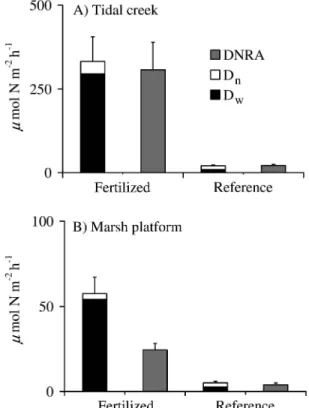
In situ denitrification in the surface sediment—In the permanently inundated tidal creek sediments, in situ denitrification of water column nitrate (Fig. 1; measured asD15in the fertilized creek, andDwin the reference creek)
was increased by more than an order of magnitude in the fertilized creek (294.96 64.7mmol m22h21) compared to
the reference creek (9.6 6 0.8 mmol m22 h21; t-test; t 5
4.41, df 5 6, p 5 0.001). On the marsh platform, denitrification of water column nitrate also increased by more than an order of magnitude (54.169.2mmol m22h21)
in the fertilized marsh compared to in the reference marsh (2.8 6 0.5 mmol m22 h21) (t-test, t 5 5.57, df 5 6, p 5
0.002).
In the permanently inundated tidal creek sediments, rates of coupled nitrification–denitrification (Fig. 1; Dn)
were three times higher in the fertilized tidal creek sediment (37.268.8mmol m22h21) compared to the reference creek
sediment (11.062.4mmol m22h21;t-test,t52.85, df56,
p 50.03). In the surface sediment of the marsh platform, no effect of fertilization was observed; rates were 3.461.7 and 2.361.6mmol m22h21in the fertilized and reference
marsh, respectively (t-test , t 5 0.9, df 5 6, p 5 0.4). Coupled nitrification–denitrification made up a small Table 6. Denitrification rates in surface sediment of the tidal creek and marsh platform (mean 6 SE; n 5 4). Amended denitrification rates (mmol m22h21;D
14+D15) measured using whole-core incubations and denitrification potentials (nmol N (g wet wt.
sed)21h21) from Koop-Jakobsen and Giblin (2009a) measured using sediment slurry incubations.
Fertilized platform
Reference
platform p Fertilized creek Reference creek p
Amended denitrification (mmol N m22h21) 59.969.8 71.3619.7 0.69 350.2676.9 186.4630.7 0.14
Denitrification potentials (nmol N (g wet wt.
sed)21h21) 9.260.6 9.061.0 0.82 7.760.4 5.260.6 0.01
Fig. 1. In situ rates of nitrate reduction pathways in the surface sediment. In situ rates of denitrification of water column nitrate (Dw), coupled nitrification–denitrification (Dn), and dissimilatory nitrate reduction to ammonium (DNRA) in (A) the surface sediment of the tidal creek and (B) the surface sediment of the marsh platform during inundation (mean6SE;
percentage of the in situ denitrification in the fertilized marsh, but comprised more than half of in situ denitrifi-cation in the surface sediment of the reference marsh in the whole-core incubations.
As a result of the fertilization effects on denitrification of water column nitrate and coupled nitrification–denitrifica-tion (Fig. 1), the total in situ denitrificanitrification–denitrifica-tion in the fertilized creek (D15 + Dn; 332.1 6 73.5 mmol m22 h21) was more
than an order of magnitude higher than denitrification in the reference creek (Dw+Dn; 20.66 2.4mmol m22h21;
t-test,t 5 4.23, df 5 6,p , 0.01). On the marsh platform, total in situ denitrification rates (D15 + Dn; 57.5 6
9.6mmol m22h21) were also approximately one order of
magnitude higher in the fertilized marsh than denitrifica-tion in the reference marsh (5.161.0mmol m22h21;D
n+
Dw;t-test,t55.44, df56,p,0.002), but proportionally
the denitrification level was lower on the platform than in the tidal creek sediment. The large increase in denitrifica-tion of water column nitrate was the main factor driving the increase in total in situ denitrification.
DNRA in the surface sediment—In the tidal creek sediment, DNRA was an important nitrate reduction pathway (Fig. 1). DNRA was also highly affected by fertilization; in situ rates in the fertilized creek (307.3 6
82.1mmol m22h21) were more than an order of magnitude
greater than in the reference creek (21.7 6 3.1 mmol m22 h21). Nitrate reduction through DNRA was
compa-rable in size to nitrate reduction through denitrification. DNRA accounted for 48% and 51% of the total dissimilatory nitrate reduction (denitrification + DNRA) in the fertilized and reference tidal creek sediment, respectively. Hence, even though the actual rates of DNRA in the tidal creek were highly affected by fertilization, the relative importance of DNRA, when compared to denitri-fication, was not affected.
On the marsh platform, the DNRA rates were also affected by fertilization (Fig. 1). Rates in the fertilized marsh (24.463.8mmol m22h21) were more than six times
higher than the reference marsh (3.961.1mmol m22h21).
Rates of DNRA made up a smaller percentage of the total dissimilatory nitrate reduction (denitrification + DNRA) than in the tidal creek sediment, accounting for 29% and 43% in the fertilized and reference marsh, respectively. However, on the marsh platform, the presence of a dense rhizosphere complicated the DNRA measurements. In order to prevent damage to roots and rhizomes and subsequent leaching of dissolved organic carbon (DOC) into the samples, subcoring and true ammonium extraction was avoided. The alternative sampling technique applied (seeMethods) did not capture ammonium adsorbed onto sediment particles, and therefore only included ammonium dissolved in pore water and in the water column. The ammonium adsorption affinity of marsh sediments can be substantial, especially in the surface sediment (Koop-Jakobsen and Giblin 2002), and consequently DNRA may have been underestimated using this method.
Rhizosphere denitrification in the marsh platform—In these marshes, where infiltration was low, nitrification was
the only source of nitrate at depth in the rhizosphere, and low nitrification activity was presumably the main factor limiting nitrate availability and controlling in situ denitri-fication. Nitrate concentrations in the pore waters were low (,1.5mmol L21NO{
3 ) and did not differ among depths (p
5 0.55), and there was no overall fertilization effect between the fertilized and reference marsh (nested ANOVA p50.39; Fig. 2).
In the rhizosphere of both the fertilized and the reference marsh, denitrification activity was observed down to a depth of 20 cm (Fig. 3). Denitrification was not measured below the 20-cm depth, but it is possible that denitrification activity continued deeper down in the sediment, following the distribution of the rhizosphere. The depth profiles of denitrification showed a large spatial as well as vertical variation in denitrification in the rhizosphere. Even though the average amended denitrification rates in the fertilized marsh were markedly lower at 20 cm, the observed difference was not statistically significant from other depths
Fig. 2. Profiles of pore water nitrate in the marsh platform sediment, mean6SE (n53).
Fig. 3. Depth profiles of rhizosphere denitrification (Dr). (A) Amended rates and (B) ambient rates of denitrification in the rhizosphere of the marsh platform. Mean6SE (n53).
(p50.36) in the fertilized marsh, nor was there an overall difference between the fertilized and reference marsh (nested ANOVA,p50.30). For the ambient denitrification rates, there were no observed differences among different depths (p50.53) in the fertilized or in the reference marsh, nor was there a difference between the fertilized and reference marsh (nested ANOVA, p 5 0.58). Since this study was carried out in the fourth year of marsh fertilization, it suggested that even long-term increased nitrogen loading did not affect denitrification in the rhizosphere.
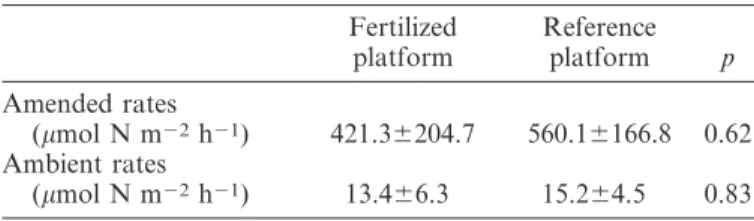
In the rhizosphere, the depth-integrated amended denitrification rates were more than an order of magnitude higher than the ambient rates (Table 7), showing that the sediment possessed a highly unexploited denitrification capacity. Even so, the ambient denitrification rates were still an important component of the overall nitrogen-processing capacity of the marsh.
Discussion
Comparing nitrate reduction activity in fertilized and unfertilized marsh—Fertilization raised denitrification and DNRA rates in the salt marsh sediments. Denitrification increased 16-fold on average in the creek sediment and 11-fold in the platform sediment, in response to an increase in the nitrate loading, ranging from 19-fold in 2006 (corre-sponding to the tidal creek studies), and 10-fold in 2007 (corresponding to the platform studies). A high degree of variance was observed for denitrification rates as well as for the nitrate concentrations within each location, and the average nitrogen loading differed between years. It was therefore difficult to determine exactly how well the increase in denitrification matched the increase in nitrogen loading. Nevertheless, this study does clearly show that a substantial increase in nitrogen loading triggers a substan-tial increase in denitrification in both tidal creek sediment and on the marsh platform.
The amended rates of denitrification and denitrification potentials showed that the denitrification capacity was increased by fertilization in the tidal creek sediment, but not on the marsh platform (Table 6). This was most likely caused by a difference in exposure to the added fertilizer. In this marsh fertilization experiment, the fertilizer was added to the flooding water on every incoming tide, mimicking the natural route of exposure for anthropogenic nitrogen to tidal marshes. In this way, the bottom of tidal creeks, which
are submerged even at low tide, were constantly exposed to the nitrate added to the marsh, whereas the marsh platform, which is flooded only during high tide, was exposed only 12% of the day on average in theS. patens zone in these marshes (Deegan et al. 2007). Consequently, the creek sediment got a markedly higher exposure to the added fertilizer, which may have stimulated the denitrifying community there more than the community on the platform.
DNRA rates were also highly affected by increased nitrogen loading, and the rates were comparable to rates of denitrification in both habitats, and in the fertilized as well as in the reference marsh. In the tidal creek sediment, DNRA accounted for approximately 50% of the total dissimilatory nitrate reduction (denitrification + DNRA), and the relative importance of DNRA was unaffected by fertilization, since DNRA was equally important in the fertilized and reference marsh.
DNRA was also an important nitrate-reducing pathway on the marsh platform, accounting for more than 30%of the total dissimilatory nitrate reduction (denitrification + DNRA). However, the lack of proper extraction of ammonium in the platform sediment may have resulted in underestimated rates, and consequently a comparison of DNRA between the tidal creek sediment and the marsh platform should be done with caution. Nevertheless, the fact that DNRA under these circumstances accounted for more than 30% of the nitrate reduction on the platform showed that DNRA was a very important nitrogen-processing pathway on the marsh platform as well.
The interest in DNRA has increased over the last decade as more studies have found it to be as important as denitrification for nitrate reduction in many marine environments (Burgin and Hamilton 2007), including wetlands (Tobias et al. 2001a,b; Ma and Aelion 2005). This study provides further evidence that DNRA is an important nitrate-reducing pathway in salt marshes.
Comparing nitrate reduction activity in creek sediment and marsh platform sediment—In the fertilized as well as in the reference marsh, the rates of denitrification and DNRA were markedly higher in tidal creek sediment than on the marsh platform. The tidal creek and the marsh platform studies were conducted in two different years, and a comparison therefore should be done with caution. It is however noteworthy that during inundation, when both habitats were equally exposed to water column nitrate, the denitrification rate in the tidal creek was 4–6 times higher than on the marsh platform (Fig. 1). This difference was also present between the reference creek and the reference marsh platform, which were both unfertilized, so nitrogen loading in itself cannot be the driving factor. Many environmental factors are known to affect denitrification in marine sediments. It is possible that differences in sediment grain size, organic content, and H2S
concentra-tion caused by the pronounced difference in water movement, air-exposure frequency, and plant cover be-tween the two habitats played a role in the observed difference in nitrate reduction activity between the tidal creek sediment and the marsh platform.
Table 7. Depth-integrated rhizosphere denitrification rates. Amended and ambient denitrification rates in the rhizosphere of the marsh platform (mean6SE;n53).
Fertilized platform Reference platform p Amended rates (mmol N m22h21) 421.36204.7 560.16166.8 0.62 Ambient rates (mmol N m22h21) 13.466.3 15.264.5 0.83
Other studies have also found differences in denitrifica-tion rates between creek and platform marsh sediment, but no clear picture has emerged. Kaplan et al. (1979) and Eriksson et al. (2003) found higher rates in creek sediments than vegetated sediments, whereas other studies found that denitrification rates were higher in vegetated sediments than in nearby creek bottoms (Abd. Aziz and Nedwell 1986; Koch et al. 1992; Davis et al. 2004).
Nitrate removal—These studies of denitrification and DNRA measured nitrate removal by monitoring the products of two important dissimilatory nitrate reduction pathways. The actual nitrate concentration in the water column was also monitored throughout the incubations of the whole-core experiment. The nitrate availability in the cores was high at all times, and only a minor fraction of the nitrate was removed.
In the tidal creek sediment, nitrate was removed steadily from the water column, and net nitrate removal rates could be calculated. Nitrate removal rates (Table 4) correspond-ed well with nitrate removal through denitrification and DNRA. The sum of denitrification and DNRA accounted for. 76% of the net nitrate removal, showing that these dissimilatory processes comprised the majority of the nitrate reduction in these incubations, whereas nitrate assimilation by microbes and benthic microalgae seemed to play a lesser role in nitrate removal.
In cores from the marsh platform, denitrification and DNRA rates were lower, and less nitrate was removed from the water column. Consequently, the nitrate concentrations were high at all times, and the regressions calculating the nitrate removal were not statistically significant. However, the very low rates of net nitrate removal indicate that net assimilatory sinks were not large, at least over these timescales.
The whole-core incubations in these experiments were carried out in the dark representing a nighttime situation. The presence of benthic microalgae in the sediment is known to suppress denitrification activity in marine sediment due to competition for nitrate (Dalsgaard 2003; Sundback et al. 2004). Nitrate uptake by benthic micro-algae and salt marsh grasses may play a more significant role in reducing denitrification during daylight hours.
Denitrification in the rhizosphere—In contrast to the bare tidal creek sediments, where denitrification is restricted to a narrow band in the upper part of the anoxic zone, the presence of salt marsh grasses on the marsh platform stimulates denitrification deeper in the sediment. In this study, denitrification activity was observed down to a depth of 20 cm and possibly continued deeper into the sediment, following the distribution of roots and rhizomes. Denitri-fication profiles in the rhizosphere were not affected by fertilization and did not differ between the fertilized and reference marsh.
Percolation of water in the vegetated marsh sediment is low and only affects the surface sediment (upper 3 cm) during inundation at high tide (Howarth and Teal 1980; Howarth and Giblin 1983). Only in areas with high drainage close to the creek banks, or areas affected by
bioturbating animals, would some of the fertilizer added to the flooding water reach into the rhizosphere through percolation or irrigation. The low percolation was reflected in the pore water nitrate profiles (Fig. 2), where no significant differences in nitrate concentrations were found between depths or between the fertilized and reference marsh. Hence, the effect of nitrate originating from the surface flood water on rhizosphere denitrification was considered negligible and rhizosphere denitrification was exclusively dependent on nitrate originating from nitrifica-tion.
Even though the rhizosphere possessed a highly unex-ploited denitrification capacity, and ambient denitrification rates appeared low, the deep vertical distribution of denitrification caused the depth-integrated rates of ambient rhizosphere denitrification (Dr) to reach substantial levels.
Rhizosphere denitrification was the dominant denitrifica-tion pathway during flooded condidenitrifica-tions in the reference marsh, where low ambient nitrate concentrations in the flooding water kept denitrification of water column nitrate to a minimum. In the fertilized marsh, on the other hand, increased nitrate availability caused denitrification of water column nitrate (Dw) in the surface sediment to increase
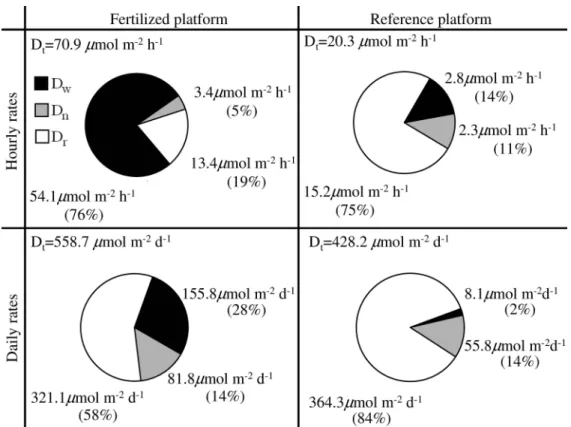
significantly. It became the most important denitrification pathway during inundated conditions, which, however, comprise only 12% of the day (Deegan et al. 2007). In contrast, rhizosphere denitrification is independent of inundation and occurs throughout the day. Denitrification rates calculated on a daily basis showed that even though the denitrification of water column nitrate was the predominate pathway during inundation, rhizosphere denitrification was the major contributor to the N2
production on the marsh platform, in the fertilized as well as in the reference marsh (Fig. 4). Hence, denitrification of internal nitrogen sources in the rhizosphere was more important than direct denitrification of external anthropo-genic nitrogen on the marsh platform, even under fertilized conditions.
Comparison with other marsh studies—Even though salt marshes have an important ecological function removing excess nitrogen, and thereby diminishing nitrogen loading to the coastal zone, studies of denitrification in marshes are few compared to studies of permanently inundated coastal sediments (Hopkinson and Giblin 2008). Continuous flooding and multiple vegetation zones with denitrification potentially occurring at depth in the rhizosphere demand a high degree of flexibility of the denitrification method employed. Of the 16 marsh denitrification studies reviewed by Hopkinson and Giblin (2008), 12 different methodo-logical approaches were used, making comparison among studies difficult. Furthermore, many older studies make use of methods, such as the acetylene block technique, which later were found to be inapplicable in most marsh studies (Hamersley and Howes 2005).
In the fertilizer application method employed in this study, fertilization was implemented from May to Septem-ber, adding dissolved nitrate and phosphate directly to the flooding water. In contrast to fertilization techniques adding dry fertilizer directly to the marsh platform, this
method mimics the natural route of exposure for anthro-pogenic nitrogen to salt marshes, resulting in intensive exposure of the tidal creeks to the added fertilizer. Exposure of the marsh platform, however, is restricted to inundations at high tide. This clearly has a large effect on nitrate reduction pathways.
On the marsh platform, the estimated daily in situ denitrification rates calculated as the sum of all denitrifi-cation pathways (Table 8), weighting the restricted denitri-fication of water column nitrate,S(Dn,Dr, 12%Dw), were in
the low end of the salt marsh denitrification range reported in the literature (Hamersley and Howes 2005; Caffrey et al. 2007; Hopkinson and Giblin 2008). Hopkinson and Giblin (2008) reported gross denitrification rates in vegetated marshes (variable vegetation) ranging from 36 to 4 12 9 mm o l m22 d21 w i t h a m e d i a n v a l u e o f
1000 mmol m22 d21 (n 5 16). The salt marshes in the
Plum Island estuary are relatively pristine marshes, and consequently low ambient denitrification rates on the platform were expected. Although it is noteworthy that even though fertilization increased denitrification of water column nitrate by an order of magnitude, the daily denitrification rates on the fertilized marsh platform were still in the low end of the denitrification range reported, due to the restricted exposure of the marsh platform to fertilized creek water.
In the tidal creek sediment, the difference between the fertilized and reference marsh was large on a daily basis
because this sediment was fully exposed to the added fertilizer (Table 8). Hopkinson and Giblin (2008) reported gross denitrification rates from bare marsh sediments ranging from 29 to 11,500 mmol m22d21 with a median
of 329mmol m22d21(n5 15). Denitrification rates from
the fertilized as well as the reference tidal creek sediment were both in the high end of the denitrification range reported, and the rate in the fertilized creek sediment was one of the highest rates shown in the literature for unvegetated marsh sediments.
Fig. 4. The relative importance of denitrification pathways in the marsh platform sediment. Comparison of denitrification of water column nitrate (Dw), coupled nitrification–denitrification (Dn), and rhizosphere denitrification (Dr). Hourly rates are calculated based on inundated sediment conditions. The daily rates take into account that denitrification of water column nitrate only occurs when the marsh platform is inundated at high tides,,12%of the day. Coupled nitrification–denitrification in the surface sediment (Dn) and rhizosphere denitrification (Dr) occur throughout the day. Total denitrification (Dt) is the sum denitrification pathways on the marsh platform.
Table 8. Estimated total daily denitrification rates in the tidal creek and marsh platform sediment. Mean 6 SE. Total daily denitrification rates in the tidal creek sediment are estimated as
S(Dw,Dn), where denitrification of water column nitrate (Dw) and coupled nitrification–denitrification (Dn) occur 24 h per day. Total denitrification of the marsh platform was estimated asS(Dr,Dn, 0.12Dw), where rhizosphere denitrification (Dr) and coupled nitrification–denitrification (Dn) occur 24 h per day and denitrification of water column nitrate (Dw) occur 2.9 h per day (12%).
Daily denitrification rates (mmol N m22d21)
Fertilized creek 797161568
Reference creek 494661
Fertilized platform 5596155
The estimated daily average of in situ denitrification rates in the fertilized creek,S(D15+Dn), was more than an
order of magnitude higher than the estimated daily average rates in the reference creekS(Dw + Dn). Compared to the
rates on the marsh platform calculated weighting the restricted exposure of the platform to the added fertilizer, denitrification in the creek sediment was also an order of magnitude higher than daily denitrification on the marsh platform (Table 8). This indicates that the tidal creek sediment is an important location for nitrogen removal through denitrification, even though the tidal creek comprises only a small part of the marsh entire area (,
20%).
The estimated daily denitrification rates from the creek sediment presented here represent denitrification in the bottoms of the tidal creeks, which are permanently inundated. However, even though the brinks and mudflats of the tidal creeks are inundated most of the day, inundation still varies with the tidal cycle on these locations. Consequently, the importance of nitrate removal through denitrification in the tidal creek, relative to the marsh platform, is a function of inundation frequency and inundation time of the tidal creek as well as the marsh platform. In future studies, this is a parameter that must be modeled in order to get insight into the relative importance of creek and platform denitrification.
Methodological considerations—Owing to ever-changing environmental conditions in multiple vegetation zones, measuring denitrification in vegetated marshes is challeng-ing.
Measurements of denitrification using whole-core incu-bations and isotope pairing are rarely carried out in the vegetated marsh sediments since the method cannot detect nitrification–denitrification at depth in the rhizosphere, which may be stimulated by the presence of plants. Furthermore, the presence of taller salt marsh grasses requires very tall and cumbersome sediment cores. On the other hand, removal of aboveground vegetation will bias the denitrification measurements, due to leaching of DOC from the damaged plant tissue and disruption of oxygen transport through the arenchyma tissue to the roots and rhizomes. In these studies, the vegetation, S. patens, was retained in the sediment cores. The flexibility ofS. patens allowed the stems to be tied up and weighed down along the edges of the cores, enabling the use of relatively small cores, while keeping the vegetation intact. The S. patens zone comprises,40%of the fertilized and reference marsh (Deegan et al. 2007), so these denitrification measurements are representative of a large part of the vegetated marsh. The methodological approach used in these studies is applicable to most of the marsh platform. However, a different approach would be needed for the creek banks where tallS. alterniflorais present and percolation is high. Denitrification in the rhizosphere was measured using a new methodical approach combining the push–pull method (Addy et al. 2002) with the isotope pairing technique (Nielsen 1992). This combination of methods was modified and refined specifically with the purpose of measuring rhizosphere denitrification in marshes (Koop-Jakobsen and
Giblin 2009b). Considering the large proportion of the total in situ denitrification that rhizosphere denitrification comprises (Fig. 4), these studies clearly show that neglect-ing to include rhizosphere denitrification in marsh nitrate removal studies would significantly underestimate the total amount of denitrification occurring.
In the marshes where the fertilization experiment was located, S. patens grows in close proximity to the tidal creeks. Denitrification was measured in theS. patenszone at a distance of 6–8 m from the tidal creek to ensure frequent inundation, and exposure to the added fertilizer, in the areas studied. Apart from the S. alterniflora zone right on the creek bank, this location on the marsh platform had the highest exposure to the added fertilizer. At higher elevations, near the landward edges of the marsh, the platform is less frequently inundated, and thereby less frequently exposed to the added fertilizer. Consequently, the observed increase in denitrification of water column nitrate in the fertilized marsh is of lesser importance in these areas.
Denitrification was measured in the surface sediment of the marsh platform and tidal creek sediment under flooded conditions, and in the rhizosphere under air-exposed sediment conditions. However, the short distance from the sediment to the atmosphere in the surface sediment promotes a rapid exchange of gasses, complicating denitrification measurements.
For the daily rates presented in this study, it is assumed that denitrification and DNRA of water column nitrate were absent when the sediment was air exposed. However, sulfur-oxidizing organisms carrying out DNRA are capable of storing large quantities of nitrate internally in vacuoles and transporting it into the sediment (Sayama 2001; Zopfi et al. 2001; Sayama et al. 2005). Consequently, DNRA of water column nitrate may also occur during air exposure of the marsh platform. This ability has not yet been described for denitrifying organisms.
In sediments, dissimilatory processes other than denitri-fication and DNRA can reduce nitrate (Burgin and Hamilton 2007). Especially, the presence of anammox can interfere with denitrification measurements. In the sedi-ment investigated in this study, however, anammox accounted for less than 1% of the total N2 production in
the tidal creek sediment as well as on the fertilized and reference marsh platforms (Koop-Jakobsen and Giblin 2009a).
In conclusion, salt marshes affect the flow of anthropo-genic nitrogen from the terrestrial upland to the coastal waters by removing inorganic nitrogen through denitrifi-cation and other processes. On the marsh platform, denitrification of water column nitrate increased by an order of magnitude because of marsh fertilization but was restricted to inundation at high tide. Consequently, denitrification in the rhizosphere, which is expected to occur throughout the day, was the most important contributor to nitrogen removal on a daily basis in the fertilized as well as in the reference marsh platform. Denitrification in the rhizosphere was unaffected by fertilization. The highest denitrification rates were found in the fertilized tidal creek sediment. In the tidal creek,
fertilization increased denitrification of water column nitrate by more than an order of magnitude. Furthermore, total in situ denitrification rates measured in the fertilized creek were also an order of magnitude higher than the rates on the marsh platform on a daily basis. This indicated that the creek sediment might play a crucial role for salt marsh nitrate removal capacity, despite comprising a minor part of the total marsh area.
Acknowledgments
We thank Dr. Linda Deegan, senior scientist at the Ecosystems Center, Marine Biological Laboratory, Woods Hole and lead principal investigator of the TIDE project, and Cristina Kennedy and John Duchette, research assistants, for giving us access to the marsh fertilization experiment and for help with fieldwork. The manuscript was greatly improved by suggestions from Jane Tucker and two anonymous reviewers.
The research was supported by the National Science Founda-tion PIE-LTER (OCE-9726921; OCE-0423565), NSF-DEB-0213767, and the National Oceanic and Atmospheric Adminis-tration (NOAA) Department of Commerce under grant NA16RG2273, Woods Hole Oceanographic Institutions Sea Grant project R/M-50 and R/M-53. The views expressed here are those of the authors and so not necessarily reflect the views of NOAA or any of its subagencies.
References
ABD.AZIZ, S. A.,ANDD. B. NEDWELL. 1986. The nitrogen cycle of an east coast, U.K., saltmarsh: 2. Nitrogen fixation, nitrification, denitrification, tidal exchange. Estuar. Coast. Shelf Sci.22:689–704.
ADDY, K., D. Q. KELLOGG, A. J. GOLD, P. M. GROFFMAN, G. FERENDO,ANDC. SAWYER. 2002. In situ push-pull method to determine ground water denitrification in riparian zones. J. Environ. Qual.31:1017–1024.
AN, S. M., AND W. S. GARDNER. 2002. Dissimilatory nitrate reduction to ammonium (DNRA) as a nitrogen link, versus denitrification as a sink in a shallow estuary (Laguna Madre/ Baffin Bay, Texas). Mar. Ecol. Prog. Ser.237:41–50. ———, ———,ANDT. KANA. 2001. Simultaneous measurement
of denitrification and nitrogen fixation using isotope pairing with membrane inlet mass spectrometry analysis. Appl. Environ. Microbiol.67:1171–1178.
BODELIER, P. L. E., J. A. LIBOCHANT, C. BLOM, AND H. J. LAANBROEK. 1996. Dynamics of nitrification and denitrifica-tion in root-oxygenated sediments and adaptadenitrifica-tion of ammo-nia-oxidizing bacteria to low-oxygen or anoxic habitats. Appl. Environ. Microbiol.62:4100–4107.
BRUNET, R. C., AND L. J. GARCIAGIL. 1996. Sulfide-induced dissimilatory nitrate reduction to ammonia in anaerobic freshwater sediments. FEMS Microbiol. Ecol.21:131–138. BURGIN, A.,ANDS. HAMILTON. 2007. Nitrate removal in aquatic
ecosystems. Frontiers Ecol. Environ.5:89–96.
CAFFREY, J. M., M. C. MURRELL, C. WIGAND,ANDR. MCKINNEY. 2007. Effect of nutrient loading on biogeochemical and microbial processes in a New England salt marsh. Biogeo-chemistry82:251–264.
CHRISTENSEN, P. B., S. RYSGAARD, N. P. SLOTH, T. DALSGAARD, ANDS. SCHWAERTER. 2000. Sediment mineralization, nutrient fluxes, denitrification and dissimilatory nitrate reduction to ammonium in an estuarine fjord with sea cage trout farms. Aquat. Microb. Ecol.21:73–84.
CROMPTON, T. R. 2005. Analysis of seawater—a guide for the analytical and environmental chemist. Springer.
DALSGAARD, T. 2003. Benthic primary production and nutrient cycling in sediments with benthic microalgae and transient
accumulation of macroalgae. Limnol. Oceanogr. 48:
2138–2150.
DAVIS, J. L., B. NOWICKI,ANDC. WIGAND. 2004. Denitrification in fringing salt marshes of Narragansett Bay, Rhode Island, USA. Wetlands24:870–878.
DEEGAN, L. A.,ANDoTHERS. 2007. Susceptibility of salt marshes to nutrient enrichment and predator removal. Ecol. Appl. 17:
S42–S63.
DOLLHOPF, S. L., J. H. HYUN, A. C. SMITH, H. J. ADAMS, S. O’BRIEN,ANDJ. E. KOSTKA. 2005. Quantification of ammo-nia-oxidizing bacteria and factors controlling nitrification in salt marsh sediments. Appl. Environ. Microbiol.71:240–246. [EPA] ENVIRONMENTAL PROTECTION AGENCY. 2002. Mid-Atlantic integrated assessment (MAIA) estuaries 1997–1998. Summary report. Report No. 2002.EPA/620/R-02/003. U.S. Environ-mental Protection Agency, Office of Research and Develop-ment, National Health and Environmental Effects Research Laboratory, Atlantic Ecology Division.
ERIKSSON, P. G., J. M. SVENSSON, AND G. M. CARRER. 2003. Temporal changes and spatial variation of soil oxygen consumption, nitrification and denitrification rates in a tidal salt marsh of the Lagoon of Venice, Italy. Estuar. Coast. Shelf Sci.58:861–871.
FISHER, J.,ANDM. C. ACREMAN. 2004. Wetland nutrient removal: A review of the evidence. Hydrol. Earth Syst. Sci.8:673–685. HAMERSLEY, M. R. 2002. The role of denitrification in the nitrogen cycle of New England salt marshes. Ph.D. thesis. Woods Hole Oceanographic Institution/Massachusetts Institute of Tech-nology.
———,ANDB. L. HOWES. 2005. Coupled nitrification-denitrifica-tion measured in situ in aSpartina alternifloramarsh with a
15NH+
4tracer. Mar. Ecol. Prog. Ser.299:123–135.
HOLMES, R. M., J. W. MCCLELLAND, D. M. SIGMAN, B. FRY,AND B. J. PETERSON. 1998. Measuring 15N-NH+4 in marine,
estuarine and fresh waters: An adaptation of the ammonia diffusion method for samples with low ammonium concen-trations. Mar. Chem.60:235–243.
HOPKINSON, C.,ANDA. GIBLIN. 2008. Nitrogen dynamics in salt marsh ecosystems, p. 977–1022.InD. Capone, D. Bronk, D. Mulholland and E. Carpenter [eds.], Nitrogen in the marine environment. Academic.
HOWARTH, R. W.,ANDA. GIBLIN. 1983. Sulfate reduction in the salt marshes at Sapelo Island, Georgia. Limnol. Oceanogr.28:
70–80.
———, A. SHARPLEY,ANDD. WALKER. 2002. Sources of nutrient pollution to coastal waters in the United States: Implications for achieving coastal water quality goals. Estuaries 25:
656–676.
———, AND J. M. TEAL. 1980. Energy flow in a salt marsh ecosystem: The role of reduced inorganic sulfur compounds. Am. Nat.116:862–872.
HOWES, B. L., P. K. WEISKEL, D. D. GOEHRINGER,ANDJ. M. TEAL. 1996. Interception of freshwater and nitrogen transport from uplands to coastal waters: The role of saltmarshes, p. 287–310. In K. F. Nordstrom and C. T. Roman [eds.], Estuarine shores: Evolution, environments and human alterations. Wiley.
KANA, T. M., C. DARKANGELO, M. D. HUNT, J. B. OLDHAM, G. E. BENNETT,ANDJ. C. CORNWELL. 1994. Membrane inlet mass-spectrometer for rapid high-precision determination of N2,
O2, and Ar in environmental water samples. Anal. Chem.66: