Note on “Engineering” Product Design
John R. Hauser
In the “Note on Product Development” we explored the use of the Lens’ model in product design. This note presents an example prescriptive method to “engineer” product design based on the Lens’ model. In particular, we recognize that customers choose products based on how well the products fulfill their perceived needs. Product development teams must select product features to fulfill those perceived needs.
Why is this so hard? Consider a liquid dishwashing detergent (for washing dishes by hand). It is basically a chemical product. Customers buy it to clean their dishes. But what do clean dishes mean and how does the customer judge that their dishes are clean? It is unlikely that they use a magnifying glass or an instrument to measure the light reflected from the dishes, although an engineer might use those instruments to test a dishwashing product’s performance. It is also unlikely that the customer will read and understand the chemical ingredients. More likely, the customer will use some subjective means to determine “clean.” This might mean holding them up to the light or it might simply mean that there is
no noticeable dirt on the dishes – a minimum requirement. Alternatively, the customer might derive peripheral cues, such as the clarity of the water in the sink (after washing dishes) or the amount and type of bubbles that are still around when the dishes are done and ready to be rinsed. The scent of the dishwater or of the dishes might be another cue to cleanliness.
But “clean” might not be the only perceived need. The customer might care about the ease of use, the “feel” of the water while washing the dishes, the scent of the liquid, the ease of storing the bottle (or package), whether or not the washing causes the dishes to deteriorate, or whether the liquid imparts a perceived taste to the dishes. It is not enough to engineer the best-cleaning liquid. The product development team must engineer the entire customer experience. This includes the liquid itself as well as the packaging and any advertising image.
Consider another example – engineering a customer-service center to provide great service. The development team may design the physical space, select the telephonic equipment, and design protocols. The development team may also design a personnel policy, training, and a monitoring/reward system. Consider the monitoring/reward system. One major financial service provider determined that customers did not like to wait. They instituted metrics and
rewarded the service providers to minimize the number of rings before answering, avoid transferring customers, and answer the customers’ questions as rapidly as possible. Unfortunately, the service providers figured out the system – answer the phone quickly, avoid a transfer even if the service provider did not know the answer, and get off the phone as quickly as possible. In fact, the metric was improved by giving incomplete and unhelpful answers.
The financial services firm responded. Service providers were now given incentives to stay on the phone until the customer got an answer. One metric was the number of minutes per hour that the service provider was on the phone. The service providers responded. They were never off the phone. Breaks were taken while the customer was on hold.
Ultimately, the financial services firm talked to the service providers and understood their needs. Service providers were not happy with gaming the
system. They wanted to serve customers but felt that the metrics prevented them from doing so. In response, the firm began using more qualitative metrics based on monitoring and on customer satisfaction scores. Service providers started to maximize the customers’ perceived needs – the customers wanted their questions answered correctly. Efficiently was a secondary criterion.
Many other example abound. Fulfilling customer needs is important to the success of a new product, but it is difficult to achieve. It is especially difficult in a complex product such as an automobile or a high-end copier. An automobile may take 1,000 person-years to design – millions of decisions need to be made. Even an office copier may require close to 10,000 critical engineering decisions. We want every one of those decisions to be focused on the customer.
The House of Quality
There are many means to match product (or service) features to perceived customer needs. For small numbers of features we often use “conjoint analysis,” a method we cover later in the course. In this note we provide one example method that has been used for many types of products varying from laundry detergents (P&G) to services (Pacific, Gas, and Electric, Inc.) to automobiles (Toyota, General Motors, Ford). It has even been used for movie theaters and off-shore drilling equipment.
Figure 1 illustrates a stylized House of Quality (HOQ) completed by Puritan-Bennett when they were redesigning a medical instrument called a spirometer (measures lung capacity). We cover the details of this case in class. The HOQ begins with a formal study of perceived customer needs called the voice of the customer.1 The voice of the customer identifies customer needs such as “the product is affordable” or “the product is easy for the physician to hold while taking measurements on a patient.” In the Puritan-Bennett case, interviews with physicians, technicians, nurses, and patients identified 25 strategic customer needs. These are listed on the left side of the house.
1
But all needs are not equally important. The customers would much prefer that some needs be fulfilled even if it means that other needs are not fulfilled as well. The voice of the customer measures the importance of each need. In Figure 1 these importances are listed next to the customer needs. In addition, the HOQ lists on the right how each existing product (PB, SM, or WA – three manufacturers) fulfill the customer needs. For example, WA does
extremely well on the important customer need of affordability, while PB does poorly. If the design team can fulfill this need at a reasonable cost it is of high priority.
House
Of
Quality
Customer Needs
(25 strategic needs) Product is affordable Easy to hold Easy to clean Convenient-sized output . . .Relationships
between
Customer
Needs and
Design
Features
Costs and Feasibility
“Engineering”
Measures
Design
Features
100 72 86 86 . . . PB SM WA Customer Perceptions Poor GreatImportances
Figure 1. Illustrative House of Quality
The remainder of the HOQ is self-explanatory. The product development team lists design features at the top of the house. For spirometers a design feature might be the size, shape, or color of the instrument. It might be the means by which data is stored or the means by which data is displayed to the physician. It might include software, hardware, or even packaging features.
The team them considers each high priority customer need, such as
“product is affordable,” and, in the center of the house, indicates how each design feature affects the fulfillment of that need. For example, special plastics may make the spirometer easy to clean (positive relationship) but expensive to produce (negative relationship with “product is affordable”). Some teams indicate the relationships with symbols (z, }, {), others with numbers (±9, ±3, ±1), and still others with simply + or –. The HOQ is a guide; any quantification must be tempered with qualitative judgment.
The HOQ is then completed with costs and feasibility and, possibly, metrics (engineering measures) at the bottom of the house.
Early applications used large numbers of customer needs and design features, but the HOQ became tedious. The HOQ evolved to a representation that was more “just in time.” When the team considers a customer need, it fills in the design features to which that need is linked.
Communication Among Product Development Team Members The HOQ is a management tool designed to enhance communication. It does not automate product design. The team must still consider customer needs and use its creativity and its firm’s strategic resources to develop a product that is profitable (and will remain so under competitive threat).
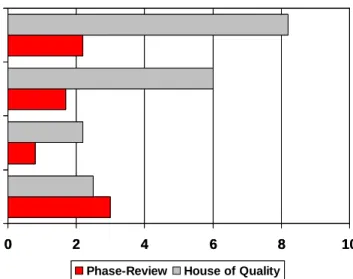
In the early days of the HOQ, MIT Sloan researchers studied its implementation at Ford Motor Company. Two teams were chosen. Each was working on a similar, but different, component of a new automobile and each team was otherwise similar in skills and team members. Both teams reported to the same managers. One team used the HOQ; another team used Ford’s standard phase review process. Over the course of the product development cycle, the MIT Sloan researchers measured the amount and type of communication among team members. The results are given in Figure 2.
0 2 4 6 8 10 To Management Between Functions* Within Functions* Overall*
Phase-Review House of Quality
* Significant at the 0.05 level. Communications per week
0 2 4 6 8 10 To Management Between Functions* Within Functions* Overall*
Phase-Review House of Quality
* Significant at the 0.05 level. Communications per week
Figure 2. Communication at Ford
The light grey bars indicate the communications per week measured for the team using the HOQ. The dark red bards indicate the communications per week measured by the team using the phase-review process. Overall, there was significantly more communication by members of the HOQ team. Deeper analysis revealed that the HOQ focused its communications within the team – both within functions and between functions on these interfunctional teams. The only type of communication reduced by the HOQ was to management. Even deeper analysis showed that the phase-review team engaged in significantly more “up-over-down” communication. For example, an engineer at Ford might
communicate a design change to his/her manager who would communication that design change to a manager at a supplier who would, in turn, communicate the design change to an engineer at the supplier. In the HOQ team the Ford engineer communicated directly to the engineer at the supplier.
Figure 2 is just one example on the success of the various means to enhance communication among product development team members on the relationship between perceived customer needs and engineering design features. Figure 2 is based on the HOQ, but there are many other ways to effect
of how conjoint analysis was used to design “Courtyard by Marriott” using conjoint analysis to link the features of the hotel to perceived customer needs. Green, Krieger, and Wind (2004) provide another example where conjoint analysis was used to design the EZPass (FastLane) system. (See “Note on Conjoint Analysis” for more detail on how to collect data from consumers and how to use conjoint analysis in marketing management.)
The important lesson for 15.810 is that such communication must occur if successful products are to be designed.
References
Akao, Yoji (1987), Quality Deployment: A Series of Articles, (Lawrence, MA: G.O.A.L., Inc.) Glen Mazur, trans.
Griffin, Abbie, and John R. Hauser (1992a), "Patterns of Communication Among Marketing, Engineering and Manufacturing -- A Comparison Between Two New Product Teams," Management Science, 38, 3, (March), 360-373.
Green, Paul E., Abba Krieger, and Jerry Wind (2004), “Thirty Years of Conjoint Analysis: Reflections and Prospects,” in Jerry Wind and Paul E. Green, eds., Market Research and Modeling: Progress and Prospects, a Tribute to Paul E. Green, (New York, NY: Kluwer Academic Publishers).
Hauser, John R. and Don P. Clausing (1988), "The House of Quality," Harvard Business Review, 66, 3, (May-June), 63-73.
_____ and Vithala Rao (2004), “Conjoint Analysis, Related Modeling, and
Applications,” Marketing Research and Modeling: Progress and Prospects, Jerry Wind and Paul Green, Eds., (Boston, MA: Kluwer Academic
Publishers), 141-168.
Krieger, Abba, Paul E. Green, Leonard Lodish, J. D’Arcangelo, C. Rothey, and P. Thirty (2003), "Consumer Evaluation of 'Really New' Services: The Traffic Pulse System," Journal of Marketing Services, 17, April.
Wind, Yoram, Paul E. Green, Douglas Shifflet, and Marsha Scarbrough (1989), "Courtyard by Marriott: Designing a Hotel facility with Consumer-Based Marketing Models," Interfaces, 19, (January-February), 25-47.