arXiv:1006.4085v1 [cond-mat.mtrl-sci] 21 Jun 2010
Wei Kang and Mark S. Hybertsen
Center for Functional Nanomaterials, Brookhaven National Laboratory, Upton, NY 11973 (Dated: June 22, 2010)
Quasiparticle excitation energies and optical properties of TiO2 in the rutile and anatase
struc-tures are calculated using many-body perturbation theory methods. Calculations are performed for a frozen crystal lattice; electron-phonon coupling is not explicitly considered. In the GW method, several approximations are compared and it is found that inclusion of the full frequency dependence as well as explicit treatment of the Ti semicore states are essential for accurate calculation of the quasiparticle energy band gap. The calculated quasiparticle energies are in good agreement with available photoemission and inverse photoemission experiments. The results of the GW calculations, together with the calculated static screened Coulomb interaction, are utilized in the Bethe-Salpeter equation to calculate the dielectric functionǫ2(ω)for both the rutile and anatase structures. The
results are in good agreement with experimental observations, particularly the onset of the main absorption features around 4 eV. For comparison to low temperature optical absorption measure-ments that resolve individual excitonic transitions in rutile, the low-lying discrete excitonic energy levels are calculated with electronic screening only. The lowest energy exciton found in the energy gap of rutile has a binding energy of 0.13 eV. In agreement with experiment, it is not dipole allowed, but the calculated exciton energy exceeds that measured in absorption experiments by about 0.22 eV and the scale of the exciton binding energy is also too large. The quasiparticle energy alignment of rutile is calculated for non-polar (110) surfaces. In the GW approximation, the valence band maximum is 7.8 eV below the vacuum level, showing a small shift from density functional theory results.
PACS numbers: 71.20.Nr 71.15.Qe 71.35.Cc
I. INTRODUCTION
Even after half a century of research1,2, investigation
of the fundamental properties of titanium dioxide (TiO2) crystal phases remains important and fruitful, in part due to the role they have in concepts to effectively utilize solar energy. For example, TiO2 structures form the photoac-tive component in heterogeneous photo-catalysts which, by absorbing energy from the sunlight, degrade environ-mentally hazard materials3,4 and split water into H2 and
O25. Scintered anatase TiO2 nanoparticles provide the
backbone for electron transport and the substrate for organic chromophores in the Grätzel photovoltaic solar cells6. In addition to that, TiO2has been widely used in
various areas from optical coatings to pigments2.
Funda-mental to all of these applications are the relative align-ments of essential energy levels near the valence and con-duction band edges of TiO2 crystal phases and the cor-responding optical transition energies. If predictive com-putational methods are going to have impact on the un-derstanding and design of heterogeneous photocatalytic systems based on TiO2, we must first establish that these methods can predict the basic properties of the crystal phases, providing a coherent framework for all the exper-imental facts.
Rutile and anatase are two common crystal structures in which TiO2is found. In both phases, each Ti atom in the crystal is surrounded by a slightly distorted octahe-dron formed by six oxygen atoms. The distinct phases exhibit a different connection between the distorted octa-hedra (TiO6). In the rutile phase each octahedron shares two edges with its neighbors, while in the anatase phase
each octahedron shares four7. In the rutile form, the
crystal has a simple-tetragonal structure8 with a = b =
0.45936 nm and c = 0.29587 nm. The symmetry of the lattice is described by the space groupP42/mnm with the only internal parameteru= 0.30479. In the anatase form the crystal structure is body-centered tetragonal9,10
and belongs to space group I41/amd. The three sides of the conventional cell are a = b = 0.3784 nm and c = 0.9515 nm respectively. The internal parameteru is 0.2089,10. The measurements quoted were done at room
temperature; the change in lattice parameters upon re-ducing the temperature to 15 K is less than 0.001 nm11.
Most of the early first-principles calculations of the properties of TiO2 were based on the local density approximation (LDA) in a Density Functional Theory (DFT) based approach12,13. The crystal structures and
ground-state properties were accurately reproduced14–17.
However, as has been more generally observed for semi-conductors and insulators, the energy gaps pertaining to optical properties were found to be too small. The min-imum energy gap in the LDA band structure underesti-mated the band gap observed in optical experiments18,19
by about 40%16. Calculations based on Hartree-Fock
theory have been performed, giving accurate structural properties for rutile and anatase, but with a minimum energy gap that exceeded 10 eV10. A hybrid approach,
admixing a fraction of the bare exchange from Hartree-Fock, also showed accurate structural properties for rutile20, with a band gap that is closer to experiment
(3.4 eV)21. A more economical approach, approximately
accounting for explicit Coulomb interactions through a U parameter acting on the Ti 3d electrons in a DFT+U
approach, overestimated the lattice parameters while still showing a band gap that was smaller than experiment22.
A direct approach to calculate electronic excitation en-ergies based on the Green’s function approach of many-body perturbation theory (MBPT), specifically utilizing the GW approximation for the electron self energy23,
has proven to be relatively accurate for a broad array of materials24–27. Several calculations have been
re-ported for TiO2 with different implementations of the GW method28–31. However, the band gap was
signifi-cantly overestimated in all these reports.
The frequency dependent macroscopic dielectric func-tion probed in optical measurements has been exten-sively studied within the framework of DFT for TiO2 crystal phases14,15,17,32. Using the independent particle
approach of Ehrenreich and Cohen33, the underestimate
of the fundamental band gap immediately gives an er-ror in the optical threshold and the overall shape of the dielectric function calculated in this way was quite dif-ferent from the experimental measurements34,35. In the
framework of MBPT, the GW-based results for the elec-tronic excitation energies are input to a direct treatment of neutral excitations through solution of the two-particle Bethe-Salpeter equation (BSE), an approach that has provided a satisfactory description of the optical prop-erties of a number of systems27,36. An application of the
BSE approach for rutile and anatase TiO2 has only re-cently appeared in the literature37. The shape of the
spectra are in much better agreement with experiment as compared to the independent particle approach.
In this article, we critically assess the application of MBPT methods to calculate the electronic and optical excitations for TiO2 in the rutile and anatase crystal phases. To treat the electronic excitation energies, we use the GW method without self consistency or inclu-sion of vertex corrections. Empirically, this approach is often relatively accurate, although a full understanding of cancellations between self consistency and vertex cor-rections remains an open area of research38–44. Several
different approximations to handle the frequency depen-dence of the screened Coulomb interaction in the GW method are compared. We find that use of plasmon pole models24,45 results in significant overestimation of the
band gap. When the full frequency dependence of the screening is included, together with explicit treatment of the Ti semicore states, the calculated electronic excita-tion spectrum is found to be in good agreement with pho-toemission and inverse phopho-toemission spectra46,47.
In-terestingly, the calculated fundamental gap (3.34 eV and 3.56 eV for rutile and anatase respectively), is still larger than the measured minimum gap from optical absorp-tion (3.03 eV for rutile18and estimated to be 3.3 eV for
anatase19). As a first step towards application to
hetero-geneous photocatalytic systems, we discuss the alignment of the valence and conduction band edges at non-polar vacuum-solid (110) interface of TiO2. We find that the GW method implies only very small corrections relative to the LDA for the valence band position, with the most
of the band gap error going to shift the conduction band edge upwards.
To explore the role of electron-hole interactions and ex-citonic binding energy, we have used the results from the GW based calculations as input to the BSE approach. Similar to the recent results of Lawleret al.37, the
calcu-lated frequency dependent dielectric function accurately reproduces the main onset of absorption near 4 eV and gives a good account of the frequency dependence for both rutile and anatase. We also solve the BSE for the low-lying, bound exciton states for rutile. The deepest exciton binding energy is calculated to be about 0.13 eV. The dipole-forbidden character of the lowest exciton agrees with low temperature measurements18, although
the predicted exciton energy (3.25 eV) is still 0.22 eV larger than experiments. Also, the magnitude of the ex-citon binding energy is larger. While the discrepancy for the exciton energy could very reasonably be regarded as within the expected errors of the MBPT methods used here, it may suggest an important role for electron-phonon coupling in screening and in further renormaliz-ing the energy gap in TiO2.
The rest of the article is organized as follows: In Sec. II, the methodologies used in the DFT, electronic excita-tion and optical excitaexcita-tion calculaexcita-tions are briefly sum-marized, the key approximations are discussed and the numerical details are provided. In Sec. III, we present the main results for the electronic and optical excitations in rutile and anatase TiO2 and discuss them in compar-ison to available experiments. Finally, we conclude the article in Sec. IV with a short discussion, including the role of coupling to phonons.
II. METHODOLOGY AND NUMERICAL
DETAILS A. DFT Calculations
The LDA eigenvalues and eigenvectors of TiO2 are calculated with a plane-wave basis set using norm-conserving pseudopotentials. Unless indicated otherwise, the LDA calculations are carried out using the ABINIT package48,49. In TiO2 the Ti is nominally ionized to
[Ti4+] and the low lying conduction band states are of predominantly 3d character. As we show below, artifi-cially dividing the n=3 shell of Ti into frozen core (3sand
3p) and valence (3d) contributions introduces a signifi-cant error to the energy band gap. The pseudopotential of Ti which includes semicore electrons is generated using the OPIUM package50in the Troullier-Martins scheme51
with an initial configuration of (N e)3s23p63d04s04p0. The outermost five orbitals are included and the cut-off radii (in Bohr) are 0.9, 0.9, 1.0, 0.9, and 0.9 re-spectively. Other pseudopotentials are taken from the ABINIT pseudopotential database generated using the FHI99PP package52.
of Ceperly-Alder exchange-correlation potential54 is
used. When including the Ti semicore states, a ki-netic energy cutoff of 200 Ry is used to ensure the con-vergence of the LDA results, as suggested by previous calculations16,55. To examine the accuracy of the
pseu-dopotentials, we calculate the optimized lattice constants for rutile, findinga =4.5484 Å(4.5936 Å),c/a =0.6414 (0.64409) andu = 0.3040 (0.30479), agreeing with the experimental values noted in parentheses8 to the
accu-racy generally expected for LDA calculations. We also compare our LDA calculations with results obtained us-ing the VASP package56,57 with the recommended
pro-jector augmented-wave (PAW) pseudopotentials58. The
difference between the two LDA calculations is within 0.5% for lattice parameters and less than 0.05 eV for bandgaps. In the GW and BSE calculations described below, the geometrical parameters of the unit cell for both rutile and anatase phases are taken from experi-mental measurements8–10,59.
B. GW Method
In MBPT, the evolution of the electrons in a material is described by the one-particle Green’s function, with the effect of electron-electron interactions represented by an electron self energy operator. Well defined electronic excitations appear as peaks in the corresponding spec-tral function. Excitations with single particle character, namely quasiparticles, can be obtained as solutions of a Schrodinger-like equation60
(T+Vext+VH)ψn,k(r) + Z
dr′Σ(r,r′;En,k)ψn,k(r′) = En,kψn,k (1) whereT is the kinetic energy,Vextis the external poten-tial, and VH is the average Hartree potential. Σ is the self energy of the electrons and the indices refer to Bloch states n, k. It includes all the exchange-correlation effects contributed by surrounding electrons. Since Σis
gener-ally non-Hermitian, En,k is complex with the real part giving the quasiparticle energy and the imaginary part corresponding to the width of the quasiparticle peak in the spectral function, i.e. the quasiparticle lifetime.
A practical approximation to calculateΣhas proven to
be the so-called GW approximation of Hedin23, in which
the self energyΣ(r,r′;E)is formally written as
Σ(r,r′;E) = i 2π Z dE′ e−iδ+E′ G(r,r′;E−E′)W(r,r′;E′), (2)
Here G is the Green’s function of the electrons and W is the dynamically screened Coulomb interaction deter-mined by the inverse dielectric matrixǫ−1(
r,r′′;E), and
δ+ is a positive infinitesimal time. The G and W in Eq. (2) refer to the fully interacting Green’s function. However, in practice, using an initial LDA calculation to determine the screening through linear response calcula-tions (not including the exchange-correlation kernel) and to provide an initial, independent-particle Green’s func-tion has often proven to be sufficiently accurate. There are specific examples where the LDA orbital character can be wrong, e.g. in some late 3d transition metal compounds61–63. However, in TiO2, the Ti3dis almost
empty and the valence band edge region is predominantly O2pcharacter with minimal admixture of Ti 3d. The TiO2case should be similar to the vast majority of semi-conductors and insulators in this regard. Also, the LDA wavefunctions are sufficiently accurate that a first order estimate of the self energy correction to the LDA eigen-values is adequate. The quasiparticle energy correction
∆En,k to a LDA orbital φn,k is obtained through a re-duced form of Eq. (1) as
∆En,k=Zn,k φn,k|Σ(En,kLDA)−VxcLDA|φn,k , (3) where VLDA
xc is the exchange-correlation potential and
Zn,k is the renormalization factor of the orbital defined asZn,k= (1−∂Σ/∂E)−1|E=ELDA
n,k .
The frequency dependence of the screened Coulomb in-teraction (W) can often be addressed using a generalized plasmon-pole (GPP) model24,45, with substantial
advan-tages in computational efficiency. The GPP models have proven to be relatively accurate for many semiconductors and insulators, including ionic crystals such as LiCl64and
MgO65. However, as discussed below, we find that use of
the GPP leads to a gap that is substantially too large for TiO2. Several approaches to include the full frequency-dependent dielectric matrix have been implemented and described in the literature: (1) an analytical continua-tion method66,67, (2) a direct method which carries out
the integration in Eq. (2) along the real axis68–70, and
(3) a contour deformation (CD) method which deforms the integration in Eq. (2) along the imaginary axis71. We
adopt the contour deformation method to carry out the calculations, which is particularly efficient for evaluating self energy for states near the gap region.
In the CD method, the correlation contribution
Σc(
r,r′;E) of the self energy is written as the sum of two terms71,72 Σc(r,r′;E) =− X n,k φn,k(r)φ∗n,k(r′) 1 π Z ∞ 0 dE′′ E−En,k (E−En,k)2+E′′2 Wp(r,r′, iE′′)
+Wp(r,r′;|E−En,k| −iη) [Θ(Ef−En,k)Θ(En,k−E)−Θ(En,k−Ef)Θ(E−En,k)]},
(4)
where Wp = W −Vcoul, Ef is the Fermi energy, η is a small damping amplitude andΘis a Heaviside function.
The first term in Eq. (4) comes from the integration along the imaginary axis. As W is now smooth along the imaginary axis, a sparse sampling ofEis sufficient to converge the integration. The second term is the residual contribution of poles near the real axis. It is non-zero only while E > En,k > Ef or E < En,k < Ef. For any
E close to the Fermi surface, only Wp for |E−En,k| ∼
0 have non-vanished contributions to Σc in the second term. This makes the calculation more computational efficient;W is a smooth function of|E−En,k|around 0, due to the band gap, and only relatively low frequencies need to be sampled.
We implement the contour deformation approach based on a private branch of the YAMBO package73.
The integration along the imaginary axis in Eq. (4) is performed with a non-uniform mesh ofN points accord-ing to
E′′
i =E0tan( i−1
2N π), i= 1,2, ..., N, (5) which maps the integration along the imaginary axis to an integration on the [0, 1) interval. The energyE0 pro-vides a scale for the overall density of the samples on the imaginary axis. Half of the mesh spans the energy scale from zero up toE0while the other half sample the higher energies. For TiO2, a mesh of 50 points and an energy scale of 1 Ry were enough to keep the numerical error of the integration within 1 meV.Wpon the real axis is uniformly sampled with an energy increment of 0.1 eV and values between mesh points are linearly interpolated. The special case in Eq. (4) for E →En,k must be han-dled with care. A consistent treatment, that avoids the apparent divergence and properly handles all the terms in Eq. (4), is to add a small positive energy toE−En,k (sayδ= 2.0×10⁻⁷ Ry) when necessary. A very similar contour deformation approach has been implemented in ABINIT72, and we have carefully compared the results
for test cases. The ABINIT package has also been used for the GPP model calculations.
For all the GW calculations, the energy cutoff is 60 Ry for the evaluation of the bare Coulomb exchange contri-bution Σx , and 20 Ry for the correlation part Σc. A total of 160 bands are used for the calculation of both di-electric matrices and self-energies. An unshifted4×4×6
Monkhost-Pack (MP) mesh74 is used to sample the
Bril-louin zone (BZ) of rutile, while for anatase an unshifted
4×4×4 MP mesh is used.
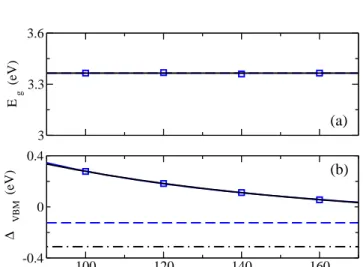
A test of the convergence with respect to the num-ber of bands included is shown in Fig. 1 for the fi-nal full-frequency approach with Ti semicore electrons treated explicitly as valence electrons in the
pseudopo-3 3.3 3.6 E g (eV) 100 120 140 160 N bands -0.4 0 0.4 ∆ VBM (eV) (a) (b)
Figure 1: Quasiparticle direct energy gap atΓ(a) and energy of VBM (b) for rutile as a function of the total number of bands kept in the full frequency dependent GW calculation. Squares represent calculations with Ti semi-core electrons in-cluded explicitly as valence electrons. The results are fitted using two different functional forms described in the text and displayed as solid lines that are indistinguishable in the figure. However, in (b), they have differentN → ∞limits, displayed
as dash-dot (1/N) and long dash (exp(−N/c)) lines in the
figure respectively.
tential. In order to characterize the fully converged val-ues, the data were fit with two different empirical forms, E(N) =E0−b/N, andE(N) =E0−b·exp(−N/c). We first check the validity of the fitting forms for the case of bulk silicon. The exponential form closely represents the band edge and band gap energies as a function of the number of included conduction bands, yielding extrapo-lated results in excellent agreement with those obtained via methods suggested by Bruneval and Gonze75. For
rutile, the fitting curves displayed in Fig. 1 are indistin-guishable, but predict slightly different N → ∞ results
for the absolute shift of the valence band edge, as indi-cated by the horizontal dashed lines in Fig. 1(b). In par-ticular, the fit for the quasiparticle energy gap indicates a converged quasiparticle energy of 3.37 eV for N=160. For the absolute shift of the valence band edge, the con-vergence is somewhat slower, with extrapolated values of -0.12 eV and -0.31 eV. This suggests that the valence band edge in the final results is 0.2 to 0.4 eV lower than the N=160 value.
C. Bethe-Salpeter Equation and Optical Properties
A detailed description of the BSE method is given in the literature27,36. We use the implementation in
the public branch of the YAMBO package73. With the
Tamm-Dancoff approximation76 and the use of a static
screened Coulomb interaction, the BSE is simplified to a generalized eigenvalue equationHvc,v′c′Av
′c′
s =EsAvcs . The effective HamiltonianHvc,v′c′ has an explicit form of
Hvc,v′c′ = (Ec−Ev)δvv′δcc′+ 2 ¯Vvc,v′c′−W¯vc,v′c′, (6)
where the quasiparticle energies (taken from the GW calculations) enter on the diagonal, V¯vc,v′c′ =
hvc|VCoul|v′c′i, W¯vc,v′c′ = hvv
′
|W(E= 0)|cc′
i and the indicesv, crefer to the occupied valence and empty con-duction band states. For brevity, the explicit reference to Bloch wavevectorkfor each state is suppressed. The effective Hamiltonian in Eq. (6) is explicitly written for the spin singlet excitations which are directly probed in optical measurements. For the spin triplet excitations, the effective Hamiltonian is modified by dropping the so-called exchange term 2 ¯Vvc,v′c′. In terms ofEs and Avcs ,
the macroscopic dielectric function ǫM(ω), including lo-cal field effects27,36, is expressed as
ǫM(ω) = 1−lim q→0 4πe2 q2 X s X vc v e −iq·r c Avc s 2 ω−Es+iη . (7) In YAMBO, we use the option to evaluate the response function recursively73,77. In order to study specific, low
energy exciton states, we also directly diagonalize the generalized eigenvalue equation.
Calculations of optical properties via BSE are more expensive computationally. For both phases, the static dielectric matrices are calculated with 80 bands and a damping coefficient of 0.1 eV. The dielectric functionǫ(ω)
is calculated on an8×8×12MP mesh for rutile and on an 12×12×12MP mesh for anatase. For both cases, electron-hole pairs within 15 eV are taken in to build up the BSE kernel, in which the energy cutoff is 10 Ry forV¯
and 3.5 Ry forW¯. To calculate the excitonic binding
en-ergy of rutile, we restrict the basis set for the effective Hamiltonian to one conduction band and one valence band. The exciton binding energy converges relatively slowly with BZ sampling. The final results are reported based on a 12×12×18 MP mesh to sample the BZ. The energy cutoff is larger in this calculation for a more accurate representation of the BSE kernel, 14 Ry forV¯
and 6 Ry forW¯.
III. RESULTS
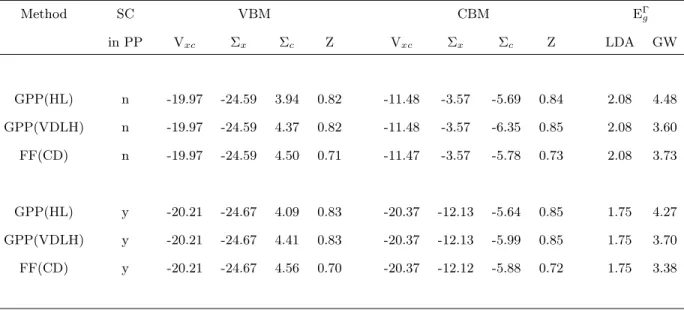
A. Electronic Excitation Energies in TiO2 The calculated electronic excitation energies in tita-nium oxides are found to be sensitive to technical factors in the GW calculations. We illustrate that here for the case of TiO2 in the rutile phase (Table I). First, ex-plicit, self consistent treatment of the semicore electrons
(3s and 3p) on the Ti in the calculations for the solid affects the calculated energy gaps. As discussed in the literature, although the 3s and 3plevels are well sepa-rated from the3dstates energetically, there is significant spatial overlap69. The effect for TiO2 is already evident
at the LDA level, where the gap is reduced by more than 0.3 eV upon explicit inclusion of the semicore electrons relative to freezing the semicore electrons in the pseu-dopotential.
Depending on the approximation used to treat the elec-tron self energy in the GW method, the net influence of the semicore electrons varies. Focusing on the in-fluence of the semicore electrons for the most accurate, full-frequency method (FF), the change is greater than 0.3 eV. A more detailed view of the contributions of the LDA exchange-correlation potentialVxc, the exchangeΣx and the correlation Σc part of the self energy are also displayed Table I. The valence band maximum (VBM) orbitals are largely composed of oxygenp-states. They are spatially separated from the Ti semicore electrons, so the changes are relatively small. Explicit treatment of the semicore electrons as valence electrons only reduces Vxc by 0.24 eV. The reduction in Vxc is partially com-pensated by the decrease ofΣx(0.08 eV) andΣc (0.04 – 0.15 eV). Consequently the overall change of∆EV BM is less than 0.1 eV. On the other hand, the conduction band minimum (CBM) orbital is almost purely of Ti3d char-acter with substantial overlap to the semicore electrons. The expectation value of (Vxc) changes by about 9 eV. Of course, there is a corresponding, large change in the pseudopotential between these two cases. The bare ex-change term in the electron self energy operator ex-changes by a similar amount. Their combined contribution to
∆ECBM is only about -0.34 eV. The changes in the cor-relation part of the self energy Σc of the CBM orbital is sensitive to the GW method. For the full-frequency method, Σc is decreased by only 0.1 eV when semicore electrons are included in the PP, so we find that most of the net effect on the band gap comes from the difference between LDA and bare exchange interactions with the semicore electrons.
In Table I the results of using different methods to ad-dress the frequency dependence of W are shown. These affect the correlation part of the electron self energy
Σc and the renormalization factor Z. The results ob-tained with the full-frequency dependent dielectric func-tion, evaluated using the contour deformation method are the reference results, designated FF(CD) in the ta-ble. For comparison, results from two different general-ized plasmon pole models are shown. In the Hybertsen-Louie approach24, designated GPP(HL), sum rules are
applied to each individual dielectric matrix element to develop a plasmon-pole model for its frequency depen-dence. As shown in the lower part of Table I, when the semicore electrons of Ti were explicitly included in the pseudopotential, the calculated energy gap is almost 1 eV too large. In the approach of von der Linden and Horsch45, designated GPP(VDLH), each dielectric
ma-Method SC VBM CBM EΓ g in PP Vxc Σx Σc Z Vxc Σx Σc Z LDA GW GPP(HL) n -19.97 -24.59 3.94 0.82 -11.48 -3.57 -5.69 0.84 2.08 4.48 GPP(VDLH) n -19.97 -24.59 4.37 0.82 -11.48 -3.57 -6.35 0.85 2.08 3.60 FF(CD) n -19.97 -24.59 4.50 0.71 -11.47 -3.57 -5.78 0.73 2.08 3.73 GPP(HL) y -20.21 -24.67 4.09 0.83 -20.37 -12.13 -5.64 0.85 1.75 4.27 GPP(VDLH) y -20.21 -24.67 4.41 0.83 -20.37 -12.13 -5.99 0.85 1.75 3.70 FF(CD) y -20.21 -24.67 4.56 0.70 -20.37 -12.12 -5.88 0.72 1.75 3.38
Table I: Analysis of the valence band maximum (VBM), the conduction band minimum (CBM) and the direct energy gapEΓ
g at theΓ point of the Brillouin zone calculated for rutile TiO2 using the GW method with several different approximations.
The methods refer to two different generalized plasmon-pole (GPP) models and the full frequency-dependent (FF) approach described in the text. The second column indicates whether Ti semicore states are explicitly included as valence electrons. For the VBM and CBM, the expectation value is shown for the exchange-correlation potentialVxcin the LDA, the bare exchange self energy (Σx), the correlation part of the self energy (Σc) and the renormalization factor (Z). The band gap is shown in the LDA and for the GW method for each case. Energies are given in eV and the renormalization factorZ is dimensionless.
trix is first transformed to the basis of eigenpotentials and then sum rules are applied to develop a plasmon pole model for each eigenpotential. This model also over-estimates the energy gap, but by a smaller amount. The renormalization factorZ, in addition to entering the eval-uation of the quasiparticle energies in Eq. (3), indicates the degree of dynamical admixture of collective excita-tions into the quasiparticle. Larger deviaexcita-tions from unity indicate more admixture. Compared with the FF results, the value of Z indicates that the degree of admixture is substantially underestimated by both GPP models.
We have also tested the GPP(HL) approximation for anatase TiO2 as well as two other titanates, SrTiO3 and BaTiO3. In all three cases, the GPP(HL) approximation leads to minimum band gaps that are too large by 0.7-0.8 eV. A similar deviation for the renormalization constant, Z, is also observed. These results suggest that the quan-titative issues with the plasmon pole model extend more generally to titanates. In previous calculations of the loss function55 and the finite wavevector dynamical
scatter-ing factor78for rutile TiO2, substantial structure is seen
in the frequency dependence, well beyond what could be easily accounted for by a single pole model. These fects trace to an interplay between strong local field ef-fects and the Ti semicore p- to empty d-shell excitation. However, further analysis of the frequency dependence of the screening in Si and LiCl shows that deviations from a pole model for a range of frequencies around the plas-mon energy is not sufficient to predict the performance of the GPP model as it is used to evaluate the GW expres-sion. The dynamical screening at larger frequencies only
Rutile Anatase K-points Γ M R Γ X EV al LDA 0.00 -1.06 -1.04 -0.48 -0.05 EV al GW 0.00 -1.15 -1.12 -0.58 -0.06 ECond LDA 1.75 1.80 1.78 1.96 3.22 ECond GW 3.38 3.40 3.34 3.56 4.89 EDirect gap,GW 3.38 4.55 4.45 4.14 4.95 EIndirect gap,GW 3.34 (Γ→R) 3.56 (∆→Γ)
Table II: LDA and quasiparticle energy levels of rutile and anatase near the Fermi surface at selected k-points of high symmetry. Corresponding quasiparticle energy gaps are also displayed. The energy reference is taken to be the valence band maximum for both LDA and GW results. All energies are in eV.
enters in an integrated fashion, resulting in substantial cancellations internally. In the case of titanates, we find that the full frequency dependence is essential for quan-titative results. Similar conclusions were drawn for the case of metallic Cu69.
The quasiparticle energy levels of rutile and anatase from the highest valence band and the lowest conduction band at selected high symmetry k-points are displayed in Table II. While the energy gap of rutile is found to be a direct gap (at Γ) in the LDA, our FF GW calculations
indicate it as indirect (Γ → R). However, the energy difference between the direct and indirect gap is small. The energy of CBM atΓis only 0.04 eV higher than the energy atR.
The calculated quasiparticle energies can be directly compared to spectroscopic measurements for electron re-moval or addition to the solid. The calculated value of the quasiparticle energy gap, 3.34 eV, agrees well with electron spectroscopy measurements, photo-emission and inverse photo-emission measurements46,47. In Fig. 2,
the density of states (DOS) of rutile derived from FF GW calculations is plotted together with the exper-imental spectra measured using x-ray photoemission and bremsstrahlung isochromat spectroscopy46, which
yielded a band gap of 3.3± 0.5 eV. Overall, the shape of the calculated DOS matches the shape of the exper-imental spectra, especially around the band gap. The experimental spectra measured using ultraviolet photoe-mission and inverse photoephotoe-mission spectroscopy47 show
very similar results with the inferred minimum energy gap about 0.2 eV smaller.
The LDA calculations show that the top of the valence band of anatase lies in the∆direction, somewhere about
0.88 times of the distance from Γ to X. The energy at this k-point is 0.05 eV higher than the energy of the VBM at X. Subtracting the energy difference as a perturba-tion from the quasiparticle energy gap betweenX andΓ, which is 3.62 eV from Table II, the quasiparticle energy gap of anatase is found to be 3.56 eV. The photoemis-sion data available for anatase show an overall occupied band with the oxygen p-bands79. That is similar to
ru-tile. To our knowledge, there is no inverse photoemission data available for anatase, so the calculations can not be compared to a direct measurement of the quasiparticle energy gap.
B. Optical Excitation Energies in TiO2 More precise measurements of the minimum energy gap rely on optical absorption. This introduces the extra complication that the observed threshold for absorption will be altered by interactions between the photoexcited electron and hole, the formation of bound exciton states. For rutile, the BSE calculation shows a series of singlet bound excitonic states atΓ. The lowest two shows-state symmetry in the electron-hole envelope. They have a binding energy of 0.13 eV and 0.06 eV respectively. They are not dipole-allowed. The third and forth are degener-ate, with electron-hole envelope showingpx,y symmetry, and have a binding energy of 26 meV. They are weakly dipole allowed for the electric vector perpendicular to the c-axis. Together with the calculated direct
quasipar-ticle gap energy from above, we obtain the lowest energy singlet exciton at Γ with energy 3.25 eV and the first
dipole allowed singlet exciton with energy of 3.35 eV. High resolution, low temperature optical absorption mea-surements for rutile resolve several separate features18. A
very weak, but sharp exciton feature at 3.031 eV is identi-fied as the 1s exciton which is electric quadrapole allowed. A stronger, but still relatively weak, dipole allowed 2p ex-citon feature starts at 3.034 eV. Finally, phonon-assisted features are also identified that correspond to an indirect gap of 3.049 eV.
There are several important points of comparison. First, the calculated lowest exciton energy atΓis about 0.22 eV higher than measured. Broadly, this error is com-parable to those encountered when using the GW ap-proximation for other semiconductors25–27. However, it
is important to be clear that the calculation is performed for a frozen lattice with no account given for electron-phonon interactions. In general, the electron-electron-phonon in-teraction will reduce the zero-temperature quasiparticle gap80. Second, the present GW calculation gives the
con-duction band minimum at the R point instead of being at Γ, as suggested by the optical measurements. The
energy differences are small; the calculated conduction band at R is 0.04 eV lower than atΓ. In the analysis of the absorption data, the indirect gap is found to be 0.01 eV higher than the direct gap18, albeit including what
ever role excitonic effects may have. The difference be-tween theory and experiment is too subtle to be resolved in these calculations, particularly without the influence of electron-phonon interactions. Third, the symmetry of the excitonic states from the calculation agrees with the interpretation of the experiments. However, the scale of the excitonic effects that we calculate using the static dielectric matrix, and only including the electronic po-larizability, is substantially larger than suggested by the experiment. Our calculated long-wavelength dielectric constant (∼ 8) is slightly higher than the measuredǫ∞
(∼7)34, but similar to previous calculations55. The
lat-tice contribution is quite large, with ǫ0 = 11118. This again points to the importance of the electron-phonon interaction.
The measured optical absorption in single crystal anatase at low temperature does not resolve any signifi-cant structure81. The energy dependence near the onset
of absorption is consistent with an Urbach tail. Analysis of the temperature dependence leads to an estimate for the band gap for extended states of 3.42 eV81. This
ex-ceeds the measured optical threshold in rutile by about 0.4 eV. Since the measured absorption edge in anatase is featureless, another way to characterize the absorp-tion edge and make comparison to rutile is to consider the energy at which the low temperature absorption is 50cm−1 for electric vector perpendicular to the c-axis. In rutile, this occurs at 3.04 eV while it occurs at 3.30 eV in anatase81. This suggests a more modest 0.26 eV
difference between the minimum energy gap of anatase and rutile. Our calculated quasiparticle minimum energy
-10
-5
0
5
10
Energy (eV)
0
2
4
6
Density (arbitrary unit)
Figure 2: Density of states (DOS) of rutile derived from FF GW calculations plotted with photoemission and inverse pho-toemission spectra46. The solid curve is the calculated DOS
which is convoluted with a Gaussian function ofσ= 0.5 eV, while circles are photo- and inverse photo-emission spectra.
gap in anatase is 3.56 eV, modestly larger than the value deduced from the absorption measurements. The calcu-lated difference in gaps between anatase and rutile is 0.22 eV, similar to the measured difference.
So far, the calculated quasiparticle energies for TiO2 have been found to agree well with electron spectroscopy, but the minimum energy gaps, including excitonic effects, are larger compared to the measured absorption thresh-old. Furthermore, the strength of the calculated exciton binding energy is larger than implied by the interpre-tation of the optical spectrum near threshold. To get additional perspective, we calculate the macroscopic di-electric function over a broad energy range, including the correlations induced by electron-hole interactions.
In Fig. 3, we show the imaginary part of the dielec-tric function of rutile for polarizations both perpendicu-lar and parallel to the tetragonal axis c. The solid curves are calculated from the BSE, while the dashed curves are derived from optical reflectivity measurements at room temperature34. For both polarizations, the theoretical
spectra are close to experiment up to about 6 eV. In particular, the first strong peak at ∼4 eV for both
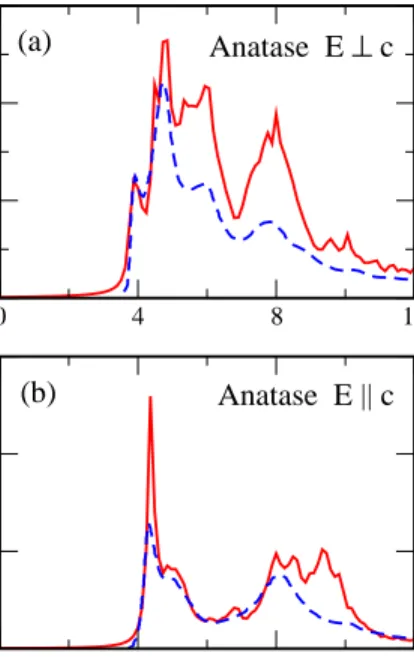
po-larizations is reproduced very well by the BSE results. Above 6 eV, the overall magnitude and prominence of the peaks in theoretical spectra are distinct from experi-ment. Theǫ2(ω)of anatase is displayed in Fig. 4, where the experimental data35were measured at 100 K. Similar
to the rutile case, the theoretical calculations capture the features around the onset of major absorption at 4 eV. For perpendicular polarization, the calculated oscillator strength is systematically too large starting at about 5 eV. The calculated results are very similar to the previous calculation for rutile TiO237. For anatase, the calculated
peak heights near 4 eV appear less intense in their spec-tra, but this is largely due to their choice of a larger
0 4 8 12 0 5 10 15 ε 2 (ω) 0 4 8 12 Energy (eV) 0 10 20 30 ε 2 (ω) Rutile E ⊥ c (a) (b) Rutile E || c
Figure 3: ǫ2(ω) of rutile from 0 to 12 eV. Solid curves are
theoretical calculations with BSE, and dashed curves are ex-perimental results34 obtained at room temperature. In (a)
the direction of polarization is perpendicular to the tetrago-nal axis c, and in (b) the direction of polarization is parallel to axis c.
damping parameter, as is evident from the broadening on the low energy side of their spectra. In particular, we have analyzed the integrated oscillator strength (i.e. the contribution to the f-sum rule) from the first peak in the anatase spectrum for parallel polarization. We find that our oscillator strength is essentially the same as theirs, but that both calculations show more oscillator strength than is found in the experimental spectra by about 30%. The systematic overestimation of oscillator strength at higher energy appears to be a more general issue. For example, a recent BSE study for several alkaline earth metal monoxides shows some similar excess oscilla-tor strength at higher photon energies82. This may well
trace to more fundamental assumptions in the method-ology. Two key issues are the use of the Tamm-Dancoff approximation, which has been identified recently as the main source of errors in the calculations of a confined system83, and the assumption of a statically screened
Coulomb interaction36,84. Also, as noted by Lawler and
coworkers, the f-sum rule for the oscillator strength con-verges very slowly in the titanates and the experimental analysis that relies on Kramers-Kronig transformations may have systematic errors as well37.
0 4 8 12 0 5 10 15 ε 2 (ω) 0 4 8 12 Energy (eV) 0 10 20 30 ε 2 (ω) Anatase E ⊥ c (a) (b) Anatase E || c
Figure 4: ǫ2(ω) of anatase from 0 to 12 eV. Solid curves are
theoretical calculations from BSE, and dashed curves are ex-perimental results obtained at 100K35. In (a) the direction of
polarization is perpendicular to the tetragonal axis c, and in (b) the direction of polarization is parallel to axis c.
C. External Energy Level Alignment: TiO2(110)
Surface
The energetic position of the quasiparticle VBM with respect to the vacuum level in the rutile phase for the (110) surface was calculated in several steps. First at the LDA level, analogous to the determination of work function for metals, the electrostatic potential change be-tween the bulk like region and the vacuum region was determined85–88. Then in a second step, the bulk VBM
position relative to the electrostatic potential is deter-mined. Previous calculations of work functions based on metal slabs based on the DFT Fermi energy were in fairly good agreements with experimental measurements89,90.
In the third step, we will apply the perturbative correc-tion to the LDA exchange-correlacorrec-tion potential to deter-mine the alignment in the GW approximation85,88.
For semiconductors and insulators the Fermi level is separated from the VBM, and the position of VBM varies as the surface structure changes. To calculate the ener-getic alignment of rutile with respect to the vacuum from the (110) surface, a stoichiometric slab of six layers of Ti atoms is cut from the bulk structure with geometrical parameters described in Sec. I. A vacuum space of the same thickness of the slab is used to buffer the two sur-faces of the slab. The surface is cleaved as a (1×1),
un-reconstructed surface as observed in experiments2. The
k-point mesh is2×4×1. After the slab is fully relaxed with the atomic positions of the central two layers fixed,
the electrostatic potential inside the slab with respect to the vacuum is measured as -12.65 eV. The energy differ-ence between the VBM (from the LDA calculation) and the electrostatic potential inside the material is 5.05 eV, which is determined in a separate bulk calculation to pre-vent the quantum size effects89. Accordingly, the LDA
value for the VBM relative to vacuum is 7.60 eV. Previ-ous LDA and gradient corrected calculations for give 7.16 eV (LDA, three Ti layer slab)91, 7.2 eV (PBE, 11 Ti layer
slab)92 and 7.6 eV (PW91, 11 Ti layer slab)92. In light
of variations at the 0.2 eV level with number of layers in the slab model92, the overall agreement is satisfactory.
The GW correction for the VBM calculated with FF model and 160 bands is 0.07 eV. However, as noted in Sect. IIC, extrapolation to full convergence with respect to the total number of bands will drive this 0.2 to 0.4 eV lower. We therefore suggest a GW correction of -0.2 eV, with about 0.1 eV uncertainty. The final prediction from GW for the VBM alignment to vacuum at the clean rutile TiO2 (110) surface is 7.8 eV.
In order to deduce the VBM alignment form experi-ment, two results must be combined: (1) the work func-tion which fixes the Fermi energy relative to the vac-uum; (2) the position of the VBM relative to the Fermi energy. Experimental measurements of the work func-tion of rutile from the (110) surface93,94 vary from 4.7
eV to 5.8 eV depending on the structure of the surface which is strongly influenced by treatment (annealing, ex-posure to oxygen, etc.). In addition, the position of the VBM relative to the Fermi energy also depends on sur-face treatment95. Therefore, it is crucial to compare with
data in which both values are measured on the same sam-ple. To our knowledge, this is relatively rare. Based on UPS measurements with (hν=21.2 eV), a work function of 5.2 eV and a relative VBM position of 3 eV were mea-sured for TiO2(110)94, which implies the VBM position
relative to vacuum falls at 8.2 eV. Similar measurements for TiO2(100) yield a work function of 4.9 eV and a rela-tive VBM position of 3.1 eV respecrela-tively96, yielding the
VBM position at 8.0 eV. The difference in workfunction between these measurements is consistent with a separate Auger Microprobe study of facet dependence97.
Based on this limited data set, the GW based pre-diction for the VBM alignment is off by about 0.4 eV. There are at least 0.1 eV uncertainties in both the the-ory and the experiment. Since both the work function and position of Fermi level are sensitive to the surface properties, the deviation between the theoretical calcu-lation and experimental measurements may well reflect the complexity of the TiO2 surfaces. For example, re-cent studies suggest that the commonly employed strat-egy of cleaning followed by annealing in oxygen may not result in the ideal surface envisioned (e.g. with no oxy-gen related defects)95. In particular, the physical origin
of the widely observed defect states around 1 eV below the CBM remains a point of vigorous discussion95,98.
IV. CONCLUDING REMARKS
We have presented a numerically well converged MBPT study of the electronic and optical excitation en-ergies in rutile and anatase crystals of TiO2. The calcula-tions are carried out in the approximation of a frozen lat-tice, without consideration of electron-phonon coupling. In most respects, the agreement with experiment is well within the expected accuracy of this approach. In par-ticular, the calculated quasiparticle gap agrees with elec-tron spectroscopy measurements (photoemission and in-verse photoemission), the change in the minimum gap between rutile and anatase crystal structures is repro-duced, and the main features of the optical spectrum agree with ellipsometry measurements. The qualitative features of the zone center bound excitons calculated for rutile agree well with low temperature absorption mea-surements. However, the scale of the exciton binding energy is larger than that estimated from experiment by about a factor of 10 and the calculated exciton energy is about 0.2 eV larger than measured.
The key theoretical assumptions in our application of MBPT include evaluation of the electron self energy in the GW approximation without iterating to self con-sistency or considering vertex corrections. Self consis-tency would certainly increase the calculated energy gap through the reduction in the screening29,44. Recent
re-sults for a set of other semiconductors and insulators shows that approximate inclusion of vertex corrections in screening leads to a partially compensating reduction of the calculated energy gap43. However, a fully
con-sistent approach to include vertex corrections remains subject of current research in the field. Because the Ti
3delectrons are almost completely ionized, TiO2 should not be subject to the sorts of systematic errors found in non-selfconsistent calculations for some late transition
3dmetal compounds61–63The accurate results found for
the key optical transition energies contributing to the absorption (Figs. 3 and 4) support this, and contrast to the case of Cu2O where non-selfconsistent calcula-tions showed substantial discrepencies63. In the solution
of the BSE, the calculated static (electronic) dielectric matrix has been used and the equations were simplified through the Tamm-Dancoff approximation. These ap-proximations are part of the standard MBPT treatment of optical spectra and the low energy excitons are ex-pected to be treated well27,36. However, they may affect
higher energy features in the spectra84.
On physical grounds, we suggest that the most sig-nificant open issue concerns the role of electron-phonon coupling. In general, the electron-phonon self energy will both lead to a smaller zero-temperature quasiparticle gap and make a significant contribution to the temperature dependence of the energy gap80. As noted in the text,
there is a very large difference between the electronic dielectric constant ǫ∞ and the low frequency dielectric
constant including lattice polarizationǫ0for TiO2. This suggests a relatively strong electron-phonon interaction
and there is a long standing debate over the polaronic character of charge excitations in TiO299.
Based on the usual form of the Frohlich interaction, the dimensionless coupling constant characterizing elec-tronic coupling to the most important polar optic mode for rutile (with mode energy about 0.1 eV) is given by α= 1.6p
mb/me where mb is the bare band mass and
me is the free electron mass. Using our DFT band dis-persions to have estimates, the electron (hole) band mass is about 0.6me (1.8me) along xory and 1.6me (3.1me) alongz. This suggests coupling constants of α∼1−2
for electrons and α ∼ 2−3 for holes which would fall
in the weak to intermediate coupling regime. Using the usual weak coupling expression, the electron and hole renormalization would be 0.1−0.2 eV and 0.2−0.3 eV respectively, both of which act to reduce the quasipar-ticle energy gap. For anatase α ∼ 1.6pmb/me, essen-tially the same as rutile, based on the mode energy and dielectric constants100. The electron (hole) band mass
is about 0.4me (1.8me) along xor y and 3.9me(1.0me) alongz, suggesting slightly different coupling constants ofα∼1−3 for electrons and α∼2 for holes with
cor-responding (weak coupling) electron and hole renormal-ization of 0.1-0.3 eV and 0.2 eV respectively. In weak coupling, the electron-phonon self energy is added to the results obtained here based on the GW approxima-tion. For the analysis of the optical absorption edge, a more detailed calculation is required because in the exciton-phonon coupling, the exciton is neutral and the electron and hole distortions of the lattice will partially cancel101,102. Taken together, if the large polaron regime
is physically correct, these rough estimates suggest that the effect of the electron-phonon coupling could account for some of the differences between the present GW/BSE results for the frozen lattice and experiment. Firmer conclusions require a more extensive set of calculations, beyond the scope of this article80,103–105. In
particu-lar, it may be that a more complete consideration of self-consistency and vertex corrections in the electron-electron contribution to the electron-electron self energy will need to be combined with an analysis of the electron-phonon contribution. The two contributions should be treated in a fully consistent theory. In more empirical terms, an overstimate of the band gap based on selfconsistent treatment of the electron-electron interactions alone may be compensated by the electron-phonon contributions.
It may well be the case that the large polaron regime is not applicable for TiO2. A recent THz spectroscopy study of rutile gave a direct measurement of the elec-tron scattering rate106. This data was analyzed with a
Frohlich form for the electron-phonon interaction, but re-garding the coupling constant as a free parameter. Using the Feynman approach107,108 to handle intermediate to
strong coupling, the analysis showed coupling constants for electronsα∼4−6depending on field orientation106.
The inferred electron mobilities were consistent with ear-lier electron transport measurements109. These values
energy of 0.4−0.7 eV108. An older estimate based on
small polaron theory also suggested 0.7 eV110. A recent
DFT+U based study suggested that an excess electron in rutile is indeed self trapped111. Although the binding
en-ergy was not presented, the barrier for polaron hopping was estimated to be 0.3 eV. A similar study for an excess hole in rutile suggested barriers of 0.5 - 0.6 eV112. Taken
together, if the small polaron regime is found to be phys-ically relevant, then the quasiparticle and excitonic ener-gies will need to be fully reanalyzed. For strong electron-phonon coupling a perturbative approach to combine the electron-electron and electron-phonon self energies is no longer justified. Furthermore, the electron-phonon cou-pling enters into the spectroscopic measurements in dis-tinct ways. The (inverse) photoemission and optical ab-sorption would each need to be properly analyzed.
Acknowledgments
We thank Dr. A. Marini for access to the private branch of the Yambo code. W. K. thanks Dr. D. Prezzi for insightfull discussions on BSE. Work performed der the auspices of the U.S. Department of Energy un-der Contract No. DEAC02- 98CH1-886. This research utilized resources at the New York Center for Computa-tional Sciences at Stony Brook University/Brookhaven National Laboratory which is supported by the U.S. Department of Energy under Contract No. DE-AC02-98CH10886 and by the State of New York.
1 F. A. Grant, Rev. Mod. Phys.31, 646 (1959). 2 U. Diebold, Surf. Sci. Rep.48, 53 (2003).
3 M. A. Fox and M. T. Dulay, Chem. Rev.93, 341 (1993). 4 M. R. Hoffmann, S. T. Martin, W. Choi, and D. W.
Bah-nemann, Chem. Rev.95, 69 (1995).
5 A. Fujishima and K. Honda, Nature238, 37 (1972). 6 B. Oregan and M. Gratzel, Nature353, 737 (1991). 7 L. Pauling, J. Am. Chem. Soc.51, 1010 (1929).
8 S. C. Abrahams and J. L. Bernstein, J. Chem. Phys.55,
3206 (1971).
9 M. Horn, C. F. Schwerdtfeger, and E. P. Meagher, Z.
Kristallogr.136, 273 (1972), as cited in10.
10 A. Fahmi, C. Minot, B. Silvi, and M. Causá, Phys. Rev.
B47, 11717 (1993).
11 J. K. Burdett, T. Hughbanks, G. J. Miller, J. W.
Richard-son, and J. V. Smith, J. Am. Chem. Soc.109, 3639 (1987).
12 P. Hohenberg and W. Kohn, Phys. Rev.136, B864 (1964). 13 W. Kohn and L. J. Sham, Phys. Rev.140, A1133 (1965). 14 K. M. Glassford and J. R. Chelikowsky, Phys. Rev. B46,
1284 (1992).
15 S.-D. Mo and W. Y. Ching, Phys. Rev. B 51, 13023
(1995).
16 M. Mikami, S. Nakamura, O. Kitao, H. Arakawa, and
X. Gonze, Jpn. J. Appl. Phys.39, L847 (2000).
17 R. Asahi, Y. Taga, W. Mannstadt, and A. J. Freeman,
Phys. Rev. B61, 7459 (2000).
18 J. Pascual, J. Camassel, and H. Mathieu, Phys. Rev. Lett.
39, 1490 (1977).
19 H. Tang, H. Berger, P. Schmid, F. Lévy, and G. Burri,
Solid State Commun.87, 847 (1993).
20 Y.-f. Zhang, W. Lin, Y. Li, K.-n. Ding, and J.-q. Li, J.
Phys. Chem. B109, 19270 (2005).
21 J. Muscat, A. Wander, and N. M. Harrison, Chem. Phys.
Lett.342, 397 (2001).
22 M. Nolan, S. D. Elliott, J. S. Mulley, R. A. Bennett,
M. Basham, and P. Mulheran, Phys. Rev. B 77, 235424 (2008).
23 L. Hedin, Phys. Rev.139, A796 (1965).
24 M. S. Hybertsen and S. G. Louie, Phys. Rev. B34, 5390
(1986).
25 F. Aryasetiawan and O. Gunnarsson, Rep. Prog. Phys.
61, 237 (1998).
26 W. G. Aulbur, L. Jönsson, and J. W. Wilkins, Solid State
Phys.54, 1 (1999).
27 G. Onida, L. Reining, and A. Rubio, Rev. Mod. Phys.74,
601 (2002).
28 M. Oshikiri, M. Boero, J. Ye, F. Aryasetiawan, and
G. Kido, Thin Solid Films445, 168 (2003).
29 M. van Schilfgaarde, T. Kotani, and S. Faleev, Phys. Rev.
Lett.96, 226402 (2006).
30 L. Thulin and J. Guerra, Phys. Rev. B77, 195112 (2008). 31 D. J. Mowbray, J. I. Martinez, J. M. García Lastra, K. S.
Thygesen, and K. W. Jacobsen, J. Phys. Chem. C113, 12301 (2009).
32 K. M. Glassford and J. R. Chelikowsky, Phys. Rev. B45,
3874 (1992).
33 H. Ehrenreich and M. H. Cohen, Phys. Rev. 115, 786
(1959).
34 M. Cardona and G. Harbeke, Phys. Rev. 137, A1467
(1965).
35 N. Hosaka, T. Sekiya, C. Satoko, and S. Kurita, J. Phys.
Soc. Jpn.66, 877 (1997).
36 M. Rohlfing and S. G. Louie, Phys. Rev. B 62, 4927
(2000).
37 H. M. Lawler, J. J. Rehr, F. Vila, S. D. Dalosto, E. L.
Shirley, and Z. H. Levine, Phys. Rev. B78, 205108 (2008).
38 E. L. Shirley, Phys. Rev. B54, 7758 (1996).
39 B. Holm and U. von Barth, Phys. Rev. B57, 2108 (1998). 40 W. Ku and A. G. Eguiluz, Phys. Rev. Lett.89, 126401
(2002).
41 F. Bruneval, N. Vast, and L. Reining, Phys. Rev. B74,
045102 (2006).
42 T. Kotani, M. van Schilfgaarde, and S. V. Faleev, Phys.
Rev. B76, 165106 (2007).
43 M. Shishkin, M. Marsman, and G. Kresse, Phys. Rev.
Lett.99, 246403 (2007).
44 M. Shishkin and G. Kresse, Phys. Rev. B 75, 235102
(2007).
45 W. von der Linden and P. Horsch, Phys. Rev. B37, 8351
(1988).
46 Y. Tezuka, S. Shin, T. Ishii, T. Ejima, S. Suzuki, and
S. Sato, J. Phys. Soc. Jpn.63, 347 (1994).
47 A. K. See and R. A. Bartynski, Phys. Rev. B50, 12064
48 X. Gonze, J. M. Beuken, R. Caracas, F. Detraux,
M. Fuchs, G. M. Rignanese, L. Sindic, M. Verstraete, G. Zerah, F. Jollet, et al., Comput. Mater. Sci.25, 478 (2002).
49 X. Gonze, G. M. Rignanese, M. Verstraete, J. M. Beuken,
Y. Pouillon, R. Caracas, F. Jollet, M. Torrent, G. Zerah, M. Mikami, et al., Zeitschrift Fur Kristallographie 220, 558 (2005).
50 URLhttp://opium.sourceforge.net/.
51 N. Troullier and J. L. Martins, Phys. Rev. B 43, 1993
(1991).
52 M. Fuchs and M. Scheffler, Comput. Phys. Commun.119,
67 (1999).
53 J. P. Perdew and Y. Wang, Phys. Rev. B45, 13244 (1992). 54 D. M. Ceperley and B. J. Alder, Phys. Rev. Lett.45, 566
(1980).
55 N. Vast, L. Reining, V. Olevano, P. Schattschneider, and
B. Jouffrey, Phys. Rev. Lett.88, 037601 (2002).
56 G. Kresse and J. Furthmüller, Comput. Mater. Sci.6, 15
(1996).
57 G. Kresse and J. Furthmüller, Phys. Rev. B 54, 11169
(1996).
58 P. E. Blöchl, Phys. Rev. B50, 17953 (1994).
59 D. T. Cromer and K. Herrington, J. Am. Chem. Soc.77,
4708 (1955).
60 L. Hedin and S. Lundqvist, Solid State Phys.23, 1 (1969). 61 F. Aryasetiawan and O. Gunnarsson, Phys. Rev. Lett.74,
3221 (1995).
62 S. V. Faleev, M. van Schilfgaarde, and T. Kotani, Phys.
Rev. Lett.93, 126406 (2004).
63 F. Bruneval, N. Vast, L. Reining, M. Izquierdo, F. Sirotti,
and N. Barrett, Phys. Rev. Lett.97, 267601 (2006).
64 M. S. Hybertsen and S. G. Louie, Phys. Rev. B32, 7005
(1985).
65 E. L. Shirley, Phys. Rev. B58, 9579 (1998).
66 H. N. Rojas, R. W. Godby, and R. J. Needs, Phys. Rev.
Lett.74, 1827 (1995).
67 M. M. Rieger, L. Steinbeck, I. White, H. Rojas, and
R. Godby, Comput. Phys. Commun.117, 211 (1999).
68 A. Marini, R. D. Sole, A. Rubio, and G. Onida, Phys.
Rev. B66, 161104(R) (2002).
69 A. Marini, G. Onida, and R. D. Sole, Phys. Rev. Lett.88,
016403 (2002).
70 M. Shishkin and G. Kresse, Phys. Rev. B 74, 035101
(2006).
71 S. Lebègue, B. Arnaud, M. Alouani, and P. E. Bloechl,
Phys. Rev. B67, 155208 (2003).
72 F. Bruneval, Ph.D. thesis, Ecole
Poly-technique, Palaiseau, France (2005), URL
http://theory.lsi.polytechnique.fr/people/bruneval/bruneval_theses.pdf.
73 A. Marini, C. Hogan, M. Grüning, and D. Varsano,
Com-put. Phys. Commun.180, 1392 (2009).
74 H. J. Monkhorst and J. D. Pack, Phys. Rev. B13, 5188
(1976).
75 F. Bruneval and X. Gonze, Phys. Rev. B 78, 085125
(2008).
76 A. L. Fetter and J. D. Walecka,Quantum Theory of
Many-Particle Systems (McGraw-Hill, 1971).
77 L. X. Benedict and E. L. Shirley, Phys. Rev. B59, 5441
(1999).
78 I. G. Gurtubay, W. Ku, J. M. Pitarke, A. G. Eguiluz,
B. C. Larson, J. Tischler, and P. Zschack, Phys. Rev. B 70, 201201 (2004).
79 R. Sanjinés, H. Tang, H. Berger, F. Gozzo, G.
Margari-tondo, and F. Lévy, J. Appl. Phys.75, 2945 (1994).
80 M. Cardona and M. L. W. Thewalt, Rev. Mod. Phys.77,
1173 (2005).
81 H. Tang, F. Lévy, H. Berger, and P. E. Schmid, Phys.
Rev. B52, 7771 (1995).
82 A. Schleife, C. Rodl, F. Fuchs, J. Furthmuller, and
F. Bechstedt, Phys. Rev. B80, 035112 (2009).
83 M. Grüning, A. Marini, and X. Gonze, Nano Lett.9, 2820
(2009).
84 A. Marini and R. Del Sole, Phys. Rev. Lett.91, 176402
(2003).
85 S. B. Zhang, D. Tomanek, S. G. Louie, M. L. Cohen, and
M. S. Hybertsen, Solid State Commun.66, 585 (1988).
86 A. Baldereschi, S. Baroni, and R. Resta, Phys. Rev. Lett.
61, 734 (1988).
87 C. J. Fall, N. Binggeli, and A. Baldereschi, J. Phys.:
Con-dens. Matter11, 2689 (1999).
88 R. Shaltaf, G. M. Rignanese, X. Gonze, F. Giustino, and
A. Pasquarello, Phys. Rev. Lett.100, 186401 (2008).
89 C. J. Fall, N. Binggeli, and A. Baldereschi, Phys. Rev. B
58, R7544 (1998).
90 C. J. Fall, N. Binggeli, and A. Baldereschi, Phys. Rev. B
61, 8489 (2000).
91 D. Vogtenhuber, R. Podloucky, J. Redinger, E. L. D.
Hebenstreit, W. Hebenstreit, and U. Diebold, Phys. Rev. B65, 125411 (2002).
92 A. Kiejna, T. Pabisiak, and S. W. Gao, J. Phys.: Condens.
Matter18, 4207 (2006), and reference herein.
93 K. Onda, B. Li, and H. Petek, Phys. Rev. B70, 045415
(2004).
94 K. D. Schierbaum, S. Fischer, M. C. Torquemada, J. L.
de Segovia, E. Román, and J. A. Martín-Gago, Surf. Sci. 345, 261 (1996).
95 S. Wendt, P. T. Sprunger, E. Lira, G. K. H. Madsen, Z. Li,
J. O. Hansen, J. Matthiesen, A. Blekinge-Rasmussen, E. Laegsgaard, B. Hammer, et al., Science 320, 1755 (2008).
96 G. Xiong, R. Shao, T. Droubay, A. Joly, K. Beck,
S. Chambers, and W. Hess, Adv. Funct. Mater.17, 2133 (2007).
97 A. Imanishi, E. Tsuji, and Y. Nakato, J. Phys. Chem. C
111, 2128 (2007).
98 C. Di Valentin, G. Pacchioni, and A. Selloni, Phys. Rev.
Lett.97, 166803 (2006).
99 Detailed references can be found in the papers cited
below106,109–112.
100 R. J. Gonzalez, R. Zallen, and H. Berger, Phys. Rev. B
55, 7014 (1997).
101 S. Schmitt-Rink, D. A. B. Miller, and D. S. Chemla, Phys.
Rev. B35, 8113 (1987).
102 S. Rudin, T. L. Reinecke, and B. Segall, Phys. Rev. B42,
11218 (1990).
103 A. Marini, Phys. Rev. Lett.101, 106405 (2008).
104 F. Bechstedt, K. Seino, P. H. Hahn, and W. G. Schmidt,
Phys. Rev. B72, 245114 (2005).
105 J. Vidal, F. Trani, F. Bruneval, M. A. L. Marques, and
S. Botti, Phys. Rev. Lett.104, 136401 (2010).
106 E. Hendry, F. Wang, J. Shan, T. F. Heinz, and M. Bonn,
Phys. Rev. B69, 081101 (2004).
107 R. P. Feynman, Phys. Rev.97, 660 (1955). 108 T. D. Schultz, Phys. Rev.116, 526 (1959).
109 E. Yagi, R. R. Hasiguti, and M. Aono, Phys. Rev. B54,
7945 (1996).
111 N. A. Deskins and M. Dupuis, Phys. Rev. B75, 195212
(2007).
112 N. A. Deskins and M. Dupuis, J. Phys. Chem. C113, 346