Predictive Analytics – Examining
the Effects on Decision Making in
Organizations
Master thesis 15 HEC, course INFM10 in Information Systems Presented in June 2015
Authors: Bojan Najdenov
Fadi Makhoul Supervisor: Odd Steen
Examiners: Björn Johansson Benjamin Weaver
Predictive Analytics – Examining the Effects on Decision
Making in Organizations
Authors: Bojan Najdenov and Fadi Makhoul
Publisher: Dept. of Informatics, Lund University School of Economics and Management. Document: Master Thesis
Number of pages: 60
Keywords: Predictive Analytics, Decision Making, Simon’s model of the decision-making process, Huber’s theory.
Abstract:
Predictive analytics is a type of business analytics which enables predictions to be made, about occurrence of particular events in the future, based on data of the past. The predictive analytics is widely incorporated among the most successful organizations where it supports their decision-making process.
The aim of our study is to examine the effects on decision making in organizations caused by predictive analytics. We perform a qualitative study to investigate the effects by using
Simon’s model to break down the decision-making process and analyse how the predictive analytics affects each stage. Additionally we test the propositions from Huber’s theory of the effects of advanced information technology on organizational design, intelligence and deci-sion making, in the context of predictive analytics as an advanced information technology. Our contribution to IS knowledge is derived from our findings which show that the predictive analytics offers strong support in the intelligence and design phase of the decision-making process, while having no effect on the choice phase. Furthermore, through the prism of Huber’s theory, we find that the predictive analytics generates effects on the organizational intelligence and decision making, while also having effects at subunit level, organizational level and the organizational memory.
– ii –
Acknowledgements
First and foremost, we wish to express our sincere gratitude to our supervisor Odd Steen, for his valuable guidance throughout the supervision of this thesis. We would also like to thank our co-supervisor Styliani Zafeiropolou for insightful comments and advice. Additionally, we are grateful to our lecturer Olgerta Tona, for her help she offered with the initial idea and in the early stages of our thesis. Furthermore, we appreciate very much the input we got from our reviewers during the initial seminars whose valuable feedback was crucial in finishing this thesis. Finally, we wish to thank all participating organizations and informants for taking part in our study.
I would like to express my sincere gratitude to my dear family and friends for their enormous support, love and encouragement throughout my whole studies. I also want to thank Lund University Global Scholarship Program for the financial support of my studies.
Bojan Najdenov
I would like to thank my lovely family for their endless support; my beloved wife for her love and patience, my mother and father for their continuous encouragement and compassion dur-ing my study.
Contents
1 Introduction ... 1
1.1 Problem area and research question ... 2
1.2 Purpose ... 3
1.3 Delimitation ... 3
2 Literature Review ... 4
2.1 From BI to BA to Predictive Analytics ... 4
2.1.1 Predictive analytics ... 7
2.2 Decision making ... 11
2.3 Theoretical frameworks ... 12
2.3.1 Simon’s model of the decision-making process ... 15
2.3.2 Huber’s theory of the effects of advanced information technologies on organizational design, intelligence and decision making... 17
2.4 Our research framework ... 22
3 Research Method ... 25
3.1 Method Choice ... 25
3.2 Data collection ... 25
3.2.1 Development of the interview guide ... 26
3.2.2 Interviewing ... 28
3.3 Data analysis ... 30
3.3.1 Interview transcription ... 31
3.3.2 Coding and analyzing ... 31
3.4 Critical reflections ... 32 3.4.1 Validity ... 32 3.4.2 Reliability ... 32 3.4.3 Ethical issues ... 33 4 Empirical Findings ... 34 4.1 Case Organizations ... 34 4.1.1 T-Mobile ... 34 4.1.2 DBank ... 34
4.1.3 One (Telekom Slovenia Group) ... 35
4.1.4 C-Retail ... 35
4.1.5 IKEA Sweden ... 35
4.1.6 Semos Group ... 36
– iv –
4.2.1 Simon’s model of the decision-making process ... 36
4.2.2 Huber’s theory of the effects of advanced information technologies on organizational design, intelligence and decision making... 40
5 Discussion ... 53
6 Conclusions ... 59
Appendix A: Interview guide ... 61
Appendix B: Transcript T-Mobile ... 64
Appendix C: Transcript DBank ... 71
Appendix D: Transcript One ... 77
Appendix E: Transcript C-Retail ... 82
Appendix F: Transcript IKEA ... 87
Appendix G: Transcript Semos ... 97
Figures
Figure 2.1 History of DSS according to Hosack et al. (2012) ... 5
Figure 2.2 Generic BI environment (according to Watson, 2009) ... 6
Figure 2.3 Predictive analytics and modelling positioned in BI&A context (Davenport and Harris, 2007) ... 9
Figure 2.4 Input-process-output model (Raghunathan, 1999) ... 13
Figure 2.5 Model of the decision-making process (Simon, 1977) ... 16
– vi –
Tables
Table 2.1 Examples of predictive analytics ... 8
Table 2.2 Explanatory Statistical Modelling and Predictive Analytics according to Shmueli and Koppius (2010) ... 10
Table 2.3 Categories of decisions and examples (Gorry and Morton, 1971; Courtney, 2001) 12 Table 2.4 Modified structural model (Molloy and Schwenk, 1995) ... 13
Table 2.5 Recent related Information Technology and Decision making literature ... 14
Table 2.6 Related IS research done using Huber's theory ... 20
Table 2.7 Categorization of the addressed variables in line with Huber's theory ... 22
Table 2.8 Propositions from Huber's theory modified in the context of predictive analytics .. 23
Table 3.1 Summary of the conducted interviews ... 29
Table 3.2 Summary of the transcribing process ... 31
Table 4.1 Empirical results about the effects at subunit level ... 43
Table 4.2 Empirical results about the effects at organizational level ... 46
Table 4.3 Empirical results about the effects on organizational memory ... 48
Table 4.4 Empirical results about the effects on organizational intelligence and decision making ... 52
1
Introduction
Information Systems research community argues that Business Intelligence (BI) today is om-nipresent in organizations, a technology that successful organizations utilize. Even though the name Business Intelligence appears to be relatively new by various sources, the main idea behind it dates several decades back to decision support systems (Hosack et al, 2012; Negash, 2004; Watson, 2009). With regards to what Business Intelligence is, Negash (2004, p.178) gives the following definition:
“Business Intelligence systems combine data gathering, data storage, and knowledge man-agement with analytical tools to present complex internal and competitive information to planners and decision makers.”
Business Analytics (BA) on the other hand, is considered to be the next evolutionary stage by information systems research community, a trend that will replace business intelligence while bringing the focus to big data and analytics (Hosack et al, 2012). Business analytics as an emerging field can ultimately lead to improved decision making, by providing a better under-standing of business dynamics (Schläfke et al., 2012). Despite that, authors in literature use both terms business intelligence and business analytics for referring to the same ideas that the Negash’s (2004) definition explains. Yet, other authors in IS literature found a reasonable compromise using the term Business Intelligence and Analytics (BI&A) while still referring to the Negash’s (2004) definition with the focus on the analytics part.
As an answer to the question what BI&A actually does for organizations, Negash (2004) states that it assists them in strategic and operational decision making by converting data into information and ultimately into knowledge via analysis done by people. Modern organizations nowadays simply must be competing on analytics, especially in the areas of predictive ana-lytics (Davenport, 2006). Some of the “sources of strength” for organizations competing on analytics, as Davenport (2006) states are the following: the right focus, the right culture, the right people and the right technology in terms of powerful business intelligence software and computing hardware. Organizations adopt analytical approaches as a way to cope with data, empowered by its constant growth and availability, resulting with development of advanced data analysis, scenario planning and predictive capabilities as means for fighting increasing complexity, uncertainty and volatility (Schläfke et al., 2012).
Predictive business analytics (or predictive analytics) is a special type of business analytics (Boyer et al., 2012) which is practiced by the most profitable organizations that are best play-ers within an industry (Davenport, 2006; Siegel, 2013). What predictive analytics does is it “enables users to predict what will happen next in order to make better decisions for future outcomes” (Boyer et al., 2012, p. 147). In addition to that, predictive analytics is dependent on data from which hidden predictive information is extracted so that various relationships are better understood and knowledge is generated to support decision making in organizations (O'Flaherty and Heavin, 2014).
– 2 –
1.1
Problem area and research question
“Organizations are competing on analytics not just because they can - business today is awash in data and data crunchers - but also because they should” (Davenport, 2006, p.1). Organizations exist in a world where big data is omnipresent and available for them, growing and developing more than ever (Chen et al., 2012; McAfee and Brynjolfsson,
2012).Organizations within an industry offer relatively similar products, using similar tech-nologies and it is their business processes and knowledge they obtain from their data that will differentiate them from others and help them get the biggest share of the profit (Chen et al., 2012; Davenport, 2006; Wixom et al., 2011; Wixom et at., 2013).
Predictive modelling and analytics can be of crucial importance for organizations if correctly aligned with their business process and needs and can also lead to significant improvement of their performance and quality of the decisions they make, thus increasing their business value (widely known examples of organizations are retailers like Amazon and EBay and targeted online ads networks like Google and Facebook) (Davenport and Kim, 2013; Siegel, 2013). Every organization can statistically analyse their data and get to know their environment bet-ter to some extent (their current clients, profit movements, track of supplies and so on), but the biggest potential for profit lies among those who are able to perform predictive modelling thus identifying the most profitable courses of action and make decisions based on them (Davenport, 2006; O’Flaherty and Heavin, 2014).
Despite the success stories of incorporated predictive analytics by practitioners (Rjeily and Reilly, 2012; CGI Group, 2013; SAP, 2013) and big tangible and measureable benefits to or-ganizations (Siegel, 2013), information systems researchers as well include the meaning and importance of predictive analytics when discussing the future trends and evolution of decision support systems (Davenport, 2006; Hosack et al., 2012).
While the area of making predictive analysis is a very hot topic for researchers in the fields of computer science, mathematics and statistics, that is not the case for the Information Systems research community. Information systems literature review about the existence of predictive analytics shows that only 52 articles were identified as relevant between the years of 1990 and 2006 (Shmueli and Koppius, 2010).
Since predictive analytics plays a big role in the most profitable organizations and also repre-sents a trend which organizations follow, it is to be considered an important segment in the support of decision making. In addition to that, IS research already done in areas associated with predictive analytics is very limited, thus it is indeed the case that new opportunities are open for further research to be conducted.
Therefore, the research question that we propose is:
What are the perceived effects of the use of predictive analytics on decision making in organizations?
1.2
Purpose
Data and business analytics tools are particularly useful for organizations because of the sup-port they offer for decision making, considering the fact that decisions based on data and made with the use of analytical tools are normally better than those made without (Klatt et al., 2011; Schläfke et al., 2012). That signifies the big importance and potential that business ana-lytics has for organizations as a whole. The use of business anaana-lytics most evidently adds value to the organization at certain level. Organizations that are characterized with superior performance typically adopt and use business analytics in an intensive way (Klatt et al., 2011) when compared to others, while the best performers incorporate predictive analytics (Daven-port, 2006; Siegel, 2013).
The reason why we propose this study is because predictive analytics, as an area under the umbrella of business analytics, is still an under-researched area within the IS community and we would like to examine its potential and influence within the context of decision making in organizations. The problem area is within the domain of IS because it explores the effects from an IT artefact in relation with organizational and business processes as is the decision making.
The purpose of our research is to study the perceived effects of the use of predictive analytics on decision making in organizations and thus generate knowledge to the research community. The research will be done on organizations that rely on predictive analytics for decision mak-ing. The results are expected to show what effects of the use of predictive analytics are per-ceived to be present in the decision-making processes, in what form and in what aspect of the decision making.
1.3
Delimitation
Business intelligence and analytics are broad areas and in our study we will only focus on predictive analytics, as a particular type of business analytics. Our study will not analyze the technical details that exist in terms of characteristics, implementation of various tools and algorithms that are being used in order to enable predictive power.
Decisions are categorized in multiple groups by different dimensions in literature. In our study we will not focus on particular type of decision that is made on a certain level within the organizations. Instead, we are interested in the decision making as a process, regardless the type of decisions.
– 4 –
2
Literature Review
Having introduced our problem area, research question and purpose of our study, in this chap-ter we dig deeper in the theoretical background of our study. We extend the context of our research which we introduced in the previous chapter by referring to relevant existent IS dis-cussions. First we are going to elaborate what predictive analytics represents and where it originates from. Second, we discuss what decision making is in the context of organizations, to provide a foundation of the theoretical frameworks that we next discuss. Finally, we pre-sent and motivate our choice of frameworks we focus on, which are Simon’s model of the decision-making process and Huber’s theory of the effects of advanced information technolo-gies on organizational design, intelligence and decision making. We conclude this chapter by presenting our theoretical framework which we are going to use in order to answer our re-search question.
2.1
From BI to BA to Predictive Analytics
Business intelligence (BI) is defined in various ways in information systems literature. Some authors see it as a process or a sequence of processes (Golfarelli et al, 2004) where data is analysed, relationships are discovered and knowledge is generated to facilitate decision mak-ing in organizations. Other authors see business intelligence as both a process and a product, where the product is information or knowledge for decision making (Martinsons, 1994). Fur-thermore, there are authors who see business intelligence as a process, product and technolo-gies, where definitions include working with data using analytical tools as one of the key components to generate information for decision makers (Clark et al., 2007). All in all, the purpose of BI is to provide the right information, in the right format and in the right time to the right users so that the performance of the company is improved in terms of decision mak-ing (Negash, 2004).
Historically speaking, business intelligence evolved from decision support systems (DSS) in the late 1980s and early 1990s (Power, 2007). However, the history of decision support sys-tems dates back to 1960s and their historical evolution has been analysed by Arnott and Per-van (2005) who built a timeline, which is later to be updated by Hosack et al. (2012), as dis-played in Figure 2.1 .
Figure 2.1 History of DSS according to Hosack et al. (2012)
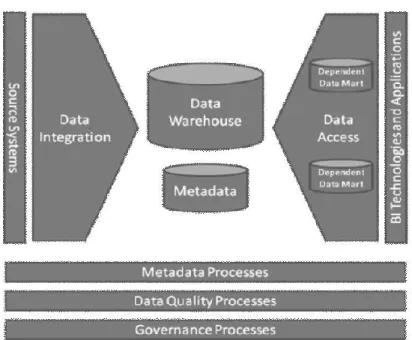
We already went through the various definitions concerning BI in IS literature and made a trip through DSS evolution history, to familiarize with the context of business intelligence. In ad-dition to that, in order to extend the context of BI we present a generic BI environment (Figure 2.2) as developed from literature review by Watson (2009). The generic BI environ-ment is applicable enterprise-wide and provides a picture of the all the processes, connecting data integration and access technologies and processes, together with governance and data quality processes to be able to support decision-makers when using BI technologies and ap-plications.
Business analytics (BA) on the other hand, is seen as a next evolutionary stage, a more ad-vanced discipline, a term that is going to push aside and replace business intelligence (Laursen and Thorlund, 2010). Additionally, BA is well associated with big data and ad-vanced analytics (Hosack et al, 2012). Furthermore, authors use the term Business Intelli-gence and Analytics (BI&A) to refer to a combination of the processes in the Negash’s (2004) definition and advanced analytics (Chen et al., 2012).
– 6 –
Figure 2.2 Generic BI environment (according to Watson, 2009)
Answering the question why business analytics is more and more embraced by organizations, Klatt et al. (2011) argue that three factors exist that are key promoters of business analytics:
data overload - business analytics presents relevant and reliable information for deci-sion makers out of the big pool of data
causal interdependencies - business analytics identifies relationships between complex impact factors thus leading to improved decision making
holistic application of business analytics - relates to the “managers’ awareness of crit-ical interdependencies between inputs, processes, outputs and outcomes”.
Both Klatt et al. (2011) and Schläfke et al. (2012) suggest a multi-layer framework that ex-plains integration of business analytics into performance management within the organiza-tional context. The purpose of the framework is to provide guidance for managers when they need to decide what kind of analytics is most suitable for them to use by mapping the “causal-ity-based couplings of context factors, inputs, processes, outputs and outcomes in order to highlight their value creation” (Schläfke et al., 2012, p.116).
The only way to get the most effective business analytics is to combine these areas of exper-tise within the organization:
IT: data mining, natural language processing, classification, regression trees etc.
Strategic management accounting: cost break down and driver analysis, process mod-eling, total cost of ownership, balanced scorecard, life cycle costing etc.
Analytical methods: econometric, mathematical and statistical like regression analysis, structural equation modeling, vector autoregressive modeling and so on (Schläfke et al., 2012).
Some of the large numbers of potential BI&A users are: analysts, information workers, man-agers and executives, suppliers, customers and regulators, front line workers and IT develop-ers (Watson, 2009). Negash (2004, p. 179) refdevelop-ers to a Gartner study that ranks the strategic use of business intelligence like:
corporate performance management
optimizing customer relations, monitoring business activity and traditional decision support
packaged standalone BI applications for specific operations of strategies
management reporting of business intelligence.
Additionally BI&A is used for creating forecasts and estimates based on data, creating and observing the outcomes from “what if” alternative scenarios, getting answers to ad-hoc non-routine questions and getting strategic insight (Negash, 2004). Despite the fact that many or-ganizations practice analytics in one way or another to facilitate their business processes and especially the decision making, not many have achieved a level of proficiency (Davenport, 2006). Furthermore, some of the other types of information systems that BI&A is related to are: Online Analytical Processing (OLAP), data warehouse, visualization, Customer Relation-ship Management (CRM) marketing, Geographic Information Systems (GIS), knowledge management, DSS/ Executive Information Systems (EIS) and data mining (Negash, 2004).
2.1.1 Predictive analytics
Having discussed what business intelligence is, how it is related to business analytics and how important it is to organizations, we will narrow down our research problem area and focus on one particular segment of interest to our study - which is the predictive analytics.
Analytics is related to “the extensive use of data, statistical and quantitative analysis, explana-tory and predictive models, and fact-based management to drive decisions and add value” (Davenport and Kim, 2013, p3). According to the differences in the analytical methods used as well as the purpose they are being used for, analytics can be divided into the following cat-egories: descriptive, prescriptive and predictive. The descriptive analytics can be referred to as reporting and it describes a certain phenomenon of interest. It includes the actions of gath-ering, organizing, tabulating and depicting data, and even though it is useful for decision makers in the context of an organization, it does not provide details about why certain event occurred nor it is able to say what could happen in the future (Davenport and Kim, 2013; Delen and Demirkan, 2013; Song et al., 2013). The prescriptive analytics on the other hand, is related to making suggestion about a certain set of actions and includes methods of experi-mental design and optimization (Davenport and Kim, 2013; Sharda et al., 2013; Song et al., 2013). The experimental design explains the reasons why a phenomenon occurs by making experiments where independent variables are manipulated, extraneous variables are controlled and therefore conclusions are being made which result with actions that the decision maker should practice. Optimization as a technique suggests balancing the level of a certain variable related to other variables, thus identifying the ideal level of it – a recommendation for the de-cision maker (for example identifying the ideal price of a product to be sold, the ideal level of supplies to be kept in inventory or the right quantity of a particular order to be made) (Daven-port and Kim, 2013).
– 8 –
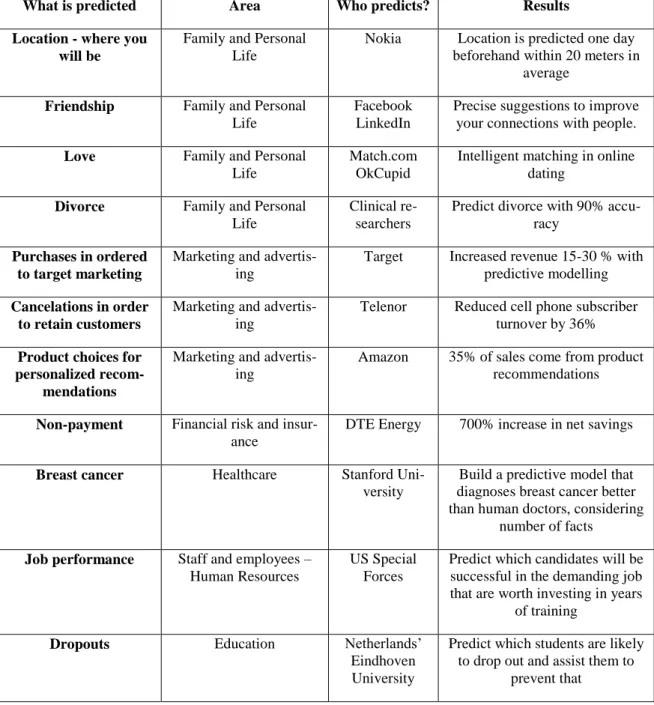
Finally, predictive analytics is about determining the events which would happen in the future with a certain likelihood (Brydon and Gemino, 2008; Boyer et al., 2012; Davenport and Kim, 2013; Delen and Demirkan, 2013; Schmueli and Koppius, 2010; Sharda et al., 2013; Siegel, 2013). The predictive analytics “go beyond merely describing the characteristics of the data and the relationships among the variables (factors that can assume a range of different val-ues); they use data from the past to predict the future” (Davenport and Kim, 2013, p. 3). In order to make it more clear for the reader to understand what predictive analytics refers to, what events are being predicted and what results are being achieved, in Table 2.1 we present a brief summary of examples introduced in Siegel’s (2013) book.
Table 2.1 Examples of predictive analytics
What is predicted Area Who predicts? Results Location - where you
will be
Family and Personal Life
Nokia Location is predicted one day beforehand within 20 meters in
average
Friendship Family and Personal Life
Facebook LinkedIn
Precise suggestions to improve your connections with people.
Love Family and Personal Life
Match.com OkCupid
Intelligent matching in online dating
Divorce Family and Personal Life
Clinical re-searchers
Predict divorce with 90% accu-racy
Purchases in ordered to target marketing
Marketing and advertis-ing
Target Increased revenue 15-30 % with predictive modelling
Cancelations in order to retain customers
Marketing and advertis-ing
Telenor Reduced cell phone subscriber turnover by 36%
Product choices for personalized
recom-mendations
Marketing and advertis-ing
Amazon 35% of sales come from product recommendations
Non-payment Financial risk and insur-ance
DTE Energy 700% increase in net savings
Breast cancer Healthcare Stanford Uni-versity
Build a predictive model that diagnoses breast cancer better than human doctors, considering
number of facts
Job performance Staff and employees – Human Resources
US Special Forces
Predict which candidates will be successful in the demanding job that are worth investing in years
of training
Dropouts Education Netherlands’ Eindhoven University
Predict which students are likely to drop out and assist them to
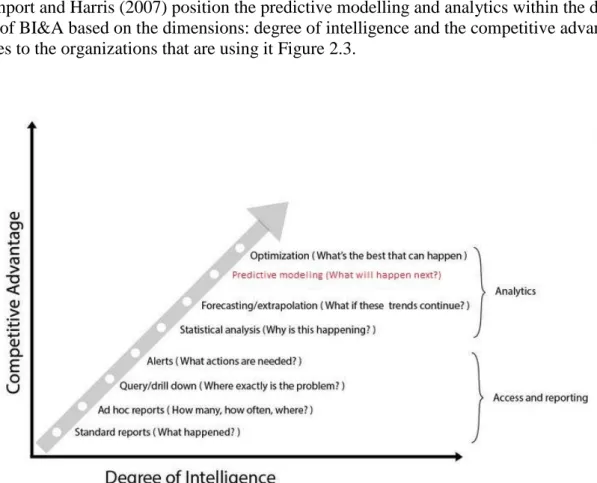
Davenport and Harris (2007) position the predictive modelling and analytics within the do-main of BI&A based on the dimensions: degree of intelligence and the competitive advantage it gives to the organizations that are using itFigure 2.3.
Figure 2.3 Predictive analytics and modelling positioned in BI&A context (Davenport and Harris, 2007)
Predictive analytics refers to “building and assessment of a model aimed at making empirical predictions” in the context of quantitative empirical modelling (Shmueli and Koppius, 2010, p. 555). That includes empirical predictive models (statistical models like data mining algo-rithms for instance) which predict future scenarios and evaluation methods assessing the pre-dictive power of a model. What prepre-dictive analytics does is identify relationships between the variables and after that, based on those relationships it predicts the likelihood for a certain event to occur. Despite the predictive purpose the relationships between data are used for, explicit cause-effect relationships are not expected or assumed to be present in the data (Dav-enport and Kim, 2013).
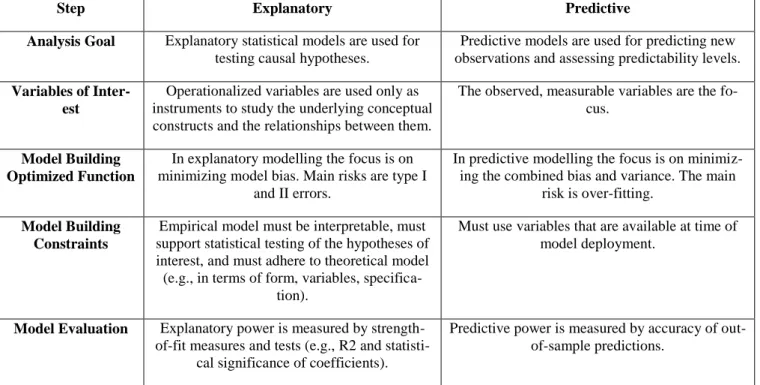
Empirical modelling for explanation refers to statistical models that are used for “testing causal hypotheses that specify how and why certain phenomena occur” (Shmueli and Kop-pius, 2010, p. 554). That includes explanatory statistical models for testing hypotheses (like regression models, common in IS research and social sciences in general) and methods for evaluating the explanatory power of the model (various statistical test for strengths of rela-tionships). Shmueli and Koppius (2010) point out to the existence of large debate about the difference between explaining and predicting and their research results with explaining the differences between these two terms in five different steps: analysis goal, variables of interest, model building optimized function, model building constraints and model evaluation in Table 2.2.
– 10 –
Table 2.2 Explanatory Statistical Modelling and Predictive Analytics according to Shmueli and Koppius (2010)
Step Explanatory Predictive
Analysis Goal Explanatory statistical models are used for testing causal hypotheses.
Predictive models are used for predicting new observations and assessing predictability levels.
Variables of Inter-est
Operationalized variables are used only as instruments to study the underlying conceptual constructs and the relationships between them.
The observed, measurable variables are the fo-cus.
Model Building Optimized Function
In explanatory modelling the focus is on minimizing model bias. Main risks are type I
and II errors.
In predictive modelling the focus is on minimiz-ing the combined bias and variance. The main
risk is over-fitting.
Model Building Constraints
Empirical model must be interpretable, must support statistical testing of the hypotheses of interest, and must adhere to theoretical model (e.g., in terms of form, variables,
specifica-tion).
Must use variables that are available at time of model deployment.
Model Evaluation Explanatory power is measured by strength-of-fit measures and tests (e.g., R2 and
statisti-cal significance of coefficients).
Predictive power is measured by accuracy of out-of-sample predictions.
Predictive analytics in IS literature
Information systems literature review about the existence of predictive analytics in literature was conducted by Shmueli and Koppius (2010) by querying the terms predictive, predicting, forecasting, predict, prediction and predictor in MIS Quarterly and Information Systems Re-search (ISR) journals, between the years of 1990 and 2006. After manually filtering the initial 250 returned papers and eliminating the ones that use those keywords for no predictive goal or analysis, authors identified 52 relevant articles in literature which they classified in four cate-gories by two dimensions: predictive goal – adequate, predictive goal – inadequate, predictive assessment –adequate and predictive assessment – inadequate. What they found based on the literature review is the following: “empirical predictive goals and claims are rare” and “pre-dictive analytics are rare” because only 7 from the 52 articles incorporated pre“pre-dictive ana-lytics while the other derived predictive power from explanatory power (Shmueli and Kop-pius, 2010, p. 560). Though the initial critic of those findings would be that authors only searched through two information systems journals while excluding other important journals, the presented numbers are rather sufficient to illustrate the limitation of IS literature when it comes down to researching areas related to predictive analytics within IS.
Analysing the value that predictive analytics delivers to information systems research, Shmueli and Koppius (2010) identify six roles that predictive analytics can have: generating new theory, developing measures, comparing competing theories, improving existing models, assessing relevance and assessing predictability. These roles can serve as means to help prac-titioners and researchers when working with predictive analytics.
2.2
Decision making
In the previous section we went through what business intelligence and business analytics are, stating that the focus of our study will be on predictive analytics as a special type of business analytics. One of the points that we wanted to make is that business intelligence, business analytics and predictive analytics as well, serve the purpose of facilitating the decision mak-ing in organizations. In this section we will be more specific about what decisions and deci-sion making are, to be able to get a clearer picture of the connection with predictive analytics. Decision making is part of the human behaviour, an act of solving a problem that occurred within a particular problem space (Boland, 2008). Additionally, decision making is a critical process that takes place in every organization and quite often is related to managing and or-ganization (Simon, 1977). Furthermore, it is something directly influences the oror-ganizations’ performance and it is something that the organizations should build their structure around (Blenko et al., 2010). Decision making occurs right before taking any action, while that action is a direct consequence of the decision that has been made before (Simon, 1977; Witte et al., 1972; Mintzberg et al., 1976).
Human decision making includes processes from information gathering to developing alterna-tives for a certain problem (Witte et al., 1972). Similarly, Griffith et al. (2008) see decision making as an activity consisted of information gathering and information use. Decisions are a specific commitment, choice to engage into doing a certain action (Mintzberg et al., 1976). Simon (1977) categorized decisions as programmed and non-programmed depending on the way managers handle the problem they are solving. The programmed decisions are repetitive, represent a routine, can easily be solved and have a definite procedure (Simon, 1977). The non-programmed decisions on the other hand, are new, novel, unstructured, difficult to solve and there is no clear method to solve them (Simon, 1977).
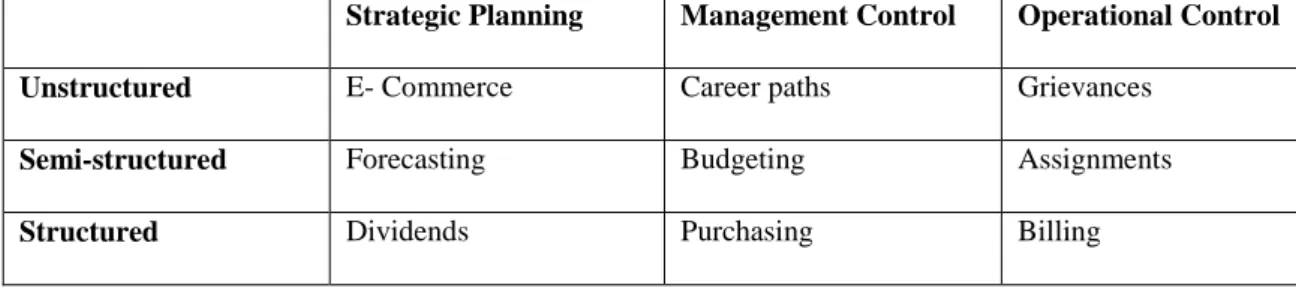
Management activities are classified in three types, based on the types of decisions they are required to make: strategic planning, management control, and operational control (Anthony, 1965). Strategic planning is related to the activities of top level management about achieving the overall goals and missions of the organization in near and far future, so it often requires them to make predictions of the future. The management control focuses on the actions that middle level management makes about guiding the organization to the strategic goals. Lastly, the operational control focuses on first line managers and their concerns about the day-to-day performance of the organization. (Anthony, 1965).
Gorry and Morton (1971) came up with the terms “structured” and “unstructured” types of decisions which are conceptually related to Simon’s classification of “programmed” and “non-programmed” decisions (Simon, 1977). In addition to that, Gorry and Morton (1971) introduced the term “semi-structured” decisions to address the need for having a category of decisions that is between the two extremes. Furthermore, Gorry and Morton (1971) created a framework for categorization of decisions over two dimensions: management activities classi-fied by Anthony (1965) and classification of decisions previously introduced, which follows the ideas from Simon (1977).
– 12 –
Table 2.3 Categories of decisions and examples (Gorry and Morton, 1971; Courtney, 2001)
Strategic Planning Management Control Operational Control Unstructured E- Commerce Career paths Grievances
Semi-structured Forecasting Budgeting Assignments
Structured Dividends Purchasing Billing
Decisions differ in their immunity to automation based on their type (Courtney, 2001). Deci-sions can be more easily automated when they are structured, meaning when the decision’s parameters and alternatives are well known. For this type of decisions, a DSS can fundamen-tally change the nature of work in the organizations by delegating the decision to a DSS (Grif-fith et al., 2008). Having that done, the decision makers can focus more on the unstructured decisions where the parameters and alternatives are not complete. DSS should supplement the human decision making and not replacing the human factor (Griffith et al., 2008).
2.3
Theoretical frameworks
The selection of theoretical frameworks which we are going to discuss in this section was made in order to help us address our research question and provide us with theoretical founda-tion which we would use in order to answer it. Coming from our research quesfounda-tion: “What are the perceived effects of the use of predictive analytics on decision making in organizations?” the most logical way to address it is to look for theoretical frameworks that analyze the deci-sion-making process itself and various aspects of it in the context of organizations. After-wards, we would use those frameworks to assess the influence, effects and perceived effects from the use of predictive analytics on decision making in organizations.
Regarding the decision making as a process composed of different phases, or sub-processes (Witte, 1972), a number of frameworks have been proposed by several researchers. Those frameworks break down decision-making process into phases ranging from three to eight (Mintzberg et al., 1976). Simon (1977) sees the decision-making process in organizations as being consisted of: intelligence, design and choice phase. Additionally, Dewey (1933) pro-posed a model of five phases: suggestion, intellectualization, development of hypotheses, rea-soning or mental, and finally testing of the hypotheses. Furthermore, Leidner and Elam (1993) understand the decision making as a set of scanning, monitoring and communication activi-ties.
Many researchers have investigated the effects of information technologies on decision mak-ing usmak-ing different approaches and different frameworks. Some researchers studied the effects of information technologies on several dimensions of decision making. Raghunathan(1999) for instance, investigated the effects of decision support systems (DSS) on the quality of deci-sions based on the well-known input-process-output model employed in economics, systems analysis, and decision analysis as in
Figure 2.4 Input-process-output model (Raghunathan, 1999)
Other researchers studied the effects of a specific category of information systems on a par-ticular perspective over decision making. For instance Mukhopadhyay and Cooper (1992) explored the impact of management information systems (MIS) on quality of the decisions from microeconomic production perspective by applying decision production theory. The input of this model is information provided by MIS while the output is a decision which is being made. The interaction can be evaluated by comparing the output with the expected out-put from the microeconomic perspective.
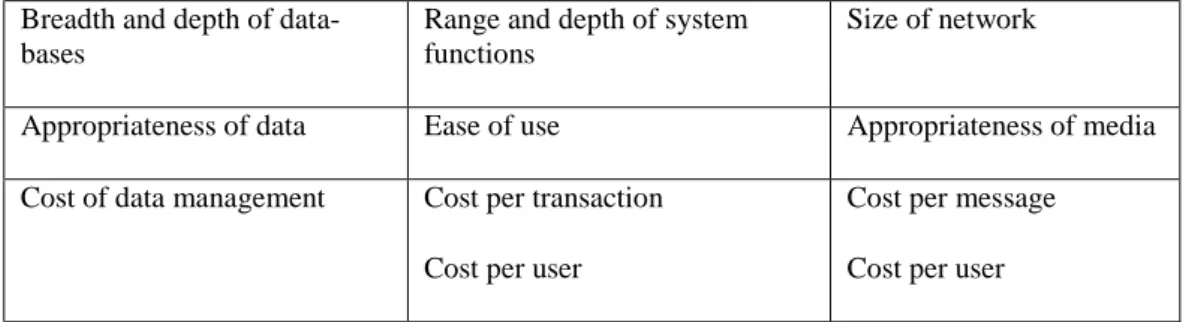
Furthermore, Bakos and Treacy (1986) built structural model for studying the effects of in-formation technologies on organizational decision making, by categorizing the characteristics of the information technology. It was built on the consideration that studying the use of IT should be done by improving the quantity, quality, and efficiency of data collection storage, processing, and communications (Bakos and Treacy, 1986; Molloy and Schwenk, 1995). However, Molloy and Schwenk (1995) provided a modified version of Bakos and Treacy model, as shown in Table 2.4.
Table 2.4 Modified structural model (Molloy and Schwenk, 1995)
Data access Processing Communication Capacity Breadth and depth of
data-bases
Range and depth of system functions
Size of network
Quality Appropriateness of data Ease of use Appropriateness of media
Speed & Efficiency
Cost of data management Cost per transaction Cost per user
Cost per message Cost per user
InTable 2.5, according to the literature review that we did, we provide a summary of the theoretical models, approaches and the main focus areas when the models were applied in the context of exploring and analysing the effects of information technologies or information sys-tems on decision making in organizations.
Information
Decision
Information
Technology
Decision-Maker
Raw Data
– 14 –
Table 2.5 Recent related Information Technology and Decision making literature
Authors Focus Type of IT/IS Theoretical approach
Raghunathan (1999)
Impact of information quality and decision-maker quality on actual decision quality
DSS Input-process-output model employed in economics. Cooper (1983) Leidner and Elam
(1995)
Impact of Executive Information Systems (EIS) on several organizational outcomes: Decision making speed, problem identifica-tion speed, informaidentifica-tion availability, in-volvement of subordinates in decision mak-ing
Executive Informa-tion Systems
Huber (1990)
Leidner and Elam (1993)
Effects of EIS on aspects decision making Executive Informa-tion Systems
Huber (1990)
Mukhopadhyay and Cooper (1992)
Impact of Management Information Systems on Decisions
Management Infor-mation
Systems
Microeconomic production theory
Molloy and Schwenk (1995)
Effects of IT on strategic decisions Wide range of IT Mintzberg, Raisinghani, and Theoret (1976) ;
Bakos and Treacy (1986) Dewett and Jones
(2001)
Impact of IT on organizational characteris-tics: structure, size and learning and out-comes: organizationally efficiency and innovation
Wide range of IT Various frameworks including Huber (1990)
Lawler and Elliot (1996)
Effect of IT in human resource manage-ment: problem solving accuracy and effi-ciency, confidence in use of ES, perceived ease of use, task
Attitude
Expert system Behavioural decision theory
Carter et al. (1994)
Effects of computer technology and deci-sion structures in enhancing organizational performance.
Wide range of IT Daft (1978) dual core approach.
Based on the literature review that we conducted, the most suitable theoretical frameworks to address our research question were Simon’s model of the decision-making process in organi-zations (Simon, 1997) and Huber’s theory of the effects of advanced information technologies on organizational design, intelligence and decision making (Huber 1990). To be more spe-cific, we chose the famous Simon’s model of decision-making process because it decomposes the decision making in organizations, breaks it down to 3 phases (Intelligence, Decision and Choice) and analyzes their characteristics. Since we want to analyze how the use of predictive analytics affects decision making in organizations, it is necessary to familiarize ourselves with each phase, to be able to address them individually and investigate how the use of predictive analytics affects them. In addition to that, Simon’s model is widely adopted in IS literature
and especially in the domain of DSS (Gorry and Morton, 1971; Keen, 1981; Choo, 1996; Courtney, 2001), which motivated us to use it for the purpose of examining the effects of pre-dictive analytics on decision making.
Furthermore, we selected Huber’s theory as it is most suitable in our context and can directly help us understand the perceived effects from the use of predictive analytics as an advanced information technology, on organizational intelligence and decision making. Huber’s theory is one of the most influential frameworks in its domain (Te'eni, 2001) and includes a wide range of organizational characteristics as dependant variables which are affected by the use of IT as independent variable in relation with decision making in the organization (Huber, 1990; Dewett and Jones, 2001).
In this section, we will analyze both the Simon’s model of decision-making process and Huber’s theory of the effects of advanced information technologies on organizational design, intelligence and decision making.
2.3.1 Simon’s model of the decision-making process
One of the most popular models that illustrate the decision making in organizations, which is widely used amongst IS researchers, especially in the areas of decision support systems (DSS) is the Simon’s model of the decision-making process. Introduced in his book (Simon, 1977), the model recognizes three phases of the decision-making processes in the organizations, which are the intelligence, the design and the choice phase. “Generally speaking, intelligence activity precedes design, and design precedes choice” (Simon, 1977, p. 3), while the whole process is not a simple sequence, but rather very complex (Figure 2.5), as each phase can be a complex decision-making process itself (Simon, 1977).
Simon in his book describes the three phases of the decision-making process in simple words as providing answers to the questions (Simon, 1977, p. 3):
“What is the problem?” “What are the alternatives?” “Which alternative is the best?”
To present a better understanding of the context, Turban et al. (2011) make a relation connect-ing Simon’s model for the decision-makconnect-ing process and the model from Tuckman (1965) about group decision making which consist of the phases forming, storming, norming and performing. Based on the tasks and processes that are being conducted in each phase, they connect the storming phase with intelligence phase, norming phase with the design phase and performing with phase with the choice phase from Simon’s model (Simon, 1997).
Next in this section, we will elaborate on each of the three phases of the decision-making process, individually, according to Simon (1997).
Intelligence phase
The intelligence phase is all about finding the occasions over which a decision should be made (Simon, 1997). “The major role of the intelligence stage is to identify the problem and collect relevant information” (Turban et al., 2011, p. 144) which would be used later in the next stages of the decision-making process. The activities that are associated with the
intelli-– 16 intelli-–
gence phase are indentifying problems (opportunities), collecting and sharing information and identifying decision criteria (Turban et al., 2011).
Once the indicators or symptoms about a certain event are recognized and known, then the problem or the opportunity can be defined and assessed if it is important or urgent, so the de-cision maker (or the dede-cision making team) is able to proceed to the next phase of the deci-sion-making process (Turban et al, 2011).
Design phase
After the problem has been identified, the next step in the decision-making process is to de-velop and evaluate multiple scenarios which would be considered as available solutions to the problem (Simon, 1997; Turban et al., 2011). Simon (1997) looks at the design phase as the step in the decision-making process where the possible courses of action are being found. The tasks that the design phase is connected to, are the following: finding alternatives, evaluating alternatives, comparing alternatives and prioritizing alternatives (Turban et al., 2011).
Choice phase
Making a choice “requires some analysis, deliberation, discussion, voting and negotiation” (Turban et al., 2011, p. 146). Simon (1997) relates the choice phase to selecting a particular course of action out of the pool of available courses, which were created in the previous, de-sign phase. The actions that the choice phase is related with are listed by Turban et al. (2011) and are doing a sensitivity analysis and making selection of an alternative which is considered to be the output of the decision-making process, or the decision itself that was brought by the decision makers.
An illustration of the decision-making process (Simon, 1977; Turban et al., 2011) is presented on Figure 2.5.
2.3.2 Huber’s theory of the effects of advanced information technologies on organ-izational design, intelligence and decision making
Huber (1990) introduces a theory about the effects of computer-assisted communication and decision-aiding technologies (advanced information technologies) on organizational design, intelligence and decision making, which is later to be widely used and referred to by many information systems researchers. When discussing about advanced information technologies, what the author refers to is technologies that include transmitting, manipulating, analyzing or exploiting information, where digital processing of information is a necessity for user’s munication or decision task and in fact represents a significant aid and assistance to the com-pletion of the communication or decision task. Having said that and taking into consideration the previous discussion about predictive analytics as a mean for decision support, we can con-sider predictive analytics as an advanced information technology in the context of Huber’s theory.
The motivation that Huber (1990) had for creating of this theory is the following: (1) there was a need to reinvestigate and revise components of organization theory; (2) it was time for theory development to evolve forward by creating a theory about the effects from advanced information technologies on organizations; (3) help researchers working in the areas of organ-izational science, communication and information systems so that they all become aware of the importance of the work they all do, therefore their work becomes better integrated and better theories are developed; and (4), considering from the pervasive nature that advanced information technologies have in organizations and combining it with their recent appearance and fast changes, their users and advisors will not have experience to help them facilitate the impact of these technologies on the organizations, therefore a theory would be of great im-portance.
Huber (1990) selected 13 dependant variables and described the relations among them with 14 propositions. The dependant variables are selected from two pools. The first pool is concerned with the characteristics of organizational intelligence and decision making, while the second pool is about the aspects of organizational design that are related with intelligence and deci-sion making. Considering the large size of both pools, Huber (1990) selected only the vari-ables which are highly affected by advanced information technologies in the organizations, attract higher interests from both researchers and practitioners and finally the ones whose di-vergence increased with the arrival of advanced information technologies. The independent variable included in the theory, on the other hand, is the use of advanced communication and decision-aiding technologies (advanced information technologies).
The propositions and the variables in the theory are categorized in four groups which we will analyze next. The first three groups are concerned with organization structure and designs, as components that influence organizational decision making. The fourth group is about the di-rect effects of advanced information technologies on organizational intelligence and decision making. (Huber, 1990).
Effect of Advanced IT at subunit level
The focus of this category is on the various effects from the use of advanced information technologies that are created at a subunit organizational level and have an influence on the organizational intelligence and decision making. The addressed variables in this category are:
– 18 –
participation in decision making, size and heterogeneity of decision units and frequency and duration of meetings.
The participation in decision making is assessed by the number and variety of people that par-ticipate as information sources in the decision-making process (Huber, 1990). Additionally, the participation in decision making is defined as the extent to which the management allows employees’ input into decisions and it is ranging from alternative analysis to joint decision making (Cooper and Wood, 1974; Miller and Monge, 1986), or from consulting employees on work related issues to employees taking decision on their behalf (Probst, 2005). Huber (1990) argues that advanced information technologies reduce both time and effort spent by individu-als in organization to communicate, consequently more people are able to share information thus serving as source of information themselves. That information later on is being used as a base for making decisions in the organization.
The next variable addresses the size and structure of decision units where decision unit is an individual or a group of individuals whose role requires selecting course of action for the or-ganization and are being held responsible for that (Duncan, 1973; Duncan, 1974; Huber, 1990). The structure of the decision units refers to the background and experience of its mem-bers (Huber, 1990). Theory suggests that decision units will be consisted of less people and will be more homogenous as a result for using advanced information technologies since they are provided with more information compared to traditional ways where advanced infor-mation technologies are not used (Huber, 1990).
The last variable within this category examines the frequency and duration of meetings about decision making in the organizations. Meetings are ways for the employees in a company to directly take part in decision making and information sharing (Tracy and Dimock, 2004; Yo-erger et al., 2015). Even though meetings are used to make the decision-making process go faster in the organizations, they reserve a significant portion of decision makers’ time often because lack of information (Huber, 1990). Theory suggests that the use of advanced infor-mation technologies can speed up the meetings and reduce the need for subsequent meetings, by making information more available and even provide new information which enables deci-sion makers to run analysis and make decideci-sions faster (Huber, 1990).
Effects of advanced IT at the organizational level
The second group of propositions and variables is about the effects generated at the level of the whole organization by the use of advanced information technologies and as such, they influence the organizational decision making. This category groups the following variables: centralization of decision making, number of organizational levels involved in authorization and number of nodes in the information-processing network.
Carter et al. (1994) see centralization as the extent to which authority is concentrated in the top levels of organization hierarchy while decentralization is the extent to which that authority is allowed down in the hierarchy. Decentralization of the decision making refers to the ability of several decision makers (individuals or groups) to make decisions instead of one (Tsitsik-lis, 1984), while centralization has the opposite meaning. Accordingly, the variable of central-ization of decision making assesses the level of centralcentral-ization in the decision-making process of an organization. Theory suggests that the availability of advanced information technologies in different levels of organization leads to a more uniform distribution of the probability that particular organizational level makes a decision (Huber, 1990). Additionally, with the use of
advanced information technologies decisions are made in wider range of organizational levels with a satisfactory degree of decision quality and timeliness for the organization (Huber, 1990).
The number of levels involved in authorizing actions directly affects the decision-making process, making it slower as the number of levels increases (Huber, 1990; Shumway et al., 1975). Organizations usually tend to have many hierarchical levels since each hierarchical level has more knowledge about their domain, making them more qualified to take the right decision (Huber, 1990). Theory suggests that the usage of advanced information technologies would make information more available and consequently reduce the number of organization-al levels involved in authorizing decisions (Huber, 1990).
The last variable in this category as the name suggests, addresses the number of nodes in the information-processing network in the organizations. The information-processing network dealing with decision situations usually consists of many nodes (units). Frequently outer nodes (sensor nodes) sense, gather the information, change or simply direct it to another node which will process it and send it to another information processing unit, for instance, closer to the final decision making unit or user (Huber, 1990). The theory proposes that advanced in-formation technologies stimulate reduction of the intermediate units in the inin-formation- information-processing network (Huber, 1990).
Effects on organizational memory
The third group of propositions and variables is concerned with the effects from the use of advanced information technologies on organizational memory, that directly influence the or-ganizational information, knowledge and decision making. Oror-ganizational memory is defined as “stored information from an organization's history that can be brought to bear on present decisions” (Walsh and Ungson, 1991, p.61). In addition to that, organizational memory in-volves encoding the information in appropriate representation so it can be used and interpret-ed later in the organization (Stein, 1995).
The first variable measures the level development and use of data bases in relation with the use of advanced information technologies (Huber, 1990). The second variable on the other hand measures the level of development and use of in-house expert systems as components of organizational memory, with relation to the existing procedures for development and use of the expert systems in the organizations and the use of advanced information technologies (Huber, 1990).
Huber (1990) suggests that increased availability of advanced information technologies and more user-friendly procedures stimulates the development of organizational memory compo-nents.
Effects on organizational intelligence and decision making
The last group is concerned with the direct effect on the decision-making process, as well as its output, a decision. The variables in this category are: effectiveness of environmental scan-ning, quality and timeliness of organizational intelligence, quality of decisions and speed of decision making.
– 20 –
The effectiveness of environmental scanning is measured through the speed and accuracy of identification of problems and opportunities for the organization (Huber, 1990). The use of advanced information technologies enables faster and more accurate environmental scanning according to theory (Huber, 1990).
Organizational intelligence is defined as the output from acquiring, processing and interpret-ing information foreign to the organization, and also the input in the decision-makinterpret-ing process (March, 1999; Huber, 1990; Sammon et al., 1984). The quality of the organizational intelli-gence is assessed through accuracy and comprehensiveness of the organizational intelliintelli-gence (Huber, 1990). In addition to that, the use of advance information technologies improves the quality and timeliness of organizational intelligence (Huber, 1990).
The quality of a decision is a relation between the selected alternative by the decision makers and the correct or best alternative (Ge and Helfert, 2013; Raghunathan, 1999) and is also di-rectly dependent on the accuracy, availability and coverage of the information that an organi-zation has (Mukhopadhyay and Cooper, 1992). In addition to that, the quality of the decisions is a consequence of both the organizational intelligence and the quality of decision-making process (Huber, 1990). Theory states that the quality of decisions is enhanced by using ad-vanced information technologies, mainly due to increase of the quality of information pro-cessing and sharing (Huber, 1990).
Lastly, the speed of decision making represents the time from the point when decision makers realize the need for a decision to be made, to the point when the decision is actually made (Leidner and Elam, 1993). The speed of decision making is assessed through the time needed for a decision to be made and actions to be authorized accordingly (Huber, 1990). Further-more, advanced information technologies can aid decision makers to analyse data quickly and also decrease the time required to authorize proposed actions and make decisions within the organization (Huber, 1990).
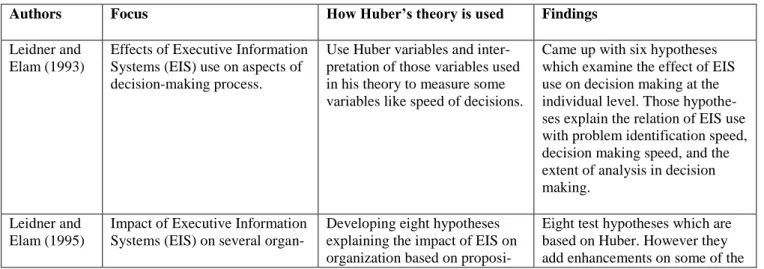
Finally, in Table 2.6 we provide a summary of the literature review we did, analysing in what context was Huber’s theory used in previous IS research, what has been done and what are the findings. We present this information to give the reader a more detailed perspective of the applicability of the Huber’s theory.
Table 2.6 Related IS research done using Huber's theory
Authors Focus How Huber’s theory is used Findings
Leidner and Elam (1993)
Effects of Executive Information Systems (EIS) use on aspects of decision-making process.
Use Huber variables and inter-pretation of those variables used in his theory to measure some variables like speed of decisions.
Came up with six hypotheses which examine the effect of EIS use on decision making at the individual level. Those hypothe-ses explain the relation of EIS use with problem identification speed, decision making speed, and the extent of analysis in decision making.
Leidner and Elam (1995)
Impact of Executive Information Systems (EIS) on several
organ-Developing eight hypotheses explaining the impact of EIS on organization based on
proposi-Eight test hypotheses which are based on Huber. However they add enhancements on some of the
izational outcomes: - decision making speed - problem identification speed - information availability - involvement of subordinates in decision making
tions from Huber’s theory. Huber’s findings. That helps Huber’s theory to better explain the relation between EIS use and improved organizational intelli-gence and decision making out-comes.
Dewett and Jones (2001)
Impact of IT on organizational characteristics: structure, size and learning and outcomes (or-ganizational efficiency and in-novation)
Extending and updating Huber’s theory.
Extends and updates Huber’s theory to better understanding of how IT will rewrite various por-tions of management theory. By extending Huber theory in: - focus on the two strategic out-comes of efficiency and innova-tion.
-Organizational functioning. -Examine IT as a moderator of the relationship between organ-izational characteristics and sev-eral organizational outcomes. Zhang et al.
(2006)
Study domino effect by the use of Radio frequency identification (RFID) as an advanced informa-tion technology on an organiza-tion’s IT infrastructure, business intelligence, and decision mak-ing.
The study based on Huber theory to examine effect of RFID by proposing a series of proposi-tions which based on Huber propositions.
Conceptual research framework of empirically tested hypotheses that illustrates the effect of RFID technology usage.
Fiedler et al. (1996)
Relation information technology (IT) and organizational struc-tures. It focus on IT structure based on the degree of: - Centralization of computer processing
- Capability to support commu-nications
- Ability to share resources
Develop further one of the propositions based on Huber theory findings about centraliza-tion and decentralizacentraliza-tion propo-sitions.
This study empirically develops a taxonomy that has implications for matching information tech-nology and organizational struc-tures. The four IT structures are identified:
- centralized - decentralized
- centralized cooperative - distributed cooperative comput-ing
Carter et al. (1994)
Computer technology and deci-sion structures’ role in enhanc-ing organizational performance in the technical and administra-tive core of the organization.
The study investigated some of those benefits based on Huber’s theory key benefits of IT on decision making. Mainly deci-sion making speed, and decen-tralization.
Overall organizational perform-ance is affected by computer usage and decision-making proc-ess in subunit levels. Also this change does not need to arise from the same conditions in dif-ferent cores of the organization. Park (2006) Examine effects of a data
ware-housing on decision quality and performance.
The study showed that Huber’s theory is valid in the context of data warehouse and DSS.
The adoption and use of a fully capable data warehouse has im-proved DSS users’ decision per-formance.
Calhoun et al. (2002)
The use of nonspecific applica-tions of information technology for organizational decision
mak-Depend on Huber theory to iden-tify decision attributes which is related to IT usage in order to
Decision makers perceive the impact of IT upon decision fac-tors which is defined based on Huber. Also non-specific use of
– 22 –
ing. use them in questionnaire. IT is more free of culture rather than the use of specific applica-tion like EIS.
2.4
Our research framework
In this chapter we provided a theoretical foundation which is needed in order to be able to understand and answer our research question. More specifically, we explained the context and importance of predictive analytics starting from business intelligence and narrowing it down to business analytics and predictive analytics. In addition to that, we discussed what decision making means according to scientific literature and analyzed theoretical frameworks which we will use in order to address our research question.
We are going to answer our research question by using Simon’s model of the decision-making process (Simon, 1977) and assessing the influence from predictive analytics on each stage of the process. Having decomposed the decision-making process like that, we would be able to generate knowledge about the effects of predictive analytics on decision making in organiza-tions.
In addition to that, we are going to test the propositions of Huber’s theory (Huber, 1990) in the context of examining the effect from the use of predictive analytics as advanced informa-tion technology on organizainforma-tional design, intelligence and decision making. We will do that by investigating whether the use of predictive analytics generates the same effects in line with each proposition of Huber’s theory. The variables used in the propositions which we are going to assess are listed inTable 2.7, categorized in line with the theory.
Table 2.7 Categorization of the addressed variables in line with Huber's theory
Category Variable Used in
proposition number Effects at
sub-unit level
Participation in decision making 1
Size and heterogeneity of decision units 2
Frequency and duration of meetings 3
Effects at organ-izational level
Centralization of decision making 4, 5 Number of organizational levels involved in authorization 6
Number of nodes in the information-processing network 7
Effects at organ-izational
mem-ory
Development and use of computer-resident data bases 8 Development and use of computer-resident in-house expert systems 9
izational intelli-gence and deci-sion making
Quality and timeliness of organizational intelligence 11
Quality of decisions 12
Speed of decision making 13, 14
Finally, we present a list of the propositions that Huber’s theory suggests (Huber, 1990) in the context of assessing the effects of predictive analytics as an advanced information technology on organizational design, intelligence and decision making (Table 2.8). Additionally, we have to state that testing proposition 5 would require investigation on a larger population of organi-zations which make same types of decisions so that generalization would be possible. Our study will target types of organizations that do not necessarily make the same types of deci-sions, to ensure generalizability of the findings regarding the test of the other propositions. Therefore, proposition 5 would be out of scope in our study. Furthermore, after the presenta-tion of the proposipresenta-tions in our context of predictive analytics, those proposipresenta-tions according to Huber’s theory (Huber, 1990) can be grouped in 4 groups (concepts) as visualized inFigure 2.6.
Table 2.8 Propositions from Huber's theory modified in the context of predictive analytics
No. Proposition
1 Use of predictive analytics leads to a larger number and variety of people participating as information sources in the making of a decision.
2 Use of predictive analytics leads to decreases in the number and variety of members comprising the tradi-tional face-to-face decision unit.
3 Use of predictive analytics results in less of the organization's time being absorbed by decision-related meetings.
4 For a highly centralized organization, use of predictive analytics leads to more decentralization. 5 For a population of organizations, broadened use of predictive analytics leads to a greater variation across
organizations in the levels at which a particular type of decision is made.
6 Use of predictive analytics reduces the number of organizational levels involved in authorizing proposed organizational actions.
7 Use of predictive analytics leads to fewer intermediate human nodes within the organizational information processing network.
8 Availability of predictive analytics leads to more frequent development and use of computer-resident data bases as components of organizational memories.
9 Availability of more robust and user-friendly procedures for constructing expert systems leads to more frequent development and use of in-house expert systems as components of organizational memories. 10 Use of predictive analytics leads to more rapid and more accurate identification of problems and
opportu-nities.
11 Use of predictive analytics leads to organizational intelligence that is more accurate, comprehensive, timely, and available.
12 Use of predictive analytics leads to higher quality decisions.
13 Use of predictive analytics reduces the time required to authorize proposed organizational actions. 14 Use of predictive analytics reduces the time required to make decisions.
– 24 –
Figure 2.6 Concepts of Huber's theory (Huber, 1990)
Propositions related: P1, P4, P7, P8, P9, P10 (Construct A) (Construct B) (Construct D) (Construct C) Availability of ad-vanced information technologies
Use of advanced in-formation
technolo-gies
Improvements in effectiveness of
intel-ligence and decision making Change in organiza-tional design Increased information accessibility Concept 1 A leads to B Concept 4 C&D leads to E Concept 3 C leads to D Concept 2 B leads to C Propositions related: P11, P12, P13, P14 Propositions related: P1, P2, P3, P4,P5,P6,P7 (Construct E)