Effect of Collaborative Project Based Learning Model and
Scientific Attitude to Student Creativity Material in Static Fluid
Jelita Panjaitan1* Sahyar2 Nurdin Bukit3
1. Postgraduate Program of Physics Education, State University of Medan 2. Postgraduate Program of Physics Education, State University of Medan 3. Postgraduate Program of Physics Education, State University of Medan Abstract
This study aims to analyze whether the creativity of students taught by collaborative based project based learning model is better than conventional learning; To analyze whether the student's creativity with a scientific attitude above the average is better than that of students who have below average scientific attitudes; To analyze whether there is an interaction between project based learning model based on collaborative with scientific attitude toward student creativity. This research is a quasi experimental research with 2x2 factorial design. This research is a quasi experimental research with two group pretest-posttest design. Research population of all students of second semester of TA. 2016/2017 Physics Education Study Program Faculty of Teacher Training and Education Darma Agung University Medan. The sample in this study was taken by cluster random sampling, that is as much as 2 classes amounted to 64 people. Class X-1 as an experimental class taught by collaborative based project-based learning model consisting of 32 students, X-2 class as control class is taught with conventional learning consists of 32 students. This research instrument uses essay test of creativity consists of 10 problems and scientific attitude in the form of questionnaire consists of 20 cases and has been declared valid and reliable. The resulting data were analyzed using two-way ANAVA. The results showed that the creativity of students who are taught a collaborative based project based learning model is better than conventional learning. Students' creativity skills that have above average scientific attitudes are better than students who have below average attitudes of science. There is an interaction between collaborative based project-based learning model and conventional learning with scientific attitude in improving student creativity.
Keywords: learning model, collaborative, scientific attitude, creativity
1. Introduction
Education plays an important role in improving the quality of human resources. Highly qualified human beings are superior in terms of spiritual, social, intellectual and human creativity able to face various challenges in the era of globalization and the rapid development of science and technology. Lack of multimedia utilization and the absence of student involvement in the process of direct observation in learning one of the factors that cause student creativity is low. Government plays an important role in advancing the education of the nation and state describes the relationship between environment and learning process as an illustration of variation in learning on student creativity (Fraser, 2002). Arious international surveys have been conducted to evaluate the science skills of students from various countries in the world. One is an international survey PISA (programme for international student assessment) PISA survey results in 2012 stated that the average science score of Indonesian students is ranked 64 th out of 65 countries participants with a score of 382. These results indicate the average science score of Indonesian students is still below the average international score, which is 501 (NCES, 2013). Therefore, there should be efforts to improve the ability of Indonesian students in the field of science
Based on the results of interviews and observations found the problem that is related to the process of learning in the classroom is rarely use a variety of learning model with the reason of lack of knowledge about learning models, then the method of learning is often used only using lecture methods, exercises and assignments that cause students to be bored and not Interested in studying physics because in essence physics can not be separated from practice activities. Another problem is the rarity of lecturers to do a simple lab or laboratory to strengthen the knowledge of students on the material that is abstract due to inadequate laboratory equipment. The last problem is the student's fighting ability in obtaining knowledge is very less. Students only expect the knowledge given by lecturers without intending to seek other reference sources in addition to science.
help students to create projects of intellectual skills to student creativity (Arendrs, 2008). In the theory of physics learning, students rarely think of making ideas or new ways of innovation in practice. Just answering the test count but not understanding the obvious problem, so the student creativity is not achieved and the systematic thinking pattern. While experimental observation, students only follow the steps in the experiment instructions. Students are rarely trained to make new moves or innovations in experiments. With model project based learning students will be trained to be creative and innovative in learning. In this case, project-based learning can also enhance students' creative thinking that can lead to the realization of planned projects, in increasing the potential for changing the way teaching and passive learning to be more creative for students (Buck Institute For Education, 2010).
Based on the above problems it is necessary a proper learning to achieve learning activities that can improve the ability of cooperation among students and enhance creativity, one of them is the model of learning project based learning, students are more active to find their own information lessons to be learned, so that Will have an impact on improving student creativity (Astika, 2013). "The based learning model is project-based learning an integration of creative learning-project-based learning. Project-project-based student learning is given the task of creating projects in learning by doing realistic activities. In addition, the application of learning kelompoh can encourage the growth of creative attitude, independence, responsibility, confidence, and critical and analytical thinking to students (Nurohman, 2008)". In general, the project-based student measures can be explained as follows: project determination, design of project completion steps, preparation of project implementation schedules, project completion with facilitation and monitoring of lecturers, report preparation and presentation/publication of project outcomes, project evaluation and project outcomes (Fathurrohman, 2015).
This can be seen from the scientific attitude undertaken in the method of physics teaching combined in the project (Lindawati, 2013). Explains that creative thinking is in line with the spirit of understanding and the goals of student achievement. Indicators of creative thinking are smooth thinking, flexible thinking, original thinking and detailed thinking (Munandar, 2012). In this case, students can imagine, think rationally, investigate, and design something in the imagination. This activity is knowledge of scientific attitudes in the values and assumptions of Nature of Science (NOS) as proposed (Liang, 2005). So, students will be motivated and more interested to learn because students will feel that have meaning in life. Based on the results of research in the creativity of students the level of creative thinking can be seen from the process of learning outcomes performed. Creative is the highest level of intelligence that demonstrates students' ability to design tools and ideas and solutions can be creative in innovative but most importantly useful to others (Mihardi, 2013). In this case, creativity is considered a process of creative thinking. To see patterns in creative thinking can be done by applying the model of project based learning (Mustaji, 2009).
The model of project based learning merpakan learning that students can show creative thinking, in practice lecturers have to work hard to conduct counseling and guidance to motivate student achievement. In addition, the project-based learning model takes a very long time and lecturer professionalism as a learning facilitator (Mihardi, 2013). This is because students are less able to focus on planning and possibly in completing projects. For that students need a broad mindset in designing the project to be achieved.
2. Method
This study uses quasi experimental method aims to see the effect of project based learning model on student creativity that distinguishes Q above average and below average Q. Population in research in Physics Education Study Program Faculty of teacher education and education Darma Agung University Medan Consists of three classes. The sample in this research is two classes by using simple random sampling, the first class as the control class which is taught by conventional learning and second class as the experimental class which is taught by model of project based learning with scientific attitude toward student creativity. The two sample classes consisted of 32 students. The design of this study is the design of two groups of pretes - pretes. Design research with 2x2 factorial design for technical analysis of variance (ANOVA) two way. Data collection techniques in this study will be obtained through the test of creativity and scientific attitude Q. Data collection will be done in two stages, collecting data about Q and collecting data on student creativity.
3. Results and Discussion
Student creativity about conventional learning class and project based learning based on the collaborative class in Table 1 below.
Table 1. Results Pretes And Postes Student Creativity Values
Student Cricket Value
Conventional Class Project Based Learning Class Collaborative based
Pretes 33,33 30,33
Postes 55,50 65,00
Based on Table 1, the description of the average value of the creativity of the pretest and posttest students in the class of project based learning based on collaborative and conventional class is as follows: For each class of Conventional class pretes 33,33 and project based learning class 30,33. Postes conventional class 55,50 and class based project based learning collaborative is 65,00. Q below average and above average is shown in Table 2 below. The value of postes in the conventional class is 55,50 while the postes value for the class of project based learning based on the collaborative is 65,00. Hypothesis test is then done. Before testing the first hypothesis tested the prerequisite that test normality, homogeneity, and test results of normal distribution and homogeneous data (Liang, 2005). After conducting prerequisite test, then continued with two way ANOVA with SPSS 19,0.
Table 2. 2x2 way ANAVA Student Scientific
Attitudes (B)
Learning model (A) Konvensional (A1) Project Based Learning (A2) Average Low (B1) 55,33 73,52 63,55 High (B2) 55,25 70,01 62,23 Average 55,86 70,90
Table 2 shows that student creativity is based on the level of scientific attitudes in the experimental and control classes. In the experimental class, it can be seen that the average score of students' creativity skill which has high scientific attitude (73,52) is higher than students who have low scientific attitude level (70,01). In the control class it can be seen that the average score of creativity skill in students with high scientific attitude (55,33) is lower than students who have low scientific attitude level (55,25). The results can be illustrated in a two-lane anova design.
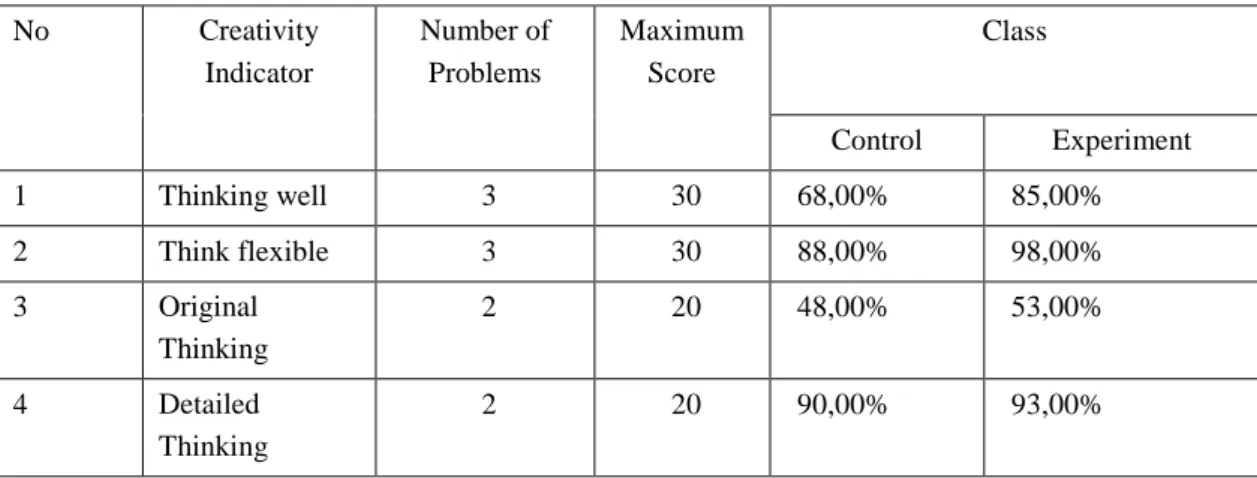
Table 3. Average Score of Student Answers Each Post on Student Creativity Postes on Control Class and Experiment Each Grain Problem
No Creativity Indicator Number of Problems Maximum Score Class Control Experiment 1 Thinking well 3 30 68,00% 85,00% 2 Think flexible 3 30 88,00% 98,00% 3 Original Thinking 2 20 48,00% 53,00% 4 Detailed Thinking 2 20 90,00% 93,00%
Problem creativity that has been answered by the student by analyzing the problem matter. This analysis is useful to look at the student creativity indicators shown in Table 3.
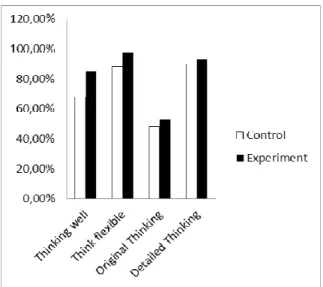
Figure 1. Indicator Analysis of Student Creativity Grain Problem in Control and Experiment Class
From Figure 1 shows the difference of students' creativity ability in control and experiment class on each item. Problem creativity has each indicator can be concluded the conclusion of this analysis is the percentage of average achievement of students who answered correctly in the matter of student creativity in the experimental class is higher than the control class. The highest percentage of achievement for each indicator lies on the first indicator, namely flexible thinking and category, where the percentage of achievement in the experimental class is 98,00% and the control class is 88,00%. This is due to the creativity issues that have indicators thinking Flexible and easy to complete categories of students because of the knowledge of flexible thinking and categories of thinking smooth, original thinking, detailed thinking, and the specific arrangement in the discipline. While the lowest percentage of achievement for each indicator lies in the original thinking indicators, namely theory, model and structure, where the percentage of achievement in the experimental class is 53,00% and the control class is 48,00%. This is due to the creativity problems Theories, models and structures are classified as difficult for students to complete because knowledge of theories, models and structures includes knowledge of the various paradigms, epistemology, theories, models used in the disciplines to describe, understand, explain, and predict phenomena.
Based on the statistical hypothesis, it is found that there is a difference of student creativity between students taught by using collaborative based project based learning model compared to the students taught using conventional learning. This is indicated by sig 0,000 <0,05, in which case Ha is accepted
There is a difference of creativity between students who have high and low scientific attitudes. This is indicated by the value of significance (0,000 <0,05) Ha is accepted
There is a significant interaction between collaborative based project-based learning model and conventional learning with the level of scientific attitude toward student creativity. This is indicated by a significance value of 0,000 <0,05 in which case Ha is accepted. Based on several comparisons of interaction between student creativity groups taught with learning model and scientific attitude as follows: Interaction between conventional learning with low scientific attitude is better than with high project based learning model with high scientific attitude. Having a mean difference of -12,25 with a significance of 0,000 is smaller than the significance of 0,05. So the two classes of different significance of high grade project based learning interaction (project based learning model with high scientific attitude) is better than with conventional learning with low scientific attitude.
The interaction between project based learning model is low (project based learning model with low scientific attitude) better than with high project based learning (project based learning model with high scientific attitude) has mean difference of -16,40 with significance 0,000 less than significance 0,05. So the two classes of
different significance are high project based learning model based model (project based learning model with high scientific attitude) better than low project based learning class (project based learning model with low scientific attitude)
The interaction between high project based learning model (project based learning model with high scientific attitude) compared with conventional low learning (conventional teaching with low scientific attitude) has a mean of 12,25 with significance of 0,000 less than 0,05. So the two classes of different significance of high project-based learning group interaction (project based learning model with high scientific attitude) is better than the conventional class is low (conventional learning with low scientific attitude)
The interaction between high project based learning model (project based learning model with high scientific attitude) compared with conventional high learning (conventional learning with high scientific attitude) has a mean of 16,40 with significance of 0,000 is smaller than
0,05. So the two classes of different significance of the interaction model project based learning high (model project based learning with high scientific attitude) is better than the conventional class high (conventional learning with high scientific attitude)
The interaction between high project based learning (project based learning model with high scientific attitude) compared with low project based learning (high project based learning model with high scientific attitude) has a mean difference of 16,46 with a significance of 0,000 less than 0,05. So the two classes of different significance of high project based learning (high project based learning) project interaction is better than low project based learning (project based learning model with high scientific attitude.
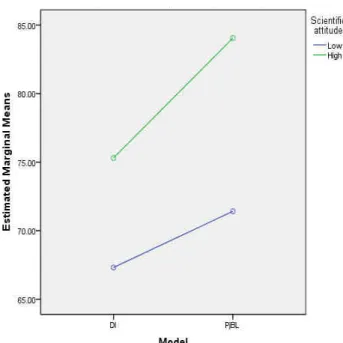
To be more clearly seen as the interaction will be shown in Figure 2.
Figure 2. Interaction Between Collaborative Based Project Based Learning Model and Conventional Learning with Scientific Attitude on Student Creativity
4. Discussion
4.1 Effect of Project Based Learning Model on Creativity
Based on the research results obtained the average value of student creativity taught by model project based learning in the experimental class when the pretest of 30,33 while the postest of 65,00. The average value of student creativity taught by conventional learning when the pretest of 33,33 while the postes of 55,50 thus the creativity of students who are taught with project based learning model is better than the students taught by conventional learning.
The project-based learning model derives from the learning theory that learning is the process by which learners actively construct their knowledge and are one of the learning models designed primarily to help
students be more creative, to learn the roles of adults by experiencing them through real situations or simulated situations; And become an autonomous and independent student.
Learning begins after students are faced with the daily problem structure that is around students, in this way students know why they are learning, problem-based learning requires students to investigate to find a real solution to the real problem. They must analyze and identify problems, develop hypotheses and make predictions, collect and analyze data and information, conduct experiments (if required), and formulate conclusions.
The demands of the student's activities become his personal experiences that have their own impression. Knowledge obtained by students directly will be easier to remember than the knowledge given by the lecturer. From his own experience the student has developed a personal concept (self-concept) in his thinking. So when a student faces similar/ identical problems in learning such as answering questions or in his daily life, he can use the concept in solving problems. The success of students in solving problems positively impacts his creativity.
This discussion is in accordance with the results of research showing that statistically the creativity of students who are taught with project based learning model is better than the students taught by conventional learning. The average experiment class creativity score was 65,00 while the mean score for the control class was 55,50. When testing hypothesis with Anava test, obtained FHitung of 60,923 and significant at 0,000 and this significance is smaller than significant level α = 0,05. Then it can be concluded that the creativity of students in the experimental class is better than the control class.
This is consistent with the theory that project based learning is one of the learning models designed primarily to help students develop their thinking skills, problem-solving skills and intellectual skills (Arendrs, 2008). The findings of this study are consistent with the results of the study saying that physics students with low levels of ability taught with problem-based learning are significantly better than those taught by conventional learning (Chakravarthi, 2009). Reveals the same thing that certain processes in project based learning theoretically support the development of student creativity in accordance with the design applied (Lindawati, 2013). Conclude that there is a statistically significant difference in the students' self-reliance learning before and after the implementation of project based learning with the creativity of student students using project based learning model is better than compared with conventional learning.
4.2 The Effect of Scientific Attitudes on Student Creativity Skills
Attitude is a tendency to make choices or decisions in action, the attitude stems from the feelings associated with the tendency of a person to respond to something / object. Attitudes are also an expression of the values or outlook of a person's life. Attitudes can be formed so that the desired behavior or action takes place. With the students' scientific attitude about the concepts to be learned, it will make it easier for the lecturer to direct the students to learn through the experiences gained, even further to solve a problem.
Based on the result of questionnaire of scientific attitude which is distributed to the students before the learning begins, the average value of conventional class of scientific attitudes is 78,72 with high scientific attitude category consist of 13 people and low scientific attitude 19 people while in the experimental class is 79,40 with category High scientific attitude consists of 21 people and low scientific attitude 11 people. The low level of scientific attitude study of physics of students is determined from the score of all samples is 79,06 where the category of high scientific attitude> 79,06 or equal to 79,06 and the category of scientific attitude category low scientific attitude level <79,06. While the average creativity of students at high scientific attitude level and low scientific attitude is 80,82 and 73,30. This result is categorized as good when compared to the study (Yalcin, 2009) where the results of his research show the average high scientific attitude creativity at 78,56 while in the expository class of 72,15 so the difference of 2,16.
Based on the results of the study using the calculation hypothesis ANAVA 2 x 2 also obtained that sig scientific attitude (0,000 <0,05). The description of scientific attitude and creativity data above gives the conclusion that the creativity that has high scientific attitude ability is better than the creativity of students with low scientific attitude ability. This can not be separated from students' activeness to build knowledge through discipline, cooperation, honest, responsible and open.
This is in line with the study, where the results of his research show that there are differences in scientific attitude between students who are taught using project based learning model with students taught using conventional learning there are differences in scientific attitude (78,56 > 72,15) and skill Critical among students who learn to use project based learning model, and there are also differences in student creativity skills between students taught by using project based learning model with students taught with conventional learning model.
It can be concluded that students who have a high scientific attitude will gain better creativity from students who have low scientific attitudes. This is in accordance with the results of research that statistically shows the creativity of students who have a high scientific attitude is better than students who low scientific attitude diperoileh FHitung amounted to 19,125 and significant at 0,033 and this significant smaller than the significant level α = 0,05
The findings of this study in accordance with the theory that the use of project based learning model in learning can improve student creativity.
4.3 Interaction Between Model of Project Based Learning and Scientific Attitude on Student Creativity
Based on the results of ANAVA 2 x 2 testing using SPSS 19,0 in figure 2 it is found that the interaction between the learning model and the scientific attitude of the sig students (Model * Scientific Attitude) is 0,000. Therefore the value of sig. 0,000 <0,05 then Ha is accepted, which means there is a significant interaction between the model based learning based on collaborative and conventional learning model with the level of scientific attitude toward student creativity.
In a collaborative based project based learning model, students' creativity improvement has been supported by good scientific attitude skills during the learning process through group activities and discussions. In the process students are required to be diligent, disciplined, responsible and able to work with groups so that the group can succeed well. This is what makes students more easily understand the courses given and will be more stored long in the memory of students. While on learning conventional learning tends to center on the student (teacher center learning). Where the activities of teaching and learning activities in the classroom is fully held by the lecturers in order to achieve all the subject matter without considering and caring about the students' understanding. As a result, students who are basically active in the classroom have a significant increase in student creativity while students who are not actively increasing the creativity of students is not significant. Then it can be concluded that the conventional model level of students' scientific attitude does not affect student creativity.
Research results are also supported by research conducted (Richardson, 2012) where the research shows that there is interaction between project based learning model and scientific attitude toward student creativity (F = 18,95 <0,05) caused by curiosity and high responsibility so that student is able Find and solve problems encountered in everyday life. While conventional learning does not give a significant contribution because the use of conventional learning is more dominated by lecturers in other words, the students become passive. Thus the findings of this study in accordance with the results of research conducted by previous researchers and in accordance with the theory that PjBL is one model of learning designed primarily to help students develop creativity, problem-solving skills and intellectual skills.
5. Conclusion
Student creativity using project based learning based on collaborative model is better than using conventional learning. This result shows that there is influence of project based learning model based on collaborative and conventional to student creativity. Student creativity in the group of students with an average Q score is better than the group of students who have an average Q below the average. This result shows there is influence of Q to student creativity. There is an interaction between project based learning model based on collaborative and conventional learning using Q in enhancing student creativity.
References
Arends, R.I., Learning to Teach. Seven editions, McGraw-Hill, New York, 2008
Astika, Urip, Suma, K., Suastra, W., “Pengaruh Model Pembelajaran Berbasis Masalah Terhadap Sikap Ilmiah dan Keterampilan Berpikir Kritis,” Program Pascasarjana Universitas Pendidikan Ganesha, 3(9).2013
Buck Institute for Education, Project Based Learning Handbook: A Guide to Standards-Focused Project Based Learning, Second Edition, The Buck Institutes for Education’s Handbook for Project Based Learning, 2010 Chakravarthi, S., Judson, John, and Vijayan, Priya, “An Evaluative Study On Comparison Of Problem Based Learning And Lecture Based Pedagogy On Self Directed Learning In Undergraduate Medical Education,” Indian Journal of Science and Technology, 2(12).2009
Fathurrohman, M., Model-model Pembelajaran Inovatif, Ar-ruzz Media, Jogjakarta, 2015
Fraser, B. J, Chapter 1 Learning Environments Research: Yesterday, Today And Tomorrow, Curtin University of Technology, Australia, 2002
Jarosievitz, B., “ICT In Physics Teaching For Secondary Schools And Colleges,” Dennis Gabor College SEK Budapest International School (Hungary).2012.
Liang, L., Chen, S., Chen, X., Kaya, O. N., Adams, A. D., Macklin, M., and Ebenezer, J., “Student Understanding Of Scientific Inquiry (Susi): Development And Validation of An Assessment Instrument,” Paper Prepared For The Eighth International History, Philosophy, Sociology & Science Teaching Conference (IHPST).2002
Lindawati, S.D., Fatmariyanti and A., Maftukhin., “Penerapan Model Pembelajaran Project Based Learning untuk Meningkatkan Kreativitas Siswa MAN 1 Kebumen,” Radiasi, 3 (1), 42-45.2013
Munandar, U., Pengembangan Kreativitas Anak Berbakat, PT Rineka Cipta, Jakarta, 2012
Mihardi, S., “Effect of Project Based Learning Model With KWL (Know-Want-Learn) Worksheet on Creative Thinking in Solved Physics Problems,” Jurnal Pendidikan Fisika Universitas Negeri Medan.2013
Mihardi, S., M.B., Harahap, & R.A., Sani., “The Effect of Project Based Learning Model with KWL Worksheet on Student Creative Thingking Process in Physics Problems,” Journal of Education and Practice, 4(25), 188-200.2013
Mustaji, “Pengembangan Model Pembelajaran Berbasis Masalah dengan Pola Kolaborasi dalam Mata Kuliah Masalah Sosial. Disertasi. Malang,” Program Pascasarjana Universitas Negeri Malang.2009
National Center for Education Statistics, Program for International Student Assessment (PISA), Science Literacy, Average Scores Online, 2013
Nurohman, S., “Pendekatan Project Based Learning Sebagai Upaya Internalisasi Scientific Method Bagi Mahasiswa Calon Guru Fisika. Yogyakarta,” Universitas Negeri Yogyakarta. 2008
Permendikbud Nomor 66 Tahun 2013 tentang Standar Penilaian
Richardson, F., Comprehension and Learning Strategy Before, During and After Reading Comprehension Strategy, Navan Education Centre, Athlumney, Navan, 2012
Yalçin, S.A, U., Turgut, and E., Büyükkasap, “The Effect of Project Based Learning on Science Undergraduate’s Learning of Electricity, Attitude towards Physics and Scientific Process Skills,” International Journal of Education Sciences, 1(1), 81-105.2009