An Animated Pedagogical Agent For
Assisting Novice Programmers Within A
Desktop Computer Environment
by
Desmond Robert Case BSc, MSc
Staffordshire University
A thesis submitted in partial fulfilment of the requirements of
Staffordshire University for the award of the degree of Doctor of
Philosophy in Computer Science
ii
Abstract
Learning to program for the first time can be a daunting process, fraught with difficulty and setback. The novice learner is faced with learning two skills at the same time each that depends on the other; they are how a program needs to be constructed to solve a problem and how the structures of a program work towards solving a problem. In addition the learner has to develop practical skills such as how to design a solution, how to use the programming development environment, how to recognise errors, how to diagnose their cause and how to successfully correct them. The nature of learning how to program a computer can cause frustration to many and some to disengage before they have a chance to progress. Numerous authorities have observed that novice programmers make the same mistakes and encounter the same problems when learning their first programming language. The learner errors are usually from a fixed set of misconceptions that are easily corrected by experience and with appropriate guidance.
This thesis demonstrates how a virtual animated pedagogical agent, called MRCHIPS, can extend the Beliefs-Desires-Intentions model of agency to provide mentoring and coaching support to novice programmers learning their first programming language, Python. The Cognitive Apprenticeship pedagogy provides the theoretical underpinning of the agent mentoring strategy. Case-Based Reasoning is also used to support MRCHIPS reasoning, coaching and interacting with the learner. The results indicate that in a small controlled study when novice learners are assisted by MRCHIPS they are more productive than those working without the assistance, and are better at problem solving exercises, there are also manifestations of higher of degree of engagement and learning of the language syntax.
iii
Acknowledgements
I would thank my supervisors Professor Bernadette Sharp and Dr Len Noriega for their patience and support. I would also like to thank Dr Peter King for his help and support in the past.
Thanks go to various members of the faculty and students of the Northampton Business School at the University of Northampton for their technical assistance, interest and accommodation for my activities during this research.
I would like to thank and reassure the many good friends and extended family members who must now believe I only appear when the moon is blue, that I am still here, you have always been in my thoughts and that I look forward to the joy of renewing old acquaintances.
Finally I would like to offer a special thank you to the patients, faith and unwavering encouragement of three special women I have woefully neglected these many, many months: my mother, Mrs Avis Case, my sister, Ms Rose Case, and my partner Dr Alison Rudd. I love and cherish you all.
iv
Table of Contents
Page
Chapter 1 Introduction 1
1.1 The difficulty with learning to program 1
1.2 Research Aims 2
1.3 Principal contribution of the research 5
1.4 Background 6
1.4.1 Mentoring vs. Tutoring 7 1.5 The research framework 8 1.5.1 The March and Smith framework 9 1.5.2 The Järvinen research framework 10 1.5.3 Applying the frameworks to this research 10 1.5.4 Ethical statement 12 1.6 Overview of the thesis 13
Chapter 2 The psychology of the novice programmer 15
2.1 Introduction 15
2.1.1 Two typical novice programming errors 15 2.2 The context for learning to program 17 2.2.1 The novice and the program 17 2.3 Enhanced development environments 22 2.3.1 Code sensitive editors 22 2.3.2 Visual programming languages 23 2.3.3 Intelligent assistance 25
2.4. Summary 27
Chapter 3 Cognitive apprenticeship 28
3.1 Introduction 28
3.1.1 Methods of the model 31 3.1.2 Constructivism 33
3.1.3 Scaffolding 34
3.1.4 Double-fading support 35 3.1.5 Anchored instruction 36 3.1.6 Traditional vs. Cognitive apprenticeships 36 3.1.7 Expert areas of knowledge 37 3.2 A Review of Systems that apply CA 38
v
3.3 Summary 45
Chapter 4 Intelligent virtual agents 47
4.1 Introduction 47
4.1.1 Intelligent Agents 47 4.1.2 Animated pedagogical agents 49 4.1.3 Intelligent Virtual Agent Systems 53
4.2 Summary 61
Chapter 5 Reasoning in agent based systems 63
5.1 Introduction 63
5.2 The BDI agent architecture 63 5.3 Case-Based Reasoning 67 5.4 The cognitive agent architecture 72 5.5 Alternate reasoning methods 74 5.5.1 Classical agent reasoning 74 5.5.1.1 Deliberative agents 75 5.5.1.2 Reactive agents 76 5.5.2 Practical agent reasoning 78 5.5.2.1 Hybrid agents 78 5.5.3 Biologically inspired reasoning methods 81
5.6 Summary 81
Chapter 6 The challenges of learning Python – Case Study 83
6.1 Introduction 83
6.2 Difficulties in learning to program 83 6.3 The properties of Python 85 6.4 Observation of novice errors 87
6.4.1 Method 87
6.4.2 Categories of programming error 88 6.4.2.1 Syntax errors 89 6.4.2.2 Semantic errors 92 6.4.2.3 Logical errors 96 6.4.2.4 Strategic errors 98 6.4.2.5 Errors arising from incorrect use of letter-case
in Python
99
vi
6.5 Related work 104
6.6 Summary 106
Chapter 7 An agent framework for mentoring within cognitive apprenticeship
107
7.1 Introduction 107
7.2 Handling errors in Python 108 7.2.1 Agent capability 110 7.3 The CA approach to learning to program 110 7.3.1 Agent capability 113 7.4 The agent interface 114 7.5 The agent environment 116 7.5.1 Agent capability 117 7.6 A mentoring scenario 117 7.6.1 Agent capability 118 7.7 A cognitive apprenticeship agent framework 119 7.7.1 Agent capability 121 7.8 Agent requirements for MRCHIPS 121
7.9 Summary 122
Chapter 8 Implementation of MRCHIPS 123
8.1 Introduction 123
8.2 The MRCHIPS cognitive architecture 123 8.3 The subsystems of MRCHIPS 124 8.3.1 Reasoning in MRCHIPS 125 8.3.2 The BDI reasoning subsystem 126 8.3.3 The case-based reasoning subsystem 129 8.3.4 Additional agent subsystems 134 8.3.4.1 The BNF parser 133 8.3.4.2 Perception 135 8.3.4.3 Actuators 136 8.3.4.4 Journaling 138 8.3.4.5 Reading code 139 8.4 Implementation details 141 8.5 The agent environment 144 8.6 Decision-making in MRCHIPS 146
vii
8.8 Summary 150
Chapter 9 Research methodology and experimental design 151 9.1 Research methodology 151 9.1.1 Quantitative research methods 151 9.1.2 Qualitative research methods 152 9.1.3 Hybrid research methods 153 9.2 Review of research objectives 153 9.3 Research Design 154 9.4 Experimental overview 156 9.4.1 Experimental setting 160 9.4.2 Experimental limitations 161 9.5 Ethical considerations 161 9.6 Summary 162
Chapter 10 Evaluation of MRCHIPS 163 10.1 Findings and analysis 163 10.1.1 The t-test analysis 167 10.1.2 The t-test calculation 169 10.1.3 Pearson’s correlation coefficient 172
10.2 Discussion 173
10.3 Summary 177
Chapter 11 Conclusions and future work 179 11.1 Review of research objectives 179 11.2 Critical Reflection 183 11.3 Research contribution 186
11.4 Future work 187
References 189
Bibliography 204
Appendix A Brief Overview of Python 210 Appendix B The MRCHIPS User Guide
Appendix C The Evaluation Brief
Appendix D The Evaluation Test Source Code Appendix E The MRCHIPS Evaluation Questionnaire Appendix F The MRCHIPS Conference Poster
viii
Figures
Page Figure 1.1 A Multi-methodological approach to IS research
(Järvinen, 2004)
11
Figure 2.1 Theories informing the mentor agent 15 Figure 2.2 The tkinter colour syntax highlighting editor for Python
code
23
Figure 2.3 The Win32 colour syntax highlighting editor for Python code
23
Figure 2.4 The Alice user interface (courtesy of www.alice.org) 24
Figure 3.1 The place of cognitive apprenticeship in educational literature (courtesy of Ghefaili, 2003)
30
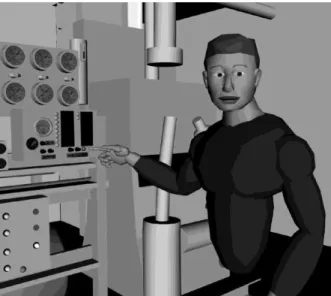
Figure 4.1 The Steve agent demonstrating a control panel (courtesy of Johnson and Rickel, 2000)
55
Figure 4.2 A PPP agent presentation (courtesy of Johnson and Rickel, 2000)
57
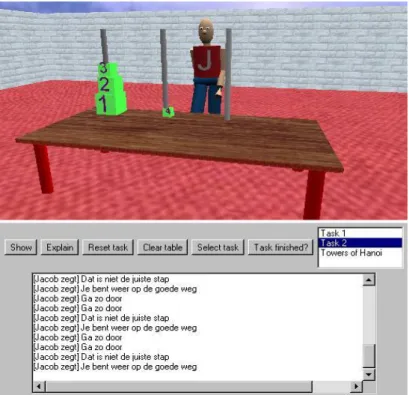
Figure 4.3 The Jacob agent teaching the tower of Hanoi (courtesy of Evers and Nijholt, 2000)
58
Figure 4.4 FatiMA characters in FearNot! Story (courtesy of Aylett, 2007)
59
Figure 4.5 Adele explains the importance of palpating the patient’s abdomen (courtesy of Johnson, 1999)
60
Figure 5.1 The generic BDI architecture 64 Figure 5.2 Logical structure of a plan (a) alongside a practical
working example (b)
66
Figure 5.3 The CBR process cycle (Aamodt and Plaza, 1994) 70 Figure 5.4 The seaworld environment – (Courtesy of Vere and
Bickmore 1990)
75
Figure 5.5 Horizontal (a) and vertical (b) information flows in layered agent architecture (Courtesy of Müller, 1991)
78
Figure 5.6 The Interrap agent architecture (Courtesy of Müller, 1991)
ix
Figure 6.1 Runtime-errors in the Python shell window 99 Figure 6.2 Listing of a faulty Python to be debugged 101 Figure 6.3 Console error output for the faulty Python code 101 Figure 6.4 Windowed error output for the faulty Python code 102 Figure 6.5 Chart of the trend of Python novice errors over one year 103 Figure 6.6 Examples of frequently reported novice programming
errors in Java
105
Figure 7.1 Sketch of the novice and mentor agent interaction 115 Figure 7.2 The mentor agent’s advice to a learner 118 Figure 7.3 The agent framework 119
Figure 8.1 MRCHIPS System overview diagram 124 Figure 8.2 The mentor agent’s architecture 125 Figure 8.3 The PAL execution cycle 126 Figure 8.4 Two example plans in MRCHIPS 127 Figure 8.5 Example of a case in MRCHIPS 129 Figure 8.6 Fragment of a discrimination tree as a case-base index 130 Figure 8.7 The search algorithm for a discrimination network 131 Figure 8.8 Expression for the degree of match in the CBR 132 Figure 8.9 The mentor agent’s architecture 133 Figure 8.10 Fragment of the agent DCG statement parser 135 Figure 8.11 MRCHIPS driving the Victor agent character 137 Figure 8.12 Table of the different types of pedagogical actions 138 Figure 8.13 Instruction hierarchy for an if-statement 140 Figure 8.14 Algorithm of the PAL top-level execution cycle 141 Figure 8.15 Algorithm of the PAL instruction interpreter 142 Figure 8.16 Algorithm for selecting a new plan 143 Figure 8.17 The mentor agent’s advice to a learner 144 Figure 8.18 The agent’s interface to the Win32 OS 145 Figure 8.19 Simplified finite state machine for main MRCHIPS
behaviours
147
Figure 9.1 The user interfaces for the hangman and unit converter applications used by the control groups
157
Figure 9.2 The user interface numerical converter application used by the mentored evaluation group
x
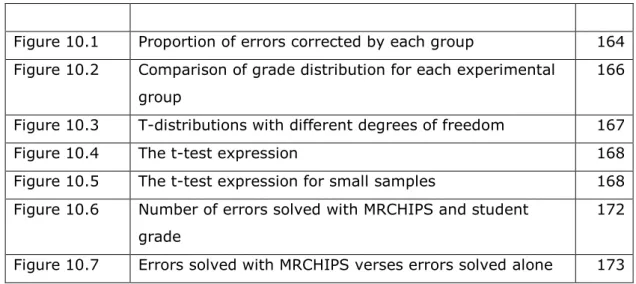
Figure 10.1 Proportion of errors corrected by each group 164 Figure 10.2 Comparison of grade distribution for each experimental
group
166
Figure 10.3 T-distributions with different degrees of freedom 167 Figure 10.4 The t-test expression 168 Figure 10.5 The t-test expression for small samples 168 Figure 10.6 Number of errors solved with MRCHIPS and student
grade
172
xi
Tables
Page Table 1.1 The March and Smith research framework 9 Table 1.2 Mapping of this thesis against the Järvinen research
framework
12
Table 3.1 Comparison of cognitive apprenticeship systems 42 Table 3.2 How the pedagogical systems implement the cognitive
apprenticeship
43
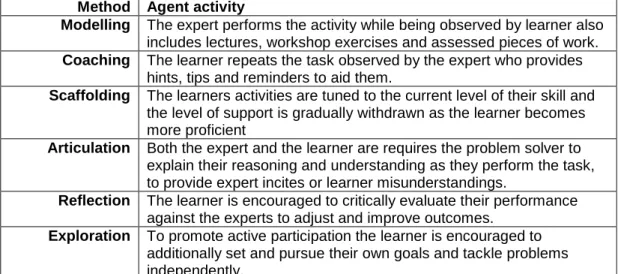
Table 3.3 The methods in the cognitive apprenticeship pedagogy mapped against the agent activity
45
Table 6.1 Syntax errors 90
Table 6.2 Semantic errors 93
Table 6.3 Logical errors 97
Table 6.4 Case sensitivity error types 100
Table 7.1 The methods in the cognitive apprenticeship pedagogy mapped against the agent activity
111
Table 8.1 BNF syntax for body of PAL plans 128 Table 8.2 Table of addressable agent subsystems 129 Table 8.3 Comparison of MRCHIPS with other virtual pedagogical
agents
149
Table 9.1 Details for the experimental setting 160
Table 10.1 Results for number of errors corrected by each group 163 Table 10.2 Results for control group 1, novice programmers 165 Table 10.3 Results for control group 2, experienced programmers 165 Table 10.4 Results for group 3, mentored novice programmers 165 Table 10.5 Results for evaluation group, subjects and MRCHIPS 166 Table 10.6 Empirical data from the novice and mentored groups 169 Table 10.7 Preliminary analysis of the sample research data 170
1
Chapter 1:
Introduction
1.1
The difficulty with learning to program
When a novice programmer first begins to learn a programming language he, or she, often encounters the same problems and makes the same mistakes as others who have learned to program before. The misconceptions, mistakes and errors form a set of knowledge that can be easily corrected by simple guidance or experience and have to be leaned as part of the programming skill. Making mistakes when learning to program is a constructive part of the process, however some learners find the precision required by programming code frustrating and may become disengaged with the process. Despite rich interactive development environments, learners continue to generate errors as they experiment with the language structures and find debug messages unhelpful because of their lack of experience of the significance of error information. During practical sessions a supervisor’s task is often to simply call on prior experience to provide guidance and offer reassurance that errors are all part of the development process. Away from supervision some learners can become stuck on a simple error that halts progress and prevents the chance to address other problems. The problems are often as a result of the learner failing to recognise where they have deviated from language syntax or which solution to apply to address a given problem. The problems are often easily fixed when pointed out by a tutor or even a more able peer and this kind of help can occur both within and outside the classroom situation. When the help is provided by a more able peer or the help is provided outside of the classroom situation it can be characterised as mentoring, which is support in the form of a more experienced practitioner sharing knowledge. It may include privileged access to information; it is informal in nature and the subject is driven by
2
the concerns of the learner. A fuller discussion of mentoring is given in section 1.4.1.
When producing a software application it is necessary for the developer to organise a large body of coding and data structures, and to decide how to arrange them in such a way as to provide a solution to a given problem. A programmer is faced with a range of coding options, operators, functions, choices, knowledge representation and data structures and how to represent the above in any particular language. In addition, the programmer must devise a sequence of code for execution and possess enough insight to recognise deficiencies and make corrections. The range of possible options and the dependency between concepts makes learning to write computer programs a challenging task. The programmer must also possess enough insight into the domain of the problem to be able to encode a solution.
Although teaching a subject is primarily concerned with one party imparting knowledge to another, in reality there are other factors that affect how well a learner is able to assimilate and apply new information. Learning is a very social activity relying on relationships, in addition to the subject knowledge, as part of the process. These relationships involve things such as providing encouragement and explanation. Much of the activity of supervising novice programmers is social in that the tutor offers encouragement with often a smaller amount of time on advising corrections to code. Anecdotal observation has found that this level of technical guidance is often sought and given irrespective of the details of the design task being undertaken by the learner.
1.2
Research Aims
This research proposes the use of a pedagogical agent, called MRCHIPS, to provide mentoring support and presented as an animated character for social interaction. The aim of the research is to determine whether the use of an automated and animated pedagogical agent can provide
3
mentoring support to novice programmers as they learn their first programming language.
Hypothesis 1) An intelligent agent with an anthropomorphic interface can provide effective mentoring support to novice programmers learning their first programming language. The agent would appear as an interactive anthropomorphic entity that would assist the novice to determine and solve programming errors when a human mentor in the form of a tutor might not be available. The idea arose from the observation that students on a business-computing course learning a programming language for the first time would often give up at the first problem they found a challenge, limiting their exposure to later exercises (problem solving with a programming language can be a linear process) and their overall learning experience.
As the students’ understanding of the subject was distributed across the range of topics they had encountered, it was difficult to predict which particular problem would impede them. In general some would understand some principles and not others in different ways. The problems would often be relatively minor and the practice of systematically reviewing the work they had produced would be enough to uncover the cause, but as reflection on ones’ work is also a skill under development as people learn programming for the first time that technique is not available to novices. The information could be gathered from available documentation and literature but as the students are still impeded by the same errors these options are not taken, or not effective. Intelligent virtual agents, sometimes called believable agents, life-like agents, synthetic agents or embedded virtual agents are part of the field of Artificial Intelligence research concerned with presenting an anthropomorphic character to represent an underlying cognitive agent in an environment. One of the uses of the virtual agent is to promote greater engagement when interacting with a human user. While this is
4
true of a 3D game environment, is the same also true of the programming environment?
Hypothesis 2) The use of an animated virtual character user interface increases the learner’s engagement with problem solving in the programming environment.
To provide the range of capabilities that would allow an agent to monitor, interact, diagnose and provide solutions to the learner it is likely to require an agent architecture that is able to coordinate multiple reasoning techniques, called a cognitive architecture. However most popular agent architectures, such as Beliefs Desires Intensions (BDI), generally support reasoning based around reactive and deliberative planning, which would be required to control the interactivity of the agent, but not enough to provide the domain reasoning of a pedagogical agent. Would it be possible to extend the capabilities of a procedural BDI agent architecture into a cognitive architecture?
Hypothesis 3) The processing capabilities of a procedural BDI agent can be extended to provide the more knowledge based reasoning capabilities of a cognitive agent architecture. Intelligent Learning Environments (ILE) are based around specially developed software applications that the student must learn to use before transferring the skills to a real-world application environment. Intelligent Tutoring Systems (ITS) and virtual agents also usually reside in their own application environments. As learning to program is a difficult enough task without having to become familiar with multiple tools or environments, the utility of the agent is likely to be greater if the agent worked in the learner’s environment and not the other way around.
Hypothesis 4) Agent based reasoning provides a framework to extend knowledge-based systems into existing computing
5
desktop environments and avoid the need to build a specialised learning application environment.
This would test how much of the cognitive agent would have to be adapted to cope with an environment that will not be as accommodating to its requirements as an agent aware environment. This is likely to be similar to the situation faced by many network applications and robotics research, but will allow for examination of cognitive and software solutions respectively. This question also imposes an implied sub constraint that the mentoring agent should not require any special hardware or software above what could be expected on a desktop computer that would be used to learn to program in Python for example. This is a useful guideline for the development of the agent and deployment for evaluation and demonstration.
1.3
Principal contributions of the research
This research brings together a number of areas namely Intelligent Learning Environments (ILE), Intelligent Tutoring Systems (ITS), virtual agents and cognitive agent architectures, which are covered in the literature review chapters. ILE systems are usually based around specially developed software applications the student must learn to use before transferring the skills to a real-world application. As it will be shown in the literature review other research into the use of intelligent virtual agents in teaching has to date provided the environment in which the interaction with the learner takes place. Evidence from this has been able to demonstrate that novice programmers respond positively to interactive learning with animated characters when developing code (Lui and Chan, 2006). The novel approach taken by this research is to avoid the requirement for a custom agent environment and for reasons arising from the pedagogical theory explained in later chapters, the agent operates in the learners’ environment of the Windows desktop. The novel approach of MRCHIPS is in its strategy, to allow the novice programmer to continue to work in the pre-existing development environment, to adhere to one of the major principles of the cognitive apprenticeship pedagogy.
6
MRCHIPS exists as a separate application that because of its unique architecture is able to monitor the user and provide knowledgeable assistance. The agent not only monitors the novice, but makes use of the reasoning of a cognitive architecture to provide expert level analysis of his or her work and provide a character driven interactive response to the user’s errors. These capabilities allow the agent to operate where they are not usually found, in a programming environment on the desktop of a conventional computer. If the subject activity is already computer based the advantage of MRCHIPS is that the learner does not have to become familiar with a second application, such as an ILE, in order to learn the first application. In this way MRCHIPS supports a closer adherence to the requirement of the cognitive apprenticeship pedagogy for the novice to work with real world examples, as learning practice is accomplished using real world tools.
1.4
Background
In the opening chapter of the book Inside Case-Based Reasoning the authors, Riesbeck and Schank, describe Artificial Intelligence as a “search for the general mechanisms underlying intelligence” (Riesbeck and Schank 1989). Embodied within that view is the concept of computers as an answer-giving device. The idea of an individual being able to present a problem to a computer when facing an unfamiliar situation and to have it provide an answer not only motivates the dreams of science fiction fantasy, as a casual survey of a series such as Star Trek would show the purpose of the intelligent computer assistant to provide information to human characters faced with the unfamiliar, as well as exposition to the human viewers at home. But also this model of the intelligent machine advisor has been the goal of real-world research and is increasingly found in the user interface of commonly available software and hardware. The concept of the intelligent computer assistant also has merit when users are charting unfamiliar knowledge and one application area where this has been useful is in education. This research is interested in the utility of agents to assist in the learning of a first programming language.
7
According to Gulz (2004) educational researchers have observed that novice programmers make the same mistakes and encounter the same problems when first learning a programming language. The learner errors are usually from a fixed set of misconceptions that are easily corrected by experience and with simple guidance. Despite rich interactive development environments, learners continue to generate errors as they experiment with the language structures and find debug messages unhelpful because of their lack of experience of the significance of error information. During practical sessions a supervisor’s task is often to simply call on prior experience to offer guidance and offer reassurance that errors are all part of the development process. Computer programming is a skill-based activity that involves problem solving within the constraints imposed by a computer environment. Learning to program is a fairly unique activity; there are few, everyday real world analogies to the activity, programs are constrained by a mathematical concept - logic, rather than an observable physical phenomena and the correctness of code is ultimately mediated by a machine. The difficulty of the task faced by the novice programmer is that when s/he start they have a limited idea of how to produce code to achieve a goal, or solve a problem, and little insight into how the code they produce will be interpreted by the programming language.
1.4.1
Mentoring vs. Tutoring
The agent’s operation alongside the learner allows another novel contribution to the research. The agent operates as a mentor towards the learner, as opposed to a traditional tutor of ITS. In a formal sense there is little difference between the terms mentor and tutor. The word Mentor originates from the name of the figure of Greek legend who in his old age was given charge of Telemachus, the son of Odysseus, when the latter went to fight in the Trojan wars. According to the legend Mentor performed his role so well that his name later became the proverbial phrase for a faithful and wise adviser. The term mentor describes a teaching relationship and is a synonym of teacher, as is tutor, counsellor, lecturer, coach, instructor and guru. By convention the different terms for a teacher are used to describe the nature of the participants in the
8
learning process. For example a person might find himself or herself taught by at teacher at school, a tutor when learning the piano, a coach for learning a sport, a lecturer at university, an instructor for driving and a mentor at the start of employment. The Collins dictionary defines the role of a mentor as “a wise and trusted advisor or guide” or “an influential senior sponsor or supporter” (Collins dictionary 1987). While accurate, this definition does not encompass the scope of mentoring, which also implies a protective role. The learner in a mentoring relationship is often called the protégé, which is a French term derived from the Latin meaning “to protect” (Johnson 2007). Johnson (2007) describes the task of mentoring which “… nearly always includes an emotional/interpersonal support dimension. Components of psychosocial support may include affirmation, encouragement, counselling, and friendship”, while Landsberg (1996) describes mentoring as “… a role which includes coaching, but also embraces broader counselling and support, such as career counselling, privileged access to information, etc.”. So the term mentoring is mainly used where there is an emphasis on a caring aspect of the teaching in varied applications such as social care, personal friendships or employment and career development. Mentoring differs from tutoring in terms of the nature of the relationship between the participants. In a paper for the University of Michigan, Arbor (1999) specifies mentors, among other academic roles, as “… advisers, people with career experience willing to share their knowledge […] tutors, people who give specific feedback on one’s performance”. Therefore throughout this research the term mentor will be used to mean an advice giver who will support the learner based on experience in pursuit of providing care, while a tutor provides lesson material, assesses the learner’s performance and provides specific feedback on progress.
1.5
The research framework
A research framework ensures the correct model is used to evaluate an item of research so results may be placed into an appropriate context to show their worth. As different types of research require different types of
9
research frameworks it also defines the different activities that can be used to produce specific outputs.
1.5.1
The March and Smith framework
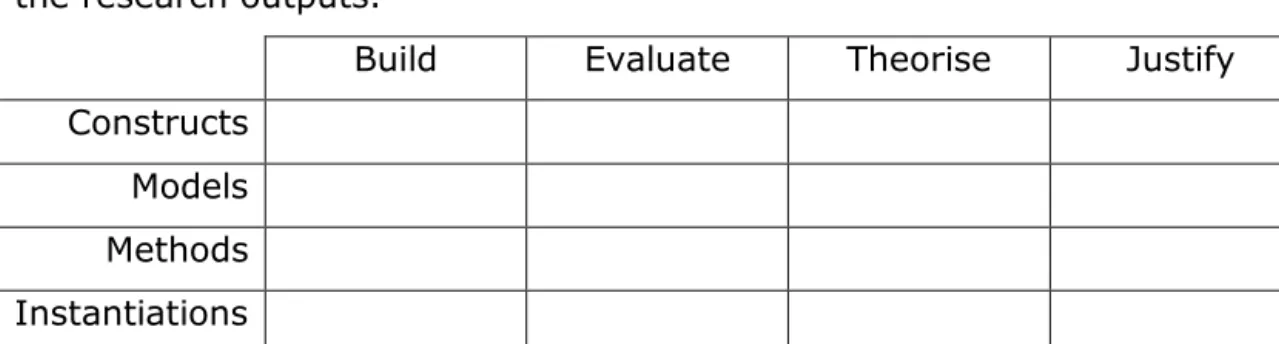
The precise origins of the framework as applicable to items of research is unclear from the literature as the term framework is used to cover other such diverse subjects as industrial projects, academic programs, corporate and government initiatives. However March and Smith (1995) proposed a framework for research projects relevant to the area of information technology. Their framework is based on the idea that scientific research can be divided into two categories “natural science” and “design science”. Research in natural science seeks to apply scientific methods to explain some phenomena in IT with the aim of either trying to understand the nature of it, which they termed descriptive, or with the aim of improving it, which they called prescriptive. Design science based research is concerned with the development of an artefact to satisfy some particular goal. It produces tools that serve human purposes and these are assessed against criteria of value or utility. Using these categories March and Smith devised a framework that organised the research activities against the research outputs.
Build Evaluate Theorise Justify
Constructs Models Methods Instantiations
Table 1.1. Example of an unpopulated March and Smith research framework
The research framework identified four research activities: build, evaluate, theorise, and justify. The build and evaluate activities are used in design science based research, whereas the theorise and justify activities are used for the natural science based ones.
1. Building is the process of constructing an artefact for a specific purpose;
10
2. Evaluation is the activity of determining how well the artefact performs;
3. Theorise is the process of constructing a theory that explains how or why something happens;
4. Justify refers to the activity of proving a theory. This is done by the systematic gathering of evidence that supports or refutes the theory.
The outputs of the framework were identified as constructs, models, methods and instantiations.
1. The constructs (or concepts) are the conceptualisations used to describe a problem in the domain. It is the specialised language and shared knowledge of a discipline.
2. The model is an expression of the relationships among the constructs. Models represent situations as problem and solution statements for design based activities.
3. The method is an algorithm – it is the sequence of steps used to perform a task.
4. Instantiation is the realisation of an artefact in its environment; this refers as much to the tools that address various aspects of design in addition to any eventual software artefact.
An example of the layout for the March and Smith research framework table is shown in table 1.1 above.
1.5.2
The Järvinen research framework
In a later development of the IT based research framework, Järvinen (2004) expanded the work of March and Smith to identify additional categories of research activities and research output. The Järvinen framework makes more of a distinction between the theoretical and practical activities of research, thus identifying five input activities. They also identify differences in the types of method of a research project, defining method identified by March and Smith as normative methods and specifying methods that are used in reality as positive methods. They also identified an additional output called description that allows for the documenting of interesting related phenomena that may occasionally occur. The Järvinen framework is therefore an extension on the March
11
and Smith framework that refines the model, method and instantiations outputs.
1.5.3
Appling the framework to this research
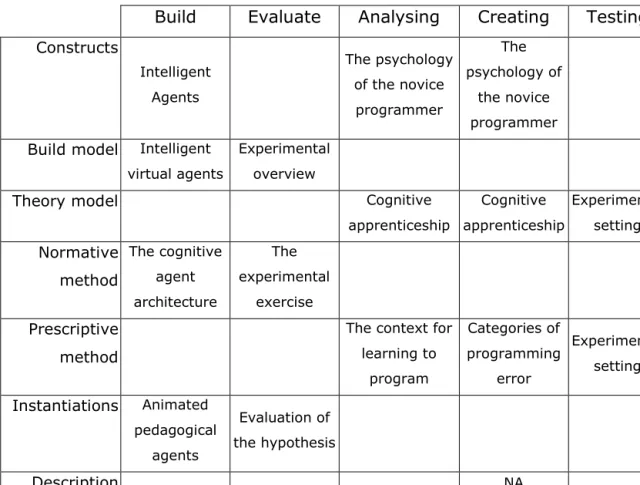
To investigate the hypotheses this research focuses on the activities of design science. Using the Järvinen framework the following outputs and activities will be produced to address the investigation.
1. The constructs for this research cover concepts such as the pedagogical theory, cognitive apprenticeship, the virtual agent, the cognitive architecture, coaching, Python, the development environment, the learner and the types of coding errors.
2. The model for the research is used to develop the requirements for the design of the agent and is based on the analysis of errors in light of the material from the literature review.
3. The method is the development and implementation of the mentoring agent architecture and development of its knowledge base.
4. Instantiation is the evaluation of the agent with reference to the learning of novice programmers.
Theory building Conceptual frameworks Mathematical models Methods Systems Development Prototyping Product development
Technology transfer Experimentation Computer simulations Field experiments Lab experiments Observation Case studies Survey studies Field studies
12
Build Evaluate Analysing Creating Testing
Constructs Intelligent Agents The psychology of the novice programmer The psychology of the novice programmer
Build model Intelligent virtual agents
Experimental overview
Theory model Cognitive apprenticeship Cognitive apprenticeship Experimental setting Normative method The cognitive agent architecture The experimental exercise Prescriptive method
The context for learning to program Categories of programming error Experimental setting Instantiations Animated pedagogical agents Evaluation of the hypothesis Description NA
The mapping of this research against the Järvinen research framework is shown in table 1.2 above. The subject name for the section of the thesis that addresses the particular activity or output of the research is given in the relevant field of the table.
1.5.4
Ethical statement
As this work involves the collection of empirical data from third parties embarked on academic studies, particular care was taken to follow the ethical guidelines as set out by Staffordshire University and The University of Northampton. All the data gathered was made anonymous. Where required those participants involved in experimentation were briefed to the purpose of the exercise and priority was given to the requirements of teaching over those of experimentation in the preparation of material.
Table 1.2. Mapping of this thesis against the Järvinen research framework
13
1.6
Overview of the Thesis
Chapter 2 reviews the psychology of programming, the nature of programming errors and examines the problems faced by a novice when learning to program for the first time. It also examines the techniques and tools that are available to reduce the occurrence of errors.
Chapter 3 provides a review of the methods and practices for the major pedagogical theories. The pedagogies are considered in terms of their suitability for teaching technical, practice based subjects and highlights the reasons why the cognitive apprenticeship pedagogy is suitable for a mentoring agent for teaching computer programming.
Chapter 4 describes the research on intelligent virtual agents, their properties and capabilities, followed by an analysis of other intelligent tutoring systems that have adopted a cognitive apprenticeship focus. Chapter 5 is an introduction to agent architecture, types of agent reasoning and the aspects of knowledge-based reasoning that are applicable to cognitive agent systems.
Chapter 6 provides an analysis of the problem domain and the errors produced by novice Python programmers. It includes a brief introduction to the features of Python before giving an account of the programming errors gathered from observation of programming students. The errors are then classified into categories depending on their cause and this analysis is used to inform the design of the agent knowledge base.
Chapter 7 brings together the theories from the literature review and the evidence of the previous chapters making the case for the capabilities of an agent based mentoring assistant for novice learners and a mapping is made from the cognitive apprenticeship pedagogy to the agent architecture.
14
Chapter 8 describes the design and implementation of MRCHIPS, the mentoring agent system. A description is given of its various subsystems, demonstrating how the agent’s behaviour and knowledge of programming errors is used to fulfil the requirements of mentoring.
Chapter 9 describes the evaluation of MRCHIPS in mentoring novice Python programmers; the options for testing and evaluation of the agent are briefly discussed. A description is given of the experimental arrangement used for the evaluation. A discussion is given that examines the strengths and limitations of MRCHIPS.
Chapter 10 presents the findings and analysis of the evaluation. A brief description is given of the reasoning behind the statistical methods of the t-test analysis. An account is given of the analysis of the findings and the results presented. A discussion is then given for the significance of the results.
Chapter 11 brings together the questions of the hypotheses and the empirical findings to summarise the outcomes of the research. A discussion is given reflecting points arising and choices made during the research. Suggestions are then made for future directions where the research and the agent development may be taken.
15
Chapter 2:
The psychology of the novice programmer
2.1
Introduction
In this chapter an analysis is made of the difficulties faced by students when learning to program for the first time. It gives a number of examples of the nature of the errors made, the different programming tools and makes the observation that although the development environments aid the identification of errors, learners still continue to make the same kinds of errors based on similar misconceptions. The literature, as will be reviewed in the following sections, supports the assertion that learning to program for the first time is a particularly difficult activity. The reason for the difficulty is that there are few analogies in the real world to describe many of the concepts in software. As a result learners have to master two skills when learning to program: they are (i) how to analyse problems to model them within the computer and (ii) how a programming language may be used to express the solutions to problems.
2.1.1
Two typical examples of novice programming errors
In 1990 Gilmore made observations of novice programmers as they tackled the problem of constructing a correctly looping program to visit
Figure 2.1 Theories informing the mentor agent
Pedagogical theory Psychology of programming Intelligent virtual agents Mentor agent
16
each item on a list (Gilmore 1990). The students had been taught how to code for both the iterative and recursive loop and were allowed to use any method to produce a solution in the POP-11 programming language. He noted one student’s particularly tortuous route to a solution as he wrote code incorporating the single error of omitting the initialisation of a variable for the loop with the result that the code did not behave as expected. Rather than attempting to determine the source of the error the student chose to write the code for the recursive solution but again made the single error of not returning a value for the terminating condition. Although the errors required different lines of code to correct both were conceptually analogous, but rather than trying to directly determine the source of the error the student chose the less useful strategy of switching between the different versions of the code a dozen times before he finally noticed his mistake. The observer noticed that when subsequently trying to produce an iterative loop the student again failed to initialise the loop properly but this time only required five attempts to correct his mistakes.
A similar observation was carried out, as part of this research, in 2008 where a novice student programmer was given an exercise that required the implementation of a loop as part of the solution. A group of students had been taught how to code for the two types of iterative loop supported in the Python scripting language, (a recursive solution was also possible but not part of the curriculum). The task was to visit each item in a string and count the total number of vowels present. The observation of one student noted that he had produced a workable iterative loop but was confused by looking for the vowels. The student was asked to simplify the problem to look for occurrences of the letter “e”. The student completed the program but placed the initialisation of the counter variable on the line immediately above the one to increment it all within the loop. The student was guided to verify the answer given before he noticed the possibility of an error, but attempts to find a correction involved rewriting the implementation of the loop. Further guidance asking the student to trace the state of the variable led to the student determining the source of the error and finally, after proving that
17
removing the initialisation line was not the solution, the student was able to move the line to occur before the loop to produce a working solution.
2.2
The context for learning to program
The area of study used for this research is the teaching of a first programming language to university students. Learning to program for the first time is a challenging task. Programming a computer is a skill based activity that involves problem solving using the opportunities and within the constraints imposed by a computer environment. In order to characterise the difficulties encountered by programming novices an examination of the psychology of programming is required to provide a context for the errors the novices make.
2.2.1
The novice and the program
A definition of the programming novice is provided by Mayer as a user who has had little or no previous experience with computers, who does not intend to become a professional programmer and who thus lacks specific knowledge of computer programming (Mayer 1980). Programming is the craft of devising a set of instructions for a computer to perform a task, or to solve a problem. The nature of the instructions may be diverse and different authorities have taken different views as to the nature of a program at different times (Pane & Myers 1996). Early programming languages such as Fortran considered the program as a sequence of calculations. Little or no consideration was given to the programming structure and unstructured programming code was shown as an easy way to obfuscate understanding and to introduce errors. Programming structures were devised to control the sequence of instructions and increase the safety of programs, for example the Pascal language. Other authorities viewed programming structures as a means to control access to data thereby reducing the chance of errors during a program’s execution (Booch 1993). The functional view defines a program as a series of functional elements that process data and act as input or output to other functions, no static data elements are encouraged and a program becomes an enlarging library of functions. Another perspective is the object-oriented view where a program is
18
considered to be a collection of data elements effectively bound to the instructions capable of processing the data (forming the objects). Objects then process tasks in response to requests from other objects and send messages to other objects to request they process their data (Booch 1993).
Despite the different views on the construction of programs, programming languages are generally represented as a script that describes a series of tasks to be performed by a computer system. All programming languages present two major forms to its user (Pane & Myers 1996): the syntax, the syntactic rules that define how data and code are expressed in the language, and the semantics, the meaning of the statements expressed in the language. An understanding of both the syntax and semantics of a language are important for effective use of the language for solving problems. The programmer must understand the sequence of execution (program flow), the transformational effects of operations on data (data flow) and the purposes of statement grouping (functional design) (Pennington & Grabowski 1990). A programmer’s ability to understand computer code is characterised by the ability to comprehend meaning at the different levels of abstraction (Hoc et. al.
1990). Skilled programmers are assumed to be able to successively regroup statements into different levels or patterns to determine meaning. Traditionally, programming courses begin by teaching the syntax of a programming language before consideration of the semantics (in reality the processes overlap but semantics lag behind syntax). In education the usual emphasis when teaching a first language is to minimise the number of new abstract ideas to be acquired and to provide immediate feedback to program activity. Languages like Logo are often used for teaching in elementary school, however while Logo is designed as a language for children with no computer experience it is not designed for teaching programming. Other experimental programming languages are being developed to teach programming, such as GRAIL (McIver 2000), but are not widely known or used.
19
The primary activity of writing a computer program is a design-centred task in that the users construct their own knowledge of the language and how to use it to solve problems. It is similar in essence to other design activities such as architecture, music composition, electrical circuit design or writing an instruction manual (Pennington & Grabowski 1990). However the difficulty with developing a computer program is not only the challenge of using the programming tool to solve a design problem but to also have sufficient insight into the problem solving methods for the domain being modelled. The simplest computer problems might involve computing and arithmetic, for other domains might require computing and accounting, computing and physics, economics, statistics, etc. which means understanding of an additional subject. However the use of a second domain is an aid to understanding. Experiments in teaching mathematical procedures demonstrated that children who were taught by modelling grounded in real-world examples were better able to transfer their skills to more complicated problems than those who were taught the techniques as a set of abstract rules (Mayer 1980). Research also suggests that novice programmers respond positively to interactive learning when developing code (Lui & Chan 2006). In a study into agile software development (also called extreme programming) the performance of an individual was compared against the performance of pairs of programmers when solving example problems. Although no discernable increase in performance could be measured between pairs of expert programmers compared to a single expert programmer, for novice programmers working in pairs there was a notable improvement in productivity over novices working alone. Experienced programmers are able to call on past experience for programming tasks. Results from studies indicate that even programmers with intermediate skills solve programming problems by the application of prior strategies when faced with new situations (Kummerfeld 2006).
Compared to more discrete fields such as physics or mathematics, results from the psychology of programming identify the difficulties for novice programmers in modelling program plans is two-fold: firstly, there are no everyday intellectual activities that are analogous to programming that
20
may encourage spontaneous creativity in the field, and secondly, programs operate on a notional machine (albeit in a physical machine) whose function and operation remain opaque to the learner (Rogalski & Samurcay 1990). This opacity does not allow for the spontaneous construction of programming concepts. Rogalski and Samurcay identify four areas that novice programmers must acquire during the learning process:
1) A coherent conceptual model of the underlying programming or processing environment of a computer: The conceptual model was called a ‘notional machine’ (Rogalski & Samurcay 1990), and difficulty forming a notional machine leads to the learner misunderstanding the activity and behaviour of a running program. Another level of complexity is the similarities and differences between the notional machines of different programming languages. A strictly typed procedural Pascal notional machine is different from an object-oriented Smalltalk machine and a declarative Prolog notional machine, even though in different contexts they may share similar syntactic constructs (e.g. arithmetic). Novice programmers appear to face a great deal of difficulty with constructing their notional models due to the complexity of any useful model that needs to incorporate two major concepts: the use of command systems and the virtual memory structures such as variables, file handlers, etc. to simulate entities with no physical identity.
2) Control structures: the primary characteristic of any control structure is that it can interrupt the linear flow of a program’s execution. Earlier research was able to demonstrate that structured programs were easier to understand and maintain than non-structured programs (Green 1980). However this has little effect on the difficulty of the use of test conditions for selection and controlling iteration. Control structures provide two areas of difficulty for the novice programmer: the conditional expression and block of executed code as a result. The difficulty a beginner faces with recursive loops is where an iterative loop describes the actions modifying the state during each iteration, while the
21
recursion describes the relationship between each state of the loop (Rogalski & Samurzay 1990). In general, iteration is taught before recursion and their studies show that students have great difficulty learning recursion. Learners with a greater grounding in logic and mathematics were found to learn the new structures more rapidly. 3) Variables, data structures and data representation: all
programming languages allow for the manipulation of entities used to represent knowledge within the domain. Novice programmers often produce errors due to misconceptions concerning the content of variables, the name of variables and their relation to other elements within a program, the manipulation of a variable’s content and the scope of variables (Rogalski & Samurcay 1990). They note that a higher level of conceptual understanding is required for novice programmers to follow the behaviour of variables within an iterative or recursive loop.
4) Programming methods: these are the supporting strategies and techniques that aid the programmer in solving problems, such as top-down design, the waterfall model, object-oriented design, etc. Even when familiar with the syntax and semantics of a programming language, inexperienced programmers tend to lack sufficient knowledge to know how to design solutions for specific problems. Studies have shown that beginner programmers find structured design processes more difficult to use because their models are based on the input data and are oriented to processes rather than the more object-based view that expert programmers take (Rogalski & Samurcay 1990).
For the novice programmer an important skill is not only to recognise certain problem situations but they also require knowledge of how to apply appropriate tools and techniques in developing a solution. A study by Perkins and Martin in 1986, which used a series of interviews, allowed them to formulate the nature of the major difficulties faced by novice Basic programmers. They characterised the difficulties as “fragile knowledge” and “neglected strategies”. With fragile knowledge the
22
opportunity to use it. The researchers identified 4 types of fragile knowledge: missing knowledge is knowledge that has simply not been acquired; inert knowledge refers to knowledge that the student has but fails to retrieve when needed; misplaced knowledge refers to knowledge that is used in the wrong context; conglomerated knowledge is a misuse of knowledge in which a programmer combines two or more known structures incorrectly. They were able to confirm that the learner was sometimes in possession of the knowledge by providing hints and clues that would not contain the actual knowledge, but recorded that on nearly 50% of occasions the student then went on to solve the problem. Neglected strategies refer to the way students do not use techniques to gain further understanding of the problem they are solving. They determined that the main strategy that learners neglected was to properly read the code to determine what it actually does (Perkins & Martin 1986).
2.3
Enhanced development environments
2.3.1
Code sensitive editors
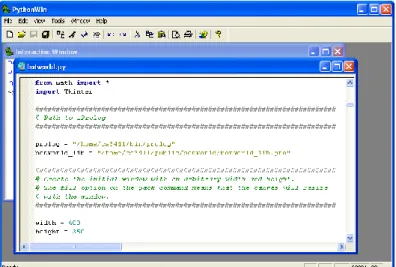
One innovation to aid software development has been the adoption of colour syntax highlighting for program code in text editors (Figures 2.2 and 2.3). This allows the different components of a program script to be displayed in a different colour depending on what category the component belongs to for instance all mathematical operators may be displayed in red, constant numerical and string values in green and language keywords in blue. The purpose of syntax highlighting is to aid the readability of code so that simple errors, such as a misspelling may be noted by the non-appearance of the expected colour and corrected before the code is compiled or run. Colour syntax highlighting is now a common feature of most program text editors, it is unclear whether colour syntax highlighting has any effect on novice programmers; anecdotal observations indicate programmers appear to make little use of the feature. Research on experienced programmers show a preference for syntax colouring with swifter identification of cognitive structures within code, although no corresponding increase in
23
productivity was found with novice programmers (Green 1989). Work by Davies (1991) indicates that syntax highlighting has an influence on the development and problem solving strategies employed by the programmer.
2.3.2
Visual programming languages
Software presents the additional challenge to learners in that code can be used to represent not only physical objects but also insubstantial concepts. There are therefore times when visual examples that may be acquired from the real world are not available and designing a suitable analogue for use on a computer can be inflexible and error prone. A number of strategies have been investigated to attempt to remedy the
Figure 2.3. The Win32 colour syntax highlighting editor for Python code
Figure 2.2. The Tkinter colour syntax highlighting editor for Python code
24
difficulties. One approach is the development of languages especially for teaching, such as LOGO or GRAIL, a more recent example of this type of system is the Alice programming environment (Cooper et al. 2003) developed by the Stage 3 Research Group at Carnegie Mellon University. Alice is a 3D interactive programming environment where students are taught the principles of programming code in terms of manipulating characters and objects in a 3D environment. The Alice system is presented as a series of windows that present different resources to the programming environment. One window depicts the 3D scene under development where objects from a library in another window may be drag-and-dropped into the scene (Figure 2.4).
The properties of any object in the scene may be viewed by selecting it and behaviours added by adding code to events that the object responds to. Instead of the learner having to write code in a script, they are shielded from the syntax details by building code from pull-down menus, edit boxes and list boxes. According to the literature Alice was designed to encourage students (typically female students who may not have been exposed to computer programming) to engage with computing by emphasising the use of programming as a method of story telling. In controlled studies involving novice programming students on their first programming course the use of Alice was credited for an average grade
25
increase from C to B and an increase in retention from 47% to 88% (Moskal et al. 2004).
However the limitation of this approach is that the learners avoid learning the features of syntax for languages likely to be encountered beyond education. Teachers have found that students who can program in Alice have trouble making the transition to traditional programming languages that use a text editor. So another approach is to design new application tools that guide the learner and couple them with new pedagogical models that specifically address issues, such as the logic of programming structures, the manipulation of different data types that arise in the programming domain.
2.3.3
Intelligent assistance
One application area related to the development of software is that of the intelligent assistant. An intelligent assistant is a software application designed to support a design activity by taking over some of a user’s more menial tasks or providing checks and verification of their activity. The nature of the assistance can be passive, only responding to the user’s requests or activity; monitoring the user’s work and carrying out operations according to set goals.
An example of a passive intelligent assistant is the Genie application (Kaiser 1990). Genie is a question and answer system that is similar to the application help facility available on desktop programs and is designed to provide expert information on the use of a development environment to new users. The information in Genie exists in a single knowledge base but the application acts intelligently in the way that the user is able to interact with it. Genie was designed to address the need to search large knowledge bases to find the appropriate information for the immediate need of the user and to present the answer at the appropriate level for the user’s ability. New users to a system may possess different levels of expertise. The system assumes novice users require precise shorter answers while expert users may require more detailed and comprehensive information. So Genie models three levels of
26
user expertise “novice”, “intermediate” or “expert” and tailors its help to be either:
a) An introduction where a command is taught that a user may not have encountered before;
b) A reminder where a brief description is given of a command that may have been forgotten;
c) A clarification to explain the details or options about commands; d) Elucidation to correct user misunderstandings that have arisen or; e) A direct execution of a command on behalf of the user.
Input questions to Genie are constructed in a natural language form from a selection of templates where the user inserts domain specific keywords into appropriate fields to form queries that are then analysed. Typical questions to Genie may be in the form of “What does command C do?” or “How do I accomplish goal G?”.
Marvel is an example of an active intelligent assistant system designed to monitor and automate many of the tasks for organising software development projects (Kaiser 1990). Marvel is similar to a Make facility but is useful for large or complex developments that may be spread across many teams or platforms and not limited to any one programming language, method of development or type of project. It uses a production system that is able to reason about and manage many of the resources in a software development project in accordance with a set of rules and information is processed based on a knowledge base, which contains a description of the project in terms of:
a) Resources: software libraries, classes and objects, the development tools and the source code and target platform;
b) Relations: among the objects, inputs and outputs, products and variations;
c) Rules: which are similar to those in expert systems with a conventional condition part but the action is expressed as a single activity with a set of post-conditions and used to model the requirements of each project.
Marvel can be made to model the stages of the software life cycle and the activities required to transform from one stage to the next.
27
Processing is carried out opportunistically using both forward and backward chaining and automatically switching between the two when necessary. When, for example, a new procedure needs to be added to a project Marvel knows which dependences need to be updated and performs the necessary operation.
2.4
Summary
For the novice, learning to program for the very first time is fraught with difficulties. To build anything more than the most trivial program skilled practitioners have acquired the skills of how to understand a problem, how it can be represented in a computer, and how to encode it in a given programming language. In addition the practitioner needs the experience to know how to analyse the resultant output of a program, how to trace faults and how to devise solutions to correct errors. In order to make any progress as a programmer, the novice has to acquire these same skills and apply them. The nature of developing software means these skills have to be developed roughly in parallel and to avoid either one undermining the capacity to make progress with the other skills. The major obstacles to understanding for the novice programmer can be summarised as “fragile knowledge”, where the learner is aware of the required information but fails to see the opportunity to use it, and “neglected strategies”, where the learner does not use techniques to gain further understanding of problem solving in the domain. It was also shown that producing errors while learning to program cannot be avoided, software applications that simply attempt to remove the chance of errors often only delay learning about parts of the language.
28
Chapter 3:
Cognitive apprenticeship
3.1
Introduction
The cognitive apprenticeship approach grew out of and is a part of the constructivist family of pedagogical techniques; it shares common attributes with methods such as Scaffolding where both require learning materials to be based on real world examples, i.e. materials that are similar to those used by expert practitioners on a subject. The cognitive apprenticeship model differs from others in providing a greater flexibility in the nature of the interaction between teacher and learner and therefore is better able to accommodate computer-supported learning environments. The cognitive apprenticeship model also accounts for a relationship between factual knowledge about the domain that may be gained from traditional textbook based sources and the requirement for heuristic knowledge that experts develop through problem solving practice. The model depends on a learner centred approach; it expects the learner to be motivated to learn the subject, to be attentive, to have access to the learning materials and to be skilled enough to be able to reproduce the desired outcomes. It specifies the need for the learner to develop monitoring, diagnostic and remedial strategies to regulate problem solving so as to be able reflect on their reasoning in a process called meta-cognition. The cognitive apprenticeship model attempts to develop the skills of the learner by allowing them to observe, enact and practice them under the guidance of the teacher with the participants taking on roles that pre-date formal traditional education. For example the way that knowledge was imparted from master craftsman to an apprentice is embedded in the social, deliberative and physical context where the learning activities were guided by interactions between teacher and learner.