JTATM Volume 1, Issue 3, Spring 2001
1
Volume 1, Issue 3, Spring 2001
“Measures” For New Product Development
Muditha M. Senanayake and Trevor J. Little
North Carolina State University
ABSTRACT
Current measures for apparel product development are presented and described. The evolvement
of the types of measurements are examined through the 1990’s. The increase in the interest and
changing emphasis in the area of product development is examined by analyzing the patent
activity from 1971 to present. Published papers on the subject of textile and apparel product
development show an increase throughout the 1990’s. New trends, technologies and business
practices are discussed in relation to the new era of product development competitiveness.
KEY WORDS: Product Development, Benchmarking, CAD, Digital Printing, Body Scanning,
Rapid Prototyping, Whole Garment Knitting, Computer Integrated Manufacturing, Internet
Commerce, Automatic Language Translation
Innovation
The development of new textile and
apparel products is rewarding and this
activity is necessary to sustain a profitable
organization. A product undergoes a product
life cycle of introduction, growth, maturity,
and finally decline (Kotler, 2000). In the
maturity or decline phase, an organization
must take an active role to expand the
apparel product line and either extend the
apparel life cycle, re-align the apparel
product to make it superior or develop a new
apparel product to maintain revenue.
If new apparel products are not
developed, sales and profits decline,
technology and markets change, or
innovation by other firms makes the original
product obsolete. The resources needed for
new apparel product development include
R&D, engineering, and test marketing. Since
all product ideas are not successfully
developed and tested, substantial funds are
spent on apparel products that never reach
the market. The successful product must not
only return its unique development cost but
contribute to the development costs of
unadopted or shelved products. The return
on investment in new apparel products will
be attractive only if risks can be minimized
and profits maximized.
An apparel firm is continually aware
of the marketing system and the
macro-apparel business environment that impact on
the organization. The firm learns to
recognize factors in the market, which
initiate new apparel products. The firm
initiates new products because of financial
goals, sales growth, competitive position,
product life cycle, regulation, material costs,
inventions, customer requests and
technology.
Growth in sales is an important goal
for many apparel corporations; in many
cases it is absolutely necessary if profits are
to be maintained. While sales growth is a
continuing force for innovation, the
emphasis has shifted to profitability as the
prime concern (Urban & Hauser, 1980).
JTATM Volume 1, Issue 3, Spring 2001
2
Product Life Cycle
As the product moves from maturity
to decline in the product life cycle, profits
fall. To regain profit, the organization
should direct effort toward rejuvenating the
life cycle or replacing the declining product
with a new, more profitable product. The
life cycle is important in apparel products
but it is also important to understand sales
patterns. If the product is about to decline,
new apparel products will be needed.
Despite the difficulties in applying the
product life cycle in all situations, the
concept is important because it directs our
attention to monitoring sales growth or
decline. New apparel inventions, like any
new product, are subjected to the high risk
of failure and should be carefully evaluated
before any major investment is made.
Other Product Development Initiators
Governments are becoming
increasingly involved in regulating apparel
business. In many cases these new
regulations cause apparel firms to consider
producing new products. The regulatory
power of government pervades competitive
practices, advertising, product safety,
labeling, labor practices, etc.
As raw material costs and
availability change, apparel products must
be revised or dropped. In a world of
increasing shortages and supply variability,
the forecasting of supply prices and the
development of new products to exploit the
structural shifts in raw material price will be
important in many organizations.
The postwar baby boom brought
about market changes, including the rapid
growth in apparel baby products, followed
by the “youth” culture, overflowing
colleges, and a very tight housing market.
As rapidly as the growth evolves, it changes
as the demographics of the U.S. population
continue to shift. Life style, fitness and mass
communication systems also generate
apparel consumption shifts. Development of
new apparel products to exploit these shifts
will ensure the success of firms.
Other sources of new apparel
product ideas are a customer request or a
mass customized demand to produce a
specific apparel product that the customer
has designed. In other industries, 80 percent
of the major innovations were the result of
customers who had a need to satisfy and
built a prototype of what they needed
(Urban and Hauser, 1980). It is common to
think of the manufacturer as the innovator
but suppliers can also be a force in
innovation.
A major factor accounting for the
‘decline phase’ of apparel products and the
shortening of life cycles is the rapid change
in technology. For firms who can be first to
successfully create apparel products based
on new technology, the rewards can be high.
A proactive apparel firm follows these
technological changes and puts them to
profitable use by matching them to the
changing market place.
Product Failure
The newly developed products can
fail due to internal and external reasons:
External
•
The failure may be due to a ‘too small
market’. A new product is developed
that attains a large market share, but
fails since the target market is not large
enough to generate sufficient sales and
profits.
•
Due to the fact that the product does not
display a ‘new or different’ feature, it
can fail. The opportunity must be
assessed in the design evaluation step to
determine if consumers perceive the
product as new and different. A product
should be both physically and
perceptually better than existing
products.
•
‘Competitive response’ is another factor
where competitors probably will copy
the successful products. The best
defense is to come up with a good
design so as to preempt the competitors
and earn its just reward.
•
“Changes in consumers’ tastes” are
perhaps the most difficult problems to
overcome in preventing a product
JTATM Volume 1, Issue 3, Spring 2001
3
failure. The dynamics of consumer
tastes requires a continued monitoring
process so that product can be
redesigned, repositioned, dropped, or
delayed.
•
‘Change in environmental constraints’
where new regulations, technology, and
material supplies can cause failure to a
new product.
Internal
•
If the product does not agree with the
company mission, it can fail. The
market opportunity must match the
company’s strategic plan before
development is begun.
•
‘Misunderstanding of consumer needs’
may be another factor for a product to
disqualify. Also poor pricing is a cause
for failure where the price/benefits
positioning is not correct
.
•
‘Little support for the channel of
distribution’ can be an internal reason
for a new product to fail.
•
Many good products fail because of the
poor organization of a firm. The main
interests in R&D and marketing may
prevent effective progress on a good
product, while conflicts between the
new products group and the sales
organization may kill a good product.
•
The issues of communication are serious
and must be explicitly addressed in
organizing for implementation of a new
apparel product development process.
Without clear responsibility, the best
designed and tested product may fail
due to poor execution of the
introduction plans.
•
‘Forecasting error’ may be another
reason for a product failure where the
leading causes can be the over
estimation of sales.
In conclusion the new product
development process must be well defined,
documented, broadly communicated, and
understood throughout the firm which will
obtain management’s support for the project.
An effective new product development
process will reduce time-to-market through
consistent execution of project team roles
and responsibilities with the involvement of
senior management at the appropriate points.
Changing Emphasis in the Area of
Product Development
The level of activity in textile and
apparel product development has been
steadily increasing. This can be observed in
terms of more styles for each company
,
global sourcing of
additional styles to
complement the existing line, and targeted
development of products for target markets.
Global sourcing has also increased the
product development activity because of the
advent of full package sourcing in addition
to those products that are manufactured or
sourced to specification.
The increase in product
development activity together with the
global manufacturing and assembly
practices, have integrated the product
development more into the mainstream
business decision structure of the firm.
Product Development Measures being
applied to today’s products cover many
aspects from the design concept to the
consumer.
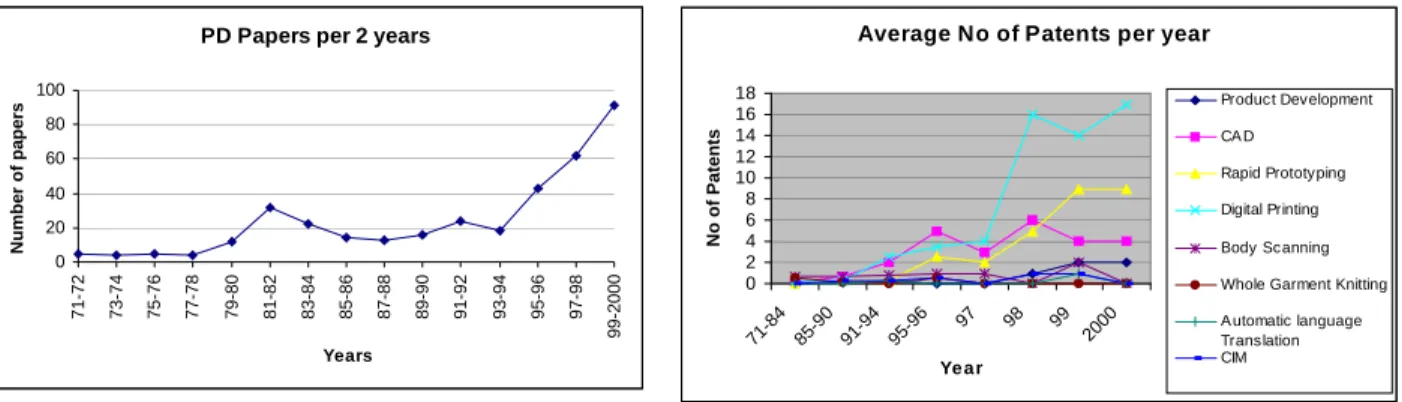
As an overall measure of the
changing importance of “product
development”, the number of published
papers in the textile literature using the
words “product development” were
determined. This was accomplished by using
the World Textile Database (2001) and its
search engine. The results of this search are
shown in Figure 1. Figure 1 shows that the
number of published papers in the 1970’s
were less than 10 every two years.
In the 1980’s, the number of papers every
two years were in the range of 13 to 32 and
this publication rate continued through
1993-94. However, after 1993-94, the
number of publications devoted to product
development has increased significantly. In
fact, the data shows a three to four fold
increase in the number of publications
related to product development.
JTATM Volume 1, Issue 3, Spring 2001
4
Furthermore, in reviewing the
number of patents issued for product
development related technologies, it can be
seen from Figure 2 that the number of
patents has increased significantly in the
1990’s. More importantly is the fact that the
number of patents issued to product-related
technologies has increased significantly over
the past four years compared with the patent
activity for the previous 25 years. Patent
issue rates for product development
activities have reached an annual average of
32 per year compared with an annual rate of
2-13 per year for the years of 1971 – 1996.
Figure 3 shows the breakdown of patents by
major product development technology.
This data clearly shows that the last five to
six years have been dominated by patents
related to rapid prototyping, computer aided
design and digital printing. It is of interest to
note that five recent patents (1998, 1999,
and 2000) have been issued for product
development and this may signify the start
of a new category of patents related to the
entire subject of product development. The
U.S. Patents (2001) and its search engine
were used to determine the results in Figures
2 and 3.
Product Development Models
The models of the new product
development process are helpful to look at
in detail the stages and activities in the
product development process. The published
product development models for apparel are
of a sequential type. Some of these models
define the process with general stages and
others use list of activities. The models
created by Burns and Bryant (1997), Regan,
Kincade and Sheldon (1998), and Sadd
(1996) describe the process as a series of
stages in a linear progression following the
form of the traditional sequential model. In
1992, Gaskill incorporated internal and
external factors to her apparel product
development model. Wicket, Gaskill and
Damhorst (1999) tested and expanded the
Gaskill’s 1992 model beyond line
presentation to include events and
considerations in post adoption product
development creating a revised retail apparel
product development model (Wicket,
Gaskill & Damhorst, 1999). May-Plumlee
and Little (1998) developed the No-Interval
Coherently Phased Product Development
Model for apparel, which is a six-phase
apparel product development model. This
model indicates the involvement of four
functional areas Marketing, Product
Development, Merchandising and
Production Planning and Control. This
model includes functional overlaps and
recycling ideas through previous
development phases for further refinement.
Major corporate decisions are shown as
fuzzy gates implying that teams involved in
the product development must collectively
PD Papers per 2 years0 20 40 60 80 100 71-72 73-74 75-76 77-78 79-80 81-82 83-84 85-86 87-88 89-90 91-92 93-94 95-96 97-98 99-2000 Years N u m b e r of pa pe rs
Figure1: Source: World Textile Database (2001)
Issue Rate of Technology Patents
0 5 10 15 20 25 30 35 71-84 85-90 91-94 95-96 97 98 99 2000 Year Averag e
Figure 2. - Source: U.S.Patents (2001)
Average No of Patents per year
0 2 4 6 8 10 12 14 16 18 71-84 85-90 91-94 95-96 97 98 99 2000 Ye a r N o of Patents Product Development CA D Rapid Prototyping Digital Printing Body Scanning Whole Garment Knitting A utomatic language Translation CIM
JTATM Volume 1, Issue 3, Spring 2001
5
decide on the next stages for a line or
category. The system constraints may vary
depending on the type of product line and
firms. Some of the examples for these
constraints are vendor reliability, raw
material availability, customer constraints
such as personal consumption expenditures,
consumer wants, marketing channel,
technology available etc. The in-depth
examination of each phase of the
development process has been explained
using six stages with detailed explanations
of each (May-Plumlee & Little, 1998).
Merchandising Calendar
The new product development
models give an overview of the major
functions involved in the process and the
detailed activities in the product
development process but do not discuss the
planning and scheduling of these activities.
The Merchandising Calendar coordinates the
activities, assigns responsibility and
establishes the required start and stop dates
for each major activity throughout the entire
production process. A part of a time-phased
multi-season merchandising calendar is
shown in the Figure 4, which comprises 40
product development activities and requires
about 35 weeks to accomplish the product
development process. This is shown as a
form of a Gantt Chart with the activities to
be accomplished in a predetermined time
frame. Each task is allotted a set amount of
time and must be completed in this time
frame. The tasks are spread out over weeks
giving targets so that the future processes
will be able to continue without being
delayed by earlier processes (Schertel, 1998;
Bertrand, 1982).
Source: AAMA (1991)
Figure 4. TIME PHASED MERCHANDISING/NPD PLAN - Multi Season
PLAN ACTIVITIES PROGRAM WEEKS
1 2 3 4 5 6 7 8 9 10 11 12 13 14 15 16 17 18 19 20 21 22 23 24 25 26 27 28 29 30 31 32 33 34 35 36 37 38 39 40 1 Establish Key Dates
2 Complete Last Season Review 3 Initiate Line Direction 4 Shop Major Retail Markets 5 Visit Major Fashion Shows/Reviews 6 Shop Fabric Sources
7 Order Proto-type yardage 8 Test Proto-type Yardage
9 Complete Retail Sell through Analysis 10 Establish Final Line Direction 11 Finalize Fabrics-Colors 12 Establish Advertising Concepts 13 Develop Initial Yardage Plan 14 Place Initial Fabric Orders 15 Place Initial Sundries Orders 16 Prepare Preliminary Fabric Samples 17 Design Submission Period 18 Product Engineering Evaluation 19 Complete Pre Costing
20 Finalize Construction/Quality Specs 21 Product Engineering Final Costing 22 Advance Breakdown to Manufacturing 23 Advertising Agency Development Review 24 Final Merchandise Development Review 25 Initial Advertising Garments 26 Complete Final Pricing 27 Complete Sales Plan 28 Complete Final Yardage Plan 29 Complete Sundries Plan 30 Establish Manufacturing Schedule 31 Establish Sales Financial Budget 32 Finalize Advertising Concepts 33 Final Management Line/Budget Review 34 Order/Complete Sample Markers 35 Order/Complete Sample Program 36 Start/Stop Graded Pattern/Marker 37 Order/Complete Sales Promotion 38 Final Advertising Meeting 39 Finalize Salesman Booking Targets 40 Sales Meeting
JTATM Volume 1, Issue 3, Spring 2001
6
Benchmarking the New Product
Development Process
Benchmarking is a formalized
approach to business improvement and is an
effective tool to facilitate improvements in
all areas of operations, including product
development. It guides the firms to focus on
areas of greatest weaknesses and allows
companies to prioritize their efforts and
improvement to be measured.
Sample Adoption Ratio
Sample Adoption Ratio is the
percentage of product development samples
that are actually adopted into a line and
indicates how efficiently the product
development process functions. Because the
cost of product development is typically
high, optimum process efficiency is
becoming increasingly important,
particularly in high style environments.
Today, management and
merchandisers are reducing the number of
samples by editing the designer's concepts
from sketches or CAD illustrations. Sample
adoption ratio in 1994 typically measured at
20% to 30% for fashion products and 40%
to 75% for basic and fashion-basic products
(Strategis, 1994). Companies that have
conducted well-focussed improvement
programs have suggested that the Hit Ratio
or the number of successful product
introductions is about 50%, and the
percentage of concepts used in the final line
as 30 percent (Sadd, 1996).
Seasons Per Year
Selling seasons are the number of
clearly differentiated (by styling, fabric
weight, or other factors) selling seasons in a
year. This provides an indication of how
often new lines are presented. The concept
of buying/selling seasons may be eliminated
as manufacturers and retailers respond to the
individual demands of each customer. The
textile manufacturing process must be
modified to support an evolutionary, quick
turn of new fabric developments.
Additionally, the retail buying structure
must transition to a longer-term dollar
commitment with the manufacturer.
Product Development Cycle Time
Product Development Cycle time is
the time between designer’s concept and
when the style is released for production. As
the number of line seasons increase, and as
the diversity of most product lines expand,
the need to shorten the time required to
develop new products becomes more
important.
Product development cycle times in
the one to three months range are achievable
for fashion garments and in the three to four
weeks range for basic garments (Strategis,
1994). This product development cycle
reduction can allow for more fashion
seasons, lower product development costs,
and significantly increased competitiveness.
To achieve this vision, the old vertical
structure where one individual or group
passed a product onto the next individual or
group must be replaced by a horizontal
structure where local or global teams
develop product in a concurrent approach.
Consumers and retail representatives may
actually become a part of the product
development team. It is not only a product
development measure but also a measure of
merchandising excellence. The companies
which focussed on improvement programs
have suggested that the cycle time for basic
styles and fashion styles (from concept to
pre production sample) is 30 to 60 days and
3 months respectively (Sadd, 1996).
Manufacturing Cycle
This is defined as the time between
receipt of an order and the time when the
order is shipped to the customer. New
approaches to manufacturing and new
technologies have significantly increased
productivity and this measurement shows
the effectiveness of the production end of an
apparel company's business.
Sell Through
Sell Through is the percentage of
product that is sold at retail at regular price.
Increasing sell through is critical to increase
profitability and competitiveness. The
marketing and merchandising present the
product line to sales and educate the sales
JTATM Volume 1, Issue 3, Spring 2001
7
force to sell the line according to the
merchandising plan. Therefore this is also a
measure of line presentation success
(AAMA, 1996). More fashion-oriented
products tend to have lower sell through,
typically in the 20-40% range and
basic-oriented products yielded a higher rate of
approximately 45-50%. If a product was
positioned by the retailer as a promotional
vehicle, or had a proliferation of stock
keeping units (SKUs), the sell through
performance could plunge to 25% or less. It
was not until e-commerce emerged that
manufacturers could easily access and
review the last season's performance with
the consumer (Strategis, 1994).
Pick and Ship Times
This is defined as the time between
the receipt of a picking ticket in the
distribution center to the time the product is
shipped. This benchmark indicates the
effectiveness of the distribution center.
Distribution center can use bar-coding
technology, automated product handling,
packing and wrapping equipment etc. to
improve the effectiveness.
Initial Forecast Accuracy
The line plans can be evaluated
according to the initial forecast accuracy.
That is, wholesale orders placed as a percent
of demand projected when a style or
merchandise group is accepted in the line.
Forecast Accuracy
This is the ratio of actual order
demand to the forecasted order demand
expressed as a percentage. As the name
implies it provides a sense of forecasting
accuracy.
Finance
If the structure of the soft goods
industry evolves as projected, the overall
financial performance of all members of the
chain will improve significantly. However,
major investments in time, technology and
systems will be required to make this
happen. To support future investments
required for improved profitability, better
profit performance is necessary in the entire
product development process.
a). GM and GMROI:
The
traditional measure of merchandising
success in the retail sector is the Gross
Margin (GM) which is the difference
between net sales and cost of goods sold. A
more sophisticated indicator of
merchandising success is the GMROI- gross
margin return on inventory; GM dollars
divided by average inventory for a specified
period. This recognizes expenses associated
with owning inventory in excess of what is
required to support sales (AAMA, 1996).
b). Return on Equity:
This is
defined as net income divided by total
equity in an organization, expressed as a
percentage. This benchmark provides an
indication of a company’s profit
performance and of how much profit is
being generated relative to how much equity
is being used to earn the profit. The keys to
a good Return on Equity are optimized
financial leverage, high sales revenues on
assets, and expense control.
c). Return on Net Assets:
The
Return on Net Assets is the operating
earnings before interest and taxes divided by
the net assets of an organization, expressed
as a percentage. Improvements in this
measure will result from optimization of
Supply Chain Management practices.
d). Investment per Sales Dollar:
This is defined as the percentage of each
sales dollar that is committed to systems
improvements. A significant boost in
systems spending will be necessary as
apparel companies move towards greater
integration. Spending will move towards
implementation of new standards, upgrading
hard and soft technologies, pre-production
systems and systems maintenance.
Order Fulfillment Efficiency
Order Fulfillment Efficiency (OFE)
is the percentage of orders that are filled
exactly as placed and defined by the
customer. It is a measure that computes
performance from receipt of a customer
order until the order is shipped as complete.
OFE depends on an organized replenishment
JTATM Volume 1, Issue 3, Spring 2001
8
system between the manufacturer and the
retailer; for example, the retailer accepts
back orders within the original cancel date
(AAMA, 1996). This measure is becoming
more critical as fulfillment requirements are
tightened by retailers.
Textile Inventories
This is the average amount of yarn
or fabric inventory in-house, expressed in
days or weeks. As with the textile order
cycle time, increasing linkages between
apparel and textile companies are driving a
decrease in “in house” textile inventory
levels.
Inventory Turns
Inventory Turns is the ratio of cost
of goods sold to the average of the
beginning and ending levels of total
inventory. In other words it is the number of
times the manufacturer uses its average raw
materials, finishes its average
work-in-process, and ships its average finished goods
inventory in a period. The measure is
usually in units but could be calculated in
dollars (AAMA, 1996). This benchmark
indicates how long a company holds an
average item of inventory before it is sold.
Too long in inventory will result in high
carrying costs. Too short in inventory can
mean loss of sales. To improve inventory
turns reductions in processing inventory
levels at all stages of production will be
necessary.
On-Time Delivery
This is defined as the percentage of
orders placed that are actually delivered to
the customer within that customer’s delivery
timetable and expectations.
Order Replenishment Cycle
Order Replenishment Cycle is the
time between receipt of a replenishment
order from a customer to the time the
replenishment product is received by the
customer. This includes the ordering
process, order administration process the
order fulfillment cycle time and the shipping
cycle time. In a retail environment, which
emphasizes replenishment capability over
maintaining high levels of inventory, the
benchmark category is critical, particularly
in commodity products.
Customer Order Processing Time
This is the time between receipt of a
customer’s order and its entry into an
organization’s systems for action.
Technology and process optimizations are
the keys to reducing this time to a minimum
Finished Goods Inventories
This is defined as the average
amount of finished product inventory
in-house, expressed in days or weeks. The level
of finished goods inventory should be
adequate to support order fulfillment
efficiency requirements.
Textile Order Cycle
The Textile Order Cycle is the time
between placement of an order for yarn or
fabric and actual receipt of the yarn or
fabric. This benchmark is an indication of
the degree of integration that has been
achieved through linkages and electronic
commerce.
SKU Planning Frequency
This measure relates to how
frequently a firm plans production as a
reaction to changes in forecast or in order
demand. The frequency can be monthly,
bi-weekly, weekly or daily (AAMA, 1996).
Time from Plan to Cut
This measure is the time from SKU
planning until cutting is completed and the
cut is ready to go in to the work-in-process
inventory. The idea of this measure is to
assure accurate replenishment of the
finished goods inventory.
Shipping Cycle Time
This measures the time from an
order being released to ship until it is
released to the carrier to be delivered to the
customer.
JTATM Volume 1, Issue 3, Spring 2001
9
Shipping Accuracy
A measure of number of units
shipped in the correct style, color and size as
a percentage of the total units shipped.
Other Measures
New measures for retail logistics,
retail inventory management, EDI and Bar
Coding have evolved. Little and Heinje
(1998) discussed 3 measures on Retail
Logistics, 6 measures on Retail Inventory
Management and 5 performance measures
on EDI and Bar Coding. Also it is of great
need to develop measures for electronic
commerce business in terms of product
development. This is to benchmark the total
apparel organization today rather than
measuring the PD process in isolation. This
is of great importance, as the new product
development activity needs communication
to all the functions in an organization.
Quantifying the extent of System
Integration
Systems integration will require
examinations of all processes not just
focused inspection of specific problems.
Systems are the key to all other competitive
improvement opportunities. Without the
synergies of integrating all processes from
design through delivery, the firm will not
have the responsiveness required to have a
sustainable business.
An effectively integrated system
will tie together the following functions:
•
Marketing
•
Forecasting
•
Merchandizing
•
Product Line Development
•
Product Design and Specifications
•
Material Requisition Planning
•
Inventory Control
•
Costing
•
Production Planning and Scheduling
•
Sourcing and Manufacturing
•
Quality Control
•
Human Resources
•
Purchasing
•
Logistics
•
Warehouse Inventory Movement
Systems
•
Finance
•
Sales
•
Field Sales Support
•
Performance Measurement
•
External Communications,
E-Commerce,
e-mail, etc.
To date the authors are not aware of any
measures to assess the level of system
integration.
Product Development Measures and
Measures for Getting the New Products to
the Customer.
It can be clearly seen from Table 1
that the number of measures involved in the
product development process has increased
over time, with the measures becoming
more stringent. This reflects the industry's
increased focus in monitoring the PD
process. The measures for getting new
products to the customer, as shown in the
Table 2, also have increased remarkably
over time (Little & Heinje, 1998). For
example, according to the Measures for
Excellence report by the Quick Response
Leadership Committee of AAMA, there
were 31 measures discussed in 1996 and
more than 40 measures discussed in 1998.
The reason for evolving more
company-wide measures can be suggested as
integrating the product development process
in to the company strategy. Some of the
other measures which have not been shown
here are performance measures related to
retail electronic data interchange (EDI) and
Bar Coding practices which were considered
later as benchmarking parameters for the
apparel industry. With the evolvement of
virtual technologies it is required to develop
more and more measures to benchmark the
product development process such as
performance of virtual samples, quality of
virtual samples etc.
JTATM Volume 1, Issue 3, Spring 2001
10
Changes Anticipated
Apparel manufacturers have
concentrated efforts to reduce manufacturers
cycle time and cost. However, the
revolutionary nature of the apparel
environment today is forcing manufacturers
to examine pre-production processes and
ways to eliminate non-value-adding
elements. The compression of the typical
calendar is underway, although many
apparel manufacturers still maintain product
development cycles with as many as 40
distinct steps requiring as long as six
months. To reduce lead times and improve
flexibility and responsiveness, more textile
and apparel firms are forming strategic
alliances. Some apparel companies are
developing internal textile capabilities or
moving operations near key supply
locations.
Benchmark companies are
achieving product development cycle times
in the range of five to six weeks. With the
number of SKUs per season typically
increasing, and with retailers demanding
shorter lead times, the margin for error in
product development must decrease.
Technology needs to be implemented with
an integrated approach to optimize the
success rate of new products.
Product Development Measures Table 1.
Best in class measures
Sample PD Cycle Manufactu- Sell Pick and Return on Return on Investment Forecast GMROI Cost Adoption Time ring Cycle Through Ship Time Equity Net Assets per Sales Accuracy Confirm
Ratio Time dollar ance
(%) (weeks) (weeks) (%) (days) (%) (%) (%) (%) (%) (%)
(AAMA, 1993) 60 3 (2 to 6 ) 20(5-50) months days (Strategis,1994)
Apparel Type
Blazers & Jackets 25 16 3 25 3 25 22 2
Bras 75 12 1.5 80 2 18 16 2 Dress Shirts 60 6 1 50 1 20 25 2 Dress Slacks 30 3 60 3 25 22 2 Dresses 35 16 3 30 3 25 22 2 Jeans 50 5 1.5 60 1 30 40 2 Ski Jackets 60 15 5 85 2 22 20 2 Socks 60 6 2 60 2.5 21 19 2.5 Suits 35 5 65 3 25 22 2 T-shirts 90 2 days 85 2 16 11 2
(Bobbin, May 1998) 30 days 1 95 85 31 120
Table 2.
Best in class measures
Order Full- Textile Inventory On time Order Customer Finished Textile Floor Auto Retail Retail
fillment Inventories Turns Delivey replenish- Order Goods Order Ready Replenishm- Logistics Inventory
Efficiency ment Cycle Processing Inventory Cycle Time Shipments nt Shipments 3 measures 5 measures
(%) (weeks) (ratio) (%) (days) Time (days) (weks) (weeks) % %
(AAMA, 1993) 85 3 to 5 3.75
(Strategis,1994) Apparel Type
Blazers & Jackets 90 6 4.2 94 3 2 8 12
Bras 95 8 7.5 95 7 2 2 10 Dress Shirts 92 2 6 92 7 0 5 4 Dress Slacks 96 6 3.5 99 3 1 7 13 Dresses 90 6 4.2 93 3 2 7 12 Jeans 96 2 6 95 1 0 4 3 Ski Jackets 92 8 3.5 94 7 1 4 10 Socks 93 1 5 98 4 2 8 2.5 Suits 95 6 3.5 99 3 1 10 13 T-shirts 95 1.5 8 95 3 0 3 1 (Bobbin, May 1998) 99 7.5 99 2 100 80
JTATM Volume 1, Issue 3, Spring 2001
11
Therefore, benchmark companies
are implementing structural and
technological improvements designed to
reduce this risk and improve customer focus.
Market research and analysis for benchmark
companies is focused, structured and
formalized. There is increasing use of
consumer panel data, focus groups and
in-store testing. Companies will move towards
a seasonless operating mode, where
merchandising and product development
will be done continuously.
Product Development Technology
Available
Improved product development
structure is enhanced by use of integrated
computer systems, where all functions can
access and use all data on a real time basis.
Increasing use of electronic commerce,
satellite and optical scanning technologies
will link internal and external functions.
These advances will allow retailers and
consumers to take a proactive role in the
product development process. Computer
aided design, retail sell-through analysis,
pattern grading, costing, style and trend
analysis, order tracking, production
scheduling, distribution logistics, and
integration of pre-production, production
and post-production processes have become
the norm.
The reader can find surveys of
product development technologies from the
following sources (Apparelkey, 2001;
Bobbin, 1999; Bobbin Buyer’s Guide, 2000;
& Techexchange, 2001).
(a). Rapid Prototyping, Body Scanning,
Digital Printing and Computer
Aided Design
Information on a detail study of
these technologies can be obtained from
“Rapid Prototyping in the Textile & Apparel
Industry: A Pilot Project “ by Istook (2000).
Figure 3 of this paper shows the evolvement
of product development technologies that
continue to drive the product development
process.
(b). Technology for Virtual Product
Development
The premiere performance of the
future will be achieved by companies using
advanced technology to radically “reduce
the need for samples”. Virtual reality
technology will illustrate all potential
designs showing the silhouette in multiple
dimensions. The fabric can be viewed at all
perspectives and, if a consumer or retailer
desires to touch the garment, a fabric swatch
can be provided.
Until virtual reality technology is
readily available, the manufacturer's product
development teams will review pictorial
depictions of basic products with customers
to
test the acceptance level of a potential
product. This will require a major paradigm
shift as most buyers today expect to touch
and see an actual garment before making
their commitment to the product. Several
uniform manufacturers today are using CAD
technology to illustrate proposed designs to
the customer and have eliminated the need
for almost all samples.
Tremendous potential has arisen
with the development of virtual reality
environments, e-commerce and Internet
business. The combination of computer
virtual technologies and database internet
techniques will provide the next generation
effects not only in industries such as film,
advertising and games but also the fashion.
It is required to adopt this technology fairly
soon in the fashion industry as textile and
fashion products have a short market life
and their success is dependent upon fashion
styles and price. The fashion, textiles and
apparel industries are moving towards
global retailing or remote shopping with the
concept of enabling customers to purchase
garments by conducting “virtual try-on”
using their own body size and shape. At this
stage, the virtual human modeling concept
has become very important and research is
underway to develop 3D systems for online
3D human measurement and reconstruction
for virtual try-on for global retailing. The
idea is to capture and analyze 3D body
profiles using an online image measurement
JTATM Volume 1, Issue 3, Spring 2001
12
and processing system and store them in a
SQL server database which can be
interfaced with global retailing (Stylios,
Han, & Wan, 2001; My Virtual Model,
2001; Browzwear, 2001)
(c). Whole Garment Knits:
The new knitting equipment has
highly advanced design software, which
allows patterns to be downloaded to the
knitting machine directly, and knitting the
whole garment thereby virtually eliminating
set-up time. As companies are linked
through computer networks between
designers, purchasers, manufacturers,
suppliers and off-shore agents, they share
common databases of information that are
progressively built throughout the process,
updated on a daily basis, and accessed at any
time (Shima Seiki, 2001).
(d). Web based information transfer
technology
The environments in which textile
and apparel companies are operating today
are becoming increasingly dynamic, diverse,
complex and hostile. In this environment the
need for relevant, timely, accurate and cost
effective information is paramount.
Companies today are linking computer
networks between designers, purchasers,
manufacturers, suppliers and offshore
agents. All parties share a common database
of information that is progressively built
throughout the process, updated on a daily
basis, and accessed at any time by all.
Companies who provide this facility provide
a secure transmission and communication of
all product specifications in terms of files.
The system provides a facility to build work
groups so that the communication is more
productive between established groups.
The most significant change is in the
way retailers, apparel companies and textile
suppliers share information. The textile
supplier needs to know as early as possible
what future requirements may be, so as to
replenish the products that are selling.
Fabric ordering must be timely, and equally
importantly, it must be accurate. With
effective linkages, reductions in textile
ordering cycle times can be achieved. This
reduces the need for textile inventories and
provides improved manufacturing
responsiveness.
The entire manufacturing process
can be done via a home through personal
computers and cyberspace. Engineering will
become web centric, where designs will be
developed, reviewed, and approved
electronically (Ai SpecNet, 2000; FitNet,
2000; Internet Commerce Committee, 2001
& WebPDM, 2001).
The evolution of the Internet has
provided the means for sharing
technical/product information among the
personnel involved in the business. With a
universal, low-cost, high-performance
network it has transformed how companies
conduct every aspect of their businesses. In
order to stay in the pace with this
e-commerce environment the product
development function has developed rapidly
in the recent past. From marketing through
the World Wide Web to transforming
purchase orders into customer products it is
no doubt that this is an important
requirement.
(e). Automatic Language Translation
Language translation is necessary
for businesses to be successful in local
markets around the world but translation is
expensive and can cause significant delays
in getting products to markets. Many of the
documents that are translated by businesses
today are highly repetitive in nature, or are
the result of a modification or update to an
existing document. Therefore a significant
part of the translation effort involves
translating, again and again, the same text
often with minor and subtle variations.
Companies with large document translation
needs, often find that managing the
translation process is as difficult as actually
doing the translation itself. As a company's
translation requirements increase, quality
and time to
market become increasingly
important. Companies are available today,
which provides translation management
software and consulting services. Several
companies are developing languages based
JTATM Volume 1, Issue 3, Spring 2001
13
on symbols to communicate the
specifications for new and existing products
(World of Sewing, 2001; Language Partners,
2001).
Summary
The Product Development function
in the textile and apparel industry appears to
be gaining activity as we examine the
measures of recent progress represented in
Patents and Papers. The increasing number
of product development measures and
technology improvements will lead to new
competitive practices in product
development. A new challenge will be to
develop appropriate measures to identify the
extent of system integration and how to
measure the effectiveness of the virtual
product development methodologies being
used to create new products.
References
AAMA. (1996). Measurements for
excellence. (Quick Response Leadership
Committee). Arlington, Virginia: Author
AAMA. (1993). The changing apparel plant.
(Technical Advisory Committee). Arlington,
Virginia: Author
AAMA. (1991). The impact of technology
on apparel: Part one. (Technical Advisory
Committee). Arlington, Virginia: Author
A dictionary for ready-made clothing:
Project “Confexicon” (2001) World of
Sewing, No.1 02/2001, 28
Ai Spec Net (2000):
http://www.aispecnetr2.com.
Apparel Key (2001):
http://www.apparelkey.com.
Bertrand, F. (1982) Profitable
Merchandising of Apparel. National
Knitwear and Sportswear Association, New
York
.
Sewn Product Industry Software Guide
(1999, July) Bobbin, Vol. 40 (11).
Bobbin Buyer’s Guide (2000):
http://www.bobbin.com.
Browzwear (2001):
http://www.browzwear.com
Burns, L.D. & Bryant, N.O. (1997) The
Business of Fashion, Designing
Manufacturing and Marketing, Fairchild
Publications, New York: New York.
FitNet (2000):
http://www.lectra.com
Gaskill,L.(1992) Toward a model of retail
product development: A case study analysis.
Clothing and Textile Research Journal,
Vol.10 (4), 17-24.
Internet Commerce Committee (2001):
http://www.vics.org/commit.htm
Istook, C.L. (2000, September) Rapid
prototyping in the textile & apparel industry:
A pilot project, Journal of Textile and
Apparel, Technology and Management,
Vol.1 (1).
Kotler, P. (2000) Marketing Management,
Chapter 10, Prentice Hall, Upper Saddle
River, New Jersey, pp. 303-316.
Language Partners (2001):
http://www.languagepartners.com.
Little, T.J.& Heinje, R.K. (1998, May) Does
your quick response program measure up?
Bobbin, Vol.39 (9), 42-47.
May-Plumlee, T. & Little, T.J. (1998)
No-interval coherently phased product
development model, International Journal of
Clothing Science and Technology, Vol.10
(5), 342-364.
My Virtual model (2001):
http://www.mvm.com
Regan, C., Kincade, D. & Sheldon, G.(1998)
Applicability of the engineering design
JTATM Volume 1, Issue 3, Spring 2001