BUSINESS CASE MODELING
REPORT AND GUIDELINES FOR
FURTHER DEVELOPMENT
Project: Tackling the ''Digital Divide'' in SEE by using the capacity of DTT
networks
Acronym: SEE TV-WEB
Version A-1.0; Date: 28.11.2014
Document name / version:
DOCUMENT HISTORY
Version Status Date Author Comments Approved by
A-1.0 Approved
version 28.11.2014
IITR, OPENLAB, UL, PTA, INTK, ETF-SA, AEM
Approved version PM, PTM
CONTENT
Index
1 Introduction ... 4
1.1 Aim of WP6 / Activity 3: Business case modelling & guidelines ... 4
1.2 What is Business Modelling ... 4
1.3 The Business Model Canvas ... 6
1.3.1 The 9 Building Blocks ... 6
1.3.2 Procedure of filling the Business Model Canvas ... 9
2 Business Model Workshops ... 10
2.1 Stakeholder analysis and deriving of requirements ... 10
2.2 Function analysis ... 15
2.3 Business model canvas ... 19
3 Concept for Business Model for TV WEB ... 22
3.1 Basic costs for infrastructure ... 23
3.2 Parameters for creating business case scenarios ... 23
3.3 Overview of likely Business cases ... 24
3.4 Business Case “Social WEB TV” ... 25
3.5 Business Case “NewsTV” ... 26
3.6 Business Case “VideoTV” ... 27
3.7 Business Case “InstitutionTV” ... 28
3.8 Business Case “FreemiumTV” ... 29
4 Guideline for further development ... 30
4.1 Technical feasibility: ... 30
Document name / version:
FIGURES
Figure 1: Emerging of the term Business Model in Articles ... 5
Figure 2: 9 building blocks of the business model canvas ... 6
Figure 3: The Business Model Canvas ... 8
Figure 4: stakeholder analysis ... 11
Figure 5: customer segments ... 13
Figure 6: value propositions ... 14
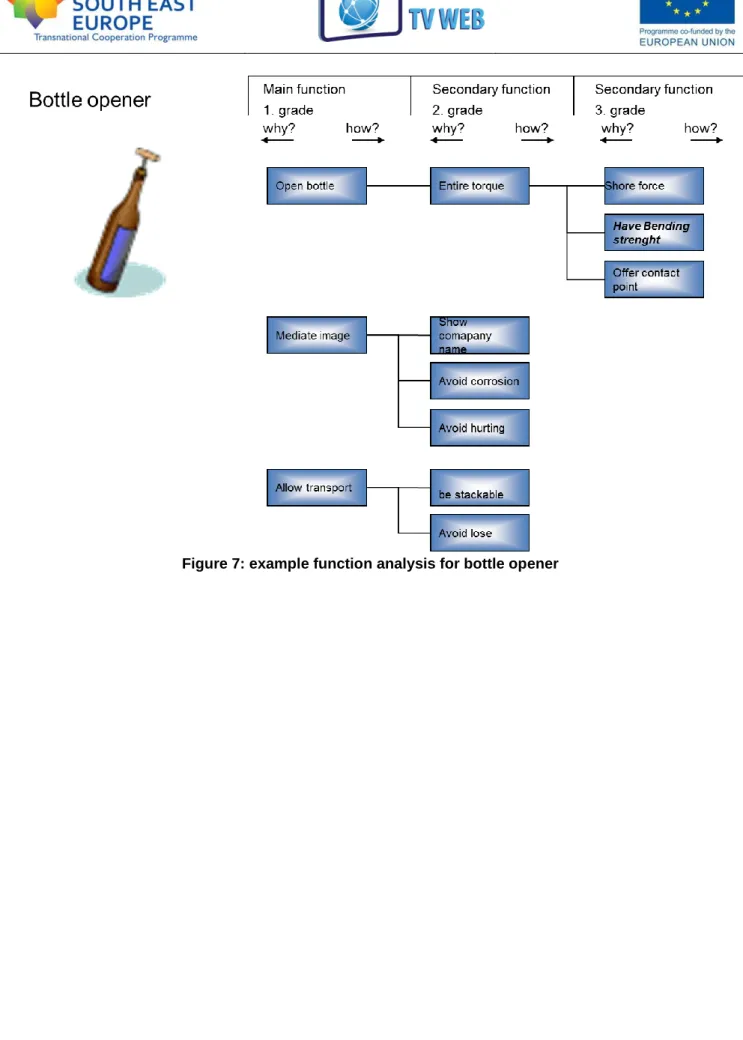
Figure 7: example function analysis for bottle opener ... 16
Figure 8: technical setup for WEB TV ... 17
Figure 9: function tree for WEB TV ... 19
Figure 10: business model canvas for WEB TV... 21
Figure 11: first business cases ... 22
Figure 12: Overview of likely Business cases ... 24
Figure 13: village of Labinje near Cerkno ... 25
Figure 14: the international news broadcaster Al Jazeera Balkans (AJB) ... 26
Figure 15: Video on demand: Game of Thrones ... 27
Figure 16: The elderly home “Föhrenhof St. Johann in der Haide” ... 28
Figure 17: education via TV set ... 29
List of acronyms
SEE South East Europe
PP Project Partner
Document name / version:
1 Introduction
1.1 Aim of WP6 / Activity 3: Business case modelling & guidelines
On the basis of activities under WP6 A1 and A2 potential business case modelling were executed The business model addresses the target audience consisting of industry, national authorities and other stakeholders, which will have to enable and foster development of new services. It touches upon their needs and concerns such as need for and/or opportunity of the proposal; alignment with general policy, objectives and strategy; priority in the allocation of limited resources; effectiveness and efficiency; level and quality of service provided; community benefits etc.
Furthermore, the model addresses most of the prerequisites to be ensured as well as main impediments for new solution, content or service introduction. The business case model includes the very essential element for further development of the project initiative - guidelines for its implementation.
Special attention was paid to identifying the range and structure of the most vulnerable groups (elderly, low-income households, households with members who are persons with disability ...) and variety of available funding schemes.
IPA-I partners contributed to the elaboration of guidelines by providing a feedback with a clear goal to address challenges faced by particular partner country related to the size and level of development of the AVMS market and its role in narrowing the digital divide after the digital switchover. The business case model and the guidelines are delivered to relevant stakeholders in each country for analysis and national implementation. This task was executed in all participating IPA countries in a following way:
- Present them on the conference
- Present summary and findings in newsletter send to relevant stakeholders - promoting them through communication events and tools.
1.2 What is Business Modelling
A business model describes the rationale of how an organization creates, delivers, and captures value, in economic, social, cultural or other contexts. The process of business model construction is part of business strategy. In theory and practice, the term business model is used for a broad range of informal and formal descriptions to represent core aspects of a business, including purpose, target customers, offerings, strategies, infrastructure, organizational structures, trading practices, and operational processes and policies. The literature has provided very diverse interpretations and definitions of a business model. A systematic review and analysis of manager responses to a survey defines business models as the design of organizational structures to enact a commercial opportunity. Further extensions to this design logic emphasize the use of
Document name / version:
narrative or coherence in business model descriptions as mechanisms by which entrepreneurs create extraordinarily successful growth firms.1
Business models are used to describe and classify businesses, especially in an entrepreneurial setting, but they are also used by managers inside companies to explore possibilities for future development. Well-known business models can operate as "recipes" for creative managers. Business models are also referred to in some instances within the context of accounting for purposes of public reporting.
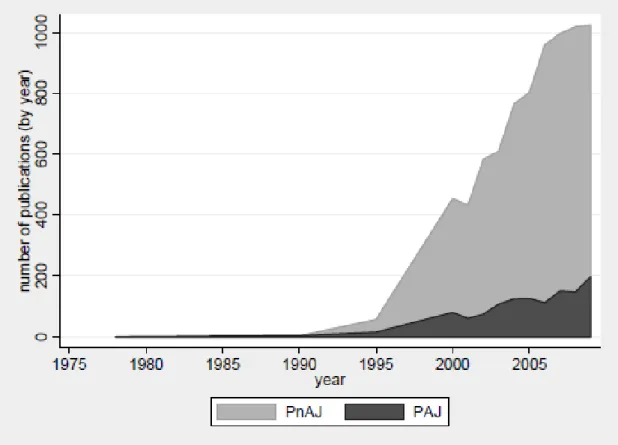
In Figure 1 the usage of the term Business Model is shown. As can be seen since the beginning of the 90s of the last century this term is constantly increasing in usage in articles worldwide. For the EU Project SEE TV WEB it is an essential question how to generate a working business model upon the outcomes of the project.
Figure 1: Emerging of the term Business Model in Articles
1
Document name / version:
1.3 The Business Model Canvas
The Business Model Canvas, is a strategic management and entrepreneurial tool. It allows you to describe, design, challenge, invent, and pivot your business model.2
1.3.1 The 9 Building Blocks
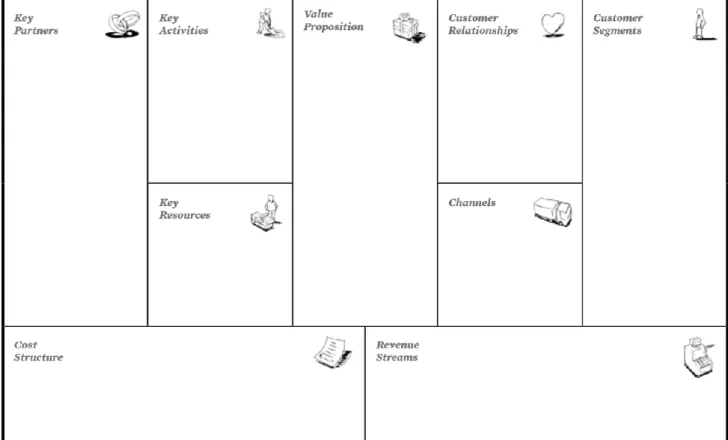
The 9 building blocks are established to give an overview of the areas that have to be defined in order to elaborate a business model. The blocks are shown in Figure 2.
Figure 2: 9 building blocks of the business model canvas3
The detailed meanings of the blocks are: 4 2 See http://www.businessmodelgeneration.com/canvas 3 http://businessmodelgeneration.com/downloads/businessmodelgeneration_preview.pdf, Inquiry 13.05.2014
Document name / version:
The Customer segments includes if:
o Their needs require and justify a distinct offer
o They are reached through different Distribution Channels o They require different types of relationships
o They have substantially different profitabilities
o They are willing to pay for different aspects of the offer The value propositions are
o What value do we deliver to the customer?
o Which one of our customer’s problems are we helping to solve? Which customer needs are we satisfying?
o What bundles of products and services are we offering to each Customer Segment?
Channels serve several functions, including:
o Raising awareness among customers about a company’s o products and services
o Helping customers evaluate a company’s Value Proposition o Allowing customers to purchase specific products and services o Delivering a Value Proposition to customers
o Providing post-purchase customer support Customer Relationships aim for:
o What type of relationship does each of our Customer Segments expect us to establish and maintain with them?
o Which ones have we established? How costly are they? o How are they integrated with the rest of our business model? Revenue Streams:
o For what value are our customers really willing to pay? o For what do they currently pay? How are they currently
o paying? How would they prefer to pay? How much does each Revenue Stream contribute to overall revenues?
Key Resources
o What Key Resources do our Value Propositions require? o Our Distribution Channels? Customer Relationships? o Revenue Streams? Key Activities: 4 http://businessmodelgeneration.com/downloads/businessmodelgeneration_preview.pdf, Inquiry 13.05.2014
Document name / version:
o What Key Activities do our Value Propositions require? o Our Distribution Channels? Customer Relationships? o Revenue streams?
Key Partnerships:
o Who are our Key Partners? Who are our key suppliers? o Which Key Resources are we acquiring from partners? o Which Key Activities do partners perform?
Cost Structure
o What are the most important costs inherent in our business o model? Which Key Resources are most expensive? o Which Key Activities are most expensive?
The nine business model Building Blocks form the basis for the Business Model Canvas.
Figure 3: The Business Model Canvas
In Figure 3 the Business Model Canvas is shown. All 9 9 Building Blocks are aligned on one painter’s Canvas.
Document name / version:
1.3.2 Procedure of filling the Business Model Canvas
First of all the customer segments are to be defined. Usually one starts with the question – who are my stakeholders? By identifying the stakeholders, the link to the customers is easily established.
The next step is to define the value propositions. In this block the benefits for the customers are described – it is important just to have the customers’ views and not the view of the own company.
After this, the customer relationship is set up. Here the question is how we want to react with the customer. Is the customer just anonymous to us and to we have not direct connect to each customer? Or do we set up our services as customized as possible?
Next step is to figure out the channels through which the customer becomes aware of our company. How does he get to know us? How do we deliver our services to him?
After these blocks it is time to define the inner key activities of the company. The questions to be answers are how can we deliver the value propositions to the customer? What are our key processes? And how can we generate a revenue stream?
In order to get the key resources done, the next question is what has to be on board of our company to manage the key activities. Here it is a question of persons, infrastructure, know how and many more positions.
The next block is the defining of key partners. In order to deliver our services, which partners are most necessary for our value chain? Here we define partners where we can have partnerships with or where we have a deep cooperation.
Looking at costs the next block is to define the cost structure. Here the most important costs are summed up.
Last but not least the revenue streams are defined. This is the reason for most business models to create profit and make the company vital. Here the different kinds of generating income for the company are derived.
We shall describe somewhere the pre-assumptions for a TV-WEB service business model which considerably determine the model; e.g.:
- The service is non-commercial (OP1) - The service is commercial (OP2)
- Driven by the interest of the government to reduce Digital Divide in the country / region / target population or improve ICT service availability - …
Document name / version:
2 Business Model Workshops
For the project SEE TV-WEB several business model workshops were done to go through the process of setting up the business model canvas.
In rough, the action points of getting to the concept for Business Model for TV WEB were as followed:
Stakeholder analysis and deriving of requirements Function analysis
Business model canvas
The key results out of these activities are described below.
2.1 Stakeholder analysis and deriving of requirements
The first step to create a future business opportunity is to get to know the stakeholders and their needs and wants. After doing the pilot projects in several countries of the project SEE TV-WEB a good understanding of the stakeholders is established.
Document name / version:
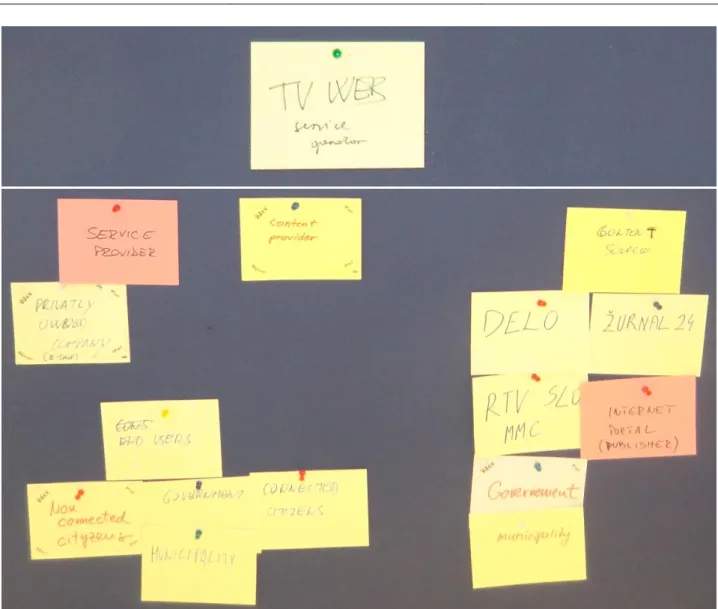
Figure 4: stakeholder analysis
Figure 4 the stakeholders of the business model of WEB TV are shown. Furthermore, national regulatory authorities and ministries can be added. There are three categories:
1. The provider of technical infrastructure and services to enable WEB TV 2. The service and content providers and sources
3. The consumers of the services of WEB TV
For the first group there can be mentioned MUX operator, DTT network operators (DVB-C operator, DVB-T operator, DVB-S operator)
The second group contains stakeholder like service providers (privately owned companies) and content sources (DELO, journal 24, RTV SLO MMC, Internet portals, government, municipality,…)
Document name / version:
The third group are the end users and customers (not connected citizens, government, municipality connected citizens,…)
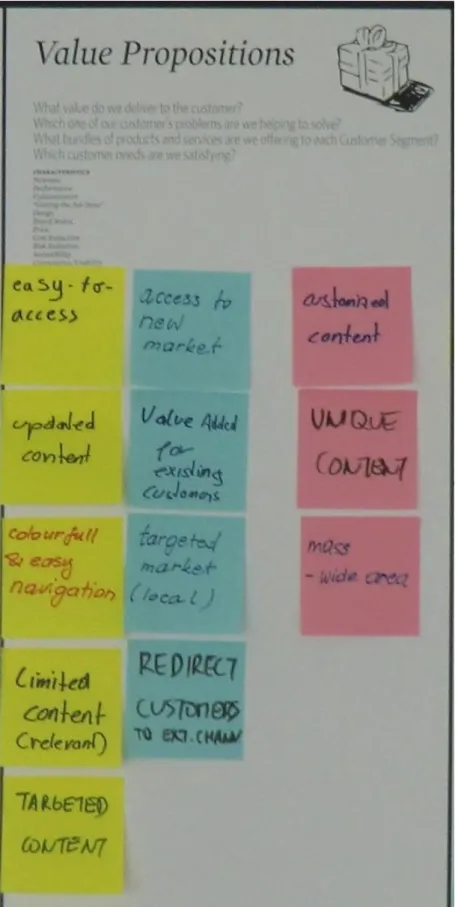
As seen in Figure 5 - focussing on the customer segments there can be three groups subdivided: Single endusers (yellow)
Companies and institutions that deliver content and services (blue) Institutions that need content for their customers (pink)
Document name / version:
Figure 5: customer segments
Document name / version:
Document name / version:
For the single endusers (yellow) the criteria are like easy –to access, each day updated content, colourful & easy navigation, only limited content and therefor targeted content. This can also be emphasized by the results of the pilot projects which had positives criteria like:
Simple, intuitive and easy to use Similar to daily newspapers
Great to use during commercial breaks on TV Good, if there are many local news articles
For reading news together, it is better than a newspaper, because of the big TV screen For the companies and institutions that deliver content and services (blue) the highlights are access to the market, value added for existing customers, targeted local market, redirect customer to external channel.
The institutions that need content for their customers (pink) require customized content, unique content but also reaching a wide area of endusers.
2.2 Function analysis
After doing the stakeholder analysis the next step was to perform a function analysis. The function analysis intends to figure out the main functions of a service or product and then to develop the secondary functions accordingly.
Document name / version:
Document name / version:
In order to do a function analysis the technical setup was drawn to create a common understanding:
TV Figure 8: technical setup for WEB TV
Document name / version:
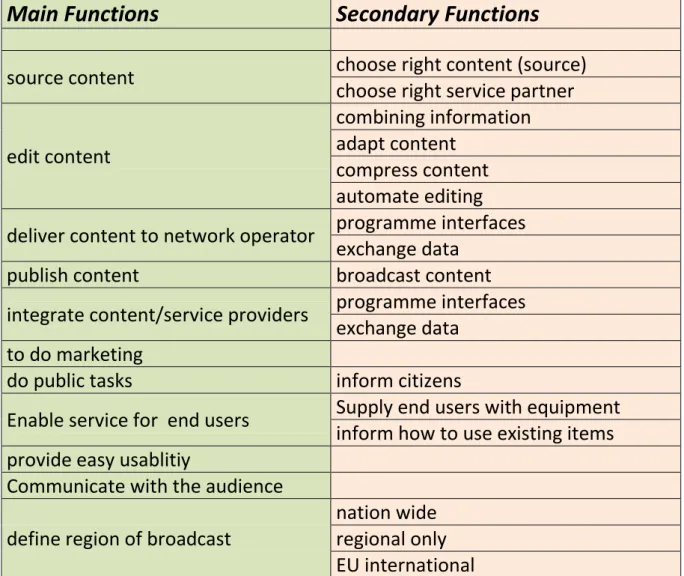
Doing a function analysis for the WEB TV he following function tree was generated:
Main Functions
Secondary Functions
source content
choose right content (source)
choose right service partner
edit content
combining information
adapt content
compress content
automate editing
deliver content to network operator
programme interfaces
exchange data
publish content
broadcast content
integrate content/service providers
programme interfaces
exchange data
to do marketing
do public tasks
inform citizens
Enable service for end users
Supply end users with equipment
inform how to use existing items
provide easy usablitiy
Communicate with the audience
define region of broadcast
nation wide
regional only
EU international
Figure 9: function tree for WEB TV
2.3 Business model canvas
Using the results of the stakeholder analysis and the function analysis the business model canvas was established. The result is shown in Figure 10.
Document name / version:
Document name / version:
3 Concept for Business Model for TV WEB
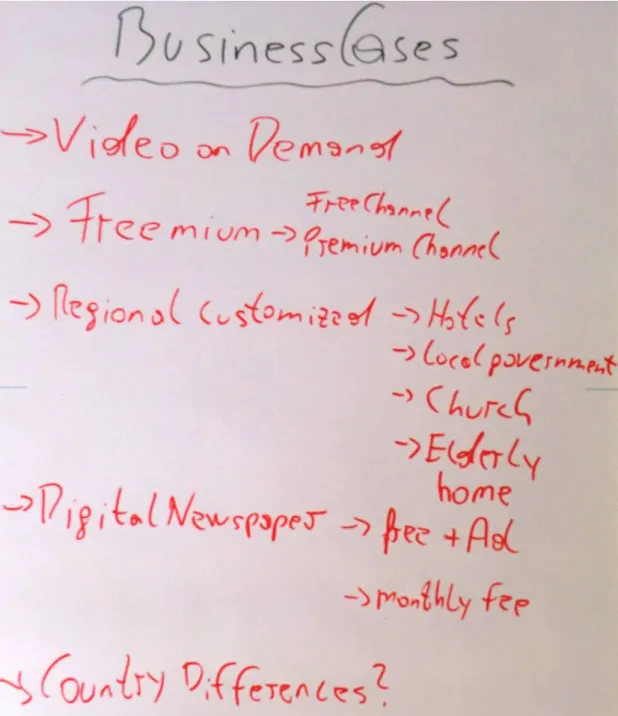
Based on the work of doing the stakeholder analysis, the function analysis and the business model canvas, scenarios respectively business cases were derived. Figure 11 shows a brainstorming for business cases.
Document name / version:
3.1 Basic costs for infrastructure
Upon a likely set up of infrastructure, staff and network needed the costs for running the TV WEB service can be calculated as beneath:
Infrastructure Costs
User part
Installation ST Box 50 - 100€/ TV set
HbbTV TV set differs
Provider part
CMS CAE (content adaptation Engine) 15.000€
The user will need an infrastructure that consists of a ST Box and the self-installation and a HbbTV set.
staff costs
2 persons / 1 full time equivalent 3000€*/ months total costs
In order to guarantee the editorial work to be done, two persons employed as one full time equivalent are needed. They do the daily update of the content, they do editorial work on the content of the content sources and they are responsible for marketing and troubleshooting.
network costs
band with 1 Mbit/sec 12.000€*/month
storage 700 Megabytes 60€
refresh time for total storage 93 min.
As a consequence to be able to broadcast content, a certain band with (here 1 Mbit/sec) and a storage for the daily content is necessary. Of course, the price varies from country to country but there might be even potential to cheaper costs because of good financial agreements.
*Reference of Slovenia
3.2 Parameters for creating business case scenarios
In order to create future business cases, trend researchers and business modelers are used to create scenarios. In these scenarios different relevant parameters which influence the business case scenario strongly are identified. Then the business case parameters are partly changed in order to come to future scenarios. Upon the setup of parameters stories for the business cases are created.
Document name / version:
Parameters with strong influence on the business cases are as followed: Region parameter:
o Less developed regional parts o Nationwide
Payment parameter: o Monthly payment o Non payment
o Setter box is for free Payment through setter boxes Paying Customer parameter
o Elderly homes (pensions, hotels,…) o Single users
o Government Marketing parameter
o Elderly homes resellers o Elderly homes promoters o Government
o Others do marketing Content parameters
o Content source is free o Content source is not free Capacity available
o Available capacity for television multiplex
o Government establishes new regulations for new spare capacity for TV Web Services
3.3 Overview of likely Business cases
This overview provides five likely business scenarios, how the TV WEB prototypes and results can be brought to market.
Name Region Payment Paying
Customer
Marketing Content Capacity Social WEB
TV
regional none government regional free New spare
NewsTV nationwide monthly Single user operator Not free multiplex VideoTV nationwide on
demand
Single user operator Not free multiplex InstitutionTV regional monthly institution E. homes Not free multiplex FreemiumTV nationwide None plus
monthly
Government, Single users
Government, operator
free New spare & multiplex Figure 12: Overview of likely Business cases
Document name / version:
3.4
Business Case “Social WEB TV”
The parameters for this business case scenario are:
Name Region Payment Paying
Customer
Marketing Content Capacity Social WEB
TV
regional none government regional free New spare
The Business Case “Social WEB TV” is the initial idea of the project TV WEB. In a world where every person has a home computer, notebook or mobile device with broadband connection to the internet, the TV WEB prototypes and results would be rarely necessary.
However, nowadays the digital divide still exists and for a certain period of many more years this situation will not improve rapidly. Therefore, it is an social issue of countries governments to reduce the digital divide.
So the government is the paying customer for the TV WEB services. Its intention is to help the rural poor or not connected regions to get parts of the internet content on TV sets.
Marco is an older man in the village of Labinje near Cerkno. He is middle educated, open minded and eager to be well informed.
Document name / version:
Every day he uses the TV WEB services to get the latest news about the region. He uses these news to discuss in his rounds with his friends. Often it happens that his friends don’t believe him what he tells them, then he turns on the TV set and shows them the proof with the TV WEB service.
Of course the content on TV WEB is not comparable to an encyclopedia because it is free content, but newspapers local TV stations are willing to give the content for free because on the one hand it is not the latest news or on the other hand they are allowed to do some product placement within the content.
The operating team of TV WEB is paid by government because the politicians like to reduce the digital divide and because they have an additional channel to reach voters through this channel.
3.5 Business Case “NewsTV”
The parameters for this business case scenario are:
Name Region Payment Paying
Customer
Marketing Content Capacity NewsTV nationwide monthly Single user operator Not free multiplex Al Jazeera Balkans (AJB) is a 24-hour international news television station broadcasting in Bosnian, Croatian, Serbian and English. The headquarters is located in Sarajevo, Bosnia and Herzegovina.
Figure 14: the international news broadcaster Al Jazeera Balkans (AJB)
They have figured out that only a small number of digital educated persons in Bosnia are really using their service in internet. A larger number of potential users is not even connected to the internet.
That is why Al Jazeera Balkans (AJB) has decided to broadcast content over the service TV WEB. The operating team is paid by the broadcasters and the content is sent nationwide. A certain capacity is reserved at TV multiplex.
The content is updated once to two times a day and is because of the actuality not free. So the broadcasting station is paying for the content source.
The end customers of the services of TV WEB content are single users or households. They pay monthly a certain fee which is quite a lot below the fees for newspapers delivered to the house. The customers like the picture and text combination and that they can store content on their ST box.
Document name / version:
3.6 Business Case “VideoTV”
The parameters for this business case scenario are:
Name Region Payment Paying
Customer
Marketing Content Capacity VideoTV nationwide on
demand
Single user operator Not free multiplex
Anna is a young teenager that likes to watch series of here favorite TV series game of thrones. Every day the TV WEB services broadcasts a new series to here ST box. She pays for this service as a single user. On holidays she even takes here ST box to her grandparents’ house where she installs the ST box. She can watch here TV series there too because the TV WEB service is nationwide.
Figure 15: Video on demand: Game of Thrones
The broadcast is hosted by SKY europe that provides the VideoTV service in different countries in Europe.
Document name / version:
3.7 Business Case “InstitutionTV”
The parameters for this business case scenario are:
Name Region Payment Paying
Customer
Marketing Content Capacity InstitutionTV regional monthly institution E. homes Not free multiplex The elderly home “Föhrenhof St. Johann in der Haide” is customer of the service TV Web. Johanna is a 70 years old lady who lives at the elderly home. Every day she gets up in the morning and takes breakfast. She likes talking to the other persons around and is not intending to read a newspaper alone.
Nevertheless, she likes to be informed about the latest news. Although she doesn’t like global news because she focusses more on regional news and further categories like weather, health, society and so on.
So after breakfast she goes to the television set in the social room and reads through the TV WEB pages on the TV set. She likes very much the combination of pictures and text. Especially the function of enlarging the text font is highly welcome because she sometimes forgets her glasses at the room.
The elderly home pays monthly for the TV WEB service and provides the TV WEB content on all TV sets of the elderly home.
Other elderly homes and the relatives of the inhabitants of the elderly home get informed by mouth to mouth marketing of this very nice service of TV WEB and also plan to receive this service.
Document name / version:
3.8
Business Case “FreemiumTV”
The parameters for this business case scenario are:
Name Region Payment Paying
Customer
Marketing Content Capacity FreemiumTV nationwide None plus
monthly
Government, Single users
Government, operator
free New spare & multiplex The FreemiumTV is a special services supported by the government. Its intention is to reduce the digital divide and to let people participate in the digital world.
The government pays the basic staff and broadcast costs for the nationwide free service. Therefore it creates a new spare capacity for broadcasting and charges no fee. Topics are set to be of nationwide interest such as political news, weather, style and socials, sports and health. The government likes to keep people informed to a good level.
Thomas is 35 years old and he does not subscribe to the service for a newspaper because he gets most of needed information through the service of TV WEB.
He is even more eager to get special services like the cooking channel in order to improve his cooking skills. Every day he gets a new recipe and he stores the ones he is interested in in order to try them out on weekends.
Document name / version:
Another channel he has subscribed to is his e-learning course for general management. Every day for 6 months he gets a new management approach visualized. He stores the content on his ST box and can repeat the lessons whenever he wants. His aim is to prepare for a bachelor degree in general management.
4 Guideline for further development
In this chapter future working items and guidelines for further development are introduced. There are two main areas of future development:
Technical feasibility Economic feasibility
4.1 Technical feasibility:
From a technical perspective the basic functions of the prototype of TV WEB is working well. The next step is to launch a model business application, where the broadcast institutions of several countries participate in a follow up initiative.
The next technical issues are to establish running broadcasting services of TV WEB in several countries in Europe. This enables the project members to collect experience in broadcasting in real life and to gain competence as professional broadcasters of a TV WEB content system. Another technical point is how to setup the delivery service of ST Boxes and how to ensure the correct installation in households.
4.2 Economic feasibility
From an economic perspective, the TV WEB service needs greater and longer test try out in order to proof the business case. This can be done in further EU projects that support the initial set up of TV WEB broadcast stations and offices. A try out over a longer period can build up a TV WEB community that becomes stable customers, therefore the concept of model regions of EU funding projects can help to establish the initial infrastructure and services needed.