Conjunctive Query Answering for the Description Logic
SHIQ
Birte Glimm [email protected]
Ian Horrocks [email protected]
Oxford University Computing Laboratory, UK
Carsten Lutz [email protected]
Dresden University of Technology, Germany
Ulrike Sattler [email protected]
The University of Manchester, UK
Abstract
Conjunctive queries play an important role as an expressive query language for Descrip-tion Logics (DLs). Although modern DLs usually provide for transitive roles, conjunctive query answering over DL knowledge bases is only poorly understood if transitive roles are admitted in the query. In this paper, we consider unions of conjunctive queries over knowl-edge bases formulated in the prominent DL SHIQ and allow transitive roles in both the query and the knowledge base. We show decidability of query answering in this setting and establish two tight complexity bounds: regarding combined complexity, we prove that there is a deterministic algorithm for query answering that needs time single exponential in the size of the KB and double exponential in the size of the query, which is optimal. Regarding data complexity, we prove containment in co-NP.
1. Introduction
Description Logics (DLs) are a family of logic based knowledge representation formalisms (Baader, Calvanese, McGuinness, Nardi, & Patel-Schneider, 2003). Most DLs are fragments of First-Order Logic restricted to unary and binary predicates, which are called concepts and roles in DLs. The constructors for building complex expressions are usually chosen such that the key inference problems, such as concept satisfiability, are decidable and preferably of low computational complexity. A DL knowledge base (KB) consists of a TBox, which contains intensional knowledge such as concept definitions and general background knowledge, and an ABox, which contains extensional knowledge and is used to describe individuals. Using a database metaphor, the TBox corresponds to the schema, and the ABox corresponds to the data. In contrast to databases, however, DL knowledge bases adopt an open world semantics, i.e., they represent information about the domain in an incomplete way.
Standard DL reasoning services include testing concepts for satisfiability and retrieving certain instances of a given concept. The latter retrieves, for a knowledge base consisting of an ABoxAand a TBoxT, all (ABox) individuals that are instances of the given (possibly complex) concept expressionC, i.e., all those individualsasuch that T andAentail thata is an instance ofC. The underlying reasoning problems are well-understood, and it is known that the combined complexity of these reasoning problems, i.e., the complexity measured in the size of the TBox, the ABox, and the query, is ExpTime-complete for SHIQ(Tobies,
2001). The data complexity of a reasoning problem is measured in the size of the ABox only. Whenever the TBox and the query are small compared to the ABox, as is often the case in practice, the data complexity gives a more useful performance estimate. ForSHIQ, instance retrieval is known to be data complete for co-NP (Hustadt, Motik, & Sattler, 2005).
Despite the high worst case complexity of the standard reasoning problems for very expressive DLs such as SHIQ, there are highly optimized implementations available, e.g., FaCT++ (Tsarkov & Horrocks, 2006), KAON21, Pellet (Sirin, Parsia, Cuenca Grau,
Kalyan-pur, & Katz, 2006), and RacerPro2. These systems are used in a wide range of applications, e.g., configuration (McGuinness & Wright, 1998), bio informatics (Wolstencroft, Brass, Horrocks, Lord, Sattler, Turi, & Stevens, 2005), and information integration (Calvanese, De Giacomo, Lenzerini, Nardi, & Rosati, 1998b). Most prominently, DLs are known for their use as a logical underpinning of ontology languages, e.g., OIL, DAML+OIL, and OWL (Horrocks, Patel-Schneider, & van Harmelen, 2003), which is a W3C recommenda-tion (Bechhofer, van Harmelen, Hendler, Horrocks, McGuinness, Patel-Schneider, & Stein, 2004).
In data-intensive applications, querying KBs plays a central role. Instance retrieval is, in some aspects, a rather weak form of querying: although possibly complex concept expressions are used as queries, we can only query for tree-like relational structures, i.e., a DL concept cannot express arbitrary cyclic structures. This property is known as the tree model property and is considered an important reason for the decidability of most Modal and Description Logics (Gr¨adel, 2001; Vardi, 1997). Conjunctive queries (CQs) are well known in the database community and constitute an expressive query language with capabilities that go well beyond standard instance retrieval. For an example, consider a knowledge base that contains an ABox assertion (∃hasSon.(∃hasDaughter.>))(Mary), which informally states that the individual (or constant in FOL terms) Mary has a son who has a daughter; hence, that Mary is a grandmother. Additionally, we assume that both roles hasSon and hasDaughter have a transitive super-role hasDescendant. This im-plies that Mary is related via the role hasDescendant to her (anonymous) grandchild. For this knowledge base, Mary is clearly an answer to the conjunctive query hasSon(x, y)∧ hasDaughter(y, z)∧hasDescendant(x, z), when we assume thatxis a distinguished variable (also called answer or free variable) andy, z are non-distinguished (existentially quantified) variables.
If all variables in the query are non-distinguished, the query answer is just true or false and the query is called a Boolean query. Given a knowledge baseKand a Boolean CQq, the query entailment problem is deciding whether q is true or false w.r.t. K. If a CQ contains distinguished variables, the answers to the query are those tuples of individual names for which the knowledge base entails the query that is obtained by replacing the free variables with the individual names in the answer tuple. The problem of finding all answer tuples is known as query answering. Since query entailment is a decision problem and thus better suited for complexity analysis than query answering, we concentrate on query entailment. This is no restriction since query answering can easily be reduced to query entailment as we illustrate in more detail in Section 2.2.
1.http://kaon2.semanticweb.org
Devising a decision procedure for conjunctive query entailment in expressive DLs such as SHIQ is a challenging problem, in particular when transitive roles are admitted in the query (Glimm, Horrocks, & Sattler, 2006). In the conference version of this paper, we presented the first decision procedure for conjunctive query entailment in SHIQ. In this paper, we generalize this result to unions of conjunctive queries (UCQs) overSHIQknowledge bases. We achieve this by rewriting a conjunctive query into a set of conjunctive queries such that each resulting query is either tree-shaped (i.e., it can be expressed as a concept) or grounded (i.e., it contains only constants/individual names and no variables). The entailment of both types of queries can be reduced to standard reasoning problems (Horrocks & Tessaris, 2000; Calvanese, De Giacomo, & Lenzerini, 1998a).
The paper is organized as follows: in Section 2, we give the necessary definitions, followed by a discussion of related work in Section 3. In Section 4, we motivate the query rewriting steps by means of an example. In Section 5, we give formal definitions for the rewriting procedure and show that a Boolean query is indeed entailed by a knowledge base K iff the disjunction of the rewritten queries is entailed byK. In Section 6, we present a deterministic algorithm for UCQ entailment in SHIQthat runs in time single exponential in the size of the knowledge base and double exponential in the size of the query. Since the combined complexity of conjunctive query entailment is already 2ExpTime-hard for the DL ALCI (Lutz, 2007), it follows that this problem is 2ExpTime-complete for SHIQ. This shows that conjunctive query entailment for SHIQ is strictly harder than instance checking, which is also the case for simpler DLs such as EL (Rosati, 2007b). We further show that (the decision problem corresponding to) conjunctive query answering in SHIQ is co-NP -complete regarding data complexity, and thus not harder than instance retrieval.
The presented decision procedure gives not only insight into query answering; it also has an immediate consequence on the field of extending DL knowledge bases with rules. From the work by Rosati (2006a, Thm. 11), the consistency of aSHIQknowledge base extended with (weakly-safe) Datalog rules is decidable iff the entailment of unions of conjunctive queries inSHIQis decidable. Hence, we close this open problem as well.
This paper is an extended version of the conference paper: Conjunctive Query Answer-ing for the Description Logic SHIQ. Proceedings of the Twentieth International Joint Conference on Artificial Intelligence (IJCAI’07), Jan 06 - 12, 2007.
2. Preliminaries
We introduce the basic terms and notations used throughout the paper. In particular, we introduce the DL SHIQ(Horrocks, Sattler, & Tobies, 2000) and (unions of) conjunctive queries.
2.1 Syntax and Semantics of SHIQ
LetNC,NR, andNI be countably infinite sets ofconcept names,role names, andindividual
names. We assume that the set of role names contains a subsetNtR ⊆NR oftransitive role
names. A role is an element of NR ∪ {r− |r ∈NR}, where roles of the formr− are called
inverse roles. A role inclusion is of the form r vswith r, sroles. A role hierarchy R is a finite set of role inclusions.
An interpretation I = (∆I,·I) consists of a non-empty set ∆I, the domain of I, and a
function·I, which maps every concept nameAto a subsetAI ⊆∆I, every role namer∈N R
to a binary relation rI ⊆∆I×∆I, every role name r∈NtR to a transitive binary relation rI ⊆ ∆I ×∆I, and every individual name a to an element aI ∈ ∆I. An interpretation
I satisfies a role inclusion r v s if rI ⊆ sI and a role hierarchy R if it satisfies all role inclusions in R.
We use the following standard notation:
1. We define the function Inv over roles as Inv(r) := r− if r ∈ NR and Inv(r) := s if r=s− for a role names.
2. For a role hierarchy R, we define v*R as the reflexive transitive closure of v over
R ∪ {Inv(r)vInv(s) |r vs∈ R}. We user ≡R sas an abbreviation for rv*Rs and sv*Rr.
3. For a role hierarchy R and a role s, we define the set TransR of transitive roles as
{s|there is a role r withr≡Rsand r∈NtR orInv(r)∈NtR}.
4. A roler is called simple w.r.t. a role hierarchyRif, for each rolessuch that sv*Rr,
s /∈TransR.
The subscriptRof v*R andTransRis dropped if clear from the context. The set ofSHIQ
-concepts (or concepts for short) is the smallest set built inductively from NC using the
following grammar, whereA∈NC,n∈IN, r is a role and sis a simple role: C::=> | ⊥ |A| ¬C |C1uC2 |C1tC2| ∀r.C| ∃r.C|6n s.C |>n s.C.
Given an interpretation I, the semantics ofSHIQ-concepts is defined as follows: >I = ∆I (CuD)I = CI∩DI (¬C)I = ∆I\CI ⊥I = ∅ (CtD)I = CI∪DI (∀r.C)I = {d∈∆I | if (d, d0)∈rI, thend0 ∈CI} (∃r.C)I = {d∈∆I | there is a (d, d0)∈rI with d0 ∈CI} (6n s.C)I = {d∈∆I |](sI(d, C))≤n} (>n s.C)I = {d∈∆I |](sI(d, C))≥n}
where](M) denotes the cardinality of the setM and sI(d, C) is defined as {d0∈∆I |(d, d0)∈sI and d0 ∈CI}.
A general concept inclusion (GCI) is an expression C v D, where both C and D are concepts. A finite set of GCIs is called aTBox. An interpretationI satisfies a GCIC vD ifCI ⊆DI, and a TBoxT if it satisfies each GCI in T.
An (ABox) assertion is an expression of the form C(a),r(a, b),¬r(a, b), ora6=. b, where Cis a concept,ris a role,a, b∈NI. AnABox is a finite set of assertions. We useInds(A) to
denote the set of individual names occurring inA. An interpretationIsatisfiesan assertion C(a) if aI ∈CI,r(a, b) if (aI, bI)∈ rI, ¬r(a, b) if (aI, bI) ∈/ rI, and a6=. b ifaI 6=bI. An
interpretationI satisfies an ABox if it satisfies each assertion in A, which we denote with I |=A.
A knowledge base (KB) is a triple (T,R,A) withT a TBox,Ra role hierarchy, andA an ABox. Let K = (T,R,A) be a KB and I = (∆I,·I) an interpretation. We say that I
satisfiesK ifI satisfiesT,R, and A. In this case, we say thatI is a model ofK and write I |=K. We say that K is consistent ifK has a model.
2.1.1 Extending SHIQto SHIQu
In the following section, we show how we can reduce a conjunctive query to a set of ground or tree-shaped conjunctive queries. During the reduction, we may introduce concepts that contain an intersection of roles under existential quantification. We define, therefore, the extension of SHIQ with role conjunction/intersection, denoted as SHIQu and, in the appendix, we show how to decide the consistency ofSHIQu knowledge bases.
In addition to the constructors introduced for SHIQ, SHIQu allows for concepts of
the form
C ::=∀R.C | ∃R.C|6n S.C|>n S.C,
where R := r1u. . .urn, S := s1u. . .usn, r1, . . . , rn are roles, and s1, . . . , sn are simple
roles. The interpretation function is extended such that (r1u. . .urn)I =r1I ∩. . .∩rnI.
2.2 Conjunctive Queries and Unions of Conjunctive Queries
We now introduce Boolean conjunctive queries since they are the basic form of queries we are concerned with. We later also define non-Boolean queries and show how they can be reduced to Boolean queries. Finally, unions of conjunctive queries are just a disjunction of conjunctive queries.
For simplicity, we write a conjunctive query as a set instead of as a conjunction of atoms. For example, we write the introductory example from Section 1 as
{hasSon(x, y),hasDaughter(y, z),hasDescendant(x, z)}.
For non-Boolean queries, i.e., when we consider the problem of query answering, the answer variables are often given in the head of the query, e.g.,
(x1, x2, x3)← {hasSon(x1, x2),hasDaughter(x2, x3),hasDescendant(x1, x3)}
indicates that the query answers are those tuples (a1, a2, a3) of individual names that,
substituted forx1, x2, and x3 respectively, result in a Boolean query that is entailed by the
knowledge base. For simplicity and since we mainly focus on query entailment, we do not use a query head even in the case of a non-Boolean query. Instead, we explicitly say which variables are answer variables and which ones are existentially quantified. We now give a definition of Boolean conjunctive queries.
Definition 1. LetNV be a countably infinite set of variables disjoint fromNC,NR, andNI.
Aterm tis an element fromNV∪NI. LetCbe a concept,r a role, andt, t0 terms. Anatom
is an expression C(t),r(t, t0), or t≈t0 and we refer to these three different types of atoms asconcept atoms, role atoms, andequality atoms respectively. ABoolean conjunctive query
q is a non-empty set of atoms. We useVars(q) to denote the set of (existentially quantified) variables occurring in q, Inds(q) to denote the set of individual names occurring in q, and
Terms(q) for the set of terms in q, where Terms(q) = Vars(q)∪Inds(q). If all terms in q are individual names, we say that q is ground. A sub-query of q is simply a subset of q (includingqitself). As usual, we use](q) to denote the cardinality ofq, which is simply the number of atoms inq, and we use |q|for the size ofq, i.e., the number of symbols necessary to writeq. A SHIQconjunctive query is a conjunctive query in which all concepts C that occur in a concept atom C(t) areSHIQ-concepts.
Since equality is reflexive, symmetric and transitive, we define ≈* as the transitive,
reflexive, and symmetric closure of ≈ over the terms in q. Hence, the relation ≈* is an
equivalence relation over the terms in q and, for t ∈ Terms(q), we use [t] to denote the equivalence class oft by≈*.
Let I = (∆I,·I) be an interpretation. A total functionπ:Terms(q)→∆I is an
evalua-tion if (i)π(a) =aI for each individual name a∈Inds(q) and (ii) π(t) =π(t0) for allt≈*t0.
We write
• I |=π C(t) if π(t)∈CI;
• I |=π r(t, t0) if (π(t), π(t0))∈rI; • I |=π t≈t0 ifπ(t) =π(t0).
If, for an evaluation π, I |=π at for all atoms at ∈ q, we write I |=π q. We say that I
satisfies q and writeI |=q if there exists an evaluationπ such thatI |=π q. We call such a
π a match forq inI.
Let K be aSHIQ knowledge base andq a conjunctive query. IfI |=K impliesI |=q,
we say that K entails q and writeK |=q. 4
The query entailment problem is defined as follows: given a knowledge base K and a queryq, decide whether K |=q.
For brevity and simplicity of notation, we define the relation ¯∈over atoms inqas follows: C(t) ¯∈ q if there is a term t0 ∈ Terms(q) such that t≈*t0 and C(t0) ∈ q, and r(t
1, t2) ¯∈q if
there are termst01, t02 ∈Terms(q) such thatt1≈*t01,t2≈*t02, andr(t01, t02)∈qorInv(r)(t02, t01)∈q.
This is clearly justified by definition of the semantics, in particular, because I |= r(t, t0) implies thatI |=Inv(r)(t0, t).
When devising a decision procedure for CQ entailment, most complications arise from cyclic queries (Calvanese et al., 1998a; Chekuri & Rajaraman, 1997). In this context, when we say cyclic, we mean that the graph structure induced by the query is cyclic, i.e., the graph obtained from q such that each term is considered as a node and each role atom induces an edge. Since, in the presence of inverse roles, a query containing the role atomr(t, t0) is equivalent to the query obtained by replacing this atom with Inv(r)(t0, t), the direction of
the edges is not important and we say that a query is cyclic if its underlying undirected graph structure is cyclic. Please note also that multiple role atoms for two terms are not considered as a cycle, e.g., the query{r(t, t0), s(t, t0)}is not a cyclic query. The following is
a more formal definition of this property.
Definition 2. A query q iscyclic if there exists a sequence of termst1, . . . , tn withn >3
1. for each iwith 1≤i < n, there exists a role atom ri(ti, ti+1) ¯∈q,
2. t1=tn, and
3. ti6=tj for 1≤i < j < n. 4
In the above definition, Item 3 makes sure that we do not consider queries as cyclic just because they contain two termst, t0 for which there are more than two role atoms using the two terms. Please note that we use the relation ¯∈ here, which implicitly uses the relation ≈* and abstracts from the directedness of role atoms.
In the following, if we write that we replace r(t, t0) ¯∈q withs(t1, t2), . . . , s(tn−1, tn) for
t=t1 and t0 =tn, we mean that we first remove any occurrences ofr(ˆt,tˆ0) and Inv(r)(ˆt0,ˆt)
such that ˆt≈*tand ˆt0≈*t0 from q, and then add the atomss(t
1, t2), . . . , s(tn−1, tn) to q.
W.l.o.g., we assume that queries are connected. More precisely, let q be a conjunctive query. We say thatqisconnected if, for allt, t0 ∈Terms(q), there exists a sequencet
1, . . . , tn
such thatt1=t,tn=t0 and, for all 1≤i < n, there exists a roler such thatr(ti, ti+1) ¯∈q.
A collection q1, . . . , qn of queries is a partitioning of q ifq = q1∪. . .∪qn, qi∩qj = ∅ for
1≤i < j ≤n, and eachqi is connected.
Lemma 3. Let K be a knowledge base, q a conjunctive query, and q1, . . . , qn a partitioning of q. Then K |=q iff K |=qi for each iwith 1≤i≤n.
A proof is given by Tessaris (2001, 7.3.2) and, with this lemma, it is clear that the restriction to connected queries is indeed w.l.o.g. since entailment of q can be decided by checking entailment of each qi at a time. In what follows, we therefore assume queries to
be connected without further notice.
Definition 4. Aunion of Boolean conjunctive queries is a formulaq1∨. . .∨qn, where each
disjunctqi is a Boolean conjunctive query.
A knowledge baseKentails a union of Boolean conjunctive queriesq1∨. . .∨qn, written
asK |=q1∨. . .∨qn, if, for each interpretation I such thatI |=K, there is someisuch that
I |=qi and 1≤i≤n. 4
W.l.o.g. we assume that the variable names in each disjunct are different from the variable names in the other disjuncts. This can always be achieved by naming variables apart. We further assume that each disjunct is a connected conjunctive query. This is w.l.o.g. since a UCQ which contains unconnected disjuncts can always be transformed into conjunctive normal form; we can then decide entailment for each resulting conjunct separately and each conjunct is a union of connected conjunctive queries. We describe this transformation now in more detail and, for a more convenient notation, we write a conjunctive query{at1, . . . , atk}asat1∧. . .∧atkin the following proof, instead of the usual
set notation.
Lemma 5. LetK be a knowledge base,q =q1∨. . .∨qn a union of conjunctive queries such that, for 1≤i≤n, qi1, . . . , qki
i is a partitioning of the conjunctive query qi. Then K |=q iff
K |= ^
(i1,...,in)∈{1,...,k1}×...×{1,...,kn}
(qi1
Again, a detailed proof is given by Tessaris (2001, 7.3.3). Please note that, due to the transformation into conjunctive normal form, the resulting number of unions of connected conjunctive queries for which we have to test entailment can be exponential in the size of the original query. When analysing the complexity of the decision procedures presented in Section 6, we show that the assumption that each CQ in a UCQ is connected does not increase the complexity.
We now make the connection between query entailment and query answering clearer. For query answering, let the variables of a conjunctive query be typed: each variable can either be existentially quantified (also callednon-distinguished) or free (also calleddistinguished or
answer variables). Letq be a query innvariables (i.e.,](Vars(q)) =n), of which v1, . . . , vm
(m ≤ n) are answer variables. The answers of K = (T,R,A) to q are those m-tuples (a1, . . . , am) ∈Inds(A)m such that, for all models I of K, I |=π q for some π that satisfies
π(vi) =aiI for alliwith 1≤i≤m. It is not hard to see that the answers ofK toq can be
computed by testing, for each (a1, . . . , am)∈Inds(A)m, whether the queryq[v1,...,vm/a1,...,am]
obtained fromq by replacing each occurrence ofvi withai for 1≤i≤m is entailed by K.
The answer toqis then the set of allm-tuples (a1, . . . , am) for whichK |=q[v1,...,vm/a1,...,am].
Letk=](Inds(A)) be the number of individual names used in the ABoxA. SinceAis finite, clearlykis finite. Hence, deciding which tuples belong to the set of answers can be checked with at mostkm entailment tests. This is clearly not very efficient, but optimizations can be used, e.g., to identify a (hopefully small) set of candidate tuples.
The algorithm that we present in Section 6 decides query entailment. The reasons for devising a decision procedure for query entailment instead of query answering are two-fold: first, query answering can be reduced to query entailment as shown above; second, in contrast to query answering, query entailment is a decision problem and can be studied in terms of complexity theory.
In the remainder of this paper, if not stated otherwise, we useq(possibly with subscripts) for a connected Boolean conjunctive query,Kfor aSHIQknowledge base (T,R,A),I for an interpretation (∆I,·I), andπ for an evaluation.
3. Related Work
Very recently, an automata-based decision procedure for positive existential path queries over ALCQIbreg knowledge bases has been presented (Calvanese, Eiter, & Ortiz, 2007).
Positive existential path queries generalize unions of conjunctive queries and since aSHIQ knowledge base can be polynomially reduced to an ALCQIbreg knowledge base, the
pre-sented algorithm is a decision procedure for (union of) conjunctive query entailment in SHIQ as well. The automata-based technique can be considered more elegant than our rewriting algorithm, but it does not give an NP upper bound for the data complexity as our technique.
Most existing algorithms for conjunctive query answering in expressive DLs assume, however, that role atoms in conjunctive queries use only roles that are not transitive. As a consequence, the example query from the introductory section cannot be answered. Under this restriction, decision procedures for various DLs aroundSHIQare known (Horrocks & Tessaris, 2000; Ortiz, Calvanese, & Eiter, 2006b), and it is known that answering conjunctive queries in this setting is data complete for co-NP (Ortiz et al., 2006b). Another common
restriction is that only individuals named in the ABox are considered for the assignments of variables. In this setting, the semantics of queries is no longer the standard First-Order one. With this restriction, the answer to the example query from the introduction would be false since Mary is the only named individual. It is not hard to see that conjunctive query answering with this restriction can be reduced to standard instance retrieval by replacing the variables with individual names from the ABox and then testing the entailment of each conjunct separately. Most of the implemented DL reasoners, e.g., KAON2, Pellet, and RacerPro, provide an interface for conjunctive query answering in this setting and employ several optimizations to improve the performance (Sirin & Parsia, 2006; Motik, Sattler, & Studer, 2004; Wessel & M¨oller, 2005). Pellet appears to be the only reasoner that also supports the standard First-Order semantics forSHIQconjunctive queries under the restriction that the queries are acyclic.
To the best of our knowledge, it is still an open problem whether conjunctive query entailment is decidable in SHOIQ. Regarding undecidability results, it is known that conjunctive query entailment in the two variable fragment of First-Order Logic L2 is
un-decidable (Rosati, 2007a) and Rosati identifies a relatively small set of constructors that causes the undecidability.
Query entailment and answering have also been studied in the context of databases with incomplete information (Rosati, 2006b; van der Meyden, 1998; Grahne, 1991). In this setting, DLs can be used as schema languages, but the expressivity of the considered DLs is much lower than the expressivity of SHIQ. For example, the constructors provided by logics of the DL-Lite family (Calvanese, De Giacomo, Lembo, Lenzerini, & Rosati, 2007) are chosen such that the standard reasoning tasks are in PTime and query entailment is in LogSpace with respect to data complexity. Furthermore, TBox reasoning can be done independently of the ABox and the ABox can be stored and accessed using a standard database SQL engine. Since the considered DLs are considerable less expressive thanSHIQ, the techniques used in databases with incomplete information cannot be applied in our setting.
Regarding the query language, it is well known that an extension of conjunctive queries with inequalities is undecidable (Calvanese et al., 1998a). Recently, it has further been shown that even for DLs with low expressivity, an extension of conjunctive queries with inequalities or safe role negation leads to undecidability (Rosati, 2007a).
A related reasoning problem is query containment. Given a schema (or TBox) S and two queries q and q0, we have that q is contained in q0 w.r.t. S iff every interpretation I that satisfies S and q also satisfies q0. It is well known that query containment w.r.t. a
TBox can be reduced to deciding query entailment for (unions of) conjunctive queries w.r.t. a knowledge base (Calvanese et al., 1998a). Hence a decision procedure for (unions of) conjunctive queries in SHIQ can also be used for deciding query containment w.r.t. to a SHIQTBox.
Entailment of unions of conjunctive queries is also closely related to the problem of adding rules to a DL knowledge base, e.g., in the form of Datalog rules. Augmenting a DL KB with an arbitrary Datalog program easily leads to undecidability (Levy & Rousset, 1998). In order to ensure decidability, the interaction between the Datalog rules and the DL knowledge base is usually restricted by imposing a safeness condition. The DL+log framework (Rosati, 2006a) provides the least restrictive integration proposed so far. Rosati
presents an algorithm that decides the consistency of aDL+logknowledge base by reducing the problem to entailment of unions of conjunctive queries, and he proves that decidability of UCQs in SHIQimplies the decidability of consistency forSHIQ+logknowledge bases.
4. Query Rewriting by Example
In this section, we motivate the ideas behind our query rewriting technique by means of examples. In the following section, we give precise definitions for all rewriting steps.
4.1 Forest Bases and Canonical Interpretations
The main idea is that we can focus on models of the knowledge base that have a kind of tree or forest shape. It is well known that one reason for Description and Modal Logics being so robustly decidable is that they enjoy some form of tree model property, i.e., every satisfiable concept has a model that is tree-shaped (Vardi, 1997; Gr¨adel, 2001). When going from concept satisfiability to knowledge base consistency, we need to replace the tree model property with a form of forest model property, i.e., every consistent KB has a model that consists of a set of “trees”, where each root corresponds to a named individual in the ABox. The roots can be connected via arbitrary relational structures, induced by the role assertions given in the ABox. A forest model is, therefore, not a forest in the graph theoretic sense. Furthermore, transitive roles can introduce “short-cut” edges between elements within a tree or even between elements of different trees. Hence we talk of “a form of” forest model property.
We now define forest models and show that, for deciding query entailment, we can restrict our attention to forest models. The rewriting steps are then used to transform cyclic subparts of the query into tree-shaped ones such that there is a “forest-shaped match” for the rewritten query into the forest models.
In order to make the forest model property even clearer, we also introduce forest bases, which are interpretations that interpret transitive roles in an unrestricted way, i.e., not necessarily in a transitive way. For a forest base, we require in particular thatall relation-ships between elements of the domain that can be inferred by transitively closing a role are omitted. In the following, we assume that the ABox contains at least one individual name, i.e., Inds(A) is non-empty. This is w.l.o.g. since we can always add an assertion>(a) to the ABox for a fresh individual name a∈NI. For readers familiar with tableau algorithms, it
is worth noting that forest bases can also be thought of as those tableaux generated from a complete and clash-free completion tree (Horrocks et al., 2000).
Definition 6. Let IN denote the non-negative integers and IN∗ the set of all (finite) words over the alphabet IN. A tree T is a non-empty, prefix-closed subset of IN∗. For w, w0 ∈ T,
we call w0 a successor of w ifw0 =w·c for some c∈IN, where “·” denotes concatenation. We call w0 a neighbor of w if w0 is a successor of w or vice versa. The empty word ε is called the root.
A forest base for K is an interpretationJ = (∆J,·J) that interprets transitive roles in
an unrestricted (i.e., not necessarily transitive) way and, additionally, satisfies the following conditions:
T2 if ((a, w),(a0, w0))∈rJ, then either w=w0 =εora=a0 and w0 is a neighbor ofw; T3 for each a∈Inds(A),aJ = (a, ε);
An interpretation I is canonical for K if there exists a forest base J forK such that I is identical to J except that, for all non-simple roles r, we have
rI =rJ ∪ [
sv*Rr, s∈TransR (sJ)+
In this case, we say thatJ is a forest basefor I and if I |=K we say thatI is a canonical
model for K. 4
For convenience, we extend the notion of successors and neighbors to elements in canon-ical models. Let I be a canonical model with (a, w),(a0, w0) ∈ ∆I. We call (a0, w0) a
successor of (a, w) if either a=a0 and w0 =w·c for some c∈IN or w =w0 =ε. We call
(a0, w0) aneighbor of (a, w) if (a0, w0) is a successor of (a, w) or vice versa.
Please note that the above definition implicitly relies on the unique name assumption (UNA) (cf. T3). This is w.l.o.g. as we can guess an appropriate partition among the in-dividual names and replace the inin-dividual names in each partition with one representative individual name from that partition. In Section 6, we show how the partitioning of individ-ual names can be used to simulate the UNA, hence, our decision procedure does not rely on the UNA. We also show that this does not affect the complexity.
Lemma 7. Let K be a SHIQknowledge base and q=q1∨. . .∨qn a union of conjunctive queries. Then K 6|=q iff there exists a canonical model I of K such thatI 6|=q.
A detailed proof is given in the appendix. Informally, for the only if direction, we can take an arbitrary counter-model for the query, which exists by assumption, and “unravel” all non-tree structures. Since, during the unraveling process, we only replace cycles in the model by infinite paths and leave the interpretation of concepts unchanged, the query is still not satisfied in the unravelled canonical model. The if direction of the proof is trivial.
4.2 The Running Example
We use the following Boolean query and knowledge base as a running example:
Example 8. Let K= (T,R,A) be a SHIQknowledge base with r, t∈NtR, k∈IN
T = { Ck v>k p.>, C3 v>3p.>, D2 v ∃s−.> u ∃t.> } R= { tvt−, s− vr } A= { r(a, b), (∃p.Cku ∃p.Cu ∃r−.C3)(a), (∃p.D1u ∃r.D2)(b) }
For simplicity, we choose to use a CQ instead of a UCQ. In case of a UCQ, the rewriting steps are applied to each disjunct separately.
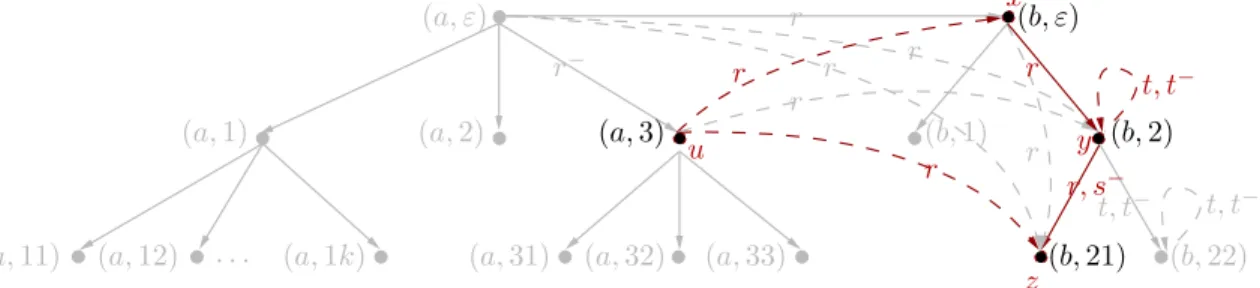
D2 t, t− t, t− t, t− C3 C (a,11) (a,12) . . . (a,1k) p p p (a,2) (a,3) (b,2) (a, ε) p p r− p p (a,33) (a,32) (a,31) p r r r r r p r r r, s− (b,21) (b,22) r (b, ε) (a,1) Ck D1 (b,1)
Figure 1: A representation of a canonical interpretationI forK.
Figure 1 shows a representation of a canonical model I for the knowledge base K from Example 8. Each labeled node represents an element in the domain, e.g., the individual nameais represented by the node labeled (a, ε). The edges represent relationships between individuals. For example, we can read the r-labeled edge from (a, ε) to (b, ε) in both directions, i.e., (aI, bI) = ((a, ε),(b, ε)) ∈ rI and (bI, aI) = ((b, ε),(a, ε)) ∈ r−I. The
“short-cuts” due to transitive roles are shown as dashed lines, while the relationship between the nodes that represent ABox individuals is shown in grey. Please note that we did not indicate the interpretations of all concepts in the figure.
Since I is a canonical model for K, the elements of the domain are pairs (a, w), where a indicates the individual name that corresponds to the root of the tree, i.e., aI = (a, ε)
and the elements in the second place form a tree according to our definition of trees. For each individual nameain our ABox, we can, therefore, easily define the tree rooted inaas {w|(a, w)∈∆I}. r (a,11) (a,12) . . . (a,1k) p p p (a,2) (a,1) (a,3) (b,1) (b,2) (a, ε) p p r− p p p (a,32) (a,31) (a,33) p (b, ε) r, s− t, t− (b,21) (b,22) r
Figure 2: A forest base for the interpretation represented by Figure 1.
Figure 2 shows a representation of a forest base for the interpretation from Figure 1 above. For simplicity, the interpretation of concepts is no longer shown. The two trees, rooted in (a, ε) and (b, ε) respectively, are now clear.
A graphical representation of the query q from Example 8 is shown in Figure 3, where the meaning of the nodes and edges is analogous to the ones given for interpretations. We call this query a cyclic query since its underlying undirected graph is cyclic (cf. Definition 2). Figure 4 shows a match π for q and I and, although we consider only one canonical model here, it is not hard to see that the query is true in each model of the knowledge base, i.e., K |=q.
u r r x r t y s z
Figure 3: A graph representation of the query from Example 8.
t, t− (a,12) . . . (a,1k) (a,31) (a,32) (a,33) u r x (b, ε) r (b,2) y r (b,21) r, s− r r (b,22) r r− (a,3) (a, ε) (a,2) (a,1) r (b,1) r z t, t− t, t− (a,11)
Figure 4: A matchπ for the query q from Example 8 onto the model I from Figure 1.
The forest model property is also exploited in the query rewriting process. We want to rewrite q into a set of queries q1, . . . , qn of ground or tree-shaped queries such that K |=q
iff K |=q1∨. . .∨qn. Since the resulting queries are ground or tree-shaped queries, we can
explore the known techniques for deciding entailment of these queries. As a first step, we transform q into a set of forest-shaped queries. Intuitively, forest-shaped queries consist of a set of tree-shaped sub-queries, where the roots of these trees might be arbitrarily interconnected (by atoms of the form r(t, t0)). A tree-shaped query is a special case of a forest-shaped query. We will call the arbitrarily interconnected terms of a forest-shaped query the root choice (or, for short, just roots). At the end of the rewriting process, we replace the roots with individual names from Inds(A) and transform the tree parts into a concept by applying the so called rolling-up or tuple graph technique (Tessaris, 2001; Calvanese et al., 1998a).
In the proof of the correctness of our procedure, we use the structure of the forest bases in order to explicate the transitive “short-cuts” used in the query match. By explicating we mean that we replace each role atom that is mapped to such a short-cut with a sequence of role atoms such that an extended match for the modified query uses only paths that are in the forest base.
4.3 The Rewriting Steps
The rewriting process for a query q is a six stage process. At the end of this process, the rewritten query may or may not be in a forest shape. As we show later, this “don’t know” non-determinism does not compromise the correctness of the algorithm. In the first stage, we derive a collapsing qco of q by adding (possibly several) equality atoms toq. Consider,
for example, the cyclic queryq={r(x, y), r(x, y0), s(y, z), s(y0, z)}(see Figure 5), which can
be transformed into a tree-shaped one by adding the equality atomy≈y0.
y, y0 y z y0 s s r r x z x s r
Figure 5: A representation of a cyclic query and of the tree-shaped query obtained by adding the atomy≈y0 to the query depicted on the left hand side.
A common property of the next three rewriting steps is that they allow for substituting the implicit short-cut edges with explicit paths that induce the short-cut. The three steps aim at different cases in which these short-cuts can occur and we describe their goals and application now in more detail:
The second stage is called split rewriting. In a split rewriting we take care of all role atoms that are matched to transitive “short-cuts” connecting elements of two different trees and by-passing one or both of their roots. We substitute these short-cuts with either one or two role atoms such that the roots are included. In our running example,π mapsuto (a,3) andxto (b, ε). HenceI |=π r(u, x), but the usedr-edge is a transitive short-cut connecting the tree rooted inawith the tree rooted inb, and by-passing (a, ε). Similar arguments hold for the atom r(u, z), where the path that implies this short-cut relationship goes via the two roots (a, ε) and (b, ε). It is clear that r must be a non-simple role since, in the forest baseJ forI, there is no “direct” connection between different trees other than between the roots of the trees. Hence, (π(u), π(x)) ∈rI holds only because there is a role s∈Trans
R
such that sv*Rr. In case of our example, r itself is transitive. A split rewriting eliminates
transitive short-cuts between different trees of a canonical model and adds the “missing” variables and role atoms matching the sequence of edges that induce the short-cut.
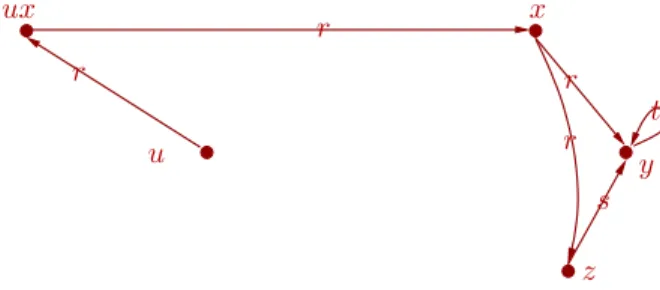
u r r r t r s ux x y z
Figure 6: A split rewritingqsr for the query shown in Figure 3.
Figure 6 depicts the split rewriting
qsr={r(u, ux), r(ux, x), r(x, y), t(y, y), s(z, y),
ofqthat is obtained fromqby replacing (i)r(u, x) withr(u, ux) andr(ux, x) and (ii)r(u, z) withr(u, ux), r(ux, x), andr(x, z). Please note that we both introduced a new variable (ux) and re-used an existing variable (x). Figure 7 shows a match forqsrand the canonical model
I ofK in which the two trees are only connected via the roots. For the rewritten query, we also guess a set of roots, which contains the variables that are mapped to the roots in the canonical model. For our running example, we guess that the set of roots is {ux, x}.
t s−, r (b,21) r (a, ε) r− (b, ε) u ux x y z (b,2) (a,3) r (a,11) (a,12) . . . (a,1k) (a,2) (a,31) (a,32) (a,33) (a,1) (b,1) r (b,22) , t−
Figure 7: A split matchπsrfor the queryqsrfrom Figure 6 onto the canonical interpretation
from Figure 1.
In the third step, called loop rewriting, we eliminate “loops” for variables v that do not correspond to roots by replacing atomsr(v, v) with two atomr(v, v0) andr(v0, v), wherev0 can either be a new or an existing variable in q. In our running example, we eliminate the loop t(y, y) as follows:
q`r ={r(u, ux), r(ux, x), r(x, y), t(y, y0), t(y0, y), s(z, y),
r(u, ux), r(ux, x), r(x, z)}
is the query obtained fromqsr(see Figure 6) by replacingt(y, y) witht(y, y0) andt(y0, y) for
a new variable y0. Please note that, since t is defined as transitive and symmetric, t(y, y) is still implied, i.e., the loop is also a transitive short-cut. Figure 8 shows the canonical interpretationIfrom Figure 1 with a matchπ`rforq`r. The introduction of the new variable
y0 is needed in this case since there is no variable that could be re-used and the individual (b,22) is not in the range of the matchπsr.
s− (a,12) . . . (a,1k) (a,1) (a,2) (a,31) (a,32) (a,33) (a, ε) (a,3) ux r− u r x(b, ε) (b,2) y (b,1) t, t− (b,21) z y0(b,22) , r r (a,11) r
Figure 8: A loop rewriting q`r and a match for the canonical interpretation from Figure 1.
The forth rewriting step, called forest rewriting, allows again the replacement of role atoms with sets of role atoms. This allows the elimination of cycles that are within a single
tree. A forest rewritingqf r for our example can be obtained from q`r by replacing the role
atom r(x, z) withr(x, y) and r(y, z), resulting in the query
qf r ={r(u, ux), r(ux, x), r(x, y), t(y, y0), t(y0, y), s(z, y),
r(u, ux), r(ux, x), r(x, y), r(y, z)}.
Clearly, this results in tree-shaped sub-queries, one rooted in ux and one rooted in x. Hence qf r is forest-shaped w.r.t. the root terms ux and x. Figure 9 shows the canonical
interpretationI from Figure 1 with a matchπf r forqf r.
y y0(b,22) (b,21) t, t− r, s− (b, ε) x r u (a,33) (a,32) (a,31) . . . (a,1k) (a,12) (a,11) (a, ε) r− ux (b,1) (a,1) (a,2) (a,3) (b,2) r z
Figure 9: A forest rewritingqf r and a forest matchπf r for the canonical interpretation from
Figure 1.
In the fifth step, we use the standard rolling-up technique (Horrocks & Tessaris, 2000; Calvanese et al., 1998a) and express the tree-shaped sub-queries as concepts. In order to do this, we traverse each tree in a bottom-up fashion and replace each leaf (labeled with a concept C, say) and its incoming edge (labeled with a role r, say) with the concept ∃r.C added to its predecessor. For example, the tree rooted in ux(i.e., the role atom r(u, ux)) can be replaced with the atom (∃r−.>)(ux). Similarly, the tree rooted in x (i.e., the role
atomsr(x, y), r(y, z), s(z, y), t(y, y0), andt(y0, y)) can be replaced with the atom (∃r.((∃(ruInv(s)).>)u(∃(tuInv(t)).>))(x).
Please note that we have to use role conjunctions in the resulting query in order to capture the semantics of multiple role atoms relating the same pair of variables.
Recall that, in the split rewriting, we have guessed thatxanduxcorrespond to roots and, therefore, correspond to individual names inInds(A). In the sixth and last rewriting step, we guess which variable corresponds to which individual name and replace the variables with the guessed names. A possible guess for our running example would be thatuxcorresponds toaand x tob. This results in the (ground) query
{(∃r−.>)(a), r(a, b),(∃r.((∃(ruInv(s)).>)u(∃(tuInv(t)).>)))(b)}, which is entailed byK.
Please note that we focused in the running example on the most reasonable rewriting. There are several other possible rewritings, e.g., we obtain another rewriting from qf r by
replacinguxwithbandx withain the last step. For a UCQ, we apply the rewriting steps to each of the disjuncts separately.
At the end of the rewriting process, we have, for each disjunct, a set of ground queries and/or queries that were rolled-up into a single concept atom. The latter queries result from forest rewritings that are tree-shaped and have an empty set of roots. Such tree-shaped rewritings can match anywhere in a tree and can, thus, not be grounded. Finally, we check if our knowledge base entails the disjunction of all the rewritten queries. We show that there is a bound on the number of (forest-shaped) rewritings and hence on the number of queries produced in the rewriting process.
Summing up, the rewriting process for a connected conjunctive query q involves the following steps:
1. Build all collapsings of q.
2. Build all split rewritings of each collapsing w.r.t. a subsetR of roots. 3. Build all loop rewritings of the split rewritings.
4. Build all (forest-shaped) forest rewritings of the loop rewritings.
5. Roll up each tree-shaped sub-query in a forest-rewriting into a concept atom and 6. replace the roots inR with individual names from the ABox in all possible ways.
Letq1, . . . , qnbe the queries resulting from the rewriting process. In the next section, we
define each rewriting step and prove thatK |=qiffK |=q1∨· · ·∨qn. Checking entailment for
the rewritten queries can easily be reduced to KB consistency and any decision procedure forSHIQu KB consistency could be used in order to decide ifK |=q. We present one such decision procedure in Section 6.
5. Query Rewriting
In the previous section, we have used several terms, e.g., tree- or forest-shaped query, rather informally. In the following, we give definitions for the terms used in the query rewriting process. Once this is done, we formalize the query rewriting steps and prove the correctness of the procedure, i.e., we show that the forest-shaped queries obtained in the rewriting process can indeed be used for deciding whether a knowledge base entails the original query. We do not give the detailed proofs here, but rather some intuitions behind the proofs. Proofs in full detail are given in the appendix.
5.1 Tree- and Forest-Shaped Queries
In order to define tree- or forest-shaped queries more precisely, we use mappings between queries and trees or forests. Instead of mapping equivalence classes of terms by≈* to nodes
in a tree, we extend some well-known properties of functions as follows:
Definition 9. For a mapping f:A→B, we usedom(f) and ran(f) to denote f’sdomain
A and range B, respectively. Given an equivalence relation≈* on dom(f), we say that f is
injective modulo≈* if, for alla, a0 ∈dom(f), f(a) = f(a0) implies a≈*a0 and we say that f
is bijective modulo ≈* if f is injective modulo≈* and surjective. Let q be a query. A tree
1. f is bijective modulo≈*,
2. if r(t, t0) ¯∈q, thenf(t) is a neighbor of f(t0), and,
3. if a∈Inds(q), thenf(a) =ε.
The queryq is tree-shaped if](Inds(q))≤1 and there is a tree mapping forq.
A root choice R for q is a subset of Terms(q) such that Inds(q) ⊆R and, if t∈ R and t≈*t0, then t0 ∈ R. For t ∈R, we use Reach(t) to denote the set of terms t0 ∈Terms(q) for
which there exists a sequence of terms t1, . . . , tn∈Terms(q) such that
1. t1=tand tn=t0,
2. for all 1≤i < n, there is a role r such thatr(ti, ti+1) ¯∈q, and,
3. for 1< i≤n, ifti ∈R, thenti≈*t.
We call R a root splitting w.r.t. q if either R = ∅ or if, for ti, tj ∈ R, ti 6 ≈* tj implies that
Reach(ti)∩Reach(tj) =∅. Each term t∈R induces a sub-query
subq(q, t) := {at∈¯ q| the terms in atoccur inReach(t)}\ {r(t, t)|r(t, t) ¯∈q}.
A query q is forest-shaped w.r.t. a root splitting R if eitherR =∅ and q is tree-shaped or
each sub-querysubq(q, t) for t∈R is tree-shaped. 4
For each termt∈R, we collect the terms that are reachable fromtin the setReach(t). By Condition 3, we make sure thatRand≈* are such that eacht0 ∈Reach(t) is either not in R ort≈*t0. Since queries are connected by assumption, we would otherwise collect all terms
inReach(t) and not just thoset0 ∈/R. For a root splitting, we require that the resulting sets are mutually disjoint for all termst, t0 ∈R that are not equivalent. This guarantees that all
paths between the sub-queries go via the root nodes of their respective trees. Intuitively, a forest-shaped query is one that can potentially be mapped onto a canonical interpretation I = (∆I,·I) such that the terms in the root splitting R correspond to roots (a, ε) ∈ ∆I.
In the definition of subq(q, t), we exclude loops of the form r(t, t) ¯∈ q, as these parts of the query are grounded later in the query rewriting process and between ground terms, we allow arbitrary relationships.
Consider, for example, the query qsr of our running example from the previous section
(cf. Figure 6). Let us again make the root choice R :={ux, x} for q. The sets Reach(ux) and Reach(x) w.r.t. qsr and R are {ux, u} and {x, y, z} respectively. Since both sets are
disjoint, Ris a root splitting w.r.t.qsr. If we choose, however,R:={x, y}, the setRis not
a root splitting w.r.t.qsr since Reach(x) ={ux, u, z} andReach(y) ={z}are not disjoint.
5.2 From Graphs to Forests
We are now ready to define the query rewriting steps. Given an arbitrary query, we ex-haustively apply the rewriting steps and show that we can use the resulting queries that are forest-shaped for deciding entailment of the original query. Please note that the following definitions are for conjunctive queries and not for unions of conjunctive queries since we apply the rewriting steps for each disjunct separately.
Definition 10. Letq be a Boolean conjunctive query. Acollapsing qco ofq is obtained by
adding zero or more equality atoms of the formt≈t0 fort, t0 ∈Terms(q) toq. We useco(q) to denote the set of all queries that are a collapsing of q.
Let K be a SHIQknowledge base. A queryqsr is called a split rewriting of q w.r.t. K
if it is obtained from q by choosing, for each atom r(t, t0) ¯∈q, to either: 1. do nothing,
2. choose a roles∈TransR such thatsv*Rr and replacer(t, t0) withs(t, u), s(u, t0), or
3. choose a role s ∈ TransR such that sv*Rr and replace r(t, t0) with s(t, u), s(u, u0),
s(u0, t0),
where u, u0 ∈NV are possibly fresh variables. We use srK(q) to denote the set of all pairs
(qsr, R) for which there is a queryqco∈co(q) such that qsr is a split rewriting of qco andR
is a root splitting w.r.t.qsr.
A queryq`ris called aloop rewriting ofq w.r.t. a root splittingR andKif it is obtained
from q by choosing, for all atoms of the formr(t, t) ¯∈q witht /∈R, a roles∈TransR such
thatsv*Rrand by replacingr(t, t) with two atomss(t, t0) ands(t0, t) fort0 ∈NV a possibly
fresh variable. We uselrK(q) to denote the set of all pairs (q`r, R) for which there is a tuple
(qsr, R)∈srK(q) such that q`r is a loop rewriting of qsr w.r.t.R and K.
For a forest rewriting, fix a set V ⊆ NV of variables not occurring in q such that ](V) ≤ ](Vars(q)). A forest rewriting qf r w.r.t. a root splitting R of q and K is obtained
from q by choosing, for each role atom r(t, t0) such that either R = ∅ and r(t, t0) ¯∈ q or
there is sometr ∈R and r(t, t0) ¯∈subq(q, tr) to either
1. do nothing, or
2. choose a role s∈TransR such thatsv*Rr and replace r(t, t0) with `≤](Vars(q)) role
atomss(t1, t2), . . . , s(t`, t`+1), where t1 =t,t`+1 =t0, and t2, . . . , t`∈Vars(q)∪V.
We usefrK(q) to denote the set of all pairs (qf r, R) for which there is a tuple (q`r, R)∈lrK(q)
such thatqf r is a forest-shaped forest rewriting of q`r w.r.t. R and K. 4
If K is clear from the context, we say that q0 is a split, loop, or forest rewriting of q instead of saying that q0 is a split, loop, or forest rewriting of q w.r.t. K. We assume that srK(q),lrK(q), and frK(q) contain no isomorphic queries, i.e., differences in (newly
introduced) variable names only are neglected.
In the next section, we show how we can build a disjunction of conjunctive queries q1∨ · · · ∨q` from the queries in frK(q) such that each qi for 1 ≤i≤`is either of the form
C(v) for a single variablev ∈ Vars(qi) or qi is ground, i.e., qi contains only constants and
no variables. It then remains to show thatK |=q iffK |=q1∨ · · · ∨q`.
5.3 From Trees to Concepts
In order to transform a tree-shaped query into a single concept atom and a forest-shaped query into a ground query, we define a mappingf from the terms in each tree-shaped sub-query to a tree. We then incrementally build a concept that corresponds to the tree-shaped query by traversing the tree in a bottom-up fashion, i.e., from the leaves upwards to the root.
Definition 11. Let q be a tree-shaped query with at most one individual name. If a ∈
Inds(q), then lettr =aotherwise let tr=v for some variablev ∈Vars(q). Let f be a tree
mapping such that f(tr) = ε. We now inductively assign, to each term t ∈ Terms(q), a
conceptcon(q, t) as follows:
• iff(t) is a leaf ofran(f), then con(q, t) :=dC(t)¯∈qC, • iff(t) has successors f(t1), . . . , f(tk), then
con(q, t) := dC(t)¯∈qCu d 1≤i≤k∃ d r(t,ti)¯∈qr .con(q, ti).
Finally, thequery concept of q w.r.t. tr iscon(q, tr). 4
Please note that the above definition takes equality atoms into account. This is because the function f is bijective modulo ≈* and, in case there are concept atoms C(t) and C(t0)
fort≈*t0, both concepts are conjoined in the query concept due to the use of the relation ¯∈.
Similar arguments can be applied to the role atoms.
The following lemma shows that query concepts indeed capture the semantics of q.
Lemma 12. Let q be a tree-shaped query with tr ∈ Terms(q) as defined above, Cq =
con(q, tr), and I an interpretation. Then I |= q iff there is a match π and an element
d∈CqI such that π(tr) =d.
The proof given by Horrocks, Sattler, Tessaris, and Tobies (1999) easily transfers from DLR toSHIQ. By applying the result from the above lemma, we can now transform a forest-shaped query into a ground query as follows:
Definition 13. Let (qf r, R)∈frK(q) forR6=∅, andτ:R→Inds(A) a total function such
that, for each a∈Inds(q), τ(a) =aand, for t, t0 ∈R,τ(t) =τ(t0) iff t≈*t0. We call such a
mapping τ a ground mapping for R w.r.t. A. We obtain a ground query ground(qf r, R, τ)
of qf r w.r.t. the root splittingR and ground mapping τ as follows:
• replace eacht∈R withτ(t), and,
• for each a∈ran(τ), replace the sub-queryqa=subq(qf r, a) withcon(qa, a).
We define the setgroundK(q) of ground queries for q w.r.t.K as follows:
groundK(q) :={q0| there exists some (q
f r, R)∈frK(q) withR6=∅
and some ground mappingτ w.r.t. Aand R such thatq0 =ground(q
f r, R, τ)}
We define the set of treesK(q) oftree queries for q as follows:
treesK(q) :={q0| there exists some (qf r,∅)∈frK(q) and
Going back to our running example, we have already seen that (qf r,{ux, x}) belongs to
the set frK(q) for
qf r={r(u, ux), r(ux, x), r(x, y), t(y, y0), t(y0, y), s(z, y), r(y, z)}.
There are also several other queries in the set frK(q), e.g., (q,{u, x, y, z}), where q is the
original query and the root splitting R is such thatR=Terms(q), i.e., all terms are in the root choice for q. In order to build the set groundK(q), we now build all possible ground mappings τ for the setInds(A) of individual names in our ABox and the root splittings for the queries in frK(q). The tuple (qf r,{ux, x}) ∈frK(q) contributes two ground queries for
the set groundK(q):
ground(qf r,{ux, x},{ux7→a, x7→b}) =
{r(a, b),(∃Inv(r).>)(a),(∃r.((∃(ruInv(s)).>)u(∃(tuInv(t)).>)))(b)},
where ∃Inv(r).> is the query concept for the (tree-shaped) sub-query subq(qf r, ux) and
∃r.((∃(ruInv(s)).>)u(∃(tuInv(t)).>) is the query concept forsubq(qf r, x) and
ground(qf r,{ux, x},{ux7→b, x7→a}) =
{r(b, a),(∃Inv(r).>)(b),(∃r.((∃(ruInv(s)).>)u(∃(tuInv(t)).>)))(a)}.
The tuple (q,{u, x, y, z}) ∈frK(q), however, does not contribute a ground query since, for
a ground mapping, we require that τ(t) = τ(t0) ifft≈*t0 and there are only two individual
names in Inds(A) compared to four terms q that need a distinct value. Intuitively, this is not a restriction, since in the first rewriting step (collapsing) we produce all those queries in which the terms of q have been identified with each other in all possible ways. In our example,K |=q andK |=q1∨ · · · ∨q`, whereq1∨ · · · ∨q` are the queries fromtreesK(q) and groundK(q) since each modelI of K satisfiesqi =ground(qf r,{ux, x},{ux7→a, x7→b}).
5.4 Query Matches
Even if a query is true in a canonical model, it does not necessarily mean that the query is tree- or forest-shaped. However, a match π for a canonical interpretation can guide the process of rewriting a query. Similarly to the definition of tree- or forest-shaped queries, we define the shape of matches for a query. In particular, we introduce three different kinds of matches: split matches, forest matches, and tree matches such that every tree match is a forest match, and every forest match is a split match. The correspondence to the query shapes is as follows: given a split match π, the set of all root nodes (a, ε) in the range of the match define a root splitting for the query, if π is additionally a forest match, the query is forest-shaped w.r.t. the root splitting induced by π, and if π is additionally a tree match, then the whole query can be mapped to a single tree (i.e., the query is tree-shaped or forest-shaped w.r.t. an empty root splitting). Given an arbitrary query match into a canonical model, we can first obtain a split match and then a tree or forest match, by using the structure of the canonical model for guiding the application of the rewriting steps.
Definition 14. Let K be a SHIQ knowledge base, q a query, I = (∆I,·I) a canonical
model ofK, andπ:Terms(q)→∆I an evaluation such thatI |=π q. We callπasplit match
1. π(t) = (a, ε) and π(t0) = (b, ε) for some a, b∈Inds(A); or
2. π(t) = (a, w) andπ(t0) = (a, w0) for somea∈Inds(A) and w, w0 ∈IN∗.
We call π a forest match if, additionally, for each term tr ∈ Terms(q) with π(tr) = (a, ε)
and a∈Inds(A), there is a total and bijective mappingf from {(a, w)|(a, w)∈ran(π)}to a tree T such that r(t, t0) ¯∈ subq(q, tr) implies that f(π(t)) is a neighbor of f(π(t0)). We
callπa tree match if, additionally, there is ana∈Inds(A) such that each element inran(π) is of the form (a, w).
A split matchπ for a canonical interpretation induces a (possibly empty) root splitting Rsuch thatt∈Riffπ(t) = (a, ε) for somea∈Inds(A). We callRtheroot splitting induced
by π. 4
For two elements (a, w) and (a, w0) in a canonical model, the path from (a, w) to (a, w0) is the sequence (a, w1), . . . ,(a, wn) where w = w1, w0 = wn, and, for 1 ≤ i < n, wi+1 is a
successor of wi. The length of the path is n. Please note that, for a forest match, we do
not require that w is a neighbor ofw0 or vice versa. This still allows to map role atoms to paths in the canonical model of length greater than two, but such paths must be between ancestors and not between elements in different branches of the tree. The mapping f to a tree also makes sure that if R is the induced root splitting, then each sub-query subq(q, t) for t ∈ R is tree-shaped. For a tree match, the root splitting is either empty or t≈*t0 for
each t, t0 ∈R, i.e., there is a single root modulo≈*, and the whole query is tree-shaped. 5.5 Correctness of the Query Rewriting
The following lemmas state the correctness of the rewriting step by step for each of the rewriting stages. Full proofs are given in the appendix. As motivated in the previous section, we can use a given canonical model to guide the rewriting process such that we obtain a forest-shaped query that also has a match into the model.
Lemma 15. Let I be a model for K.
1. If I |=q, then there is a collapsing qco of q such that I |=πco qco for πco an injection modulo≈*.
2. If I |=πcoq
co for a collapsingqco of q, then I |=q.
Given a modelI that satisfiesq, we can simply add equality atoms for all pairs of terms that are mapped to the same element in I. It is not hard to see that this results in a mapping that is injective modulo≈*. For the second part, it is easy to see that a model that
satisfies a collapsing also satisfies the original query.
Lemma 16. Let I be a model for K.
1. If I is canonical and I |=π q, then there is a pair (qsr, R)∈srK(q) and a split match πsr such that I |=πsr qsr, R is the induced root splitting ofπsr, and πsr is an injection modulo≈*.
For the first part of the lemma, we proceed exactly as illustrated in the example section and use the canonical modelI and the matchπ to guide the rewriting steps. We first build a collapsingqco∈co(q) as described in the proof of Lemma 15 such that I |=πcoqcoforπco
an injection modulo≈*. Since I is canonical, paths between different trees can only occur
due to non-simple roles, and thus we can replace each role atom that uses such a short-cut with two or three role atoms such that these roots are explicitly included in the query (cf. the query and match in Figure 4 and the obtained split rewriting and with a split match in Figure 7). The second part of the lemma follows immediately from the fact that we use only transitive sub-roles in the replacement.
Lemma 17. Let I be a model of K.
1. If I is canonical and I |=q, then there is a pair (q`r, R)∈lrK(q) and a mapping π`r such that I |=π`r q
`r, π`r is an injection modulo≈*, R is the root splitting induced by
π`r and, for each r(t, t) ¯∈q`r, t∈R.
2. If (q`r, R)∈lrK(q) andI |=π`r q`r for some match π`r, then I |=q.
The second part is again straightforward, given that we can only use transitive sub-roles in the loop rewriting. For the first part, we proceed again as described in the examples section and use the canonical modelI and the matchπ to guide the rewriting process. We first build a split rewritingqsrand its root splittingRas described in the proof of Lemma 16
such that (qsr, R) ∈ srK(q) and I |=πsr qsr for a split match πsr. Since I is a canonical
model, it has a forest base J. In a forest base, non-root nodes cannot be successors of themselves, so each such loop is a short-cut due to some transitive role. An element that is, say,r-related to itself has, therefore, a neighbor that is both anr- and Inv(r)-successor. Depending on whether this neighbor is already in the range of the match, we can either re-use an existing variable or introduce a new one, when making this path explicit (cf. the loop rewriting depicted in Figure 8 obtained from the split rewriting shown in Figure 7).
Lemma 18. Let I be a model of K.
1. IfI is canonical andI |=q, then there is a pair(qf r, R)∈frK(q) such thatI |=πf rqf r for a forest match πf r, R is the induced root splitting of πf r, and πf r is an injection modulo≈*.
2. If (qf r, R)∈frK(q) and I |=πf r qf r for some matchπf r, then I |=q.
The main challenge is again the proof of (1) and we just give a short idea of it here. At this point, we know from Lemma 17 that we can use a query q`r for which there is a
root splitting R and a split match π`r. Sinceπ`r is a split match, the match for each such
sub-query is restricted to a tree and thus we can transform each sub-query of q`r induced
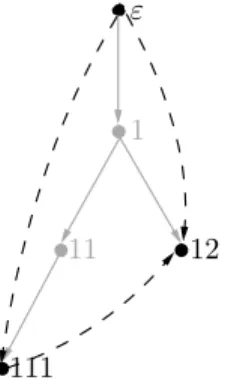
by a termtin the root choice separately. The following example is meant to illustrate why the given bound of ](Vars(q)) on the number of new variables and role atoms that can be introduced in a forest rewriting suffices. Figure 10 depicts the representation of a tree from a canonical model, where we use only the second part of the names for the elements, e.g., we use just ε instead of (a, ε). For simplicity, we also do not indicate the concepts and roles that label the nodes and edges, respectively. We use black color to indicate the nodes
and edges that are used in the match for a query and dashed lines for short-cuts due to transitive roles. In the example, the grey edges are also those that belong to the forest base and the query match uses only short-cuts.
ε
1
111
12 11
Figure 10: A part of a representation of a canonical model, where the black nodes and edges are used in a match for a query and dashed edges indicate short-cuts due to transitive roles.
The forest rewriting aims at making the short-cuts more explicit by replacing them with as few edges as necessary to obtain a tree match. In order to do this, we need to include the “common ancestors” in the forest base between each two nodes used in the match. For w, w0∈IN∗, we therefore define thelongest common prefix (LCP) ofwandw0as the longest
ˆ
w∈IN∗ such that ˆwis a prefix of bothw andw0. For a forest rewriting, we now determine
the LCPs of any two nodes in the range of the match and add a variable for those LCPs that are not yet in the range of the match to the set V of new variables used in the forest rewriting. In the example from Figure 10 the set V contains a single variable v1 for the
node 1.
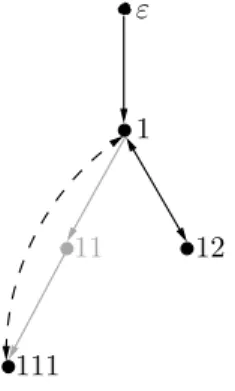
We now explicate the short-cuts as follows: for any edge used in the match, e.g., the edge from ε to 111 in the example, we define its path as the sequence of elements on the path in the forest base, e.g., the path for the edge fromεto 111 isε,1,11,111. Therelevant path is obtained by dropping all elements from the path that are not in the range of the mapping or correspond to a variable in the set V, resulting in a relevant path of ε,1,111 for the example. We now replace the role atom that was matched to the edge fromεto 111 with two role atoms such that the match uses the edge fromε to 1 and from 1 to 111. An appropriate transitive sub-role exists since otherwise there could not be a short-cut. Similar arguments can be used to replace the role atom mapped to the edge from 111 to 12 and for the one that is mapped to the edge from ε to 12, resulting in a match as represented by Figure 11. The given restriction on the cardinality of the set V is no limitation since the number of LCPs in the set V is maximal if there is no pair of nodes such that one is an ancestor of the other. We can see these nodes as n leaf nodes of a tree that is at least binarily branching. Since such a tree can have at most n inner nodes, we need at most n new variables for a query in nvariables.
ε
111
12 11
1
Figure 11: The match for a forest rewriting obtained from the example given in Figure 10.
For the bound on the number of role atoms that can be used in the replacement of a single role atom, consider, for example, the cyclic query
q ={r(x1, x2), r(x2, x3), r(x3, x4), t(x1, x4)},
for the knowledge base K = (T,R,A) with T = ∅,R = {r v t} with t ∈ TransR and
A = {(∃r.(∃r.(∃r.>)))(a)}. It is not hard to check that K |= q. Similarly to our running example from the previous section, there is also a single rewriting that is true in each canonical model of the KB, which is obtained by building only a forest rewriting and doing nothing in the other rewriting steps, except for choosing the empty set as root splitting in the split rewriting step. In the forest rewriting, we can explicate the short-cut used in the mapping fort(x1, x4) by replacingt(x1, x4) witht(x1, x2), t(x2, x3), t(x3, x4).
By using Lemmas 15 to 18, we get the following theorem, which shows that we can use the ground queries ingroundK(q) and the queries in treesK(q) in order to check whetherK
entailsq, which is a well understood problem.
Theorem 19. Let K be a SHIQ knowledge base, q a Boolean conjunctive query, and
{q1, . . . , q`}=treesK(q)∪groundK(q). Then K |=q iff K |=q1∨. . .∨q`.
We now give upper bounds on the size and number of queries intreesK(q) andgroundK(q). As before, we use](S) to denote thecardinality of a setS. Thesize |K|(|q|) of a knowledge base K (a query q) is simply the number of symbols needed to write it over the alphabet of constructors, concept names, and role names that occur in K (q), where numbers are encoded in binary. Obviously, the number of atoms in a query is bounded by its size, hence ](q)≤ |q|and, for simplicity, we use nas the size and the cardinality of q in what follows.
Lemma 20. Let q be a Boolean conjunctive query,K= (T,R,A) aSHIQknowledge base,
|q|:=n and |K|:=m. Then there is a polynomial p such that 1. ](co(q))≤2p(n) and, for eachq0 ∈co(q),|q0| ≤p(n),
2. ](srK(q))≤2p(n)·logp(m), and, for each q0 ∈srK(q), |q0| ≤p(n),