PRACTICAL AUTHENTICATION IN LARGE-SCALE
INTERNET APPLICATIONS
A Thesis Presented to The Academic Faculty
by Italo Dacosta
In Partial Fulfillment
of the Requirements for the Degree Doctor of Philosophy in the School of Computer Science
Georgia Institute of Technology August 2012
PRACTICAL AUTHENTICATION IN LARGE-SCALE
INTERNET APPLICATIONS
Approved by:
Professor Mustaque Ahamad, Co-Advisor
School of Computer Science
Georgia Institute of Technology
Professor Alexandra Boldyreva School of Computer Science
Georgia Institute of Technology
Professor Patrick Traynor, Co-Advisor School of Computer Science
Georgia Institute of Technology
Professor Raheem A. Beyah School of Electrical & Computer Engineering
Georgia Institute of Technology
Professor Jon Giffin
School of Computer Science
Georgia Institute of Technology
Dedicated to my mother, Belinda Petrocelli, and the memory of my dad, Dimas Da-costa. And to the person who brings love, happiness and balance to my life, my dearest Oksana.
ACKNOWLEDGEMENTS
This dissertation would not have been possible without the help, assistance and advice of many people. I would like to acknowledge the support I have received from the Fulbright program, Georgia Tech, my advisors, peers, friends and family.
My dream of studying in the US came true thanks to the Fulbright scholarship. I am grateful for all the help and support provided by the Fulbright program, the Insti-tute of International Education (IIE) and the BARSA scholarship program. Specif-ically, I want to thank Mrs. Belsi Medina and Mrs. Dalys DeGracia in the US consulate in Panama for guiding me and other Panamanians through this process.
Since my acceptance in this program I have benefited from the resources provided by Georgia Tech. I want to express my gratitude to all the academic and adminis-trative staff that make this university successful. I am particularly grateful to Mrs. Alfreda Barrow and Mrs. Mary Claire Thompson at GTISC for their help with all the administrative inquiries.
Most importantly, I want to thank my academic advisors and mentors. Dr. Mus-taque Ahamad and Dr. Patrick Traynor who supported and guided my dissertation work while giving me freedom and flexibility to explore and develop my thinking. I greatly appreciate that over the years they have challenged my ideas, honed my research skills, provided critical feedback and inspired me to go above and beyond the boundaries of my field. I also want to acknowledge the support of my dissertation committee members: Dr. Alexandra Boldyreva, Dr. Jon Giffin and Dr. Raheem Beyah. I appreciate their timely feedback and suggestions to improve my work. In addition, I extend my gratitude to Dr. Julio Escobar, my undergraduate mentor. Dr. Escobar introduced me to the field of Information Security, encouraged and inspired
me to pursue graduate studies, and has served as a role model.
My Georgia Tech experience has been enhanced through interactions and collabo-rations I have had with my peers and friends. At CISEC and GTISC, I want to thank Vijay, Chaitrali, Saurabh, Hank, Frank, Jeff King, Mike Hunter, Kapil and Daisuke. I have enjoyed getting to know each of you and sharing our experiences at Georgia Tech. Outside my program, I want to acknowledge my friends in Panama and the US: Guillermo, Jimena, Marta, Nuvia, Mayli, Claudina, Claris, Min, Antonia, Igna-cio, Gaspar, Jean Carlos, Roxana, Alexis and Carlos. In particular, I am indebted to Mimi and Flaviu Hodis and Jeff and Caroline Thompson, whose friendship has been invaluable during these years.
Finally, I want to thank my family for their love, assistance and encouragement. A heartfelt thank you goes to my parents, brothers, grandmother, aunts and uncles. Especially, I want to acknowledge my mother who always respected and supported my decisions and plans. Most of all, I want to express my gratitude to the most important person in my life – my wife. Her love, care and help have been fundamental to my success. Thank you my dearest Oksana, we did it our way...
TABLE OF CONTENTS
DEDICATION . . . iii
ACKNOWLEDGEMENTS . . . iv
LIST OF TABLES . . . xi
LIST OF FIGURES . . . xiii
SUMMARY . . . xvii
I INTRODUCTION . . . 1
1.1 Thesis Statement . . . 3
1.2 Research Challenges and Methodology . . . 4
1.3 Contributions . . . 5
1.4 Dissertation Outline . . . 6
II BACKGROUND . . . 8
2.1 Large-Scale Internet Applications . . . 8
2.2 VoIP Applications . . . 10
2.2.1 Session Initiation Protocol (SIP) . . . 11
2.2.2 A Nationwide SIP Infrastructure . . . 13
2.2.3 SIP Digest Authentication . . . 15
2.3 Web Applications . . . 17
2.3.1 Large-Scale Scenario . . . 18
2.3.2 The HTTP Protocol . . . 19
2.3.3 HTTPS: HTTP over SSL/TLS . . . 20
2.3.4 User Authentication . . . 21
2.3.5 HTTP Cookies and Session Authentication . . . 23
2.3.6 Server Authentication . . . 26
III RELATED WORK . . . 28
3.1 VoIP Applications . . . 28
3.1.1 SIP Authentication and Its Impact on Performance . . . 28
3.1.2 Robust and Efficient SIP Authentication . . . 30
3.2 Web Applications . . . 32
3.2.1 More Robust Alternatives for Session Authentication . . . 32
3.2.2 Stronger Server Authentication . . . 35
IV IMPROVING AUTHENTICATION PERFORMANCE OF DIS-TRIBUTED SIP PROXIES . . . 40
4.1 Improving SIP Authentication Performance in a Distributed Scenario 43 4.2 Experimental Setup . . . 45
4.2.1 Testbed Configuration . . . 45
4.2.2 Adding Batch Requests Support to OpenSER . . . 47
4.2.3 Methodology . . . 47
4.3 Analysis of Throughput Enhancement Techniques . . . 49
4.3.1 Standard Configuration . . . 49
4.3.2 Improving Performance with Multiple Processes . . . 50
4.3.3 Improving Performance with Batch Requests . . . 55
4.3.4 Hybrid Approach: Combining Multiple Processes with Batch Requests . . . 60
4.3.5 Analysis of the Delay Introduced by Batch Requests . . . 64
4.3.6 Evaluating Performance with Multiple Proxies . . . 66
4.4 Discussion . . . 68
4.5 Summary . . . 70
V PROXYCHAIN: DEVELOPING A ROBUST AND EFFICIENT AUTHENTICATION INFRASTRUCTURE FOR CARRIER-SCALE VOIP NETWORKS . . . 72
5.1 Problems with Digest Authentication . . . 74
5.2 Proxychain Protocol Specification . . . 76
5.2.2 Design Goals . . . 77
5.2.3 Hash Chains . . . 77
5.2.4 Design and Formal Description . . . 78
5.3 Experimental Setup . . . 81 5.3.1 Testbed . . . 82 5.3.2 Proxychain Implementation . . . 83 5.3.3 Methodology . . . 85 5.4 Experimental Results . . . 86 5.4.1 Microbenchmarks . . . 86 5.4.2 Call Throughput . . . 87 5.4.3 Scalability . . . 90
5.4.4 Credential Preloading in the Proxies . . . 91
5.4.5 Prefetching Mechanism . . . 93
5.4.6 Authenticating Multiple Message Types . . . 95
5.5 Discussion . . . 96
5.5.1 Performance . . . 96
5.5.2 Security and Threat Analysis . . . 99
5.5.3 Availability . . . 102
5.6 Summary . . . 103
VI ONE-TIME COOKIES: ROBUST AND EFFICIENT HTTP SES-SION AUTHENTICATION VIA STATELESS AUTHENTICATION TOKENS . . . 105
6.1 The Session Hijacking Threat . . . 109
6.2 One-Time Cookies: A Robust and Stateless Session Authentication Protocol . . . 111
6.2.1 Threat model . . . 112
6.2.2 Desired Protocol Properties . . . 113
6.2.3 Protocol Description . . . 115
6.3 OTC Security Analysis . . . 118
6.3.2 ProVerif Analysis . . . 121
6.4 Experimental Evaluation . . . 122
6.4.1 OTC Implementation . . . 122
6.4.2 Evaluation and Results . . . 124
6.5 Discussion . . . 130
6.5.1 Incrementally Deploying OTC . . . 130
6.5.2 Extending OTC Integrity Protection . . . 131
6.5.3 OTC and Multi-Factor Authentication . . . 132
6.5.4 OTC in Mobile Devices . . . 133
6.5.5 SessionLock . . . 133
6.6 Summary . . . 135
VII DVCERT: ROBUST SERVER AUTHENTICATION FOR SSL/TLS WITHOUT THIRD-PARTIES . . . 136
7.1 Background and Motivation . . . 140
7.1.1 The SSL/TLS Protocols and Web Applications . . . 140
7.1.2 MITM Attacks against SSL/TLS . . . 141
7.1.3 Problems with Third-Party Solutions . . . 142
7.2 Direct Validation of SSL/TLS Certificates . . . 143
7.2.1 Scenario and Threat Model . . . 143
7.2.2 Desired Protocol Properties . . . 145
7.2.3 Protocol Description . . . 146 7.3 Security Analysis . . . 150 7.4 Experimental Analysis . . . 152 7.5 Discussion . . . 157 7.5.1 DVCert Benefits . . . 157 7.5.2 DVCert Limitations . . . 158 7.6 Summary . . . 159
VIIICONCLUSIONS AND FUTURE WORK . . . 160
APPENDIX A — OTC SECURITY VERIFICATION USING PROVERIF V.1.86 . . . 164
APPENDIX B — DVCERT SECURITY VERIFICATION USING
PROVERIF V.1.86 . . . 166 REFERENCES . . . 174
LIST OF TABLES
1 Performance results for multiple proxies including 95% confidence in-tervals . . . 67 2 Best configuration for each query technique: multiple processes, batch
requests and hybrid approach. . . 68 3 Response computation time at the UA and verification time at the
proxy for Digest and Proxychain authentication. Proxychain adds lit-tle overhead to the response computation and it is more efficient per-forming verifications. . . 86 4 Time required by the database to compute credentials with different
hash chain lengths. For lengths <100, the overhead is small. . . 86 5 Main threats affecting authentication cookies. OTC is robust against
most of these threats; thus, it effectively reduces the attack surface affecting session authentication based on cookies and simplifies the security architecture of the web application. (Note: x = affected by the threat, - = not affected by the threat). . . 121 6 Example of authentication cookies and OTC credentials for WordPress.
Cookies are setup in the browser with the Set-Cookie HTTP header field while OTC credentials are setup with the X-OTC-SET header field. On each request that requires authentication, the browser at-taches the cookies using the Cookie HTTP header field or attaches an OTC token using the X-OTC HTTP header field. WordPress uses 3 authentication cookies by default. . . 123 7 WordPress generation and verification times for cookies and OTC. The
additional delay added by OTC operations is small (<1 ms) and negli-gible when compared to other web application’s operations. Note: c.i. = confidence intervals. . . 126 8 Time to generate tokens in the browser. The overhead added is small
and unlikely to affect the user experience . . . 126 9 DVCert request generation time (tg) and response verification time
(tv), including 95% confidence intervals, on a laptop and on a
smart-phone for different exponent sizes. For 384 bits exponents, a DVCert transaction required a total time (tg +tv) of 12.03 ms on the laptop and 97.70 ms on the smartphone. Thus, these operations are unlikely to be noticed by users . . . 155
10 Server response time (tr) for a single HTTPS request (baseline) and
single HTTPS requests with DVCert using dynamic and static param-eters (trsp) and different exponent sizes. By subtracting the time of a single HTTPS request, we estimated the cost of DVCert operations with static (td) and dynamic (tdsp) parameters and determined the per-centage of improvement (% Imp.) due to static parameters. For 384 bits and static parameters, DVCert operations required half of the time used to server a single HTTPS request. . . 155
LIST OF FIGURES
1 A hypothetical nationwide VoIP SIP infrastructure. As it is done by some cellular providers, the authentication service/database (DB) is centrally located, with proxies (P) distributed across the country. . . 13 2 A different view of a nationwide VoIP SIP infrastructure. Alice and
Bob communicate via a SIP provider with proxies distributed across the United States. . . 14 3 SIP call setup using Digest authentication (bold). . . 15 4 Simplified view of the traditional and the new Web 2.0 client-server
models. In the new model, state synchronization among the web ap-plication’s servers is expensive due to network latency. . . 18 5 HTML form-based authentication example. . . 22 6 Session authentication using HTTP cookies. The browser attaches the
same cookies to all the HTTP requests sent to a particular domain. . 24 7 Simplified view of the SSL/TLS handshake protocol. The server can
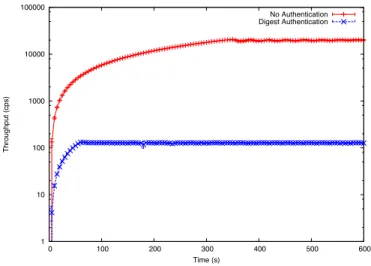
only complete the protocol if it has the private key corresponding to the public key in the server certificate (Cert. Thus, a successful handshake validates the server’s identity. . . 27 8 Proxy’s throughput with and without Digest authentication. The
net-work latency (30 ms) between the proxy and the database significantly reduces proxy’s performance . . . 49 9 Proxy’s maximum usable throughput (<1% failed calls) for different
number of processes. Proxy’s performance improves with higher num-ber of processes. However, performance drops sharply when 1024 pro-cesses are used. . . 51 10 Proxy’s throughput for the 512 processes configuration. The
maxi-mum throughput that the proxy can handle is limited by the database maximum throughput. . . 52 11 Proxy’s throughput for 1024 processes configuration. Trashing in the
proxy due to the high number of processes degrades proxy’s performance 53 12 Proxy and database CPU utilization for different number of processes.
Around 512, the database CPU utilization is more than 100 % and the database becomes a bottleneck for proxy’s performance . . . 54 13 Bandwidth between the proxy and the database for different number
of processes. A considerable amount of bandwidth is required for high number of processes . . . 55
14 Proxy’s maximum usable throughput for different batch sizes using a single process. The performance improvement is lower when compared with multiple processes. . . 56 15 Total query time (tbatch+RT Tpd) and tsq = RT Tpdn+tbatch for different
batch sizes. Using batch sizes larger than 64 has little effect on im-proving performance . . . 57 16 Bandwidth between the proxy and the database for different batch
sizes. Batch requests have lower bandwidth requirements than multiple processes . . . 58 17 Total packet length for batch queries and single queries. Batch queries
have better payload efficiency than the equivalent number of single queries . . . 59 18 Proxy’s maximum usable throughput for different combinations of
num-ber of processes and batch sizes. The best performance is achieved with the 32 processes with batch size of 16 . . . 61 19 Bandwidth between the proxy and the database for different number
of processes and for 32 processes with different batch sizes. The com-bination of multiple processes with batching required significantly less bandwidth than using multiple processes only. . . 62 20 Proxy and database CPU utilization for different number of processes
and for 32 processes with different batch sizes. The combination of multiple processes with batching requires less proxy CPU time than multiple processes . . . 63 21 Proxy CPU utilization for 512 processes and for 32 processes with
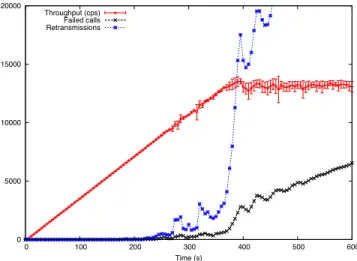
batch size of 16. Both configurations handle approximately the same maximum throughput but the hybrid approach requires less CPU time 64 22 Throughput for 32 processes with batch size of 16. Notice the lower
number of retransmissions and failed calls when compared with the 512 processes configuration (Figure 10) . . . 65 23 Call setup time distribution for 120,000 calls measured using a constant
call throughput (6,000 cps) and a 32p-16b proxy configuration. Most of the calls (99.90 %) were established in less than 350 ms. . . 66 24 Hash chains are generated by hashing a secret value forward n times.
A principal Bob stores the current value of the hash chain (Hc). A
participant Alice can prove knowledge of the initial secret by presenting Bob with the previous value (Hc−1). If Bob hashes Alice’s input and
generates Hc, Alice must know the initial secret due to the one-way
property of hash algorithms. Bob then makes the current value Hc−1
25 Call setup flow using Proxychain. For the first request (above dashed line), the proxy must request a temporary credential from the database. Subsequent requests (below dotted line) can be dealt with immediately by the proxy. . . 79 26 Proxychain protocol: The formal definition of the Proxychain
proto-col. We assume that there exists an encrypted channel (e.g., IPsec connection) between the proxy and the database. . . 80 27 Total call throughput for no, Digest and Proxychain authentication.
Proxychain’s maximum call throughput is close to the one obtained without authentication. . . 88 28 Percentage of CPU required by the database process for Digest and
Proxychain authentication. The database process is virtually idle when Proxychain is used. . . 89 29 Throughput measured for a range of proxies using Digest and
Proxy-chain authentication. ProxyProxy-chain is considerably more scalable than Digest authentication. . . 91 30 Call throughput measured for different number of credentials preloaded
in the proxies and a constant offered load (10K cps). Proxychain re-quires that proxies have most of the credentials in memory for maxi-mum performance. . . 92 31 Call setup time for four different configurations: no, Digest, Proxychain
and Proxychain with prefetching authentication. The call setup time for Proxychain with prefetching is similar to the one obtained with no authentication. . . 93 32 Throughput for INVITE and INVITE and BYE Proxychain
authenti-cation. Proxychain allows authentication of two requests per call while still supporting high throughput. . . 95 33 Simplified view of a session hijacking attack. (1) After login, the victim
sends requests to the web application using a cookie for authentication. (2) Because this request is sent over HTTP, an adversary can eaves-drop the request and capture the cookie. (3) Finally, the adversary can use this cookie to send arbitrary requests to the web application, successfully hijacking the victim’s session. . . 109 34 Flow diagram of a web session using OTC. Messages 1 and 2 represent
the user login transaction and require HTTPS protection. After user login, HTTPS is optional; each browser request includes a unique OTC token (message 3) to authenticate the request. . . 116
35 Average user experienced latency per request for cookies with HTTP, cookies with HTTPS, OTC with HTTP and OTC with HTTPS. When compared to cookies, the delay introduced by OTC is small and un-likely to be noticed by the user. . . 127 36 Web server throughput and CPU utilization for cookies with HTTP,
cookies with HTTPS, OTC with HTTP and OTC with HTTPS. These tests used a simple PHP page (14 KB) because WordPress throughput was too low (<100 req/sec) to see performance differences among the configurations evaluated. Cookies and OTC allow similar performance in the web server for practical throughput values. . . 128 37 Example of a MITM attack against SSL/TLS. The adversary
estab-lishes two SSL/TLS connections: one with the victim and one with the client. However, from the victim’s and server’s point of view, there is only a single SSL/TLS connection. . . 141 38 High level overview of the DVCert protocol. First, the browser
ob-tains a fresh DCL (Domain Certificate List) after executing a DVCert transaction over SSL/TLS with the web application (step 1). Second, the browser uses the fresh DCL to validate the certificates used in all the SSL/TLS connections with the web application and associated third-parties (step 2). . . 146 39 Detailed description of a DVCert transaction. DVCert uses a modified
version of PAK to establish a session secret (gab) that is used to protect
the integrity of the DCL (Domain Certificate List). At the end of the transaction, the server is authenticated and the browser can use the DCL to verify all the certificates used during a session with this domain.148 40 Comparison of the web server throughput for single HTTPS request
and HTTPS requests with DVCert in the hypothetical case that DVCert transactions are executed per SSL/TLS connection (i.e., upper bound). HTTPS+DVCert configurations used different exponent sizes and one configuration used static parameters (HTTPS+DVCert-sp). Using DVCert with 384 bits exponents allowed a maximum throughput close to the one achieved with single HTTPS requests. Thus, DVCert trans-actions are unlikely to degrade server performance. Note: SSL/TLS connections used a 2048 bits RSA key. . . 156
SUMMARY
Internet applications have experienced a rapid and massive growth in popu-larity in the last decade. For example, today many Web and Voice over IP (VoIP) applications rely on large and highly-distributed infrastructures to process requests from millions of users in a timely manner. Due to their unprecedented requirements, these large-scale Internet applications have often sacrificed security for other goals such as performance, scalability and availability. As a result, these applications have typically preferred weaker but more efficient security mechanisms in their infrastruc-tures.
Authentication mechanisms, a security layer required by most Internet applica-tions, are an example of this trend. Mechanisms such as Digest authentication, HTTP Cookies, HTML form-based authentication and SSL/TLS server authentication are widely deployed regardless of their known weaknesses. However, as recent incidents have demonstrated, due to the increasing importance of large-scale Internet applica-tions, powerful adversaries are now targeting and exploiting the weaknesses in these authentication mechanisms. While more robust authentication mechanisms have been proposed, most of them fail to address the specific requirements and threat model of large-scale Internet applications and, as a result, they have not been widely deployed. In this dissertation we demonstrate that by taking into account the specific re-quirements and threat model of large-scale Internet applications we can design au-thentication protocols for such applications that are not only more robust but also have low impact on performance, scalability and existing infrastructure. In particu-lar, we show that there is no inherent conflict between stronger authentication and other system goals.
This dissertation makes four major contributions. First, through an extensive experimental study, we demonstrate how even a simple authentication mechanism such as SIP Digest authentication can significantly impact the performance and scal-ability of a carrier-scale VoIP infrastructure. Second, we propose Proxychain, a SIP authentication protocol that not only provides better security guarantees than Digest authentication but also improved performance and scalability for highly-distributed VoIP environments. Third, we develop One-Time Cookies (OTC), a more secure alternative to the use of HTTP cookies as session authentication tokens. OTC is inherently robust against session hijacking attacks while preserving the efficiency and statelessness benefits of cookies. Fourth, we present Direct Validation of SSL/TLS Certificates (DVCert), a practical mechanism that offers more robust validation of SSL/TLS server certificates without requiring external third-parties or additional in-frastructure. By providing stronger server authentication, DVCert effectively reduces the risk of man-in-the-middle attacks against SSL/TLS connections. In so doing, we provide robust and practical authentication mechanisms that can improve the overall security of large-scale VoIP and Web applications.
CHAPTER I
INTRODUCTION
Internet applications have experienced a rapid and massive growth in popularity in the last decade. Today, Voice over IP (VoIP) providers such as Vonage and AT&T and Web applications such as Facebook, Google and Twitter offer their services to millions of users located in different geographical areas. This vast and distributed user base generates a significantly large number of requests that need to be served in a timely fashion to provide adequate user experience. To process this high request load, these applications rely on a highly distributed and complex infrastructure composed of thousands of servers and other network components. As a result, the architects and developers of these large-scale Internet applications have made availability, per-formance and scalability their top priorities when designing and implementing such systems.
Due to this focus on performance and scalability, security has been often consid-ered a secondary goal. In general, it is often assumed that robust security mechanisms conflict with high performance and scalability demands. Therefore, many large-scale Internet applications have deployed weaker but simpler and more efficient security mechanisms to avoid degrading other system goals. One of the reasons for this ap-proach is that many of the mechanisms currently available were designed decades ago, when the scale and threat models of Internet applications were different. As a result, such mechanisms are not appropriate for today’s large-scale Internet applica-tions. In addition, robust security mechanisms can be more complex and expensive to deploy (e.g., additional infrastructure requirements). For example, as a response to the increasing number of attacks, Google enabled full SSL/TLS support by default
in its applications. However, while Google reported that no additional hardware was required, this project took several years and required multiple changes to servers and the SSL/TLS software stack [116]. In contrast, Facebook has enabled full SSL/TLS support as optional only, while Yahoo has not deployed it yet. To compensate for the performance impact of more robust security mechanisms, Internet applications could rely on the high capacity and elasticity of cloud computing technologies. However, such approach requires additional financial investments. Thus, it is desirable to have robust security mechanisms that are easier to deploy by using existing infrastructure more efficiently.
Authentication, the correct validation of the identity of the participants in a com-munication channel, is a core mechanism for most Internet applications. Without reliable user authentication, other mechanisms such as session management, access control, audit logs and billing cannot work properly. Even worse, adversaries can have arbitrary access to users’ accounts and their data. In addition, reliable server authen-tication is important to prevent a variety of active attacks such as man-in-the-middle (MITM) and server spoofing. Unfortunately, authentication mechanisms such as Di-gest authentication, HTTP Cookies, HTML form-based authentication and SSL/TLS server authentication are widely deployed despite their known weaknesses. The secu-rity community has long been critical of the lack of robustness of such mechanisms and their vulnerabilities to known attacks. Nevertheless, many large-scale Internet applications rely on them due to their simplicity, efficiency and easy deployment.
The growing importance of Internet applications has increased their risk to attacks and, by extension, their need for stronger authentication mechanisms. Today’s ap-plications process a vast amount of confidential information (e.g., personal, business and government data). In addition, some applications have also become an important communication medium in countries with oppressive governments [89]. Consequently,
Internet applications have become a valuable target for a variety of adversaries, in-cluding organized crime and governments. For instance, the Open Web Application Security Project (OWASP) Top Ten report classifies “Broken Authentication and Session Management” as the third top security risk for Web applications. Recent at-tacks against Gmail [35], Hotmail [27] and Facebook [55], where adversaries exploited weaknesses in authentication mechanisms, are examples of this problem. Similarly, attacks against providers of authentication technologies such as RSA [83] and certi-fication authorities [82, 36] show that adversaries are targeting different elements of the authentication infrastructure.
Large-scale Internet applications require stronger authentication mechanisms to defend against powerful adversaries. However, as mentioned earlier, while more ro-bust authentication mechanisms are available, most of them are not appropriate for large-scale Internet applications due to their negative impact on performance and scalability and their significant deployment costs. Thus, robust authentication mech-anisms designed to accommodate the specific performance, scalability and deployability requirements of large-scale Internet applications are currently lacking.
1.1
Thesis Statement
This dissertation aims to study the specific characteristics and requirements of large-scale VoIP and Web applications and to use this knowledge to design and implement robust authentication mechanisms for this class of applications. We argue that, by taking into account factors such as network latency, server state requirements, re-sponse times, CPU utilization and deployment costs, we can design practical authen-tication protocols that offer a more balanced trade-off among security, performance, scalability and deployability. Our purpose is to demonstrate that there is no inherent conflict between robust authentication and other system goals. Therefore, we propose the following thesis statement:
Current authentication protocols do not address the specific requirements and se-curity needs of large-scale Internet applications. Authentication protocols designed for the scale and threat model of such applications can offer stronger security guarantees with low impact on performance, scalability and changes to existing infrastructure.
1.2
Research Challenges and Methodology
There are several challenges associated with the analysis of large-scale Internet ap-plications. First, our evaluation requires the proper generation of the operational conditions of large-scale Internet applications. This includes the use of high-capacity servers, generation of high request loads and the configuration of the different infras-tructure’s components. Thus, several assumptions will be required due to the lack of public information regarding the infrastructure and operational conditions of large-scale Internet applications. Second, our analysis requires the correct characterization of the systems under study using different configurations and requests loads. The test load generated should be high enough to reach the maximum system’s capacity (i.e., saturation). Third, our proposed solutions should include the implementation of new authentication mechanisms into existing Internet applications without affecting existing functionality or violating the application’s constraints. Finally, we need to validate the security properties of the mechanisms proposed. This includes informal evaluation-by-inspection and automated formal approaches.
In general, our study uses the following methodology. First, we design and im-plement experimental testbeds that simulate the operational conditions of large-scale VoIP and Web applications. Second, we use these testbeds to evaluate the perfor-mance and scalability of widely supported authentication mechanisms in these sys-tems. For VoIP, we evaluate SIP Digest authentication; for Web applications, we evaluate session authentication based on HTTP cookies and server authentication based on SSL/TLS certificates. In this context, performancerefers to how efficiently
the application uses its resources (e.g., server CPU utilization, network bandwidth, etc.) to process requests and the maximum load supported under operational condi-tions. Similarly, scalability refers to the ability of the application to expand its ca-pacity to handle expected or unexpected increases in the number of requests. Third, based on the results of the experimental analysis, we identify key properties that a robust authentication mechanism requires to address the requirements of large-scale Internet applications. Fourth, we use these properties to design and implement new authentication mechanisms. Our design also considers deployability, the effort and cost required to deploy the mechanism into existent infrastructure (e.g., modification of client and server components, additional hardware, etc.). Fifth, we implement the proposed authentication mechanisms and evaluate their performance and scal-ability. We then use the experimental results to compare our proposed mechanism to currently deployed mechanisms. Sixth, we also evaluate the security properties of the proposed mechanisms using informal and semi-formal security analysis based on automatic protocol verifiers. Finally, we make our prototype implementations freely available to the research community for further analysis and to extend research in this area.
1.3
Contributions
This dissertation offers the following main contributions:
• We present an detailed experimental study of the impact of SIP Digest au-thentication on the performance and scalability of a carrier-scale VoIP infras-tructure [49, 47]. This study demonstrates how a simple protocol such as SIP Digest authentication can significantly degrade call throughput in a highly dis-tributed scenario and explores different techniques to improve performance in such scenario.
authentication credentials based on hash chains to not only provide better secu-rity guarantees than SIP Digest authentication but also improved performance and scalability in a carrier-scale VoIP infrastructure.
• We develop One-Time Cookies (OTC) [50], a more secure alternative to the use of HTTP cookies as session authentication tokens. OTC is inherently robust against active attacks such as session hijacking while preserving the efficiency and statelessness of HTTP cookies.
• We propose Direct Validation of SSL/TLS Certificates (DVCert) [48], a practi-cal mechanism that offers more robust validation of SSL/TLS server certificates without requiring external third-parties or additional infrastructure. DVCert relies on existing user authentication credentials to provide stronger server au-thentication and effectively reduces the risk of MITM attacks against SSL/TLS.
1.4
Dissertation Outline
This dissertation is organized as follows:
Chapter 2 offers background concepts associated with large-scale Internet applica-tions and authentication mechanisms; Chapter 3 presents relevant work in the areas of VoIP and Web authentication mechanisms; Chapter 4 describes our experimental study of the impact of SIP Digest authentication on the performance and scalabil-ity of a distributed VoIP infrastructure and our analysis of different techniques to reduce such impact; Chapter 5 presents the design and evaluation of Proxychain, a more secure alternative to SIP Digest authentication that also provides improved performance and scalability; Chapter 6 describes One-Time Cookies, a more robust session authentication mechanism that is inherently secure against session hijacking attacks and maintains the performance benefits of authentication cookies; Chapter 7 explores the problems associated with the current CA-based trust model for SSL/TLS
mechanism that allows more robust SSL/TLS server certificate validation without additional third-parties, preventing MITM attacks against SSL/TLS connections; Chapter 8 presents our concluding remarks and future work.
CHAPTER II
BACKGROUND
2.1
Large-Scale Internet Applications
Internet applications are a type of distributed programs that communicate using In-ternet protocols and services. Their process-to-process communications are performed by protocols and methods defined at the application layer of the Internet protocol suite (TCP/IP) and the Open System Interconnection (OSI) model. In general, these applications use a centralized client-server model where hosts running client programs send requests to hosts running server processes that prepare corresponding responses. However, the peer-to-peer model, where hosts act as both a client and a server and there is no a central infrastructure, is also common.
First Internet applications such as email and FTP were designed in the late 1960’s and early 1970’s as part of the ARPAnet, a predecessor of the Internet. With the standardization of the TCP/IP protocol in the 1980’s and the ARPAnet transition to research and educational networks in the early 1990’s (i.e., the early Internet) more applications were developed. In addition, several authentication mechanisms, that are still in use today (e.g., Kerberos, PAKE, PKI, SASL and HTTP Basic and Digest authentication), were designed during this period. However, the size of the Internet by mid 1990’s was relatively small compared to today’s Internet and, as a result, most Internet applications had small to moderate performance and scalability requirements. Moreover, the number of security threats and adversaries affecting In-ternet applications was also small. This scenario changed rapidly in the mid 1990’s with the introduction of the World Wide Web (i.e., the Web), the commercialization of the Internet and improvements in network technologies and infrastructures. These
factors fueled the extraordinary increase in the number of hosts, users and applica-tions, leading to the Internet we know today. Current Internet applications are not only capable of providing most of the functionalities found in traditional standalone applications but also new and advanced functionality and capabilities (e.g., electronic commerce, social networking and online gaming) that have changed our lives as well as the world’s social and economical landscape.
The increasing popularity of the Internet has allowed some applications to grow to unprecedented level, resulting in large-scale Internet applications. Examples of such applications are search engines such as Google, Bing and Yahoo; social networking services such as Facebook and Twitter; VoIP providers such as Skype, Vonage and AT&T; and electronic commerce sites such as Amazon and Ebay. Due to their pop-ularity, large-scale applications serve a vast number of users, typically in the order of millions, located in different geographical areas. As a result, these applications require a massive infrastructure capable of processing the high request load gener-ated by users. For example, Ebay had an estimgener-ated of 212 millions users generating around 1 billion page views (i.e., requests) per day in 2006 [170]. To process such load, Ebay used approximately 15,000 application servers. More recently, Facebook announced that, in March 2012, it had approximately 901 million users generating close to 3.2 billion “likes” and comments request per day [91]. While Facebook does not disclose the number of servers in its infrastructure, this number was estimated to be at least 60,000 in 2010 [133]. To provide better capacity and response times, large-scale Internet applications rely on ahighly distributed infrastructure, with server clusters located geographically close to the users. As a result, there are high network latencies among different components of the application’s infrastructure. The high network latency makes certain requests and state synchronization operations among the application’s servers considerably expensive. Moreover, large-scale Internet appli-cations require a scalable architecture capable of handling expected and unexpected
increases in request load (e.g., flash crowds, emergency situations) that could affect the availability and quality of the services offered.
The specific requirements of large-scale Internet applications, described earlier, de-termine the security mechanisms that are used by these applications. In the following sections, we describe the basic concepts of two popular types of Internet applications: VoIP and Web applications, present example scenarios of large-scale deployments of such applications and describe the standard authentication mechanisms used by these systems.
2.2
VoIP Applications
Voice over IP (VoIP) can be defined as the set of protocols, technologies and infras-tructure required to transmit voice signals over an IP network such as the Internet. VoIP has fundamentally reshaped the telephony landscape. Instead of using dedi-cated, circuit-switched lines, VoIP allows for phone calls to be multiplexed with other data traffic over the Internet. This convergence between voice and data communica-tions provides a number of benefits. For instance, providers can now offer a range of new services such as video calls, video conferences and presence.
VoIP uses different protocols for signaling (i.e., session establishment and manage-ment) and data transmission. In general, there are two main signaling protocols for VoIP applications: H.323 [99] and the Session Initiation Protocol (SIP) [161]. How-ever, SIP has more widespread support due to is simpler and more efficient design. As a result, SIP can be considered the de facto signaling protocol for VoIP. Once a session has been established, VoIP uses additional protocols such as the Real-Time Transport protocol (RTP) [166] exchange voice and video data among the participants in the session.
Authentication of user requests and server responses is performed at the VoIP signaling layer (authentication is not performed at the data layer). Thus, we will
focus on the SIP protocol and its authentication mechanisms.
2.2.1 Session Initiation Protocol (SIP)
As stated before, SIP is an application-layer signaling protocol. Instead of simply passing content between parties, SIP allows endpoints to negotiate the characteristics and protocols of communication and establish and tear down sessions [161]. SIP is used mainly to establish client-to-client sessions, instead of just client-server interac-tions (e.g., HTTP protocol). While widely used to perform the signaling operainterac-tions for multimedia applications including Voice over IP (VoIP) and video conferencing, SIP can also be used to establish connections for applications such as instant mes-saging.
SIP uses uniform resource identifiers (URI) to identify each network resource. SIP URIs are similar to email addresses, following the username@domainname format.
A SIP network contains a number of different components:
• User Agents (UAs): Instead of traditional telephones, SIP users communicate via UAs – software entities running on the user platform (e.g., desktops, laptops, SIP phones). UAs are simply communications endpoints and are responsible for initiating, responding to and terminating calls between other endpoints. A UA acts as a client (UAC) if it send a SIP requests and as a server (UAS) when it receives a requests and returns a SIP response.
• Registrar: To allow the mobility of users and their UAs between different do-mains, SIP networks operate Registrars. Like Home Agents (HAs) in Mobile IP or Home Location Registers (HLRs) in cellular telephony, SIP Registrars keep track of the current location (IP address) of a UA and are queried during call setup.
make requests on behalf of other clients. Proxies also assist in authentication and billing operations. Accordingly, the performance of these servers is of crit-ical importance to providers. Because both proxy and registrar functionality is implemented in software, these tasks are often executed on a single physical node.
• Redirect: A redirect server is used to redirect a UAC request to the targeted UAS. Instead of forwarding requests on behalf of the UAC (like a proxy), a redirect server informs the UAC of the address of the targeted UAS. With this information, the UAC can send a request to the UAS directly.
The communication among UACs, UAS and other SIP components is based on different type of request (client to server) and response (server to client) messages. There are six type of request messages:
• REGISTER: used by a UA to notify its current location (i.e., IP address) to a Registrar server.
• INVITE: used to invite another UA to communicate and then establish a session between them.
• ACK: used to acknowledge a reliable message exchange.
• CANCEL: used to terminate a pending request.
• BYE: used to terminate an existent session.
• OPTIONS: used to query for the capabilities of SIP servers or other UAs.
The SIP responses are group into six categories that indicate the status of the current request:
P DB P P P P P
Figure 1: A hypothetical nationwide VoIP SIP infrastructure. As it is done by some cellular providers, the authentication service/database (DB) is centrally located, with proxies (P) distributed across the country.
• Success (2xx): the request was successfully received and accepted.
• Redirection (3xx): the request requires further actions to be completed.
• Client error (4xx): the server cannot process the request because it contains errors.
• Server error (5xx): the request was successfully received but the server cannot process it.
• Global failure (6xx): the request was received but it cannot be processed by any server.
2.2.2 A Nationwide SIP Infrastructure
Telephony networks have long relied on a collection of distributed databases and prox-ies to store user information and implement authentication. However, advances in processor speeds and ease of management have prompted a number of cellular [139] and VoIP providers such as Skype to rely on a central authentication service1. The
use of a central database or network authentication service provides several benefits:
UA Alice sip:[email protected] SIP Proxy Authentication Service SIP Proxy SIP Proxy UA Bob sip:[email protected]
Figure 2: A different view of a nationwide VoIP SIP infrastructure. Alice and Bob communicate via a SIP provider with proxies distributed across the United States. it simplifies management, avoids complex database synchronization operations, re-quires less hardware resources and allows better protection of user information (e.g., information is stored in a single location). Figure 1 provides a high-level view of a hypothetical nationwide VoIP SIP infrastructure. Notice that the provider has deployed multiple SIP proxies (P) across the country to minimize the latency as-sociated with servicing user requests. In addition, the provider relies upon a cen-tralized service/database to authenticate incoming call requests. The cencen-tralized service/database is located somewhere in the middle of the country to reduce the network latency with the proxies. Figure 2 shows a different view of the nationwide SIP infrastructure. A user Alice ([email protected]) in California attempts to call her friend Bob ([email protected]) in Georgia. Alice’s call request (IN-VITE) is first transmitted to the closest proxy. The proxy then authenticates Alice’s identity with the assistance of the centralized service/database. Successfully authen-ticated call requests are forwarded to the proxy currently serving Bob. After the call is established, Alice and Bob directly exchange audio packets using a protocol such as RTP.
UAC SIP Proxy UAS User 1 sip:[email protected] User 2 sip:[email protected] INVITE
407 Proxy Auth Req ACK
INVITE (Response) AUTH
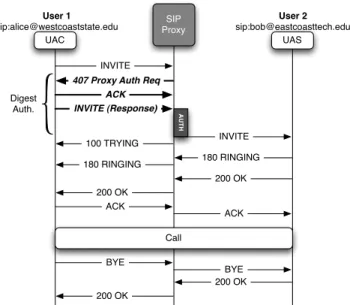
INVITE 100 TRYING 180 RINGING 180 RINGING 200 OK 200 OK ACK ACK Call BYE BYE 200 OK 200 OK Digest Auth.
Figure 3: SIP call setup using Digest authentication (bold).
2.2.3 SIP Digest Authentication
There are a number of ways in which SIP transactions can be authenticated. The SIP standard, RFC 3261 [161], recommends strong security mechanisms such as TLS, S/MIME and IPSec to authenticate and protect SIP sessions. However, these mech-anisms are complex to deploy and impose a significant overhead. Instead, most SIP providers use SIP Digest authentication, a simpler and lighter-weight challenge-response authentication protocol based on HTTP Digest authentication [71]. Fur-thermore, it is the only authentication protocol required in the UAs according to RFC 3261 (support for other protocols is not required). Thus, digest authentication is often considered the de facto authentication mechanism for SIP.
Digest authentication is used by SIP proxies to validate the identity of requests received from UAs (i.e., user authentication). It allows users to prove their knowledge of a shared secret (e.g., password) to a server without sending the secret unprotected over the network (protection against eavesdropping attacks).
Figure 3 shows a SIP call dialog using Digest authentication. As in most de-ployments, only INVITE requests require authentication. First, Alice’s UA sends an
INVITE request to the proxy. The proxy determines that the request requires authen-tication and responds with a SIP 407 response (“Proxy Authentication Required”) containing a nonce. Alice’s UA acknowledges the reception of the challenge, computes the hash of the shared secret and the nonce and sends it back to the proxy using a new INVITE message. The proxy then computes the answer after querying a database that stores the user’s shared secret. Finally, the proxy compares both values and, if they match, forwards the INVITE to the destination and the SIP dialog continues its standard flow.
Digest authentication efficiency relies on the use of hash operations and nonces, instead of symmetric or public key cryptography. In its basic form, a Digest authen-tication response is computed as follows:
response = M D5(HA1|n|nc|cnonce|qop|HA2)
where the MD5 hash algorithm is run over the concatenation of a value HA1, the nonce generated by the proxy, an optional nonce count (nc) value to prevent replay attacks, an optional client nonce (cnonce), the Quality of Protection (qop) value that should be set to “auth” and a value HA2. HA1 and HA2 are calculated as follows:
HA1 = M D5(username|realm|password)
HA2 = M D5(method|digestU RI)
whereusernameandpasswordare unique values to Alice (and ideally all other users),
realm is the protection domain (i.e., the provider or proxy’s name), method is the SIP action being authenticated and digestU RI is the destination address the client is attempting to reach.
offline dictionary attacks due to the use of low-entropy secrets (i.e., passwords) to compute the UA response. Moreover, a number of weaknesses in MD5 [195, 20, 108] have led the security community to recommend the use of other hashing algorithms. Still, in spite of its weaknesses, MD5-based digest authentication is widely supported by most SIP providers.
2.3
Web Applications
The World Wide Web (WWW), or simply the Web, is a repository of documents (web pages) linked together that are accessible over the Internet. The HTTP protocol is the main mechanisms to access these linked documents. The Web uses a client-server model where a web browser (client) is used to retrieve and display web pages from a web server. The set of related web pages and other documents stored in a web server is known as a web site.
During the early days of the Internet and the Web, most web sites only provided static content and basic functionality. Browsers were mainly used to request and display static web content. Thus, the flow of information was mostly unidirectional (i.e., server to client). However, due to the popularity of the Web, improved Internet access and the development of new web technologies (i.e., server-side and client-side code, Flash, AJAX,etc.), many web sites are now web applications, offering dynamic and customized content and a wide variety of services. In addition, the information flow is bidirectional: from the server to the client and the client to the server (i.e., user generated content). The set of new web technologies and web applications has been informally named as Web 2.0. Today’s web applications not only allow novel services such as social networking, online banking and online shopping; but also enable many of the tasks traditionally performed by standalone applications (e.g., word processing, spreadsheets, video games, etc.). This trend continues as web applications begin to merge with applications in mobile devices such as tablets and smartphones (i.e.,
Client
Web App Server Farm
User login (HTTPS) Content (HTTP or HTTPS)
(a) Traditional model
Client Web App Server Farm User login (HTTPS) Content (HTTP or HTTPS) CDN CDN Web App Server Farm (b) New model
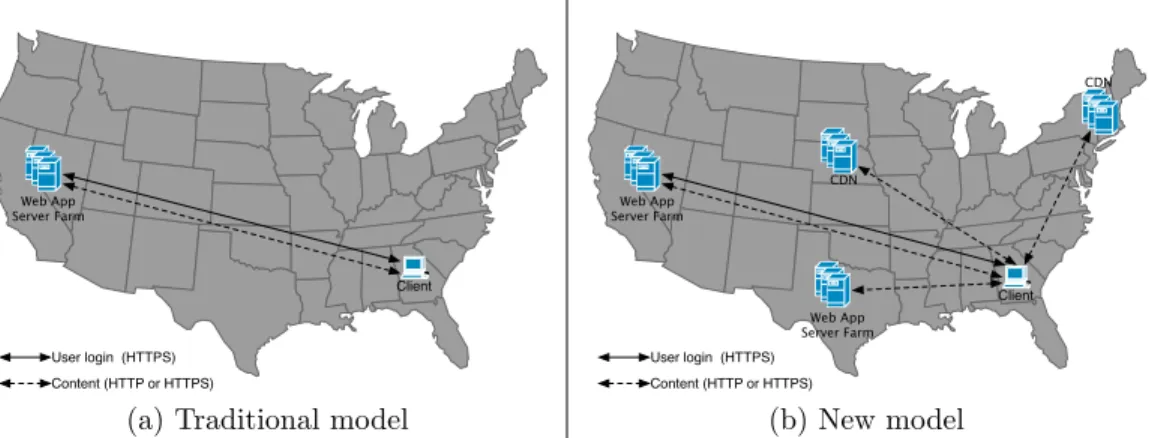
Figure 4: Simplified view of the traditional and the new Web 2.0 client-server mod-els. In the new model, state synchronization among the web application’s servers is expensive due to network latency.
mobile applications).
2.3.1 Large-Scale Scenario
Figure 4a shows a simplified view of the traditional model used by web applications. Clients located in different geographical areas send requests and retrieve content from a set of web application’s servers located in a single physical location. In this model, synchronizing state among the servers is typically not expensive. However, highly distributed Web 2.0 applications have replaced the traditional model with the one depicted in Figure 4b. In the new model, a web application has data centers in diverse locations and relies on Content Delivery Networks (CDN). Clients send requests and retrieve content from servers located in different geographical areas, typically closer to the client. This approach provides several benefits such as better redundancy, improved access bandwidth and reduced access latency. In this model synchronizing state among all the web application’s servers is expensive. For example, the web application cannot guarantee that all the servers have the same state information at a given moment. If this state information is required for authenticating requests, then some requests are likely to be denied wrongly.
2.3.2 The HTTP Protocol
The HyperText Transfer Protocol (HTTP) [68] is an application-layer protocol used to access Web resources. HTTP uses a messaged-based, client-server model in which browsers send requests and the servers return response messages. The server’ re-sponses include the requested resource (if successful) or a error message indicating why the request failed. HTTP is also a stateless protocol. Requests to a web server are treated as independent transactions with no relation to each other. In addition, HTTP relies on Uniform Resource Locators (URL) to identify and locate any resource on the Web. Each web resource is assigned a unique URL which defines four things: protocol, host computer, port and path (e.g., http://www.example.com/index.html). An HTTP transaction consist of a browser request and a server response. All the HTTP requests and responses have one or more headers containing connection details and an optional message body. The first line of each HTTP request has three components: an HTTP method, the requested URL and the HTTP version being used. The HTTP method is the actual command or action to be performed on the specified resource. The HTTP standard defines several methods such as:
• GET: requests a resource from the web server.
• POST: sends information from the browser to the web server. Also used to perform an action on the web server.
• HEAD: similar to GET except that the web server does not return the resource requested, only the response header (i.e., no message body).
• PUT: sends resources from the browser to the server.
• TRACE: echoes the incoming request. Used for diagnostic purposes.
However, from the list above, the GET and POST methods are the most commonly supported by web servers.
Similarly, the first line of the HTTP response messages includes a 3-digit status code and a short text description of the result of the request received. The response status codes can be divided in five groups:
• 1xx: informational status.
• 2xx: successful request.
• 3xx: redirection to a different resource.
• 4xx: the request contains an error (i.e., client error).
• 5xx: the server encountered an error processing the request (i.e., server error).
In general, the most common status codes are: 200 OK (the request was success-ful),404 Not Found(the resource was not found),301 Moved Permanently (redirects the browser permanently to a different URL) and401 Unauthorized(the request lacks proper authorization, HTTP authentication is required).
2.3.3 HTTPS: HTTP over SSL/TLS
Due to is simple design, HTTP offers no protection for the message’s control infor-mation (headers) and payload. As a result, the Secure Sockets Layer (SSL) protocol [72] and its successor, Transport Layer Security (TLS) [53] were developed to provide confidentiality and integrity protection for HTTP transactions (and latter extended to protect other application protocols). SSL/TLS offers a transparent transport en-cryption layer to web applications and it is widely supported by most browsers and web servers. Thus, HTTPS (i.e., HTTP over SSL/TLS) has become the standard way to provide protection to web communications. SSL/TLS can also be used to provide client and server authentication (see Section 2.3.6).
2.3.4 User Authentication
Most web applications require users to create an account (i.e., registration) and log in to create or resume a session. During registration, users are typically required to create a password that will be used during the log in process to authenticate the user. User authentication is one of the core security mechanisms used by most web applications. If user authentication fails, then an adversary can take control of the user account and access all the data stored in the application. In this section, we describe some of the main user authentication mechanisms used by web applications.
2.3.4.1 HTTP Basic and Digest authentication
Basic and Digest authentication [71] are HTTP’s built-in authentication mechanisms. Both mechanisms assume that each user shares a secret (password) with the server. The user needs to prove her knowledge of the password to the server in order to be able to access protected resources. For this purpose, Basic authentication requires the user to send her password unprotected (cleartext) over the network to the server. However, sending cleartext passwords over the network is a serious security flaw because an attacker can eavesdrop an authentication session and learn the user’s password. Digest authentication avoids this problem by sending a hash of the password and other authentication parameters instead of the password itself. In this way, it is more difficult for an attacker to obtain the user’s password by capturing her network traffic. While Basic and Digest authentication were the main authentication mechanisms used during the early days of web applications, today they are rarely used in appli-cations of medium or large complexity. One of the reasons is that these mechanisms do not integrate well with the look-and-feel of web applications (e.g., they rely on the browser’s dialog boxes).
Web App
POST login.php HTTP/1.1 [username, pwd] HTTP/1.1 200 OK SSL/ TLS 5 4 Web Browser SSL/TLS setup 1 2 3 GET login.php HTTP/1.1 HTTP/1.1 200 OK
Figure 5: HTML form-based authentication example.
2.3.4.2 HTML Form-based Authentication
With the adoption of server-side scripting languages, web applications became ca-pable of directly validating users credentials, instead of relying on server mechanims (e.g., digest authentication). Thus, HTML form-based authentication rapidly be-came the main user authentication mechanism used by current web applications due to its simplicity and flexibility. It has been estimated that more than 90% of web applications use this authentication method [179].
Figure 5 depicts an HTML form-based authentication flow. First, the browser and the server establish a SSL/TLS connection (step 1) to protect the subsequent HTTP transactions. Next, the browser sends a request for the web application’s login page (step 2), which is then returned by the server (step 3). The login page includes an HTML form that is used to capture the users’s authentication credentials (i.e., username and password). Once the user inputs her authentication information and presses the submit button, the browser sends the user’s authentication credentials to the server in a POST request (step 4). Finally, the server compares the values received with values stored in the application’s database. If the values match, the user is successfully authenticated and the server sends a 200 OK HTTP response to the browser (step 5). If the verification fails, the application typically asks the user to input her authentication information again (i.e., sends the login page again to the browser), for a limited number of times.
2.3.4.3 Other Authentication Mechanisms
Web applications can also rely on other well-known user authentication mechanisms such as NTLM (NT LAN Manager) and Kerberos. However, these mechanisms are rarely used in Internet scenarios (they are more appropriate for intranets and private networks). Similarly, SSL/TLS client certificates can be used to provide strong user authentication; however, they are typically used only in scenarios with high security requirements due to their associated deployment and management costs. Some web applications use multifactor authentication to provide more robust authentication. In this approach, users employ hardware tokens that generate one-time passwords. More recently, some web applications can also send one-time codes to users through secondary channels such as text messages and phone calls. Still, multifactor authen-tication mechanisms are not widely deployed due to their implementation costs and effects on user experience. Finally, web applications can also rely on third-party authentication services such as OpenID [146] and Microsoft Passport [132]. In this approach, users only share authentication credentials with an identity provider. To log into a web application, users authenticate first with an identity provider which vouches for the user identity to the targeted web application. This approach, however, has not been widely adopted.
2.3.5 HTTP Cookies and Session Authentication
HTTP does not provide support for session management. Each request and response exchanged between a client and a server are considered an independent transaction. While this is sufficient for most basic static pages, the need for session management mechanisms increased with the development of the first web applications. In 1994, Netscape proposed the use of HTTP cookies [113, 114, 15] for web session manage-ment. Due to their simplicity and efficiency, HTTP cookies were rapidly adopted by all major browsers and web applications, becoming the default mechanism for web
Web App
POST login.php HTTP/1.1 [username, password ]
HTTP/1.1 200 OK HTTP/1.1 200 OK SSL/ TLS 5 6 4 Web Browser
GET priv2.php HTTP/1.1[Cookie: SID=645aa87285e8d8adbe97c4f3e22 ] SSL/TLS setup GET login.php HTTP/1.1 HTTP/1.1 200 OK SSL/TLS setup 1 2 3 7 HTTP/1.1 200 OK [Set-Cookie: SID=645aa87285e8d8adbe97c4f3e22] GET priv1.php HTTP/1.1[Cookie: SID=645aa87285e8d8adbe97c4f3e22 ]
8 9
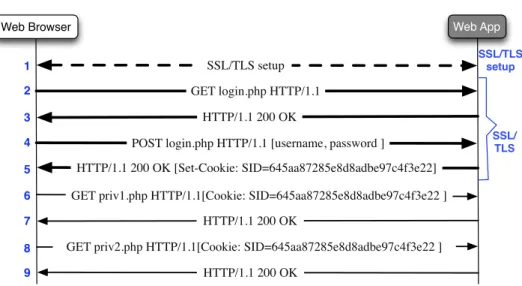
Figure 6: Session authentication using HTTP cookies. The browser attaches the same cookies to all the HTTP requests sent to a particular domain.
session management.
Cookies consist of name-value pairs containing session information that is stored in the browser. A web application generates cookies and sends them to the browser using theSet-CookieHTTP response header field, as shown in the following example:
Set-Cookie: SID=645aa87285e8d8adbe97c4f3e22
In addition to the cookie’s name and value, the web application can define other attributes such as thedomain and path to define the cookie’s scope, theexpiration to determine cookie’s lifetime, thehttponly flag to decide if client-side scripts can access the cookie and the secure flag to determine if the cookie should be transmitted only using a secure channel (i.e., HTTPS). Once cookies are accepted by and stored in the browser, they are appended to each request sent to the web application, using the
Cookie HTTP request header field, as shown in the following example:
2.3.5.1 Authentication Cookies
Authentication cookies are generally created during the user login process. After suc-cessful validation of the user’s authentication credentials, the web application gen-erates authentication cookies and sends them to the browser. The browser attaches these cookies to each request that requires authentication, based on the cookies’ scope and flags. Once established, authentication cookies become a temporary replacement of the user’s password credentials.
Figure 6 shows how cookies are set and used to authenticate browser requests. First, the browser and the server establish an SSL/TLS connection to protect the user login process (step 1). Next, the user authenticates to the web application using HTML form-based authentication (steps 2 to 5). Notice that after the successful vali-dation of the user credentials (step 4), the server response includes the authentication cookie (SID) as part of the message header (step 5). The browser stores the cookie and proceeds to attach it to each request that match the domain and path of the cookie. For example, requests for private resources in steps 6 and 8 require authentication; thus, the browser attaches the cookie to these requests. If the cookies are valid, the server returns the requested resources (steps 7 and 9). In addition, notice that the requests and responses after user login are not protected by SSL/TLS. This is a com-mon practice in web applications to reduce performance overheads and complexity due to SSL/TLS. However, this practice also introduces security vulnerabilities due to the static nature of the authentication cookies (see Chapter 6).
Authentication cookies should be carefully constructed to prevent abuse. How-ever, due to the heterogeneity of web applications, there are no standards for designing and implementing cookie-based session authentication mechanisms. As a result, many web developers design and implement in-house mechanisms, frequently introducing critical vulnerabilities [73, 191]. In general, web applications rely on well-known cryp-tographic techniques (e.g., symmetric encryption algorithms and crypcryp-tographic hash
functions) and secret information (e.g., cryptographic keys, users’ passwords) to build authentication cookies. The secret information is shared among all the web appli-cation’s servers that need to verify the authenticity of users’ requests. Nevertheless, while the confidentiality and integrity of cookies can be guaranteed by cryptographic mechanisms, attacks are still possible based on how cookies are used.
2.3.6 Server Authentication
Most of the protocols previously described only provide user authentication. However, implementing both user and server authentication (i.e., mutual authentication) is important to defend against different types of attacks such as server spoofing, phishing and MITM attacks (see Section 7.1.2). The most common approach to validate the identity of a web application’s server is via X.509 digital certificates [4]. A digital certificate binds the server’s identity (i.e., domain name) to the server’s public key and it is signed by a Certification Authority (CA) trusted by both the server and the browser. CAs are required because the browser and the server do not share any secrets at the SSL/TLS layer; thus, a trusted third-party is needed to vouch for the authenticity of the server’s certificate.
2.3.7 The SSL/TLS Protocols and Web Applications
Figure 7 presents a simplified view of the SSL/TLS handshake protocol between a browser and a web server. First, the browser sends a SSL/TLS ClientHello message to the server to request a new SSL/TLS connection (step 1). The server responds with a ServerHello message that typically includes the server SSL/TLS certificate
Cert (step 2). Next, the browser proceeds to validate the server certificate to ensure it is valid (i.e., it has not expired or revoked) and that it has been signed by a trusted CA. After successful validation, the browser uses the public key included in the certificate to encrypt protocol state parameters that are required to complete the handshake (i.e., parameters required to derive the session keys). The browser
ClientHello
ServerHello + Cert + ServerHelloDone ClientKeyExchange + Finished Finished 1 2 3 4 Browser Web Server
Figure 7: Simplified view of the SSL/TLS handshake protocol. The server can only complete the protocol if it has the private key corresponding to the public key in the server certificate (Cert. Thus, a successful handshake validates the server’s identity.
then sends the encrypted information in aClientKeyExchange message to the server, together with an authenticated and encrypted Finished message (step 3). Next, the server decrypts the information received and proceeds to use this information to generate the SSL/TLS session keys. The server then sends aFinished message to the browser that is encrypted and authenticated with the sessions keys (step 4). Finally, the browser uses the session keys to decrypt and to validate the server’s Finished
message. If this validation succeeds, then the server has proven to the browser it has the private key corresponding to the public key in the certificate. As a result, the browser is able to successfully verify the server’s identity and the sessions keys are then used to protect the subsequent HTTP messages.
CHAPTER III
RELATED WORK
3.1
VoIP Applications
3.1.1 SIP Authentication and Its Impact on Performance
Performance and scalability are critical properties for telecommunication networks. Emergency situations (i.e., natural disasters, terrorist attacks [88]), large scale events (i.e., American Idol [188], President’s Inauguration Day [159]), and Denial of Service attacks [119] are examples of events that can cripple the availability of the telecommu-nication network. SIP, as one of the central protocols of many IP telephony networks, plays an important role in the performance and scalability of such systems.
The performance and scalability of a SIP infrastructure has been the subject of several studies. Schulzrinne et al. [167] described a set of metrics for evaluating and benchmarking the performance of SIP proxy, redirect and registrar servers, and an architecture and techniques to measure SIP server performance. Other studies have focused exclusively on the performance of a SIP proxy, analyzing how different config-urations impact overall performance. Nahum et al. [141] evaluated the impact of state management, transport protocol and authentication on proxy’s performance. Their findings show that proxy’s performance varies greatly depending on the configuration chosen and that authentication has the greatest impact across all the configurations analyzed. Salsano et al. [162] presented a similar study focused on security configu-rations such as Digest authentication and TLS. They also concluded that authenti-cation considerably affects the performance of the proxy. Ono et al. [145] analyzed how the use of TCP affects the performance and scalability of a proxy. In addition, the author proposed several configuration changes to improve performance. Cortes et