The Nvivo Looking Glass: Seeing the Data Through the Analysis
Jenine Beekhuyzen Sue Nielsen Liisa von Hellens
School of Information and Communication Technology Griffith University
Brisbane, Australia
Email: jenine; l.vonhellens ; s.nielsen @ griffith.edu.au
Abstract
This paper focuses on the process of data analysis for an ethnographic doctoral study. Analysis of the interviews for the critical ethnography is discussed in detail in this paper, with particular attention given to the use of Nvivo – a qualitative data analysis software tool – to support data analysis. It is argued that using Nvivo helps to make the analysis process transparent. The metaphor of the looking glass is used to analogise the process of data analysis, and using Nvivo. The context of the critical ethnography is presented, the file sharing sub-culture. Actor-network theory is the guiding theory for the research, and detailed accounts of how different researchers apply actor-network theory to empirical data are rare. Therefore this paper makes a contribution by providing a detailed account of a systematic approach to qualitative data analysis, using ANT as the guiding theory.
Keywords
Nvivo, ethnography, coding, music, qualitative data analysis
INTRODUCTION
Methodology is the systematic study of the principles guiding an investigation, and the ways in which theory finds its application, as opposed to method which is a general mode of yielding data e.g. interviewing (Ellen, 1984: 9). Leininger (1992: 401) argues that, “the goals of qualitative research are not to ‘measure’ something but rather to understand fully the meaning of phenomena in context and to provide thick accounts of phenomena under study”. One important step in qualitative research analysis is coding, which “involves linking, breaking up and disaggregating the data so that once coded, the data look different, as they are seen and heard through the category rather than the research event” (Morse and Richards, 2002: 115).
This paper reports on the data analysis for an ethnographic doctoral study – see Beekhuyzen (2009) for more details of the larger study. The process of analysis of the interviews for the critical ethnography is discussed in detail in this paper. Nvivo8, a qualitative data analysis software tool, was used to aid data analysis, and how Nvivo was used is discussed. One of the primary reasons for using Nvivo to support data analysis is the ability to make the analysis transparent to other researchers. However it is strongly argued that it is important to understand the principles and literature about how to do rigorous qualitative research, regardless of whether software is used to support the process. The same principles apply whether doing analysis with folders and highlighter pens or with the aid of software, however the main benefit of using software is its ability to manage large amounts of data, and the associated search and retrieval features.
This paper adopts the metaphor of the looking glass from Alice in Wonderland, in which the process of qualitative analysis is much like the looking glass. During qualitative analysis, the data is “fractured” (Strauss, 1987), or smashed (glass), breaking it up into manageable pieces. The researcher then reconstructs the data to reflect back a view of reality, with the chosen theory guiding the investigation. The looking glass / analysis also has a mystical quality, reflecting the exploratory nature of qualitative research. Nvivo adds to this metaphor by becoming the looking glass itself, the mirror that enables the researcher to smash the data and to reconstruct it into something meaningful. Nvivo enables the researchers to see the data well, as it accurately reflects the data back to the researcher.
Myers (1999) brings together the critical research approach with ethnography as a methodology for investigating information systems. Although the critical approach is not discussed in detail in this paper, it is important to outline the research design to explain the context for analysis. Critical ethnography views ethnographic research as an “emergent process, involving a dialogue between the ethnographer and the people in the research setting” (Myers, 1999). To guide this dialogue, a research question was formulated:
How do information systems support unauthorised file sharing activities within an underground online community?
This paper is not specifically concerned with answering this research question; instead it attempts to outline the systematic process of analysis that helped to answer this question.
LITERATURE REVIEW: AN ACTOR-NETWORK THEORY PERSPECTIVE OF
THE FILE SHARING SUBCULTURE
Actor-network theory, or ANT as it is often abbreviated, was pioneered by Bruno Latour, Michael Callon and John Law (Callon, 1986; Latour, 1987; Law, 1987). ANT provides an interdisciplinary approach to studying issues of technology and society. It is an established social theory for investigating information systems (Walsham, 1997). In ANT, all contributors to the formation of the network are treated equally, thus “the term actant is symmetrical, it applies indifferently to both humans and non-humans” (Latour, 1991: 179).
There are criticisms of ANT; the main argument is against the assumption that actors can be human or non-human; however this is also the main feature of the theory. Other arguments are against using the same conceptual apparatus to analyse humans and non-humans in the heterogeneous network (Shoib, Nandhakumar and Jones, 2006), and that it treats technological and social elements as inseparable. Regardless, many information systems studies have used ANT; some authors have used the theory to develop theoretical foundations (Latour, 1999; Rose, Jones and Truex, 2005; Walsham, 1997) while others use it to present their empirical data (Beekhuyzen and von Hellens, 2006; Lanzara and Morner, 2005; Shoib et al., 2006). Shoib et al. (2006) believe its usefulness and applicability to practice has been visited only briefly.
Actor-network theory is used to guide the analysis of the music file sharing subculture in this paper, a group considered a deviant subculture for purposes of analysis. ANT has been used to study a variety of other subcultures and voices that are marginalised in political debates, often focusing on contemporary issues. Mol (2008) used ANT to investigate anaemia, a medical condition she conceptualizes as a “deviance that comes in (at least) clinical, statistical and pathophysiological forms”. Gomart gains insight into the use of methodone and heroin by investigating the actor-network that drug users (another marginalised group) are situated in (Gomart, 2002). The study by Hoyweghen, Horstman, and Schepers (2006) titled “Making the normal deviant”, also in the medical domain, uses ANT to better understand the policy debates on genetic testing in life insurance. They argue that predictive medicine constitutes new ground in old debates about individual control, responsibility and blame for health. They are shedding new light on a much-discussed topic in contemporary society.
Newton (2002) used ANT in his critique of ‘greening’ organisations, tracing the associations of the actor-network which included greening organisations and green technologies, situating his critique within issues of globalisation. The paper by Hamilton (2001) which looks at new literacy studies, argues that ANT demonstrates the contingent and precarious way in which social order is created. These studies suggest that ANT offers a useful way to investigate the contemporary issue of unauthorised file sharing.
Contemporary online music access and use is a complex issue with many competing interests at stake. Actor-network theory (ANT) is the adopted theory due to its ability to view people and technology equally in the music network. ANT is useful in identifying and discussing the relationships between those in the music actor-network. Social theories and their assumptions can help researchers to construct a variety of worldviews, enabling a focus on the everyday experience of music consumers (Shoib et al., 2006). Through applying ANT to understand the associations in the music actor-network, it is possible to construct a variety of worldviews of those related to the underground file sharing community.
Actor-network theory provides the tools to investigate the sensitive balance between the technical and social aspects of the community. Lee (2003) argues that peer-to-peer file sharing systems blur the distinction between the technologies that exist in the network, and suggests that is necessary to learn more about how individuals interact in this highly technical network. He proposes to gather “an overall picture of how current users perceive existing file-sharing systems, the importance of various features, and the concerns underlying these reactions” (Lee, 2003).
METHODOLOGY - A CRITICAL ETHNOGRAPHY OF A SUBCULTURE
Key informants can be a useful way to explore the how cultural ethos is reflected in selected aspects of everyday. They allow us to focus on particular behaviours in particular settings rather than attempt to portray a whole cultural system. This is a useful way to look at the activities in music file sharing, and how it is done in different settings. This paper focuses on the analysis of the interview data for the study, however it is important to note that the coding presented in this paper was only carried out after 120 days of participant observations in an underground music file sharing community, and after the focus groups had occurred. During this time, the scope of the empirical research was established.
To summarise the ethnography that forms the basis for the data analysed in this paper, tertiary students are the music consumers at the centre of the study, contributing to sixteen1 interviews and three focus groups with 2-4 people. Six musicians and eight music recording industry stakeholders also informed the study through interviews. They provided information that was useful in providing context for observing Roswell – an underground music file sharing community. A key feature of ethnography is spending extended time in the ‘field’ so the 120 days of observations of Roswell form the basis of the ethnography, strengthened through insights gained from interviews with music users, musicians, and key people in the music recording industry. This paper focuses on the data analysis of the interviews from each of the stakeholder groups.
There are criticisms of ethnographies that need acknowledging, the main criticism being the choice of small samples in an ethnography which represents a trade-off between studying cases in depth or breadth (de Laine, 1997: 24). However the choice of small sample sizes provide an opportunity for deep analysis in an ethnography, resulting in thick descriptions (Geertz, 1973) of a particular setting or scenario. Rather than seeing this as a negative, purposefully choosing the setting (Patton, 1990: 169) can provide a good opportunity to investigate a problem in great detail. Because the purpose of this study is to understand the meanings shared by a social group and their culturally specific model of experience (de Laine, 1997: 46) this approach can help to gain a actor-oriented (file sharer) perspective.
Analysing the Literature
The qualitative data analysis software Nvivo8 was also used in conducting the literature review for the wider doctoral study. Traditionally Nvivo has been used mostly for data collected in the field but now it is being used more regularly for reviewing literature; see the paper by Bandara (2006) in which she presents “an illustrative demonstration of Nvivo2 for research management”, however di Gregorio started the discussion back in 2000 when she demonstrated the tools in Nvivo2’s toolkit which she believes “support the various processes and strategies involved in constructing arguments from the literature” (2000). More recently, some other papers on how to use Nvivo for research have been published, and are useful in providing advice to researchers (Dean and Sharp, 2006; Woods and Wickam, 2006), however such papers are in short supply.
Each research paper analysed for the literature review in the study was imported into Nvivo to help in identifying themes and classifying the literature data for writing about it, a process very similar to that described for empirical data analysis in this paper. Nvivo was useful in managing the large amount of research papers over the period of the doctoral study (three and a half years). Details of how Nvivo was used for the literature review is outlined Beekhuyzen (2007, 2008). This paper continues that discussion by taking the next step, discussing how Nvivo8 was used to aid data analysis.
MAPPING THE ACTOR-NETWORK
Detailed accounts of how different researchers apply actor-network theory to empirical data are rare. Therefore this paper makes a contribution by providing a detailed account of a systematic approach to qualitative data analysis, using ANT as the guiding theory.
The ANT approach to analysis and interpretation used in this paper is in line with the approach outlined in the collection of articles in Actor-network theory and organising (Czarniawska and Hernes, 2005: 9; Hernes, 2005: 117). Firstly, actants (those which act and are acted upon) are identified, and then the actants are followed through a trajectory or programs and anti-programs until they become actors (acquiring a distinct and relatively stable character). Those with successful programs (e.g. iTunes), or successful anti-programs (e.g. Roswell who has strength in opposition and resistance) become actors. Their success is due to association: the formation and stabilisation of networks of actants, who can then present themselves as actor-networks (Czarniawska and Hernes, 2005: 9)
Unauthorised music file sharing can be considered a black box in ANT terms; a topic taken for granted, containing issues often not given any explanation. As a starting point for the analysis, actants in the network are identified. These include music consumers, musicians, and those involved in distributing music. This was not an easy task due to the many new players continually entering the industry, and the changing alliances between those in the network. However the associations between each of the actants at a point in time are identified and documented. An example of an association between music consumers and musicians is that consumers may feel that musicians get a low monetary return from music sales because most of it goes to record labels, so they choose not to pay.
The documented associations are traced to identify the actants connections with the programs (paid authorised
systems) and anti-programs (free unauthorised systems) available. These programs/music information systems become actors in the music network. In doing so, details of how the groups/actors form and stabilise is explored; for example, details of how Roswell came to exist, and the use of the concept of translation to gain knowledge
of Roswell’s embedded cultural practices, technology and artifacts (Czarniawska and Hernes, 2005: 9). Through this analysis, Roswell is seen as a “super actor that seems to be much larger than any individuals that constitute it, and yet it is an association – a network – of these individuals, equipped with a ‘voice’” (Czarniawska and Hernes, 2005: 7). The super actor is akin to the Leviathan identified by Callon and Latour (1981). Actor-network theory’s theoretical constructs place great reliance on the tracing of intricate networks and associations (Doolin & Lowe, 2002), and through tracing and organising these associations, power relations become visible. The Roswell artifact (the anti-program) is then given a voice and allowed to tell its own story (Porsander, 2005). ANT was useful in observing, describing and interpreting the formation of power within each of these groups of actors (Czarniawska and Hernes, 2005: 13).
The term controversies is a concept from actor-network theory (Callon, Latour and Rip, 1986: 11) and it is used in this paper as a tool for analysis to identify points of difference, or problems in the file sharing network. Complementing the use of actor-network theory is a critical research approach, which focuses on the oppositions, conflicts and contradictions in contemporary society (Doolin & Lowe, 2002). In this paper, actor-network theory is used with a critical spirit, providing the concepts and tools to enable an understanding of the marginalised subculture of underground file sharing communities. In line with actor-network theory traditions for empirical research, four main controversies were identified during the analysis of the data:
1. Changes in music distribution channels have an influence on how music is accessed and used – pirate vs. purchase ideologies, complex relationships between stakeholders, the move to digital music, legal cases/issues/interventions.
2. Legal online music distribution does not appear to meet the needs of many users – quality, cost, choice, convenience, interoperability, and value.
3. Technical competence is an influence on choices about which technology to use for music access, and general acceptance/non-acceptance/awareness restrictions such as Digital Rights Management. 4. Community life/culture including the every day activities of file sharers is relatively unknown – roles,
rules, rituals, norms, values, ideologies, and language.
Once the actor-network was established, ANT was used to problematise file sharing in order to identify the main
controversies. This was done through collecting and documenting all of the issues raised by the research subjects in the empirical data, and identifying patterns, or points of difference, between them. The issues fell into four main areas or controversies (it is important to note that controversies are not necessarily controversial, instead the concept is used to explore points of difference). In focusing on the controversies, the black boxes begin to open to show the complex chains of actor-networks which are normally concealed by the black box effect (Latour, 1999). This grouping into controversies then provided a basis for further analysis of the underlying issues in order to answer the research question outlined earlier.
According to Latour (1993), science and its products (such as technologies used for music distribution) are intricately and inextricably related to power,and the study of science from an ANT perspective inevitably leads into politics. Mapping the controversies emphasises the importance of identifying the problems related to unauthorised music file sharing to see how the current situation came to be. The data analysis process presented in next section enabled the identification and exploration of these controversies (outside of the scope of this paper – see Beekhuyzen, von Hellens and Nielsen (2010) for more details) .
CODING STRATEGIES
Coding, if done well, “is the way you monitor occurrences of data about your ideas and the way you test them. It makes resilient links between data and ideas, links that you can trace back to find where particular ideas came from and what data are coded there, to justify and account for the interpretation of the ideas” (Morse and Richards, 2002). Coding needs to be a systematic process to ensure the data is treated equally. However coding strategies adopted for qualitative data analysis are rarely documented in detail.
Maxwell (2005: 96) presents a useful strategy for qualitative data analysis, details of which are covered in this section. He argues that the initial step in qualitative analysis is “reading the interview transcripts, observational notes” and any other documents relevant to the study. The transcription process itself can be used for initial analysis, with the analyst recording notes or memos while transcribing. These initial notes can be used to formulate categories and themes, and help to begin to think about relationships between them.
According to Maxwell (2005: 96), the researcher has a number of analytical options falling into three categories: (1) memos, (2) categorizing strategies, and (3) connecting strategies. Maxwell strongly argues that qualitative research is more than coding (categorizing), and that most researchers informally use other strategies as well, they just do not emphasise them in their writing. Examples of these strategies include reading and thinking about the transcripts and observation notes, writing memos, developing and evolving coding categorizations and
applying these themes to the data, analysing narrative structure, and building contextual relationships between themes in the data. Agreeing with Maxwell, it is proposed that these are all important strategies for data analysis and the following section presents these as a systematic approach to data analysis.
Memos
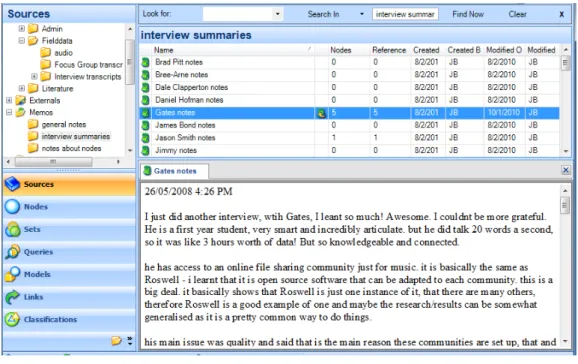
Memos are a way to store notes about the data, providing a useful way to record interpretations of patterns found in the data, or to comment generally on issues revealed during the analysis. Nvivo enables the creation of such notes as Memos, stored in a similar way to an interview transcript, allowing stored notes to be easily retrieved and linked to relevant items. Ideas stored in memos can also be coded in a similar way to interview transcripts. Categories of memos can also be created, allowing easy management of different types of stored notes e.g. interview summaries, notes about nodes etc (as seen in Figure 1).
Memos can contain notes about analytical, methodological and/or theoretical insights of the data, with the ability to be linked directly to research events such as interviews or observations. For instance, good qualitative research practice suggests the researcher completes a summary of the interview within a day of completing the interview. Such notes capture important elements of the interview which allow the data to be put into context when being analysed; they might include comments about the environment in which the interview took place (noisy, difficult to hear), about the participant’s perceived demeanour at the time of the interview (did not want to talk about controversial topics, just had a disagreement with a colleague), and/or other contextual issues (the phone kept ringing keeping the interviewee distracted etc). An example of these memo notes is presented in Figure 1.
Figure 1: Creating Memos
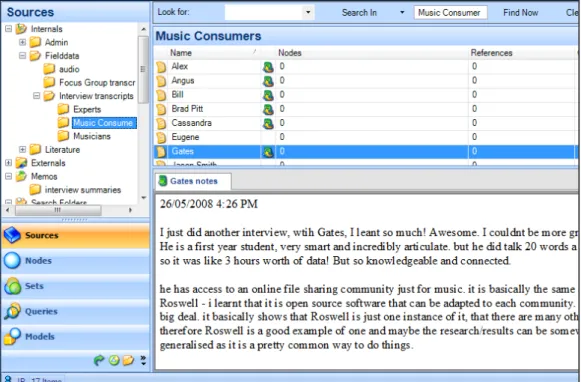
Such notes can capture important information useful for putting the research subjects comments in context when analysing their discussion. To make the link between the memo and interview explicit, a memo-link can be created in Nvivo (as shown in Figure 2). The icon next to the memo – a green notepad with a yellow arrow, identifies the link. It is then easy to see that there is further information related to the interview when looking at the list of interview transcripts in the Internals folder, or easy to see which node a memo relates to.
Figure 2: Linking Memos
Figure 2 also shows how empirical data from the different stakeholder groups are represented in Nvivo. They are separated out to enable the searching and retrieving of data only in the interviews, or only in the focus groups, or to easily find the audio files of the interview transcripts to go back and listen to comments in context.
Categorizing Strategies
The main categorizing strategy in qualitative research is coding (Maxwell, 2005: 96). Differentiating from quantitative research where the focus is on counting the frequency of items in pre-established categories, the goal of coding in qualitative research is to “fracture” (Strauss, 1987) the data, rearrange it into categories that facilitate comparison between things in the same category, and aid in the development of theoretical concepts (Maxwell, 2005: 96). This process of fracturing the data can be analogised to the metaphor of the looking glass, where the looking glass (Nvivo) allows the data to be smashed or distorted, so that it can be put back together to provide a reflection of reality, effectively seeing the data through the category and not the research event (Morse and Richards, 2002: 115).
Others simply call these categories labels (Morse and Richards, 2002: 115), however Morse and Richards argue that it is important to “move beyond mere labelling”. They suggest three approaches to coding which fit with Maxwell’s strategy, suggesting that these are a generally accepted approach to coding. Maxwell (2005: 96) provides useful advice for planning the categorizing, separating the process into three categories (although it is important to note that these categories are iterative):
1. Organizational – Descriptive coding (Morse and Richards, 2002:116)
2. Substantive – Topic coding(Morse and Richards, 2002:116)
3. Theoretical – Analytical coding(Morse and Richards, 2002:116)
The first category is a good place to start building the categorization scheme for your research. Organizational
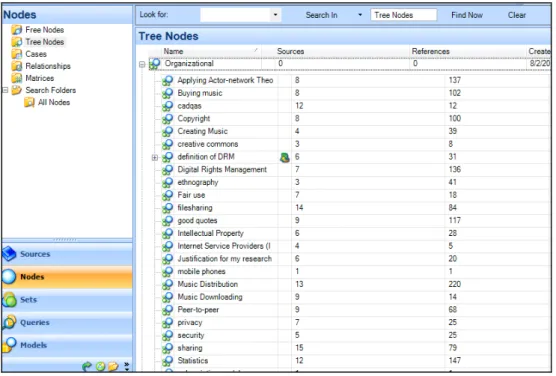
categories are “broad areas or issues that you establish prior to interviews and observations, or that could usually have been anticipated” (Maxwell, 2005: 97). Such categories may be thought of as ‘topics’, referring to the more descriptive elements of the subject of the study. He gives examples including ‘retention’, ‘policy’, ‘goals’, ‘alternatives’, and ‘consequences’. Figure 3 provides examples of organizational categories in the file sharing ethnography; these include copyright, music distribution, peer-to-peer, sharing etc.
Figure 3: Organizational Categories
Some of the organizational categories were created before data collection: such as security, privacy, file sharing, good quotes, definitions of DRM etc. These were derived primarily from the literature review. Those originally created were added to as the data analysis proceeded. During data analysis, memos were also created as a place to store ideas and thoughts about a particular theme/topic. The screenshot in Figure 3 shows a link to a memo that holds notes and a discussion about the differing definitions of digital rights management presented by the research subjects.
The second category possibly builds upon the first ‘organizational’ categories. Substantive categories, according to Maxwell (2005: 97), “provide some insight into what’s going on”. He argues that these categories are generally not known to be significant before data analysis, unless the researcher is already somewhat familiar with the kind of participants and/or setting under investigation, or using a well-defined theoretical framework or model.
Substantive categories are primarily descriptive (2005: 97), and generally reflect the research subjects concepts and beliefs. Categories are often taken from the participant’s own words, in addition to being developed from the researchers description of the situation. Such categories are often developed inductively through a process of “open coding” of the data (Maxwell, 2005: 97; Strauss, 1987). This level of coding contributes to the formation of “substantive theory” in grounded theory (Silverman, 2006: 95).
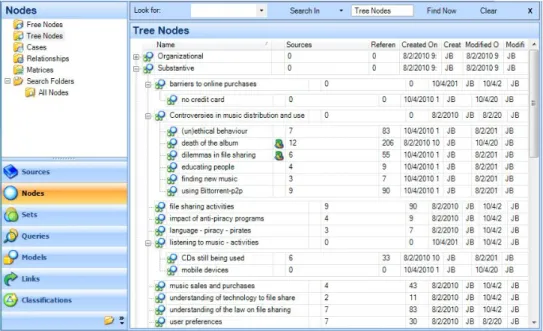
Such substantive categories developed for the study of file sharing at the centre of this paper include processes for buying music and for finding new music, using BitTorrent technology, and for capturing participant’s ideas about topics such as the ‘death of the album’ – See Figure 4. Other categories were developed to capture associations in the actor-network, and controversies were identified through the data analysis of the interview transcripts. Some of these categories were moved to the theoretical category and expanded in the later stages of data interpretation.
Figure 4: Substantive Categories
The final category for classification that Maxwell presents is the theoretical category (2005: 97), which encourages arranging the coded data into a more abstract framework. These categories are developed from concepts in the theory being used, or from an inductively developed theory (or both). These categories more closely represent the researcher’s concepts created through a theoretical lens, and generally do not resemble words that a research subject would use in a regular conversation/discussion. Miles and Huberman (1994: 18) summarise theory-building saying it “relies on a few general constructs that subsume a mountain of particulars”. Often the coding in these theoretical / analytical categories comes from ‘coding on’ from the substantive categories to new, finer categories (Morse and Richards, 2002: 117): effectively opening up a node, and coding to other theoretical nodes from this already classified data. Memos made during earlier phases of coding can provide relevant details useful in theory building/testing. Such theoretical categories developed for the study on file sharing include motivations for file sharing, power relations, and the perceived impact of file sharing on the music recording industry – see Figure 5. The linked memo to the motivations node contains useful notes and insights recorded previously, which are helpful for interpreting the data in a theoretical context.
Figure 5: Theoretical Categories
Moving from substantive to theoretical themes in this project was made difficult by the lack of details about how to apply ANT. The advice given by Czarniawska and Hernes (2005) discussed earlier in the section Mapping the Actor-network was employed in these later stages of analysis when looking for emerging theory.
Connecting Strategies
Connecting strategies build upon the memos and categorization strategies discussed so far. Once the data is ‘fractured’ to a level that is deemed satisfactory (i.e. that nodes adequately hold all ideas about a concept), connecting analysis “attempts to understand the data in context, using various methods to identify the relationships among the different elements of the text” (Maxwell, 2005: 98). This is the process of reconstructing a model of the data as mentioned earlier, with such strategies looking for “relationships that connect statements and events within a context into a coherent whole” (2005: 98).
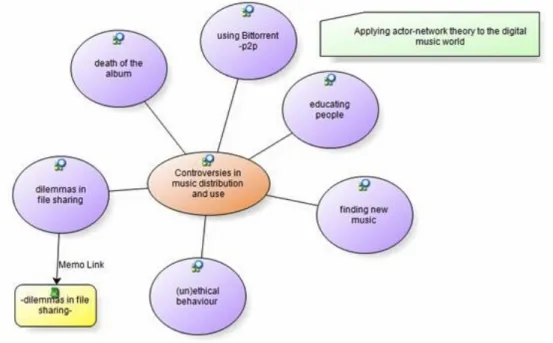
Analysis strategies need to be compatible with the research questions being asked, and Maxwell argues that connecting strategies are necessary for building theory, a primary goal of analysis (2005: 98). Specialised software like Nvivo are designed to help with the process of abstraction (Morse and Richards, 2002: 140), and Morse and Richards argue that software can make a considerable contribution at the early stages of abstracting. It is argued that it is important to retain the contextual ties related to the data, and Nvivo enables this easily. One visual way of achieving this is through the development of models, which are useful for displaying the associations between different elements of the data. Figure 6 shows one such attempt at a connecting strategy; the theoretical category of controversies in music distribution and use has been linked to substantive categories earlier identified. This process is part of theory development and it is iterative with the coding of theoretical themes (nodes).
Figure 6: Example of Connecting Strategies
It is somewhat difficult to document and discuss connecting strategies as they are often abstract and difficult to make explicit. However it is argued in this paper that the building blocks in the early stages of data analysis (as presented in this paper) are essential to enable the building of useful and relevant connecting strategies.
DISCUSSION
Maxwell (2005: 98) argues that the distinction between organizational and substantive/theoretical categories is important to encourage the development of substantive categories in addition to organizational ones, and it also encourages a systematic way of applying a theoretical lens to the data. He also argues that the more data in a research study, the more important the latter categories are because it becomes harder to keep all ideas in your head. Confirming Maxwell’s beliefs, this paper argues that a formal organisation and retrieval system is essential for adequately capturing the process of analysis and documenting the interpretation.
Actor-network theory was initially chosen because of the way it perceives humans and machines as equal in the actor-network. It was also chosen because of its focus on associations; at the beginning of the project although the network was unclear, it was clear that the associations were in flux and that there were complex relationships between the actants/actors. Nvivo was useful in enabling the creation of models to represent firstly the actors and actants, then for documenting the associations between them. Then it was possible to trace the associations to
identify problems/differences in their points of view. These contributed to identifying the relevant controversies
related to answering the research question.
Nvivo was also useful within the ANT approach as it made it easy to see the data supporting the theory of
controversies as they were discussed by different stakeholders, e.g. how do consumers talk about “educating people” and how did the music recording industry experts talk about it, giving the ability to represent multiple points of view on a topic. These multiple perspectives were one of the main contributions of the study.
When reflecting on how useful Maxwell’s coding strategy (2005: 96) was for this study, it is argued that it was useful in providing a systematic approach to data analysis, encouraging the writing of memos to capture thoughts about the data and patterns seen in the data. Breaking down the themes or nodes into three distinct but iterative stages also helped to plan and work through the analysis. Although the connecting strategies applied are somewhat difficult to discuss due to their abstract nature, the modelling tools particularly were useful to illustrate the patterns in the data, and to consider how data connects with theory. Above all, Nvivo was useful to manage the large amount of interview data, easily enabling a view of multiple perspectives on a topic from different groups of stakeholders. The work of Morse and Richards (2002) was also useful to give a more descriptive account of applying Nvivo, and much of their work is consistent with the strategy proposed by Maxwell.
One other major benefit of using Nvivo to support data analysis if used also for managing the literature review is having empirical data and literature together in one place. When writing about the data, one challenge is to link the empirical findings back to the literature to demonstrate how the current study fills a gap in the literature. As discussed in Beekhuyzen (2008), the process for analysing literature is very similar to the process for analysing empirical data outlined in this paper, and similar coding strategies can be applied to the literature analysis. An added benefit of using Nvivo to manage both types of analyses is that, for instance, the literature and the empirical data related to the “death of the album” are all in one place, making connections when writing much easier to identify.
CONCLUSION
This paper focuses on the process of data analysis for an ethnographic doctoral study. It provides a detailed account of data analysis as it occurred in one particular doctoral study. Analysis of the interviews for the critical ethnography are discussed, with particular attention given to the use of Nvivo. Actor-network theory is the guiding theory for this study, and there were challenges in applying this theory, as there are few documented details of how the theory should be applied. Mapping the actor-network is one such approach to applying the theory in this study, and a benefit of using Nvivo was that it helped make the application of the theory transparent, so that others can see how the analysis was done.
Actor-network theory is a useful lens to investigate the file sharing as its main consideration is in understanding the relationships in an actor-network. It is not so concerned with why a network takes its form, rather it is concerned with how actor-networks are formed, evolve and are maintained. Nvivo helped to document the relationships between the actors, allowing these associations to be updated to reflect any changed positions in the actor-network. In doing this, Nvivo provided tools to visually illustrate these connections and associations. This paper uses the metaphor of the looking glass to analogise the process of data analysis. Nvivo (the looking glass) was very useful in supporting the data analysis in this study. Guidelines for data analysis as discussed in the qualitative research texts are essential when approaching data analysis, and the explicit process for applying them in this study is presented. It is strongly argued that in order to use Nvivo effectively, a strong knowledge of the theory of conducting qualitative research and doing qualitative data analysis is essential.
The use of a software tool like Nvivo is advocated in this paper for the literature review and analysis of empirical data. By applying the principles of qualitative analysis when using Nvivo, the outcome is a systematic research process, which enables the data, the analysis and the subsequent findings to be transparent.
REFERENCES
Bandara, W. (2006). Using Nvivo as a research management tool: A case narrative. Proceedings of QualIT2006: Quality and Impact of Qualitative Research, Brisbane, Australia, Griffith University.
Beekhuyzen, J. (2007). Putting the pieces of the puzzle together: Using Nvivo for a literature review. Proceedings of QualIT2007: Qualitative Research, From the Margins to the Mainstream, Wellington, New Zealand, Victoria University of Wellington.
Beekhuyzen, J. (2008). Conducting a literature review: A puzzling task. Australian Association For Research In Education Brisbane, Australia.
Beekhuyzen, J. (2009). "A Critical Ethnography of an Online File Sharing Community: An Actor-Network Theory Perspective of Controversies in the Digital Music World." Brisbane, Australia, Griffith University, Doctorate of Philosophy, http://www.iinet.net.au/~beek/phd.pdf
Beekhuyzen, J. and L. von Hellens (2006). An actor-network theory perspective of online banking in Australia. AMCIS American Conference on Information Systems, Acapulco, Mexico, Association for Information Systems.
Beekhuyzen, J., L. von Hellens and S. Nielsen (2010). Collaboration in Online Communities: Reconceptualising the Complex Problem of Unauthorised Music File Sharing. Proceedings of the Australasian Conference on Information Systems (ACIS), Brisbane, Australia, Queensland University of Technology.
Callon, M. (1986). Some elements of a sociology of translation: Domestication of the scallops and fishermen of St. Brieuc Bay. Power, action and belief: a new sociology of knowledge? J. Law. London, Routledge:
196-233.
Callon, M. and B. Latour (1981). Unscrewing the Big Leviathan: How Do Actors Macrostructure Reality. Advances in Social Theory and Methodology: Toward an Integration of Micro and Macro Sociologies. K. Knorr and A. Cicourel. London, Routledge.
Callon, M., B. Latour and A. Rip (1986). Mapping the Dynamics of Science and Technology: Sociology of Science in the Real World. London, Sheridan House Inc.
Czarniawska, B. and T. Hernes (2005). Constructing macro actors according to ANT. Actor-network theory and organizing. B. Czarniawska and T. Hernes. Elanders Berlings, Malmö, Liber & Copenhagen Business School Press: 7-13.
de Laine, M. (1997). Ethnography: Theory and applications in health research. Sydney, Maclennan and Petty. Dean, A. and J. Sharp (2006). "Getting the most from NUD*IST/NVivo." The Electronic Journal of Business
Research Methods 4(1): 11-22.
di Gregorio, S. (2000). Using Nvivo for your literature review. Strategies in Qualitative Research: Issues and Results from Analysis using QSR Nvivo and Nud*ist, London, Institute of Education.
Ellen, R. F., Ed. (1984). Ethnographic Research: A Guide to General Conduct. London, Academic Press. Geertz, C. (1973). Thick description: Toward an interpretive theory of culture. The interpretation of cultures.
New York, Basic Books.
Gomart, E. (2002). Methadone: Six effects in search of a substance. London, Sage Publications.
Hamilton, M. (2001). "Privileged literacies: Policy, institutional process and the life of the IALS." Language and Education 15(2&3).
Hernes, T. (2005). The organization as nexus of institutional macro actors: The story of a lopsided recruitment case. Actor-network theory and organizing. B. Czarniawska and T. Hernes. Elanders Berlings, Malmö, Liber & Copenhagen Business School Press: 112-128.
Hoyweghen, I., K. Horstman and R. Schepers (2006). "Making the normal deviant: The introduction of predictive medicine in life insurance." Social Science & Medicine 63(5): 1225-1235.
Lanzara, G. F. and M. Morner (2005). Artifacts rule! How organizing happens in open source software projects. Actor-Network Theory and Organizing. B. Czarniawska and T. Hernes. Malmo, Liber & Copenhagen Business School Press: 67-90.
Latour, B. (1987). Science in action: How to follow scientists and engineers through society. Cambridge, Massachusetts, Harvard University Press.
Latour, B. (1991). Technology is society made durable. A sociology of monsters. J. Law.
Latour, B. (1993). We have never been modern. Cambridge, Massachusetts, Harvard University Press.
Latour, B. (1999). On Recalling ANT. Actor Network Theory and After. J. Law and J. Hassard. Oxford, Blackwell Publishers / The Sociological Review: 15-25.
Law, J. (1987). Technology and heterogeneous engineering: The case of Portuguese expansion. The social construction of technological systems: New directions in the sociology and history of technology. W. E. Bijker, T. P. Hughes and T. J. Pinch. Cambridge, MA, MIT Press.
Leininger, M. (1992). "Current issues, problems and trends to advance qualitative paradigmatic research methods for the future." Qualitative Health Research 2(4): 392-415.
Maxwell, J. A. (2005). Qualitative Research Design: An interactive approach. Thousand Oaks, California, Sage Publications.
Miles, M. B. and B. A. Huberman (1994). Qualitative data analysis: An expanded sourcebook. Thousand Oaks: CA, Sage Publications.
Mol, A. (2008). "Ontological politics. A word and some questions." Sociological Review 46(5): 74-89.
Morse, J. and L. Richards (2002). Readme first for a user's guide to qualitative methods. London, Sage Publications.
Myers, M. D. (1999). "Investigating information systems with ethnographic research." Communications of the Association for Information Systems 2(23): 20.
Newton, T. J. (2002). "Creating the new ecological order? Elias and actor-network theory." Academy of Management Review 27(4): 523-540.
Patton, M. Q. (1990). Qualitative Research and Evaluation Methods. Newbury Park, CA, Sage Publications. Porsander, L. (2005). "My name is lifebuoy". An actor-network emerging from an action-net. Actor-network
theory and organizing. B. Czarniawska and T. Hernes. Elanders Berlings, Malmö, Liber & Copenhagen Business School Press: 14-30.
Rose, J., M. Jones and D. Truex (2005). "Socio-Theoretic Accounts of IS: The Problem of Agency." Scandinavian Journal of lnformation Systems 17(1): 133-152.
Shoib, G., J. Nandhakumar and M. Jones (2006). Using social theory in information systems research: A reflexive account, in quality and impact of qualitative research. Proceedings of QualIT2006: Quality and Impact of Qualitative Research, Brisbane, Australia, Griffith University.
Silverman, D. (2006). Interpreting qualitative data. Thousand Oaks: CA, Sage Publications.
Strauss, A. (1987). Qualitative analysis for social scientists. Cambridge, England, Cambridge University Press. Walsham, G. (1997). Actor-network theory and IS research: Current status and future prospects. Information
systems and qualitative research. A. S. Lee, J. Liebenau and J. I. DeGross. London, Chapman and Hall:
466-480.
Woods, M. and M. Wickam (2006). Methodological implications of software use: an empirical investigation of software programs on literature analysis using n6 and nvivo. Proceedings of QualIT2006: Quality and Impact of Qualitative Research, Brisbane, Australia, Griffith University.