Barbed Model–Driven Software Development:
A case study
Carlo Montangero
1,2Laura Semini
2Department of Informatics University of Pisa
Pisa, Italy
Abstract
When thinking of MDE, the immediate understanding is that models drive software development, in the sense that the software is constructed by transforming models from higher levels of abstraction to the point where we reach a model which is executable with the desired degree of quality characteristics. What tends to be less evident, is that, precisely in order to reach the desired quality, many other models are used in the verification and assessment of the solutions under consideration at the various stages of development. That is, looking at the development process, besides a spine of model transformations moving from highly abstract, domain related models down to concrete platform related models (programs), we can see a number of barbs, relating models in the spine to specialized models that permit specific analysis of parts of the software. In this paper we report on some preliminary work on understanding Barbed Model–Driven Software De-velopment. We are taking an experimental attitude, designing and implementing a barb, using specific technologies and verification tools. The goal is twofold: to get acquainted with the technologies, and to provide a first assessment of their suitability for subsequent explorations. In the experiment experiment the barb deals with the verification of properties of a SOA system modelled in UML.
Keywords: SOA, MDE, UML, VIATRA.
1
Introduction
Models have emerged as primary artifacts of the software development, and model– driven development refers to those software development processes that are based on the use of models and model transformations.
Introducing a recent special issue devoted to Model–Driven Engineering (MDE3) [26], D. Schmidt suggests that Model-driven engineering technologies of-fer a promising approach to addressing the complexity of platforms and express
1 This work is partially supported by the EU project SENSORIA IST-2005-16004. The first author was also partially supported by the Joint PhD program: Department of Informatics, University of Pisa and International Institute for Software Technology, United Nations University, Macao. Thanks to J. Vital, T. Baptista, G. Camacho and M. J`ulio for implementing the system, and to the anonymous reviewers for valuable comments on the first version of the paper.
2 Email: {
cmontangero,semini}@di.unipi.it
3 MDE is best used to refer to general model engineering ideas, without committing to strict OMG stan-dards: the Object Management Group holds trademarks on MDA (Model Driven Architecture), as well as several similar terms including Model Driven Development (MDD), Model Driven Application Development, Model based Application Development, Model Based Programming, and others.
This paper is electronically published in Electronic Notes in Theoretical Computer Science
domain concepts effectively. The purpose of this note is to highlight an aspect of MDE that may deserve more attention than it has received till now. The benefits we expect from focusing on this facet are in a smoother integration of the analysis tools, based on model-checkers, theorem provers, etc., which are being developed for early static verification. The point is that usually, besides a spine of model transformations moving from abstract models down to programs, there are usually a number ofbarbs that introduce specialized models. These models permit specific, often very sophisticated, analysis of parts of the software under development, usu-ally in the early stages. We can call this approach Barbed Model–Driven Software Development (BMDSD).
In this paper we report on some preliminary work on understanding how much, and how, the barbs should influence the structure of the spine, i.e. how much the models introduced for analysis should influence the structure of the overall development. We are taking an experimental attitude, designing and implementing a specific barb, using specific technologies and verification tools. The goal is twofold: to get acquainted with the technologies, and to provide a first assessment of their suitability for subsequent explorations.
The structure of the paper is the following. The next section presents the issues we are interested in, with respect to BMDSD. Section 3 reviews the technologies we are using in our experiments, namely the profiling capabilities of UML2 [24] as supported by Rational Software Architect [18], the transformation framework VIA-TRA [6], and the SENSORIA CaseTool [11]. This section also provides motivations for the appeal of these technologies, besides the fact that they are supported by the project we are working in, namely SENSORIA [4]. Section4presents the case study, which is centered around Politically Correct [19], a tool that checks statically some security properties of distributed services, exploiting the verification techniques of
λreq [9]. Section5illustrates a concrete example. After a discussion of related work
in section6, we wrap up with some final considerations.
2
Barbed Model–Driven Software Development
When thinking of MDE, the immediate understanding is that modelsdrive software development, in the sense that software is constructed by transforming models from higher levels of abstraction to the point where we reach a model which is executable with the desired degree of quality characteristics. What tends to be less evident, is that, precisely in order to reach the desired quality (both functional, e.g. correct-ness, and non–functional. e.g. performance, security, usability, etc.), many other models are used in the verification and assessment of the solutions under consid-eration at the various stages of development. That is, looking at the development process, besides a spine of model transformations moving from highly abstract, do-main related models down to concrete platform related models (programs), we can see a number of barbs, relating models in the spine to specialized models that per-mit specific, sometimes very sophisticated, analysis of parts of the software. What we have in reality is a barbeddevelopment process.
Without explicit recognition, the BMDSD idea has been around for some time, and pursued in major projects, like AGILE [1], DEGAS [2], and SENSORIA. In
the latter, several barbs are being developed to permit early analysis to guarantee a better quality of the products, in this case with a Service Oriented Architecture. There are interesting issues with respect to BMDSD in general, related to un-derstanding how much, and how, the barbs should influence the structure of the spine, i.e. how much the models introduced for the analysis should influence the structure of the overall development.
The first issue is related to the technologies to be used in building the develop-ment environdevelop-ment, the others are more conceptual in nature, since they are related to the number and kind of models to be introduced in the development process.
With respect to the technologies, the issue is that they should be such as to ease both the vertical development (along the spine) and the integrations of the tools in the barbs. In this paper we experiment with UML2 as the modelling notation and VIATRA [6] as transformation engine to develop a barb for the static verification that a service oriented application satisfies given policies. We think that UML is a good candidate for BMDSD, thanks to the wealth of modelling approaches it supports, most of which are based on well established and popular concepts, and can be fruitfully exploited in the main development. The extension capabilities of UML have already proved able to support the integration of barbs [14].
On its side, VIATRA has built-in facilities to import/export UML models that support the smooth integration with UML modelling tools. Besides, the designer can express the transformations in a declarative style that eases the development of the barb. VIATRA is integrated in Eclipse, and using Rational Software Architect for UML, which is also an Eclipse plug-in, we get a uniform development environ-ment. Finally, using the Eclipse based SENSORIA case tool, we can deploy the verification tool as a service, in the same environment.
The second, conceptually more important, issue with respect to BMDSD relates to the reciprocal influence of the spine and the barbs in terms of modeling concepts and development process architecture, i.e. what to model, how, and when. The case we deal with, Politically Correct, is exemplar in this respect. λreq, the underlying
theory [7], entails a very specific approach to the specification and execution of service based applications: the interface of a service comprises an abstraction of its behaviour, and the execution model carries on an analysis of these abstractions to select the proper services to invoke at run–time. One of the goals of our work is to understand how much this approach may be compatible with more traditional SOA settings.
The cognitive burden of the developer is also an issue. How many conceptual frameworks does he need to master, and how many related notations, to carry on his work proficiently, in a barbed development? We think that UML may help in providing a unifying framework for the different barbs, thanks also to its ability to support different views of the models under development, and to integrate various modelling concerns thanks to itsstereotype extension mechanism. The obvious way to lower the cognitive burden is to distribute it among several developers, each with his own expertise. However, the issue of keeping the model needed for the various concerns consistent, still remains, and we want to assess how much the aforementioned characteristics of UML can help in facilitating the development of consistent models.
3
Technologies for BMDSD
3.1 UML profiles
Profiles give the ability to tailor the UML language for different application areas, while maintaining interoperability among tools [24]. Indeed, tools are defined on the standard meta–model, which is not changed by the definition of a new profile: only some limited additions are permitted. The profiles mechanism is consistent with the OMG Meta Object Facility (MOF).
A profile is a package that defines a subset of the UML meta–model elements, and defines constraints, stereotypes and tags to be applied to this set. A profile can be used in a UML model by applying it.
A stereotype permits to extend the UML language by adding new elements. This is done, by adding a new class in the meta–model, as a specialization of an existing one. Tags are used to add properties to a UML element by adding new attributes to the corresponding meta–model class. A constraint specifies a restriction of the meta–model element it is applied to. It can be written in natural language or in the UMLs Object Constraint Language (OCL).
3.2 Model transformation in VIATRA
VIATRA (VIsual Automated model TRAnsformations) is a framework for model transformation [6]4. It includes an engine to derive the target model fully auto-matically.
VIATRA focuses onprecise model–driven development: the model transforma-tions are specified in a mathematically precise way. A model transformation takes as input a model conforming to a given meta–model and produces as output another model conforming to the same or to a different meta–model.
Meta–models and models are described in VIATRA using the VIATRA Textual Modeling Language (VTML), within the Visual and Precise meta–modeling (VPM) approach [28]. The basic elements of a meta–model in VIATRA, are entities –a gen-eralization of the Meta Object Facility (MOF) package, class, and object concepts– and relations – a generalization of MOF association end, attribute, link end, and slot concepts. Relations may have an associated multiplicity and a generalization relation may be defined between entities and/or relations.
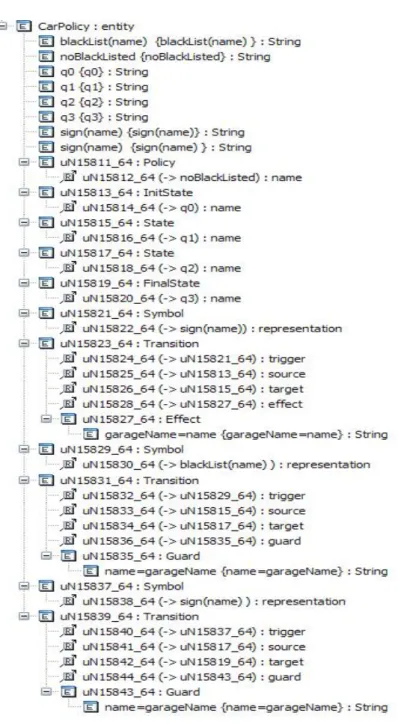
As an example we show in Table 1 part of the meta–model we use in the case study, relative to the representation of policies as automata. Its interpretation should be clear, taking in mind that the first argument of a (binary) relation is its name, and the other two are the related entities. A model conforming the given meta–model is shown in Figure6, and will be discussed later.
Model transformations are defined by precise rules in two mathematical for-malisms, graph transformation (GT) and Abstract State Machines (ASM). GT transformations are specified by pre– and post–condition patterns, and an action
part which defines additional side-effects of a rule. ASMs provide for complex model transformations with all necessary control structures of imperative programming
//***************** POLICY ENTITIES ******************// entity(Policy);
entity(State); entity(InitState);
entity(FinalState); // the error state in policies entity(Symbol);
entity(Transition); entity(Guard); entity(Effect);
//***************** POLICY RELATIONS *****************// relation(name, Policy, String);
relation(initstate, Policy, InitState); relation(name, State, String);
relation(source, Transition, State); relation(target, Transition, State); relation(name, Transition, Symbol); relation(guard, Transition, Guard); relation(effect, Transition, Effect); relation(representation, Symbol, String);
//**************** POLICY DEPENDENCIES *****************// supertypeOf(State, InitState);
supertypeOf(State, FinalState);
Table 1 The policy meta--model
languages. An ASM machine is defined by a set of rules in the form pattern–action and functions.
Even though the VTML language, the VPM approach, and the transformation for-malisms are nonstandard, VIATRA provides importing and exporting tools from and to other formalisms. Among them, VIATRA provides an importer of UML2.0 models of IBM Rational Software Architect software, version 6.0. Moreover, VIA-TRA is an Eclipse plugin, and imports Eclipse Modeling Framework (EMF) models using an appropriate importer plugin. Indeed, among the goals of the VIATRA project, there is the on–line synchronization between EMF and VPM models.
In particular, with respect to UML, VIATRA includes a facility to import UML models abiding the EMF UML2 meta–model, and therefore supports their transfor-mation. Facilities to parse extended meta–models (profiles) are under development.
3.3 The SENSORIA Case Tool: XML and EMF
Within the SENSORIA project a Case Tool is being developed, to provide a plat-form for the integration of the SENSORIA tools. The platform architecture is service–oriented: tools are published as services, they can be discovered, used, and orchestrated. The SENSORIA Case Tool itself is built as a SOA, and implementa-tion is being done on top of the (Equinox implementaimplementa-tion of the) OSGi platform. In our case, we deal with the integration of three tools, namely Software Architect, VIATRA, and Politically Correct.
In the OSGi platform, the exchange of data between services is based on Java objects, which should instantiate a meta model in EMF. This is not a strict con-straint for the SENSORIA tools, since any XML based representation of data will serve. However, the EMF allows one to directly use EMF based transformation tools like VIATRA.
4
Case study: Politically Correct in UML
To experiment with a barb in the advocated development approach, we are design-ing and implementdesign-ingPolitically Correct in UML (PCU), a service for the verifica-tion of service based software systems. PCU is intended to wrap a UML interface around Politically Correct (PC) [19], one of the verification tools being developed in SENSORIA as part of the work onλreq [7].
The λreq theory underlying the specification and verification approach of PC is
based on a few tenets:
• a service interface comprises a signature and a history expression that over–
approximates itspublic behavior, in terms of all the possible traces (histories) of
visible actions;
• these interfaces are available to service developers in a repository, and they are
certified, i.e. their implementations abide to their specifications;
• the approach, with the typical style of SOA, allows developers to define new
services by orchestrating other services by call by contract, a mode of call that includes constraints on the requested interfaces. Constraints are called policies, and are defined as automata: a history expression satisfies a policy if all the traces it defines are accepted by the policy automaton;
• policies can also be used to constrain a piece of orchestration, enclosing it in a
scope with an associated policy.
The original target of λreq was security: in fact it can be used to express more
general constraints, since it all depends on what is considered visible, and used in the interfaces and policies.
4.1 The UML interface for Politically Correct
We assume the spine model development to be carried on in UML: the designer specifies services and policies in UML, extended with the λreq profile, which we
will discuss in a while. In particular, the designer specifies the relevant dynamic facets of each service, i.e. the services it requires and those actions of its that are relevant to the constraining policies. This behavior is specified by a UML interaction owned by the service. These two elements –signature and interaction–, together with the policies, are what λreq requires to specify a service: from such a PCU model,
we can extract the representation that PC needs to perform its analysis. Policies are specified using UML state machines. Indeed, policies are defined in λreq by
suitable automata [8] that over–approximate the admissible execution traces of the services. These automata can be recovered from the profiled representation as State Machines, introduced by theλreq profile.
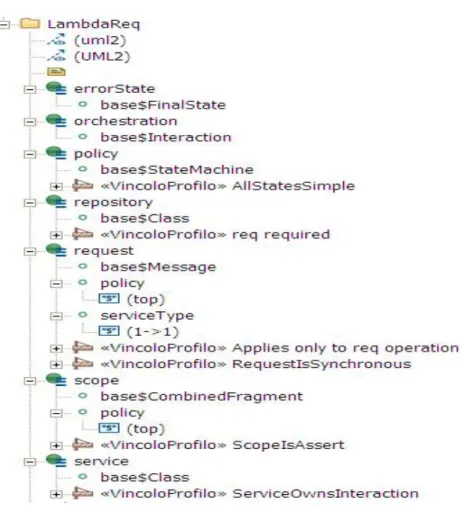
Figure 1 presents the λreq profile, as it appears in the RSA Model Navigator.
The profile introduces six stereotypes. The base class of stereotype B appears as an attribute, with name base$B in Figure 1. The tags values are also listed as attributes, with their default value listed below, when defined. For policies, the value top references the most permissive policy, i.e. the one that excludes no
Fig. 1. Theλreqprofile
behavior. The constraints defined in the profile are stereotyped VincoloProfilo5
in RSA. For the sake of space, only the name of each constraint is shown: still, it should be enough to convey at least the purpose of the constraint.
In this PCU case study, we could quite naturally exploit standard UML concepts (as base meta–classes for the new stereotypes) to capture new advanced modelling concepts. As already said, this has the consequence that standard tools can be easily adapted and offered to the designers. At the same time, the new concepts are framed in a well known context, hopefully accelerating their adoption. We expect to assess the acceptance of the profile for PCU, by interacting with industrial partners. The next subsections outline how to transform the UML model into a suitable input for PC.
4.2 Model transformation
Despite the just mentioned advantages, a UML model usually has a major defect, when exported from a tool like RSA: it is a huge beast, since it has to cater for the many concerns of the development process. Instead, the analysis tools usually work on models built on a small set of concepts, with ad hoc notations. Hence the need of extracting from the UML model the input for the analysis tool, nowadays
usually some form of XML presentation. This could be done in one step, directly transforming the UML models into some linearized form that the relevant analysis tools can accept. This was done in some previous work, but lacks of flexibility and open-ness. The approach we are following, which is also coherent with the SENSORIA main stream with respect to model representation, is to pass from the UML model to another model, which abides to a suitably defined, as simple as possible meta-model. This makes almost straightforward the linearization of the target model for tool input, and also paves the way to other utilizations of the target model by transformation tools. The SENSORIA context suggests the adoption of EMF as the modelling framework for PCU.
The target meta-model for PCU has two major components. The first one is a straightforward representation of the abstract syntax of the λreq expressions: the
corresponding models are extracted from the interactions, i.e. from the sequence diagrams. The second part caters with the policies, i.e. these models are ex-tracted from the state machines: we adapted a standard notation for representing automata, [5].
The extracted models can be exported as such, i.e. as EMF files, or linearized in XML according to a suitable XSD, for successive input to other tools. In our case, a suitable interface to Politically Correct is being defined.
4.3 VIATRA transformation: discussion
VIATRA combines graph transformations and abstract state machines into a sin-gle approach, and proved to be a powerful model transformation tool. Among the main advantages of using this framework instead of using a standard programming language, we note that rule patterns make it easier to adapt a transformation spec-ification in the case of changes of the source or target metamodels. This has proved to be a useful feature, especially when dealing with verification tools at their early stages of development. We expect that the declarative specification style that will be provided by the next version of VIATRA will make the work even smoother.
Moreover, at least on the small models we experimented with, performance is not an issue.
Due to the lack of full handling of profiles in the available VIATRA version, PCU currently rather than dealing with a single model comprising both interactions and policies deals with two separate models that are extracted from the comprehensive one. The next version of VIATRA should solve this problem.
5
A concrete scenario: car repair
To experiment with the PCU barb, we exploit one of the SENSORIA case-studies, the Car repair scenario [16]. The PCU specification presented here follows the one given inλreq in [10].
Assume a car equipped with a diagnostic hardware/software system that contin-uously reports on the status of the vehicle. When the car experiences some major failure (e.g. engine overheating, exhausted battery, flat tires) an embedded service
Fig. 2. Some involved services
is invoked to provide the user with a tow-truck that carries his damaged car to a garage for repair. We are interested in a SOA based design and implementation such that the selection may take into account some driver personalized policies, e.g. avoiding garages that did not service well in the past, as well as other global constraints, e.g. the truck should be close enough to both the damaged car and the garage. The design naturally leads to identify the need of three kinds of services: TheCarEmergency service, which is invoked by the diagnosis subsystem, and looks for tow-trucking and repair; theTowTruck service, which manages towing, and the
Garage service that manages car repair.
5.1 Car repair in PCU
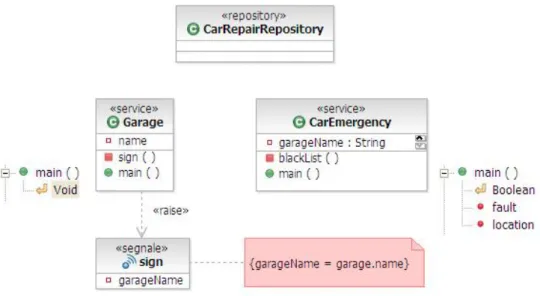
As usual in UML, we consider separately static and dynamic modelling. The static facets are given in the class diagram of Figure2.
The CarEmergency service is invoked by the embedded diagnosis system, each time a fault is reported. The actual kind of fault, and the location of the car, are passed as arguments: the signature of the service is exposed by the public standard operation main of the service, i.e. we require the designer to define the service signature through this operation6.
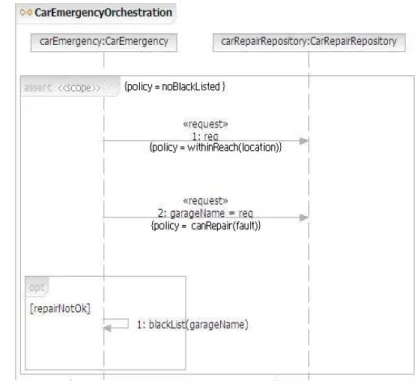
For instance, the sequence diagram in Figure 3 specifies that CarEmergency
needs two services and may perform the visible action blacklist. Consider first the pair of requests: the first one looks for the tow-truck service, and the second one for the garage service7. The contract policy withinReach(location) requires that the tow-truck is able to serve the location where the customer is waiting for
6 In Figure2we have annotated the diagram with the signature of the operations. This information is in RSA model, but cannot be shown in the class diagram, and is only visible in the Model Explorer pane. 7 For simplicity, we assume that both the truck and the garage will be available. As for now, our UML profile and the related transformation tool need to be extended to cope with theλreqplanning blocknotion that caters with the required transactional behavior.
Fig. 3. The CarRepair interaction
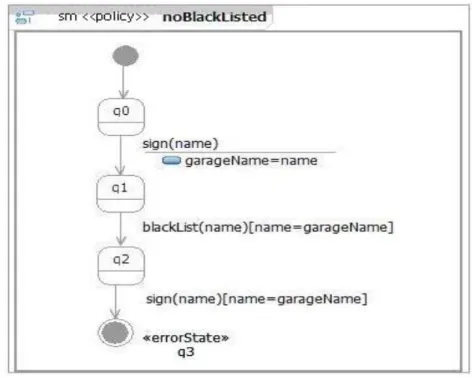
towing. The contract policy canRepair(fault) requires that the garage can repair the fault. In order to be candidate for invocation, each garage service exposes the faults it can handle, in the initial fragment of its own sequence diagram: therefore they become part of the service interface, and can be matched with the caller requirements8. Going back to CarRepair, once the repair is over, the customer can assess the quality of the service he received from the garage, and possibly put the garage on a black-list. This list is exploited by the enclosingassertfragment, which introduces the policy that a black-listed garage cannot be selected for future emergencies, and requires that it is respected by all the enclosing behaviors. This policy, noBlackListed is shown in Figure4 as a stereotyped state machine.
To understand the policy in Figure4, we need to know that the sign(name) event is issued by a garage after a repair: therefore any history including the sequence sign(name), blackList, i.e. any history where a garage issues a receipt once black-listed, leads to an error state9. It is precisely this kind of policy breaches that the verification machinery of PC is able to detect. Assume as an example an instance of the scenario with a carCAR, two tow–track services T1 and T2, and two garage
servicesGF L and GLU, where: T1 can serve Florence and Pisa;
T2 can serve Pisa, Siena, and Lucca;
GF L is a garage in Florence repairing tires and batteries;
GLU is a garage in Lucca repairing engines and tires;
8 In PC, it is assumed that when a service is published in the repository, its interface is formally certified. 9 It should be pointed out that, though this description lends itself a run–time flavour, the analysis is performed prior to service invocation, during service selection.
Fig. 4. An example policy: noBlackListed
CAR is in Pisa with a flat tire, and it has black listed the garage in Lucca.
Most pairshgarage, tow–tracki violate some policies. For instance,hGF L, T2iis not
a possible solution, since the tow–track does not reach Florence, and the garage in Lucca cannot be selected since it is blacklisted. Politically Correct is able to perform this analysis and to single out the only orchestration of services that does not violate any policy, namelyhGF L, T1i.
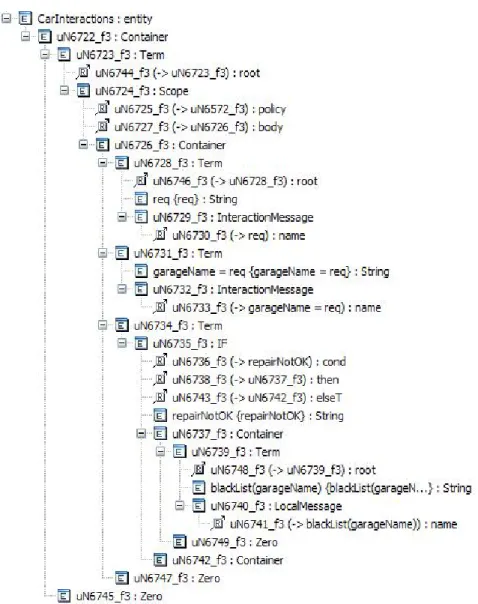
For completeness, the results of applying the transformation for the scenario above is shown in Figure5and6, as they appear in the VIATRA VPM modelspace pane.
6
Related works
Model-Centric Software Development (MCSD) [29] is a form of model driven en-gineering in which models are central to all phases of the development process. The approach uses domaspecific modeling languages (to represent aspects of in-terest such as atomicity of data access, end-to-end message delay, and resource contention), automated generation of partial implementation artifacts (they can include fine-grained concrete functionality and specifications for software simula-tors and emulasimula-tors), and model verification and checking as well as rapid-prototype generation. MCDS is an instance of BMDSD, but apparently the supporting envi-ronment is built in a rather ad hoc fashion.
Within previous EU projects, DEGAS and AGILE, several prototypical environ-ments have been developed, well in line with BMDSD.Choreographer is a software tool platform which facilitates security and performance analysis of systems which
Fig. 5. EMF model of the interaction
starts and ends with UML model descriptions [14]. A UML project is presented to the platform for analysis, formal content is extracted in the form of process cal-culi descriptions, analysed with the analysers of the calcal-culi, and the results of the analysis are reflected back into a modified version of the input UML model. The methodology integrates the use of ForLysa, a tool for security analysis [13] based on the LySa approach [12], and the PEPAWorkbench [3], based on PEPA [17]. The goals are very similar to ours, but the model transformations are built with ad hoc Java programs: we expect to benefit from the flexibility gained by using VIATRA in our experiments in generalizing the approach toward BMDSD.
As for the present work, the Choreographer platform is centered on a UML pro-file, called UMLsec [22]. This profile expresses security–relevant information within the diagrams in a system specification, and on the related approach to secure system development [20]. UMLsec includes elements to express security requirements, like fair exchange, secrecy/confidentiality, secure information flow, secure communica-tion link. Validacommunica-tion is based on a formal semantics for the used fragment of UML,
Fig. 6. EMF model of the policy
and on a formal notion of adversary.
Other related work include model transformation from protocols specified with sequence diagrams to first order logic theories [20], where verification exploits stan-dard theorem-provers, like e-SETHEO, to reveal potential attacks: [21].
A further approach permits the verification of web services including asyn-chronous events, modelled as a set of communicating state machines. The UML model is transformed into a doubly labelled transition system, and then verified –by on-the-fly model checking– with respect properties in the UCTL temporal logic [27]. In this case, both model transformation and verification are supported by a unique tool, called UMC.
7
Conclusion
Barbed Model–Driven Software Development is a Model Driven Engineering ap-proach where, besides a spine of model transformations moving from the most ab-stract, domain related models, to the most concrete, platform related models, there are a number of spikes, relating models in the spine to specialized models. These permit specific, sometimes very sophisticated, analysis of part of the software.
In this paper we report on ongoing work addressing experimentally the issues related to BMDSD, to get acquainted with the approach and the tools supporting the integrations of the tools used in the barbs. We describe the design and imple-mentation of a specific barb, using specific technologies: the profiling capabilities of UML2 as supported by Rational Software Architect, the transformation framework VIATRA, and the SENSORIA CaseTool. The case study is centered around a tool, named Politically Correct, that statically checks that an orchestration of servicies abides given policies.
The experimentation with VIATRA has been so far promising, both with respect to usability of the tool and performance. Notwithstanding, we plan to consider other transformation frameworks, still based on EMF, like Tiger [15] –currently also under development in SENSORIA–.
An emerging pattern from our experience is that the transformations that go from the spine to the other end of the barb look like homomorphic projections of one complex model in a simpler one: we plan to investigate this intuition and see if it may lead to a general framework to simplify the construction of the barbs on one side, and support the formalization of the BMDSD approach, e.g. in an algebraic setting [25,23], on the other. Besides, an algebraic formalization may also help in structuring the approach to the backward transformations, from the analysis results to the UML model. This is especially needed from a pragmatical point of view, when the analysis finds some errors. Preliminary results, rather ad hoc, are available, e.g. in [14], but a general theory of error reflection is still missing.
References
[1] Agile home page. www.pst.informatik.uni-muenchen.de/projekte/agile/.
[2] Degas home page. www.omnys.it/degas/.
[3] Pepa home page. www.dcs.ed.ac.uk/pepa/.
[4] Sensoria home page. www.sensoria–ist.eu.
[5] Y. An and S. Yu. Automl: Definition and implementation. Technical Report 629, Department of Computer Science, University of Western Ontario, Jan 2004.
[6] A. Balogh and D. Varr´o. Advanced model transformation language constructs in the VIATRA2 framework. InSAC ’06: Proceedings of the 2006 ACM symposium on Applied computing, pages 1280– 1287. ACM Press, 2006.
[7] M. Bartoletti, P. Degano, and G.L. Ferrari. Planning and verifying service composition. Technical Report TR-07-02, Dipartimento di Informatica, Universit´a di Pisa, 2007. To appear in Journal of Computer Security. http://compass2.di.unipi.it/TR/Files/TR-07-02.pdf.gz.
[8] M. Bartoletti, P. Degano, G.L. Ferrari, and R. Zunino. Types and effects for resource usage analysis. In H. Seidl, editor,Proc. Foundations of Software Science and Computation Structures (FOSSACS’07), volume 4423 ofLecture Notes in Computer Science, pages 32–47. Springer, 2007.
[9] M. Bartoletti, P.Degano, and G.L. Ferrari. Security issues in service composition. InProc. FMOODS06, volume 4037 ofLecture Notes in Computer Science. Springer, 2006. Invited talk.
[10] M. Bartoletti, P.Degano, G.L. Ferrari, and R. Zunino. Secure service composition. In A. Aldini, editor,
Proc. International Summer School on Security Analysis and Design, Lecture Notes in Computer Science. Springer, 2006. To appear.
[11] H. Baumeister et al. D7.4a: Case tool: Initial requirements. SENSORIA project deliverable
www.pst.if i.lmu.de/projekte/Sensoria/del12/D7.4.a.pdf, Aug 2006.
[12] C. Bodei, M. Buchholtz, P. Degano, F. Nielson, and H. Riis Nielson. Automatic validation of protocol narration. In16th Computer Security Foundations Workshop (CSFW 2003), pages 126–140. IEEE Computer Society Press, 2003.
[13] M. Buchholtz, C. Montangero, L. Perrone, and S. Semprini. For-LySa: UML for authentication analysis. In2nd Int. Workshop on Global Computing (GC04), volume 3267 ofLNCS, pages 92–105, Rovereto, Italy, 2004. Springer-Verlag.
[14] M. Buchholtz, S.Gilmore, V. Haenel, and C. Montangero. End-to-end integrated security and performance analysis on the DEGAS Choreographer platform. In I.J. Hayes J.S. Fitzgerald and A. Tarlecki, editors,Proceedings of the International Symposium of Formal Methods Europe (FM 2005), number 3582 in LNCS, pages 286–301. Springer-Verlag, June 2005.
[15] K. Ehrig, C. Ermel, S. H¨ansgen, and G. Taentzer. Generation of visual editors as eclipse plug-ins. InASE ’05: Proceedings of the 20th IEEE/ACM international Conference on Automated software engineering, pages 134–143, New York, NY, USA, 2005. ACM Press.
[16] S. Gnesi, N. Koch, and A. Zobel et al. D8.0: Case studies scenario description (automotive case study). SENSORIA project deliverable, 2006.
[17] J. Hillston. Process algebras for quantitative analysis. In Proceedings of the 20th Annual IEEE Symposium on Logic in Computer Science (LICS’ 05), pages 239–248, Chicago, June 2005. IEEE Computer Society Press.
[18] IBM. Rational software architect. www-306.ibm.com/software/awdtools/architect/swarchitect/.
[19] E. Italiano. Politically correct. Master’s thesis, University of Pisa, 2006. In Italian. http://etd.adm.unipi.it/theses/available/etd-03062007-123926/.
[20] J. J¨urjens.Secure Systems Development with UML. Springer–Verlag, 2004.
[21] J. J¨urjens and T.A. Kuhn. Automated theorem proving for cryptographic protocols with automatic attack generation. Technical Report TUM-I0424, Institut f¨ur Informatik, Technische Universit¨at M¨unchen, 2004.
[22] Jan J¨urjens. Umlsec: Extending uml for secure systems development. InUML ’02: Proceedings of the 5th International Conference on The Unified Modeling Language, volume 2460 of LNCS, pages 412–425, London, UK, 2002. Springer-Verlag.
[23] C. Montangero. Program specification and optimization of functions over recursive data structures. In
3rd International Symposium on Programming, pages 336–351, Paris, 1978.
[24] OMG. Uml superstructure specification, version 2.1.1, formal/07-02-05. Download from www.omg.org/technology/documents/formal/uml.htm, Feb 2007.
[25] D. Sannella and A. Tarlecki. Essential concepts of algebraic specification and program development.
Formal Aspects of Computing, 9:229–269, 1997.
[26] D.C. Schmidt. Model-driven engineering.IEEE Computer, 39(2):25–31, Feb 2006.
[27] M.H. ter Beek, A. Fantechi, S. Gnesi, and F. Mazzanti. An action/state-based model-checking approach for the analysis of an aynchronous protocol for service-oriented applications. In12th International Workshop on Formal Methods for Industrial Critical Systems (FMICS 2007), LNCS, Berlin, Germany, July 1–2 2007. Springer-Verlag. To appear.
[28] D. Varr´o and A. Pataricza. Vpm: A visual, precise and multilevel metamodeling framework for describing mathematical domains and uml. Journal of Software and Systems Modeling, 2(3):187–210, 2003.