FastSLAM: A Factored Solution to the Simultaneous
Localization and Mapping Problem
Michael Montemerlo and Sebastian Thrun
School of Computer Science Carnegie Mellon University
Pittsburgh, PA 15213
[email protected], [email protected]
Daphne Koller and Ben Wegbreit
Computer Science Department Stanford University Stanford, CA 94305-9010
[email protected], [email protected]
Abstract
The ability to simultaneously localize a robot and ac-curately map its surroundings is considered by many to be a key prerequisite of truly autonomous robots. How-ever, few approaches to this problem scale up to handle the very large number of landmarks present in real envi-ronments. Kalman filter-based algorithms, for example, require time quadratic in the number of landmarks to in-corporate each sensor observation. This paper presents FastSLAM, an algorithm that recursively estimates the full posterior distribution over robot pose and landmark locations, yet scales logarithmically with the number of landmarks in the map. This algorithm is based on an ex-act fex-actorization of the posterior into a product of con-ditional landmark distributions and a distribution over robot paths. The algorithm has been run successfully on as many as 50,000 landmarks, environments far be-yond the reach of previous approaches. Experimental results demonstrate the advantages and limitations of the FastSLAM algorithm on both simulated and real-world data.
Introduction
The problem of simultaneous localization and mapping, also known as SLAM, has attracted immense attention in the mo-bile robotics literature. SLAM addresses the problem of building a map of an environment from a sequence of land-mark measurements obtained from a moving robot. Since robot motion is subject to error, the mapping problem neces-sarily induces a robot localization problem—hence the name SLAM. The ability to simultaneously localize a robot and accurately map its environment is considered by many to be a key prerequisite of truly autonomous robots [3, 7, 16].
The dominant approach to the SLAM problem was in-troduced in a seminal paper by Smith, Self, and Cheese-man [15]. This paper proposed the use of the extended Kalman filter (EKF) for incrementally estimating the poste-rior distribution over robot pose along with the positions of the landmarks. In the last decade, this approach has found widespread acceptance in field robotics, as a recent tutorial paper [2] documents. Recent research has focused on scal-ing this approach to larger environments with more than a few hundred landmarks [6, 8, 9] and to algorithms for han-dling data association problems [17].
A key limitation of EKF-based approaches is their compu-tational complexity. Sensor updates require time quadratic
in the number of landmarks to compute. This
complex-ity stems from the fact that the covariance matrix maintained
by the Kalman filters has
elements, all of which must be updated even if just a single landmark is observed. The quadratic complexity limits the number of landmarks that can be handled by this approach to only a few hundred— whereas natural environment models frequently contain mil-lions of features. This shortcoming has long been recog-nized by the research community [6, 8, 14].
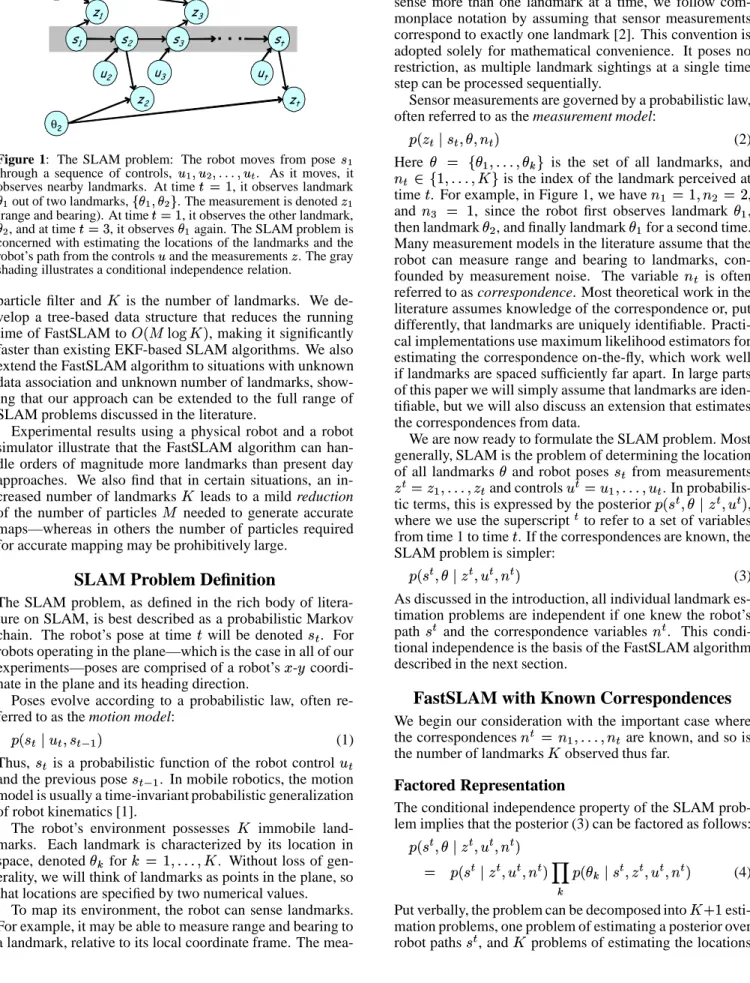
In this paper we approach the SLAM problem from a Bayesian point of view. Figure 1 illustrates a generative probabilistic model (dynamic Bayes network) that underlies the rich corpus of SLAM literature. In particular, the robot
poses, denoted
, evolve over time as a function
of the robot controls, denoted . Each of the
land-mark measurements, denoted , is a function of the
position of the landmark measured and of the robot pose
at the time the measurement was taken. From this diagram it is evident that the SLAM problem exhibits important condi-tional independences. In particular, knowledge of the robot’s
path
renders the individual landmark
measure-ments independent. So for example, if an oracle provided us with the exact path of the robot, the problem of
determin-ing the landmark locations could be decoupled into
inde-pendent estimation problems, one for each landmark. This observation was made previously by Murphy [12], who de-veloped an efficient particle filtering algorithm for learning grid maps.
Based on this observation, this paper describes an efficient SLAM algorithm called FastSLAM. FastSLAM decomposes the SLAM problem into a robot localization problem, and a collection of landmark estimation problems that are con-ditioned on the robot pose estimate. As remarked in [12], this factored representation is exact, due to the natural con-ditional independences in the SLAM problem. FastSLAM uses a modified particle filter for estimating the posterior
over robot paths. Each particle possesses Kalman
fil-ters that estimate the landmark locations conditioned on
the path estimate. The resulting algorithm is an instance of the Rao-Blackwellized particle filter [5, 13]. A naive im-plementation of this idea leads to an algorithm that requires
s1 s2 st u 2 u t θ2 θ1 z 1 z 2 s3 u 3 z 3 z t
. . .
Figure 1: The SLAM problem: The robot moves from pose
through a sequence of controls, . As it moves, it
observes nearby landmarks. At time
, it observes landmark
out of two landmarks,
. The measurement is denoted (range and bearing). At time
, it observes the other landmark,
, and at time
, it observes
again. The SLAM problem is concerned with estimating the locations of the landmarks and the robot’s path from the controls and the measurements . The gray shading illustrates a conditional independence relation.
particle filter and is the number of landmarks. We
de-velop a tree-based data structure that reduces the running
time of FastSLAM to! #"
, making it significantly faster than existing EKF-based SLAM algorithms. We also extend the FastSLAM algorithm to situations with unknown data association and unknown number of landmarks, show-ing that our approach can be extended to the full range of SLAM problems discussed in the literature.
Experimental results using a physical robot and a robot simulator illustrate that the FastSLAM algorithm can han-dle orders of magnitude more landmarks than present day approaches. We also find that in certain situations, an
in-creased number of landmarks leads to a mild reduction
of the number of particles needed to generate accurate
maps—whereas in others the number of particles required for accurate mapping may be prohibitively large.
SLAM Problem Definition
The SLAM problem, as defined in the rich body of litera-ture on SLAM, is best described as a probabilistic Markov
chain. The robot’s pose at time$ will be denoted
. For
robots operating in the plane—which is the case in all of our
experiments—poses are comprised of a robot’s% -&
coordi-nate in the plane and its heading direction.
Poses evolve according to a probabilistic law, often re-ferred to as the motion model:
'
)( +*
(1)
Thus, is a probabilistic function of the robot control
and the previous pose +* . In mobile robotics, the motion
model is usually a time-invariant probabilistic generalization of robot kinematics [1].
The robot’s environment possesses immobile
land-marks. Each landmark is characterized by its location in
space, denoted for,.-0/ . Without loss of
gen-erality, we will think of landmarks as points in the plane, so that locations are specified by two numerical values.
To map its environment, the robot can sense landmarks. For example, it may be able to measure range and bearing to a landmark, relative to its local coordinate frame. The
mea-surement at time$ will be denoted. While robots can often
sense more than one landmark at a time, we follow com-monplace notation by assuming that sensor measurements correspond to exactly one landmark [2]. This convention is adopted solely for mathematical convenience. It poses no restriction, as multiple landmark sightings at a single time step can be processed sequentially.
Sensor measurements are governed by a probabilistic law, often referred to as the measurement model:
' ( 21 (2)
Here 3-54 76 is the set of all landmarks, and
1 98:4;/ 6 is the index of the landmark perceived at
time$. For example, in Figure 1, we have1 <-=/21
-?> ,
and 1A@B-C/ , since the robot first observes landmark ,
then landmark
, and finally landmark for a second time.
Many measurement models in the literature assume that the robot can measure range and bearing to landmarks,
con-founded by measurement noise. The variable 1 is often
referred to as correspondence. Most theoretical work in the literature assumes knowledge of the correspondence or, put differently, that landmarks are uniquely identifiable. Practi-cal implementations use maximum likelihood estimators for estimating the correspondence on-the-fly, which work well if landmarks are spaced sufficiently far apart. In large parts of this paper we will simply assume that landmarks are iden-tifiable, but we will also discuss an extension that estimates the correspondences from data.
We are now ready to formulate the SLAM problem. Most generally, SLAM is the problem of determining the location
of all landmarks and robot poses from measurements
- and controls
- . In
probabilis-tic terms, this is expressed by the posterior'
D( ,
where we use the superscript
to refer to a set of variables
from time 1 to time$. If the correspondences are known, the
SLAM problem is simpler:
' E( 21 (3) As discussed in the introduction, all individual landmark es-timation problems are independent if one knew the robot’s
path
and the correspondence variables 1
. This condi-tional independence is the basis of the FastSLAM algorithm described in the next section.
FastSLAM with Known Correspondences
We begin our consideration with the important case where
the correspondences1
-=1 21 are known, and so is
the number of landmarks observed thus far.
Factored Representation
The conditional independence property of the SLAM prob-lem implies that the posterior (3) can be factored as follows:
' E( 21 -' ( 21 GF ' H( 21 (4)
Put verbally, the problem can be decomposed intoJI
/
esti-mation problems, one problem of estimating a posterior over
robot paths
of the landmarks conditioned on the path estimate. This factorization is exact and always applicable in the SLAM problem, as previously argued in [12].
The FastSLAM algorithm implements the path estimator
' ( 21
using a modified particle filter [4]. As we argue further below, this filter can sample efficiently from this space, providing a good approximation of the poste-rior even under non-linear motion kinematics. The
land-mark pose estimators'
( 1 are realized by Kalman filters, using separate filters for different landmarks. Because the landmark estimates are conditioned on the path estimate, each particle in the particle filter has its own,
lo-cal landmark estimates. Thus, for particles and
land-marks, there will be a total of Kalman filters, each of
dimension 2 (for the two landmark coordinates). This repre-sentation will now be discussed in detail.
Particle Filter Path Estimation
FastSLAM employs a particle filter for estimating the path
posterior' ( 1
in (4), using a filter that is similar (but not identical) to the Monte Carlo localization (MCL) algorithm [1]. MCL is an application of particle filter to the problem of robot pose estimation (localization). At each point in time, both algorithms maintain a set of particles
rep-resenting the posterior'
( 21 , denoted . Each particle 8
represents a “guess” of the robot’s path:
- 4 6 - 4 6 (5)
We use the superscript notation
to refer to the -th
par-ticle in the set.
The particle set
is calculated incrementally, from the
set
+* at time$D/ , a robot control , and a measurement
. First, each particle
in
+* is used to generate a
probabilistic guess of the robot’s pose at time$:
' ( +* (6)
obtained by sampling from the probabilistic motion model. This estimate is then added to a temporary set of
parti-cles, along with the path
+*
. Under the assumption
that the set of particles in
+* is distributed according to ' +* ( +* +* 1 +*
(which is an asymptotically cor-rect approximation), the new particle is distributed
accord-ing to' ( +* 21 +*
. This distribution is commonly referred to as the proposal distribution of particle filtering.
After generating particles in this way, the new set
is
obtained by sampling from the temporary particle set. Each
particle
is drawn (with replacement) with a probability
proportional to a so-called importance factor
, which is calculated as follows [10]: -target distribution proposal distribution -' ( 21 ' ( +* 21 +* (7)
The exact calculation of (7) will be discussed further below.
The resulting sample set
is distributed according to an
ap-proximation to the desired pose posterior'
( 21 , an approximation which is correct as the number of particles
goes to infinity. We also notice that only the most recent
robot pose estimate
+* is used when generating the
parti-cle set
. This will allows us to silently “forget” all other
pose estimates, rendering the size of each particle
indepen-dent of the time index$.
Landmark Location Estimation
FastSLAM represents the conditional landmark estimates
' ( 1
in (4) by Kalman filters. Since this estimate is conditioned on the robot pose, the Kalman filters
are attached to individual pose particles in
. More
specifi-cally, the full posterior over paths and landmark positions in the FastSLAM algorithm is represented by the sample set
C- 4 6 (8) Here and
are mean and covariance of the
Gaus-sian representing the, -th landmark , attached to the -th
particle. In the planar robot navigation scenario, each mean
is a two-element vector, and
is a 2 by 2 matrix.
The posterior over the, -th landmark pose is easily
ob-tained. Its computation depends on whether or not1 -?, ,
that is, whether or not was observed at time$. For1 - , ,
we obtain ' ( 21 (9) ' )( +* 1 ' ( +* 1 !#"%$#&' -' )( 21 ' ( +* +* +* 21 +*
For1 )(- , , we simply leave the Gaussian unchanged:
' ( 1 -' ( +* +* +* 1 +* (10) The FastSLAM algorithm implements the update equation (9) using the extended Kalman filter (EKF). As in existing EKF approaches to SLAM, this filter uses a linearized
ver-sion of the perceptual model '
( 21
[2]. Thus, FastSLAM’s EKF is similar to the traditional EKF for SLAM [15] in that it approximates the measurement model using a linear Gaussian function. We note that, with a lin-ear Gaussian observation model, the resulting distribution
' ( 1
is exactly a Gaussian, even if the mo-tion model is not linear. This is a consequence of the use of sampling to approximate the distribution over the robot’s pose.
One significant difference between the FastSLAM algo-rithm’s use of Kalman filters and that of the traditional SLAM algorithm is that the updates in the FastSLAM algo-rithm involve only a Gaussian of dimension two (for the two landmark location parameters), whereas in the EKF-based
SLAM approach a Gaussian of size>
I+*
has to be updated
(with landmarks and 3 robot pose parameters). This
cal-culation can be done in constant time in FastSLAM, whereas
it requires time quadratic in in standard SLAM.
Calculating the Importance Weights
Let us now return to the problem of calculating the
impor-tance weights
needed for particle filter resampling, as
defined in (7): ' ( 1 ' ( +* 1 +* -' 21 )( +* 1 +* ' +* +*
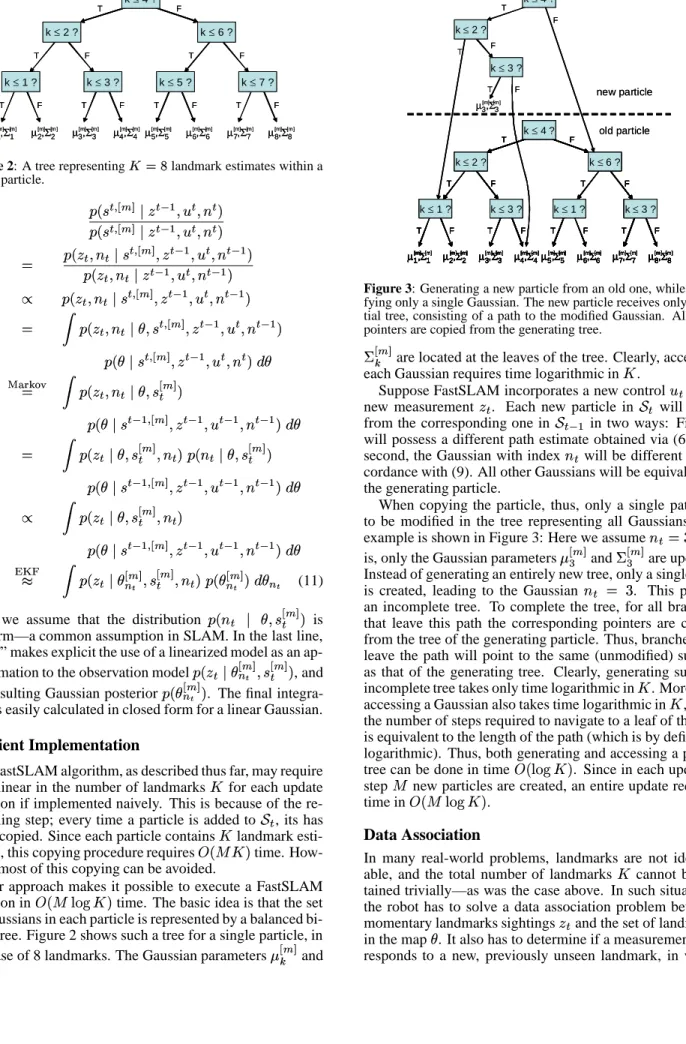
µ8,Σ8 µ7,Σ7 k≤7 ? F T µ6,Σ6 µ5,Σ5 k≤5 ? F T µ4,Σ4 µ3,Σ3 k≤3 ? F T µ2,Σ2 µ1,Σ1 k≤1 ? F T k≤6 ? F T k≤2 ? F T k≤4 ? F T [m] [m] [m] [m] [m] [m] [m] [m] [m] [m] [m] [m] [m][m] [m] [m] µ 8,Σ8 µ7,Σ7 k≤7 ? F T µ6,Σ6 µ5,Σ5 k≤5 ? F T µ4,Σ4 µ3,Σ3 k≤3 ? F T µ2,Σ2 µ1,Σ1 k≤1 ? F T k≤6 ? F T k≤2 ? F T k≤4 ? F T [m] [m] [m] [m] [m] [m] [m] [m] [m] [m] [m] [m] [m][m] [m] [m]
Figure 2: A tree representing
landmark estimates within a single particle. ' ( +* 21 ' ( +* 21 -' 21 ( +* 21 +* ' 21 ( +* 21 +* ' 21 ( +* 21 +* ' 21 )( +* 21 +* ' E( +* 21 !"$&' ' 21 )( ' E( +* +* +* 21 +* ' )( 1 ' 1 )( ' E( +* +* +* 21 +* ' ( 1 ' E( +* +* +* 21 +* ' ( 1 ' (11)
Here we assume that the distribution '
1 =(
is uniform—a common assumption in SLAM. In the last line, “EKF” makes explicit the use of a linearized model as an
ap-proximation to the observation model'
( , and
the resulting Gaussian posterior'
. The final integra-tion is easily calculated in closed form for a linear Gaussian.
Efficient Implementation
The FastSLAM algorithm, as described thus far, may require
time linear in the number of landmarks for each update
iteration if implemented naively. This is because of the
re-sampling step; every time a particle is added to
, its has
to be copied. Since each particle contains landmark
esti-mates, this copying procedure requires
time. How-ever, most of this copying can be avoided.
Our approach makes it possible to execute a FastSLAM
iteration in! #"
time. The basic idea is that the set of Gaussians in each particle is represented by a balanced bi-nary tree. Figure 2 shows such a tree for a single particle, in
the case of 8 landmarks. The Gaussian parameters
and µ8,Σ8 µ7,Σ7 k≤3 ? F T µ6,Σ6 µ5,Σ5 k≤1 ? F T µ4,Σ4 µ3,Σ3 k≤3 ? F T µ2,Σ2 µ1,Σ1 k≤1 ? F T k≤6 ? F T k≤2 ? F T k≤4 ? F T [m] [m] [m][m] [m][m] [m][m] [m][m] [m][m] [m][m] [m] [m] µ 8,Σ8 µ7,Σ7 k≤3 ? F T µ6,Σ6 µ5,Σ5 k≤1 ? F T µ4,Σ4 µ3,Σ3 k≤3 ? F T µ2,Σ2 µ1,Σ1 k≤1 ? F T k≤6 ? F T k≤2 ? F T k≤4 ? F T [m] [m] [m][m] [m][m] [m][m] [m][m] [m][m] [m][m] [m] [m] µ3,Σ3 k≤3 ? F T k≤2 ? F T k≤4 ? F T [m] [m] new particle old particle µ8,Σ8 µ7,Σ7 k≤3 ? F T µ6,Σ6 µ5,Σ5 k≤1 ? F T µ4,Σ4 µ3,Σ3 k≤3 ? F T µ2,Σ2 µ1,Σ1 k≤1 ? F T k≤6 ? F T k≤2 ? F T k≤4 ? F T [m] [m] [m][m] [m][m] [m][m] [m][m] [m][m] [m][m] [m] [m] µ 8,Σ8 µ7,Σ7 k≤3 ? F T µ6,Σ6 µ5,Σ5 k≤1 ? F T µ4,Σ4 µ3,Σ3 k≤3 ? F T µ2,Σ2 µ1,Σ1 k≤1 ? F T k≤6 ? F T k≤2 ? F T k≤4 ? F T [m] [m] [m][m] [m][m] [m][m] [m][m] [m][m] [m][m] [m] [m] µ 8,Σ8 µ7,Σ7 k≤3 ? F T µ6,Σ6 µ5,Σ5 k≤1 ? F T µ4,Σ4 µ3,Σ3 k≤3 ? F T µ2,Σ2 µ1,Σ1 k≤1 ? F T k≤6 ? F T k≤2 ? F T k≤4 ? F T [m] [m] [m][m] [m][m] [m][m] [m][m] [m][m] [m][m] [m] [m] µ 8,Σ8 µ7,Σ7 k≤3 ? F T µ6,Σ6 µ5,Σ5 k≤1 ? F T µ4,Σ4 µ3,Σ3 k≤3 ? F T µ2,Σ2 µ1,Σ1 k≤1 ? F T k≤6 ? F T k≤2 ? F T k≤4 ? F T [m] [m] [m][m] [m][m] [m][m] [m][m] [m][m] [m][m] [m] [m] µ 8,Σ8 µ7,Σ7 k≤3 ? F T µ6,Σ6 µ5,Σ5 k≤1 ? F T µ4,Σ4 µ3,Σ3 k≤3 ? F T µ2,Σ2 µ1,Σ1 k≤1 ? F T k≤6 ? F T k≤2 ? F T k≤4 ? F T [m] [m] [m][m] [m][m] [m][m] [m][m] [m][m] [m][m] [m] [m] µ3,Σ3 k≤3 ? F T k≤2 ? F T k≤4 ? F T [m] [m] new particle old particle
Figure 3: Generating a new particle from an old one, while
modi-fying only a single Gaussian. The new particle receives only a par-tial tree, consisting of a path to the modified Gaussian. All other pointers are copied from the generating tree.
are located at the leaves of the tree. Clearly, accessing
each Gaussian requires time logarithmic in .
Suppose FastSLAM incorporates a new control and a
new measurement . Each new particle in
will differ
from the corresponding one in
+* in two ways: First, it
will possess a different path estimate obtained via (6), and
second, the Gaussian with index1 will be different in
ac-cordance with (9). All other Gaussians will be equivalent to the generating particle.
When copying the particle, thus, only a single path has to be modified in the tree representing all Gaussians. An
example is shown in Figure 3: Here we assume1
-*
, that
is, only the Gaussian parameters
@ and
@ are updated.
Instead of generating an entirely new tree, only a single path
is created, leading to the Gaussian 1
-*
. This path is an incomplete tree. To complete the tree, for all branches that leave this path the corresponding pointers are copied from the tree of the generating particle. Thus, branches that leave the path will point to the same (unmodified) subtree as that of the generating tree. Clearly, generating such an
incomplete tree takes only time logarithmic in . Moreover,
accessing a Gaussian also takes time logarithmic in , since
the number of steps required to navigate to a leaf of the tree is equivalent to the length of the path (which is by definition logarithmic). Thus, both generating and accessing a partial
tree can be done in time ! #"
. Since in each updating
step new particles are created, an entire update requires
time in ! #"
.
Data Association
In many real-world problems, landmarks are not
identifi-able, and the total number of landmarks cannot be
ob-tained trivially—as was the case above. In such situations, the robot has to solve a data association problem between
momentary landmarks sightings and the set of landmarks
in the map . It also has to determine if a measurement
(a) (b) (c)
Figure 4: (a) Physical robot mapping rocks, in a testbed developed for Mars Rover research. (b) Raw range and path data. (c) Map generated
using FastSLAM (dots), and locations of rocks determined manually (circles).
case the map should be augmented accordingly.
In most existing SLAM solutions based on EKFs, these problems are solved via maximum likelihood. More
specif-ically, the probability of a data association1 is given by
' 1 )( ' 1 ( ' ( ' 1 )( !#"%$#&' ' 1 )( # ' ( 1 (12)
The step labeled “PF” uses the particle filter
approxima-tion to the posterior'
(
. The final step assumes
a uniform prior'
1 (
, which is commonly used [2]. The maximum likelihood data association is simply the
in-dex 1 that maximizes (12). If the maximum value of
' 1 D(
—with careful consideration of all constants
in (12)—is below a threshold , the landmark is considered
previously unseen and the map is augmented accordingly. In FastSLAM, the data association is estimated on a
per-particle basis:1 - " ' ( 21 . As a result,
different particles may rely on different values of1
. They
might even possess different numbers of landmarks in their respective maps. This constitutes a primary difference to EKF approaches, which determine the data association only once for each sensor measurement. It has been observed frequently that false data association will make the conven-tional EKF approach fail catastrophically [2]. FastSLAM is more likely to recover, thanks to its ability to pursue multi-ple data associations simultaneously. Particles with wrong data association are (in expectation) more likely to disap-pear in the resampling process than those that guess the data association correctly.
We believe that, under mild assumptions (e.g., minimum spacing between landmarks and bounded sensor error), the data association search can be implemented in time
loga-rithmic in . One possibility is the use of kd-trees as an
indexing scheme in the tree structures above, instead of the landmark number, as proposed in [11].
Experimental Results
The FastSLAM algorithm was tested extensively under vari-ous conditions. Real-world experiments were complimented by systematic simulation experiments, to investigate the scaling abilities of the approach. Overall, the results indicate favorably scaling to large number of landmarks and small
particle sets. A fixed number of particles (e.g., - / )
appears to work well across a large number of situations. Figure 4a shows the physical robot testbed, which consists of a small arena set up under NASA funding for Mars Rover research. A Pioneer robot equipped with a SICK laser range finder was driven along an approximate straight line, gener-ating the raw data shown in Figure 4b. The resulting map
generated with - / samples is depicted in Figure 4c,
with manually determined landmark locations marked by circles. The robot’s estimates are indicated by x’s, illustrat-ing the high accuracy of the resultillustrat-ing maps. FastSLAM re-sulted in an average residual map error of 8.3 centimeters, when compared to the manually generated map.
Unfortunately, the physical testbed does not allow for sys-tematic experiments regarding the scaling properties of the approach. In extensive simulations, the number of land-marks was increased up to a total of 50,000, which Fast-SLAM successfully mapped with as few as 100 particles. Here, the number of parameters in FastSLAM is approx-imately 0.3% of that in the conventional EKF. Maps with 50,000 landmarks are entirely out of range for conventional SLAM techniques, due to their enormous computational complexity. Figure 5 shows example maps with smaller numbers of landmarks, for different maximum sensor ranges as indicated. The ellipses in Figure 5 visualize the residual uncertainty when integrated over all particles and Gaussians. In a set of experiments specifically aimed to elucidate the scaling properties of the approach, we evaluated the map and robot pose errors as a function of the number of landmarks
, and the number of particles , respectively. The results
are graphically depicted in Figure 6. Figure 6a illustrates
that an increase in the number of landmarks mildly
re-duces the error in the map and the robot pose. This is be-cause the larger the number of landmarks, the smaller the robot pose error at any point in time. Increasing the number
of particles also bears a positive effect on the map and
pose errors, as illustrated in Figure 6b. In both diagrams, the bars correspond to 95% confidence intervals.
(a) (b)
Figure 5: Maps and estimated robot path, generated using sensors
with (a) large and (b) small perceptual fields. The correct landmark locations are shown as dots, and the estimates as ellipses, whose sizes correspond to the residual uncertainty.
Conclusion
We presented the FastSLAM algorithm, an efficient new so-lution to the concurrent mapping and localization problem. This algorithm utilizes a Rao-Blackwellized representation of the posterior, integrating particle filter and Kalman filter representations. Similar to Murphy’s work [12], FastSLAM is based on an inherent conditional independence property of the SLAM problem. However, Murphy’s approach main-tains maps using grid positions with discrete values, and therefore scales poorly with the size of the map. His ap-proach also did not deal with the data association problem, which does not arise in the grid-based setting.
In FastSLAM, landmark estimates are efficiently repre-sented using tree structures. Updating the posterior requires
! #"
time, where is the number of particles and
the number of landmarks. This is in contrast to the
complexity of the common Kalman-filter based ap-proach to SLAM. Experimental results illustrate that Fast-SLAM can build maps with orders of magnitude more land-marks than previous methods. They also demonstrate that under certain conditions, a small number of particles works well regardless of the number of landmarks.
Acknowledgments We thank Kevin Murphy and Nando de Freitas for insightful discussions on this topic. This research was sponsored by DARPA’s MARS Program (Contract number N66001-01-C-6018) and the National Science Foundation (CA-REER grant number 9876136 and regular grant number IIS-9877033). We thank the Hertz Foundation for their support of Michael Montemerlo’s graduate research. Daphne Koller was supported by the Office of Naval Research, Young Investigator (PECASE) grant N00014-99-1-0464. This work was done while Sebastian Thrun was visiting Stanford University.
References
[1] F. Dellaert, D. Fox, W. Burgard, and S. Thrun. Monte Carlo localization for mobile robots. ICRA-99.
[2] G. Dissanayake, P. Newman, S. Clark, H.F. Durrant-Whyte, and M. Csorba. An experimental and theoretical investigation into simultaneous localisation and map building (SLAM).
Lecture Notes in Control and Information Sciences: Exper-imental Robotics VI, Springer, 2000.
[3] G. Dissanayake, P. Newman, S. Clark, H.F. Durrant-Whyte, and M. Csorba. A solution to the simultaneous localisation and map building (SLAM) problem. IEEE Transactions of
Robotics and Automation, 2001.
[4] A. Doucet, J.F.G. de Freitas, and N.J. Gordon, editors.
Se-quential Monte Carlo Methods In Practice. Springer, 2001.
10 100 1000 0.2 0.3 0.4 0.5 0.6 0.7 0.8 0.9
Accuracy of FastSLAM as K Increases
Number of landmarks K
Position Error (standard deviation)
Landmark Position Error Robot Position Error
50 500 5000 0 50 100 150 200 250 0 0.5 1 1.5 2 2.5
Accuracy of FastSLAM as Number of Particles Increases
Number of Particles
Position Error (standard deviation)
Robot Position Error Landmark Position Error (a)
(b)
Figure 6: Accuracy of the FastSLAM algorithm as a function of
(a) the number of landmarks , and (b) the number of particles
. Large number of landmarks reduce the robot localization error, with little effect on the map error. Good results can be achieved with as few as 100 particles.
[5] A Doucet, N. de Freitas, K. Murphy, and S. Russell. Rao-Blackwellised particle filtering for dynamic Bayesian net-works. UAI-2000.
[6] J. Guivant and E. Nebot. Optimization of the simultaneous localization and map building algorithm for real time imple-mentation. IEEE Transaction of Robotic and Automation, May 2001.
[7] D. Kortenkamp, R.P. Bonasso, and R. Murphy, editors.
AI-based Mobile Robots: Case studies of successful robot sys-tems, MIT Press, 1998.
[8] J.J. Leonard and H.J.S. Feder. A computationally efficient method for large-scale concurrent mapping and localization.
ISRR-99.
[9] F. Lu and E. Milios. Globally consistent range scan alignment for environment mapping. Autonomous Robots, 4, 1997. [10] N. Metropolis, A.W. Rosenbluth, M.N. Rosenbluth, A.H.
Teller, and E. Teller. Equations of state calculations by fast computing machine. Journal of Chemical Physics, 21, 1953. [11] A.W. Moore. Very fast EM-based mixture model clustering
using multiresolution kd-trees. NIPS-98.
[12] K. Murphy. Bayesian map learning in dynamic environments.
NIPS-99.
[13] K. Murphy and S. Russell. Rao-blackwellized particle fil-tering for dynamic bayesian networks. In Sequential Monte
Carlo Methods in Practice, Springer, 2001.
[14] P. Newman. On the Structure and Solution of the
Simulta-neous Localisation and Map Building Problem. PhD thesis,
Univ. of Sydney, 2000.
[15] R. Smith, M. Self, and P. Cheeseman. Estimating uncertain spatial relationships in robotics. In Autonomous Robot
Vehni-cles, Springer, 1990.
[16] C. Thorpe and H. Durrant-Whyte. Field robots. ISRR-2001. [17] S. Thrun, D. Fox, and W. Burgard. A probabilistic approach
to concurrent mapping and localization for mobile robots.