Part Two - Getting the most from your batteries
Prolonging
battery life BU31
BU32
BU33 BU34 BU35 BU36
The secrets of battery runtime - Declining capacity
- Increasing internal resistance - Elevated self-discharge
- Premature voltage cut-off
Non-correctable battery problems - High self-discharge
- Low capacity cells - Cell mismatch - Shorted cells - Loss of electrolyte Memory: Myth or fact?
- How to restore and prolong nickel-based batteries
- Field results on exercise and recondition How to prolong lithium-based batteries - Longevity of high-power lithium-ion
How to restore and prolong lead-based batteries - The sealed lead-acid (SLA)
- Valve regulated lead-acid (VRLA)
Battery performance as a function of cycling - Nickel-cadmium
- Nickel-metal-hydride - Lithium-ion
- What is the best cycling pattern? Battery applications BU37 BU38 BU39 BU40 BU40a
Choosing the right battery for wireless communications
- What's the best battery for cell phones? - Counterfeit cell phone batteries
- What's the best battery for two-way radios? Choosing the right battery for portable
computing
- What's the best battery for laptops? - How to calibrate the battery
Choosing the right battery for industrial applications
- What's the best battery for video cameras? - What's the best battery for still cameras? - What is the best battery for medical devices? - What is the best battery for power tools?
What's the best battery for wheeled & stationary applications?
- What's the best battery for wheelchairs?
- What's the best battery for the electric bicycle? - What's the best battery for the electric vehicle? - What's the best battery for stationary
applications?
Are the Hybrid Cars here to stay?
-What's the best battery for the hybrid car? -The plug-in hybrid electric vehicle (PHEV) -The paradox of the hybrid vehicle
-Conclusion BU41 BU42 BU42A BU42B BU42C
Rapid testing portable batteries - The load test
- The AC conductance test - The Cadex QuickTest™
Rapid testing automotive and stationary batteries
- Electrochemical Impedance Spectroscopy (EIS) - Commercializing Electrochemical Impedance Spectroscopy
Why do different test methods provide dissimilar readings?
- Battery rapid test methods and how they work - Capacity measurements
- An important need fulfilled
What causes car batteries to fail?
- Acid stratification, a problem with luxury cars - The challenge of battery testing
- The tough choice
Starting is easy… but can I steer and brake? - What is the difference between CCA and RC? - Capacity measurements, the most
comprehensive battery test
- Early test results on Reserve Capacity - Summar
y
Battery service BU43 BU44 BU45 BU46 BU47 BU48Advanced battery analyzers - Fixed current analyzers - Programmable analyzers - Battery adapters
- Service programs - Printing
Computerized battery testing - Cellular dealers
- Cellular service Centers - Battery fleet owners
- Manufacturers and pack assemblers How to service two-way radio batteries - The 'green light' lies
- Maintenance of fleet batteries How to service cell phone batteries - Refurbishing, a cost-effective exercise - Storefront battery service
- Why was storefront service not done earlier? How to service laptop batteries
- Battery connection
- Repairing a 'smart' battery
Increasing battery power by zapping
Battery behaviorBU49 Observing batteries in everyday lives - The personal battery user
- What lack of battery maintenance can do Comparisons BU50 BU51 BU52 BU52A BU53
Will secondary batteries replace primaries? - Capacity rating of alkaline cells
- Run-time estimation
- The switch to secondary batteries The Cost of Battery Power
- The primary battery - The secondary battery - The combustion engine - The fuel cell
The fuel cell - Type of fuel cells - Applications - Limitations
The miniature fuel cell
- Will the fuel cell replace the battery? Comparing battery power
- Battery power and the Boeing 747 jumbo jet - How are newer battery chemistries faring? Things to come BU54
BU55
The future battery
- What is the ultimate miracle battery? - Will the fuel cell replace the battery Battery Statistics
- Where will commercial batteries come from?
The secrets of battery runtime
(BU31)Is the runtime of a portable device directly related to the size of the battery? The answer should be 'yes' but in reality, the runtime is governed by other attributes than the specified capacity alone. This paper examines the cause of unexpected downtime and short battery service life. We look at four renegades - declining capacity, increasing internal resistance, elevated self-discharge and premature voltage cut-off on discharge. We evaluate how these regenerative deficiencies affect nickel, lead and lithium-based batteries.
Declining capacity
The amount of charge a battery can hold gradually decreases due to usage and aging. Specified to deliver 100% capacity when new, the battery should be replaced when the capacity drops to below 80% of the nominal rating. Some organizations may use different end-capacities as a minimal acceptable performance threshold.
The energy storage of a battery can be divided into three imaginary sections consisting of: available energy, the empty zone that can be refilled, and the unusable part (rock content) that increases with aging. Figure 1 illustrates these three sections.
Figure 1: Battery charge capacity.Three imaginary sections of a battery consisting of available energy, empty zone and rock content.
In nickel-based batteries, the so-called rock content is present in form of crystalline formation, also known as memory. Restoration is possible with a full discharge to one volt per cell. However, if no service is done for four months and longer, a full repair becomes increasingly more difficult the longer service is withheld. To prevent memory, nickel-based batteries should be deep-cycled once every one or two months. Nickel-cadmium and nickel-metal-hydride batteries are used for two-way radios, medical instruments and power tools.
Performance degradation of the lead-acid battery is caused by sulfation and grid corrosion. Sulfation is a thin layer that forms on the negative cell plate if the battery is being denied a fully saturated charge. Sulfation can, in part, be corrected with cycling and/or topping charge. The grid corrosion, which occurs on the positive plate, is caused by over-charge. Lead-acid batteries are used for larger portable devices and wheeled applications.
Lithium-ion batteries lose capacity through cell oxidation, a process that occurs naturally during use and aging. The typical life span of lithium-ion is 2-3 years under normal use. Cool storage a 40% charge minimizes aging. An aged lithium-ion cannot be restored with cycling. Lithium-ion is found in cell phones and mobile computing.
Increasing internal Resistance
The capacity of a battery defines the stored energy - the internal
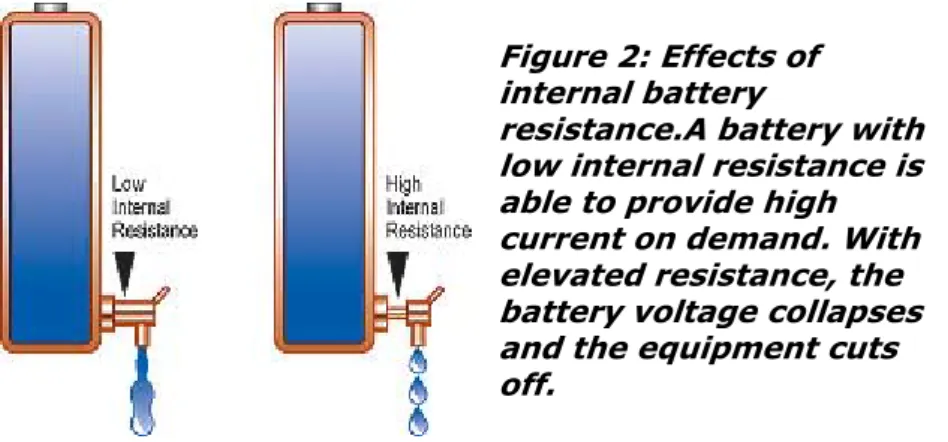
resistance governs how much energy can be delivered at any given time. While a good battery is able to provide high current on demand, the voltage of a battery with elevated resistance collapses under a heavy load. Although the battery may hold sufficient capacity, the resulting voltage drop triggers the 'low battery' indicator and the equipment stops functioning. Heating the battery will momentarily increase the output by lowering the resistance.
A battery with high internal resistance may still perform adequately on a low current appliance such as a flashlight, portable CD player or wall clock. Digital equipment, on the other hand, draw heavy current bursts. Figure 2 simulates low and high internal resistance with a free-flowing and restricted tap.
F gure 2: Effects ofi internal battery
resistance.A battery with low internal resistance is able to provide high current on demand. With elevated resistance, the battery voltage collapses and the equipment cuts off.
Nickel-cadmium offers very low internal resistance and delivers high current on demand. In comparison, nickel-metal-hydride starts with a slightly higher resistance and the readings increase rapidly after 300 to 400 cycles.
Lithium-ion has a slightly higher internal resistance than nickel-based batteries. The cobalt system tends to increase the internal resistance as part of aging whereas the manganese (spinel) maintains the resistance throughout its life but loses capacity through chemical reaction. Cobalt and manganese are used for the positive electrodes.
High internal resistance will eventually render the battery useless. The energy may still be present but can no longer be delivered. This condition is permanent and cannot be reversed with cycling. Cool storage at a partial state-of-charged (40%) retards the aging process.
The internal resistance of Lead-acid batteries is very low. The battery responds well to short current bursts but has difficulty providing a high, sustained load. Over time, the internal resistance increases through sulfation and grid corrosion.
Elevated self-discharge
All batteries suffer from self-discharge, of which nickel-based batteries are among the highest. The loss is asymptotical, meaning that the
self-discharge is highest right after charge and then levels off. nickel-based batteries lose 10% to 15% of their capacity in the first 24 hours after charge, then 10% to 15% per month afterwards. One of the best
batteries in terms of self-discharge is Lead-acid; it only self-discharges 5% per month. Unfortunately, this chemistry has the lowest energy density and is ill suited for portable applications.
lithium-ion self-discharges about 5% in the first 24 hours and 1-2% afterwards. Adding the protection circuit increases the discharge by another 3% per month. The protection circuit assures that the voltage and current on each cell does not exceed a safe limit. Figure 3 illustrates a battery with high self-discharge.
Figure 3: Effects of high load impedance.Self-discharge increases with age, high cycle count and elevated temperature. Discard a battery f the i self-discharge reaches 30% in 24 hours.
The self-discharge on all battery chemistries increase at higher temperatures. Typically, the rate doubles with every 10°C (18°F). A noticeable energy loss occurs if a battery is left in a hot vehicle.
Aging and usage also affect self-discharge. nickel-metal-hydride is good for 300-400 cycles, whereas nickel-cadmium may last over 1000 cycles before high self-discharge affects the performance. An older nickel-based battery may lose its energy during the day through self-discharge rather than actual use. Discard a battery if the self-discharge reaches 30% in 24 hours.
Nothing can be done to reverse this deficiency. Factors that accelerate self-discharge are damaged separators induced by crystalline formation, allowing the packs to cook while charging, and high cycle count, which promotes swelling in the cell. Lead and lithium-based batteries do not increase the self-discharge with use in the same manner as their nickel-based cousins do.
Premature voltage cut-off
Not all stored battery power can be fully utilized. Some equipment cuts off before the designated end-of-discharge voltage is reached and precious battery energy remains unused. Applications demanding high current bursts push the battery voltage to an early cut-off. This is especially visible on batteries with elevated internal resistance. The voltage recovers when the load is removed and the battery appears normal. Discharging such a battery on a moderate load with a battery analyzer to the respective end-of-discharge threshold will sometimes produce residual capacity readings of 30% and higher, jet the battery is inoperable in the equipment.Figure 4 illustrates high cut-off voltage.
Figure 4: Illustration of equipment with h gh cut-off i voltage.Some portable devices do not utilize all available battery power and leave precious energy behind.
High internal battery resistance and the equipment itself are not the only cause of premature voltage cut-off - warm temperature also plays a role by lowering the battery voltage. Other reasons are shorted cells in a multi-cell battery pack and memory on nickel-based batteries.
Non-Correctable Battery Problems
(BU32)Some rechargeable batteries can be restored through external means, such as applying a full discharge. There are, however, many defects that cannot be corrected. These include high internal resistance, elevated self-discharge, electrical short, dry-out, plate corrosion and general chemical breakdown.
The performance loss of a battery occurs naturally as part of usage and aging; some is hastened by lack of maintenance, harsh field conditions and poor charging practices. This paper examines the cause of non-correctable battery problems and explores ways to minimize these breakdowns.
High Self-discharge
All batteries are affected by self-discharge. This is not a defect per se, although improper use enhances the condition. Self-discharge is
asymptotical; the highest loss occurs right after charge, and then tapers off.
Nickel-based batteries exhibit a relatively high self-discharge. At ambient temperature, a new nickel-cadmium loses about 10% of its capacity in the first 24 hours after charge. The self-discharge settles to about 10% per month afterwards. Higher temperature increases the self-discharge substantially. As a general guideline, the rate of self-discharge doubles with every 10°C (18°F) increase in temperature. The self-discharge of nickel-metal-hydride is about 30% higher than that of nickel-cadmium. The self-discharge increases after a nickel-based battery has been cycled for a few hundred times. The battery plates begin to swell and press more firmly against the separator. Metallic dendrites, which are the result of crystalline formation (memory), also increase the self-discharge by marring the separator. Discard a nickel-based battery if the
self-discharge reaches 30% in 24 hours
The self-discharge of the lithium-ion battery is 5% in the first 24 hours after charge, and then reduces to 1% to 2% per month thereafter. The safety circuit adds about 3%. High cycle count and aging have little effect on the self-discharge of lithium-based batteries.
A lead-acid battery self-discharges at only 5% per month or 50% per year. Repeated deep cycling increases self-discharge.
The percentage of self-discharge can be measured with a battery
analyzer but the procedure takes several hours. Elevated internal battery resistance often reflects in higher internal battery resistance, a
parameter that can be measured with an impedance meter or the OhmTest program of the Cadex battery analyzers.
Cell matching
Even with modern manufacturing techniques, the cell capacities cannot be accurately predicted, especially with nickel-based cells. As part of manufacturing, each cell is measured and segregated into categories according to their inherent capacity levels. The high capacity 'A' cells are commonly sold for special applications at premium prices; the mid-range 'B' cells are used for commercial and industrial applications; and the
low-end 'C' cells are sold at bargain prices. Cycling will not significantly
improve the capacity of the low-end cells. When purchasing rechargeable batteries at a reduced price, the buyer should be prepared to accept lower capacity levels.
The cells in a pack should be matched within +/- 2.5%. Tighter
tolerances are required on batteries with high cell count, those delivering high load currents and packs operating at cold temperatures. If only slightly off, the cells in a new pack will adapt to each other after a few charge/discharge cycles. There is a correlation between well-balanced cells and battery longevity.
Why is cell matching so important? A weak cell holds less capacity and is discharged more quickly than the strong one. This imbalance may cause cell reversal on the weak cell if discharged too low. On charge, the weak cell is ready first and goes into heat-generating overcharge while the stronger cell still accepts charge and remains cool. In both cases, the weak cell is at a disadvantage, making it even weaker and contributing to a more acute cell mismatch.
Quality cells are more consistent in capacity and age more evenly than the lower quality counterparts. Manufacturers of high-end power tools choose high quality cells because of durability under heavy load and temperature extremes. The extra cost pays back on longer lasting packs. lithium-based cells are by nature closely matched when they come off the manufacturing line. Tight tolerances are important because all cells in a pack must reach the full-charge and end-of-discharge voltage thresholds at a unified time. A built-in protection circuit safeguards against cells that do not follow a normal voltage pattern.
Shorted Cells
Manufacturers are often unable to explain why some cells develop high electrical leakage or an electrical short while still relatively new. The suspected culprit is foreign particles that contaminate the cells during manufacturing. Another possible cause is rough spots on the plates that damage the separator. Better manufacturing processes have reduced the 'infant mortality' rate significantly.
Cell reversal caused by deep discharging also contributes to shorted cells. This may occur if a nickel-based battery is being fully depleted under a heavy load. nickel-cadmium is designed with some reverse voltage protection. A high reverse current, however, will produce a permanent electrical short. Another contributor is marring of the separator through uncontrolled crystalline formation, also known as memory.
Applying momentary high-current bursts in an attempt to repair shorted cells offers limited success. The short may temporarily evaporate but the damage to the separator material remains. The repaired cell often
exhibits a high self-discharge and the short frequently returns. Replacing a shorted cell in an aging pack is not recommended unless the new cell is matched with the others in terms of voltage and capacity.
Loss of Electrolyte
especially if venting occurs due to excessive pressure during careless charging. Once venting has occurred, the spring-loaded vent seal on nickel-based cells may never properly close again, resulting in a build-up of white powder around the seal opening. The loss of electrolyte will eventually lower the battery capacity.
Permeation, or loss of electrolyte in valve regulated lead-acid batteries (VRLA) is a recurring problem. Overcharging and operating at high temperatures are the causes. Replenishing lost liquid by adding water offers limited success. Although some capacity may be regained, the performance becomes unreliable.
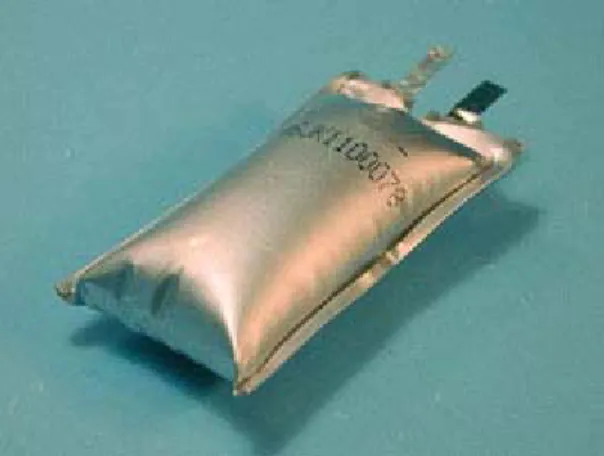
If correctly charged, lithium-ion cell should never generate gases and cause venting. But in spite of what is said, the lithium-based cells can build up internal pressure under certain conditions. Some cells include an electrical switch that disconnects the current flow if the cell pressure reaches a critical level. Other cells rupture a membrane to release the gases in a controlled way. lithium-ion-polymer in a pouch cell sometime grows to the shape of a small balloon because these cells do not include venting. Ballooning cell are known to damage the housing of the portable device.
Figure 1: lithium-ion-polymer cell in a pouch pack. Made ultra-slim, some cells generate hydrogen gas during charge and puff up. The force can damage the housing of the portable device
Memory: myth or fact?
(BU33)The word 'memory' was originally derived from 'cyclic memory'; meaning that a nickel-cadmium battery could remember how much energy was drawn on preceding discharges. On a longer than scheduled discharge, the voltage would rapidly drop and the battery would lose power. Improvements in battery technology have virtually eliminated this phenomenon.
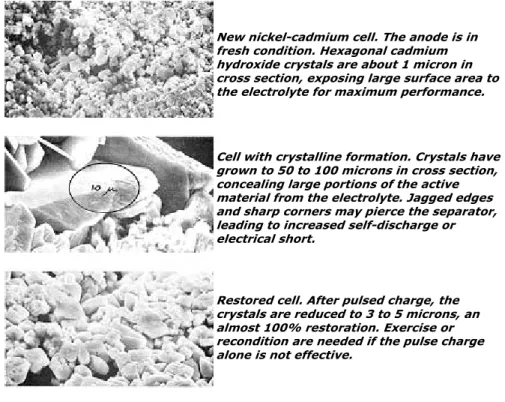
The problem with nickel-cadmium is not so much the cyclic memory but the effects of crystalline formation. The active cadmium material is present in finely divided crystals. In a good cell, these crystals remain small, obtaining maximum surface area. With memory, the crystals grow and conceal the active material from the electrolyte. In advanced stages, the sharp edges of the crystals penetrate the separator, causing high self-discharge or electrical short.
When introduced in the early 1990s, nickel-metal-hydride was promoted as being memory-free. Today, we know that this chemistry is also
affected but to a lesser degree than nickel-cadmium. The nickel plate, a metal that is shared by both chemistries, is partly to blame. While nickel-metal-hydride has only the nickel plate to worry about, nickel-cadmium also includes the memory-prone cadmium plate. This is a non-scientific explanation why nickel-cadmium is affected more than nickel-metal-hydride.
The stages of crystalline formation of a nickel-cadmium cell are
illustrated in Figure 1. The enlargements show the cadmium plate in a proper functioning crystal structure, crystalline formation after use (or abuse) and restoration.
New nickel-cadmium cell. The anode is in fresh condition. Hexagonal cadmium hydroxide crystals are about 1 micron in cross section, exposing large surface area to the electrolyte for maximum performance.
Cell with crystalline formation. Crystals have grown to 50 to 100 microns in cross section, concealing large portions of the active material from the electrolyte. Jagged edges and sharp corners may pierce the separator, leading to increased self-discharge or electrical short.
Restored cell. After pulsed charge, the crystals are reduced to 3 to 5 microns, an almost 100% restoration. Exercise or recondition are needed if the pulse charge alone is not effective.
Figure 1: Crystalline formation on nickel-cadmium cel .
Illustrat on courtesy of the US Army Electronics Command in Fort Monmouth, NJ, USA.
l i
How to restore and prolong nickel-based batteries
Crystalline formation is most pronounced if a nickel-based battery is left in the charger for days, or if repeatedly recharged without a periodic full discharge. Since most applications do not use all energy before recharge, a periodic discharge to 1 volt per cell (known as exercise) is essential to prevent memory.
Nickel-cadmium in regular use and on standby mode (sitting in a charger for operational readiness) should be exercised once per month. Between these monthly exercise cycles, no further service is needed. No scientific research is available on the optimal exercise requirements of nickel-metal-hydride. Based on the reduced crystalline buildup, applying a full discharge once every three months appears right. Because of the shorter cycle life compared to nickel-cadmium, over-exercising is not
recommended.
Exercise and Recondition - Research has shown that the crystals ingrain themselves if no exercise is applied to nickel-cadmium for three months or more. A full restoration with exercise becomes more difficult the longer service is withheld. In advanced cases 'recondition' is required. Recondition is a slow, secondary discharge applied below the 1 volt/cell threshold. During this process, the current must be kept low to minimize cell reversal. Nickel-cadmium can tolerate a small amount of cell reversal but caution must be applied to stay within the allowable current limit. Tests performed by the US Army have shown that a nickel-cadmium cell needs to be discharged to at least 0.6V to effectively break up the more resistant crystalline formation. Figure 2 illustrates the battery voltage during a discharge to 1V/cell, followed by the secondary discharge to 0.4V/cell. Figure 2: Exercise and recondition features of a Cadex battery analyzer.If a nickel-cadmium battery has not been exercised for three months or longer, recondition is required to restore capacity. Recondition is a slow, deep discharge to 0.4V/cell. If service is denied for 6 to 12 months, recondition
becomes ineffective.
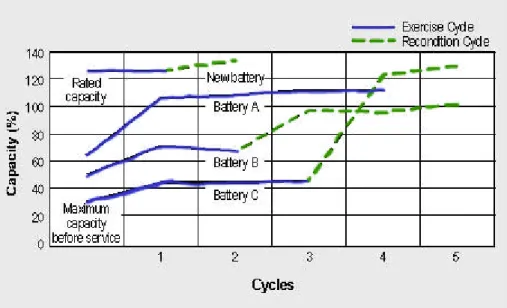
Figure 3 illustrates the effects of exercise and recondition. Four nickel-cadmium batteries afflicted with various degrees of memory are
serviced. The batteries are first fully charged, then discharged to 1V/cell. The resulting capacities are plotted on a capacity scale of 0 to 120% in the first column. Additional discharge/charge cycles are applied and the battery capacities are plotted in the subsequent columns. The green line represents 'exercise', and the blue line 'recondition'. The exercise and recondition cycles are applied manually at the discretion of the research technician.
Figure 3: Effects of exercise and recondition.Four batteries afflicted with memory are serviced. Battery 'A' improved capacity on exercise alone; batteries 'B' and 'C' required recondition. The new battery improved further with recondition.
Battery 'A' responded well to exercise alone and no recondition was required. This battery may have been in service for only a few months or has received periodic exercise cycles. Batteries 'B' and 'C' required
recondition to restore performance. Without recondition, these two batteries would have been discarded.
After service, the restored batteries were returned to full use. When examined after six months of field service, no noticeable degradation in the performance was visible. The regained capacity was permanent but periodic service will be needed to maintain the performance.
Applying the recondition cycle on a new battery (top line on chart) resulted in a slight capacity gain. This increase is not fully understood, other than to assume that the battery improved by additional forming. Another explanation is early presence of memory. Since new batteries are stored with some charge, the self-discharge that occurs during storage produces some crystalline formation. Exercising and
Recondition has its limitations. If no exercise had been applied for 6 to 12 months, permanent damage may have been inflicted. The capacity may not recover or the pack may suffer from high self-discharge caused by a marred separator. Older batteries may get worse with recondition. These packs can be compared to an old man to whom strenuous activity is harmful. Such batteries must be replaced.
Typically 50%-70% of discarded nickel-cadmium batteries can be restored when using the exercise and recondition methods of a Cadex battery analyzer or equivalent. The recovery rate of nickel-metal-hydride is about 40%. This lower yield is, in part, due to the battery's low cycle count.
Field results on exercise and recondition
After the Balkan War, the Dutch Army examined how many field batteries could be restored with a battery analyzer (Cadex). The army was aware that the packs were used under less than ideal conditions. They had been sitting in the chargers with only 2-3 hours use per day.
The capacity on some packs had dropped from 100% to 30%. With the analyzer's recondition function, 9 of 10 batteries were restored to 80% and higher. The nickel-cadmium batteries were 2-3 years old.
The importance of exercising and reconditioning is emphasized by another study carried out for the US Navy by GTE Government Systems. To determine the percentage of batteries needing replacement in the first year of use, one group of batteries received charge only (no maintenance), another group was periodically exercised and a third group received recondition. The batteries studied were used for two-way radios on US aircraft carriers.
With charge only (charge-and-use), the annual percentage of battery failure was 45% (Figure 4). With exercise, the failure rate was reduced to 15%. By far the best results were achieved with recondition. The failure rate dropped to 5%.
Maintenance method Annual % of batteries requiring replacement Annual battery cost (US$) Charge-and-use only 45% $40,500 Exercise 14% $13,500 Recondition 5% $4,500
Figure 4: Replacement rates of n ckel-cadmium batteries. Exercise and recond tion prolong battery life by three and nine respectively.
i
i
The GTE report concluded that a battery analyzer featuring exercise and recondition functions costing $2,500US would return its investment in less than one month on battery savings alone.
Simple Guidelines
• Do not leave a nickel-based battery in a charger for more than a few days, even on trickle charge.
• Exercise nickel-cadmium every 1 to 2 months and nickel-metal-hydride every 3 months. Running the battery down in the equipment may do this also.
• Do not discharge the battery before each recharge. This puts undue stress on the battery.
• Avoid getting the battery too hot during charge. The temperature should only rise for a short moment at full charge, then cool off.
How to prolong lithium-based batteries
(BU34)Battery research is focusing heavily on lithium chemistries, so much so that one could presume that all portable devices will be powered with lithium-ion batteries in the future. In many ways, lithium-ion is superior to nickel and lead-based chemistries and the applications for lithium-ion batteries are growing as a result.
Lithium-ion has not yet fully matured and is being improved
continuously. New metal and chemical combinations are being tried every six months to increase energy density and prolong service life. The improvements in longevity after each change will not be known for a few years.
A lithium-ion battery provides 300-500 discharge/charge cycles. The battery prefers a partial rather than a full discharge. Frequent full
discharges should be avoided when possible. Instead, charge the battery more often or use a larger battery. There is no concern of memory when applying unscheduled charges.
Although lithium-ion is memory-free in terms of performance
deterioration, batteries with fuel gauges exhibit what engineers refer to as "digital memory". Here is the reason: Short discharges with
subsequent recharges do not provide the periodic calibration needed to synchronize the fuel gauge with the battery's state-of-charge. A
deliberate full discharge and recharge every 30 charges corrects this problem. Letting the battery run down to the cut-off point in the equipment will do this. If ignored, the fuel gauge will become
increasingly less accurate. (Read more in 'Choosing the right battery for portable computing', Part Two.)
Aging of lithium-ion is an issue that is often ignored. A lithium-ion battery in use typically lasts between 2-3 years. The capacity loss manifests itself in increased internal resistance caused by oxidation. Eventually, the cell resistance reaches a point where the pack can no longer deliver the stored energy although the battery may still have ample charge. For this reason, an aged battery can be kept longer in applications that draw low current as opposed to a function that
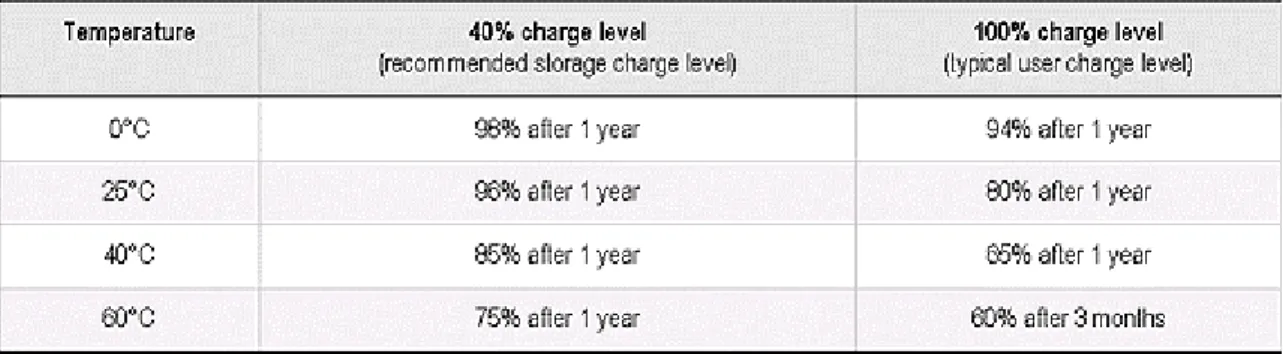
demands heavy loads. Increasing internal resistance with cycle life and age is typical for cobalt-based lithium-ion, a system that is used for cell phones, cameras and laptops because of high energy density. The lower energy dense manganese-based lithium-ion, also known as spinel, maintains the internal resistance through its life but loses capacity due to chemical decompositions. Spinel is primarily used for power tools. The speed by which lithium-ion ages is governed by temperature and state-of-charge. Figure 1 illustrates the capacity loss as a function of these two parameters.
Figure 1: Permanent capacity loss of lithium-ion as a function of temperature and charge level.
High charge levels and elevated temperatures hasten permanent capacity loss. Improvements in chemistry have increased the storage
performance of lithium-ion batteries.
The mentioning of limited service life on lithium-ion has caused concern in the battery industry and I will need to add some clarifications. Let me explain:
If someone asks how long we humans live, we would soon find out that the longevity varies according to life style and living conditions that exist in different countries. Similar conditions exist with the batteries, lithium-ion in particular. Since BatteryUniversity bases its informatlithium-ion on the feedback from users as opposed to scientific information derived from a research lab, longevity results may differ from manufacturer'
specifications. Let's briefly look at the various living conditions of the lithium-ion battery.
The worst condition is keeping a fully charged battery at elevated
temperatures, which is the case with running laptop batteries. If used on main power, the battery inside a laptop will only last for 12-18 months. I must hasten to explain that the pack does not die suddenly but begins with reduced run-times.
The voltage level to which the cells are charged also plays an important role to longevity. For safety reasons, most lithium-ion cannot exceed 4.20 volts per cell. While a higher voltage boosts capacity, the
disadvantage is lower cycle life. Figure 2 shows the cycle life as a function of charge voltage.
F gure 2: Effects on cycle life at differeni t float charge levels (Choi et al., 2002) Higher charge voltages boost capacity but lower cycle life.
There are no remedies to restore lithium-ion once worn out. A
momentary improvement in performance is noticeable when heating up the battery. This lowers the internal resistance momentarily but the condition reverts back to its former state when the temperature drops. Cold temperature will increase the internal resistance.
If possible, store the battery in a cool place at about a 40% state-of-charge. Some reserve charge is needed to keep the battery and its protection circuit operational during prolonged storage. Avoid keeping the battery at full charge and high temperature. This is the case when placing a cell phone or spare battery in a hot car. Running a laptop computer on the mains has a similar temperature problem. While the battery is kept fully charged, the inside temperature during operation rises to 45°C (113°F).
Removing the battery from the laptop when running on fixed power protects the battery from heat. With the concern of the battery overheating and causing fire, a spokesperson for the U.S. Consumer Product Safety Commission advises to eject the battery of affected
laptops and to run the machines on a power cord. It should be noted that on a power outage, unsaved works will be lost.
The question is often asked, should the laptop be disconnected from the main when not in use? Under normal circumstances, it should not matter with lithium-ion. Once the battery is fully charged, no further charge is applied. However, there is always the concern is malfunction of the AC adapter, the laptop or the battery.
A large number of lithium-ion batteries for cell phones are being discarded under the warranty return policy. Some failed batteries are sent to service centers or the manufacturer, where they are refurbished. Studies show that 80%-90% of the returned batteries can be repaired and returned to service.
Some lithium-ion batteries fail due to excessive low discharge. If
discharged below 2.5 volts per cell, the internal safety circuit opens and the battery appears dead. A charge with the original charger is no longer possible. Some battery analyzers (Cadex) feature a boost function that reactivates the protection circuit of a failed battery and enables a
recharge. However, if the cell voltage has fallen below 1.5V/cell and has remained in that state for a few months, a recharge should be avoided because of safety concerns. To prevent failure, never store the battery fully discharged. Apply some charge before storage, and then charge fully before use.
All personal computers (and some other electronic devices) contain a battery for memory back up. This battery is commonly a small
non-rechargeable lithium cell, which provides a small current when the device is turned off. The PC uses the battery to retain certain information when the power is off. These are the BIOS settings, current date and time, as well as resource assignment for Plug and Play systems. Storage does shorten the service life of the backup battery to a few years. Some say 1-2 years. By keeping the computer connected to the main, albeit turned off, a battery on the PC motherboards should be good for 5-7 years. A PC should give the advanced warning when battery gets low. A dead back-up battery will wipe out the volatile memory and erase certain settings. After battery is replaced, the PC should again be operational.
Longevity of high-power lithium-ion
Generally speaking, batteries live longer if treated in a gentle manner. High charge voltages, excessive charge rate and extreme load conditions will have a negative effect and shorten the battery life. This also applies to high current rate lithium-ion batteries.
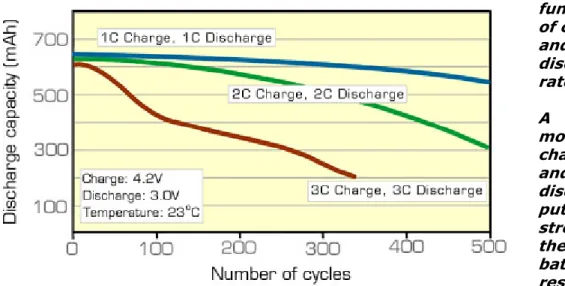
Not only is it better to charge lithium-ion battery at a slower charge rate, high discharge rates also contribute the extra wear and tear. Figure 3 shows the cycle life as a function of charge and discharge rates. Observe the good laboratory performance if the battery is charged and discharged at 1C. (A 0.5C charge and discharge would further improve this rating.)
Figure 3: Longevity of lithium-ion as a function of charge and discharge rates. A moderate charge and discharge puts less stress on the battery, resulting in a longer cycle life. Battery experts agree that the life of lithium-ion depends on other
factors than charge and discharge rates. Even though incremental improvements can be achieved with careful use of the battery, our environment and the services required are not always conducive to achieve optimal battery life. The longevity of a battery is often a direct result of the environmental stresses applied.
Simple Guidelines
• Avoid frequent full discharges because this puts additional strain on the battery. Several partial discharges with frequent recharges are better for lithium-ion than one deep one. Recharging a
partially charged lithium-ion does not cause harm because there is no memory. (In this respect, lithium-ion differs from nickel-based batteries.) Short battery life in a laptop is mainly cause by heat rather than charge / discharge patterns.
• Batteries with fuel gauge (laptops) should be calibrated by applying a deliberate full discharge once every 30 charges.
Running the pack down in the equipment does this. If ignored, the fuel gauge will become increasingly less accurate and in some cases cut off the device prematurely.
• Keep the lithium-ion battery cool. Avoid a hot car. For prolonged storage, keep the battery at a 40% charge level.
• Consider removing the battery from a laptop when running on fixed power. (Some laptop manufacturers are concerned about dust and moisture accumulating inside the battery casing.)
• Avoid purchasing spare lithium-ion batteries for later use. Observe manufacturing dates. Do not buy old stock, even if sold at
clearance prices.
• If you have a spare lithium-ion battery, use one to the fullest and keep the other cool by placing it in the refrigerator. Do not freeze the battery. For best results, store the battery at 40% state-of-charge.
How to restore and prolong lead-acid batteries
(BU35) The sealed lead-acid battery is designed with a low over-voltagepotential to prohibit the battery from reaching its gas-generating state during charge. This prevents water depletion of the sealed system. Consequently, these batteries will never get fully charged and some sulfation will develop over time.
Finding the ideal charge voltage threshold is critical and any level is a compromise. A voltage limit above 2.40 volts per cell produces good battery performance but shortens the service life due to grid corrosion on the positive plate. The corrosion is permanent. A voltage below the 2.40V/cell threshold strains the battery less but the capacity is low and sulfation sets in over time on the negative plate.
Driven by diverse applications, two sealed lead-acid types have emerged. They are the sealed lead acid (SLA), and the valve regulated lead acid (VRLA). Technically, both batteries are the same. Engineers may argue that the word 'sealed lead acid' is a misnomer because no lead acid battery can be totally sealed.
The SLA has a typical capacity range of 0.2Ah to 30Ah and powers
personal UPS units, local emergency lighting and wheelchairs. The VRLA battery is used for large stationary applications for power backup. We are looking at methods to restore and prolong these two battery systems separately.
The sealed lead-acid (SLA)
SLA batteries with mild sulfation can be restored but the work is time consuming and the results are mixed. Reasonably good results are achieved by applying a charge on top of a charge. This is done by fully charging an SLA battery, then removing it for a 24 to 48 hour rest period and applying a charge again The process is repeated several times and the capacity is checked with a final full discharge and recharge.
Another method of improving performance is by applying an equalizing charge, in which the charge voltage threshold is increased by about 100mV, typically from 2.40V to 2.50V. This procedure should last no longer than one to two hours and must be carried out at moderate room temperature. A careless equalize charge could cause the cells to heat up and induce venting due to excessive pressure. Observe the battery during the service.
The cylindrical SLA, made by Hawker and sold under the Cyclone name, requires slightly higher voltages to reverse sulfation. An adjustable power supply works best for the service. Set the current limit to the lowest practical setting and observe the battery voltage and temperature during charge. Initially, the cell voltage may rise to 5V, absorbing only a small amount of current. In about two hours, the small charging current converts the large sulfate crystals back into active material. The internal cell resistance decreases and the cell starts to clamp the voltage. At around 2.30V, the cell accepts charge. If the sulfation is advanced, this remedy does not work and the cell needs replacing.
Sealed lead-acid batteries are commonly rated at a 20-hour discharge. Even at such a slow rate, a capacity of 100% is difficult to achieve. For
practical reasons, most battery analyzers use a 5-hour discharge when servicing these batteries. This produces 80% to 90% of the rated capacity. SLA batteries are normally overrated and manufacturers are aware of this practice.
Cycling an SLA on a battery analyzer may provide capacity readings that decrease with each additional cycle. A battery may start off at a marginal 88%, then go to 86%, 84% and 83%. This phenomenon can be corrected by increasing the charge voltage threshold from 2.40V to 2.45V and perhaps even 2.50V. Always consider the manufacturer's recommended settings. Cyclone batteries require slightly higher voltage settings than the plastic version.
Avoid setting the charge voltage threshold too high. In an extreme case, the limiting voltage may never be reached, especially when charging at elevated temperatures. The battery continues charging at full current and the pack gets hot. Heat lowers the battery voltage and works against a further voltage raise. If no temperature sensing is available to
terminate the charge, a thermal runaway can be the result.
The recovery rate of SLA batteries is a low 15%. Other than reverse sulfation, there is little one can do to improve SLA. Because the SLA has a relatively short cycle life, many fail due to wear-out.
Valve regulated lead-acid (VRLA)
The charge voltage setting on VRLA is generally lower than SLA. Heat is a killer of VRLA. Many stationary batteries are kept in shelters with no air conditioning. Every 8°C (15°F) rise in temperature cuts the battery life in half. A VRLA battery, which would last for 10 years at 25°C (77°F), will only be good for 5 years if operated at 33°C (95°F). Once damaged by heat, no remedy exists to improve capacity.
The cell voltages of a VRLA battery must be harmonized as close as possible. Applying an equalizing charge every 6 months brings all cells to similar voltage levels. This is done by increasing the cell voltage to
2.50V/cell for about 2 hours. During the service, the battery must be kept cool and careful observation is needed. Limit cell venting. Most VRLA vent at 0.3 Bar (5 psi). Not only does escaping hydrogen deplete the electrolyte, it is highly flammable.
Water permeation, or loss of electrolyte, is a concern with sealed lead acid batteries. Adding water may help to restore capacity but a long-term fix is uncertain. The battery becomes unreliable and requires high
maintenance. Simple Guidelines
• Always store lead-acid in a charged condition. Never allow the open cell voltage to drop much below 2.10V. Apply a topping charge every six months or when recommended.
• Avoid repeated deep discharges. Charge more often. Use a larger battery to reduce the depth of discharge.
• Prevent sulfation and grid corrosion by choosing the correct charge and float voltages. If possible, allow a fully saturated charge of 14h.
• To reverse sulfation, raise the charge voltage above 2.40V/cell for a few hours.
• Avoid operating lead-acid at elevated ambient temperatures. Note: Wheelchair batteries don't last as long as golf cart batteries because of sulfation. The theory goes that a golf cart battery gets a full 14 hours charge whereas a wheelchair only gets 7 hours while the user sleeps.
Battery performance as a function of cycling
(BU36)As part of ongoing research to find the most durable battery system, Cadex has performed life cycle tests on nickel-cadmium, nickel-metal-hydride and lithium-ion batteries. All tests were carried out on the Cadex 7000 Series battery analyzers in the test labs of Cadex, Vancouver,
Canada. The batteries tested received an initial full-charge, and then underwent a regime of continued discharge/charge cycles. The internal resistance was measured with Cadex's OhmTest™ method, and the self-discharge was obtained from time-to-time by reading the capacity loss incurred during a 48-hour rest period. The test program involved 53 cell phone batteries, of which one per chemistry was chosen for the charts below.
Nickel-cadmium
In terms of life cycling, standard nickel Cadmium is the most enduring battery. Figure 1 illustrates the capacity, internal resistance and self-discharge of a 7.2V, 900mA nickel-cadmium battery with standard cells. Due to time constraints, the test was terminated after 2300 cycles. The capacity remained steady, the internal resistance stayed flat at 75mW and the self-discharge was stable. This battery receives a grade 'A' for almost perfect performance. It should be noted that nickel-cadmium has a moderate energy density, requires periodic full discharges and contains toxic metals.
Figure 1: Cycle
performance of standard nickel-cadmium.
7.2V, 900mAh This battery deserves an 'A' for almost perfect
performance in terms of stable capacity, internal resistance and self-discharge over many cycles.
The ultra-high capacity nickel-cadmium offers up to 60% higher in energy density compared to the standard version at the expense of reduced cycle life. In Figure 2, we observe a steady drop of capacity during the 2000 cycles delivered. At the same time, the internal
resistance rises slightly. A more serious degradation is the increase of self-discharge after 1000 cycles.
Figure 2: Cycle
performance of ultra-high nickel-cadmium.
6V, 700mAhThis battery offers higher energy density than the standard version at the expense of reduced cycle life.
Nickel-metal-hydride
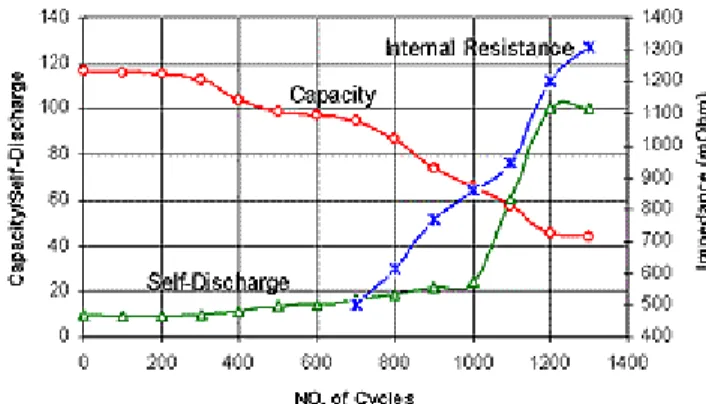
Figure 3 examines nickel-metal-hydride. We observe good performance at first but past 300-cycles, the readings starts to deteriorate rapidly. One can observe the swift increase in internal resistance and
self-discharge after cycle count 700. nickel-metal hydride has a higher energy density than nickel-cadmium and does not contain toxic metals. Some argue that nickel-metal-hydride is an interim step to lithium-ion.
Figure 3: Cycle
performance of nicke -metal-hydride
6V, 950mAh.This battery offers good performance at first but past 300 cycles, the capacity, internal resistance and self-discharge start to deteriorate rapidly.
l
Lithium-ion
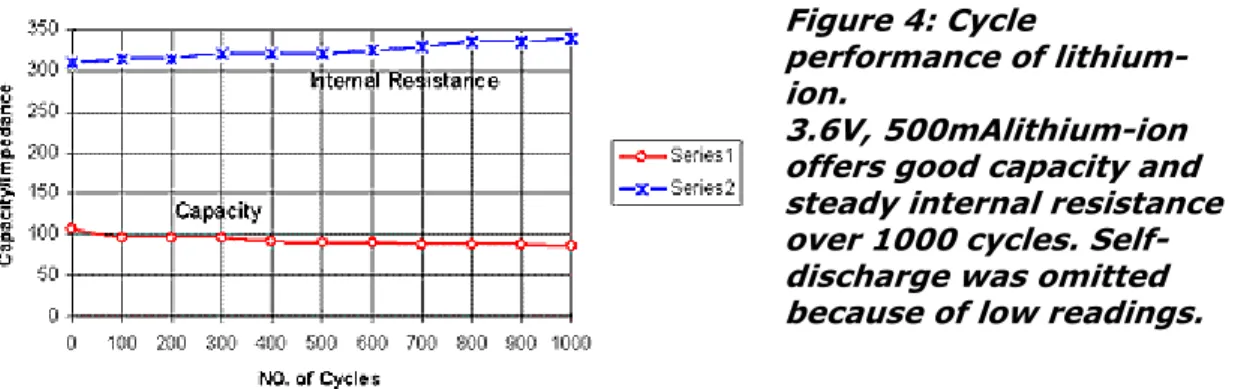
In Figure 4 we examine the capacity and internal resistance of a lithium-ion battery. A gentle and predictable capacity drop is observed over 1000 cycles and the internal resistance increases only slightly. Because of low readings, self-discharge has been omitted on this test. lithium-ion offers the highest energy density of the above-mentioned chemistries and contains no toxic metals. Limited discharge current, the need for safety circuits and aging are negative attributes of this battery.
Figure 4: Cycle
performance of lithium-ion.
3.6V, 500mAlithium-ion offers good capacity and steady interna res stancl i e over 1000 cycles. Self-discharge was omitted because of low readings.
When conducting battery tests in a laboratory, it should be noted that the performance in a protected environment is commonly superior to that in field use. Elements of stress and inconsistency present in
everyday use cannot be simulated accurately in the lab. Here are some of the reasons why:
Under a full cycle program, as conducted in this test, nickel-based batteries are not affected by crystalline formation (memory). Memory shortens battery life in everyday use if not properly maintained. Applying a full discharge/charge cycle once a month solves this problem. Nickel-cadmium is more prone to memory than nickel-metal-hydride.
Lithium-ion benefited from a controlled life cycle test because the aspect of aging plays a less significant role. The service life of lithium-ion in real life is a combination of cycle count and aging. All batteries are affected by aging in various degrees.
Another reason why life the lab cycling produced very positive readings is the controlled temperature environment in which the tests were carried out. In true life, the batteries meet much harsher treatment and are often exposed to heat. Furthermore, the batteries in our test were charged with a well-defined charge algorithm. Overcharge was
minimized and damaging heat buildup prevented. Low-cost consumer chargers do not always service the battery optimally.
The type of load with which the batteries are discharged also plays a role. The above test consisted of an even DC discharge. Digital equipment loads the battery with heavy current bursts. Tests have shown reduced cycle life when a battery is discharged with sharp current pulses as opposed to DC, even though the delivered end-energy is the same. Cell phones, laptop computers digital cameras are devices that draw such heavy current spikes.
In some other aspects, however, a lab test may be harder on the battery than actual field use. In our test, each cycle applied a full discharge. The nickel-based packs were drained to 1.0 volt and lithium-ion to 3.0 volts per cell. In typical field use, the discharge before re-charge is normally shallower. A partial discharge puts less strain on the battery, which benefits lithium-ion and to some extent also nickel-metal-hydride.
Nickel-cadmium is least affected by delivering full cycles. Manufacturers normally specify the cycle life of lithium-ion at an 80%
What is the best cycling pattern?
I often get asked by the readers, "how deep can a battery be discharged and still achieve maximum service life?" There are no definite answers. Batteries are like us humans. Suppose we ate all the vegetables our mother heaped on our plates and do our daily exercise, would we life longer? Perhaps. But by how much, no one will know. Batteries lose capacity as part of aging, cycling and exposure to heat. Nickel-cadmium also loses capacity due to lack of exercise because of memory.
To maximize service life, satellite batteries are kept at a cool
temperature and undergo a very shallow discharge of only 10% before recharge. Nickel-based batteries in space also receive a periodic full discharge. This regime allows ten of thousands of cycles. Closer to earth, the ideal charge/discharge patterns cannot be scheduled; neither is the temperature always perfect. As a result, a replacement will be required sooner or later.
If possible, do not discharge lithium-based batteries too deeply. Instead, recharge more often. Allow a nickel-cadmium battery to fully discharge once every 30 cycles or so. This also applies to nickel-metal-hydride but to a lesser extent. Exact data as to how often a nickel-based battery should be discharged is not available. Neither do we know low long a lithium-ion will last under different depth-of-discharge regimes. Manufacturers typically specify lithium-ion at an 80% depth-of-discharge.
Choosing the right battery for wireless communications
(BU37)
Research has brought about a variety of battery chemistries, each offering distinct advantages but none providing a fully satisfactory solution. With today's variety of battery types, better choices can be made to suit specific user applications. This paper talks about the recommended battery chemistry for cell phones and two-way radios in terms of energy density, durability and price.
What's the best battery for cell phones?
Early cell phones were powered with nickel-based batteries but most newer phones are now equipped with lithium-ion. This chemistry is lightweight, offers high energy density and lasts long enough to span the typical life of the product. Lithium-ion contains no toxic metals.
To obtain thin geometry, some cell phone manufacturers switched to lithium-ion-polymer.
This satisfied consumer requests for slim designs. In the meantime, technological advancements also made low profile lithium-ion possible. lithium-ion packs are now available in 3 mm, a profile that suits most designs. lithium-ion has the advantage of lower manufacturing cost, better performance and longer cycle life than the polymer version. Lithium-ion is a low maintenance battery. No periodic discharge is needed and charging can be done at random. A random charge means that the battery does not need to be fully depleted before recharge. In fact, it is better to recharge before the battery gets too low. Full
discharges put an unnecessary strain on the battery. A recharge on a partially charged battery does not cause memory because there is none. Charging lithium-ion is simpler and cleaner than nickel-based batteries but the chargers require tighter tolerances. lithium-ion cannot absorb overcharge and no trickle charge is applied on full charge. This allows lithium-ion to be kept in the chargers until used. Some chargers apply a topping charge every week or so to replenish the capacity lost through self-discharge while the battery sits idle in the charger. Repeated
insertion into the charger or cradle does not damage the battery though overcharge. If the battery is full, no charge is applied. The battery voltage determines the need to charge.
On the negative side, lithium?ion gradually loses charge acceptance as part of aging, even if not used. lithium?ion batteries should not be stored for long periods but be rotated like perishable food. The buyer should be aware of the manufacturing date when purchasing a replacement
battery. Aging affects battery chemistries at different degrees. Counterfeit cell phone batteries (clone batteries)
In the search for low-cost battery replacements, consumers may
inadvertently purchase clone cell phone batteries that do not include an approved protection circuit. Lithium-ion packs require a protection circuit to shut off the power source if the charger malfunctions and keep on charging, or if the pack is put under undue stress (electrical short).
Overheating and 'venting with flame' can be the result of such strain. (See photos of an exploded cell phone with clone battery on charge.)
Photos of a cell phone with a clone battery
that exploded while left on charge in a car
Cell phone manufacturers strongly advise customers to replace the battery with an approved brand. Failing to do so may void the warranty. Counterfeit cell phone batteries have become visible since the beginning of 2003 when the world was being flooded with cheap replacement batteries from Asia.
Cell phone manufacturers act out of genuine concern for safety rather than using scare tactics to persuade customers to buy their own accessories. They do not object to third party suppliers in offering batteries and chargers as long as the products are well built, safe and functioning. The buyer can often not distinguish between an original and a counterfeit battery because the label may appear bona fide.
Caution should also be exercised in purchasing counterfeit chargers. Some units do not terminate the battery correctly and rely on the battery's internal protection circuit to cut off the power when fully
charged. Precise full-charge termination and a working protection circuit are needed for the safe use of the lithium-ion battery.
What's the best battery for two-way radios?
Most two-way radios use nickel-cadmium. These batteries are durable and forgiving if abused. But nickel-cadmium batteries have only
Environmental agencies have been discouraging its use, especially in Europe. The recommended alternative is nickel-metal-hydride, a battery that has higher energy density and contains no toxic metals. nickel-metal-hydride has been tested in two-way radios for a number of years but the results are mixed. Shorter than expected service life is the major drawback.
For two-way radios, nickel-metal-hydride has a cycle life, which is half that of standard nickel-cadmium. nickel-metal-hydride prefers a
moderate discharge current of 0.5C or less. A two-way radio, on the other hand, draws a discharge current of about 1.5A when transmitting at 4W of power. High discharge loads and sharp pulse currents shorten battery life.
To compare the longevity of nickel-metal-hydride under different load condition, a test was carried out in which batteries of the same type were discharged with a DC and digital load. In both tests, the batteries were discharged to 1.04 volts per cell. The DC load was a steady 500mA; the digital load simulated the Global System for Mobile Communications (GSM) at 1.65 ampere peak for 12 ms every 100 ms with 270 mA
standby. (Note that the GSM pulse for voice is about 550 ms every 4.5 ms).
With the DC discharge, nickel-metal-hydride wore out gradually,
providing an above average service life. At 700 cycles, the battery still provided 80% capacity. By contrast, the same battery type faded more rapidly with a digital discharge and the 80% capacity threshold was reached after only 300 cycles. This phenomenon indicates that the kinetic characteristics for nickel-metal-hydride deteriorate more rapidly with a digital than analog load. Although the test was simulating a GSM cell phone, Tetra and other digital two-way radios have similar loading. Let's briefly compare the characteristics of cadmium and nickel-metal-hydride. nickel-cadmium has the advantage of maintaining steady high capacity and low internal resistance through most of its service life. nickel-metal-hydride, on the other hand, starts with good capacity and low internal resistance but the resistance increases after a few hundred cycles, causing the voltage to drop on a load. Even though the energy may still be present, the battery cannot deliver the high current during transmit and the message cuts off. The radio becomes unreliable.
Nickel-based batteries are high in maintenance. Periodic discharge cycles are needed to prevent crystalline formation on the cell plates, also
known as memory. nickel-cadmium is more receptive to memory than nickel-metal-hydride because both nickel and cadmium plates are affected by memory.
Nickel-cadmium should be exercised once ever 1 to 2 months, whereas nickel-metal-hydride can get by with a deliberate full discharge once every 3 months. Without proper maintenance, the advantage of nickel-cadmium over nickel-metal-hydride in terms of cycle life cannot be realized.
Lithium-ion has been tested for two-way radios and the results are positive. Substituting lithium-ion with nickel-based will require chargers specifically suited for this chemistry. While cadmium and nickel-metal-hydride can often share the same charger, lithium-ion uses a
different charge algorithm. There is also a cost premium for lithium-ion. Future two-way radios will undoubtedly be fitted with lithium-ion.
Choosing the right battery for portable computing
(BU38) Laptops are known to be tough hosts on their batteries. The host demands a stream of uninterrupted power but offers a poor working environment in return. As a result, the battery cannot provide the promised runtime and the service cuts short, often with little notice. In this paper we address the unhappy marriage between the host and battery, and examine what causes a battery to deteriorate faster than in other portable devices.What's the best battery for laptops?
Batteries for laptops have a unique challenge - they must be small and lightweight. In fact, the laptop battery should be invisible to the user and deliver enough power to endure a five-hour flight from Toronto to
Vancouver. In reality, a typical laptop battery provides only about 90 minutes of service. Many users complain of much shorter runtimes. Computer manufacturers are hesitant to add a larger battery because of increased size and weight. A recent survey indicated that, given the option of larger size and more weight for longer runtimes, most users would settle for what is being offered today. For better or worse, we have learned to accept the short runtime of a laptop.
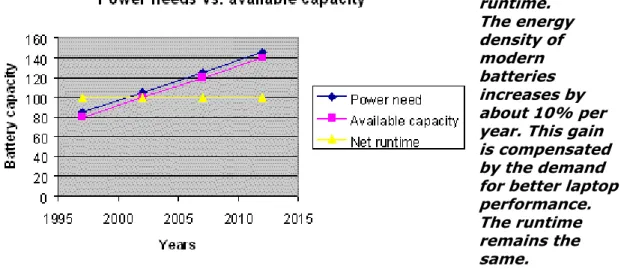
The energy density of modern batteries improves by about 10% per year. However, the benefit of better battery performance is eaten up by higher power requirements of laptops. This results in the same runtime but more powerful laptops.
Figure 1: Net runtime. The energy density of modern batteries increases by about 10% per year. This gain is compensated by the demand for better aptop performance. The runtime remains the same.
l
During the last few years, batteries have improved in terms of energy density. But any benefit in better battery performance is being eaten up by the higher power requirements of the laptops. This trend is continuing and the net effect will be the same runtimes but more powerful laptops. Most laptops are powered by lithium-ion. This chemistry has a high energy density and is lightweight. There is no immediate breakthrough on the horizon of a miracle battery that would provide more power than the current electro-chemical battery.