Policy Research Working Paper
5925
Assessing Real Exchange Rate Misalignments
Megumi Kubota
The World Bank
Latin America and the Caribbean Region
Office of the Chief Economist
December 2011
WPS5925
Public Disclosure Authorized
Public Disclosure Authorized
Public Disclosure Authorized
Abstract
The Policy Research Working Paper Series disseminates the findings of work in progress to encourage the exchange of ideas about development issues. An objective of the series is to get the findings out quickly, even if the presentations are less than fully polished. The papers carry the names of the authors and should be cited accordingly. The findings, interpretations, and conclusions expressed in this paper are entirely those of the authors. They do not necessarily represent the views of the International Bank for Reconstruction and Development/World Bank and its affiliated organizations, or those of the Executive Directors of the World Bank or the governments they represent.
Policy Research Working Paper 5925
There is a renewed debate on the role of exchange rate policies as an industrial policy tool in both academic and policy circles. Policy practitioners usually examine real exchange rate misalignments to monitor the behavior of this key relative price and, if possible, exploit distortions in the traded and non-traded relative price to promote growth. Anecdotal evidence shows that some countries have pursued very active exchange rate policies to promote the export sector and enhance growth by undervaluing their currencies. The main goal of this paper is to provide a systematic characterization of real exchange rate undervaluations. The long-run real exchange rate equation is estimated using: (a) Johansen time series cointegration estimates, and (b) pooled mean group estimates for non-stationary panel data. The paper
This paper is a product of the Office of the Chief Economist, Latin America and the Caribbean Region. It is part of a larger effort by the World Bank to provide open access to its research and make a contribution to development policy discussions around the world. Policy Research Working Papers are also posted on the Web at http://econ.worldbank.org. The author may be contacted at [email protected].
constructs a dataset of real undervaluation episodes. It first evaluates whether (and if so, to what extent) economic policies can be used to either cause or sustain real undervaluations. In this context the paper empirically models the likelihood and magnitude of sustaining real exchange rate undervaluations by examining their link to policy instruments (such as exchange rate regimes and capital controls, among other policies) using probit and Tobit models. Finally, it investigates whether foreign exchange intervention can generate persistent real exchange rate deviations from equilibrium. In general, it finds that intervention can lead to greater persistence in the incidence and magnitude of real exchange rate undervaluations.
Assessing Real Exchange Rate Misalignments
*Megumi Kubota
The World Bank
First Version: November 2007
This Version: December 11, 2011
JEL Classification: F31, F41
Key Words: Real Exchange Rate Misalignment, Undervaluation and Foreign
Exchange Intervention
Sector Board: EPOL
*Kubota: The World Bank, Office of the Chief Economist, Latin America and the Caribbean Region
(LCRCE). E-mail: [email protected]. The author is deeply grateful to Michael Wickens, Peter N. Smith and Neil Rankin for their guidance, suggestions and a human sweetness in her endless way. She would like to express her sincere appreciation to César Calderón, Michael Funke, Eduardo Levy-Yeyati, Ioannis Litsios, Frank McGroarty, Enrique Mendoza and her VIVA external examiner Ronald MacDonald for their precious suggestions and comments. This research paper is developed from Chapter 3 and 6 of the author’s PhD thesis at University of York, ―Real Exchange Rate Misalignments‖ and a part of the University of York Discussion Paper No. 2009/25 in November, 2009. The earlier version of her dissertation was presented at the following workshops and conferences: special thanks to the participants of Research Student Workshop at the Department of Economics, York, WEF/ESRC workshop on Incentives and Governance in Global Finance at Warwick, the University of Sheffield Postgraduate Research Workshop in Economics at Sheffield, the 2008 LACEA/LAMES Annual Meetings at Rio de Janeiro, and Macroeconomic and Financial Linkages: Theory and Practice at Cambridge, INFINITI Conference 2010 at Dublin, Ireland (Trinity College) and 2010 Econometrics Society World Congress, Shanghai, China for their discussion and advice. She greatly acknowledges the support of the Department of Economics at University of York, ESRC, University of Sheffield, the Faculty of Economics at University of Cambridge, the Royal Economic Society Conference Grant and the Econometrics Society Travel Grant. The usual disclaimer applies and all errors are hers. The views expressed in this paper are those of the author, and do not necessarily reflect those of the World Bank or its Boards of Directors.
1.
Introduction
The growing globalization of financial markets –as observed by rising cross-border trade of assets– has led to some important changes in the patterns of saving and investment across the world. Lane and Milesi-Ferretti (2007, 2008a) have extensively documented the fact that emerging market economies (in particular, emerging Asia and oil exporting countries) have become net suppliers of savings while the United States has become an absorber of global savings. This saving glut in emerging markets and the excess consumption in the U.S. led to the so-called global imbalances. The recent debate on the resolution of these imbalances has brought attention towards the role of the real exchange rate (RER) as the relative price that would drive the international adjustment of countries. It has been argued that the depreciation of the US dollar may help improve the net foreign asset (NFA) position of the country through trade and financial effects (Lane and Milesi-Ferretti, 2005, 2006, 2008b). The trade effect suggests that current account deficits will narrow (and, eventually, turn into a surplus) because of a weakening of the US dollar required. The financial effect, on the other hand, implies that the depreciation of the US dollar may lead to an improvement of the NFA position due to the fact that the US external liabilities are mostly denominated in US dollars whereas its external assets have a more varied currency composition. Therefore, the real exchange rate exerts an influence on both net capital flows and net capital gains on external holdings (Lane and Milesi-Ferretti, 2002, 2004, 2006, 2007; Galstyan and Lane, 2008).
Emerging market economies have recently undertaken competitive devaluations so as to keep their currencies undervalued and, hence, promote exports. Recent evidence shows that growth accelerations tend to be associated with higher investment, export surges and real exchange rate depreciation (Hausmann, Pritchett and Rodrik, 2005). Rodrik (2008) finds a somewhat positive co-movement between RER undervaluation and growth increases in China; India; South Korea; Taiwan, China; Uganda; and Tanzania. He states that undervaluation facilitates growth among developing countries and stresses the role of the relative price of traded to non-traded goods as an instrument of industrial policy in the process of economic convergence. Theoretically, Rodrik (2008) argues that RER undervaluation acts as a second-best mechanism to alleviate distortions in developing countries (e.g. institutional weaknesses and incomplete contracts in the traded sector, and information and
coordination problems) and, hence, foster structural change and spur growth. Aizenman and Lee (2007), on the other hand, suggest that RER undervaluations may be used to internalize a learning-by-doing (LBD) externality in the traded sector if the LBD calls for subsidies to labor in tradables. This debate has led to a heated argument about the desirability of undervaluations and the likelihood to support them through economic policies.
Official intervention on the foreign exchange market is one of the crucial issues in the subject of academics and policy-related literature. It has been suggested that intervention may tend to introduce a deviation of the exchange rate relative to its long run equilibrium. An abundant body of research has been conducted on the effectiveness of FOREX market intervention in stabilizing exchange rates. For instance, Taylor (2004) estimated a Markov-switching model to examine the effectiveness of intervention on the US$-DM exchange rate (from 1985 to 1998) and found that intervention increased the likelihood of stability when the real exchange rate is misaligned, and that this influence grew with the degree of misalignment. However, intervention can also generate greater instability. According to Sarno and Taylor (2001) overall, the evidence on the effectiveness of official intervention, through either the portfolio balance channel or the signaling channel, is still mixed on balance, although the more recent literature does suggest a significant effect of official intervention on both the level and the change of exchange rates.
Doroodian and Caporale (2001) support the view of Friedman and Schwartz that exchange rate intervention destabilizes the foreign exchange market by introducing additional level of uncertainty. They test the effectiveness and the impact of Federal Reserve intervention on US dollar against German mark and Japanese yen of daily data from January 3, 1985 to March 19, 1997. Their results from GARCH suggest that the intervention causes significant increase in the conditional variance of spot exchange rates.
Why is this study of real exchange rate misalignments so relevant? Real exchange rate misalignments help to signal distortions in relative prices. Measuring the misaligned currencies (in real terms) would permit us to assess and monitor the behavior or real exchange rate as well as examine the consequences of either overvaluation or undervaluation of the currency in real terms. It has been documented in the literature that a real overvaluation of the currency may have an adverse impact on economic performance –especially, if this is associated with poor macroeconomic
and inconsistent exchange rate policies (Dollar, 1992; Razin and Collins, 1999). A relatively stronger currency tends to raise the cost of imports (among them, intermediate inputs and capital goods) and has a detrimental effect on investment. Moreover the loss of competitiveness associated with the overvaluation could hamper the country’s ability to adjust internationally and reallocate resources more efficiently across the different sectors of economic activity. However, the literature on the growth effects of RER undervaluation is not abundant. As we mentioned above, Hausmann et al. (2005) and Rodrik (2008) have suggested that RER undervaluation may trigger growth.1 If it is true that real undervaluation of the currency leads to higher growth, the relevant policy question is what type of policy shocks may cause RER undervaluations and how persistent these are.
To accomplish this task, we use RER misalignments based on Kubota (2009). This measure of RER misalignments is as deviations of the actual from the equilibrium RER. We estimate the fundamental RER equation using the following econometric techniques: (a) Johansen time series cointegration methods, and (b) pooled mean group (PMG) for non-stationary panel data.2 This equilibrium level is derived from a theoretical model that guarantees intertemporal BOP equilibrium and equilibrium in the tradable and non-tradable goods market by solving for the current account dynamics and Harrod-Balassa-Samuelson (HBS) productivities. We calculate the RER misalignment using two different types of estimates for the coefficients of the long-run RER equation: the time series estimates (Johansen, 1998, 1991) and the PMG panel estimates.
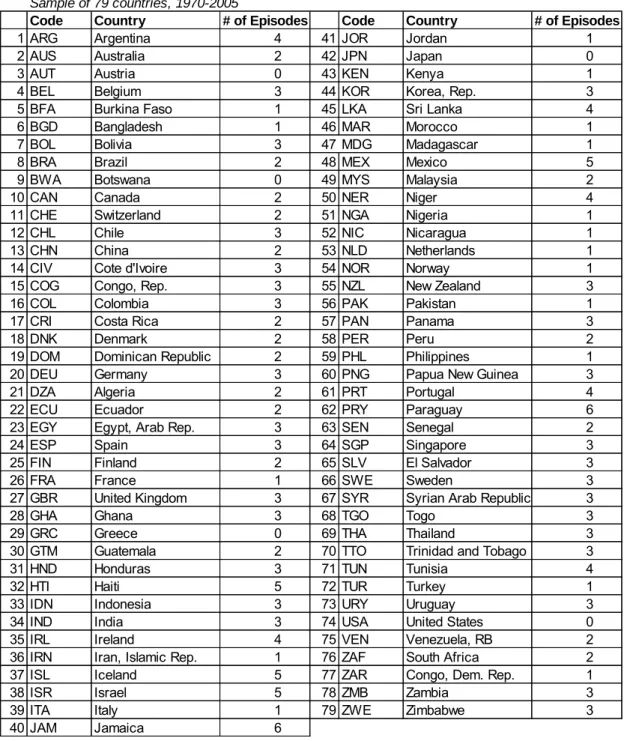
The main goal of our paper is to test whether economic policies and regulations undertaken by the authorities affect the likelihood of keeping the RER undervalued and/or determine the size of the undervaluation. This will allow us to test whether the ―mercantilist‖ view of the exchange rate policy is empirically valid. To accomplish this task we gather an unbalanced panel dataset of 79 countries, of which 21 are
1 Recent research on the ―mercantilist‖ view of exchange rate policy suggests that the accumulation of
international reserves by some countries such as China and Argentina are aimed at keeping the real exchange rate undervalued; therefore, promote growth through rising exports (Rodrik, 2008). Others suggest that accumulating reserves may soften the blow of adverse financial and real shocks –that is, demand for reserve hoarding is precautionary (Aizenman and Lee, 2007; Cheung et al. 2007).
2In order to compute our theory-based measure of RER misalignment a long-run RER equation from a
theoretical model that considers the equilibrium real exchange rate (ERER) as the relative price of tradable to non-tradable goods. The building blocks of the model will follow Balassa (1964) and Samuelson (1964) for equilibrium in the tradable and non-tradable goods market, and Mussa (1984) and Frenkel and Mussa (1985) for the inter-temporal BOP equilibrium.
industrial economies and 58 are developing countries, over the period 1971-2005 (i.e. at most 36 observations per country).
This paper uses limited dependent variable techniques to explore: (a) the linkages between policy actions and the likelihood of sustaining undervaluations, and (b) the ability of economic policy to influence the magnitude of real undervaluations. As a result, we evaluate whether real exchange rate undervaluations could be sustained by economic policy actions using Probit and Tobit analysis. While the probabilistic model (Probit) helps to estimate to what extent the likelihood of achieving a real undervaluation of the currency is affected by policies, the Tobit model examines whether the size of undervaluations can be influenced by policies such as active intervention in the exchange market by the Central Bank (say, reserve hoarding), capital controls, labor and output market regulations, among other factors. We proceed to test whether other policies can generate a more persistent likelihood of exchange rate deviations, and then we also test whether ―de facto‖ fixed or flexible exchange rate arrangements allow a faster speed of mean reversion.
We first undertake our Probit and Tobit analysis of the determinants of the incidence and magnitude of undervaluations. In short, our Probit analysis shows that pro-active economic policies may have an effect on the likelihood of sustaining the RER undervaluation while our Tobit model shows that the authorities may have a more limited ability to influence the magnitude of the RER undervaluation.
Our Probit analysis shows evidence that active exchange rate policies may influence the incidence of RER undervaluations —as measured by deviations from equilibrium RER calculated using both the Johansen estimated coefficients and the PMG ones. For instance, with Johansen estimated RER misalignments, intervention in the foreign exchange market is effective to support small to medium RER undervaluation and its effect becomes non-negligible for larger degrees of undervaluation. The flexibility of exchange rate arrangements —proxied by either the coarse or fine classification of arrangements made by Reinhart and Rogoff (2004)— has a positive and significant coefficient regardless of the threshold of undervaluation. These findings imply that countries with more flexible exchange rate arrangements and larger intervention in the FOREX market are able to experience episodes of currency undervaluation. Analogous to the intervention result, an active fiscal policy seems to raise the likelihood of small to medium RER undervaluation, and it becomes
ineffective when the RER undervaluation is larger (say, more than 20 percent). For RER misalignments calculated using our PMG estimates of the long-run RER equation, trade openness becomes positive and significant while liability dollarization is negative and significant. These results may imply that: (a) countries that are more open to trade may be more successful in engineering an undervaluation, (b) the likelihood of undervaluation is smaller in countries that are highly dollarized. The latter result may reflect the ―fear of floating‖ due to deleterious effects of depreciation on the balance-sheet of countries with high liability dollarization. Finally, it should be pointed out that the measure of exchange rate flexibility is robustly positive and significant, whereas intervention in the FOREX market has a significant effect on the incidence of undervaluation only in the presence of fiscal discipline.
The Tobit analysis shows that policymakers may have a more limited role in influencing the magnitude of the RER undervaluation with either Johansen or PMG estimated RER misalignments. In contrast to our Probit results with Johansen estimated RER misalignments, flexible exchange arrangements and FOREX market intervention have a less robust link with the size of RER undervaluations. The exchange arrangement is mostly not significant in all regressions, while FOREX intervention has a positive and significant effect only while controlling for the fiscal policy stance. With the PMG coefficient estimates of the long-run RER equation capital account openness variables (as measured by the ratio of foreign liabilities to GDP, TL, and foreign assets and liabilities to GDP, TAL) are positive and significant while the Chinn-Ito index of financial openness is significant in regressions that do not control for fiscal discipline. Moreover, fiscal discipline and liability dollarization have a negative and significant coefficient while trade openness is positive and significant. Intervention is significant only when controlling for fiscal discipline while exchange rate regime has a robustly positive and significant coefficient estimate.
Next, we investigate whether foreign exchange intervention can generate persistent RER deviations from equilibrium. Our Probit analysis shows that RER misalignments may not be easily corrected (hence, deviations may persist) in highly dollarized economies and will dissipate at a slower speed in countries with less flexible arrangements. More specifically, the speed of mean reversion would be slower in countries with fixed regimes in RER overvaluation. In turn, FOREX intervention will also reduce the speed of mean reversion and, therefore, generate a more persistent incidence of undervaluation.
While looking at whether intervention in FOREX markets can generate more persistent deviations in terms of magnitude, our Tobit analysis fails to show significant results. This paper finds that FOREX intervention may affect the persistence of the likelihood of undervaluation rather than the magnitude itself. Overall the coefficient estimates from Tobit estimates are relatively negligible compared with Probit results.
This paper consists of the following sections: Section 2 explains the data used in the empirical work. Section 3 describes the econometric methodology applied to evaluate the determinants of the incidence and size of real exchange rate misalignments (Probit and Tobit analysis, respectively) whereas Section 4 analyzes the results from our Probit and Tobit analysis. Section 5 concludes.
2.
The Data
This section provides the description and sources of the data used in our empirical analysis. We follow Kubota (2009) 3 to define and generate the data on real exchange rate misalignment, and RER misalignments are defined as deviations of the actual RER from its equilibrium level. First, we describe the data sources on the determinants of the real exchange rate as suggested by the model in Kubota (2009). Then we gather annual information for a sample of 79 countries over the period 1971-2005 and for a wide array of factors such as exchange rate regimes, capital controls, foreign exchange intervention, trade and financial openness, liability dollarization and central government balance. Finally, we calculate the RER misalignment using two different types of estimates for the coefficients of the long-run RER equation: (a) Johansen time series cointegration estimates, and (b) PMG estimates for non-stationary panel data.
2.1.The Determinants of the Equilibrium Real Exchange Rate
In order to define the dependent variable in the analysis of the likelihood and sustainability of RER undervaluations, we first need to define the real exchange rate misalignment as the deviation of the actual RER from its equilibrium value. Following Kubota (2009) we compute the equilibrium RER by first regressing the
actual RER on the ratio of net foreign assets to GDP, productivity differentials and terms of trade. The actual RER is proxied by the real effective exchange rate (REER), as defined by the domestic price index of country i vis-à-vis the price index of its main trading partners multiplied by the nominal exchange rate of country i,
n k k k k kt kt i it it it e P e P e e P q
1 0 * 0 * 0where eit is the nominal exchange rate of country i (vis-à-vis the US dollar) in period t, Pit is the consumer price index of country i in period t, dkt is the nominal exchange rate of the k-th trading partner of country k in period t (in units of local currency vis-à-vis the US dollar), and 0
kt
P is the wholesale price index of the k-th trading partners in period t. The nominal exchange rate, e, is proxied by the average price of the dollar in local currency (line rf of the International Monetary Fund's International Financial Statistics (IFS)). Domestic and foreign prices, P, are proxied by the consumer price index of the country (line 64 of IFS). According to this definition, an increase in q implies a real appreciation of the domestic currency.
NFA data is drawn from Lane and Milesi-Ferretti (2001, 2007). This database comprises a set of foreign asset and liability stocks for a large group of industrial and developing countries spanning over the 1970-2005 period. The construction of the data is thoroughly documented in Lane and Milesi-Ferretti (2001, 2007), and the NFA position of country i in year t is defined as:
it it
it it
it it it
it FDIA FDIL EQYA EQYL RA LA LL
NFA
where the letters A and L denote assets and liabilities, respectively. Thus, the net foreign asset position is the sum of net holdings of direct foreign investment, FDIA-FDIL, plus net holdings of portfolio equity assets, EQYA-EQYL, and the net position in non-equity related assets (i.e. ''loan assets''). In turn, the net position in non-equity related assets consists of international reserves, RA, and the net loan position, LA-LL.
For productivity differentials we use labor productivity differentials weighted by trade patterns. Then, we develop the data on labor productivity of traded and
non-traded sectors based on ISIC code classifications of the economic activity.4 Output per capita is proxied by GDP per capita, and output per capita of the foreign country is a trade-weighted average of GDP per capita of the domestic country's trading partners. TOT is the ratio of export to import prices. Data are taken from IMF, the World Bank, OECD, and national central banks.
The equilibrium RER is obtained by multiplying the estimated coefficients of the long-run RER equation by the permanent values of the RER fundamentals. These permanent components are computed using the band-pass filter, and the RER misalignment is the difference between the actual and equilibrium levels of the RER5. According to our definition of RER, positive (negative) deviations imply a real exchange rate over- (under-) valuation. We use two different set of estimated coefficients to compute the RER misalignment. While we compute RER misalignments using the Johansen time series cointegration estimator, for the sake of robustness we also compute the RER misalignments using the PMG estimator for non-stationary panel data series.
2.2 The Determinants of the Likelihood and Sustainability of Real Exchange Rate Undervaluations
After defining the real exchange rate misalignments, we examine the ability of economic policies to affect the probability and magnitude of RER undervaluations. We include policy variables such as exchange rate regimes, capital controls, foreign exchange market intervention, trade openness, liability dollarization and fiscal discipline.
Exchange Rate Regimes. We approximate the exchange rate regime de facto in place in the country by the database developed by Reinhart and Rogoff (2004) and updated by Ilzetzky, Reinhart and Rogoff (2009). These authors have developed a new system to classify historical exchange rate regimes. In contrast to previous
4
The sign of the coefficient of relative labor productivity at Home (relative to the Foreign) country will be positive (negative) if the surge in aggregate labor productivity is explain by shocks to tradables (non-tradables).
5 The coefficient estimate of the ratio of net foreign assets (NFA) to GDP may be subject to issues of
reverse causality as it can be argued that the NFA position of the country is sensitive to valuation effects arising from changes in the real exchange rate. In spite of the detrending the NFA position (using band-pass filtering techniques), this permament component of NFA is still determined by the exchange rate. For instance, a real depreciation will increase the absolute value of the stock of net foreign debt assets over GDP. Therefore, net debtors would see their NFA worsening with a depreciation, which captures the correlation implicit in the model but for the wrong reasons.
classifications, their extensive database is not only uses of market-determined or parallel exchange rates but also develops a natural classification algorithm. Specifically, we use the fine classification of Reinhart-Rogoff that takes values between 1 and 15 where higher values indicate a higher level of flexibility in the exchange rate arrangements in place.
The data on capital controls used in this paper is a binary variable collected from the IMF’s Annual Report on Exchange Arrangements and Exchange Restrictions. It takes the value of 1 in the years when restrictions on capital account transactions are in place and 0 otherwise (Prasad, Rogoff, Wei and Kose, 2003). The typical problem of this type of data is that, although it captures the presence of controls, it fails to capture the intensity of the controls imposed.
As a result, countries with closed capital account may increase the stringency of those controls by imposing restrictions on current account transactions, multiple exchange rate practices or the surrender of export proceeds while countries with an open capital account may still restrict the flow of capital by imposing other restrictions on cross-border financial transactions (Chinn and Ito, 2007). To capture these aspects, we complement the measure mentioned above with the inverse of the Chinn-Ito index of financial openness which incorporates the different types of restrictions on cross-border financial transactions stated above. We multiply the Chinn-Ito index by -1 to capture the presence of different types of restrictions on cross-border financial transactions. Higher values of this new index would imply more strict restrictions on cross-border financial operations.
The data on intervention in the foreign exchange market is constructed following Levy-Yeyati and Sturzenegger (2007). We aim to show whether FOREX intervention has a lasting effect on the real exchange rate. Although it has traditionally been argued that nominal interventions are unlikely to have a real impact, we examine whether FOREX interventions help to sustain misalignments. According to Levy-Yeyati and Sturzenegger (2007) we construct a measure of intervention that is not affected by the growth-induced increases in money demand —which in turn may lead to either increases in domestic credit or in international reserves. To calculate such a measure, we construct first the ratio of reserves to broad money (M2) for country c in year y and month m, R2c,y,m,
m y c m y c m y c M FA R , , , , , , 2
and, then, intervention in the FOREX market, Int2, is computed as the average of the monthly change in the ratio of reserves to broad money, R2,
12 1 1 , , , , , 2 2 2 m m y c m y c y c R R IntNote that Int2 is positive whenever reserve accumulation exceeds the increase in monetary aggregates —thus, implying a strong degree of intervention in the foreign exchange market.
We also consider trade and financial openness as determinants of RER misalignments. Trade openness is proxied as the ratio of real value of exports and imports (that is, total trade) to real GDP, and the data is obtained from the World Bank’s World Development Indicators (WDI). Measuring financial openness involves data on foreign assets and liabilities from Lane and Milesi-Ferretti (2001, 2007). We construct the ratio of foreign liabilities as a percentage of GDP (which include stocks of liabilities in portfolio equity, foreign direct investment, debt and financial derivatives) and, for robustness purposes, the ratio of foreign assets and liabilities to GDP. We also assess the role played by the composition of capital flows in affecting the ability of the government to sustain RER undervaluations. Hence, we decompose our measure of financial openness into equity- and loan-related foreign liabilities. While the former includes the foreign liability position in foreign direct investment and portfolio equity, the latter includes only the debt liability position (i.e. portfolio debt and other investments). The same calculation is performed for the ratio of foreign assets and liabilities to GDP.
Liability dollarization is measured as the ratio of foreign liabilities of the financial sector to money. The data is taken from the IFS —more specifically, lines 26C and 34 for foreign liabilities of the financial sector and broad money, respectively. Although this is not a direct measure of the extent to which a country’s balance sheet present currency mismatches in assets and liabilities, there is a wide availability across countries and over time which is attractive for panel data analysis. For robustness
purposes, a measure of financial dollarization6 from Levy-Yeyati (2006) is also used, namely the ratio of deposit dollarization.
Our proxy for fiscal discipline is the central government balance as percentage of GDP and the data is obtained from WDI and the IMF’s World Economic Outlook (WEO). Savings is measured as the ratio of gross domestic savings to GDP in local currency units taken from WDI whereas private consumption is the ratio of household final consumption expenditures to GDP in local currency units from WDI. Finally, export growth is annual percentage growth rate of exports of goods and services, gross domestic investment is calculated as the ratio of gross capital formation to GDP in local currency units, and inflation is the percentage change in consumer price index. All the variables mentioned above are constructed using data from WDI.
3.
Econometric Methodology
This section describes the econometric techniques we use to examine whether policymakers are able to sustain real exchange rate misalignments –and, more specifically, undervaluations, through policy actions. As a result, we empirically model the likelihood of sustaining a RER undervaluation as well as the magnitude of this undervaluation using limited dependent variable and censored variable techniques. In particular, we examine the impact of active economic policies on the likelihood (or incidence) of real exchange rate undervaluations using the Probit analysis while the Tobit analysis is used to assess the effects of economic policy on the size or magnitude of RER undervaluations.
3.1.The Probit Model
The Probit model is a model of binary choice where the dependent variable takes the value of one whenever there is a sharp real undervaluation of the currency and zero otherwise. Suppose that X is a binary variable that can only take two possible outcomes, zero (0) and one (1). We also have a vector z of variables that is assumed to have an effect on the outcome X. Hence, we assume that our probabilistic model (Probit) takes the following form:
1 , Prob X F z
6 Dollarization data by Levy-Yeyati (2006) does not have enough coverage. Therefore, we use this data
0 1 , Prob X F z
Our regression model is such that:
z z x E x z x E x ' | |where E
x|z
Fz, and Var
|z
'z1E
x|z
. This assumption requires that: 1 1 Pr lim ' ob X z and lim' ProbX 1 0 z
z dt t X ob z ' ' 1 Pr
1 ' 1 ' 1 | x x z z X L Assuming a standard normal distribution, the logistic distribution implies that:
z e e X ob z z ' ' ' 1 1 Pr The dependent variable takes the value of 1 whenever the actual RER depreciates more than equilibrium (or appreciates less than equilibrium) beyond a threshold, and 0 otherwise. We test whether policy variables have an influence on the likelihood of achieving an undervalued real exchange rate. The negative coefficient in the dependent variable shows the smaller a lag in the misalignment values the higher tendency to undervalue the RER. Our dependent variable X is a dichotomic variable which reflects whether or not we observe a certain phenomenon.
1
Prob X , if
qq*
k 0 0
This means that X reflects the incidence/likelihood of episodes, where the RER is below, is equilibrium level beyond a certain threshold k. The response, as we see, is binary which is a choice among two possible outcomes is. We model this response as a linear regression problem and the probability of achieving an undervalued RER beyond some threshold k such as 5, 10, 20 and 25 percent. We regress the binary outcome on potential explanatory variables such as intervention, exchange rate arrangements, openness, monetary and fiscal variables. The expected value of achieving undervaluation in the model (given a set of explanatory variables z) is:
X z
ob k q q ob Otherwise ob k q q ob z x E | 1 Pr Pr * 1 Pr * 0 Pr * 1 | * * = linear function of zOur Probit analysis therefore evaluates the impact of active macroeconomic policies on the probabilities of RER undervaluation with using our event-analysis database.
3.2.The Tobit Model
The Tobit model is a type of censored regression model where the latent variable cannot always be observed while the explanatory variables are always observed. The Tobit model has the following general specification:
i i i z x ' 0 i x if xi 0 i i x x if xi 0
The latent variable, E
xi is 'zi. The estimation of this model is similar to one of truncated regression. The log-likelihood for the censored regression model is:
0 ' 0 2 2 ' 2 1 log log 2 log 2 1 log i i x i x i i z z x L In our model the dependent variable is the extent of RER undervaluation when it takes place otherwise 0 when the RER is in equilibrium or overvalued.
The dependent variable is the absolute value of the undervaluation beyond a certain threshold, and 0 otherwise. We test whether policy variables have an influence on the extent of real undervaluation of the local currency. The negative coefficient in the dependent variable means that the smaller a lag in the misalignment the larger magnitude of undervaluation in the local currency. This model is used when the response is continuous but possibly censored with the dependent variables assuming discrete values. Although these values are unknown, we can still identify whether those values are greater than some threshold values. We want to investigate whether the RER undervaluations greater than some thresholds such as 5, 10, 20 and 25 percent. Hence, our dependent variable is as:
| |q q* X if
qq*
k 0 0 X , otherwiseThis implies that X reflects the magnitude of the deviation of RER below its equilibrium level beyond a certain threshold k. We measure the size of the undervaluation when it is greater than a threshold k and explain whether our explanatory variables affect the size of the undervaluation beyond a certain threshold. In short, our Tobit analysis examines the effects of macroeconomic policies on the magnitude of RER undervaluations.
4.
Empirical Assessment
This section discusses the findings from the limited dependent variable analysis on the linkages between economic policies and the likelihood (of sustaining) and magnitude of RER under-valuations.
4.1.Policy Analysis of RER Undervaluations: Probit and Tobit Models
We examine the linkages between policy actions, the likelihood of sustaining under-valuations and the extent to which policy can affect the magnitude of the undervaluation —these relationships are evaluated using Probit and Tobit models, respectively. Some researchers argue that some countries (e.g. China and Argentina)
use active exchange rate policies to undervalue their currency in real terms so that they can foster growth in their economic activity. Our purpose is to test whether it is likely that economic authorities can sustain under-valuations and whether they could affect the size of this undervaluation through the use of active exchange rate policies (say, strong intervention in the foreign exchange market by the monetary authority), and the use of capital controls, strategies of outward orientation and fiscal discipline among other factors.
4.2.What Determines the Success in Occurring Undervaluations?
In the following section we discuss the results on the effects of policy determinants on the likelihood of occurring real exchange rate undervaluations beyond some determined threshold, and the influence of the authorities on the magnitude of the real exchange rate undervaluation.
The incidence of RER undervaluation, I(q-q ), is captured by a dummy variable that takes the value of one when the RER deviation from its computed long-run equilibrium is such that:
otherwise q q if q q I , 0 0 , 1 ) (
where we define the occurrence of RER undervaluation for different values of the threshold —more specifically, = 5%, 10%, 20% and 25%.
Also, we define the variable magnitude of undervaluation, S, is captured by a dummy variable that the value of one when the RER deviation from its computed long-run equilibrium is as:
otherwise q q if q q q q S , 0 0 , ) (
4.2.1 Can Pro-Active Policies Determine the Likelihood of Occurring RER
Undervaluations? A Probit Analysis
We model the likelihood of real exchange rate under-valuations occurring using Probit models and test whether pro-active economic policies may affect its
probability. The set of policies comprises active exchange rate policies (as proxied by the exchange rate regime in place and the degree of integration in the foreign exchange market), outward-oriented policies in goods and asset markets (say, trade and financial openness) and the composition of capital flows, reducing currency mismatches (as measured by the degree of liability dollarization), and fiscal discipline (as measured by the central government surplus).
The empirical assessment explores the link between economic policies and country characteristics on RER undervaluation. Our purpose is to show whether governments can sustain the real undervaluation of the currency through policy actions. Therefore, we evaluate the impact of economic policies on the incidence and magnitude of RER undervaluation.
Baseline Results
Table 2 shows the baseline regression analysis for our Probit model where the dependent variable takes the value of 1 whenever there is an episode of RER undervaluation beyond 5%. In this table, the RER misalignment was calculated using the time series estimates of the long-run RER coefficients. The lagged misalignment (as calculated with the Johansen estimates) is statistically significant in our Probit regressions. Therefore, misalignments tend to correct themselves, which is sensible due to our definition of misalignments as not only the reflection of policy but also of real shocks to which the economy ultimately adapts. Hence, real exchange rate misalignments in period t-1 would affect the likelihood of undervaluation in the current period (t), thus enabling the initial RER misalignment to play a role. For instance, the negative coefficient of the lagged misalignment found in regression [1] in Table 2 shows that a drastic devaluation likely occurs with a probability of 27.3% that might lead to an undervalued local currency in real terms if there is an initial disequilibrium. Regarding financial openness, it is found that foreign liabilities (FL) and total foreign assets and liabilities (FAL) are all insignificant. The lack of significance of the outcome measures of financial openness may be attributed to the fact that we do not take into account the composition of capital flows.7 The policy measure of financial closedness —as measured by a measure of capital controls derived from the Chinn-Ito index— enters with a significant coefficient but the sign is
not robust. Closed capital accounts have a negative sign when we control for fiscal policy and a positive one when we do not control for that variable. If we include fiscal policy in our regression, trade openness reduces the likelihood of undervaluation by about 9.5 percent, while excluding fiscal policy raises the effect of openness by 8.3 percent.
Fiscal discipline, as measured by the Central Government budget balance (as % of GDP) enters with an expected negative sign. This implies that countries with healthier fiscal positions are less likely to undervalue their currencies.
Interestingly, the exchange rate regime (as proxied by the fine classification of Reinhart and Rogoff, 2004) and intervention in the foreign exchange market enter with a positive sign in our regressions. This implies that countries with more flexible exchange rate arrangements and more frequent intervention in the FOREX market are able to generate an undervaluation of the currency. Liability dollarization is only significant without fiscal policy; hence, dollarization matters on a probability to undervalue the exchange rate while central government does not process its policy.
Table 3 shows our baseline Probit regressions with RER misalignments calculated using our PMG estimates of the long-run RER equation. The lagged misalignment is statistically significant; hence, real exchange rate misalignments in the previous period would affect the likelihood of undervaluation in the current period. The negative significant coefficients imply that the initial RER misalignment plays a role. FA and FAL are significant in most cases. Compared with our results in Table 2, trade openness becomes positive and significant while liability dollarization is negative and significant. These results may imply that: (a) countries that are more open to trade may be more successful in engineering an undervaluation, (b) the likelihood of undervaluation is smaller in countries that are highly dollarized. The latter result may reflect the ―fear of floating‖ due to deleterious effects of depreciation on the balance-sheet of countries with high liability dollarization. Finally, it should be pointed out that the measure of exchange rate flexibility is robustly positive and significant, whereas intervention in the FOREX market has a significant effect on the incidence of undervaluation only in the presence of fiscal discipline.
Composition Effects in Financial Openness
Table 4, on the other hand, presents the results for the composition effects of financial openness. That is, we test whether the structure of external liabilities plays a
role in determining the likelihood of real undervaluations. Before we discuss these results we should point out that our policy measure of financial openness (the index of capital controls) enters the regressions with an insignificant coefficient. As we mentioned above, we conjecture that the failure to find a significant impact from outcome measures of financial openness such as the total foreign assets and liabilities may be due to fact that different types of capital flows may have opposite effects on the likelihood of occurring RER undervaluations. For instance, Calderón and Kubota (2009) show that the composition of capital flows is important when analyzing the factors that help mitigate the impact of shocks on real exchange rate volatility. In fact, they found that shocks to the RER would be mitigated by the accumulation of equity-related foreign liabilities, whereas they would be amplified by loan-equity-related foreign liabilities.
This distinction between different types of flows and integration to capital markets may be important due to the different persistence of these flows and its differential impact on RER and its deviations from equilibrium. Hence, we decompose foreign liabilities into and loan-related liabilities. Note that the coefficient of equity-related liabilities is robustly negative across specifications while that of loan-equity-related liabilities is positive and significant. This shows that the structure of external liabilities plays a role in explaining the probability of real exchange rate undervaluations taking place.
Finally, we should point out the following interesting results in Table 4 (when controlling for the structure of external liabilities): countries with more flexible exchange rate arrangements (proxied either by the coarse or fine classification of exchange rate regimes) are more prone to generate an undervaluation of the currency. So do countries that intervene in foreign exchange markets.
Table 5 presents our results for the incidence of undervaluation and RER misalignments are calculated using the pooled mean group estimator. It shows that loan-related liabilities have a negative and significant coefficient while equity-related liabilities are neither negative nor significant. On the other hand, undervaluations are more likely to occur in countries with high trade openness and lower liability dollarization. Although fiscal discipline does not have a significant effect, our indicator of exchange rate flexibility has a positive and significant coefficient that is robust to its different definitions or classifications. Finally, intervention is again positive and significant if we control for the presence of fiscal discipline.
Real Vulnerabilities
Tables 6 and 7 test whether vulnerabilities on the real side might prevent the country from sustaining undervaluation Real vulnerabilities are measured by the degree of: (a) output concentration —as measured by the Herfindahl index of sector value added based on the one-digit ISIC code of economic activity, and (b) export concentration as approximated by the Herfindahl index of export values using the COMTRADE database. In addition, to test whether the effect of openness depend upon the diversification of economic activity in the country, we interacted our trade openness ratio with both measures of concentration. The results reported in Table 6 show that we fail to find a significant effect from trade openness and concentration. These results suggest that the trade patterns of specialization do not matter in determining the probability of RER undervaluation. Table 7 reports our results for RER undervaluations constructed from PMG estimates of our RER equation. This table shows robustly a positive and significant effect of trade openness and a negative and significant effect for liability dollarization. However, we should point out that countries with either output or export concentration fail to have any significant differing impact on the likelihood of undervaluations. The flexibility of exchange rate regimes has a positive and significant effect while either intervention or fiscal discipline is not significant.
Sensitivity Analysis
Tables 8 through 13 replicates the results reported in Tables 2 through 7 for different thresholds of RER undervaluation. In the first two columns of these Tables we report the baseline results for a RER undervaluation greater than 5%. Then, we present the results where the dependent variable is the occurrence of a RER undervaluation taking place as defined by higher thresholds –say, 10, 20 and 25 percent.
With RER misalignments measured using our Johansen estimates we find that (as opposed to the results found with undervaluations beyond 5%) capital controls have a positive and significant effect for undervaluations greater than 10, 20 or 25%. This implies that capital controls may be successfully used to sustain larger undervaluations. Since higher values indicate high intensity of capital controls, the positive coefficient estimate implies that capital controls may help to maintain the real exchange rate undervalued —say, by either avoiding further appreciation that what
the equilibrium appreciation dictates or by leading to further depreciation (beyond the equilibrium level). Table 9 reports our results for RER undervaluations estimated using our panel data PMG estimator and shows that capital controls may have a significant effect for a larger value of the undervaluation threshold. That is, capital controls may influence the incidence of larger undervaluations.
For our Johansen time-series estimates of undervaluation, trade openness variable (open) fails to yield a significant coefficient estimate and so do the outcome measures of financial policy while trade openness is positive and significant especially with a lower threshold with RER misalignments using PMG. Fiscal discipline with RER misalignments by Johansen, on the other hand, shows a negative and significant sign only when we consider thresholds of undervaluation of 5 and 10%. This implies that fiscal discipline reduces the likelihood of being able to sustain undervaluations. If the threshold is 20 or 25 percent, the fiscal variable becomes insignificant. This shows that fiscal policy is effective while the probability of the RER undervaluation is still closer to its equilibrium and fiscal policy likely becomes ineffective while the threshold gets more than 20 percent. Liability dollarization with RER misalignments by PMG shows negative and significant especially with a lower threshold although we did not find any significance in fiscal discipline.
Finally, the ability to sustain undervaluations granted by flexible exchange rate regimes and FOREX market intervention is robust for different thresholds of RER undervaluation with RER misalignments by Johansen (see Table 8). Higher values of the indicator of intervention in the foreign exchange market (Int2) help signal a more active policy to keep the currency undervalued. The regressions in Tables 8 through 13 shows that with the 5 percent threshold the RER is more likely to undervalue in countries pursuing a more active intervention in the foreign exchange rate market. As the value of the threshold increases, the coefficients become insignificant. This means that the RER is less likely to be undervalued when pursuing a more active intervention when the RER gets too far from its equilibrium. With RER misalignments by PMG exchange rate regimes are robust but the results of FOREX market intervention varies.
Table 10 and 11 investigate the effects of the structural of external liabilities on the likelihood of generating and/or sustaining RER undervaluations using our Johansen and PMG estimates, respectively. Our findings in Table 10 are consistent with those of Table 4: equity-related liabilities enter with a negative sign whereas
loan-related liabilities have a positive coefficient. Countries with a large accumulation of loan-related liabilities are more prone to sustain RER undervaluations. Table 11 supports the evidence of the composition effect but at a larger threshold of undervaluation.
Central government balance as a fiscal variable is a positive significant if the threshold is either 5 or 10 percent in Table 8~12 when RER misalignments are computed using Johansen. While using PMG, on the other hand, we fail to find a significant coefficient estimate for our proxy of fiscal discipline. Table 12 and 13 include the real vulnerabilities –as proxied by concentration in economic activity and in the export sector. Although we mostly fail to find a significant coefficient for those variables, we find a positive significant coefficients in output concentration with the incidence of RER undervaluations when misalignments are computed using PMG.
Dollarization Robustness Analysis
Table 14 replicates the results from the baseline regressions using different measures of dollarization: (a) the ratio of foreign liabilities to money used in Cavallo and Frankel (2008), and (b) the ratio of deposit dollarization from Levy-Yeyati (2006). As a benchmark for this variable, we also include some regressions without dollarization. We present the results for lower to higher thresholds (10, 20 and 25 percent). Table 14 depicts these results.
Our control variables in the regression show pattern seen so far. The coefficient of lagged RER misalignment as calculated from the Johansen estimates is always statistically negative significant in Table 14. While the coefficient of the Chinn-Ito index of de jure financial openness is always positive significant, that of total foreign liabilities is always positive significant without dollarization measure. Exchange regime is positive and significant in almost all regressions while intervention is positive and significant with the ratio of foreign liabilities and without dollarization when the threshold is 5 percent.
Regarding our variable of interest in Table 14, dollarization, we find that the coefficient estimate is positive and significant for both measures when the proxy of fiscal discipline is not included in the regression.
Can other policies generate a more persistent likelihood of exchange rate deviations?
Table 15 reports a positive and significant coefficient for dollarization. This implies that misalignments may not be easily corrected in highly dollarized economies due to fear of floating (and the associated deleterious effects on economic activity of balance sheet effects of depreciations). As a result, we proceed to test whether ―de facto‖ fixed or flexible exchange rate arrangements allow a faster speed of mean reversion. Table 16 reports the regression results of our baseline regression with the interaction term between lagged RER misalignments and fine classification of exchange rate regimes by Reinhart and Rogoff (2004). The negative and significant coefficient for the interaction term imply that countries with less flexible exchange rate arrangements tend to have a slower speed of reversion in the RERs. That implies that the misalignments will dissipate at a slower speed in countries with less flexible arrangements.
Table 17 shows the baseline regression results augmented by two interaction terms: the lagged interaction between overvaluation and exchange rate regime and the lagged interaction of undervaluation and exchange rate regime. The coefficients estimates show that the interaction term for undervaluation and exchange rate regime is negative and significant. Hence, the speed of mean reversion is slower for countries with fixed regimes and especially so in situations of RER overvaluation. As a result, intervention when these deviations are present generates a more persistent incidence of undervaluation. We should point out that for countries with fixed regimes; the speed of mean reversion is slower when the misalignment is an overvaluation rather than an undervaluation.
Intervention Analysis
Our results so far show that intervention in the FOREX market has a statistically (and economically) significant effect on the likelihood of an undervaluation. In addition, we test here whether that intervention may be able to generate a persistent deviation in exchange rates. To accomplish this task, we include an interaction term between the RER misalignment and the intervention in the FOREX market. The rationale behind this analysis is that intervention may reduce the speed of mean reversion of the exchange rate and thus make the deviation from equilibrium more persistent (hence, we expect a positive coefficient). Table 15 shows the results of the
baseline regression augmented by the interaction term. All regressions reported show that the interaction term is positive and significant. Therefore, foreign exchange intervention may slow down the speed of mean reversion. This means that deviation from equilibrium (in this case undervaluation) would be more persistence, and the slowdown will be greater is the extent of intervention in FOREX market is larger. In addition, the coefficient of intervention itself (alone and not interacted) is positive and significant in the lower thresholds.
Finally, we create the interaction term which multiplies intervention by overvaluation and intervention by undervaluation. Table 18 shows that the interaction coefficients are all positive and significant in most cases. This implies that overvaluation and undervaluation generate more persistent deviations. However, the effect for the undervaluation is economically much larger than the one for the overvaluation.
4.2.2 Can Active Policies Affect the Magnitude RER Undervaluations? A
Tobit Analysis
We model the likelihood (or incidence) of real exchange rate undervaluation episodes using Probit models and test whether pro-active economic policies may affect that probability. We assume that the set of policies that may exert an influence on the incidence of undervaluation episodes includes active exchange rate policies (typically, identified as more flexible exchange rate arrangements and substantial intervention in the foreign exchange market), outward-oriented policies in goods and asset markets (say, trade and financial openness) and the composition of capital flows, declining currency mismatches (as measured by the degree of liability dollarization), and fiscal discipline (as measured by the central government surplus).
We empirically explore the link between economic policies and the incidence (or likelihood) of RER undervaluation episodes controlling for country characteristics. Our purpose is to show whether governments can engineer real undervaluations of the currency (i.e. real depreciation beyond that attributed to fundamentals) through policy actions. Therefore, we evaluate the impact of economic policies on the probability of a RER undervaluation taking place.
Our limited dependent variable analysis is carried out using the measure of undervaluation that is derived from the deviation of the actual RER from the time-series cointegration estimate of the equilibrium RER. We use these estimates rather
than the PMG estimates for the following reasons: first, it deals with the issue of heterogeneity of the long-run parameters across countries in our real exchange rate equation. Second, even if the Hausman tests of the PMGE fail to reject the null of homogeneity, this result could be driven by very large standard deviations in some countries. We should also point out that although the measures of misalignment calculated using the time series and panel date cointegration techniques may go in the same direction (indeed, they are positively correlated –especially, among industrial countries), there may be some large quantitative differences. These differences may be attributed to the fact that, in fact, the regression may be a better fit for average countries rather than countries that deviate from this average.
Baseline Results
Tables 19 through 24 present our Tobit analysis of RER undervaluations. The dependent variable measures the size of the undervaluation (in absolute value) whenever the actual rate weakens relative to the equilibrium real exchange rate by more than 5%. The baseline results in Table 19 (with RER misalignments calculated using the time-series Johansen cointegration estimates) show a negative and significant coefficient for the lagged level of RER misalignment. This implies that the degree of RER misalignment in the previous period would affect the extent of undervaluation in the current period. For instance, regression [1] in Table 19 implies that if the RER misalignment index deteriorates by 50% (ln(1/2)=-0.69) in period t-1, the probability of affecting the level of RER undervaluation in period t by 15% (=-0.229 x -0.69).
Interestingly, either policy or outcome measures of financial openness fail to explain the magnitude of RER undervaluation. An analogous result is found for trade openness. Liability dollarization did not seem to matter either. In contrast, the central government budget balance has a negative and significant coefficient. This shows that fiscal policy may play a role in determining the extent of undervaluation in the exchange rate market. It also shows that fiscal discipline may reduce the size of the undervaluation.
Finally, the coefficient estimate of intervention in the FOREX market is not robust. While controlling for fiscal balance we find a statistically insignificant coefficient whereas it becomes positive and significant when we do not control for the
fiscal position. However, the exchange arrangement is not mostly significant in all regressions but column [3] of Table 19.
Table 20 uses the misalignments calculated with the PMG coefficient estimates of the long-run RER equation. The lagged RER misalignment again shows a negative and significant coefficient. Capital account openness variables such as TL and TAL are positive and significant while the Chinn-Ito index of financial openness is significant in regressions that do not control for fiscal discipline. On the other hand, fiscal discipline and liability dollarization have a negative and significant coefficient when trade openness is positive and significant. Intervention is significant only while controlling for fiscal discipline while exchange rate regime has a robustly positive and significant coefficient estimate.
Composition Effects in Financial Openness
Tables 21 and 22 attempt to disentangle the effects of financial openness and investigates whether the structural of foreign liabilities helps determine the size of RER undervaluations. In Table 21 we present the findings of RER misalignments using the time series Johansen estimates whereas Table 22 uses those of PMG estimates. Analogously to the Probit analysis, we find that equity-related liabilities have negative and significant coefficient while loan-related liabilities have positive and significant coefficient in almost all specifications reported in Table 21.
Again, fiscal policy has a negative and significant coefficient, whereas intervention in the foreign exchange market is significant only when we exclude the fiscal position of our analysis. The coefficient is positive though, supporting the idea that active policies in the FOREX market may also influence the size of the undervaluation. Finally, we find that the exchange rate regime indicator –either measured by the coarse or find classification- has a positive and significant coefficient estimate in most regressions. Hence, countries with more flexible arrangements are able to sustain and also affect the magnitude of the RER undervaluation.
Table 22 shows that loan-related liabilities are positive and significant while the coefficient of equity-related liabilities is not significant for a 5% threshold in RER undervaluations. Trade openness is positive and significant while liability dollarization is negative and significant. Fiscal discipline is positive significant while intervention is always positive significant with or without fiscal discipline. Exchange rate regime is always significant under any classification.