IIIS Discussion Paper
No.29/July 2004
Foreign Direct Investment And Host Country Wages:
New Evidence From Irish Plant Level Panel Data
Ali Ugur,
Economics Department, IIIS, Trinity College Dublin
Frances Ruane,
IIIS Discussion Paper No. 29
Foreign Direct Investment And Host Country Wages:
New Evidence From Irish Plant Level Panel Data
Frances Ruane and Ali U
ğ
ur
Disclaimer
Any opinions expressed here are those of the author(s) and not those of the IIIS.
All works posted here are owned and copyrighted by the author(s).
Foreign Direct Investment And Host Country Wages: New Evidence From Irish Plant Level Panel Data
Ali Uğura,∗ and Frances Ruane b
a
Institute for International Integration Studies, Trinity College Dublin, Dublin 2, Ireland
b
Department of Economics and Institute for International Integration Studies, Trinity College Dublin, Dublin 2, Ireland
Abstract
This paper examines how foreign plants may impact on the averages wages paid by domestic plants within a host economy. The analysis, building on Aitken, Harrison and Lipsey (1996), is based on plant level panel data for the Irish manufacturing industry during the 1990s. We find that respective wages for both skilled and unskilled workers are relatively higher in foreign firms within the same sector, even after controlling for plant-level effects. Our analysis also shows that differences between domestic plants’ average wages across sectors are positively and
significantly related to differences in foreign presence across sectors. However, this relationship disappears once sector and plant characteristics are taken into account.
Keywords: Foreign Direct Investment, wages, Ireland JEL Classification: F23, J31
∗
Corresponding author.
Email addresses: [email protected] (Ali Ugur), [email protected] (Frances Ruane)
To facilitate the research necessary for this paper the Central Statistics Office gave the authors controlled access to anonymised micro data.. We acknowledge the assistance in handling queries related to the data from Elaine Lucey, Tom McMahon and Patsy King. We are grateful to Jim Markusen, Georges Siotis, Antonello Zanfei and colleagues at Trinity College Dublin for comments on an earlier draft of this paper. Support for this research from the IIIS is gratefully acknowledged. The usual disclaimers apply.
1. Introduction
The effects on host countries of foreign direct investment (FDI) operating through multinational enterprises (MNEs) are well documented in the literature (see Lipsey
(2002) for a recent review). Inter alia, these studies distinguish between the direct and
indirect effects of FDI. Direct effects are typically reflected in the capital formation,
employment and trade associated with FDI projects. The indirect effects on host
economies are seen to arise when, for example, the investments of MNCs generate externalities that enhance the productivity of indigenous firms in the economy. These externalities, which are typically referred to as “positive productivity spillovers”, are seen as helping to improve the competitive advantage of the indigenous sector over time. Recent papers by Görg and Greenaway (2004) and Lipsey (2002) have surveyed
this growing literature on FDI spillovers. 1
It has also been argued in the literature, as for example by Aitken, Harrison and Lipsey (1996), that MNEs might have also direct and indirect effects on average
manufacturing wages of host countries.2 The direct effects operate through MNEs
paying higher wage levels than those paid by local enterprises (LEs) operating in the same sector and hence raising average wages. The indirect effects arise through the positive effect that the entry or presence of MNEs may have on wages in LEs, that is to say, that wage levels in LEs are higher in sectors where there is a higher presence of MNEs.
1
One consequence of this literature is that there has been a shift in policy internationally towards greater focus on the indirect impact of FDI on the manufacturing sector; see UNCTAD 2001. 2
In this paper we explore the effects of MNEs on wages using panel data on the Irish manufacturing sector for 1991-1999, a period in which the Irish economy experienced exceptionally high rates of economic growth and low unemployment rates relative to
other European Union (EU) and OECD countries.3 Table 1 shows that growth in real
Gross Domestic Product (GDP) averaged over six percent in the period 1991-1999 compared to overall growth rates of 1.9 and 2.5 per cent in the EU and OECD countries. This growth in the output levels of the Irish economy has brought down unemployment levels from 15.7 per cent in 1993 to 5.6 per cent in 1999. Table 2 shows that the unemployment level in the Irish economy in 1999 was well below the average rates in EU and OECD countries, having begun the decade substantially higher than their averages.
It is widely acknowledged that the manufacturing sector, and especially the MNEs in that sector, was one of the main contributors to this high rate of growth.4 Total net
manufacturing output increased by over 200 per cent in real terms between 1991 and
1999, accompanied by a 26 per cent rise in the employment levels. Ruane and Uğur
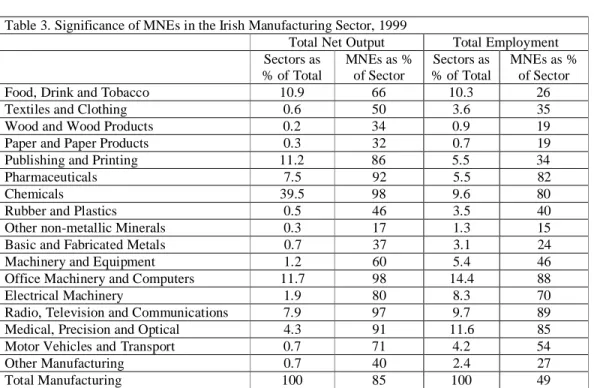
(2003) show that foreign plants in Irish manufacturing industry accounted for 92 per cent of the growth in net output and 68 per cent of the growth in net employment in Irish manufacturing industry over that period. Table 3 shows that MNEs accounted for 85 percent of total net output and 49 percent of employment in manufacturing in
1999, holding a dominant position in all of the “high-tech” sectors.5 The sheer scale of
the MNE sector in Ireland would lead one to expect it to have a significant impact on average wages. Employment rather than output shares are generally seen a preferred
3
See Barry and Bradley (1997) and Honohan and Walsh (2003). 4
See papers by Paul Krugman and Jeffrey Sachs in Gray (1998) 5
Ireland has pursued a policy of promoting FDI into its high tech sectors. These are defined as: Pharmaceuticals, Chemicals, Office Machinery and Computers, Radio, Television & Communications, Medical, Precision & Optical.
indicator of ownership and sectoral composition in the Irish manufacturing sector, because the low rate of Irish corporate tax is seen as creating incentives for transfer pricing in certain sectors.6
The objective of this paper is to examine two issues: first, to what extent do MNEs pay higher wages than their domestic counterparts, when allowance has been made for plant level differences? Second, are wages in LEs relatively higher in sectors with a greater MNE presence? In examining these issues, the skill composition of the workforces in MNEs and LEs is of critical importance. In describing skill composition, the literature uses a variety of terms to dichotomise the workforce, viz. unskilled/skilled, production/non-production, and blue-collar/white-collar workers; in
this paper we use unskilled/skilled. 7
The remainder of the paper is organised as follows. Section 2 discusses some of the growing literature on wage differences between MNEs and LEs and on the possible indirect impact of MNEs on wages paid by LEs. In Section 3 we examine average wage differentials between foreign and domestic enterprises in Irish manufacturing industry over the 1990s. In Section 4 we outline the general model used to estimate the determinants of wage differentials between MNEs and LEs and describe the data set used. In Section 5 we estimate the model, focussing particularly on the distinction between skilled and unskilled labour. Section 6 looks for evidence that the presence of MNEs in a sector may impact on the wages paid by LEs in that sector, and Section 7 concludes.
6
Note particularly the differences in shares in net output and employment in the Chemical sector. 7
2. Wage Differences and the Impact of MNEs on LE Wages
Empirical evidence shows that foreign firms tend to pay higher wages than their domestic counterparts both in developing and developed countries. Examples from developed countries include Doms and Jensen (1998) and Feliciano and Lipsey (1999) for the US, Globerman, Ries and Vertinsky (1994) for Canada and Girma, Greenaway and Wakelin (2001) for the UK; all of these studies show that there are wage differences between foreign and domestic firms even after controlling for sector and firms specific factors. We also find that studies on developing countries show similar results; see for example Görg et al. (2002) for Ghana and te Velde and
Morrisey (2001) for five African countries.8
Why would MNEs pay higher wages than LEs if they operate in the same labour market pool? The first explanation put forward in the literature is size: since MNEs are typically larger than LEs, they pay higher wages.9 The second explanation for
MNEs paying higher wages is skill composition: they have a relatively more skilled workforce than LEs and this is reflected in higher average wages. A third reason is that, because of their productivity advantage, MNEs can afford to do so and there may also be comparability relationships with wage payments in plants in other host
countries.10 (The argument here is that MNEs are more technologically advanced, as
reflected in the presence of greater spending on R&D and greater capital intensity and consequently in their higher labour productivity.) Given that wage differentials exist,
8
See Lipsey (2002) for a review. 9
The fact that larger enterprises pay higher wages than smaller enterprises is well documented in the literature. See Brown and Medoff (1989).
10
A simple explanation for this could be the firm specific advantages of foreign firms proposed by Dunning 1993. If the firm specific assets for foreign firms are such that the marginal product of labour is higher, then one would expect labour to be paid a higher wage in foreign firms.
the issue is to determine whether the differences can be explained by these three factors.
There are several other reasons given to explain why MNEs may offer higher wages, but these are not always relevant and/or may be difficult to test empirically. First is the idea that higher wages are paid by MNEs in order to compensate workers who perceive employment in an MNE as less certain than employment in an LE.11 This
reason is not particularly likely to apply in the case where there is a substantial and longstanding MNE presence, and where MNE sector jobs are no less secure than
those in the LE sector.12 A further reason given is that, since MNEs are less familiar
with local labour market conditions, they may offer higher wages in order to attract better quality labour in the first instance, and may continue to do so, because they find that the higher wages reduce worker turnover. The use of higher wages to attract better quality labour is less likely to occur when the labour market is well developed and information on wage rates is widely available.13 In an expanding market, it is
more likely that MNEs offer higher wages to reduce worker turnover when LEs in the same sector are expanding employment. Yet another reason for foreign firms paying higher wages is that they want to minimize technology spillovers to other firms via labour mobility. The final reason given for higher average wages in MNEs is that their specific skill requirements may differ from those of LEs, and consequently they
11
This becomes less likely as time goes on, assuming that the MNE sector develops along a stable path.
12
This is certainly the case in Ireland, which has experienced over 50 years of a steadily developing MNE sector in manufacturing; with job survival rates no less than those in the LE sector. See Görg and Strobl (2003).
13
In Ireland, MNEs quickly become familiar with local labour market conditions and centralised pay bargaining ensures that information on wage setting is particularly transparent. However, the MNE sector is typically non-unionised and the LE sector is increasingly non-unionised, and there may be a premium paid by MNEs to compensate for this.
may have to pay more for these skills – in effect they are not operating in the same labour market pools.14
Turning to the overall effects of FDI on average wages paid by LEs in the host country, there have been a number of conduits for such effects identified in the literature. Firstly, as MNEs enter the host country, there will be an increase in labour demand, which will increase average wages in the host country assuming that the
labour supply curve facing the manufacturing sector is not horizontal.15 Secondly, if
there are positive productivity spillovers to LEs from the activities of MNEs, then the higher productivity of LEs will allow them to pay higher wages. This will particularly be the case where the productivity effect is realised through skilled labour moving from MNEs to LEs. Thirdly, domestic spin offs from MNES may increase competition for skilled workers, leading to upward pressure on wages.
The general approach in the empirical literature to examining foreign-domestic wage differentials and host country wage effects of FDI has been to examine (a) whether
industry and firm characteristics16 can explain differences in wages in MNEs
compared with LEs, and (b) whether the differences in average wages of LEs across sectors can be explained by foreign presence in those sectors. One of the key early empirical studies in this literature is by Aitken et al. (1996). They measure the impact
of FDI on wages in the US, Mexico and Venezuela using 4-digit industry level data.17
14
This is likely to happen if there is a shortage of certain types of skilled labour in the host country. 15
While this channel could also work with the entry of new LEs, the argument is stronger in the case of foreign entry, if, as argued above, MNEs have firm specific advantages over their domestic
counterparts, such as superior technology. These advantages allow the MNEs to pay higher wages, and LEs may have to pay higher wages in order to attract/retain workers.
16
Worker characteristics are also important in explaining wage differentials, but in most of the studies using plant or firm level data, these characteristics cannot be incorporated into the analysis because of data limitations.
17
Although authors have plant level data for Venezuela and Mexico, due to data availability of US manufacturing industries at industry level by state, they aggregate up variables from plant level data to
They examine the wage differentials between foreign and domestic firms and find that, even after controlling for size, geographic location and capital intensity, wage differentials persist with MNEs paying higher wages than LEs. They also examine the relationship between higher wages and FDI and find evidence of a positive effect of MNE presence in a sector on that sector’s LE wages in the US, but not in Mexico and Venezuela.
Following in a similar vein, Lipsey and Sjöholm (2003) analyse the effects of FDI on wages in Indonesian manufacturing industry, using plant level data for the period 1975-1999. They find that, even when industry and plant characteristics are taken into account, foreign enterprises in Indonesian manufacturing industry pay higher wages than their domestic counterparts. In examining the effect of FDI presence, they investigate the impact on wages of the domestic enterprises that were taken over by foreign enterprises during the same period; they find that after foreign takeovers both white-collar and blue-collar wages increase significantly.
In a subsequent paper, Lipsey and Sjöholm (2004) examine host country wage effects of foreign firms in Indonesian manufacturing industry using a unique cross-section data set of plants for 1996. This data set allows them to control for different characteristics of the workforce, as well as industries and enterprises. They conclude that, controlling for these factors, foreign-owned enterprises pay higher wages than domestic enterprises. They also find that a higher foreign presence in an industry is associated with a higher level of wages in locally-owned enterprises for workers of a given educational level, controlling for industry and firm characteristics.
industry level data. The data for US are only for 1987, and those for Mexico and Venezuela cover the periods 1984-1990 and 1977-1989, respectively.
Girma et al. (2001) test for the positive effects of FDI on wages in domestic enterprises using firm level panel data on UK manufacturing industry for the period 1991-1996. They find that, on average, there is no evidence of a positive relationship between foreign presence and wage levels in domestic enterprises but there is some weak evidence of a negative effect of foreign presence on domestic enterprises’ wage growth.
Using data on the electronics industry in the UK for the period 1980-1992, Driffield and Girma (2003) examine the wage differentials between MNEs and LEs and whether the presence or entry of FDI has an effect on the average wages paid by LEs. They find that even after controlling for industry and firm effects there is a significant wage difference between foreign and domestic firms in the UK electronics sector. They also find that MNEs have an effect on the average wages paid by LEs for both skilled and unskilled workers in the electronics industry, though the impact is regionally constrained. In other words wage spillovers to LEs from MNEs are only evident in the region where MNEs are located.
Thus far two studies have considered wage differentials and wage effects of FDI in the Irish economy. The first, by Figini and Görg (1999), uses sectoral level data (disaggregated by foreign and domestic enterprises) to examine the impact of FDI on wage inequality in Irish manufacturing industry. Based on data for the period 1979-1995, they find that, with the increasing presence of foreign firms in a sector, wage inequality in that sector first increases, reaches a maximum and eventually decreases. Barry et al. (2004) investigate the effect of foreign presence on overall wages in domestic firms using firm level panel data. Their study focuses on domestic exporting
and non-exporting firms18 and shows that foreign presence has a negative effect on
wages in domestic exporting firms but no effect on wages paid by domestic non-exporters in the same sector.19
3. Wage Differentials between Domestic and Foreign Plants in Ireland
As discussed in the previous section, many studies in the literature have found that foreign firms pay higher wages than their domestic counterparts both in developing and developed countries. In this section we investigate whether this is valid in Irish manufacturing industry for the period 1991-1999
Table 4 presents average wages in Irish manufacturing industry in 1991 and 1999, disaggregated for MNEs and LEs and for skilled and unskilled workers. 20 Overall
average real wages increased by 25 per cent during this period,21 a combination of
wage increases of 35 and 18 percent respectively for skilled and unskilled workers. This reflects the structural changes in the economy over that period which increased the relative demand for skilled workers. This resulted in the share of skilled workers overall rising by five percentage points, to a third in the case of MNEs and a quarter in the case of LEs. The difference between averages wages in MNEs and LEs fell from 47 to 41 percent over the 1990s. This reduction in the wage gap is almost entirely due to the differences in wages for skilled workers employed by MNEs and
18
Because their data set does not distinguish between skilled and unskilled workers, they use the exporting/non-exporting firms dichotomy in order to proxy the effects of MNEs on skilled and unskilled workers in LEs.
19
This study uses a dataset covering firms with more than 20 employees and Barry et. al. suggest that their results might be affected by the exclusion of many small Irish firms from the analysis.
20
We define skilled workers as clerical, technical and administrative workers and unskilled workers as industrial workers, apprentices and outside piece workers.
21
Real after tax wages increased even more rapidly in the later period as income tax rates were reduced from 65 to 40 percent and tax allowances were increased significantly.
LEs, which fell quite dramatically from 49 to 29 percent between 1991 and 1999.22
The dramatic fall in the wages gap for skilled workers is consistent with the emergence of skill shortages during the latter part of the 1990s, which led to a radical change in labour market policies in Ireland.23
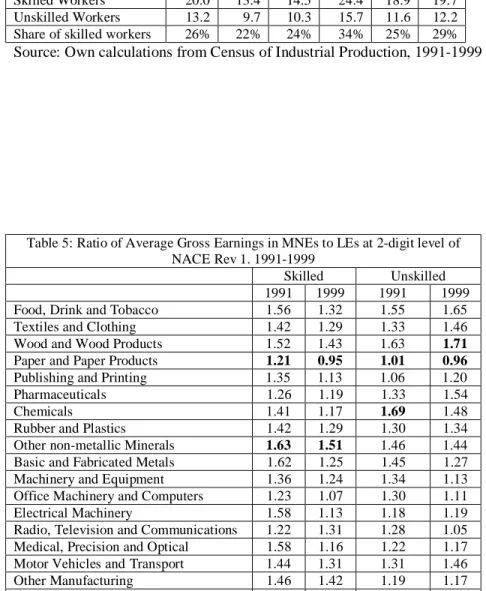
Table 5 shows the wage gap between MNEs and LEs for skilled and unskilled labour at the 2-digit industry level. For skilled labour, the wage gap fell in all but one sector (Radio, Television & Communications) as the economy reached full employment, whereas the wage gap for unskilled labour widened and narrowed in an equal number
of sectors.24 Over the period, the range of sectoral wage gaps for skilled workers fell
from (21 to 63) percent to (–5 to 51) percent, whereas there was no change in the range of wage gaps for unskilled labour. These findings indicate that there has been a convergence of wages paid to skilled workers between MNEs and LEs across all individual manufacturing sectors, whereas no similar convergence is evident in the case of unskilled workers.
4. Empirical Model and Data:
The analysis in the previous section showed that foreign plants in Irish manufacturing industry pay higher wages than their domestic counterparts. This result accords with the majority of studies on foreign ownership and wages. However our analysis in Section 3 did not take industry or firm characteristics into account when comparing average wage levels between foreign and domestic plants.
22
The corresponding reduction in the wage gap for unskilled workers was marginal in the same period (from 36 to 35 percent).
23
Policies were introduced to increase the output of skilled labour from training college and universities and to encourage immigration of workers with skills which were in short supply. 24
For both types of labour, the lowest wage gap was in the Paper & Paper Products sector in 1991 and by 1999 this gap had reversed with averages wages higher in the LEs compared with MNEs. However, this comparison is not really valid, as it reflects the dominance of one of the few Irish MNEs in this sector.
In this section we investigate the wage differentials between foreign and domestic plants using a model following Girma et.al. (2001):
Wit= FORit + Xit + Sjt + Tt + fi + εit (1)
where i, j and t represent plant, sector and year respectively. W is a plant’s average wage, FOR is a dummy variable to distinguish ownership which takes on the value 1 when the plant is foreign owned, and X is a vector of plant characteristics that may influence the level of wages. S are industry dummies to control for industry specific affects, T are time dummies that account for aggregate shocks. Finally, f is a time invariant plant-specific term and will be estimated both as random and as fixed effects
and ε denotes a random noise term.
Regarding the plant-specific characteristics, it is argued in the literature that foreign firms are more capital intensive and larger than domestic firms and that these might account for some of the wage differentials between these two groups. Our data do not allow us to measure physical capital directly, so we proxy capital with the fuel and power consumption of the plant. Thus our capital intensity variable is measured by the ratio of fuel and power consumption to total employment. To take account of the impact of scale on wage differentials, following Girma et. al. (2001), we measure the scale effect using the ratio of net output in each plant to average industry net output. In our case, the industry averages used refer to the foreign and domestic plants’ mean values of net output in the industry. We do this to take account of the possible impact of transfer pricing on the net output figures for foreign plants in certain
sectors.25 Another factor that can influence the average wages paid by plants is the
composition of their workforce. We expect the average wages in plants employing more skilled workers to be higher than those in plants with less skilled workers. In order to account for this we use the ratio of skilled workers to total workers in each plant. We also include sector (at 4-digit) and time (annual) specific dummies to account for sector and time specific wage effects.
The data used in this paper come from the Irish Census of Industrial Production (CIP). This census is carried out annually by the Central Statistics Office in Ireland and covers all industrial local units with 3 or more persons engaged. As such it is the only fully representative survey of manufacturing plants in Ireland. The Census comprises two separate annual inquiries, namely the Census of Industrial Enterprises and the Census of Local Units. In this paper we use data from the Census of Local Units and all calculations carried out at the micro level refer to the plant level data. The data available are those standard for such Censuses – output (gross and net), sales, employment, wages, capital additions, sectoral (NACE 4-digit) and regional (county) classification as well as nationality of ownership. In the CIP the classification by nationality of ownership is determined by the nationality of the owners of 50 per cent or more of the share capital. There are no details recorded on the extent of foreign ownership within a given company and thus it is not possible to determine the impact of different degrees of foreign ownership within plants.26 A further limitation with
the data set is that it does not distinguish hours worked, so that implicitly the
25
This is particularly considered to be a problem in the Pharmaceutical and Chemical sectors. 26
In the Irish case, this is not considered to be a severe restriction as virtually all FDI is single-nationality, greenfield investment.
assumption is made that plant differences in average wages are not unduly affected by
differences in overtime behaviour across plants within a sector.27
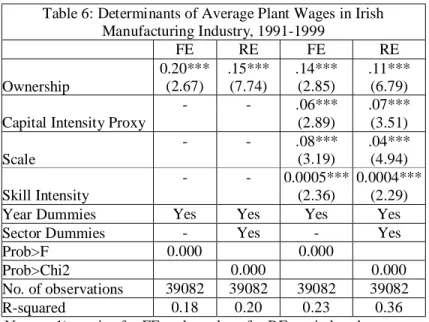
5 Determinants of Wage Differentials between Foreign and Domestic Plants Table 6 presents results of the determinants of wage levels for all workers in Irish manufacturing industry. In the first 2 columns we present results using ownership only as an explanatory factor, employing fixed (FE) and random (RE) effects models. We see that average wages are estimated to be 20 per cent and 15 per cent higher in foreign plants than in their domestic counterparts using fixed and random effects
specifications, respectively. 28 In the next two columns we introduce the plant-specific
variables, namely, capital intensity, scale and skill intensity into the estimation. These results indicate that controlling for these plant characteristics reduces the wage differential between foreign and domestic plants to 14 and 11 per cent respectively, for FE and RE estimates. Overall results from Table 6 show that, even after controlling for sector and plant characteristics, average wages are still higher in foreign plants than in domestic ones in Irish manufacturing industry over the period 1991-1999.29
Because of the importance of skill composition to average wages, we analyse wage differentials for these two categories of workers respectively. Table 7 shows that, on average, foreign plants pay around over 16 per cent more for skilled workers than do
27
To the extent that overtime patterns differ across sectors, these will be picked up by the sector dummies.
28
We should note that the RE model controls for both sector and time effects whereas FE model can only control for time effect and this could result in the higher wage differential effect in this estimate.
29
The validity of these results depends on the hours worked not varying systematically between foreign and domestic plants in the same sector. See Girma et. al. (2001).
their domestic counterparts; however, once sector and time effects are taken into account, this difference falls to 12 percent, and reduces further to 8 percent when plant characteristics are taken into account. In the unskilled category foreign plants on average pay 22 per cent more than their domestic counterparts, but this differential reduces to 14 per cent once sector and time effects are taken into account; it further decreases to 10 per cent with introduction of plant characteristics as control variables. These results are consistent with the analysis in Section 3 that showed that the differential between average wages of skilled workers in domestic and foreign plants narrowed over the period 1991-1999.
6 The Effect of Foreign Presence on Wages of Local Enterprises:
We outlined a number of conduits for the relationship between FDI and host country wages identified in the literature in Section 2. In order to test whether there is a relationship between the entry or presence of foreign firms and average wages in domestic plants in Irish manufacturing industry we estimate Equation (2) for local enterprises only:
Wit= FPit + Xit + Sjt + Tt + fi + εit (2)
where FPit measures the share of employment accounted by all foreign-owned plants
in the sector in which the plant operates. All other variables are as for Equation (1).
Table 8 presents results for the effect of foreign presence on the average wages in local enterprises, controlling for sector and plant characteristics as well as common shocks proxied by year dummies. To focus on the foreign presence factor specifically,
the first column shows that when foreign presence alone is included to explain the average wages in domestic plants, it has a positive and significant effect. However, we can see in the second column that when sector specific factors are taken into account, the effect of foreign presence reduces and is only statistically significant at 10 per cent level. Furthermore, as we can see in the last two columns, once plant characteristics such as capital intensity and scale are taken into account, the effect of foreign presence on average wages in domestic plants is not statistically significant. These results suggest that FDI has no significant effect on average wages in local
enterprises during the period 1991-1999. 30 .
Table 9 extends the analysis to distinguish between skilled and unskilled workers as in Section 5. The results show a similar patter to those in Table 8: the impact of foreign presence is not statistically significant when account is taken of sector and plant level differences31.
As outlined in Section 2, one of the main channels that MNEs might be expected to affect the average wages in their domestic counterparts is by impacting on their
productivity levels. Ruane and Uğur (2002) find that there appears to be no
relationship between the presence of MNEs and the productivity of local plants in Irish manufacturing industry. That result is consistent with the result found here
30
Endogeneity of the foreign presence variable may produce upward biased results on the coefficient of this variable. However we try to control for this by using sector dummies. Another method applied in the literature is to use IV-GMM estimation methods. Given the relatively short duration covered by our data set, we would lose at minimum two years of observations. The use of GMM techniques would be expected to produce even lower coefficient estimates of foreign presence variable and thus would be expected to support the results obtained here using FE and RE models. .
31
Regression analysis carried out using foreign presence as the only explanatory variable as in the first two columns of Table 8 showed that the presence of MNEs has a positive significant effect when firm specific characteristics are not taken into account.
which suggests that MNEs may not have any influence on average wages paid by domestic plants through this channel.
7. Summary and Conclusions
The growing literature on the host country effects of FDI shows that foreign firms on average pay higher wages than their domestic counterparts and suggests that there may be a positive relationship between foreign presence and average wages in domestic firms, i.e. higher foreign presence in a sector leads to higher average wages in domestic firms.
Using a panel data set for Irish manufacturing industry we found that foreign plants pay higher wages than their domestic counterparts, although the extent of the wage differential reduces once sector and plant characteristics are taken into account. This result holds for both skilled and unskilled workers. Our results for Irish manufacturing in terms of the magnitude of the wage difference are very similar to the ones obtained in the studies on UK manufacturing, as outlined in Table A.1. We found that the positive and significant relationship between foreign presence and domestic plants’ average wages disappeared once sector and plant characteristics were taken into account. This result is in line with most of the studies in the literature, e.g., Girma,
Greenaway and Wakelin (2001) for the UK and Aitken et al. (1996) for Venezuela
and Mexico. While Aitken et al. (1996) find positive and significant effects of the presence of MNEs on average wages paid by LEs in the US manufacturing sector, we note that their results are based on cross-section rather than panel data. When we
followed a similar approach (Table A.2), estimating the effects of MNEs on LE average wages using cross-section data, we found higher MNE presence associated with higher LE wages in seven of the nine regressions. Our results point to the sensitivity of results in this area to estimation methods, as noted by Görg and Greenaway (2004); they find evidence of spillover effects in most of the studies using cross-section analysis, but virtually none with panel data analysis.
References:
Aitken, B., A. Harrison and Lipsey, R. E, 1996. Wages and Foreign Ownership: A Comparative Study of Mexico, Venezuela and the US. Journal of International Economics, Vol. 40, pp. 345-371
Barry, F., H. Görg and Strobl E., 2004. Foreign Direct Investment and Wages in Domestic Firms: Productivity Spillovers vs. Labour Market Crowding-Out. mimeo, University College Dublin
Barry, F. (Ed), 1999. Understanding Ireland’s Economic Growth. Macmillan, London Barry, F. and J. Bradley, 1997. FDI and Trade: the Irish Host-Country Experience. Economic Journal, 107 (445), pp. 1798-1811.
Brown, C. and J. L. Medoff, 1989. The Employer Size Wage Effect. Journal of Political Economy, 97 (5), pp. 1027-1059.
Driffield N. and S. Girma, 2003. Regional Foreign Direct Investment and Wage Spillovers: Plant Level Evidence from the UK Electronics Industry. Oxford Bulletin of Economics and Statistics, 65 (4), pp. 453-474
Doms, M. E. and J. B. Jensen, 1998. Comparing Wages, Skills, and Productivity Between Domestically and Foreign-owned Manufacturing Establishments in the United States, in R. Baldwin, R. Lipsey and J.D. Richardson (Eds.), Geography and Ownership as Bases for Economic Accounting, Chicago University Press, Chicago, pp. 235-255.
Dunning, John, 1993. Multinational Enterprises And The Global Economy, Addison-Wesley, Wokingham, England.
Feliciano, Z. and R. E. Lipsey, 1999. Foreign Ownership and Wages in the United States, 1987-1992, NBER Working Paper No. 6923.
Figini, P. and H. Görg, 1999. Multinational Companies and Wage Inequality in the Host Country: The Case of Ireland. Weltwirtschaftliches Archiv, Vol. 135, pp. 594-612
Girma, S, D. Greenaway and K. Wakelin, 2001. Who Benefits from Foreign Direct Investment in the UK? Scottish Journal of Political Economy, Vol. 48, pp. 119-133 Globerman,S., J. C. Ries and I. Vertinsky, 1994. The economic performance of foreign affiliates in Canada. Canadian Journal of Economics, Vol. 27, pp. 143-156. Görg, H. and D. Greenaway, 2004. Much ado about nothing? Do domestic firms really benefit from foreign direct investment?. forthcoming in World Bank Research Observer
Görg, H., Strobl E and F Walsh., 2002. Why do foreign firms pay more? The Role of On-the-job Training. IZA Discussion Paper 590, Bonn
Görg, H. and E. Strobl, 2003. Multinational Companies, Technology Spillovers and Plant Survival. The Scandinavian Journal of Economics, 105 (4), pp. 581-595.
Gray, A. (Ed.) 1998. International Perspectives on the Irish Economy. Indecon ,Dublin
Honohan, P. and B. Walsh, 2002. Catching up with the Leaders: The Irish Hare. Brookings Papers on Economic Activity, No: 1
Kearns, A., 2000. Essays on the Consequences of Research and Development for Manufacturing Firms in Ireland. Unpublished Ph. D. Thesis, Trinity College Dublin Lipsey, R., 2002. Home and Host Country Effects of FDI. NBER Working Paper, No: 9293
Lipsey, R. E. and F. Sjöholm, 2004. Foreign direct investment, education and wages in Indonesian manufacturing. Journal of Development Economics, 73 1, pp. 415-422 Lipsey, R. E. and F. Sjöholm, 2003. Foreign Firms and Indonesian Manufacturing Wages: An Analysis with Panel Data. NBER Working Paper, No: 9417
O’Muircheartaigh, F., 2000. Industry in Ireland in the 1990s: Comparative Performance of Irish-Owned and Overseas-Owned Companies. ESRI Seminar Paper Ruane, F. and H. Görg, 1997. The Impact of Foreign Direct Investment on Sectoral Adjustment in the Irish Economy. National Institute Economic Review. No.160. pp. 76-86
Ruane, F. and A. Uğur, 2003. Sources of Productivity Growth in Irish Manufacturing
Industry 1991-1999. Paper presented at the Comparative Analysis of Enterprise (micro) Data Conference, 15 - 16 September 2003
Ruane, F. and A. Uğur, 2002. Foreign Direct Investment and Productivity Spillovers
in Irish Manufacturing Industry: Evidence from Firm Level Panel Data. Trinity Economic Paper Series, No: 2002/6, Trinity College Dublin.
Te Velde D. W. and O. Morrissey, 2001. Foreign Ownership and Wages: Evidence from five African Countries. CREDIT Research Paper No: 01/19, University of Nottingham
UNCTAD, 2001. World Investment Report: Promoting Linkages. United Nations, New York and Geneva.
Tables:
Table 1: Annual Growth Rates in Real GDP, 1991-1999
1991 1992 1993 1994 1995 1996 1997 1998 1999 1991-1999 Ireland 1.9 3.3 2.7 5.8 9.9 8.1 11.1 8.6 11.3 6.7 Japan 3.3 1.0 0.3 1.0 1.9 3.4 1.8 -1.1 0.1 1.3 US -0.5 3.1 2.7 4.0 2.7 3.6 4.4 4.3 4.1 3.1 EU 1.8 1.0 -0.4 2.8 2.4 1.6 2.6 2.9 2.8 1.9 OECD 1.2 2.0 1.4 3.2 2.5 3.0 3.5 2.7 3.1 2.5
Source: OECD Economic Outlook 71, June (2002)
Table 2: Average Unemployment Rates, 1991-1999
1991 1992 1993 1994 1995 1996 1997 1998 1999 Ireland 14.4 15.1 15.7 14.7 12.2 11.7 10.4 7.6 5.6 Japan 2.1 2.1 2.5 2.8 3.1 3.3 3.3 4.1 4.6 US 6.8 7.5 6.9 6.1 5.6 5.4 4.9 4.5 4.2 EU 8.4 9.1 10.1 10.5 10.1 10.2 10 9.4 8.7 OECD 6.8 7.4 7.8 7.7 7.3 7.2 7 6.9 6.7
Source: OECD Economic Outlook 71, June (2002)
Table 3. Significance of MNEs in the Irish Manufacturing Sector, 1999
Total Net Output Total Employment
Sectors as % of Total MNEs as % of Sector Sectors as % of Total MNEs as % of Sector
Food, Drink and Tobacco 10.9 66 10.3 26
Textiles and Clothing 0.6 50 3.6 35
Wood and Wood Products 0.2 34 0.9 19
Paper and Paper Products 0.3 32 0.7 19
Publishing and Printing 11.2 86 5.5 34
Pharmaceuticals 7.5 92 5.5 82
Chemicals 39.5 98 9.6 80
Rubber and Plastics 0.5 46 3.5 40
Other non-metallic Minerals 0.3 17 1.3 15
Basic and Fabricated Metals 0.7 37 3.1 24
Machinery and Equipment 1.2 60 5.4 46
Office Machinery and Computers 11.7 98 14.4 88
Electrical Machinery 1.9 80 8.3 70
Radio, Television and Communications 7.9 97 9.7 89
Medical, Precision and Optical 4.3 91 11.6 85
Motor Vehicles and Transport 0.7 71 4.2 54
Other Manufacturing 0.7 40 2.4 27
Total Manufacturing 100 85 100 49
Table 4: Average Real Wages In Irish Manufacturing Industry, 1991-1999 (1995 prices, £000)
1991 1999
MNEs LEs All MNEs LEs All
All 14.9 10.1 11.0 18.2 12.9 13.7
Skilled Workers 20.0 13.4 14.5 24.4 18.9 19.7
Unskilled Workers 13.2 9.7 10.3 15.7 11.6 12.2
Share of skilled workers 26% 22% 24% 34% 25% 29%
Source: Own calculations from Census of Industrial Production, 1991-1999
Table 5: Ratio of Average Gross Earnings in MNEs to LEs at 2-digit level of NACE Rev 1. 1991-1999
Skilled Unskilled
1991 1999 1991 1999
Food, Drink and Tobacco 1.56 1.32 1.55 1.65
Textiles and Clothing 1.42 1.29 1.33 1.46
Wood and Wood Products 1.52 1.43 1.63 1.71
Paper and Paper Products 1.21 0.95 1.01 0.96
Publishing and Printing 1.35 1.13 1.06 1.20
Pharmaceuticals 1.26 1.19 1.33 1.54
Chemicals 1.41 1.17 1.69 1.48
Rubber and Plastics 1.42 1.29 1.30 1.34
Other non-metallic Minerals 1.63 1.51 1.46 1.44
Basic and Fabricated Metals 1.62 1.25 1.45 1.27
Machinery and Equipment 1.36 1.24 1.34 1.13
Office Machinery and Computers 1.23 1.07 1.30 1.11
Electrical Machinery 1.58 1.13 1.18 1.19
Radio, Television and Communications 1.22 1.31 1.28 1.05
Medical, Precision and Optical 1.58 1.16 1.22 1.17
Motor Vehicles and Transport 1.44 1.31 1.31 1.46
Other Manufacturing 1.46 1.42 1.19 1.17
Total Manufacturing 1.49 1.29 1.36 1.35
Table 6: Determinants of Average Plant Wages in Irish Manufacturing Industry, 1991-1999 FE RE FE RE Ownership 0.20*** (2.67) .15*** (7.74) .14*** (2.85) .11*** (6.79) Capital Intensity Proxy
- - .06*** (2.89) .07*** (3.51) Scale - - .08*** (3.19) .04*** (4.94) Skill Intensity - - 0.0005*** (2.36) 0.0004*** (2.29)
Year Dummies Yes Yes Yes Yes
Sector Dummies - Yes - Yes
Prob>F 0.000 0.000
Prob>Chi2 0.000 0.000
No. of observations 39082 39082 39082 39082
R-squared 0.18 0.20 0.23 0.36
Notes: 1) t-ratios for FE and z-values for RE are in brackets 2) ***=Significant at 1%, **=significant at 5%, *=significant at 10%
Table 7: Determinants of Average Plant Wages for Skilled and Unskilled Workers in Irish Manufacturing Industry, 1991-1999
Skilled Workers Unskilled Workers
FE RE FE RE FE RE FE RE Ownership .16*** (2.23) .12*** (8.13) 0.13*** (2.02) .08** (1.85) 0.22*** (2.55) .0.14*** (8.91) .15*** (2.17) 0.10*** (7.21) Capital Intensity Proxy - - 0.03*** (10.23) 0.05*** (7.03) - - 0.05*** (8.12) 0.07*** (5.74) Scale - - 0.05*** (6.06) 0.07*** (5.20) - - 0.08*** (5.89) 0.09*** (5.49)
Year Dummies Yes Yes Yes Yes Yes Yes Yes Yes
Industry Dummies - Yes - Yes - Yes - Yes
Prob>F 0.000 0.000 0.000 0.000
Prob>Chi2 0.000 0.000 0.000 0.000
No. of observations 36518 36518 36518 36518 39263 39263 39263 39263
R-squared 0.07 0.17 0.15 0.25 0.05 0.17 0.21 0.32
Notes: 1) t-ratios for FE and z-values for RE are in brackets 2) ***=Significant at 1%, **=significant at 5%, *=significant at 10%
Table 8: Effect of Foreign Presence on Average Wages in Domestic Firms in Irish Manufacturing Industry, 1991-1999
FE RE FE RE Foreign Presence 0.06*** (2.04) 0.04*** (7.45) 0.04 (1.41) 0.03 (1.01) Capital Intensity Proxy
- - 0.05*** (2.30) 0.06*** (4.55) Scale - - 0.03*** (6.54) 0.04*** (6.47) Skill intensity - - 0.0003** (1.94) 0.0002** (1.85)
Year Dummies Yes Yes Yes Yes
Sector Dummies - Yes - Yes
Prob>F 0.000 0.000
Prob>Chi2 0.000 0.000
No. of observations 34435 34435 34435 34435
R-squared 0.06 0.13 0.21 0.22
Notes: 1) t-ratios for FE and z-values for RE are in brackets 2) ***=Significant at 1%, **=significant at 5%, *=significant at 10%
Table 9: Effect of MNEs on Average Wages for Skilled and Unskilled Workers in LEs in Irish Manufacturing Industry, 1991-1999
Skilled Workers Unskilled Workers
FE RE FE RE Foreign Presence 0.01 (0.97) -0.04 (-1.03) -0.02 (-0.74) -0.03 (-0.92) Capital Intensity Proxy
0.06*** (10.24) 0.07*** (4.49) 0.04*** (5.29) 0.03*** (5.91) Scale 0.04*** (6.07) 0.04*** (4.71) 0.03*** (2.97) 0.02*** (3.03)
Year Dummies Yes Yes Yes Yes
Sector Dummies - Yes - Yes
Prob>F 0.000 0.000
Prob>Chi2 0.000 0.000
No. of observations 30639 30639 33525 33525
R-squared 0.09 0.20 0.18 0.27
Notes: 1) t-ratios for FE and z-values for RE are in brackets 2) ***=Significant at 1%, **=significant at 5%, *=significant at 10%
Appendix:
Table A.1
Author Country Data Set Skilled Wage
Gap Unskilled Wage Gap Effect of MNEs on LE wages Aitken and Harrison
(1996)
US 1987 29%a (+), s.
Venezuela 1977-1989 25%b 21%b (-,) n.s
Mexico 1984-1990 30%c 32%c (-), n.s.
Lipsey and Sjoholm (2003)
Indonesia 1975-1999 21% 10% (+), s.
(2004) Indonesia 1996 22% 12% n.a.
Girma et. al. (2001) UK 1991-1996 7 %a +, ns
Girma and Driffield (2003)
UK (electronics industry)
1980-1992 7.6% 6% +, sd
Notes: s.: statistically significant, n.s.: statistically not significant, n.a.: not applicable
a
Data not available for skilled and unskilled categories
b
Cross section comparison for 1987
c
Cross section comparison for 1990
d
Only at the regional level
Table A. 2 Regression Results from Cross-Section Analysis of the Effects of MNE Presence on Wages Paid by LEs 1991 1992 1993 1994 1995 1996 1997 1998 1999 (+) *** (+) (-) (+), * (+), ** (+) * (+) *** (+) *** (+) ***