2020
Vien Pham
GAMIFICATION ON LEARNING
– Gamifying the Gamification and Serious Games
course
Degree programme in Information and Communications Technology 2020 | 44, 2
Vien Pham
GAMIFICATION ON LEARNING
- Gamifying the Gamification and Serious Games course
Recently, gamification has become a trending topic in the world. Using game elements in a non-game context could improve the engagement and motivation of people in many fields. Particularly in higher education, this method has been applied successfully by educators. Taking advantage of gamification, this thesis aims to apply gamification into the Gamification and serious game course at Turku University of Applied Sciences, which would become an online course, in order to increase motivation and engagement of students in the course. To achieve the objectives of the study, a design science research approach has been used to collect lecturer viewpoints and student’s ideas about gamification to create a prototype and obtain feedback from the experts and then finalize the course mockup.
The findings indicated that students and lecturer were supportive of such an environment and the data they gave related to the prototype learning environment. Furthermore, the expert evaluator suggested to include a feedback area. Finally, a gamified online learning environment has been developed according to student, lecturer, and expert feedback. In the future, the mockup of gamified website will be tested further with students and is expected to be launched for the 2020 Gamification and Serious Games course.
KEYWORDS:
LIST OF ABBREVIATIONS 5 1 INTRODUCTION 6 2 THEORETICAL BACKGROUND 10 2.1 What is gamification? 10 2.2 Game elements 11 2.3 Psychology in gamification 15 2.3.1 Motivation 15 2.3.2 Behaviours 16
2.4 Gamification of teaching and learning 18
2.4.1 Students as players 18
2.5 Criticism 19
3 METHODOLOGY 20
3.1 Interviews and questionnaires 20
3.2 Prototyping 20
3.3 Expert evaluation 21
3.4 Iterative design 21
4 DESIGN PROCESS 22
4.1 Analysis 22
4.1.1 Defining learning objectives 22
4.1.2 Understanding the users 22
4.2 Game elements and selection 23
4.2.1 Quizzes, badges and storyline 25
4.2.2 Levels, progress bar and experience points 26
4.3 Design and implementation 26
4.4 Evaluation 33
5 DISCUSSION 37
5.1 The impact of gamification on learning 37
5.2 Implementation guidelines for gamification in education 38
FIGURES
Figure 1. Research structure. 8
Figure 2. The idea of students about gamifying the course. 23
Figure 3. The enjoyment of students about the course 23
Figure 4. Result of game elements selection. 24
Figure 5. Result of quizzes contribution to the final grade of the course. 24 Figure 6. Badges as rewards for students complete pop quizzes. 25
Figure 7. Homepage screen of the mockup. 27
Figure 8. Lesson menu screen. 28
Figure 9. Presentation of the lesson page. 29
Figure 10. Quizzes menu screen. 30
Figure 11. Project menu screen. 31
Figure 12. Badges screen menu. 32
Figure 13. Criteria menu screen. 33
Figure 14. The feedback from teachers have been added to the Workspace menu
screen. 34
Figure 15. Feedback from the teachers's screen. 35
Figure 16. The experience points change to knowledge points and the amount of
knowledge points changed. 36
TABLES
Table 1.Game elements based on Werbach and Hunter, 2012. 13 Table 2.Levels of game design elements (reproduced from Deterding et al., 2011). 14
APPENDICES
DGBL Digital Game Based Learning GSG Gamification and Serious Game UI User Interface
1 INTRODUCTION
Over the past few years, gamification has become the trending topics and it has been increasingly popular. It initially began in marketing but has since spread into many other areas of the business (Gartner, 2014). According to Huff Post (2013), since 2010 over 350 companies and organizations have launched main gamification in projects such as Adobe, NBC, Ford, eBay, Oracle, Cisco and more. The Engagement Alliance shows that by 2014 more than 70% of the Global 2000 federation and cooperation had at least one gamified application, promoted 50% of all innovation. The attraction of gamification raises from the opinion that it impacts people performance. Game generates impressive reactions such as curiosity, failure, and delight (McGonigal, 2011). While Deterding et al.,(2011) defined that the application of game elements in a non-gaming context to enhance user experience and engagement. Particularly in education, with the statistics of Talent LMS(2019), over 60% of students said that their study would be more energetic if the university or institution was more game-like. Moreover, also following Talent LMS survey results(2019), over 60% of learners would be inspired by leaderboards and the contest among them, 89% say that a point system would gain their commitment to the online study website or application. Gamification provides learners with many advantages and can make the study experience not only more fun but also motivating. The motivation of learners to engage in training depends on the background of the context of study progress and what follows from their accomplishment (Huang et al, 2013) while Merquis (2013) describes the gamification in university as a step for the enhancement in psychological adaptability, problem-solving skills, team work skills of the students. Hence, game-based learning and gamification have been used in Information Technology Engineering degrees with outstanding results linked to motivation, high learning cooperation, and solid computer learning skills (Rodriguez et al.,2013). Buckley and Doyle(2014) state that “as lecturers, we aim to catch the concentration and enthusiasm of our students, and carry their engaged behavior to assist their curiosity and keep them coming back for more”. Thanks to gamification, the teachers could also follow the process, the contribution of each student and finally grade them correctly and objectively. Thus, researching this phenomenon will help designers to have a theoretical base and practical experience to understand the core of the application of gamification. Personally, as a student of the Gamification and Serious Games course of Turku University of Applied Sciences, the author became aware of the necessity of gamification
for this course as the course required students engagement for acquiring some pieces of knowledge and directly applying them in customer projects. Specifically, the course is a mandatory part of the Game Development track. The concept of the course is to deliver the mechanics of a game into a non-game situations such as business, marketing, transportation, e-learning, interior design. Teachers bring projects from companies such as Meyer Turku, CGI and Treston. By applying game-based mechanics, the students could sustain their interest, engage with the course, attend the lectures more often, and achieve better results. Furthermore, the advantages of this gamification platform could be that students could have more motivation to compete with each other and deliver not only on time but also meet or even exceed the customer requirements. Some groups of students might continue to work with the project and if they could progress further than expected, they might get a chance to grow their network with the company.
With that in mind, this thesis research focus is on gamification thinking, techniques, the psychology of students on gamified e-learning. The objective goal is to develop a mockup website to take the advantages of gamification and apply it to the course. To do that:
• What is gamification thinking?
• What is the psychology behind gamification?
• How could game-based e-learning improve the study experience?
Regarding the research method and data collection, the data will be collected by carrying out a semi-structured interview with the teacher about the objectives and the ideas of the Gamification and Serious Games course. In addition, there will be a survey to study the opinion of students who participated last year. Next, the prototype of the mockup will be created, tested and evaluated by the experts. Finally, receiving the feedback and complete the final mockup will be studied.
Figure 1. Research structure.
About the structure, with the purpose of achieving the target, this thesis will be split into six chapters :
Chapter 1: Introduction
This chapter introduces readers with the general information and background of the gamification business, about the gamification and serious game course. The reasons, objectives, method, and structure of this thesis are also presented.
Chapter 2: Theoretical background
This chapter serves as the theoretical framework including concepts such as gamification, about gamification thinking, research about the psychology of students, game elements and the criticism of gamification by carrying out literature review.
Chapter 3: Methodology
By using the mentioned research method, the methodology chapter will focus on the practical side of the thesis which is tested in the following chapter of this study.
Chapter 4: Design process
This chapter will present the whole process from turning scratch gamification thinking, ideas into a website prototype. It will also present the procedure from all the data collected before in order to finish the mockup.
This chapter will discuss the result of the research and the change of the Gamification and Serious games mockup after collecting feedback from experts.
Chapter 6: Conclusion
Lastly, this chapter will compile the principles of the completed digital product conclude on t the outcome of the study.
2 THEORETICAL BACKGROUND
This chapter will discuss published articles in gamification. Especially, a key investigation in this chapter is the definition of gamification, the reason for gamifying the course and the psychology of students as players. Moreover, It will dive deeper into the core of the game elements and analyze the characteristics of these components. Lastly, this chapter will discuss some criticism of gamification.
2.1 What is gamification?
In a gaming environment, people do not often feel depressed or overwhelmed when encountering obstacles, whereas in reality, similar obstacles may bring about adverse psychological reactions or cause a hindrance to task completion. Additionally, people tend to choose instant fulfillment for keeping themselves engaged and motivated alternatively and this is when gamification appears (Huang et al., 2013).
Gamification is defined as ”using game-based mechanics, aesthetics and game thinking to engage people, motivate action, promote learning, and solve problems” (Kapp, 2012, p.10). While Deterding et al.,(2011) define gamification in a simpler way as the adoption of video game components in a non-gaming context to increase user experience and user engagement. Besides, Lander (2015) concluded that serious games and gamification are similar in that they both include game elements, they are distinct in that games integrate a variety of all game elements, while gamification covers the description, separation, and utilization of individual game elements or narrow, essential combination of those elements. Also, Buckley and Doyle (2016) stated that what discriminates gamification most precisely from more traditional methods is the obvious use of competition as a provocational tool.
Gamification can be implemented in various backgrounds to make an impact on the behaviors of human beings and has been applied successfully in marketing and business to influence customer behaviors (Zichermann and Cunningham, 2011). For example, in the aviation industry, many airline companies have applied gamification approaches to increase the engagement and experience of passengers such as the loyalty card or member flying program of Lufthansa or American Airlines (WTM 2018). Their customers will collect points and redeem rewards thereafter. Another industry that use gamified
systems is medical services, according to Lee et al.,(2017) using gaming elements in healthcare monitor application could motivate people who are either unhealthy or are healthy to engage in healthy behaviors. In the context of education, Huotari and Hamari (2012) state that gamification can be seen as a remedy for engaging students in academic process issues. To prove this assumption, many courses or learning programs have been gamified successfully (Subhash et al., 2018) for example: Caton and Greenhill (2014) have examined the attendance and engagement of undergraduate students through their Computer Game Production gamified framework’s course. The gamification framework applied rewards and penalties to spot and motivate disengaged participants. The result showed that the attendance and participation increased 16% higher than before and 13 of 18 students who received penalty did not have any further violation. Please be aware that this thesis does not reflect on the use of digital games based learning (DGBL) and according to Squire (2004), it is essential to discriminate gamification from the effective use of video games in education. DGBL differentiates itself from gamification by introducing students to a game with a gameworld where the learning takes place. Gamification, as mentioned earlier, uses gaming elements on top of an existing structure and therefore, has no content of its own.
2.2 Game elements
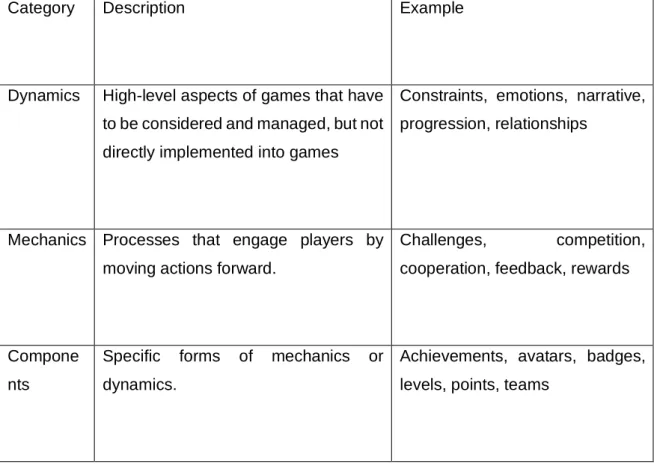
Game elements are defined as ”elements that are characteristics to the game”(Deterding et al., 2011). While Stanculescu et al., (2016) define that game elements as a tool used by the gamified engine to instruct players to approach the goals. These definitions have the same commonality,i.e, that game elements are the characteristic of the game. Werbach and Hunter (2012) state that is the distinct and characteristic elements of games that can be used in a gamified system. The most typical game elements can be applied in learning and teaching for examples:
- Points: can be collected for particular activities, a point system can be a structure such as experience point, skill point or reputation point.
- Progress bars: display the study process or ongoing status of students to approach a goal
- Rewards: when finishing the session, the points could be converted to the prizes such as adding points to the final grade or physical prizes which were small inexpensive that students can enjoy such as movie tickets or stickers.
- Levels: Teachers can set up the number of levels, the experience needed to towards the next levels, the number of experience points per task.
- Leaderboards: are the lists of students, mostly ranked base on their success. The leaderboard also inspires competition between students and make them more active in the study process.
- Avatars: students could choose representations of characters or images within gamification.
- Quests: could be little tasks or quizzes that students have to accomplish.
- Storylines: teachers could implement a fictional story into their learning context. - Feedback: the rapid and positive feedback usually is the main reason that
triggers student’s motivation, engagement, and encouragement. The teacher could give feedback through tests or assignments.
- Performance graphs: show information about student’s performance and compared them with their previous one.
- Badges: are visual awards of achievements, students can collect it by completing the give tasks.
All these above elements have different features and it cannot be denied that they play the main role in the gamified system( Sailer et al., 2013). However, the gamification game elements are complicated more than just visual elements such as above mentioned elements. By reviewing some published research, game elements were determined on the hight level of abstraction. Hence, this thesis will discuss what game elements are and its characteristics on some existing articles instead of diving deep into game elements definition details. According to Werbach and Hunter (2012), there are three game elements on the gamification system which are dynamics, mechanics, and components.
Table 1.Game elements based on Werbach and Hunter, 2012.
Category Description Example
Dynamics High-level aspects of games that have to be considered and managed, but not directly implemented into games
Constraints, emotions, narrative, progression, relationships
Mechanics Processes that engage players by moving actions forward.
Challenges, competition, cooperation, feedback, rewards
Compone nts
Specific forms of mechanics or dynamics.
Achievements, avatars, badges, levels, points, teams
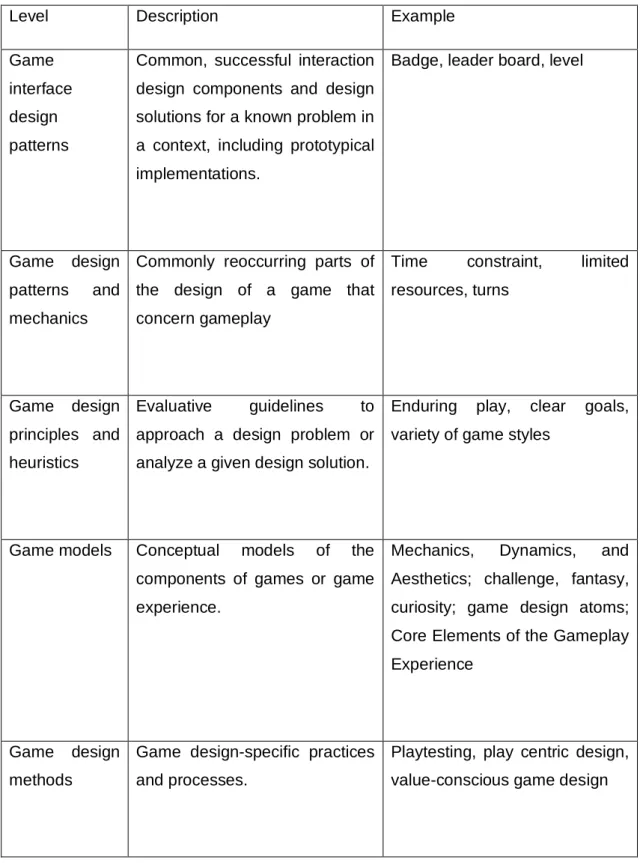
Another perspective is the classification in to five levels similar to the previous designation. Deterding et al.,(2011) differentiate five levels of game elements shown in the following table:
Table 2.Levels of game design elements (reproduced from Deterding et al., 2011).
Level Description Example
Game interface design patterns
Common, successful interaction design components and design solutions for a known problem in a context, including prototypical implementations.
Badge, leader board, level
Game design patterns and mechanics
Commonly reoccurring parts of the design of a game that concern gameplay
Time constraint, limited resources, turns
Game design principles and heuristics
Evaluative guidelines to approach a design problem or analyze a given design solution.
Enduring play, clear goals, variety of game styles
Game models Conceptual models of the components of games or game experience.
Mechanics, Dynamics, and Aesthetics; challenge, fantasy, curiosity; game design atoms; Core Elements of the Gameplay Experience
Game design methods
Game design-specific practices and processes.
Playtesting, play centric design, value-conscious game design
Both perspectives above have the same common ground which is that the game elements are arranged and grouped based on the level of abstractions. The first table
classifies from abstract to concrete and the second table arranges from concrete to abstract.
It is essential for educators to consider which game elements should be applied to the gamified structure. Using different types of elements can provoke different attitudes and reactions from students and when not applied correctly, those elements may fail the gamification design (Huang et al., 2013). Thus, this study will analyze the psychology in gamification in the next section.
2.3 Psychology in gamification
When observing others playing video games, the motivational and sentimental involvement of players can be boundless (Hense et al., 2012). Inheriting this motivational power, gamification has been used for influencing people’s motivation and behaviors such as encouraging curiosity or domination. Researching about motivational mechanisms and basic psychological perspective helps designers to adopt a motivational concept on their gamified system.
2.3.1 Motivation
To gain engagement and motivation, the psychology plays a vital role in gamification design process. Maehr and Meyer (1997) explained that motivation is a philosophical construct used to demonstrate the inception, direction, concentration, endurance and aspect of behavior. There are many types of motivation theories contributing to the success of gamification, however, this study will specify two major motivation categories which are instrinsic motivation and extrinsic motivation.
According to Ryan and Deci (2010), the instrinsic motivation illustrate the activity done for self-fulfillment without any external prospect. Deci et al., (2001) define that instrinsic is an inborn psychological need for capability and self-decision. Moreover, the test, the curiosity, domination and illusion are the key elements to bring out this type of motivation (Gopalan et al., 2017). Besides, instrinsic motivation has a powerful and helpful relationship with academic achievement (Lepper et al., 2005). Particularly, instrinsic motivation motivates people to engage to academic activities to experience the pleasure,
challenging or singularity without any external influences (Ryan and Deci, 2010). Furthermore, instrinsic motivation could expand the positiveness and improve participant’s knowledge to preserve for a long run (Lepper et al., 2005).
In comparison, extrinsic motivation represents external factors such as the reward, obligation or punishment (Tohidi and Jabbari, 2012). An example can be found in education, students will be motivated if they will be rewarded or under pressure or obligation. Tohidi and Jabbari (2012) also state that the motivation can be stored at the beginning stage and convert to instrinsic motivation when it dives deeper. This kind of motivation produces solid persistence and engagement but it would not able to maintain longer as intrinsic motivation ( Lepper et al., 2005). Furthermore, if gamification designers keeping using extrinsic motivation by giving rewards and compliments continuously, the habit will be established in people’s mind that they only perform for earning the rewards and skip learning skills or gaining knowledge. Other than that, once extrinsic or intrinsic motivation is not able to influence to an individual, then the amotivation apears. Amotivation is defined as lacking of motivation or engagement to activity (Vallerand et al., 1992).
In conclusion, intrinsic motivation make human to self-motivation in ensuing knowledge while extrinsic motivation provides the direction to ensuing the knowledge. Particularly in education, intrinsic motivation and extrinsic motivation are necessary during the study process and both of them have their unparalleled functions to motivate students (Li and Lynch, 2016). Li and Lynch (2016) also conclude that learning is sophisticated and motivation is the stable foundation of this process. Thus, the learners have to be motivated to constrain the obstacles, understand the progress and be able to apply knowledge in real problems (Lepper et al., 2005).
2.3.2 Behaviours
For each game elements and motivational theory in gamification, users may have diverse emotional reactions to these game mechanics. This diversification is clarified by player typologies which can be applied as a principle for adoption.
In 1990, Bartle defined that there are four types of game players and this typology was used widely in the gaming industry. The four types are killer, achiever, explorer and socializer. However, Nick Yee (2005) has argued that these gamers typology is limited
to a unique game genre (Role Playing Games) and they may not perform well if used in other background, such as gamification. Kallio et al.,(2007) realized this problem and have advanced a gamer type heuristics separate from the game genre. However, they concentrate on the connection between the player and in game activities, therefore their development cannot be used for gamification either. By reviewing neurobiological literature, Nacke et al., (2011) propose BrainHex player typology and it can be applied for other context particularly gamification although this player type’s research evaluation is currently use questionnaires instead of neurobiological techniques. This designation was investigated in relationship with player’s behavior and it includes seven player types:
- The Seeker is curious and enjoys the game world. - The Survivor prefers escaping and enjoying the fear.
- The Daredevil is excited about risk taking, playing on the edge. - The Mastermind interested in facing puzzles and inventing strategies. - The Conqueror is excited struggling against adversity until they win. - The Socialiser interested in collaborating with other players.
- The Achiever is excited about accomplishing tasks or challenges.
Oriji et al.,(2013) describe the beneficial respect between Brainhex and key factors of a healthy behavior. Rogers et al.,(2016) research found that the behavor in gameplay and Brainhex typology are related, for example, the Seekers did show a higher exploration count compare with other player’s types.
Lavoué et al.,(2018) point out BrainHex has many advantages when apply to gamification system for three main reasons. Firstly, the BrainHex is not limited to a context (compared with Bartle’s typology) and examines a wide area of game mechanics. Secondly, this typology does not restrict each gamer to one archertype, but describes them as a full set of valuation demonstrating their engage in each kind of mechanics. Lastly, BrainHex is the only player’s type correlated with uncomplicated survey questionares, helps the designer understanding their potential players.
2.4 Gamification of teaching and learning
In Cook’ (2013) opinion, any progress with the following conditions can be gamified: - The players can learn the activity
- The user acitivity could be check by a method - The users can receive prompt feedbacks
While Buckley and Doyle (2016) explained that in many ways that the concept that manages an ongoing educational structure has many similar characteristics with the game. Because of these similarities, these two authors stated that gamification will be easier to implemented and designed in the learning environment.
Secondly, the major issues in education currently are linked to the lack of commitment and encouragement of learners to engage actively in the study process. Therefore, educators try to apply new methods and concepts that motivate their student’s performance and more active in training attendance (Kiryakova et al.,2014).
The purpose of gamification on learning is to adjust a circumstantial student performance and attitude, and which is planned to enhance pre-existent guidance as a repercussion of that behavioral change (Landers, 2015). Hence, by using gamification in education, educators could achieve their goals. For example, one common solution is to reward the achievement with awards, which lead to gained interest in attendance and performance (Kiryakova et al.,2014).
2.4.1 Students as players
In game, players are aiming to complete each mission and when finishing all missions, they have to defeat the final mission in order to win the game. Likewise, typically in the learning course, when the students complete each assignment or task, they will have a final exam to get a grade for that course. Another example of this comparison is mapping the process of players is important since the next stage and action are based on their performance results. Also, student’s learning progress is defined by the accomplished knowledge and skills (Glover, 2013). Team or group work in the learning environment is a breakthrough in active learning. Although the competing elements in the game are
strong, the gamification of learning should be focused on building up skills and responsibility for the group work rather than competition among students (Kiryakova et al., 2014).
Sheldon et al., (2011) has given an example of how a regular study environment can be gamified without using technology, to make students more engaged and make class more fun. Students begin with 1 and climb up to 5, by finishing quests and tests and earning experience points. Nevertheless, there are not many statistics that are presented to support the advantage of this method. Most educators supposed that their evaluation goal in a gamified learning system is unbiased, students collect points for fulfilling tasks accurately. These transcribe into comparable rewards – grades. If the performance of students meet the requirements, they could ”level up” by moving forward to taking the advanced course of the curriculum at the end of every academic year (Lee and Hammer, 2011).
2.5 Criticism
Despite the positives effect of gamification, there is still some existing criticism of this method in the learning process.
Firstly, according to Werbach (2012), the engagement of students may only temporarily or even decrease once they realize no real valuation behind the game mechanics. Werbach points out the main reason behind this phenomenon is a gamified system poorly designed using simplistic game elements. To address this problem, Huang et al.,(2013) recommended that teachers must consider carefully and thoroughly using extrinsic motivators to adjust student behaviors, avoiding temporarily motivation. Secondly, the research of Faiella and Ricciardi (2015) found that the self-consciousness of students needs to be guaranteed because the effectiveness of gamification is greater when the learners can choose. The duty influences the basis of the gamification activity and diminishes learner motivation (Cheong et al, 2013).
Finally, implementing gamification techniques or technology in the learning process may often improve students experiences. Nevertheless, the whole curriculum or all of the face-to-face teaching should not be replaced by this method (Huang et al.,2013). Leong et al., (2011) states “teaching is fundamentally a human activity”.
3 METHODOLOGY
In this chapter, all the methods applied in this research will be defined. These methods are used because it will clearly define the objective, purpose of the teacher of this course, gettting understand students who took this course and the students who expect what this course will bring them. Next, with the evaluation of the expert, the digital product will receive more technical aspect.
3.1 Interviews and questionnaires
Interviews are one of the most common methods that used to classify obligation and sumerize the information of the users, stakeholders or experts. There are three different type of interview for qualitative research: unstructured , semi-structured and structured. For this study, semi-structured interviews are used to approach this study’s goal. About the semi-structured interview, the interviewees are free to give and broaden their ideas. With this characteristics, semi-structured interview could help intervewer gather systematic informations about topics, additionally, exploring the new issues or topics appear (Wilson,2013). In this study we used a semi-structured interview to better understand the lecturer’s experiences and thoughts about the possibility of gamifying the Gamification course for future students.
Furthermore, the opinion of students who participated this course last year was also collected by means of questionnaire survey. The aiming of this survey is try to understand students psychology and their expectations.
3.2 Prototyping
Prototyping is promptly making an approach version of the design idea to quickly get feedback. By this technique, the design will be improved and some valuable vision might be discovered. The role of the prototype is it help people have shared ground understand exactly what design idea is about. Testing a prototype also demonstrate stackholders and suppliers the common understanding on how the product would work meanwhile decreasing the misunderstanding (Preece, et al., 2002). However, it is very important that the prototype nearly are or have to be unfinished. The reason behind that is the
prototype help designer quickly get feedback, so they will not waste time to go to the wrong path. So, prototype is an extremely helpful strategy for an efficient design. By applying this way, a rapid prototype of gamification will be created and tested by the expert. Finally, getting feedback and fixing to fill the gap of gamification thinking. We obtained feedback for the prototype by means of consulting with an online pedagogy and gamification expert.
3.3 Expert evaluation
Generally, evaluation plays a vital role in user-centered design, and also in the development of technology. With deep knowledge, the expert could give useful feedback and give some recommendations to improve the design. Typically, more than one expert will take part in the design evaluation because it is unlikely that any single person could point out all or most of a design usability issues (Gabbard et al., 1999). Each expert first examines the design independently of other expert’s discovery (Gabbard et al., 1999). Furthermore, Nielsen (1994) proposed a two-pass strategy. In the first pass, the expert gets an overview of the design flow. In the second pass, the expert will go to more detail in each design component and identify conflicts with the flow of the design. This method could address the issues of the design and was applied effectively, widely in the development process (Gabbard et al., 1999).
3.4 Iterative design
After receiving feedback from the expert, the gamified prototype will undergo a second round of development, leading to a full mock-up site that will be presented in this thesis. Future plans, not part of this thesis scope, for the mock-up would be to present it to past students of the course to get their opinion for a next design-develop-evaluate iteration of the mock-up. A final round of mock-up presentation would then be with the next students of the Gamification course, after which functionality will be added and full implementation would be ready in October 2020.
4 DESIGN PROCESS
This chapter will provide the design process of gamification by inspiring the study of Antonaci et al.,(2018). The design process of gamification interference embraces its complexity because the gamification design is affected by several fields such as psychology, learning science and design, users experience design, human-computer interaction(Antonaci et al., 2018). There are four main steps in designing a gamified system which are analysis, game elements selection, design and implementation and evaluation.
4.1 Analysis
The purpose of this phase is to help designers have an overall understanding of the characteristics and functions regarding the context in which gamification needs to apply for.
4.1.1 Defining learning objectives
To gamify a course, the learning objective must be clearly defined. As mentioned above, the learning objectives were conducted by semi-structured with the instructor of the Gamification and serious game course. The interview scripts will be attached at the end of this thesis. According to the lecturer, this course includes two different learning objectives :
- The theoretical objective is to explain how gamification works, why it works and which industry gamification could implement.
- The practical part is to allow students could make a gamification application but it does not have to be fully functioning application, it could be a mockup.
4.1.2 Understanding the users
Like the game, the main players in gamification on learning are students. It is crucial to identify student’s characteristics to define whether the new approach would be applicable
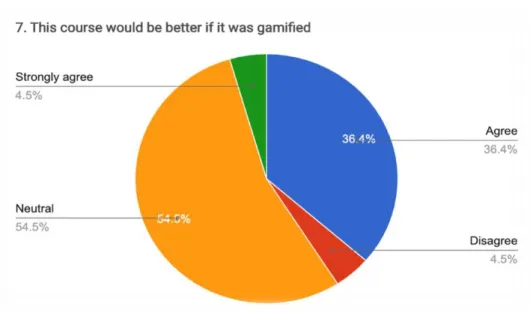
(Kiryakova, 2014). In this thesis circumstances, the questionaires about the idea of gamification was created. There are 22 responses from participants who have participated in the course this year include 18 students from Turku University of Applied Sciences and 4 students from University of Turku. The questionaires was given to address the characteristic of students such as game typology, their idea about the course, about the game elements and quizzes (Figure 2 & 3).
Figure 2. The idea of students about gamifying the course.
Figure 3. The enjoyment of students about the course 4.2 Game elements and selection
There are a lot of game elements selections available. So the gamification designers should consider the application fields and way of approach (Bjork, 2004).
By analyzing the data collected from the survey result (Figure 4), the participants interest in rewards, the progress bar (50%), points (40.9%) and levels, badges and trophies (36.4%).
Figure 4. Result of game elements selection.
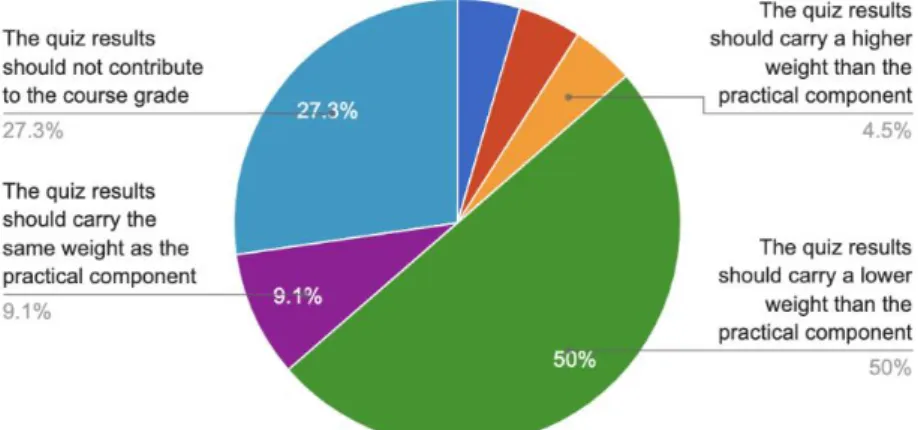
Furthermore, the quiz’s ideas (Figure 5) also were investigated and the result shows that the quizzes should carry lower weight is most selected(50%) and the quizzes result should not contribute to the course grade(27.3%).
Figure 5. Result of quizzes contribution to the final grade of the course.
Based on the theoretical framework and considerations, six game elements was chosen and the relation with the theory mentioned above is further pointed out.
4.2.1 Quizzes, badges and storyline
As mentioned above, the instructor’s purposes were to let students catch the knowledge and apply it to the practical side. So the function of the test would be divided into two parts: preparation quizzes and pop quizzes. The preparation quizzes are mandatory parts and occur 40% total grades of the course. The purpose of this part helps students could prepare some knowledges before the lecture so they will easier adapt the content of the lecture and perhaps improve the enjoyment of the theory lessons. The pop quizzes are not mandatory and it will let students several times to overcome. Students will reward some badges after completing each quiz section.
Figure 6. Badges as rewards for students complete pop quizzes.
Besides as rewards, the badges also indicate the process of the practical part in project storyline with the meaning of each badge(Figure 6):
The Socializer for forming, greeting within the group
The Seeker for exploring, discovery the ideas for the project
The Mastermind for brainstorming, generating the idea for the project The Conqueror for executing, conquering the project goal
The Achiever for achieving, completing the final goal of projects.
At the end of the course, if students could achieve 4 of 5 badges, they will be rewarded an inexpensive award or the lecture could rounding their grade up for example 3.25 to 3.5 or 3.75 to 4 on the final course grade. The exact rewards would be examined and decided after the next iterative design loop with the past students of the Gamification course – please recall that this iteration is not within the scope of this thesis.
4.2.2 Levels, progress bar and experience points
Base on the content, learning objective of the course and the survey about student’s ideas. The course will be split into 5 levels and include 5000 experience points. To complete and level up, students must achieve two requirements which are personal task and group task (each task is 500 points):
Level 1: group task: greeting with other group members. The personal task is looking, exploring the learning website.
Level 2: group task: generating, presenting the idea with lecturers. The personal task is to complete the first preparation quiz.
Level 3: group task: Having a complete wireframe and present it with lecturers. The personal task is to complete the second preparation quiz.
Level 4: group task: Having all the UI elements of the wireframe. The personal task is to complete the third preparation quiz.
Level 5: group task: presenting the final presentation of the project. The personal task is to complete the final summarize quiz.
4.3 Design and implementation
After identifying the suitable game elements, it is essential to conceptualized, designed and implemented according to the goal of the interference, the user experience, the application scheme and the logic stated in the theoretical framework. According to Atonaci et al., (2018) the design and application of gamification depend on the platform applied, function and the programming skills of the designers. However, in this study, the mockup of gamification will be focused instead of a functional online learning website. The learning website mockup includes six main menus: workspace, lessons, quizzes, projects, trophies, and criteria.
Students could see their activity, tasks required, their current badges, other team member status and the checklist of group tasks.
Figure 7. Homepage screen of the mockup. Lesson menu:
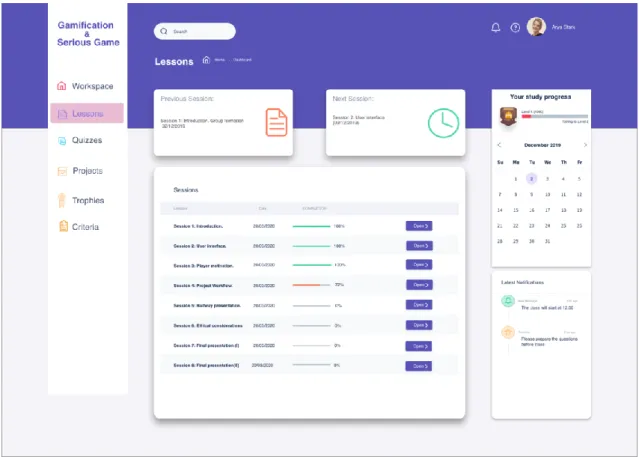
Students could follow the status of the course, which session they have to complete and which session they have completed.
Figure 8. Lesson menu screen.
The presentation of each lecture will be opened when students click on the open button (Figure 9). In the presentation of the lecture page, students could leave comments or questions so the lecturers could answer them. Other students also could discuss with their classmates about the lecture, so they could help each other catch the knowledge of the lecture easier.
Figure 9. Presentation of the lesson page. Quizzes menu:
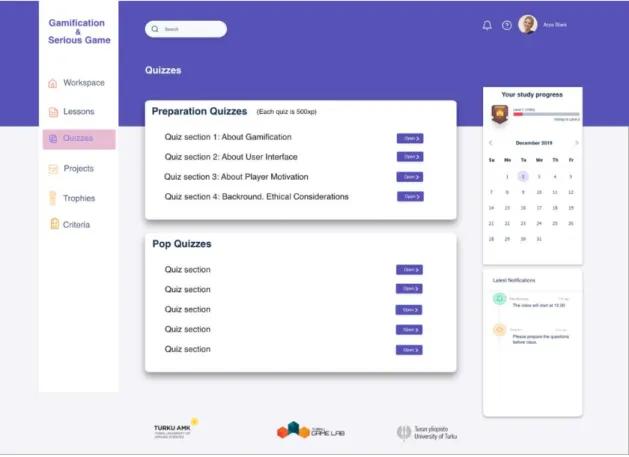
Students could access to the preparation quizzes or pop quizzes. They could do the test and immediately see the result. There is also a timer on the test screen so they could check the time as well.
Figure 10. Quizzes menu screen. Projects menu:
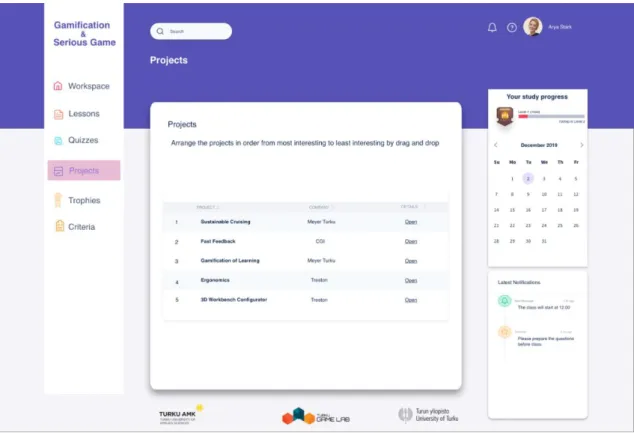
Students could arrange projects from most interesting to least interesting by drag and drop function.
Figure 11. Project menu screen. Trophies menu:
In this section, students could see their current status, or currently collected badges, as well as their level and requirement points to level up.
Figure 12. Badges screen menu. Criteria menu:
In this section, the criteria were clearly showed and easy to follow, help students understand the course evaluation and requirements.
Figure 13. Criteria menu screen. 4.4 Evaluation
After having a review on the prototype, the experts indicated some issues need to be modified :
On the workspace, there should be a place where lecturers can give written feedback on the group or individual tasks – this is to encourage learners to reflect and guide debriefing sessions with the lecturer. Besides the group feedback, the big problem is that lecturers are not able to remember all the individual cases, and when approached at a later stage, and the written feedback will help their memory. Also, as student groups get larger, less time can be spent with individual groups in class and lecturers will have to resort to giving online comments to be used in later discussion.
Adopting this feedback, the author has added the feedback button on the Workspace menu so each student could watch their own feedback from lecturers.
Figure 14. The feedback from teachers have been added to the Workspace menu screen.
Figure 15. Feedback from the teachers's screen.
The experts also stated that the experience points should be more suitable for the context of the course, so students could have the motivation to collect points. The suggestion of the experts that the experience points should be changed to knowledge points so when achieve those points, students might feel more competence, and the amount number of knowledge points of each given assignment should be decreased to 5 points (instead of 500 points), and the total knowledge point is 50 points (instead of 5000 points).
Figure 16. The experience points change to knowledge points and the amount of knowledge points changed.
Furthermore, the experts pointed out that normarlly the learning environment should have both a lecturer view and student views. For this thesis, the experts argued that it is possible to only focus on the student view because the author is looking at gamification from the student perspective and lecturer data have been not collected enough to make a sensible lecturer view at this point.
Other than these concerns, the expert was very positive and truly believes this study has developed a good gamification solution for the course.
5 DISCUSSION
In this chapter, the result of the study which is the impact of gamification on learning will be discussed. Furthermore, some guidelines for gamification application in education research will be provided.
5.1 The impact of gamification on learning
The study shows the overall review of gamification application on learning, particularly on gamification and serious game course. By researching existing articles, the gamification also affects on behavior and motivation of students.
This techniques is a useful method for anti-laziness and demotivated students in class nowadays. By diving deeper into the psychology behind gamification literature, the research shows that psychology plays a vital role in the gamified system. The intrinsic and extrinsic and the game elements selection also are key factors in this system. By matching game elements with motivation, the instructor could design an encouraging gamified application and help students achieve the learning objectives.
On the other hand, some authors are trying to remain unbiased by analyzing the advantages and disadvantages of gamification on learning. They suppose the instructor should consider adopting game elements in gamification application into the current curriculum. Moreover, there are some authors emphasized that many designers failed the gamified system by trying to gamify the outcome rather than the behaviors, for example, the course is not gamified for easier to get higher grades instead, the process of the course can be gamified for motivating students to get better grades.
As a result of the research review and although having some issues should be taken into account, it is possible to conclude that gamification has a positive affect on student’s engagement and motivation. Most of the resources proved that gamification helps their students more engage and motivate on the study process. The outcome statistics of these resources are clearly presented and promising about gamification in various fields in general, on education in particular.
However, if the gamification was designed not correctly, it may backfire on the educators (Huang et al., 2013). For example, students are required to overcome the learning
session by having abilities and skills. With some problematic sections, students should be placed in individual or self-learning rather than using a community environment. The students who have fewer skills and abilities may feel discouraged when they are always compared with others and lead to drop out of the course. According to Kapp (2012), when using leaderboards, learners who have low position might feel embarrassed and demotivated.
5.2 Implementation guidelines for gamification in education
When start designing gamification activities in education, there are few important characteristics that the instructors should consider. Firstly, the learning objectives and psychology behind should be clearly defined and research. The instructors could make a questionaire to help them understand their students and easier for them to select the game elements later. Furthermore, the problem of the gamified system should be identified to design a tool for solving it. The problem can be related to the group, individuals or society level. Secondly, game elements should be carefully selected and implemented. Each game element will bring a different kind of training experiences for students (Helms et al., 2015). By selecting suitable game elements, the gamification application could provoke student’s curiosity or motivation to accomplish the course objectives. Next, as mentioned above, the game elements selected need to be implemented that suit the context of the course. The user experience and user interface research are also important in the designing phase. Lastly, the evaluation phase’s purpose is to measure and get feedback on the gamification application. The evaluation could be in a different stage of the designing system depends on the instructors. The instructors could choose pre-evaluation, during and post interference.
6 CONCLUSION
In traditional learning and teaching methods, motivation and engagement of students could be burdened for many reasons. By researching and applying successfully suitable gamification approaches, information and knowledge could be delivered in new simple ways. This study has presented the benefits of gamification on the learning process by carefully reviewing existing articles and case study statistics. Furthermore, the advantages of game mechanics such as game elements and motivation behind were analyzed clearly.
Another part of this study was applying the gamification techniques and designing process of the Gamification and Serious Games course learning website mockup have been illustrated step by step. Despite limitations in the survey participants and the interventions, the gamification and serious game mockup have received positive and promising feedback from experts.
Based on the literature review and data collected during the process of doing this study, the implication guidelines for future gamification in education were discussed and four main steps were recommended. These steps serve as a reference for educators or designers to increase the possibility of designing an effective gamified system strategy in the learning environment in the future.
Although it is difficult to measure the success of gamification application, the effective influence of gamification application in education are undeniable, especially the student’s motivation and engagement. In conclusion, there is some proof to be optimistic about the future of gamification in education.
REFERENCES
Antonaci, A., Klemke, R., Kreijns, K. and Specht, M., 2018. Get Gamification of MOOC right!. International Journal of Serious Games, 5(3), pp.61-78.
Buckley, P. and Doyle, E., 2016. Gamification and student motivation. Interactive learning environments, 24(6), pp.1162-1175.
Caton, H. and Greenhill, D., 2014. Rewards and penalties: A gamification approach for increasing attendance and engagement in an undergraduate computing module. International Journal of Game-Based Learning (IJGBL), 4(3), pp.1-12.
Cheong, C., Cheong, F. and Filippou, J., 2013. Using Design Science Research to Incorporate Gamification into Learning Activities. In PACIS (p. 156).
Cook, W., 2013. Five reasons you can’t ignore gamification. Chief Learning Officer, 12(5), pp.46-55.
Deci, E.L., Koestner, R. and Ryan, R.M., 2001. Extrinsic rewards and intrinsic motivation in education: Reconsidered once again. Review of educational research, 71(1), pp.1-27.
Deci, E.L. and Ryan, R.M., 2010. Self‐determination. The Corsini encyclopedia of psychology, pp.1-2
Deterding, S., Dixon, D., Khaled, R. and Nacke, L., 2011. From game design elements to gamefulness: defining" gamification". In Proceedings of the 15th international academic MindTrek conference: Envisioning future media environments, pp. 9-15.
Engagement Alliance, 2014. What is Gamification? [Online]
Available at: https://engagementalliance.org/what-is-gamification/ [Assessed 20th March 2020].
Faiella, F. and Ricciardi, M., 2015. Gamification and learning: a review of issues and research. Journal of e-Learning and Knowledge Society, 11(3).
Gabbard, J.L., Hix, D. and Swan, J.E., 1999. User-centered design and evaluation of virtual environments. IEEE computer Graphics and Applications, 19(6), pp.51-59.
Gartner, 2014. Gartner Reveals How Gamification Drives Digital Business. [Online]
Available at: https://www.gartner.com/en/newsroom/press-releases/2014-04-08-gartner-reveals-how-gamification-drives-digital-business
[Assessed 20th March 2020].
Glover, I., 2013. Play as you learn: gamification as a technique for motivating learners. In Edmedia+ innovate learning, pp.1999-2008.
Gopalan, V., Bakar, J.A.A., Zulkifli, A.N., Alwi, A. and Mat, R.C., 2017, October. A review of the motivation theories in learning. In AIP Conference Proceedings (Vol. 1891, No. 1, p. 020043). AIP Publishing LLC
Helms, R.W., Barneveld, R. and Dalpiaz, F., 2015. A Method for the Design of Gamified Trainings. In PACIS, p. 59.
Hense, J. and Mandl, H., 2012. Learning. International Association for Development of the Information Society.
Huang, W.H.Y. and Soman, D., 2013. Gamification of education. Research Report Series: Behavioural Economics in Action, Rotman School of Management, University of Toronto.
Huotari, K. and Hamari, J., 2012. Defining gamification: a service marketing perspective. In Proceeding of the 16th international academic MindTrek conference, pp. 17-22.
Huffing post, 2013. Gamification: The Hard Truths. [Online]
Available at: https://www.huffpost.com/entry/gamification_b_2516376 [Assessed 20th March 2020].
Kallio, Pauliina, K., Kaipainen, K. and Mäyrä, F., 2007. Gaming Nation? Piloting the International Study of Games Cultures in Finland. Tampere: Hypermedia Laboratory.
Kapp, K.M., 2012. The gamification of learning and instruction: game-based methods and strategies for training and education. John Wiley & Sons, pp. 12.
Kiryakova, G., Angelova, N. and Yordanova, L., 2014. Gamification in education. Proceedings of 9th International Balkan Education and Science Conference.
Landers, R.N., Bauer, K.N., Callan, R.C. and Armstrong, M.B., 2015. Psychological theory and the gamification of learning. In Gamification in education and business (pp. 165-186). Springer, Cham.
Lavoué, E., Monterrat, B., Desmarais, M. and George, S., 2018. Adaptive gamification for learning environments. IEEE Transactions on Learning Technologies, 12(1), pp.16-28.
Lee, C., Lee, K. and Lee, D., 2017. Mobile healthcare applications and gamification for sustained health maintenance. Sustainability, 9(5), p.772.
Lee, J. J. & Hammer, J. (2011). Gamification in Education: What, How, Why Bother? Academic Exchange Quarterly, 15(2), p.146.
Leong, B., Koh, Z.H. and Razeen, A., 2011. Teaching introductory programming as an online game. Department of Computer Science, National University of Singapore.
Lepper, M.R., Corpus, J.H. and Iyengar, S.S., 2005. Intrinsic and extrinsic motivational orientations in the classroom: Age differences and academic correlates. Journal of educational psychology, 97(2), p.184.
Li, T. and Lynch, R., 2016. The relationship between motivation for learning and academic achievement among basic and advanced level students studying Chinese as a foreign language in years 3 to 6 at Ascot International School in Bangkok, Thailand. Scholar: Human Sciences, 8(1), p.1
López-Rodríguez, D. and García-Linares, A., 2013. Spare: Spatial rehabilitation with learning, recommendations and gamification. ICERI2013 Proc.
Maehr, M.L. and Meyer, H.A., 1997. Understanding motivation and schooling: Where we've been, where we are, and where we need to go. Educational psychology review, 9(4), pp.371-409.
McGonigal, J., 2011. Reality is broken: Why games make us better and how they can change the world. Penguin, p.23
Merquis J, 2013. 5 Easy Steps to Gamifying Higher Education. [Online]
Available at: http://classroom-aid.com/2013/08/16/5-easy-steps-togamifying- highereed/ [Assessed 21th March 2020].
Nacke, L.E., Bateman, C. and Mandryk, R.L., 2011. BrainHex: preliminary results from a neurobiological gamer typology survey. In International conference on entertainment computing, pp. 288-293.
Nielsen, J., 1995. How to conduct a heuristic evaluation. Nielsen Norman Group, 1, pp.1-8.
Orji, R., Mandryk, R.L., Vassileva, J. and Gerling, K.M., 2013. Tailoring persuasive health games to gamer type. In Proceedings of the sigchi conference on human factors in computing systems, pp. 2467-2476.
Preece, J., Rogers, Y., & Sharp, H., 2002. Interaction design: Beyond human-computer interaction. New York, NY: John Wiley & Sons.
Rogers, K., Kamm, C. and Weber, M., 2016. Towards player-centric adaptivity: Interactions of gameplay behaviour and player traits in a survival game. In Proceedings of the 2016 Annual Symposium on Computer-Human Interaction in Play Companion Extended Abstracts, pp. 269-276.
Sailer, M., Hense, J., Mandl, J. and Klevers, M., 2014. Psychological perspectives on motivation through gamification. Interaction Design and Architecture Journal, (19), pp.28-37.
Sheldon, P.J. and Park, S.Y., 2011. An exploratory study of corporate social responsibility in the US travel industry. Journal of Travel Research, 50(4), pp.392-407.
Squire, K., Barnett, M., Grant, J. M., & Higginbotham, T., 2004. Electromagnetism supercharged!: learning physics with digital simulation games. In Proceedings of the 6th international conference on Learning sciences, ICLS ’04 pp. 513–520.
Stanculescu, L.C., Bozzon, A., Sips, R.J. and Houben, G.J., 2016. Work and play: An experiment in enterprise gamification. In Proceedings of the 19th ACM Conference on Computer-Supported Cooperative Work & Social Computing, pp. 346-358.
Subhash, S. and Cudney, E.A., 2018. Gamified learning in higher education: A systematic review of the literature. Computers in Human Behavior, 87, pp.192-206.
TalentMLS, 2019. The 2019 Gamification at Work Survey. [Online]
Available at: https://www.talentlms.com/blog/gamification-survey-results/ [Assessed 20th March 2020].
Tohidi, H. and Jabbari, M.M., 2012. The effects of motivation in education. Procedia-Social and Behavioral Sciences, 31, pp.820-824.
Vallerand, R.J., Pelletier, L.G., Blais, M.R., Briere, N.M., Senecal, C. and Vallieres, E.F., 1992. The Academic Motivation Scale: A measure of intrinsic, extrinsic, and amotivation in education. Educational and psychological measurement, 52(4), pp.1003-1017.
Werbach, K. and Hunter, D., 2015. The gamification toolkit: dynamics, mechanics, and components for the win. Wharton School Press.
Wilson, C., 2013. Interview techniques for UX practitioners: A user-centered design method. Newnes.
WTM, 2018. World travel market industry report 2018. [Online]
Available at: https://hub.wtm.com/category/press/industry-report/ [Assessed 24th April 2020].
Yee, N., 2005. The Daedalus project: the psychology of mmorpgs. [Online]
Available at: http://www.nickyee.com/daedalus/archives/001610.php?page=1 [Assessed 24th April 2020].
Zinchermann, G., and C. Cunningham, 2011. “Chapter 2: Player Motivation.” In Edited by Mary Treseler Gamification by Design: Implementing Game Mechanics in Web and Mobile Apps, 15– 33. CA, USA: O’Reilly Media.
Appendix: Interview transcript
Vien Pham: Good morning, Sir. I am in the process of writing my thesis, the objective of my thesis is to develop a gamified mockup for Gamification and serious game course so I would like to interview you as a lecturer of the course couple of questions related to the course.
Mr. Werner : Sure, I don’t mind.
Vien Pham: That’s great, firstly, in order to understanding the course, could you please explain me about the learning objectives of the course, Sir?
Mr.Werner: Well, the learning objectives are two different things, one of objective is of course the theoretical objective is to explain how gamification function, how it works or so why it works and in what industry it can works and the second objective is to allow students to make a practical application of gamification but it does not have to be fully functioning, it can just be a mockup or something like that.
Vien Pham: Thank you for the answer, Sir. Next, I would like to ask which method do you want to connect with student through online platform ( through slides presentations or video teaching..etc) ?
Mr.Werner: Okay, personally, if I going to teach this course online, I would like to have a platform that has minimal student contact, so very little student contact in the sense of face to face contact, it’s does not mean that I will be absent, I just don’t think that there is a need to have the video of me talking, just some slides on folder sharing. I think students can work independently, and I think students will be more get used to it. So I think there is a place on the mockup where I could put all the materials, I don’t need to talk about the materials but I will be present online for questions, and for support and so on.
Vien Pham: Thank you for the clear answer, Sir. Next, I would like to ask about the content of the course. Any changes about the content of the course in the future, Sir? Mr. Werner: Well, besides gamification like last year you participated, the course in the future will add the serious game part as well, so it will be gamification and serious game. Vien Pham: Thank you, Sir. So could you please explain me about the criteria of the course, Sir?
Mr.Werner: The evaluation criteria will be demonstrate two ways according to me, I like to students have to be prepare, usually what I do is I will give some preparation work before I share my materials so they will get some questions about the materials that they should know about and they should anwer this quizzes. It can be multiple choices questions, it can be true false, just very basic, but what it does is to let students prepare before they see the materials otherwise when I share the material, they read it and they think they know. So now I am making them have something that they have to look up and they have to try answer the question because then this quizzes will be graded and it will be counted to the evaluation so that is one evaluation that I would have. And the other evaluation I would like to have is some practical application of the materials because we are in University of Applied Sciences so it is very important that we actual apply the knowledge that we are gaining so I am not sure how to evaluate the practical online but we should come up by the way.
Vien: Thank you for that, Sir. The last question I would like to ask is do you like to add some game elements such as points, badges, leaderboards or level into this course, Sir? Mr. Werner: I think I would not mind, I think it is very nice because it is gamification course and I think it is very nice that they actually see gamification in action in the course that i am teaching. I will leave that question up to you but I think it is a good plan. Vien: Yes, that is my last question. Thank you for useful information, Sir. I believe that it will help me a lot when designing a gamification mockup for this course.