Honors Research Projects The Dr. Gary B. and Pamela S. Williams Honors College
Spring 2015
Assertiveness in Nursing Students
Kaitlin F. AmiconeThe University Of Akron, [email protected] Rachel Miller
The University Of Akron, [email protected]
Please take a moment to share how this work helps youthrough this survey. Your feedback will be important as we plan further development of our repository.
Follow this and additional works at:http://ideaexchange.uakron.edu/honors_research_projects
Part of theOther Nursing Commons
This Honors Research Project is brought to you for free and open access by The Dr. Gary B. and Pamela S. Williams Honors College at IdeaExchange@UAkron, the institutional repository of The University of Akron in Akron, Ohio, USA. It has been accepted for inclusion in Honors Research Projects by an authorized administrator of
IdeaExchange@UAkron. For more information, please [email protected], [email protected]. Recommended Citation
Amicone, Kaitlin F. and Miller, Rachel, "Assertiveness in Nursing Students" (2015).Honors Research Projects. 8. http://ideaexchange.uakron.edu/honors_research_projects/8
Assertiveness in Nursing Students Kaitlin Amicone & Rachel Miller
The University of Akron
Author Note
Kaitlin Amicone and Rachel Miller, College of Health Professions, School of Nursing, The University of Akron. This paper is submitted in partial fulfillment of Honors Nursing Research, 8200:435.
Abstract
The problem that this study focused on was that there was minimal evidence on whether or not nursing students become more assertive throughout their academic education. The purpose of this study was to compare the assertiveness scores of sophomore level nursing students and senior level-nursing students. The study was guided by Hildegard Peplau’s theory of
interpersonal relations in nursing, which focuses on the therapeutic process between nurses and patients, rather than on internal patient pathology. The descriptive, comparative study used a 15-question survey design and a convenience sample of sophomore and senior level nursing
students at a large urban Midwest university. Recruitment, informed consent, and data collection occurred during the sophomore and senior classes. An independent sample T test was used to determine group differences in assertiveness. The results revealed that the sophomore level students were more assertive than the senior level-nursing students.
Introduction
Assertiveness isthe ability to express one’s feelings, opinions, beliefs, and needs directly, openly and honestly, while not violating the personal rights of others (Ellis & Hartley, 2005). Assertive staff nurses are able to present suggestions in a direct, comfortable way, give and take criticism, assess the rights and responsibilities in a nursing situation, and act on assessments in a thoughtful problem-solving way (Clark, 2010). Lack of assertiveness results in diminished communication efficacy, thus compromising patient care (Poroch and McIntosh, 1995). When nurses express a lack of confidence and a lack of assertiveness, patients may notice. If those patients do not feel that nurses are confident in their work, they will not have a strong trusting relationship. For nurses to empower their patients, they need to be assertive (O’Mara (1995). Assertiveness should not be mistaken for aggressiveness, which involves inappropriate
expression of thoughts, emotions and beliefs in a way that violates the rights of others (Lawton and Stewart, 2005).
Nurses’ development of assertiveness and effective communication skills should begin in nursing education programs, where students are encouraged to express opinions and personal rights with the hopes of encouraging empowerment and enhancing autonomy (Baggs & Spence, 1990; Ibrahim, 2011; Lee & Crokett, 1994). Classroom-based knowledge is not always easily transferred to clinical practice (Jones, 2007). Therefore,students need to practice their skills through demonstration, role-play, and experience in clinical lab so that they can receive support, direction and feedback from nursing faculty.By doing this students may be able to practice their skills in a non-threatening environment that can be observed by faculty in order to evaluate and give feedback (Zavertnik, Huff, & Munro, 2010). The purpose of this study was to compare the assertiveness scores of sophomore level nursing students with the assertiveness scores of senior level-nursing students at a large midwestern university baccalaureate-nursing program. The following questions were answered: Is there a statistically significant difference in assertiveness scores between sophomore level nursing students and senior level nursing students? Is there a relationship between assertiveness and demographic factors, such as age, race, gender, years of nursing experience, employment in a health care setting, and basic nursing education? These questions were important when determining the assertiveness of nursing students and the effect of the nursing curriculum on their assertiveness throughout the program.
Review of Literature
Researchers have consistently found that nursing student’s perceived assertiveness increased progressively throughout their nursing education and training (McCabe & Timmins, 2005, 2010; Wise, 1980). Using a three-part questionnaire, Ibrahim (2010) studied 207 nursing
students to see if the level of assertiveness increased or decreased throughout their nursing education. They found that 62.5% felt assertive in the first year of nursing school, and 67.2% felt assertive in the fourth year. The results showed that the senior level students felt slightly more assertive in the hospital and education setting than the sophomore level students. These results are similar to those found by Deltsidou’s (2008) whose study looked at the level of assertiveness in nursing students from their sophomore to senior year. The study consisted of 298 nursing students who participated in a questionnaire to rate level of assertiveness throughout their education. The findings showed that the students felt more assertive in their education and in the hospital setting as they progressed throughout the program.
Researchers have also found a positive correlation between the level of assertiveness and assertiveness training throughout their education (McCabe & Timmins, 2005; Kageyama, Kobayashi, Nagami, Shimazu, & Yamagishi, 2007). Kageyama et al. (2007) studied 25 nursing students and had them participate in a three weeklong web-based stress and assertiveness class. They found that the participants felt more assertive after the training (P = 0.031) than before the assertiveness class. Implications were that assertiveness training should become a component in all nursing programs because it may increase students’ confidence and it could allow them to feel more comfortable in their education and in the hospital setting.
Few researchers have investigated demographic factors such as age, gender, experience, and nursing education on assertiveness. Unal (2012) examined assertiveness in 79 nursing students and found that age and sex were not related with assertiveness. However, studies show that male or female nursing students may be viewed differently if they are assertive (Hargie & McCartan, 1990; Kilkus, 1993). McCabe and Timmins (2005) studied 27 nurses and found that regardless of gender, age, and amount of education, BSN educated nurses without any
assertiveness training were less assertive than those who had assertiveness training. Even the amount of clinical experience did not compensate for the lack of assertiveness training and experience (Hargie & McCartan, 2004). Therefore, there is little known about the relationship between assertiveness and demographic factors in sophomore and senior level students, which supported the need for this study.
Theoretical Framework
The study was guided by Hildegard Peplau’s theory of interpersonal relations in nursing. This theory focuses on the nurses’ attention away from the internal patient pathology to the therapeutic process between the nurses and patients (Peplau, 1997). By switching this focus, every interaction with patients becomes an important therapeutic opportunity to teach patients and to empower them to make changes (Peplau, 1997). There are three phases to the theory: orientation, working, and termination (Peplau, 1997).The orientation phase is mostly a one-sided conversation, where the nurse identifies him or herself, and explains the purpose, nature, and time of meetings (Peplau, 1997). The nurse will then seek essential information about the patient and also set the tone for future interactions. The working phase is where planning, patient
education, and the physical care of the patient. Nurses also provide knowledge to their patients and build on their own previous knowledge as well. The third phase is the termination phase. This phase provides time for summarizing and closure of the work that has been accomplished (Peplau, 1997). Planning for termination begins during the working phase (Peplau, 1997) with nurses carefully guiding all of these phases. This theory also stresses the importance of the nurses’ ability to understand their own behavior to help others identify problems they are experiencing (Peplau, 1997).
To provide competent care for patients, nurses must first develop a trusting relationship with the patient. This relationship is established in the orientation phase. Nurses need to establish the framework for what the relationship will consist of and work with the patient to come up with reasonable goals. Assertiveness is defined as the ability to express one’s feelings, opinions, beliefs, and needs directly, openly and honestly, while not violating the personal rights of others (Ellis & Hartley, 2005). Assertiveness is an important quality for nurses in all three phases because it is used to accomplish precise patient care. Establishing the trusting
interpersonal relationship allows nurses to make suggestions, communicate openly with patients, and be assertive in their care. Peplau’s theory gives nurses guidelines on how to put each phase into practice. Based on this theory, it is expected of nurses to have a good understanding of their own behaviors and attitudes, have a strong trusting relationship with their patients, and have good communication skills. The nurses need to be assertive in their work to provide competent care for their patients. Studying nursing students has allowed the co-investigators to see if the students were learning these skills throughout the nursing program.
Methods Design
This was a descriptive, comparative study using a survey to collect data. Following study approval from the university institutional review board, data were collected with a 25- item questionnaire measuring assertiveness skills in nursing students at the sophomore level and senior level. The demographic data included: age, gender, years of nursing experience, and basic nursing education.
The setting was a nursing school at a large urban public university in the Midwest of the United States. There are 27,000 students at the university. There are approximately 450 students currently enrolled in the school of nursing, and approximately 150 students per level.
The sampling of the population was conducted through convenience sampling. The inclusion criteria included: at least 18 years of age, current enrollment in the traditional undergraduate baccalaureate nursing program and sophomore and senior level students.
Participants were not excluded based on gender, ethnicity, or age, as long as they were at least 18 years old.
Sampling and Data Collection Procedures
As stated earlier, the sampling of the population was conducted through convenience sampling. Sophomore students completed a total of 79 surveys, and senior students completed a total of 116 surveys. The co-investigators obtained permission from two professors in the school of nursing to take approximately 20 minutes of their class time and explained to the subjects the study and asked for participants. The research project was designed to compare assertiveness levels between sophomore and senior students. All students in the class received copies of the informed consent (see Appendix B) and the survey. The participants filled out the questionnaires during their class time. Once they were completed, the questionnaires and were returned
facedown and directly to the co-investigators. Completed questionnaires implied informed consent. Surveys did not include identifying information and were kept in a locked file cabinet in the sponsor’s locked university office. Only the members of the research team had access to the file cabinet. All of the data was entered into a SPSS file for analysis, and only the
co-investigators and sponsor had access. All surveys have been destroyed since the study is completed.
Measures
The Rathus Assertiveness Schedule (RAS, see Appendix C) was used to measure assertiveness and was modified slightly by the co-investigators for the purpose of focusing on nursing students alone. The tool contained 20 items, which were scored on 6-point Likert scales with response options ranging from “very much unlike me” (coded as -3) to “very much like me” (coded as 3). Sample items include:
1. I am careful to avoid hurting other people’s feelings, even when I feel that I have been injured.
-3 -2 -1 1 2 3
2. When I am asked to do something, I insist upon knowing why.
-3 -2 -1 1 2 3
3. Most people seem to be more aggressive and assertive than I am.
-3 -2 -1 1 2 3
4. To be honest, people often take advantage of me.
-3 -2 -1 1 2 3
Ratings from all items were coded so that higher scores indicate a higher level of assertiveness. Item ratings will be summed with scores ranging from -60 to 60. The RAS has shown to have moderate to high test-retest reliability (r= .78; p<.01) and split-half reliability (r= .77; p<.01) (Elsevier, 1973).The co-researchers also used the Cronbach alpha tool, which measured the internal consistency of the study. Validity was established based on the terms of the impressions respondents made on other people (.33r’s.62; p’s<.01) and in terms of their indications of
how the respondents would have behaved in specific situations in which assertive, outgoing behavior could be used with profit (r= .70; p<.01) (Elsevier, 1973). The survey used for the study
on nursing students was modified from the original RAS. Therefore, the reliability and validity of this study may vary from the original RAS. The survey also contained five items dealing with the demographic variables: age, gender, ethnicity, years of nursing experience, and basic nursing education.
Data Analysis
The data was analyzed using SPSS, a statistical analysis program. Descriptive statistics were used to describe the sample, the variables, and the levels of assertiveness. Independent sample t-tests were used to determine group differences in assertiveness mean scores. Pearson correlation coefficients were used to determine the relationship between assertiveness and age. If the alpha or p value was less than 0.05, then the variables were significantly different. If the p
value was greater than or equal to 0.05, then the variables were not significantly different.
Variables Sophomore Senior
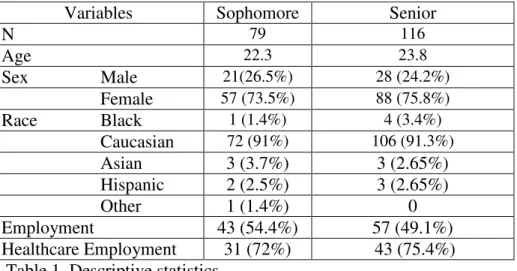
N 79 116 Age 22.3 23.8 Sex Male 21(26.5%) 28 (24.2%) Female 57 (73.5%) 88 (75.8%) Race Black 1 (1.4%) 4 (3.4%) Caucasian 72 (91%) 106 (91.3%) Asian 3 (3.7%) 3 (2.65%) Hispanic 2 (2.5%) 3 (2.65%) Other 1 (1.4%) 0 Employment 43 (54.4%) 57 (49.1%) Healthcare Employment 31 (72%) 43 (75.4%) Table 1. Descriptive statistics
Table 1 shows descriptive statistics for the sample. More seniors (116) than sophomores (79) participated in the study, possibly because senior student have a better understanding of the importance of research and are more willing to participate. The mean age for both groups was nearly the same. This could be explained by the current trend of people seeking a second career and choosing health care, resulting in the students being older since they may already have
completed a degree. The demographics showed that the majority of the sophomore and senior level-nursing students were Caucasian. Less than half of the sophomore students were employed, and of those students, 72% of them were employed at a health care facility. More than half of the senior nursing students were employed, and of those, 75.4% of those students worked at a health care facility. Pearson Correlation showed only a very weak, positive (.113) correlation between age and assertiveness scores and this was not significant (p=.116) in this study.
t-test Mean Mean T value P value
Sex (F) 5.41 (M) 11.30 -2.243 .033
Employment (Y) 4.69 (N) 9.21 -1.976 .049
Healthcare Employment (NHC) 6.39 (HC) -.156 1.332 .028
Rank (So) 7.5 (Sr) 6.48 .431 .667
Table 2. Comparison of Means
Table 2. Shows the comparison of mean assertiveness scores. Scores for males were higher than females and this was a significant difference (p= .033). This tool measures the participants perception of assertiveness and it is not surprising to find men report perceiving themselves significantly more assertive than females. A significant difference (p=.049) was found between assertiveness scores for students who were employed (4.69) and those who were not (9.21). The co-investigators suspect that the students who were not employed may not be aware of the degrees of knowledge and effective communication skills essential for successful assertiveness.
The statistics indicatethat students employed in non-health care positions reported themselves as beingmore assertive than those who were employed in a health care facility.This might be explained bythe fact thatnon-health care jobs may not require as much responsibility and knowledge as those who care for and maintain the lives of others. Therefore, these
employees may be more assertive in their workforce due to the lack of responsibility as those who work at a health care facility. Nurses encounter stressful workloads, high standards of job performance, and long hours with limited breaks in the health care setting. Since nurses are held
to these high standards, new graduates may appear less assertive since they have not mastered these difficult skills yet. Although the data also indicated that the sophomore level students were more assertive than the senior nursing students, this result was not statistically significant.It is speculated that these results may be due to the fact that sophomores feel like they have a longer period of time to master the difficult skills that senior level students are expected to have achieved in the school of nursing. In contrast to this, the senior level students are preparing to graduate and they are expected to be knowledgeable enough to practice as a registered nurse. This can be extremely intimidating and overwhelming for new graduates. The process of becoming a nurse is difficult and these students are held to very high standards compared to other professions, which may lead nursing students to become less assertive.
Conclusion
Sophomore level-nursing students describethemselves as slightlymore assertive than the senior level-nursing students at the large midwestern university baccalaureate-nursing program. It is crucial that nurses and students develop assertiveness skills so that they can provide safe and effective care for patients. Expressing positive and negative feelings honestly and
straightforwardly, without anxiety or intimidation, can empower assertiveness and better the communication in the health care environment. This can also allow the nurses to improve their care to their clients, peers, and even themselves. Nurse educators are the leaders of the next generation of nurses, and it is vital that they motivate their students to express their opinion and personal rights. Educators could improve student assertiveness skills by implementing classes that focus primarily on assertiveness skills and training, more simulation exercises throughout the program, and more clinical time rather than classroom learning. Their job is also to empower their students and enhance their autonomy throughout their education and career. Conducting
further research on the impact of learning styles on students’ patient communication is also recommended.
References
Baggs, K., & Spence, S. H. (1990). Effectiveness of booster sessions in the maintenance and enhancement of treatment gains following assertion training. Journal of Counseling & Clinical Psychology, 58(6), 845-854.
Clark, C. C. (2010) Assertiveness issues for nursing administrators and managers. Journal of Nursing Administration, 20-24.
Deltsidou, A. (2008). Undergraduate nursing students’ level of assertiveness in Greece: A questionnaire survey. Nurse Education in Practice, 9(2), 322-330.
Ellis, J., & Hartley, C. (2005). Managing and coordinating nursing care (4th ed., pp. 7-8, 18). Philadelphia, PA: Lippincott, Williams and Wilkins.
Hargie, O., & McCartan, P. (2004). Assertiveness and caring: are they compatible?
Journal of Clinical Nursing, 13(1), 707-713.
Hargie, O., & McCartan, P. (1990) Assessing assertive behavior in student nurses: a
comparison of assertion measures. Journal of Advanced Nursing, 15(4), 1370-1376. Ibrahim, S. A. (2011). Factors affecting assertiveness among student nurses. Nurse
Education Today, 31(4), 356-360.
Jones, A. (2007). Putting practice into teaching; An exploratory study of nursing undergraduates’ interpersonal skills and the effects of using empirical data as a teaching and learning resource. Journal of Clinical Nursing, 16(12), 2297-2307. Kageyama, T., Kobayashi, T., Nagami, M., Shimazu, A., & Yamagishi, M., (2007). Effect of
web-based assertion training for stress management of Japanese nurse. Journal of Nurse Management, 15(3), 602-607.
Kilkus, S.P. (1993). Assertiveness among professional nurses. Journal of Advanced Nursing, 18(6), 1324-1330.
Lawton, S., Stewart, F., 2005. Assertiveness: making yourself heard in district nursing. British Journal of Community Nursing, 10 (6), 281-283.
Lee, S., & Crokett, M. S. (1994) Effective of assertiveness training on levels of stress and assertiveness experienced by nurses in Taiwan, Republic of China. Issues in Mental Health Nursing, 15(4), 419-432.
McCabe C., & Timmins, F. (2005).How assertive are nurses in the workplace? A preliminary pilot study. Journal of Nursing Management, 13(3), 61-67.
McCabe C., & Timmins, F. (2005). Nurses’ and midwives’ assertive behavior in the workplace.
Journal of Advanced Nursing, 51(1), 38-45.
O’Mara, A., 1995. Communicating with other health professionals, In: Boggs, K. (Ed.), Interpersonal Relationships: Professional Communication Skills for Nurses, 2nd ed. Saunders, Philadelphia.
Poroch, D., & McIntosh, W. (1995). Barriers to assertive skills in nurses. The Australian and New Zealand Journal of Mental Health Nursing, 4(3), 113-123.
Unal, S. (2012). Evaluation the effect of self-awareness and communication techniques on nurses’ assertiveness and self-esteem. Contemporary Nurse, 43(1), 90-98.
Wise, M.W. (1980). A comparative study of assertiveness characteristics among female nursing graduate students and other female graduate students at the University of Utah. The University of Utah, 1978.
Zavertnik, J. E., Huff, T.A., & Munro, C.L. (2010). Innovative approach to teaching
Appendix A ROL Summary Table
*Author(s). (Year). Title of article **Problem Research Purpose &/or Research Question Theoretical Framewor k What is it and how is it used? Design of Study ***Sample and sampling procedure Variables and Measures/ tools. Reliability and validity of measures/ tools Findings and conclusions Implication s **** Limitations 1). Margaret Walter Wise (1980). Title- A comparativ e study of assertivene ss characteris tics among female nursing graduate students and other female graduate students at the University of Utah (P) (QUAN) Purpose- to compare the assertiveness scores of graduate nursing students with other women graduate students at the University of Utah to determine if there was any significant difference. Questions- 1.Is there a statistically significant difference in assertiveness scores between nursing and other women graduate students at the University of Utah? 2. Is there a significant difference N/A Design- Comparative survey methodology was employed using data from an 85-item self-report questionnaire designed to measure assertiveness skills. Demographic al data collected included: age, marital status, graduate school, sub-specialty, and number of years subject has been in grad. School. Sample/ Procedure- Women currently enrolled in graduate programs. The Patterns of Social Adaptation Scale (PSA) was used to measure assertivenes s. Reliability- Based on the results obtained from 100 undergradua te nursing students, and 52 faculty members, it was concluded that the PSA is a reliable tool to measure assertivenes s. Validity- A study was done in 1976 with 16PF and it indicated that the PSA has some Regarding research question- 1.The results that while there was a consistent trend for nurses, social workers and business students to be very slightly above the mean in assertivenes s scores, and law and medical students to be very slightly below the mean, there was no significant difference No implication s are necessary because there were no significant differences between each sample group Limited to the female graduate student population at the University of Utah. The findings cannot be generalized to a general population or used in the future because women are always changing.
among graduate nursing students in different pathways of nursing, perinatal nurses, family nurse clinicians, physiological nurses, gerontologica l nurses, or psycho-social nurses? 3. Is there a significant difference in assertiveness scores of women 35 years old and above as opposed to women between 21 and 34? (IV) Nurses and faculty (DV) Assertiveness Population- 100 Faculty members 52 nursing students Total sample: 39 nurses, 23 business women, 17 law students, 18 social workers, and 25 physicians. The subjects were given a Sixteen Personality Factor Questionnair e (16PF) at the beginning of their classes and they were to return it to the College of Nursing when they were finished. validity as a measure of assertivenes s. Results showed that assertion (measured by PSA) correlated significantly with four source traits of the 16PF: outgoing, assertive, venturesom e, and self-assured. According to this study it was concluded that assertivenes s was significantly related to personality traits attributed to assertive individuals as described by the literature. though 2. Inadequate size of subgroups within the nursing responses prohibited reliable analysis of the data. This hypothesis was neither accepted nor rejected. 3. A T- test indicated that there was no significant difference in the assertivenes s scores of women 20 to 34 years of age and women 35 years of age and older. 2). Sanaa Abd El Azim Ibrahim (2010). Title- Factors affecting The study investigated the factors affecting assertiveness among student nurses by: Theoretical framework -Problem based learning The faculty will find a Design- A descriptive analytical design was used Sample/ Procedure- student The questionnair e was used to collect data on the personal characteristi cs of the The fourth year student’s recorded the highest percentage, while second year Nurse educators must motivate their students to express their
The study was limited to those 207 students at Port-Said University, Egypt. The results could
assertivene ss among student nurses (P) (QUAN) 1.Determinin g student nurses level of assertiveness 2. Identifying the psychological empowermen t among student nurses 3. Finding out the relations between students, personal characteristic s, psychological empowermen t and student nurses assertiveness Questions- 1.What is the student nurses level of assertiveness? 2. Do student nurses have psychological empowermen t 3.Is there a correlation of student’s personal characteristic s, psychological empowermen t and student nurses’ assertiveness? problem among the student body and learn about it in order to fix the issue. During this process, the students have a chance for open communic ation and expression throughout the debriefing sessions. It is used to evaluate and solve issues among the students within the college of nursing. nurses were selected from different scholarly levels from first to fourth year. The calculated sample size was 207 student nurses who were chosen from different scholarly levels using systematic random sample. A three-part questionnaire was used for the study. 1.The first part was to collect data related to personal characteristic s of student nurses 2.The second part used “Rathus Assertiveness Schedule” which determined the level of assertiveness 3.The third part used a 12-item scale to measure empowermen individuals. The RAS was used to determine the assertivenes s. Lastly the 12- item scale was used to measure empowerme nt Reliability- Alpha Crombach test was used to test the reliability of the questionnair e and the 12-item scale to prove that empowerme nt and assertivenes s was measured correctly. Alpha scores for the assertivenes s and empowerme nt were (0.79, and 0.81) respectively, which indicates that the tool is reliable students recorded the least percentage. Findings showed that, about half of the students were empowered . There was a positive relationship between student assertivenes s and psychologic al empowerm ent. There was also a positive relation regarding family income, student assertivenes s, and psychologic al empowerm ent opinion and personal rights. It is also important to introduce specific courses aiming to enhance acquisition of assertivene ss skills in student nurses. They also need to pay attention for students’ empower-ment and enhance student autonomy. It would also be good to conduct further research on the impact of learning styles on students’ patient communic a-tion not be used to determine assertiveness of any other program or at a different University
(IV) Nursing students (DV) Assertiveness Population- 207 nursing students t 3). Anna Deltsiduo (2008). Title- Under- graduate nursing students’ level of assertivene ss in Greece: A questionna ire survey (P) (QUAN) The purpose of this study was to assess the level of assertiveness in nursing students throughout their curriculum (IV) Nursing students (DV) Assertiveness Population- 298 nursing students Theoretical framework -quantitativ e study This type of study is the explanatio n of a phenomena by collecting numerical data that is analyzed using mathemati cally based methods- in this study statistics was used in order to conclude the study Design- A questionnaire was given that incorporated three dimensions of assertiveness: positive assertion, negative assertion, and self-denial. There was also a collection of demographic data in a different questionnaire , which asked the age, semester, employment status and nationality of the student. The population that was studied was composed of nursing students in different semesters at one school in Central An assessment tool of assertive behavior in nurses was used to gauge how assertive the students were. The questionnair e included 28 questions with always, often, rarely, and never as the choices to answer the questions. Validity/rel iability- The questionnair e was translated into Greek and back translated by another bilingual expert in order to ensure the accuracy of the translation. It was then The study concluded that nursing students’ perceived assertivenes s grew progressive ly throughout their training. It is critical that student nurses need to acquire assertivenes s skills just as much as registered nurses. Despite this need, there is a lack of literature concentrati on on the mechanism s necessary to ensure that nursing students will become assertive nurses. Assertive behavior should be encouraged through learning methods. Nursing instructors need to develop an assertive-ness training curriculum for under-graduate nursing students. Assertive-ness training should be implement-ed among students and qualified staff. This study involved only one school of nursing and did not carry out any sort of intervention. Therefore, the results cannot be generalized or deemed to apply to other nursing schools. It also must be accepted that the assessment scale used may be liable to elicit socially desirable responses.
Greece who agreed to complete a questionnaire to assess their level of assertiveness. The survey was translated into Greek and adapted to the population of students. There were 65 first semester students, 69 second semester students, 77 fourth semester students, 73 fifth semester students, and 14 seventh semester students for a total of 298 students. They were given a brief written research proposal to fill out in class tested on 23rd year student nurses near the end of their training and no problems were recognized which ensured the validity of the study. Alpha Cronbach was used to test for internal consistency. The final score was a 0.653, which was a reliable coefficient, and the instrument was approved. 4). Sati Unal (2012). Title- Evaluation the effect of self-The purpose of this study was to evaluate the effect of a self-awareness N/A Design- A pre-test and a post-test study, which used three forms, were used to The three tools that were used to collect data were1. A student information The study found that the self-awareness and communica -tion These educational approaches should be evaluated in future studies and The study demonst-rates the results of the nursing program in only one nursing school.
awareness and communic ation techniques on nurses’ assertivene ss and self-esteem (P) (QUAN) and communicati on techniques course on assertiveness and self-esteem in nursing education. (IV) Nursing students who participated in the study (DV) Assertiveness Population- 79 nursing students collect data. Form 1. Asked questions on age, gender, and whether or not the person was mentally ill. Form 2. Used the SEI, which asked 25 questions about the person’s outlook on life, family relationships, and strength of resistance. The last form used the RAS to determine the person’s level of assertiveness. Sample/ Procedure- 79 students participated in a course on self-awareness and communicat-ion techniques during the second year of a 4-year undergraduat e nursing degree. The mean age of students in the course form aimed at the determinatio n of students’ socio-demographi c characteristi cs 2. The Coopersmit h Self-Esteem Inventory (SEI) was used to determine their level of self-esteem 3. The RAS was used to determine their level of assertivenes s. Validity/Re liability- The SEI test was tested by Turan and Tufan for validity and reliability. The tool was found to have a test-retest reliability of r=0.76. Therfore, the Turkish SEI has been proven techniques course significantl y increased the assertivenes s and self-esteem of nursing students. It provides satisfactory approaches to assess these factors and gives students a learning environmen t in which practice enhances self-awareness, communica -tion skills, assertivenes s and self-esteem. In addition to pre-test and post-test, follow-up measureme nt is recommend ed in future studies after the end of the course. It can be concluded that the self-awareness adopted in the nursing curriculum . As a result, the results of this study cannot be generalized to any other nursing schools. Also, data was collected only before and after the course. Follow-up measure-ments of assertive-ness and self-esteem were not conducted after the end of the course.
was 20, the youngest being 19 and the oldest age of 25. All of the students enrolled in the course volunteered to participate in the study. The students took a pretest at the beginning of week one of the class and a final test at the end of week 14. The results of these two tests were used to compare their assertiveness and self-esteem before and after the course to see if there was a change. to be a reliable and valid instrument. The RAS was tested by Voltan for validity and reliability. The test’s reliability coefficient was found to be r=0.92. Therefore, the tool was proven to be reliable and valid. and communica -tion techniques course increased nursing students’ assertivenes s and self-esteem. 5). Stephen P. Kilkus (1993). Title- Assertiven ess among profession al nurses (P) (QUAN) The purpose of this study was to determine the assertiveness levels of a population of nurses using a large random sample of subjects. Questions- 1.How assertive are N/A Design- A simple descriptive correlational design was used for the study. They also tested demographic factors including age, gender, years of nursing The RAS was used to measure assertivenes s. It was composed of 30 situational statements for which the subject was asked to rank the degree to The nurses reported being more assertive than the literature on nursing assertivenes s. The majority of the nurses believed in themselves and their According to the statistical findings, it is proven that assertive-ness training helps nurses feel more comfortabl e and The biggest limitation of the study was the fact that self-reports may not reflect actual behavior. Another limitation stemmed from the 64% questionnaire return rate. It
the professional nurses in this population? 2.Are younger nurses more assertive than older nurses? 3.Are male nurses more assertive than female nurses? 4.Are nurses with more experience working as a nurse more assertive than nurses with less experience? 5.Are there differences m assertiveness levels based on the type of institution in which the nurse works? 6.Are there differences in assertiveness levels based on the clinical specialty in which the nurse works? 7.Are there differences in assertiveness levels based on the type of nursing education the experience, basic nursing education, clinical nursing specialty, type of employer, highest educational level, and prior assertiveness training. There was a questionnaire composed of the RAS model and a personal and professional data form to test assertiveness of nurses. Sample/ Procedure- A questionnaire was mailed to a sample of 800 registered nurses chosen randomly from a list of 2500 names. 500 of the 800 nurses responded and were used as the sample. The nurses completed and returned which each statement is characteristi c and descriptive of his/her behavior (-3 to +3) yielding a total assertivenes s score between -90 and +90. Validity/ Reliability- Several authors provide data to support the reliable and valid use of the RAS for nursing populations (Walkbek, Gordon, Michelson, McCartan, & Hargie). abilities. Questions- 1.The mean RAS score for all respondents was +17 28 with a range of 155 from a minimum score of -740 to a maximum of +810. 2. Age was categorized into five 10-year age groups, beginning with the 20-29 years group. The oldest respondent was 76. The statistical analysis indicated that nurses 60 years of age and older were significantl y less assertive than any of the other age groups. 3. There was no significant difference according to RAS assertive in the clinical setting. Therefore, training should be made available to nurses so that they can become more assertive. was difficult to know whether the simple request to take part in the study resulted in self-selection of more assertive nurses or not. This could have inflated the results and perhaps the most assertive nurses chose not to take the time to
respond and offset the facts.
nurse received? 8. Are there differences m assertiveness levels based on the highest educational level that the nurse has attained? 9.Are nurses who have received specific assertiveness training more assertive than nurses who have not? (IV) Nurses (DV) Assertiveness Population- 500 Nurses the questionnaire for it to be reviewed. scores 4. The most experienced nurses had the lowest assertivenes s score. 5. None of the statistical findings were significant in their differences 6. According to the one-way ANOVA there were significant differences in the assertivenes s levels of nurses working in different clinical specialties 7. There were no statistically significant differences in assertivenes s levels of nurses when differentiat ed by nursing entry level. 8. There
were no significant differences in assertivenes s based on the highest level of education. 9. Nurses who had received some prior assertivenes s training reported higher mean assertivenes s scores. 6) Timmins, F. & McCabe, C. (2005). How assertive are nurses in the workplace ? A preliminar y pilot study. (P)(QUAL ) To outline the development and results of an instrument that describes the assertive behavior of nurses. IV: Nurses who participated in the research study. DV: Assertiveness . Population: 27 registered nurses attending a one-year nursing degree program at the same university. N/A Researchers used a 44-item questionnaire to collect data from 27 registered nurses. A 44-item questionnair e based on themes derived from literature on the subject was used. The questionnair e was assessed by five international experts and minor alterations were made before it was used for research. Reliability: Reliability was assessed by The questionnai re revealed that participants most often show the following behaviors: allowing others to express opinions, compliment ing others, and saying no. These findings suggest that nurses behave in a more passive than assertive manner. Assertive behavior is a skill and can be supported or prevented by factors such as colleagues and atmosphere . Small convenience sample may indicate that the findings are not representative. A self-report questionnaire was used to gather data, so participants may have responded in a socially desirable manner. This study assumes that assertiveness is an easily understood concept, although participants may have
a test-retest, which revealed no significant differences in participant responses on two separate occasions. confused it with aggression. Also, this study only measures the participants’ views on their assertive behavior as opposed to measuring their actual assertive behavior. 7) Timmins, F. & McCabe C. (2005). Nurses’ and midwives’ assertive behavior in the workplace. (P)(QUAN ) To describe the assertive behavior of a group of professional nurses and midwifes and explore potential barriers and facilitators to the use of assertiveness skills in the workplace. IV: Nurses who participated in the study. DV: Assertive behavior. Population: A random sample of nurses and midwives registered with the National Nursing N/A A descripted self-report survey design was adopted, and data were collected in 2003. A 44-item questionnair e based on themes emerging from the literature. Content reliability was ensured by presenting the questionnair e to a panel of six international experts. Alterations were made in response to suggestions and in response to the pilot study done in 2003. A test-retest was done and revealed Sixty-two percent of the sample said they did not find it difficult to behave in an assertive manner in the workplace. However, most had not received assertivenes s training. Respondent s frequently compliment ed their colleagues and let them express their opinions, but did not express their own Nurses and midwives need to learn how to behave assertively. Assertiven ess training should be included in both pre- and post-registration education programs. The response rate was low at 27%. A self-report questionnaire was used, which poses the risk of socially desirable responses. Although it was assumed that assertiveness is an easily understood concept, and a definition was provided, it is possible that misinterpretati on occurred. Also, this study only measures the participants’ views on their assertive behavior as opposed to
Board of Ireland. no significant differences in participant responses on two separate occasions. Also, using the pilot study data, the internal consistency of items in the questionnair e was assessed by using Cronbach’s coefficient alpha, which reached a satisfactory level at 0.88. opinions or make requests often. Responsibil ity to patients emerged as a supporting factor for using assertive behavior. Managers, the work atmosphere, and fear were viewed as obstacles to using assertive behavior. measuring their actual assertive behavior. 8) McCartan, P.J. & Hargie, O.D.W. (2004). Assertiven ess and caring: are they compatible ? (P)(QUAN ) To explore the relationship between assertion and caring skills. Two study objectives sought to determine whether both positive and negative assertive behaviors were related to caring skills. IV: N/A Correlational and cross-sectional study. The Caring Assessment Instrument and the assertion inventory were used to collect self-report data. Reliability: A test-retest was done, which showed high test reliability. One significant result between the assertion measureme nts and caring skill scores was noted. This suggests a relationship between negative assertion and the caring ‘accessible’ The findings suggest that the presence of caring attributes can not be offered as a possible reason for non-assertion in nurses. The sample group and size were not representative. It is possible that ‘reactivity’ occurred due to video recording. The camera may have provoked anxiety in subjects, which may have influenced their responses.
Nurses participating in the study. DV: the relationship between caring and assertiveness skills. Population: 94 trained nurses undergoing a part-time program leading to an advanced degree in a large school of nursing and midwifery from a university in Northern Ireland. subscale. Overall, the findings suggest that positive and negative assertive behaviors are not related to caring skills. 9) McCartan, P.J. & Hargie O.D.W. (1990). Assessing assertive behavior in student nurses: a compariso n of assertion measures. (P) (QUAN) To assess the assertiveness of nursing students. IV: Nursing students. DV: assertive behavior. Population: 19 student nurses. : N/A Cross-sectional study. The Rathus Assertivene ss Schedule (RAS), a Semantic Differential Measureme nt, a behavioral test, and observer ratings. Reliability: Because there is negative stigma attached to females behaving The Rathus Assertivene ss Schedule accurately reflected what the student nurses felt about their own levels of assertivenes s. Having a positive relationship with the RAS would suggest that subjective reports More than one assessment method is needed when assessing assertivene ss in student nurses. Limiting a study to one assessment method may lead to inaccuracie s with The population is not large or diverse enough to be representative. Only 19 students were assessed, and 13 of the 19 students were female.
assertively, female observers may have viewed assertivenes s in others negatively. Also, if the students used assertive behavior verbally during the behavioral test, this may have not been reflected in their nonverbal communicat ion and therefore not seen by the observers. Students may believe themselves to be assertive and act assertively in other situations, but may not have acted assertively in the particular situation presented for the study. have strong predictive abilities, however other findings of the study fail to support this. subsequent failure of training programs in communic ation skills. Greater emphasis must be given at the beginning of training programs to how student nurses perceive themselves with regard to assertivene ss and other communic ation skills.
10) Kageyama T., Kobayashi T., Nagami M., Shimazu A., Yamagishi M. (2007). Effect of web-based assertion training for stress manageme nt of Japanese nurses. (P) (QUAN) The purpose of this study was to examine the effects of web-based assertion training programs for Japanese hospital nurses based on their assertion knowledge, attitude, behavior, job stress, and depression. The study was also used to gauge how assertive these students felt after the class was completed IV: nurses who participated in the study DV: assertive behavior Population- 25 Nurses N/A Twenty-five nurses from and urban tertiary hospital in western Japan completed the 70-minute assertion program during a 3-week period. The changes between pre-training and post-training and between pre-training and 1 month after the training were tested The web-based assertion program that was used to see if assertivenes s would increase over the study was the Internet Navigware: Assertion in the Workplace. They completed a questionnair e that included items on the demographi c characteristi cs of the participants (assertion, knowledge, assertive attitudes and behavior, job stress and depression). The Assertive Mind Scale measured assertive attitudes and the Assertion Check List measured Results showed that assertion knowledge and voluntary behavior in assertive behavior had increased as post-training and remained higher a month later. With regard to job stress, mental workload decreased. The results also showed the effects of web-based assertion training on assertion skills and stress managemen t for Japanese hospital nurses. Lastly, the students were also more assertive and confident in the hospital once the Since all of the participant s assertion knowledge and voluntary behavior subscales of the ACL increased at post-training and remained high 1 month after, it suggests that assertion training should be incorporate d into hospital training. The student’s assertivene ss also increased after the class. This research was not a randomized controlled trial, so the effects of the training might not all be attributable on the direct effects of the training. Participants were volunteers and so it might be easy to improve their assertion because such volunteers would have a high interest level and be motivated for the training. Also, the participants were few in number and all from one hospital.
assertive behaviors. The Job Stress Brief Questionnai re measured job stress and depression was measured by a part of the Brief Job Stress Questionnai re. The values are reliable because in the statistical analyses, the changes of the scores were tested both between pre-training and post-training and between pre-training and 1 month after the training. Lastly, changes in the participants response divided by the medians of each assertion subscale were tested class was completed
for reliability. Assertion knowledge and voluntary behavior of the ACL significantly increased at post-training (+1.32, P < 0.001; +0.14, P 1⁄4 0.011), and remained significantly high 1 month later (+0.96, P < 0.001; +0.12, P 1⁄4 0.031)